#FirstDraft60 Day 23: One-Sentence and One-Paragraph Story Summaries #amwriting #nanoprep
 If you haven’t yet completed the assignments from Days 19 and 20, writing the premise and a basic outline of your story, never fear—today’s project goes hand-in-hand with those!
The One-Sentence and One-Paragraph Story Summaries
The one-sentence summary. The Quick Pitch. The Elevator Pitch. The Slug Line. It doesn’t matter what it’s called, if you’re a writer, you need at least one one-sentence and one one-paragraph summary that you can recite at the drop of a hat (or the drop of an important editor/agent’s name) that clearly conveys the tone, theme, and premise of your story.
Simple, right?
But wait. We haven’t even started writing our first drafts yet. Why are we worried about creating something that we won’t need until months or maybe even years down the road?
Because creating your one-sentence and one-paragraph summaries (pitches) helps give you clarity as to what your story is about, what your main characters’ goals are, and what your story’s tone/theme is or should be. And these will keep you from getting lost when you get into the middle of writing your draft and have no idea where your story goes next.
1. Review Your Premise and Outline First
You’ve been working on your premise and outline for the past couple of days, so everything should be top-of-mind for you. But pull them out anyway and re-read all of your notes as well as your finalized versions of the premise and outline.
Assignment 1: Make a bulleted list of three to five important events that happen in the story. Make another list for each main character that includes goal, motivation, conflict. Make a third list that includes what you think are the main theme(s), “take-away” message (or moral of the story), and tone (humorous, serious, scary, thrilling, suspenseful, etc.).
2. Create Your One-Sentence Summary
If you plan to pursue publication, you need to be able to explain the gist of your story in as few words as possible—whether for those fleeting moments at conferences when you have a sudden face-to-face encounter with your dream agent/editor or to use as part of your marketing materials for selling your novel to readers. Or, frankly, when someone you know asks you what your story is about.
From your lists above, you should have been able to narrow down the main conflict and theme of your story. Now start thinking about those from the viewpoint of each of your main characters. What would each viewpoint character say is the main focus of the story from the character’s point of view?
Assignment 2: Write several one-sentence pitches that summarize your story from each of your main characters’ viewpoints. These should be no more than 25 to 50 words. (And yes, it’s okay if it’s two sentences instead of just one—but try to keep it down to one if possible.)
You may discover you come up with several sentences that you like (and you’ll discover that a thesaurus may be your best friend in this process). Some examples from my previous work:
- Falling in love with a client could cost this wedding planner her business; learning the true identity of the groom could cost her heart.
- Executive Chef Major O’Hara has foresworn love, knowing he could never saddle the woman he loves with a family situation like his. But when it seems he’s about to lose Meredith Guidry to another man, he realizes he must concoct a Menu for Romance to win her back.
- Falling in love with your lawyer isn’t all bad . . . unless he’s the son of the people you’re suing.
- Under pressure to marry her wastrel cousin from relatives who seek to control her inheritance, Julia Witherington is forced to forge an arrangement to marry Captain William Ransome, the Royal Navy officer she swore she’d never forgive for what he did twelve years ago. Can these two set aside their pride and anger and learn what love and honor really mean?
- Royal Navy Lieutenant Ned Cochrane is in no position to take a wife, especially his captain’s younger sister. Charlotte Ransome is determined to follow her heart—all the way to Jamaica and her secret fiancé—but her audacious plan will put her in danger of more than just losing her heart.
- When both Julia and Charlotte are captured by pirates, will William and Ned be able to trust a most unlikely ally and have faith that all their fates are in God’s hands?

My rough draft of One-Paragraph summaries for A CASE FOR LOVE
Now that you have (hopefully)several one-sentence summaries of your story, it’s time to expand that to a one-paragraph summary. Go back to your premise and outline and the bulleted lists you made in Assignment 1. While it’s hard to focus on more than one character in a one-sentence summary, one paragraph allows you a little more leeway. Who are the two or three main characters it’s most important for your audience (whether editor/agent or reader) to know about? What is the one main plotline that should be the focus of the summary? This is your chance to experiment with writing back-cover copy.
Assignment 3: Write two or three one-paragraph summaries of approximately 150 to 175 words. If you need help with this, pull your favorite books off the bookshelf and study the back-cover copy.
Examples of the one-paragraph summaries of the one-sentence summary books above:
- Stand-In Groom (Click through to read it on my page for the book. Only 86 words—but it was my very first attempt!)
- Menu for Romance (169 words)
- A Case for Love (149 words)
- Ransome’s Honor (156 words)
- Ransome’s Crossing (138 words)
- Ransome’s Quest (163 words)
If you feel so led, please share your favorite one-sentence and/or one paragraph summary that you come up with.
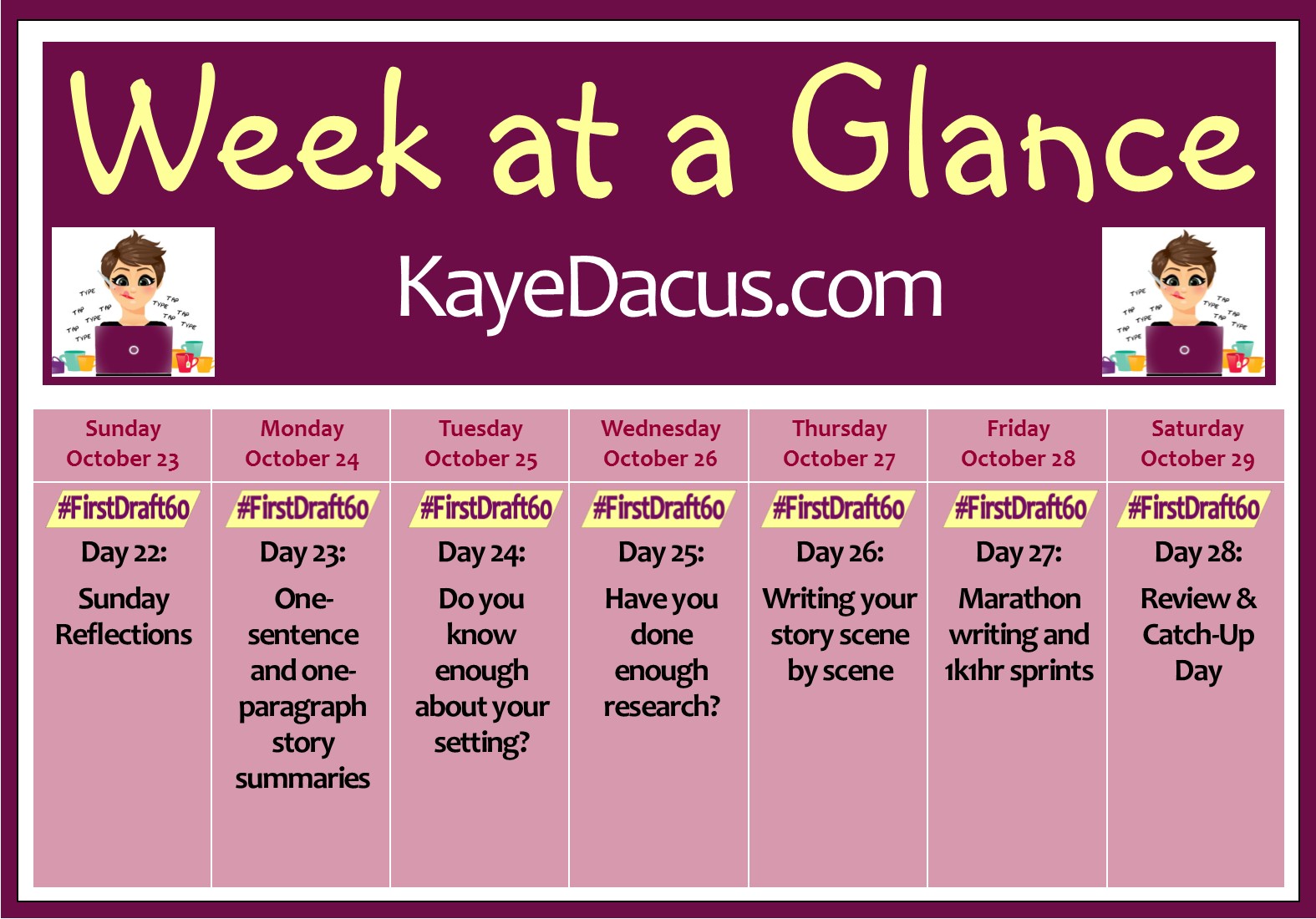
#FirstDraft60 Day 22: Sunday Reflections–Responsibilities, Priorities, & Writing Time #amwriting #nanoprep
On Sundays, we’re going to take a moment to step back and think about our writing from a wider view. In order to do that, I’ll post some guided questions—feel free to answer them here with as much or little detail as you’d like; or answer them on your own blog or on Facebook. Or just write the answers down in a private journal or notebook. The important thing is to actually think through and write down your answers.
Reflections for Day 22
1. What are your key daily responsibilities that cannot be put aside for writing?
2. What priority does writing take in your life?
3. What would you be willing to give up, for just 30 days, in order to have more time to write?
4. What are some obligations and commitments you currently have that you can reprioritize and/or reschedule in order to build more writing time into your daily schedule and give your writing the priority in November?
I look forward to seeing your answers and will be posting mine soon.
#FirstDraft60 Day 21: Saturday Catch-Up & Review Day #amwriting #nanowrimo #nanoprep
 As a reminder, Saturdays throughout this challenge are going to be our days to review what we’ve covered during the week, and to catch up on anything we fell behind with.
We had some big assignments this week, and some of you, like me, were still working to get caught up with previous weeks’ assignments, too. So it may be a really busy weekend for some of us! 😉
So let’s begin.
Part 1: Review of the Week
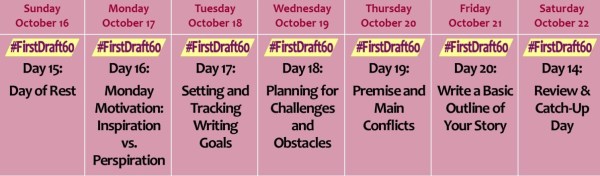
Here are all of the assignments from this past week. Click the day of the week to open that post in a new tab/window:
Monday (Day 16)
Assignments:
- Read the post “Inspiration vs. Perspiration.”
- Determine what your prep-work/writing schedule will be for each day for the remainder of the challenge (today through November 30, 2016).
- Create a calendar and write your writing schedule for every day remaining in the challenge on it.
- Share your plan/calendar.
Tuesday (Day 17)
Assignments:
- Determine what you want your final word-count to be for your completed first draft. Calculate your daily average needed to reach that goal.
- Determine how you will track your word-count progress.
- Decide if you want to track your writing-related time/projects.
Wednesday (Day 18)
Assignment:
- Think through possible challenges and obstacles that may come up between now and November 30 that may hinder you from meeting all of your goals. For each scenario, think through how you may handle it and how it might impact your writing time. What are you going to do when obstacles and challenges arise during this challenge?
Thursday (Day 19)
Assignments:
- Write out a brief sketch of your story idea—no more than a paragraph, maybe two. Is your premise plausible? Is it realistic without being predictable?
- Write out at least three main conflicts (plot points) that you know will happen in your story. Are they deep enough to sustain the story’s momentum by creating additional sub-conflicts that will move the plot forward? Are there enough problems facing your characters to keep readers’ interest?
- What books out on the market are similar to yours in genre, subject, theme, character? How does your premise position your book in the market? Now, what makes your premise unique? . . .
- What are the emotional stakes in your story premise? How do you want readers to react to your story—do you want to make them laugh? cry? cringe in horror? sit on the edge of their seats? Would you want to read this story if someone else had written it?
Friday (Day 20)
Assignments:
- Write out/map everything you know is going to and/or needs to happen in your story.
- Create a structured outline of your story, including all of the details you know at this point.
Part 2: Catch-Up, Update, and Brainstorm
Assignments for Saturday:
- Review everything you’ve done so far and catch-up with anything you couldn’t get to or couldn’t finish during the week.
- Update your Story Bible and Style Guide based on everything you came up with this week.
- Once you’ve caught up and have everything updated, do some “what if” brainstorming with your character information and backstories and see if you can come up with some additional ideas for either the characters themselves or for your story/plot. Have fun with this. And if you feel inspired to write some scenes, do it!
- Check in and let us know how you’re doing, what you’ve accomplished, and what you hope to achieve this weekend.
Above all else, have a great weekend!
#FirstDraft60 Day 20: The Road Map to Your Story #amwriting #nanoprep #nanowrimo
When it comes to planning your story before you start writing it, there are two directions you can go: plotting (outlining) and road mapping. Both will get you where you want to go. In fact, road mapping is a great kick-off point to get to plotting. So we’re going to look at both today as we get ready to write a basic road map/outline of our stories.
Road Map to Outline to Story in Six Stages
Yesterday, we discussed premise and how it’s more than just a story idea, but it doesn’t go as far as actual plotting. This is where the idea of a road map comes in.
Stage 1—I Have an Idea
- I want to drive from Nashville to Dallas.
- I want to write a romance novel.
Stage 2—General Geography
- I will need to take the interstate to Little Rock where I’ll get on another interstate that goes all the way into Dallas.
- I need a hero and heroine who meet & fall in love.
Stage 3—Basic Directions
- Take I-40 West out of Nashville through Memphis to Little Rock. In Little Rock, get on I-30 West toward Texarkana. Stay on I-30 West until you reach Dallas.
- My hero’s name is Quin, and he is a Post Captain in the Royal Navy as well as an intelligence officer (spy). My heroine’s name is . . . still unknown; she’s the daughter of one of the most successful spymasters (and an admiral) in the Royal Navy and grew up being trained to be a spy herself. Quin and Heroine meet. There are sparks, even though Quin is hiding something about himself from Heroine. But there’s a conflict that comes between them—a conflict that could keep them from getting together. They overcome the conflict separating them and we get a HEA ending.
Stage 4—A Little More Detail
- Take I-40 West toward Memphis. Go through Memphis on I-40, and cross the Mississippi River into Arkansas. Just east of Little Rock, take I-440 West and connect to I-30 West toward Texarkana. Then just stay on I-30 you’ll get to Dallas!
- (one of my early attempts at a premise—which I tend to write more like marketing blurbs, since I’m very familiar with writing those) When Heroine Stanhope meets a handsome stranger at the assembly room ball in the small country village where she took refuge two years ago, she’s instantly smitten—and equally suspicious. There’s something about Quinton Ryles, gentleman, that leaves her feeling both excited and anxious. Then she receives word from her father—the Royal Navy’s most celebrated spymaster, Admiral Stanhope—that he needs her to return to Gibraltar to rejoin his hunt for The Raven, a traitor in the ranks of the Royal Navy the Stanhopes have been trying to capture for years. Arriving in Portsmouth to board the ship that is to take her to Gibraltar, Heroine’s suspicions are confirmed when she meets the ship’s commander—Captain Quinton Ryles of the Royal Navy. Once aboard Captain Ryles’s ship, Heroine must determine if he’s The Raven, as her father suspects him of being, or if it’s someone else on his ship. A few weeks into the journey, she is convinced Quin is not guilty—after all, how could she fall in love with a traitor? But someone on his ship is a turncoat . . . and she’s running out of time to clear Quin’s name and find the real enemy before her father has Quin arrested, convicted, and executed as a spy. Because he can’t be The Raven. Can he?
- Or a Seven Beat or other outline with basic information at each step.
Stage 5—Turn-by-Turn Directions
- Turn by turn directions with mileages, estimated times, and exit numbers—pretty much what you’d get printing out the driving directions from Google Maps before you leave on your trip.
- Your five- to seven-page synopsis or structured outline with most of the key conflicts, turning points, and at least a broad-overview summary of how the book ends. (“In five hundred feet, your destination will be on the left.”)
Stage 6—Only the Book Is More Detailed
- Turn by turn directions of how to get from your driveway to the driveway of your final destination. Map with mileages. Pictures of every city you’ll pass through. Road construction and speed limit zones marked. Places of interest to stop along the way—and the best restaurants and rest areas to stop at. Your GPS talking to you the whole way.
- A chapter-by-chapter synopsis; the Snowflake Method; a detailed outline of all major and minor events with character descriptions and setting information.
Map Your Ideas
Writing out your premise yesterday should have gotten you to around Stage 3 in this list—you probably know your general overview of your story, but not necessarily a lot of firm details.
Today, we want to move as close to Stage 5 as we can (we can aim for about Stage 4.5). And to do that, you might need to do some brainstorming. And Mind Mapping is a great tool for those of us who are visually oriented. Here are a few links to get you started:
- Mind Maps: What Are They and How Can You Use Them? by Joanna Penn on The Creative Penn
- How to Use Mind Mapping, Centre for Teaching, Learning and Technology, University of British Columbia University of British Columbia
- Using Mind Maps For Creating Novels by Wendy van Camp on No Wasted Ink
Assignment 1: Write out/map everything you know is going to and/or needs to happen in your story (you can use a bulleted list, index cards/Post-it Notes, a Mind Map, or other method that’s helpful for you in brainstorming). It doesn’t have to be chronological—just write it down as the ideas come to you. I don’t expect you to finish with this in just one day—but if you’re happy with the process you choose, please take a photo of your work in progress and share it below. All you have to do is copy/paste the URL where the image exists into your comment and WordPress should do all the work for you. If it doesn’t work, Here’s a link to a document with instruction on what the link(s) should look like. (Thanks, Carol, for making me look further into this and making this old dog learn new tricks!)
Time to Start Outlining
Once you’ve gotten all of those ideas written down, it’s time to figure out what structure will work best for you to pull it all together into a cohesive outline.
My preferred method of outlining is using the Seven Story Beats from Billy Mernit’s Writing the Romantic Comedy.
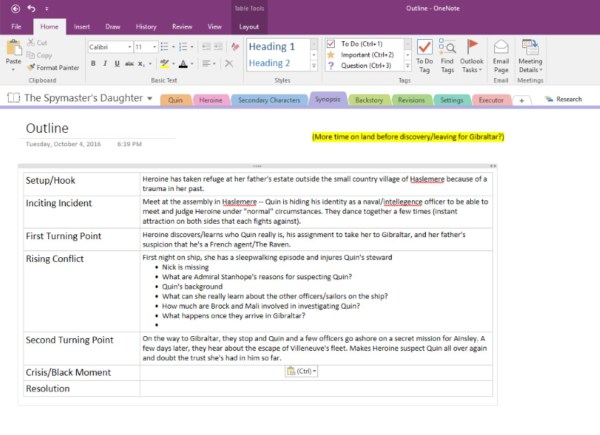
Here are links to some other outlining ideas, helps:
- Tools to Outline Your Novel: NaNoWriMo Tip #9 by Jason Boog on GalleyCat
- The Snowflake Method For Designing A Novel by Randy Ingermanson on Advanced Fiction Writing
- 8 Ways to Outline a Novel by Robbie Blair on Lit Reactor
- Outline Your Novel in Thirty Minutes by Alicia Rasley
- How I Outline! [3 Acts : 9 Blocks : 27 Chapters] by Katytastic on YouTube
- Scrivener Hybrid Outlining by J. A. Marlow on Vision: A Resource for Writers
- Create Story Maps Using PowerPoint by Wendy Russell on About/Tech
You’re more than welcome to Google other ideas for organizing/creating your outline. What I’ve shared above barely scratches the surface.
Assignment 2: Take your list/cards/notes/Mind Map of story points from Assignment 1 and use one of the outlining methods linked above (or another that you’ve found or created) and create a structured outline of your story, including all of the details you know at this point.
Keep in mind—you’re just writing an outline at this point, not a synopsis. Keep it as simple as possible with key words/phrases and brief explanations of the actions/plot points.
For Discussion:
Where does your outline fall in the six stages of road mapping? Do you feel like you know enough about your story at this point to be able to churn out the word-count you’ll need in order to complete your first draft in 30 days? What did this exercise show you about what you know about your story and what you need to figure out before you start writing?
Don’t forget—we’d love to see images of your progress, even if you just share a link to a publicly viewable image you’ve shared on social media.
#FirstDraft60 Day 19: Writing/Testing Your Story Premise
Now that we’ve had a few weeks to work on developing our characters, their external attributes, and their internal motivations and goals, it’s time to broaden our focus to the overview of our stories: the premise.
It may sound absurd that we’ve put it off this long, because premise—or what your story is about—is one of the essential elements to being able to write a complete draft of a story. Without your premise in place, how do you even know you have a story to write?
The Difference Between Genre Structure and Premise
For the story I want to write in this challenge, I have two strong characters. And I know it’s a romance novel. I know how Quin and the heroine (who still hasn’t told me her name yet) meet. I know that the bulk of the story will be the developing romantic relationship between these two characters—that there’s an instant attraction but there’s a major conflict keeping them apart. And I know they’ll eventually end up together. After all, it’s a romance novel.
So I know the basics of what happens in the story. But I don’t know the premise—I don’t know the why of the story. Why do these two fall in love with each other? Why is this new love threatened? Why should readers care if they have a happily-ever-after ending?
The Difference Between Plot and Premise
To know the premise of my story—the why—I need to have a broad view of the plot of the story. But I don’t need to know every single detail of the plot. Do I need to know some of the plot? Yes. But the individual plot points—the action beats of the story—can remain murky, or completely unknown, until I discover them while actually writing the first draft.
What I do need to know are at least a few of the main conflicts in the plot. The conflicts drive the plot; therefore, we can draw our premise from knowing a few key conflicts we’re centering the plot around.
So while the premise is tied into the plot—or we can say it’s the basic overview of the plot—we don’t have to know every plot point of the story in order to polish our premises.
Developing Your Premise
Obviously, you’re going to start with an idea. Whether that idea comes from a character or a what if…? scenario running through your head, your mind starts building a story around that idea. Now it’s time to take your story idea to the next level and develop it into a premise.
According to Donald Maass in Writing the Breakout Novel:
The key ingredients that I look for in a fully formed breakout premise are (1) plausibility, (2) inherent conflict, (3) originality, and (4) gut emotional appeal.
(p. 40)
Let’s explore Maass’s elements a bit so that you can determine if you have an idea or if you have a premise that will sustain your manuscript through to the end.
1. Plausibility
How many times have you sat watching a movie or TV show or reading a book and all of a sudden snorted in derision and grumbled, “Yeah, right. Like that would ever happen!”
Whether it’s too many coincidences happening at just the right time to make things work out well for the main characters or a deus ex machina element—something/someone swooping in at the last moment to solve the unsolvable crisis*—what you’ve just experienced is a lack or loss of plausibility. If a writer needs to resort to coincidences and/or deus ex machina machinations in order to get through to the end of the story, it’s likely the premise wasn’t a strong one to begin with.
- *If you watch Game of Thrones, then you witnessed this in Season 5 when ***SPOILER*** Drogon suddenly appeared to save/carry off Dany to keep her from being killed by the Sons of the Harpy. I immediately said, “Dragon ex machina.”
According to Maass, not only do we need to make sure our premises are realistic—“…most readers, me included, need to feel that the story we are being presented has some basis in reality” (40)—we also don’t want them to be so realistic, so ordinary, that they become predictable. One of the reasons we turn to fiction for entertainment is to escape from normal everyday life. We don’t want everyday ordinary reality in our fiction. We want something to catch our attention by triggering our imaginations and leading us to try to imagine where a story is going. We want to explore “what if…?” We just want it to be realistic.
We don’t want a story premise that makes readers say,
“Yeah, I saw that coming.”
We want a story premise that makes readers say,
“Wow! I wish I’d written that!”
Assignment 1: Write out a brief sketch of your story idea—no more than a paragraph, maybe two. Is your premise plausible? Is it realistic without being predictable?
2. Inherent Conflict
Conflict is the driving force of fiction. Without conflict, there is no story.
It’s so tempting, especially for beginning writers, to shy away from conflict, to not want to put our beloved characters in difficult situations. But if you never get beyond that, if you never learn how to torture your characters, you’ll never be more than just a wannabe writer.
When you’re testing your premise to see if it’s worth committing months, perhaps even years, to developing, you need to know if it creates enough opportunities for conflict to actually sustain the length of story you intend to write. This is why I said that premise is more complex than just having a story idea.
As mentioned above, at this point, you don’t need to know every single conflict that will happen in your story—that’s for another stage of development when you’re actively working out your plot. Right now, all you need to do is be able to list two or three major conflicts that could happen in a story based on this premise.
The next question to ask yourself is this: Does the world of my story have conflict built into it? Opposing forces, both strong, perhaps both in the right? If the milieu of the story is not only multifaceted but also involves opposing factions or points of view, then you have a basis for strong, difficult-to-resolve conflict. To put it another way, if problems already exist in your “place,” that is a good thing.
(Maass, 41)
Assignment 2: Write out at least three main conflicts (plot points) that you know will happen in your story. Are they deep enough to sustain the story’s momentum by creating additional sub-conflicts that will move the plot forward? Are there enough problems facing your characters to keep readers’ interest?
3. Originality
When we pitch our manuscripts to editors and agents, one of the things we’re told to do is include a list of similar titles in the proposal. Where will our story fit into the market? What already-published stories is it similar to in setting, tone, character, theme, content?
And then once that’s established, it’s our job to point out how our story is unique, how it’s not like all of those already-published books. This is where I think newbies attending writing conferences for the first time get really confused, because this is a somewhat oxymoronic situation: tell us how your novel is just like everything else we publish, but different. The nuance of it, what usually gets lost, is that publishers want to know that they can market a book the same way they market everything else they publish—but that readers are going to want to read it because it has an original and unique slant to it that no one else has ever done before.
Remember the adage to write what you know? You know what? No one else has ever had the same thoughts and experiences that you have. Even if you’re an identical twin. No one else thinks or feels the exact same way you do about things. So tap into what makes you unique and bring that to your premise.
Assignment 3: What books out on the market are similar to yours in genre, subject, theme, character? How does your premise position your book in the market? Now, what makes your premise unique? Does it bring a different perspective? Different characters? Different themes? What is the mix of elements in your story’s premise that makes it stand out in a crowd?
4. Gut Emotional Appeal
The fiction we enjoy the most—no matter if it’s romance, sci-fi, true crime, sweeping family sagas, or fantasy epics—is enjoyable to us because it hits us in that sweet-spot emotionally. Perhaps you like reading tear-jerkers. Or maybe you eschew those for books that make you laugh out loud. Or maybe the type of book you pick up depends on the mood you’re in that day.
As writers, one of our primary jobs is to grab our readers by the emotions and not let go, whether it’s creating sigh-worthy heroes or horrifying scenes of death and mayhem.
Assignment 4: What are the emotional stakes in your story premise? How do you want readers to react to your story—do you want to make them laugh? cry? cringe in horror? sit on the edge of their seats? Would you want to read this story if someone else had written it?
If a premise has gut emotional appeal, the novel will start to write itself in my mind. The very idea invites me to imagine characters, complications and dramatic climaxes. It gets me. It feels personal. That, I believe, is because it touches emotions that are deep, real and common to us all.
(Maass,pp. 47–48)
Assignment 5: If you weren’t already working all of the above out in your Story Bible, please pause and add everything from the above assignments to a new section (Plot/Premise) in your Story Bible.
__________________________________________
Works Cited:
Maass, Donald. Writing the Breakout Novel: Insider Advice for Taking Your Fiction to the Next Level. Cincinnati, OH: Writer’s Digest Books, 2001. Print.
#FirstDraft60 Day 18: Planning for Challenges and Obstacles
This is going to be more of a motivational post—and a “something to think about as we move forward” assignment/discussion question. But it’s something that’s very important to think about. However, I know that most of you, like me, are trying to get caught up with stuff from Week 2 and earlier this week. Please do take the time to think about and post an answer to today’s question—and then get back to working on any of the story-prep stuff you haven’t done yet.
(If you are all caught up, today would be a great day to do another brainstorming/draft-writing assignment to keep in touch and get deeper with your characters.)
Planning for Challenges and Obstacles—or, When Life Gets in the Way of Writing
- One of the kids gets a stomach bug that ends up getting passed around the whole family. You’re nursing them and/or in bed yourself for five days.
- Your college girlfriend’s fiancé walked out on her at the altar and she needs you to go to Cancun with her so that she doesn’t lose the money spent on a honeymoon.
- You get offered the promotion of a lifetime. The only catch is that you now have to relocate three hundred miles away before the end of the month.
- You just don’t feel like writing today.
Yesterday, we pulled out our calendars and started working on our writing schedules for the 30 days in November on which we’ll actually be writing our first drafts. But no matter how carefully we plan, we know that something is going to come up to interfere, it always does.
Okay. So what are we going to do? Quit?
Of course not.
There are, obviously, going to be things that come up in the thirty-day writing period that are beyond your control—things that take precedence over writing and require your time and attention. But it’s how you handle getting back on track with your writing that will be the key to success or failure.
If it’s something that just knocks you out of the (writing) game for a day or two, that’s going to be easier to catch up with than the stomach bug laying you out flat for five days.
Because we’ve set so much stock in doing this challenge—in completing that first draft—losing even a single day of writing time may seem like an insurmountable obstacle. Especially if you know from creating your writing calendar that you already might not have time to write every single one of those thirty days.
So what are you going to do? Quit?
Of course not!
Setting Goals = Risking Failure
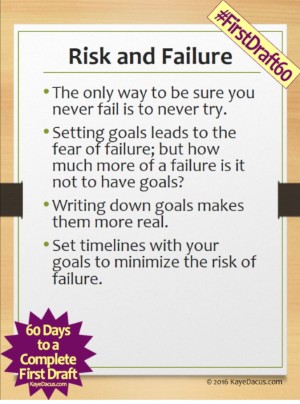 Yes, by setting goals, you’re making yourself promises. You promise yourself that you are going to take this journey and that you’re going to help yourself succeed.
However, unless you’ve signed a contract that requires you submit your manuscript on November 30, there is no penalty for modifying your word-count goal in order to account for the roadblocks and obstacles that are going to come up.
But the only way to ensure you fail is to not even try.
For anyone who’s set
a self-imposed deadline
and missed it.
For anyone who’s stated
a certain number of words to be written every day
and not done it.
For anyone who’s submitted
manuscripts to editors and/or agents
and been rejected.
For anyone who’s joyously told
family and friends that we’ve decided to
write novels and get them published,
only to have those same people
lose faith in or even mock you
when you can’t show tangible results.
We know what failure feels like,
and we don’t want to be there again.
So our hearts and minds tell us
it’s easier not to risk that failure.
To quit while we’re ahead.
One of the reasons why I believe most writers are hesitant to actually sit down and go through the process of definitive goal setting (word-count goals for a manuscript, goals for daily word-count, and, above all, planning and writing a first draft in 60 days) and then writing it down and sharing it with others is not only because doing that makes it more concrete, more real, but also because by defining exactly what it is that we want to accomplish, we are defining exactly the ways in which we can fail.
What Do I Do if I Need to Change My Goal?
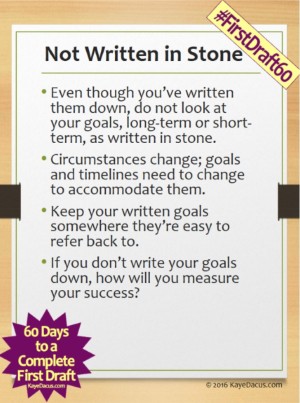 Writing down your goals—handwritten in a journal, typed on the computer, emailed to yourself as a list, however you want to do it—makes them real. By having them written down, it gives you the opportunity not only to go back and check things off that you’ve accomplished or completed, but also to remind yourself of the other steps you promised yourself you’d be taking.
Just because you’ve written your goals down (even if you used pen or posted them online somewhere that you can’t change it!), doesn’t mean that they’re written in stone—as your circumstances change, as issues arise, as it becomes apparent that the timelines you set don’t work, then, by all means, re-evaluate and, if necessary, change your goals. But when you change them, make sure to write the new/revised goals down, too—after all, how will you measure your success if you don’t have it written down so you can check/cross it off?
Assignment: Spend some time today thinking through possible challenges and obstacles that may come up between now and November 30 that may hinder you from meeting all of your goals. For each scenario, think through how you may handle it and how it might impact your writing time.
Then post a comment answering the question: What are you going to do when obstacles and challenges arise during this challenge?
#FirstDraft60 Day 17: Setting Goals and Tracking Everything #amwriting #nanoprep #nanowrimo
There’s not much that can be said about setting writing goals that hasn’t already been said. In fact, I did a series on it, which you can read/re-read here.
So why don’t we go ahead and just jump into the meat of the matter.
Part 1: Setting Word-Count Goals
In order to figure out how long your manuscript needs to be, you need to know what type of manuscript you’re writing:
Novella: 20,000 to 25,000 words
Novelette/Category Romance: 40,000 to 65,000 words
Single Title/Mass Market/Trade Fiction: 75,000–120,000 words
Epic: 125,000+ words
My published novels fall between approximately 82,000 (An Honest Heart) to 109,000 (The Art of Romance) words—and a total published word count of 1,076,443 words!
Remember when setting your total word-count goal for this challenge that a first draft isn’t a final draft; and if we stay true to the Draft Writing method, there will be lots of details missing and scenes that need to be fleshed out/added in the revision process. Depending on how you write (sparingly or effusively), your ultimate word-count may be a few to several thousand words longer or shorter than the draft you write next month.
The daunting thing about doing a challenge like this (or like NaNo) is thinking about how many words a day we need to average to meet our goal of a completed first draft. You may only need 800 to 1,000 words a day. You may need 2,500 to 3,000 or more. Which sounds like a whole lot . . . unless you look at it more like getting in a full day’s worth of calories. You’re not (hopefully) going to eat 2,000 calories all in one meal (though, there are days . . .). In addition to breaking down your full word-count to a daily average, you can break down the words needed per day into smaller chunks to be done at designated times per day—just like meals. For example, waking up a little early to write 500 words before the day starts. Trying to get in 800 to 1,000 words at lunch, and then finishing up the rest of it in an hour or so in the evening.
Assignment 1: Determine what you want your final word-count to be for your completed first draft—or at least the word-count you’d like to reach at the end of this challenge—and post it in the comments section along with your calculation of what you’ll need to average daily to reach it and how you intend on scheduling your time to reach the daily goals.
Part 2: Tracking Your Word Count
For years, I used StoryToolz.com to keep a running meter on my word-count, both for myself and here on the blog. You’ll see that I still have a widget over on the right that links to my word-count meter for The Spymaster’s Daughter on ST. And when I clicked on it, I realized why I haven’t been thrilled with the idea of continuing to use it. Because the code that is supposed to keep the widget here on my website up-to-date isn’t working correctly (it’s most likely just a compatibility issue between WordPress and ST—so if you don’t use WordPress for your site, ST may work just finefor you). It’s time for me to find a new way to track my word-count.
StoryToolz isn’t the only free online tracker—they’re easy enough to find with a basic Internet search. Of course, if something like StoryToolz isn’t for you, you can always go “old skool” and track it privately in a spreadsheet on your computer. (I may do this and just change that widget to a text box which I can update daily when I come in here to do my blog posts.)
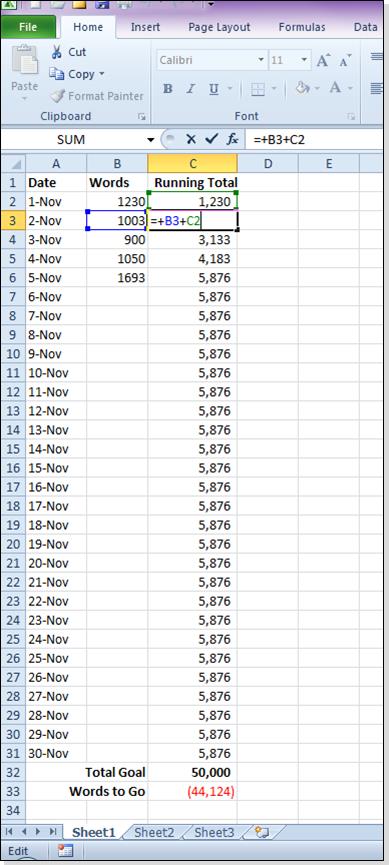
If you don’t know how to set up the formulas, just ask. I’ve been doing spreadsheet formulas for over twenty years now.
Assignment 2: Determine how you will track your word-count progress and share your plan in the comments.
Part 3: Tracking Writing and Writing-Related Activities Time
Tracking your progress isn’t just about word-count. Sometimes, you may have what feels like an amazingly productive “writing day,” yet end up with very little word count to show for it. That’s where tracking the time you spend both writing and working on writing-related activities comes in.
We typically schedule our “writing time” as the time in which we plan to be actually writing. But what about all the other time that goes into creating a manuscript? The planning (what we’ve been doing all along), the study of craft, the naming/casting of characters, the research, the plotting, the brainstorming (both alone or with trusted writing friends). All of that is important Writing-Related Activity. And when you’re first getting started writing, it’s just as important to keep track of all of the time you spend working on developing your story as you do actually writing it.
As you may have seen in the comments on the Day 8 post, I’ve been using a simple spreadsheet to track all of my story/writing-related work (which includes the time spent on these blog posts, responding to and posting comments, and writing-related social media activity). I’m also tracking the time spent on story prep work (the daily assignments).
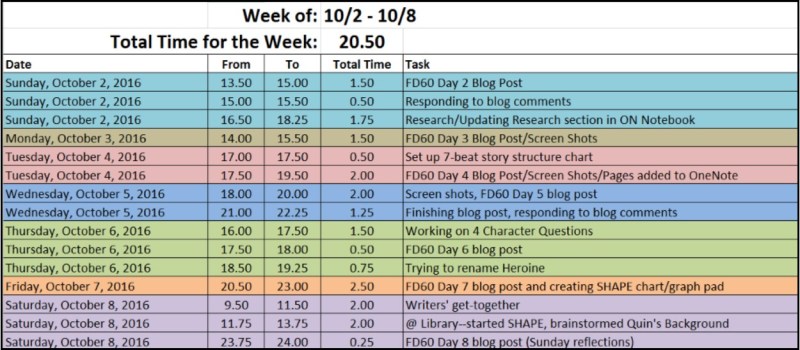
But if you want to get even more technologically savvy, there are thousands of free time/project-tracking apps for your phone or computer or both.
Assignment 3: Decide if you want to track your writing-related time/projects and, if so, share how you intend to do so in the comments.
#FirstDraft60 Day 16: Inspiration vs. Perspiration (Writing Schedules) #amwriting #nanoprep #nanowrimo
Sorry there was no Sunday Reflections post yesterday. I’ve been fighting a weather-triggered migraine all week, and Sunday it got the better of me and I spent most of the day in bed. I’m hoping that (and some good drugs) will help knock it out and make Week 3 of FirstDraft60 much better, and more productive, than Week 2 was for me!
What that means for me is that I have even more catching up to do now.
Oh, and I think I may be re-casting the template for my hero character. But I’ll figure that out when I get caught up to that day’s assignment!
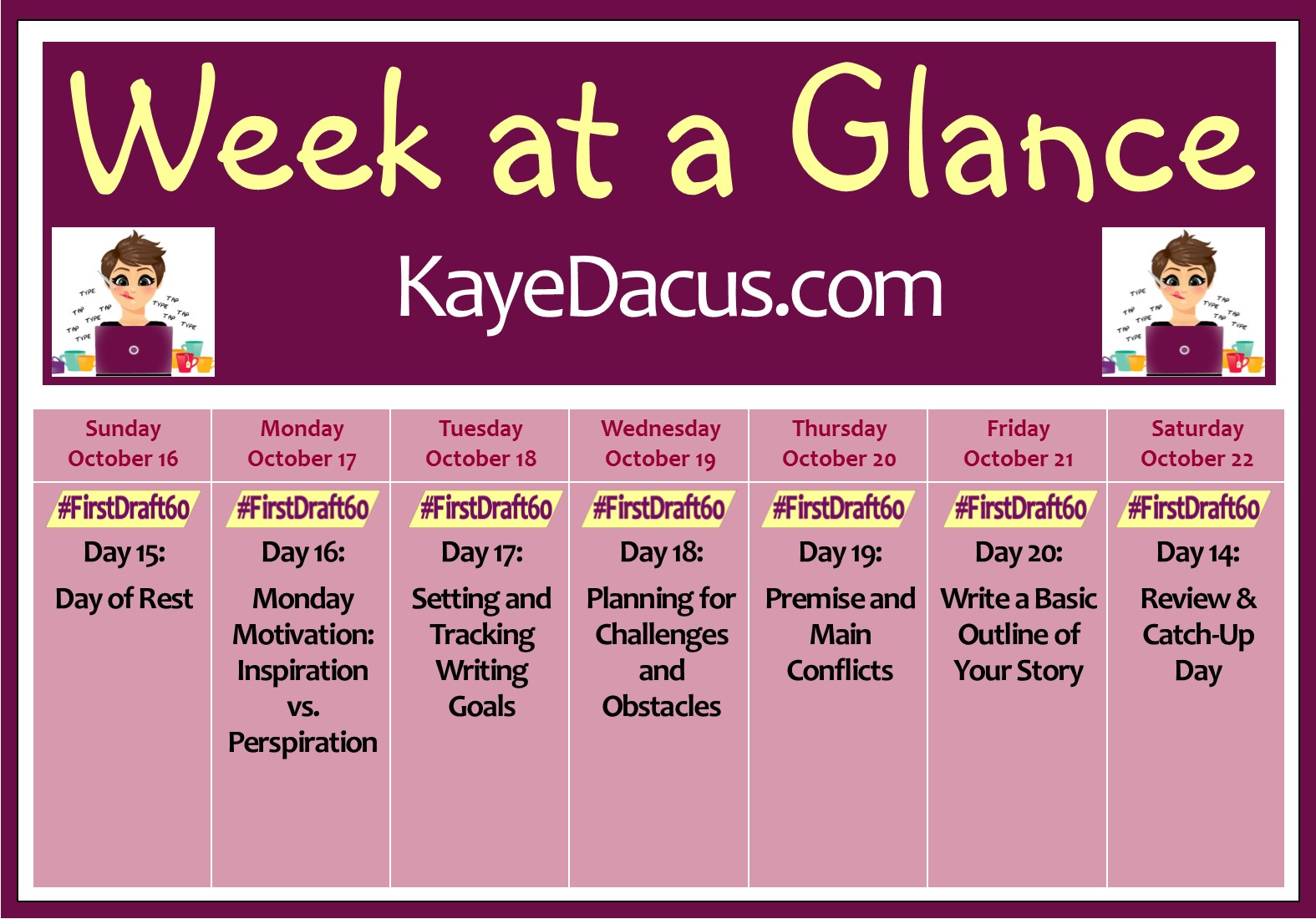
Since I didn’t post yesterday, here’s the week-at-a-glance schedule for Week 3 of FD60:
#FirstDraft60 Day 16: Inspiration vs. Perspiration—Setting a Writing Schedule
Assignment 1: Read the post “Inspiration vs. Perspiration (Setting a Writing Schedule)” from FD60 2015. (Link will open it in a new tab/window.) Then come back here to complete the assignments (below).
Assignment 2: Determine what your prep-work/writing schedule will be for each day for the remainder of the challenge (today through November 30, 2016). It may be the same every day, or you may have to mix it up based on prior commitments.
Assignment 3: If don’t already have a wall calendar, print one out and hang it up. Make sure the calendar is hanging somewhere everyone in the house can see it. Write your writing schedule for every day remaining in the challenge on the calendar.
Assignment 4: Share with us what your plan is to make sure that you’re able keep to your writing schedule throughout October—you can even share a photo or link to your calendar if you’d like!
Calendar Template:
Here’s a week-at-a-glance calendar template that you can use to set your prep-work/writing schedule for the remainder of the challenge, in two versions—a printable PDF version and a customizable Excel version. (The Excel version is saved on a shared OneDrive folder—you may need to sign in with a Microsoft account to access it.)
FirstDraft60 Calendar Template–PDF (will open in a new tab/window)
FirstDraft60 Calendar Template (Excel) (will open in a shared OneDrive folder in a new tab/window)
__________________________________________
Work Cited:
L’Engle, Madeleine. Walking on Water: Reflections on Faith and Art. Wheaton, IL: Harold Shaw Publishers, 1980. Print.
#FirstDraft60 Day 14: Review & Catch-Up Day #amwriting #nanoprep #nanowrimo
Saturdays throughout this challenge are going to be our days to review what we’ve covered during the week, and to catch up on anything we fell behind with.
When doing any kind of a challenge like this in which the goals are cumulative, it’s always good to build in a day (or two) to be able to get caught up on anything we haven’t done yet. Because most of us work during the week, we have more time to do this on the weekends. So for the next six weeks, be sure to set aside time on your weekend, whether on Saturday or Sunday to stop, review what you’ve accomplished throughout the previous week, and then caught up on anything you didn’t have time to finish or even start.
This isn’t permission to slack off during the week. It’s to give you permission to not beat yourself up if you don’t get an assignment done or a goal accomplished on the day it’s assigned. As long as you give it your best effort and the complete it by the end of the week, you’ll be able to stay on track.
So let’s begin.
Part 1: Review of the Week
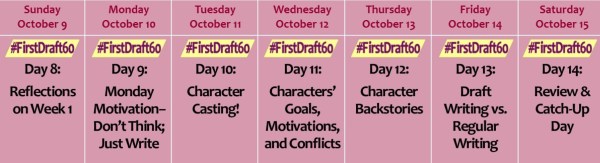
Here are all of the assignments from this past week. Click the day of the week to open that post in a new tab/window.
Monday:
-
Assignment 1: Read the post “Don’t Think. Just Write.” and complete the creative vs. analytical exercise.
Assignment 2: Review the Week 1 assignments and work on anything you haven’t finished yet.
-
Assignment: Add your characters’ physical description (using the [posted] “chart” or something of your own making) to your Story Bible. Cast your characters, if desired.
-
Assignment: Determine your main characters’ Goals, Motivations, and Conflicts.
-
Assignment: Write out your main characters’ full backstory.
-
Assignment: Read the Draft Writing vs. Regular Writing post and then complete the draft-writing assignment.
Part 2: Catch-Up, Update, and Brainstorm
Assignments for Saturday:
- Review everything you’ve done so far and catch-up with anything you couldn’t get to or couldn’t finish during the week.
- Update your Story Bible and Style Guide based on everything you came up with this week.
- Once you’ve caught up and have everything updated, do some “what if” brainstorming with your character information and backstories and see if you can come up with some additional ideas for either the characters themselves or for your story/plot. Have fun with this. And if you feel inspired to write some scenes, do it!
- Check in and let us know how you’re doing, what you’ve accomplished, and what you hope to achieve this weekend.
Above all else, have a great weekend!
#FirstDraft 60 Day 13: A Draft-Writing Assignment #amwriting #nanoprep #nanowrimo
In addition to continuing to work on all of the character development projects from last two weeks, today we’re going to try our hands at actually doing some writing.
We’re almost halfway through the thirty days of prep work, so now is a great time to try your hand at practicing the type of writing we’re going to need to do starting November 1 in order to be able to get that first draft written.
Part 1: Draft Writing vs. Regular Writing
Assignment 1: Read this post to find out what I mean by “draft writing”: NaNo Prep: Draft Writing vs. Regular Writing
Go on—go read it now. I’ll wait . . .
Part 2: Writing Assignment
Assignment 2: Using the draft-writing technique explained in the above-linked post, write a short scene of approximately 500 words in which one of your viewpoint characters must face one of their greatest fears, whether it’s doing something physically (bungee jumping, going into water/swimming, etc.), mentally (public speaking, performing creatively under pressure, etc.), or emotionally (telling someone a secret, saying “I love you” without knowing the response, someone with social anxiety going to a party, etc.). Or at least write about them doing something that makes them uncomfortable or coming face-to-face with someone they really don’t like.
This is a writing exercise, which means there’s a 99% chance that what you write in this assignment won’t end up in your story. But it’s a great way not only to practice Draft Writing, but also to get inside your character’s head prior to actually starting to write your story.
For Discussion: How was it to use the draft writing technique? How many words did you end up with—and how long did it take you? What did you learn about your character? Did you add that new knowledge to your Story Bible?

 KayeDacus.com