Hooking the Reader: Love at First Sight
Do you believe in love at first sight? I don’t, but that’s not actually important for this discussion. We’ve discussed openings here several times:
Famous First Lines
Not-so-Famous First Lines
What’s the Big Deal about First Lines?
A Last Word about First Lines
Critical Reading: The First Date
So I’m not actually going to go into a lot of detail about first lines or opening hooks. Just remember that a great opening line, followed by a great opening paragraph, followed by a great opening page . . . will hook the reader’s interest—be it an editor, agent, or consumer.
- “We have a choice. You can begin with a flash fire in the kitchen that endangers the entire house (melodrama), or you can put a pot on the boil, bubbling and simmering, as you show your characters acting in a situation that is slowly alarming, a conflict developing into the big event that will hold the reader curious, concerned, perhaps even enthralled, gripped as if glued to your story for its duration” (Stein, How to Grow a Novel, pg. 33)
Give your readers a character or a situation that they’re going to love at first sight. Yesterday, most of us said that one of the things we hope most for, when we pick up a book to read, is to get lost in it.
For Discussion:
You have won a gift certificate for two books. All you have to base your choice on is the first page of each book. No title, no front cover image, no backcover blurb. What will you be looking for to help you make your choice? Should you be able to determine what genre the book is from the first page? What would make you not choose it?
Hooking the Reader: An Introduction
 Anyone who’s a regular reader of this blog knows (at least) two things about me: I’m a rabid LSU football fan, and I quote from Stein on Writing whenever I can. Well, guess what—no Stein on Writing today!
In How to Grow a Novel, Sol Stein (aha!) compares the act of reading with the phenomenon of sports fanaticism. In the first chapter of the book, Stein writes about how the one person most writers don’t think about when writing is the reader:
- “What is amazing is the fact that so many writers with a novel in the planning stage give little or no conscious thought to the reader’s experience. They need look no further than sports to understand the spectator seeks the excitement that does not usually occur in daily life. The joy of winning, even through surrogates, is real” (Stein, 8).
This past year was one of the best—and worst—in college football history. No one, it seemed, could hold onto the top spot. The number one position came with a target, and lots of other teams hit the bull’s eye. This was the season of Appalachian State, the University of South Florida, and Rutgers—under-rated teams from small schools who toppled giants, only to be toppled themselves. But this was also the year of controversy—the year that proved the BCS championship system doesn’t work. Because of all this CONFLICT, it was the most-watched, best-attended, most-talked-about football season ever.
- “But let us remember that when a team—even the team we are rooting for—is winning too easily, our enjoyment of the game decreases” (Stein, 8).
I truly believe that the reason it took until the spring for the doctor to get my high blood pressure down is due, in large part, to the 2007 LSU football season. Games that came down to the wire—won by touchdowns with only a couple of seconds left on the board. Two losses in triple overtime. Nail-biters that had me screaming at the top of my lungs. Games so close they kept my complete focus for four—or more—hours. But then there were a few others in which my boys jumped out to a commanding lead and never looked back. The other team may have made a foray or two into the red-zone, but they posed no serious threat to LSU’s winning the game. I could do laundry, write, even read, and not worry about the ultimate outcome.
When we write, we want to give our readers the same kind of experience LSU fans had when Les Miles had our boys go for it on fourth-down not once, not twice, but five times in a neck-and-neck game against defending national champs, Florida. We want to surprise them with faking a field goal and scoring with a no-look, over-the-shoulder touchdown pass to the kicker . . .
Okay, yes, I’m ready for football season five months early—but I hope you’re getting my point. Readers want that kind of enthralling experience—the kind that doesn’t happen in our normal lives—to lose ourselves in. That is the promise we’re making when we put words on paper and call it a story. That’s what we’re going to be discussing over the next few weeks.
To get the discussion started: What kind of experience do you hope for when you pick up a book to read?
Stand-In Groom–Edits Are FINISHED!
 Since I ended up spending most of the day yesterday shopping, I just now finished making all of the changes in the file of Stand-In Groom. My editor is on vacation this week, so I’m going to wait until next Monday to e-mail it to her. But it’s finished!!!
I only ended up cutting 1,573 words and a total of six pages from the length.
I still need to write my dedication and acknowledgments, figure out three authors whose writing style I would compare mine to, and determine 1–3 key issues the book deals with that someone could use to help a friend “through the softened message of fiction” for my April 1 deadline.
One of the things that I had to do while reading through the manuscript for edits was to make changes based on decisions I’ve made since starting the second novel, as well as check on details that I need to make sure remain consistent through the series. Here’s a photo of my continuity notes (sorry it’s blurry):
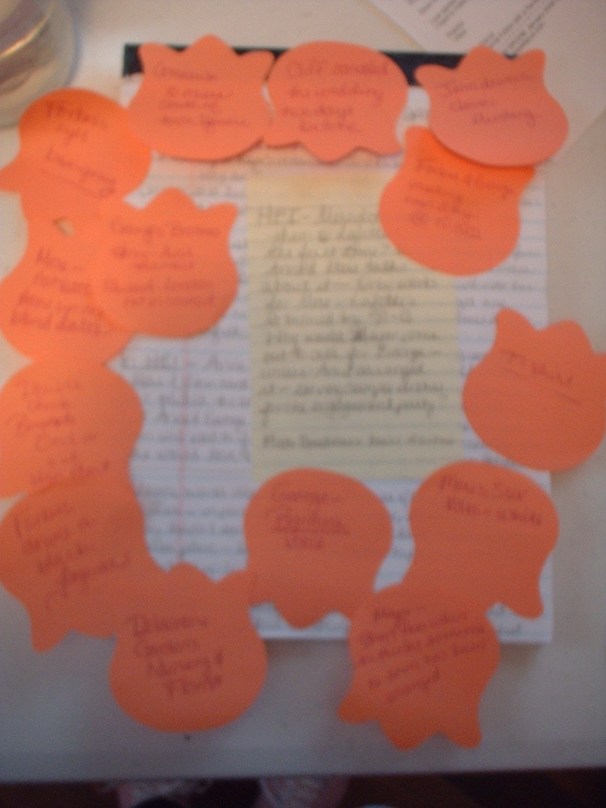
Stand-In Groom Edits Day 5
 As of 1:32 a.m. on Sunday, March 16, edits on the hardcopy of the manuscript of Stand-In Groom are complete! Yay! Now I can spend a few hours making those changes in the electronic file Sunday and enjoy my day off on Monday!
I’m curious to know what the final word count will be and how much I’ve managed to cut out.
But for now, I’m going to bed!
Fun Friday–Favorite British Actresses

This week, I’ve divided my faves into two lists: older actresses and younger actresses. The older British actresses (born 1965 or earlier) are those whose maturity and body of work brings a gravitas to anything they do—if they’ve chosen a certain film project, it’s practically guaranteed it’s going to be fabulous.
5. Dame Helen Mirren. Whether she’s The Queen (as in Elizabeth II) or the Queen (in Elizabeth I) or even Nick Cage’s mum in National Treasure: Book of Secrets, there’s no denying the regal grace and nobility Helen Mirren brings to every role she inhabits. I think she’s really the only reason the movie The Queen was as interesting as it was—her acting, the emotion she brought to the role through body language and facial expressions. She definitely deserved the Academy Award she won for it. I’m looking forward to seeing her in the upcoming Inkheart.
4. Geraldine McEwan. Almost twenty years ago,  Ms. McEwan brought to life some of the funniest lines Shakespeare ever penned, as Alice—the handmaid in Kenneth Branagh’s quintessential version of Henry V. In recent years, she’s become indelibly linked with the persona of a character penned by another famous author—as Jane Marple in the BBC/PBS Marple series (see numbers 1–12). It is with great sadness that I’ve learned she is not reprising the role for the new episodes coming out in 2008—according to her bio on IMDb, she decided to “retire from the role.” She will be greatly missed. I don’t know if anyone will ever be able to do justice to the character again.
3. Dame Maggie Smith. With her aristocratic stature and the austere air she brings to so many of her characters, there was no more obvious choice for the intimidating-yet-goodhearted Professor Minerva McGonagall in the Harry Potter movies than Dame Maggie. But lest we forget, she also has a comedic side,
  which has been seen in movies such as The Divine Secrets of the Ya-Ya Sisterhood, Gosford Park, and the Sister Act films. Oh, and she’s also the mother of Toby Stephens (Mr. Rochester, Jane Eyre, 2006).

Judi Dench & Maggie Smith
2. Dame Judi Dench. Like Helen Mirren, Dame Judi  has given us queenly performances (as Elizabeth I in Shakespeare in Love and as Victoria in Mrs. Brown), but she’s also taken her turn as James Bond’s ultimate “girl”—M in the last four films (and is filming her fifth). From 1992 through 2005—even after winning her Academy Award in 1999—Dame Judi starred in the British sit-com As Time Goes By (which you can probably catch on PBS on Saturday evenings). I’m really excited about her upcoming project, Cranford—a serialization of three novellas by North & South author Elizabeth Gaskell, which is coming to PBS in a couple of months!
1. Dame Julie Andrews. Yes, the hills are alive with The Sound of Music! After getting her start portraying Cinderella in the live
  TV production of Rodgers & Hammerstein’s musical, Dame Julie was cast in the title role of the Disney film Mary Poppins. When the filmmakers for The Sound of Music, who thought Julie wasn’t attractive enough for the role of Maria, saw dailies of her in Mary Poppins,
  they were sold—on her looks, voice, and performance. And the rest, as they say, is history. In the forty-odd years since The Sound of Music came out, Dame Julie has tried to break away from this Disney-fied image of who she is, but seems to have embraced it in recent years—giving us Queen Clarisse Renaldi in the Princess Diaries, the nanny in the Eloise movies, and the spoof-filled Shrek movies. I especially loved her in the live television performance of On Golden Pond, which aired a few years ago, which reunited Dame Julie with Christopher Plummer in the roles originally brought to life on the silver screen by Katharine Hepburn and Henry Fonda. And why is she the top choice on this list? One of the first dates my parents went on was to see The Sound of Music, so that movie has always held a special place in my heart.
- Honorable Mentions: Dawn French (The Vicar of Dibley), Amanda Root (Persuasion 1995), Emma Thompson (Sense & Sensibility 1995), Sophie Thompson (Persuasion 1995), Phyllida Law (Miss Austen Regrets), Alice Krige (Persuasion 2007), Imelda Staunton (HPOOTP and the upcoming Cranford), Sinéad Cusack (North & South), Gemma Jones (Sense & Sensibility 1995), Gretta Scacchi (Miss Austen Regrets), Angela Lansbury (Murder, She Wrote), Cherie Lunghi (The Buccaneers), Jane Seymour (Somewhere in Time), Tilda Swinton (Narnia), Brenda Blethyn (Pride and Prejudice 2005), Natasha Richardson (The White Countess), Miranda Richardson (St. Ives), Lynn Redgrave (The Jane Austen Book Club), and Vanessa Redgrave (Atonement)
These younger British actresses (born after 1965), in many cases, are still trying to find their big break—beyond the circle of those of us who love the BBC costume dramas they’ve appeared in.
5. Olivia Williams: The first thing I ever saw  Olivia Williams in was in the 1996 A&E/BBC/Andrew Davies adaptation of Emma, closely followed by The Sixth Sense. But I must say that she wouldn’t have landed on this list (maybe not even the HM list) if it hadn’t been for her portrayal of Jane Austen in Miss Austen Regrets. If you want to know why, read my reaction to the movie.
4. Rosamund Pike. I’ve mentioned before that Rosamund Pike is my favorite actress to have portrayed Jane Bennet in an adaptation of Pride & Prejudice (2005). But I haven’t ever mentioned another movie (which I just received a DVD of in the mail yesterday!) she’s in that I have this strange affinity for: Doom—the shoot ’em up action film based on the violent video game of the same name. Okay, yes, I initially watched Doom because of Karl Urban (and Dwayne “The Rock” Johnson). But the interplay between Karl’s and Rosamund’s characters (John and Samantha) is what made me want to watch it again . . . and again . . . and again. Her American accent isn’t great—but I saw more of her range as an actress in the film, and I liked what I saw.
3. Justine Waddell. Now we’re getting into the  territory of actresses that most people in North America haven’t heard of. Amongst the BBC-watching-set, Justine Waddell is most familiar to us as Molly from Wives and Daughters, Andrew Davies’ adaptation of an unfinished Elizabeth Gaskell novel. She was also in a wonderful adaptation of Wilkie Collins’ The Woman in White and played Julia Bertram in the 1999 theatrical-release version of Mansfield Park (the Frances O’Connor version). She also played opposite Ioan Gruffudd in the 1999 BBC version of Great Expectations and made a wonderful Estella. She doesn’t have any current projects listed on IMDb, but they don’t always have BBC’s productions-in-work listed until they’re finished. I’m eager to see her in something else.
2. Daniela Denby-Ashe. Fans of North & South  know exactly why Daniela is on my list! She’s the actress who played the character that reformed John Thornton and made us all fall in love with Richard Armitage. One of the things I really like about her is that she (like many other British actresses) isn’t the epitome of high-fashion beauty—like most American actresses. And it made us love John Thornton even more that he’d fall in love with the somewhat plump brunette instead of the skinny blonde. Although we don’t get the series here, she has also been a series regular on the BBC staples East Enders and My Family (with Sir Robert Lindsay—on last week’s list). She also doesn’t have any works-in-progress listed on her page, but I’m sure whatever she chooses to do next, she’ll be great in it.
1. Anna Maxwell Martin is probably one of the most overlooked, under-rated actresses working today. You may have noticed her in the background there in Becoming Jane (she played Cassandra)—I’m of the opinion she should have been cast as Jane. She doesn’t have a really long filmography. But she made her mark with her vastly different roles in North & South (as a secondary character to Daniela Denby-Ashe’s lead) and Bleak House—guess what, another Andrew Davies adapation
  (maybe after the Masterpiece Classics’ Austen Series ends, I’ll have to do a Fun Friday on all of my favorite Andrew Davies films!). Anna Maxwell Martin led the cast of dozens in Bleak House with a grace that many actresses who’ve been in the business for fifty years wouldn’t have been able to muster (starring opposite my favorite underappreciated actor, Denis Lawson).
- Honorable Mentions: Anna Friel (Timeline), Sonya Walger (LOST), Laura Fraser (A Knight’s Tale), Kelly Macdonald (Gosford Park), Samantha Morton (Elizabeth: The Golden Age), Felicity Jones (Northanger Abbey 2008), Jennifer Ehle (Pride & Prejudice 1995), Victoria Hamilton (Victoria & Albert), Keeley Hawes (Under the Greenwood Tree), Talulah Riley (Pride & Prejudice 2005), Emily Watson (Miss Potter), Michelle Ryan (Jekyll and Mansfield Park 2008), Carey Mulligan (P&P 2005 and Northanger Abbey 2008), Romola Garai (Amazing Grace), Imogen Poots (Miss Austen Regrets), Sophia Myles (Tristan + Isolde), Kate Winslet (Finding Neverland), Cate Blanchett (Lord of the Rings), Minnie Driver (Return to Me), Kate Beckinsale (Emma 1996), Joely Richardson (The Patriot), Emma Watson (Harry Potter), Rachel Weisz (The Mummy/Returns)
Yes, you will notice at least one well-known British actress whose name you feel is missing from this list. Let me state for the record (for those who don’t already know this): I don’t like Keira Knightley. There. I’ve said it. Aside from her horsey-face, bad posture, and strangely flapping lips when she talks, she has the acting range of a teaspoon (to steal a phrase from Harry Potter).
Stand-In Groom Edits Day 3
I managed not only to make it through the day today without feeling like I was going to fall asleep at my desk, but got to the gym and walked two miles and went back to the library for some more edits.
Thursday, March 13: I arrived at the library at seven and lucked into another empty group study room. After twenty minutes, though, I figured out why it was empty. The people in the room next door were so loud—and had an occasionally screaming child in there with them—that even with my earphones in and music turned up as loud as I could stand it, I could still hear them. Instead of making a scene and knocking on the door and asking them to shut up (which might surprise Ruth, Lori, and Leticia—after the movie theater incident and asking the loud drunk chicks last night to take their conversation outside), I packed everything up again and ended up moving to a carrel on the other side of the building.
Completed: Chapters 10–14. Rewrote the dialogue in the scene I didn’t like. Cut some unimportant stuff here and there. Got rid of more “as” and “was” sentence constructions (that’s what’s taking me the longest!). I’m now officially halfway through (and I say “officially” because I set the completed pages next to what’s remaining and the stacks were the same height).
What’s even better, I completed chapter six of Menu for Romance and will get that out to the CPs tonight!
Tomorrow, the library closes early, so I’ll have to be disciplined and work at home. But things are looking quite good that I’ll be able to meet my goal of getting all of these changes finished by Monday evening.
No-Edits Wednesday
 As I mentioned yesterday, last night was a night off from edits while I went to dinner and attended the Michael Buble concert downtown. We had a wonderful time (especially since the loud-talking, possibly drunk girls with tickets for the two seats beside Ruth left during the second song from the warm-up band, Naturally 7, and never came back!).
While I had a really great time at the concert and am glad I went, it reminded me, though, of why I so rarely attend concerts. I enjoyed the music, Michael’s banter with the crowd, and being with friends. But as he was singing, all I could think of was how much stuff I could have gotten done at home while listening to music. This is what happens to me during concerts, though. I’ve written before about how I’ve taken home napkins filled with a new scene or a three-foot-square piece of paper table cloth covered with plot brainstorming—written while sitting through concerts. Then, there’s the fact that I’m totally feeling my age this morning—plus at least ten years!
All that to say that, while I would enjoy going to another one of his concerts, I’m thinking I’ll wait a couple of years—and hope it’s on a Friday or Saturday, instead of a weeknight when I have to go to work the next day.
Tonight . . . the plan is to get through at least four more chapters. I will record the two episodes of LOST that air tonight and save them to watch until after I’ve completed the hand-written edits (that’s a big challenge and incentive for me!). One of the chapters I face tonight contains a scene that I’ve disliked ever since I wrote it—it’s a conversation between Anne and George that I wrote when my grad school mentor told me she didn’t think George was coming across as British enough. So I forced a conversation between the two of them about some of the idiosyncrasies of Southern slang that George was trying to figure out. Since I originally wrote that, I started working with and have become really good friends with a gal who is actually British—in fact, she’s my walking buddy whom I go to the gym with after work every day. So I’ve been picking her brain for something real I can have them discuss (culture-difference) and have a great topic. Tonight, I just need to figure out how to work that into the situation.
Stand-In Groom Edits Day 2

Well, the editing process is slower-going than I’d originally expected—though there are more scenes in the beginning of the novel that need changes due to Meredith’s presence in them. Tonight, I won’t get to work on it as I’m going to see Michael Bublé in concert with friends.
Tuesday 3/11: Walked two miles at the gym after work, came home, and took a quick shower. Got to the library a little before seven o’clock. Found an empty study room, which was definitely better than the carrel I’d ended up using Monday night—much more room to spread out.
Completed: Edits/rewrites on chapters 5–9. Cut a big chunk from chapter 6, where my editor thought the pace was too slow (it was), and found several places where I could tighten the writing (as in, cutting out lots of telling signpost phrases like she knew, she felt, and he wondered).
Supper: Easy-Peasy Pork Roast
- 3–5 lb. Boston butt pork roast
1 cup water
1 medium-to-large onion, cut into 1″ chunks
Favorite season-all seasoning (I use Tony Chachere’s Creole Seasoning)
Sprinkle roast with seasoning. Pour water into crock pot. Break up the layers of the chunked onion and place in crock pot. Place roast on top of onions. Cover and cook for at least three to four hours on low.
I put this in the crock pot when I went home for lunch yesterday (so, around two o’clock). By the time I got home at six, it was cooked through. I left it in the crock pot while I was at the library; and when I got home at nine, I was able to pull it apart with a fork, it was so tender! The water, onion, and run-off from the meat create a nice au jus to serve with the meat. Perfect with sautéd asparagus.
Stand-In Groom–The Edits Begin
I’ve gotten everything I need to work on the final edits for Stand-In Groom (final, that is until it goes to the copy editor). My goal is to have hand-written corrections completed on the hardcopy of the manuscript finished by Friday, and electronic changes completed by the end of the day Monday, which I’d already planned as a day off for this very purpose. Since that means this will be taking up all of my free time, I’ll just be checking in with my daily progress for the rest of the week.
My plan is to spend two to three hours at the library at my undergrad college (about five minutes from my house) each evening this week—away from the distractions of TV, e-mail, Facebook, blog stats, etc., and concentrate on copy editing and making the necessary changes to the manuscript.
Monday 3/10: Was at the library from 7 — 9 p.m. Reviewed all of my continuity notes—notes I’ve made since starting Menu for Romance to make sure that little details, like the types of cars people drive to eye color, all the way to big things, like the changed backstory for the main characters of MFR, get changed—and then started editing. It’s been a really long time since I’ve read this manuscript, and I found myself laughing over some of the things I didn’t remember writing.
Completed: Hand-written changes to chapters 1–4.
Entering Contests–A Judge’s Perspective
Before we move on to the new series HOOKING THE READER, I wanted to give some final thoughts on the subject of writing contests, this time from my perspective as a judge who has finaled in the past and is now no longer eligible to enter unpublished author contests. Some of this I’ve gotten into a little bit already, but there are a few things I want to discuss further.
Judging in the ACFW Genesis contest is something I highly anticipate every year. In the past several years, I’ve judged women’s fiction (was the category coordinator in 2004 as a matter of fact), contemporary romance, historical romance, young adult, and the tag-along assortment of leftovers when we didn’t have enough judges. I try to stick with the romance categories—they say, “Write what you know”; well I say, “Judge what you know.”
Even with as much as I look forward to judging the contest, it never fails that when my entries finally arrive, I dive in with gusto . . . and then by the second or third entry I’m so frustrated I’m nearly ready to give up! What frustrates me? Usually common mistakes, oversights, or flaws that could be easily addressed before the chapters were ever entered into the contest—and definitely need to be addressed before they’re submitted to editors or agents. Here are some of the most common:
1. Manuscript entered in the wrong category. This seems to be a more pervasive problem this year—or at least, I’m in communication with more judges who are seeing this issue. Fantasy novels entered into the historical category. Chick lit or women’s fiction novels entered into contemporary romance. Romance novels entered into general fiction or historical fiction. Young-adult stories entered into anything but YA. Not only is this frustrating for the judges, but this is a good way to get a manuscript rejected by an editor. In the CBA, genre guidelines are pretty clear-cut; and most houses’ submission guidelines clearly spell out what they’re expecting to see in the genres, which is how the contest coordinators wrote the genre descriptions for the contest. When you get ready to enter a contest and you aren’t certain which category to enter, ask a few people (preferably not friends, people who aren’t familiar with your story at all) to read your submission and ask them what genre they think it is. If it’s supposed to be a romance and they come back and tell you it’s a mystery, you either need to spend some time revising your entry so that the elements expected in the first few pages of a romance novel are evident, or you need to consider your book may actually not be a romance novel.
2. Grammatical errors—especially punctuation,.!?!; Ooh, this is a pet-peeve of mine. Yes, that mostly stems from my full-time job as a copy editor, where I’m required to know the punctuation rules backward and forward—and even then, I still miss commas or put in a period when I need a question mark or forget the closing parenthesis or quotation mark. But that’s one of the reasons I have crit partners: to catch all those little things I’ve overlooked.
- –Please, please, please have a couple of people who are well versed in punctuation rules read your entry before you submit it. One of the most frustrating things is inconsistency in the use of commas. Learn the rules.
–While most of us punctuate our e-mails, IMs, and other electronic correspondence with a plethora of exclamation points, they are very rarely needed in fiction! Especially in narrative!! And more than one is never called for!!! If your character is yelling, show it through emotional and visceral responses!!!!
–Sentences that start with He wondered if are declarative rather than interrogatory ninety-nine percent of the time (e.g., He wondered if he should buy the roses or lilies). I can’t tell you how many entries I’ve seen where the writer puts a question mark at the end of this. Of course, my comment (aside from changing the question mark to a period) is to flag wondered as a telling signpost word and suggest it be put into deeper POV (e.g., He debated between the roses and lilies; she loved both).
3. POV problems. While I’m not going to go into too much detail here (see Point of View under the Writing Series Index), I do need to point out that one sign of a novice writer is not having a good handle on POV. A POV character—whether first or third person (limited)—cannot see his or her own face to know it’s red, unless he or she is looking in a mirror. They cannot see that they look tired. While they can hear their voice, it’s more likely the person they’re with who’ll notice it sounds weak or strained or high-pitched. Really get inside your character’s head—give us the emotion behind what’s making the face red, the voice strained.
4. Showing vs. Telling. I’ve done a whole series on this subject. I spend more time judging trying to suggest easy ways for the entrants to learn what this really means than on most other craft-related issues.
5. Too much or not enough introspection. It seems that most of the manuscripts I’ve judged over the years have had one or the other problem (when I run across one that doesn’t have this problem, it’s one that usually ends up being a finalist). In the first two entries I judged this year, one was overwhelmed with narrative introspection, the other had almost none. What does that mean? Well, the first had page after page after page of the character’s thoughts and internal monologue. Not a lot of action, not a lot of interaction with other characters. Not a very dynamic opening to the story. The second had a lot of dialogue and stage direction, but very little indication of internal thought in the POV character. There is no quick-fix for this. It’s just something we learn over time through extensive critical reading and working with critique partners.
6. Too much italicized direct internal thought in third-person manuscripts. Either you’re writing in third person, or you’re writing in first person. Don’t go half-and-half. In deep third-person POV, editors are looking for the writer to be so inside of the character’s head that the narrative is the character’s stream-of-consciousness thoughts and feelings. Extensive use of italicized first-person internal dialogue is not only annoying to readers, it’s a sign that you’re not getting deep enough in your third-person POV narrative. (See this column by Zondervan editor Andy Meisenheimer as well as my take on when it can be useful for more on this subject.) Don’t just switch back and forth between third person/past tense and first person/present tense—better to italicize the first person thoughts or else receive a low score for constantly switching POV. Make all the first-person stuff third person narrative.
Fore more common mistakes, see Camy’s article today on Writer . . . Interrupted.

 KayeDacus.com
