Snow in Nashville . . . finally
Well, we’ve had several “winter weather advisories” since December that have all ended up being false alarms. Ten days ago, we had one that gave us a “dusting” of snow (literally, it looked like the confectioners’ sugar sprinkled on top of a bundt cake) that closed down schools and had our office opening two hours late. Most of us were hoping this “winter weather advisory” would have the same results.
Last night, Ruth and a couple of other friends and I had made plans to meet in Green Hills to see Miss Pettigrew Lives for a Day at 7:30. We met for dinner at six. It was cold, but not freezing, with a fine mist of rain. At 7:15, when we walked around the corner to the theater, we could tell the precipitation had changed over to frozen, but it was still very fine and wasn’t sticking to anything.
But when we came out at 9:30 . . .

(from WSMV.com)

(from WSMV.com)
(From Tennessean.com—This is what I had to drive home on last night. Ruth ended up staying the night at my house because it was too dangerous for her to drive the additional thirty or forty miles to get all the way home to Murfreesboro.)
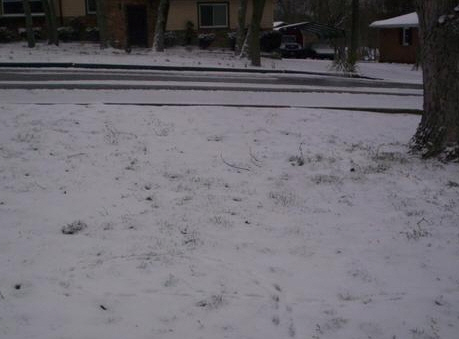
(from WSMV.com—This is very much what my front yard looked like early this morning.)

(from WSMV.com—The sun came out around eleven o’clock, and though the temperature hadn’t made it above freezing at that time, because of the sun and the fact we haven’t had below-freezing temperatures for a couple of weeks, the snow rapidly started melting, much to the delight of our birds.)
I went to the library at 12:45 to pick up a few writing-craft books for the upcoming “Hooking the Reader” series (for more info, click on UPCOMING SERIES at the top of the page), and by the time I got back at 1:30, the snow was gone everywhere in my yard except the places still in the shade.
This is the kind of snow that would have been nice to have had during the week to get a “snow day” from work. But unfortunately, coming last night, it meant we had to reschedule our monthly MTCW meeting—at which it looked like we might have had a record attendance—for next week, when many of our members already have commitments. But better we all stayed safe and warm.
Oh, by the way, the movie was FABULOUS! I’m seriously considering sneaking out and seeing it again this weekend . . . Ciaran Hinds is so romantic!
Fun Friday–Favorite British Actors

So I’ve been on a British film kick recently . . . oh, who am I kidding? I’ve always had a thing for the Brits. Since Masterpiece Classics’ Jane Austen series is on hiatus until March 23, it means I actually have to think of something to blog about on my fun Friday. So, since my friend Ruth is going through internet withdrawal, not having a computer at home right now, I thought I’d give her something to blog about when she finally does get a computer, because I know she’ll disagree with this list.
Here are my favorite British actors:
10. James & Oliver Phelps, a.k.a. Fred and George Weasley from the Harry Potter movies.  Ever since I first started reading the books and watching the film adaptations, Fred and George were my favorite characters—possibly because I love James & Oliver’s portrayal of Hogwarts’ chief Mischief Makers. It’s going to be sad that they’ll be absent from most of the sixth movie, and then the seventh . . . I don’t even want to think about that one! I’ll be very interested to see what each of them does acting-wise when the Harry Potter movies are finished. Both of these boys have wonderful acting futures ahead of them.
9. Dominic Monaghan & Billy Boyd. Dom and Billy have wonderful  comic timing together as Merry and Pippin in the Lord of the Rings movies. But I love Dom because his character is the first one that made me cry in three seasons of watching Lost—at the end of last season and the beginning of this season. Billy hasn’t gotten as much exposure as Dom has from Lost, but he’s shone brightly in the few bit roles he’s had, like Bonden in Master & Commander. These two are the highlights of the cast commentary on the extended LOTR movies, and I would love to see them team up for a comedy movie soon.
8. Jack Davenport. He’s most well-known for his role  as Commodore Norrington in the Pirates of the Caribbean movies. But one of my favorite pieces he’s done was the Marple episode The Body in the Library, where he played the young inspector who had a thing or two to learn from Miss Marple . . . and there was a little romance involved, if I recall correctly. Then again, he did play my favorite character in the third Pirates movie and I was very sad that his character had to die.
7. Ioan Gruffudd. While he hasn’t made some of the best choices 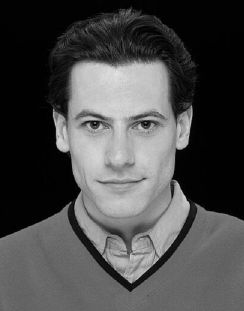 when it comes to deciding which films to be in (I was embarrassed for him when I saw the second Fantastic Four movie!), when he chooses right, it’s right all the way around. Though he’d done a few films before, this Welshman stormed onto the British acting scene with his role as Horatio Hornblower in the BBC/A&E movies—eight in total (and he said in an interview given in 2006 that he wants to do more HH movies—perhaps when HH is an admiral, now that Ioan is older). His latest claim to fame was his portrayal of the British statesman William Wilburforce—the parlimentarian responsible for passing the abolishment of the slave trade in Britain and all her territories and colonies in the early 19th century. If there was ever an actor born to play historical roles, it’s Ioan.
6. Robert Lindsay is probably one of the greatest  British actors ever. He’s played a wide variety of roles, from Horatio Hornblower’s crusty commander, Sir Edward Pellew, to the crusty 50s police inspector, Jericho, to the crusty Shakespearian hero, Benedick (from Much Ado about Nothing). Well, so he plays “crusty” a lot! One of the things on my wishlist at Amazon are the DVD sets for the first two seasons of a BBC sitcom (My Family) in which Sir Robert plays the father. I’ve seen a few clips of it on You-Tube and it looks absolutely gobsmackingly hysterical. Oh, and did I mention he’s the template for Julia’s father in Ransome’s Honor?
5. James D’Arcy. I’m not sure what it is about him, but I’ve really been enthralled with him recently. It could have something to do with how good he looks in period costume—whether it’s as Tom Bertram in the new (horrible) version of Mansfield Park, as Lieutenant Tom Pullings in Master and Commander with the scar down his cheek (and, oh, that uniform!), or as playboy Jerry Burton in Marple: The Moving Finger. Like Ioan Gruffudd, James D’Arcy just seems to have been born to be in historical films.
4. Clive Owen. Whether he’s King Arthur or the assassin with only two or three lines in The Bourne Identity, if Clive Owen is on the screen, he’s going to steal it. The first thing I ever saw him in was Gosford Park, which to this day remains one of my favorite British films. Clive Owen has a very Old Hollywood appeal—handsome enough for the women and yet still comes across as a man’s man. He can do action and drama, contemporary and historical, and morph into whatever the character calls for. And, darn it, he’s just yummy to look at.
3. Jason Isaacs. Sure, he has a tendency to play bad guys, but he does it so well! Though I originally loved The Patriot because Adam Baldwin was in it, the more I watched it, the more my attention was captured by the deliciously evil Col. Tavington. Then I saw him in Black Hawk Down, and, his horrible attempt at a Southern accent aside, found the hero I knew was lurking under those piercing blue eyes. Now, shall we talk about the Harry Potter movies? 🙂 Jason Isaacs brings the same touch of delicious evilness to Mr. Malfoy as he did to Col. Tavington. He’s the badguy I love to loathe.
2.Paul McGann. No surprise to anyone who knows me. Paul McGann snuck up on me as a favorite . . . it took a few viewings of the last four Horatio Hornblower movies for me to really notice him—and it was his voice that drew me in first. Only a true Paul McGann fan will understand what I mean by that. He has this slight rasp and a musical lilt to his inflection, and when he’s using his received-British accent, a slight edge to the enunciation of his hard consonants that makes my ears feel like they’ve died and gone to British heaven. Can I mention Paul McGann without mentioning William Ransome?
1. Henry Ian Cusick. If you’re not a fan of a certain American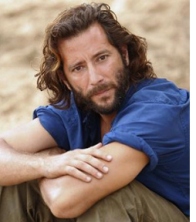 TV program, you probably have no idea who this Scotsman is. After his stunning introduction at the beginning of the second season of LOST, his character, Desmond, quickly became my favorite character on the show.
 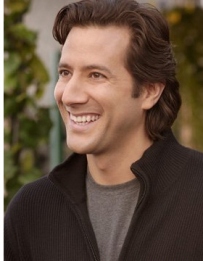 I’ll admit, I’m a sucker for a Scottish accent, but Henry Ian has the good looks to go along with it, whether he’s long-haired, unshaven, and bedraggled, or clean-cut and dressed up (and we get to see him BOTH ways on the show—yay!) I told Erica the other day that if I ever write a romance featuring a Highlander, Henry Ian will be the template!
Honorable Mentions: Sean Bean, Peter Wingfield, Ewan MacGregor, Ciaran Hinds, David Rintoul, Daniel Craig, Alan Rickman, Toby Stephens, Patrick Stewart, Greg Wise, Ian McKellen, Christopher Lee, Jake Weber, Gerard Butler, Jeremy Irons, Matthew MadFadyen, and Richard Grant.
Entering Writing Contests–Resisting the Dark Side
My agent, Chip MacGregor, gives the advice that if you want to be praised and told what a wonderful writer you are, send your story to your mama. If you’re ready for critical feedback—positive, negative, and most of the time subjective—then you’re ready to enter a writing contest.
The advice I give most “young” (as in experience, not necessarily age) writers who come to me seeking advice on whether or not they should enter a writing contest is that while they may have a wonderful story, great characters, and a fantastic writing style, if they’re not emotionally ready for the feedback they’re sure to receive, they shouldn’t enter a contest. If they’ve never worked with critique partners, if they’ve never received anything but positive feedback on their writing, if they get very defensive whenever anyone offers constructive criticism, they’re not only not ready to enter a contest, they’re most likely to fall prey to the Dark Side if they do.
I was so envious when I read Erica’s story about how Carla had been praying for her and the other finalists in the contest last year. Why hadn’t I thought of doing that? What this shows is that Carla was more emotionally and, more importantly, spiritually prepared to enter the contest than I was the year before. I wanted to win. Plain and simple. I’d been working on that manuscript for three years. I’d just finished my master’s degree in creative writing. I was former vice president of the flippin’ organization! Didn’t that make me the “most likely to win,” even though the judges didn’t know it was my story they were reading? Or at least the most deserving?
Dark Side alert!
I hadn’t planned on attending the conference that year (2006), but when I found out I was one of the top five finalists in my category, I decided to fly in for the weekend to attend the public book signing and the awards banquet (added bonus of spending the weekend with my parents who live in the area). I was so proud of myself when I found out I was a finalist, I actually ended up inadvertently creating a situation in my local writing group where one of the members became so angry she left the group because she was so upset over what she felt like were the contest’s shortcomings (i.e., she didn’t final, therefore she thought the judges were ignorant/ill-trained, the contest coordinator inept, and the whole contest corrupt). That served as a wake-up call for me. My fleshly pride in being a finalist was no different than her fleshly (wounded) pride in not being a finalist.
I wish I could say that through that adversity, I changed my attitude. I did, a little. But really what happened is that my built-in pessimism kicked into high gear. After submitting the entry, as I’ve mentioned, I ended up cutting the first three or four pages of the first chapter (for a revision for grad school). So I told myself—even as I flew from Nashville to Dallas that September—that if I didn’t win, that was okay, because the story was better now than it was when I submitted it. I knew, as soon as I sat down to write down a few thoughts for my “acceptance speech”—as the coordinator had recommended—that I wasn’t going to win, that I was “jinxing” myself (no, I’m not really superstitious, just pessimistic). But that was okay, I told myself, because I really was only going to see friends and to make contact with the agent to whom I wanted to submit.
See? I was still toying with the Dark Side. I wasn’t looking at this as the opportunity for me to support the four other lovely women who were finalists along with me. I was already coming up with excuses to give people for why I hadn’t won. Not that someone else’s entry was better than mine (congrats and my most humble apologies to Glynna Sirpless), just that mine wasn’t as good when I submitted it as it now was. Not that I went to congratulate the other four women who were finalists along with me, but that I went for the networking opportunity. And it never even entered my mind to pray for the other people who entered my category.
Even though my manuscript won second place, I personally was winning no contests with my Dark Side attitudes!
Contest, Thy Name Is SUBJECTIVITY
A major area of concern for those of us who may be tempted by the Dark Side of entering contests is the fact that, even though judges try to rate manuscripts on the Platonic Ideal of the Genre, personal preference still plays a major role in the scores and comments given. Face it: tastes in fiction are subjective—from the CEO of the publishing house on down to the average reader on the street. What works well for one judge might come across as flat or unrealistic to another. I consider myself to be a relatively tough judge—mine is probably the lower score of what the entrant receives back. Yet there have been times when I’ve absolutely loved an entry that the other two judges gave middling to low scores—because subjectively I liked it and they didn’t. Having been taught how to evaluate fiction as a creative writing professor would in a classroom setting, I “grade” each entry with the letter-grade I would give it were I teaching a CW class before I even start breaking down my thoughts into the different areas for scoring. That “grade” is more of an emotional reaction—a did-I-or-didn’t-I-like-it reaction—than an objective one. Then, I go back through and use the more “empirical” standards of the score sheet to determine why I did or didn’t like it.
Not every judge is going to make an effort to try to bring objectivity to bear on their scoring. All contest entrants must be prepared to receive remarks/scores that reflect only the personal tastes or ideals of the judge. Get used to it. Though most publishing houses try to stay away from hiring folks like this, there are some acquisitions editors out there who base their acquisitions solely on their personal taste. Agents, too, look for stories that they like when considering submissions.
The Dark Side would tell us that this is a personal affront. That these people don’t like me. That when they make negative remarks (or what we construe to be negative), they’re insulting me. That every rejection my manuscript receives, every critique, is a reflection on me, on who I am as a writer, on my quality of life, on whether or not I’m really called to be a writer, on whether or not I’ll ever get published.
The truth of the matter is, even if you’re not in the least a competitive person, contests can bring out the worst in us. Mostly due to the personal nature of submitting our writing for “public” critique, and the fact that we’re all tempted by the Dark Side—by pride, which has led the the downfall of greater people that I’ll ever aspire to be; by anger; by self-doubt; by emotion; and by the nature of competition itself. Or to put it into the words of the Jedi Master, Yoda:
 Yoda: Yes, a Jedi’s strength flows from the Force. But beware of the dark side. Anger, fear, aggression; the dark side of the Force are they. Easily they flow, quick to join you in a fight. If once you start down the dark path, forever will it dominate your destiny, consume you it will, as it did Obi-Wan’s apprentice.
Luke: Vader… Is the dark side stronger?
Yoda: No, no, no. Quicker, easier, more seductive.
Luke: But how am I to know the good side from the bad?
Yoda: You will know… when you are calm, at peace, passive. A Jedi uses the Force for knowledge and defense, never for attack.
What side of the “Force” are you taking with you as you enter contests? As you submit to agents and editors?
Entering Writing Contests–Battle Scars by Georgiana Daniels
Today, we welcome my other critique partner, Georgiana Daniels, who’s going to reveal some of her “battle scars” received in the frontlines of writing contests.
Battle Scars
by Georgiana Daniels
Time heals all wounds . . .
. . . or at least makes them less noticeable. You should have seen the battle scars on my Genesis entry last year. It’s amazing how you can edit your piece a zillion times, have others check it over, make the necessary repairs, and still come out on the other side of the contest with some rather obvious flaws pointed out.
I had high hopes when I entered the contest, after all, surely someone would see the potential in my manuscript. Right? Though I was a finalist, my visions proved not to be entirely accurate. In fact, it was a humbling experience, which is a good thing. I came out of the contest with something valuable that I am so thankful for today: unbiased feedback.
Feedback is part of what makes contests priceless for aspiring writers. I’m in a unique position right now because I’m using last year’s judges comments to jumpstart my manuscript. When I initially received the comments, I was sure they’d missed the mark, that if they’d read further they’d understand, that they just didn’t get it. But now that almost a year has passed I realize that they were, for the most part, right.
Here’s where the time-heals-all-wounds factor comes into play: it’s not that the judges comments morphed over the last several months, it’s that my writing changed, my skill level changed, and frankly, I’ve changed. I see their feedback through slightly more mature eyes.
I recently discovered an interesting phenomenon that I named Word Attachment Disorder. It’s the acute condition of being unable to erase, let go of, or substantially change words after they have been committed to paper or hard drive. You know what I’m talking about! The only painless cure I have found to date is time.
You see, I can now press delete without feeling like I’ve erased something sacred. I can move words around, reconstruct sentences, and (gasp!) add new lines. And part of what I’m using is the unbiased feedback provided through the Genesis contest. What you do with your scores and judges responses, and how you learn to handle the criticism as well as the praise is more important than where you place.
If you entered Genesis, congratulations! You’ve taken the next step in your journey as a writer. No matter what the final results are, you are a winner.
About the Author:
 Georgiana Daniels is an active member of ACFW and RWA. After graduating with a degree in public relations, she spent several years in the business world, but now has the privilege of staying home and working on the stories she loves. In the 2007 Genesis contest her entry placed 2nd in the chick lit category. Her first book, Table for One, is available now.
Entering Writing Contests–Etiquette 101 by Erica Vetsch
As my crit partners are also veterans at this whole writing-contest thing, I’ve asked Erica to give us a few words about the etiquette that goes along with entering writing contests.
Contest Etiquette 101
by Erica Vetsch
I’ve entered several contests in the past, some RWA regional contests, and the ACFW Genesis contest. The first contest I entered was the Genesis (called the Noble Theme at the time). I had a very raw manuscript that had never really been critiqued before, but I thought it was amazingly beautiful. I was sure it would win, offers of publication would pour in, and I’d be forced to chose between two dream editors.
Oh, the naivety. That manuscript stank. Really. I look at it now and cringe. I also sent that same manuscript to two other contests at the same time, sure I would hit the trifecta and rake in the writing accolades. Needless to say, the responses were nowhere near what I expected. Shocking! I was hurt, angry, frustrated, and I did what most novice writers do. I took my battered baby manuscript to my local critique group full of novice writers to whine. They gave me props, told me the scores were unfair, and basically poured a balm on my soul. What that group didn’t do, mostly because they didn’t know any better than I, was tell me the truth. The ms needed work. A lot of work.
I put that manuscript away for awhile and focused on a new one. I read books on craft, learned from the courses on the ACFW, listened whenever someone would talk to me about the writing craft, and went to a writer’s conference. I went back after a few months and re-read the judges’ comments. And you know what? Those judges were right in all the correction they gave.
When I felt I had improved a lot, I entered another contest, this one RWA sanctioned. And I entered for the feedback, not to win. This time, the scores were much better, and I got an offer from one of the judges to give me some one-on-one tutoring because she thought the story had promise. I’d made some progress.
Last year I entered the Genesis with one manuscript. And I was a finalist! The feedback I got from the editors in the final round was invaluable. I was invited to submit to both publishing houses, and I received the nicest one-page rejection letter of my career.
This year I’ve entered the Genesis. It was a struggle whether to enter again. What if I didn’t do as well as I had last year? Would that mean last year was a fluke? Would it mean I had regressed as a writer? Fear everywhere I turned. And yet, I knew this was the best way to get impartial feedback, to get my manuscript hopefully before some editors I admire and would like to work with, and to conquer the anxiety that was holding me back. I’m hoping for the best, but I know the feedback will be the most valuable part of the contest.
So what do you do with your results when you get them? I can GUARANTEE you will get at least one comment that stings, burns, and otherwise makes you want to kick a trash can. You will be tempted to vent to all your writing buddies, your family, and the lady who works at the post office about how unfair that comment, that score, that placement was.
My advice is don’t. Not right away, not while the pain is fresh. Most of us can’t be objective about our scores right away, whether good or bad. And sometimes we say things out of hurt that we wish we could take back. And while it is true that misery loves company, it is also true that discontent breeds discontent. We may, through our grumbling, draw someone into the pity party that, before we crossed their path like a dark cloud, was quite content with their results. We don’t want to be guilty of causing someone else to stumble.
Last year the ACFW forums saw quite a bit of post-Genesis pain. I would suggest that you hold off venting in public for at least three months. It’s okay to cry some, or even pour out your frustration and confusion and disappointment to the Lord, but don’t give in to the temptation to grouse about the judges, about the unfairness of it all, especially in public. Put your work away. Get busy on the next project. In a few weeks, take out those scores and really read them through. You might find yourself feeling differently about your comments/results/scores after a time away than you did when you first got them back. You might find a lot of good things the judges said about your work that you were blinded to when you first saw your scores. And as an added bonus, you won’t have a pain-drenched (sometimes thinly-veiling anger) post on the forum for all to read.
Please remember this is a small industry. You want to be known as a gracious contestant, win, place or ‘I’m never showing anyone this manuscript ever again!’
Contest coordinators strive to find qualified judges, impartial score sheets, and experienced final round editors and agents. They answer sometimes hundreds of emails, wrangling entries, contestants, judges, and logistics, all the while never letting you see them sweat. They are assisted by category coordinators who evaluate the manuscripts for correct form before passing it along to the judges. They preserve the identity of the judges and serve as liaisons among the contest coordinators, the judges, and the contestants.
Judges give of their time willingly, and often those who are the most qualified to judge have the least amount of time to give. They have only your best interest at heart, and they understand the danger to a writer if they only give ‘atta-girls’ and ‘way-to-go’s’. They want to make you a better writer.
Final round editors and agents who judge have ZERO time to devote to contests, but they do it anyway.
It is a matter of good form and politeness to thank those who took the time to volunteer to make you a better writer. Thank your coordinators, thank your judges, and if you final, be sure to thank the editors and agents, regardless of the scores. If you are hurt to the core by your scores, I have two pieces of advice: First, pray, pray for your judges, pray for yourself. It’s awfully hard to wish ill to a person you are truly praying for. Second, send the thank you anyway. You don’t have to say something you don’t feel is true, but you can always say ‘thank you for taking the time to judge my manuscript.’
In conclusion, here’s another thing I learned from last year’s Genesis contest from a dear woman I now count as a friend. Carla Stewart, the winner of the Historical Fiction category of the 2007 Genesis Contest, both encouraged and humbled me. We ran into each other at the ACFW conference the day before the awards banquet. She read my nametag, recognized me as one of the finalists in her category, opened her arms to hug me, and told me she had been praying for me for the past four months. How amazing is that? We’ve kept in touch of the last few months, and she’s been such a blessing to me.
Look for the ways God can bless you through contests. They probably won’t be the ways you imagine, but they will be blessings nonetheless.
About the Author:
 Erica Vetsch lives with her husband and two children in Rochester, MN. She is a home-school teacher, bookkeeper, and fan of western movies. She belongs to the American Christian Fiction Writers, the Writer’s View, the Christian Fiction Blog Alliance and the Minnesota Historical Society. Erica is a 2007 Genesis Contest Finalist with her manuscript Drums of the North Star. She has recently completed her sixth novel. She holds a Bachelor’s degree from Calvary Bible College and has been a librarian and high school history teacher.
Road to Publication Update
I’ve reached my first deadline for the book that’s under contract, which is now entitled Stand-In Groom. I filled out a questionnaire about the characters, settings, themes, and recurring symbols in the story for the graphic designers to start working on a cover. I’ve sent them my one-paragraph summary, my one-page summary, and my new headshots (see numbers 1, 3, 4, & 8 here).
Yesterday, my agent (Chip) forwarded me an e-mail from the editor in which the editor asked if I could have the completed manuscript of the second novel, Menu for Romance (excerpt of the first chapter is here), to them by November 1, because she’s going to be talking to the marketing people about getting it on the pub list for the Fall 2009 season (Stand-In Groom is still slated for a January 2009 release). Since they’d already mentioned that they would be interested in looking at the second book, I’d set myself the deadline of having the manuscript written and ready to be turned in by the end of June.
I’m supposed to be receiving the edits back from Barbour sometime in the next few days so that I can revise the manuscript and get it all polished up and sent back to them by the April 1st deadline. For April 1, I also have to give them a list of three authors I would compare my style to, one to three “key issues” included in the story “that may help someone help a friend in need through the softened message of fiction,” and write my dedication and acknowledgments. I think I may also be getting three proposed covers to look at some time in April. I don’t have power of approval or veto, but from what other Barbour authors have said, they really listen to their author’s opinions on the covers and have been known to completely redesign them if the author thinks none of them work. With all of the very specific information I included in my questionnaire, I’m really hoping this won’t be a problem.
Chip also heard back from an editor I met at the ACFW conference in Dallas last September about the proposal for Ransome’s Honor. This is the publishing house that came this close to putting me under contract for a “small-town fiction” book Chip had suggested I try writing–and that was based on just the first three chapters: the first draft that I’d sent to Chip just for feedback! The editor said she (and the other editors) really likes my writing style, but feels the beginning of Ransome’s Honor needs a little bit of work before they would be able to take it to their publishing board. She ended the (very long) e-mail by saying, “One thing that [the senior editor] said was that it seems that if Kaye came on board that she might have a long career with us. She seems to be full of stories and a talented writer.” So Chip and I feel confident that with just a little work, that series might sell soon as well.
That’s what’s happening on the publication front. More later!
Saturday Star Wars Fun
This was TOO CUTE not to share . . .
Fun Friday–Fire Study by Maria Snyder
Happy Leap Year, everyone!
For the last several weeks (or has it been months?) I’ve been featuring the upcoming Jane Austen movie on Fun Fridays. But those of you who aren’t Jane Austen fans are in luck this week! I am featuring an author whose books I’ve devoured, but there is no formal Regency society or courtship rituals here.
 Fire Study is the third book in the debut fantasy series by Maria Snyder—a wonderful author I met in Seton Hill University’s Master of Arts in Writing Popular Fiction program. This is one of the ABA books on my 2008 Reading List this year . . . though I would have read it anyway! I thoroughly enjoyed the first two books and cannot wait to delve into this one.
The series begins with Poison Study, in which Yelena starts her adventure in a dungeon, waiting to be executed for murder. She is given a choice of the noose or to become the new food taster for the Commander of Ixia—a military dictator paranoid of being poisoned. She chooses the job, and learns how to taste foods for poisons without dying. Life in the castle is full of hazards: the General, whose son she killed, wants revenge; rebels plot to seize Ixia; and Yelena develops magic she can’t control—magic which is forbidden in Ixia and punishable by death. As she searches for a way to freedom, Yelena is faced with more choices, but this time the outcomes aren’t so clear.
In Magic Study, Yelena is on her way to be reunited with the family she’d been stolen from long ago. Although she has gained her freedom, she can’t help feeling isolated in Sitia. Her Ixian background has changed her in many ways, and her newfound friends and relatives don’t think it’s for the better. Despite the turmoil, she’s eager to start her magical training. But her plans take a radical turn when she becomes involved in a plot to reclaim Ixia’s throne for a lost prince, and gets entangled in powerful rivalries with her fellow magicians. If that wasn’t bad enough, it appears her brother would love to see her dead. Luckily, Yelena has some old friends to help her with her new enemies.
And now, at long last, the third book in the series. Fire Study continues Yelena Zaltana’s adventures. When word that Yelena is a Soulfinder—able to capture and release souls—spreads like wildfire, people grow uneasy. As the Council debates Yelena’s fate, she receives a disturbing message: a plot is rising, led by a murderous sorcerer she has defeated before. Drawing on untested skills, Yelena becomes embroiled in the desperate fight to stop the Daviian Clan from unleashing a Fire Warper. Unfortunately, fire is one element she can’t control even if her life depended on it. And there is more at stake than just her life. Yelena’s journey is fraught with allies, enemies, lovers and would-be assassins, each of questionable loyalty. She will have one chance to prove herself—and save the land she holds dear.
 Meet Author Maria Snyder
What was your inspiration for writing Fire Study?
I wanted to explore the uses and abuses of power in this book. Poison Study, which is the first in the Study series, concentrated on Yelena’s inner conflicts and her self-confidence, and only touched briefly on magic. Magic Study focused on discovering the extent and type of powers Yelena possesses. In the third book, I wanted to show the extent some magicians will go to gain power over others. Using magic to solve problems can be addicting, and, in Fire Study Yelena realizes how much she depends on her magical abilities. She must learn how to balance the use of her power with more mundane methods and to discover that completely turning your back on magic isn’t the right answer.
What sort of research did you do to write this book?
In order to write the scenes with Opal, a glass artist in the book, I needed to enroll in glass blowing classes. The teacher made it look so easy to gather a slug of glass. But when it was my turn—yikes! It was HOT! The big vat of molten glass was kept in a rip roaring furnace at a toasty 2100 degrees Fahrenheit. I held a metal rod, and, while squinting through an eye-melting orange light, I dipped the end into the thick goo and spun it, gathering a glob of glass onto the end. The incandescent glob glowed as if alive.
Once acquired, the slug then needed to be quickly shaped. Glass cooled at a rapid pace, and, even though heat waves pulsed from the slug, it didn’t stay pliable for long. My first paperweight was a misshapened blob. After hours of practice, my ability improved, and I created a paperweight worthy to hold down my next novel’s manuscript pages.
I learned that working with glass required deft coordination, arm strength, tons of patience, and a good partner—it’s a good thing I have a day job!
Who are your favorite authors and books now and when you were growing up?
Currently my favorite authors all have humor in their books. Since my life is so stress-filled and complicated, I’ve been enjoying light and fluffy reading with Mary Janice Davidson’s vampire series and her new mermaid series, Connie Willis is another favorite of mine, and I’ve recently discover the mystery/suspense thrillers of Harlan Coben. Growing up, I started with mysteries because that is what my mother enjoyed. Nancy Drew and the Hardy Boys were my favorites before I graduated to Agatha Cristie, Dick Francis, Robert B. Parker, Barbara Vine, and Ed McBain.
Who has influenced you in your writing?
I read a ton of mystery novels growing up. My favorite mystery author is Dick Francis and his books have influenced my writing style. I also use first person point of view and try to keep the story’s pace moving. My cliff hanger endings are a direct result from his books; I can never stop reading one of his books at a chapter break. My favorite fantasy writers all have strong female protagonists and interesting characters in common. Barbara Hambly’s books have a nice mix of action, character and humor—all essential elements to what I consider good fiction.
What is it about fantasy/science fiction that attracts you?
As a writer, the attraction is in exploring new settings and characters and not having to worry too much about what is physically possible or not. I make my own rules about my world and, as long as I stick to them, can explore various problems generated by the unique setting and situation. As a reader, I enjoy traveling beyond my everyday world to a new place full of wonder and surprises.
What (besides writing) do you do for fun?
I love to travel with my family. Exploring new places and meeting new people and experiencing other cultures are wonderful for the writer’s soul—I also enjoy playing volleyball, reading and I dabble with photography.
What are you writing now?
I’m writing the fourth book based in the Study world titled, Storm Glass. Set five years after Fire Study, Storm Glass has a new protagonist and she’s the reason for the new series title. Storm Glass will be out December 2008. Here is the cover copy of the book:
“As a glassmaker and a magician-in-training, Opal Cowen understands trial by fire. Now it’s time to test her mettle. Someone has sabotaged the Stormdancer clan’s glass orbs, killing their most powerful magicians. The Stormdancers—particularly the mysterious and mercurial Kade—require Opal’s unique talents to prevent it happening again. But when the mission goes awry, Opal must tap into a new kind of magic as stunningly potent as it is frightening. And the further she delves into the intrigue behind the glass and magic, the more distorted things appear. With lives hanging in the balance—including her own—Opal must control powers she never knew she possessed…powers that might lead to disaster beyond anything she’s ever known.”
Did you always want to write? Or did you stumble into it? How did you get where you are now?
I started writing because of boredom! My first job after college was as a Meteorologist for an environmental consulting firm. The amount of work came in waves, and we were either extremely busy or very bored. During the slow times, I started writing a short story. Ideas were always floating around in my mind, but that was when I began using them. I submitted my first short story for critique at a writing conference in Philadelphia, and when the workshop leader gave me 7 out of 10, I thought that was pretty good for a first effort and decided to stick with writing for a while. After my son was born and I only had about one hour a day to myself, I had to decide what was important enough to spend that precious time on. Most days writing won.
And Now . . . an Excerpt from Fire Study:
The man stepped from the midst of the roaring bonfire. Scorched black from head to toe, small flames clung to him like feathers. He advanced toward me. I broke my paralysis and scrambled away from him.
“Did I surprise you, my little bat?” the man asked. “Counted nine when there really were ten. Hot little trick.”
He knew my conscience had flown with the bats. But who was he?
I scanned the surrounding jungle, looking for my backup. Leif and my friends were at the edge of the clearing.
“No help from them, my little bat. They will burn if they come any closer.”
I tried to project into the flaming man’s mind, but his mental defenses proved impenetrable, a Warper of incredible strength. Running out of options, I glanced behind me and caught sight of my bow.
The blazing Warper pointed and a line of fire appeared between me and my weapon. The moisture evaporated from my mouth. I tasted ashes. A wall of hot air pushed against me and the Warper was before me.
“Fire is your downfall, little bat. Can not call it. Can not control it.”
My body roasted as if I had been staked to a spit over a giant campfire. Just when I thought I would faint, he extended his hands and a bubble of cool air caressed my skin. The break from the heat an intoxicating relief. I swayed.
“Take my hands. I will not burn you. Travel with me through the fire.”
“Why?”
“Because you belong to me.”
Entering Writing Contests–It’s Personal then It’s Business
Yesterday, I left off on the idea of contests being personal. So many people will tell you when you get your results, “It’s not personal, don’t take it personally.” And if you don’t think all authors feel the same way about our “babies” going out into the world, let me refer you to Anne Bradstreet’s poem “The Author to Her Book,” which was written in 1678.
I’m sure most people have seen the movie You’ve Got Mail with Meg Ryan and Tom Hanks. If so, you’ll remember this exchange when they’re talking about her specialty bookstore’s being forced out of business by his big-box bookstore:
- Joe Fox: It wasn’t . . . personal.
Kathleen Kelly: What is that supposed to mean? I am so sick of that. All that means is that it wasn’t personal to you. But it was personal to me. It’s personal to a lot of people. And what’s so wrong with being personal, anyway?
Joe Fox: Uh, nothing.
Kathleen Kelly: Whatever else anything is, it ought to begin by being personal.
What I’m about to say next may be controversial, and there may be people out there who will disagree with me, but this is my advice: Let it hurt the first time you read the comments. Don’t shield your emotions; don’t pretend it doesn’t make your stomach churn, your head spin, your skin go clammy. Cry. Mourn. Get angry. Grieve. Kick cabinets. Yell to the ceiling, “These people are stupid, and they just don’t get it!” (But, please, do this in private. Do not vent these feelings publicly . . . or you may come to sincerely regret them.)
Then set it down and walk away. Let it sit there for a couple of days while you go through the seven steps of the grief process. (Shock, Guilt, Fear, Depression, Denial, Anger, Acceptance.) Once you get to the acceptance stage (you’ll know it because you won’t cringe or cry or seethe with anger whenever you see the manuscripts sitting on your desk—you’ll want to look at them), then read through the comments again, and you will be surprised by how not personal they are.
I’m not going to sit here and say “don’t take it personally” . . . especially if this is the first time you’ve ever entered a contest or gotten feedback on your writing. Take the comments personally—just not as a personal insult. Take it that there are at least two or three people out there who care enough about YOU as a writer to take the time to read your writing and give feedback on it. That is so much more than the majority of beginning authors have, those who are out there struggling, on their own, trying to figure out how to do it with no support of a writing organization like ACFW and no feedback, guidance, or mentoring from more experienced writers.
Then, once you get over the personal part, it’s time to get down to business—revisions. Rather than repeat what I’ve already expounded upon before, let me refer you to Critiquing Step 4: Putting the Crits to Work.
Be very cautious when reading your contest critiques. Not every comment you receive will be helpful or—much as I, as a judge, hate to admit it—correct. Sometimes those of us who serve as judges have been told something by someone else (another contest judge or a mentor) in complete honesty and integrity that just isn’t right, but we believe it’s true because of the source we received it from. So take every comment with a grain of salt, not as biblical truth. They are suggestions based on the judge’s knowledge and OPINION to make your piece stronger, not an editor’s mandated corrections.
Ask questions. Post them here or your writing group’s forums or e-mail your crit partners. Go to your favorite authors’ blogs or websites and contact them to see if they have the time to answer the questions for you.
Whatever you do–do not get discouraged. Keep writing. Keep studying. Keep entering contests. Learning the craft of writing is a long process, and this is just part of it. And look at it this way: not finaling/winning a contest is good practice for being rejected by agents and editors in the future. Hopefully, by going through this process, it will mean fewer of those rejections and more sales!
Entering Writing Contests–Why?
There’s a lot of discussion going on these days about entering writing contests—the deadline for the ACFW Genesis contest for unpublished writers is March 1, and while entrants were encouraged to get their entries in by the beginning of this week, I know there are still some out there who are frantically trying to put those finishing touches on the fifteen pages or figure out how to write that one-page synopsis.
What sometimes gets lost in all the freneticism (is that a word?) of preparing an entry for a contest is the reason why one enters the contest in the first place.
I’ve mentioned before that I entered my first unpublished-author contest in 2002 (What Matters Most, my first complete manuscript into the Noble Theme contest at the first-ever ACRW conference). I hadn’t planned to enter, but then, the night before the postmarked-by deadline, I felt God urging me to enter. So I did. I was afraid that if I entered, I would get sick to my stomach, that I would regret it as soon as I handed that flat-rate envelope over to the postal worker. But I didn’t. I actually felt good about sending it. I received an Honorable Mention certificate that year . . . probably because there were only a few entries, so they decided to give us all something. 🙂 Because when I look back at it now, it sure wasn’t worth mentioning. But the feedback I received from the two judges was invaluable and helped me so much on certain aspects of my writing—tightening my POV, showing not telling, fully developing my characters, and making sure each scene is important to the movement of the story.
I entered two manuscripts the next year (2003): The Best Laid Plans (follow-up novel to What Matters Most) and Love Remains. Neither finaled. The feedback was a little less “honorable mention” and a little more “you can do better than this—and here’s how.” Those were a little harder to take, but, after a few weeks, I really gleaned a lot from them.
In 2004, I entered the manuscript I was sure was not only going to win the contemporary romance category, but would be chosen for the Janet Kobobel Grant award for the best overall manuscript: the first draft of Stand-In Groom, then titled Happy Endings Inc. It was the strongest story idea I’d ever had, and it got me into graduate school. And my crit partners liked it. Not only did it not final, I got some pretty harsh feedback on it in addition to middling scores. I wasn’t happy. But, after a few weeks, I was able to really see the points made by the judges (especially having served as a judge myself in the contest that year) and eat humble pie and realize my manuscript wasn’t all that.
In 2005, because I was Vice President and therefore over the contest, I wasn’t eligible to enter—but I did a ton of judging, I’ll tell ya! (More on judging in another post.)
Finally, in 2006, with three full revisions on the manuscript behind me, and thesis submission and master’s graduation ahead of me, I entered the new version of Stand-In Groom into the newly named Genesis contest. After I entered it, I ended up doing another revision of the manuscript, which included cutting almost three pages from the opening chapter—the opening chapter that was, at that moment, being judged for Genesis . . . and guess what? I came in SECOND PLACE in my category.
Monday, there was a post on the Seekerville Blog about first chapters and how some writers get caught in a hamster wheel of being a professional contest entrant instead of striving to be a published writer. They spend so much time working on their first ten, fifteen, or twenty-five pages to enter into contests, but never finish a manuscript—or if the manuscript is completed, they never spend any time revising the rest of it but just keep tweaking the first part based on contest judges’ feedback. And it really made me think about why I chose to enter HEI/SIG that second time. Here’s part of the comment I left there:
So while I did enter it twice, in two vastly different incarnations, entering it into the contest wasn’t my main focus–it was the litmus test to see if it was ready to be submitted to editors and agents.
It seems to me that one flaw, one drawback for people who are addicted to entering contests is that they’re using the contest judges’ feedback as their critique group—and as their validation as a writer. If they don’t get good feedback, if they don’t get good scores, if they don’t final, if they don’t win, if they don’t do as well in this contest as the last one, or whatever, they lose confidence in themselves as writers. Contests aren’t for personal affirmation or for summary judgment on whether or not you’re “good enough” to pursue publication. Contests are market research. Contests are great for getting anonymous feedback on your manuscript. But entering contests should not be our writing goal. Our goal in entering a contest should be to make sure that we’ve got the strongest story possible before submitting it to editors and/or agents. They’re the litmus test, not the be-all-and-end-all of becoming a writer. Two years ago, I made promise to myself that I would become ineligible to enter unpublished-author contests in 2007. And as of December 7, 2007, I am officially ineligible to enter the Genesis or any other unpublished-author contest! Make that your goal this year—to use whatever contest you choose to enter this year your springboard to becoming ineligible to enter it next year.
Finally, on another note, people will tell you that the feedback you get on your contest entries isn’t personal. I disagree. Even though as a judge, I don’t know whose manuscript I’m judging, it’s still personal for me. I know that there’s a person on the other end of that entry who’s going to read the comments I’m making, see all of the highlighting and marking I’ve done, and take it very personally (which we’ll get into more in another post). Anything having to do with someone’s writing is very personal! And even as anonymous judges, we have to keep that in mind—while still making sure that we’re giving the strongest and best feedback we can possibly give. So in the coming days, I’ll try to shed a little light on contests from my perspective as a finalist and as a judge. And my crit partners will be dropping in with words of wisdom from their experiences as contest finalists and judges as well.
Why do you enter contests? What do you hope to gain/learn? How much money do you spend in a year entering writing contests versus postage on sending out submissions to editors/agents? How much time do you spend preparing contest entries versus queries/submissions to editors/agents? Do you enter more contests than you send out queries? How has feedback from contests helped/hindered you?


