Hooking the Reader: Facing the Consequences
 In Monday’s post, we explored the idea of creating sequels—i.e., what happens next—through the disasters or hooks at the end of each scene. In addition to Bickham’s methods listed there, he also introduces the technique of the scene interruption. To keep the reader hooked, he suggests creating a diversion that stops the hero’s ability to complete the task or work through the conflict of that scene. The character wants to move on, but is thwarted because his scene is postponed, left hanging. This creates a delay, a setback, a “mini-disaster.” In cinematography, they call this the “cut-away.”
In a single-POV story, this is going to be extremely hard to do, unless your cutaway involves a timelapse. In that case, the sequel scene may actually be more of the character internalizing the disaster that just happened—a chance for a character-growth/development scene. But, as anyone can tell you, don’t let the interrupting scene pull the reader away from the previous disaster too long, or else you’ll lose the tension because the reader will forget the peril the character was facing.
Regardless of how long or short your chapters are, always end your chapters at a place where the reader has to know what happens next. If you don’t end at the disaster moment, the next best place to end is in the middle of the conflict, especially if the next chapter opens with the continuation of the conflict. Another way to end is at a place when the character is stuck, thinking there’s no way out or that things can’t possibly get worse (which of course, is a method of foreshadowing and immediately implanting the idea in the reader’s mind that things are definitely about to get much, much worse). Or you can end the chapter when the character is on the brink of making an important decision or taking a new action that has potential to change the story outcome.
As in life, in writing “what happens next” is all about consequences. We’ve already seen how our job as authors is to make sure that our characters fail to reach their goals often enough to generate more conflict for the story. Failure brings consequences that generate conflicts that necessitate setting new goals—in addition to the main story goal that must still be met. These then become your scene goals. For each conflict, there are multiple outcomes dependent upon which decision is made or action taken, and this is the driving force behind the plot of your novel. For example, in the Lord of the Rings trilogy, Frodo and Sam’s main story goal is to take the One Ring to Mordor to destroy it. Yet all along the way, they encounter roadblocks, interruptions, setbacks, and other characters with different goals that keep setting them along paths they don’t necessarily want to be on. They must work their way through each of those conflicts—they must resolve those consequences—before they can resolve their story goal.
Along with consequences come rewards. Stein, in How to Grow a Novel, states that in a discussion with playwrights once, he jotted down the phrase, “You must reward your audience” (18). As we discussed in the Plot or Plod series, you cannot just pile up the conflicts one on top of another in an ever increasing intensity, or else the reader is going to be overwhelmed. Once you’ve finished your first draft and are ready to start revisions, take the time to write out a scene-by-scene outline (or use scene cards) and pinpoint scenes where you’re rewarding the reader for sticking with you by revealing something important, resolving a conflict, or allowing a breather-scene where your reader can fall in love with your characters a little bit more. This will also help you in tracing the conflicts and consequences and making sure that each scene ties in with the scenes that follow in some way, and that each ends with some kind of a hook.
And just because I took the time to pull them and I kept forgetting to use them, here are the rest of the chapter-ender hooks that I pulled as examples for this series:
Dean Koontz, The Mask, end of Part 1:
- “Gracie . . . it can’t go on forever. You’ve got . . . to put an end to it. Protect her, Gracie. Protect her . . .”
The voice faded away.
There was only silence. But not the silence of an open phone line. There was no hissing. No electronic beeping in the background. This was perfect silence, utterly unmarred by even the slightest click or whistle of electronic circuitry. Vast silence. Endless.
She put the phone down.
She started to shake.
She went to the cupboard and got down the bottle of Scotch she kept for visitors. She poured herself a double shot and sat down at the kitchen table.
The liquor didn’t warm her. Chills still shook her.
The voice on the phone had belonged to Leonard. Her husband. He had been dead for eighteen years.
Carolyn Keene, The Moonstone Castle Mystery, end of Chapter 13:
- Bess and George and the boys hurried toward Ned. “Where’s Nancy?” they asked in one breath.
“I don’t know,” Ned said fearfully, then told them where he had left her.
“How long ago was that?” Bess asked quickly.
“Why, just a few minutes.”
“Then she didn’t come up the stairway, nor was she anywhere near it,” said Bess. “Otherwise, we would have seen her.”
The five young people looked at one another. Panic seized them. What had happened to Nancy?
Dick Francis, Dead Heat, end of Chapter 13:
- I dreamed that I could smell toast. But someone had left it in my broken toaster for too long, and it was beginning to burn. Burned toast. My father had always liked his toast burned black. He had joked that it wasn’t burned, it was just well-done.
I was awake, and I could still smell the burned toast.
I got up and opened my bedroom door.
My cottage was on fire, with giant flames roaring up the stairway, and great billowing black smoke filling the air.
Michael Crichton, Timeline, end of 30:21:02:
- Sir Guy stared for a moment, and then he began to shout, “The prisoners! All escaped! Prisoners!”
This cry was taken up by the Lady Claire, who called out in the hallway.
In the passage, the professor turned to them. “If we’re separated, you go to the monastery. Find Brother Marcel. He has the key to the passage. Okay?”
Before any of them could answer, the soldiers came running into the passageway. Chris felt hands grab his arms, pull him roughly.
They were caught.
JK Rowling, HP & The Deathly Hallows, End of Chapter 34:
- Voldemort had raised his wand. His head was still tilted to one side, like a curious child, wondering what would happen if he proceeded. Harry looked back into the red eyes, and wanted it to happen now, quickly, while he could still stand, before he lost control, before he betrayed fear—
He saw the mouth move and a flash of green light, and everything was gone.
Hooking the Reader: “To Be Continued . . .”
Picture this scenario: You’re watching your absolutely favorite show. Things are getting dicy for the heroes. All of a sudden, there’s an explosion! Your heroes’ lives are in danger! What’s going to happen to them? Are they okay? Will they survive? Then, the screen goes black. And then you see: TO BE CONTINUED. “NOOOOOOOOOOO!” you scream. “I have to know what happens next!”
And what does happen next? Well, you tune in when the next episode airs or the new season starts. Why? Because you’re HOOKED. Because you need to know the sequel: what happens next.
Though I wouldn’t recommend reading it straight through, just like with Stein’s books, I recommend everyone should at least check Scene and Structure out from your local library and read the sections on Sequels. It’s not about subsequent books, but the pattern of how scenes follow-up the disaster that happened in the previous scene.
The way you structure the flow of your scenes is one of the primary ways, after dropping disasters on your characters, to keep the reader hooked. Remember, the purpose of each scene is to move the character further from quick fixes and shortcuts. Once you’ve written to the hook, the disaster, you can keep the reader frustrated and wanting to find out what happens next by breaking away from one character’s disaster to a subplot or other POV character’s scene. But change POV only when it creates more tension and suspense, not just to be in the other character’s head.
Bickham gives a few ways to amp up the conflict for each character within the scene that then ties that scene to either the next one or what happens later in the book (setting up sequels to keep the reader turning pages):
- Drop hints that the antagonist knows something which the hero/POV character doesn’t—something that is advantageous to the antagonist and/or disastrous for the hero. This is Malfoy taunting Harry Potter with stuff he knows that Harry obviously doesn’t. This is the serial killer taunting the detective. This is someone (either an antagonist or someone well-meaning but ill-informed) telling the heroine that the hero is cheating on her.
- The antagonist could actually reveal something the hero didn’t know yet—a bit of bad news that alters the hero’s assumptions or decisions or even make him deviate from his scene goal (or at least make the reader believe he will).
- Show that the hero has faulty information—and that he doesn’t realize it—to lead the reader to believe he’ll make the wrong decision.
- Have the antagonist (or an outside source) set a ticking clock on the duration of the scene (Can Jack Bauer stop the terrorists in twenty-four hours? Can Rose get Jack unshackled before the room fills with water as Titanic sinks?)
Once you’ve upped the tension in a scene, then ended it with a disaster, there are six ways to keep the conflict going in the sequel that will give the reader some closure on the previous conflict and yet still keep the tension level rising:
- As already mentioned, set a timer on your character’s actions, a time-limit in which to make a decision. You end a scene with the hero receiving a ransom note from the kidnapper who has his child: You have three hours to deliver $5 million or I kill the kid. What happens in the sequel scenes is shaped by that disaster, by that time-limit.
- Have the POV character come to understand—on his own or with help—an entirely different aspect of the previous disaster he hadn’t thought of before. How can that disaster actually be used to his advantage?
- On the flip-side, instead of realizing how the disaster can be advantageous, the character is now overwhelmed by the disaster (and the emotions resulting from it) and plunges back into the conflict with insufficient understanding of what’s going on, leading to more disasters.
- Introduce roadblocks (have you ever seen Amazing Race?) that create a “sidebar” conflict the character must get through to get to the next scene—conflicts which the character (and thus the reader) sees as relating directly to his stated goal for that scene, but which, in reality, only serve to throw him further off course.
- Have the character hint that he has more of an agenda than he’s revealed to the reader. Something along the lines of, “He knew what he had to do.” [End of scene].
- Stage an interruption—an outside stimulus—which forces the character to stop “sequelizing” and meet the new threat/conflict. This is very similar to the roadblock idea. Something interrupts the very straight-forward direction of the plot and either waylays the character for a little while or throws him completely onto a different trajectory for the remainder of the story.
Now that you’ve read the “how to,” let’s look at some examples of how published authors have put these techniques to work. I probably should have put these on the “disasters” page, but I think from these, you’ll also be able to see how the disaster sets up the sequels to come:
Janet Evanovich, Eleven on Top, end of Chapter 5:
- “How could you be the big bounty hunter without knowing how to pick a lock? How’d you ever get in anywhere?” Lula stood back and looked at the store. “Ordinarily I’d just break a window, but they got one big window here. It’s just about the whole front of the place. It might look suspicious if I broke the window.”
She ran across the street to the Firebird and came back with a tire iron. “Maybe we can pry the door open.” She put the tire iron to the doorjamb and another car drove by. The car slowed as it passed us, and then took off.
“Maybe we would try the back door,” Lula said.
Sandra Brown, Play Dirty, end of Chapter 13:
- She must have parked around back, where he’d parked the first time, because the red Honda was the only car in the driveway. In the time it took him to reach it, he was already considering going back inside to apologize. He was still mad as hell, but he couldn’t afford his anger. The price tag of it was half a million now, and millions more to come. Not worth it. Not by a long shot.
He turned on his heel and had started back toward the house when he spotted something that drew him up short.
Susan May Warren, Happily Ever After, End of Chapter 21:
- He needed Mona. But he was the last thing she needed. She had her hands full building her life, and the Joe Michaels deluxe package, complete with handicapped brother and covert identity, did not fit into that reality. She needed a man who could hang up his backpack and invest in her dreams.
Instead he’d spent the past month knitting together a façade of white lies. Lies meant to keep him and Gabe safe. Lies that could unravel at any moment.
No, he couldn’t stay.
He closed his eyes and fought the urge to weep.
Linda Windsor, Maire, end of Chapter 25:
- Unable to speak, Maire strained against the hold of the guards, leaning into the sword and toward the fire as though she too were ready to walk into its deadly mouth, even if it meant perishing with him . . .
Rowan stepped to the fire’s edge where the heat slapped him and reached into his lungs with invisible hands, clutching his breath. The perspiration on his forehead evaporated. Lord, use my example to Your glory. He lifted his foot, ready to take the final plunge from which there would be no return, when a voice of protest cut through the bonds of tension holding all in check, save the beasts of flame.
“Hold, in the name of God Almighty!”
For Discussion:
Are there some scenes/chapters in your WIP in which you can apply one (or more) of these techniques to tie the scene to what comes after it (sequel)? What are some ways in which you’ve planted information or dropped hints that the hero doesn’t know everything he needs to know before facing the next conflict? Do you tend to immediately follow your disaster with a scene that resolves it, or do you leave your character hanging off the cliff and cut to another character/subplot?
Sense & Sensibility Part One
Well, the seduction scene at the beginning we’d all been warned about really didn’t show much of anything, nor did it reveal the identity of the seducer. Even though I know the story, it makes it feel very disconnected from the main action at Norland with Mr. Dashwood’s death.
First major quibble with this adaptation: why is Marianne calling Fanny “aunt” when Fanny is their sister-in-law?
The first half hour of the movie didn’t seem much different than the 1996 Emma Thompson version—down to the scene (not from the book) of Margaret on the floor in the library.
Speaking of Margaret, Andrew Davies seems to have taken Emma Thompson’s lead on the character—she is more closely related to Thompson’s version of the character than how the character appears in the book.
Also, at times, several of the characters seemed to have taken their acting direction from the Emma Thompson version—especially the actress playing Fanny, who seemed to have studied her lines by repeated watchings of her predecessor in the role.
First thing out of my mouth when Sir John Middleton walked onto the screen was: “Oh my goodness! It’s Mr. Weasley!” He looks absolutely hysterical in the wig—almost as if it’s a send-up rather than a serious costuming choice.
I must say I’m really enjoying David Morrissey as Colonel Brandon—though I’m having a hard time not seeing him as a young Liam Neeson. It was also nice to see Marianne smiling at him when he turned the pages of music for her instead of being quite so heartlessly cold to him the way Kate Winslet was in the theatrical version.
Another quibble: never, not once, in the book does anyone call Elinor “Ellie.”
All in all, I’m enjoying the adaptation. It does seem quite a bit like Andrew Davies took Emma Thompson’s screenplay from 1995 and extended it with new scenes and with scenes (and characters) that were left out from the book. There have been some obvious diversions from the book, but those haven’t really bothered me.
I do have to say, I like Kate Winslet so much better than Charity Wakefield as Marianne. Hattie Morahan is growing on me, but I don’t think she’ll be any less plain and homely next week than she was this week. I do think the actor playing Willoughby was miscast, but that could be just because he suffers in comparison to Greg Wise’s portrayal in the 1995 version.
Next week, my “head to head” comparison between the actors in key roles in this first installment will be posted on the Jane Austen Today blog. I’ll be sure to announce it here when it’s up!
Fun Friday–Sense & Sensibility

Simple words cannot express how excited I am about seeing the new version of Sense & Sensibility, which begins this Sunday on PBS.

- Sisters Elinor (Hattie Morahan, The Golden Compass) and Marianne Dashwood (Charity Wakefield, Jane Eyre) have opposite approaches when it comes to the pursuit of love. One is tempered and rational, the other impulsive and full of youthful passion. The sisters attract a trio of suitors — handsome Edward Ferrars (Dan Stevens, The Line of Beauty), heroic Colonel Brandon (David Morrissey, State of Play), and effusive John Willoughby (Dominic Cooper, The History Boys). But are the men as genuine as they seem? A romantic odyssey full of seduction and abandonment unfolds in Andrew Davies’s bold adaptation of Jane Austen’s classic novel. (Courtesy PBS)
Sense & Sensibility is not my favorite, nor my least favorite of Jane Austen’s novels. I love it for the nuance of character and the complexity of the story that she told. Because it was one of the first she wrote (and the very first one published), her style wasn’t yet as crisp as in later novels, and it does tend to ramble a bit. My mom told me at Christmas that she tried listening to the audiobook, but gave it up because the narrative just went on and on and on, and since she didn’t know the story, because she was just listening to it driving in and around town—fifteen minutes here, twenty minutes there—she couldn’t keep track of who was who and what was going on. So she asked me to give her the five-minute version of the story.
It took almost twenty.

I’m sure you’re all here looking for my comparison of the actors in the new version to the actors in the 1995 Emma Thompson version. However, I’ll be doing that for next week and it’ll be over on the Jane Austen Today blog!
So what am I looking forward to in this new adaptation?
First and foremost, I’m looking forward to seeing the roles filled by actors who were cast because they actually fit the descriptions of the characters, not because of their star-power. Yes, I love the Emma Thompson version. But Eleanor is supposed to be nineteen years old when the story opens. Emma Thompson was thirty-six when she made this film. I’ve never been a fan of Hugh Grant (one of these days, I’ll explain why—it’s because of the first movie I ever saw him in: The Lady and the Highwayman). Kate Winslet was around nineteen or twenty, so she was as close to the right age for Marianne (seventeen) as one could hope. She was wonderful in the role (as were all of the actors in this version . . . with the exception of Hugh Grant).

I know there are some people out there who feel as adamantly about Alan Rickman in the role of Colonel Brandon as they do about Colin Firth as Mr. Darcy. So, since I’m 100 percent in favor of equal opportunity, I’ll go ahead and offend the Alan Rickman lovers to say I feel he was completely miscast as Colonel Brandon. (Side note trivia: the first name Christopher was made up for that version of the movie.) Yes, he’s a wonderful actor, and did a good job in the role. But he wasn’t the Colonel Brandon who appears in the book. The biggest problem is that Colonel Brandon is meant to be thirty-five years old. Alan Rickman was forty-nine. So I’m really interested to see not only Andrew Davies’s interpretation of the characters, but how actors who are closer to the characters’ ages interpret (and look in) them.

(Yes, there really is a duel that takes place in the story—only there, it’s offstage.)
So, anyway, back to the new version and what I’m looking forward to.
Andrew Davies has apparently beefed-up the men’s roles—and I’m not talking just physically. One of Davies’s gripes about Jane Austen’s stories (and he’s studied them quite a bit) is that she didn’t really understand her male characters—didn’t give them enough of a presence. Which is why in Davies’s adaptations, there is usually at least one scene that doesn’t appear in the novel, because it involves only the male characters interacting with each other.

Another aspect I’m highly anticipating are the costumes and sets. From what I’ve seen in the still images online, they look spectacular!
I don’t know about you, but just pulling these images and writing about the new adaptation has whetted my appetite, and I can’t wait to watch it. I hope you will too!
Links of Interest
Interview with screenwriter Andrew Davies (see #11)
Listing on IMDb.com
Main page at PBS’s Masterpiece Classics site
Wikipedia Article on Sense & Sensibility
Full Text of Sense & Sensibility on the Republic of Pemberley
For more information on Jane Austen and all of her works:
The Jane Austen Society of North America
The Republic of Pemberley
Hooking the Reader: That Scene Is a Disaster!
On Tuesday, we discussed the five elements of keeping the reader hooked into our stories: characters, POV, suspense, balance, and bomb-dropping. Today, we’re going to look at what goes into the development of an individual scene, and for help, we’re turning to my new favorite writing-craft book, Scene and Structure by Jack Bickham.
According to Bickham, the structure of a scene is threefold:
- Statement of the character’s goal
- Introduction and development of conflict
- Failure of the character to reach the goal; a disaster
The scene should start with the POV character who has a definite, clear-cut, attainable goal: Anne is going to show George potential sites for (what she thinks is) his engagement party. George is going to reveal the identity of his employer to Anne before the man shows up at the site for the party. Meredith is going to the pet store to buy food for the puppy she found. Major is attending his employers’ New Year’s Day open house because they’ve asked him to come to talk to him about something. And so on. Each scene should start out with a goal that is an important step in the character’s game plan—a small goal that gets them one step closer to attaining the main goal of the story (or what the character thinks is their main goal for the story—that’s where the conflict/disaster part comes into play). But the goal cannot be easily attained—it’s your job as the author to make sure your characters suffer.
Once you know what your character’s goal for the scene is, you must determine what Bickham calls the “disaster” that will happen at the end of the scene to keep them from reaching that goal. Now, when I first read this, I thought, but that doesn’t work in every genre. But I think I’ve figured out what he means. From the examples above:
- Anne is going to show George potential sites for (what she thinks is) his engagement party. However, by the end of the scene, she’s actually ended up sharing with him the details of her past: that she survived a plane crash that killed her parents—pushing her ever closer to the edge of what she believes is falling in love with a client (because George, after all, is the Stand-In Groom). For Anne, at this point in the story, her real goal at the beginning of the scene was not getting him to choose a party site, but trying to keep herself from falling ever closer to the precipice of falling in love with him.
- I’m not going to reveal the disaster that George faces—you’ll have to read the book!
- Meredith is going to the pet store to buy food for the puppy she found. She’s dressed in her skuzzy clothes because she’s been at her house, which she’s refurbishing, stripping paint. In trying to get the puppy out from under the back porch, she fell in the grass and got soaked (because it’s pouring rain). Though she’s dried off and cleaned up, she’s definitely not looking like she does when she’s planning black-tie events for her parents’ Fortune-500 company. So, naturally, she runs into the recently elected mayor’s wife—a woman who was not only in Meredith’s mother’s sorority, but the woman whom Meredith must work with to plan an upcoming black-tie fundraiser event. Not a great first impression, and Meredith dreads news of the encounter reaching her always very proper and appearance-minded mother.
- Major meets with his employers at their open house and receives an offer for a business opportunity he can’t pass up. Not a disaster, right? Well, he then meets someone who has the potential to make-or-break his career—and his personal life.
See how it works? It’s not a disaster in the truest sense of the word: a car accident, a stock-market crash wiping out the hero’s livelihood, a death, or whatever. It’s a disaster in that it puts our character further into the hole of narrative debt—a setback, a redirection. And, as in Major’s case, it doesn’t even have to be an immediate setback, as he won’t know for several more chapters that this woman he’s met has the potential to affect his life so greatly.
In other words, you’re starting the scene out with a question: can the character do/attain this? To keep a reader hooked into the story, the answer at the end of the scene should be no. Or at least yes, BUT . . . or yes, IF . . . —if it’s a yes answer, it cannot be unconditional. The end of the scene has two primary jobs: to answer the scene question (preferably “NO!”) and to make the reader want to read the next scene to find out when the character will attain that goal.
Sometimes, you may have to work a scene backwards. If you know the disaster that needs to happen—because of what comes after it, because it sets up what happens next (a.k.a., “sequel,” which we’ll get into later in the series), examine the disaster and determine what it is that the disaster is stopping the character from doing/attaining. But don’t forget that all of your “disasters” must also fit logically into the main “disaster” (climax) of the story.
“Well-planned scenes end with disasters that tighten the noose around the lead character’s neck; they make things worse, not better; they eliminate hoped-for avenues of progress; they increase the lead character’s worry, sense of failure, and desperation—so that in all these ways, the main character in a novel of 400 pages will be in far worse shape by page 200 than he seemed to be at the outset.”
~Jack Bickham, Scene & Structure, pg 44.
A good scene will end with the characters making “backwards” progress; it eliminates options for an easy answer or solution; it makes the walls start closing in (think about the trash-compactor scene in Star Wars); and it has an impact on later events (consequences/sequel).
But one caveat: don’t contrive a disaster just to create a cliffhanger—hooks should be unexpected, but they should also be realistic and logical for your plot, the world of your story, and the development of your characters. Make the lead-up to the disaster subtle enough that the reader is suspicious something’s going to go wrong, but not so that they can see it coming from a mile away.
For Discussion:
Pull a scene from your WIP and examine the structure of it. What’s the scene question/the character’s goal at the beginning? What conflicts build during the scene? And, finally, what’s the “disaster” that happens at the end of the scene that keeps your character from attaining his/her goal? Did you find, as I did with Anne’s scene above, that the character’s goal at the beginning of the scene was actually more subtle than you originally thought?
Menu for Romance Progress Page
I’m cracking the whisk!

During the month of March, I was supposed to be writing about 31,000 words on Menu for Romance during MTCW’s March Madness Marathon. Unfortunately, I didn’t think about the fact that edits on Stand-In Groom were due at the end of the month nor know that I’d get feedback on Ransome’s Honor and want to take time out to make revisions on that as well.
So, I might be limiting the number of new posts here until I get caught up with where I need to be on the word count for Menu for Romance, if I’m going to have the first draft of it finished by the end of April. That gives me five weeks to write about 60,000 words—which means I need to average 12,000 words per week, or about 1,715 words per day. I only wrote 750 yesterday. 😦
At the top of the screen, you’ll see a page entitled MFR Progress. I should be updating that page daily with what I’ve accomplished (either that day or the day before). If I go for more than a couple of days without updating that page, please contact me to find out why I haven’t written anything!
If I can get at least 1,500 words written today, I’ll have another Hooking the Reader post for you tomorrow!
Don’t forget, if you would like to be an influencer for Stand-In Groom and receive a copy of it from Barbour about a month before it hits shelves (so sometime in December) in exchange for posting a promotional review on your blog/Amazon/B&N/CBD, etc., please e-mail me with your name and mailing address and I’ll add you to the list.
Hooking the Reader: Scene Two, Take Five
A sign of a novice writer is that
he begins scenes too early
and ends them too late.
I don’t know if it’s a quote, a maxim, a proverb, or just something that was said at a writing conference a decade ago that everyone took to heart. (It’s probably from Don Maass or Sol Stein, but I couldn’t find it quickly.) I’m sure that most of the people reading this blog have had the experience of reading someone else’s work in which the scene starts with the character waking up in the morning, going through the morning routine, thinking about what they have to do that day, having breakfast, kissing the family goodbye, getting in the car and setting off for work. Then, once they arrive at the office, they’re fired. Or their boss turns into a big green monster and tries to eat them.
This is a prime example of starting the scene too early. There is no hard and fast rule that says, in both cases, the scene should have started in the boss’s office—with the character receiving the pink slip, or with the boss turning into the big green monster. In the second case, especially, there is a need for the establishment of “normal” before something like that happens if it is at the beginning of the book. Hopefully, if this isn’t the opening scene of your book, you’ve already established that in the “normal” world of your characters, bosses don’t usually turn into big green monsters, so opening the scene with your already-established character walking into the already-established boss’s office will seem normal until the extraordinary happens—as soon as the scene opens.
Starting scenes in media res, or in the middle of the action, hooks the reader. Just as we don’t want to open the book with the boring scene of someone going through the morning routine (unless he wakes up to discover he’s metamorphosed into a giant cockroach overnight), you don’t want to start any scene in your book that way. Readers don’t want the mundane, day-to-day stuff. As I quoted from Stein last week, readers are looking for something that they don’t usually experience—they want to be put smack into the middle of this fictional fantasy you’ve promised them.
“Suspense is achieved by arousing the reader’s curiosity and keeping it aroused as long as possible.” (Stein, How to Grow a Novel) A reader is hooked when she can’t put the book down—she just has to turn the page to find out what happens next. “Immerse the reader so deeply in the story that he’ll let go of the book only when the real world intrudes” (Stein).
Once you’ve created characters the readers will invest in, then you have to start writing each scene, each chapter, to a hook. The structure of a chapter is similar to that of the novel itself—except the chapter ends before the resolution of the conflict.
Reality TV as well as scripted shows like LOST, Heroes, Jericho, and soap operas have perfected this in the visual storytelling medium. It’s the long pause by the reality show host before announcing who’s getting kicked off the island. It’s the commercial break right before Heidi Klum announces who’s in and who’s out. It’s the cliffhanger at the end of the show—followed by the snippet of a preview for the next week—that leaves us worried about whether Jake and Stanley and Robert will all survive and keep the bad guys from using the last nuclear weapon to take out the new government.
There are five key elements to making sure you’re continually hooking the reader in each scene you write:
1. Credible Characters. As has already been mentioned many times, the reader must identify with and become invested in the characters.
2. Strong POV. Go deep. Show, don’t tell. Eliminate structures that keep the reader at arms’ length. Don’t write, “He saw something happen.” Get so deep in the character’s head that you’re writing, “Something happened.”
3. Suspense. Your hero is hanging off the cliff by his fingertips. The reader wants you to rescue him. Your job as the author is to avoid rescuing him as long as is possible (and believable). The reader gets more and more hooked by a story when she wants something to happen and it hasn’t happened yet.
4. Balance. You must have a good balance between narrative and dialogue, introspection and action. Every scene needs to serve the novel—to move the plot ever closer to the climax—while revealing who the characters are and why they’re here.
5. BOMB DROPPING. Imagine all the action in your scene is happening in a small room. You, the author, are standing at the door, directing everything that’s happening. You’re getting to the end of the scene/chapter. You casually pull out a grenade and yank the pin. Toss it in, and slam the door closed. This is the end of your scene. Think about those TV shows or movies that do this—they throw the characters into mortal peril then either cut away to a commercial, flash to be continued on the screen, or cut away to another scene. You’re on the edge of your seat. What’s going to happen? Will the “grenade” explode? Will anyone be hurt? Will someone be heroic and sacrifice himself to save others? We have to make the reader want to wrench the door open (read the next chapter) to find out.
Remember, though, what we talked about with plots—your action/drama/suspense cannot be unrelenting. There do need to be quieter moments as well. Not every single scene can end with a dropped bomb—at least, not all on the same magnitude. But you do need to have built up enough questions in the reader’s mind that a “happy” scene ending doesn’t lead them to putting down the book feeling like all their questions have been answered, all the conflicts resolved. [For more on this, see (Narrative) Debt and Simple vs. Compound Interest.]
For Discussion:
From something you’ve read or from a TV show/movie, what is the best cliffhanger scene ending you’ve ever read/seen? How did the writer/filmmakers build up to it—how did they hook you into caring about what happened to the character(s)? Then, from your own writing, have you ever written a scene ending like that? One that just made you clap your hands and laugh maniacally, knowing you’d just dropped a big bomb on your readers? What kind of feedback did you get from people who’ve read it? Did it make you want to write more scene endings like that?
Stand-In Groom Has Been TURNED IN!
Well, I just e-mailed the final version (at least, my final version) of Stand-In Groom to the editor, along with the dedication and acknowledgments.
I made one last little tweak to it before sending it in—introducing the heroine of the third book, A Case for Love, by name through a voicemail message Anne listens to (she’s an important secondary character in Menu for Romance as well).
If you would like to be an influencer for Stand-In Groom and receive a copy of it from Barbour about a month before it hits shelves (so sometime in December) in exchange for posting a promotional review on your blog/Amazon/B&N/CBD, etc., please e-mail me at kaye (at) kayedacus.com with your name and mailing address and I’ll add you to the list. I can submit up to 75 influencer names, so it’s first-come-first-served.
Hope you enjoy the rest of the weekend and have a blessed and reflection-filled Easter.
Fun Friday–Emma
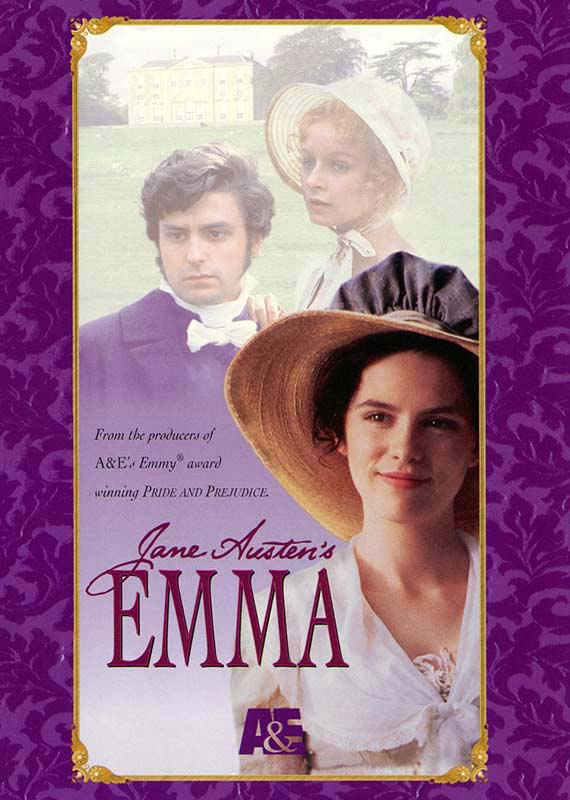
This Sunday marks the return of the Jane Austen series on PBS’s Masterpiece Classics (which means the spring membership drive is OVER! Yay!)
Emma Woodhouse (Kate Beckinsale, Pearl Harbor) has a penchant for matchmaking, despite her imperfect success rate. Curiously, as Emma is forcing introductions, she seems entirely disinterested in finding a match for herself. She does feel a twinge of interest in Frank Churchill, (Raymond Coulthard, He Knew He Was Right) and a brotherly regard for Mr. Knightley (Mark Strong, Stardust). When Jane Fairfax (Olivia Williams, The Sixth Sense, Miss Austen Regrets) enters the scene with a certain air of mystery, intrigue gets layered into Jane Austen’s tale of misconstrued romances. (summary courtesy PBS)
I am going to be woman enough to admit that Emma is my least favorite Jane Austen novel. Jane Austen herself called Emma “a heroine whom no-one but myself will much like.”
There are several things that set Emma apart from Austen’s other heroines, like Lizzy Bennet or Anne Elliot. Emma is the only one of the six (seven, counting Marianne Dashwood, eight if you count Jane Bennet) major heroines for whom finances aren’t a problem. Emma is wealthy. She doesn’t need to worry about securing a good marriage to ensure a comfortable future. In fact, Emma informs her protege, the poor Harriet Smith, that she plans never to marry, because she doesn’t need to. Emma is also the first in precedence in her neighborhood/social circle. She is the woman everyone admires and defers to, so that when she deigns to bestow her time and attention on Harriet, the foundling orphan who grew up in a nearby girls’ school, it is seen as an act of great benevolence. Emma is more closely related to Miss Caroline Bingley or Elizabeth Elliot than to Lizzy or Anne—she thinks more highly of herself than she should and looks down upon those she considers unworthy or beneath her.
Yet Jane Austen manages to redeem her in the end. The metaphoric mirror is held before her, and she realizes the bad judgment she’s used, the awful way she’s treated people, and the fact that she may have lost her only chance at real love—and admits that she deserves to lose him.
But never fear—an Austen hero always comes through in the end! Here, again, there are differences that set him apart. Mr. George Knightley is the oldest of all the Austen heroes, yea, older even than good ol’ Colonel Brandon with his flannel waistcoats. Mr. Knightley is thirty-seven years old, to Emma’s twenty-one (similar to Col. Brandon’s thirty-six to Marianne’s seventeen). He has known her since she was born, lived a mile away at Donwell Abbey all her life, has been a frequent and welcomed visitor over the years, and is related to Emma by marriage—her older sister to his younger brother (unlike Fanny and Edmund from Mansfield Park, who are first cousins and have lived in the same house since she was eight years old). Like the other Austen heroes, he is driven by his high morals and his concern for those less fortunate than himself—and by his love for our heroine (though we’re never really sure why).
There are several other important secondary characters, primary amongst them are Harriet Smith, Reverend Elton, Frank Churchill, and Jane Fairfax. But I’ll let you watch the movie to figure out their characters.
Now, let’s talk adaptations.
More people are familiar with the 1996 theatrical-release adaptation of this film, starring Gwenyth Paltrow (with her terrible, put-on British accent) as Emma and the glorious Jeremy Northam (whom, yes, I did forget to mention in my Favorite British Actors list) as Mr. Knightley. However, the adaptation that is airing on PBS this weekend is the much better Andrew Davies–penned adaptation done for the ITV/A&E in 1997, starring Kate Beckinsale and Mark Strong. In the ’97 version, the characters are much more richly drawn, and, in my opinion, Kate Beckinsale makes a much more likable and believable Emma than does Paltrow. She brings a vulnerability to the character that Paltrow’s Emma doesn’t possess. (She also brings a genuine British accent to the role, but I digress.)
So, without further ado . . . a head-to-head comparison of the actors:
Emma Woodhouse: Gwyneth Paltrow vs. Kate Beckinsale

Gwyneth Paltrow brought a petulance and haughtiness to the role that made her into more of an ice-queen than I believe is found in the characterization in the book. And I didn’t quite believe her reformation in the end.

Kate Beckinsale gives the superior performance of the two, in my opinion. She is a little more snarky, but it comes across less as being cold (like Paltrow) and more as a defense mechanism—to hide any sense of vulnerability she feels, because with her position, she cannot show weakness. And, frankly, I happen to think Kate Beckinsale is prettier.
Mr. George Knightley: Jeremy Northam vs. Mark Strong

Ever since I first saw The Net back in 1993 or ’94, I’ve loved Jeremy Northam. He was the saving grace of the theatrical version of Emma for me, even though I’m not sure his interpretation of the character is spot-on. He does bring a little more lightness and good humor to the role than Mark Strong, but there are a few scenes when he’s just a little too light-hearted to do the character justice. But his “badly done, Emma!” scene makes me cringe every time, he’s so powerful.

The first time I saw the A&E adaptation—after having seen the theatrical release—I wasn’t impressed with Mark Strong as Knightley. He was forgettable. He was stiff and formal and dry. But then, last fall, I saw Stardust, in which Mark Strong plays the delightfully villainous Septimus. Afterward, Ruth and I got to talking about him—about how much he reminded us of “that guy” who played Knightley in the Beckinsale version of Emma. Low and behold, it was the very same actor! So, is it weird that I now really like Mark Strong in this role because he was so good in Stardust? Or is it strange that the first notice I’ve taken of either of these actors was in a movie where they were playing the bad guy? Many years later, now, and more familiar with the story (I hadn’t read Emma before seeing either movie the first time), I have to say that Mark Strong’s potrayal is closer to how I imagine Knightley behaving when I read the book.
Harriet Smith: Toni Collette vs. Samantha Morton

Toni Collette—who is actually Australian, not British—plays a Harriet Smith who is a slack-mouthed simpleton. She cannot seem to come up with a unique thought of her own, and depends too greatly on Emma. Much of what was done to her character was done for comic effect, but it just makes the character look stupid, which she wasn’t.

Samantha Morton gives us a much softer, more humble version of Harriet Smith. She pays attention to what Emma says because she respects Emma’s position, not because she can’t think for herself. And she fits the physical description of Harriet from the book much better.
Jane Fairfax: Polly Walker vs. Olivia Williams

The weird thing about the casting of Polly Walker as Jane Fairfax in the theatrical version is that she resembles Greta Scacchi, who plays Mrs. Weston (her future step-mother-in-law). That, and she just looked too old for the role.

I’ve really become an Olivia Williams fan of late. I think her look is a little softer, her demeanor more retiring, as is fitting for the character of Jane Fairfax. But, frankly, both actresses do an adequate job in the role.
Frank Churchill: Ewan McGregor vs. Raymond Coulthard

Yes, there is a reason I’ve saved Frank Churchill for last—and that’s because Ewan McGregor was so laughably bad in this role, I almost feel sorry for him. With as much as I love him in Revenge of the Sith (Star Wars #3), and with his wonderfully romantic performance in Miss Potter, he’s AWFUL in the theatrical release of Emma. Then, there’s the issue of the cat that crawled up onto his head and died there . . .

I haven’t ever seen Raymond Coulthard in anything else. He’s a decent actor and fulfilled the requirements of the role much better than Ewan did. And if that’s not his real hair, it’s a much better wig than Ewan’s.
Links of Interest
Interview with screenwriter Andrew Davies (see #10)
Listing on IMDb.com
Main page at PBS’s Masterpiece Classics site
Wikipedia Article on Emma
Full Text of Emma on the Republic of Pemberley
For more information on Jane Austen and all of her works:
The Jane Austen Society of North America
The Republic of Pemberley
Hooking the Reader: The Character Investment
I had the opportunity during my Christmas vacation to read the ARC of a historical romance. The opening Hook Line was good, the first few paragraphs strong. But then as I read, I started losing confidence in the writer. You see, the story started with a bang . . . then went stagnant pretty quickly as the author had to go back and explain, in about two full pages of narrative, the events immediately preceding the opening line. Then, the hero, whose POV this is all seen through, not only comes up with an implausible plan—which takes several pages—he ends up accidentally taking an action that makes those pages and pages of his original plan null and void, as the accident sends him on the run. Then, once he’s on the run, the logic of the story falls apart even more with various and sundry minor characters suddenly popping up as someone he’s supposedly built friendships with, not to mention the poor historical research.
I put the book down at the end of the fifth chapter and haven’t picked it up since. What might have kept me reading? A character I liked. There are a lot of flaws I’m willing to overlook in a book if the author immediately draws me into the character, gives me a reason to care what happens to him. In that ARC, not only did I not care what happened to the main character, he was unlikable.
Once again, Creating Credible Characters is a topic I’ve already covered at length, but let’s take a few minutes to look at how, once we create them, we can use them to hook the reader into the story.
A couple of weeks ago, my agent forwarded an e-mail to me from an editor at one of the big CBA houses in response to the proposal for the Ransome Trilogy. The gist of the very long e-mail was that while they like my writing, they don’t like how gloomy the heroine is when we first meet her. They wanted to know if there was a way I could either revise the opening or write a prologue that would introduce Julia when she’s in a happier frame of mind, so that the reader understands that Julia isn’t going to be like that throughout the whole book. Guess what I’ll be working on this weekend! 😉
Last year, I judged an entry in the YA category of the Genesis in which the main character, in first-person POV, was so extremely negative, after a couple of pages, I didn’t want to read any further.
Yet there are some authors who are so adept at characterization, they can introduce a gloomy or negative character as a POV protagonist in the beginning of their novels and they don’t lose us. The secret is building the rest of the narrative around the character so that the reader feels invested in what happens to the character—whether for ill or for good—and wants to know what happens next.
One of my favorite quotes about writing comes from historical novelist Jeff Shaara: “When the characters are ready, the story will come out of me.” As a character-driven writer, this has almost become my mantra. For me, story comes from character. If the characters aren’t well developed when I start writing, or if I’ve misinterpreted who they are, I write myself into a hole and usually have to start over. When I start thinking of a story idea, I don’t just write out a summary of what the story’s about. I write page after page of backstory for each main character—figuring out who they are before I can figure out what the story’s about. Because I have to care about the characters before I can start writing their story.
Not only do they have to be real to me, they have to be unique. F. Scott Fitzgerald once wrote, “Begin with an individual and you will find that you have created a type; begin with a type and you will find that you have created—nothing.” I think that’s the problem with most books in which we aren’t immediately invested in the main character from the first page. The author didn’t spend as much time getting to know the character before they started writing. They just started out with a type—a “good guy,” perhaps—and worked that type into their story.
Readers don’t necessarily have to like our characters—I mean, look at the popularity of characters such as Scarlett O’Hara or Hannibal Lechter. They can be morally ambiguous or even morally reprehensible like those two are—and yet the authors managed to draw us in, to make us want to know what happens to them. Readers must have a reason to invest in the characters, to care what happens to them next—even if it is more of the morbid curiosity that makes us slow down to rubberneck at a car accident.
For Discussion:
Who is your favorite literary character? What makes you like (or even loathe) that character? How was the character introduced in the book? Why did you care what happened to that character? What was it about the character that made you want to read the book?

 KayeDacus.com