Fun Friday—A Fourth of July Musical Tribute

“Seventy-six trombones led the big parade . . .”
For some reason, summertime always makes me want to pull out my favorite musicals and watch them over and over. Maybe it’s because the last one I was in was performed in June and is set in the summer (around the Fourth of July, in fact).
I’m very picky about musicals and what I enjoy, though. I don’t like a lot of the MGM musicals—the whole “this is a musical about putting on a stage-show” cheat doesn’t work well for me. They have to have a strong story (yes, a romance, usually), and the music has to really fit what’s going on in the story, not just be someone all of a sudden breaking into song. So I’m going to spend some Fridays this summer talking about some of my favorite musicals. And since I’ve already mentioned the last one that I was in is set around the Fourth of July, I’ll start with it.
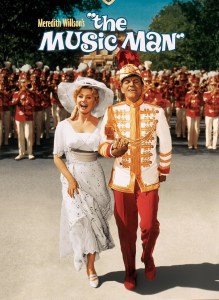 Written for the stage by Meredith Wilson, The Music Man became a hit on Broadway in the late 1950s, and was one of the last major big-production-number musicals made, in 1962. Harold Hill, a conman posing as a traveling saleman has a scheme that’s been working pretty well for him: he comes into a town posing as a band leader and convinces the town that they need him to organize a boys’ marching band to save the town from the trouble it’s in. Along the way, he woos the local music teacher to get and keep her on his side, before he skips town with all the money and leaving the citizens with no band. Hearing other salesmen say that they don’t think he’ll be able to pull the wool over the eyes of people in Iowa, Professor Hill gets off the train in little River City, where prim piano teacher and librarian, Marian Paroo, threatens to expose his whole con. But when Harold’s attention and encouragement begins to bring her younger brother, Winthrop, out of his shell, Marian finds herself softening toward him. Ultimately, Harold must risk being caught and exposed before the whole town because of his love for Marian.
The musical starts off with a rap-like number by the salesmen on the train. The summer that I was in the production, I heard it practiced so often that I knew all the words and cadences—see if you can catch all of it (the number starts around 0:47 in this clip):
Once Harold is in River City, he must come up with an angle—he must find something that threatens the perfect Americana life of its citizens, and, oh, we’ve got trouble, right here in River City. (Something very important to keep in mind is that a billiard table is different from a pool table):
Probably the best-known song from the musical is the one that occurs at the Fourth of July celebration as well as at the finale of the story, “Seventy-Six Trombones.” (I couldn’t find the Robert Preston/1962 version on YouTube, so here’s Matthew Broderick from the 2003 TV remake—but watch the ’62 version if you want to experience the musical—it’s so much better than this.)
I was in a production of The Music Man in 1994. At twenty-three years old, I played Mrs. Paroo—the mother of Marian. We did six performances and three actresses portrayed Marian on two nights each—and I was younger than all three of them! However, Mrs. Paroo had some of the most fun lines in the script, so I enjoyed playing her. And yes, I did the role with an Irish accent. I pulled out the tape and watched it last weekend, and it gave me a little stirring of wanting to be in a stage production of it again . . . but not enough that I’ll pursue it!
In closing, here’s the finale version of “Seventy-Six Trombones” from the 1962 version, complete with the credits for the major cast members. I hope this has whetted your appetite and you’ll rent it or find it on TV sometime and watch it!
An Easy One for Y’all
Something that a lot of people like to do on the Fourth of July is play softball. So in that tradition, I’m throwing y’all a “softball” topic to respond to today.
What are your plans for the Fourth of July? If you’re not in the U.S., what’s your take on our Independence Day and all of the excess we go to celebrating our country’s birthday?
Travel-Time Entertainment
Don’t forget to enter the contest! See link to the right or at the top of the page for details!
So, I actually wrote this post yesterday afternoon since I knew I’d be away from the computer all day today. You see, I’m traveling today—driving six hours to Hot Springs, Arkansas, for a long weekend with my parents.
I’ve written before how road trips are a lot like writing (Road Trips and Writing,
Roadmap to Writing), so I don’t think I need to drag out another analogy comparing traveling to writing, do I?
Instead, I thought I’d focus on what I actually do when I’m traveling.
Since moving out on my own a little more than twelve years ago, whenever I’ve traveled, it’s been almost exclusively alone—with the exception of a few trips to nearby places like Gatlinburg with the singles group from church, or when a friend and I coordinated our flights to Pennsylvania so that we met up in Memphis and flew the second leg of the trip together. I like traveling alone for the most part—I’m not having to wait on anyone else, make decisions with anyone else, or stop when someone else wants to stop (which is always more often than I want to stop).
But this also means long, long hours of being in the car by myself. Now, because of the combination of my personality and the fact that I have lived alone for twelve years, this isn’t as big of a dilemma for me as it would be for some people. But I do have to make sure that I stay entertained while traveling.
And that means audiobooks and music.
When I make the decision to buy/download an audiobook, it’s always a very carefully thought-out decision. I try to choose a book I’ve been wanting to read, or I choose a classic or a book I know I’ll want to listen to over and over and over. My audiobook collection includes all seven of the Harry Potter books, all six of Jane Austen’s major works, a 24-hour-long unabridged version of Little Women, Dee Henderson’s O’Malley series, the novelizations of the three new Star Wars movies, as well as a series from the Star Wars “extended universe” (the X-Wing series), and so on.
Last Christmas, I downloaded two audiobooks from Audible.com. The first one I listened to was Dick Francis’s Dead Heat. I enjoyed it so much that when I arrived in Baton Rouge, I didn’t want to get out of the car, because the story was getting to the juicy part. I love audiobooks like that—they make eight or nine hour drives so much easier. I finished listening to that one about four hours into my trip home. I stopped at a rest area, fired up the laptop and transferred my other downloaded audiobook onto my MP3 player—Hood by Stephen Lawhead, since I’d heard really good things about the story. Unfortunately, only about twenty or thirty minutes into it, I had to turn it off. I was so confused about who was who because the Welsh names for the characters, while probably unusual to the eye if read, were nearly incomprehensible to the ear.
This time, I decided on Deanna Raybourn’s Silent in the Grave, a book I’ve been wanting to read for a while. According to Audible, it’s just over 13 hours total playtime, so that’s perfect for a six-hour drive, especially if traffic is heavy coming back on Sunday. [But I also downloaded my copy of Persuasion onto the MP3 just in case.]
But audiobooks aren’t the only thing I load onto the MP3 player. I make sure I have all of my music loaded onto it too. Because if my mind starts churning on my own stories, the audiobook gets switched off. Since I can’t have a quiet car, I have to have music. So Dean Martin, Frank Sinatra, Steve Tyrell, Nat “King” Cole, Harry Connick Jr., Diana Krall, Tony Bennett, Bing Crosby, and all of the American Standards singers past and present accompany me on the road as well.
So what about you? Any road trips planned for the summer? How will you entertain yourself/your kids in the car?
Seven Confessions and a Compact
Okay, so far, only ten people are entered in the contest. And a word of clarification: for comments to count toward the contest, they must be on the posts dated between June 30 and July 30—no going back to older posts and commenting on those! Also—it should be more than just “Great topic. Thanks for posting it.” I want thoughtful comments that prove you’ve actually read what I’ve written. Yes, that sounds narcisistic, but it is my blog and my contest, after all! For a refresher on the rules, click on the 500th Blog Post Contest & Giveaway link at the top of the page.
First confession. I don’t usually know from day to day what I’m going to post about on my blog. Even when I’m doing series, most of the time, until I sit down to write the post, I’m not entirely sure what the exact topic will be—though with most series, because I have to do a lot of reading, I already have a list of ideas that I want to blog about. And then there are some which I have to plan out very carefully, because it’s a topic that either requires a lot of research or a lot of time to construct. In the speech-giving world, this is considered “extemporaneous” versus “scripted.” Though I hated it when I first started, over the course of the semester in which I took my public speaking class as an undergrad, I learned that I actually enjoy public speaking. However, I’m much more comfortable when I’ve written out the entire speech multiple times so that when I’m up there with just bullet points, I can remember exactly what it is I want to say about each one. Why, then, am I a seat of the pants writer and blogger? If I’m more successful as a speaker when I’ve outlined and planned and researched before I even write the speech, why does the idea of outlining and planning a story stop me cold when it comes to sitting down to write it?
Second confession. Every time I even think about sitting down to write more of Menu for Romance, my second book under contract, I totally freeze up. Usually, when I have such wonderful ideas for conflicts and scenes running around in my head, I can’t wait to sit down and put it all on paper (well, on the computer, anyway). But I’m totally in the grip of some massive fear that I can’t seem to conquer. It’s the fear that all writers deal with: What if what I write doesn’t live up to how it plays out in my head? What if I do write it to my satisfaction and enjoyment but everyone else hates it? What if I write this whole contracted book and the editor decides she doesn’t like it at all and I have to start over from scratch? What if my books are successful and I have to do this again and again and again—write books that are already contracted and face these fears every time? What if I am just a one-hit-wonder, a flash-in-the-pan?
Third confession. I hate okra. It’s slimy.
Fourth confession. At the ACFW conference last year, keynoter James Scott Bell talked about certain people who have an affliction that the fear I just discussed has given me: they want to have written; they don’t actually want to write. Years ago, I used to come home from work and spend most of the evening sitting at my computer composing my stories—if not in the living room at a decent hour, I’d sit in bed with the laptop until 2 a.m. because the words were flowing and I didn’t want to stop writing. Now, I’d much rather be in the process of revising a complete manuscript. The problem is, I can’t bring myself to complete it! What a conundrum.
Fifth confession. I have a hard time writing when my house is in chaos, which it has been the last couple of months. I don’t know how I let it get as bad as it did. Well, I do—I’m lazy and I don’t like housework. I’d pulled out all of the clothes I’d kept from four or five years ago (the last time I lost a bunch of weight) and dragged the boxes into the living room where I tried all of them on. Many of them fit me. A few are still a little too snug. And a bunch need to go away—whether they fit or not—because I’m never going to wear them again. Great project, right? Yeah, except for the fact that until this weekend, every time I entered my living room, I started feeling claustrophobic because of these piles of clothes all around. (I live in a house that’s less than 900 square feet, so we’re not talking a huge living room here.) Stuff in my office started piling up—then in my bedroom . . . it got to the point where I was so overwhelmed by all the stuff that I couldn’t function. I would get home at night and enter a vegetative state in front of the TV every night because I didn’t know where to get started. But this past weekend, when I should have been marathon-writing with my fellow MTCWers, I spent the weekend organizing and starting to get my house, and hopefully my life, back in order so that when I come back from my little mini-vacation this week, I can start over fresh, with renewed motivation.
Sixth confession. I love jellybeans. Except the black ones.
Seventh confession. I’m the world’s worst role-model when it comes to being a “published” author. Aren’t I? I mean, look at everything I’ve confessed. How many times have I quoted or advocated what Madeleine l’Engle wrote in Walking on Water about writing every day? How many times have I talked about how important it is to make sure we push ourselves when we don’t feel like writing? How many times have I experienced in my own writing journey how the less often I sit down to write, the less often I’m going to feel like writing? how when I make myself write even when I don’t feel like it, I’ll eventually have a break-through when it’s all of a sudden 3 a.m. and I’ve written 3,000 words without even realizing it?
The compact. My Dazzlingly Clever Critique Partners, Georgiana and Erica, and I have entered into a compact with each other. For the month of July, we will write 7,000 words per week, which we will submit to each other for crits every 14 days. The three of us are very competitive—in a good natured way—so I know each of us is going to be trying to make sure we beat the others’ word counts. So far, I’m way behind for this week. My excuse has been that I’ve been trying to get the house organized and somewhat clean before I go on vacation. The truth is what I’ve just confessed. So I’ll be scrambling to get some writing done while I’m on vacation!
So, there you have it. Hopefully I’ve given you enough various topics that you can find something to comment on!
500th Blog Post Contest & Giveaway!

On July 31, 2008, I’ll publish my 500th Blog Post on Write Place, Write Time! That means it’s time to celebrate!
The blessing I’ve received from blogging is the feedback that I get from readers—those of you who are reading and commenting almost every single day, as well as those who might visit only once or twice. So my 500th Blog Post is going to be an announcement of the winners of a very special contest!
In a mere six months, my first book, Stand-In Groom, will hit the shelves. But I’m going to give you the opportunity to receive a signed copy before the book is available to the public. And if that isn’t enough, winners will also receive a CD-mix of the songs mentioned in the book, including Dean Martin’s “Ain’t That a Kick in the Head,” “That’s Amore,” and “Return to Me,” along with other American Standards singers like Frank Sinatra and Nat “King” Cole. But wait! That’s not all! Winners will also get an Amazon gift certificate for up to $100!
THE PRIZES
Grand Prize: Signed copy of Stand-In Groom, Mixed CD of music mentioned in the book, and a $100 Amazon.com gift certificate.
2nd Place: Signed copy of Stand-In Groom, Mixed CD of music mentioned in the book, and a $50 Amazon.com gift certificate.
3rd Place: Signed copy of Stand-In Groom, Mixed CD of music mentioned in the book, and a $25 Amazon.com gift certificate.
4th Place: Signed copy of Stand-In Groom, Mixed CD of music mentioned in the book, and a $15 Amazon.com gift certificate.
5th Place: Signed copy of Stand-In Groom, Mixed CD of music mentioned in the book, and a $10 Amazon.com gift certificate.
- I will mail CDs and e-mail Amazon gift certificates as soon as the contest ends; winners will receive their copies of Stand-In Groom as soon as I receive advance copies in December or early January.
HOW DO I ENTER?
1. To enter the grand prize drawing, you must do both of the following:
(a) Submit an anecdote about the funniest thing you’ve ever seen happen at a wedding (your own or someone else’s) in 500 words or less. I along with a panel of anonymous judges (probably relatives) will choose the winner. Entries should be e-mailed to me at kaye (at) kayedacus (dot) com, with a subject line:
WPWT Contest Entry. Entries must be received no later than midnight (U.S. Central Time) Friday, July 25.
(b) Post a comment on at least ten blog posts between Monday, June 30 (today), and Wednesday, July 30. Comments must be relevant to the topic of that day’s post. Only one comment per post will count toward the contest, but each comment over the ten required earns you another name in the “hat”—so the more you visit the blog and comment on posts, the greater your chances of winning.* One comment out of the ten can be a link to an announcement of my contest on your blog (please use this link: https://kayedacus.com/500th-blog-post-contest-giveaway/).
- Eligible non-winning entrants for the grand prize will be entered into the drawing for the 2nd through 5th place prizes.
2. To enter the drawing for the 2nd through 5th place prizes (names to be drawn at random):
Post a comment on at least ten blog posts between Monday, June 30 (today), and Wednesday, July 30. Comments must be relevant to the topic of that day’s post. Only one comment per post will count toward the contest, but each comment over the ten required earns you another name in the “hat”—so the more you visit the blog and comment on posts, the greater your chances of winning.* One comment out of the ten can be a link to an announcement of and link to my contest on your blog (please use this link: https://kayedacus.com/500th-blog-post-contest-giveaway/).
- *Posting a comment on ten posts earns you one entry in the contest; each additional comment (one per post) earns additional entries. For example: if you comment on eleven posts, you’ll have two entries; comment on fifteen posts, earn six entries. The greatest number of entries possible is fourteen (a comment on each of the 23 posts between June 30 and July 30).
HOW WILL I KNOW IF I’VE WON?
I will e-mail winners (so be sure your e-mail address is correct when you post your comments) on Thursday evening, July 30, and the winning anecdote and names of winners will be posted as my 500th blog post on Thursday, July 31.
Fun Friday—Even MORE You Know You’re a Writer If…
Yes, it’s time once again to revisit the wonderful world of “You Know You’re a Writer If…”
~~~~~~~~~~
You know you’re a writer if . . .
• You’ve ever gone anywhere “in character” for research purposes.
• You know that critters aren’t cute little fuzzy animals, but the people who shred any delusions you may have about how wonderful your writing is.
• You would so buy the perfume “New Book Smell.”
• You buy tons of cool gel-ink or other nifty pens and cannot bypass a sale on your favorite spiral notepads even though you haven’t written longhand since the Clinton Administration.
• You found it much easier to write before you knew all the “rules.”
• Whenever you’re at the bookstore or library, you automatically look for the spot where your books will one day be shelved. Or if you’re published, you to go where you know your books are shelved to see if anyone has checked them out/bought them, because you know how many were there last time.
• You aren’t concerned when someone else talks about “the voices” not leaving them alone—in fact, you ask them about their voices and tell them about your own.
• You have random pieces of paper, envelopes, napkins, toilet tissue, and church bulletins scattered throughout your house and car that contain the chapter you’re currently writing.
• Your work uniform is jammies and/or sweats.
• You’ve started chewing coffee beans because actually making coffee means leaving your computer.
• Your diet consists of take-out, microwave/crockpot dinners (which your your five-year-old is in charge of), and CHOCOLATE. Your family has learned to deal with it.
• You know more than ten verbs to describe the way someone walked into the room.
• An ink stain on your middle finger is a badge of honor.
• Poorly written novels make you bipolar—elated knowing that you’re a better writer, and depressed because that hack got published and you can’t get past the acquisitions editor.
• You use semicolons (correctly) in e-mails, forums, and blog posts; you just can’t help yourself.
• It takes you forever to send a text message on your cell phone because it has to be properly spelled and punctuated. “Chatspeak” is totally incomprehensible (not to mention totally annoying) to you.
• Your writing would have made you wealthy by now, if only you’d bought stock in Panera and/or Starbucks when you started.
• When given an essay/paper assignment in school with a ten-page length requirement, the professor turns and looks at you and says, “That means ONLY ten pages!” Your response is, “Is eight-point font okay?”
• Writing is all you can think about when you don’t have time to do it, and the last thing you want to do when you set aside time for it.
• Your coworkers show up at work with red eyes and headaches from partying too much. You show up with red eyes and headache from waking up at 3 a.m. with the perfect conflict for your story.
• You have favorite words—probably a different one each week, month, or manuscript.
• You know the difference between metaphor, allegory, and analogy—and you use all of them.
• You knew you’d never make it as a journalist when you realized you’d rather make up the story than chase down witnesses or experts for quotes and details.
• The thought of sharing a computer with someone else horrifies you. What if they accidentally download a virus? What if they change the settings in Word? WHAT IF THEY READ MY STUFF???
• You live in a constant state of “What if?”
• Getting a contract on a book that’s half-written gives you the worst case of writer’s block you’ve ever experienced.
More “You Know You’re a Writer If . . .” Posts:
You Know You’re a Writer If . . .
More You Know You’re a Writer If . . .
You Know You’re A Writer If, Extended Edition
Writing the Series Novel: Writing Series Endings with Maria Snyder
This interview was originally posted a little over a year ago, but it bears repeating as a wonderful way of wrapping up our series on Series.
Maria V. Snyder changed careers in 1995 from being a Meteorologist to a Novelist when she began working on her first novel, Poison Study. Published in October 2005, Poison Study won the 2006 Compton Crook Award for Best First Novel, won the Salt Lake Co. Library’s Reader’s Choice award, was a 2005 Booksense pick, was nominated for four other awards, and received a Starred Review from Publisher’s Weekly. Maria’s second book, Magic Study was published in October 2006, is a 2006 Booksense pick, and is a RITA Award Finalist.

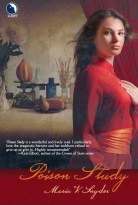


Since, for the most part, my blog readers won’t be familiar with your work, tell us a little about your series.
My “Study” series starts with Poison Study. Poison Study is about Yelena who is in the dungeon waiting to be executed for murder. She’s offered a choice of being the Commander’s new food taster or the noose. She chooses life and ends up getting into all kinds of trouble. Magic Study continues Yelena’s story. This time instead of learning about poisons, she’s trying to learn about magic and how to control her powers. Problems arise unexpectedly and she’s tangled in a plot to reclaim a throne and has to deal with a soul-stealing serial killer who is after her. Fire Study came out in March 2008 and it is the last Study book with Yelena as the main character. In Fire Study she battles a Fire Warper, comes to terms with her conflicting loyalties, and fights the lure of power. The Study series is considered adult fantasy with romantic and suspenseful elements, but I have many young adult readers who are enjoying the books, too. [For more info on Fire Study, click here.]
Did you know when you came up with the story idea that it would be a series?
No. When I wrote Poison Study, I thought it would be a stand alone book. 
When you started writing, did you already know/had you already written the ending?
No. I’m what’s known as a “seat of the pants” writer (aka pantser). I like to discover the plot and twists as I write. However – I usually have a general idea of where and how the book will end, but I wouldn’t write it out until I reach that point, because it can always change.
How did you determine the plot structure for each volume and how each would fit into your overall plot for the series?
As I said before – I’m a pantser so there wasn’t any overall planning for a multi-book series. But what I did discover as I wrote the second book was little subplots in Poison that I could use and expand on for Magic or Fire. For example, in Poison I mention the Kennel Master – who is in charge of the Commander’s dogs – there’s rumor that he might have a magical connection with the dogs so everyone avoids him. That was it – the scene was to demonstrate the Commander’s strong intolerance for magic that makes a rumor ruin a person’s reputation. But in Fire – I used the Kennel Master’s hidden magic for a whole subplot. This is a technique that can be used for someone plotting a long series, planting info and events that seem minor at the time, but will become very important in later books.
How did you decide which subplots to tie up and which to leave hanging at the ends of the first and second books?
I believe you have to tie up all the major plots at the end of each book. I tried to make each Study book a story of itself so they could be read out of order. I will leave a subplot or two without a knot at the end – usually because life is messy and nothing ever gets pulled together completely at the end. My biggest complaint about trilogies is the middle book tends to be just all middle story – nothing is solved and I find myself very frustrated with them.
How did you determine how much information from Poison Study to include in the opening of Magic Study so that new readers could follow along and those who’d read the first book wouldn’t feel like they were being dragged back through the whole story?
That was the hardest part to write! I tried to tell the new story straight on, but when ever I came to a place where the reader needed a little background info, I added an internal thought or some dialogue like when Yelena’s mentor chides her about climbing trees, mentioning she had no trouble before – which leads Yelena to think about the time she had climbed through the tree canopy to avoid being captured.
Have you written the ending of the series? If so, how did writing the end of the last book differ from the first two?
Fire Study is not the end of the series, but it is the end of Yelena’s story. The difference was getting her to a place (both physically and emotionally) where the reader knows that Yelena has fought the good fight and is now a better person. By that point all the questions about Yelena needed to be answered – but I could still leave a few mysteries for future stories.
When you pitched/submitted the series to publishers/agents, did you have a synopsis/3 chapters of each book or just of the first book with a more general synopsis of the sequels?
I submitted the complete manuscript of Poison, and when LUNA books called they offered me a two-book contract. Good thing I had 18 months to write that second book, and that I had an idea for it. The original ending of Poison was revised to be more suspenseful and to mesh better with Magic. I knew I needed to write Fire half way through Magic – and for approval – I sent my editor a 4 page synopsis and they offered me a three-book contract. At that time – I had no idea what books 4 & 5 would be. I’m working on #4 now and it’s set in the Study world, but no title has been approved, yet. Five is still a mystery!
What have you learned about writing through the experience of writing a series that we might not learn through writing single-title/stand-alone stories?
The two things I mentioned earlier – leaving clues in earlier books for later use and how to insert background info without boring the people who have read the first book – were the most important lessons I learned.
Any other words of advice you can share about writing endings?
I tend to be an instinctual writer – while I know where I want my story to end, I’m not going to force it there. I would advice writers to listen to your internal feelings. Your logical mind may say to end with X Y Z, but as you write you might hit a spot (a sentence or a scene) and your heart will go “That’s It!” To quote song lyrics, “Listen to your heart.”
Writing the Series Novel: My Series has Back(story) Problems
Probably the biggest question when it comes to writing series is: just how much backstory do you include in subsequent novels?
Again, a piece of advice from one of my grad-school seminars: when trying to figure out how much backstory to include in a series novel, pretend like you never wrote the first book. According to the person leading this workshop, it doesn’t matter if it’s a spinoff, serial, or sequel, a series novel should never contain more backstory than a stand-alone novel.
This made perfect sense to me when I heard it three or four years ago. But that was before I started writing the Ransome Trilogy, a sequel-series. Now that I’m faced with writing the second book in the series (or will be as soon as I get the second book in the Bonneterre Brides series written—or at least under control), I have to wonder if I’ll be able to just pick up and continue the story as if just continuing the first novel, or if when things happen in the second novel that are precipitated by stuff that happens in the first, I’ll need to include a little explanation of why it’s important or of what happened before that leads the character(s) to make a certain decision.
When I first tried reading The DaVinci code many years ago, aside from being frustrated at the poor level of craft in the writing, I became more and more frustrated by the character’s internal dialogue making a continual reference to some event that happened before this book opened. I remember at one point thinking, If this event is so important, why not show it in this book instead of just referring to it as backstory? Well, after I tossed the book aside (around chapter seven or eight), I found out that it’s actually a sequel to Angels & Demons, and the event happened in that book. Did that make me want to read the previous book in the series? No. But that’s more because of the writing and my lack of interest in the second story than anything else. So I don’t know if that incident had any bearing on what happened in The DaVinci Code or not. All I know is that it didn’t work as backstory—because the event was never explained; it was just referenced.
Around the same time, I picked up the second book in a new historical trilogy by an author whose previous historical trilogies I’d enjoyed. I did approach it with a little trepidation, because I hadn’t been happy with the way the first book ended—though it was multiple POV, the entire setup of the first novel pointed toward the girl getting together with the main male POV character. However right at the end, she makes a sudden and surprising choice to marry someone else—a much more minor character whom we as readers were led to believe was the wrong choice for the heroine. So, as I mentioned, I was already a little leery of reading the second book. But when I did finally pick it up to read, I ended up putting it away about a third of the way through—because the first third of the book was mostly devoted to the male POV character (the one not chosen by the heroine in the first book) rehashing mentally everything that happened in the first book, which was supposed to have been five or ten years before. In other words, the first third of the book was all backstory—and it seemed like it was the author’s way of trying to justify the choice she had her heroine make at the end of the first book.
So here are two examples of series—one in which I’d read the first book, the other in which I hadn’t—where backstory didn’t work for me as a reader. Either it was referenced but not explained as being important, or it was rehashed to the point that the story of the second novel couldn’t get its legs under it and take off.
As with everything in writing, there must be a balance—and that’s where that piece of advice I mentioned above comes in.
When we’re reading a stand-alone novel, we as readers know that there’s been stuff that happened to the characters before the story started that will impact what they do and say within the structure of the novel we’re reading. That’s how we need to approach writing subsequent books in series. Yes, this time we have actually written what comes before. However, we cannot guarantee that anyone will have read that. So we need to treat it the way we treat all of the stuff we wouldn’t include in a stand-alone.
With sequel series, this is much harder done than in the others—especially when it’s a series like Lord of the Rings, where what happens in subsequent books is predicated by what happened in previous books. But as mentioned before, there will always be some series that must be read in order and in full to really be able to understand what’s going on. These are a harder sell for writers; if the first book doesn’t do well, that pretty much guarantees the subsequent novels won’t do well. However, if a sequel series is written so that each could be read apart from the others—while making the reader want to know what happened before and what’s going to happen next—then it’s going to be much more attractive to editors. Because, if the second novel in the trilogy takes off in a big way, it’s much more likely that sales of the first book will increase, and it will create increased demand for the third book. And The DaVinci Code is a prime example of how series books can become popular out of order.
For Discussion:
What does “pretend like you never wrote the first book” mean to you? What are some examples of series books you’ve read that do a good job at weaving the stories together with backstory? What are some that didn’t work quite so well?
Writing the Series Novel: Shattering the Happy Ending
How do you start the next story in the series?
That’s probably one of the biggest questions when it comes to writing a series (the other is about backstory, which we’ll get into tomorrow).
Last week, we discussed ending a series novel. The gist is, no matter which kind of series it is, each novel must give a satisfying ending. If the series is a spinoff series, which picks up with different POV characters, starting the next novel shouldn’t be too hard, as you have two new characters with brand new conflicts to explore. You can throw them into immediate conflict with no problems whatsoever. If your characters from the first book appear at all, they can still be living in the afterglow of their happy ending (if it’s a romance or other “happy ending” story). If it’s a family saga and you’re continuing the story with the kids of the characters in the first book, again, you have totally new characters and new conflicts to explore.
However, if you’re writing a serial or sequel series, you’re faced with shattering the “happy” (i.e., satisfying) ending from the first book and throwing your beloved POV characters into new turmoil and conflicts . . . when you just spent 80,000–100,000 or more words getting them OUT of turmoil and conflicts. This is where your mettle as a writer will be tested—as you’re forced to once again embroil your characters in enough conflict to drive the plot of the next novel, as well as get them closer to the ultimate plot’s climax and resolution.
If you’re writing a serial series, in which you have the same character throughout getting into one fix after another, starting the next story is a matter of finding the right conflict that not only will bring out new aspects of your character but will also allow your character to pick up at the level of development she attained in the previous book(s). Even though each book in a serial series could be read as a stand-alone, for you as the author, it isn’t. You can’t have your character making mistakes that she was making in the first book if you’re in the third, fourth, or ninth book in the series. Even though each book has its own self-contained story/plot, your character must continue to grow and develop throughout the series so that she’s a different person by the end of the series than she was at the beginning—just like she’s different at the end of the novel than she is at the beginning. You, the author, must keep up with her growth, her strengths, her weaknesses. Exploit them for the plot, but never forget what you’ve already put her through, nor the lessons she’s already learned. Don’t have her learning the same lessons over and over and over throughout the series. Revisit if necessary, but don’t just rehash. In other words, don’t start the next book with a crisis that is precipitated by the character doing something she should have learned not to do in the first book.
If you’re writing a sequel series, you’re faced with not only continuing the over-arcing storyline, but with coming up with a plot that will drive the narrative of each of the books in the series. Even if it’s most definitively a “to be continued” story—such as The Empire Strikes Back in the original Star Wars trilogy—each volume of the series must have its own beginning, middle, and end. It must have turning points. It must have a climax and a denoument—even if the denoument doesn’t wrap up all of the loose ends of the story. Most importantly, just like any stand-alone novel, a sequel must begin with a hook and an inciting incident that gets the plot rolling. Remember, you cannot be certain that a reader will have read the previous book(s) in the series. Even if the first line of the first chapter picks up right where the previous book left off, you still need to hook the reader with the first line, the first paragraph, the first page.
This is one area where knowing your story ahead of time can really help out—because you’ll know where to break it into volumes so that each ends with a bang and each starts with a bang.
In a sequel series, you also want to make sure that each volume in the story continues to ratchet up the tension for the characters. Don’t look at a sequel series as individual books; look at a sequel series as one REALLY LONG story. Remember in the Plot or Plod series when I gave the example of a plot looking more like an EKG than a steadily rising line on a graph? Well, I did a quick-and-dirty example for Fellowship of the Ring that shows the rising and falling tension levels in the plot of the story (taken from the movie, not the novel). That’s what you want the storyline of your SERIES to look like as well—ending each volume after one of those tension spikes where the level then drops—but then seeing the tension level rise swiftly (and higher) almost immediately in the next volume.
For Discussion:
Consider the characters of your current WIP. Even if you’re not planning on writing a SEQUEL to the story (as in, continuing the story), what’s something you could do to them that would shatter their “happy ending” and begin a new volume of their story? If you were to write a SERIAL with them, what’s the next conflict you could throw them into? And if you were to write a SPINOFF of your WIP, how would the original characters come into play in the next book? What would you want your readers to know about those characters after the close of their story?
Fun Friday–AFI’s Top Ten Top Tens
This week, the American Film Institute named their top ten movies in ten categories. As with most of their lists, some I agree with, some I’ve never seen, and some I totally disagree with. The titles in bold are ones I’ve seen:
ANIMATION
“AFI defines ‘animated’ as a genre in which the film’s images are primarily created by computer or hand and the characters are voiced by actors.”
1. Snow White and the Seven Dwarfs (1937)
2. Pinocchio (1940)
3. Bambi (1942)
4. The Lion King (1994)
5. Fantasia (1940)
6. Toy Story (1995)
7. Beauty and the Beast (1991)
8. Shrek (2001)
9. Cinderella (1950)
10. Finding Nemo (2003)
My take: I would have placed Cinderella at the top of the list, not because of the quality of the animation, but because of the impact the movie has had on generations of girls ever since it came out. I can understand why Snow White is at the top of the list, because it ushered in the era of full-color, full-length animated feature films. The one on this list that I feel shouldn’t be here is Fantasia. But that’s because it has no storyline. I’m sure they put it on here based on the technical quality of the animation.
……………………………………………………………………
FANTASY
“A genre where live-action characters inhabit imagined settings and/or experience situations that transcend the rules of the natural world. By presenting dreamlike realms where fairies flourish, witches scheme and pigs fly, fantasy demands that audiences believe in magic and hope for wishes to come true.”
1. The Wizard of Oz (1939)
2. The Lord of the Rings: The Fellowship of the Ring (2001)
3. It’s a Wonderful Life (1946)
4. King Kong (1933)
5. Miracle on 34th Street (1947)
6. Field of Dreams (1989)
7. Harvey (1950)
8. Groundhog Day (1993)
9. The Thief of Bagdad (1924)
10. Big (1988.)
My take: Hello? Where is Superman? The Princess Bride? I liked The Wizard of Oz when I was a kid, but I guess because we saw it so often on TV, I grew very tired of it. I love the LOTR trilogy, so no argument there. My problem is with the inclusion of It’s a Wonderful Life. I hate that movie.
……………………………………………………………………
GANGSTER
“A genre that centers on organized crime or maverick criminals in a twentieth century setting. Profit-minded and highly entrepreneurial, the American gangster is the dark side of the American dream. The gangsters’ lifestyles are portraits in extremes, with audiences cheering their excesses and reveling in their demise.”
1. The Godfather (1972)
2. Goodfellas (1990)
3. The Godfather Part II (1974)
4. White Heat (1949)
5. Bonnie and Clyde (1967)
6. Scarface: The Shame of a Nation (1932)
7. Pulp Fiction (1994)
8. The Public Enemy (1931)
9. Little Caesar (1930)
10. Scarface (1983)
My take: Obviously I’m not a Gangster Movie aficionado. I struggled through watching the Godfather series. I did love the syndicated TV series The Untouchables back in the early 1990s.
……………………………………………………………………
SCIENCE FICTION
“A genre that marries a scientific or technological premise with imaginative speculation. Whether it’s a flying saucer whirling through space or a gleaming city on a distant planet, at the core of all science fiction is the provocative question, ‘What if…?’, science fiction presents stories and situations that tap our brightest hopes and darkest fears about what might, one day, turn out to be true.”
1. 2001: A Space Odyssey (1968.)
2. Star Wars: Episode IV – A New Hope (1977)
3. ET the Extra-Terrestrial (1982)
4. A Clockwork Orange (1971)
5. The Day The Earth Stood Still (1951)
6. Blade Runner (1982)
7. Alien (1979)
8. Terminator 2: Judgment Day (1991)
9. Invasion of the Body Snatchers (1956)
10. Back to the Future (1985)
My take: Is Back to the Future science fiction or fantasy? I have to say that I totally disagree with 2001 being the best film in this genre—it’s so boring. I do agree with only the original Star Wars movie being on this list. It was not only groundbreaking, but it was the best. I think I would replace A Clockwork Orange with Jurassic Park and I would replace 2001 with Serenity.
……………………………………………………………………
WESTERN
“A genre of films set in the American West that embodies the spirit, the struggle and the demise of the new frontier. Brimming with subtext and mythology, westerns offer iconic images of a time gone by and perhaps a time that never was. A man of action with an unspoken code of honor, the western hero faces gun-toting opponents, hostile natives, lawless towns, the harsh forces of nature, and the encroachment of civilization. But the westerner keeps going, drawn to the freedom of the open plains and the promise of a new life.”
1. The Searchers (1956)
2. High Noon (1952)
3. Shane (1953)
4. Unforgiven (1992)
5. Red River (1948.)
6. The Wild Bunch (1969)
7. Butch Cassidy and the Sundance Kid (1969)
8. McCabe & Mrs. Miller (1971)
9. Stagecoach (1939)
10. Cat Ballou (1965)
My take: I saw Unforgiven shortly after it came out on video, and hated it. Of course, I’ve never been a Clint Eastwood fan, so no help there. If I had to choose Westerns that I’d put on a list like this, I don’t think I could come up with ten, but I’d have to go with Silverado as my #1 pick, then Fort Apache, Three Amigos, The Magnificent Seven, She Wore a Yellow Ribbon, and, even though I now find it annoying, Dances with Wolves.
……………………………………………………………………
SPORTS
“Whether smashing a ball into the outfield, landing a right hook in the final round or crossing a finish line to the roar of a crowd, sports movies create myths and larger-than-life heroes. The stakes in sports may be simple—someone wins and someone loses—but cheering for a character who faces adversity and aims for the top is an exhilarating reminder of the power of the human spirit.”
1. Raging Bull (1980)
2. Rocky (1976)
3. The Pride of the Yankees (1942)
4. Hoosiers (1986)
5. Bull Durham (1988.)
6. The Hustler (1961)
7. Caddyshack (1980)
8. Breaking Away (1979)
9. National Velvet (1944)
10. Jerry Maguire (1996)
My take: Jerry Maguire is one of the most annoying, most over-rated movies ever made (this is coming from someone who can’t stand Tom Cruise and Renee Zellweger, mind). My favorite sports movie is Remember the Titans. What I find totally unbelievable is that the #1 movie on this list isn’t Brian’s Song. Another one I’d put on my list is Mystery, Alaska. I caught it on one of the movie channels I get, and it was great. Oh, and I’d probably have to include The Game Plan on my list too.
……………………………………………………………………
MYSTERY
“Steeped in the unpredictability of human nature and wrapped in a tangle of plot twists, mysteries inhabit a world where the secrets are dark and the agendas well hidden. Unlike the open-endedness that characterizes so much of real life, a movie mystery delivers the ultimate satisfaction of a solution in the final reel.”
1. Vertigo (1958.)
2. Chinatown (1974)
3. Rear Window (1954)
4. Laura (1944)
5. The Third Man (1949)
6. The Maltese Falcon (1941)
7. North By Northwest (1959)
8. Blue Velvet (1986)
9. Dial M for Murder (1954)
10. The Usual Suspects (1995)
My take: Again, can you tell this is a genre I don’t gravitate toward? I guess if I’m going to watch a mystery, I prefer a lighter British mystery, such as the Miss Marple TV movies.
……………………………………………………………………
ROMANTIC COMEDY
“Romantic comedy spares no one in chronicling the horror and humiliation, the hope and despair, the agony and ecstasy of Cupid’s arrow. Wrapped in fantasy and charm, laced with funny little truths about the human condition, romantic comedies remind us that we’re all susceptible to that crazy thing called love.”
1. City Lights (1931)
2. Annie Hall (1977)
3. It Happened One Night (1934)
4. Roman Holiday (1953)
5. The Philadelphia Story (1940)
6. When Harry Met Sally… (1989)
7. Adam’s Rib (1949)
8. Moonstruck (1987)
9. Harold and Maude (1971)
10. Sleepless in Seattle (1993)
My take: The Philadelphia Story should be at the top of this list! The ones that I love which aren’t listed are 10 Things I Hate About You, The Bachelor and the Bobbysoxer, Bringing Up Baby, My Big Fat Greek Wedding, While You Were Sleeping, and You’ve Got Mail.
……………………………………………………………………
COURTROOM DRAMA
“Innocent until proven guilty. These four words inspire stories where the outcome may be the difference between life and death. The drama inherent in the theatre of a courtroom—the accused enters, prosecution and defense state their case, and a jury deliberates—all build to the moment when a verdict is read.”
1. To Kill a Mockingbird (1962)
2. 12 Angry Men (1957)
3. Kramer vs Kramer (1979)
4. The Verdict (1982)
5. A Few Good Men (1992)
6. Witness for the Prosecution (1957)
7. Anatomy of a Murder (1959)
8. In Cold Blood (1967)
9. A Cry in the Dark (1988.)
10. Judgment at Nuremberg (1961)
My take: Um . . . yeah. Oh—wait, I do have a favorite in this category (because the one I have seen on that list is definitely not a favorite): A Time to Kill. It’s the only Grisham-novel-turned-movie that I’ve watched multiple times.
……………………………………………………………………
EPIC
“A genre of large-scale films set in a cinematic interpretation of the past. Their scope defies and demands—either in the mode in which they are presented or their range across time. A bloody sword fight in an ancient coliseum; carnage on an open battlefield; a country on the eve of revolution. With sweeping interpretations of turbulent times, epics depict characters that, whether nobly heroic or shamefully depraved, are living life on the grandest of scales.”
1. Lawrence of Arabia (1962)
2. Ben-Hur (1959)
3. Schindler’s List (1993)
4. Gone With the Wind (1939)
5. Spartacus (1960)
6. Titanic (1997)
7. All Quiet on the Western Front (1930)
8. Saving Private Ryan (1998.)
9. Reds (1981)
10. The Ten Commandments (1956)
My take: Missing from this list are Gladiator, Braveheart, Glory, and Master and Commander. I totally disagree with the inclusion of GWTW and Titanic on this list—I passionately dislike both of those movies.

 KayeDacus.com