Settings That Inspire
 For the last couple of weeks, National Public Radio has been running a series in which they not only interview mystery/suspense authors, but they visit the cities that these authors have made iconic through their fiction. (See Crime in the City at NPR.) While I haven’t listened to all of the installments in the series (it’s usually on air as I’m running out of the house to try to make it to work on time), there is one thing I’ve noticed in common with those I have heard: the cities in question are all beloved by the authors who write about them.
Which (naturally) leads me to the question: do settings choose the author or do authors choose the setting?
It’s no secret that the setting of my three novels with Barbour are set in a fictional city in Louisiana that has been under development as a setting since 1992. How did it get started? Well, I needed to mask the fact that I was writing a fictional account of the lives of me and my friends from LSU. So I changed Baton Rouge to College Park (and later to Bonneterre) and I changed LSU to ULa (and recently to the University of Louisiana-Bonneterre, because who knew that during the years I would be using this setting, Louisiana would change the names of the smaller state colleges to the University of Louisiana system).
So why have I continued using this setting after all these years?
Well, for one thing, it’s easy. With so many years and stories set in a single setting, especially a fictional setting, I know this city. I know what the big social events are. I know where everything is. If I want to add a feature, I can. By not using Baton Rouge, where I spent every summer as a child and lived from 1989–1992, I’m not tapping into an existing culture nor being bound by a particular city’s real history or layout. Yes, it may be stretching some Louisianians’ imaginations that there’s a mid-size city buried somewhere in the middle of the state (especially for those who live in the middle of the state in Alexandria and surrounding areas). But the truth of the matter is that my experience with actually living in Louisiana is limited, even though I’m there at least once a year. By using a fictional setting instead of a real one, I can tap into my emotional memory of living there and apply it to a setting where I can control all of the cultural constraints upon the characters and events, instead of them controlling me.
In looking at my writing longer term, once I complete the three books in the Bonneterre series, I’ll need to figure out if the next contemporary-set stories I write will also be set there or if it may be time to look at setting my stories in the city where I live: Nashville. But will anyone buy novels that are set in Nashville if they don’t have anything to do with the music business? After all, that’s what the outsiders’ stereotype of Nashville is: Music City U.S.A. Opryland. The Grand Ol’ Opry. The Ryman Auditorium. The home of Country Music. Etc. But having lived here for twelve years, I have an insider’s view of the city that while music is, yes, a large industry in town, so are publishing, auto manufacturing (Saturn and Nissan plants, Nissan just moved their US headquarters here and Volkswagen just announced they’re doing the same), healthcare, aeronautics manufacturing, telecommunications, and so on. It’s also got a great history, from Daniel Boone to Davy Crockett to General John Bell Hood.
But would the setting (Nashville) be important to the story? Or would it just serve as a more generic city? What part of the culture of the location would I be incorporating in the story? What is this area’s culture if I don’t have at least one of the characters involved in the music industry? Would I be setting the stories here because it’s easy—since I live here—or because it’s for some reason a facet of the story that it takes place in Nashville, Tennessee?
I’ve discussed settings on this blog quite a bit before, yet still these questions persist. It’s easy to think of continuing to use Bonneterre as a setting for the foreseeable future—because, after all, I’ve “lived” in (with) Bonneterre for most of my adult life (I’ve lived in Nashville since 1996—four years less). Bonneterre is a part of me, because it came out of my imagination. However, I also have to think that while readers can enjoy a fictional setting, readers can connect even more with a real setting, especially one where they live or where they’ve visited or where they’d like to visit.
I’m not certain what I’m going to do (and plan to discuss this with my editor in September). I’m not leaning one way or the other right now. All I know is that I do need a good reason for the setting I choose so that I can use the setting as part of the story: to create culture and conflict, for events and things the characters can do, and to develop the background of the characters.
My historical trilogy is set in England, Jamaica, and aboard ships of the Royal Navy in 1814. For the story to work, it had to be set there because the story wouldn’t exist outside of it. So, in a way, instead of the setting being inspired by the story (like Bonneterre), the story was inspired by the settings. And that inspiration grew out of my love of that setting developed through my love of the stories of Jane Austen and the Horatio Hornblower series. There was no question about where I would set those books.
How do you choose your settings? Does your story dictate where it needs to be set, or has you developed your story around a particular setting? Are there certain places you’d like to set stories because those cities/towns/places inspire you?
Fun Friday–Our State Fair Is a Great State Fair

“Our state fair is a great state fair;
Don’t miss it, don’t even be late!
It’s dollars to donuts that our state fair
Is the best state fair in our state!”
After Seven Brides for Seven Brothers, Rodgers & Hammerstein’s State Fair is my favorite musical. It could have something to do with the fact that it’s probably the only musical ever written where both of the leading female roles were written for altos, which means I can sing along at the top of my lungs without straining anything. But, really, I think it has more to do with the wonderful music and the simple but wonderful parallel romance storylines.
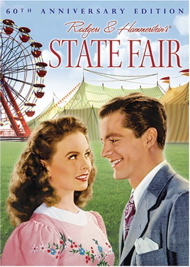 Based on a novel by Phil Strong, State Fair was originally made as a non-musical movie in 1933 starring Will Rogers, Janet Gaynor, and Lew Ayers. Because the story proved very popular amongst movie goers, in the early 1940s, it was thought that a musical version would do well. With Oklahoma! a huge success on Broadway, Rodgers & Hammerstein were approached and asked to adapt the story into a musical. They agreed—as long as they didn’t have to go to Hollywood to do it. Released in 1945, it would be the only musical they would ever write only for the movies. (The first stage version wasn’t produced until the 1990s.)
The cast is stellar, including the divine Dana Andrews (Laura, The Best Years of Our Lives), Jeanne Crain (A Letter to Three Wives, People Will Talk), one of the top crooners of the day Dick Haymes (whose biggest hits include “You’ll Never Know,” “Room Full of Roses,” “It’s Magic,” and several of the songs from State Fair that he re-recorded as singles), and Vivian Blaine (Guys & Dolls).
The storyline is pretty straight forward. The Frake family is headed for the Iowa state fair, each with his or her own goals: Dad wants to win the grand championship with his Hampshire boar Blue Boy; Mom hopes her mincemeat and pickles are winners; son, Wayne (Dick Haymes), wants to get back at the carnie who swindled him the previous year; daughter, Margie (Jeanne Crain), wants to get away from the doldrums of farm life—and her dull beau.
In what is perhaps the best-loved song from the musical, here is Margie (singing dubbed by Louanne Hogan) expressing her desire to do and see something different for a change in “It Might as well Be Spring”:
Even though he has a girl back home, when Wayne meets singer Emily Edwards (Vivian Blaine), he’s smitten and ends up spending most of his time at the fair with her.
Margie also has a chance at romance when she meets newspaper reporter Pat Gilbert (Dana Andrews) on the roller coaster. But will their love affair last longer than the fair?
And what’s a Rodgers & Hammerstein musical without a song about the state in which it’s set? Here’s one of the most fun sing-along songs in the film, “I Owe Ioway”:
Another version was made in 1962 starring Pat Boone, Bobby Darin, and Ann-Margret—but if you’re going to watch this, the 1945 original version is definitely the best (especially since one of the new songs written for/included in the 1962 version is the very rape-y “Never Say No to a Man” sung from mother to daughter).
If you do ever have the opportunity to see it on the stage, I highly recommend it. When it was adapted in the early 1990s, they added a few songs back into it that had been cut from the film (including Abel Frake crooning a lullaby to Blue Boy) as well as some that had been cut from other R&H musicals, like Flower Drum Song. Because it’s longer, they were able to add more humor into it, as well as develop the characters and the relationships much better.
Make this a State Fair weekend!
Comfort Zones
We’ve had an ongoing joke in my local writing group, Middle Tennessee Christian Writers, about how on the second Saturday of every month, we’re the most extroverted group of introverts anyone has ever seen. This most recent meeting, we had a visitor come who’d found out about our meeting through the announcement on our group blog. Usually what happens is that someone posts a comment that they’re interested and they’d like to be contacted by “one of the moderators” (me) and we have an e-mail dialogue before they visit one of the meetings. I can thoroughly understand someone wanting to do this—it’s more comfortable to visit a new group when you’ve already met someone there (even if it’s just through cyberspace). But this gal just decided to come and check us out. Well, come to find out, she’s an extrovert—doesn’t mind going new places and meeting new people; in fact, she probably is stimulated personally and creatively by doing so.
Most of us always assume that a great majority of writers are introverts. And I’m using that term in the technical sense—introverts need time alone, it’s through solitude or time away from others that introverts recharge and get energy; being around large groups of people is extremely draining for the true introvert. (Extroverts, naturally, are the opposite and get their energy and stimulation from being around people; they have a tendency to shut down and become depressed if forced to spend too much time alone.) Those who are closer to center (like me) can do both when need be, but always we revert back to our natural inclination (which, for me, is getting away from it all to recharge).
I’m starting to wonder now if that commonly held belief that most writers are introverts is as true as we think.
Think about writers who talk about how they can’t work in silence, or they get their best work done down at the local coffee shop where people are coming and going all the time. Now, I personally, don’t work well with complete silence. I almost always have music playing—but very softly in the background. But there’s no way I’d be able to write in a coffee shop where people are talking, the register is going, the barristas are taking orders, the doors opening and closing—I’d find it far too distracting. Yet some writers love this environment. I’d venture a guess they’re extroverts.
People who’ve met me at conferences have a really hard time believing that I’m not an extrovert, that I am very uncomfortable when in large groups, and that for me, approaching someone I’ve never met and talking to them is one of the hardest things I do. For a couple of years, being an officer with ACFW made it somewhat easier because I was representing the organization, not myself. I’ve also learned over the years techniques for networking and taught myself (through lots of practice) how to handle social situations not by focusing on the large group of people surrounding me, but by focusing on only a few people out of that large group. (For more tips and tricks, check out the two series on Networking on the Writing Series Index page.)
Ah, yes, networking. You’ve read about it often enough here, and heard about it elsewhere. Why is it so important to push ourselves out of our introverted comfort zones and do something we don’t enjoy?
As I’ve stated before, you don’t have to network in order to get published. You don’t have to be a member of a professional writers’ organization (ACFW, RWA, MWA, etc.). You don’t have to attend conferences. You don’t have to blog. You don’t have to enter contests. You don’t have to do anything but write and submit in order to pursue publication. But those things sure do help.
How many times have I relayed the story about how I knew my agent for a couple of years before I ever submitted anything to him? He not only interviewed me for a job (when he was publisher of one of the CBA houses located in Nashville), but from that meeting came an idea for a project that we worked on together for ACFW. I took his continuing education session at that year’s ACFW conference. The next year, I’d planned to seek him out at conference just to touch-base and keep the dialogue open—and then I learned he’d left the publishing house and was opening an agency. Since I was only there for one evening (the banquet), as soon as I saw him walking down the hall, I had a decision to make: stay in my comfort zone, not put myself forward, OR talk to him and ask him if I could submit. The conversation lasted less than two minutes. And he’s now my agent.
Knowing the boundaries of our comfort zones is important, because if we don’t know where the boundaries are, we won’t know in what areas we need to be pushing ourselves.
Building name recognition (in a good way) before publication is important. If you are actively involved in your writing organization, if you are successful in contests, if you volunteer or serve as an officer, if you write a blog that generates interest amongst other writers—and possibly editors and agents—then when you start submitting, if the editor whose desk your proposal lands on recognizes your name, he or she might be a little more interested in looking at it (just like we’re always more interested in reading debut novels by people whose names we recognize than those we don’t).
This year at conference, I’ll be pushing my comfort zone by giving one of the morning devotionals as well as volunteering to be a timekeeper for the editor/agent meetings. But in a way, this was sort of a selfish act. You see, I enjoy public speaking, so getting up in front of everyone (though I’ll be nervous) will be enjoyable for me. And when I saw the call for volunteer timekeepers, my heart leapt because all I could think of was being able to be there for all of those people who are so nervous they’re nearly sick to their stomachs—to be able to talk to them, and possibly pray with them, beforehand, and to be able to see them afterward. Yes, it will mean talking to a bunch of people I’ve never met before, but it meshes so well with my desire to lift up and encourage other writers that it’s an easy way to step out of my own comfort zone.
So I challenge you: what’s one way you can step out of your comfort zone to help further your writing career this year?
Brainstorming and Viral Marketing Help Needed
Between some fabulous marketing brainstorming we did as a group at the Middle Tennessee Christian Writers’ meeting Saturday (which lasted almost four hours, instead of our scheduled two!), I’ve spent several hours today brainstorming the plot points for Menu for Romance.
First, I want to talk about what we were brainstorming so long at MTCW, because it’s something that everyone reading this blog can help out with, if you’re willing.
How do publishing houses get started? Well, someone who loves the written word, who has a heart for getting books in the hands of readers, decides that they want to take the risk to start a business to do that. A very dear friend of mine, Joan Shoup (that’s pronounced SHAUP not SHOOP), has done just that. If you haven’t been following her journey in starting Sheaf House, after you finish reading this post, you need to hop over to her Sheaf House blog.
But, like every new business just taking off, Sheaf House is struggling to get the word out about its products. Joan really needs to get the sales numbers for Sheaf House’s first release, One Holy Night by J.M. Hochstetler (Joan’s penname), up to the five or six thousand range. Now, don’t rush off to Amazon to order it just yet—it won’t be up and live for purchase for a few days yet (and I’ll let you know when it is). Here’s where the brainstorming part of our meeting began.
One thing we really need to do is get people talking up One Holy Night and creating a buzz about it and the two books that are coming out this fall: Michelle Sutton’s YA romance, It’s Not about Me, and A. K. Arenz’s cozy mystery, The Case of the Bouncing Grandma (which are available for preorder on Amazon). I know that most of the people reading this blog already have TBR piles that are about to create a fatal avalanche of books in your home. But these are wonderful books and a great way to support Sheaf House and our fellow writers. Please, please, consider purchasing these books—and ask your friends and family to as well!
We want to create not just a sales surge for One Holy Night when it’s “live” on Amazon again, but we also want it to be a recommended title connected with a bestseller (probably The Shack). If you’re interested in participating and don’t mind purchasing two books, let me know and once we work out all the details, I’ll e-mail you the details. Even if the bestseller is one you already own, you can donate it to your library or local literacy program or to a gift box going overseas to our soldiers.
If you are interested in featuring Sheaf House, One Holy Night, and/or Joan on your blog, or if you’re involved in a reader’s club and want recommend it as a book for your group to read, let me know, and I’ll get you in touch with Joan.
Let’s put the power of “word of mouth” (a.k.a. “viral”) marketing to work and support a fledgling publishing house that is putting out powerful, meaningful fiction the likes of which readers aren’t going to be able to get anywhere else.
~~~~~~~~~~
Now, the other brainstorming I did this weekend is on Menu for Romance. You’ll notice that I’ve put a second counter in the widget in the right navbar. I’ve marked it my second draft, but really it’s my third, since what’s tracked in the first counter is actually a restart from what I had written last year. But I’m trying to simplify things.
Two weeks ago, I mentioned that I was going to go through and write out the basic structure based on Billy Mernit’s seven beats of the romance story. The night I got home from vacation, I started it on my whiteboard. But then I realized my mistake—when I needed to go back up in the list and fill in an earlier beat with an idea, I ended up erasing whatever was underneath my hand as I wrote. Yikes! I was losing lots of good stuff.
A while back, I purchased a flip-chart at Sam’s. I bought it to draw a map of Bonneterre (the fictional city where Stand-In Groom and its sequels are set), but then set it aside and never did anything with it, nor the set of Sharpies containing 36 colors. So I got it out and copied everything from the whiteboard onto the flip chart:

The stuff in the middle is hard to see—that’s the “rising conflict” section, and I was penciling in ideas for conflicts that could happen during that part.
Well, today, after sending the revised first three chapters to the crit partners on Saturday, before moving on with revising/rewriting what already exists (that 41,000 words on the first of the two counters up above) I decided I needed to ask/answer some questions to make sure that I’m not going to get midway through again and decide again that I don’t like the direction the conflict is going again. So I just started by writing questions, then thinking of all the possible ways I can write the conflict:

(Visually oriented me: pink is for Meredith, aqua for Major, and yes, it’s sitting on one of my extra office chairs, because I don’t have any free wall space in my office to hang it up!)
So there you have it. I think I’ve answered the pressing questions and can now move on with the new stuff I need to write for chapter four. And my goal is for that second counter over there to be moving at a pretty brisk clip right now, since I’ll be salvaging as much as I can from what’s already written as I write new stuff for the new/changed conflicts.
Don’t forget: if you’re interested in helping out with the viral marketing campaign for One Holy Night, be sure to mention that in your comment and I’ll contact you via e-mail.
Fun Friday–A Passel of Frontiersmen Seek Brides
“Tell you ’bout them Sobbin’ Women, who lived in the Roman days—
Well, it seems that they all went swimmin’ while their men was off to graze.
A Roman troop came ridin’ by and saw them in their me-oh-mys,
So they took them all back home to dry.
‘Least that’s what Plutarch says.”
As mentioned last week, I’m going to spend a few weeks featuring some of my favorite musicals on Fun Fridays. Today’s entry: Seven Brides for Seven Brothers.
Trailer:
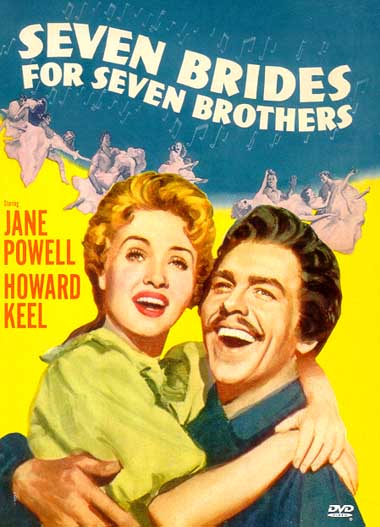 This is one of the few musicals that was not originally a stage play before becoming a film. Released in 1954, the story is based on a short story penned by Stephen Vincent Benet, a popular writer for the Saturday Evening Post and short-story author, whose best-known work is probably The Devil and Daniel Webster. Benet’s short story The Sobbin’ Women was itself based on another story—the Roman legend of “The Rape of the Sabine Women” (rape in its ancient usage meaning kidnapping), which is recounted in Plutarch’s Lives.
The film was directed by Stanley Donen (also known for Singin’ in the Rain), with music and lyrics composed by Saul Chaplin (An American in Paris, Westside Story), Gene de Paul (In the Navy), and Johnny Mercer (who penned the lyrics to such classics as “Come Rain or Come Shine,” “Ac-Cent-Tchu-Ate the Positive,” “That Old Black Magic,” “Jeepers Creepers,” and “Hooray for Hollywood”). The production numbers were choreographed by Michael Kidd, who would go on to choreograph My Fair Lady and innumerable Broadway productions.
The story centers around the seven Pontipee brothers. When eldest brother Adam (Howard Keel) returns from a trip to town with a wife, his six younger brothers—while learning etiquette from their new sister-in-law, Milly (Jane Powell)—take a notion to get wives for themselves. So Milly tries to teach them about “Goin’ Courtin'”:
When the family attends a barn raising, the boys meet six eligible women and do their best to behave, but, as always happens with the Pontipees, trouble is bound to happen! And this is where Michael Kidd’s choreography shines!
Well, because the boys get into a fight with the girls’ original beaux, the boys are certain they’ll never win the hearts and hands of their girls, but Adam (whom Milly agreed to marry after just one meeting) has some advice for his brothers (after “Goin’ Courtin’,” this is my favorite song in the musical):
 So the brothers take matters into their own hands and go get their brides . . . except there’s a little hitch in the proceedings. But I’ll let you watch the movie to find out what that is!
On a personal note, my favorite brother is the second eldest and best looking, Benjamin (Jeff Richards). Not only that, but I love the girl he ends up with, played with stately grace by Julie Newmar, Catwoman from the 1960s Batman series and inspirational icon for the movie To Wong Foo, Thanks for Everything, Julie Newmar.
The one song/production number in the film that never did sit right with me, and which I forward through every time I watch it is the “Lonesome Polecat” song. There’s just something not right about that song and that sequence.
Fictional Writers: Anne Shirley
- “What’s your name?”
The child hesitated for a moment. “Will you please call me Cordelia?” she said eagerly.
“
Call you Cordelia! Is that your name?”“No-o-o, it’s not exactly my name, but I would love to be called Cordelia. It’s such a perfectly elegant name.”
“I don’t know what on earth you mean. If Cordelia isn’t your name, what is?”
“Anne Shirley,” reluctantly faltered forth the owner of that name, “but oh, please do call me Cordelia. It can’t matter much to you what you call me if I’m only going to be here a little while, can it? And Anne is such an unromantic name.”
And thus we’re introduced to Anne Shirley. This year marks the 100th anniversary of the publication of Lucy Maud Montgomery’s classic novel Anne of Green Gables, the first installment in a series of eight books about the inimitable orphan Anne Shirley. When first published, the book was considered a great success by selling 19,000 copies in the first five months. A century later, more than fifty million copies are in print. It has been adapted into a very successful and popular set of miniseries (though the third one, while wonderful, has absolutely nothing to do with the story originally penned by Montgomery), musicals, stage plays, dolls, and other peripheral items such as dishes and linens.
~~~~~~~~~~
 Lucy Maud Montgomery (1874–1942, called “Maud” by friends and family, known as L.M. Montgomery as an author) was born in Clifton, Prince Edward Island, Canada. Her mother passed away (from tuberculosis) when Maud was very young. Her father moved her to Saskatchewan, and shortly thereafter, she returned to Prince Edward Island, to Cavendish, to be raised by her very strict maternal grandparents. Though she would return to Saskatchewan for a brief time, she spent most of the rest of her life on Prince Edward Island, as well as in Nova Scotia. She attended Prince of Wales College in Charlottetown, where she completed the two-year teachers’ program in a year, then went on to study literature at Dalhousie University in Halifax, Nova Scotia. After teaching in a variety of schools around the islands, she returned to Cavendish, PEI, in 1898 to live with her widowed grandmother. In 1901, she returned to Halifax, where she wrote for the two newspapers, but she returned to Cavendish in 1902 to care for her grandmother. During this time, she began writing Anne of Green Gables, which was published in 1908 (at age thirty-four, if anyone’s counting).
In 1911, she married minister Ewan MacDonald, and they moved to Ontario so he could take up the leadership of St. Paul’s Presbyterian Church in Leaskdale. It was from the Leaskdale Manse that Montgomery wrote her next eleven novels.
Montgomery died in 1942, and is buried in the Cavendish cemetery on Prince Edward Island. Twenty of Montgomery’s novels were published, but of those, Anne of Green Gables remains the most popular and well-known.
~~~~~~~~~~
 Anne Shirley (that’s Ann-with-an-E) comes to Avonlea on Prince Edward Island when she is eleven years old. She is adopted by brother and sister Matthew and Marilla Cuthbert, who live in a large farmhouse with a multi-gabled, green roof, commonly known as Green Gables. Because of her difficult life before coming to Avonlea, Anne has lived in a world of imagination ever since she can remember. She has an overblown ideal of “the romantic” and seeks it in every aspect of her life—leading to some quite humorous “scrapes” and disasters. Living close-by is Diana Barry, whom Anne claims as her “bosom” friend. Believing her own red hair to be a curse, Anne envies Diana’s dark tresses and teaches the very grounded Diana how to dream and pretend.
Though her arrival causes a stir in the small community, especially with neighbor Rachel Lynde stirring the gossip up, Anne eventually wins the hearts of the residents through her kindness, her generosity, her humor, and her accomplishments. Anne is challenged in those accomplishments by Gilbert Blythe, the boy whom she originally cannot abide for his major mistake of calling her “Carrots,” due to her red hair. Anne works hard to beat Gilbert for the top marks in school.
Anne and Gilbert, and a few of their friends, eventually end up in the teachers’ program at Queens College in Charlottetown, where, once again, Anne finds herself in competition with Gilbert for academic honors. Eventually, they reconcile at the end of the first book and become friends.
Like Jo March from Little Women, Anne’s first forays into writing are by penning fantastical stories. Where Jo’s were of marauders and pirates and highwaymen, Anne’s are of fantastical, romantic worlds, with damsels in distress and knights in shining armor to rescue them.
When assigned to write a story for a school composition assignment (by Anne’s beloved teacher, Miss Stacey), Diana admits to Anne that she cannot possibly come up with a story to write. So Anne starts a story club where she, Diana, and their friends will make up and write down stories. Marilla thinks this is complete and utter nonsense, to which Anne responds:
- “But we’re so careful to put a moral into them all, Marilla,” explained Anne. “I insist upon that. All the good people are rewarded and all the bad ones are suitably punished. I’m sure that must have a wholesome effect. The moral is the great thing. Mr. Allan says so. I read one of my stories to him and Mrs. Allan and they both agreed that the moral was excellent. Only they laughed in the wrong places. I like it better when people cry. Jane and Ruby almost always cry when I come to the pathetic parts. Diana wrote her Aunt Josephine about our club and her Aunt Josephine wrote back that we were to send her some of our stories. So we copied out four of our very best and sent them. Miss Josephine Barry wrote back that she had never read anything so amusing in her life. That kind of puzzled us because the stories were all very pathetic and almost everybody died. But I’m glad Miss Barry liked them. It shows our club is doing some good in the world. . . .”
Though Anne eventually puts her writing aside to focus on raising her children, we can learn a lesson from her fearless approach to life and to writing—the idea of living in the imagination, letting it overcome us until we can do nothing but tell the story, lest we lose it.
Resources and Articles:
100 Candles: Anne of Green Gables Grows Old and Gets Her Due
Virtual Green Gables
Prince Edward Island
The Films
Four of the novels online:
Anne of Green Gables
Anne of Avonlea
Anne of the Island
Anne’s House of Dreams
Midweek Motivation
This is something I posted on the forums at ACFW yesterday. It’s adapted from the discussion topic from my Weight Watchers meeting earlier this week.
With the ACFW conference only ten weeks away, many writers are beginning to feel anxious and experiencing writer’s block when it comes to accomplishing their writing goals by then—whether it’s what they’re going to be pitching to editors/agents, getting their submission polished for their paid critique, or just the prospect of attending their first writing conference. Since the WW topic was about motivation, and since I really need motivation in both “W” areas of my life right now (writing and weightloss), I adapted the topic from losing weight to writing.
~~~~~~~~~~
What is the motivating factor that made you decide to pursue publication—by submitting, by pitching, by attending a conference? Was it wanting to be published? Was it wanting to get a message out to readers? Was it being so full of stories you might just burst and wanting to share those stories with others?
Whatever it is, write it down. Tape it to your computer monitor and/or the bathroom mirror. Keep that motivating factor top of mind all the time.
- I’ve been thinking about this for several days now. I’m not sure that I can pinpoint it to any one particular instance, except the fact that writing has always been such a part of my life that even when I was in college the first time and was told by my writing professors that I’d never succeed (because I write romance and not literary fiction, I now know), it didn’t stop me from writing. For as long as I can remember, I’ve dreamed of being a published author. That dream, that love of story, is my motivating factor. Oh, and proving those college profs wrong is nice too.
There are three stages of working toward publication:
1. The Honeymoon—You love writing. You’ve taken some online courses and maybe attended a conference or two. The friends and family who’ve read your stories love them and tell you you’re a better writer than everyone on the bestsellers’ list.
2. The Thrill Is Gone—You don’t final in the first contest you enter—nor the second nor third. You join a critique group and discover that you don’t know as much about the craft of writing as you thought. You learn that your beloved story has all kinds of plot holes and that you have a tendency to use “as” and “so” too much. You have a file full of form rejection letters/cards from every publishing house and agent in the market. You have massive writer’s block and would rather vegetate in front of the TV than write. You wonder why you decided to do this in the first place.
3. Renewed Resolve—You go back to the beginning, back to the Honeymoon stage. You remember your motivating factor. You ask for accountability with making sure you write every day. You realize that it takes planning and discipline to be a writer. You also remember that God gave you this talent and that you’re following His calling on your life. You keep submitting, keep studying, keep learning, keep writing, because you know you’re doing what you’re supposed to be doing.
The things in our lives that throw us into stage 2 are stress, tragedy, boredom, fatigue, emotions, and falling into old patterns. Being aware of these triggers doesn’t make them go away, but helps us manage those times. That’s when we need to consciously work to move ourselves into stage 3—by asking for help, by reviewing our crit partners’ feedback along with the comments on contest entries, by looking back at where we were when we started, by shaking things up a little bit and maybe trying something new or different as a kick-start.
- I’m definitely in stage 2 right now, but I’m trying to move to stage 3. The discipline is what’s lacking at the moment. But I’m determined to get there this week. Because I have to submit something to my critique partners on Saturday, and I’ll be darned if I don’t have at least a chapter or two for them to critique!
To be successful . . .
Do what successful athletes do: visualize yourself as a success. What publishing house will you be published by? How many copies of your book will sell? Where are you going to do book signings? How many more books will you write? How will being published affect your daily life? How will your stories impact the lives of readers? What kind of feedback will you get from readers?
What will success feel like for you? Will you be more confident? more self-assured? more assertive?
Start practicing those things now—practice being more confident and self-assured. Be more assertive. NOW. (For ideas on how to practice these behaviors, check out the two series on Networking on the Writing Series Index page.)
And most of all, you must persevere and not let one negative critique or contest score affect your relationship with your story or your feelings about yourself as a writer. Or, if you’re like me, you must persevere and ignore the fear that comes from actually achieving a measure of success. Again, I’m struggling to do this and plan to conquer it this week as best I can. Then I’ll start next week and conquer it again. And the next week . . .
Oh, and in case you haven’t noticed, per Jess’s request, I’ve added a new widget to my right-sidebar containing the counter for MFR. I’m going back and concentrating on revising and shoring up the 41,000 words that show on the counter currently, but hopefully once that’s done, you’ll start to see that counter moving every single day!
Can a SOTP Writer Become a Plotter?
I have always been a seat-of-the-pants (SOTP) writer, even well before I had ever heard that term. I almost never knew, beyond the fact that the hero and heroine are supposed to end up together, where my stories were going when I sat down to write them. With my first three manuscripts, I just sat down and wrote. Started with Chapter One and wrote straight through, discovering the story as I went along, being as surprised by the twists and turns the story took as if I were reading a book written by someone else.
Of course, that was before I started graduate school and learned all the ins-and-outs of plotting, character development/arc, story beats, and pacing. All of a sudden, there were elements of writing a story I kind of had to know before I could actually sit down and write one. Which is why my three manuscripts since then, Stand-In Groom, Ransome’s Honor, and Menu for Romance, have all taken me much longer to write, and have all required a couple of re-starts—because once I got into them, I found major holes in the stories or characters behaving in ways that didn’t lend to a good character growth arc.
A week or so ago, I pulled out the notebook containing the printed copy of my first complete manuscript—a six point-of-view romance/women’s fiction novel that I wrote in nine months following the first writing conference I attended. It’s the one where I practiced what I’d learned about limited POV and writing every day even when I didn’t feel like it. The amazing thing is that the story is strong, the main conflicts and plotlines are easily identifiable, and, even though the pacing suffers in places, the narrative drives toward the ending.
So why, over the last four years, have I had trouble repeating this process of just sitting down and writing a story?
Part of the difference is that I’d been “working with” the characters in What Matters Most for a couple of years before I started writing it. I’d started developing the lead female character, Bekka d’Arcement, and her four best friends several years before I figured out which of their stories I was going to write first. So I knew her quite well by the time I started writing. I knew less about the main male character, Andrew Blakeley, when I first started writing; but like Bekka, I got to find out his background and personal history as the novel moved along (which kept me from including too much backstory in the beginning of the novel). The other four POV characters were some I’d been working with for a while too.
So, in essence, even though I hadn’t been actually writing the manuscript for a couple of years, nonetheless, the story had still been in development for a couple of years. Same with the second book I wrote, which centered around another one of these five friends.
My third manuscript was an exercise in writing a contemporary-set tribute to my favorite Jane Austen novel, Persuasion, so I already had a pretty good idea of which direction the story needed to go when I started writing. Even though I hadn’t come up with the characters but about a month before I started writing the stories, they were based on Anne and Frederick, so I knew them in essence.
Stand-In Groom, however, started from the fact that I didn’t like the storyline of a certain movie about a wedding planner who falls in love with a client. I wanted to tell the story of a wedding planner who falls in love but doesn’t break up her client’s wedding by stealing the groom. Unfortunately, it took me about a year and a half—and three versions of the first ten chapters—to figure out who my characters really were and what their conflicts were.
With Menu for Romance being a spinoff of SIG, you’d think it would be easier to write, right? Well . . . while Meredith and Major are secondary characters in SIG, they don’t have a significant on-page presence, so I didn’t really spend a lot of time with them. In fact, up until I realized I wanted Meredith to be the heroine of a spinoff novel and that Major was the guy she was going to end up with, he was actually married in the original draft of SIG! But as I expanded his role a little bit, as he grew on me, I realized he was the perfect hero for Meredith. However, I still didn’t know that much about either of them when I started writing MFR.
Now that I’m facing a deadline to get this book written, I realize that winging-it isn’t going to suffice with this manuscript. So last night, I pulled out my big flip-chart pad and my copy of Billy Mernit’s Writing the Romantic Comedy and determined the seven story beats of Menu for Romance. I also started penciling in the ideas for conflicts I’ve had and brainstormed a few more.
Just like What Matters Most was an exercise in learning POV and how to finish a manuscript, Menu for Romance is going to be an exercise in determining if a dyed-in-the-wool seat-of-the-pants writer can become a plotter.


