Writing the Series Novel: The End–or Is It?
Before we can consider how we move on into a second, third, or sixteenth book in our series, we need to be able to successfully end the first book. The advice that most editors and agents will give is that, in the CBA especially, while editors like to look at series—to know that an author they’re about to invest in has more than one novel in them—they aren’t necessarily going to immediately dive into purchasing a seven-book series from an unproven author. Their advice: make your books read like stand-alone novels, even if it’s a continuing story throughout. For spinoff and serial novels, this is much easier than it is for sequel series where the main conflict of the story arcs over all of the volumes.
Ending Spinoff novels is just like ending any other stand-alone story. The first novel is a self-contained unit, even though you may have already started planting the seeds for the spinoff story of a secondary character. What’s important to remember here is that the spinoff series typically features characters who are not POV characters in the originating story. They are usually a secondary character—sometimes even a minor character. Or, if it’s the setting and not a succession of characters (a family, college sorority sisters, coworkers, victims of the same crime) that the series is built around, you must ensure that each successive title, while building on the richness of the stories that came before, is whole and complete in and of itself. While the main characters from the originating novel(s) may come into play in the spinoffs, they are no longer POV characters and any role they play in the spinoff should be minor, or else you have a sequel or a serial and not a spinoff. However, spinoffs can be tied together by having a continuing minor subplot thread through all of them—such as Meredith, in Menu for Romance working with Anne (heroine of Stand-In Groom) to plan Anne’s wedding. Or the continuing story of Jennifer’s cancer in the O’Malley series—a seemingly minor subplot which doesn’t have to be known by the reader to enjoy the books individually, but which actually sets in motion the events of the final book in the series.
Ending Serial novels is very much like spinoffs and stand-alones: hardly anything is left hanging at the end . . . though there may be a thread or two left dangling—but no major cliffhangers. The questions that could remain at the end of a serial novel would be along the lines of a continuing will-they-or-won’t-they relationship between the heroine (Stephanie Plum) and a recurring male character (Joe Morelli). The POV character is going to have some kind of job or life-situation that continually puts them in series of conflicts—solving mysteries, chasing bail-jumpers, becoming mired in political intrigue, etc. Many times, serials will feature an “arch-nemesis” such as Moriarty in the Sherlock Holmes serials or the Nazis in the original Indiana Jones movies. It is someone or something that the hero will come up against time and time again, and, though each book will end with a victory for the hero and a satisfying ending, there may be a stalemate between the hero and his arch-nemesis that will come to a conclusion only with the end of the series. The arch-nemesis does not always appear in every story—or, as in the case of the Indiana Jones films, it is an amorphous enemy/society against which the fight will be continual, with different faces put on it in each successive story—which keeps it from being a Sequel.
Ending Sequel novels may be the hardest skill a writer ever acquires. Of course, the final book in the series will be least difficult, as you’re finally wrapping up all of the threads/plots/conflicts you’ve created throughout the series. But when ending the first and middle books, you must find a balance between giving the reader a satisfying climax, resolution, and denouement, and keeping some questions unanswered and conflicts unresolved so that they’re anxious to read the next installment. In fact, many sequel-series writers will say that they wrote the ending of the final book at the very beginning of the writing process—some even before they began the first book. The important thing when writing a sequel series is to figure out the entire story from beginning to end, then determine the main events that can become the climaxes of each of the novels in the series. What is going to happen to your characters before they can get to the ultimate resolution? Stories centered around a war are easiest to use as examples. Which important battles must the soldier-hero survive and what atrocities at home must the heroine make it through before the two can finally come together at the end? Sequel series typically feature more than just two POV characters, and definitely more than one plot. There should be multiple subplots. The main plot of the novel is your over-arching throughline. It is the story of the entire series. Your subplots are those which drive the narrative of each individual novel. For example, in my Ransome trilogy (historical romance), the over-arching question posed in the first novel is, “Will William and Julia fall in love and have a happily-ever-after ending?” Now, by the end of the first book, they’ve gotten married. Both have also realized they love the other—though have not admitted it to each other. However, there are enough threads still hanging, and hints at conflicts to come—in addition to a subplot left hanging wide open with another POV character—to set up the action of the second and third novels. But there is satisfaction in the ending. They’ve fallen in love and now they’re married and getting ready to embark on the next leg of the adventure, where the hanging subplot will take center stage and drive the narrative of book 2.
For Discussion:
How much closure do you want at the end of a series novel? How much do you think can be left hanging and how much needs to be concluded? What will make you want to read the next book in a spinoff series? a serial series? a sequel series?
Writing the Series Novel: Know Your World
One of the best pieces of advice I ever heard about setting out to write a series, whether it’s a trilogy or a forty-book saga, is that before you start writing the first book, you have to know the “world” of the story intimately.
Yes, I heard this in a seminar geared mainly for speculative-fiction writers (sci-fi, fantasy, allegory, etc.). However, the same holds true for ALL fiction, and it was never brought more clearly to light than when I did my final revisions on Stand-In Groom. You see, in the two years since I last worked on the novel, I’ve written two different openings for the second book in the series, Menu for Romance (a spinoff). Though I didn’t realize I was doing it, I made a few decisions on different aspects of my setting, and some of my characters, that had been different in Stand-In Groom, or that could be added to it to tie the series even more closely together. When I finished edits, I posted an image of all of the notes I made:
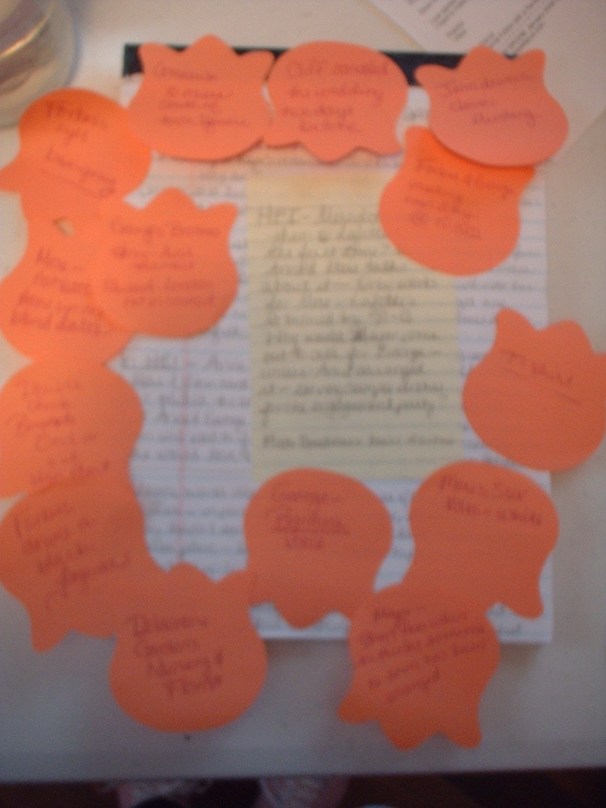
Most of these are what we editors call “continuity” details. Such as:
–Forbes’s eyes are gray-green
–Major’s birthday is March 3
–Meredith drives a white Volvo SUV
Since finishing Stand-In Groom two years ago, not only have I gotten deeply involved in Meredith and Major’s story in Menu for Romance, but I’ve written a somewhat detailed synopsis for the third book in the series, A Case for Love. Forbes, who is the cousin of Anne in SIG, and the older brother of Meredith in MFR, is the hero of the third book. But I was never quite sure who the heroine was. I’d come up with a story idea when I originally pitched the series to Barbour, but even then I wasn’t crazy about the heroine I’d created for him. In the process of writing MFR, a woman walked in and demanded a supporting role and all of a sudden, I had a perfect match for Forbes. Fortunately, I “met” her and came up with the story idea for book three before I went into final revisions on SIG, so I was able to actually drop her name, and the name of her parents’ business (which is important in book three) into Stand-In Groom, tying the books together.
Knowing your “world” is more than just knowing the setting where your story is taking place. It’s knowing as much about your characters as you can. If you’re writing a series in which the main characters from your first book either continue on as the main characters of your second book, or have a supporting role, you need to know them well enough by the end of the first book that you aren’t going to get into the middle of the third book and realize that there’s something fundamentally wrong with one of them that you need to change, which is going to require a complete rewrite of the series . . . especially if you’ve already sold that first book.
Whether you’re using a real or fictional, contemporary or historical setting, one POV character or six, keeping a continuity sheet is important—and that goes for people who aren’t writing series as well! If you have the sign out in front of Delacroix Nursery and Florists being green in chapter three and blue in chapter nineteen, that’s something a copy editor might not catch, but a reader probably will. If Forbes has gray-green eyes in Stand-In Groom (where he’s a secondary character) and hazel-brown eyes in A Case for Love (where he’s a POV character), while that might not necessarily be as noticeable as if it happened in the same book, if someone goes through and reads both books back to back, they are going to notice—and probably lose a little bit of confidence in me as an author. Same goes with my setting. Because Bonneterre is fictional, my readers are depending on me to know the setting intimately. If I “misplace” something from one book to the next—as in, it’s near Town Square in book one and on the north side of downtown in book three—again, the reader loses confidence in my authority as the creator of this setting.
Now, does this mean that you have to map all of this out before you start writing? Not exactly. But it does mean that you have to do some work with your characters and settings before you start writing. That’s why I like to use Real World Templates for my characters, so I don’t have to try to constantly conjure a mental image of my own making for them. That’s why I also make a character spreadsheet as well as a collection of images of the characters as I write. That way, as I write more of the series, I have these files to refer back to so that I’m not having to comb through the first book to find the information or just try to remember it on my own.
For Discussion:
How much time do you spend on developing your characters and setting before you start writing? How do you keep track of the details you’ve written into your story for continuity?
Writing the Series Novel: How Do You Know It’s a Series?
When I first started writing Ransome’s Honor, I thought it was going to be very much like my contemporaries: a stand-alone story with, perhaps, the possibility for a spinoff with a secondary character. However, the more I got into the story and the characters, the more I came to realize that I had way too much story to fit it all into one 100,000-word novel. When I sat down and wrote a (very generalized) synopsis including all of the ideas and conflicts I already knew I wanted to include, I realized I had enough for two novels. Then, as I got into the middle of writing the first book and I suddenly had POV characters I hadn’t planned on being POV/important, I realized that there was no way the story would fit into two books . . . but it would make a great trilogy. There were natural breaks in the story—natural cliffhangers as well as places to give satisfactory conclusions—to be able to not only keep the reader hanging and wanting to buy the next book to find out what happens, but enough big subplots to wrap up each book satisfactorily.
When J.R.R. Tolkien wrote the Lord of the Rings story, he envisioned it as one massive volume. But because it was being published after WWII, when money and paper were scarce, the publishers decided it needed to be broken into three volumes. Because Tolkien had written the story in six “books,” the natural place to break them was after books 2 and 4, so that each volume of the trilogy was about the same length.
How do you know if what you’re writing is a series?
Remember yesterday, we discussed the three different kinds of series: spinoffs, sequels, and serials. If you’re writing a stand-alone novel, you can ask yourself if there’s the possibility of a sequel—of continuing the story beyond the ending. Is there enough conflict? Is there an overarching storyline that could tie more than one book together as a whole story? If not, ask yourself if you can take your main characters and put them in a new set of circumstances and have a new story in a serial series. If the main conflict for your characters ends at the end of the novel, are there any minor characters you could take to spinoff a new novel from?
Don’t forget about using themes rather than characters as a way to develop series. What about a series of novels based on telling the “romances” of each of the first ladies of the U.S.? Debra White Smith did a contemporary-set retelling of each of Jane Austen’s novels. What about doing the same with your favorite classic author like Dickens or the Bronte sisters (come on, you know Jane Eyre and Wuthering Heights are just begging to be set in modern times). What about a series of historical novels based on the lives of the royal family of Liechtenstein or Luxembourg?
But what if you just have a really long story that has no natural place to break it? We’ve all been told that publishers won’t look at anything over about 120,000 words. What if yours is 180,000 or more—and it just doesn’t seem like you’ll be able to break it into two novels? Well, then you may be in a quandary . . . you’re either going to have to convince a publisher to publish a five- or six-hundred-page novel—which is a hard sell unless you’re an established author like Steven King or J.K. Rowling or Philippa Gregory—or you are going to have to find a way of breaking it into a series.
The way to do this is with subplots and secondary characters. If you haven’t already, write a detailed synopsis of your novel. If you have a story of 150,000 words or more, you’re going to have several major events happening. (If you don’t, you should probably consider either adding some conflict or cutting a lot of stuff out, as you’ll need several major conflicts to sustain a reader’s interest in something that long.) Is there a major event that you could use as a climax of your first novel? Do two of your main characters get married? Is there a major battle? Does someone important die?
Look at how Peter Jackson broke the Lord of the Rings trilogy. Rather than following the way it breaks in the printed books, he broke it more naturally with how the story flows. He broke Fellowship of the Ring after the death of Boromir (which is the opening sequence of the second book). That gave him a battle for a climactic scene, as well as the goodbyes to Boromir as the denoument. Even though in the long-term scheme of the story, it’s not a conclusion, just the breaking of the Fellowship, it made a natural place to end the first “volume.” In a similar manner, he chose to end the second film with the Battle for Helm’s Deep, with the aftermath of the battle as a denoument.
Look in your story for episodes like that—times of great conflict for your character which have a satisfactory conclusion (remember, “satisfactory” doesn’t have to mean “happy”), but which still leave the main story arc conflict hanging.
For Discussion:
Have you ever written or are you currently writing a series? Which kind is it (spinoff, sequel, serial)? Did you know when you first started writing it that it would be a series (two, three, or more books)?
Writing the Series Novel: Introduction
se•ries: SEER-eez (n)
1. a group or a number of related or similar things, events, etc., arranged or occurring in temporal, spatial, or other order or succession; sequence.
4. a set of successive volumes or issues of a periodical published in like form with similarity of subject or purpose.
Random House Unabridged Dictionary, 2006
When it comes to fiction, what is a series? Well, to put it simply, a fiction series is a number of books written around a particular continuity theme. It can be a duet, a trilogy, or an open-ended number of books, but they are a series only if there is some thread that ties them all together.
What kind of thread? Well, that depends. In Jan Karon’s Mitford series, the continuity thread is the main character, Father Timothy. Dee Henderson’s O’Malley novels are tied together because the main characters in each of them are adopted siblings. But they’re also tied together because each of the main characters is in some kind of “heroic” profession—like a police detective, a U.S. Marshal, a firefighter, a grief counselor, or an EMT. In Susan May Warren’s Deep Haven series, it is the setting that ties the books together, though the characters from the previous books do make “cameo” appearances in subsequent books.
With some series, there is a little bit of a difference, because it’s a continuing story throughout the series—which is seen most commonly in trilogies such as the Lord of the Rings series—in which the first two books may give a somewhat satisfying ending, but more than likely just leave the story hanging so that you have to continue reading to get any closure. This is true in some longer series, such as J.M. Hochstetler’s American Patriot series—which will extend to seven or eight volumes before the storyline comes to a conclusion.
The many ways of tying books together to create a series can pretty much be broken down into the three different kinds of series: spinoffs, serials, and sequels.
Spinoffs: A series of novels that take an existing minor character, setting, or concept from the first stand-alone story and create a new plot/situation for additional stand-alone stories. Examples: Dee Henderson’s “Uncommon Heroes” series or Christine Schaub’s “Music of the Heart” series that had as its continuing thread the novelization of the stories behind some of the greatest hymns of all time. Spinoffs are very common in the Romance genre—or in TV, though sometimes without as much success as in novels (e.g., Joni loves Chachi, Joey, or Frasier or the “Avonlea” series that was a spinoff of the Anne of Green Gables setting).
Serials: A series of novels that follow one particular character throughout many different, mostly unconnected episodes. Each novel is self-contained and could be read as a stand-alone title, though each successive title reveals more about the continuing character(s). Examples: Tony Hillerman’s novels featuring Navajo tribal police officers Leaphorn and Chee; Tom Clancy’s Jack Ryan novels; Janet Evanovich’s Stephanie Plum novels; Sherlock Holmes; Nancy Drew/Hardy Boys… are you sensing a genre pattern? Serials are seen most often in Mystery/Suspense and Action/Adventure. This is also what makes up the bulk of TV programming: the CSI and Law & Order franchises are prime examples. If you’re addicted to them, you watch every week and pick up on all of the tiny hints about the continuing-characters’ lives outside of the cases they’re working. However, the driving force of each week’s episode is the self-contained crime they must solve. Non-addicts can come in at any time and watch an episode and understand 95% of what’s going on (the other 5% being information about the characters that have been built throughout the series, such as Bobby Goren’s mother’s schizophrenia and cancer, or Horatio Cane’s relationship and short-lived marriage to Eric’s sister).
Sequels: A series of novels that contain one continuing story in a finite number of volumes. While each volume has a beginning, middle, climax, and denouement, the main plot/conflict of the series continues throughout the series and finally comes to a climax and resolution in the final volume. This main plot/conflict must be introduced early in the beginning of the first book. It cannot suddenly appear three chapters from the ending. While, if well-written, sequel-series books could be read separately, it is usually necessary to start with the first volume and read them in sequence to truly understand the entire storyline. Examples: Star Wars (whether taken as the original trilogy or the full set-of-six films), Tracie Peterson’s “Ribbons West” series, the Harry Potter series. Sequel series are most common in Science Fiction, Fantasy (just do a search for “trilogy” in the books section of amazon.com!), and Historical Fiction/Romance. In television, these are shows such as LOST or Alias where each show builds the story upon what happened in the show before, and it’s really difficult to come into the middle of it and really know what’s going on without going back to the beginning to catch up.
Over the next few weeks, we’ll be examining what, exactly, goes into developing and writing a fiction series, so I hope you’ll stick around for the journey.
Fun Friday–Steel Magnolias Quotes

As promised a couple of weeks ago, here is a list of my favorite quotes from the most quotable movie of all time, Steel Magnolias.
………………………………………………..
Truvy: In a good shoe, I wear a size six, but a seven feels so good, I buy a size eight.
………………………………………………..
Truvy: Time marches on and sooner or later you realize it is marchin’ across your face.
………………………………………………..
M’Lynn: That sanctuary looks like it’s been hosed down with Pepto-Bismol.
………………………………………………..
Truvy: Oh get with it, Clairee. This is the eighties. If you can achieve puberty, you can achieve a past.
………………………………………………..
Clairee: All gay men have track lightin’. And all gay men are named Mark, Rick, or Steve.
………………………………………………..
Truvy: There’s so much static electricity in this room, I pick up everything but boys and money.
………………………………………………..
Shelby: Relax! You can’t screw up her hair. Just tease it and make it look like a brown football helmet.
………………………………………………..
Shelby: Remember what Daddy always says—an ounce of pretension is worth a pound of manure!
………………………………………………..
M’Lynn: Drum would never, ever point a gun at a lady.
Ouiser: Oh! He’s a real gentleman! I bet he takes the dishes out of the sink before he pees in it!
………………………………………………..
Ouiser: I have got to talk to M’Lynn about her husband. He is a boil on the butt of humanity.
………………………………………………..
Shelby: Pink is my signature color.
………………………………………………..
Annelle: I think we should pray.
Sammy: Oh, I’d rather eat dirt!
………………………………………………..
Clairee: Looks like two pigs fightin’ under a blanket.
(observing the new mayor’s wife dancing)
………………………………………………..
Truvy: I don’t trust anybody that does their own hair. I don’t think it’s normal.
………………………………………………..
Ouiser: This is football. All people care about are touchdowns and injuries. They don’t give a damn about that grape sh*t.
………………………………………………..
Truvy: Sammy’s so confused he don’t know whether to scratch his watch or wind his butt.
………………………………………………..
Ouiser: I’m not crazy M’Lynn. I’ve just been in a bad mood for the last 40 years!
………………………………………………..
Ouiser: Yes, Annelle, I pray! Well, I do! There, I said it, I hope you’re satisfied.
Annelle: I suspected this all along!
Ouiser: Oh! Well don’t you expect me to come to one of your churches or one of those tent-revivals with all those Bible-beaters doin’ God-only-knows-what! They’d probably make me eat a live chicken!
Annelle: Not on your first visit!
Clairee: Very good, Annelle! Spoken like a true smart-ass!
………………………………………………..
Truvy: I have a strict policy that nobody cries alone in my presence.
………………………………………………..
Clairee: Ouiser could never stay mad at me; she worships the quicksand I walk on.
………………………………………………..
Ouiser: A dirty mind is a terrible thing to waste.
………………………………………………..
Clairee: They were both high. They’d been smokin’ everything but their shoes.
………………………………………………..
Truvy: Laughter through tears is my favorite emotion.
………………………………………………..
Ouiser: The only reason people are nice to me is because I have more money than God.
………………………………………………..
Clairee: Well, you know what they say: if you don’t have anything nice to say about anybody, come sit by me!
………………………………………………..
Ouiser: What’s the matter with you M’Lynn? You got a reindeer up your butt?
………………………………………………..
Clairee: M’Lynn you just missed a chance of a lifetime. Half of Chinquapin Parish would give their eye teeth to take a whack at Ouiser!
………………………………………………..
M’Lynn: I find it amusing. Men are supposed to be made out of steel or something. I just sat there. I just held Shelby’s hand. There was no noise, no tremble, just peace. Oh, God. I realize as a woman how lucky I am. I was there when that wonderful creature drifted into my life and I was there when she drifted out. It was the most precious moment of my life.
Conference Prep–A Quick Review Part 2
As promised, here is a review of posts on following up and preparing your requested submission.
Following Up After Pitching
Follow-up after a pitch session is very important, whether you’re asked to submit or not.
Networking: Stumbling Block #2–Communication—Have you ever considered taking your thank-you notes to the conference with you and mailing them from the hotel as soon as your pitch session is over?
Networking: Stumbling Block #3—Following Up—How long should you wait after the conference to follow-up with either a thank-you note or a submission? Can you contact the editor later even if they didn’t request a submission?
Networking Refresher–When Did We Stop Sending Notes?—Sure, e-mail correspondence is easy, but a hand-written note shows that you’ve taken time and effort with your communication.
Preparing Your Submission
Ah . . . what a wonderful feeling! You’ve received a request to submit from an editor or agent. But then you get home and you start to second-guess yourself. What if it’s not good enough? I still need to do lots of work on it before it’s ready. As I told Sharon on the ACFW forums the other day—editors and agents don’t ask to see your stuff out of the goodness of their hearts. They ask for a submission because they see promise in what you’ve pitched to them. If they can see the potential through a one-sheet or verbal pitch, they’ll be able to see it through a submission’s rough edges. You have NOTHING to lose if you submit. If you let the opportunity pass you by, you could possibly be losing your only chance with that editor or agent. I forget where I saw it, but somewhere in the last couple of days, I read that editors and agents say that they receive less than half of the submissions they request at conferences. Those are odds in your favor. So get that requested submission in!
A standard submission is a cover (query) letter, full synopsis, and first three chapters (or thirty or fifty pages, whatever the editor/agent requested).
Beyond the First Draft—The Query Letter—While a requested submission isn’t really a “query,” the same format is used for a cover letter with a submission as is used for a query. Article links to a sample letter.
Beyond the First Draft–The Dreaded Synopsis—We all hate writing them. So here are some pointers I’ve gleaned through the years on what the dreaded synopsis should include. Links to samples of both a short and a standard-length synopsis.
What’s the Big Deal about First Lines?—Does your first page start off with a bang? Make sure that the chapters you’re submitting catch the editor’s/agent’s attention immediately.
Critical Reading: The First Date—Editors and agents are professional critical readers. Here are some of the questions they may be asking when looking at your submission.
Hooking the Reader: The Character Investment—Make sure that your character(s) hooks the editor/agent immediately. Poor character development is a big turn-off and almost a guaranteed rejection.
Hooking the Reader: Scene Two, Take Five—It isn’t just the first page that needs to hook the reader. Make sure you carry that through the entire submission . . . and choose an ending point that’s going to leave them wanting to see more!
Writing the Romance Novel: You’ve Written It, Now What? (Guest Blogger Rebecca Germany)—Barbour Senior Fiction Editor Rebecca Germany gives a little insight on what an editor looks for in a submission.
Conference Prep–A Quick Review Part 1
No, I’m not starting the conference prep series right now (that’ll be in August). But I know people are starting to get antsy about the ACFW conference, since we haven’t been able to register yet, so I thought I’d post links to stuff I’ve written that may be helpful in trying to figure out what happens at conference, what to take to a pitch session, how to network, etc.
I’m a Wallflower and Don’t Know Anyone
Though right now we’re all excited and anxious to register for conference, come August, all of us are going to be facing the fear that being surrounded by hundreds of people can bring. Yes, even I, with eight conferences under my belt, have the fears of I’m not going to know anyone. I’ll be all alone. No one will like me. This is a mistake. So here are some posts that include exercises you can start doing this summer to help you prepare to approach all those strangers with a little more ease in September:
Networking–What is it, really?
Networking Refresher–The “Soft Sell”
Networking = Name Recognition = Marketing
Networking Refresher–Building Name Recognition
Networking: Stumbling Block #1–Fear
Networking Refresher–Is This Seat Taken?
Preparing Your Pitch
Pitching to an editor or agent face-to-face can be one of the most daunting things we as writers face. Because the majority of writers are introverts, putting ourselves forward, talking about ourselves, “selling” ourselves is intimidating at best, nauseating and panic-attack-inducing at worst. Here are some posts that can help you prepare your pitch so that you can (hopefully) approach your pitch session(s) with confidence:
Beyond the First Draft–Clarity—Two of the most important things you’ll need to do are to make sure you are targeting the correct publisher and to understand and be able to easily describe your novel. This post will help you get from your thirty-second pitch to your one-sentence to your one-paragraph to your one-page synopses.
Beyond the First Draft—The Pitch Sheet and One-Sheet—Though they used to be the exception, having a one-sheet for each project you’re pitching is now the norm. The sample linked on this post was my first attempt, so pay no attention to it!
My Pitch Sheets!—Samples of the pitch sheets I took to conference last year.
Beyond the First Draft–Face-to-Face Pitch Sessions—Not only do I detail what I take with me into a pitch session, but there’s a link to Gina Conroy’s wonderful article on pitch sessions.
Networking Refresher–Face-to-face editor/agent meetings—This post links to articles that Camy Tang wrote on pitch sessions.
Tomorrow, following up after pitching and preparing your requested submission!
Upcoming Series: Writing Series Novels
Beginning next week, I’ll be starting a new series, so I want to collect as many questions as I can ahead of time to make sure I research all of the areas of interest.
Writing Series Novels: As a follow-up to the series I did on Endings, this series will go more deeply into how much to review in a sequel or a follow-up—is it backstory, flashback, or even necessary? How many threads can you leave hanging at the end vs. how much should be wrapped up? Can you introduce the POV of the main character of a second/spinoff novel if they’re not a POV character in the original? Etc.
Now, what haven’t I mentioned that y’all would like to see covered in this series?
Fictional Writers: Jo March (Little Women)
I heard a piece on the radio this morning, on NPR’s “In Character” series, about Jo March from Little Women, and it got me thinking about characters in fiction who are authors. So I’m going to take a leaf out of NPR’s book (a wave from their signal?) and do a semi-regular series on fictional characters who happen to also be writers, and the authors who created them.
~~~~~~~~~~
“An old maid, that’s what I’m to be. A literary spinster,
with a pen for a spouse, a family of stories for children, and
twenty years hence a morsel of fame, perhaps, when, like poor
Johnson, I’m old and can’t enjoy it, solitary, and can’t share
it, independent, and don’t need it. . . .”
~Jo March, Little Women
 Louisa May Alcott (1832–1888.) was not only the daughter of famed transcendentalist Amos Bronson Alcott, she spent her life amongst a community that included Henry David Thoreau, Ralph Waldo Emerson, Nathaniel Hawthorn, Margaret Fuller, and Elizabeth Peabody. She helped out in the school her father founded (the Temple School, based on the ideals of a utopian society), and was active in the abolitionist movement in her early years. Due to her family’s poverty, she began working at a young age—as a seamstress, a domestic helper, a governess, a teacher, as well as an authoress. Her first published work, Flower Fables was published in 1854. It had originally been written for RW Emerson’s daughter Ellen.
With such a background, and so many successful and brilliant writers surrounding her, it is no wonder that Louisa was allowed not only to explore her creativity through writing, but to pursue publication. Though it wasn’t as unheard-of for women in the mid-19th century in America to write and be published, it still wasn’t necessarily considered by many (outside of her circle of society) to be an appropriate path, especially for an unmarried woman, to pursue.
She became a regular contributing writer for Atlantic Monthly in 1860. For six weeks in the winter of 1862–1863, Louisa volunteered as a nurse at the Union hospital in Georgetown (Washington DC). The letters she wrote home during that time were revised and published in the Commonwealth, which began to garner some serious interest in her writing. They were published as a collection (Hospital Sketches) in 1863.
Alcott, like her creation Jo March, loved to write “pot-boilers”—thrilling tales of adventure and suspense, which she published under the pseudonym A.M. Barnard, including A Long Fatal Love Chase and Pauline’s Passion and Punishment. These stories were immediately (and fiscally) successful and she always had a market for them.
 In 1867, Alcott began writing Little Women at the suggestion of her publisher who wanted a “girls’ book” to market to younger readers than those reading Alcott’s other works. She finished the manuscript in two and a half months, drawing on her own family (including her three sisters, May [Amy], Anna [Meg], and Elizabeth [Beth]) and experiences for the story. The novel originally ended after Chapter 23, with Meg’s engagement to Mr. Brooke. The novel was an immediate success, and the second part, picking the story up three years later with Meg and John’s wedding, was published in 1869. The two parts were not actually combined into one volume until 1880, in the U.S., while in Britain, the second part continued to be published separately under the title Good Wives (a decision that Alcott had no say in). This was followed by two sequels: Little Men (1871) and Jo’s Boys (1886), which continued to follow the March girls as they had children and as their children grew up.
 Jo March was the second of four daughters of a scholarly minister, Robert March, and a feminist-figure mother, Margaret “Marmee” March. Jo is fifteen years old at the opening of the novel and is the central character. Jo is a tomboy, wishing she could go off to war with her father (a chaplain in the Union army), and claiming to be the man of the house in her father’s absence. Jo strikes up a friendship with the “boy next door” Theodore “Teddy/Laurie” Laurence. Jo is not only bold natured, she is impulsive—which has a tendency to land her in hot (or freezing) water. She speaks before she thinks and acts on her first reaction to a situation without taking the time to think it through first. The softest spot in her heart is reserved for younger sister Beth. It is Beth’s influence on Jo that helps Jo to become the “little woman” her father wishes her to be.
Jo as a writer is clearly a representation her creator. Jo’s love of passionate, suspenseful, thrilling stories parallels Alcott’s own publishing history, as does her ultimate publishing success when she begins to write stories about herself and her sisters, though Jo wrote these at the suggestion of her parents after the death of her beloved sister Beth (though in the movies, it’s usually at Professor Bhaer’s suggestion).
“Why don’t you write? That always used to make you happy,” said her mother once, when the desponding fit over-shadowed Jo.
“I’ve no heart to write, and if I had, nobody cares for my things.”
“We do. Write something for us, and never mind the rest of the world. Try it, dear. I’m sure it would do you good, and please us very much.”
“Don’t believe I can.” But Jo got out her desk and began to overhaul her half-finished manuscripts.
An hour afterward her mother peeped in and there she was, scratching away, with her black pinafore on, and an absorbed expression, which caused Mrs. March to smile and slip away, well pleased with the success of her suggestion. Jo never knew how it happened, but something got into that story that went straight to the hearts of those who read it, for when her family had laughed and cried over it, her father sent it, much against her will, to one of the popular magazines, and to her utter surprise, it was not only paid for, but others requested.
Jo’s ultimate success in writing comes through everything the character has experienced in the novel. It is through the penning of the stories and poems about her family, and Beth especially, that Jo finds out who she truly is. And it is “In the Garrett,” a melancholy poem about Jo and her sisters in childhood days, which brings Professor Bhaer to Concord and leads to the eventual resolution of their romance.
Jo is probably one of the best-known fictional female writers in classic American literature. Though she does exhibit some doubts in herself as a writer, some fears of letting others see what she’s written, it’s only when she’s allowed herself to become vulnerable, to pour her heart out onto the page that her true skill as a writer is recognized.
For a small thing it was a great success, and Jo was more astonished than when her novel was commended and condemned all at once.
“I don’t understand it. What can there be in a simple little story like that to make people praise it so?” she said, quite bewildered.
“There is truth in it, Jo, that’s the secret. Humor and pathos make it alive, and you have found your style at last. You wrote with no thoughts of fame and money, and put your heart into it, my daughter. You have had the bitter, now comes the sweet. Do your best, and grow as happy as we are in your success.”
“If there is anything good or true in what I write, it isn’t mine. I owe it all to you and Mother and Beth,” said Jo, more touched by her father’s words than by any amount of praise from the world.
So taught by love and sorrow, Jo wrote her little stories, and sent them away to make friends for themselves and her, finding it a very charitable world to such humble wanderers, for they were kindly welcomed, and sent home comfortable tokens to their mother, like dutiful children whom good fortune overtakes.
Links of Interest
Learning/Teaching Resources on Louisa May Alcott
Online Text of Little Women
“Jo March: Everyone’s Favorite Little Woman” on NPR’s “In Character” series
Farmers’ Market Trip
I went to the farmers’ market for the first time this summer, after going to a water aerobics class at the downtown YMCA this morning. I’m planning on making this a regular activity this summer—not just working out on Saturday mornings, but also going to the farmers’ market to get all of my fresh produce for the upcoming week. The one thing I didn’t do last night that I should have was to plan out my meals for next week so that I’d have a better idea of what to look for, but I did at least look to see what I still have in the fridge from an emergency grocery-store run Tuesday night. So I didn’t end up getting much. But I thought I’d share:

I love watermelon. I don’t usually buy whole ones, simply because it’s hard for me to eat that much of it before it goes bad. This one is 14″ from stem to “stern” and about 28″ in diameter. So it’s not huge. I have tried the little “personal” watermelons, but I don’t like the way they taste as much as the real thing.

LSU cauliflower! No, your eyes aren’t deceiving you, these two small heads of cauliflower are naturally purple and gold. I thought those would be fun to cut up and have on salads at lunch this week, as well as steamed for dinner for a meal or two. The heads are pretty small, so they won’t last long, but if they’re good, I’ll buy bigger heads next week!

What’s a salad without cucumbers and tomatoes? Actually, I like to just slice the cucumbers and dip them in dressing—or possibly make a cucumber/onion/vinegar “salad.” The tomatoes that look yellow here are actually green—the kind that stay green when they’re ripe, which are usually sliced, breaded, and fried down here in the South. The reddish one next to it is actually kind of purple-y. It’s not a variety I recognized. But if I like it, I may plant a couple of seeds and grow my own!
So as I said, I didn’t get much. Most of the “locally-grown” fruit was peaches (local meaning from Georgia, really), which aren’t my favorite fruit, so I didn’t see any point in spending money on something I know will probably just sit here until they go so soft they aren’t edible.
I think next week, I’m going to try to get up early enough to go to the market before I go to the gym—I got there around 10:45 a.m. and it was already over 90-degrees outside. Even though it’s shady and the breeze was blowing through, I still worked up a major sweat—enough that I considered stopping at the gym and getting into the pool again just to cool off! The Y has a parking garage, so I’m not worried about the produce going bad because the car gets too hot. Plus, if I go before, I won’t have to spend so much time after the water aerobics class showering and drying my hair and everything else, and can just shower after I come home.
So what are you up to this weekend?

 KayeDacus.com


