Thursday Thought Provoker

What do you mean I DIDN’T FINAL???
 As expected, the congratulatory e-mails and blog posts are making the rounds for those who were announced as semifinalists in the Genesis contest. But what about those who entered but didn’t final? Where are their consolation e-mails? Their “come cry on my shoulder” blog posts?
Never fear! Here are a couple of blog posts I read yesterday:
Not Finaling in Genesis Doesn’t Make You a Loser by Gina Conroy
I Never Finaled in the Genesis Contest by Katie Ganshert
I’ve been on both sides of this, both as an unpublished writer and as a published author—but it’s that first one I want to focus on today.
I entered ACFW’s contest—back when it was ACRW and the contest was called “Noble Theme”—the first three years of its existence.
 The first year (2002), I received an honorable-mention certificate for the sample I entered—of the first manuscript I’d ever completed, after twenty years of “playing.” Though I’ve never received confirmation on this, I have a feeling that there were only five entries and mine came in #5—but they felt like everyone who was brave enough to enter should receive something. I got tons of great feedback on that entry—but by that time, I already knew I was never going to do anything with that manuscript, so I learned what I could from that feedback and applied it to the manuscript I was currently writing.
The next year (2003), I entered two manuscripts—and both failed miserably. Well, maybe that’s an overstatement. They received fair to middling scores. Unfortunately, I didn’t get a lot in the way of constructive comments; for example, I had one judge who scored me a 3 (out of 5) on everything and the only comment she made on the entire entry was, “Well done.”
By the time the contest opened up for entries in 2004, I knew I had THE WINNING ENTRY! You see, just before conference in 2003, I’d come up with an idea of a romance novel involving a wedding planner who takes on a contract for a huge wedding—only to discover it’s her ex-fiancé-turned-movie star’s wedding, and she has to work with his personal assistant to get the wedding planned. When I came up with this story idea, I recognized it as the strongest idea I’d ever had and felt like God was telling me it was going to be my first published novel. I’d completed three manuscripts (those three contest entries above), so this was my year. Manuscript #4. I’d win the contest, and editors would by vying for my attention, waving contracts and money at me for the chance to publish this wonderful work of whimsy.
 So imagine my surprise—my astonishment, my anger, my grief, my utter rage at the judges…and God—when I not only didn’t final, but received back scores that were even lower than the scores I’d received the year before. How was that possible? Didn’t these people know that God told me this was going to be my first published novel????? Of course, I’d already completely re-written the first ten chapters since I’d submitted it. And I was about to start on another rewrite of those ten chapters within another month—once I started graduate school (though, naturally, I didn’t know that at the time).
Talk about a game changer. Talk about having to go back to square one—no, before even square one, having to go back to sit at the foot of the throne of God to find out why the judges hated me so much, why He hadn’t told them what He’d told me. And that was when I learned that just because God gave me the story and just because God told me it would be my first published novel, He never said it was going to be easy. He never said He was going to throw success and the adulation of others into my lap. He showed me that if I really wanted to be published, it was going to be a long, hard, sometimes disappointing road. It was up to me to decide if I wanted to take that road or if I wanted to quit.
I’m no quitter.
I’d already enrolled in graduate school, so I put my head down, my nose to the grindstone, my ear to the ground (insert other meaningless cliché here). Over the next two years, I went through the ringer with this manuscript: two years of graduate school, two published-author mentors, six or seven critique partners, public critique workshops, and so on.
In 2006, I felt it was ready—this was my chance to see if “the industry” thought so, too. So I entered it in Genesis again. And then I had to prepare the manuscript for thesis review to see if I would actually be receiving a master’s degree with this manuscript. And before I submitted it, I re-read it—and realized how boring the first chapter was. I cut the first three pages and rewrote it to eliminate an unnecessary character—all the time knowing that these things were still in the version being judged in the contest. So I had my excuse ready at hand if I didn’t final. But—surprise, surprise—I did! And I came in second place in the contemporary romance category—shocker, since I knew how much work what those judges read needed.
More important than finaling in the contest, though, were the invitations to submit a proposal from the two top agents on my target list. But finaling did give me the courage to approach them and ask them if I could submit my work to them.
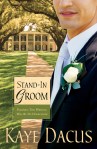 That was in September 2006. In January 2007, I signed with Chip MacGregor of MacGregor Literary. In December 2007, I received my first book contract for that manuscript. And in December 2008, that manuscript became my first published novel—Stand-In Groom.
But there are so many people who have never finaled in a contest who’ve gone on to get published and have successful writing careers.
And think about it this way: Look at how many writers over the centuries have gotten published before writing contests like these were ever even thought of, much less considered mainstream and “normal” for people to enter.
Unpublished writers: Do you enter contests? Why/why not? If you do, what do you do with the feedback you receive? What do you hope to accomplish by entering contests? How many do you enter each year?
Published authors: Did you enter writing contests before getting published? Did you final/win? Did your finaling/winning entries get published? What did you learn from entering unpublished-writer contests you’d like others to know?
Readers: What’s your opinion of writing contests for unpublished writers? Would you be more likely to read a debut author’s book if you knew this author had finaled in and/or won a contest with the first chapter of the book?
Writer’s Window–Susan Page Davis
 Joining us today for Writer’s Window is romance author Susan Page Davis.
One lucky commenter* will win a signed copy of Susan’s latest release, Love Finds You in Prince Edward Island, Canada. Deadline for leaving a comment to enter the drawing is Friday. To enter the drawing, you must answer the question posed by Susan at the end of the interview. Only one comment per person will count toward the drawing. Please do not include your e-mail address in the body of your comment—just make sure it’s correct when you sign in to leave your comment. The winning name will be drawn next weekend and announced on the next Writer’s Window post. Congratulations to Carla Gade, who won the drawing for last week’s featured book.
- *U.S. residents only, void where prohibited. If you win the drawing, you will be ineligible for the next three drawings, though hopefully you will still come back and join in the discussion.
__________________________________________________________
Love Finds You in Prince Edward Island, Canada
Prince Edward Island pulls out all the stops to prepare for the visit of Prince Albert Edward (Queen Victoria’s son, later King Edward VII) in 1860. Molly Orland, a farmer’s daughter, is hired as a housemaid at the governor’s mansion, where the prince and his entourage will stay. Peter Stark is sent ahead of the royal party to ensure the arrangements are in order. Though Peter and Molly are attracted to each other, there seems to be no future for them, since Peter must soon leave with his master, the Earl of Washburn, and Molly will lose her job if discovered to be engaging in a flirtation with one of the visitors. However, Molly’s family harbors a secret that connects her family to Washburn’s. Can she and Peter overcome the past and set right a sixty-year-old wrong?
Welcome, Susan!
What do you like best about being a writer?
- I get to make people (that is, my characters) do whatever I want them to do.
What do you like least about being a writer?
- The sporadic nature of my income.
Pop, Soda, or Coke? What do you call it, and what’s your favorite variety?
- Soda, diet Pepsi. I also like cream soda.
What’s your favorite dessert?
- Well, fat is banned for me right now, but with that aside, strawberry-rhubarb pie.
What’s the most fun/interesting/crazy/scary/unique hands-on research you’ve done for a book?
- Scouting a spot from which a sniper could shoot the governor. The really scary thing was that it wasn’t at all hard to find.
What’s your favorite movie from childhood?
- National Velvet
If you were to write a novel about what your life would have been like if you’d become what you wanted to be at eight years old, what kind of character would the story be about?
- I would be the owner of a hotel with all sorts of mysterious and fascinating guests.
What makes you happy?
- Having my family together.
What makes you nervous?
- Deadlines and bills.
What’s your biggest dream for the future?
- Visiting my daughter who lives in England.
Tell us about your newest release and what you’re working on now.
- Love Finds You in Prince Edward Island is set in 1860, when Queen Victoria’s son, Albert Edward, visited what is now Canada. It’s a fun historical romance set against the backdrop of a colorful historical event.
Today I am working on Lady Anne’s Quest, book 2 in my Prairie Dreams series (the first book, The Lady’s Maid, will release in October). Lady Anne is in Oregon looking for her uncle, so she can tell him he is now the Earl of Stoneford. Only, someone wants to stop her.
Where can people find out more about you/connect with you online?
Now it’s your turn to ask the question. What question do you want to ask the commenters to answer?
- What fictional villain to you most love to hate?
__________________________________________________________
 Susan Page Davis is the author of more than thirty novels. She’s the mother of six and grandmother of six. A Maine native, she now lives in western Kentucky with her husband Jim (a freelance editor) and the two youngest of their children. She’s a past winner of the Carol Award and the Inspirational Readers’ Choice Award.
THE ART OF ROMANCE–The Inspiration
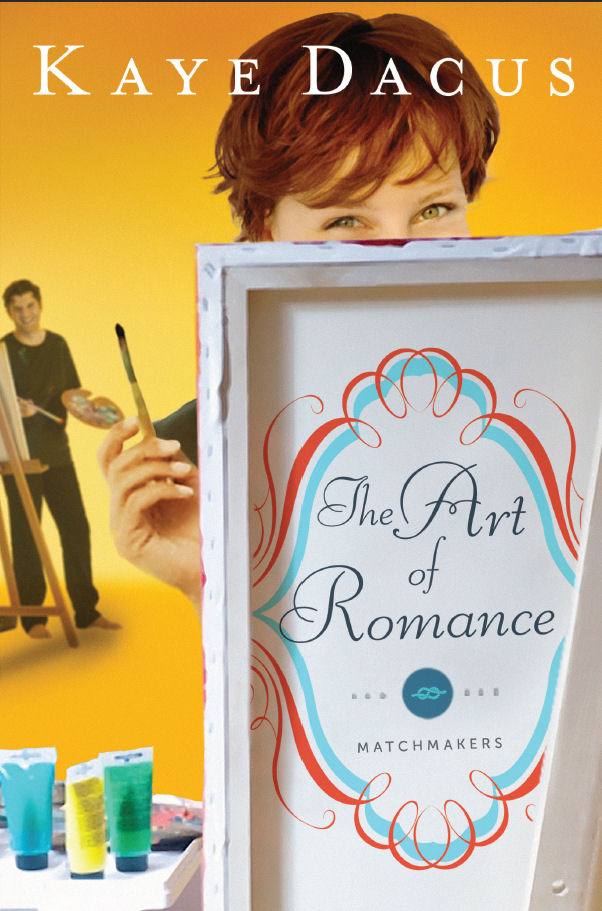 You know how sometimes you come up with an idea, you jot down some notes, that idea sprouts legs and becomes something, and then, some time later, you can’t remember what gave you the idea in the first place? Well, that’s where I am with trying to remember how I initially came up with the idea for what would become The Art of Romance. The only thing I know for certain is that the idea hinged on my character-development-crush on the guy who should have won season 2 of Top Chef, Sam Talbot.
Initially, when I came up with the idea back in February 2007, my working title was Cover Model. I even still have the idea writeup I did back on February 20, 2007, so that I wouldn’t lose the idea:
Jason ??? (Sam Talbot)–
After years living in New York City, all Jason wanted was a quiet place to settle down and focus on his art – and maybe teach a lesson or two. To ensure his anonymity, he takes on the stereotypical artist persona – paint covered clothing, distracted, mussed look. When his grandmother encourages him to teach classes for the senior adults at church, he agrees to humor her – and to take her up on her promise of two home-cooked meals a week.
Diana has lived with her grandmother for the past five years, ever since Manna’s eyesight became too poor for her to get a new driver license. Even though Diana is single and 31, Manna has a better social life than the young college Linguistics professor. Most of Diana’s free time is spent with Manna and her three zany best friends, one of whom keeps hinting that she wants to set Diana up with her grandson Jason.
When Manna informs Diana that every Tuesday night she will be attending an art class at church, Diana agrees with a sigh, knowing it’s just as easy to grade papers at church as at home, and without the distraction of the TV or fridge.
Eight seniors have signed up for his class. So when a tall young woman enters with one of the ladies, Jason’s attention is captivated. The girl isn’t beautiful by the New York sense of the term, but in her perfect posture, long dark hair, and chiseled features, she reminds him of a Rodin sculpture.
Diana takes over a table at the rear of the fellowship hall where she hopes she won’t be distracted by the group at the front. But her attention is drawn to the artist teaching the class. His hair is haphazardly pulled into a ponytail, the large white shirt he wears is splattered with paints, as are his worn, torn jeans and battered athletic shoes. His eyes are half-obscured by dark-framed glasses, and Diana wonders what he would look like without them.
Jason tries to keep his attention on the differences between water colors and oils while the young woman pulls out piles of papers and a red pen from her briefcase and organizes several stacks around her on the table. His mother used to grade papers like that.
Unable to concentrate on grading Old English translations, Diana pulls out a notepad and begins to scribble down an idea for a new romance novel… with a handsome artist as the hero. No one except for her grandmother knows that she publishes sweet romance novels under the name Kate Blane. She’s afraid if anyone knows, they’ll lose respect for her as a serious academic.
After the class ends, the grandmothers start. As best friends, Julia and Maggie have long plotted to get Diana and Jason together. Each woman knows a secret about her grandchild that she’s kept from the rest of the world.
Diana can’t deny her attraction to Jason as they shake hands, and her reaction surprises her. Jason bears no resemblance to the man who has occupied her dreams for the last six years. Ever since she saw the cover art for her first published novel, the dark, brooding man in a Marine uniform has consumed her imagination. At her request, the publisher uses the same model for each of her covers. When Diana asked for the model’s name, hoping to meet him, she was told that he wanted to remain anonymous.
Jason thinks about Diana constantly. He draws pictures of her, paints her, and even imagines her as the heroine in the books of his grandmother’s that he reads secretly. The romance novels by author Kate Blane. The books with his picture on the cover.

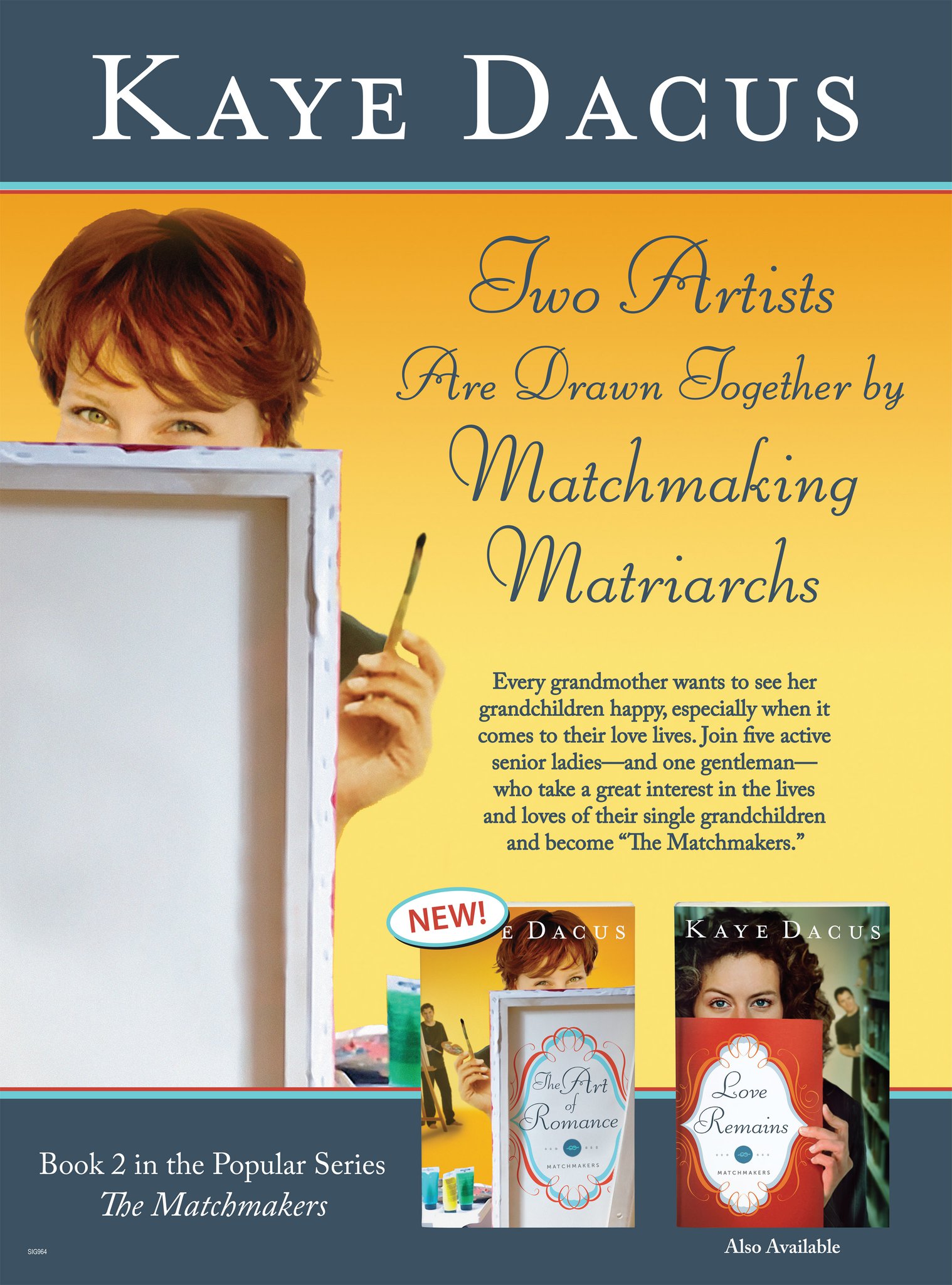 In 2009, when it was time for me to pitch a new series idea to Barbour, I went back through my Ideas folder on the computer—looking for this one to go along with the reworked idea for Love Remains. And because the grannies played such a big role in this book—and because Zarah’s grandparents were vital in her story—the idea to have the grandparents not only all be friends, but band together to try to matchmake for their grandchildren, developed.
But I wasn’t crazy about the names Jason and Diana. And, obviously, the storyline here needed a little more development. And, for some strange reason, I decided to make the heroine seven years older than the hero. And that initial story idea morphed into this:
- English professor Caylor Evans moved in with her grandmother five years ago when Sassy’s eyesight became too poor to get her driver’s license renewed. Though she is now writing sweet/inspirational romance novels, Caylor still draws inspiration for her heroes from the portfolio of covers and sample images drawn/painted by Patrick Callaghan for the steamy romances she used to write (as “Melanie Mason”), and dreams of meeting a man like that cover model. After losing his teaching position and being shunned by the fine-arts community in Philadelphia, artist Dylan Bradley has returned home to Nashville to regroup and determine the next step for his life. His grandparents offer him their guesthouse for as long as he wants it—along with plenty of opportunities to meet young women. Though it was years ago, Dylan is uncomfortable with the fact that his face—only slightly disguised—is on the covers of half a dozen steamy romance novels by Melanie Mason, the artwork he did to put himself through college under the pseudonym Patrick Callaghan. Especially after he meets Caylor Evans, a woman who has her life together in a way he only dreams of. Will Caylor and Dylan learn that the true art of romance is grounded in honesty and truth?
So, that’s the “inspiration” behind The Art of Romance. And, just in case you missed them, here are some other posts I’ve already written about it over the last year or so:
Sneak Peek at The Art of Romance
I’ve Been Hungry while Writing (real restaurants in The Art of Romance)
Sassy and Caylor’s House
Next Friday: Character Names & Character Casting
Thursday Thought Provoker

Debunking Writing Myths: “Showing Is Always Better than Telling”
 You should always make sure that you’re always writing in an active, showing style, rather than just telling the reader what’s happening. Showing is always better than telling in fiction.

Sometimes, telling is much better than showing.
. . . . .
If you’ve spent any time over on the Writing Series Index page, you’ve probably read this series:
Showing vs. Telling (January/February 2007)
Showing vs. Telling—An Introduction
Showing vs. Telling—The First Date
Showing vs. Telling—Mirror, Mirror on the Wall
Showing vs. Telling—In the Eye of the Beholder
Showing vs. Telling—Feeeeeeeeeelings . . .
Showing vs. Telling—Do You See What I See?
Showing vs. Telling—Do You Smell What I Taste?
Showing vs. Telling—The Sixth Sense
Showing vs. Telling—Puppets, Cartoon Characters, or Live Action?
which you should have time to explore, because today’s post is going to be rather short . . . because I’m going to show you why telling is sometimes better than showing:
Showing
- She ran to the car and fit her key into the keyhole in the door of the dark green Pontiac G6 coupe. The lock clicked open and she lifted the door handle to yank the door open. She turned and slid her right leg in the car first, her rear-end sliding across the leather seat with ease, drew her left foot in, and slammed the door–in which was the panel holding the controls for the power windows, door locks, mirrors, and driver’s seat adjustments. She poked the key into the ignition, turned it to the right, and engaged the engine. With her foot on the brake—because the car required the brake be engaged to be able to put it into gear—she pressed the button on the gear shifter with her right thumb and jerked the stick down to the R-position. Without looking behind her, she took her foot off the brake and positioned it on the accelerator and pressed down hard. The car backed out of the space faster than was safe. Once out of the space, she put her foot on the brake again and shifted the car into drive. She stomped her foot on the accelerator and the car lurched forward, tires making a squealing sound against the pavement.
(Did you make it reading this far? If so, good on ya!)
Telling
- She jumped in the car and peeled out of the parking lot.
. . . . .
The first example is an exaggeration, of course, but I think you get my point. In some instances, we need to give the reader the benefit of the doubt that they understand what it means when we write that the character got in the car and peeled out of the parking lot. Sometimes, it’s okay to tell when it’s the difference between a twelve-word sentence that keeps the action moving and an entire paragraph that brings the action to a screeching halt.
Writer’s Window–Lyn Cote
Joining us today for Writer’s Window is romance author Lyn Cote.
One lucky commenter* will win a signed copy of Lyn’s latest release, Daddy in the Making. Deadline for leaving a comment to enter the drawing is Friday. To enter the drawing, you must answer the question posed by Lyn at the end of the interview. Only one comment per person will count toward the drawing. You do not need to include your e-mail address in the body of your comment—just make sure it’s correct when you sign in to leave your comment. The winning name will be drawn next weekend and announced on the next Writer’s Window post. Congratulations to Jolanthe, who won the drawing for last week’s featured book.
- *U.S. residents only, void where prohibited. If you win the drawing, you will be ineligible for the next three drawings, though hopefully you will still come back and join in the discussion.
__________________________________________________________
Daddy in the Making
#2 in New Friends Street seriesBrought together by a Matchmaking Dog. . . .
Dr. Jake McClure’s basset hound has fallen in love. With a single mom, her adorable twins, and the orphaned kittens they rescued. Man’s best friend suddenly won’t budge from Jeannie Broussard’s home—and Jake can understand why. Jeannie’s place is full of love, laughter, and everything Jake has been missing in his life lately. As Jake spends time with Jeannie and her girls, a bond forges between them, and soon Jake is wondering if he’s the perfect fit in this fatherless family.
New Friends Street:
Where love and dreams find a home.
Welcome, Lyn!
What do you like best about being a writer?
- Hearing from readers. I am truly heartened when my writing has touched someone’s heart or made them see something they needed to see about themselves or their situation.
What do you like least about being a writer?
- Going over copy edits (that’s the final stage of editing where a copy editor uses a magnifying glass to find typos and funny little mistakes). I AM NOT A DETAIL PERSON. And I have to go over every page after the CE has done so. It’s exhausting and irritating. (But I do it.)
Pop, Soda, or Coke? What do you call it, and what’s your favorite variety?
- Pop—Diet Coke (Of course my dh does Diet Pepsi!)
What’s your favorite dessert?
- Oh, that is hard. But I’ll narrow it down to fruit-flavored pie or ice cream OR pie à la mode, the best.
What’s the most fun/interesting/crazy/scary/unique hands-on research you’ve done for a book?
- Before the Internet was popular, I was researching a book and my heroine was to be pushed down a flight of stairs, land on a cement floor, and be unconscious for more than twenty-four hours. I needed to know if IV feeding existed in 1906 San Francisco. I didn’t know how long I could have her unconscious. I couldn’t find it in my research library at home so I called the local library. Three days later, a reference librarian called me to tell me IV feeding started in 1937 in the US. She sounded so happy. She crowed, “It took all of us three days to find this.” And her tone suggested: “What can we look up for you next?”
What’s your favorite movie from childhood?
- Another hard question. I think Walt Disney’s Old Yeller. Such a touching story of loyalty and friendship.
If you were to write a novel about what your life would have been like if you’d become what you wanted to be at eight years old, what kind of character would the story be about?
- It would be about me, a former schoolteacher and writer, a wife and mother. I’ve been pretty consistent in knowing what I do well from an early age. When I was a sophomore, our high school administered the Kuder Preference Test so we could see what we should pursue. Guess what? KPT said I should be a teacher and writer. Imagine that.
What makes you happy?
- Sitting in the evenings with my marmalade cat, V-8 (named for his might purr), lying across my lap like a baby, belly up. (Of course, he also wants to do that during the morning when I have my laptop on my lap.)
What makes you nervous?
- Being late. I was taught being on time meant being early.
What’s your biggest dream for the future?
- I’ve achieved most of my goals, so perhaps taking a Alaska cruise with my dh?
Tell us about your newest release and what you’re working on now.
- My latest release is Daddy in the Making, a Love Inspired Romance.
Right now I’m waiting for a response to my latest proposal to my editor at Love Inspired Suspense. The proposal is for a three-book romantic suspense series set in Amish country in Iowa. Kalona, Iowa, has the oldest Amish settlement west of the Mississippi (since 1846). While I wait, I’m doing the spring-cleaning. Please, dear editor, call soon!
I’m also posting an original manuscript, La Belle Christiane, on my blog, three scenes a week—Mondays, Wednesdays, and Fridays—and I’m archiving the chapters there, one by one, after I’ve posted them completely.
Where can people find out more about you/connect with you online?
- I appreciate if readers purchase books from my website since Harlequin gives me an extra 20%. That means I get 26% of $4.99 instead of 6%. So do me a favor, drop by my website http://www.BooksbyLynCote.com and scroll down the right side. Just click the line under the cover.
http://twitter.com/#!/LynCote
https://www.facebook.com/lyn.cote
http://www.LoveInspiredAuthors.com
http://www.CraftieLadiesofRomance.blogspot.com
Now it’s your turn to ask the question. What question do you want to ask the commenters to answer?
- In my latest book, my hero’s basset hound serves as matchmaker. So do you have a pet? If so, what and what are the names and why did you name them that?
__________________________________________________________
 When Lyn Cote became a mother, she gave up teaching, and while raising a son and a daughter, she began working on her first novel. Finally, Lyn got “the call.” Her first book, Never Alone, was chosen for the new Love Inspired romance line. Since then, Lyn has had over thirty novels published. In 2006, Lyn’s book Chloe was a finalist for the RITA, one of the highest awards in the romance genre. Lyn’s brand “Strong Women, Brave Stories” always includes three elements: a strong heroine who is a passionate participant in her times, authentic historical detail, and a multicultural cast of characters. Lyn also features stories of strong women both from real life and true to life fiction on her blog http://BooksbyLynCote.com. Now living her dream of writing books at her lake cottage in northern Wisconsin, Lyn hopes her books show the power of divine as well as human love.
Saturday Special: Jane Eyre
I figured I couldn’t wait until next Friday to share some of my thoughts about the new Jane Eyre adaptation—that I should do it while it’s fresh.
First off, let me start with this caveat: I’m not a huge fan of Jane Eyre (or anything by any of the Brontë sisters—I think they all had something seriously wrong with them, given how twisted their books/stories are, but that’s just me). However, I had a fabulous time on this girls’ night out with Ruth, Liz, Rachel, and Lori. (Yes, poor Lori is the only one without a blog/website.)
Second, since I’m so familiar with the story, and I assume most of my readers are, there might be (probably will be) spoilers in this “review”; so for anyone who doesn’t know the story but is thinking about going to see the movie, I would recommend it. It is highly enjoyable and very well done. And now you probably shouldn’t read the rest of this post.
The Cast
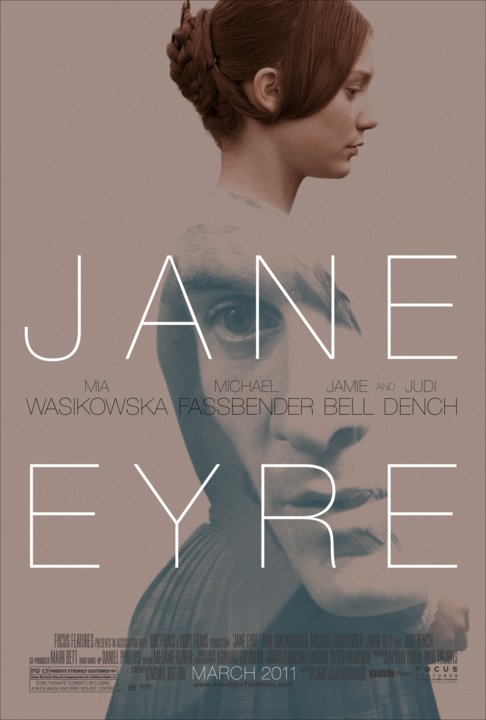
Before chatter about this movie started on the blogosphere, I’d never heard of the two lead actors in this adaptation: Michael Fassbender and Mia Wasikowska.


And I have to say, they were very well cast, and I’m looking forward to seeing them in other projects. (Michael Fassbender is interesting looking—from some angles, he reminded me of Aidan Quinn—I think it’s the eyes—and from others, of Leslie Howard.)
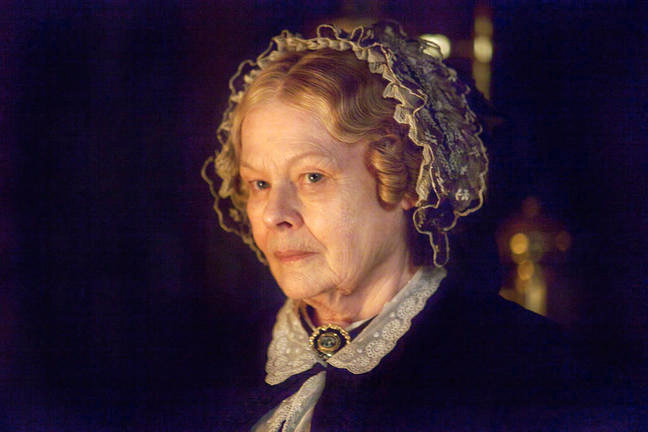
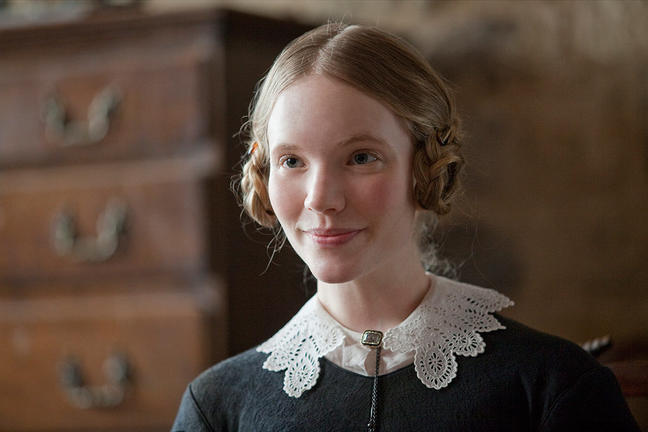
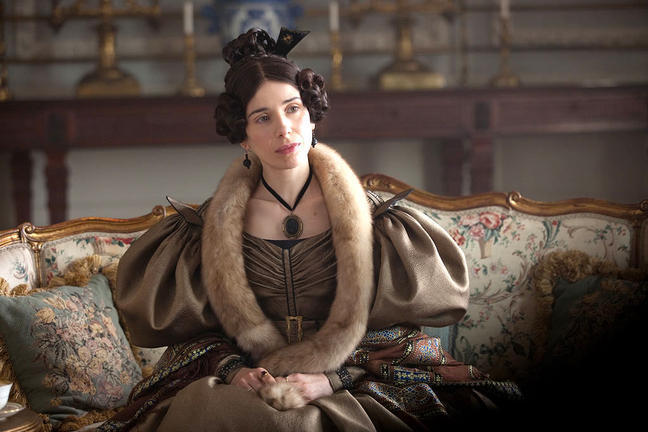
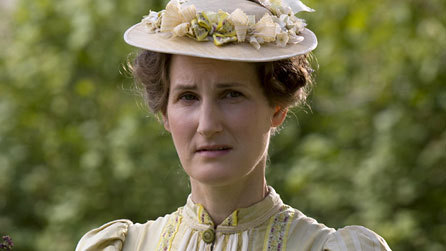
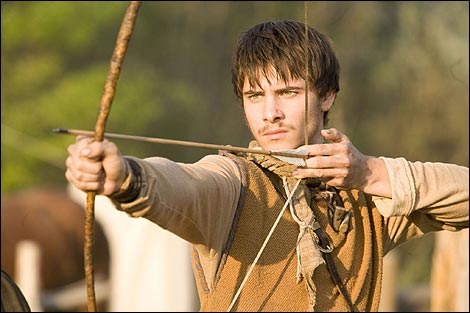
There were several other recognizable names (and some not so recognizable faces!) in the supporting cast. The biggest name in this movie has to be Dame Judi Dench as Rochester’s housekeeper, Mrs. Fairfax. Her character brought some much-needed humor to the movie. Then there was Jamie Bell (Billy Elliot, Defiance, The Eagle, and Nicholas Nickleby) as St. John Rivers, Tamzin Merchant (Catherine Howard in The Tudors, Georgiana Darcy in Pride & Prejudice 2005) as Mary Rivers, Sally Hawkins (Anne Elliot in Persuasion 2008) as Jane’s aunt Mrs. Reed, Sandy McDade (Margaret Brown in Lark Rise to Candleford) as one of Jane’s school teachers, Imogen Poots (Fanny Knight from Miss Austen Regrets) as Jane’s potential rival Blanche Ingram, and Harry Lloyd, whom both Ruth and I kept thinking looked extremely familiar as Richard Mason, Rochester’s brother-in-law, but who looked so different from his stint as Will Scarlett on the BBC-TV version of Robin Hood a few years ago.


My Viewing Experience
Maybe it’s because I did already know the story before going into this movie, but I actually found myself paying a lot of attention to the technical aspects of the film—the lighting (very dim/dark, as it would have been in an age when everything was lit by candles, also reflective of the mood of the scenes), the camera work (we were all a little worried at the herky-jerky hand-held camerawork in the first scene—repeated later—when Jane is running away from Thornfield Hall, but it was only for that one scene), the settings (the interiors of the houses were breathtaking down to every last detail!), and the COSTUMES.
Oh, my goodness, the costumes were gorgeous. With this novel having been published in 1847, the costuming was almost from “my” era of 1851—though the influences for the costuming seemed to be a little more early 1840s, with long, straight sleeves on the fancy dresses instead of the more flowing, bell-shaped sleeves of the late 1840s/early 1850s with dropped shoulder seams which emphasized the sloped-shouldered posture that was considered fashionable in that era (which the twenty-first century actresses weren’t able to adopt) and bum-pad petticoats that made the hips stand out (as they did in the 18th century) instead of the more flared look of multiple stiff, starched petticoats and crinolines of the late 40s/early 50s—the look that gave rise to the invention of hoops so that they didn’t have to wear so many petticoats.
But even with the variations from what I expected the costuming to look like, many times in viewing, I found myself thinking, Look at those sleeves! Look at that gathering! Look at that lace! Look at that pin tucking!
The movie itself.
I’d read ahead of time that the movie begins with Jane running away from Thornfield. No reason is given for this flight. We just see a young woman, running from an old house in the gray weather. We see her standing at a crossroads waiting for the mail coach. We see her wandering across the moors, sobbing. We then see her pounding on the door of a home in the pouring rain, begging to be let in. And then we see the Riverses take her in and nurse her back to health.
Then, the actual story is told mostly in flashback, beginning with Jane as a child at her aunt’s home being tormented by her male cousin (this was a bit much for me) and then being locked in a room—in which scene they really started playing up the gothic elements of the book. Mixed in with the scenes of Jane’s childhood are her scenes with the Riverses—St. John, Mary, and Diana. Sometimes it seemed like she was telling them her story as she remembered these scenes, while other times it was obvious these were private reflections. The brutality—emotional, spiritual, and physical—at the school Jane attended is shown, along with the trauma of Jane’s losing her best friend to illness. And then she goes to Thornfield.
Once Jane arrives at Thornfield, we lose the flashbackiness of the movie, and it just stays put and moves forward with the story instead of jumping back and forth, which I appreciated as someone who likes a consistent, forward-moving chronology in stories (Lost being a major exception to this preference).
What this theatrical version of the film lost for me was the development of the relationship between Jane and Rochester. They spent so much time on the setup—on the initial scenes of Jane running away and on her childhood—that they didn’t really have time to show how the relationship between Jane and Rochester grew from almost adversarial to passionate. In the film, they were just all of a sudden passionately in love with each other—and it was most unbelievable on Jane’s side, because this version of Rochester had really given no reason for her unswerving loyalty to him.
Also, even though they played up the gothic elements in certain places, the one element they didn’t play up was Bertha. As I recall, Grace Poole, Bertha’s caregiver, is quite visible in the book, and Jane even interacts with her—and it’s Grace Poole who gets blamed for everything weird that happens in the house. (Including when a “savage looking” woman sneaks into Jane’s room the night before the wedding and rips her veil in two—which didn’t happen in the movie at all.) They also dropped the explanation of Rochester’s marriage to Bertha that Bertha’s family tricked him into marrying her by making sure he only saw her when she was behaving normally and not showing her schizophrenic tendencies. If they truly wanted to highlight the gothic elements of the novel, they missed the boat here.
I’m going to have to pull the book off the shelf and revisit the ending of the novel—because I don’t remember it ending as abruptly as the movie did—kiss, hug, the end.
So, there you have it. My reaction to seeing Jane Eyre. Again, it’s never been one of my favorites, so I apologize for not gushing about it. (If you would like to read a review of the movie from someone who’s a true fan of the book, check out Ruth’s review.) But it was enjoyable—and I’ve never been to a movie in a theater that packed that stayed so quiet and attentive! All in all, definitely worth seeing if it comes to a theater near you.
Fun Friday–What’re You Doing This Weekend?

So, I couldn’t think of anything “fun” to share today. Instead, I thought we could talk about what’s on tap for the weekend that we’re looking forward to.
Tonight, I’m getting together with girlfriends to go see the new Jane Eyre movie, with dinner at Cheeseburger Charley’s beforehand.
And then I get to work all weekend—as usual. But at least I have girls’ night out tonight to look forward to.
What fun things do you have planned for this weekend?
Thursday Thought Provoker

 KayeDacus.com