Book-Talk Monday: Reading *Popular* Fiction

The term “popular fiction” is occasionally used interchangeably with “genre fiction”—another term to describe books that fall into categories like romance, science fiction, fantasy, mystery, etc. In fact, my master’s degree is in Writing Popular Fiction, and my area of specialization was Romance.
But using popular to describe all genre fiction is a misnomer—because not every book published in genre fiction is going to be “popular,” i.e., “regarded with favor, approval, or affection by people in general.” Looking at my own sales numbers, Stand-In Groom is a much more “popular” book than A Case For Love—as it’s sold several thousand more copies.
As readers, the books we love don’t always find the spotlight of popular approval. They’re not the bestsellers, the books that get all the media attention, become major motion pictures. And for many of us, the books that are the most popular (those on the bestseller lists, for example) aren’t those that we enjoy—we just don’t “get” why these books are so popular.
I’m a stubborn person by nature and I rarely do something just because everyone else is doing it. That’s not to say I don’t get caught up in pop culture trends—like certain TV shows like LOST. However when it comes to books, the more often I’m told I should read something, the less likely I am to read it unless it’s something that greatly interests me. (I have to this day never read The Shack, even though I have a copy of it on my shelf. I’ve been told repeatedly I *should* or *need* to read it—but the concept of the book and the storyline itself doesn’t interest me at all, so I don’t see the point in reading it.) I’m also not the kind of person who runs out and reads a book just because there’s a movie coming out based on it. Sometimes, the investment of two hours is all I need to know whether or not I’m going to like a story. (Such as with The Help. Now that I’ve seen the movie, I have no desire to read the book.)
 However, there are times when something becomes so popular, gains such a following, that I decide out of curiosity to check it out to see what the hubbub is. This happened many years ago when the sixth Harry Potter book came out. All the outcries against the series started up again in the Christian writers’ group I was in—from people who’d never read the books, just read about them on conservative blogs or heard about them from preachers or speakers who were against them. That’s not to discount their stances or beliefs on the books. But I have never allowed others to form my opinions for me. So before I took a stance one way or the other on the books/films, I decided I needed to find out what they were about. So I got the discs of the first three movies from Netflix (they all actually arrived on the same day) and spent a Saturday watching them. Before the third movie ended, I’d gotten online and ordered a set of the first five books in paperback, as well as the hardcover of the sixth book (it wasn’t out in paperback yet), and within less than two months, I’d read the entire series and was eagerly anticipating the release of the seventh book. Which wouldn’t happen for a couple of years.
There have been other times when I’ve picked up a book to read because I’d heard a lot about it, because it was popular. But most of the time, I’ve discovered that my tastes don’t necessarily run to what’s “popular,” not even within the romance genre. I’m just a picky reader.
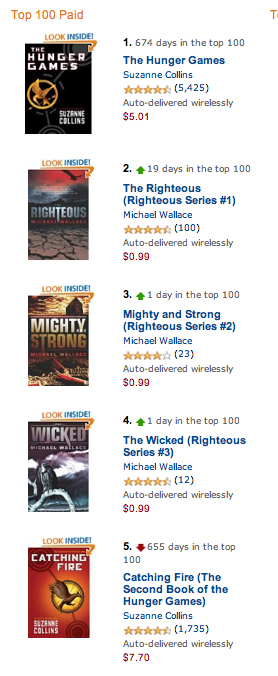
This weekend, I decided that I needed to once again get in touch with popular culture and read The Hunger Games. I started with downloading the sample to my Kindle. When on that page on Amazon, I discovered that it’s a title that’s part of Amazon’s free lending program. But I still wanted to read the sample first. I did—and as soon as I got to the end of the sample, I downloaded the entire book. That was around 9 p.m. Saturday night. At 5 p.m. Sunday afternoon, I finished reading the book. And I could see what all the hype was about—and I’m now wanting to see the movie, too.
Have you ever read something because it’s “popular,” even if it’s not something you might normally pick up? What’s been your experience in reading “popular” fiction?
Writer-Talk Tuesday: Let’s Talk STORY
 Two weeks ago, I posted some of the comments I’ve made as a writing-contest judge in the areas of Characterization, Conflict, and Dialogue. I wasn’t able to get to the area of STORY . . . simply because “story” covers so much ground. So for the next few Writer-Talk Tuesdays, I’ll break that element down into chunks and share some of my favorite comments from past contests. (The headings these are broken into are from the score sheet from the ACFW Genesis contest.)
Does the story hold your interest to the end of the entry?
This is where a lot of judges will knock off points subjectively. Because, let’s face it, this is a very subjective question. This is where both how you start your entry and where you end your entry come into play.
First, obviously, you need a great opening hook. You want to grab the reader (in this case, the contest judge) right off the bat. Since receiving my Kindle a year ago, I’ve read a lot of sample opening chapters—mostly of Christian fiction, but of some general-market fiction as well. If I read all the way through to the end of the sample, it’s one that’s going on my wishlist—or possibly, if I have disposable income and/or it’s got a really low sale price, I’ll go ahead and purchase/download the whole book. That’s how important your opening pages are: will it make the reader (the editor, agent, or customer) pull the trigger and buy your book?
You also want to leave your reader (judge) wanting more when they get to the end of the entry—you want them wishing that they had just one more page, just one more chapter, because they need to know what happens next. Even if there are technical/craft issues with your entry, if you leave the reader wanting more story, they’re going to give you a higher score.
So you need several key things to score well on this:
• Strong opening hook
• Strong, interesting characters
• Interesting setting/scenario
• Unique premise
• End with a hook
Here are some recent comments I’ve made on entries under this question:
Suggested Reading:
Make a Scene: Crafting a Powerful Story One Scene at a Time by Jordan E. Rosenfeld
The Power of Point of View by Alicia Rasley
Characters and Viewpoint by Orson Scott Card
Scene and Structure by Jack Bickham
Setting by Jack Bickham
Writing the Breakout Novel by Donald Maass
Stein on Writing by Sol Stein
Writing the Christian Romance by Gail Martin
______________________________________
In this blog post, James Scott Bell wrote the following:
- There were several items that should be avoided at all costs on the first page. Here they are, in no particular order:
Exposition Dump
In most of the first pages I reviewed there was entirely too much exposition. The author thinks that this is information the reader has to know in order to understand the character and the scene.
In truth, readers need to know very little to get into the story. They will wait a long time for explanations and backstory if the action is gripping, essential, tense or disturbing. My rule, ever since I began writing and teaching, is act first, explain later.
This rule will serve you amazingly well your entire writing career.
______________________________________
The scenes are static—mostly descriptions/summaries of actions, not the actions themselves—and they lack purpose and direction.
______________________________________
Because of the amount of telling of backstory in this section, I had a hard time wanting to keep reading. Any time you have to use transitions such as three months later or they stayed for six days in your first chapter, it’s an indicator you’ve started your story in the wrong place. Plus, long paragraphs of narrative that tell about the passing of time, that tell about what’s going on around the character, or that tell about emotional events that impact the character after the fact (without having shown the active scene in which the events occurred), aren’t going to draw readers in and keep them interested in what’s going on in your story. You have a way with words—I’d love to see that put to much better use in active, showing, impactful scenes instead of scenes full of long paragraphs of telling.
______________________________________
While your prose is well crafted, nothing happens in these fifteen pages to make me, as a reader, interested enough to want to know more about these characters (and even after reading your synopsis, which I waited to do until after reading the fifteen pages, I still wasn’t hooked). In fact, I’m more interested in [a secondary character’s] story than [the heroine’s].
______________________________________
Story begins with character. To draw a reader into your story, you must create compelling characters that draw the reader into the emotional and visceral experience of the world you’re crafting. Characters must have depth of emotion. Not melodrama, but there must be something deeper than just the surface-level presented here. A couple of really good books you should study to help you in this aspect are Getting into Character by Brandilyn Collins and The Plot Thickens by Noah Lukeman—because in addition to compelling characters, a story that’s going to hold a reader’s interest is going to start with compelling plot as well. The most interesting thing that happened in your entry happened on the last two or three pages. An editor isn’t going to give you that long to draw them into the story.
______________________________________
You need to get your characters into the scene as soon as possible. And be sure the reader knows who your characters are. Make it clear whose viewpoint we’re in. Establish a purpose, a goal, or an intention for the character. Jordan Rosenfeld in Make a Scene calls this the scene intention:
- Give [your character] an intention in every scene—a job that he wants to carry out that will give purpose to the scene. The intention doesn’t come from nowhere—it stems directly from the significant situation of your plot and from your protagonist’s personal history. An intention is a character’s plan to take an action, to do something, whereas a motivation is a series of reasons, from your character’s personal history to his mood, that accounts for why he plans to take an action.
Questions to ask yourself for each scene—but especially opening scenes/chapters:
• What are the most immediate desires of your character?
• Will your character meet his intention or meet with opposition?
• Does the scene intention make sense to the overall plot of your story?
• Who will help your characters achieve the intention—or thwart it?
Scene intentions need to involve conflict and they need to tie into the plot or one of the subplots of the story. You need to know your character’s intentions from the beginning of the scene so you know whether they are supposed to reach them or not.
Action doesn’t need setup.
The sooner you start the action in a scene, the more momentum it has to carry the reader forward. If you find yourself explaining an action, they you don’t have action anymore—you have narrative.
You need physical movement and a sense of time passing—and the lack of an explanation as to why something is happening is what keeps a reader reading.
Get straight to the action. If a character is going to jump off a cliff, open with him stepping off the edge, not standing there contemplating it for five paragraphs.
Hook the reader with big or surprising actions. An outburst, a car crash, a heart attack, a public argument, a knock at the door. But this big, surprising action must be relevant to the main plot of the novel. Don’t invent a “bang” just for the sake of opening with a “bang.”
Be sure the action is true to your character. Don’t open a scene with a shy/quiet character going off on someone. That’s something to build up to at the end of a scene much further into the book. Do open with a difficult boss berating that shy/quiet character.
Act first, think later. If the character needs to react to something or have a (brief) moment of introspection, have her do something active first.
______________________________________
Any questions about any of those comments?
Book-Talk Monday: Fiction vs. Nonfiction
What’s the ratio of fiction vs. nonfiction that you read?
And I’m not talking about devotionals or Bible study books. I’m talking biographies, memoirs, histories, essay collections, etc. And reading, not just books for research. A nonfiction book you choose to read versus one you have to read for a school paper or for what you’re writing.
Last month, I read the novel The Lady Elizabeth by Alison Weir, who, I learned, is better known for her nonfiction histories of eminent personages from the Tudor era (mainly) along with other historical British personalities. Since one of my major gripes with the novel was that it was apparent she was more accustomed to writing nonfiction (way too many info dumps/too much unnecessary historical context given throughout), I decided to read her nonfiction account of Elizabeth’s mother, The Lady in the Tower: The Fall of Anne Boleyn. The same “wait, let me backtrack and tell you all the details leading up to this event” tendency is there, but in a nonfiction piece, for me it’s not only acceptable, but I appreciate it.
I don’t read a lot of nonfiction by choice. I do enjoy research when it’s for a project (I’m the person who, in college, wrote a research paper on a historical figure I was interested in just because I wanted to—properly annotated and everything—and no one else has ever read it!), but to just sit down and read something nonfiction isn’t really something I do. There are some nonfiction books I’ve enjoyed—many of which are memoirs/personal accounts of public figures or celebrities I’ve liked (I’ve read Bill and Hillary Clintons’ books, Barack Obama’s books, biographies of Katharine Hepburn and Cary Grant, the psuedo-autobiography of the Judds, and a couple of Frank Schaeffer’s most recent books). I have a huge number of books on the Civil War—but the only ones I’ve actually read cover to cover are the ones I had to read for my college classes.
On the flip side, I enjoy watching documentaries: Rome: Engineering an Empire, Queen Victoria’s Empire, The Civil War, Ken Burn’s The West, The National Parks, and so on. When I had cable TV, more often than not, when there was nothing else on, I might find the TV parked on H2 (formerly History International) on something like The Dark Ages or America: The Story of Us or Life After People. But just don’t ask me to sit down and read 400 pages on those topics!
So I’d have to say that my fiction to nonfiction ratio (not counting research books, remember) is at least 100:1 (100 fiction books to every 1 nonfiction book). My reading goal for this year is to read at least thirty-six new-to-me books, and I’m going to alter that goal to include at least two nonfiction books read for pleasure, not research.
What about you?
Fun Friday–TGIF!

Not for nothing is their motto TGIF – ‘Thank God it’s Friday.’ They live for weekends when they can go do what they really want to do.
~ Richard Nelson Bolles
.
The rhythm of the weekend, with its birth, its planned gaiety, and its announced end, followed the rhythm of life and was a substitute for it.
~F. Scott Fitzgerald
.
There aren’t enough days in the weekend.
~Rod Schmidt
.
Weekends don’t count unless you spend them doing something completely pointless.
~ Bill Waterson
.
Weekends are a bit like rainbows; they look good from a distance but disappear when you get up close to them.
~John Shirley
.
Make each day of the week like Friday and your life will take on new enthusiasm.
~Byron Pulsifer
.
Only Robinson Crusoe had everything done by Friday.
~Thank Goodness It’s Friday
Thursday Thought Provoker
Writer-Talk Wednesday: March 2012 Writing Update
If anyone’s been watching the word-count widget over in the right-hand column, you’ll have noticed that I haven’t made much progress since my last writing update post four weeks ago. (Fewer than 5,000 words written in February.) I stated last month that my goal was to have the first draft of Follow the Heart finished by mid-March. Obviously, that’s not going to happen. However, my goal is still to have the draft finished in time so that I have a couple of weeks for the rewrites/revisions/additions I know the first part of the draft needs.
So what does that mean?
Well, that means if I can write 1,000 words a day, I can reach that 80,000 to 90,000-word goal by April 16, which would give me two weeks for revisions/rewrites/additions/edits before I turn it in. That’s a pretty tight turnaround!
If I can write 1,200 words a day, I can be finished by April 8, which gives me a little more breathing room.
However, if I can write 1,500 words a day, I can be finished by April 1, which gives me a month to really work on crafting those additional scenes I need, rounding out the ones I have, revising the ones that feel forced or dry . . . and then still be able to go back for a final pass for editing before I turn it in on May 1.
In the 1k1hr challenges I did in January and February, I always wrote between 1,200 and 1,600 words. So that’s my goal. Do a 1k1hr challenge every day and try to average between 1,200 and 1,500 words a day so that I can get this first draft finished and get on to what I consider more fun—polishing everything and making it sing!
How have you done with your writing (novel, short stories, articles, devotionals, school papers, blogging) in the past month? Share your successes/challenges!
Book-Talk Monday: What Are You Reading (March 2012)
It’s the first Monday of the month, so it’s time to share what we’re reading!
.
- What is the most recent book you’ve finished reading? (Please tell us a little about it, and whether or not you enjoyed/would recommend it.)
Since February’s update, I finished reading (click the title for my “review”):
—A Tailor-Made Bride by Karen Witemeyer
—A Kiss at Midnight by Eloisa James (audio book)
—The Lady Elizabeth by Alison Weir
—Dracula by Bram Stoker (audio book)
—Waterfall by Lisa T. Bergren
- What are you currently reading?
Currently reading: I’m not allowing myself to start reading anything new until I get the first draft of Follow the Heart finished. Reading will be my treat for finishing.
Currently listening to: Christy by Catherine Marshall (read by Kellie Martin)
- What’s the next book on your To Be Read stack?
Follow the Heart, Book 1 of the Great Exhibition series by Kaye Dacus—I must finish this manuscript so that I have time for rewrites, revisions, and edits before I have to turn it in on May 1!
Fun Friday–Say 33
I found this meme on one of the blogs I follow and thought it looked like fun. Feel free to take and use on your own blog (and post a link in the comments if you do!).
Say 33—You in 33 Questions
1. Your main trait: Inborn pessimism
2. The quality you like best in a man: It’s a tie between good earning potential and a premium health insurance policy he can add me to
3. The quality you like best in a woman: a good sense of humor
4. Your main flaw: See #1
5. Last time you cried: So long ago, I can’t remember
6. Ideal job: English/writing professor
 7. Scent of a place: Smoky Mountains in the Fall
8. Beloved movie: The Philadelphia Story
9. Book on the nightstand: My Kindle—and I’m currently reading Waterfall by Lisa T. Bergren
10. First and best kiss: Still waiting . . .
11. You couldn’t do without: My laptop
12. How you would like to die: Painlessly and not alone
13. Song you sing in the shower: Whatever song is playing on Pandora
14. Your deadly sin: See #1
15. Your not-so-deadly sin: Addiction to Pinterest
16. Your motto: If it doesn’t work, turn it off and back on again.
17. Ideal first date: Any
18. Favorite present: When my parents paid for me to attend my first writers’ conference for my 30th birthday
19. What you do on the train: When I used to ride the Metro to work in downtown DC, I would read. Haven’t commuted by “train” since early 1994.
20. Something you’d change in your body: Um . . . my BODY!!!
21. Your addiction: Sugar
22. Now on your left: Completed editing project ready to be turned in.
23. Now on your right: On the other side of my mouse, a green highlighter, a box of staples, an empty coffee cup, and my Flip video camera
24. Now in front of you: My computer (???)
25. Now behind you: An extra office chair with a bunch of stuff piled in it that needs to be put away.
26. 3 names for (of) your children: I don’t want to have children (and am too old now anyway), but I was always partial to Julia, David, and Charmianne (shar-mee-ANN), all family names.
27. 3 things in your purse: Bookmarks, Excedrin, 6 pens (just in case five run out of ink?)
 28. 3 places that fascinate you: Romania, Ukraine, and Germany
29. 3 people you’d like to meet: Julian Fellows, Andrew Davies, and J.K. Rowling
30. 3 traits that annoy you in others: Dishonesty, closed-mindedness, and intolerance
31. 3 values inherited from your parents: Strong work-ethic, high morals, open-mindedness
32. In your past life you were: A professor
33. In your future life you’ll be: A professor
Writing Contest Prep: Words from a Judge on DIALOGUE
Good dialogue is hard to define, but bad dialogue is so easy to spot!
Suggested Reading:
Writing Dialogue by Tom Chiarella
http://www.writing-world.com/fiction/said.shtml
http://writingfiction.suite101.com/article.cfm/dialogue_tags
Say What?
“Say What?” How Do You Say Hello?
“Say What?”–Uh, Um, Well, So, Wow, Great, Yeah, Really?
“Say What?”–Transcribed Dialogue Assignment
“Say What?”–Where Do I Put the Quotation Marks?
“Say What?”–A Delicate Balancing Act
“Say What?”–What Direction Is Your Dialogue Going?
“Say What?”–Dialogue Writing Assignment
Fun Friday–Favorite Movies/TV for Dialogue
“Say What?”–Is It Dialogue-Worthy?
“Say what?” she intoned incredulously.
“Say What?”–Subtexting
“Say What?”–Character Quirks & Non-Verbal Dialogue
Comments I’ve made on past entries:
Speaker attributions should be in the same paragraph as the dialogue. If the beat that follows the dialogue is NOT the introspection or action of the person who just spoke, it goes in a new paragraph.
_____________________________
Don’t have a character react to something before it’s been said (He turned toward her and was startled when she said . . .).
_____________________________
Where you do have dialogue, it’s well done. Unfortunately, your narrative-heavy opening overwhelms it. In this blog post, James Scott Bell wrote the following:
- Characters Alone, Thinking
This was in the majority of the first pages I reviewed. We did not get a scene, which is a character in conflict with others in order to advance an agenda. We got, instead, the ruminations of the character as he/she reflects on something that just happened, or the state of his/her life at the moment, or some strong emotion. The author, in a mistaken attempt to establish reader sympathy with the character, gave us static information.
Such a page is DOA, even if the character is “doing” something innocuous, like preparing breakfast:
- Marge Inersha tried to mix the pancake batter, but thoughts of Carl kept swirling in her head, taking her mind off breakfast and back to Tuesday, horrible Tuesday when the sheriff had served her with the divorce papers. Tears fell into the batter, but Marge was powerless to stop them. She put the mixing bowl on the counter and wiped her eyes. How much more could she take? With two kids sleeping upstairs?
Marge is certainly hurting, but you know what? I don’t care. I hate to be piggy about this, but I really don’t care that Marge is crying into her pancake batter. The mistake writers make is in thinking that readers will have immediate sympathy for a person who is upset.
They won’t. It’s like sitting at a bar and guy next to you grabs your sleeve and immediately starts pouring out his troubles to you.
Sorry, buddy, I don’t care. We all got troubles. What else is new?
Don’t give us a character like that on page 1.
Don’t open with narrative that either takes place inside the character’s head and/or long paragraphs of exposition. Writing like that is static and lacks purpose, movement, and direction.
_____________________________
Put dialogue in the driver’s seat in scenes where you need to drive conflict. Make your character want something that she needs to get from another character. Will she just walk up and ask for it? Or will she commence in small talk first and then get around to asking for it? And how will the other character react to this request?
- “All good dialogue has direction. It’s a mishmash of needs and desire on the part of an individual character weighed against the tension inherent in the gathering of more than one person. . . . This is the stuff that fills the spaces between us, even when we don’t recognize it. As a writer, you have to learn to trust that it’s there” (Chiarella, 21).
In other words, make sure your dialogue has direction—that it’s leading both the characters and the readers toward more conflict, toward the rising tension of the main plot of the story.
If you have an action or introspection that follows the dialogue, you don’t need to use said/asked. (And it will also eliminate the unnecessary/repetitious use of “as” and “when.”)
Eliminate as many said/asked dialogue tags as possible. These types of dialogue tags get very old very quickly. Just as you want to look for ways to make your writing stronger when it comes to verb or adverb use, you want to make sure you’re not overusing any words, and that includes the words said and asked (or embellished tags such as shouted) even as dialogue tags. And the best way to do that is with action and/or introspection laced in with the dialogue.
Embellished dialogue tags—those using more descriptive verbs or, even worse, adverbs—come across as author intrusion. If your character has just explained something in dialogue, the reader knows it and doesn’t need a “she explained” tag. Same thing with “argued,” “elaborated,” or “confirmed.”
Elmore Leonard wrote: “Never use an adverb to modify the verb ‘said’ . . . he admonished gravely. To use an adverb in this way (or almost any way) is a mortal sin. The writer is now exposing himself in earnest, using a word that distracts and can interrupt the rhythm of the exchange.”
Why are adverbs bad? Because, even more than the descriptive verbs, adverbs tell rather than show:
- “Say what?” she asked incredulously.
“Say what?” Her eyes widened and jaw went slack.
If you feel you need to emphasize the incredulity or quickness or cheerfulness with which your character has said something, instead of adding an adverb, look at the dialogue and the surrounding narrative/introspection and do whatever you can to show the emotion/speed/whatever through the dialogue/narrative than through an adverb. If your character asks something “nervously,” show the nervousness through her body language or through the creepy-crawly feeling on the inside of her skin.
_____________________________
According to Tom Chiarella in Writing Dialogue:
- . . .the writer must never feel compelled to duplicate dialects simply for the sake of “authenticity.” The writer who thinks she is writing dialect because she is clipping the ends off of words and stretching out others is often taking delight more in her own experimentation than in any real sense of story. She may be shooting for a folksy charm or for root authenticity, but most often she fails miserably. Try all you want to make the words unrecognizable—misspell them, cut them in half, throw in a fistful of apostrophes, sound out every groan the character makes—the truth is, they are still words you’re dealing with. . . .
There is no quicker way to fail, no quicker way to sell yourself short than to write unconvincing dialect. Your best intentions become mawkish charades. Readers are challenged not to live in your story, to get at the heart of what you have to say, but to “check” the loose strands of accent and spelling.
And from Sol Stein, in Stein on Writing:
- Spelling out pronunciations. . .is almost always a bad choice. I would also like to caution against a use of dialect in which speech is differentiated from the standard language by odd spellings. Though dialect was used quite extensively in earlier periods, today it is seen as a liability for several reasons. Dialect is annoying to the reader. It takes extra effort to derive the meaning of words on the page; that effort deters full involvement in the experience of a story. . . . Dialect is offensive to some readers. Moreover, people do not hear their own dialect or regional mode of speaking; only listeners from other communities hear it. That means you are reducing your potential audience by the employment of dialect. As a substitute for dialect use word order, omitted words, and other markers. . . .
Affecting “ethnicity” or “foreignness” through phonetic dialogue is the cheap way to do it—and, as these experts point out, is difficult for the reader (who must stop and read it aloud to figure out what it actually says) and keeps the reader from connecting with your character. A better way to use dialogue to brand your characters’ ethnicity, education, and place of origin is through diction—i.e., through the words you choose and how you string them together.
The dichotomy between the over-the-top descriptions and the “affluent” word choice in the narrative and the “low-country”/uneducated black-speak of the characters works against you—it’s such a jarring transition to see “walkin’ wid me” and “ackin’” and “gunna” and “yuh” throughout the dialogue and then to see words like eclectic and statuesque and en route and capacious in the narrative. In deep third-person POV (which is what romance should be written in), the narrative is the viewpoint character’s stream of consciousness—and should, therefore, be written in the character’s internal dialogue (though not in dialect!).
_____________________________
Where there is dialogue, it’s stiff and stilted, not the way that real people talk. But it’s all overwhelmed by the narrative. Additionally, the dialogue is actually coming across more as a device for you, the author, to get information across to the reader, not like people really interacting with each other—it’s the characters talking about things that happened in scenes you haven’t shown (but should).
_____________________________
Where you have dialogue, it’s okay. But it’s so overwhelmed by narrative summary that it’s hard to get a good feel for it.
_____________________________
Don’t use dialogue just to explain the Britspeak (the boot discussion toward the end of this entry). As a self-professed anglophile, she would know what all these terms are—but you can show the reader what they mean just by having the hero put the suitcases in the trunk of the car after saying he’s going to put them into the boot.
You need a lot less narrative and a lot more dialogue in your opening chapter. Two full pages of narrative, uninterrupted by dialogue, isn’t appealing to the reader’s eye, and it’s something most editors/agents will say makes them put down a manuscript unread.
_____________________________
Your dialogue is something of a “feed the reader information” device right now—and it’s overwhelmed, especially in the heroine’s scenes—by the amount of narrative. In opening chapters, it’s more important to have dialogue than it is to have deep introspection or long paragraphs of setting description.
Also, yes, we use “uh” and “um” a lot in our everyday speech. But it actually gets annoying to a reader.
_____________________________
Be careful about using dialogue to “tell” the reader information (about the setting, specifically in the statements at the council meeting). A key signal that you’re telling through dialogue is every time the character begins a statement with, “As you all already know . . .”
_____________________________
There are several places you’ve had the heroine “thinking out loud” as a substitute for genuine dialogue. Don’t. That comes across as amateurish writing. Delve deeper into POV and make things like that part of the character’s deep, internal stream of consciousness (the narrative)—or, better yet, give her a secondary character to say these things to in conversation. Where there is dialogue, it’s good, but it is somewhat overwhelmed by the narrative.
_____________________________
Most of the dialogue in the heroine’s scenes are used for the sole purpose of telling the reader information—either about the heroine and who she is or about what’s happened before that scene (after your time transition). The hero’s dialogue is stronger—but then there are scenes that should be dialogue and aren’t. (Prime example: telling the parents about their son’s death. Writing out the dialogue and visceral/emotional reactions of that scene would much more powerfully show who the hero is than anything you currently have about him in this excerpt.)
_____________________________
There is not a lot of emotion revealed through the dialogue, nor is dialogue used for subtexting—in other words, the character is thinking or feeling one thing but saying something else because she knows what’s expected of her.
Narrative is your key to subtexting, to making your dialogue even more dynamic, and to making your characters more credible and likable. The reader needs to know what the heroine is thinking and feeling as she interacts with others, especially with the hero and the ex-boyfriend.
_____________________________
The hero has a tendency to run-on a bit at the mouth. I’ve never known a man to ramble like this—even those I know who are particularly verbose.
_____________________________
Now it’s your turn to have a say. What questions/comments do you have on DIALOGUE?
Writing Contest Prep: Words from a Judge on CONFLICT
As we know, there is no story without conflict. And for a reader to be interested enough to keep reading a story, that conflict must be introduced right from the beginning.
Of course, in a contest entry, you only get between 15 and 25 pages (if you’re lucky, I’ve judged some that only allowed three pages!), which is about how much attention an editor or agent will give a sample of your writing. So it’s vitally important to figure out how to get not just any conflict on your opening pages, but to figure out how to immediately draw your reader into the story conflict—the conflict that drives the plot of your novel—into the opening pages without giving too much of it away.
Here are a couple of questions from the score sheet from the ACFW Genesis contest about conflict, and a little explanation given to the judges about them:
Are character motivations powerful enough to create sufficient conflict?
- Consider what you are given about the main characters and if there is enough potential for good conflict. You may not see a character’s goal or motivation, but there should be enough hints to sense if this is building up to something big. If you can’t sense that, then you should deduct points. Sometimes writers will use external conflicts—disasters, threats, etc.—to hide a lack of internal conflict.
But also be wary of all character motivations spelled out in the first chapter.
Is a potential for conflict established that is strong enough to move the story forward?
- Think of the previous question as being character-focused, and this question as being plot focused.
Suggested Reading:
The Plot Thickens by Noah Lukeman
Conflict, Action & Suspense by William Noble
Plot by Anson Dibell
Comments I’ve made on past entries:
Kurt Vonnegut said that he taught his students to have their character want something on the first page—even if it’s just a glass of water. It’s not interesting to read about someone who doesn’t want anything—who has no goals. The greater the desire, the more interesting the story.
Above, I said each scene should start out with a goal that is an important step in the character’s game plan—a small goal that gets them one step closer to attaining the main goal of the story and end with a “disaster.” It’s not a disaster in the truest sense of the word: a car accident, a stock-market crash wiping out the hero’s livelihood, a death, or whatever. It’s a disaster in that it puts our character further into the hole of narrative debt—a setback, a redirection. In other words, you’re starting the scene out with a question: can the character do/attain this? This is how you build CONFLICT.
To keep a reader hooked into the story, the answer at the end of the scene should be no. Or at least yes, BUT . . . or yes, IF . . . —if it’s a yes answer, it cannot be unconditional. The end of the scene has two primary jobs: to answer the scene question (preferably “NO!”) and to make the reader want to read the next scene to find out when the character will attain that goal.
Sometimes, you may have to work a scene backwards. If you know the disaster that needs to happen—because of what comes after it, because it sets up what happens—examine the disaster and determine what it is that the disaster is stopping the character from doing/attaining. But don’t forget that all of your “disasters” must also fit logically into the main “disaster” (climax) of the story.
- “Well-planned scenes end with disasters that tighten the noose around the lead character’s neck; they make things worse, not better; they eliminate hoped-for avenues of progress; they increase the lead character’s worry, sense of failure, and desperation—so that in all these ways, the main character in a novel of 400 pages will be in far worse shape by page 200 than he seemed to be at the outset” (Jack Bickham, Scene & Structure).
A good scene will end with the characters making “backwards” progress; it eliminates options for an easy answer or solution; it makes the walls start closing in; and it has an impact on later events.
But one caveat: don’t contrive a disaster just to create a cliffhanger—hooks should be unexpected, but they should also be realistic and logical for your plot, the world of your story, and the development of your characters. Make the lead-up to the disaster subtle enough that the reader is suspicious something’s going to go wrong, but not so that they can see it coming from a mile away.
Having read your synopsis, it comes across that really the only major conflict between the hero and heroine is that they don’t talk to each other, and that’s a very difficult sell to readers to sustain their interest and for them to want to keep reading. Try to find something other than just misunderstanding caused by lack of communication as your main conflict between these characters.
_________________________________
It’s hard to tell if there is going to be any conflict for this story to build on. Right now, all we’ve got is a bitter woman and a confused, naïve man from her past. Apparently she’s got to have some kind of surgery, but not even the reader knows what it is, so it’s probably not all that important. We know that there’s conflict from their past, but because so much time has been spent just camping out in her negative thoughts, there’s no indication of why the reader would want to continue reading to see if there’s going to be any way that these two people get together—at this point in time, if these were real people, I’d tell the hero to run for the hills and avoid any further interaction with this highly unstable woman. Right now, her motivation is anger/negativity/bitterness. The hero’s motivation is . . . not sure. Maybe confusion over why she’s angry with him.
If you rewrite this so that there’s much more action/interaction between characters (and possibly add a couple of other secondary characters), you’ll be building much more conflict and tension than by just camping out in the heroine’s and hero’s thoughts so much.
_________________________________
If I hadn’t had the synopsis to read, I probably would have scored conflict lower, as it’s somewhat unclear where the story is going just from reading the excerpt.
_________________________________
So far, I’m not really connecting with the conflict of the story, other than the she’s there and he doesn’t want her there; and she has something to hide. What’s unique about this story that will make it stand apart from all the other proposals crossing your dream agent’s desk?
_________________________________
Study published books’ opening chapters to see how conflicts are introduced in the opening pages.
_________________________________
This is one area where, even though the synopsis isn’t judged, it can affect the scoring. If I’d only had your fifteen pages to read, I probably would have ended up scoring these two elements as 2s rather than 3s. You’ve told me in your synopsis that there does seem to be a good amount of conflict to come; however, as I mentioned under STORY, you haven’t started in the correct place to show the reader that there is a high level of conflict to come between these two characters, no hint that it’s going to be more than just a clichéd historical forced-marriage romance. If you can find a way to start the story at a point where the conflict level is much higher, where one or both of the main story conflicts are beginning to be revealed, these scores would come way up.
_________________________________
Is a potential for conflict established that is strong enough to move the story forward? For the hero, yes, there is conflict established for a story for him. If the thrust of the plot is the “rich girl falls in love with poor boy despite societal conventions” (and despite his being spurned by a rich girl before) then I’m not sure that works as a strong enough conflict to drive a trade-length romance novel.
_________________________________
Other than the fact that it looks like this story is going to center around the heroine deciding between two men, I’m not sure what the conflict of this story is—where the plot is headed. In Beginnings, Middles & Ends, Nancy Kress writes:
- “Every story makes a promise to the reader. Actually, two promises, one emotional and one intellectual, since the function of stories is to make us both think and feel. . . . Thus, a romance promises to entertain and titillate us, to confirm our belief that ‘love can conquer all,’ and to transport us to a more glamorous world than this one, where the heroine (and by vicarious identification, the reader) is beautiful, well-dressed, and ultimately beloved. . . . As a writer, you must know what promise your story or novel makes. Your reader will know. She may buy your book because it belongs to a genre that promises certain things . . . or she may come to your story without preconceptions, in which case she’ll form them pretty quickly from your characters, tone, plot, and style. . . . By the time she’s read your opening, your reader knows what you’ve implicitly promised.”
Determine what the implicit promise of your story is and make sure that you’re expressing it from the first line of the story.
_________________________________
There’s more setup for the conflict/plot of this story to be about her becoming a caretaker for her mother if her mother has mental deficiencies after the surgery than there is for this to be a romance novel. Sure, she ran into an old flame and had a little bit of a flutter of regret, but that could happen to anyone—could even make her situation worse by having to live in the same town with her ex-fiancé to take care of her mother and witness the fact that he’s moved on with his life without her. Great conflict, just not necessarily the set-up for a romance.
_________________________________
I had to score this lower than I really wanted to. You have a strong conflict for the heroine—but it’s between her and her ex-boyfriend’s mother. Right now, there’s more potential for this to be a situation where the ex-boyfriend comes back and the story is about his trying to win her back again, not about her moving on with a new love. I see no conflict between the heroine and the hero at all—and that’s what makes a strong plot for a romance novel: the conflict that involves both the hero and heroine.
_________________________________
There is good conflict in this story, but I don’t see the romance element—especially since the hero/heroine are at a physical distance from each other and don’t actually interact except for over the phone.
_________________________________
Because so much of the conflict building is skipped over in the two-week gap in the action, it’s hard to know exactly what the conflict of your story is. If the only conflict in their relationship is that he’s a Christian and she’s not, it’s not going to be a strong enough conflict to sustain a plot. There is a hint that there would be a reason she wants to avoid the police, but the reason behind that is never shown to the reader (for example, you have her think about her “injured” shoulder—which at first I thought was hurt during the action of her scene, but then realized it must have been something that happened to her and the reason why she’s on the run).
_________________________________
I can see where there is conflict for your main character—financial problems and having to tutor someone she sees as privileged. But because she is an unlikable character, her conflicts really don’t matter to me as a reader. Make me like her, and then I’ll sympathize with her and root for her to overcome these obstacles.
_________________________________
I see it, I understand it, and I believe it. For all of them.
_________________________________
I feel the conflict building on every page—whether it’s internal, between the main character and his grandmother, or between him and the world-at-large. Good job.
_________________________________
I can see the immediate danger to the characters, but I can’t see what the ultimate conflict of the novel is. Make sure the main conflict (the Quest) is defined within the first chapter or two.
_________________________________

 KayeDacus.com