#FirstDraft60 Day 21 — Writing and Testing Your Story’s Premise
 Now that we’ve had a few weeks to work on developing our characters, their external attributes, and their internal motivations and goals, it’s time to broaden our focus to the overview of our stories: the premise.
It may sound absurd that we’ve put it off this long, because premise—or what your story is about—is one of the essential elements to being able to write a complete draft of a story. Without your premise in place, how do you even know you have a story to write?
The Difference Between Genre Structure and Premise
For the story I want to write in this challenge, I have two strong characters. And I know it’s a romance novel. I know that Stone and Alex meet (I’ve written that scene). I know that the bulk of the story will be the developing romantic relationship between Stone and Alex (and I know one or two conflicts that might get in the way—but nothing that an honest conversation with each other wouldn’t immediately solve, so I need something deeper). And I know they’ll eventually end up together.
So I know the basic how of the story. But I don’t know the premise—I don’t know the why of the story. Why do these two fall in love with each other? Why is this new love threatened? Why should readers care if they have a happily-ever-after ending?
The Difference Between Plot and Premise
To know the premise of my story—the why—I need to have a broad view of the plot of the story. But I don’t need to know every single detail of the plot. Do I need to know some of the plot? Yes. But the individual plot points—the action beats of the story—can remain murky, or completely unknown, until we discover them while actually writing the first draft.
What I do need to know are at least a few of the main conflicts in the plot. The conflicts drive the plot; therefore, we can draw our premise from knowing a few key conflicts we’re centering the plot around.
So while the premise is tied into the plot—or we can say it’s the basic overview of the plot—we don’t have to know every plot point of the story in order to polish our premises.
Developing Your Premise
Obviously, you’re going to start with an idea. Whether that idea comes from a character or a what if…? scenario running through your head, your mind starts building a story around that idea. Now it’s time to take your story idea to the next level and develop it into a premise.
According to Donald Maass in Writing the Breakout Novel:
The key ingredients that I look for in a fully formed breakout premise are (1) plausibility, (2) inherent conflict, (3) originality and (4) gut emotional appeal.
(p. 40)
Let’s explore Maass’s elements a bit so that you can determine if you have an idea or if you have a premise that will sustain your manuscript through to the end.
1. Plausibility
How many times have you sat watching a movie or TV show or reading a book and all of a sudden snorted in derision and grumbled, “Yeah, right. Like that would ever happen!”
Whether it’s too many coincidences happening at just the right time to make things work out well for the main characters or a deus ex machina element—something/someone swooping in at the last moment to solve the unsolvable crisis—what you’ve just experienced is a lack or loss of plausibility. If a writer needs to resort to coincidences and/or deus ex machina machinations in order to get through to the end of the story, it’s likely the premise wasn’t a strong one to begin with.
According to Maass, not only do we need to make sure our premises are realistic—“…most readers, me included, need to feel that the story we are being presented has some basis in reality” (40)—we also don’t want them to be so realistic, so ordinary, that they become predictable. One of the reasons we turn to fiction for entertainment is to escape from normal everyday life. We don’t want that in our fiction. We want something to catch our attention by triggering our imaginations and leading us to try to imagine where a story is going. We want to explore “what if…?”
We don’t want a story premise that makes readers say,
“Yeah, I saw that coming.”
We want a story premise that makes readers say,
“Wow! I wish I’d written that!”
Assignment 1: Write out a brief sketch of your story idea—no more than a paragraph, maybe two. Is your premise plausible? Is it realistic without being predictable?
2. Inherent Conflict
Conflict is the driving force of fiction. Without conflict, there is no story.
It’s so tempting, especially for beginning writers, to shy away from conflict, to not want to put our beloved characters in difficult situations. But if you never get beyond that, if you never learn how to torture your characters, you’ll never be more than just a wannabe writer.
When you’re testing your premise to see if it’s worth committing months, perhaps even years, to developing, you need to know if it creates enough opportunities for conflict to actually sustain the length of story you intend to write. This is why I said that premise is more complex than just having a story idea.
As mentioned above, at this point, you don’t need to know every single conflict that will happen in your story—that’s for another stage of development when you’re actively working out your plot. Right now, all you need to do is be able to list two or three major conflicts that could happen in a story based on this premise.
The next question to ask yourself is this: Does the world of my story have conflict built into it? Opposing forces, both strong, perhaps both in the right? If the milieu of the story is not only multifaceted but also involves opposing factions or points of view, then you have a basis for strong, difficult-to-resolve conflict. To put it another way, if problems already exist in your “place,” that is a good thing.
(Maass, 41)
Assignment 2: Write out at least three main conflicts (plot points) that you know will happen in your story. Are they deep enough to sustain the story’s momentum by creating additional conflicts that will move the plot forward? Are there enough problems facing your characters to keep readers’ interest?
3. Originality
When we pitch our manuscripts to editors and agents, one of the things we’re told to do is include a list of similar titles in the proposal. Where will our story fit into the market? What already-published stories is it similar to in setting, tone, character, theme, content?
And then once that’s established, it’s our job to point out how our story is unique, how it’s not like all of those already-published books. This is where I think newbies attending writing conferences for the first time get really confused, because this is a somewhat oxymoronic situation: tell us how your novel is just like everything else we publish, but different. The nuance of it, what usually gets lost, is that publishers want to know that they can market a book the same way they market everything else they publish—but that readers are going to want to read it because it has an original and unique slant to it that no one else has ever done before.
Remember the adage to write what you know? You know what? No one else has ever had the same thoughts and experiences that you have. Even if you’re an identical twin. No one else thinks or feels the exact same way you do about things. So tap into what makes you unique and bring that to your premise.
Assignment 3: What books out on the market are similar to yours in genre, subject, theme, character? How does your premise position your book in the market? Now, what makes your premise unique? Does it bring a different perspective? Different characters? Different themes? What is the mix of elements in your story’s premise that makes it stand out in a crowd?
4. Gut Emotional Appeal
The fiction we enjoy the most—no matter if it’s romance, sci-fi, true crime, sweeping family sagas, or fantasy epics—is enjoyable to us because it hits us in that sweet-spot emotionally. Perhaps you like reading tear-jerkers. Or maybe you eschew those for books that make you laugh out loud. Or maybe the type of book you pick up depends on the mood you’re in that day.
As writers, one of our primary jobs is to grab our readers by the emotions and not let go, whether it’s creating sigh-worthy heroes or horrifying scenes of death and mayhem.
Assignment 4: What are the emotional stakes in your story premise? How do you want readers to react to your story—do you want to make them laugh? cry? cringe in horror? sit on the edge of their seats? Would you want to read this story if someone else had written it?
If a premise has gut emotional appeal, the novel will start to write itself in my mind. The very idea invites me to imagine characters, complications and dramatic climaxes. It gets me. It feels personal. That, I believe, is because it touches emotions that are deep, real and common to us all.
(Maass,pp. 47–48)
Assignment 5: If you weren’t already working all of the above out in your Story Bible, please pause and add everything from the above assignments to a new section (Plot/Premise) in your Story Bible.
__________________________________________
Works Cited:
Maass, Donald. Writing the Breakout Novel: Insider Advice for Taking Your Fiction to the Next Level. Cincinnati, OH: Writer’s Digest Books, 2001. Print.
#FirstDraft60 Day 20 — Sunday Reflections: Responsibilities, Priorities, and Writing Time
On Sundays, we’re going to take a moment to step back and think about our writing from a wider view. In order to do that, I’ll post some guided questions—feel free to answer them here with as much or little detail as you’d like; or answer them on your own blog or on Facebook. Or just write the answers down in a private journal or notebook. The important thing is to actually think through and write down your answers.
Reflections for Day 20
1. What are your key daily responsibilities that cannot be put aside for writing?
2. What priority does writing take in your life?
3. What would you be willing to give up, for just 30 days, in order to have more time to write?
4. What are some obligations and commitments you currently have that you can reprioritize and/or reschedule in order to build more writing time into your daily schedule and give your writing the priority in October?
I look forward to seeing your answers and will be posting mine soon.
#FirstDraft60 Day 19 — Review and Catch-Up Day
Saturdays throughout this challenge are going to be our days to review what we’ve covered during the week, and to catch up on anything we fell behind with.
When doing any kind of a challenge like this in which the goals are cumulative, it’s always good to build in a day (or two) to be able to get caught up on anything we’ve fallen behind with. Because most of us work during the week, we have more time to do this on the weekends. So for the next five or six weeks, be sure to set aside time on your weekend, whether on Saturday or Sunday to stop, review what you’ve accomplished throughout the previous week, and then caught up on anything you didn’t have time to finish or even start.
This isn’t permission to slack off during the week. It’s to give you permission to not beat yourself up if you don’t get an assignment done or a goal accomplished on the day it’s assigned. As long as you give it your best effort and the complete it by the end of the week, you’ll be able to stay on track.
So let’s begin.
Part 1: Review of the Week
Here are all of the assignments from this past week:
Monday:
Assignment: What are some other activities you can add to the “Creative” column that will help you in preparing to write your story? What are some other “Analytical” activities you are doing that are hindering you from being able to have fun and be imaginative in creating your characters and brainstorming ideas for your story?
Tuesday:
Assignment 1: Read this post to find out what I mean by “draft writing.”
Assignment 2(a): Using the draft-writing technique explained in the above-linked post, write a scene of at least 500 words in which one of your viewpoint characters goes to the market for groceries.
Assignment 2(b): How was it to use the draft writing technique? How many words did you end up with—and how long did it take you? What did you learn about your character? Did you add that new knowledge to your Story Bible?
Wednesday:
Assignment 1: Determine what you want your final word count to be for your completed first draft—or at least the word-count you’d like to reach at the end of this challenge—and post it in the comments section along with your calculation of what you’ll need to average daily to reach it and how you intend on scheduling your time to reach the daily goals.
Assignment 2: Determine how you will track your word-count progress and share your plan in the comments.
Assignment 3: Decide if you want to track your writing-related time/projects and, if so, share how you intend to do so in the comments.
Thursday:
Assignment 1: Determine what your writing schedule will be for each day in October. It may be the same every day, or you may have to mix it up based on prior commitments.
Assignment 2: If don’t already have a wall calendar, print one out and hang it up. Make sure the calendar is hanging somewhere everyone in the house can see it. Write your writing schedule for every day in October on the calendar.
Assignment 3: Share with us what your plan is to make sure that you’re able keep to your writing schedule throughout October.
Friday:
Assignment: What are you going to do when obstacles and challenges arise during this challenge?
Part 2: Catch-Up, Update, and Brainstorm
Assignments for Saturday:
- Review everything you’ve done so far and catch-up with anything you couldn’t get to or couldn’t finish during the week.
- Update your Story Bible and Style Guide based on everything you came up with this week.
- Once you’ve caught up and have everything updated, do some “what if” brainstorming with your character information and backstories and see if you can come up with some additional ideas for either the characters themselves or for your story/plot. Have fun with this. And if you feel inspired to write some scenes, do it!
- Check in and let us know how you’re doing, what you’ve accomplished, and what you hope to achieve this weekend.
Above all else, have a great weekend!
#FirstDraft60 Day 18 — Planning for Challenges and Obstacles
When Life Gets in the Way of Writing
Yesterday, we pulled out our calendars and started working on our writing schedules for the 30 days in October on which we’ll actually be writing our first drafts. But no matter how carefully we plan, we know that something is going to come up to interfere, it always does.
Okay. So what are we going to do? Quit?
Of course not.
There are, obviously, going to be things that come up in the thirty-day writing period that are beyond your control—things that take precedence over writing and require your time and attention. But it’s how you handle getting back on track with your writing that will be the key to success or failure.
If it’s something that just knocks you out of the (writing) game for a day or two, that’s going to be easier to catch up with than the stomach bug laying you out flat for five days.
Because we’ve set so much stock in doing this challenge—in completing that first draft—losing even a single day of writing time may seem like an insurmountable obstacle. Especially if you know from creating your writing calendar that you already might not have time to write every single one of those thirty days.
So what are you going to do? Quit?
Of course not!
Setting Goals = Risking Failure
Yes, by setting goals, you’re making yourself promises. You promise yourself that you are going to take this journey and that you’re going to help yourself succeed.
However, unless you’ve signed a contract that requires you submit your manuscript on October 31, there is no penalty for modifying your word-count goal in order to account for the roadblocks and obstacles that are going to come up.
But the only way to ensure you fail is to not even try.
For anyone who’s set a self-imposed deadline and missed it. For anyone who’s stated a certain number of words to be written every day and not done it. For anyone who’s submitted manuscripts to editors and/or agents and been rejected. For anyone who’s joyously told family and friends that we’ve decided to write novels and get them published, only to have those same people lose faith in—or even mock—you when you can’t show tangible results. We know what failure feels like, and we don’t want to be there again. So our hearts and minds tell us it’s easier not to risk that failure. To quit while we’re ahead.
What Do I Do if I Need to Change My Goal?
Writing down your goals—handwritten in a journal, typed on the computer, emailed to yourself as a list, however you want to do it—makes them real. By having them written down, it gives you the opportunity not only to go back and check things off that you’ve accomplished or completed, but also to remind yourself of the other steps you promised yourself you’d be taking.
Just because you’ve decided you want to try to reach a certain word count, and you’ve written that goal down (whether by sharing it here, on your own blog, on Facebook, etc.), doesn’t mean that it’s carved in stone—as challenges and obstacles arise, as it becomes apparent that the daily word-count goals you set don’t work, then, by all means, re-evaluate and, if necessary, change your goals. But when you change them, make sure to write the new/revised goals down, too—after all, how will you measure your success if you don’t have it written down so you can check/cross it off?
What are you going to do when obstacles and challenges arise during this challenge?
#FirstDraft60 Day 17 — Inspiration vs. Perspiration (Setting a Writing Schedule)
The origin of the word inspiration is the same as the word for breathe (inspire). But what does that really mean when it comes to the creative process?
According to the Bible, one day God got a picture in His mind of a creature made in His own image. This sparked His creativity, so He constructed something that resembled that image out of mud. But it just stood there. Lifeless. Dumb. Blind. Deaf. Incapable of movement. Until God breathed life—inspired—into it.
You can have the greatest imagination and creativity in the world, but without inspiration, what you create isn’t going to go far. But without hard work—without putting in sometimes excruciating hours of labor—it doesn’t matter how much inspiration or creativity you have.
Where does inspiration come from?
In Walking on Water, Madeleine L’Engle wrote that inspiration “far more often comes during the work than before it.”
Inspiration is not thinking about a final product. Inspiration is what leads us to write in the first place: the joy we take in imagination and creativity. When we are in the creative process and inspiration hits, everything else falls away. We lose track of time; we’re deaf to anything going on around us; nothing fills us with more joy than creating a story from our imagination.
Remember the verse in Ecclesiastes that says, “A cord of three strands is not quickly torn apart”? Well, here are our “three strands” as writers:
Imagination = Idea
Creativity = Words
Inspiration = Story
Inspiration = Appetite; Writing = Cooking
It’s all well and good to be “inspired to write a story.” However no matter how inspired you are, that story will never come into fruition unless you are willing to put in a lot of hard work.
Think of your story inspiration as your physical appetite. You can have a craving for a certain kind of food, a certain meal. Thinking about that food builds up your appetite for it. Then, once that happens, you can’t help but think of that food over and over and over until you finally get to the point at which . . .
- You distract yourself by doing something else.
- You go raid the fridge and eat everything in the house because nothing is satisfying.
- You actually do something about it and make (or go buy) that food.
Over the past couple of years, while I haven’t been actively writing, there have been many, many evenings in which I start feeling restless. I feel like there’s something I’m supposed to be doing or something I’ve forgotten to do. It’s a craving for story. So I binge watch something on Netflix. Or I read. Or I eat. Or I knit. Or I listen to an audiobook. You know what I didn’t do? Yep, you guessed right. No matter how strongly that feeling hit. No matter how many times during those couple of years that I had ideas that I thought might make good characters or plots for a new story. The one thing I didn’t do was actually sit down and do the work.
And where are those story ideas now?
Gone.
It’s taken me a couple of years to heal, mentally and emotionally, from having to force myself to write a couple of books that I didn’t feel inspired by, that I didn’t want to write, and that I was writing solely for the income. Going through that ruined, for a while, my ability to not just feel inspired by a story idea, but to be motivated to actually put the work into creating that story.
Back to our analogy. Appetite (inspiration) doesn’t actually do anything constructive for you. In fact, if left untended and unaddressed for long enough, it will become a craving. And cravings, unless addressed appropriately, can lead to destructive behaviors. (Take it from a chronic overeater—I’m an expert in this!)
But if we learn how to cook. If we’re willing to go into the kitchen and spend time finding and cooking new and unique recipes, we’re letting that appetite push us to create, to make something, to have something to show for our efforts.
Now, while cooking results in a product that is fleeting, when we turn this back around to talk about writing, when we let our appetite (inspiration) spur us into creating and then writing the story, we have something tangible at the end—a completed manuscript. And, maybe someday, a published book.
And just like a meal we’ve cooked, we can share that product with others and hope it brings them the same joy it brought us . . . making all the time, sweat, tears, and energy put into creating it well worthwhile.
Put Your Inspiration into Action

If the work comes to the artist and says, “Here I am, serve me,” then the job of the artist, great or small, is to serve. The amount of the artist’s talent is not what it is about. . . .
Servant is another unpopular word we have derided by denigrating servants and service. To serve should be a privilege, and it is to our shame that we tend to think of it as a burden, something to do if you’re not fit for anything better or higher. . . .
When the work takes over, then the artist is enabled to get out of the way, not to interfere. When the work takes over, then the artist listens.
But before he can listen, paradoxically, he must work. Getting out of the way and listening is not something that comes easily, either in art or in prayer. . . .
Someone wrote, “The principal part of faith is patience,” and this applies, too, to art of all disciplines. We must work every day, whether we feel like it or not, otherwise when it comes time to get out of the way and listen to the work, we will not be able to heed it.
(L’Engle, pp. 23–24, emphasis mine)
We are now two weeks out from the writing portion of this sixty-day challenge. Because writing a first draft in thirty days is not a normal level of writing that any of us do on a regular basis, it’s important to start thinking now about how you’re going to schedule time to write every day.
Don’t take this lightly. If you’re really serious about this, you need to sit down with your calendar (and if you’re scheduling around a spouse/partner and/or kids, every calendar in the house) and really look at what you have coming up October 1–30.
To paraphrase Master Yoda: Guess not. Know, or know not. There is no guess.
Look at the word-count goals that you determined yesterday (overall and daily average). Think about how long it takes you to write 1,000 words. Have you ever timed yourself? If you never have and you don’t know how productive you can be in a certain amount of time, then you need to allow more time than you think you’ll need.
Don’t short-change yourself.
And if you’re working around the schedules of other people in your household, now is a great time to start talking to them about this challenge and about how, in October, you’re going to need their understanding and support as you pour most of your focus and energy into your story. Get them on board. Start planning schedules of who’s responsible for meals and other things you usually take care of now, rather than waiting until October 1 and then announcing that things must change.
Assignment 1: Determine what your writing schedule will be for each day in October. It may be the same every day, or you may have to mix it up based on prior commitments.
Assignment 2: If don’t already have a wall calendar, print one out and hang it up. Make sure the calendar is hanging somewhere everyone in the house can see it. Write your writing schedule for every day in October on the calendar.
Assignment 3: Share with us what your plan is to make sure that you’re able keep to your writing schedule throughout October.
Update:
Here’s a week-at-a-glance calendar template that I whipped up in Excel really quickly in order to set my story-work/writing schedule for the next five or six weeks, in two versions—a printable PDF version and a customizable Excel version. (Please be aware that when you click on the link for the PDF file, it should open in a new tab; the Excel link will automatically start a download of the file to your computer.)
FirstDraft60 Calendar Template (PDF)
FirstDraft60 Calendar Template (Excel)
__________________________________________
Work Cited:
L’Engle, Madeleine. Walking on Water: Reflections on Faith and Art. Wheaton, IL: Harold Shaw Publishers, 1980. Print.
#FirstDraft60 Day 16 — Setting Goals and Tracking More than Just Word-Count
There’s not much that can be said about setting writing goals that hasn’t already been said. In fact, I did a series on it, which you can read/re-read here.
Part 1: Setting Word-Count Goals
In order to figure out how long your manuscript needs to be, you need to know what type of manuscript you’re writing:
Novella: 20,000 to 25,000 words
Novelette/Category Romance: 40,000 to 65,000 words
Single Title/Mass Market/Trade Fiction: 75,000–120,000 words
Epic: 125,000+ words
My published novels fall between approximately 82,000 (An Honest Heart) to 109,000 (The Art of Romance) words—and a total published word count of 1,076,443 words! But a first draft isn’t a final draft, and if I stay true to the Draft Writing method, there will be lots of details missing and scenes that need to be fleshed out if not added in the revision process.
So my goal is to write a 75,000-word first draft (if I end up with enough story for a full Trade Fiction novel and not a novelette—so far, all of my story ideas have fallen squarely in the Trade Fiction category, because that’s how I’m accustomed to structuring a story—and because I signed contracts to write books that long).
To write 75k in 30 days, I’ll need to average 2,500 words per day. Which sounds like a whole lot . . . unless you look at it more like getting in a full day’s worth of calories. In addition to breaking down your full word-count to a daily average, you can break down the words needed per day into smaller chunks to be done at designated times per day. For example, waking up a little early to write 500 words before the day starts. Trying to get in 800 to 1,000 words at lunch, and then finishing up the rest of it in an hour or so in the evening.
Assignment 1: Determine what you want your final word count to be for your completed first draft—or at least the word-count you’d like to reach at the end of this challenge—and post it in the comments section along with your calculation of what you’ll need to average daily to reach it and how you intend on scheduling your time to reach the daily goals.
Part 2: Tracking Your Word Count
 Being a visual person, I highly recommend StoryToolz.com for word-count tracking. (You can click on the image on the left to see screen captures of just a few of the available features. You can also see my StoryToolz tracker for my story-in-progress in the right-hand sidebar.)
In addition to graphing your progress, StoryToolz will show you a spreadsheet of your progress (click History) and a summary of your project and progress (click About).
And, as you can see in both the cropped image on this page and in the larger, extended edition when you click through to the full image, you can have more than one progress meter going at a time. It’s very easy to pull the HTML code and add it to your website (as I’ve done). I believe there are also other options for how you can share your progress meters through other social media sites.
StoryToolz isn’t the only online tracker—they’re easy enough to find with a basic Internet search. Of course, if something like StoryToolz isn’t for you, you can always go “old skool” and track it privately in a spreadsheet on your computer.
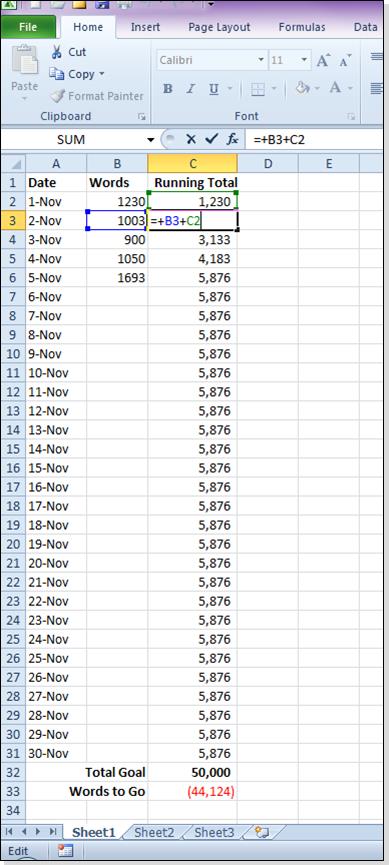
If you don’t know how to set up the formulas, just ask. I’ve been doing spreadsheet formulas for over twenty years now.
Assignment 2: Determine how you will track your word-count progress and share your plan in the comments.
Part 3: Tracking Writing and Writing-Related Activities Time
Tracking your progress isn’t just about word-count. Sometimes, you may have what feels like an amazingly productive “writing day,” yet end up with very little word count to show for it. That’s where tracking the time you spend both writing and working on writing-related activities comes in.
We typically schedule our “writing time” as the time in which we plan to be actually writing. But what about all the other time that goes into creating a manuscript? The planning (what we’ve been doing all along), the study of craft, the naming/casting of characters, the research, the plotting, the brainstorming (both along or with trusted writing friends). All of that is important Writing-related activity. And when you’re first getting started writing, it’s just as important to keep track of all of the time you spend working on developing your story as you do actually writing it.
For me, when I feel like I need to track time in order to prove to myself that I am being productive (or to see where I’m spending too much time/wasting time), I use an old-fashioned week-at-a-glance desk calendar. This can also be done in a Google or Outlook calendar on the computer or a calendar app on your phone.
But if you want to get even more technologically savvy, here’s a list of time/project-tracking apps.
Assignment 3: Decide if you want to track your writing-related time/projects and, if so, share how you intend to do so in the comments.
#FirstDraft60 Day 15 — Draft Writing vs. Regular Writing: A Writing Assignment
In addition to getting caught up with all of the character development from last week, this is going to be a week in which we try our hands at actually doing some writing.
Now, halfway through the thirty days of prep work, is a great time to try your hand at practicing the type of writing we’re going to need to do starting October 1 in order to be able to get that first draft written.
Part 1: Draft Writing vs. Regular Writing
Assignment 1: Read this post linked below to find out what I mean by “draft writing”:
NaNo Prep: Draft Writing vs. Regular Writing
Go on—go read it now. I’ll wait . . .
Part 2: Writing Assignment
Assignment 2(a): Using the draft-writing technique explained in the above-linked post, write a scene of at least 500 words in which one of your viewpoint characters goes to the market for groceries.
This is a writing exercise, which means there’s a 99 percent chance that what you write in this assignment won’t end up in your story. But it’s a great way not only to practice Draft Writing, but also to get inside your character’s head prior to actually starting to write your story.
If you’re using a contemporary setting, this means sending them to the grocery store. Try to be as true to your character as you can. Would they make a list and stick to it? Is it just a quick run to the store to pick up a few items needed for a recipe for a special meal? How do they approach their shopping experience? Are they harried? Do they enjoy shopping? Do they compare brands/products or just pick up the name brands they’re familiar with? And so on.
If your setting is historical, otherworldly, or fantastical, what type of market is it? How does your character interact with others in and around the marketplace? What products is your character there for—and how will they pick them out? How will they pay (barter/trade, etc.) for them? Do not do research, and do not spend too much time creating/building/fleshing out the setting. Write what you know (or surmise) about the market experience, but focus on your character.
Assignment 2(b): How was it to use the draft writing technique? How many words did you end up with—and how long did it take you? What did you learn about your character? Did you add that new knowledge to your Story Bible?
#FirstDraft60 Day 14 — Don’t Think. Just Write.
One of the hardest parts of marathon writing—what we’re going to attempt to do starting October 1—is shutting off the analytical side of our brains and allowing the creative side free rein as we’re composing our first draft.
When I was under contract, I was really bad about not keeping to a daily word-count goal and letting that deadline creep closer and closer and closer—until I was mere weeks (or days) from deadline with tens of thousands of words left to write to complete the story. I never thought I’d be pulling all-nighters well into my late thirties and early forties, but there were several while I was in the throes of getting those manuscripts completed to turn in by deadline. And you know what? During those panic-filled, marathon-length writing sessions, I wrote some of my favorite scenes in those books. Because when I have thirty thousand words to write in just a couple of weeks, panic and adrenaline allow the the right side of my brain to take over and shut down any self-doubt or criticism that comes from that left-side inner editor/critic.
In other words . . .
Don’t think. Just write.
Try to shut off the left side of your brain when writing. When you’re writing you want to tap into your creativity—the right side of the brain.
The more we learn about craft, the harder it gets to write. That’s because learning about craft strengthens the left side of the brain. And that’s a good thing. Really, it is—except for when you’re trying to get your first draft finished.
And that’s one of the reasons I’m talking about this now, in the middle of doing our prep work for our story.
The first draft is the child’s draft, where you let it all pour out and then let it romp all over the place, knowing that no one is going to see it and that you can shape it later. You just let this childlike part of you channel whatever voices and visions come through and onto the page. If one of the characters wants to say, “Well, so what, Mr. Poopy Pants?,” you let her. No one is going to see it. If the kid wants to get into really sentimental, weepy, emotional territory, you let him. Just get it all down on paper, because there may be something great in those six crazy pages that you would never have gotten to by more rational, grown-up means.
–Anne Lamott, Bird by Bird
The left side of the brain is the self-analyst, the self-critic, the self-doubter, the little voice that says you’re not good enough, not talented enough, and that you’ll never be able to write the story the way you see it in your head. This is the side you want in charge after you finish the first draft when it’s time to edit and revise. This side isn’t very helpful when it comes to writing the first draft.
The right side is the creative side. The side that wants to make believe and play and laugh and spin around the room until we’re dizzy. This is the side of the brain we need to tap into when writing that first draft. We don’t need to analyze. We just need to tell a story. In writing.
In the creative act we can experience the same freedom we know in dreams. This happens as I write a story. I am bound by neither time nor space. I know those distant galaxies to which Meg Murray went with Charles Wallace and Calvin. But this freedom comes only when, as in a dream, I do not feel that I have to dictate and control what happens. I dream, sometimes, that I am in a beautiful white city I have never seen in real life, but I believe in it. When we are writing . . . we are, during the time of creativity, freed from normal restrictions and opened to a wider world, where colors are brighter, sounds clearer, and people more wondrously complex than we normally realize.
–Madeleine L’Engle, Walking on Water
Imagination gives us the ability to distance ourselves from oppression or stress. Over the past twenty years, multiple studies have been conducted on the efficacy of creative writing as therapy (the emphasis being on creative). Results have shown that college students’ test scores increased an average of about one letter-grade; blood pressure and heart rate can decrease; it can improve immune function and reduce the rate of minor illnesses such as colds and flu; it can reduce psychological distress over a traumatic experience by reducing “intrusive” thoughts about the event; and so on.
I know very little about how this story was born. That is, I don’t know where the pictures came from. And I don’t believe anyone knows exactly how he ‘makes things up.’ Making up is a very mysterious thing. When you ‘have an idea,’ could you tell anyone exactly how you thought of it?
–C.S. Lewis, qtd. in The Christian Imagination
Where does inspiration come from? Well, in Walking on Water, Madeleine L’Engle wrote that inspiration “far more often comes during the work than before it.”
Have you ever used an old-fashioned water pump? If it hasn’t been used in quite a while, you’re going to have to work long and hard to get anything out of it. But if it’s used regularly—every day—when you go to it wanting a drink of water, the pump is already primed. The water is right there, waiting to pour out.
Inspiration comes when we prime the creative pump. It is not thinking about a final product that gives us inspiration. What gives us inspiration is what leads us to write in the first place: the joy we take in imagination and creativity. When we are in the creative process and inspiration hits, everything else falls away. We lose track of time; we’re deaf to anything going on around us; nothing fills us with more joy than creating a story from our imagination. Or, as Gordon Dickson put it, we “fall through the words into the story.” That’s using the right side of the brain.
When the work takes over, then the artist is enabled to get out of the way, not to interfere. When the work takes over, then the artist listens.
But before he can listen, paradoxically, he must work, getting out of the way and listening is not something that comes easily. . . .
We must work every day, whether we feel like it or not, otherwise when it comes time to get out of the way and listen to the work, we will not be able to heed it. . . .
Inspiration comes much more often during the work than before it, because the largest part of the job of the artist is to listen to the work, and to go where it tells him to go. Ultimately, when you are writing, you stop thinking and write what you hear.
–Madeleine L’Engle, Walking on Water
What you’ve been doing for the past two weeks—adding details to your Story Bible, casting your characters, writing out character backstories—is imaginative, creative work. There is no right or wrong when you’re imagining, when you’re making something up. You know that what you’re doing right now is flexible and easily changed later on down the road.
And that’s the feeling that you need to carry through with you into the writing portion of this sixty-day challenge. Just because you’re writing something down in your story doesn’t mean it’s permanent. It can always be changed later, in the revision process after you complete the full draft and you know the whole story. But until then, remember the feelings that you have now—the feelings of being a child and turning to your best friend and saying, “Let’s pretend . . .”
Time for you to do some left-brain work:
| Creative | Analytical |
|---|---|
| Writing (try longhand) | Trying to find the “right word” |
| Character casting | Trying to figure out how to show what emotion the character is experiencing rather than tell it |
| “What If-ing” | Trying to figure out how to do an action/introspection tag instead of using “said.” |
| “Listening to the voices” | Trying to apply GMC to every single scene before writing it. |
—
Assignment: What are some other activities you can add to the “Creative” column that will help you in preparing to write your story? What are some other “Analytical” activities you are doing that are hindering you from being able to have fun and be imaginative in creating your characters and brainstorming ideas for your story?
__________________________________________
Works Cited:
L’Engle, Madeleine. Walking on Water: Reflections on Faith and Art. Wheaton, IL: Harold Shaw Publishers, 1980. Print.
Lamott, Anne. Bird by Bird: Some Instructions on Writing and Life. New York, NY: Pantheon Books, 1994. Print.
Ryken, Leland (Ed.). The Christian Imagination. Colorado Springs, CO: WaterBrook Press, 2002. Print.
#FirstDraft60 Day 13 — Sunday Reflections
On Sundays, we’re going to take a moment to step back and think about our writing from a wider view. In order to do that, I’ll post some guided questions—feel free to answer them here with as much or little detail as you’d like; or answer them on your own blog or on Facebook. Or just write the answers down in a private journal or notebook. The important thing is to actually think through and write down your answers.
Reflections for Day 13
1. Why do you want to write?
- Things to think about:
- What motivates you to think about sitting down to write?
- What was the driving force that made you want to start writing in the first place?
- Try to identify both the inner compulsion and external encouragement/pressure that make you want to write.
2. Why did you choose this particular story to write?
- Things to think about:
- Is it the characters, the setting, the plot, the message?
- What is compelling enough about this particular story to make you want to see it through to completion?
- What do you want others to know about you through the telling of this story?
3. How do you think writing this story will change you?
- Things to think about:
- Is there something you need to learn, either from the characters’ actions/motivations or their emotional or spiritual arc?
- How do you think you, yourself, will be different upon the completion of this manuscript?
- Do you think others will perceive you differently by completing this manuscript?
I look forward to seeing your answers and will be posting mine soon.
#FirstDraft60 Day 12 — Review and Catch-up Day
Saturdays throughout this challenge are going to be our days to review what we’ve covered during the week, and to catch up on anything we fell behind with.
When doing any kind of a challenge like this in which the goals are cumulative, it’s always good to build in a day (or two) to be able to get caught up on anything we’ve fallen behind with. Because most of us work during the week, we have more time to do this on the weekends. So for the next six weeks, be sure to set aside time on your weekend, whether on Saturday or Sunday to stop, review what you’ve accomplished throughout the previous week, and then caught up on anything you didn’t have time to finish or even start.
This isn’t permission to slack off during the week. It’s to give you permission to not beat yourself up if you don’t get an assignment done or a goal accomplished on the day it’s assigned. As long as you give it your best effort and the complete it by the end of the week, you’ll be able to stay on track.
So let’s begin.
Part 1: Review of the Week
Here are all of the assignments from this past week:
Monday:
Assignment 1: Who are the characters that will have a viewpoint in your story (e.g., your “main” characters)? Who are some of your major secondary characters—those who are important but don’t get their own viewpoints?
Assignment 2: What POV will you be writing your story in? Is there anything you need to study/learn about this POV before you start writing?
Tuesday:
Assignment: Create and complete, as best as you can, a S.H.A.P.E. chart for each of your main/viewpoint characters in your Story Bible.
Wednesday:
Assignment: Add your characters’ physical description (using the [posted] “chart” or something of your own making) to your Story Bible. Cast your characters, if desired.
Thursday:
Assignment 1: Answer the [posted] questions for each of your viewpoint/main characters.
Assignment 2: For each character’s main story goal, determine what the main conflict is that will keep them from easily attaining that goal—and who or what presents that obstacle/challenge/conflict to the character.
Friday:
Assignment: Write out the full backstory (as full as you can make it at this point) for each of your main/viewpoint characters.
Part 2: Catch-Up, Update, and Brainstorm
Assignments for Saturday:
- Review everything you’ve done so far and catch-up with anything you couldn’t get to or couldn’t finish during the week.
- Update your Story Bible and Style Guide based on everything you came up with this week.
- Once you’ve caught up and have everything updated, do some “what if” brainstorming with your character information and backstories and see if you can come up with some additional ideas for either the characters themselves or for your story/plot. Have fun with this. And if you feel inspired to write some scenes, do it!
- Check in and let us know how you’re doing, what you’ve accomplished, and what you hope to achieve this weekend.
Above all else, have a great weekend!

 KayeDacus.com