Fun Friday: Underappreciated Period Drama Couples

Fun Friday is back! Let’s celebrate with this video that highlights some of the most underappreciated couples from some of the most underrated period dramas!
Word-Count Wednesday: Do More than You Did Yesterday #amwriting #1k1hr
So, after a month of pretty rigid blog topics for each day of the week, I may stick with that for a while just to get back into the habit of blogging each weekday. I’m sure I’ll mix it up as other ideas start to emerge (Any requests for a new topical Writing Series? Sound off in the comments!), but for now, we’ll stick to the schedule.
Your Wednesday word-count challenge for this week, if you choose to accept it, is:
Do more than you did yesterday.
Therefore, my challenge is to write at least 2,191 words today, since I wrote 2,190 yesterday.
As a means to reach that end, I’ll be doing two 1k1hr sprints today: one at 6:30 p.m. and one at 10:30 p.m. (U.S. Central time). Look for the notifications on Twitter
For you, that can mean increasing your word-count over yesterday. Or it could mean editing one or two more pages than yesterday, or adding fifteen or twenty minutes onto your time allotted for research. Or if you’re not a writer, read more pages/longer than you did yesterday, or spend more time today doing a craft or creating something.
So, who’s up for the challenge?
#LeapAheadWritingMarathon: Results and Plans for Keeping Up the Momentum
Happy March 1, everyone. As usual, here in Nashville, it’s gray and stormy and wet (you know how the saying goes, March comes in like a dark, grouchy, drooling lion). So it’s the perfect day to look back on the Leap-Ahead Writing Marathon and see what was accomplished—and discuss how to keep—or gain—momentum going forward in March.

Although I didn’t keep to my commitment of writing every day, I re-learned (from years and years ago, before I took that much-needed mental break for a few years) that the more often I wrote, the more I found myself thinking about my characters and my story. And I did write often enough that toward the end of the month, setting a word-count goal of 29,000 words for the month, or an average of 1,000 per day, became a very realistic and, ultimately, achievable goal. And you know I’m a big proponent of those!
Self-Analysis:
- This month—and this manuscript—has been a re-learning experience for me. I’ve had to reset myself to where I was pretty much before I started grad school in 2006. I needed to get back to a mental state of I choose to write because I love writing. I want to write because I love this story and these characters. I’m doing this for me, first and foremost, and it doesn’t matter what becomes of this manuscript once I finish it. After years of writing on deadline to fulfill contracts—at the end, just so I could afford to eat—and having such short turn-around times in which to get the books written (while also being in the process of editing a previous manuscript, marketing a newly releasing book, and planning the next book/series), I had trained myself how to write in “final draft” mode. That meant that when I sat down to write a scene, I couldn’t just wing it. I had to know where it was going, how it fit into the structure of the story, and, after completing it, going back and immediately revising it. Because for the last seven or eight of my published books, I was turning in my first draft as my final draft, just to meet deadlines.
This month, as I got further and further into this manuscript, I had to force myself back into what is good and truly first-draft writing mode. After writing the first 6k words, I had an idea for a rather major change in the on-land setting, as well as the secondary characters, which necessitate a lot of changes in the opening of the story. But instead of going back and rewriting all of it, I started a revisions section in my OneNote notebook, jotted down all of the ideas (and came up with some others), and then started a new chapter picking up with the story as if I’d already made all of those changes.
I went from the beginning of the month, when I had to pause in the middle of writing to look up details or words or research what type of food they might be eating to writing this last night:
Katriona smiled. The wonder in his expression was what she’d hoped for. “Roast duck with ______. Vegetable and vegetable. Bread and fresh butter. Fruit and fruit. And, of course, Madeira wine. . .”
I’m forcing myself to re-learn how to be more of a seat-of-the-pants writer. I’ve done some preliminary research and written out the timeline of historical events my story is happening around so that I know what I’m working with. But I stopped myself from trying to outline this story or even to try to write a synopsis of it. (I still have the Post-it flip chart laid out on the bed in my spare bedroom/office with the cup of colored markers sitting on it and the seven story beat titles written out down the side—but with no other information filled in.)
I also re-learned just how much easier it is for me to step right into the “slipstream” of the story when I write late at night. I can usually average between 1,200 and 1,500 words in an afternoon or early evening 1k1hr writing sprint. But the last two nights of the marathon, I did at least one 1k1hr late (or when I was exhausted, so it felt really late), and wrote 1,802 and 1,799 words respectively. Now, are they prefect, turn-it-in-to-an-editor words? Absolutely not. I’m under no delusions that this manuscript isn’t going to need a TON of revisions. But they’re written—which means they can be revised later. After all, my #1 writing tip is: Above all else, FINISH YOUR FIRST DRAFT.
Word-Count:
- As I said above, I finished the month having added 29,320 words to my manuscript—which brought it up to a total of 35,430. This could mean I’m almost halfway through (if it does turn out to be a 70–75k draft) or it could mean that I’m only about a third of the way through (if it turns out to be a 95–100k draft). But either way, it’s the most I’ve written in four years, so it’s a win no matter how long the full draft turns out to be!
Awesome Accomplishments:
- What can I say more than I’ve already mentioned? 😉 I’m writing again. I’m loving my characters and my story (and I’m now far enough into it that I’m actively trying to find ways to justify a kiss scene, while also pushing it off to keep the tension building!), and I’m thinking about story/character stuff even when I’m not writing.
I guess my awesome-est accomplishment for the month actually happened last night. It was getting on toward 8:30 p.m. I was exhausted, as I’d only slept 3 or 4 hours the night before, and I was starting to nod off in my chair. It was so tempting to just shut down the computer and go crawl in the bed and come back here today and shrug and justify my not hitting the 29k mark by reminding everyone I said from the beginning this marathon wasn’t about numbers.
And then, even as I was composing that in my head, eyes closed, half asleep, the other part of what I created this marathon for struck me—hard. No, it wasn’t about numbers. It was about commitment, and I’d be failing myself if I didn’t at least try to do one 1k1hr before crashing for the night. So I did one. And I wrote 1,799 words. Which meant I needed fewer than 340 words to reach the 29k mark. When I saw that number, it made it so much easier to do an intense 20-minute sprint to get those final words in. And I wrote almost 600 words, which is what put me over the top. And made me very proud of myself.
Tidbit to Share:
- I shared this on Facebook earlier in the month, but this is one of my favorite things I’ve written in this manuscript so far:
“Where is he going?”
“Oh, so the good captain decides to speak again, finally.” Katriona didn’t turn to look at him, but continued to look through a display of hand-woven and embroidered shawls.
“I wanted to ensure that you were well looked after today—that is why I wanted Mr. Brocklehurst along with us.”
“I have other errands I need him to see to while we are here.” She selected a fine ivory linen shawl embroidered with vines and small orange and red flowers and started to negotiate a price with the merchant.
She’d just handed over the payment when Quin roughly took hold of her arm and turned her around to face him.
“Do you always take your own safety so lightly?”
Katriona raised her brows and then looked down at his abdomen—at the small knife she had pressed against his waistcoat. Quin instantly released her arm and took a step back.
“No, Captain Ryles. I learned long ago that I could never entrust my safety to others.” She returned the blade to the thin sheath strapped to her wrist under her sleeve, then smiled up at him. “Now, I believe I saw a bookseller’s stall a little farther up the way. Shall we see what he has on offer?”
Before he could answer, Katriona slipped her arm through Mali’s, turned, and headed toward the bookseller, not looking back to make sure Quin was following them.
Momentum Going Forward:
- I got together with a group of writer friends over the weekend, and while most of them weren’t in a position to do much writing or work on their manuscripts in February, it’s looking like March is going to be a good month for us to do a private marathon together. Because I am who I am, I’ll be leading that charge, but it always helps to have at least one or two others along on the journey in order to keep each other motivated.
I’m also going to continue doing (almost) daily 1k1hr sprints—which I will announce/conduct on Twitter. My goal for March is what it turned out to be toward the end of February—finish the month with an average of 1,000 words per day. But I also know it’s unrealistic not to build some days off in there, especially since I’ll be traveling to visit family over spring break in a couple of weeks. But what’s an hour—or even just half an hour—a day (especially late at night?) in order to keep my commitment to myself and my story momentum going, right? (Especially as a couple of these family members have a vested interest in my finishing this manuscript and getting to the revision process—since they’re already bugging me about wanting to read it.)
How did you do in February? What will you do to start/gain/keep your momentum going?
#LeapAheadWritingMarathon Day 29: Monday Motivation with Author Gayle Forman (@gayleforman)
 It’s the last day of the Leap-Ahead Writing Marathon. Remember, the goal of this marathon was not really about word-count but about commitment.
I mentioned last Thursday that I wanted to finish out the month by having written at least 29,000 words on The Spymaster’s Daughter in the month of February. Last week, I made the commitment to do at least one 1k1hr writing sprint each day. A goal which I (almost) succeeded on . . . Saturday was the only day I didn’t do that (though I did write—the book review I posted on Saturday, which is about 2,400 words).
On Thursday, once I realized how close I was to getting to that 29k mark, I started doing two 1k1hr sprints a day, and I was writing between 2,200 and 2,500 words a day. Yesterday, I did them later at night and really found my rhythm—a little more than 1,500 words in the first sprint, and right at 1,800 words in about 50 minutes in the second sprint.
So my word-count goal for this final day of the marathon is 2,138—the total I need to hit the 29k mark for the month.
I’m not sure when I’ll be doing my 1k1hr sprints today—but I will be doing two of them, and I will be announcing them on Twitter.
Today’s motivational video features advice for writers from author Gayle Forman:
What can you commit to doing today on your manuscript that will help you to “leap ahead” with your writing this leap year?
Books Read in 2016: ‘Uprooted’ by Naomi Novik (Review, Part 1)
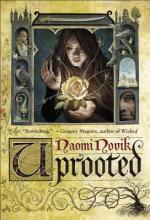 Uprooted by Naomi Novik
Alumni Readings in Genres (ARIG) “book club” Fantasy selection for March.
My rating: TBD
Book Summary from Goodreads:
“Our Dragon doesn’t eat the girls he takes, no matter what stories they tell outside our valley. We hear them sometimes, from travelers passing through. They talk as though we were doing human sacrifice, and he were a real dragon. Of course that’s not true: he may be a wizard and immortal, but he’s still a man, and our fathers would band together and kill him if he wanted to eat one of us every ten years. He protects us against the Wood, and we’re grateful, but not that grateful.”Agnieszka loves her valley home, her quiet village, the forests and the bright shining river. But the corrupted Wood stands on the border, full of malevolent power, and its shadow lies over her life.
Her people rely on the cold, driven wizard known only as the Dragon to keep its powers at bay. But he demands a terrible price for his help: one young woman handed over to serve him for ten years, a fate almost as terrible as falling to the Wood.
The next choosing is fast approaching, and Agnieszka is afraid. She knows—everyone knows—that the Dragon will take Kasia: beautiful, graceful, brave Kasia, all the things Agnieszka isn’t, and her dearest friend in the world. And there is no way to save her.
But Agnieszka fears the wrong things. For when the Dragon comes, it is not Kasia he will choose.
Part 1 of what could be a much longer review, eventually
So I’m about 40% through with Uprooted by Naomi Novik. For the first 30-35% of the book, I found myself speeding through it, not necessarily always enjoying it, but definitely engaged by it—despite some major flaws, which I’ll get to momentarily. There was still something about it I found . . . fascinating enough to look forward to getting back to it each night.
But then . . . my interest started waning. And the sad thing is, my interest started waning right around what we writers call the first turning point—the point at which the biggest conflict of the book is supposed to step in and throw the main plot of the book into the characters’/reader’s faces. This is the point of the book at which things really start happening and when the reader is supposed to become so engrossed in the plot (because, by this point, the reader should already be completely engaged with the characters) that they have a hard time putting the book down.
I’ve reached that point in the book, and I have a hard time wanting to pick the book up and read more.
But let’s start from the beginning.
Read more…
#LeapAheadWritingMarathon Day 26: Self-Evaluation, Word Count, Awesome Accomplishments, and Terrific Tidbits. It’s SWAT Day!
It’s Friday! That means it’s time to check in with your progress in the marathon.
On Fridays, I want to know about your full writing week. What were your greatest successes during the week? What was your favorite line/bit that you wrote? What did you learn about yourself, your characters, and/or your story during the week’s work? What are you most proud of yourself for doing this week when it came to your writing? What are you proud of yourself for accomplishing?
That means it’s SWAT Day!
Check in with your progress on your story and share, if you feel like it, the following:
- Self-Evaluation (how do you think you did? what can/do you want to do differently next week? what did you learn about yourself as a person or as a writer? what didn’t you do or finish that you wanted to? etc.)
- Word count (total for the week, Saturday through today)
- Awesome Accomplishments (breakthroughs, discoveries, highest daily word-count ever, etc.)
- Tidbits too good not to share
If you don’t want to share this stuff publicly, that’s okay. You can add a section to your Story Bible or start a journal (or add this to your existing journal) to keep track of this. But don’t skip doing this—I think that in the future, when you look back either on what you accomplished during this marathon or (heaven forbid) why you gave up on it, the insights you’ll gather later with hindsight on your thoughts during the challenge will be invaluable.
Happy writing!
#LeapAheadWritingMarathon Day 25: A Checkup and a Challenge
I said yesterday that there were only five days left in the Marathon. But that’s only if you look at it mathematically. If you look at it on the calendar, as of today there are five days left (today, Friday, Saturday, Sunday, Monday) in the Leap-Ahead Writing Marathon. Look at that, I just gave you an extra day for writing! Yay! 😉
So after writing my 2,500+ words yesterday in my two 1k1hr sprints, I decided it was time to do a little number crunching. So I went over to my word-count meter on StoryToolz.com (which is the site I’ve been using for years to keep track of my word count and for my blog widget) and pulled up my numbers (on the “History” tab) for The Spymaster’s Daughter, the historical romance I’m writing.


(I have to play around in Excel every so often—it’s hard not to let the other 50% of my brain out to play after I’ve spent so long exercising the right/creative side.)
It looks like I’ll easily hit the 30k mark before the end of the month. But in looking at this and doing a couple of calculations—including taking out the numbers from January—I’ve written an average of 884 words per day in February, with a total of 21,220 for the month. Of course, there were a lot of days when I didn’t write. My goal for myself, to really live up to the “Leap-Ahead” part of the Marathon this month, is to write a total of 29,000 words for the month—or an average of 1,000 words per day.
That means I need to write an average of 1,556 words (total of 7,780) starting today and ending on 2/29 to reach that goal.
And that’s very doable for me, especially with my goal of doing at least one 1k1hr sprint every one of the remaining days of the Marathon. If I’m on a roll, I can easily bang out between 1,200 and 1,400 words in an hour—even more if I’m in the middle of a really good scene of action or dialogue! (And we all love those, don’t we?)
How have you done so far this month?
Remember, this marathon isn’t about word-count (though that’s nice), but about having made a commitment to work on your story in some way every day this month.
What is your goal for the last five days of the marathon?
Again, this doesn’t have to be numeric. Just something to help you “leap ahead” with your writing.
#LeapAheadWritingMarathon Day 24: Wednesday Word-Count Challenge—Write Your Age x 50
It’s once again time for our weekly word-count challenge! There are only five days left in the Leap-Ahead Writing Marathon, so I’ve picked something that sort of ties in with that.
Your Wednesday word-count challenge for this week, if you choose to accept it, is:
Take your current age and multiply it by 50. Write at least that many words today.
That means, for me, my challenge is to write at least 2,200 words today. (Jeepers, I’d better get started!)
This is where being younger helps considerably. 😉
So, who’s up for the challenge?
#LeapAheadWritingMarathon Day 23: Timer Tuesday (#1k1hr Sprint @ 6:15 p.m. Central)
You know the drill by now. On Tuesdays, the challenge will be scheduling and completing at least one 1k1hr writing sprint some time during the day.
I’ll be doing my 1k1hr sprint tonight at 6:15 p.m. (Central). I will send out Tweet reminders and warnings a few minutes before the start and end, then ask for your follow-up there.
Another friend, @CarolBCollett, will be doing a sprint starting at 7 p.m. (Central) if that time works better for you (and be sure to Tweet Carol if you plan to participate in hers).
As always, pick the time that works best for you and write!
I’d love to make these weekly (sometimes daily!) writing sprints a “team” effort with as many of you participating as possible, even if we don’t do it at the same time of day. The more support (and accountability) there is, the more successful we’ll all be! So go ahead and pick the times that work best for you.
1k1h Tips for Success
- Let anyone within your household know that you need one uninterrupted hour to try to head off at the pass any interruptions.
- Set a timer. This is most important. Don’t do this by just watching the clock. You’ll find yourself only watching the clock and not getting anything written. Setting a timer allows you to forget about the time and concentrate fully on writing.
- Prepare yourself before starting your timer. Re-read the last few pages you wrote (without editing/revising!) to get your head back into the story and figure out where you need to pick up. Review your outline and/or character pages in your Story Bible. And then put all of that away so you don’t use those to procrastinate during the hour.
- If you listen to music while writing (I recommend instrumental so that you don’t get distracted by the lyrics), have it set up and playing before starting your timer. Use earphones, even if you’re working at home, to block out any sounds that might pull you out of your story.
- If you can’t listen to music while writing, I recommend wearing the earphones anyway. People are less likely to interrupt you (at home or working somewhere like a coffee shop) if you have them in/on—and they help block out those distracting sounds.
- Make sure your writing space (both physical and mental) is set up and ready to go before you start your timer.
- In other words, make sure that about five to ten minutes before you start the 1k1h sprint, you’re in the process of getting ready to write.
- Silence or turn off your cell phone (unless you’re using it as your timer—then don’t turn it off). Close your Internet browser. Close Facebook and Twitter (as soon as I give the “start” signal, of course). Close your email program if you use something like Outlook that isn’t web-based. Eliminate all distractions!
Don’t Know How to Start Writing?
If you aren’t sure how to start writing when the hour starts, even after re-reading what you’ve previously written, here are a few suggestions.
- Which character had the viewpoint in the last scene you wrote? Start with a different character in this scene.
- Still not sure what to write? Try this prompt:
Character walked into the room. Character saw a piece of paper tacked to the wall on the other side of the room. Character walked across the room and took the piece of paper down. Character read the piece of paper. The piece of paper said . . . - If that prompt doesn’t work, try the exercise of taking your character to the market to buy food.
- If you can’t think of what the “next” scene is that comes after the one you just left off with in your previous writing session, start writing something you know comes later in the story that you already have a good idea for. Though I recommend writing your story in linear fashion (from beginning to end) instead of jumping around, sometimes you need to write stuff that comes later if you already have a clear idea of the scene in your head, just to make sure you don’t lose it. And that can also help you figure out what comes between what you’ve written so far and that future scene and help you to fill in the gap next time.
#LeapAheadWritingMarathon Day 22: Monday Motivation with Author Chuck Wendig
Obviously, I fell off the marathon “path” at the end of last week—not only did I not get any new blog posts up, I didn’t get any writing done between Tuesday and Sunday of last week. But thanks to good friend and regular blog reader Carol Collett, I got back on my feet and running with a 1k1h sprint last night, in which I added 1,470 words—and wrote a fun scene, a piece of which I shared on my Facebook page afterward. My goal for this week is to do at least one 1k1h sprint every day (or the ones that my grad-school group does—which is a series of three or four 25-minute sprints over a two-hour block), with the goal of adding at least 1,000 words per day to the story.
Today’s motivational video is a fun quick-take from the Papercuts channel on YouTube with author Chuck Wendig, best known recently for his Star Wars novel Aftermath, talking about his “myth lab.”
Where’s your “myth lab” and how much time have you spent there recently?

 KayeDacus.com