Books Read in 2016: ‘The Captain’s Wallflower’ by Audrey Harrison #amreading
 The Captain’s Wallflower by Audrey Harrison
My rating: 2.5 of 5 stars
Book Summary from Goodreads:
Captain Worthington is injured in the battle of Trafalgar. Blinded by shrapnel, his life goes from being at the forefront of society to being almost cast off. He finds himself sitting with the wallflowers at a ball – something he doesn’t take too kindly to.Miss Amelia Basingstoke has no dowry and enough dreadful relations to ensure that even on her third season, she is unmarried and a confirmed wallflower. Her only friend is a large boisterous dog of dubious character who considers himself too good to chase dead birds.
A chance meeting between the pair frees the Captain in ways that he had never thought possible since his injury.
A stubborn Captain – an opinionated young woman – an unruly dog and Christmas is approaching – what could possibly go wrong?
Premise: 4 stars
Writing Level: 2 stars
Editing Level: 2 stars
Proofreading Level: 2 stars
Overall execution: 2.5 stars
This read like a decent first draft written by someone who’s never taken a writing class or attended a writers’ conference. Now, I’m not saying that those things are necessary to being able to write a great story. However, for people who bypass pursuing traditional publishing for self-publishing, that kind of training becomes vitally important. Otherwise, you end up with what this turned out to be—something that reads like a draft by an unpolished, newbie writer.
The Pros:
The premise of this story was good. I enjoyed the idea of the hero being blind, and she did a pretty good job of getting across his frustration of going from someone who was a Royal Navy captain—active, a leader, independent—to someone who was completely dependent on others just to be able to leave the house.
There were some great interactions in dialogue between the hero and heroine, and while it could have been stronger, she did a decent job of showing a believable relationship building between them.
While at first I questioned the bit about the dog automatically/naturally becoming a guide dog, I did appreciate that she showed them working with/training the dog to help out. And she actually used the fact that this isn’t a professionally trained dog later in the book to somewhat good effect. Then, in her (very long) afterword, it was nice to learn a little more about the history of people training dogs to work with/guide the seeing impaired.
The Cons:
As I already said, this read like a first draft by someone who hasn’t studied the craft—and who obviously didn’t work with a developmental editor, content editor, copy editor, or proofreader who knows what they were doing (and probably not critique partners, either). The biggest issues I had with this, craft-wise, were:
- The head-hopping. The character development in this book could have been so much better—if only the author had written it in limited POV, giving us only the viewpoints of the hero and heroine, not every single minor character around them. POV switched from paragraph to paragraph, usually, and could be very jarring because I could never be quite sure whose viewpoint the narrative in any given passage was in, which kept me from being able to lose myself in the characters/story.
- The poor research. Ugh. Really? A simple Google search would have netted her the information that in the early 19th century, the London Season ran from approximately January/February through June, the most active part of the Season being from Easter through the end of June. It hadn’t started in November since the mid- to late-1700s. Also—Christmas trees and big family Christmas celebrations were a Victorian introduction, not something that was done in 1806. And there were several details surrounding the Royal Navy that I found errors in—though anyone who hasn’t done extensive research on this would never notice/be bothered by it. I can’t speak to the medical research. It seemed like something that could have been done, given the historical accounts I’ve read of other surgical procedures done (many on ships in the heat of battle) during this era.
- The anachronistic language. Yes, those of us who write historicals find it necessary to modernize the language so that it’s accessible to a modern audience. However, that doesn’t mean that we throw all historical accuracy out the window. Two of the most glaring examples of this that completely pulled me out of the story: at one point, she “screeched to a halt,” something that wouldn’t have happened before the advent of rubber tires or shoe soles, neither of which existed in this era; then there was the use of the word “heck” as a substitute for hell—a quick Google search for the etymology of this word shows its first recorded usage dates to 1865, or 59 years after this book is set. (That would be like having Lady Mary walking around Downton Abbey using terms like “groovy” and “far out” and “totally tubular” or even “cool.”)
- The lack of editing/proofreading. If I were the proofreader who had an “about the proofreader” blurb in the back of this book, I’d be embarrassed. There were so many grammatical errors, so many misused words, so many missing/misused punctuation marks . . . I’d have been fired if I’d let a manuscript go to print in this condition if it had been one I’d worked on at the publishing house. And that’s just the proofreading issues. As mentioned before, it was quite obvious that the author did not work with—nor likely has ever worked with—content and/or developmental editors. Because no editor worth her salt would have let the brain-twister sentence structures, the odd/misused word choices, the anachronistic language, the head-hopping, the over-descriptions, the info-dumps, and the general lack of polish get out into the public sphere.
- [Spoiler–highlight to read]The miraculous “he gets his sight back with a hit on the head” trope. No, he didn’t get his full sight back, but still . . . I find it very disappointing when romance novelists choose to go this route when they have a main character with a disability—especially blindness. As an author, if you’re going to choose to have a character go blind due to a battlefield injury, then commit to it. You don’t need to give the character a “reprieve” and have him regain some/all of his eyesight just so that he can confirm that he was right all along in thinking that the heroine is pretty/beautiful (or vice-versa with the heroine). I’ve read far too many books that use this “get out of jail free” card, as if someone who has no vision cannot have a happy ending. (It reminds me a lot of the “fat girl can’t have a happy ending until she loses weight” trope that I loathe.) The best book I’ve read that realistically deals with having a hero blinded in the war is Mary Balogh’s The Arrangement. (In fact, there were many similarities between that book and this one, including the heroine living with relatives who ill-treat her in order to put their own daughter forward in society.)
- It’s a “sweet” (clean) romance. This is both a pro and a con. It’s a pro because I enjoy reading romance novels that take the old-fashioned approach of not feeling the need for the characters to immediately fall in lust with each other or to have graphic sex scenes—without being religious fiction (not that I, obviously, have a problem with that genre, but it’s nice to see sweet romance in the general market as well). However, I was quite taken aback, toward the end, when they’re kissing in the sedan chair that he put his hand under her cloak and touched her breast, something that came across as very inappropriate for the tone of this story. It ripped me out of the story when it happened and I started worrying that there would be a very uncomfortable-to-read wedding-night scene. (I assumed from the other issues I had with the writing that it would be very awkwardly written.) But I worried for naught. She kept it sweet.
Because this book is short, I was able to make it through in two sittings—but I think if I hadn’t forced myself to push through the second half, it might have been a DNF for me, due to the technical issues I had with it and my overwhelming desire to critique/edit it as I read.
_______
My rating matrix:
5 STARS = one of the best I’ve ever read
4 STARS = a great read, highly recommended
3 STARS = it was okay
2 STARS = I didn’t enjoy it all that much, not recommended
1 STAR = DNF (did not finish)
Fun Friday: How Far Back in Time Could You Go and Still Understand English?
For those of us who are fans of time-travel science fiction/fantasy costume dramas, we’re used to the standard trope that, with perhaps the addition of a few “period” words thrown in for flavor, the characters of that historical time period all speak mostly modern English and our modern characters can understand everything they’re saying.
As someone whose favorite undergrad major class was History of the English Language, who had to do translations of “English” texts from Old and Middle English, I get really frustrated by this glossing over the evolution of our language. (And don’t even get me started on the Stargate TV shows, which I love, but in which all the races, no matter the galaxy, speak perfect, modern English, even though the Ancients “seeded” their planets more than 10,000 years ago when English didn’t even exist and then left them to develop on their own.)
#TBT: So You Want to Be a Writer? #amwriting
Originally published September 23, 2013
One of the comments I hear most often when people find out I’m a published author is: “Oh, I’ve always wanted to write.” Or something similar: “I have a story I’ve been thinking about writing for a long time. How do I get started?”
In my mind, what separates true “writers” from those who “want to write” is the compulsion to actually put words on the page. This goes for every type of writing there is: fiction, nonfiction, poetry, drama, essay, memoir, etc. If you truly are going to be a writer, there must be somewhere within you the drive, the desire, to put pen to paper, fingers to keyboard, and actually write.  The need to share whatever story, information, image, or experience that’s burning a hole in the pocket of your mind must be so consuming that you can’t help but write about it, whether it’s blogging, writing about it in a journal, writing snippets of scenes/dialogue on fast-food napkins, or stealing moments during the Sunday sermon to write a stanza on the back of the bulletin. Because if you don’t have that burning desire to see your ideas put into black-and-white, hard-edged text, you’ll never succeed as a writer.
Second, but of almost equal importance to the compulsion to put words on paper, is your ability to live life to its fullest, to seek out “new life and new civilizations. To boldly go where no one has gone before.” No, this doesn’t mean you have to be a thrill-seeker, nor a world traveler, nor even someone who is outgoing and adventurous. What it means is that you have to be an observer. You have to immerse yourself in life, to catalog your experiences and those you observe in people around you. In a 1962 article for The Writer (reprinted in the May 2008 edition), best-selling author Sloan Wilson (The Man in the Gray Flannel Suit) put it this way:
The important thing of course is to learn to live fully, to love with kindness as well as passion, to hate the right things and even the right people effectively rather than self-destructively, to worship well. . . . Writing is, in general, no better than . . . other kinds of activity; it is only better for certain people, those whose emotions and ideas take the form of words more easily than patterns of color, sound or other methods of expression. For those, the typewriter is a blessing. But it can be used well only if one is constantly aware that it is only a tool for the expression of life or the reporting of life—by itself, the typewriter has nothing to offer but an annoying metallic clatter.
One of my favorite books to pull out and read segments from whenever I’m doubting my calling to write, or am just exhausted by the process, is Madeleine L’Engle’s Walking on Water: “If the work comes to the artist and says, ‘Here I am, serve me,’ then the job of the artist, great or small is to serve. The amount of the artist’s talent is not what it is about.” So the third part of being a writer is not talent but obedience.
Eh? What’s that you say? OBEDIENCE?
Yes, obedience. Obedience to the calling of the story inside you longing to be written. Obedience to yourself when you set a writing schedule. Obedience to pick up a pencil and scrap of paper to write down the scene, line, or idea that pops into your mind at the least opportune moment. Obedience to make time to write a priority in your life. Obedience to learning the craft of writing. And obedience to stop if it becomes apparent writing is not the path you are supposed to be following right now.
Something that is of vital importance to both the dabbler and the writer seeking publication is the fourth guidepost on this journey: the ability to let go. This is a two-fold step. The first half, as Obi Wan Kenobi put it in Star Wars IV: A New Hope, is to “let go of your conscious self and act on instinct.” As you are creating, in the composing process, there can be nothing self-conscious about the act of writing. There can be no fear of embarrassment, no worry of what others will think of it.
Stephen King puts it this way in On Writing: “write with the door closed . . . Your stuff starts out being just for you.” Even if you are intent on the pursuit of traditional publication, you cannot be thinking about that when you’re in the creative process. You have to let go of every outside influence but the story. You have to let yourself go and allow yourself to become immersed in your characters, in your setting, in your plot. You have to let go of everything your internal editor is trying to trip you up with and, as already mentioned, be obedient to the story wanting to be told. Let go of the voices (internal or external) telling you that what you write will never be good enough. Let go (and banish forever) the thought that if people knew what you were doing, they’d laugh at you (again, just think about those hoards of people out there who “want to write”). Let go of the notion that you have to write within certain genre guidelines or in the certain manner of a highly touted author or a particular publisher’s expectations. Let go of anything that limits you.
The second half of letting go comes after you’ve completed the composition process. Let go of the idea that your “baby” is perfect just as it is. Let go of the idea that it’s the most wonderful thing ever written and publishers will be fighting to get their hands on it. Let go of the dream of a smooth, easy road to publication. Let go of your favorite scenes, your favorite pieces of dialogue, your favorite characters. Let go of the belief that everyone who reads it will love it. Again, returning to Steven King: “rewrite with the door open. . . . Once you know what the story is and get it right—as right as you can, anyway—it belongs to anyone who wants to read it. Or criticize it.” Let go and take criticism—from contest judges, from critique partners, from mentors, from editors. Let go and be willing to change—be willing to learn, be willing to edit, be willing to grow, as a person and as a writer.
So You Want to Be a Writer?
- Have the desire to actually put words on the page. Then actually put words on the page regularly.
- Live life to its fullest. Seek new knowledge and experiences.
- Be obedient to the voice of your story and to your commitment to write.
- Learn to let go. Let go of anything that limits you while you’re writing. Then let go of your “baby” and be willing to learn, change, and grow once you’re finished and you put it out there for others to read.
Do you have a grasp of all four of these? Or is there a certain area you need to work on a little more?
Timer Tuesday: Read or Write for One Uninterrupted Hour Today #amwriting #amreading #1k1hr
 I’m changing this up a little bit, because I know not everyone who reads this blog is a writer. From now on, the challenge on Tuesdays will be to schedule and complete at least one interrupted hour of reading or writing some time during the day (if you’re a writer, I’m challenging you to do a 1k1hr writing sprint instead of reading).
I’ll be doing my 1k1hr sprint tonight around 6:45 p.m. (US Central). I will send out a Tweet reminder when it starts and then at the end, I’ll ask for your follow-up there.
For those of you who’ll be reading, I’d love to hear from you as to what you read, how much you read, and what it meant for you to actually schedule a time to read.
As always, pick the time that works best for you and write or read!
Monday Motivation: Misused Modifiers (A Grammar Lesson from TED-Ed) #amwriting
I know grammar lessons aren’t necessarily motivational, but they are very important. So here’s a TED-Ed lesson on modifiers and how to not misuse them.
Books Read in 2016: ‘A Very Proper Monster’ by Elizabeth Hunter #amreading
 A Very Proper Monster by Elizabeth Hunter
from Beneath a Waning Moon—A Duo of Gothic Romances
My rating: 3.75 of 5 stars
Book Summary from Goodreads:
In A VERY PROPER MONSTER, Josephine Shaw spends long nights filling the pages of her Gothic stories with the fantastic and the macabre, unaware that the suitor her father has arranged is one of the dark creatures she’s always dreamed. For Tom Dargin, courting an ailing spinster was only one duty in a long life of service to his sire. But after he meets the curious Miss Shaw, will Tom become the seducer or the seduced? Can a love fated to end in tragedy survive a looming grave?
[Review may contain spoilers]
I picked up this duet of novellas by two indie authors with very high ratings on Goodreads because of the subtitle on the front cover: “A Duo of Gothic Romances.”
By the time I’d gotten to the end of the first (Kindle) page, I realized this wasn’t actually Gothic romance; rather, A Very Proper Monster is more accurately categorized as paranormal romance. Although the generalized definition of “Gothic fiction” includes horror classics such as Dracula and Frankenstein, the subgenre of Gothic Romance evolved to include certain, very specific tropes such as:
- Typically in first-person POV from the heroine’s viewpoint. If it’s in third person, it may be omniscient (events are narrated, never gets into the heads of the characters) and/or the heroine’s is still the only viewpoint the reader is given.
- One or more characters surrounding the heroine has/seems to have malevolent intentions toward the heroine. This includes the “hero” character.
- The reader is not privy to the thoughts, motivations, or intentions of the other characters surrounding the heroine. It’s similar to an unreliable narrator situation because the only POV character, the heroine, suspects everyone/anyone.
- The heroine’s life is in jeopardy—or seems to be—from someone close to her.
- There are, or seem to be, paranormal elements.
- Many times, there are two male characters vying for the affection of the heroine—one is dark, mysterious, and potentially dangerous, while the other seems to be bright, forthright, cheerful, and safe—in other words, they seem to be the exact opposite of each other.
- The setting plays a major role in the story—whether it’s an ancient estate on a misty moor, Mr. Rochester’s house with its strange sounds at night, a creepy castle in the far mountains of Transylvania in the 1800s (Deanna Raybourn’s The Dead Travel Fast), or a Gothic-style Victorian home in foggy Northern California filled with previously unknown relatives and a dying grandfather (White Jade by Willo Davis Roberts—my favorite Gothic Romance novel).
- There is a lot of focus on the psychological impact on the heroine of the fear driven by the setting, situation, and surrounding characters.
This novella, while a quick, interesting read, did not hit most of these tropes.
- Written in third person, not only do we get the hero’s POV, the story actually opens in his POV, so we know right from the beginning that he’s a “tame” vampire.
- The heroine, Josie’s, cousin could fill the “has malevolent intentions toward the heroine” role—except he didn’t have the agency or the power (or the intelligence) to actually do anything to her. There is a minor character who seems to be the Big Bad for the wider world of the series this novella fits into, but, again, aside from being told that he’s the Big Bad and runs the vampire community in Dublin, there was never truly any jeopardy from him for the heroine.
- There is no unreliable narrator situation created. Because we get Tom’s POV right from the start, we know that he’s a good guy and that he only wants to help Josie/her father.
- The heroine’s life was in jeopardy, yes—but only because she was consumptive and had been slowly dying for years from tuberculosis.
- There definitely were paranormal elements, given that most of the characters in it are vampires—and for a novella that fits into a wider storyworld, Hunter did a fabulous job of doing just enough world-building that I was never confused (for long) over a few made-up words or situations. It helps that she kept most of the standard rules for vampires (can’t go out in the sun, have the ability for mind control, have heightened sight and smell and hearing, etc.).
- There was no foil for Tom—and given that he never had, nor seemed to have, malevolent intentions toward her, combined with the shorter length of this story, it would have been hard to do that.
- The setting didn’t really play a role here. It could have been set in London or Edinburgh or New York and that wouldn’t have changed anything about the story. It was set in 1880s Dublin, so the actual world didn’t have to be built—only a few details given here and there to make it feel real . . . though not Gothic or fear-inducing.
- This was a very straight-forward romance. The only psychological focus was on her falling in love with him (and the potential that she wasn’t quite right in the head?) and his worry—then fear—of losing her when he was falling in love with her. She never feared him, or anyone else in the story.
I really did appreciate the fact that, because this obviously fits into a wider storyworld, I didn’t really have any trouble figuring out what was going on. Hunter gave just enough backstory for Tom and his “brothers” that I immediately was able to place each of them in my mind and keep them straight throughout. She also did a great job of contextualizing the paranormal elements so that I never had to wonder for more than a page or two what a certain (made up?) world-specific word or scenario meant.
As a romance writer myself, I’m always looking for the “big problem”—what’s the final big conflict that threatens to tear the couple apart seemingly forever (or which threatens their relationship but which they both must fight together, which brings them closer). In this story, because Josie is dying, which we know from the beginning, and because Tom is a vampire, I never truly felt their relationship was in any jeopardy. I knew right from the beginning that he would turn her (have her turned) rather than let her die—especially once they fell in love so quickly/easily.
And then Josie’s transition into being a vampire . . . yes, there was discomfort and a little disorientation, but again, there was never any jeopardy, despite Anne and Murphy’s worrying over whether nor not she’d become problematic after turning, or all of the “dire” warnings in the narrative about how dangerous newborn vampires are. Sure, it was dangerous for Neville, but that needed to happen anyway.
All-in-all a fun, quick read . . . just not the “Gothic Romance” I was prepared for. It was good enough that I may look at eventually reading other books in this series. And this author is going onto my “ones to watch” list!
Fun Friday — PBS and Ridley Scott’s ‘Mercy Street’
In case you didn’t catch it after Downton Abbey this winter, in the U.S., PBS aired a six-part miniseries that quickly became my new favorite costume drama: Mercy Street.
I know some people chose not to watch it because they thought it might be too gory—and I will admit that there were some medical scenes that made me squirm, but no more so than any of the recent or current forensics/police shows (Bones, CSI were/are both much more gory than this) or medical shows (Chicago Hope, Code Black). Plus, in just under six hours of television the characters are better developed and storylines more complexly explored than in a full 22-episode season of most TV shows. So when it ended a couple of weeks ago, with most of the storylines still hanging, I was distraught.
Until earlier this week when it was announced that they’re definitely getting a second season. To celebrate, here are some trailers/behind the scenes videos. And you can watch full-episodes online on the PBS website (or on the PBS App on Roku or Fire TV devices) or streaming on Amazon with a Prime membership.
Nurse Mary and Dr. Foster!!!!
Did you watch Mercy Street? What did you think?
#TBT: You Know You’re a Writer If . . .
Originally posted March 23, 2007
Signs you might be afflicted with the condition known as WRITER:
- You would rather talk to the voices in your head than the person sitting next to you.
- You know the research librarian’s office, cell, and home phone numbers but can’t remember your own.
- Some of the letters on your keyboard are completely worn off.
- You would rather write than go out.
- Your/you’re and their/there/they’re errors send you into an apoplectic fit.
- You get cranky if you don’t get to write.
- You’ve ever said, “The voices are getting louder; I must go write.”
- When talking with others, you mentally edit their dialogue and compose tags and beats.
- You’ve heard/seen something and thought, I need to write that down.
- You’ve ever written a scene, outline, synopsis, or character sketch on a restaurant napkin . . . and it wasn’t a paper napkin.
- In the middle of the night, you grab the pen and paper you keep next to your bed to write down a scene to make the voices be quiet so you can get some sleep.
- You end an argument with your spouse by saying, “Oh, wait, I have to write this down–this is the perfect conflict for my characters! Now, repeat what you just yelled.”
- Getting the scene finished is more important than food, coffee, or the bathroom.
- You have a momentary reality lapse and mention your characters’ situation as a prayer request in Sunday school.
- A blank wall becomes the screen where the scene you’re writing takes place right in front of your eyes.
- The easiest way for you to deal with conflict is to go home and write it into your story.
- You have filed and cross-referenced every issue of The Writer and Writer’s Digest you’ve ever received.
- You purposely eavesdrop when out in public.
- At parties, your method of making conversation is to discover people in the room with interesting occupations (preferably your hero’s or heroine’s) so you can conduct research.
- You listen to the writer’s commentary on every DVD so that you can analyze his/her writing process.
- You have a favorite line from every movie you’ve seen.
- You can’t write because you’re mad at one of your characters.
- You argue with said character.
- You have a folder on your computer labeled “Ideas.” Some of the files within this folder have only one or two words or sentences and while they made perfect sense fifteen years ago, between the software changes in that period of time garbling half the words and your own faulty memory, you have no idea what it means or where you were going with it. But you keep it anyway because you never know, you might remember it eventually.
- You drive three hours to a city where you don’t know anyone, spend another three hours driving around the city, then drive three hours home and decide NOT to set your story there.
More “You Know You’re a Writer If . . .” Posts:
More You Know You’re a Writer If . . .
Even MORE You Know You’re a Writer If . . .
You Know You’re A Writer If, Extended Edition
Books Read in 2016: ‘Uprooted’ by Naomi Novik, Part 2 #amreading
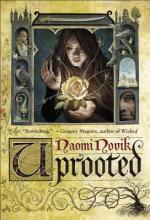 Uprooted by Naomi Novik
Alumni Readings in Genres (ARIG) “book club” Fantasy selection for March.
My rating: 2.75 stars
Book Summary from Goodreads:
“Our Dragon doesn’t eat the girls he takes, no matter what stories they tell outside our valley. We hear them sometimes, from travelers passing through. They talk as though we were doing human sacrifice, and he were a real dragon. Of course that’s not true: he may be a wizard and immortal, but he’s still a man, and our fathers would band together and kill him if he wanted to eat one of us every ten years. He protects us against the Wood, and we’re grateful, but not that grateful.”Agnieszka loves her valley home, her quiet village, the forests and the bright shining river. But the corrupted Wood stands on the border, full of malevolent power, and its shadow lies over her life.
Her people rely on the cold, driven wizard known only as the Dragon to keep its powers at bay. But he demands a terrible price for his help: one young woman handed over to serve him for ten years, a fate almost as terrible as falling to the Wood.
The next choosing is fast approaching, and Agnieszka is afraid. She knows—everyone knows—that the Dragon will take Kasia: beautiful, graceful, brave Kasia, all the things Agnieszka isn’t, and her dearest friend in the world. And there is no way to save her.
But Agnieszka fears the wrong things. For when the Dragon comes, it is not Kasia he will choose.
You can read the full-ranting Part 1 here.
[Spoilers follow—read at your own risk!]
Here’s a quick recap of the issues I had with this book at the 40% mark:
1. It’s trying to be “adult” fantasy, but it’s YA.
2. Agnieszka spends (Kindle) page after (Kindle) page of the beginning of the book telling us how much she’s NOT a special snowflake. Just like every other heroine of every other YA fantasy or dystopian novel.
3. Apparently none of these girls has ever actually told (or shown) anyone exactly why she was taken by the Dragon or what she did/learned while she was with him.
4. Why do they keep having children during the 10th year, when they know the Dragon is going to take one away?
5. The Dragon says he is under a mandate from the king to train people who have magic. But neither the Dragon nor the government told the citizens this is what is going on. WHY???
6. The Dragon is only looking for/taking a girl to train. What about the boys? Are boys no longer being born with magic?
7. Why only every ten years? Does magic skip half-generations? Are witches/wizards born only every ten years? And is only one born exactly every ten years?
8. An almost-rape scene, a squicky (he-touched-her-between-her-legs) kiss scene, and a very uncomfortable sex scene do not make this an “adult” novel. It makes it a really confused YA novel. And speaking of the Dragon . . .
9. The Dragon/Sarkan is THE WORST. This is no Buffy and Angel. It’s not even Buffy and Spike. This comes much closer to Sansa-and-Joffrey-level awful. (Not quite—Dragon isn’t quite as bad as Joffrey, but that’s the best comparison I can come up with right now.)
10. Of course, Agnieszka has special magic.
11. The Wood sets the trap that draws the Dragon away from the tower and Agnieszka’s village signals for help. She barely knows any spells and none of them *should* actually be useful for the epic scope of the catastrophe she’s facing. But of course, because she’s a Chosen One, even when she’s doing things wrong, they end up working out just fine. And then, when Kasia is taken by the Wood, Agnieszka is so special that she can do something that neither the Dragon nor any other known (trained, experienced) wizard has ever been able to do.
12. Which leads up to the first turning point of the novel, where I’ve stopped reading for several days because I’ve read this before. Not this particular book—but so many other “this is the mostest specialest girl in the world even though she doesn’t realize it” young adult novels that I know how the rest of the book will go.
Here’s my review now that I’ve finished reading:
Now that I’ve finished reading the entire book, I can’t say that I will recant any of these sentiments/observations—this is a true representation of how I felt about the first 40% of the book. I will admit, though, that finishing it allowed some of the vehemence of a few of these to moderate, somewhat.
I was very happy that Sarkan didn’t have much of a presence in the last half of the book. When they went into the Wood to rescue the queen, I was annoyed that Agnieszka was, of course, the one who pretty much saved the day (though I was really happy to see Lady Brienne of Tarth—I mean Kasia 😉 being a badass with a sword).
Once they split up and Agnieszka/Kasia go to court and Sarkan stays to fight the Wood, I actually skipped a couple of chapters—I would read the first paragraph or so, then click forward to the end of the chapter and read the last few lines. And if it didn’t make me want to go back and read the chapter to see what had happened or what I’d missed, I just moved on. And I think that’s the only thing that helped me get through the book. And other than some (minor) character introductions, I really don’t feel like I missed anything. Novik has a penchant for over-describing and over-explaining minor things (like unimportant characters and settings) while glossing over important things (like worldbuilding and development of relationships between characters). For example, did we really need a full paragraph of physical description of the soldier who opens the barn door when they go to save Jerzy, when that soldier immediately goes away and never does anything else in the book except disappear in the Wood a few pages later?
I know that there are those who “swoon” over what they call the “romance” in this book. It was even nominated in a couple of categories in the All About Romance “best of 2015” survey. Maybe it’s because I’m so entrenched in the romance genre, as a lifelong reader and writer of it, that I just couldn’t see it here. As mentioned, the first kiss between the two of them took me by surprise, because up until that point in the story, there was no indication that there was any romantic—or even physical or emotional—attraction between the two of them. At least not from Agnieszka’s POV, which is all we get. Then the scene in which she goes to his bedroom and basically forces him to have sex with her . . . yuck! Again, no build up, no development, no romantic or sexual tension between them to lead me as a reader to believe that this was a true romantic connection between them. It seemed more like the typical YA trope of the young woman protagonist must have a romantic interest who must be a man.
Frankly, I thought there was a lot more of a true romantic-intellectual-emotional relationship between Agnieszka and Kasia—and that would have made for a much more interesting book, too!
I had to read the “about the author” piece in the back of the book after I finished reading to see if English was her second language—or if it had been written in Polish and translated into English. I was so confused over a lot of the wording choices, syntax, and grammar in the book. (For example, the rain “gouted” at one point. Not a word. And then she uses this as a verb again a page or two later.) The metaphors and similes were mixed (shaken and stirred at times) to the point that they pulled me out of the story while I tried to figure out what they meant. And her sentence structures were bizarre at times, requiring rereading to glean meaning.
Now, I will say that I enjoyed the last 15-20% of the book much more than the middle portion of it. Even after the excitement of the assassinations and Agnieszka and Kasia’s escape with the children, I ended up skimming most of their journey to the tower (went on way too long—I never had a doubt they’d arrive) and the battle between the Baron’s men and Marek’s. Again, it just went on too long.
My interest really didn’t pick up again until Agnieszka and Sarkan went back to the Wood to confront the Wood Queen. THAT was a great bit of character development for the antagonist and I like the way that it was resolved. I enjoyed the “epilogue” feel of Agnieszka now living in the Wood and slowly restoring it, leaching the poison out, putting to “rest” all of the souls it had taken over the years. And attending the festival with her family would have been a great ending, especially after meeting the little girl with her cow and basically promising to train her when she was old enough. That, to me, would have been the perfect way to end it.
I thought it was a big mistake to bring Sarkan back, and it weakened Agnieszka’s emotional journey for me. She was strong enough to stand on her own and was making her own life—a life that was *rooted* in the Wood and in her village and in her family. She’d already made the point that Sarkan not only wasn’t rooted there, he didn’t want roots. He’d done everything he could to keep from putting down roots. Yet here he was, demanding her attention. How long would it have been until he demanded she leave the wood/her village/her family to go back into isolation with him and do things the way he wanted to do them? After all, that’s all we see him do throughout the rest of the book.
But this is a problem I have with a lot of the romance novels that use the Alpha-Male/Bad Boy-must-be-tamed/reformed trope. People are capable of change, yes, but when a character trait is that firmly entrenched (especially since he’s been like this for more than 100 years), it’s very unlikely that they’re ever going to change their ways.
All in all, this was a 2.75-star read for me. Will I ever re-read it? No. If it does get made into a movie, will I go see it? Sure—as far as movies go, this one hits most of the right beats for me.
It’s Reading Report Time! (March 2016) #amreading
Happy First Monday of March, everyone.
It’s Reading Report time!
Open Book by Dave Dugdale
.
Tell us what you’ve finished over the last month, what you’re currently reading, and what’s on your To Be Read stack/list. And if you’ve reviewed the books you’ve read somewhere, please include links!
To format your text, click here for an HTML cheat-sheet. If you want to embed your links in your text (like my “click here” links) instead of just pasting the link into your comment, click here.
.
- What book(s) did you finish reading (or listening to) since the last update?
- What are you currently reading and/or listening to?
- What’s the next book on your To Be Read stack/list?
Here’s my report:
I didn’t get as much reading done in February because I’ve been doing more writing. And because I’ve been somewhat stalled out on my “book-club” book for March (which I forced myself to finish last night).
What book(s) did you finish reading (or listening to) since the last update?
- Harry Potter and the Goblet of Fire (Harry Potter #4) by J. K. Rowling, audiobook performed by Jim Dale (5 stars–this one may be my favorite of the series, the link is to the status updates I posted on GR as I was reading)
- Night Pleasures (Dark-Hunter #1) by Sherrilyn Kenyon (1 star/DNF—review at the link)
- Harry Potter and the Order of the Phoenix (Harry Potter #5) by J. K. Rowling, audiobook performed by Jim Dale (4 stars–see my status update at 75%, at the link, for why this one loses a star for me)
- Harry Potter and the Half-Blood Prince (Harry Potter, #6) by J. K. Rowling, audiobook performed by Jim Dale (again, just 4 stars on this one—with a brief explanation of why at the link)
- Uprooted by Naomi Novik (ARIG Fantasy selection for March)
See my review of it up to 40% here: ‘Uprooted’ by Naomi Novik (Review, Part 1); and my most recent status update (76%) here: Kaye Dacus’s Reviews > Uprooted > Status Update
What are you currently reading and/or listening to?
- Hornblower During the Crisis (Hornblower: Chronological Order #4) by C. S. Forester (I plan to finish this one today. Halfway through, it’s definitely a solid 4-star read for me. Reading this for “research” for The Spymaster’s Daughter.)
- Harry Potter and the Deathly Hallows (Harry Potter #7) by J. K. Rowling, audiobook performed by Jim Dale
What’s the next book on your To Be Read stack/list?
- Uprooted is the book we were assigned to read for my grad school alumni group for March, which I just finished last night, so I’ll be completing/writing a final review of that one this week. In a couple of weeks, I’ll start on the March book, A Head Full of Ghosts by Paul Tremblay (Horror).
- The Red Door Inn (Prince Edward Island Dreams #1) by Liz Johnson (the book I chose for the letter “J” for my A–Z challenge—and the book launch I just went to yesterday!)
- Beneath a Waning Moon (A Duo of Gothic Romances) by by Elizabeth Hunter and Grace Draven
- It Happened One Midnight by Julie Anne Long
- The Lady’s Command by Stephanie Laurens
- The Captain’s Wallflower by Audrey Harrison
- Terror Before Trafalgar: Nelson, Napoleon, and the Secret War by Tom Pocock (for research)
- Tress by Larissa Brown
I’m also feeling the need to dig into some romance, both contemporary and historical, because I haven’t read much of that this year—and the few I have, I didn’t enjoy at all! So here are the books that I currently have checked out of the library or recently downloaded to my Kindle:
Other than that, my next reading selection will most likely be from the 2016 Reading List that I put together for myself on Goodreads for my A to Z reading challenge for this year.

 KayeDacus.com