#FirstDraft60 Day 2: Setting Up a Revisions Notebook, Style Sheet, and Research Repository
 Part of doing a challenge like FirstDraft60 (for writing) or Whole30 (a food plan) is making sure that you’ve done as much preparation ahead of time as possible—so that during the actual challenge period (the 30 days of writing in November), you can focus on writing your story because you’re already organized and ready to go.
In Book in a Month, Victoria Lynn Schmidt’s first tip for finishing a draft in 30 days is to write “as if.” What that means is that as you make changes to your story or characters while writing, you don’t go back through what you’ve already completed and revise/rewrite. You make a note of the change and what parts of the story it will affect (and will thus need to be revised later) and then continue on writing as if you’ve already made the change.
I’ve blogged about how I’ve used this method—to great effect, for me, anyway—before, so I won’t get into that long story again.
Instead, let’s jump right into the preparation-to-write that we’re doing today.
Revisions Notebook
According to Schmidt: “Working ‘as if’ means that you keep writing—that you keep moving forward with your story—without stopping to rewrite every time you change your mind about a character, plot, or setting detail. Instead, you take notes on your Story Tracker worksheet to stay on task while still remembering changes you’ll need to make later” (10).
You can see Schmidt’s three-act chart via the Writer’s Digest website. I’ve looked at those charts for a while now, and my brain just doesn’t work that way.
I know some people swear by Scrivener, and more power to you. I’ve never found it useful, mainly because I was exposed to OneNote first and could never get Scrivener to work the way OneNote does. So I’ve been using ON since around 2009. But if you use Scrivener and would like to share some screen shots of how you use it during this process, please link to the images (or to your blog post) in the comments!
(Clicking each image below will open it a new tab/window so you can look at it more closely.)
Last year, I set up pages that followed the suggestions in her book, which looked like this:

However, that setup never really worked for me because it felt clunky—forced.
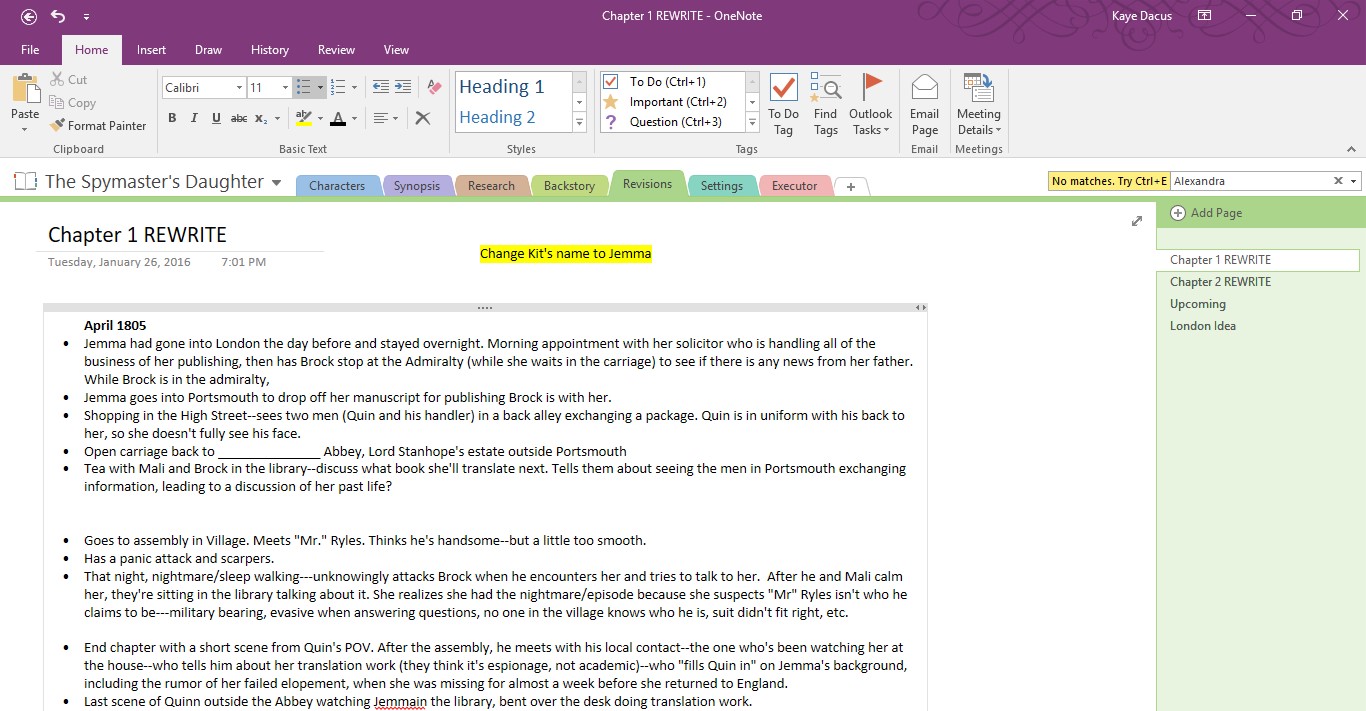
Because I’ve been working on my current story for almost a year now, the Revisions section of my OneNote Notebook for The Spymaster’s Daughter has developed organically—because I just started doing it instead of trying to force myself to do it a certain way:
But way back in the distant past (10+ years ago), when I was first writing Stand-In Groom—pre-OneNote days—I just made notes at the beginning of the chapter file. This is writing “as if”—making notes for myself of the changes that I need to go back and make but then writing forward.
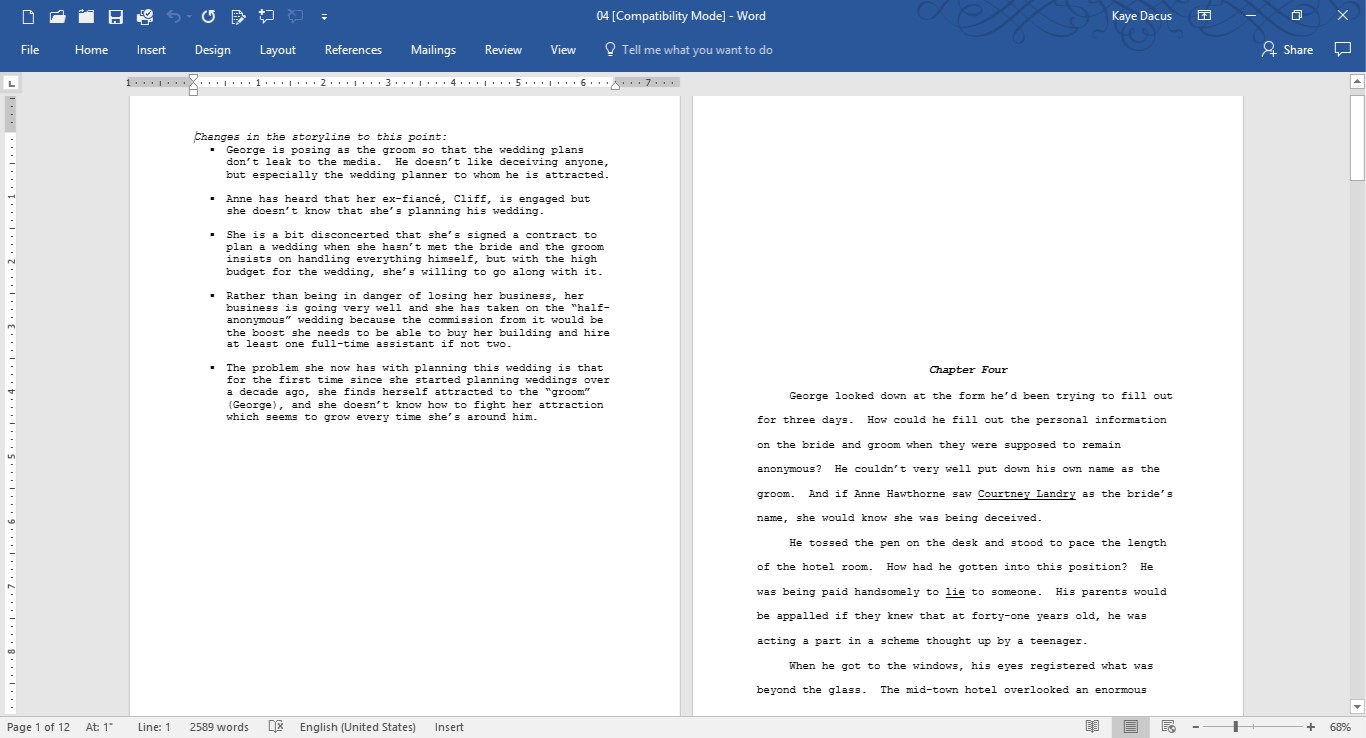
The biggest problem with doing it this way (for me) is that I keep each chapter in a separate file until I’m at my final-draft stage. And keeping the revision notes in individual chapter files made them hard to locate later on. Keeping them all in OneNote now ensures I can find all of my notes almost immediately.
The structure of how you set up your Revisions section/page isn’t as important has having it and using it. So really take stock of how you know you write—and how you’ve made notes for yourself in the past of things you know you need to change/revise—and try to build your Revisions section around your own personal quirks.
Style Sheet
Creating a Style Guide is something I’ve blogged about before. A Style Sheet is something that you’ll build as you prep and as you write. It’s a place to keep track of the unique items in your story as you come up with them. Setting it up now—before you really dig into your prep work—and then filling it in throughout the prep process will get you in the habit of using it that will continue on into the writing process.
As a refresher:
Items to track in your style guide include the following, along with an explanation and a summary of how it should be “styled”:
- Unusual, foreign, archaic, uniquely spelled, and made-up names.
Examples: Zarah, nicknames for grandparents (such as Mamere, Kiki, Pops, etc.); the Admiralty is capitalized, but the port admiralty is not. - All place names.
Examples: Woodbine, Woodmont, Green Hills, Forrest Hills (yes, it has two Rs), Belle Meade, Bellevue, Fair View, Fairview, etc. Bonneterre, Comeaux (how far is it from Bonneterre, again?), Beausoleil Parish, Moreaux Mills, Warehouse Row, Town Square (or was that Towne Square?). - Names of restaurants, stores, schools, and other establishments.
Frothy Monkey, James Robertson University, University of Louisiana–Bonneterre (geaux Marauding Pirates!), Beignets S’il Vous Plait (see—I had to look that one up just to include it here!), Boudreaux-Guidry Enterprises/B-G. - Anything that gets a red squiggly line as you write it.
Whether it’s a regional word, professional jargon, a rare piece of dialect, an abbreviation, pet name, or other shortened form of a word, or something foreign or made up, if Word doesn’t recognize it, add it to your style guide. (And then add it to Word’s dictionary so it doesn’t keep flagging it every time you run a spell-check.) - Foreign, archaic, regional, or made-up words and phrases.
These words may be familiar to you, but not to an editor who’s going to waste his/her time trying to look them up or contacting you to find out more about them. You may forget how you spelled something, or which place name you used. Writing it down saves everyone time. - Anything you don’t want to fight with your editor about later.
Here’s a snapshot of my style sheet for the Bonneterre series:

Research Repository
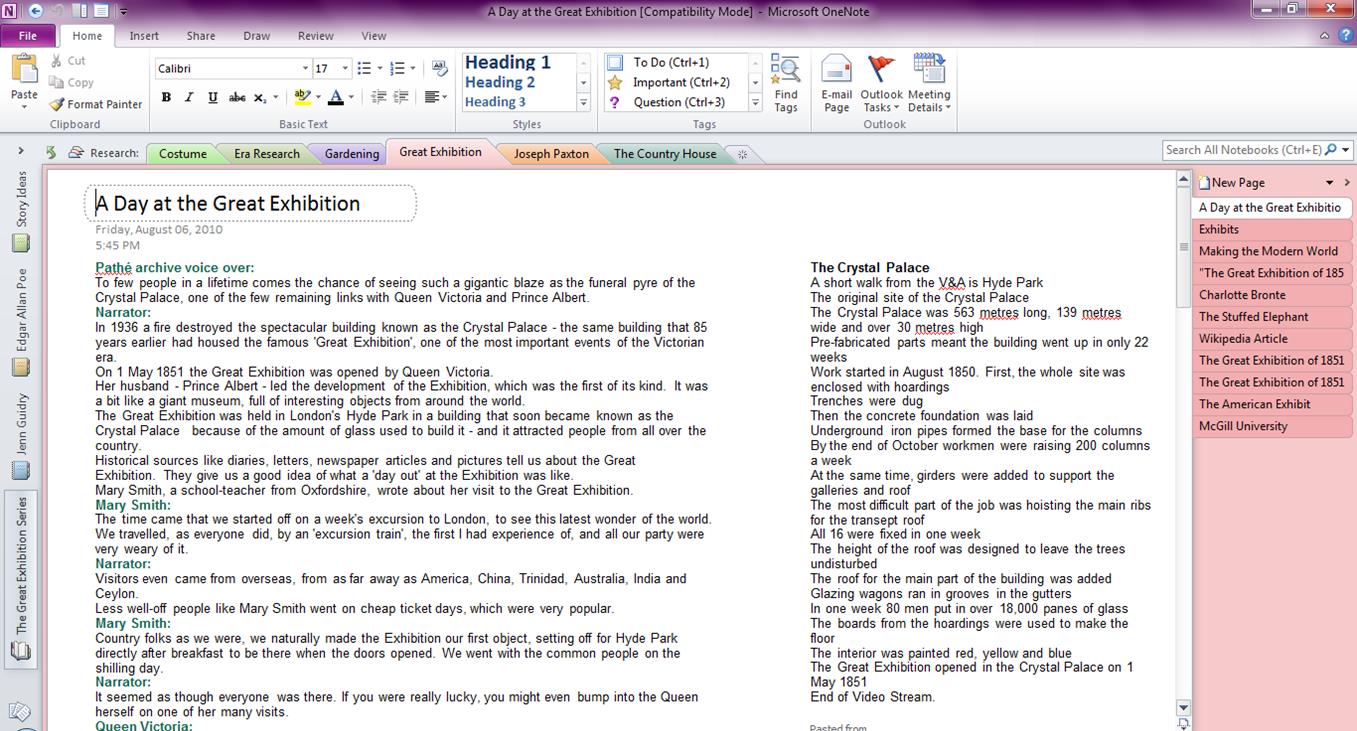
It doesn’t matter if you’re writing a contemporary set in your own neighborhood or a sweeping historical epic spanning generations and continents. You’re going to have to do some research somewhere along the way. Our planning process will help you do some of this research. And something I’ve found helpful to keep as much of it close at hand as I can (especially since I’m not always writing in the location where my books are located, or websites get deleted/moved) is to either copy/paste the info from the website or type notes from books into OneNote for safekeeping.
Here’s a screenshot of the research section group (click for a screenshot of how to set one up) of my ON notebook from the Great Exhibition duet:
And here’s the section for The Spymaster’s Daughter:

I also have a story research section set up in my Feedly blog aggregator in which I subscribe to several Austen/Regency-related blogs.
And, of course, you could always just go old-school:
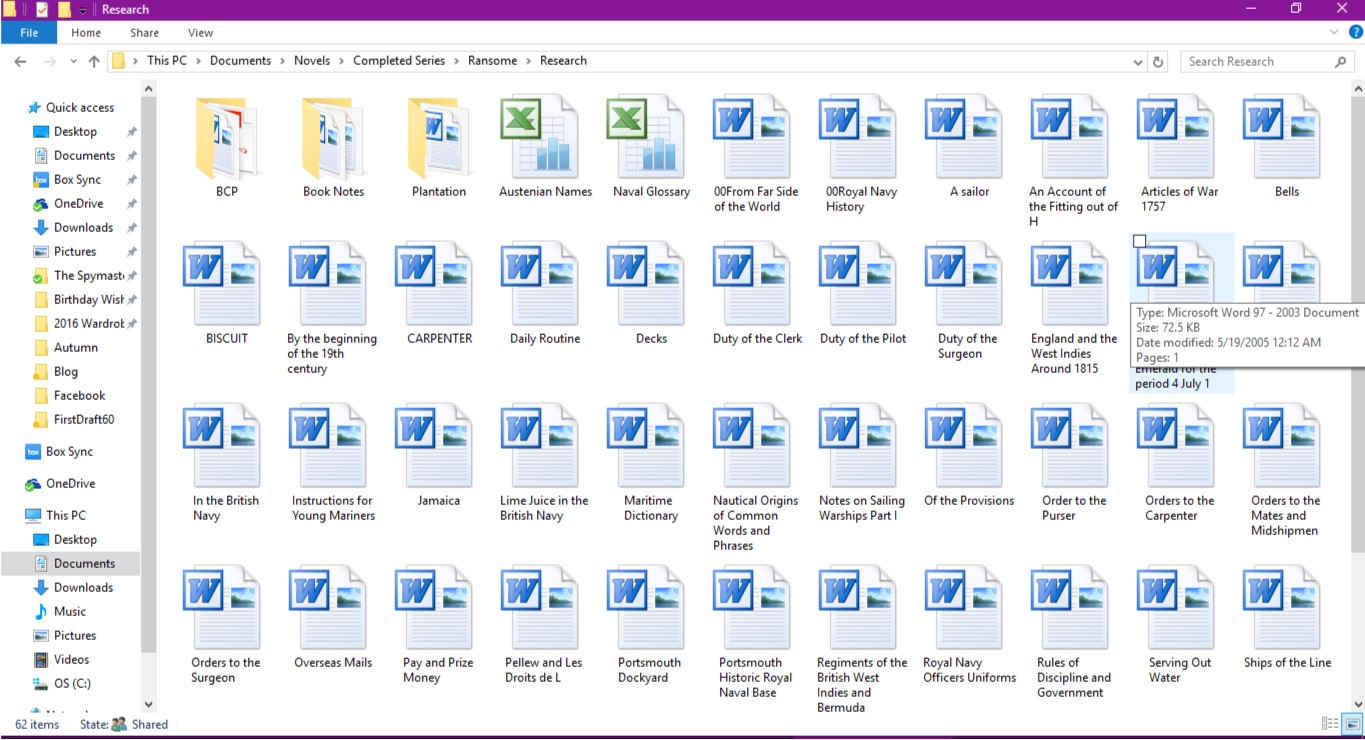
You can read more about collecting and organizing your research here (because, of course, I’ve blogged about it before).
FirstDraft60 Day 2 Assignment:
Your project for today is to figure out how you’re going to keep track of your revisions, style info, and research—and to go ahead and set them up as best you can. Then come back and let us know how you are planning to do it and how you’ve set yours up. Links to images would be great (e.g., Instagram, your blog, photos on Facebook shared publicly so we can see them even if we aren’t connected, etc.).
Can’t wait to see/hear about yours. I’m off to work on adding more stuff to the style sheet and research parts of my notebook!
__________________________________________
Work Cited:
Schmidt, Victoria Lynn. Book in a Month: The Foolproof System for Writing a Novel in 30 Days. Cincinnati, OH: Writer’s Digest Books, 2008. Print.
#FirstDraft60 2016: Day 1—Determining Your Commitment and Motivation with Guided Questions
Welcome to the official first day of #FirstDraft60–2016, a sixty-day challenge to plan and write a manuscript first draft. I hope you spent some time yesterday ruminating on the questions posed and reviewing the planned schedule for the challenge. Today, the questions dig a lot deeper into why and how we’re going to do this challenge. I’ll post my answers in the comments—because I needed to do this exercise, and hopefully to serve as encouragement for you to share your answers as well.
A note for those who are planning to participate but are writing nonfiction—the posts and advice will be focused on fiction writing, but you should be able to apply much of it to writing nonfiction as well. If you aren’t sure about any of it and how it might apply to nonfiction, please post your question(s) in the comments for clarification.
As promised yesterday, here’s the calendar for this week so you can start planning ahead:

Determining Your Commitment and Motivation with Guided Questions
Today, it’s time to not just think about but also actually answer some questions that will hopefully kick-start your planning and preparation for this project. (Adapted from Book in a Month by Victoria Lynn Schmidt.) You can answer them here in the comments, or if you want to blog through this yourself, please share the link to your post with your answers to these questions:
- 1. Why do you want to write?
2. What will finishing this project in sixty days mean to you? Do you think that completing this challenge will change you? How?
3. If this is your first attempt at completing a manuscript, how do you think finishing it will impact your life?
OR, If you’ve completed multiple manuscripts, what will finishing another one mean to you?
4. What will happen if the people closest to you don’t understand, support, and encourage you during this challenge?
5. Imagine how you will feel on November 30 knowing that you’ve completed this challenge. How can you use that to motivate you during the next sixty days?
6. What is the ONE thing you think you’re going to need the most to help you accomplish your goal for this challenge?
Considerations to Get You Through This Challenge
(Again, adapted from Book in a Month by Victoria Lynn Schmidt.)
- Set a specific time every day to write.
The book suggests doing it first thing in the morning before you get distracted and pulled in different directions. Mornings may not work for you, though. So choose a time that you can consistently set aside every day and make an appointment with yourself—set a reminder on your phone or computer if you need to, block out the time on your calendar. This is a commitment you are making to yourself. Your owe it to yourself to make it important. Start practicing this month by doing our FirstDraft60 preparation activities during your appointed writing time. If you make setting that time aside a habit now, it will be that much easier. - Commit to cutting out frivolous/non-productive activities.
October and November may be hard months to do this for those of us who are TV addicts, since most of our favorite shows are premiering new seasons and all of the new fall shows will be debuting (not to mention football games and other outdoor activities we might go to/participate in). But completing this first draft takes priority. If you don’t have a DVR or Hulu, plan to have your prep work (October) or word count (November) complete before the show comes on; otherwise, save them for later as rewards for when you meet your goals. Also—your writing time should be phone-free and Internet-free. No distractions. - Track your progress.
We’ll get into this more in a future post, but consider tracking writing-related activities besides just word count. Outlining, making revision notes, brainstorming, character casting—this month, you’ll be doing a lot that’s writing related but not actually building word count. It’s all time spent on your story, so why not track it to see just how much you’re really accomplishing. - Meals.
Consider planning and precooking (or at least pre-preparing) meals for the upcoming week on the weekends when you have more time. Here’s a YouTube Vlogger who has videos with ideas for how to plan ahead of time to make the most of your limited time during the week. - Prioritize.
The writing portion of this challenge is only 30 days. What can you give up or put on hold for 30 days in order to achieve the goal of a completed first draft? - Say no.
For the 30 days of this challenge in which you’ll be writing, don’t take on any new responsibilities or obligations that aren’t absolutely required. You have, right now, 30 days’ warning in which to prepare yourself for this. Start practicing now. Is it a matter of life or death? Does it put your job at risk to say no? Or are you just risking someone else getting miffed at you? You’ve already made a commitment to this challenge. Isn’t your commitment to yourself and your writing just as important—if not more so—than anything else that might come up? Practice telling people that you have a commitment right now, but as soon as you’re finished, you’d be more than happy to help them out.
- List of Considerations… (to copy/paste into your comment)
- Set a specific time every day to write.
- Commit to cutting out frivolous/non-productive activities.
- Track your progress.
- Meals.
- Prioritize.
- Say no.
Your Questions, Suggestions, and Ideas
Once you answer the Guided Questions and address the Considerations above, don’t forget to also post your own questions, suggestions, and ideas to help encourage and support each other.
#FirstDraft60: Day Zero—Are You Ready to Write a Story? #amwriting #nanoprep #nanowrimo
If you didn’t participate last year, or if you haven’t had a chance to explore the posts, here’s the explanation/introduction to what the #FirstDraft60 challenge is.
Here’s a link to a .pdf file (opens in a new tab) of this year’s calendar—but be aware that it’s subject to change. I’ll also be posting a schedule each Sunday of what we’ll be doing/covering so that you can plan ahead each week.
As we did on “day zero” last year, we’re going to start off with some questions today to help us start thinking about and planning for the story we’re going to be working on between now and November 30.
Before answering these questions, please read the explanations/clarifications/further info on last year’s Day Zero post.
What story are you going to work on?
I need to break down and reconceptualize The Spymaster’s Daughter in order to have a completed manuscript (ready to go to my agent) before the end of the year.
Who’s your support team?
As mentioned in the comments on this post, I’ve let go of most of my support team over the past few years. In doing this challenge, I’m also challenging myself to rebuild that support team and not just rely on one or two family members or friends for encouragement and support.
What do you hope to achieve?
The easy answer is to have a completed manuscript submitted to my agent. The hard answer is “to fall in love with writing again.”
Do you really have the time to commit to this challenge right now?
Yes. Because I’m making this a priority, and I’ve already mapped out my calendar for the next sixty days. The only big commitment I have between now and the end of November is going home for the week of Thanksgiving. And I know my parents fully support my writing and will encourage me to take the time I need daily in order to get it done.
How will you set realistic goals—and adjust them as time goes on?
As you can see in the calendar linked above, I’ve broken down a total word count of 50,000 for the daily word goal for November 1–30. Although I am currently sitting on a word-count of 55,000+ right now (I think I missed adding a couple thousand to that number), I’m hoping that I’ll be able to salvage at least 25–30,000 of the current draft, and that writing 50,000 new words will be the rough draft I need in order to be able to spend the first few weeks of December revising/editing in order to get it sent to my agent on the promised timeline.
Here’s the list of questions if you want to copy/paste them into your comment for answering:
1. What story are you going to work on?
2. Who’s your support team?
3. What do you hope to achieve?
4. Do you really have the time to commit to this challenge right now?
5. How will you set realistic goals—and adjust them as time goes on?
In addition to answering those five questions, what questions and/or suggestions do you have for how this challenge will work?
Don’t Forget: #FirstDraft60 2016 starts 10/02/16! #amwriting #nanoprep #nanowrimo
In case you missed the announcement earlier this week, here’s the original post:
Starting Sunday, October 2, I’m challenging myself—and y’all—to an audacious project: to plan, prep, and write a first draft in 60 days. A few of you followed along when I tried this last year (and we all fizzled out there at the end). This year, however, I have a little more motivation to get this done—I told my agent I’d have a completed manuscript draft to him by the end of the year so he can start shopping it around in 2017. This year, unlike last year, I’ll be working on an existing idea, breaking it down, tearing it apart, and rebuilding/rewriting it. So, hopefully having that head start will give me the impetus I need in order to be successful this go-round.
Let’s Complete a First Draft Together in 60 Days
For those who have completed National Novel Writing Month (NaNoWriMo/NaNo) in the past, this is old hat for you. But there are so many of us who think about it, maybe try for a few days, and then give up. Usually because we haven’t adequately planned ahead of time, not just for the story, but for everything that life can throw at us in the course of a month of marathon writing.
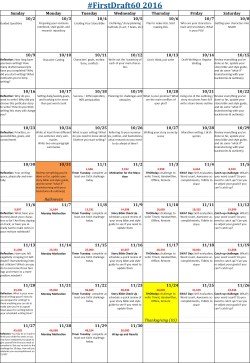 So I’ve decided to take a systematic approach, inspired in part by the book Book in a Month by Victoria Lynn Schmidt. To that end, I have planned out my blogging/writing calendar for the entire 60 days (click the image to the right to open the .pdf version of the tentative calendar for 2016).
You may have already done some/most of the prep work we’ll be working on for the month of October—you may have even started writing your story already. And that’s okay. This will give you a chance to review all of it and make some tweaks and revisions to your characters, story idea, setting, etc., in order to get ready for our writing marathon in November. Or there may be that one story you’ve always wanted to try writing, but just have’t yet taken the time. Now would be a great opportunity. What’s sixty days in the grand scheme of things?
Yes, I know that NaNo is coming up in November. I won’t be officially participating, but I did plan this to coincide with it. If you plan to participate in NaNo, feel free do your prep work along with us in October but then switch over to the NaNo site on November 1. Or stick around with us. Or do both. It’s up to you.
I hope you’ll not only follow along, but jump in with your responses, examples of your work, questions, ideas, suggestions, and tips in the comments every day. If you need help brainstorming an idea or figuring out a plot point, please post. Yes, the comments here are public, but I moderate them closely to keep this a safe and encouraging place for writers to communicate with each other.
So what do you say? Are you in?
Books Read in 2016: ‘Diamonds or Donuts’ by Lucie Ulrich (3 stars)
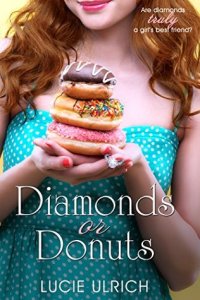 Diamonds or Donuts
by Lucie Ulrich
My rating: 3 stars
Book Summary:
Sarah Alexander’s marriage to millionaire Logan Montgomery is put on hold when Logan is offered the opportunity to go on an extended archaeological dig in Egypt. Though not happy with his decision, Sarah supports her fiancé, despite the fact she’s already given up her apartment and teaching position.When Sarah’s best friend, Pippa, suggests Sarah move to Sunset Cove, she figures a new town, new job, and new friends are just what she needs to help her through the separation. If she’d known one of those friends would turn out to be kind-hearted, good-looking, and well-built Officer Kevin Jenkins, she might have figured a little harder.
Though Sarah goes out of her way to keep her relationship with Kevin on a friends-only basis, it’s clear their feelings for one another are teetering toward something more. Now Sarah must make the most important decision of her life. Will she go for diamonds or donuts?
My GR Status Update(s):
08/18. . .marked as: currently-reading
08/18. . .19.0%
09/19. . .marked as: read
My Review:
I knew going into this book that it already had one strike against it—that being the premise of a heroine who is already engaged to one man entering a new romance with another man. This may be my least favorite of all contemporary romance tropes. But I decided to give it a try because it did sound cute.
I didn’t know going into this book that it’s sweet/borderline inspirational romance. The characters live a lifestyle in which praying and going to church are normal activities, but it’s not bashed over the reader’s head, which I really appreciate, as that’s the type of writing that I try/like to do myself.
Because of the way the book is structured (i.e., because of the viewpoints chosen), there’s never a doubt which man Sarah will end up with. Unlike most books that start with one of the main characters already deeply involved in another romantic relationship (to the wedding planning stage in this book), the reasons why she would choose to leave the one she’s already “in love with” to be with someone else aren’t necessarily as clear-cut. He’s not abusive. He’s not mean. She’s just not his main priority. And she doesn’t really fit into his family/lifestyle all that well. I just find it hard to believe that she wouldn’t have figured this out long before they got to the wedding-planning stage. It was interesting that the biggest conflict for Kevin, a.k.a., Mr. Donuts, is knowing that she’s engaged to another man and not wanting to hone in on someone else’s fiancée—something that isn’t seen very often in stories like this and which made me like Kevin a lot.
All in all, a cute read . . . but it took me a while to finish because I kept forgetting about it. But not so forgettable that it would keep me from trying other books from this author!
_______
My rating matrix:
5 STARS = one of the best I’ve ever read
4 STARS = a great read, highly recommended
3 STARS = it was okay
2 STARS = I didn’t enjoy it all that much, not recommended
1 STAR = DNF (did not finish)
#FirstDraft60 2016 starts 10/02/16 — A Writing Challenge!
Starting Sunday, October 2, I’m challenging myself—and y’all—to an audacious project: to plan, prep, and write a first draft in 60 days. A few of you followed along when I tried this last year (and we all fizzled out there at the end). This year, however, I have a little more motivation to get this done—I told my agent I’d have a completed manuscript draft to him by the end of the year so he can start shopping it around in 2017. This year, unlike last year, I’ll be working on an existing idea, breaking it down, tearing it apart, and rebuilding/rewriting it. So, hopefully having that head start will give me the impetus I need in order to be successful this go-round.
In case you missed it last year, here’s what the FirstDraft60 challenge is all about:
Let’s Complete a First Draft Together in 60 Days
For those who have completed National Novel Writing Month (NaNoWriMo/NaNo) in the past, this is old hat for you. But there are so many of us who think about it, maybe try for a few days, and then give up. Usually because we haven’t adequately planned ahead of time, not just for the story, but for everything that life can throw at us in the course of a month of marathon writing.
So I’ve decided to take a systematic approach, inspired in part by the book Book in a Month by Victoria Lynn Schmidt. To that end, I have planned out my blogging/writing calendar for the entire 60 days (click the image to the right to open the .pdf version of the tentative calendar for 2016).
You may have already done some/most of the prep work we’ll be working on for the month of October—you may have even started writing your story already. And that’s okay. This will give you a chance to review all of it and make some tweaks and revisions to your characters, story idea, setting, etc., in order to get ready for our writing marathon in November. Or there may be that one story you’ve always wanted to try writing, but just have’t yet taken the time. Now would be a great opportunity. What’s sixty days in the grand scheme of things?
Yes, I know that NaNo is coming up in November. I won’t be officially participating, but I did plan this to coincide with it. If you plan to participate in NaNo, feel free do your prep work along with us in October but then switch over to the NaNo site on November 1. Or stick around with us. Or do both. It’s up to you.
I hope you’ll not only follow along, but jump in with your responses, examples of your work, questions, ideas, suggestions, and tips in the comments every day. If you need help brainstorming an idea or figuring out a plot point, please post. Yes, the comments here are public, but I moderate them closely to keep this a safe and encouraging place for writers to communicate with each other.
So what do you say? Are you in?
Ransome Trilogy Readers—I Need Your Feedback!
Readers of my Ransome Trilogy, I need your help with my new story!
As many of you know, I’ve been working on a new Royal Navy–Regency romance novel this year, The Spymaster’s Daughter. After several months of being “stuck” (because I tried to write it “by the seat of my pants,” the way I used to write years and years ago before I was published, and discovered I just can’t write that way anymore), I’m getting geared up to try to get the characters and story idea revamped/revisualized and get it finished by the end of National Novel Writing Month (11/30/16).
So here’s how you can help me (part 1).
In the Ransome Trilogy, there are two main female characters—Julia Witherington and Charlotte Ransome.

There are things I like and dislike about both of these characters—aspects and character traits I want to make sure my new heroine has—but I don’t want her to be too similar to them, since this is a totally new story. So the feedback I’m looking for is:
What do you like most about Julia? What would you change about Julia? What do you dislike about Julia?
What do you like most about Charlotte? What would you change about Charlotte? What do you dislike about Charlotte?
What would you most like to see in a new heroine in a story set around the same time?
Feel free to post in the comments below or you can contact me directly/privately.
I’ve Lost that Loving Feeling (for writing)…
 I just posted this on Facebook, but thought I’d expand my reach as much as I could by posting it here, too.
I need your help—your support.
I’ve forgotten what it means to love writing. To love creating characters and storylines and conflicts and happy endings.
If you’ve ever been in a place in which you’ve had to regain your love for something you once had a passion for, how did you do it?
Help me, oh my lovely readers. You’re my only hope. 😉
It’s Reading Report Time! (September 2016)
Happy First Monday of September, everyone.
It’s Reading Report Time!
Open Book by Dave Dugdale
.
Tell us what you’ve finished over the last month, what you’re currently reading, and what’s on your To Be Read stack/list. And if you’ve reviewed the books you’ve read somewhere, please include links!
To format your text, click here for an HTML cheat-sheet. If you want to embed your links in your text (like my “click here” links) instead of just pasting the link into your comment, click here.
.
- What book(s) did you finish reading (or listening to) since the last update?
- What are you currently reading and/or listening to?
- What’s the next book on your To Be Read stack/list?
Blogging Through ‘Scene & Structure’–Chapter 5: “Structure in Macrocosm: Scenes with Results”
I thought I’d try something a little different today. Let me know what you think!
.
Blogging Through ‘Scene and Structure’–Chapter 1: “The Structure of Modern Fiction”
Blogging Through ‘Scene and Structure’–Chapter 3: “Structure in Microcosm: Cause and Effect”
Blogging Through ‘Scene & Structure’–Chapter 4: “Structure in Larger Elements: The Scene”

 KayeDacus.com