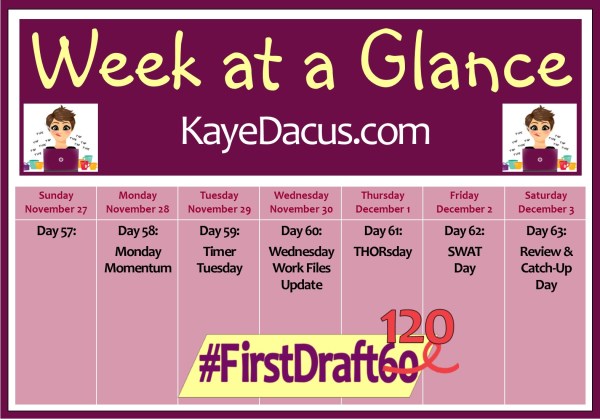
#FirstDraft120 Day 68: It’s THORsday! #amwriting #1k1hr #handwriting
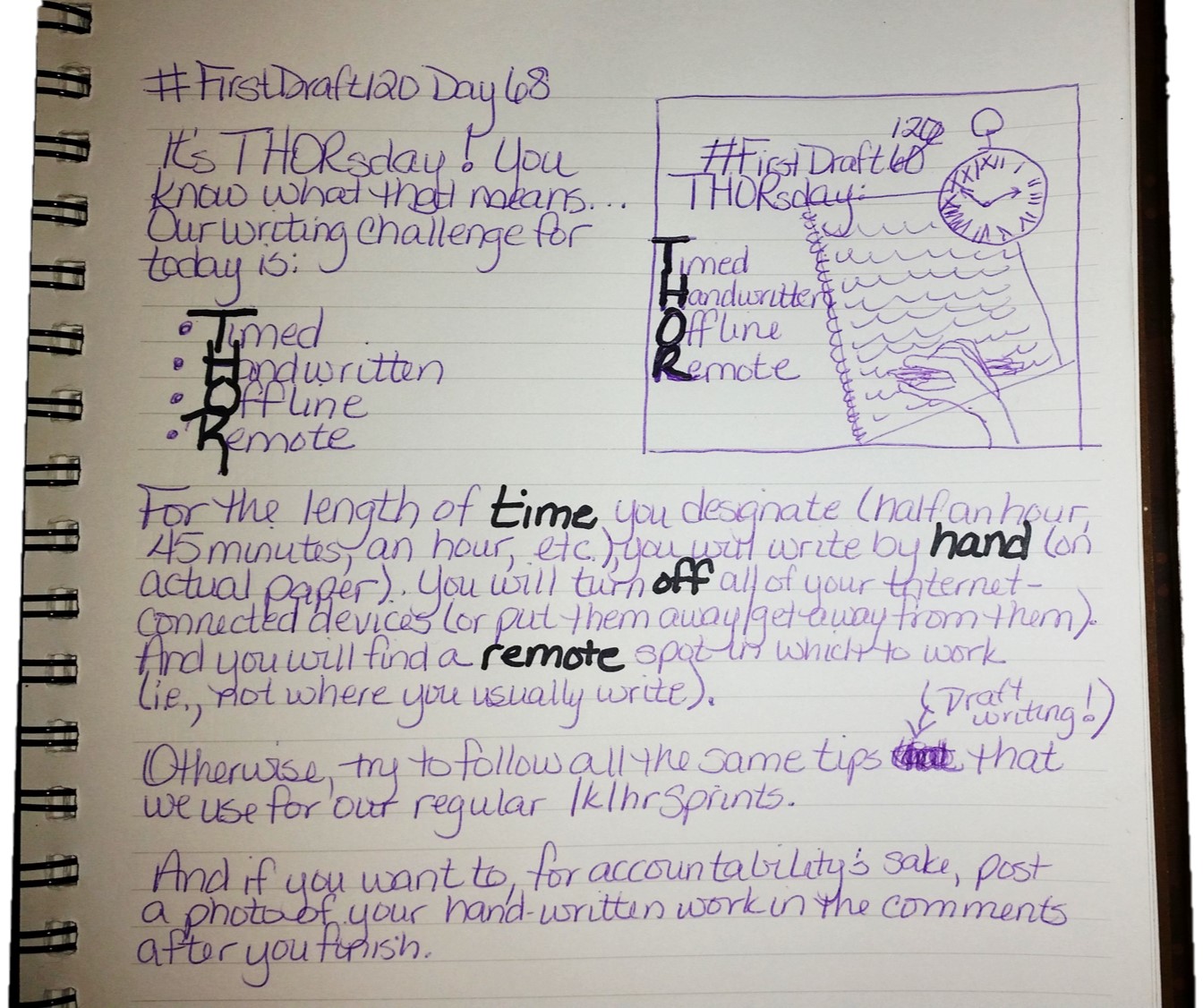
On Thursdays, we do an alternate version of Timer Tuesday—instead of challenging ourselves to sit at the computer and try to crank out as many words as fast as we can, the challenge is to get away from the computer.
 What Does THORsday Mean?
It’s pretty simple. Our writing challenge for today is:
Timed
Handwritten
Offline
Remote
What that means is that for the length of time you designate (half an hour, 45 minutes, an hour, etc.), you will write by hand (on actual paper). You will turn off all of your Internet-connected devices (or put them away/get away from them). And you will find a remote spot in which to work—in other words, don’t do this at the same place where you usually write. Go into a different room. Go outside. If you can, get out of the house and go work somewhere else, like your public library or a coffee shop.
Otherwise, try to follow all of the same tips that we use for regular 1k1hr writing sprints. (Refresher here.)
Assignment: Leave a comment with your THORsday goal—when, where, and for how long do you plan to do your handwritten challenge today? If you’d like to, for accountability’s sake, come back afterward and post an image of your handwritten work.
#FirstDraft120 Days 60-67ish: Discovering the Force #amwriting #writersblock

It doesn’t seem to matter how often I tell myself that this time I’m committed to get back into writing. This time, I’m going to make it work. This time, I’m actually going to stick to a daily writing schedule. This time, I won’t procrastinate and then quit.
Well, this time has been no different than the few times I’ve tried this before—ever since completing my last contracted book in 2013, I’ve been unable to overcome the procrastination and laziness that overwhelms me whenever I think about sitting down to write.
It’s not that I don’t want to write—or at least do something creative. As most of you well know, I deal with depression on a daily basis. Not only am I wired for it, but I also take medication that exacerbates it. (And medication to try to counteract that.) I work from home so I don’t really feel much accountability to keep a regular daily schedule, despite telling myself every weekend that this week I’m going to make myself get up at a regular time and sit at the work computer for eight hours—with breaks, of course—and focus on my job instead of allowing myself to get distracted with other stuff, which just makes the work day extend well into the evening; and then I don’t feel like doing anything else. And it just becomes a vicious loop of distraction and procrastination and wallowing in the “blah” feeling of unmotivation that the depression brings on, instead of working to overcome it.
See, I know deep down that if I make myself stick to a schedule, both for work and for writing, I’ll feel and function better both mentally and emotionally. I’ll have more energy to get more stuff done around the house (you don’t even want to know what a wreck it’s become). I’ll actually get stuff done, which in turn will give me an emotional boost, which will make overcoming the blahs/procrastination tendency that much easier the next time.
Yet, I don’t.
Confession: I’ve Been Playing Instead of Writing
It’s not that I haven’t been channeling the need to do something creative. Although some of my time has been spent productively in working on hand-crafted Christmas gifts, the majority of my time has been spent working on something that has become a go-to for me when I wallow in my depression long enough that I need a mental escape. It’s a project I call my “imaginary husband.” It started years ago as an alternate reality for myself when I was “self”(un)employed and struggling to make ends meet through diminishing freelance editing projects and writing contracts. Imagining myself falling in love and living a fabulous life with a great husband in a great house with a great job gave me a mental and emotional escape that I needed to help me through that time.
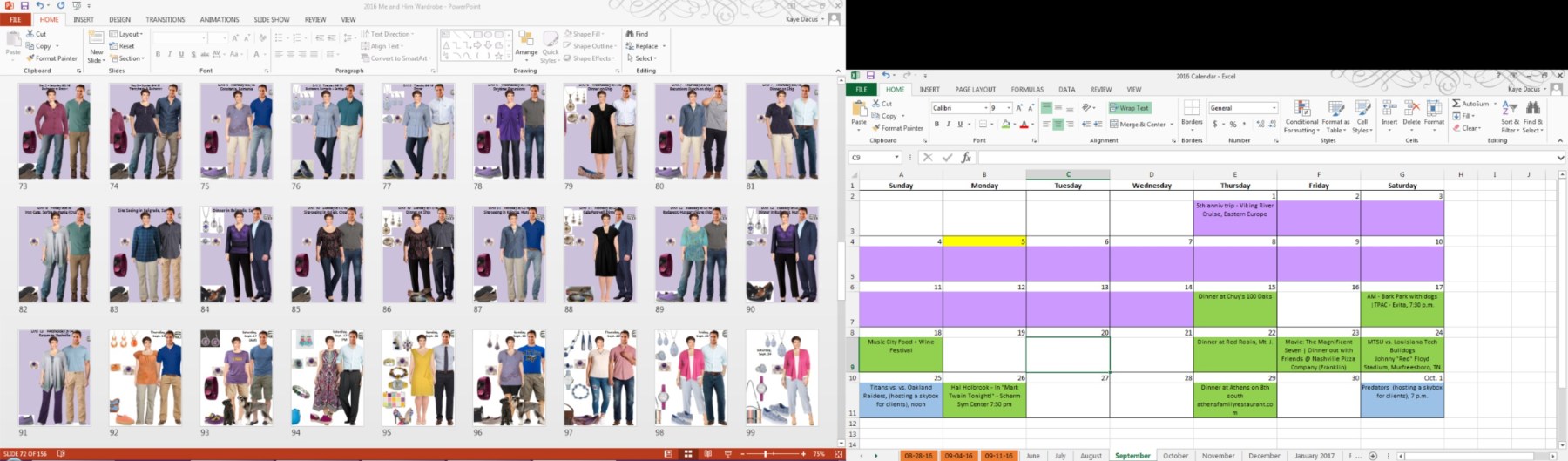
In the past couple of months, I’ve found myself returning more and more frequently to that outlet and losing myself in it for hours at a time. It isn’t writing—it’s both analytical (scouring websites for events that “we” could go to/be involved with and setting up a calendar of events) and visual (creating virtual paper dolls of me and the template for the imaginary husband—a guy I found on a stock photo site—choosing outfits, which means lots of virtual shopping for the clothes and accessories, and even down to choosing restaurants and “ordering” our meals at each one from viewing their menus online). It’s something that uses many of my skills: analytical, creative, graphic, design. However, it isn’t really productive, and it’s really just more procrastination.
Actually, it’s a lot like what I used to do when I started making the transition from playing with Barbies and then, eventually, into writing when I was around thirteen or fourteen years old. Only, back then, I had to use catalogs and magazines, glue/tape, and loose-leaf notebooks, since the Internet didn’t exist. It’s playing. It isn’t writing.
Discovering and Using the (Writing) Force
If you ever had to take physics, you know Newton’s first law of motion: An object at rest tends to stay at rest while an object in motion will stay in motion. This is known as inertia. The object at rest will remain at rest until acted upon by an “unbalancing” force. (Yes, that’s a simplification.) In the physical realm, this means an outside entity must act upon the object to get it to move (or stop). In the mental/emotional realm, it can also be an outside force that must be enacted (a deadline, a contract, a commitment to others, etc.). However, most of the time, it requires that force come from within.
So, my “imaginary husband” project has created an object-at-rest state for me. It’s a lot like overeating junk food—it’s satisfying in the moment, but then as soon as it’s over, I feel guilty for not making better choices. Which just makes overcoming the mental/emotional hurdles that much harder.
It’s so easy to sit here, while writing this post, and tell myself this time it’ll be different. This time, I’ll actually stick to my commitment to write daily. This time, I’m really going to do it. But those are just words. And words are easy to say (type). Action is harder.
But then, thinking about everything that I need to change (work schedule, writing schedule, being a better housekeeper, making healthier food choices, etc.), it becomes overwhelming. So I know I need to make smaller changes. Getting up 20 minute earlier every day until I’m back on a normal work schedule. Setting a timer for one hour and making myself focus on work before taking a 10-minute break. Writing 50 words. Then 100 words. Then 200 words. Taking it in small chunks until I’ve built up the INERTIA needed to be an object that stays in motion.
It’s 4 p.m. on Wednesday afternoon. I’ve already done most of my work for today (just need to send in my daily report). So that means the rest of the evening is mine to do with what I will. So here’s what I’m going to accomplish tonight:
1. Write/publish a blog post. (DONE!)
2. Write at least 200 words on my novel between now and the time I go to bed.
3. Take the trash out (trash-pickup is early Thursday morning on my street).
4. Unload the dishwasher and put the dishes currently in the sink into it.
5. Put the couple of boxes of stuff that need to go to Goodwill in the car.
Now, if accomplishing this to do list taps me into the Force and gives me momentum, I might do more than this. But even if I just get these five things accomplished, it’ll be more than I’ve done in quite some time.
Assignment: What are five things that you can to tonight that will help you tap into the “force” and go from at-rest to in-motion?
#FirstDraft120 Day 61: THORsday & Some Thoughts on Dialogue Constipation in First Drafts #amwriting
 Sorry for the spotty posting this week—it’s always hard to get back into the swing of things after being gone (from home and from work) for more than a week. But let’s take today as the opportunity to ease ourselves back into a good daily writing schedule with our regularly scheduled THORsday writing challenge. For a reminder/clarification of what THORsday is all about, click here.
Assignment: Leave a comment with your THORsday goal—when, where, and for how long do you plan to do your handwritten challenge today?
Some Thoughts on Dialogue Constipation in First Drafts
So, I saw this commercial the other day. (No, this is not a sponsored post, nor do I support/recommend this product—this is just used as an example.)
https://www.ispot.tv/share/AuUN
And it started me thinking about how horribly stiff and unnatural the dialogue is in it. That, naturally, led me to think about everything I’ve ever read/heard/written/taught about writing dialogue in fiction. (And believe me, there’s a lot.) One of my primary go-to quotes about dialogue is this, from Sol Stein in How to Grow a Novel, in the chapter “Our Native Language Is Not Dialogue”:
Dialogue is a language that is foreign to most writers of nonfiction and many newcomers to fiction. Totally different from whatever language a writer grows up using, dialogue is also a triumphant language. It can make people unknown to the author cry, laugh, and believe lies in seconds. It is succinct, but can carry a great weight of meaning. In a theater, dialogue can draw thunderous applause from people who have paid heavily for the privilege of listening to it. At its best, as in Shakespeare’s best, dialogue provides us with memorable—and beautiful—guides for understanding the behavior of the human race.
(p. 90)
However, trying to write good dialogue—dialogue that isn’t didactic or overly expository or telling stuff that we should be showing or meandering or, simply put, “bad”—isn’t something that we need to focus on when writing a first draft. Crafting meaningful, colorful, quippy, witty, scintillating dialogue that pops and moves the story forward is the work of revision and rewriting (and revision and rewriting, and revision and rewriting).
So if you have developed a “constipated” feeling when you’re writing, and it’s because you feel like the dialogue you’re writing stinks, take this post as your “laxative” and let the words flow as they will. You can always flush them/clean them up later. (Ick, I know.) 😉
___________________________________________________________
Works cited:
Stein, Sol. How to Grow a Novel: The Most Common Mistakes Writers Make and How to Overcome Them. New York: St. Martin’s, 1999.
#FirstDraft120 Day 59: Timer Tuesday! #amwriting #nanowrimo
 As always on Tuesdays, today our challenge is to schedule and complete at least one 1k1hr writing sprint some time during the day.
IT’S TIMER TUESDAY!
I’m going to try to do my #1k1h sprint today at 7:30 PM US Central time*.
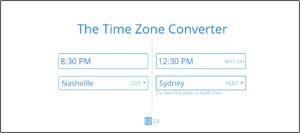
*To determine the time of the 1k1hr sprint in your time zone, go to the Time Converter website by clicking the image above and inputting my time (as Nashville or Central Standard Time) on the left, and your city/location on the right. For example, 7:30 PM Tuesday 11/29 in Nashville is 12:30 p.m. Wednesday 11/30 in Sydney, Australia.
What time will you be doing your 1k1hr sprint today? Or if not a 1k1hr, how will you work the concept of the sprint into your day?
Remember, the more support (and accountability) there is, the more successful we’ll all be!
1k1h Tips for Success
- Let anyone within your household know that you need one uninterrupted hour to try to head off at the pass any interruptions.
- Set a timer. This is most important. Don’t do this by just watching the clock. You’ll find yourself only watching the clock and not getting anything written. Setting a timer allows you to forget about the time and concentrate fully on writing.
- Prepare yourself before starting your timer. Re-read the last few pages you wrote (without editing/revising!) to get your head back into the story and figure out where you need to pick up. Review your outline and/or character pages in your Story Bible. And then put all of that away so you don’t use those to procrastinate during the hour.
- If you listen to music while writing (I recommend instrumental so that you don’t get distracted by the lyrics), have it set up and playing before starting your timer. Use earphones, even if you’re working at home, to block out any sounds that might pull you out of your story.
- If you can’t listen to music while writing, I recommend wearing the earphones anyway. People are less likely to interrupt you (at home or working somewhere like a coffee shop) if you have them in/on—and they help block out those distracting sounds.
- Make sure your writing space (both physical and mental) is set up and ready to go before you start your timer.
- In other words, make sure that about five to ten minutes before you start the 1k1h sprint, you’re in the process of getting ready to write.
- Silence or turn off your cell phone (unless you’re using it as your timer—then don’t turn it off). Close your Internet browser. Close Facebook and Twitter (as soon as I give the “start” signal, of course). Close your email program if you use something like Outlook that isn’t web-based. Eliminate all distractions!
Don’t Know How to Start Writing?
If you aren’t sure how to start writing when the hour starts, even after re-reading what you’ve previously written, here are a few suggestions.
- Which character had the viewpoint in the last scene you wrote? Start with a different character in this scene.
- Still not sure what to write? Try this prompt:
Character walked into the room. Character saw a piece of paper tacked to the wall on the other side of the room. Character walked across the room and took the piece of paper down. Character read the piece of paper. The piece of paper said . . . - If that prompt doesn’t work, try the exercise of making your character face a great fear or come face-to-face with someone they don’t like.
- If you can’t think of what the “next” scene is that comes after the one you just left off with in your previous writing session, start writing something you know comes later in the story that you already have a good idea for. Though I recommend writing your story in linear fashion (from beginning to end) instead of jumping around, sometimes you need to write stuff that comes later if you already have a clear idea of the scene in your head, just to make sure you don’t lose it. And that can also help you figure out what comes between what you’ve written so far and that future scene and help you to fill in the gap next time.
Don’t forget to check in with your progress and how you do with your own 1k1hr sprint(s) today!
#FirstDraft120 Day 58: Monday Momentum–Motivation in Adrenaline-Fueled Panic #amwriting #nanowrimo
 I hope everyone in the U.S. had a wonderful Thanksgiving week . . . and if you’re not in the U.S. and didn’t celebrate a holiday last week, I hope you had a great writing week.
Now we’re back on schedule and ready to get our (writing)motors started for a new week of possibilities, goals, and untold story waiting to be written.
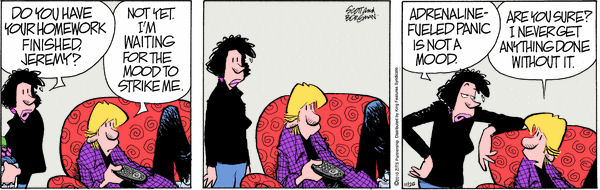
I don’t know how many of you have been around since I was actively writing my books under contract. But if you’ve been here that long, you know that I wrote most of them on very short-turnaround deadlines, which is what happens when you sign contracts to write three 100,000-word books per year. Of course, the fact that I’m a professional procrastinator doesn’t help, either. So I ended up writing most of them in an adrenaline-fueled panic mere weeks before the deadline, most right up to (literally) the last second before emailing the manuscripts to my editors. I quickly had to learn to write final-draft quality, because I never had time to go back and even re-read the full manuscript after finishing the last chapter (I did re-read in pieces, and kept up-to-date scene cards with a summary of what happened in each chapter I’d written so I’d know what I’d covered and what I hadn’t), much less do any revision.
Which prompted my mom to send me the link to this comic strip back in 2010:
.
My Monday Motivation: Avoiding Adrenaline-Fueled Panic
I’ll admit it—I’ve allowed myself to procrastinate and I’ve only written a few hundred words since the first week of the month. But I know that January 31, 2017 deadline is looming. I don’t want to give up; I don’t want to fail. But I also don’t want to spend the month of January in that all-too-familiar panic because I have 30k, 40k, 50k, or more words left to write in order to finish this draft.
So that’s my Monday Motivation: avoiding the panic and being methodical in making sure I get my word count in before deadline is looming.
Assignment: What is motivating you today? How will you build momentum to strive toward your goal(s) this week?
Happy (Belated, U.S.) Thanksgiving! #FirstDraft120 Will Be Back
Happy Thanksgiving to all of my U.S. followers. As you’ve probably guessed, I ended up taking the week off rather than using it as a final-push to get word count in, since we extended the deadline.
But I wanted to reassure you all that FirstDraft120 isn’t finished, nor have I given up on it. I’ll be back with daily posts on Monday, 11/28/16.
In the meantime, I hope if you weren’t also taking a break this week, you followed the schedule of . . .
- Motivating yourself on Monday.
- Doing a 1k1hr sprint on Tuesday.
- Reviewing and updating your story bible on Wednesday.
- Having a THORsday on Thursday.
- And reviewing your successes, word count totals, awesome accomplishments, and sharing some tidbits on Friday.
Take the time on Saturday to do any catching up you need to in order to meet your weekly goal(s) or to update your story bible or do some brainstorming. Sunday, reflect on what it means to have an attitude of gratitude as you write and how that can impact your writing.
And I’ll “see” you on Monday!
#FirstDraft120 Day 51: Monday Momentum–I’m Thankful I’m a Writer Because…
Sorry for no posts this weekend—but I was traveling to my family’s home for the holiday and needed to spend time with them.
Speaking of the holiday, today’s Monday Momentum post is different, because there’s only one question for you to answer. Think about this carefully—both in terms of how to answer it and how you can use your answer as motivation throughout the rest of the challenge.
Assignment: Answer the following question:
What is it about being a writer that makes you thankful?
As I said, think about this not only in terms of how to answer the question but as to how your question can help motivate you throughout the remainder of the challenge. As usual, you don’t have to share your answer here (but I hope you will, even if it’s a link to your own blog or a publicly shared Facebook post), but do write it down, even if you don’t share it.
I’m still thinking about this myself, so I will post my answer later today.
#FirstDraft120 Day 48: It’s SWAT Day! Check in with Your Progress #amwriting
 It’s Friday! And that means I want to know about your full writing week. What were your greatest successes during the week? What was your favorite line/bit that you wrote? What did you learn about yourself, your characters, and/or your story during the week’s work? What are you most proud of yourself for doing this week when it came to your writing? What are you proud of yourself for accomplishing?
In the business world, there’s a planning model called SWOT—which is an acronym for Strengths, Weaknesses, Opportunities, and Threats.
Around here, we’re going to use SWAT, but we’re going to do it differently, so check in with the following recap for your week:
- Self-Evaluation (how do you think you did? what can/do you want to do differently next week? what did you learn about yourself as a person or as a writer? what didn’t you do or finish that you wanted to? etc.)
- Word count (total for the week, Tuesday through today)
- Awesome Accomplishments (breakthroughs, discoveries, highest daily word-count ever, etc.)
- Tidbits to share—something you wrote that’s just too good not to share or that struck you as funny or whatever.
If you don’t want to share this stuff publicly, that’s okay. You can add a section to your Story Bible or start a journal (or add this to your existing journal) to keep track of this. But don’t skip doing this—I think that in the future, when you look back either on what you accomplished during this challenge or (heaven forbid) why you gave up on it, the insights you’ll gather later with hindsight on your thoughts during the challenge will be invaluable.
Happy writing!
#FirstDraft120 Day 47: It’s THORsday Thursday! #amwriting #handwriting #1k1hr
How is your challenge going? Have you hit a stumbling block? Have you found it easier to write since we extended the deadline? What’s up? 😉
On Thursdays, we do an alternate version of Timer Tuesday—instead of challenging ourselves to sit at the computer and try to crank out as many words as fast as we can, the challenge is to get away from the computer.
What Does THORsday Mean?
It’s pretty simple. Our writing challenge for today is:
Timed
Handwritten
Offline
Remote
What that means is that for the length of time you designate (half an hour, 45 minutes, an hour, etc.), you will write by hand (on actual paper). You will turn off all of your Internet-connected devices (or put them away/get away from them). And you will find a remote spot in which to work—in other words, don’t do this at the same place where you usually write. Go into a different room. Go outside. If you can, get out of the house and go work somewhere else, like your public library or a coffee shop.
Otherwise, try to follow all of the same tips that we use for regular 1k1hr writing sprints. (Refresher here.)
Assignment: Leave a comment with your THORsday goal—when, where, and for how long do you plan to do your handwritten challenge today?
#FirstDraft120 Day 46: Story Bible Review & Update Day #amwriting #nanowrimo
 In order to be able to focus on writing as much as we can on a daily basis, keeping our Story Bibles updated is important. So on Wednesdays, be sure to schedule additional time to review your Story Bible and see what needs to be updated or revised.
Since Story Bibles can start to get kind of massive, here are the sections to focus on reviewing/updating today:
- Secondary/Minor Characters
- Props/Costumes
- Research
- Revisions section
- Style Guide
- Synopsis/Outline (in case your recent writing has made you think of any new scenes/plot points you want to add—or realize that some of the ones you thought of before you started writing no longer work).
And don’t forget to check in with your writing progress!
My 1k1hr Today
I’ll be doing my 1k1hr writing sprint today at 5:00 p.m. Central time. I’ve used the others this week to dig a little more into the assignments I didn’t really get to during October, so I haven’t added any actual word count to my total. Today, that changes!

 KayeDacus.com