Fun Friday–Not Really Reality

I’m sure everyone was waiting with bated breath for another mind-spinning list of questions to ask of the book you’re currently reading . . . but alas, I can’t give up my Fun Friday post for something so, well, critical.
Some people say they’re the bane of television, while others can’t get enough of them. Yes, that’s right, I’m talking about “reality” TV shows. To me, there are two distinct types: documentaries and gameshows. The one similarity: for the most part, they’re unscripted (though I have heard rumors . . .). But since one of my favorites just started back up this week, and since confession is supposed to be good for the soul, I thought I’d share the list of “reality” shows I just can’t seem to live without.
 I LOVE this show—it’s the best gameshow on TV. Now in its twelfth “season” (they do two half-seasons each year), I still haven’t quite figured out what it is that keeps me glued to the TV on Sunday evenings. The new season started November 4, much to my very great pleasure. I haven’t picked a favorite yet, but I do know that I want Lorena and Jason to be gone SOON!
 I’ve mentioned this show on the blog a couple of times. Have I mentioned recently that I have a crush on season 2 runner-up Sam Talbot?
 Yay! It’s back! I’m not at all into fashion, and a lot of times I completely disagree with what’s “in” and what’s “out” according to the judges, but I just can’t resist Tim Gunn’s “Make it Work” attitude! (The irony is, I’m not overly fond of his other show, Tim Gunn’s Guide to Style).
 It is so much fun seeing Jon and Kate and how they relate to each other . . . oh, and their kids.
 Watch it once and you’ll be addicted too!
 This show has been a staple in my house on Friday nights for years.
 Maybe it’s the British accent, maybe it’s the tight black T-shirts showing the bulging muscles. There’s just something about that Chef Robert Irvine . . .
 I first saw pastry chef Duff on Food Network’s “Challenge” series. The cakes he makes are AMAZING!
——————————————————————————————-
Now comes the confession part. These last two are guilty pleasures for me.
 I haven’t seen any of the episodes of the new cycle, but VH1 has been reruning them season-by-season marathons the last few weekends and I just can’t stay away from it.
 There’s just something tantalizingly wonderful about the “beautiful” people living up (or down, as the case may be) to their reputation. The sad thing is, it’s the women who come across as the most ignorant/uneducated.
Critical Reading: The First Date
If reading the back cover and ruminating on everything you can learn about the book is like meeting someone new, reading the first chapter is like your first date. You’re not going to learn everything, but you’ll come away from it with a really good sense of whether or not you want to know more.
And I have to say, y’all are really lucky you’re getting this lesson from me. I picked up John Sutherland’s book How to Read a Novel at the library today and had to skim all the way through to chapter twelve before he gets around to talking about first lines! (As an aside, the image on the front cover is of an open book with, you guessed it, Post-its sticking out of it!)
Okay, so you’re ready for your first date with your chosen novel. You have your pens and Post-its and notepad. You’ve set your goal for what you want to read, and you’ve answered yesterday’s questions.
Chapter Titles.
After waiting nearly five hours at Barnes & Noble, when I got home with my midnight-edition of Harry Potter and the Deathly Hallows, I averted my gaze as I turned past the table of contents. Why? Because J.K. Rowling has a bad habit of revealing too much in her chapter titles. So, that’s something to consider when you pick up the book to read.
- Is there a chapter title? Does the chapter title reveal or hint at what’s going to happen?
- Is there an epigram/quote? Once you’ve read the entire chapter, does the quote fit what happened?
What’s the First Line?
Remember back a while ago when we had a brief discussion of First Lines? Now might be a good time to review that post to recall what Don Maass, Sol Stein, and Nancy Kress had to say about composing first lines. I also give a couple of examples there of how to break down a first line to see what can be learned from it.
What does the First Line really say?
If you’re a wine drinker, you know that you don’t just guzzle the whole glass down at once. The sommelier pours a tiny bit into the glass. The connoisseur swirls it, raises it to the light to see the color, smells it, then takes it into his mouth. Once in his mouth, he makes sure the liquid touches each area of his tongue, since different parts of the tongue are responsible for sweet, sour, salty, spicy, etc. He may open his mouth slightly and breathe in, which will allow the aroma to reenter his nasal passages, giving him a different experience of the bouquet (since smell is at least 50% of taste). Then he swallows it—all before the full glass of wine is served. This is how you want to treat the opening lines of a book you’re reading critically.
- Break down the sentences into key components (do you know how to diagram sentences?)—the nouns, verbs, and adjectives.
- Does it grab you and not let go? (“Somebody please help me! Somebody please! Can anybody hear me?”)
- Is it tantalizing and mysterious, urging you to read further? (He should never have taken that shortcut.)
- Is it a commentary on the society you’re about to get a glimpse into? (Living in Savannah was my way of being close enough to my family in the South Carolina Lowcountry, yet still far enough away.)
- Is it “a riddle, wrapped in a mystery, inside an enigma”? (Moon. Glorious moon. Full, fat, reddish moon, the night as light as day, the moonlight flooding down across the land and bringing joy, joy, joy.)
- Is it active (The crack of the pistol’s report came from directly behind the courier) or passive (Ryan was nearly killed twice in half an hour) voice?
- Is the character named or not?
- Is the setting revealed (and not just because it’s written with a date stamp above the first line)?
- What do you learn about the time of day, the location of the character, what you might have just walked in on the middle of?
Read the first chapter. Just the first chapter (oh, okay, the prologue, too, if there is one). This is where you will need your notebook.
- Does the opening page grab your attention and make you want to keep reading? If not, is there something within the next two pages that would have made a better opening? Does the book start slowly with lots of description, or does it open in media res—in the middle of something happening?
- What’s the setting? (Location, time period, time of year, etc.) On what page is the physical setting first mentioned? Does it feel real to you? What do you learn about the setting?
- Point of View. What Person/tense has the author chosen? Does POV feel tight and deep? Do you like the author’s choice of POV? Who is/are the POV character(s)?
- Characters. Start a list of POV/Main and secondary characters (keeping in mind not all of the POV characters will have a POV in the first chapter). When do you learn the main character’s name? When is the main character physically described for the first time? Do you like the main character? What is revealed about them in the first chapter? What can you surmise about the character’s past and about their personality from the first chapter?
- What kind of tone has the author set on the first page? (Exciting, funny, suspenseful, light, ominous, etc.) Does that match the expectation you had from reading the back blurb?
- Is there any backstory in the first chapter—more than just a hint of something that might have happened?
- Is there a hook at the end of the first chapter that makes you want to read more?
Virginia Woolfe wrote in 1926: “The only advice, indeed, that one person can give another about reading, is to take no advice, to follow your own instincts, to use your own reason, to come to your own conclusions.” We’re just getting started with this series and I’ve already posted tons of questions to ask—and we’re barely through the first chapter. I know that just with these two posts, you’re probably ready to give up on critical reading already. But this is why you really need to set a specific goal. If you’re not interested in POV, don’t bother analyzing the book’s POV (but do identify what it is, just for the practice). What I’ll be giving you throughout the course of this series is a set of questions that will give you the most in-depth critical reading experience possible. Some of it will be important to you, a lot of it won’t. Think of this series like a giant Sam’s-size bag of M&Ms . . . if you only want the blue ones, that’s quite all right.
Critical Reading: Goals & Back Covers
As I mentioned in a comment yesterday, critical reading is different than reading for pleasure. The main difference is having a goal when you set out to read. This is not a curl up in the bed half an hour before falling asleep kind of reading. This is sitting in a bright room with pen in hand ready to write things down kind of reading.
Choose your book with purpose.
There should be a reason why you’ve chosen the particular novel to read critically. As I’ve already suggested, choose a book in the genre you write put out by a publishing house you’re targeting.
Set goals. Why did you choose this book?
When I picked books to do this with in grad school, I looked for stories that included elements I wanted to either strengthen or figure out in my own WIP. For example, I chose Happily Ever After and The Celebrity because a key conflict in both plots is that the hero has hidden his celebrity-status identity from the heroine (and everyone else around him), and I wanted to see how these two authors I greatly respect (Susan May Warren and Robert Elmer) handled it in a book published in the CBA. I chose Linda Windsor’s Along Came Jones when I was trying to instill more humor in my writing.
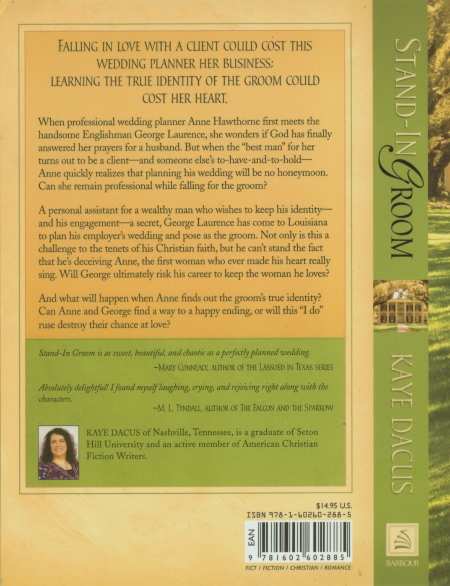
Read the back cover copy and start answering questions:
–What’s the genre listed on the back cover? (It’s usually on or around the barcode.) After reading the cover copy, does that sound like the right genre category? Does there appear to be a subgenre (i.e., is it predominantly a romance or is it a romantic suspense)?
–What do you think is the intended audience? (gender, age, CBA/ABA)
–What does it sound like the thematic conflict is?
–What does the back cover copy make it sound like the master plot is?
–What are competitive/similar books you’ve read before?
–Have you read anything else by this author? What are your general thoughts on this author’s other work?
–Have you read any reviews of this book? Were they positive or negative? Did the reviews affect your choice to read this book?
–Is there an endorsement on the cover by another author? Have you ever read anything by that author? What do you think of that author’s writing? Did the endorsement affect your decision to choose this book?
–Are you committed to reading this book all the way through no matter what?
Once you’ve answered these questions, you’ll be ready to start your critical reading. Make sure you have your Post-its, pens, highlighters, and notepad!
Critical Reading: Photographic Evidence
So before we start delving into the “micro and macro” information, I thought I’d share a couple of images of what a critically read book looks like after I’m finished with it:
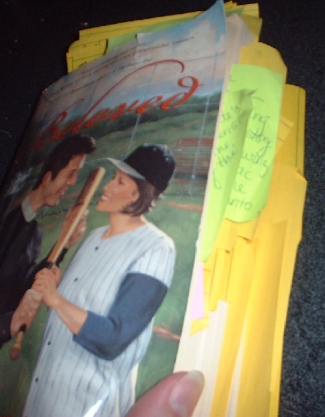
Here you can see how this can look pretty random—but each note was typed into a summary which I then submitted as part of my reading journal for grad school. (In my defense for the condition of the cover of the book—I purchased it used and it wasn’t in great condition when I received it!)

Here’s what it looks like inside. I know, you’re wondering what the note says . . .
The whole “knowing she’s hurt” thing doesn’t ring true to me. Yes, he’s a pastor, but he’s still a man and he’s shown no clairvoyance into anyone else’s character like that. Better he pull back because he’s a pastor, because he feels (felt) called to stay single, because she’s his boss, because he feels like he doesn’t have anything to offer her.
(I was a little disillusioned with this book by this point.)
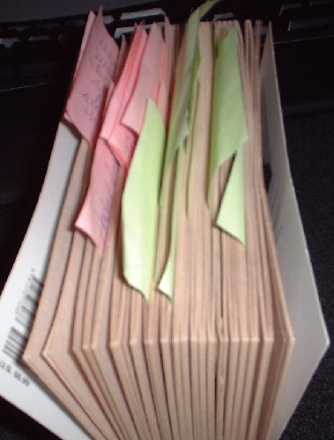
This is another book using smaller Post-its. The reason there are two different colors is because I ran out of pink. They’re not color-coded.

And here, you can see where I was taking notes on things I liked in the hero’s character (I chose to analyze this novel because, like my contemporary romance Happy Endings Inc., it has a hidden-identity as part of the plot) as well as breaking down the main storylines and conflicts. Also, notice the difference in my note here about his seeing something locked inside of her—that it works—as opposed to the first example. Part of the analysis process is figuring out why it would work in one book and not another.
Critical Reading: An Introduction
Well, I said I was going to wait until after NaNo to start this new series . . . but NaNo is NoNo for me right now—as in, I have the hugest case of writer’s block I’ve ever experienced, so I had to work on something over the weekend, and guess what? You’re getting the new series a few weeks early.
One of my critique partners asked if I could do a series on how to break apart a novel, or, in other words, read critically, so that we can apply what others are doing to our own writing. This is something I had to learn how to do in grad school. As an English major, it was a natural step for me to apply the critical analysis we learned to do in literature classes to popular fiction. But the next step was figuring out how to use it to improve my own writing.
Why is critical reading something I should do?
How many times have you heard agents/editors on panels at conferences say that the best piece of advice they can give to aspiring writers is “read, read, read”? You think, I do read all the time, and I’m still no closer to being published. Well, that’s because you probably aren’t reading critically. It’s more than just reading a book and saying, “I liked it,” or “I didn’t like it.” It’s about probing into the whys and hows. Once you learn to analyze your reactions to what you’re reading, you’ll begin to understand the principles of writing better than you ever have before.
Is critical reading different from critiquing?
Yes. Critiquing is reading with the view in mind of helping another writer make their writing better. Critical reading is reading to figure out the mechanics behind a whole work—not just a few chapters at a time—and to try to see it from a more academic viewpoint. What makes it work? What is it about this particular story/writing that would lead to its being published?
So, all I have to learn are a few steps and I’ll be a critical reader?
It’s not quite that easy. There is no one right way to be a critical reader—but there is a wrong way. The wrong way is to approach it with the attitude that you’re going to rip the story apart and find all of the bad parts and show why it should never have been published and yours should be. Yes, you may end up feeling that way afterward, but don’t start out with a chip on your shoulder. Be positive and open minded—this is an opportunity not only to learn from a published author, but to try to figure out what it is about the book and their writing style that works.
What kind of novel should I choose?
I highly recommend choosing a novel published in the genre in which you write, by a publisher you’re targeting. By choosing your own genre, you’re picking what you’re already most familiar with—you won’t be trying to figure out if the author is sticking to the conventions of what’s expected in a certain genre, you’ll know and be able to judge better whether or not it works. By choosing books published by the house(s) you’re targeting, you’ll start getting a better feel for the kinds of things they’re looking for as you analyze more and more books.
This sounds suspiciously like high school English class.
What you learned in high school when it came to evaluating classic literature will come in quite handy in this exercise. You’re going to want to brush up on literary elements such as theme, symbolism, and rhetorical devices.
A few tips and tricks.
–Go ahead and buy the book. While this can be done with a library book, you’re really going to want to have it to refer to in the future.
–Don’t be afraid to write in the book. As John Keating said in Dead Poets’ Society: “It’s not the Bible; you’re not going to hell for this.” Highlight, underline, write.
–If you get caught up in reading and forget to analyze, that’s great! Do your analysis on a second read-through.
–Be brutally honest. This is for you not for a review you’ll be distributing publicly. If you want to write GAG! over a really cheesy dialogue exchange, do it. Don’t filter or censor your gut reaction to what you’re reading. The whole purpose of critical reading is to have that reaction—and then figure out why.
Supplies to have on-hand.
–Post-it Notes. At least 3×3 or larger, lined are great. If you want to go so far as to color-code your notes, get a few different colors depending on just how OCD/AR you want to be with this project.
–Colored pens/pencils. Again—depending on just how in depth you want to get with color-coding, you can survive with one pen or you may want several different colors. I know Margie Lawson teaches a color-coding method of analyzing writing, so if you’re comfortable with that, go for it.
–Highlighters. Same thing as with colored pens: one or several colors.
–Legal pad or single-subject spiral notebook for writing down information on things like characters or setting, for writing questions, for writing your theories of what direction the story is moving in, writing down words you’re not familiar with, etc.
What kinds of things should I be marking?
I’ll be getting into the specific details to look for, but here are some general suggestions:
–Highlight words/phrases you like, good showing/action, great dynamic verbs, good/unusual word choices, character descriptions you like, setting descriptions you like, well-written passages, good things that stand out to you.
–Use the pen to underline pet-peeve phrases (for me, it was/there were are major culprits), incorrect grammar/poorly written passages, passive language that could easily be fixed with an active verb, overuse of certain words (as, was, -ing verbs, -ly adverbs), telling, backstory, repeating information already revealed/rehashing events, anything that just really bugs you.
–When you react to something—positively or negatively—write your reaction on a Post-it Note and affix it to that page (LOL, great description, stilted/unrealistic dialogue, GAG!).
–If you read something that makes you think of a scenario of how the conflict/story might turn out, write it on a Post-it and stick it to that page, or write it in the notebook.
–If something you read sparks an idea for your own work (without plagarizing what you’re reading), write it down immediately and examine what you’ve learned or what emotional reaction you had to what you’re reading that made you think of it.
–Most importantly, don’t forget reading is supposed to be fun. I’ve decided I’m going to start reading critically again, but only if I read a book for fun in between each novel I analyze. Don’t let critical reading rob you of the joy of losing yourself in a good book.
Fun Friday–Pep Talks
You got a little taste of this week’s topic last week . . . because this week, I’m highlighting great “going into battle” speeches from movies. Now, I will give this caveat: I don’t watch a lot of “war” movies—i.e., World War II, John Wayne, Allies and Nazis, etc. But I do watch a lot of movies that have battle sequences in them and a lot of them have wonderful pep-talk speeches in them. So, be ready to be inspired . . .
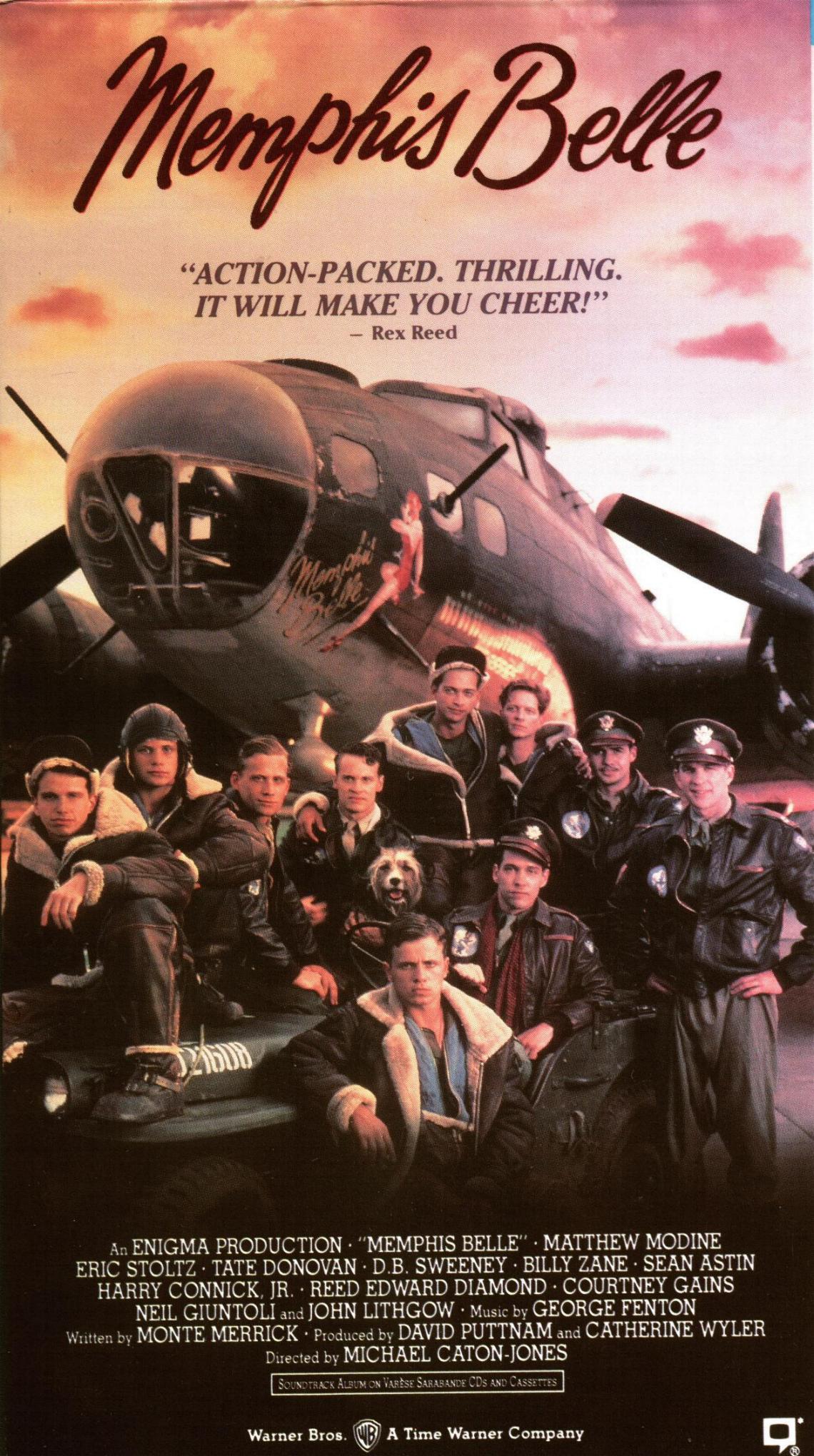
Memphis Belle. The crew of the flying fortress Memphis Belle is on their twenty-fifth and final bombing mission, sent to bomb a factory in Germany. They’ve already aborted the drop once, because of a smoke screen. They’ve watched other planes around them go down, when their captain decides to take one more run at the target:
Everybody listen. I know you want to drop the bombs and get the hell out of here. But there’s civilians down there, there’s a school right next door and if we don’t get these bombs right in the pickle barrel, a lot of innocent people are going to be killed. . . . I don’t want to go around again any more than you do. But we were sent here to bomb a factory and if we don’t do it, somebody’s going to have to come back here again and do it for us. . . . Nobody promised us it would be fun and games. It’s our job. Ours, nobody else’s. . . . If we do it right, it’s something we can be proud of our whole lives. That’s all I want, believe me.
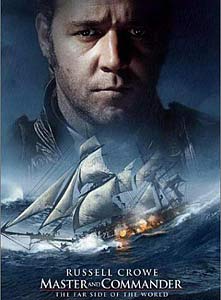
Master & Commander. The important thing to know about this pre-battle speech is that the name of Jack’s ship is Surprise.
Right, lads. I know there’s not a faint heart among you, and I know you’re as anxious as I am to get into close action. But we must bring him right up beside us before we spring this trap. That will test our nerve. And discipline will count just as much as courage. . . .
They mean to take us as a prize. And we are worth more to them undamaged. Their greed will be their downfall.
England is under threat of invasion. And though we be on the far side of the world, this ship is our home. This ship is England. So it’s every hand to his rope or gun. Quick’s the word and sharp’s the action. After all, Surprise is on our side.
Glory. This isn’t your typical pre-battle speech, but it’s stirring and moving just the same:
King Arthur. He doesn’t give one long pep-talk speech, but several shorter ones and a great prayer:
Oh, merciful God, I have such need of Your mercy now. Not for myself, but for my knights, for this is truly their hour of need. Deliver them from their trials ahead and I will pay You a thousandfold with any sacrifice You ask of me. And if in Your wisdom, You should determine that sacrifice must be my life for theirs, so that they can once again taste the freedom that has so long been denied to them, I will gladly make that covenant. My death will have a purpose. I ask no more than that.
……….
You be my friend now and do not dissuade me. Seize the freedom you have earned and live it for the both of us. I cannot follow you, Lancelot. I know now that all the blood I have shed, all the lives I have taken have led me to this moment. . . .
……….
How many times in battle have we snatched victory from the jaws of defeat? Outnumbered, outflanked, but still we triumph? With you at my side, we can do so again. Lancelot, we are knights. What other purpose do we serve if not for such a cause?
……….
Knights! The gift of freedom is yours by right. But the home we seek resides not in some distant land, it’s in us, and in our actions on this day! If this be our destiny, then so be it. But let history remember, that as free men, we chose to make it so.
Henry V. There are two great battlefield speeches in this play/movie:
The first is Act III, Scene i:
Once more unto the breach, dear friends, once more;
Or close the wall up with our English dead!
In peace there’s nothing so becomes a man
As modest stillness and humility:
But when the blast of war blows in our ears,
Then imitate the action of the tiger;
Stiffen the sinews, summon up the blood,
Disguise fair nature with hard-favour’d rage . . .
I see you stand like greyhounds in the slips,
Straining upon the start. The game’s afoot:
Follow your spirit; and, upon this charge
Cry ‘God for Harry! England and Saint George!’
The second is from Act IV, Scene iii:
Gesundheit!
Sometimes, there’s nothing like a good sneeze . . .
Making Himself Heard: Paul Potts
There’s nothing better than someone who has developed his talent and chases his dream.
Anyone who knows me knows that I absolutely hate shows like American Idol and America’s (or Britain’s) Got Talent—not because they’re about people chasing their dreams, but because of the way they’re judged, ridiculed, and criticized in a demeaning manner.
But this is an exception to that. Watch these videos and see if you aren’t inspired to chase your dream . . .
The Audition:
The Semi-Finals:
The Finale:
The Winner Is Announced:
Here’s the fansite for Paul Potts: http://www.paulpottsopera.org/
And here’s his first CD.
More You Know You’re a Writer If . . .
More signs that you’re afflicted with the condition known as WRITER:
–You are more anxious about your mailman showing up an hour late than your kids.
–The “sermon notes” section of the Sunday morning bulletin comes home every week filled in with ideas or scenes for your WIP.
–The only magazine quiz you regularly fill out is the vocabulary quiz in The Writer—and you score at least 18/20 every time and cut it out to hang on your fridge.
–Your idea of a vacation is going somewhere like Denver, Houston, Dallas, or Minneapolis to attend a writer’s conference, and you never leave the hotel.
–You have a hard time explaining what you “do.”
–You–hold on, I have to check my e-mail . . .
–You do everything you can think of to procrastinate from writing, then turn the light on in the middle of the night and furtively write a few hundred words because you feel guilty for not writing.
–You can predict the next line or conflict in just about every TV show/movie you watch.
–You don’t meet “new friends”; you meet “potential characters.”
–You stay in bed ten minutes after you wake up structuring the details of your dream into a novel synopsis, complete with character descriptions, setting, and costumes.
–You’ve ever had to replace your bathroom flooring because you decided you could get a few thoughts written down while waiting for the bathtub to fill.
–You have a cup or canister filled with pens and pencils in every room of the house—and yet you can never find a pen when you really need one. You also put the dry pens back in the cup, simply because it seems like a waste to throw away a perfectly good pen casing—one of these days, you might actually buy some refills.
–Your non-writing friends/family don’t like going to the movies with you, because you don’t walk out saying, “Yeah, that was good,” you walk out saying, “If I’d written that, I would have . . .”
–You spend more on “writing stuff” every year than you do on groceries and gas combined.
–You text-message yourself while out and about so you won’t forget a great name, a piece of dialogue, or a story idea you saw/heard while you were out.
–Conversations with friends start to include the question, “You’re not going to use that in your book, are you?”
–You think Paul Bettany’s portrayal of Chaucer in A Knight’s Tale is one of the most brilliant characters ever put on film . . . and you often quote several of his lines:
- Chaucer: I’m a writer.
Wat: A what?
Chaucer: A wha–a what? A writer. I write, with parchment, and ink. Geoffrey Chaucer’s the name, writing’s the game. You’ve read my book? the Book of the Duchess? No? Well, it was allegorical.
Roland: Well, we won’t hold that against you, that’s for every man to decide for himself.
……….
Chaucer: I will eviscerate you in fiction. Every pimple, every character flaw. I was naked for a day; you will be naked for eternity.
……….
Will: You lied . . .
Chaucer: Yes . . . yes I lied. I’m a writer, I give the truth scope!
–In a group discussion/debate, you can can always see the other person’s point of view—literally. You’re composing their internal dialogue, visceral and emotional reactions while they talk.
–You’re never bored, because your characters are always there to entertain you.
More “You Know You’re a Writer If . . .” Posts:
You Know You’re a Writer If . . .
Even MORE You Know You’re a Writer If . . .
You Know You’re A Writer If, Extended Edition
National Novel Writing Month

If you’re a writer, you have to have been hiding under a rock not to know that November is National Novel Writing Month. While I still don’t understand the thought process behind choosing a month that not only contains a major holiday, but is the lead-up to the biggest time-gobbling holiday of the year, I am all for a month where tens of thousands of writers come together with a single purpose: to write as much as we possibly can in one month’s time.
The stated goal of NaNoWriMo is for the participant to write a 50,000 word “novel” between November 1 and November 30. Local area groups have “write-ins” where people meet up at a local coffee shop and bring their laptops and sit and write for hours. There are kickoff parties, midway parties, and wrap-up parties. The NaNo site has forums for discussion on all topics of writing—from the basics to genre-related concerns. There’s also the networking capability of hooking up with “buddies” through their site so that we can each check each other’s progress, send messages, etc. (although most of my buddies are fellow ACFW or MTCW members, and it’s easier for us to communicate directly). It’s like a month-long, long-distance writing conference.
My goal this year is to get my small-town fiction novel, Peace in the Valley, finished. I have about 50,000 words to go, so it’s the right length for what everyone else is working on. Unfortunately, I didn’t meet my previous goal of finishing revisions on Ransome’s Honor by October 31. I took Friday and Monday off work this weekend, which was supposed to be for forging ahead and getting several chapters of PitV written . . . but turned out to be the time I needed to get RH finished (which I’m very pleased to say I did, though it needs one more round of revisions to truly meet my vision of the final story).
So, I officially started NaNo yesterday–I wrote 1,464 words, after spending most of the day re-reading the original eight chapters and doing some background work on characters and setting. If I am to have this book finished by Thanksgiving (my original goal), I will need to write 3,333 words per day between now and Tuesday, November 20th (because I’m driving to Arkansas the 21st and will not have time to write the rest of the holiday weekend). This is doable for me. It’ll mean lots more time spent writing than I’ve been committing to it recently, but I can do it. And I need to. This taking two or three years to get a manuscript finished is for the birds. My first three manuscripts, I churned out in nine, seven, and four months respectively—and that was when I was working full time and taking nine hours of undergrad courses every semester.
I never thought I’d say this: thank goodness for the screenwriters’ strike. That means more reruns and less temptation to watch TV in the evenings (though most of my “must see” shows are those that stockpiled episodes). I’ve mentioned before how I work best with schedules and deadlines, so starting today, I’m putting myself back on a strict schedule in the evenings to make sure that I’m not procrastinating on either writing or going to the gym to workout . . . which will be even more important than ever if I’m going to be trying to get that much writing done. I cooked a lot this weekend—huge pot of soup, a pork roast (2-3 lb. Boston butt, all surfaces sprinkled with Tony Chachere’s Creole seasoning; place in baking dish with one onion cut into large pieces and one cup of water; bake in a 350-degree oven for about two-and-a-half or three hours–yummy!), and a few other things that will be easy to pull out and warm up in the microwave over the next couple of weeks.
All of that is to say that I will not be starting a new blog series until after Thanksgiving, as I need to concentrate on writing. I will be posting every day—so don’t leave me!—just no series.


