Fall Break–More Medieval Stuff
I took Friday and Monday off work to try to get kick-started on my NaNo manuscript, Peace in the Valley. So far, I’ve managed to complete the second draft revisions on Ransome’s Honor and am trying to get myself motivated to work on Peace by re-reading the eight existing chapters. So, rather than try to come up with a new topic today, I thought I’d upload the paper I mentioned in which I explored the effect of the Norman Conquest on the English language.
Erica suggested I do a blog series on how to be a critical reader—in other words, how to break down a published book to learn from what the writer did. So look for that series to start soon.
It has just started raining, it’s starting to get dark already (yes, at 3:30 in the afternoon–it’ll be fully dark by about 4:45/5:00 this afternoon), and I’m feeling the need for some Earl Grey, hot. So, if you’re interested in English history (both the people and the language), please enjoy . . . and if you’re a professor, please forgive the obvious MLA formatting errors—this was one of the first research papers I wrote upon returning to college as an adult learner.
From the Conqueror to the Bruce: Impact of the Norman Invasion
Fun Friday–Favorite Medieval Movies

The sword fights. The romance. The chivalry. The armor. The war horses. The men in tights . . .
Yep, I’m talking about Medieval Movies! This past weekend, I pulled out an old favorite to watch, which got me thinking about all of the movies I love that are set during “medieval” times. I put it in quotes because some of them are actually more from the baroque/renaissance eras (and, okay, two are actually from the 17th century)—but I think you get my drift.
One of my favorite undergrad literature courses I took was Medieval Literature. It’s more than just Beowulf and King Arthur, though there are a lot of great stories written about King Arthur and his knights. Another favorite course was History of the English Language, where I did a research project on the impact of the Norman conquest of England in 1066 on the English language—all the way up through the reign of Robert the Bruce in Scotland, including the origins of the Robin Hood tales. Then there were the plays we read/saw in the Shakespeare class that were set during the Middle Ages. And of course, all of the medieval-set romance novels I read in my teens and twenties when that was the most popular setting for historicals. Basically what I’m saying is: I love stories about those times.
So without further ado . . . (click on the movie title for an image collage)
10. Tristan + Isolde. This movie would be much higher on my list if the romance didn’t center around an extra-marital relationship. The absolute best part of this movie is Rufus Sewell’s portrayal of Marke, the British overlord. It’s worth watching over and over and over just for him!
9. The Adventures of Robin Hood (1938). What medieval movie montage would be complete without a Robin Hood film? And no one buckles swashes like Errol Flynn. I like this movie so much that when my computer starts up, there’s no “Windows” chime—it’s a sound clip of Mr. Flynn’s line, “Welcome to Sherwood, my lady” from this film! Sure, Robin’s and the Merry Men’s costumes are the most clichéd ever, but that just makes it more fun. And Olivia deHavilland is absolutely gorgeous as Maid Marian. If it were a movie instead of a TV show, I would have listed the newest version of the story, the BBC’s current Robin Hood series, starring Jonas Armstrong as Robin, Lucy Griffiths as Marian, the incomparably funny Keith Allen as the Sheriff of Nottingham, and the divinely dark and brooding Richard Armitage as Sir Guy of Gisborne.
8. The Three Musketeers (1993). Charlie Sheen and Kiefer Sutherland followed up their success in a boy-band-like version of the story of Billy the Kid (1988’s Young Guns) with a comedic and campy version of The Three Musketeers, which probably had Alexandre Dumas spinning in his grave. Sanitized by Disney, Charlie Sheen (my ultimate heartthrob in the late 80s/early 90s) played the religious romantic Aramis, with Kiefer Sutherland as the brooding Athos, Oliver Platt as a portly and quite funny Porthos, and Chris O’Donnell as d’Artagnan—whose role was not center-stage as in other productions of this story. Point of interest: Paul McGann, one of my all-time favorite actors, played two different characters in this film: Girard, the dandy who was chasing d’Artagnan for ruining his sister’s reputation, and Jussac, one of the soldiers the musketeers fight at the ruins near the beginning of the movie. Rebecca deMornay does a turn as the sinister woman scorned, and Tim Curry is absolutely delightful as the villain, Cardinal Richelieu.
7. The Man in the Iron Mask. Though taking a more serious turn than the Disney version of the early part of the story, this movie is a great follow-up to #8 . . . not to mention the star-power of the actors replacing our Gen-Xers above: Jeremy Irons (Aramis), John Malkovich (Athos), Gerard Depardieu (Porthos), and Gabriel Byrne (d’Artagnan). While I’m no fan of Leonardo diCaprio, he did a great job in this movie, playing the double roles of Louis and Philippe. The costumes are divine, as is the acting from all of the main players. (And Jeremy Irons looks pretty good in this movie . . . for an old guy!)
6. Braveheart. Despite all of its glaring historical innacuracies, this is a fun movie to watch . . . though a bit on the longish side. In the days before Mel Gibson totally lost his mind, he and Randall Wallace had a lot of fun making a pseudo-biographical film about Scottish hero Sir William Wallace and the role he played in the rebellion against England that led to Scotland’s independence and the ascention of Robert the Bruce to the throne. (Historcial sidebar: Robert the Bruce was descended from both the native Celts and the Norman conquerors.) I adore Angus MacFadyen as Robert the Bruce—especially given the emotional journey his character makes throughout the film.
5. King Arthur. My only problem with this movie was the casting of Keira Knightley as Guinevere. Of course, I pretty much have a problem with any movie she’s cast in, as she can’t act. But that’s beside the point. Clive Owen was a ravishing Arthur, or Arturus. Ioan Gruffudd was a bit comical trying to be dark and brooding as Lancelot, but that’s okay, because it gained him some great exposure as an actor. The rest of the knights are some of the most underappreciated actors working today. Setting it in the late Roman period and making Arthur a Roman soldier, the knights conscripts from Sarmatia, was an interesting twist to the story. It was also interesting that they didn’t include the love affair between Guinevere and Lancelot. There is also a lot of talk about faith in this movie, which was nice.
4. A Knight’s Tale. If Chaucer were alive in the 21st century, what kinds of stories would he be writing? All hail to A Knight’s Tale for bringing us a campy, fun, hysterical movie that at once pays homage to the medieval pasttimes of tournaments and chivalry while also making fun of them. This may be Paul Bettany’s best role to date, as Chaucer—the writer who gives “the truth scope.” Oh, and look—it’s another medieval featuring Rufus Sewell, this time portraying the villain, which he does with aplomb. The major flaw of this movie is the ill-concieved romance storyline. Neither the character nor the actress playing Will’s love interest is at all likeable, which makes that part of the film fall flat. But that’s easily ignored for all of the other wonderful parts of the movie.
3. Henry V. Kenneth Branagh was only twenty-eight years old when he adapted, directed, and starred in this version of Shakespeare’s play about the English king, Henry V. Incorporating some of Shakespeare’s best dramatic battlefield dialogue (“Once more unto the breach, dear friends, once more; or close the wall up with our English dead!” and the St. Crispin’s Day speech), Branagh assembled a veritable who’s-who of British film and stage actors. And the score by Patrick Doyle (who also appears in the film) is delicious. (Film trivia: many of the costumes used in this film were originally made for the 1944 Laurence Olivier version.)
2. Ever After. This is the only movie I’ve ever liked Drew Barrymore in (as an adult actress, anyway). This is one of the best versions of the Cinderella story ever, made even better by the casting of Dougray Scott as Prince Charming, and the genius twist of Leonardo daVinci becoming the “fairy godmother.”
1. Ladyhawke. Since this is the film that got me onto this train of thought, it’s only fitting that it’s the top entry. I fell in love with this movie the first time I saw it as a teenager. Typically, if I heard “Matthew Broderick in a medieval-fantasy movie,” I would laugh and pass on by. But with the gravitas brought to the roles of Navarre and Isabeau by Rutger Hauer and Michelle Pfeifer, Matthew Broderick’s character (Mouse) brings a much-needed comic relief to the story. Though the music has not aged well, this is a classic for the ages. (Note: the music in this video is not music from the movie.)
Plot or Plod: Wrap-up
As a follow-up to my post on plot twists yesterday, today, there’s a wonderful article up on Novel Journey by one of my former crit partners, Cindy Woodsmall, where she breaks down what could have been cliche about her Amish novel and shows how she added twists in her plot to make it unique.
Obviously, I haven’t been able to cover every single aspect of plotting here. But I hope that I’ve given everyone enough food for thought to carry you into NaNoWriMo, which starts today. I’m going to try to keep up with my word count there, but will also be keeping up with it on my Writing Update page here.

So what are my last few words on plot?
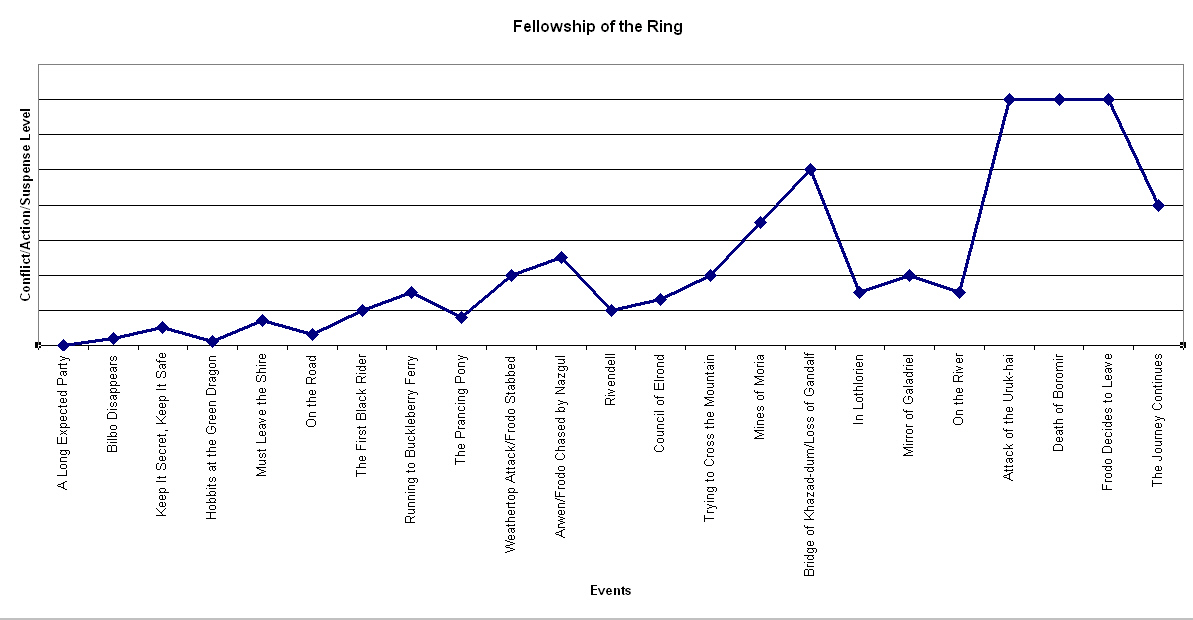
Study your favorite books/movies and try to create a plot-line graph for them. Read the how-to books, but study the masters. Concentrate more on how your favorite authors created their plots. Look for the structure and twists in your favorite novels/movies.
If you feel like your plot has stalled out and your writing is going nowhere, take a step back. Instead of trying to write through it, spend some time just toying with your characters. Throw everything you can think of at your characters. Are your hero’s reactions coming across as cliche or stereotyped? Stop thinking of him as your hero. What would he do if he were the bad-guy? What if, instead of trying to save the world for good, pure motives, he were a mercinary only out to make a dollar (or a few million)? Put him in a Daniel Webster–type situation. How would your hero react if someone (a “devil”?) came to him and offered him everything he could possibly dream of, if only he compromised on one little thing? Or, put him in Job’s situation: take everything away from him . . . and then put him in physical pain. Would that change him?
Check and re-check your characters’ goals and internal motivations. Are the goals both specific and universal enough? Will the reader care if the character achieves the goal (universal), and will the reader understand why the goal is important to the character (specific)?
Is there enough/too much conflict? Do you have enough lulls/quiet times to give the reader a break, but not so many that they put the book down and forget to come back to it because there isn’t enough tension? Do you end each chapter with a hook? I don’t mean a cliffhanger, but just a hint of what’s to come so that the reader wants to turn the page to the next chapter and keep reading. Is there too much conflict? Is it becoming melodramatic because you keep pouring conflict down onto the characters at every turn?
Is there movement in your story? No matter if it’s a physical or emotional journey, something must move from Point A to Point Z (or even Point M). And, even if it’s a physical journey, the character must undergo an internal change—must learn something, become a better person, fall in love, forgive someone, or learn something important about him/herself. No one wants to read about perfect characters (no need for change) or stunted characters (can’t/don’t change).
Do all of your plot points connect with the characters’ goals and motivations? Does everything that happens to the characters have an effect on the outcome of the story? Does each plot point lead up to creating the climax? Is there anything you’ve thrown at your characters that, while it may be interesting, doesn’t really have anything to do with the actual direction/climax of the story?
But the absolute most important question I can ask by way of wrap-up is: ARE YOU ACTUALLY WRITING? If you don’t apply tush to seat and fingers to keyboard (or pen to paper), it doesn’t really matter if you have the most amazing plot in the world. Because no one’s ever going to see it. That’s how people who’ve written what to us seem like mediocre stories get published. Because people who’ve thought up amazing plots, great characters, and conflicts no one’s ever seen before aren’t actually writing!
So, think about these questions, but don’t dwell on them. Just go write!
Plot or Plod Part 7: The Plot Twist
Hopefully every writer is familiar with the literary device known as Checkov’s Gun. Author/Playwright Anton Checkov wrote: “If you say in the first chapter that there is a rifle hanging on the wall, in the second or third chapter it absolutely must go off. If it’s not going to be fired, it shouldn’t be hanging there.” This is a technique also known as foreshadowing. Sometimes it’s as obvious as the gun hanging on the wall, sometimes the reader isn’t aware the hints are there until they get to the twist at the end.
Every writer needs to watch the movie The Sixth Sense. If you’ve never seen it, get it on DVD and watch it straight through. If you’ve seen it and have never watched the “Rules and Clues” featurette, this is a must-see for anyone who wants to write stories that have some kind of twist at the end.
In The Sixth Sense, writer/director M. Night Shyamalan did the near-impossible: he created a story that has such a surprise twist ending that he had to make the behind-the-scenes featurette to show exactly how he did it. The clues are all there, meticulously thought out and planted—from the clothes Malcolm is wearing to the temperature to the color red. Because he was dealing with the supernatural, he created rules and stuck to those boundaries. It was so subtly and masterfully done that when the twist was revealed, the audience didn’t feel cheated, didn’t feel like Shyamalan pulled that little trick out of thin air. Subconsciously, we were seeing the clues and understanding the rules, even though we didn’t realize it.
J.K. Rowling was great at dropping important pieces of information into her stories in such a way that they didn’t seem important—until the twist came or the object was needed at the end of the book, or even later in the series. For example, the invisibility cloak Harry receives in Book 1 that becomes an integral part of the plot of Book 7, or the “throw-away” mention of a locket being tossed aside when they’re cleaning up headquarters at the beginning of Book 5, which also becomes important in Book 7.
If you’re planning a surprise twist in your plot, you don’t want your markers to be as obvious as Checkov’s Gun. You want to hint, to suggest, to make things seem unimportant at the time by having lots of other things going on (as well as planting red-herrings). But you also don’t want to bury your markers so deeply or make them so obscure that the reader cannot find them even after they’ve read the ending.
Shyamalan used the color red as a marker that something supernatural was about to happen. Once you know this clue, it’s really easy to see on a second viewing—the big red-brick schoolhouse, Cole’s red sweater, a red balloon, Malcolm’s red doorknob.
Think about some of your favorite books or movies that have twist or surprise endings. How did the writer/filmmaker plant clues throughout so that they’re there when you know what you’re looking for, but didn’t give away the twist the first time? Old-fashioned mystery movies/shows/books are great for this—because in the climax scene, when the murderer is revealed, they sit there and go through all of the clues for you, because they were subtle enough you probably missed them. The Marple series that Masterpiece Theater/Mystery! did, based on Agatha Christie’s Miss Marple books, are wonderful for studying this kind of subliminal clue-dropping.
You want your readers to go back and say, “I can’t believe I missed that!” You don’t want them to say, “Yep, I knew it from the first page when I saw the gun hanging on the wall.”
Plot or Plod Part 6: Answering Some Plot Questions
Can a book have more than one plot?
Yes. This is more than just adding a subplot to your main plot—this is what is typically called crossing genres. This is where new genres come from, for example Romantic Suspense (“Love Story” plot + “Mystery-to-Answer” or “Thwart the Destruction . . .” plot). It’s taking elements from more than one master plot to structure your story.
But how do you know if something is a plot or a subplot?
General rule of thumb is that if something is a subplot, you could cut it out completely and it would not unravel your story. It might flatten it, might diminish its effectiveness, but you’d still have a story there. If it’s a mixed-plot or cross-genre story, such as a romantic suspense, removing either the romance element or the suspense element completely unhinges the plot.
How do I make sure I’m not shortchanging one of the plot elements?
This is where the writer’s left-brain needs to kick in. If you enjoy graphs like the ones I did in the first couple of posts in this series, chart your plotlines. Use a different color for each one so that you can see where it is in each chapter of your book. If you have a chapter that’s all suspense and not a lot of romance, the suspense line would spike while the romance line would stay relatively flat. (And Erica, I can already hear you asking me to give an example of this. I can—but it may take some time.) Or you can do this with your scene cards/storyboards. Color code them according to whether they’re romance or suspense or both so that you can see if you’ve got too much of one or the other, or if there aren’t enough scenes where you have both going on.
Is it a good idea to mix plots or make up my own genre?
Mixing plots/crossing genres is one of the ways that you can make your book stand out from the rest of the manuscripts on the slush pile. Creating your own niche, your own genre, could be just the edge you need in the extremely competitive publishing industry. Everywhere you go—editors’/publishers’/agents’ blogs, conferences, etc.—everyone says that the Chick Lit genre is dead. (I personally thought it was D.O.A., but that’s just me.) But smart Chick Lit writers have taken their passion for the genre and added twists—instead of single, socialite New Yorkers looking for a sugar daddy, we get demon-fighting suburban-mom chicks (Carpe Demon), Asian-American chicks (Sushi for One?), missionary chicks (Everything’s Coming Up Josey), and Regency chicks (All the Tea in China). Granted, most of these are not mixed plot, but I hope you’re catching my point. Taking a tried-and-true plot and adding a twist to it is one of the best ways to get noticed—and to start building your brand.
Are there any plots that are over-done? that editors won’t look at?
Look at the books on your shelves and pick out about ten in the same genre. I’ll choose romance, because that’s what I have the most of. Do all of them follow the standard romance storyline (they meet, they fall in love, they’re torn apart, something climactic brings them back together, they live happily ever after)? For mine, yes. So why do I have ten books when they all have the same plot? Because while they may all have the same basic plot structure, each author has crafted her own take on that structure to create a unique plot. Dee Henderson’s O’Malley Series romances are different from Catherine Palmer’s Finder’s Keepers which is different from Susie Warren’s Deep Haven trilogy which are totally different from Linda Windsor’s Along Came Jones. Dee Henderson gives us a whodunnit/suspense plot to go along with the romances. She also adds the twist to the plot that each of the main characters is involved in some kind of law enforcement or rescue profession. Catherine Palmer’s Finders Keepers has as one of its twists that the heroine has a young son whom she adopted from Romania, and another twist that the hero must discover secrets about his family’s past and his own heritage. Susie Warren’s Deep Haven series focuses on a small resort town in Minnesota—and each of the three books has a different twist to the story, whether it’s the opening of a small bookstore, a celebrity hiding his identity, or the hero hiding his mentally challenged brother from the heroine. And in Along Came Jones, the heroine has gotten caught up in a situation not of her choosing which necessitates her hiding out at the hero’s ranch in Montana—also a situation not of her choosing.
Plots that are overdone in the CBA (again, speaking Romance genre here) are: Pastor falls in love with Church Member; prairie romance where one or both of the characters lose a spouse and must marry/join their families to make a go of it—and then fall in love with each other; the Cinderella story—rich man falls in love with poor girl and takes her away from all her troubles; down-on-his-luck aristocrat must marry for money, chooses good Christian girl who “saves” him as he falls in love with her; anything where the main source of conflict between the hero and heroine is that one of them is not a Christian (“salvation romances”).
Aren’t Plot and Genre really the same thing?
Not really. Knowing what genre you want to write in can help you by giving you a basic structure for your plot (with the exception of genres such as literary or women’s fiction, which could really go anywhere) and with how to market it afterward. But genre is just the foundation. Your plot encompasses the unique characters, conflicts, setting, and ebb-and-flow of your story. Let the genre be your guide, your compass, but don’t let it hem you in or constrict you in any way. If someone asked me, “What’s the plot of your story?” I wouldn’t answer, “It’s a romance novel.” I would say, “It’s a romance in which the wedding-planner heroine fears she’s falling in love with a client, only to discover he isn’t really who he says he is.”
What are some other questions you have about plot?
Plot or Plod Part 5: Themes and Master Plots
Last Thursday, we discussed raising the stakes to keep our plots alive and moving forward. But a couple of you raised the question of how much conflict can we throw at our characters before it becomes melodramatic. To summarize the answers I gave there (check them out in the comments), You have to throw enough conflict at your character to make the reader fear the character will not reach his or her ultimate goal, but not so much that it’s realistically or logically insurmountable.
If, in the climax of the story, you have to give your character a new ability (whether natural or supernatural–example: the tone-deaf heroine must sing for the king or face losing her head; when she stands up before him and opens her mouth, she suddenly has a miraculously beautiful singing voice when she has never had anything supernatural happen to her before then), have a new charater (the cavalry, literally or figuratively) swoop in out of the blue to save the character, have the villain suddenly and inexplicably relent, or solve a crisis off stage because even you have no idea how the character will get out of it, you’ve either thrown too much or the wrong kind of conflict at your character.
As I explained in the post Conflict: Thematic vs. Actual, you need to know what the thematic conflict of your story is. Thematic conflicts include:
Man vs. Man (or Man vs. Woman in a romance)
Man vs. Himself
Man vs. Nature
Man vs. Society
Man vs. God
(see this Wikipedia article for definitions)
All of these are vague, lofty ideas, on par with defining what genre you’re writing. They don’t actually define the plot of your novel.
Depending on what article you read or what book you buy, there are anywhere from six to fifty master fiction plots. In addition to knowing your thematic conflict, you should know what your master plot is. Many popular fiction genres lend themselves toward certain master plots, but you will find that some of the best genre fiction writers use master plots not usually seen in their genre to take their stories to the next level. (Don Maass would call these people “breakout” novelists.) Here are eight master plots I came up with:
1. The PHYSICAL JOURNEY plot. The character must get from point A to point Z. Prime example: Lord of the Rings. Frodo must get from The Shire to Mount Doom to destroy the ring. Everything that happens to him along the way, all of the conflicts he encounters, happens because he must complete this journey.
2. The FIGURATIVE JOURNEY plot. If graphed, this plotline would look much like the physical journey plot. But this is a journey that takes place internally. “Coming of Age” novels are the best example of this type of plot. It’s less about what is happening on the outside and more about the change that is taking place internally for the character. Literary fiction many times will fall into this category.
3. The PROBLEM-to-SOLUTION plot. The character is presented with a problem at the beginng that must be solved. This can be a writer who has writer’s block (think of the movie Stranger than Fiction), an artist who has broken both hands and can’t paint, a visitor is stranded in a strange land (planet) and must figure out how to communicate with the locals to survive.
4. The MYSTERY-to-ANSWER (or QUESTION-to-ANSWER) plot. This is one of the plots that is very closely tied to a genre. When someone says they’re writing a mystery novel, they don’t really need to define the plot of it, do they? But this plot has a broader scope than just Murder, She Wrote or Law & Order. This is the baby left on the doorstep story—the characters must find out who left the baby there. This is the amnesiac trying to figure out who he or she is.
5. The DOWNWARD SPIRAL/DESTRUCTIVE plot. This is the plot we find in many short stories, including “The Yellow Wallpaper” by Charlotte Perkins Gilman. This is where the character goes from a place of sanity/normalcy through a cycle of depression or self-destructiveness. Like the Figurative Journey, this deals more with what’s going on inside, but it moves in the opposite direction.
6. The LOVE STORY plot. Yes, this is the plotline most closely related to the romance genre. It goes deeper than just two characters falling in love. There is an expectation of what will happen in a love story: boy and girl meet, fall in love, are ripped apart, something climactic happens to bring the back together, boy and girl live happily ever after. However, not every love story plot necessarily follows this expectation. A prime example is the movie Roman Holiday, in which the hero and heroine don’t get together at the end. (Sorry if I’ve just ruined that for anyone.)
7. The BATTLE-to-VICTORY plot. Seen in historicals, action, SciFi, and many other genres. These are stories that center around war, or that use physical conflict as the main focus of the story. This is Michael Shaara’s The Killer Angels, Star Wars, Glory, or Behind Enemy Lines. The climax of the plot comes in the heat of battle, the resolution comes with the victory and the peace enjoyed afterward (no matter how short-lived).
8. The THWART THE DESTRUCTION OF THE WORLD plot. This could actually be considered a Battle-to-Victory plot, but it takes it to a grander scale. This is the ultimate Good Guy vs. Bad Guy matchup. This is James Bond versus Dr. No. Harry Potter versus Voldemort. Jean Luc Picard versus the Borg. Homeland Security Agent versus the Terrorists. The country/world/planet is about to be destroyed and the hero must stop it from happening.
What are some other basic plots you can think of? Does your story fit into one of these? Have you incorporated more than one of these into your story? (HeeHee . . . topic for tomorrow . . .)
Fun Friday–Gone but Not Forgotten
Maybe it’s the fatalist in me, but whenever the new TV season starts, I’m leery of getting too attached to new shows because I’m pretty certain that if it turns out to be a show I really love, it’ll probably be cancelled—sometimes as soon as eight shows into the season, sometimes after one or two seasons. (I’m really hoping ABC’s new show Pushing Daisies is one that makes it.) There have been some that I loved that lasted years, though, and many of those are now either in constant reruns on TV Land or Nikelodeon. But there are some that were hardly given a chance—and those are the ones I decided to honor today: TV shows I loved that were on three or fewer seasons. Oh, and I found a great archive of TV shows, listed by the year they premiered: epguides.com
(Series summaries are from IMDb.com)
Square Pegs (1982-1983)

Welcome to Weemawee High School, where being in the right clique can make one’s years in school memorable. Enter Patty Greene and Lauren Hutchinson, two freshman who tried hard to be accepted into these cliques. The only problem was they stood out like sore thumbs. Patty was brainy and wore glasses, and Lauren was overweight and had braces. Thankfully, two other “square pegs” accepted them. They came in the form of aspiring comedian Marshall Blechtman and New Wave rocker Johnny Ulasewicz (aka Johnny Slash). Still, Lauren and Patty wanted to be in with the cool kids who came in the form of Jennifer DeNuccio, a wanna-be Valley Girl; LaDonna Fredericks, the hippest black girl in Weemawee High; Jennifer’s boyfriend Vinnie Pasetta, a John Travolta carbon copy; and Muffy Tepperman, a Jewish princess who joined anything from JV pep squad to science fair organizer. Starring Sarah Jessica Parker, Tracy Nelson, and Jami Gertz
Riptide (1984-1986)

Three Vietnam veterans now work as private eyes in sunny southern California. Nick and Cody are the muscles and Murray is a computer wizard of the trio and together they solve even the hardest cases. Starring Perry King, Joe Penny, and Thom Bray
Outlaws (1986)
(This show was so short-lived that there aren’t even any images to be found online!) Sometime during the 19th century, Sheriff Grail was chasing a gang of bank robbers when they were all accidentally thrown forward in time to the year 1986. Realizing they need to work together to survive (and perhaps to find a way home), the good guy and the bad guys team up to open their own private-detective agency to fight crime. Maggie was their neighbor and police contact. Ensemble cast featuring Rod Taylor, Richard Roundtree, and Charles Napier.
Starman (1986-1987)

A TV series sequel to the theatrical released film Starman. In the series, the alien returns to find and assist the child he fathered 14 years before on his visit to Earth. When he arrives, he takes on the identity of Paul Forrester, a prize-winning free-lance photographer with a rather wild reputation killed in a helicopter accident. He finds the child (Scott Hayden) and his mother (Jenny) have been separated. Paul convinces Scott to help him to locate Jenny, his friend from his first visit to Earth. Unfortunately, their search is plagued by George Fox, a paranoid government agent who feels Paul and Scott are dangerous and wants to capture, examine, and probably kill them. Starring Robert Hays and Erin Gray
The Young Riders (1989-1992)

Set just before the American Civil War, this series presented a highly fictionalized account of the heyday of the Pony Express. Its focus was a group of young Express riders based at the waystation in Sweetwater, Kansas. Running the station was ex-Texas Ranger and all-around eccentric Teaspoon Hunter. The role of cook, housekeeper and mother hen was filled first by Emma and later by Rachel. The riders included the future “Buffalo Bill” Cody and James Butler (“Wild Bill”) Hickok, as well as Ike, a mute, Buck, a half-White/half-Kiowa scout and the Kid, a quiet Southerner. Their final member was Lou, a young woman who lived and worked with the riders disguised as a boy. In second season, their group was joined by Noah Dixon. Ensemble cast featuring among others Josh Brolin and Stephen Baldwin
Time Trax (1993-1994)

Darien Lambert, Captain of the Fugitive Retrieval Section in the 22nd century, time-travels to the 20th century to capture 22nd century criminals who have escaped by time-traveling. He is armed with a PPT, a 3-button weapon that can render a man unconscious or send a man to the 22nd century. He has a computer named Selma, disguised as a credit card. Selma helps him to capture the fugitives, for she has access to various databases, and can make logical conclusions. She has also many other functions. The main criminal is Mo Sahmbi, who invented the time machine (TRAX) and helped the criminals to get away. Lambert cannot go to the 22nd century until he has captured all the fugitives. Starring Dale Midkiff and Elizabeth Alexander
The Cape (1996-1997)

Drama about astronauts and candidates at the Kennedy Space Center. Filmed on location, it had NASA’s cooperation (and former astronaut Buzz Aldrin as a technical advisor). Ensemble cast featuring Adam Baldwin and Corbin Bernsen
The Magnificent Seven (1998-2000)

In a time of outlaws, seven young heroes, each with unique talents and abilities, band together to help tame the wild west and protect the citizens of a small frontier town. Ensemble cast featuring Eric Close, Michael Biehn, and Dale Midkiff
UC: Undercover (2001-2002)

A complex action-thriller which focused on the secret lives and private demons of an elite Justice Department crime-fighting unit that confronted the country’s deadliest, most untouchable lawbreakers by going undercover to bust them. As a federal team, the group responded to emergencies all over the country — taking down elite bank robbers, drug kingpins, domestic terrorists, spies, jewel thieves and dirty cops. Starring ODED FEHR (and some other people)
Firefly (2002-2003)

In the distant future, Captain Malcolm ‘Mal’ Reynolds is a renegade former war rebel now turned smuggler/rogue who is the commander of a small spacecraft. With a loyal hand-picked crew and a couple of fugitives, they travel the far reaches of space in search of food, money, and anything to live off on.
Ensemble Cast featuring Adam Baldwin and Nathan Fillion
Plot or Plod Part 4: Raise Those Stakes!
So your characters are in place. You’ve made connections between character development and plot. You know where your story is going.
Great. Now raise the stakes.
Huh? What does that mean?
“Raising the stakes” for our characters is something we writers see and hear over and over and over in writing books, in online classes, and at conferences. But what does it actually mean when it comes to writing?
Have you ever had one of those days (or weeks or months or years)? One of those days where it feels like everything has gone wrong and there’s no way your day could possibly get worse? The car didn’t start this morning. It took the tow truck two hours to come. Your boss yelled at you when you got to work for being late (even though you called). The daycare center called—your kid just threw up on their new carpet and you have to go get them right now. But the rental car company hasn’t come to pick you up yet. Your husband calls from his business trip on the other side of the country to say his boss has asked him to stay two more days because the deal isn’t going as planned. Older kid’s school calls—kid got into a fight and is being suspended. Mom calls from two hundred miles away: she’s taking your dad to the hospital because they think he might be having a heart attack. The auto shop calls to give you an estimate to fix your car and it’s over $2,000—which is more than you have in your checking account at the moment. And it’s not even lunch time yet!
Each one of these CONFLICTS increases the stakes for the character. (And no, you would not want to throw this level of conflict at your character all in one day. This is what people read fiction to get away from.) The reason they increase the stakes is not inherent in and of the conflicts themselves, but because each conflict builds upon the one that came before it—getting the call from your mother that your dad may be having a heart attack and they’re two hundred miles away is bad. But with no car, dealing with issues with both kids, a husband who’s out of town, and facing a bill you’re not going to be able to pay, the situation with the parents is twenty times worse than it would be if that were the only thing going wrong.
Remember Murphy’s Law: whatever can go wrong will go wrong.
Donald Maass, in the Writing the Breakout Novel Workbook explains “the essence” of raising the stakes as “making things worse, showing us that there is more to lose, promising even bigger disasters that will happen if the hero doesn’t make matters come out okay.” This can be on a global scale (think of all of the villains bent on world destruction that James Bond defeated) or it can be on an individual scale (will Maria stay at the abbey or will she return and declare her love for Captain von Trapp?).
In Stein on Writing, Sol Stein writes that “the essence of plotting [is] putting the protagonist’s desire and the antagonist’s desire into sharp conflict. . . . One way to plan is to think of what would most thwart your protagonist’s want then give the power to thwart that want to the antagonist.”
What is the main conflict for each of your main characters? How can you make the problem worse? For a great example of this, follow Frodo’s journey from the Shire to Mount Doom. Every time something happens to him, we think that nothing else worse could happen, but it always does.
Is there another character (whether good or bad) in your story that has the ability to keep your main character from achieving his or her goal? If the character must be somewhere at a certain time to stave off worldwide disaster, how many things can you think of to stop the character from getting there on time?
A great example of a movie (miniseries, really) that raises the stakes and develops conflicts like nothing else I’ve ever seen is The 10th Kingdom. The simple premise is that two modern New Yorkers (played by John Larroquette and Kimberly Williams-Paisley) find themselves transported into the land of the Nine Kingdoms—fairy-tale land! They must find the magic mirror that transported them to this fantasy world to get back to New York. When the story finally ends seven hours later, you feel like you’ve run a marathon—because these poor characters have been put through the ringer.
Do you back off of conflicts in your story? Do you pull punches? Do you try to make things easier for your characters? Do you resolve arguments off stage?
STOP THAT RIGHT NOW!
What’s the worst thing that happens to your character in your current work in progress? Your assignment is to think of a way to make it even more horrible. Raise those stakes!
Have you ever considered any situation in which your character might not reach his or her goal? Put them in that situation and see what happens. Raise those stakes!
And just think about this. When you’re watching a movie, and one of the characters says something along the lines of, “Things can’t get any worse.” What is our immediate reaction? “Yeah, right. Oh, look, things just got worse.” The stakes were just raised.
So go out there and raise the stakes—make things worse—for your characters and see if that doesn’t add a totally new spin to your plot.
Plot or Plod Part 3: . . . and ACTION!
“Plot does not magically appear with the creation of character; Frankenstein’s monster might open his eyes, but until he gets up from the table and does something, there is little basis for a plot.” (Noah Lukeman, The Plot Thickens)
Yesterday, I talked about connections—that what happens in the course of events of the story needs to be connected to characters, to everything else that’s going on. That plot isn’t just the “how” of what happened, it’s also the “why.”
Lukeman spends the first two chapters of his book on plot discussing deep character development. Once you know your characters’ internal and external conflicts that make up who they are, he posits, then you are ready to begin your story.
And story begins with narration.
Hopefully, by the time you start writing your story, you know who your point of view characters are going to be. Yes, from time to time, another voice may pop up and demand to have a viewpoint in the story—this happened to me in Ransome’s Honor with William’s younger sister . . . whose appearance as a POV character not only rounded out some of what was happening in that story, but whose story became the plot for the second book of the trilogy.
But I digress . . . According to Lukeman, there are three jobs that the point of view characters play in driving the narrative of the story:
1. The POV character is the avatar through which the reader experiences the events of the story. The reader needs to know what’s happening, how events are unfolding. The POV character provides this information by experiencing the events.
2. The POV character also creates a certain perception of the events for the reader. The character’s internal conflicts, spiritual beliefs, upbringing, ethnicity, socio-economic status—everything about them—adds a certain twist, a certain perspective of what’s actually happening. Or, as Obi Wan Kenobi would call it, the truth “from a certain point of view.” The reader is to see everything the way the character would see and experience it. Narrative is subjective, not objective. If the character views the world through rose colored glasses, the world should appear to the reader as a very friendly, lovely, rosy place. Everything the POV character interacts with should be observed, judged, measured by the POV character’s own internal standards. If she thinks the hero is handsome—even though her friend points out he’s somewhat overweight, has a receding hairline, crooked teeth, and a big nose, the reader should see him how the POV character sees him: through the eyes of love, not reality.
3. The POV characters must be involved in what’s happening in the story. They cannot just be bystanders, observers. They must have a part in what’s going on. Gone are the days of objective narrators telling a story (think Moby Dick). This is what I wrote about yesterday—plot is making the connection between character and story.
In Plot, Ansen Dibell gives a simple question to ask of our story: “Is it going somewhere?” Is the story you have come up with something that has dynamic—in other words, something that moves? “Has it got an engine, or could you put one into it?” Dibell writes. “You could attach a motor to a tree, but it wouldn’t go very far.”
Does the action of your story, of your characters, have a motor? Is it going somewhere? Let me point you back to Part 1 of this series with the graphs I showed. Have you ever graphed your plot to see if it’s actually moving along? Does each event of your story build upon what came before, out of consequences of your characters’ actions? Or is it just a series of mostly unrelated events?
A plot graph doesn’t have to be a straight/diagonal line. It can be a spiral, such as the short story “The Yellow Wallpaper” by Charlotte Perkins Gilman, which follows the main character as she spirals inward into depression/mental illness. But whether it’s an EKG chart or a spiral, it still has to have action—it has to move.
Is your plot moving? If not, can you put a motor in it and have the characters do something to jump start it? Sometimes, writing scenes that you know will never appear in your finished manuscript may be just the catalyst you need to figure out where the story is going, where the action really is, and then jump right into the middle of it.
Plot or Plod Part 2: Making Connections
One of the most important lessons to learn about plot is that it is different from narrating a sequence of events—it is connecting the events together with emotion and meaning. E. M. Forster explained it best. “The king died, and then the queen died is a story. The king died, and then queen died of grief is a plot.” Why is the second plot? Because there is now a cause-and-effect that gives meaning to the queen’s death. Plotting a story is more than just cataloguing the events that happen. It is connecting all of the events with the characters’ internal conflicts and with the other events in the story.
This is one of the main reasons why the experts I quoted in the first Plot or Plod post all point to character as a main focus of plotting. The characters are where the connections come from.
Even for SOTP writers, when we begin to develop a story idea, we typically know the general direction our stories are going. I recently had the opportunity to talk plotting with award-winning CBA author Tamera Alexander. She admitted to being mostly a Pantster (a seat-of-the-pants writer) but did say that, even though she doesn’t plot the whole story out, she always knows what her ending scene will be. The story is what happens between the opening and closing scene. Plotting is how we make all of those story events tie together and, ultimately, make sense.
Just as with character development, when developing your plot, you want to constantly be asking “why?” Why would she make that decision? Why would she go there? Why would she think she would be able to get away from the bad guy by running UPstairs? Why is the bad guy a bad guy? Why is the hero going to the place where he is going to have a humorous run-in with the heroine?
I recently posted a question on my Facebook page about why shows like LOST and Heroes are so addictive. Someone said it’s because of the soap-opera-like serial storytelling—each show builds upon the last. Someone else mentioned it’s the ensemble cast of characters. I think it’s actually both. Without a cast of characters that we fall in love with, the continuing story wouldn’t be of interest. One of the most fun things about LOST is the flashbacks where they reveal that most of our survivors have crossed paths in the three to five years leading up to boarding flight 815—or at least bumped into each other in Sydney or at the airport before they got on the plane. Instead of connecting them in their backstories, Heroes has made connections by slowly bringing all of the heroes together. Their paths cross now and again throughout the first season until they all come together in the finale, where Peter can absorb their powers and defeat Sylar (or so it seems). The plot hinges on the characters, on the decisions they make, on their emotional/visceral reactions to the conflicts they face, on the reason why they do the things they do.
Star Trek liked to play with the chain-reaction concept. In the Star Trek universe, they used the premise that each decision the characters made actually created an alternative universe where they’d made the opposite decision. Occasionally a character would cross over into an alternate universe where one person making one decision differently created a totally different reality—usually where all of the good guys are now bad guys. In an episode of the Original Series, they visited a planet that was basically a doppleganger of Earth . . . except it was an Earth where the Roman Empire never fell, which made it completely different than the Earth we know.
Plotting is about chain reactions. If your character makes a decision, there have to be consequences—for good or bad. Things can’t just happen in your story. Unlike in life, the events that your characters experience must have meaning, must connect with something else going on in the story. Otherwise, you’re leading your reader down a bunch of rabbit trails, but actually going nowhere.
This is one of the problems I’ve experienced in reading the Lord of the Rings books. Tolkien was so immersed in his world that he wanted to include all of the history, all of the lore, of the peoples who had been long-gone from Middle Earth in the narrative. There are long passages telling stories of characters like Beren and Luthien which, while they would be good stories in their own right, in reality have nothing to do with the forward progress of the plot of this story: trying to destroy the One Ring.
I’ve been busily working on the second draft of Ransome’s Honor (I’ve completed revisions through chapter 23—or about 65,000 words), and one of the things I keep asking myself is: Does this dialogue / introspection / action / description / scene have an important impact on the plot? I’m combing through the narrative to make sure that everything my characters do connect somehow with the forward progress of the story. By doing this, I’ve managed to cut about a chapter and a half—and I know that once my crit partners get a hold of it, I’ll be able to cut even more, especially once I get all of the new conflicts/events of the last third squared away.
Again, going back to the experts and their comments on characters. It’s all well and good to be constantly throwing conflict at your characters—in fact, it’s great. Don’t pull punches. Just make sure that the conflicts connect the characters to the plot, that there is a reason, a purpose, for the conflict to exist. And don’t forget to ask why.