The Inspirational Element–Guest Columnist Rachel Hauck
Today, I’m pleased to feature a guest column by chick-lit and contemporary-romance author Rachel Hauck!
 Thanks to Kaye for inviting me to participate in this discussion of inspirational elements in fiction. I’ve known Kaye for a long time and am so happy for her publishing success!
All writers approach the inspirational element differently. My publisher produces novels from a Christian worldview, meaning it’s assumed Christian values and principles are accepted—that God and salvation through Jesus is a given. However, that doesn’t mean I’m bound to any particular way of writing. The inspirational theme, in my mind, must be true to the story and character.
I develop the spiritual theme after the story. It feels more generic to me that way. Some times I change once the story gets going.
In Sweet Caroline, (Thomas Nelson, Feb 2008) my heroine Caroline started out a Christian. But as I wrote the story, I decided her journey to Jesus had to come as part of the plot. So, in the beginning, she does not know Jesus.
To avoid sounding preachy, I don’t think authors should start with a strong spiritual position or theme. Don’t bring your soap box to the story. Agent Chip MacGreagor calls it, “agenda fiction.”
 In Diva NashVegas, my heroine grew up in a Christian home, but fell away from faith after her parents were killed. When the book opens, she’s a country superstar living with her boyfriend.
While I am not a proponent of premarital sex, I felt for this story Aubrey James would not be virginal. Her moral and spiritual compass is whacked based on her life experience.
However, she does return to Jesus and break up with her boyfriend.
Sometimes as Christian authors, we try to show characters how they should live not how people actually do. So, we write about characters who don’t lie or cheat, have sex outside marriage or steal. But Christians make these mistakes all the time.
What we need to show is our characters being convicted and changing.
I like to show how God engages us in different ways. He’s a supernatural God, creative and unique.
 Caroline encounters God when she visits a church one Sunday and out of the blue, the pastor calls out her name and says “Jesus loves you.”
Later in the story, Caroline wakes up in the middle of the night with a heavy fragrance in the room. She realizes God is visiting her and has a profound since of awe and holiness. She surrenders her life to Jesus in that moment.
A story’s inspirational theme should be an extension of the author. The author should be an extension of the Great Author, Jesus.
I pray for my characters. I do. If I’m found in Christ, as the Bible says, and my characters are found in me, then my characters are found in Christ. I pray to know what God wants to communicate through the mouth and actions of my characters.
 As an author in CBA (Christian Booksellers Association,) I’m trying to boost my spiritual themes however. Not to preach, but because most CBA readers appreciate a strong spiritual theme.
At first, I wrote with a more subdued theme thinking I wanted my books to appeal to non Christian readers as well as Christian. But, my books are shelved in the Christian fiction section, sold at Christian book stores. Customers are expecting a certain theme and message. While they don’t want a sermon, they want to be encouraged and exhorted spiritually.
So, I changed from trying to be stealth, to being bold with a spiritual theme. However, it still must be true to the character and the story.
For aspiring authors in Christian fiction, I encourage them to develop a deep personal relationship with Jesus. He’s the one we want resonating through our stories, not religious traditions and our personal soap boxes.
Write inspirational elements familiar to you. I’m familiar and comfortable with the supernatural so I can write about it  with sincerity.
And spiritual themes go beyond salvation. There’s hope, faith, love, forgiveness, giving, or hospitality. As lovers of Jesus, we should all be familiar with aspects of His personality that we can write about in our characters.
Be an author who is a Christian. Not a Christian author. Know that the fragrance of God is on you, therefore on the words you write whether you mention God or Jesus.
Write a true story. All the pieces will fall into place.
~~~~~~~~~~
 Rachel Hauck writes about life, love, and faith. She lives in Florida with her youth-pastor hustand, Tony, applying the truth of her stories to everyday life . . . and getting it right. Rachel has published nine titles including Lambert’s Pride, Lambert’s Code, and Lambert’s Peace for HeartSong Presents and her groundbreaking “redneck” chick lit novels Georgia on Her Mind, Lost in NashVegas, and Diva NashVegas. Her latest release is Sweet Caroline, set in the Carolina low-country.
2008 Reading Goals Update

I thought I would take a quick moment to update my Reading Goals one month into 2008. I actually have three that I’ve completed (all ABA) and written reviews for on Good Reads.
CBA Fiction
1. Lady of Milkweed Manor by Julie Klassen—Purchased 2/9/08
2. Sisters, Ink (Scrapbooker’s Series #1) by Rebeca Seitz—Purchased 2/9/08
3. Sweet Caroline by Rachel Hauck
4. My Name Is Russell Fink by Michael Snyder
5. Faking Grace by Tamara Leigh
6. For Better or For Worse by Diann Hunt—Began reading 2/9/08
I also purchased Linda Windsor’s Wedding Bell Blues on 2/9/08
ABA Fiction
1. Finish reading the Lord of the Rings trilogy. Finished FOTR before Christmas. Finished TTT in Jan. ’08. Currently reading ROTK.
2. The Darkest Evening of the Year by Dean Koontz—Read my review here
3. Fire Study (Study, Book 3) by Maria V. Snyder (book releases March 1; I preordered in Oct.)
4. To Catch A Pirate by Jade Parker (YA)
5. Last One In by Nicholas Kulish Shadow Music by Julie Garwood—Finished reading it 2/7/08. Read my review here.
6. The Bourne Identity by Robert Ludlum
Non-Fiction—have not started on any of these yet.
1. Stealing Fire from the Gods: The Complete Guide to Story for Writers and Filmmakers by James Bonnet
2. Emotional Structure: Creating the Story Beneath the Plot by Peter Dunne
3. Jane Austen on Film and Television: A Critical Study of the Adaptations by Sue Parrill
4. Teaching Creative Writing, Graeme Harper (Ed.)
5. Jane Austen and the Interplay of Character by Ivor Morris
6. The Midnight Disease: The Drive to Write, Writer’s Block, and the Creative Brain by Alice Weaver Flaherty
Fun Friday–Pride & Prejudice (Part 1)


It is a truth universally acknowledged that a single man, in possession of a good fortune, must be in want of a wife.
Uh . . . do I really need to explain this one? 🙂
The arrival of two handsome and eligible bachelors, Mr. Bingley (Crispin Bonham Carter) and Mr. Darcy (Colin Firth), stirs romantic imaginings for the girls of the Bennet household. Jane Bennet (Susannah Harker) seemingly strikes an immediate connection, while Elizabeth Bennet (Jennifer Ehle) finds the path to love more tortuous. Just when it seems true and abiding matches might emerge, a family scandal threatens to ruin everything. (From the PBS Masterpiece Classics website)
If you’ve never read the book nor seen a film adaptation of it (or even if you’ve seen just the 2005 version with Matthew MacFadyen as Darcy), you’re in for a treat. Originally released in 1995, the version of Pride & Prejudice which airs in three installments over the next three Sundays marked a turning point in how A&E and the BBC put classic literature on film. (I hope that recent adaptations of Austen’s novels—especially Persuasion and Mansfield Park don’t mark another turning point!) The screenplay was adapted by Andrew Davies and includes so much of the original dialogue from the film that it’s a pleasure for someone who loves the book to just listen to it. But it’s a visual feast as well. The costumes, the sets, the locations . . . this isn’t your old amateur-theater-caught-on-film BBC production!
Now, let me talk about the elephant in the room. I can always tell someone who came to Pride & Prejudice because of this miniseries. Know how I can tell? They think Colin Firth is the be-all and end-all romantic hero and the Mr. Darcy none will ever compare to. I know I’m probably about to offend about 99.999% of all P&P lovers, but Colin Firth is not my favorite Mr. Darcy. He does a good job in the role, helped out tremendously by Andrew Davies’s fabulous script and Jane Austen’s incomparable storytelling/character development. But having read the book many times before the 1995 version aired the first time, as well has having seen the 1980 BBC/Masterpiece Theatre version starring David Rintoul many, many times before the 1995 version came out, Colin Firth doesn’t fit my visual image of Mr. Darcy.
Now that I’ve just lost most of my readers, if anyone else is still around, I thought it would be fun to look at the different actors/actresses in key roles over the years. I’ve narrowed it down to the three most well-known adaptations (1980, 1995, 2005) . . .
Miss Elizabeth Bennett. Age 21. Jane Austen’s most popular heroine. Spunky, sardonic, gives as good as she gets. Would walk three miles in the mud to check on her sick sister.
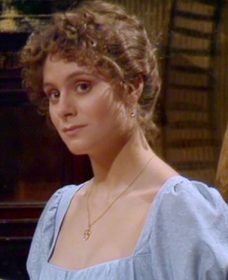
1980: Elizabeth Garvie did a creditable job in the role, though with better costuming, script, sets, direction, cinematography, and overall filmmaking quality in the 1995 version, it’s not her fault she suffers by comparison.

1995: Jennifer Ehle, my favorite Elizabeth though she was a few years too old for the role. She played the role with both the playful nature and the maturity Jane Austen described the character as possessing.

2005: Keira Knightley. Right age; horrid actress, hate looking at her, horrible posture, terrible figure for Regency gowns, awful hair, no charisma. Have I mentioned how much I hate watching the way her mouth moves when she talks?
Mr. Fitzwilliam Darcy, gentleman. Age 28. Inherited an enormous estate in Derbyshire from his father. Is worth a rumored 10,000 pounds/year (about 5–600,000 in today’s currency!). Described by Jane as being a “fine, tall person” with “handsome features [and] noble mien.”
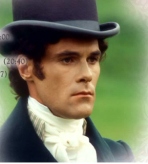
1980: David Rintoul, my favorite Mr. Darcy. Yes, he was stiff. But David Rintoul pulls off the stiffness while making it look like it’s because he’s uncomfortable in the situation, as the introverted Darcy would have been. And David Rintoul looks really good in the Regency-cut coats and trousers! (And someone agrees with me! Here’s a tribute video of David Rintoul as Mr. Darcy.)

1995: Colin Firth, everyone else’s favorite Darcy. For me, he’s too jowly and doughy-looking to fit my mental image of Mr. Darcy, developed, as I’ve already mentioned, for many years before Colin Firth was ever cast in this role.

2005: Matthew MacFadyen, who was about the correct age, and did a wonderful job with the limited script he had. As I’ve mentioned before, during the first proposal scene, even though I knew it was wrong and totally not in the book, I was hoping he was just going to go ahead and kiss Elizabeth!
Mr. Charles Bingley, up & comer. Age 22–24. Income, approximately 4,000/year (about 250,000).
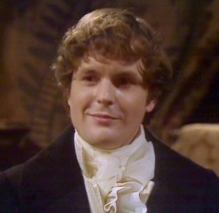
1980: Osmund Bullock brought a round-cheeked, boyish charm to the role. Not nearly as silly as Bingley would be portrayed in the next two.

1995: Crispin Bonham-Carter, third cousin of Helena Bonham-Carter (they admitted at the time to being slight acquaintences). He was an older, more mature Bingley, yet still slightly silly at times—usually allowing his sister to run roughshod over him, interrupt him, and not let him get a word in edgewise.
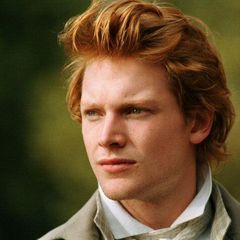
2005: Simon Woods, the first red-headed Bingley. Totally the comic character of this adaptation. He was cute and funny and quite charming.
Jane Bennett, Elizabeth’s older sister and best friend. Age 22. Quiet, reserved, always believes the best about everyone, even when presented facts to the contrary.
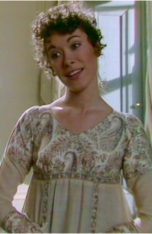
1980: Sabrina Franklyn, who embodied the character of Jane quite well. Again, limited by the script, sets, filmography.

1995: Bless Susannah Harker’s heart . . . Jane Bennet is supposed to be the most beautiful of all the sisters. I have no idea what the casting director was thinking when casting Susannah Harker as Jane. Because she is definitely not the prettiest of the five girls, in fact, she’s the least attractive.
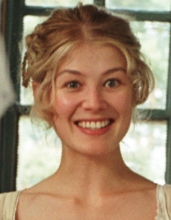
2005: Rosamund Pike, my favorite Jane Bennet. She was the prettiest, and though she was quiet and reserved, she also showed a good sense of humor. And the proposal scene with Bingley is priceless.
Your turn now. Who do you like? Who do you think was miscast? Which version is your favorite?
Update 9/3/10: I “re-cast” all of the major roles in P&P with actors/actresses who are, in 2010, the correct ages for these characters. See my picks here.
The Inspirational Element–Making it Believable
I have to admit, I’ve been a day ahead of myself all week . . . I almost started posting my Fun Friday topic! But I’m actually glad we have another day this week to explore the Inspirational Element topic. Next week, we’ll captstone the series with a guest column by Rachel Hauck and a wrap-up.
Georgiana posted an interesting comment on yesterday’s post:
God did create a huge diversity for us to enjoy, and yet sometimes I do feel the prickle of guilt for spending time on “secular” things.
This always reminds me of the verse that I had to memorize in junior high, at a small Christian school, when our Bible teacher was trying to convince us to never listen to secular music or watch movies or TV ever again:
Finally, brethren, whatever is true, whatever is honorable, whatever is right, whatever is pure, whatever is lovely, whatever is of good repute, if there is any excellence and if anything worthy of praise, dwell on these things. (Philippians 4:8, NAS*)
I think we, as the members of “the Church” have a tendency to give this verse a connotation I’m not sure was actually meant by Paul. Look at the four verses that come before it:
4 Rejoice in the Lord always; again I will say, rejoice!
5 Let your gentle spirit be known to all men. The Lord is near.
6 Be anxious for nothing, but in everything by prayer and supplication with thanksgiving let your requests be made known to God.
7 And the peace of God, which surpasses all comprehension, will guard your hearts and your minds in Christ Jesus.
(Philippians 4:4–7, NAS*)
Just before we’re told to “dwell” on that which is true, honorable, right, pure, lovely, of good repute, of any excellence, or worthy of praise, we’re told to rejoice, to show the gentle spirit God has given us, to be anxious for nothing, to pray openly . . . and if we do all of this, His peace will be with us and will guard our hearts and minds.
I think we have too much of a tendency to just look at verse 8 and interpret it to say that the only things that are “true . . . honorable . . . right . . . pure,” etc., are those things which “the Church” deems are “Christian” and therefore worthy of our time and attention and heaven forbid that we should find any kind of pleasure in that which isn’t sanctioned by whatever branch of “the Church” we attend—because we all know what’s “holy” differs from flavor to flavor even within “the Church” (for example, why it’s okay for Methodists and Episcopalians to dance but Baptists aren’t supposed to).
Certainly, there are so-called secular activities which we are better off avoiding—those things which we know will lead us into sin. This isn’t the same for everyone though. Some may need to choose not to see rated-R movies, while for others, it’s not a stumbling block. For some, listening to “secular” music may draw them further away from God, while for others, music has very little effect on them. And so on.
We are also exhorted:
Watch over your heart with all diligence,
For from it flow the springs of life. (Proverbs 4:23, NAS*)
and:
And do not be conformed to this world, but be transformed by the renewing of your mind, so that you may prove what the will of God is, that which is good and acceptable and perfect. (Romans 12:2, NAS*)
I think I’m in pretty good company when I say that we can do these things (guard our hearts, be transformed not conformed) even when participating in “secular” activities: reading ABA published books, writing books that don’t have an overt inspirational message, enjoying a movie or TV show, listening to music, viewing art, and so on. It all goes back to the filters, to the worldview, through which we see all of it. Not everything in the world is going to be edifying or useful for us as Christians, but I am totally against the idea that the only things we should find pleasure in are those that are labeled “Christian” or “Inspirational.” Even Jesus enjoyed a good dinner amongst sinners. 🙂
If you do not yet own it, there is one book I believe every Christian who is an author (whether writing fiction with an inspirational element or not) is Madeleine L’Engle’s Walking on Water. Not only does she spend quite a bit of time discussing what I’ve been trying to say in a round-about way—finding the Divine in the mundane—but it’s a great refreshment for the soul. I can pick it up, turn to a random page, and come away renewed and ready to write.
In the essay “Novelist and Believer,” short-story scribe Flannery O’Connor wrote “As a novelist, the major part of my task is to make everything, even an ultimate concern, as solid, as concrete, as specific as possible.”
As a Christian, a major part of this task is to make the inspirational element “as solid, as concrete, as specific as possible.” O’Connor believed, and I agree, that this doesn’t mean beating the reader over the head with the Four Spiritual Laws: “The problem of the novelist who wishes to write about a man’s encounter with his God is how he shall make the experience—which is both natural and supernatural—understandable, and credible, to his reader.”
I know of so many people who won’t pick up a “Christian” novel because they don’t want to be preached at. They want a good story. Yes, I do believe that God has appointed some books to have an overt Evangelical message and that these books have had an impact on people’s lives. But for the majority of “everyday Joe” readers, a much more subtle message may reach them even better. I have found myself in the past skipping over large sections of some “Christian” novels because the author turned into a preacher, and what they wrote doesn’t really move the novel along in any meaningful way, except to make one of the characters a Christian through a very standard and, usually, clichéd conversion scene. There have been others, though, that have so deftly woven the inspirational element into their stories that they’ve led me to tears as the character comes to salvation. The difference is believability—credibility.
“But the real novelist,” O’Connor wrote, “The one with an instinct for what he is about, knows that he cannot approach the infinite directly, that he must penetrate the natural human world as it is.” Or as Walker Percy wrote, “The trick of the novelist, as the Psalmist said, is to sing a new song, use new words . . .”
What’s been your experience in reading novels with an inspirational message when the message has overwhelmed the story so much as to make it unbelievable—where it became more about the message and no longer about the story? What books have you read where the author so deftly wove in the inspirational message that it moved you or made you wish you could write like that? What about books without an inspirational message—have they ever helped you come to a better understanding of your relationship with God or your view of the world? In what ways do you find the “Divine” in the secular world, and how do you apply that to your writing?
Scripture taken from the NEW AMERICAN STANDARD BIBLE®, Copyright © 1960, 1962, 1963, 1968, 1971, 1972, 1973, 1975, 1977, 1995 by The Lockman Foundation. Used by permission.
The Inspirational Element–Bringing Delight (or de-Light?)
“Reading with worldviews in mind—both one’s own and that projected by the text—allows Christians to engage works in their own terms, while also interacting with the theologically” (Dr. Gene Edward Veith, Jr., “Reading and Writing Worldviews”). My tagline as a writer is: Inspired by Life . . . Molded by God. That is to say that I get my story ideas from the things I see around me, but when I start putting them down on paper, the way it comes out is molded, shaped, influenced by my relationship with God. I have a Christian worldview, therefore my writing does too.
My characters view the world through a certain set of filters, because those are the filters through which I view the world. That is also the worldview that I take with me whenever I read anything. It is this worldview as a Christian that allows me to “engage constructively the whole range of human expression from a Christian perspective.”
But does that mean we have to evangelize? Do we have to “preach” to our readers? Not unless that’s the kind of fiction we’re called to write! In real life, some people are called to be preachers or evangelists and are given a heart for reaching the lost or those who’ve lost their way, while many others of us aren’t. You must listen to your heart as you start writing, be true to yourself when it comes to the inspirational element you include in your stories. As you read from Shelley Adina and MaryLu Tyndall right here on this very blog, there are as many ways to present the inspirational message of a story as there are writers to do it. But while we may be called to write fiction with a certain level of spirituality included in it, I believe our primary goal is to bring delight to our readers—while also representing the Light.
In his essay “‘Words of Delight’: A Hedonistic Defense of Literature,” Leland Ryken wrote, “Through the centuries, the hedonistic defense of literature has had to contend with a utilitarian or functional outlook that belittles anything that is not directly useful in mastering the physical demands of life.” How many times have you been made to feel guilty for reading a “popular fiction” novel? Does it seem frivolous to you sit sit down and read the latest romance or mystery novel from your favorite author? Have you ever been made to feel as if you’re doing something wrong by writing fiction, even if it is from a Christian worldview?
If God had wanted the world to be simply utilitarian, Ryken explained, He wouldn’t have created such diversity in the flora and fauna around us—in the colors of the rainbow, in the variety of trees in the forest. So many passages in the Bible—especially in the Psalms—express pleasure with the physical world around us that God created. He gave us creativity to entertain ourselves and others and to bring pleasure . . . to bring delight.
Pleasure in reading, of course, goes hand in hand with pleasure in writing. If I don’t enjoy writing something, no one is going to enjoy reading it. When I read something that I know the author enjoyed composing, I’m going to at least have vicarious enjoyment in that (especially if it’s someone I know well). Therefore, the pleasure I derive in writing my novels will translate into enjoyment for my (eventual) readers.
“Lifelong readers of literature can attest that many of the most powerful ideas in their lives are ones that they encountered first or most memorably in literature” (Ryken). There’s a line from the Meg Ryan/Tom Hanks movie You’ve Got Mail that describes me perfectly: “So much of what I see reminds me of something I read in a book.” As C.S. Lewis so aptly put it, literature becomes a window to the world. Ryken calls it “a mirror in which we see ourselves and our experiences.”
This is why I write! It’s my window to the world, the mirror in which I can examine myself and what’s happened in my life in a more objective way through creating characters. God gave us the ability to create to delight us and to delight others around us. Think about all of the different forms of art in the world: sculpture, paintings, music, drama, dance, poetry, fiction . . . God gave all of them to us for joy, for pleasure, and so that we could experience the delight of having the spark of His creativity living inside of us and becoming an outward expression so we can share that delight with others.
“Christians are the last people in the world who should feel guilty about the enjoyment of literature,” Ryken wrote.
Amen and amen!
In what ways do you find delight in what you choose to read? In what way do you find delight in what you write?
The Inspirational Element–Guest Columnist MaryLu Tyndall
Today, I’m pleased to feature a guest column by historical-romance author MaryLu Tyndall!
If you have read any of my novels, then you know that I always weave a strong spiritual theme within my plot.  This is not happenstance. It is my passion. It is why I write Christian Fiction. I believe every Christian writer has a ministry. For some is may be just to provide a clean story for other Christians to enjoy, for others it may be to reach non-believers with a very mild introduction of the gospel, or provide a positive alternative to the sometimes depressing smut you can find in the secular market. My passion, the desire of my heart, is to wake up Christians who have fallen asleep in their walk, those who are drifting from God, or even people who call themselves Christians but who are not. I want them to see God in a different light, to show that He is alive and powerful and loves them. Through my characters, they see Him working in flawed people’s lives, transforming them, using them for a higher purpose, and giving them the abundant life He promises.
That is why when I begin a story or a series, I always start with a spiritual theme. What is it about God I want to reveal to my readers and how can I best do that? Each of my books so far has been based on a different spiritual theme. In my first novel, The Redemption, the theme was the redemption of a young lady who had an abusive childhood and who was searching for love in a human father’s arms. In book two, The Reliance, the theme revolved around the question: What do we as believers do when God lets us down? In The Restitution, the main  theme was forsaking everything you hold dear to follow Christ. In a book I just completed, The Falcon and the Sparrow, the theme is strength in Christ through our weakness. The current series I’m working on follows the lives of three sisters who are examples of the three seeds in the parable of the sower in Matthew 13.
Once I have my spiritual theme, I create characters, typically a hero and a heroine, their friends and companions, and a villain, and then I decide how I’m going to reveal this theme in their lives and circumstances. I create spiritual arcs for most of the main characters. On a chart, I list under each character’s name where they are spiritually at the beginning of the book, then on the other side of the chart, I list where I want them to end up spiritually. In between, I write down my ideas on things that will happen to them that will cause them to change. Out of this chart comes my general plot and the three main disasters that will occur during the story, plus the interrelationships between the characters that will aid in their change.
Another thing I try to do in each story is include a supernatural miracle to demonstrate that God is just as powerful and involved with his creation today as He has always been. While many writers have a character-driven plot or goal-driven plot, I guess you could say I have a spiritual theme driven plot. The setting and time period are secondary and only add elements of adventure and romance to the story.
Each writer whom God calls to write will have a different way of writing and a different goal for their writing ministry. My books may be a turn-off for a non-believer who may feel they are too preachy, but someone else’s books may give the gospel message in such a subtle way that a non-believer might read it.  So, my advice to you? Write what God puts on your heart and don’t worry about those that say you are too preachy or you don’t have enough of a spiritual theme in your book. God has a place for your writing and He has already hand-picked certain people to read your books at a certain time in their lives.
Now about “edgy” books. My books are definitely edgy. They contain violence, drinking, taverns brawls, and very wicked villains. Sensitive subjects such as child abuse and rape are addressed, which some Christians may find objectionable. Naturally I don’t want to offend anyone, but I go back to my prior admonition. Write what God puts on your heart. My books aren’t for everybody, but let’s face it, it’s a cruel, wicked world out there and it’s only getting worse. We can stick our heads in the sand and pretend everything is rosy and only deal with issues that fit in with our Christian worldview or we can get out there in the trenches and tell people about Jesus. The people I hope to reach are not the committed strong Christians, but the Christians who are struggling with temptation, the Christians who think the world has more to offer than God. I want to show them that these things do not satisfy and there’s always a price to be paid, that God’s rules do not restrict them but set them free, that following the Lord is far more adventurous than they could ever imagine.
About the Author
 MaryLu Tyndall dreamt of pirates and sea-faring adventures during her childhood days on Florida’s Coast. She holds a degree in Math and worked as a software engineer for fifteen years before testing the waters as a writer. Her love of history and passion for story drew her to create the Legacy of the King’s Pirates Series. MaryLu now writes full time and makes her home with her husband, six children, and four cats on California’s coast, where her imagination still surges with the sea. Her passion is to write page-turning, romantic adventures that not only entertain but expose Christians to their full potential in Christ. Her next release will be an adventurous Regency coming out in August 2008. You can visit her on her website at http://www.mltyndall.com or her blog at http://crossandcutlass.blogspot.com/
The Inspirational Element–The Christian Imagination
I swear I didn’t plan to do this series to coincide with the Jane Austen series on PBS. But for the past two weeks, there have been elements of the stories/films that have lent themselves very well to the discussion of the Inspirational Element in fiction.
For those of you who saw Miss Austen Regrets this weekend, or who have read the review I posted yesterday, you are aware that there was quite a bit of discussion of the idea that Jane’s talent for writing was a gift given her by God. Though the movie shows her as having regrets over the proposals of marriage she turned down in her life—mostly because of outside forces making her feel she should have married to ensure financial security for her family—in the end, it has her coming to terms with her life, being content with the life she had because, as she told Cass, she chose freedom. Freedom to write, to put to use the gift God had given her. Did this mean she had to write Christian Fiction—that she must use her gift of writing to write Evangelical fiction? No, of course not. What it meant is that she was given the gift to use in the way God directed her, which in her case was writing Moral romances with just a touch of the Inspirational.
As Christians who write, we are each gifted differently and we are each called to write different types of stories—not just different genres, but with differing levels of Christian/Inspirational content in them. Look at an author like John Grisham. Though his books are gritty, for the most part, they fall under the category of Moral Fiction. His Christian faith has influenced all of his stories—and has begun to push from Moral into Christian Worldview in recent years. Does it mean that his first releases are “less worthy” than his more recent books because the recent stuff has a more obvious inspirational theme? Not at all. How many people who aren’t Christians who love Grisham’s early work will read his more inspirational novels and be influenced by them to find out more about God? Of course, that doesn’t mean that a Christian writer who starts out writing fiction without a spiritual thread must “graduate” to writing Inspirational or even Evangelical fiction. As Paul wrote in 1 Corinthians 12, we are each given different gifts by God because not everyone is called to do the same kind of work, though we are all called to be part of the same body in Christ. Some are called to write Evangelical fiction, some are called to write Christian Worldview fiction, some are called to write Inspirational fiction, and some are called to write Moral fiction. And woe be it unto us to say that one is better or more valuable/spiritual than another. “But God has combined the members of the body and has given greater honor to the parts that lacked it, so that there should be no division in the body, but that its parts should have equal concern for each other. If one part suffers, every part suffers with it; if one part is honored, every part rejoices with it.” (1 Corinthians 12:24b–26, NIV*)
One of my guiding inspirations for this series is the book The Christian Imagination: The Practice of Faith in Literature and Writing, a compilation of essays on the inclusion of the Christian faith in literature which we used in my undergrad literary criticism class.
In the essay after which the book takes its title, author Janine Langan writes about the importance for us as Christians to use our imaginations. We are created in the IMAGE of God, therefore we have been given the capacity for IMAGING Him. Because He is creative, He has given us IMAGINATIONS through which to create. A couple of important points she makes in her essay are:
- “The imagination is not its own end, just as art is not for art’s sake. It is an instrument of encounter, at the service of life—one’s own and that of others.”
“. . . we should help each other to notice beauty . . .”
“Nothing reveals more forcefully one’s true view of God than the quality of one’s imaginings.”
She points out how our culture, by our dependence on TV, movies, magazines, etc., for entertainment has squelched our imaginations. “Whether it wishes to or not, modern information technology tempts us to disconnect the products of our imagination—words, sounds, image—from any objective truth, from any personal responsibility, from any shared project.” Langan believes it is the imagination which draws us toward God and gives us the hunger to know more about Him. Contemporary “imaging” through the mass media/entertainment “no longer hint at the hidden joy, beyond imagining, which this world prefaces. They provide only the pleasure they promise.”
As I read this, I was once again faced with the question of why I write “Christian” fiction. Then I came to a realization: What I write is not “Christian.” What I write is the fruit of my being a Christian. Or to put it in Langan’s words, I write “to reflect faithfully the face of the Beloved.”
In the next essay, “Beauty and the Creative Impulse,” Luci Shaw writes that the act of writing is “an act of Redemption.” It is “bringing order and beauty out of disorder and chaos.” I’d never thought of it this way, but it’s very true. During the times when my (internal) life has been most chaotic—when I dropped out of college at age 21 because of depression, when I was working full time and taking 9 undergraduate hours per semester—was when I was most prolific with my writing. Writing brought me out of my depression fifteen years ago. Writing helped me cope with the stress of the succession of jobs I had and hated when I lived in the D.C. area afterward. Writing gave me focus and clarity when I was trying to figure out where I was supposed to go next and through my move to Nashville in 1996. And writing now helps me work through spiritual issues I may not even realize I’m having until it comes out on the page.
In this same way, Shaw wrote, “if an image shows up, often uninvited, unexpected, I am called to stop everything and pay attention.” Like many other authors before me and many to follow behind me, I have files filled with loose scraps of paper upon which are written words, phrases, names, ideas for plot or conflict . . . A “phrase will come to me, calling out, ‘Write me!’ And I can’t help but obey.” Isn’t it nice to know we’re not the only ones who experience that? 🙂
Shaw included in her essay a quote from author/teacher Henri Nouwen:
- “Most students…feel that they must first have something to say before they can put it down on paper. For them writing is little more than recording a preexisting thought. But . . . writing is a process in which we discover what lives in us. The writing itself reveals what is alive.” (italics mine)
Through writing, we discover “what lives in us.” When we are indwelled by the Holy Spirit, what comes out on paper cannot help but be affected by “what lives in us.”
Finally, Shaw wrote, “To write is to embark on a journey whose final destination we do not know. . . . Writing is like giving away the few loaves and fishes one has, in trust that they will multiply in the giving.” It is to this point that I have pursued publication—so that the gift God has given me may be blessed and multiplied as it goes out into the world. I have had to overcome the thought that I was somehow odd or wrong for indulging in writing and learn that it is “a gift of pure grace.” That the creative process “links us with our Creator.”
Tomorrow, we’ll learn from MaryLu Tyndall about her experience with how her writing links her with the Creator.
*Scripture taken from the HOLY BIBLE, NEW INTERNATIONAL VERSION®. Copyright © 1973, 1978, 1984 International Bible Society. Used by permission of Zondervan. All rights reserved.
Miss Austen Regrets
Let me see if I can collect my emotions enough to write coherently!
Stunningly poignant. That’s my review. None of the concerns I mentioned in Friday’s post came to fruition (just goes to show that you can’t judge a movie by its preview), and I connected with this movie and with the portrayal of Jane on a deeper level than I imagined possible.
This film was strangely personal for me. There were so many times when I found myself in tears just from what people were saying to Jane about the way her writing affected those who read it . . . especially the conversation with the French maid–that God had given Jane the dual gifts of singleness and writing romances to give hopes and dreams to women who’d lost theirs. And all I could think was, If God is using this film to try to tell me He’s given me that gift, I’ll never be worthy of it.
Even now, several minutes after the movie has ended, I still have tears streaming down my cheeks, trying to process the meaning of the talent, the genius, the solitude of the author I admire so much. Trying to understand if, through the brilliant dialogue—especially at the end—if I, like Jane, am meant to forego romance in my own life to give that part of my time and attention solely over to my writing.
This sounds silly and sentimental, I know, that I’ve been affected so deeply by a movie. But it’s definitely given me a lot to think and pray and soul-search about.
Oh, but one little critique: once again, the filmmakers have included characters dancing a waltz, this time in 1814. While the waltz was introduced in London in 1812, it was widely considered vulgar and scandalous—especially in the country and amongst the clergy—until post-Regency (after 1820). Here is a quote from a book reviewed in the Edinburgh Magazine dated 1818:
‘I do not mean to say that I consider all young ladies who waltz as devoid of modesty, delicacy, or proper feeling; but I feel that I should wish my sister, or my mistress, or my wife, to have a sort of untaught aversion to the familiarity which waltzing induces. I would have her prize too highly, from self-respect, the sort of favour which a woman confers on a man with whom she waltzes, to be willing to bestow it on any one of her acquaintance. I would wish her to preserve her person unprofaned by a clasping arm, but that of privileged affection. For indeed, dear Miss Musgrave, if I saw even a woman whom I loved, borne along the circling waltz, as I see these young ladies now borne, I should be tempted to address her partner in the words of a noble poet–‘What you touch you may take.’
Fun Friday–Miss Austen Regrets

Miss Austen Regrets / Olivia Williams
I must confess that I don’t know much about my favorite author’s life. I know the most basic details: she died in her early forties; she was a spinster; she didn’t make much money off her writing; she was the daughter of a country clergyman who took in students to help make more money; she had an older sister, Cassandra, and a niece, Fanny, to whom she was very close; two (or more?) of her brothers went into the Royal Navy, and at least one of them rose to the rank of admiral; and she may have had one broken engagement in her past.
Somehow, I’ve managed to separate my love for her stories from having a great deal of curiosity about the intimate details of her life. For me, I enjoy knowing this brief bit about her background because it helps me as a reader feel confident she knew the people and society she wrote about. But I really don’t want to know that much about the personal lives of my favorite authors (or actors/actresses). It allows me to focus solely on the story and not be thinking about the creator behind it.

Olivia Williams as Jane Austen
I missed last year’s Becoming Jane, which focuses on Jane as a younger woman during her romance with Tom Lefroy, an event in her life we do not have a lot of details about, just a lot of conjecture. This Sunday’s Miss Austen Regrets focuses on the last five or six years of her life.
- “The more I know of the world, the more I am convinced that I shall never see a man whom I can really love.”
— Jane Austen in Sense and Sensibility
Approaching her fortieth birthday, Jane Austen (Olivia Williams, Emma, The Sixth Sense) appears happily unmarried. When asked by her young niece Fanny (Imogen Poots) to help her vet potential husbands, Jane’s confident composure is threatened as she finds herself looking back on her own potential suitors and the choices she has made. Could potential family financial ruin have been averted if she’d accepted the proposal of a wealthy landowner? And what about the handsome young physician Jane meets as a result of a family illness?
Based on the life and letters of Jane Austen, Miss Austen Regrets tells the story of the novelist’s final years, examining why, despite setting the standard for romantic fiction, she died having never married or met her own Mr. Darcy. (From the PBS/Masterpiece Classics website)
I can already tell, just by the quote at the top of the main page for this film on PBS’s website that they’re trying to do what other films about Jane Austen’s life have done: try to explain away everything in her life by making her stories out to be more autobiographical than they most likely were. Yes, Jane Austen wrote the line that is quoted from Sense & Sensibility, but she was writing in the character of Marianne Dashwood, the character who was all sensibility and no sense. Just because one of her characters said that in one of her books, doesn’t mean that’s how Jane Austen felt herself. [I know I as a writer have had plenty of characters say things that I personally don’t feel or believe.]
I also find it interesting that it seems like those who write the stories for these fictionalized-biographies of Jane Austen’s life make it seem as if Mr. Darcy were Jane’s favorite hero out of all those she wrote. Any Janite who knows this for certain, please correct me, but I do not believe that anywhere, in any of her still-existing writing, does she mention that Mr. Darcy was her favorite hero. If she was anything like me when it came to writing, her favorite hero was the one she happened to be writing about at the time. So, if this is really set in the last few years of her life, it would probably have been Frederick Wentworth, not Darcy, as her last completed novel was Persuasion (in 1816), and Sanditon, the novel she was working on when she died, isn’t a romance.
Anyway, I’m not here to debate the merits of this style of literary criticism (I can’t remember the exact term for it, but twining the author’s personal life with his/her fictional works as if the fictional works are merely representations of the author’s life is one branch of literary criticism), I’m here to post a preview of the film.

Greta Sacchi as Cassandra Austen
The movie starts off with a younger Jane and Cassandra running (here we go with the running again) through the halls of a great house when Jane is pulled aside and proposed to. Cassandra, her older sister, questions her acceptance, and the next thing we know, Jane has recanted.

Imogen Poots as Fanny Knight
Twelve years later, Jane is asked by her niece, Fanny Knight, to help Fanny screen potential suitors. This request is what makes Jane start reminiscing over all the times in her life when she had (or might have had) the opportunity for romance and/or marriage. In reading the extended synopsis of the film, I’m a little concerned over the implication that when a certain young doctor turns his attention from Jane to Fanny, Jane “becomes sullen and resentful.” (Again, Janites, help me out here—is there anything like this reflected in her letters or personal papers?)

Jack Huston as Dr. Charles Haden
(Is it just me, or does he look like a young Rufus Sewell?)
I’m hoping that the story will be well-written enough that I’ll be able to set aside what I do know about Jane Austen, as well as my own personal projections about being a thirty-something, single romance writer, and truly be able to enjoy this film. But I do have to say that, right now, this “Complete Jane Austen Series” is 1–2 (one win, two losses), so please excuse my trepidation.
For a more in-depth review of the film, visit the Jane Austen’s World blog.
Links of Interest
A letter of apology to Jane Austen from columnist Theresa Hogue of the Corvallis, OR, Gazette Times
Listing on IMDb.com (interesting that they have the image from Persuasion up on this page!)
Main page at PBS’s Masterpiece Classics site
The Republic of Pemberley
For the most accurate information on Jane Austen (and all of her works):
The Jane Austen Society of North America
The Inspirational Element–When Good Characters Make Bad Choices
I hope you all were as encouraged as I was by Shelley’s column yesterday. It’s always good to see how we can write stories that “stealthily” glorify God and may lead our readers to a better understanding of Him, or even to a first-time relationship with Him.
On Tuesday, Lori Benton posted:
I had originally seen my male MC, Ian, reaching the point where things have gang sae agley that he finally gives up, and puts his life in God’s hands. Circumstances still gang agley for quite some time after that point, but he’s no longer making them worse by trying in his own fleshly wisdom to make them better.
The book now ends far short of that point, so when I begin editing next week (I took January away from the novel, the cooling off period), one of my main concerns will be to strengthen the spiritual arc. If there is one. Oh boy.
No, I’m sure there is. But what if it’s a downward arc? What if it ends with the MC making a life-altering choice in a moment of spiritual and emotional crisis? A choice that I expect the reader will be not at all pleased about. Does that work in the first book of a series? Is it a reasonable hook for the sequel?
This is a hard set of questions to answer. Most editors will tell you that when they look at a book proposal, even if it’s a sequel/trilogy/series, they want the first book of the set to be plotted in such a way that it could be a stand-alone story. The book publishing business is, first and foremost, a business. For a first-time, unproven author, they’re going to be so much less likely to sign the author to a multi-book contract until they know that the first book is going to sell well, though this is not quite as true in the realm of historical fiction as it is contemporary. Readers almost expect a new historical novel to be the first in a series.
Also, what I have found in a lot of historicals I’ve read is that the spiritual message may be much less obvious than in a contemporary—in other words, they fall more into the Inspirational category.
That said, I would have to tell you that I think it’s okay to end the first book at a point when the main character has been faced with making a choice and doesn’t choose the spiritual route, so long as you give the reader an otherwise satisfying ending. You can’t just leave them completely hanging. And even if the character makes this “wrong” choice, you need to show that there is reason for significant hope that the character will turn around and make the “right” choice in the second book.
In a similar vein, Austin Field asked:
My main character starts out as a Christian & I know what lesson he has to learn by the end of the story. But he has a best friend, a close confidante and advisor, who is a good person but not a Christian…also a point of view character. The best friend is very opposed to the main character’s attempts at witnessing (he’s seen some of the things the Christian character has done in his life and thinks he’s somewhat hypocritical calling himself a Christian). In the action scene at the climax, the best friend dies. A few people who’ve read it have told me that if I want to market it to Christian publishing houses, I need to have him make a dying profession of faith. I don’t want to because it wouldn’t be right for the character or for the continuing story of the main character. Plus I think stories that do that are cop-outs. In real life, people die every day without making that death-bed confession. Have I ruined my chances of selling this book in the Christian market?
After many long years when every character in a CBA-published novel had to be completely redeemed and on the path of sanctification/righteousness by the end of the book, we are finally starting to see fiction reflect real life—not everyone gets saved in Christian Fiction anymore. It is harder when it’s a point-of-view character, but I think it can be done with great success—especially if you find a way to contrast the internal conflicts of the two characters. You have the chance to show hope-in-crisis in the life of the Christian character while the non-Christian character has none. When fear overwhelms, contrast how the two characters deal with it differently. And when you pitch it, make sure to highlight how the loss of his friend, knowing he wasn’t saved, greatly affects your hero’s own spiritual journey (and the guilt that drives him on the revenge-quest) through the rest of the series.
It may come as a surprise, but there are a vast number of books on the market—secular books—that deal with this very theme: one character makes a good, or redemptive, choice while another character makes a bad, or destructive, choice. A lot of YA literature deals with this. The main character sees a childhood friend begin to hang out with the wrong group, making destructive choices, and must decide if they want to go the same route or if they want to make better choices, be a “good” person.
I don’t know if that has sufficiently answered those questions, and I hope my readers will pipe in with their words of wisdom as well. What do the rest of you do when characters in your novels make bad choices or refuse to obey God and make the right choice?


