The Inspirational Element–Guest Columnist Shelley Adina
Today, I’m pleased to feature a guest column by award-winning author Shelley Adina!
This is a great discussion and one I have regularly with readers both young and old. I’m writing the All About Us series for FaithWords, featuring a different protagonist in each of six books set in a posh private school in San Francisco. With everything that kids have to deal with today, from metal detectors and ID badges to cliques, classes, and crushes, it’s a challenge to weave in an inspirational element without sounding like a preachy dork.
So I go stealth. 🙂
My readers could be regular and hearty churchgoers, with lots of involvement in youth groups and missionary work, or they may not have any spiritual leanings at all. You see, the books won’t be shelved in the inspirational section, they’ll be in with the regular YA books. So figuring out how to approach the faith thread when 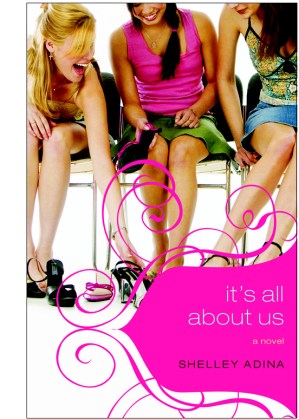 the audience is so diverse was tricky—but it was also doable. And fun. 🙂
My strategy was to locate the books in your Christian Worldview camp, Kaye. Lissa Mansfield and Gillian Chang, two of the characters in the first book, It’s All About Us, are Christians when we meet them—though unfortunately they don’t show it, because the first thing they do is have a massive, screaming fight! The other three of the five main protagonists are not Christians, though two had gone to church with their parents while they were at home. One has hardly any exposure to faith at all. So I cover the spectrum of belief and nonbelief, and part of the over-arching series plot is these characters’ journey from realization of a lack in their lives to acceptance that there’s something out there that’s bigger than they are—and that when they say it’s “all about us,” they mean “me and God.”
The books are not evangelical. I treat faith as something that’s just in your life. My characters talk to God and pray together (and Gillian walks around with Christian music playing on her iPod). The thing that differentiates this series, I think, is that given the same choices and distractions as other popular series with glitzy covers and spinoff TV shows whose titles I won’t mention , the characters in the All About Us books make different choices based on their beliefs and on biblical values. Faced with a decision, they choose a direction after praying about it. This may take them to places they don’t expect, but they grow and learn from it.
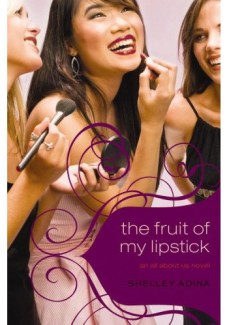 Also, in each book, the protagonist learns to find within herself a biblical power. It’s never mentioned or spelled out, but it’s always there as part of the underlying theme. For instances, in It’s All About Us, which comes out in May 2008, Lissa discovers the power of discernment—especially when it comes to boys. In The Fruit of My Lipstick, releasing in August, Gillian learns the power of honesty—with herself. And in next year’s Be Strong and Curvaceous, their friend Carly Aragon finds out that there’s such a thing as being too nice and going with the flow—that sometimes you need the power of courage.
It’s possible to show the Christian life without actually spelling it out—and whether the characters do the wrong thing and make mistakes, or listen to their hearts and work through their challenges and problems, it all makes for a fun read. And that’s my ultimate goal!
 Award-winning author Shelley Adina wrote her first teen novel when she was 13. It was rejected by the literary publisher to whom she sent it, but he did say she knew how to tell a story. That was enough to keep her going through the rest of her adolescence, a career, a move to another country, a B.A. in Literature, an M.A. in Writing Popular Fiction, and countless manuscript pages. Shelley is a world traveler and pop culture junkie with an incurable addiction to designer handbags. She knows the value of a relationship with a gracious God and loving Christian friends and loves writing books about fun and faith—with a side of glamour. Between books, Shelley loves traveling, music, making period costumes, and watching all kinds of movies.
The Inspirational Element–Letting It Happen
Wow, what a fun weekend of discussing the novel that is considered to be one of Jane Austen’s most “Christian” of novels. Mansfield Park—really most of JA’s novels—exemplify the art of writing fiction from a Christian worldview. In MP, we have the most moral, most humble of heroines, and, as in Sense & Sensibility, a hero who has chosen to become a minister. While it was much more of a step outside of the norm, and therefore a more striking choice for Edward as the oldest son and heir, in MP we see Edmund eventually choose his ministry over the flattering attentions of a worldly, beautiful woman. (And for those of you interested in pursuing this topic further, here’s a discussion question: is Edmund the first hero in a romance novel to unsuccessfully try “evangelism dating”?)
One of the reasons Jane Austen’s novels are not typically considered to be “Christian Fiction” is that there is no obvious agenda, no obvious spiritual journey/lesson learned. But we cannot escape the fact that, for the most part, her main characters (i.e., the heroes and heroines) have a Christian lifestyle. In several of her books, MP especially, the characters discuss religion as being an important choice and part of their lives. But the reason why her novels have such a broad appeal to the general reading market is because she wasn’t writing with a spiritual message in mind. She wasn’t trying to evangelize anyone. She was just writing romance novels. Romance novels in which her characters, like she, were church-going, moral people. She just let it happen.
I’ve heard from a few people who are struggling with the inspirational element of their stories. While I will answer as many questions as I can from my experience, I’m really hoping that y’all will add your comments, experience, and advice here, too.
Amy Jane wrote:
I’m beginning to think my current story cannot be adequately told without the spiritual element. There is so much hope-in-the-face-of, and good-decisions-when-it’s-hard, I’m having trouble just “letting it happen.” My discussion of music the other day woke me to it further, when I realized that the majority of songs (in the soundtrack I’ve complied in the last year) were the “Praise You in the Storm” type. . . . It’s intimidating to jump off that cliff that says “this is now ‘inspirational.'”
When I started writing more than twenty years ago, I didn’t set out to write “Christian” or “Inspirational” stories. And even though I’m about to be published in the Christian Fiction market, the irony is that I still don’t consciously think about writing an “Inspirational” novel when I sit down to write. Because my faith is so ingrained in who I am as a person, it naturally follows that it’s a big part of my characters’ lives, which puts me squarely under the Christian Fiction umbrella.
I don’t sit down and figure out what the spiritual theme of my book is going to be—what lesson the characters need to learn. I just start writing a romance novel. Since my characters always come to me first, and since my characters are the driving force of the novel, the spirituality is always there, even if it’s very subtly under the surface. But by the time I arrive at the climax at the end of the novel, the character must make some kind of realization or decision spiritually for the story to come to a happy conclusion . . . and it’s usually something I’m dealing with in my own life at the time, whether it’s forgiveness or trust or letting something go.
Many, many years ago, I tried writing secular romance novels. After all, if Julie Garwood and Jude Deveraux could write steamy romances where the heroines still prayed and believed in God, I could too, right? But when it would come to the point of writing the sensual scenes, I couldn’t do it—and not just because I’m not married and have never experienced it for myself. I couldn’t do it because it wasn’t the right thing for me to do. It wasn’t the direction my writing was supposed to go.
I finally came to understand that the first part of just letting our fiction happen—whether inspirational or not—is letting go. We have to let go of all of our inhibitions about what we’ve been told is “good” or “bad” storytelling. I’m not talking about throwing away the rules, just all of the myths about how to tell stories. We have to let go of everything we’ve been told about what sells and what doesn’t. Yes, it’s good to know the market and to be aware of who’s publishing what, but if we’re ever to find our true voices, if we’re going to tell the best story possible, we cannot necessarily write “to the market”; sometimes we just have to write. And we have to let go of the stereotype of what inspirational fiction is that has so permeated the writing culture, and just allow ourselves to be free to write our stories with—or without—that Christian worldview. We have to let go of the limitation of defining what we write as “inspirational” or “non-inspirational” (or Christian/secular) and just write.
One of the things I always have to do whenever I start a revision is to increase the inspirational element of the story. Because I don’t start out with the spiritual theme in mind, I sometimes don’t even realize what it is until it starts appearing on the page toward the end of the novel. Once I know what it is and how it resolves itself, in the revision process, I can see areas where I can drop in a thought, a prayer, a remembered passage of scripture (usually paraphrased, not quoted) that will make this spiritual journey the character makes realistic instead of something that just happens, even though it doesn’t usually happen that way in real life. In real life, sometimes we do have epiphanies. Why? Because we’re open to Letting It Happen.
How do you Let It Happen? Does the inspirational element of your stories come easily to you? Do you struggle with it—do you have to almost force it to happen? Do you start out knowing what the spiritual theme of your story is before you start writing? Do you struggle when writing with wondering exactly where your story will fit in the publishing world—where you’ll submit it—when you’re finished with it?
Tomorrow, award-winning author Shelley Adina will be our guest blogger, and I know you’re going to be blessed by her words!
Mansfield Park–My Reaction
To be blunt, I hated this adaptation. I may actually like this less than the new version of Persuasion, and most of it has to do with the grossly miscast Billie Piper. All I could focus on while watching it was her buck-teeth, her heaving bosom, and her hair that was not only not styled appropriately for whatever period they were trying to invoke but NEEDED TO BE BRUSHED FOR THE ENTIRE MOVIE! (Speaking of hair, Blake Ritson’s hair was strangely plastered to his head in every scene, almost as if they wanted to make sure that each spike lay on his forehead in the exact same place for every scene he was in.)
I corrected this in Friday’s post, but many of you may not have seen it. This adaptation was not written by Andrew Davies as I originally stated, but by Maggie Wadey, who wrote the screen adaptation for The Buccaneers.
The Fanny Price in this adaptation in this movie has absolutely nothing to do with the character Jane Austen created. Fanny was a shy, retiring girl who grew up being emotionally/verbally abused by her aunt Mrs. Norris, and yet persevered under it to become a kind, gentle, humble girl who always put others above herself and was mortified whenever anyone wanted to do anything nice for her. And she would never have run around pellmell around Mansfield Park like a hoyden. Maria and Julia did that, but never Fanny. (What is it in the new adaptations that they want the heroines sprinting around all over the place?)
As far as the time period, this book was written between 1811–1813, during the height of the Empire style—when pretty much all unmarried women wore were high-waisted, white gowns. Actual images of dresses from the time during which this book was written:
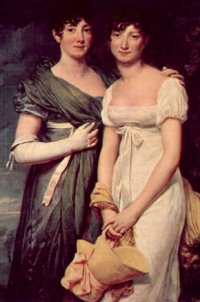
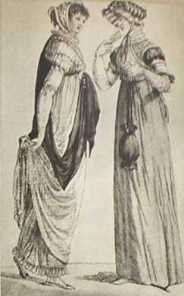
In the text of Mansfield Park, Jane wrote that Fanny receives a new white gown to wear to Maria’s wedding. In this film, not only is she wearing brown, but she’s wearing a day/workdress (which we only see as she goes tearing across the courtyard as her cousin is taking her leave):
“Now I must look at you, Fanny,” said Edmund, with the kind smile of an affectionate brother, “and tell you how I like you; and as well as I can judge by this light, you look very nicely indeed. What have you got on?”
“The new dress that my uncle was so good as to give me on my cousin’s marriage. I hope it is not too fine; but I thought I ought to wear it as soon as I could, and that I might not have such another opportunity all the winter. I hope you do not think me too fine.”
“A woman can never be too fine while she is all in white. . . .”
And I have a minor quibble about William’s showing up in uniform too (only because I made the point of trying to follow this in Ransome’s Honor):
William had obtained a ten days’ leave of absence, to be given to Northamptonshire, and was coming, the happiest of lieutenants, because the latest made, to shew his happiness and describe his uniform.
He came; and he would have been delighted to shew his uniform there too, had not cruel custom prohibited its appearance except on duty. So the uniform remained at Portsmouth. . . .
I’d already read on Ms. Place’s Jane Austen’s World Blog that Mrs. Norris’s character has basically been almost erased from existence in this adaptation. All I can say is that there’s a reason why J.K. Rowling named Filch’s cat “Mrs. Norris.”
And don’t get me started on how vulgar the waltz was considered when this book was written!
Given that Maggie Wadey did the screenplay for The Buccaneers, I’m really surprised at how much they downplayed Maria and Henry’s affair, since it really does have a big emotional impact on the story.
And I was right—taking Fanny’s exile to Portsmouth out of the story basically ripped the soul out of it. Of course, it was already braindead before it got to that point, so the loss of Portsmouth was just unplugging the life-support.
Here’s part of the Boston Globe‘s Matthew Gilbert’s take on it:
Written by Maggie Wadey and directed by Iain B. MacDonald, the PBS adaptation breezes along regardless of the subtle manners indigenous to Austen’s world or the intense reserve that marked so many of Austen’s women. All the conflicts and tensions are EZ-to-read – the Crawfords, for example, who are too clearly undesirable, and Edmund’s older brother, who is rarely seen without a wine glass in his hand.
Piper’s Fanny is little more than a stubborn Cinderella who always gets left at home. There’s nothing timid or intelligent about her. A nature child with flowing locks, she’s even a little bit flirty. And Fanny is never sent back to her poor family in the movie, so her economic vulnerabilities – such an important element in Austen’s novels – are left vague and unexplored. Meanwhile, Ritson’s Edmund, with his pointed nose and rock-star haircut, looks something like a young Rod Stewart.
Fun Friday–Mansfield Park on PBS

Before getting into the discussion of this week’s presentation, let me take a step back to last week’s and say, for the record, how much I absolutely adored the new version of Northanger Abbey. As I wrote last week, I believe NA will be the triumph of the Austen Series. Now, on to Mansfield Park . . .

I may be one of the few people in the world who enjoys the full experience of Jane Austen’s longest novel, Mansfield Park. There is only one section of it that I routinely skip when reading it, listening to the audiobook, or watching the 1983 BBC version starring Sylvestra Le Touzel—who, by the way, played Mrs. Allen in the new Northanger Abbey this past week—and that’s the part when Tom brings a friend home and, in Sir Thomas’s absence, they start rehearsing a play. But I’m pretty sure that part’s been cut out. I’m a little concerned that what took them 312 minutes to show in the ’83 version (which still left out some stuff from the book, but not much), has been cut down to 90 minutes for this new release.
Here’s the synopsis from the PBS/Masterpiece Classics site:
-
“We all have our best guides within us, if only we would listen.”
— Fanny Price in Mansfield Park
Fanny Price (Billie Piper, Doctor Who, The Ruby in the Smoke) is plucked from poverty as a child and taken to live with relatives at stately Mansfield Park. Surrounded by entitled and vain cousins, Fanny forges a connection with one — Edmund Bertram (Blake Ritson, Inspector Lynley Mysteries). Years later, two neighbors fresh from a life in high society descend on Mansfield Park, sparking a labyrinth of intrigue and affairs. Fanny finds herself being pursued, but not by the longstanding love of her life. Can Fanny listen to her own heart and wait for her true love to notice her?
I’m trying to stay positive about this adaptation of the novel—not my favorite of the six, but still one that I’ve enjoyed—but a few elements do concern me:
1. Billie Piper

Maybe it’s because, with the exception of Gwyneth Paltrow in the theatrical release version of Emma (my least favorite of the six novels/stories), Austen’s heroines have almost exclusively been cast with brunette actresses, Billie Piper already doesn’t fit my mental image of Fanny Price. And there are two issues I have with this image: the costume, which looks like it’s about twenty years out of date; and her hair, which never would have been left unbound during that age (nor would it have been shoulder-length, nor would she have had bangs nor would she have obviously black eyebrows with blonde hair—okay, yes, I’m getting a little too critical).
2. Length which I’ve already mentioned.
3. The Ending. After reading the full synopsis at the PBS/Masterpiece site, I’m a little concerned that they’ve glossed over some of the important—the vitally important—events that occur near the ending of the novel . . . the most important of which is Fanny’s being sent back to Portsmouth after she refuses Henry’s first proposal. The synopsis says she is “left in solitude at Mansfield Park.” There is no way that will have the impact on the characters/story that her being sent away to Portsmouth has in the original story. Being sent away from Mansfield Park—and Edmund—and having to live in her family’s squalid quarters near the dockyard in Portsmouth, cut off from everyone she cares about, is the pivotal moment in the book when Fanny’s strength of character is revealed. Even though she desires nothing more than to get back to Mansfield Park, when Henry comes to Portsmouth and offers to rescue her, by way of renewing his proposal of marriage and an offer to take her back to the life/people she misses, she still refuses to lower her standards or compromise/give up her love for Edmund. So it’ll be interesting to see how taking this part out works.
~ ~ ~ ~ ~ ~ ~
So what am I looking forward to in this version?
1. Script by Andrew Davies. Just click back to last week’s Fun Friday post about Northanger Abbey in case you’ve forgotten why fans of Austen’s books love Andrew Davies. Even though I do have my concerns over the changes to the story, I trust that he will still have done his uttermost to maintain the integrity of the themes and characters. UPDATE SUNDAY, JAN. 27: I was misinformed about Andrew Davies being the screenwriter for this adaptation. Apparently it’s Maggie Wadey, and the only other book-to-screen adaptation of hers I’ve seen was The Buccaneers, which may go a long way in explaining what may or may not have been cut out of this story.
2. The Men. I’ve never been shy about admitting that I have a thing for British actors. And the casting director of this production seems to have outdone herself:

Edmund Bertram
Blake Ritson is just on that line between stodgy and good looking, which is perfect for the role of Edmund.

Tom Bertram
Though Ruth and I disagreed about the new version of Persuasion, I know she’ll completely agree with me in saying that any movie with James D’Arcy in it has at least one redeeming quality!

Henry Crawford
I haven’t seen Joseph Beattie in anything before, but just from this picture, he looks like he fits the role of Henry Crawford perfectly.
3. The Bertram Sisters. Maria and Julia are secondary characters in the book, but their actions have great impact on the unfolding of Fanny’s story. And here, the casting director seems to have done an excellent job as well:

Maria Bertram-Rushworth
My main exposure to Michelle Ryan was in her role as Katherine in the BBC miniseries Jekyll, but the majority of U.S. viewers may know her better as the latest incarnation of The Bionic Woman. She has just the right combination of beauty and haughtiness needed for the role of the condescending and ill-fated Maria.

Julia Bertram
I can’t recall having seen Catherine Steadman in anything before, but she is very well cast as Maria’s younger sister who has always lived in her more lively, more beautiful older sister’s shadow—especially when it comes to men. My only fear is that her character has drawn the short-straw in this adaptation, and she will not be shown to actually be the “good” daughter—as well as have a happy romance eventually sanctioned by her parents.
Links of Interest
Interview with screenwriter Andrew Davies on NPR
Listing on IMDb.com
Main page at PBS’s Masterpiece Classics site
Wikipedia Article on Mansfield Park
Full Text of Mansfield Park on Bibliomania
For more information on Jane Austen and all of her works:
The Jane Austen Society of North America
The Republic of Pemberley
The Inspirational Element–Through the Ages
Sorry about not posting yesterday—the day just got away from me.
While most reports about the surge in sales of Christian Fiction talk about it as if it’s something new that’s never been seen before, this is about as far from true as possible. But just as Christian Fiction has its roots in antiquity, so does the argument about whether or not Christians should be reading fiction.
In his essay “Christian Poetics, Past and Present,” in the book The Christian Imagination, Donald T. Williams looks at some of the more famous arguments for and against Fiction from a Christian viewpoint:
–Augustine believed that “literature—even pagan literature—conveys truth and is therefore not to be despised.” He also believed that Christians have not only a right but an obligation to “learn and employ the art of rhetoric” to enable us to share Truth with the “pagan” world.
–Moving into the Medieval and Renaissance periods, we see literature become more allegorical in nature (such as Beowulf, Piers Plowman, etc.). Yet there still remained enough tension to cause Chaucer to retract his “human and sympathetic portrait of ‘God’s plenty’” before he died.
–Luther wanted to know why the devil should have all the good music and “noted that literary study equipped people as nothing else does to deal skillfully with Scripture.”
–Calvin brought in classical philosophers such as Plato, Seneca, and Cicero to apply to the critical reading of Scripture.
–Puritans such as Richard Baxter advised “Christian readers to read first the Bible, then books that apply it. If there is any time left, they may turn to history and science.” Novels (i.e., “vain romances, play-books, and false stories”) would “bewitch your fancies and corrupt your hearts.” They were seen as filling the mind with nonsense rather than focusing the mind on holier thoughts. Yet during this time period, the majority of fiction that was being written was at least Moral Fiction if not completely Evangelical Fiction.
–Sir Philip Sidney pointed out literature’s “antiquity, its universality, and its effectiveness as a mnemonic device and as an enticement to and adornment of what his opponents consider more ‘serious’ studies.” He expanded the positive points from Augustine’s tome “distinguishing the right use from the abuse of literary art.” He used the argument that has become the main defense of the art of writing for modern Christian authors: that of pointing out the fact that Jesus told stories, and the Bible includes hundreds of poems (the Psalms, Song of Solomon, Ecclesiastes, etc.). Since, in Sidney’s view, education is supposed to not only provide facts but virtue as well, he argues for the inclusion of literature. The historian is bound by the facts of what happened. The moral philosopher can give the “precept of virtue.” It is the poet/author who can combine both to give role models that can then be translated into real life applications. It is because we were created in God’s image that we have the capacity for creativity, thus creativity expressed in language such as literature, is only showing that we are the image of God.
–John Milton took Sidney’s ideas and ran with them. He wanted to use “concrete images for acquiring both understanding and virtue.” It is through reading Christian literature that we are connected with the mind of the author and, therefore, put into closer contact with God; the author, as the image of God, is sharing the mind of God through his writing. Milton argued against banning secular writings; he saw it as important to expose ourselves to the world’s mindset, or else “What wisdom can there be to choose, what continence to forbear, without the knowledge of evil?”
–Moving toward the modern era, literature was still slow to be accepted by those of good morals and upstanding character. This is quite visible even in Jane Austen’s writings. In Pride and Prejudice, when Mr. Collins is asked to read to the family on his first visit to Longbourne, he is aghast when handed a novel from the circulating library and gives a diatribe on the evils of exposing the minds of young women (especially) to fiction. He chooses to read instead from Fordyce’s Sermons, much to the consternation of the girls.
–Tolkien saw man, the author, as “the refracted Light/Through whom is splintered from a single white/To many hues, and endlessly combined/In living shapes that move from mind to mind.” In fiction, “the secondary” (created/fictional) “world echoes the primary creation in more ways than one.” Or in other words, the basic plot for fiction is that of Salvation.
–Lewis believed that “idolization of culture (including literature) corrupts and destroys culture.” Literature “enlarges our world of experience to include both more of a physical world and things not yet imagined. . . . This makes it possible for literature to strip Christian doctrines of their ‘stained glass’ associations and make them appear in their ‘real potency’” which is seen in the Narnia series. Literature gives us the heroes that can teach us how to face the villains in our real world. Reading outside of our own narrow culture can fortify our faith, which we have inherited in its full strength through the ages in which that literature was written.
–Flannery O’Connor “believed that great literature deals with ultimate concerns that are essentially theological.” She stripped away the “stained-glass associations . . . with practical wisdom on how to embody the anagogical vision in concrete images which can speak to the modern reader.” (quotations from Williams’ essay)
Williams concludes his essay by arguing that we have lost our strong literary tradition from 150 years ago and have become “cheap imitations of Lewis and Tolkien” with “too many saccharine historical romances” for Christian literature to be taken seriously.
So my question is this: what’s the last piece of classic literature you’ve read? Did you see elements of Christian Fiction in it? Was it Moral? Inspirational? Worldview? Evangelical? What can we as writers learn from the content and themes (not necessarily craft) of classic literature?
The Inspirational Element–Introduction
Christian Fiction. Evangelical Fiction. Fiction with a Christian Worldview. Inspirational Fiction. Moral Fiction.
No matter what it’s called, there’s no denying the power of fiction that has a spiritual theme and strong morals and values. Though most of it (Moral Fiction being an exception at times) falls under the umbrella of Christian Fiction, there is a difference between these categories: how much of a spiritual thread/message is included. While there are no official designations, I’ll try to explain my method of labeling the subgenres to clarify what we’ll be discussing in the next couple of weeks.
“Evangelical Fiction” is fiction that is written with a specific, evangelical message to get across to the reader. The most important part of the plot is to get the character to a point of spiritual awakening: i.e., coming to salvation. Without this, the story cannot end properly. Prayers and quoted Scripture are used liberally throughout, there may be a sermon or two written out, and the entire presentation of the gospel will be given at least once—with at least one character coming to salvation in the course of the book. These are books like This Present Darkness and the Left Behind series.
“Fiction with a Christian Worldview” makes up the majority of what we call Christian fiction today. While the spiritual thread of the story is important, it’s not the driving force of the plot. These are books where Christianity is a normal part of the characters’ lives and defines how they live and make decisions.There will be a spiritual lesson to be learned before the story can come to its conclusion, but the story could have been written without the spiritual element (thus, these are mostly popular genres with standard plot structures). A sermon may be referenced—maybe even a line or two put in as dialogue, but not the whole thing. At least one of the main characters is already a Christian when the story opens, and everything that happens in the course of the story is seen through the lens of Christian beliefs and morals. You will still see prayers spoken or thought out—but much shorter—as well as quoted Scripture sprinkled here and there.
“Inspirational Fiction” straddles the fence between Christian Worldview and Moral fiction. The spiritual message in these stories can be overtly Christian, less obvious by just mentioning God, or allegorical. The spiritual lesson to be learned is usually much more subtle—as are the steps leading up to it. While there might be one or two prayers spoken or thought, usually it is more of a reference to the fact that the character prayed. If scriptures are mentioned, they’re usually paraphrased as part of dialogue. And no sermons here! Allegorical stories fall into this category, as well: fantasy or science fiction stories where the Christian life is implied or illustrated by different cultural references and clues—like the Narnia stories. The lessons learned are more “feel good” or just changing a single aspect of someone’s life (forgiving a particular person, learning that honesty-is-the-best-policy, etc., but because of a spiritual belief).
“Moral Fiction” is good, clean fiction with a morality that isn’t necessarily religious/spiritual. These are good people who might or might not go to church, but their personal spirituality doesn’t play a role in the story. Characters in Moral Fiction will have to learn some kind of message about being a good person, being a good citizen, or any Aesop’s Fable–type lesson—but not because of a religious/spiritual belief, but because it’s “right,” or moral. It’s the good thing to do. It’s the story of the Good Samaritan without the spiritual element. Characters may pray—but it happens off page. They may attend church regularly—but again, it happens off page. If a deity is mentioned at all, it is an amorphous “God” that can be construed as Christian or Jewish or really any “supreme being.” Many of Nicholas Sparks’ novels fall into this category. They’re sweet (no sex-scenes, no swearing), yet more worldly in their outlook than the other types I’ve outlined. All genres of fiction can be found in this category, though they’re the hardest to find, as not a lot of publishers put them out. CenterStreet, an imprint of FaithWords, is a “Moral Fiction” line.
Now that the categories have been defined, where do your stories fall?
Over the course of this series, we’ll be looking at the history of Christian fiction, dissecting the structures of stories that include a spiritual thread, as well as determining how much is too much/too little; how to incorporate Scripture, prayers, and other elements; and how to target your novel toward the appropriate publishers. And be looking for some special guest columnists too!
So post all of your questions about this, and we’ll get the ball rolling.
And the Winner Is . . .

The winner of the Taste of Louisiana gift box is Delia Latham, even though she voted for one of the other titles 🙂
Thanks to everyone who stopped by and weighed in on the decision!
Fun Friday–Northanger Abbey on PBS

In an effort to promote the watching of the adaptations of Jane Austen’s novels which will be airing through April on PBS’s Masterpiece Classics, I’ll be featuring the upcoming movie/episode on Fun Fridays.
I’ve only read Northanger Abbey once or twice, so I know most of y’all haven’t read it. The only film version available to date is one that the BBC did in the 1980s—with bad 80s music in the background. So needless to say, they could make massive divergences from the novel in this film, and I might not notice—so no ranting message next week (I hope!).
This new version of NA was adapted for the screen by the incomparable Andrew Davies. Now, most of you probably have no idea who he is. For those of us who are BBC costume drama fanatics, to us, Andrew Davies is like Ridley Scott to action/triller-movie addicts—he’s the best. Or, to put it in other words, Andrew Davies is the one who gave us Collin Firth in that infamous wet-shirt scene in the 1995 version of Pride & Prejudice. (He also wrote the screen adaptations for the Bridget Jones movies, but most of us have forgiven him that.)
This Austen series is almost a Davies series; he is the credited screenwriter on four of the six adaptations that will be airing: Northanger Abbey (airing Jan. 20), Pride & Prejudice (Feb. 10, 17, 24), Emma (March 23, made for A&E in 1996 and starring Mark Strong [Stardust] and Kate Beckinsale [Pearl Harbor]), and Sense & Sensibility (Mar. 30, Apr. 6). He has also adapted a new version of A Room with a View which will play later in April or May.
But today, we’re focusing on NA.
The daughter of a country clergyman, Catherine Morland has a passion for gothic romance novels and a vivid imagination. She gets the opportunity to go to Bath for the season with family friends. While in Bath, she makes the acquaintance of the Thorpe family, specifically Isabella, who is engaged to Catherine’s brother, and John. Isabella teaches Catherine the fine art of flirtation, and soon John is showing romantic interest in Catherine.
Catherine, however, isn’t interested in the wild John, but in the quiet Henry Tilney. Henry’s father, General Tilney, under the misinformation that Catherine is wealthy, invites Catherine to come spend some time at their ancestral home, Northanger Abbey. The Abbey answers all of Catherine’s gothic imaginings; and as soon as she arrives, the fun begins.
This is one of Austen’s least-read, least-analyzed novels. She observed around her young women so overtaken by emotion when reading gothic romances (akin to horror novels now) that she wrote this story to illustrate the ridiculous nature of their reactions—that it was all in their imaginations.
Now that I think about it, it really is one of her more humorous novels, as she continually puts Catherine in situations where she thinks she’s about to see a ghost or a dead body or discover some clue to an ancient and horrible secret which turns out to be a laundry receipt or something equally mundane. I really need to read it again.

With a cast of fresh faces (even with as addicted to BBC movies/shows as I am, I don’t recognize the majority of the actors/actresses in it), I believe this new version will prove to be the ultimate winner of this Austen Season.
Links of Interest
Interview with screenwriter Andrew Davies on NPR
Listing on IMDb.com
Main page at PBS’s Masterpiece Classics site
Wikipedia Article on Northanger Abbey
Full Text of Northanger Abbey on Bibliomania
For more information on Jane Austen and all of her works:
The Jane Austen Society of North America
The Republic of Pemberley
Cultural References in Fiction
I am about to become a John Wayne aficionado. Or at least well-versed in his movies. Why? Because I needed a cultural reference as a continuing theme in my follow-up book to Anne & George’s Story. In the first book, Anne and George both love Dean Martin’s music. A couple of pieces of his music actually play a significant role in key turning points in their relationship (“That’s Amore” and “Return to Me”).
In trying to figure out what cultural reference I wanted to use as a running touchstone in Major and Meredith’s story (which for the current lack of title I’ll reference as M&M for the time being), I thought about music, but as I developed them, they both told me they have different tastes in music—Meredith likes Jazz/Blues while Major likes Country/Southern Gospel. Plus, it would have come across as too contrived to use the same cultural theme, even if I chose a different genre of it. I thought about books. But then Meredith revealed she isn’t much of a reader (Major is, and right now his favorite author is Ted Dekker). I thought about art, since Meredith’s background has shifted from psychology to art history, but that doesn’t translate well onto the page—and Major, while he can appreciate it, isn’t really into it. So I settled on movies. But I didn’t want anything too recent, and I didn’t want anything that might contain any potentially offensive material, so I knew I needed to go classic. But in this day and age, so few people watch classic movies any more, I needed something that would be iconic, without being cliche.
And almost as soon as I had that thought, I flipped the channel and came across an old John Wayne Western. Now, while this could initially seem like the most cliche direction to take it, using John Wayne as the cultural icon gives me a lot of flexibility. As I watched Comanche Moon this week, I started developing the idea that Meredith would love the Duke’s Westerns—which tend to have an element of romance to them—though her favorite JW movie will be The Quiet Man, a great romantic comedy in its own right even apart from the JW cannon. But Major prefers the Duke’s war movies—World War II or Korea or whatever; the bigger the battle scene, the better. This then led me into thinking about why each of these characters would be drawn to each type of story. For Meredith, it’s the draw of the romance, the nostalgic quality of the relationships between men and women, the ideals of the “old West.” For Major, it’s the strong, masculine leadership figure he didn’t have growing up in a single-parent home. In a way, John Wayne is his father-figure. The way Duke leads on-screen is incorporated by Major into how he leads in the kitchen . . . and I might throw a Duke quote or two in for good measure. (Hmmm . . . and while the name “Major” originally was supposed to come from his mother’s family tree, I’m now thinking John Wayne’s movies might have played into that too . . .)
Is this realistic or is this just a device used in fiction? Well, all I have to do is think about a guy that I worked with at the newspaper who quoted lines from the movie Office Space at any given opportunity, even adopted Gary Cole’s voice and mannerisms a couple of times a day. When I was in college, my friend Amy and I could look at something happening, then look at each other and pop off with the same line of dialogue from Steel Magnolias that just encapsulated the moment perfectly. Ruth and I cannot watch a movie with British actors in it without recognizing at least one—if not a dozen—of them from other British films we’ve watched and loved. So, yes, using movies as a touchstone for characterization is one of those things that we can observe in “real” life and translate into creating our characters.
Cultural references are used, primarily, to ground readers in the “reality” of our stories. But, we must be cautious in how we do this. The Chick Lit genre does it in such a way that it creates problems for itself. Either the cultural references are too specific to a very narrow portion of the population (shopping at Bergdorfs, which pair of Manolo Blahniks to buy, living in New York in a $5,000/month apartment and never having to actually work to afford it, being more concerned with what people are wearing that who they are, etc.), or the references are to current pop-culture events/icons that come in and out of favor so quickly that five years later, the book hasn’t aged well. Writers of Regency romances used one specific cultural icon of the era so much that he probably has more precedence now than he ever had during his own age: Beau Brummell. If modern-day Regency romance authors hadn’t picked up on his fashion-forward persona and used him as the be-all-and-end-all of fashion leadership of the ton in London, would history even remember him as more than just a blip on the social-history radar?
Rather than get into the trap of “aging” my book by using pop-culture references (well, I threw in a few, like having Anne pull out the DVDs of Return of the King to watch when she’s moping around in one scene), I’ve chosen to use classic-culture icons (Dean Martin, John Wayne), as they’re more universal, more readily accessible to the majority of people who might come across my work. They also have the added advantage of being dead, therefore I know that they’re not going to do anything that will make me regret including them in my books. Yes, I know Dean Martin had a horrible reputation when he was alive, but now so much time has elapsed it’s really just his music we remember.
What about you? What are some cultural references you’ve included in your work? Did you have a purpose—for setting, for characterization, or just for fun?
One-Book Meme
I picked this up off Erica’s blog today . . .
1. One book that changed your life. Victoria by Willo Davis Roberts, book 13 of the Sunfire YA romance series. It (obviously) wasn’t the first romance novel I read, but there’s just something about the way Willo Davis Roberts wrote that kept me returning to this book over and over and over. I got it when I was fourteen or fifteen and read it a few times a year until I was in college! It’s what led me to stop just making stories up in my head and start putting them on paper.
2. One book that you have read more than once. Too many to enumerate. But if I had to pick the book I’ve read the highest number of times, it would probably have to be These Happy Golden Years by Laura Ingalls Wilder. It’s the story of her romance with Almanzo. I’ve read it at least once a year since childhood. (Along with most of the others in the series, with the exception of Farmer Boy and The First Four Years.)
3. One book you would want on a desert island. The Complete Works of Jane Austen
4. Two books that made you laugh. Along Came Jones by Linda Windsor and the not-yet-published Honey Do Inc. by Georgiana Daniels
5. One book that made you cry. Harry Potter and the Deathly Hallows—when several characters died, but then when Harry resigned himself to the fact that he had to die and bravely walked out to face it. I bawled when I read that book!
6. One book you wish you’d written. Pride & Prejudice
7. One book you wish had never been written. Fear and Loathing in Las Vegas by Hunter S. Thompson—well, I don’t know that I wish it had never been written. I just wish I hadn’t been forced to read it my first semester of college.
8. Two books you are currently reading. The Two Towers by J.R.R. Tolkien and The Making of a Chef by Michael Ruhlman
9. One book you’ve been meaning to read. North and South by Elizabeth Gaskell. I bought it last year, have read the first forty or fifty pages, but just keep putting it down and forgetting to get back to it.
I’m not tagging anyone, but if you want to use this on your blog, feel free . . . and be sure to post a comment if you put it up!


