A Criminal Minds Favorites Fest
Seasons 1–9 Spoilers abound . . .
Favorite Episode by Character:
 Hotch – “100” (season 5)
Rossi – “Epilogue” (season 7)
Morgan – “Profiler, Profiled” (S2) / “Restoration” (S8)
JJ – “200” (season 9)
Reid – “Zugzwang” (season 8)
Penelope – “Lucky”/“Penelope” (season 3)
Prentiss – “52 Pickup” (season 4)
Will – “Hit” / “Run” (season 7)
Gideon – “Riding the Lightning” (season 1)
Elle – “Derailed” (season 1)
Jordan – “52 Pickup” (season 4)
Ashley Seaver – “It Takes a Village” (Season 7, Episode 1—because she was gone!)
Favorite Bookend Quotes:
Spencer Reid: “Being deeply loved by someone gives you strength, while loving someone deeply gives you courage.” Lao Tzu
Maeve Donovan: “Love is our true destiny. We do not find the meaning of life by ourselves alone; we find it with another.” Thomas Merton
From episode 8.12 – “Zugzwang”
Favorite On-Screen Couple
- JJ and Will
Ship That Will Never Sail
- Prentiss and Viper (“52 Pickup”)

Also . . . Prentiss and Rossi
Favorite Lighthearted Moment
- I had to pick two, and both involve Reid:
1. Physics Magic
2. Henry’s Halloween Costume
.
Favorite Relationship on the Show
- Is there any other answer for this one? I love Morgan and Garcia’s friendship! (This video isn’t solely Garcia-Morgan moments, but it’s too funny not to share.)
.
Not to mention that Garcia is one of the only people who can make Hotch smile.
.
Season 10 Premiere is TONIGHT!
Be Your Own Casting Director (Part 5): Isn’t This All Just a Big Waste of Time?
Why bother finding visual templates for our characters? After all, we’re writing stories, not casting a movie.
If you’ve been reading this blog for a while, you’ll know that I can’t write if I haven’t cast my characters—even my secondary (non-viewpoint) characters. I am so visually oriented that if I don’t have a concrete physical representation of each character, they start running together in my head. I also have a tendency to over-describe them (if you can imagine, given my tendency to love describing my characters) if I don’t have the image there. Having images of the RWTs to look at while I’m writing a scene helps me, I believe, to focus in on smaller details, things that will help make the character more unique, rather than just mentioning their blue eyes or brown hair.
For example (from Follow the Heart):
Andrew Lawton’s thick brows raised a fraction. Once again, Kate found herself mesmerized by his eyes, unable to draw her gaze away. How had she never noticed before the chip of brown in the green iris of his left eye? She leaned forward as if to step closer to examine his eyes more carefully, to ensure her own did not play tricks on her, but managed to stop herself before doing so.
Now, where in the world would I get the idea to give Andrew a “brown chip” in the iris of his left eye? Well, here’s a close-up image of the RWT for Andrew (Henry Cavill):
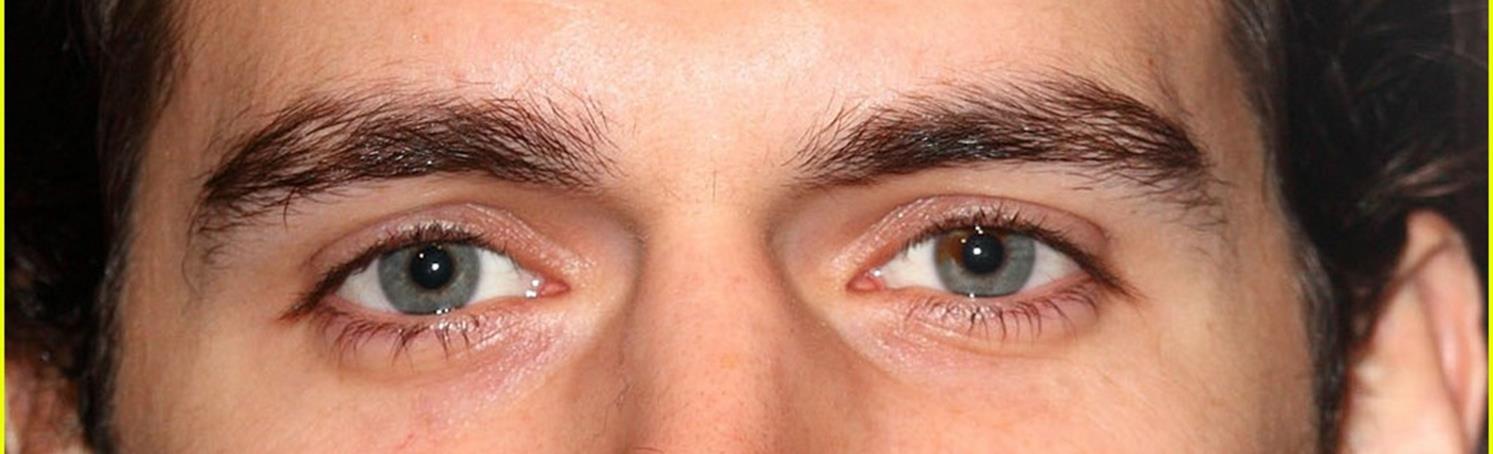
See the brown chip in his left eye? It’s something that someone falling in love would notice—after all, that’s how I found it! 😉 (And now you’ll never be able to not see it.)
Kate closed her eyes and breathed deeply, trying to separate and identify the aromas surrounding her. But instead of inhaling the fragrances of flowers and plants, a phantom of the woodsy, spicy scent of Andrew Lawton filled her mind. She shivered at the memory of his smile, his slightly crooked front teeth making it all the more charming. Not for the first time in her life did she wish she’d mastered the skill of drawing, for she would love to be able to capture his square jaw and the way the light and shadows emphasized his planed cheeks. And his eyes . . . oh, his eyes. Dark hazel or mossy green, depending on his surroundings, with that mesmerizing chip of brown in the left iris making it so hard for her to look away.
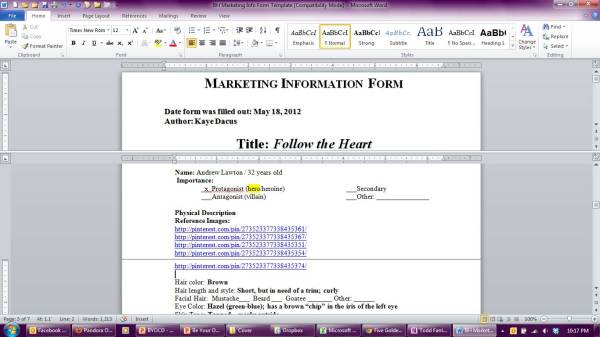
In addition to being able to use the RWTs to inspire myself (and my heroes and heroines) as I write, I’m also able, as I mentioned in yesterday’s post, to use them to inspire the graphic designers creating my covers. Here’s a screen shot, which is linked to the actual document, of the Marketing/Cover Design info questionnaire I filled out for my publisher for this book:
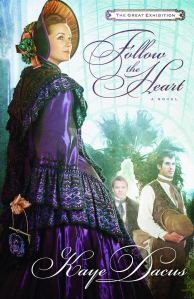
Because I sent such detailed information to the designer, I ended up with a cover that I absolutely love (I also got to give input on the dress she ended up in):
Wait . . . let’s take a closer look at one of those images on the cover:
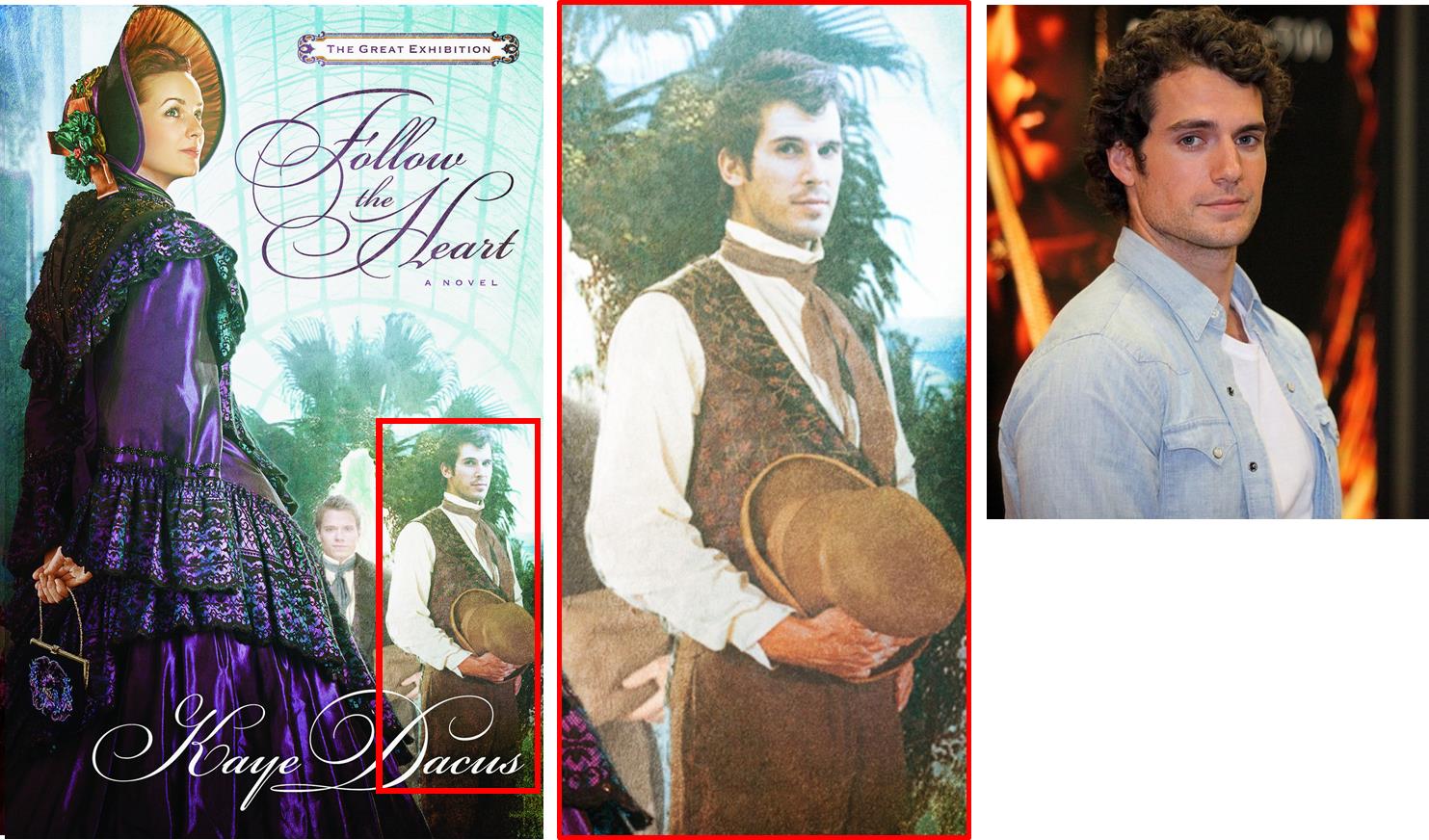
Apparently, according to him, my designer was greatly inspired by the links to all of the images I sent him—especially those of the character templates. You can see what the result of that was!
So, is it worth the time to cast characters and collect images of our RWTs?
It’s been helpful to me. I chose both the hero and heroine images on the covers for both The Art of Romance and Turnabout’s Fair Play—making it easier for the designers and ensuring that the characters on the published covers of my book look exactly how I pictured them when I was writing. And it helped to inspire the designer of both Follow the Heart and An Honest Heart to find images of people who strongly resembled the RWTs I shared with him.
Was it worth the time I spent? Most definitely!
* * * * * * * * * * * * * * * * * *
In case you missed the other posts in this series…
Part 1: Character Development for Visually Oriented Writers; or, Be Your Own Casting Director
Part 2: Be Your Own Casting Director: 4 Methods of Character Casting
Part 3: Be Your Own Casting Director: Creating a “Casting Book”
Part 4: Be Your Own Casting Director: Using Real World Templates in Character Development
Part 5: Be Your Own Casting Director: Isn’t This All Just a Big Waste of Time?
* * * * * *
If you like what I do here and want to keep this content free,
consider supporting me and my work by buying me a coffee.

Be Your Own Casting Director (Part 4): Using Real World Templates in Character Development
So far, we’ve looked at what Character Casting is, four types of Character Casting, and creating a Casting Book. So today, we’re going to go beyond the fun part of character casting and into the more fun part/the working part of it.
How does Character Casting help with Character Development?
Once you have cast your characters and begun the process of collecting images, you may find yourself thinking of scenes inspired by the images you see—and you may find images that fit scenes you’ve already written but which give you ideas for how to better describe your characters’ reactions or movements. One of the reasons why I collect so many images of each of my characters is because different facial expressions or different things going on in the image can spark story ideas for me. It’s also one of the reasons I tend to use public figures (mainly actors/actresses)—so that in addition to still photos, I can see them in motion, hear their voices, see the minute changes in their facial expressions as they portray different emotions.
For example:

This is a screen capture of Anna Friel, the Real World Template (RWT) for Julia Witherington, from the film St. Ives. I actually found this image (and watched the movie) after I’d already written Julia’s opening scene in Ransome’s Honor in which she’s homesick and looking out a window on a rainy night. But with this image in front of me when I went back to that scene in revisions, I was able to, I believe, bring a more evocative feel to her homesickness and the way the rain played into it, in it.
When I first started working on the Matchmakers series, I knew who Zarah (Love Remains) was, mostly because that book was a complete rewrite of a manuscript I’d finished five or six years before. She’d been cast from a model I’d fallen in love with from a Land’s End women’s-sizes catalog. She was, apparently, their go-to model for that catalog, because there were tons of images of her, and the model was wonderful at conveying different emotions . . . all of them leading me to a certain personality type for her.
When I first came up with the idea for what would become The Art of Romance, I just slapped an RWT into the role of the heroine (whose name I didn’t even know at the time)—the genesis of that story was the RWT for Dylan, celebrity chef Sam Talbot. When it came time to write the proposal for the story (in order to sell it to a publisher), I had to cast the heroine. I knew I wanted her to be a redhead, so I went to my Excel spreadsheet and started narrowing my parameters, until I found this template, a model from the Lane Bryant website:
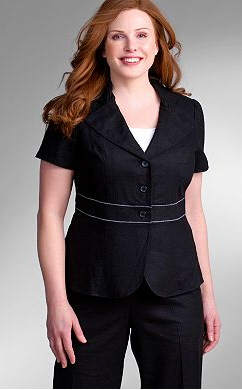
But when I started developing her character (based off of multiple images of her from that website and a few retailers where she modeled), I discovered that she was becoming too much like Zarah. I guess plus-sized models are directed to use similar body language and facial expressions when modeling. But I went ahead and finished writing the proposal with her as the RWT for Caylor.
After receiving a cover design for Love Remains with a female model that looked nothing like Zarah, the publisher told me that they wanted to be able to use stock images for the covers (rather than going to the expense of a photo shoot). So instead of leaving things to chance, I hopped onto a stock photo site and started browsing images of twenty- and thirtysomething redheads in order to both re-cast Caylor and to have stock images for the designer to work with. And I came across this image:

And, suddenly, Caylor’s character clicked for me. (And I was able to find a bunch of other images of her, as well, which only helped me both in the prep work and as I wrote.) Caylor went from being soft-spoken, demure, and something of a shrinking violet to vibrant, sassy, occasionally silly, outgoing, yet still able to be professional as an author and a professor when needed.
She also went from having long, softly curled hair that becomes somewhat of a curtain to hide behind, to a short, chunky, purposely messy style that announces who she is as soon as she enters a room. (Or runs into the hero on the stairs in her office building.)
Maybe this visual will show the importance of getting just the right RWT for a character:
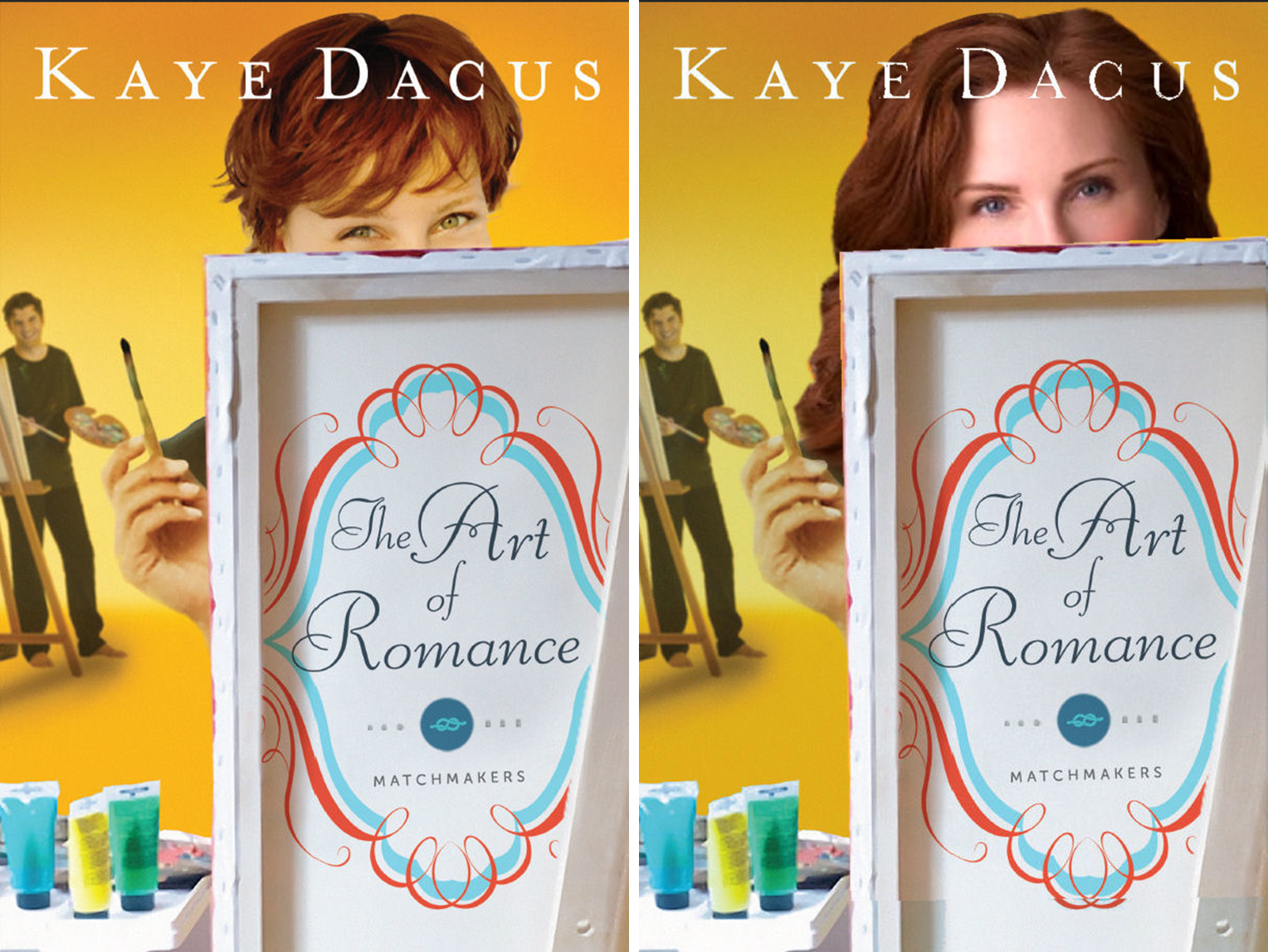
Even with just the eyes and the hairstyle showing, they’re obviously two different characters.
How has the process of character casting and/or working with Real World Templates helped (or hindered) you when it comes to developing your characters?
* * * * * * * * * * * * * * * * * *
In case you missed the other posts in this series…
Part 1: Character Development for Visually Oriented Writers; or, Be Your Own Casting Director
Part 2: Be Your Own Casting Director: 4 Methods of Character Casting
Part 3: Be Your Own Casting Director: Creating a “Casting Book”
Part 4: Be Your Own Casting Director: Using Real World Templates in Character Development
Part 5: Be Your Own Casting Director: Isn’t This All Just a Big Waste of Time?
* * * * * *
If you like what I do here and want to keep this content free,
consider supporting me and my work by buying me a coffee.
Fun Friday: The Dog Days of Autumn

Doggies plus autumn. What could be better?!?!
Costume-Drama Thursday: Pompeii (2014)
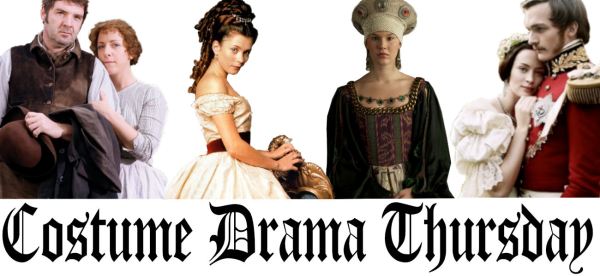

Picture © 2014 Constantin Film International GmbH and Impact Pictures (Pompeii) Inc. All rights reserved.
Title: Pompeii
Historical Setting: Pompeii, Roman Empire, 79 CE
Starring: Kit Harrington, Emily Browning, Adewale Akinnuoye-Agbaje, Kiefer Sutherland, Sasha Roiz
Original Release Year: 2014
This movie didn’t make much of a blip at the box-office when it released back in February, and for those reviewers who did see it, it was largely panned. I, however, found it vastly entertaining, if for no other reason than seeing Sasha Roiz (Capt. Renard on Grimm) as a Roman Centurion.
.
.
.
.
Bonus Video
http://youtu.be/fWmw01XZGBE
Be Your Own Casting Director (Part 3): Creating a “Casting Book”
In the previous post, I mentioned that one of the methods of character casting depends greatly on creating a “Casting Book.” This isn’t necessarily a “book,” though; for me, for many, many years, I had two four-inch-thick three-ring binders—one for men, one for women—in which I had a page/pages for each Real World Template (RWT). I subscribed to multiple entertainment magazines and made sure I got as many clothing company catalogs as possible. This, of course, was back before the days of wide Internet use and computers that could store images without filling up the hard drive.
Creating Your Casting Book
There are so many ways to keep a casting book, but there’s really only one way to start: Always be on the lookout for images of people who strike a creative nerve inside you. You can find them in:
- Catalogs—either online or physical
- Magazines—again, virtual or physical
- Movies/TV shows (best place to find out who the actor playing that character is is on IMDb.com)
- Stock Photo Sites (Unfortunately, my favorite, JupiterImages.com, no longer exists, but Getty Images will work as long as you can put up with the gray-box/label on the images). Just be aware that you cannot use any of the images from most stock-photo sites for anything other than personal usage without paying for them.
- Pinterest (follow authors—most of us have Possible Character Template type pages)
- Museums/libraries’ online photo collections
- People watching (this is why God invented camera phones!)
Once you find the templates, you can keep track of as much or as little detail as possible about them—if they’re public figures (celebrities, professional athletes, etc.), there will be much more specific info on them than if it’s a model from a catalog or someone you happened to see on the street and sneaked a picture of. This is why I prefer using celebrities/public figures, because not only do I want multiple images, and preferably video, of them to study expressions, body language, and vocal intonations/dialect, I like to keep track of a lot of technical specifications as well, such as:
- Year born
- Height
- Hair color
- Eye Color
- Ethnicity
- Where I first noticed them
I find most of this info on IMDb.com, or sometimes from Wikipedia and/or fan websites. This info is collected in an Excel spreadsheet, which gives me the ability to sort and filter by any of these indicators.

A screen shot of the Actresses page in my Casting Book, sorted by Last Name (click image to view full-size)
.
My Casting Book currently has just over 1,240 names in it (682 men and 560 women), but that’s because I haven’t recently gone through and added everyone I’ve pinned to my Possible Character Templates board on Pinterest, which would add probably 250 names to the list if not more.
Collecting Images of RWTs
As I mentioned at the beginning of this post, up until about fifteen or so years ago, I kept my casting books in three-ring binders with images cut out of magazines and catalogs. But then along came the Internet and computers with ever-increasing memory capacity (I have a 1-Terabyte external hard drive that’s smaller than my first Walkman, and even with two computers backed up to it, it isn’t half full). Once technology allowed me to forgo the physical books, this was how I kept the images that went along with the Excel spreadsheet:
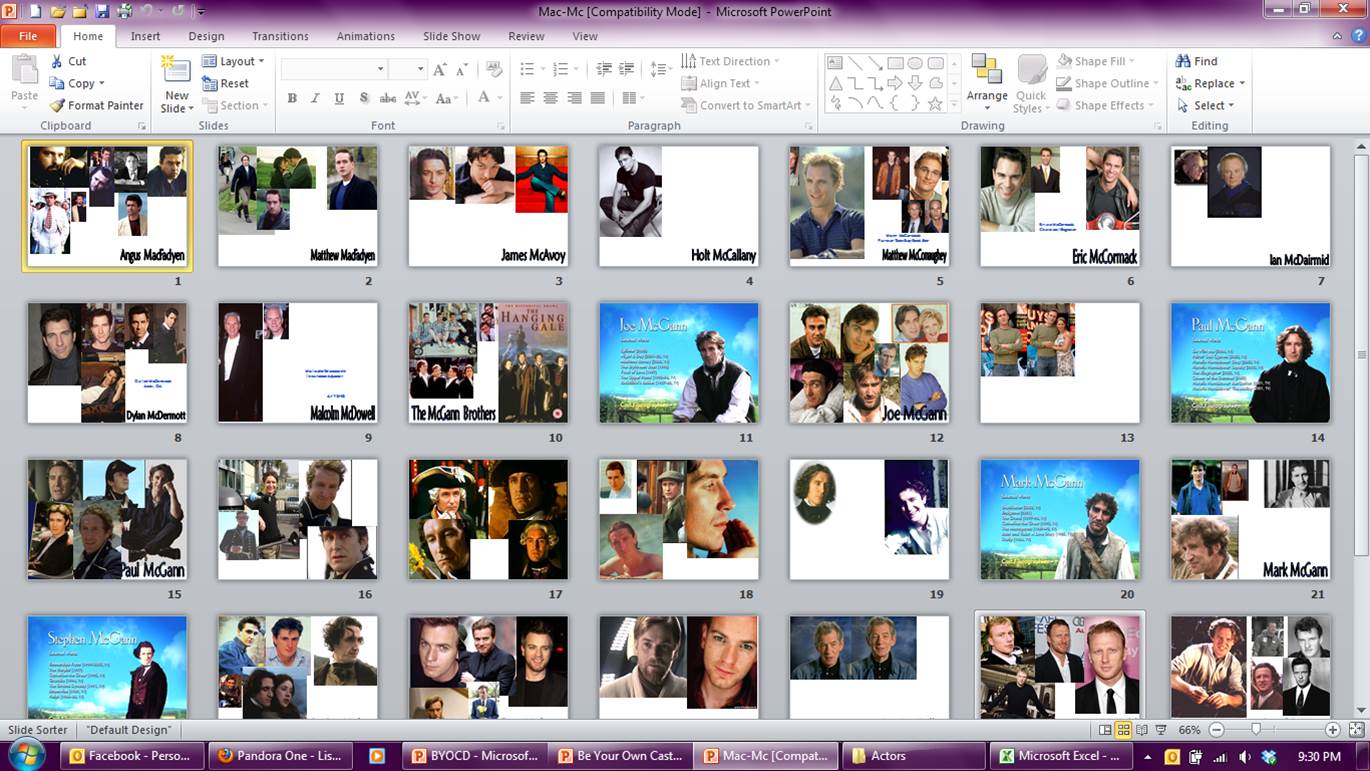
Slide-sorter view of the PowerPoint document containing my “Mac-Mc” Real World Templates (click image for full-size view)
.
I still have all of these files—two PowerPoint documents for each letter of the alphabet (one for men, one for women). I haven’t added to them in a couple of years. Not since . . .
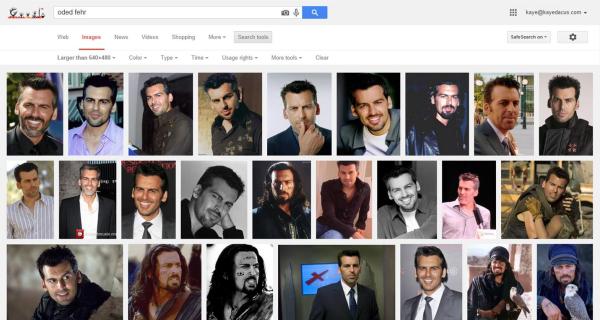
Google Image Search for Oded Fehr, using the search tools to make sure I’m getting larger/higher quality images (click for full-size image)
.
Google Image Search is such a space saver when it comes to finding multiple images of RWTs. I’m not having to keep files with multiple images of every template that’s listed in the Casting Book spreadsheet—not when it’s so easy to find images of them online.
And now, with the addition of Pinterest, I have another place where I can “keep” my templates, though I typically don’t do more than one or two on the Possible Character Templates board until I’m ready to use that template—and then I will add them to the board dedicated to that particular story.
Casting a Character Using the Casting Book (Character “Shopping” Method)
First . . . I generally know what kind of character I’m looking for:
- White
- Between 30 and 40 years old
And I filter the spreadsheet appropriately:
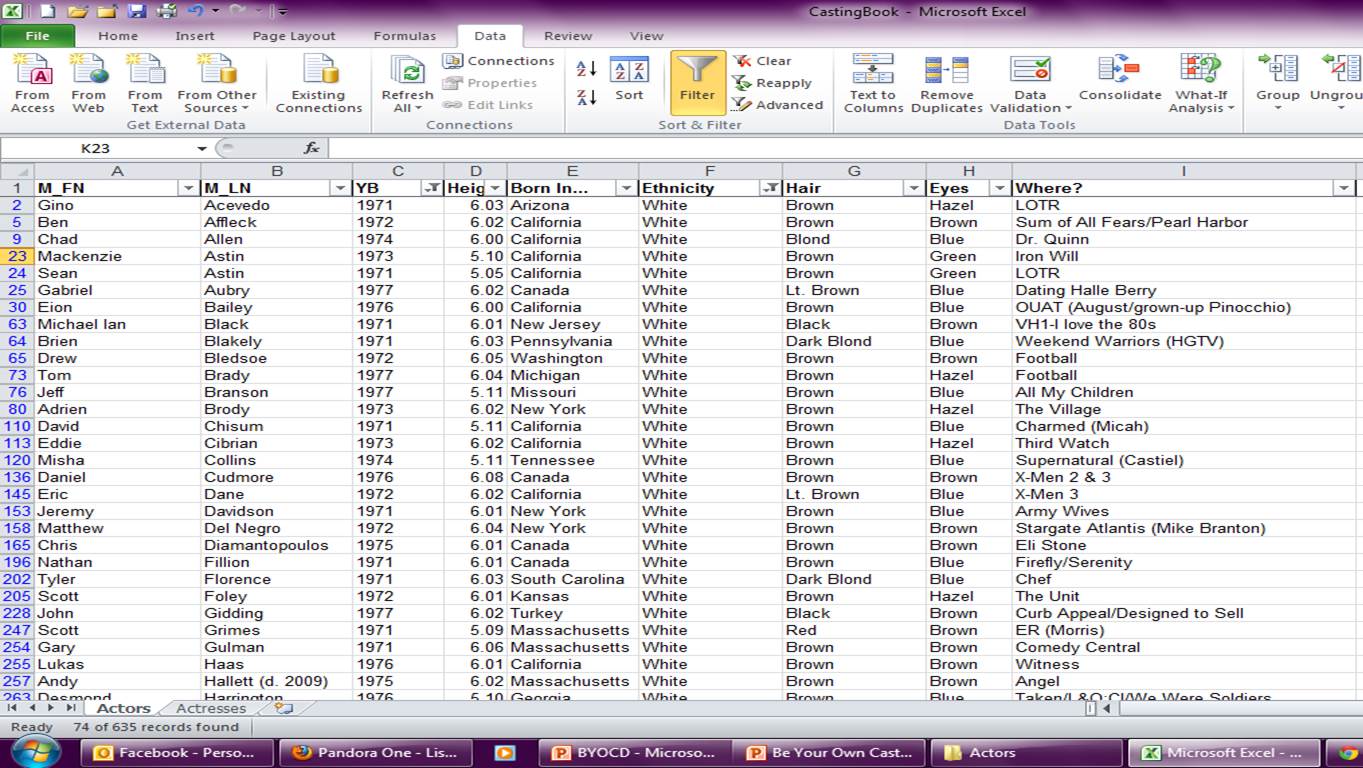
Spreadsheet filtered by YB (year born) and Ethnicity. (click image for full-size view)
.
Then . . . I start to narrow it down:
- Brown hair
- Blue eyes

Previous results additionally filtered by hair color and eye color (click image for full-size view)
.
Once I choose a template from the short list, I go over into Google Image Search and look him up:

.
Then, my story bible and my Pinterest board for that story idea come into play.
That’s the “shopping” method. But if you’re always on the lookout for templates to add to your casting book, you’re “browsing” and you might just be struck by “lightning.”
Do you have a “casting book”? How do you find and then collect/keep track of your possible character templates?
* * * * * * * * * * * * * * * * * *
In case you missed the other posts in this series…
Part 1: Character Development for Visually Oriented Writers; or, Be Your Own Casting Director
Part 2: Be Your Own Casting Director: 4 Methods of Character Casting
Part 3: Be Your Own Casting Director: Creating a “Casting Book”
Part 4: Be Your Own Casting Director: Using Real World Templates in Character Development
Part 5: Be Your Own Casting Director: Isn’t This All Just a Big Waste of Time?
* * * * * *
If you like what I do here and want to keep this content free,
consider supporting me and my work by buying me a coffee.
Be Your Own Casting Director (Part 2): Four Methods of Character Casting
If you’re not someone who is “into” character casting or even that much into writing the physical descriptions of characters, you may be wondering:
Why Worry About Looks?
After all, we’re writing stories, not casting a movie or play. Right, but see, here’s the thing: too little description can leave readers struggling to connect while too much description gets boring/overwhelming. Knowing all the details of what a character looks like by having a readily available picture of him/her allows us to find a balance between too much and not enough description. We’re not having to try to figure out what the character looks like by writing down every detail that comes to mind because we can see them so clearly in our heads and we don’t want that image to disappear, and we’re not abandoning description altogether because we really don’t know (or care) what the character looks like anyway.
However, even we visually oriented types have to keep something very important in mind: Physical description is not character development. It’s the giftwrap on the package. And the level of physical description offered in a story varies by genre. Typically, romance, fantasy, and science fiction genres will have much more, and more specific, descriptions of the characters’ physicality; while mystery may focus only on what’s important (or what the writer wants the reader to think is important) to solving the case. Thrillers, action adventure, and even horror can be sparing with descriptions, using the bare minimum to draw the reader into the character’s peril or heroicism.
Finding Real World Templates (RWTs)
After many, many years of doing this, I’ve narrowed my methods down to four. Yours may be one (or all) of these, or you may have a different way do to it. There is no right or wrong way. Do it the way it works best for you—or don’t do it if you find it’s distracting rather than helpful.
1. Character “Fitting”
You already have an idea of what the character looks like and you go on a search for someone who fits. For example: I have a story idea. I know my heroine just turned 40 (because the story hinges on that). She’s from a big Southern family. I want her to be plus-sized with dark hair and dark eyes, somewhat tall. She’s a scientist/genius—but not the stereotypical short hair, lab-coat, and horn-rimmed glasses female scientist. But because of her physical presence and her genius-level intellect (and the fact she’d finished two PhD’s by the time she was twenty-eight years old), men tend to be intimidated by her.
With this description in mind, I went out searching. And I found the RWT for Kyleigh Bordelon in the plus-size clothing section on the Nordstrom website:

.
2. Character “Shopping”
As soon as the idea for a character comes to mind, you immediately shop for a RWT to develop the character from. For example—you know you want a character who’s a certain age and certain ethnicity—but you really aren’t sure about anything else. You “shop” around until you find the RWT that speaks to you.
.
3. Character “Lightning”
You see someone who inspires a character. For example:

Paul McGann as 2nd. Lieutenant William Bush in Hornblower: Mutiny
It wasn’t just seeing an image of Paul McGann in this uniform that inspired the entire Ransome Trilogy. It was seeing Paul McGann in this uniform as Lt. William Bush in the Horatio Hornblower movies that inspired the entire Ransome Trilogy. You see, had a different actor played this role—one without a voice and accent that is like bathing in melted chocolate for the ears, one without those impossibly fathomless blue eyes—I might never have become obsessed with the character of William Bush. And I might never have fixated on the line in Duty (in the scene here, starting at 1:45) when Bush says to Hornblower: “In my opinion, sir, there’s never a good time to get married.” Which, of course, made me take pencil to paper and start figuring out just what kind of woman it would take for William Bush (soon to be rechristened William Ransome) to change his tune when it comes to getting married.
.
4. Character “Browsing”
You spend time browsing IMDb, catalogs, websites, and adding images to a casting “book.”
Ah, there’s that term . . . casting book.
Which we’ll get into tomorrow. But for now . . .
.
What methods do you use/have you used in the past to cast your characters?
* * * * * * * * * * * * * * * * * *
In case you missed the other posts in this series…
Part 1: Character Development for Visually Oriented Writers; or, Be Your Own Casting Director
Part 2: Be Your Own Casting Director: 4 Methods of Character Casting
Part 3: Be Your Own Casting Director: Creating a “Casting Book”
Part 4: Be Your Own Casting Director: Using Real World Templates in Character Development
Part 5: Be Your Own Casting Director: Isn’t This All Just a Big Waste of Time?
* * * * * *
If you like what I do here and want to keep this content free,
consider supporting me and my work by buying me a coffee.
Character Development for Visually Oriented Writers; or, Be Your Own Casting Director (Part 1)
Does your computer monitor look anything like this?
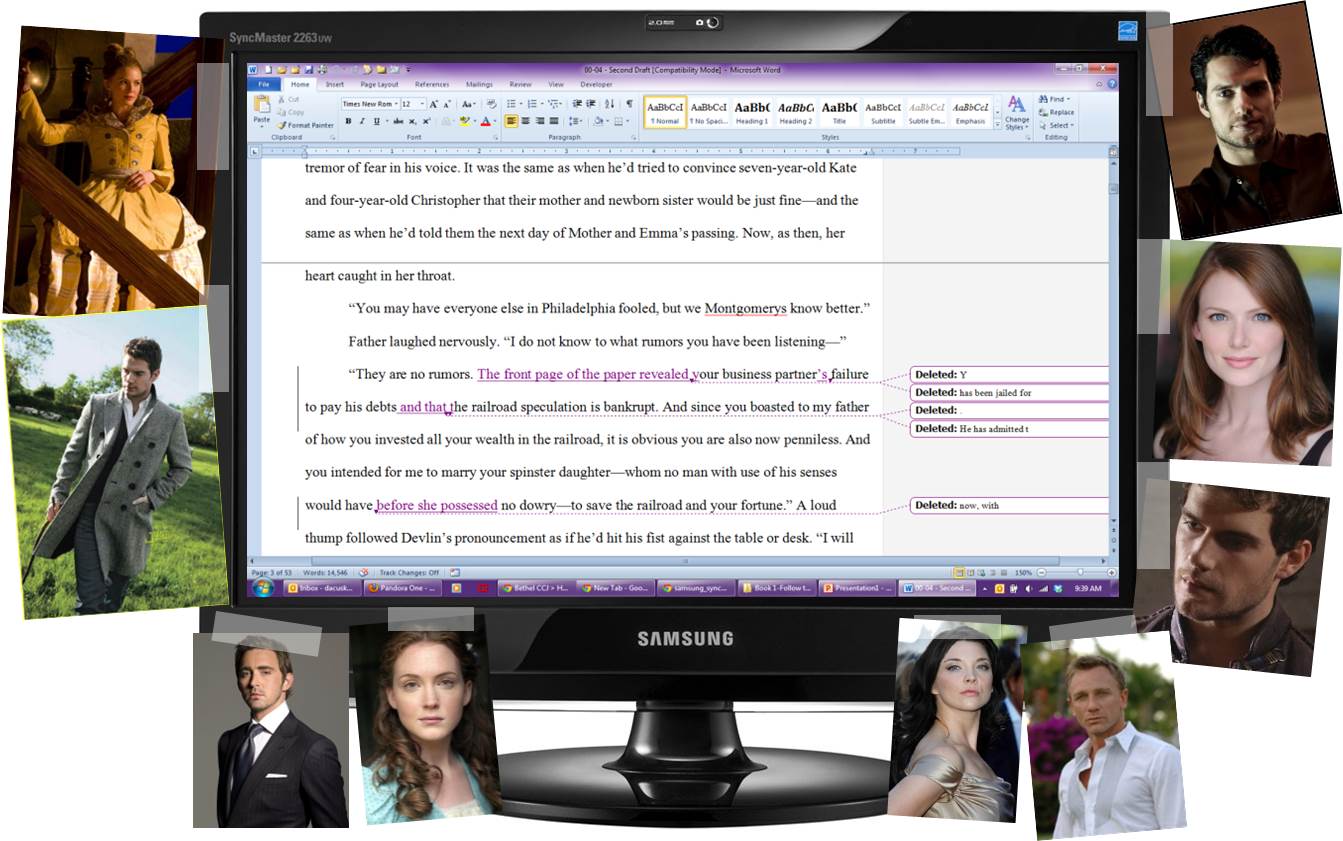
.
Do you have a wall or bulletin board in your house like this?

.
Do you get a story idea and immediately start one of these?
.
Do you have files on your computer like this?

.
Have you ever sneaked a photo of a complete stranger?

.
You might be a visually oriented character developer!
Let’s back up a minute for those who aren’t . . .
Character Casting goes deeper than just finding images of people who look like our characters. Those of us who are compelled to find Real World Templates (RWTs) for our characters are looking for inspiration—for emotions, actions, and body language in addition to how they look. We use RWTs as one of many building blocks for character development.
Just like every other way of character development, we are looking to create characters who jump off the page as real, whole, alive PEOPLE. Character casting gives us tools we use to connect the reader to the story in a way that goes beyond just describing what a character looks like. The characters are the active part of the story—they are what give the story emotional resonance, whether it’s a romance novel or an action thriller. Characters are what make the reader care what happens in the story.
But this blog series redux isn’t really about taking characters to that level.
For the next week or so, we’re going to look at what, to me, is one of the most fun parts of developing a story: casting my characters and then finding as many images of the Real World Templates as I can so that I can use those to generate ideas about who the characters are.
Do you cast your characters?
If so, how do you cast your characters?
* * * * * * * * * * * * * * * * * *
The Be Your Own Casting Director complete series:
Part 1: Character Development for Visually Oriented Writers; or, Be Your Own Casting Director
Part 2: Be Your Own Casting Director: 4 Methods of Character Casting
Part 3: Be Your Own Casting Director: Creating a “Casting Book”
Part 4: Be Your Own Casting Director: Using Real World Templates in Character Development
Part 5: Be Your Own Casting Director: Isn’t This All Just a Big Waste of Time?
* * * * * *
If you like what I do here and want to keep this content free,
consider supporting me and my work by buying me a coffee.
Costume Drama Thursday: Winter’s Tale

I thought maybe it was time to reintroduce this weekly feature, although a little less intensely this time—by simply sharing a video or two (trailers, odes, tributes, etc.) to some of my favorite costume dramas from over the years.
Here’s one of my recent favorites.
Title: Winter’s Tale
Historical Setting: New York, Early 20th Century (and present time)
Starring: Colin Farrell, Jessica Brown Findlay, Russell Crowe
Original Release Year: 2014
.
.
Writing Tip #10: YOU Are Your Best Source of Motivation
There are going to be days (weeks . . . months . . .) when we don’t feel like writing. We may sit in front of the computer for an hour and write six words—and then delete three of them. Or during our designated writing time, we find that’s the best time to scrub the toilet and clean out that dark corner cabinet that’s been emanating a funky smell for at least three months.
We’ve turned into Rick Castle staring at his laptop for hours on end and then jumping to grab the phone when it rings and, instead of hello, saying, “Please tell me there’s a dead body,” so he can get away from the writing he’s supposed to be doing.
What we need is motivation. So where do we get it?
Writing Tip #10. YOU are your best source of motivation.

No matter how many writing groups you join, no matter how active you are in them, no matter how many blogs you write and read and comment on, no matter how many writers’ forums you participate in, when it comes down to it, writing is a solitary venture. Unless you put YOUR butt in YOUR chair and start committing words to paper (whether electronic or wood pulp), your story will not get written.
And, yes, I need this lesson as much as or more than anyone who may be reading this post.
There are external stimuli that can put the pressure on you to write: school, critique partners, readers expecting the next chapter (contracts, deadlines, agents, editors). But the truth of the matter is, they aren’t in control of your writing, you are.
If the artist works only when he feels like it, he’s not apt to build up much of a body of work. Inspiration far more often comes during the work than before it, because the largest part of the job of the artist is to listen to the work, and to go where it tells him to go. Ultimately, when you are writing, you stop thinking and write what you hear.
(L’Engle, p. 149)
Remember the most famous line to come out of the movie A League of Their Own about baseball and crying? Well . . .
There’s no whining—there’s no whining in writing!
But I don’t feel like writing.
Tough. Do it anyway. Sure, you may find that you’re writing drivel that you’re eventually going to edit out in a future revision—but as our guru Ms. L’Engle said, more often than not, you’ll find that once you make yourself sit down and do the work, the inspiration will come.
I’ll double up my word count tomorrow.
“You pile up enough tomorrows, and you’ll find you are left with nothing but a lot of empty yesterdays” (The Music Man).
That’s a really slippery slope—I don’t feel like writing today, so I’ll double up tomorrow. And then tomorrow—I don’t feel like writing today, but I can get three days worth of words written tomorrow. And soon, you’re pressed up against your deadline (whether it’s self-imposed or external) and you’re having to write 28,000 words over Thanksgiving week to make your deadline. (Hello, Ransome’s Crossing.) Or you’re sitting on about 22,000 words on June 17 with forty-four days in which to write the remaining 83,000 words. (Hello, Ransome’s Quest.)
So what are some ways in which you can keep yourself motivated?
1. Pick a project you want to work on.
- For those of you who are not yet under contract, you’re at a beautiful, glorious time in your writing journey—because you can choose to work on anything you want to. So, hearkening back to yesterday’s post about writing your passion, make sure you choose a story that’s going to keep you motivated to write it. Yes, there are still going to be times when you don’t feel like writing it; there may be times when you hate it. But if you choose something that interests and intrigues you, you’re more likely to stay the course and get it finished.
2. Take a moment to remember why you started writing in the first place.
- Why did we start writing in the first place? Was it so that we could get our wrists slapped and be told “no” and “don’t” and “you can’t do it that way”? So we could sit at the computer and stare at the screen and feel so inadequate and full of self-doubt that we’d never be able to do it “right” that we’re unable to write at all?
Of course not. We all started writing because WE LOVE TELLING STORIES!
3. If your story has lost steam, stop writing and sit down and read it.
- Not to edit it, but to see if it’s your story or you that’s lost steam. If it’s your story, see if you can find the place where it went off track—or see if there’s a place where you can introduce a new character or a new plot twist. I couldn’t get rolling on Stand-In Groom after three full drafts (written, not revised) of the first ten chapters until I came up with the hidden-identity plot.
Do the “what if” exercise. Get out a notebook/legal pad and your favorite pen or pencil (or do it on a white board or easel pad on the wall)—and just start brainstorming. What if instead of George being resentful at having been sent to Louisiana to plan his boss’s wedding, he’s having to pretend to be the groom? What if instead of butting heads with George because it’s obvious he doesn’t want to be there, Anne’s conflict is that she’s afraid she’s falling in love with a client? What if the last time William and Julia saw each other wasn’t when she was ten, but when she was seventeen? And what if when she was seventeen and he was twenty-two, they fell in love and he almost asked her to marry him?
4. If you can’t come up with any ideas on your own, brainstorm with a few trusted people.
- These can be other writers, family members, friends, anyone who is creative and with whom you’ve talked about your writing before. No, you probably won’t be able to use 90 percent of what you come up with, but it may stimulate you to come up with some new ideas on your own (but be sure to write everything down just in case).
 5. Set daily goals.
- Whether it’s a word count goal, a goal to write one scene, one chapter, one page, one paragraph, whatever, per day, set a standard and make yourself meet it every day. I know, I’m the world’s biggest hypocrite in writing that. After each book deadline, I always say the next one’s going to be different. I’m going to write 1,000 or 1,500 words a day and get the first draft finished early so I actually have time to re-read it and edit it before I have to turn it in. But it never seems to stick.
6. Reward yourself when you meet your goals.
- Did you meet your daily word goal today? Great, now you can watch Castle. Did you exceed the number of pages you wanted to get written this week? Excellent, enjoy dinner out and get the biggest, gooiest, fudgiest dessert on the menu—as your appetizer. Have you reached a total word count higher than anything you’ve ever reached before? Superb. Go get a mani/pedi. Did you finish your first draft? Pop open a bottle of wine, go get a massage, meet the girls (or guys) for a fun night out on the town. Go see that movie you’ve been wanting to see. Take a mini-vacation. (Try to not make all of them food rewards.)
7. Develop a routine/create a schedule.
- AND STICK TO IT! I would imagine that for someone with other people in the house, it’s all about setting rules and boundaries. Rules about what time certain things will be done, and boundaries to let the other people in the house know that during those certain times, they aren’t allowed to cross certain boundaries (like the threshold of the room you’re trying to write in). Make a DO NOT DISTURB sign and hang it on the door of the room in which you’re working—or if your writing space is in a common space in the house, hang the sign from a string and wear it around your neck. Let the people in your house know what your schedule is and what their boundaries are (Unless someone is bleeding and needs to be taken to the hospital, do not talk to me for the next forty-five minutes.) Once you establish your routine, the rest of the people in your life will adjust to it. As long as you stick to it.
8. Unplug.
- A while back, a friend of mine posted a link for some software she’d purchased that will block her access to the internet for a specified period of time. Now, I’m bad about keeping Outlook and Twitter turned on when I’m sitting at the computer—unless I go somewhere (like the library at my undergrad college) where I can’t access the internet—and reading each e-mail as it comes in when I’m supposed to be working.
 We complain about how addicted kids are to their smartphones—there is actually evidence that it is an addictive disorder. How many of us have the same problem, it’s just hidden because it’s coming in on the computer where we’re “working,” instead of on a more obvious hand-held device? Try working away from the computer (writing longhand) or try unplugging/turning off your modem (most laptops have a key which will sever a WiFi connection—mine is on the F2 key). Turn the TV off—or move out of the room where it is. Turn the sound on your phone off (if there’s another parent/adult who can be the designated emergency-dealer-with’er for that span of time).
Writing is your job, your profession, so act like a professional who’s on the clock. You’d be amazed how much you can get accomplished when you don’t allow yourself to become distracted. (Though you may need to shoot the neighbor’s dog who barks constantly underneath your office window.)
9. Take regular breaks.
- When I worked at the newspaper, I was the ergonomics specialist for my department. One of the things that I was tasked with training everyone to understand is that you must take regular breaks while you’re working to stay fresh and to stave off physical strain and exhaustion.
- Every fifteen to twenty minutes, look away from your computer screen or notepad for at least a minute and up to two minutes at something in the distance, at least ten to twenty feet away. This cuts down on eye strain and on headaches.
While you’re taking your eye break, give your hands a break, too. Put your pen down or take your fingers off the keyboard and rest your hands in a relaxed, flat position. Your wrists and fingers should be straight. If you’d like, you can stand and stretch or just move around your desk area for these few moments.
Don’t go longer than an hour without taking a real break. Get up from your desk. Walk into another room. Get a glass of water. Go to the bathroom. Do something else for about five to ten minutes. But time yourself. Don’t allow this to distract you from your writing.
If you’re going to work longer than two hours, do some stretching exercises at least once an hour.
Make sure you’re working in an ergonomically correct position.
10. Believe in yourself.
- You’ll have enough rejection and negativity rolling in from the outside. You don’t need to be another source of it.
You know it takes courage to write. It takes courage to write when you’re not published and you don’t have an agent.
It takes courage to write when you are published and you do have an agent (this is why so many writers drink to excess or anything they can think of to drink to).
You have it inside you to fight this fight. Write, think about what you write, then write some more.
Day by day. Year by year.
Do that, and you’ll jump ahead of 90 percent of the folks out there who want to get published.
(Bell, p. 258)
__________________________________________
Works Cited:
Bell, James Scott. The Art of War for Writers: Fiction Writing Strategies, Tactics, and Exercises. Cincinnati, OH: Writer’s Digest Books, 2009. Print.
L’Engle, Madeleine. Walking on Water: Reflections on Faith and Art. Wheaton, IL: Harold Shaw Publishers, 1980. Print.
Music Man, The. Dir. Morton DaCosta. Warner Bros. 1962. Film.

 KayeDacus.com