#FirstDraft60 Day 11 — Write Out Your Main Characters’ Backstories
 As the culmination of everything we’ve done with our characters this week, we are going to pull everything we know about them together and write down—and discover more through the process—their backstories. One of the worst things we can do in our writing is not develop our characters well. This comes either from a lack of knowledge of how to do it or not spending enough time getting to know the characters at a deeper level.
In Noah Lukeman’s writing craft book The Plot Thickens: 8 Ways to Bring Fiction to Life, the first THREE chapters of eight are about characterization. There are dozens of books on the market about characterization—to help with everything from naming them to giving them careers to describing what they look like. That’s in addition to general books about writing that contain chapters or entire sections on building believable characters.
“Begin with an individual and you will find that you have created a type;
begin with a type and you will find that you have created—nothing.”
~F. Scott Fitzgerald
What Fitzgerald was saying is that if our characters do not stand out as unique individuals—if instead they fall into “types”—then our writing will be empty.
On a road trip with my family more than thirty years ago, we took along a little questionnaire booklet called “So, You Think You Know Your Parents?” Instead of just trying to answer all the questions ourselves, my sister and I used it as an opportunity to get to interview our parents to get to know them better. The beginning of it contains questions like:
When are your parents’ birthdays?
What cities and states were your parents born in?
Were they named for anyone?
Did they have childhood nicknames?
What was their favorite subject in school?
When they were children, what did they argue most about with their parents?
How did they meet?
Where did they go on their first date? (My parents went to see The Sound of Music for their first date. Is it any wonder I love that movie?)
And so on. Later in the booklet, the questions get a little more in depth:
If your parents found a wallet with $100 in it, would they try to find its owner or keep the money?
What one food do your parents absolutely refuse to eat?
Are they open to changing their minds after making a decision?
What was the happiest moment in each of their lives? The saddest? The funniest? The scariest? (My dad’s being sent to Vietnam, for both of them.) The most embarrassing? The most important?
What irritates them more than anything else?
What do they worry about more than anything else?
Do they always believe “honesty is the best policy”?
What would they say is their worst habit?
What part of the newspaper do they read first?
What do they think about when they daydream?
“When the characters are ready, the story will come out of me.”
~Jeff Shaara
There are as many different ways to go about learning who your characters are as there are writers. Many writers talk about “interviewing” their characters during the development process. Here are three examples I have run across:
Character Background Worksheets
Character Chart
Character Profile Worksheet
I have tried each of these over the years—and while they’re fun for characters who come to me, but whose stories I do not plan to write immediately, I don’t usually bother with them . . . I find that much of what’s on them isn’t relevant to my particular character or the story I’m developing.
Rather than rely on charts or interviews, I go through the process I’ve taken you through this week. I start at the macro level—determining the basics about the heroine and hero from their jobs to their physical attributes—and then I start focusing in on more specific details (such as S.H.A.P.E.). Then I get down to the micro—I write out the character’s entire backstory: their family background, where they grew up, what they were like as a child/teen/young adult, where they went to school, what their interests were, and so on. For example (from Stand-In Groom.):
Anne Hawthorne
- Born and raised in Bonneterre, Louisiana.
- Her parents were world-renowned magazine photographers who traveled extensively and left her with her grandparents or her mother’s brothers or sister. Anne begged her parents to take her along, but they went places with unstable governments, diseases, etc., that they didn’t want to expose her to. This left Anne with the subconscious feeling of being unloved and that she had to work to earn her parents’ love.
- For the first years of her life, she spent a net total of about six months a year with her parents.
- When she was eight years old, they surprised her with a trip with them to Washington, D.C. for the 4th of July. The commuter plane they were on to get from Bonneterre to New Orleans crashed. Only Anne and one other person out of 25 survived.
- For a year, while she recovered from her burns and injuries, Anne lived with her grandparents, at their rural home outside of the city. Her grandmother, a retired teacher, tutored her, and when Anne was tested to determine what grade she should go back in, she was able to skip ahead a grade.
- Because her grandparents lived so far out of town, Maggie, Anne’s mother’s only sister, and her husband offered for Anne to come live with them. While Anne loved her aunt and uncle and their four sons, she never allowed herself to become completely attached to them, not knowing when or if they might get tired of her and send her to live with someone else. After all, when her parents would leave her behind when they traveled, she would get bumped from home to home until they came back.
- The scars from her burns ran up the left side of her neck and onto her cheek. The teasing from the other children in school made her turn inward and become very isolated. Her cousins tried to protect her, but the other kids knew better than to do it around them and Anne didn’t talk about it. She also got teased about reaching her full height of 5’11” by age 13 and being larger-sized than was considered popular.
This is just the beginning of three pages that explain who Anne is and what her psychological makeup is. And here’s Alex’s backstory page in my OneNote Story Bible for my current project:

Does your character feel like a real, unique person to you? Do you feel like you know enough about him or her as a person that you’d be able to answer any of the questions I listed above? Have you interviewed your character and yet feel he or she is holding something back from you? Have you delved deeply enough into the backstory to truly know where the character is coming from? What techniques/books/questionnaires do you use to get to know your characters?
Assignment: Write out the full backstory (as full as you can make it at this point) for each of your main/viewpoint characters.
For Discussion:
What did you learn about your character(s) through the process of writing out the backstory that you didn’t know before completing this exercise? Did it give you any ideas for plot points or scenes that you can include in your story?
#FirstDraft60 Day 10 — What Does Your Character Want, What Will She Do to Get It, and What Can Stop Her? (a.k.a., Goals, Motivations, and Conflicts)
No matter how wonderfully complex and well-developed a character is, a reader isn’t going to care about her unless they can identify with what the character wants, what the character is willing to do to get what she wants, and how she faces the challenges and obstacles that conspire to keep her from getting what she wants—otherwise known as Goals (desires), Motivation, and Conflict.
In Getting into Character, Brandilyn Collins wrote:
“What is your innermost Desire that will propel you through this story? . . . All of your main characters and important secondary characters should have a Desire. Conflicts between characters come into play when they are pursuing Desires that oppose one another” (37).
In Stein on Writing, Sol Stein describes plotting at its most basic as “putting the protagonist’s desire and the antagonist’s desire into sharp conflict . . . think of what would most thwart your protagonist’s want, then give the power to thwart that want to the antagonist” (83).
Before you can develop that conflict, you have to delve into what each character’s goal/desire is. We have a tendency to define characters as “good guys” and “bad guys,” but when we start developing real, multi-dimensional characters, we have to move beyond these epithets into the knowledge that no one is “all good” or “all bad” (unless, of course, you’re writing fantasy or allegory with “evil” characters such as Sarumon and Orcs). What separates our protagonists from our antagonists can be as simple as having goals that are in opposition to each other. That doesn’t necessarily make the antagonist a “bad guy” . . . but that’s another series.
Goals and Motivations
Having completed your characters’ S.H.A.P.E. analysis day before yesterday, you should already have a good grasp on who your character is, how she thinks and feels, and how she will react in just about any situation. Now you need to determine what your character’s story goal is.
What is it that each of your main/viewpoint characters wants that sets this story in motion—and keeps it going once obstacles arise? That’s the story goal.
- For example, the story goal for Anne in Stand-In Groom is to successfully plan and execute the biggest, most expensive wedding she’s ever been hired to do, which will secure the future of her business. For George, it’s to successfully plan and execute his (celebrity) employer’s wedding while keeping his employer’s identity a secret from the public—and from the wedding planner. And if you’ve read the book, you know how these two goals come into conflict with each other.
A character’s story goal should be specific, but should also be universal. When we define our character’s desire/goal, it shouldn’t just be, “I need to get from point A to point B,” but the deeper, “I must get home and protect my family from those who seek to tear it apart” kind of goal that transcends time periods. (Keep asking “why?” until you get to the deepest level.) Give your character the kind of goal she is not going to give up on—the kind she will fight to the death to achieve. Reaching that goal becomes the motivating force behind everything the character thinks, says, and does. And knowing what this goal is specifically gives us the ability to set up obstacles—in the physical environment, in the character’s own inner psyche, in the antagonist—to thwart our character’s achieving that goal.
If the character meets no resistance on the path toward gaining what they most desire, there is no motivation, no story. Think about The Wizard of Oz. If Dorothy & Crew hadn’t constantly met with conflict—with the Wicked Witch trying to stop them, with the Wizard turning out not to be a wizard after all—it wouldn’t have been a very interesting story.
The way I keep my characters movtivated is to make sure the character has a goal, then to set other characters and situations in opposition to that goal. If the character keeps coming up against a brick wall, or if someone or something keeps thwarting them from being able to reach their goal, the motivation to reach it grows stronger. Naturally, they cannot always fail in moving toward the desire—they must have some successes to show that this goal is ultimately achievable, if they will just persevere, hold on, keep going.
Assignment 1: Answer the following questions for each of your viewpoint/main characters:
- What is her main goal/desire?
- What will she do to attain it? (go deep here)
- What will she do when she meets resistance?
- How far will she go to achieve her goal/desire? (keep going deeper)
- What internal hindrances does she have that could keep her from achieving her goal? (Dig deeper than just fear—what is the root cause of the fear? What happened in the past to give her this fear?)
- What external hindrances could keep her from achieving her goal? (This can be the antagonist . . . or even the hero or other main character, family members, cultural restraints, geographic constraints, finances, etc.)
- Is there anything that could happen that would make her relinquish her goal? (If so, then you need to start over at the beginning, because this goal isn’t the right one.)
- Is this goal something she would sacrifice everything—her health, her wealth, her family, even her own life—to achieve? (Make her prove it by putting her in one or more of those situations.)
Conflicts
The conflicts in your story are the points that make up the majority of your plot. You will need minor conflicts (resolved in one or two scenes) and major conflicts—those that affect the outcome of the story. Rather than repeat myself, here’s a post that explains the difference between them and the necessity for each type of conflict:
Generating Conflict and Collecting Narrative Debt
In another series of posts, I have discussed conflict at length, and this is where Goals, Motivation, and Conflict come into union with each other:
It’s Good to Be Conflicted
Conflict: Thematic vs. Actual
Conflict: Desires and Goals
Conflict: Move That Bus!
Assignment 2: For each character’s main story goal, determine what the main conflict is that will keep them from easily attaining that goal—and who or what presents that obstacle/challenge/conflict to the character.
_______________________________
Works Cited:
Collins, Brandilyn. Getting Into Character: Seven Secrets a Novelist Can Learn from Actors. New York, NY: John Wiley & Sons, Inc., 2002. 102–103. Print.
Stein, Sol. Stein On Writing: A Master Editor of Some of the Most Successful Writers of Our Century Shares His Craft Techniques and Strategies. New York, NY: St. Martin’s Press, 1995. Print.
#FirstDraft60 Day 9 — Your Characters’ Physical Descriptions including Character Casting
Today we’re going to get into what is, to me, one of the most fun parts of prep work—figuring out what our characters look like!
Part 1: Casting Your Characters
There is absolutely no point whatsoever in me repeating what I’ve posted before about casting your characters, so here are the links to the series:
Be Your Own Casting Director—Choosing and Using Real World Templates (RWTs) to Help with Character Development (Updated September 2014, originally published October/November 2006).
-
Character Development for Visually Oriented Writers; or, Be Your Own Casting Director
Be Your Own Casting Director: 4 Methods of Character Casting
Be Your Own Casting Director: Creating a “Casting Book”
Be Your Own Casting Director: Using Real World Templates in Character Development
Be Your Own Casting Director: Isn’t This All Just a Big Waste of Time?
- Original Series:
Be Your Own Casting Director: Introduction
Be Your Own Casting Director: Real World Template Exercise
BYOCD: Creating a Casting Book
BYOCD: Collecting Images
BYOCD: Putting RWTs to Work for You
BYOCD: Guided Brainstorming with RWTs
- Other posts about using Real World Templates/Character Casting:
Virtual Barbies and Paper Dolls
Storyboard Examples
Part 2: Describing Your Characters
If you haven’t already done so, it’s time to put the full description of each of your main (POV) characters into your story bible, as well as any details you might know about your secondary characters. If you do already have some of this, go back and make sure you have all of it—and see if there are ways in which you can make your characters’ looks more unique.
Create a page/folder/section for each character so that the info isn’t running together and so that they’re easier to find.
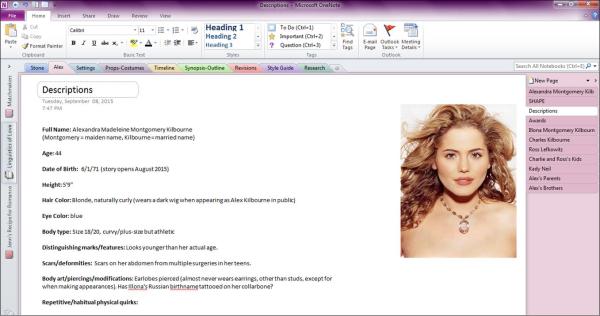
Here’s what this part should include for each main/POV character:
Full Name:
Age:
Date of Birth:
Height:
Hair Color:
Eye Color:
Body type: (stocky, muscular, athletic, full-figured, slender, emaciated, etc.)—from the character’s viewpoint and in others’ opinions, if that’s important
Distinguishing marks/features:
Scars/deformities:
Body art/piercings/modifications:
Repetitive/habitual physical quirks: (i.e., biting fingernails, grinds teeth, pops knuckles, rolls neck when stressed, leg bounces/can’t sit still, etc.)
Include image(s) of the Real World Template for the character if you have them. If not, there’s no time like the present to cast your characters.
Here’s mine for my heroine, Alex, using OneNote (still needs some work):
Assignment: Add your characters’ physical description (using the above “chart” or something of your own making) to your Story Bible. Cast your characters, if desired.
That’s all for this part for today. Don’t do anything else other than look at your characters’ physicality. And have fun with it!
FOR DISCUSSION:
What did you learn about your character(s)’ physical appearance that you didn’t know before this exercise?
#FirstDraft60 Day 8 — Getting Your Characters into S.H.A.P.E.
Yesterday, we determined who our main characters are and what POV we’ll be using in our stories. Today, we’re going to go deeper with our characters and chart out who they are as people.
When I start developing a story idea and know who at least one of the main characters is, the first thing I do is figure out where that character came from—literally and figuratively. I know that many people use character “interviews” or worksheets to do this; I write it out like a synopsis, letting the ideas flow as I write and the questions rise as they may. Part of this is figuring out who/what a character is, inside.
When working with a series in which my main character appeared in other books as a secondary character, I start by going back and making notes (if I didn’t already) of everything mentioned about this person (goes for physical description as well) and his or her background, personality, demeanor, reactions, actions, schooling, friends, work, etc. When working with new characters, I like to use a technique I actually learned on a church retreat.
Get Your Characters into S.H.A.P.E.
 Here’s a surefire way to figure out who your characters are, which does go hand-in hand with figuring out their backstory, which we’ll be working on later this week. But today, we’re going to work on getting our characters into S.H.A.P.E.:
– SPIRITUALITY: Not just for those writing Christian or inspirational fiction, this is something important for all writers to know about all of your main characters, because the characters’ morals and values, and thus their actions, reactions, and decision making, will hinge on what they believe about life and the afterlife and the value of both.
– HEART: What is your character passionate about? What are his desires? Her goals? What does she want to do with her life? What does he want to accomplish by the time he’s 30, 50, 70?
– ABILITIES: This goes beyond their physical abilities (walk, run, talk, etc.). What have they learned to do? Is she a Victorian girl who’s learned to use a typewriter in hopes of getting a job to support herself instead of marrying someone she doesn’t love? Has he learned to train guard dogs and police canines? But then, what are their inborn talents? Those things with which we would say he or she is “gifted”?
– PERSONALITY: What is your character’s personality type? This is where you can really have fun. Find out your character’s Meyers-Briggs type by taking the test as your character. If you don’t want to take the test, you can read about personality types. Introverts and Extroverts “recharge” differently and react differently in public and private settings. Thinkers and Feelers come to decisions in totally different ways. And so on. Make your character more dimensional by giving him or her a complete personality.
– EXPERIENCES: What are your character’s life experiences? What have your characters been through in their lives to make them who they are when they step onto Page 1 of your story? This is the bulk of the backstory, which everything else plays off of and is affected by. This part makes a really good lead-in to writing out the characters backstory, because it can include:
- – Family makeup/background. What size family does he come from? How many siblings? Were both parents present? Did she have a good relationship with them? What was his relationship with his siblings like? Did she love her family or could she not wait to escape? And so on.
– Education. Whether formal or self-taught, one’s education is crucial to who they are as a person. Did they have all the benefits of an upper-class private/Ivy League education? The scrappier, American-dream public school education? Or maybe she had to drop out in eighth grade and go to work to support the family. And even if someone went to school and got a college degree, that doesn’t make them “intelligent” or “learned.” That just means that they have a couple of pieces of paper. How intellectual is your character? How smart? How street-smart? How wise? How knowledgeable? How does this compare to the people around him/her?
– Favorites. Color, food, music, entertainment, etc. What are the things that give your character a good quality of life? (Or would if they had access to them.) Get creative and have fun with these.
And here’s the example of Stone’s S.H.A.P.E. page in my Story Bible:
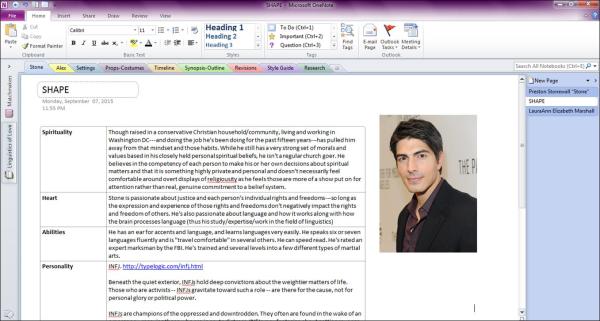
Once you have all of this down you should have a good understanding of who your character is. The reason I try to figure as much of this out before writing is that it saves me time in revision after finishing the first draft if I don’t have to go back and edit out long stream-of-consciousness scenes in which I’m inside the character’s head digging into backstory I didn’t know before I started writing. But no matter how detailed I get with this, I always have a few revelations about my characters—things I never would have known about them until they were faced with a crisis and forced to own up to something from the past they kept deeply hidden, even from me.
Assignment: Create and complete, as best as you can, a S.H.A.P.E. chart for each of your main/viewpoint characters in your Story Bible.
FOR DISCUSSION:
How will figuring out the S.H.A.P.E. of your character(s) help you in developing your story?
#FirstDraft60 Day 7 — Who Are Your Characters and What Is Your POV?
Now that all of your systems are (should be) set up, it’s time to start digging into the nitty-gritty of information you’ll need to know in order to be able to marathon-write a first draft. And this week, it’s all about the characters.
Schedule for Days 7–11:
Day 7 (today): Identifying your characters (main and secondary), and determining your POV and viewpoint characters.
Day 8: Getting Your Characters into S.H.A.P.E.
Day 9: Character Casting
Day 10: Determining Your Main Characters’ Goals, Motivations, and Conflicts
Day 11: Writing Out the Complete Backstories of Your Main Characters
Now, for those of you who’ve been around the blog for a while, you’ll recognize several of these topics. If you want to work ahead, or if you’ve already done your character casting or GMC or SHAPE, spend your FirstDraft60 time this week working on backstories or getting a head start on your synopsis/outline. But if you’re still in the process of figuring everything out, working thorough the activities/assignments this week should really help with figuring out not just your characters but generate new ideas for your story.
Identifying Your Main (Viewpoint) and Secondary Characters
The first question to ask yourself when it comes to determining your Viewpoint characters is: Whose story am I telling? In a romance novel, this is easy—it’s the story of the hero and the heroine as they fall in love with each other. In a detective/P.I. novel, it’s probably best to go with a single viewpoint—the viewpoint of the one solving the crime. However, even though these are usually the case, you can’t always force your stories to fit into that mold.
Next, which characters have important information to reveal to the reader that cannot be done without getting inside their heads? This is a tricky question—because when we’re first starting out writing, there may seem to be lots of characters who have important things to reveal to the reader, even if it’s just for one short paragraph. But as we read more, study more, and write more, we’ll get a better feel for what really is important and what isn’t. Typically, if it’s only one scene’s worth of information to be revealed, it’s probably not that important in the grand scheme of things—or it can most likely be revealed in another manner without dipping into that character’s POV for just one scene. If you’re not sure, make a list of the characters in your story and try dividing them up into three categories: walk-ons (may not even have a speaking role, may or may not need to be named, might have one or two lines of dialogue, but never appear again); secondary characters (are along for pretty much the whole journey, are somehow connected to the development of the story—but not important enough to have a viewpoint); and viewpoint, or main, characters (those whose story you’re telling). If you’re coming up with too many main characters ask the next question . . .
Which characters’ internal journeys affect the direction, conflict, climax, and resolution of the story? If you’re giving a character a viewpoint just to reveal information to the reader, they may not actually be a viewpoint character, they may be a secondary character. If you still end up with multiple viewpoint characters, ask . . .
Do all viewpoint characters’ story arcs tie in to the main plot of the novel? Does each viewpoint character’s storyline somehow intersect with and/or affect or influence the main plot of the story? Do the characters’ lives intersect with each other? Does each viewpoint character’s storyline wrap up at the end and tie in to the ending? If you have multiple viewpoint storylines going on, and they don’t tie in with each other by the end of the novel, what you have are two plots—two stories that should be separated from each other.
How often does a character’s viewpoint appear? If you have a viewpoint character who has only a few scenes scattered throughout a 350-page novel, it may be time to consider relegating that character to a secondary role and finding a way to incorporate what’s revealed in his/her scenes to one of the major characters—UNLESS there is a very compelling reason to only have a few, such as it’s the villain’s POV or something like that which serves to up the ante and increase the conflict and/or suspense.
Finally, which character has the most to gain/lose in each scene? Who will be the most embarrassed by what’s about to happen? Who has a secret agenda? Whose heart is going to be racing? Who’s going to be ducking around the corner out of sight and overhear something he/she shouldn’t? That will help you choose the correct viewpoint character for each scene. But it isn’t foolproof. If a scene feels flat to you, try it from another major character’s viewpoint and see if it changes things.
Assignment 1: Who are the characters that will have a viewpoint in your story (e.g., your “main” characters)? Who are some of your major secondary characters—those who are important but don’t get their own viewpoints?
Picking Your POV
“Point of View” or POV is quite often the term used to identify which characters’ heads the reader is allowed into in a story. However, we’re using it in the more technical, grammatical definition today.
In order to set your story up to get ready to write it, there are three parts of POV you must decide upon:
- Person: First (I, me, my), Second (you, your, yours), Third (he, she, his, hers, they, theirs).
- Omniscience: Omniscient (using a narrator, even if it’s an invisible/god-like narrator), Limited (camping out in just one viewpoint character’s head per scene, the narrative is in the character’s voice, not a “narrator’s”), Objective (more of a journalistic style—“just the facts, ma’am”—not seen in fiction often).
- Tense: Present (action is happening in the here-and-now), Past/Active (verbs are past tense, but because this is the most common form of storytelling, it still seems to be immediate action), Past/Passive (usually a form of the “be” verb plus a gerund—word ending in -ing—or a form of the “have” verb + past-tense verb).
You can read more about these, and the vast array of combinations thereof here.
Must you know what POV you’re going to use for your story before you start writing? It’s a good idea to have a grasp of what’s accepted/expected in your genre—and the example I always give here is that in romance, the accepted and expected (by readers) POV is 3rd Person, Limited, Past/Active with the heroine and the hero being viewpoint characters. But since this is a first draft and you’ll have ample time to revise after you complete this draft, if you want to play with POV to see what works best for your story, feel free to experiment.
Assignment 2: What POV will you be writing your story in? Is there anything you need to study/learn about this POV before you start writing?
#FirstDraft60 Day 6 – Sunday Reflections
On Sundays, we’re going to take a moment to step back and think about our writing from a wider view. In order to do that, I’ll post some guided questions—feel free to answer them here with as much or little detail as you’d like; or answer them on your own blog or on Facebook. Or just write the answers down in a private journal or notebook. The important thing is to actually think through and write down your answers.
Reflections for Day 6
1. How long have you been writing?
- Things to think about:
How old were you when you first started putting your story ideas down on paper?
How old were you when you completed your first novel?
2. How many novel-length manuscripts have you completed? What have you learned by completing manuscript(s)?
- If you’ve never actually finished one, how close have you come? Why haven’t you ever been able to finish one? What will it mean to you to finish a manuscript draft?
3. Why did you start writing?
- If this is your first attempt at writing fiction, what makes you want to do this?
4. How do you think participating in this challenge and completing a first draft of this particular story will change you?
- .
I look forward to seeing your answers and will be posting mine soon.
#FirstDraft60 Day 5 — Plan to Make Lists. Start Making Lists
Happy Saturday, everyone! This is going to be a quick post because today’s the day on which we can get caught up with our Story Bible prep work and we can cheat and work ahead on characters or plotting, or even downright writing, if we want!
We have lots of stuff to keep track of, both for our story in progress as well as just general writing-related stuff.
Which brings me to today’s assignment.
Make lists. Lots and lots of lists.
Something every successful con artist or pathological liar knows is that you MUST keep track of the details; you have to know whom you told what and when. Since those of us who call ourselves writers know that what we’re doing is basically telling lies for fun and fortune (okay, maybe not so much fortune as farthings), we need to remember what we’ve made up. So that’s what we’ve been working on setting up for the last few days: our Story Bible, where we can keep track of these details.
But there are a lot of other things we want to remember also, whether for this story or the next. For example:
Potential Character Names (some of mine are: Elaine, Stephen, Montgomery, Elisa, Joycelyn, Brandon, Kyle, Dacia, Liane, Neal, Ryan, Shaun (F), Alexander, Deborah, Grace)
Interesting Words (synonyms for loud: forte, fortissimo, sonorous, deafening, ear-rending, thunderous, crashing, booming, full-throated, trumpet-voiced, clangorous, clamorous, blaring; synonyms for do: act, serve, practice, take action, proceed, go ahead, run with it, make it so, get on with it, have a go, effect, bring about, deliver)
Possible Titles (The Wooing of Mrs. Paroo, House Mother, The Thirty-Five Guarantee, There Is Nothing Lost, Your Right to Remain Wrong, The Very Thought of You, The Bride’s Spinster Aunt, The Spinster Aunt Conquers the World, etc.)
Interesting Things Overheard (At a restaurant: “As soon as we get back to the office, we need to put a kill order in on McCall.” Guy on the phone at Panera: “How do you feel about widows?” Heard on ESPN: “Cooler than the flip side of the pillow.”)
There are also business/industry things we need to keep track of:
Networking Contacts (Agents/editors met at conferences; authors met at conferences; authors, publicists, book sellers met at book signings; librarians, book buyers, writing teachers)
Blogs (those to read daily, weekly, or occasionally—Feedly.com is great for this)
Reading Lists (books to read for fun; books in my genre for critical reading/study; research books; craft books; nonfiction; devotionals)
Research Resources (contacts for interviews, websites, books, museums)
And so on.
These can be kept hand-written in notebooks or you can use my old method of various sizes and colors of Post-it Notes stuck to the sides of the computer and the wall. Or you can type them up and keep them electronically.
So while this assignment isn’t necessarily specific to your current story in progress, it is a good idea, if you haven’t done so already, to create a “lists book,” or a central location where you keep your lists for easy access for when you want to use something from them or need to add something to them.
Happy list-making, everyone!
#FirstDraft60 Day 4 — Choosing How to Track and Organize Your Story’s Timeline and Structure
If you’ve worked through the assignments for the last few days, your Story Bible should be mostly set up and ready to go. Today, we’re going to add two additional, important sections to it.
Story Synopsis/Structure
One of the things we’re going to work on in Days 21–30 is the development of your story and structuring it to help give you momentum and security as you write (security that you know where your story is going and what you’re supposed to be writing when you sit down every day to do it).
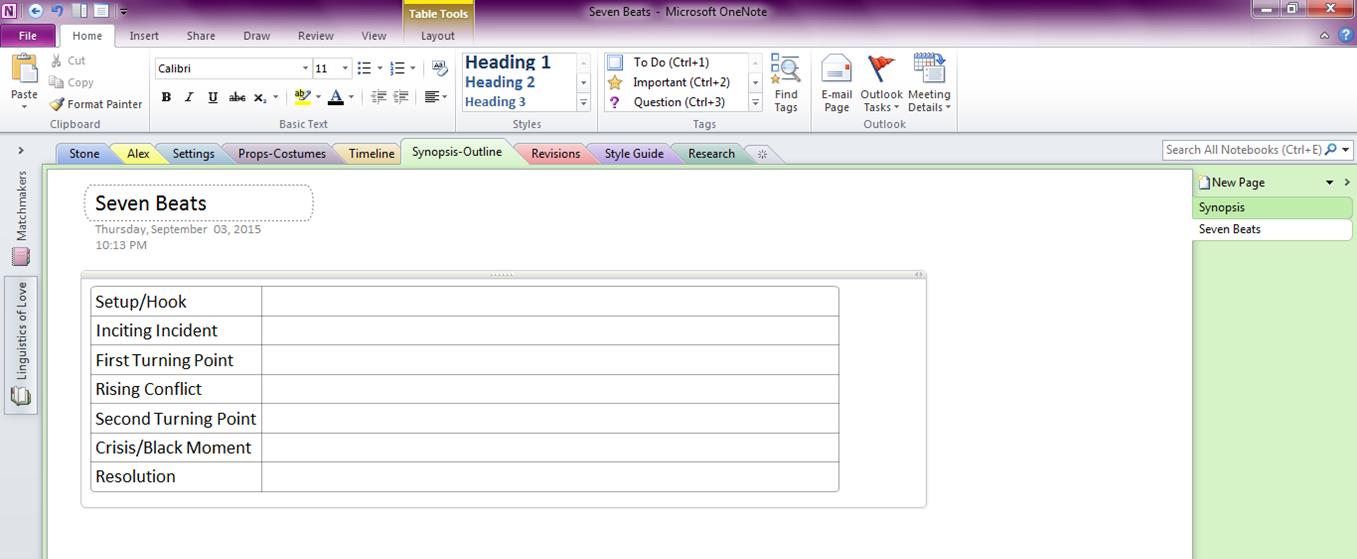
As you can see, I intend to use the Seven Beat structure for planning my story (working title: The Linguistics of Love—I’m not happy with it, but until I know more about the plot and themes of the story, that’s what I’m sticking with). Obviously, I haven’t filled anything in yet—because we’re not at that part of the process yet!
You don’t have to decide yet what structure you’re going to use in order to create this section of your Story Bible, but if you’ve never tried pre-planning/pre-plotting or if you haven’t yet settled on one that you like, it’s a good time to start researching the different options for outlining/structuring your story.
Assignment 1: Create a section in your Story Bible for your story outline and synopsis (we’ll be working on both later this month).
Your Story’s Timeline
Way back when I was editing fiction, it didn’t take me long to get to the point at which I could easily differentiate between an author who had actively tracked her timeline as she wrote/revised and one who hadn’t. As readers, often times this becomes clear, too—because it doesn’t seem like things are happening in a logical flow of time.
You don’t want that to happen to your story!
Tracking your story’s timeline is as easy as can be, and there are multitudes of options for how to do it, from the simple to the complex. Probably the most simple is to use the Calendar template in Word and print out calendars for the number of weeks/months your book covers (if it covers years, I’d suggest year-at-a-glace calendars, not weekly or monthly . . . that would be a lot of wasted paper).
Or if you don’t want to print them, set up a new calendar online or on the computer using Google or Outlook. Or just track it as a text timeline in Excel or Word or OneNote along with the rest of your notes.

This is the calendar layout I used for the Matchmakers trilogy. Because I knew from the beginning that Caylor and Flannery would have their own books, I needed to track what was going on with them during Zarah’s book. And it was helpful to have something easily at hand to be able to refer back to when I was working on Books 2 and 3 instead of having to search through the previous manuscript(s) to figure out how long it had been since something happened. Not only do I have a summary of events that happen in the book (whether on page or not), I also included holidays, regular events in the characters’ lives (for example, if Caylor or Flannery had a regular event or meeting on a certain day or evening, I put it on the calendar even during the timeline for Zarah’s book—after all, they’re best friends and spend a lot of time together, so I needed to know when they could plan stuff together and when they couldn’t).
Unlike some of the other parts of the Story Bible which will get updated sporadically throughout the writing and revision process, the calendar is something I use almost every time I write. In this one, for the Matchmakers, in addition to the summaries of events, I put the chapter numbers on the dates when they occur as well, for quick at-a-glance referencing. That way, if I needed to go find exactly what I wrote about a specific event, I could look at the calendar and then go straight to that chapter instead of having to search through each chapter file.
OneNote, for all that I love it, isn’t quite as functional for calendering (yes, I just made that into a verb) as Word is, so I will probably use the calendar template in Word again. In fact, I really like this one from the Matchmakers. Hold on, I’m going to go do a Save As . . . and then clear it out for LoL. (Ha! Yes, I’m slow and just now noticed that the acronym for Linguistics of Love is LoL. Hopefully that will happen while people read it, too!)
If the calendar idea doesn’t work for you, Google “create a story timeline”—there are bunches of ideas out there of how other writers have had success tracking their story timelines.
Assignment 2: Create or find a calendar/timeline format to use to track the timeline of events for your story. And don’t forget to check in with your progress!
#FirstDraft60 Day 3 — Creating Your Story Bible
I haven’t heard much from anyone, so hopefully you’re actively working away, completing each day’s assignment and ready and eager for the next. (And if you’ve fallen behind, or if you’ve started late, don’t worry, there will be time later this month to play catch up.)
Yesterday, you created your revisions notebook, style sheet, and research repository. In case you’ve never done this before, those are three major components of your Story Bible—the place where you keep all of the background information and notes you need in order to keep you on track when writing.
More than just those three components, though, you’re going to need to keep up with all the trivial—and not-so-trivial—details going on in your story. This is how you make sure that you’re always spelling unusual names/words the same way. How you keep track of what eye color you assigned to what character. How you know when and where things take place in your story (or your series).
How do you create a Story Bible? I’m so glad you asked!
Part 1: Pick Your Poison
First, you need to figure out how you’re going to keep all of this information. As Ramona mentioned in the comments yesterday, she keeps most of hers in an Excel worksheet—along with some physical storyboards for visual plotting.
Determine how you will keep/organize your Story Bible. You can do this the old-fashioned way, in hard copy in a three-ring binder or series of file folders in a drawer. Or you can employ one of hundreds of pieces of software and do it electronically.
I personally use OneNote to contain all of my information for my book—and it’s the program I use when I’m figuring out backstory or forward story (i.e., brainstorming), as well as keep all the info about my characters, setting, etc. But I’m getting ahead of myself.
Assignment 1: Determine and share with the “class” (i.e., leave a comment) how you intend to keep up with all of the details/background info for your Story in Progress. Will you use a notebook? OneNote? Scrivener? Evernote? Or do you have some other method of keeping track of your story/series details? Tell us what it is—and share links if you use a specific website or software.
Part 2: Characters
One of the largest sections of your Story Bible is going to be dedicated to your characters.

Right now, as you can see, I have one section with a single page for each character. Once I really get into character development next week, though, my two mains, Stone and Alex, will probably be promoted to each have their own section with multiple pages, covering backstory, physical description, family info, and info on the secondary characters connected to them. But I’m not there yet, so I haven’t started separating stuff out to that extent just yet. Right now, I just needed a simple layout to jot down the basic information I know about each character.
Assignment 2: Create the Characters section of your Story Bible. Other than figuring out how you plan to organize it, don’t worry about filling it out. We’re going to work on that next week.
Part 3: Setting
If you’re writing a world-building genre, like fantasy, or science fiction, or historical, you’re going to have a relatively large section for your setting, too. But even when we’re writing contemporaries set in places we’re familiar with (like for me, with this story set in Nashville), we’re going to need a place to keep information about our settings. What do your characters’ homes or workplaces look like? Where are things located geographically? What’s the topography or weather like?
This is where I tend to split things up a bit. I’ll keep the research part of my setting information (text) in OneNote, but I’ll collect setting images in Pinterest. It’s so much easier, and it doesn’t take up space on my computer.
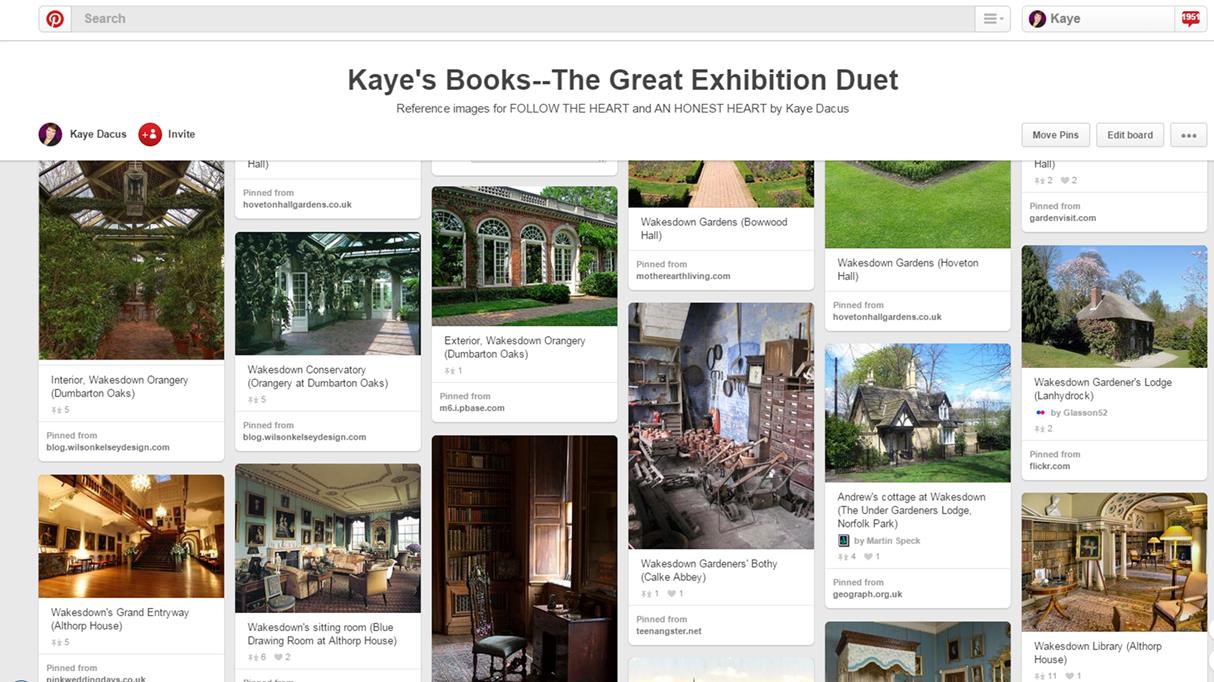
I’ve also done things like hand-draw a map of my fictional city of Bonneterre, Louisiana, and hung it on the wall for easy reference. (And then I took a digital picture of it and put it in my folder of images in my cloud drive so I could access it anytime I needed it.
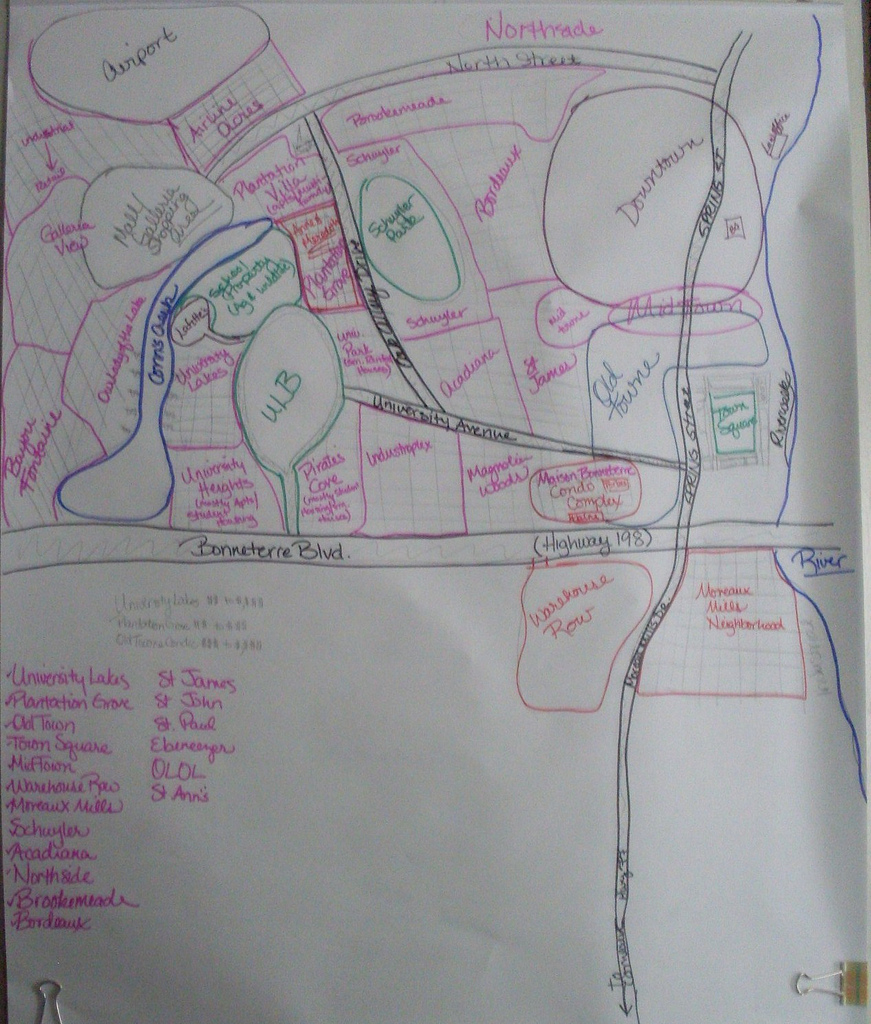
My rough, hand-sketched map of Bonneterre
Assignment 3: Determine how you will keep track of the details of your settings. What tool or combination of tools do you think you’ll use?
Part 4: Props and Costumes
Your characters have to get dressed. And they need to be able to pick things up and move them around occasionally. They need personal items that make us identify with them, even if they may not personally be in the room. (And these types of details are even more significant in mysteries—you never know what little piece of detritus on the floor will lead to the killer!) In SciFi, Fantasy, and Historical genres, costumes and the general look of things lying about will be important in drawing the reader into the storyworld.
Things to keep track of in this section, which will be filled out mostly as you write and discover these items:
- What does each character carry on his/her person?
What items would your character never leave home without? This is Doctor Who’s sonic screwdriver, Peter “Star Lord” Quill’s Walkman, or Phrynie Fisher’s golden revolver. Or think of it like this—what is something that if left behind would signal to others that your character had been there? - Location of important/key objects in the story.
Even though we don’t always see it, we always know where the One Ring is throughout the Lord of the Rings trilogy. Keep track of where you’ve placed the most precious items in your story. - Furniture, Objet d’Art, Curios, and Knicknacks.
It may seem trivial, but readers notice when the Tiffany lamp is on the table at the right-end of the sofa in one scene and on the end table next to the wing chair in another. Use your Story Bible to keep track of all the little things, too. (Though this may wait until you do your read-through of your first draft after it’s completed. But create a space for it now.) - Modes of transportation.
How do your characters get from one place to another? - Costuming.
If you’re writing a costume-specific piece (like a historical or fantasy where costuming can make quite a statement about characters on its own), you may want to include this in your character section. But whether it’s with character (a line or two about their personal style in their write-up) or pages of images for each character, you need to keep track of it. (Again, a combo of text/descriptions/research info in your Story Bible and images on Pinterest works well). - Any other “physical properties” you think you might need to keep track of.
Assignment 4: Determine how you will keep track of props and costumes. What tool or combination of tools do you think you’ll use?
I know this seems like a lot of work, but remember—you’re just laying the groundwork and getting your Story Bible set up. You’re not actually filling it up yet!
Can’t wait to hear from you to find out how you plan to keep your story organized.
#FirstDraft60 Day 2: Preparing Your Revisions Notebook, Style Sheet, and Research Repository
Part of doing a challenge like FirstDraft60 (for writing) or Whole30 (a food plan) is making sure that you’ve done as much preparation ahead of time as possible—so that during the actual challenge period (the 30 days of writing in October), you can focus on writing your story because you’re already organized and ready to go.
In Book in a Month, Victoria Lynn Schmidt’s first tip for finishing a draft in 30 days is to write “as if.” What that means is that as you make changes to your story or characters while writing, you don’t go back through what you’ve already completed and revise/rewrite. You make a note of the change and what parts of the story it will affect (and will thus need to be revised later) and then continue on writing as if you’ve already made the change.
It may sound counter-intuitive, but believe me, this approach does actually work in enabling us SOTP writers to be able to complete manuscripts. This happened to me when I was writing Stand-In Groom as my master’s thesis. After rewriting the first ten chapters three times, I finally had to suck it up and finish the manuscript for grad school. So I wrote down all of the changes I needed to make after the first draft was finished and then went right back to writing as if I’d already made those (massive) changes. And after two years of an endless loop of revisions, I completed the final 2/3 of the manuscript in less than four months.
What I didn’t have back in 2004–2005 when I was doing this was OneNote. Or some other way of organizing my notes and ideas for what needed to change. I had a lot of it just typed in as notes in the computer. Or when I’d make a change in between chapters, I’d make a note at the top of my new chapter to go back from that point and make the change I’d be incorporating from there on out. Something I discovered in writing stories with more characters, more research, and more intricate plotting—like the Ransome Trilogy—is that I have to have a better way of keeping track not just of my revision notes, but my style guide, and my research. So that’s what we’re setting up today.
Revisions Notebook
Ever since I bought my laptop in 2009 and saw it for the first time, Microsoft OneNote has been an integral part of my writing process. And now that it’s available online and on my phone, it’s become an important and portable tool for me as a place to collect my ideas, notes, research, etc.
According to Schmidt: “Working ‘as if’ means that you keep writing—that you keep moving forward with your story—without stopping to rewrite every time you change your mind about a character, plot, or setting detail. Instead, you take notes on your Story Tracker worksheet to stay on task while still remembering changes you’ll need to make later” (10).
She works with a three-act structure, and suggests making a chart/table with places to track changes for character, plot, subplot(s), setting, and “other” for each of those three acts (which you can see via the Writer’s Digest website). I’ve looked at those charts for a while now, and my brain just doesn’t work that way. Although I’m sure I may tweak (or completely) change these as I work, here’s what I’ve come up with for my Revisions pages in OneNote:

I’m sure that as I get further into this and run into the changes I’ll inevitably need to make, I’ll hone this tool and really customize it into an invaluable tool for my next manuscripts.
Style Sheet
Creating a Style Guide is something I’ve blogged about before. As a quick refresher:
Items to track in your style guide include the following, along with an explanation and a summary of how it should be “styled”:
- Unusual, foreign, archaic, uniquely spelled, and made-up names.
Examples: Zarah, nicknames for grandparents (such as Mamere, Kiki, Pops, etc.); the Admiralty is capitalized, but the port admiralty is not. - All place names.
Examples: Woodbine, Woodmont, Green Hills, Forrest Hills (yes, it has two Rs), Belle Meade, Bellevue, Fair View, Fairview, etc. Bonneterre, Comeaux (how far is it from Bonneterre, again?), Beausoleil Parish, Moreaux Mills, Warehouse Row, Town Square (or was that Towne Square?). - Names of restaurants, stores, schools, and other establishments.
Frothy Monkey, James Robertson University, University of Louisiana–Bonneterre (geaux Marauding Pirates!), Beignets S’il Vous Plait (see—I had to look that one up just to include it here!), Boudreaux-Guidry Enterprises/B-G. - Anything that gets a red squiggly line as you write it.
Whether it’s a regional word, professional jargon, a rare piece of dialect, an abbreviation, pet name, or other shortened form of a word, or something foreign or made up, if Word doesn’t recognize it, add it to your style guide. (And then add it to Word’s dictionary so it doesn’t keep flagging it every time you run a spell-check.) - Foreign, archaic, regional, or made-up words and phrases.
These words may be familiar to you, but not to an editor who’s going to waste his/her time trying to look them up or contacting you to find out more about them. You may forget how you spelled something, or which place name you used. Writing it down saves everyone time. - Anything you don’t want to fight with your editor about later.
Here’s a snapshot of my style sheet for the Bonneterre series:

Research Repository
It doesn’t matter if you’re writing a contemporary set in your own neighborhood or a sweeping historical epic spanning generations and continents. You’re going to have to do some research somewhere along the way. Our planning process will help you do some of this research. And something I’ve found helpful to keep as much of it close at hand as I can (especially since I’m not always writing in the location where my books are located, or websites get deleted/moved) is to either copy/paste the info from the website or type notes from books into OneNote for safekeeping.
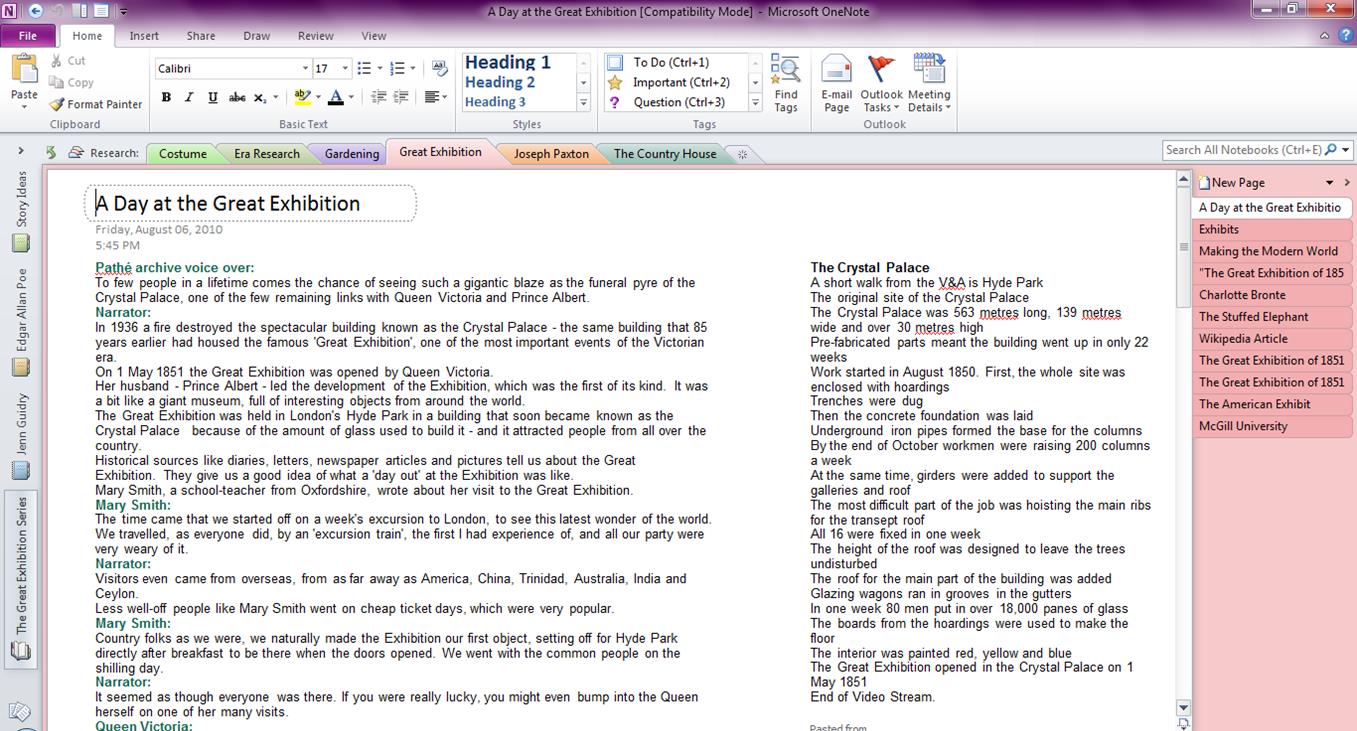
You can read more about collecting and organizing your research here (because, of course, I’ve blogged about it before).
FirstDraft60 Day 2 Assignment:
Your project for today is to figure out how you’re going to keep track of your revisions, style info, and research—and to go ahead and set them up. Then come back and let us know how you are planning to do it and how you’ve set yours up. Links to images would be great (e.g., Instagram, your blog, photos on Facebook shared publicly so we can see them even if we aren’t connected, etc.).
Can’t wait to see/hear about yours. I’m off to work on the style sheet and research parts of my notebook!
__________________________________________
Work Cited:
Schmidt, Victoria Lynn. Book in a Month: The Foolproof System for Writing a Novel in 30 Days. Cincinnati, OH: Writer’s Digest Books, 2008. Print.

 KayeDacus.com