#FirstDraft60 Day 32 — Friday is SWAT Day!
 It’s Friday! It’s also the first Friday of the writing portion of our sixty-day challenge.
Yesterday, I was traveling, so I didn’t really get a chance to write a full post (I had to do it on my phone in the car at a rest stop—thank goodness for technology!) to explain how we’ll be doing our check-ins during this half of the challenge. Every day, I’ll be posting something on the blog and will encourage you to post your daily goal, as well as what you accomplished the day before.
On Fridays, though, I want to know about your full writing week. What were your greatest successes during the week? What was your favorite line/bit that you wrote? What did you learn about yourself, your characters, and/or your story during the week’s work? What are you most proud of yourself for doing this week when it came to your writing? What are you proud of yourself for accomplishing?
In the business world, there’s a planning model called SWOT—which is an acronym for Strengths, Weaknesses, Opportunities, and Threats.
Around here, we’re going to use SWAT, but we’re going to do it differently, so check in with the following recap for your week:
- Self-Evaluation (how do you think you did? what can/do you want to do differently next week? what did you learn about yourself as a person or as a writer? what didn’t you do or finish that you wanted to? etc.)
- Word count (total for the week, Saturday through today)
- Awesome Accomplishments (breakthroughs, discoveries, highest daily word-count ever, etc.)
- Tidbits too good not to share
If you don’t want to share this stuff publicly, that’s okay. You can add a section to your Story Bible or start a journal (or add this to your existing journal) to keep track of this. But don’t skip doing this—I think that in the future, when you look back either on what you accomplished during this challenge or (heaven forbid) why you gave up on it, the insights you’ll gather later with hindsight on your thoughts during the challenge will be invaluable.
Happy writing!
#FirstDraft60 Day 31 — TODAY WE WRITE!
Have you already started? Are you geared up and champing at the bit, waiting for your lunchbreak or for the end of the work day in order to get started writing?
Today is our first writing day of the challenge. Please check in when you can with your goal of what you intend to accomplish today, and then don’t forget to actually do it! Then tomorrow, you can check in with today’s results and your next goal.
And if you need a little help getting started with your opening scene, you may want to review this post.
Happy writing!
#FirstDraft60 Day 30 — Tomorrow We Start Writing
We’ve gone through twenty-nine days of prep work in order to get us, hopefully, to the point at which we’re more prepared to sit down and start writing a story than we’ve ever been in our lives. But, if you’re anything like me . . . you’ve probably fallen a bit behind on the planning. (Confession time: I just yesterday figured out the main conflict/dark moment for my story because I just yesterday figured out my heroine’s internal conflicts.)
Today is the last day of preparation before we set everything else aside—all the research, all the character casting/ development, all the outlining, all the preplotting, all the worldbuilding—and start writing.
I usually post these instructions on Saturdays (and you’ll see them in a slightly modified version this coming Saturday), but it’s important that we spend time doing this today, before we start writing tomorrow.
Time to Catch Up:
- Review everything you’ve done so far and catch-up with anything you couldn’t get to or couldn’t finish during the previous 29 days.
- Update your Story Bible and Style Guide based on everything you came up with in the past 29 days.
- Once you’ve caught up and have everything updated, do some “what if” brainstorming with your character information and backstories and see if you can come up with some additional ideas for either the characters themselves or for your story/plot. Have fun with this. And if you feel inspired to write some scenes, do it!
- Check in and let us know how you’re doing, what you’ve accomplished, and what you still need to get done today in order to start writing tomorrow.
#FirstDraft60 Day 29 — Using the #1k1h Method for Marathon Writing
Thursday begins the marathon thirty-day writing portion of this sixty-day challenge. Hopefully you already set your total word-count goal and broke that down into digestible daily goals. (If you haven’t, now would be a good time.) We’ve already discussed the difference between draft writing and regular writing—focusing on draft writing for this challenge in order to get our speed up. But one of the most helpful thing to get through a marathon writing challenge are one-hour writing “sprints.”
1k1h = 1,000 Words in One Hour
If you’re on Twitter and if you follow other writers, you may have seen the #1k1h tag and wondered what it meant. I did a bit of research (okay, I Googled for about ten minutes) and couldn’t track down the originator of this hashtag, but it’s been around for years. And it’s something that I found quite helpful in the years when I had to complete a 90–100k manuscript every three to four months.
The name somewhat describes what you’re supposed to do—set aside one hour (using a timer) with the goal of writing 1,000 words in your story. Sounds simple enough, right?
Well, yes and no.
What if I’ve never been able to write 1,000 words in one hour?
In one hour, if you’ve prepared, planned, and organized ahead of time, most writers can easily write 1,000 words or more. But not everyone can do this. Sometimes, no matter how well-prepared we are, the words just won’t come. And some people will never be fast writers.
While this is a great exercise for building word count, it’s an even better exercise for being able to start writing on command—and to stop when a timer goes off. It’s also a great way to build the habit of writing every day.
I’ve used this example multiple times, but I’m pulling it out again—just like an old-fashioned water pump, the more often we work at it, the easier it will flow. So if you start out only being able to write 500 or 700 words during that hour, the more often you do it, the more likely you are to be able to build up to 1,000 words, or more.
What if I don’t know what to write when it’s time to start the 1k1h?
When you sit down for that 1k1h sprint and you stare at that flashing cursor waiting for the words to come, and they don’t, DO NOT walk away from it and give yourself the excuse that you’ll just take a break and do it later. You know it’s unlikely that you’ll have any better of an idea of what to write in two hours than you do right now. And then you’ll have wasted additional time that you could have been writing.
Fifteen years ago, when I was writing what would become my first completed manuscript, I got to a point at which (being a seat of the pants writer with no synopsis, only a vague story idea) I had no idea where my story was going. But I needed to write. So since I’d just gone to the grocery store that evening after work, I wrote one of my characters doing the same thing. I had him get his basket. I had him pick out produce. I got him through the store all the way to the frozen-food section—where, surprisingly, he ran into another major character; and, all of a sudden, I had a scene that moved the story forward again.
A few weeks ago, on my regular Tuesday writing night (when I meet up with a friend for dinner followed by a 1k1h session), I ended up doing the same thing. I’d started writing Alex and Stone’s story without really knowing much about them or having a clear idea of the premise. But I was able to write a really cute first meeting scene and was feeling like I had a good direction for the story. But then I started a new chapter. And nothing happened. I was stuck. Not having an idea of where the story was going to go, I decided to take my own advice and just drop Stone into a situation and see what happened. He started a conversation with someone and then—after about 1,200 words and with only three minutes of the hour left—WHAM! I had a breakthrough idea about Alex’s backstory. I grabbed the notepad I always keep beside the computer when I’m writing and jotted down a sketch of the idea so that I wouldn’t forget it next time I sat down to write.
It sounds mundane and like bad writing to just wing it like that and make up some random situation that doesn’t seem to have anything to do with the story (and it’s probably something you’d end up cutting most of in a revision), but not only are you working at that creative pump, you can also learn more about your character by doing something like that.
So exactly how does 1k1h work?
- No Interruptions. Pick a time when you know you can have sixty minutes of uninterrupted time. Sometimes, it helps to pick a location in which you don’t usually work—a cafe or coffee shop, a library, or even a different room in your house. Just make sure it’s somewhere it’s guaranteed you won’t be disturbed.
- No Procrastinating. Commit yourself to doing nothing but writing during that hour. No emails, no Facebook or Twitter, no blog reading/writing, no research. No thesaurus or dictionary. If you don’t know a word, can’t think of the right word, or aren’t sure you’re using a word correctly, just use a blank line or highlight what you’ve used so you can come back to it later. During this hour, turn off the internal editor and draft write.
- Unplug. A while back, a friend of mine posted a link for some software she’d purchased that will block her access to the internet for a specified period of time. Now, I’m bad about keeping my email program open when I’m sitting at the computer and reading each e-mail as it comes in when I’m supposed to be working. And now that I’ve had a smartphone for a few years, it’s even worse. Oh, yeah, and I usually sit in the living room where the TV/DVR/Roku are—and the TV is almost always on. So when doing 1k1h, it’s best to try to get away from all of that. Try working away from the computer (writing longhand) or try unplugging/turning off your modem (most laptops have a key which will sever a WiFi connection; mine is on the F2 key). Turn the TV off—or move out of the room where it is. Turn off sound/vibration notifications on your smartphone (I’d say turn it off completely, but since some of you have kids, you still need to have the phone feature available.) For this hour, writing is your job, your profession, so act like a professional who’s on the clock—and on a deadline to produce a quota of words.
- Set a Timer. This is one of the most important aspects of 1k1h. If you set a timer, you’re much less likely to be continuously watching the clock to see if your hour is up or not. With the knowledge that an alarm will sound when time is up, it’s much easier to focus on your story and characters and forget about time altogether. If you’re able to leave your phone alone for an hour, most phones have a timer feature in the clock app (or I’m sure you can download one). My Surface also has a built-in clock app that includes a countdown timer with an alarm. Even though I didn’t use the iPad for writing when I had it, it had one, too. And you can download timer apps to your computer. Or use a $5 analog kitchen timer. Set it for 60 minutes and start writing.
- Walk Away. When time is up and the alarm sounds, STOP. If you need to finish a sentence or jot down a few ideas so next time you remember where you were going with the scene/idea, that’s okay. But you need to get up and walk away (after saving your work, of course). If you’ve built up momentum by the end of the hour and the words and ideas are flowing, stopping and walking away in the middle of it may be one of the best things you can do for yourself—because it makes you anxious to get back to it. So walk away, take a break, and relax for a little while. The come back, set the timer for another hour, and sprint again.
How much prep work do you still need to do before you’re ready to start sprinting toward a marathon finish?
#FirstDraft60 Day 28 — Writing Your Story Scene by Scene
How do you eat an elephant? One bite at a time. How do you write a novel? One scene at a time.
Even for those of us who’ve been doing this for quite some time, it’s tempting when we approach our writing time to think: I’m going to write my novel. But just like with the elephant, if we’re focusing on the entire animal—the entire novel—when it’s time to sit down and write, we’re going to become overwhelmed, no matter how much we’ve planned ahead.
When you sit down to work on your story, don’t think about “writing the story,” think about “writing a scene.” If you don’t think about what you’re doing in terms of small chunks, then it’s going to be overwhelming and it’s the quickest path to writer’s block.
However, if you schedule your writing time in order to write a scene or two, you’re more likely to not feel overwhelmed and actually meet your daily writing goals.
Now, rather than try to repeat what I’ve written about scenes before, here’s the whole series:
SCENE IT!
NEW SERIES! Scene It–Introduction
SCENE IT! How Long Should Scenes Be?
SCENE IT: 1-2-3 Blast Off! Crafting Out-of-this-World Scene Launches
SCENE IT! Is there a bit of tension in here?
SCENE IT! Complicate Your Characters’ Lives
SCENE IT! Hooking Your Reader with Scene Endings
SCENE IT! Consequences and Rewards (a.k.a., Scene and Sequel)
SCENE IT! Is it a keeper?
SCENE IT! Types of Scenes
SCENE IT! Working with Multiple Viewpoint Characters
To try to summarize, though . . .
- Make sure each scene has a beginning, middle, and end.
- End each scene with a hook/question—not only do you want to end a scene leaving your reader wanting more, you want to end a scene where you want to know what happens next—and then walk away. That way, you’re more anxious to get back to writing.
- Try to mix up the ways in which you open and close your scenes.
- Make sure your characters have an intention/desire/goal in each scene.
- Make sure each scene moves the plot of your story forward.
What can you do in order to help yourself think about writing scene by scene rather than “writing your story” when it’s time to start writing?
#FirstDraft60 Days 26 & 27: Weekend Catch-Up and Sunday Reflections
It’s the final weekend before we begin the writing portion of our sixty days . . . and I missed posting the Saturday catch-up post! (We were celebrating the birthday of one of my best friends yesterday, so it was a very full day.) Hopefully, you forged on without me.
Let’s Play Catch(-Up)
Rather than repeat all the assignments here, like I’ve done in the previous weeks, here are links to each day’s post from this past week. Please review them and see if there’s anything you need to get caught up on.
Writing and Testing Your Story’s Premise
Mapping and Outlining Your Story
Write One-Sentence and One-Paragraph Story Summaries
Do You Know Enough About Your Setting?
What Research Do You Need to Do Before You Start Writing?
Time to Catch Up:
- Review everything you’ve done so far and catch-up with anything you couldn’t get to or couldn’t finish during the week.
- Update your Story Bible and Style Guide based on everything you came up with this week.
- Once you’ve caught up and have everything updated, do some “what if” brainstorming with your character information and backstories and see if you can come up with some additional ideas for either the characters themselves or for your story/plot. Have fun with this. And if you feel inspired to write some scenes, do it!
- Check in and let us know how you’re doing, what you’ve accomplished, and what you hope to achieve this weekend.
Reflections for Day 27
A. What is your physical writing space?
- Where is your physical writing space? What are its boundaries? Have you made it a “sacred” space (i.e., do others in your household know not to disturb you when you are working in that space)?
- Is your writing space distraction-free? Are the surfaces free of clutter? Is it clean? Is there anything in or about the physical space that could be or become a distraction for you if you find yourself having difficulty focusing on writing?
- What can you make sure you do have in your physical writing space that will assist you in being able to focus and not get distracted?
B. What is your mental writing space?
- What time of day can you best focus on writing?
- What time of day to you feel most creative?
- What type of environment is least distracting to your mind? Do you need quiet? Music? Soft lighting? Bright light? Do you get less distracted when you’re sitting upright in an office chair at a desk, or with a lapdesk slouched down in bed?
- What can you do to train yourself to be able to write in any environment?
- What images, sounds, smells, or other factors are relaxing and/or put you in a creative frame of mind?
- How can you silence your internal editor and just let the creative side out to play? What Creative exercises could you do for ten or fifteen minutes before your writing time starts in order to get the creative juices flowing?
- Have you done enough prep work on your story to start writing with the confidence that you have a clear enough picture of where the story is going that you aren’t going to get “stuck” once you reach a certain point?
Hope you’ve had a great weekend and are looking forward to our last few days of prep before we start writing on Thursday!
#FirstDraft60 Day 25 — What Research Do You Need to Do Before You Start Writing?
Whether it’s figuring out where an event could be held, what the weather is like in a certain timeframe, whether or not your state has imminent domain laws, or specific details of an obscure battle five hundred years ago, you’re going to have to look stuff up. And what better time to do it than now, before you start trying to churn out 1,500 to 2,500 words per day?
We’re told to write what we know. But that advice is more about taking what we know and extrapolating it into other situations, rather than just about the specific things we’ve experienced in our lives. “Write what you know” is one of the most misunderstood instructions given about writing. Most people take it at face value, interpreting it as, “Write about only what you have personally done or experienced in the confines of your own life.” If fiction writers were to interpret it this way, we would eliminate entire genres: science fiction, fantasy, horror, historical, and 99% of mystery/crime/suspense/thriller. There would be no Mr. Spock and Captain Kirk, no Luke Skywalker, no hobbits and Middle Earth, no Jack Aubrey and Stephen Maturin, no Scarlett O’Hara, no Sherlock Holmes, no James Bond or Jason Bourne, no Superman or Batman, and no one would have ever heard of a man named Stephen King.
Figure Out What You DON’T Know
 Hopefully, as you’ve been going through and doing the exercises over the past three weeks, you’ve been doing research as you go. For example, when I was writing out Stone’s backstory, I spent an awful lot of time researching lacrosse teams—for children, at the schools where he attended elementary and secondary, and at the university where I ended up having him go on a scholarship to play lacrosse. I’d already done my research on the degree programs at that university, so it worked out well that Georgetown not only has an NCAA lacrosse team, but they reached the Final Fours/Semifinals in the national championship the year Stone would have been a senior (which turned out to be one of the only times in his life when his father expressed pride in him verbally). And I wouldn’t have figured this out if I hadn’t done my research while working on backstory. (And yes, the idea to have the sport he played growing up be lacrosse and not football or baseball is because his template, Brandon Routh, was in a movie called Crooked Arrows about lacrosse, which is where that image is from—see how helpful character casting can be?)
Even if you’re writing a contemporary novel set in the city/neighborhood where you live, you’re still going to find that there are things you’re going to have to research. And it’s to your advantage before a marathon writing challenge like this one or NaNo to get as much research done as possible beforehand.
Assignment 1: If you haven’t already, add a RESEARCH section to your Story Bible.
In the Research section of my Story Bible, I already have a few pages:

At this point, because I don’t know exactly how much I need to know about linguistics (beyond what I remember from the one course I took as an undergrad), I’ve just started a collection of articles I’ve run across over the past few weeks that I know would be of interest to Stone.
But what about all that research I just said I did about lacrosse? Well, that’s actually included in Stone’s character section on his backstory page. Because while I needed to know that for the development of his character, it probably isn’t anything I’m going to need to refer to while writing the story. I do, however, need to create a page in the Resource section for FBI/BAU Team, because even though he no longer works there, his experience there is integral to certain interactions he’ll have with the heroine—because she features FBI/BAU (Behavioral Analysis Unit) agents in her novels (and, as it turns out, the consultant she and the other writers for the TV show based on her novels work with is the now-retired agent who recruited Stone into the FBI and helped him get into the BAU). I know that there’s going to be some kind of linguistic element that Alex needs help with in the book she’s currently writing, which she’ll ask Stone for help figuring out. But I’m not that deep into my plotting yet (and I know—we’re less than a week away from our writing start date; I need to get on the ball!). Which brings me to . . .
Assignment 2: After reviewing your character backstories/information, your premise, outline, and everything else you’ve already created, create pages in the Research section of your Story Bible for all of the subjects which you think you might need to research—and start gathering research!
If you’ve already done some research, or at least gathered resources (like a bookmarks folder in your web browser where you’ve been saving links to websites) go ahead and add those to your Research section. If you realize that there are some important topics/issues/laws/historic details/etc. that you’re going to need to research, go ahead and create pages for them, even if they’re blank. Having them there whenever you look at that section will remind you of the research you need to do.
How much research do you need to do in the next six and a half days before we start writing?
#FirstDraft60 Day 24 — Do You Know Enough About Your Setting?
Sometimes, the geographic location of a story is an integral part of the premise. Other times, we have to figure out where the best setting for our story will be. And this is something you need to know before you get into the planning stage.
Placing your story in the right location is just as vital to its success as choosing the right characters and the right premise.
One of the prime examples I like to give for this when teaching workshops is Stand-In Groom. Because the premise of the story involves a celebrity whose identity must be kept secret, it needed to be set in a location where seeing a celebrity is rare. It also needed to be a city that was big enough for amenities, such as a large event center and a business infrastructure that would support planning a wedding as large as the one Anne is hired to plan. So, while I love Nashville, it was automatically out—it’s a city where celebrity sightings are frequent, and the biggest result is the identification of locals (who don’t approach) and tourists (who want autographs and photos).
Because I’d spent fourteen or fifteen years before coming up with the idea for SIG developing a fictional small city in central Louisiana that includes elements of many other cities where I’ve lived or visited, I decided it would make a perfect backdrop for this story. It gave me the opportunity to create and include any of the types of venues and businesses that I needed for everything that happens in the story, while still incorporating the real-world culture of Louisiana.
Could I have set this story in a fictional city of similar size in, say, New England or the Pacific Northwest? Sure. But since I’ve never lived there, I don’t know the culture. I could have made Anne’s large extended family Italian or Greek instead of Cajun. But, again, I don’t know those cultures. And there are so many fun elements about a large southern family and the Louisiana setting (crawfish boils! Mardi Gras-themed events! unique names! even more of a culture shock for my British hero!) that I was able to incorporate into the story which, I hope, sets it apart from books set elsewhere.
Do You Know Your Setting?
I’m not just talking about knowing where your story is physically taking place. What I’m asking is how much you know about your setting.
Assignment 1: If you don’t already have one, add a SETTING section to your Story Bible. Then ask yourself (and write down your answers to) the following questions:
- Does your setting have a unique culture that can play a role in your story?
Think of places that have cultures that are unique to them: Santa Fe, Louisiana, Las Vegas, the Deep South, Hawaii, a small fishing town on the coast of Maine, etc. What are the unique elements of a setting that you can incorporate into your characters’ background/mannerisms/behavior and into how your story unfolds? - What are the elements of the culture you need to make sure you get absolutely right?
If you’ve read my Bonneterre books, you know I don’t have people walking around calling each other cher or babbling in Cajun French. If you live somewhere with a unique culture and watch movies/TV shows set there, what are the things that they get wrong that drive you crazy? How can you make sure you get those elements right? - What are some specific locations and/or events you can incorporate into your story?
In the Matchmakers series, set in Nashville, I have my girls meet for coffee on Sunday afternoons at The Frothy Monkey in the 12 South neighborhood. In the Bonneterre series, with my fictional setting, I created Beignets S’il Vous Plait, a beignets-and-coffee shop reminiscent of Cafe Du Monde in New Orleans or Coffee Call in Baton Rouge. Use specific locations, but have a reason for using those locations. Don’t just “name drop.” - How can your setting affect how your story plays out?
For example, if you’re writing suspense and your characters are on the run outdoors, they’re going to run into much different conflicts in a mountainous area than in a desert than in a jungle. Is it cold and snowy? hot and humid? Does your character have environmental allergies that could affect whether or not he’s able to do the physical activities required of him in the plot? - What’s the “mood” of your setting?
Think about the cliche of the gothic novel being set in a creepy, dark, old castle with a labyrinth of hallways, tunnels, and dungeons. There’s a reason why it’s become cliche—because it works. One of my favorite YA novels from childhood is a gothic, but it’s set in a recently built Victorian mansion in Northern California in the late 1800s. The author uses the house, and the fog that envelops it daily, to great effect. How can the weather, the landscape, the culture of your setting affect and effect the mood of your story?
Getting Specific with Your Setting
In addition to knowing the tone and mood and culture of your setting, you need to know as many specifics as possible—even if it doesn’t show up in the story. You need to be an expert. You need to know more about your storyworld than anyone else. If it’s a real city and you don’t live there, natives of that city need to think you’re one of them when they read your book. There’s nothing worse than picking up a book that’s set in a place you’re intimately familiar with and finding errors, cliches, “misplaced” landmarks, stereotyped locals, etc., within. (Especially for someone like me who lives in a city like Nashville that is SO different for those of us who live here than the reputation/stereotype that most people think of.)
Assignment 2: Add a chart (or pages, if you have lots of information in these categories) to your Settings section of your Story Bible to record/collect the following information about your setting.
- Your Story World
- Houses, Buildings, Architectural Styles
This is easier if you’re using a real setting vs. a fictional setting. But it’s still important to do research on the correct terms for the types of buildings/houses and their architectural styles, even if you’ve lived in the place where your story is set your entire life. A neighborhood developed in the 1880s isn’t going to be filled with Craftsman style houses; nor is one built in the 1980s going to be filled with mid-century modern styles. One of the things that makes a story seem more immediate is detail. What detail can you discover about the buildings in your setting that you can include in your notes WHETHER OR NOT YOU USE IT IN YOUR ACTUAL STORY? - Landscapes, Climates
What does your story world look like? What are the geographic features? What is the weather like? No, you’re not necessarily going to include all of this in your story, but you, the author, need to know as much about this as possible so that you don’t have it snowing on Thanksgiving in Brownsville, Texas. If you’re creating a fantasy/sci-fi world, this is of VITAL importance to know before you start writing. - Map(s)
- Terminology
Is there a unique terminology to your setting? For example, when I was writing the Ransome series, I had to keep lists of all of the different parts of the ships and sails. Be specific with these (schooner rather than ship; jigger staysail instead of sail, etc.). - Historical Background
What’s the history of your storyworld? For those of us writing in either real or fictional cities set in familiar countries (like the US), this isn’t as hard as for those creating their own countries/worlds. But it is important to know why, for example, a person of color might be treated differently in Selma, Alabama, than in Detroit, Michigan, even in the year 2015. - Culture and Customs
What are the unique cultures and customs of your story world? “Nashville” has one connotation to the outside world, and a very different one to those of us who live here (and to those who live in different areas of Nashville. What’s culture/custom for me living in Woodbine might be completely different from culture/custom for a 20something hipster living in downtown. What festivals and other celebrations take place in your city? (And what does it mean when someone in Nashville calls CMA Fest “Fan Fair”—or even CMApocalypse?) How do people greet each other? Do they make eye contact and speak with strangers (Nashville), or do they avoid it if at all possible (Washington DC)? - Language, Accent, and Regional Slang
Whether real-world or fantasy/sci-fi, people are going to have different vernacular based on their region, their local culture/customs, and their backgrounds. But do not fall into the newbie trap of feeling like you must write this out in phonetic dialect. It marks you as a novice who doesn’t know the rules of good writing. - Social/Government Organization
More important for fictional/otherworldly story settings, but it’s good to know what would happen if a character breaks a social taboo or a law (and knowing what those social taboos and laws are). It’s also good to know if a character in a historical set in North America would be referring to the head of their government as “King George” (the third) or “President George” (Washington). - Daily Life
This includes fashion/dress/style, manners, diet, calendar, customs, etc. Again, this is less consuming if you’re writing contemporary/real-world settings, but still something everyone needs to consider when developing your settings. - IMAGES, IMAGES, IMAGES
Collect images of settings that inspire, floorplans/images from real-estate sites of your characters’ homes, images of the city or countryside or landscape, and so on. This is a great time to employ Pinterest—and you can use a private board if you don’t want to share with the rest of the world just yet.
Where does your story take place? Go from the broad (Planet Earth) to the narrow (the Woodbine neighborhood of Nashville) to the specific (77 Elberta Street).
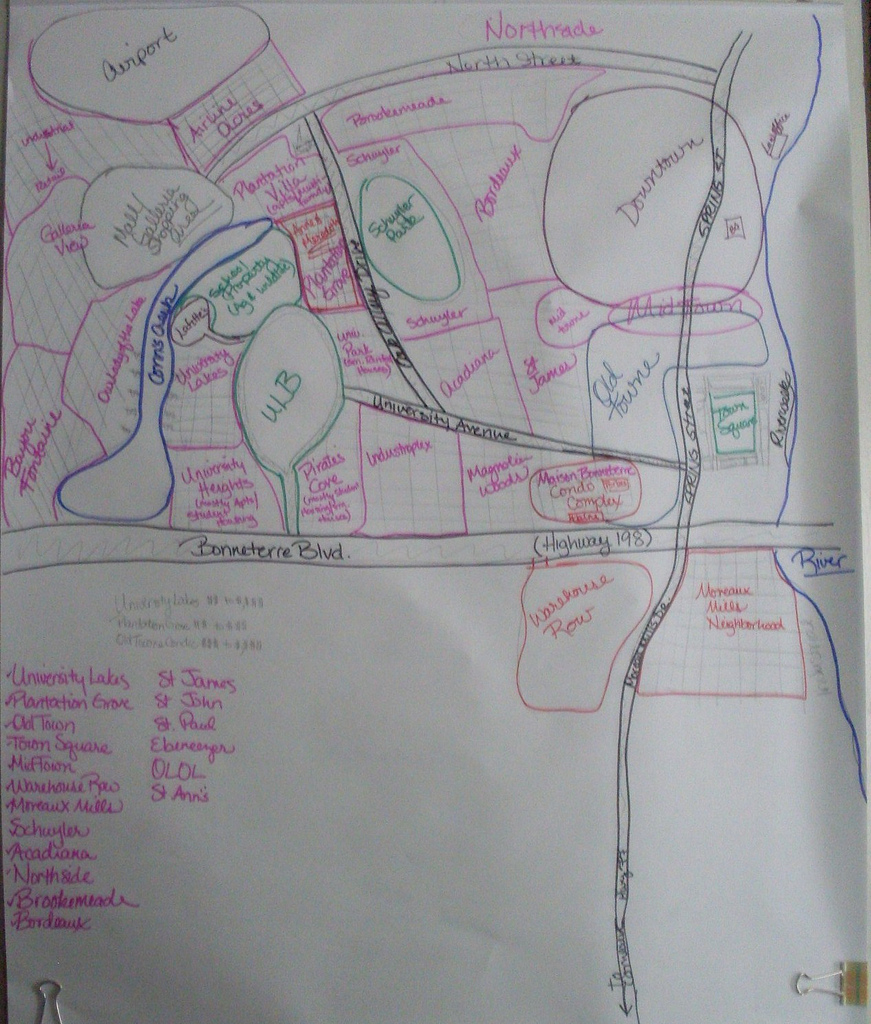
My rough, hand-sketched map of Bonneterre
Either collect maps (you can use the PrtScr/Print Screen button on your PC keyboard to capture an image of your screen and then paste it as an image in PowerPoint or Publisher, crop away whatever you don’t need (double click on the image and then the crop button will be on the toolbar), and the save it as an image you can use anywhere else (right click on the image and select Save as Picture…). Make sure to save it as a .jpg file for universality of use. If you’re creating your own setting (real world or fantasy/sci-fi), create your own maps, because that’s the best way to remember where you put those houses/buildings from #2.
Learn more about developing your setting here.
#FirstDraft60 Day 23 — Write One-Sentence and One-Paragraph Story Summaries
The one-sentence summary. The Quick Pitch. The Elevator Pitch. The Slug Line. It doesn’t matter what it’s called, if you’re a writer, you need at least one one-sentence and one one-paragraph summary that you can recite at the drop of a hat (or the drop of an important editor/agent’s name) that clearly conveys the tone, theme, and premise of your story.
Simple, right?
But wait. We haven’t even started writing our first drafts yet. Why are we worried about creating something that we won’t need until months or maybe even years down the road?
Because creating your one-sentence and one-paragraph summaries (pitches) helps give you clarity as to what your story is about, what your main characters’ goals are, and what your story’s tone/theme is or should be. And these will keep you from getting lost when you get into the middle of writing your draft and have no idea where your story goes next.
Review Your Premise and Outline First
You’ve been working on your premise and outline for the past couple of days, so everything should be top-of-mind for you. But pull them out anyway and re-read all of your notes as well as your finalized versions of the premise and outline.
Assignment 1: Make a bulleted list of three to five important events that happen in the story. Make another list for each main character that includes goal, motivation, conflict. Make a third list that includes what you think are the main theme(s), “take-away” message (or moral of the story), and tone (humorous, serious, scary, thrilling, suspenseful, etc.).
Create Your One-Sentence Summary
If you plan to pursue publication, you need to be able to explain the gist of your story in as few words as possible—whether for those fleeting moments at conferences when you have a sudden face-to-face encounter with your dream agent/editor or to use as part of your marketing materials for selling your novel to readers.
From your lists above, you should have been able to narrow down the main conflict and theme of your story. Now start thinking about those from the viewpoint of each of your main characters. What would each viewpoint character say is the main focus of the story from the character’s point of view?
Assignment 2: Write several one-sentence pitches that summarize your story from each of your main characters’ viewpoints. These should be no more than 25 to 50 words. (And yes, it’s okay if it’s two sentences instead of just one—but try to keep it down to one if possible.)
You may discover you come up with several sentences that you like (and you’ll discover that a thesaurus may be your best friend in this process). Some examples from my previous work:
- Falling in love with a client could cost this wedding planner her business; learning the true identity of the groom could cost her heart.
- Executive Chef Major O’Hara has foresworn love, knowing he could never saddle the woman he loves with a family situation like his. But when it seems he’s about to lose Meredith Guidry to another man, he realizes he must concoct a Menu for Romance to win her back.
- Falling in love with your lawyer isn’t all bad . . . unless he’s the son of the people you’re suing.
- Under pressure to marry her wastrel cousin from relatives who seek to control her inheritance, Julia Witherington is forced to forge an arrangement to marry Captain William Ransome, the Royal Navy officer she swore she’d never forgive for what he did twelve years ago. Can these two set aside their pride and anger and learn what love and honor really mean?
- Royal Navy Lieutenant Ned Cochrane is in no position to take a wife, especially his captain’s younger sister. Charlotte Ransome is determined to follow her heart—all the way to Jamaica and her secret fiancé—but her audacious plan will put her in danger of more than just losing her heart.
- When both Julia and Charlotte are captured by pirates, will William and Ned be able to trust a most unlikely ally and have faith that all their fates are in God’s hands?

My rough draft of One-Paragraph summaries for A CASE FOR LOVE
Now that you have several (hopefully) one-sentence summaries of your story, it’s time to expand that to a one-paragraph summary. Go back to your premise and outline and the bulleted lists you made in Assignment 1. While it’s hard to focus on more than one character in a one-sentence summary, one paragraph allows you a little more leeway. Who are the two or three main characters it’s most important for your audience (whether editor/agent or reader) to know about? What is the one main plotline that should be the focus of the summary.This is your chance to experiment with writing back cover copy.
Assignment 3: Write two or three one-paragraph summaries of approximately 150 to 175 words. If you need help with this, pull your favorite books off the bookshelf and study the back-cover copy.
Examples of the one-paragraph summaries of the one-sentence summary books above:
- Stand-In Groom (Click through to read it on my page for the book. Only 86 words—but it was my very first attempt!)
- Menu for Romance (169 words)
- A Case for Love (149 words)
- Ransome’s Honor (156 words)
- Ransome’s Crossing (138 words)
- Ransome’s Quest (163 words)
If you feel so led, please share your favorite one-sentence and/or one paragraph summary that you come up with.
#FirstDraft60 Day 22 — Mapping and Outlining Your Story
When it comes to planning your story before you start writing it, there are two directions you can go: plotting (outlining) and road mapping. Both will get you where you want to go. In fact, road mapping is a great kick-off point to get to plotting. So we’re going to look at both today as we get ready to write an outline of our stories.
Road Map to Outline to Story in Six Stages
Yesterday, we discussed premise and how it’s more than just a story idea, but it doesn’t go as far as actual plotting. This is where the idea of a road map comes in.
Stage 1—I Have an Idea
- I want to drive from Nashville to Dallas.
- I want to write a romance novel.
Stage 2—General Geography
- I will need to take the interstate to Little Rock where I’ll get on another interstate that goes all the way into Dallas.
- I need a hero and heroine who meet & fall in love.
Stage 3—Basic Directions
- Take I-40 West out of Nashville through Memphis to Little Rock. In Little Rock, get on I-30 West toward Texarkana. Stay on I-30 West until you reach Dallas.
- My hero’s name is Stone and he just moved to Nashville. My heroine’s name is Alex and she’s an author. Stone and Alex meet. There are sparks, even though Alex is hiding something about herself from Stone. But there’s a conflict that comes between them—a conflict that could keep them from getting together. They overcome the conflict separating them and we get a HEA ending.
Stage 4—A Little More Detail
- Take I-40 West toward Memphis. Go through Memphis on I-40, and cross the Mississippi River into Arkansas. Just east of Little Rock, take I-440 West and connect to I-30 West toward Texarkana. Then just stay on I-30 you’ll get to Dallas!
- (from Stand-In Groom) A wedding planner thinks she is falling in love with a client. But he is a man with a secret. When the secret is revealed—the real identity of the man she’s planning the wedding for—he could lose her forever. After several conflicts that seem to finally tear them apart, she realizes he is the one she truly loves and will go to extreme lengths to make sure she doesn’t lose him. They reconcile and live HEA.
- Or a Seven Beat or other outline with basic information at each step.
Stage 5—Turn-by-Turn Directions
- Turn by turn directions with mileages, estimated times, and exit numbers—pretty much what you’d get printing out the driving directions from Google Maps before you leave on your trip.
- Your five- to seven-page synopsis or structured outline with most of the key conflicts, turning points, and at least a broad-overview summary of how the book ends. (“In five hundred feet, your destination will be on the left.”)
Stage 6—Only the Book Is More Detailed
- Turn by turn directions of how to get from your driveway to the driveway of your final destination. Map with mileages. Pictures of every city you’ll pass through. Road construction and speed limit zones marked. Places of interest to stop along the way—and the best restaurants and rest areas to stop at. Your GPS talking to you the whole way.
- A chapter-by-chapter synopsis; the Snowflake Method; a detailed outline of all major and minor events with character descriptions and setting information.
Map Your Ideas
Writing out your premise yesterday should have gotten you to around Stage 3 in this list—you probably know your general overview of your story, but not necessarily a lot of firm details.
Today, we want to move as close to Stage 5 as we can. And to do that, you might need to do some brainstorming. And Mind Mapping is a great tool for those of us who are visually oriented. Here are a few links to get you started:
- Mind Maps: What Are They and How Can You Use Them? by Joanna Penn on The Creative Penn
- How to Mind Map by Susan Gregory on YouTube
- Using Mind Maps For Creating Novels by Wendy van Camp on No Wasted Ink
Assignment 1: Write out/map everything you know is going to and/or needs to happen in your story (you can use a bulleted list, index cards/Post-it Notes, a mind map, or other method that’s helpful for you in brainstorming). It doesn’t have to be chronological—just write it down as the ideas come to you.
Time to Start Outlining
Once you’ve gotten all of those ideas written down, it’s time to figure out what structure will work best for you to pull it all together into a cohesive outline.
My preferred method of oulining is using the Seven Story Beats from Billy Mernit’s Writing the Romantic Comedy.

Here are links to some other outlining ideas, helps:
- Tools to Outline Your Novel: NaNoWriMo Tip #9 by Jason Boog on GalleyCat
- The Snowflake Method For Designing A Novel by Randy Ingermanson on Advanced Fiction Writing
- 8 Ways to Outline a Novel by Robbie Blair on Lit Reactor
- Outline Your Novel in Thirty Minutes by Alicia Rasley
- How I Outline! [3 Acts : 9 Blocks : 27 Chapters] by Katytastic on YouTube
- Scrivener Hybrid Outlining by J. A. Marlow on Vision: A Resource for Writers
- Create Story Maps Using PowerPoint by Wendy Russell on About/Tech
You’re more than welcome to Google other ideas for organizing/creating your outline. This barely scratches the surface.
Assignment 2: Take your list/cards/notes/mind map of story points from Assignment 1 and use one of the outlining methods linked above (or another that you’ve found or created) and create a structured outline of your story, including all of the details you know at this point.
Keep in mind—you’re just writing an outline at this point, not a synopsis. Keep it as simple as possible with key words/phrases and brief explanations of the actions/plot points.
For Discussion:
Where does your outline fall in the six stages of road mapping? Do you feel like you know enough about your story at this point to be able to churn out the word-count you’ll need in order to complete your first draft in 30 days? What did this exercise show you about what you know about your story and what you need to figure out before you start writing?

 KayeDacus.com