#FirstDraft120 Day 45: Timer Tuesday! What Time is YOUR #1k1hr Today? #amwriting #nanowrimo
 As always on Tuesdays, today our challenge is to schedule and complete at least one 1k1hr writing sprint some time during the day.
IT’S TIMER TUESDAY!
I’m going to try to do my #1k1h sprints today at 8:30 PM US Central time*.
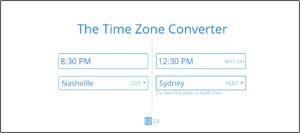
*To determine the time of the 1k1hr sprint in your time zone, go to the Time Converter website by clicking the image above and inputting my time (as Nashville or Central Standard Time) on the left, and your city/location on the right. For example, 8:30 PM Tuesday 11/15 in Nashville is 1:30 p.m. Wednesday 11/16 in Sydney, Australia.
What time will you be doing your 1k1hr sprint today? Or if not a 1k1hr, how will you work the concept of the sprint into your day?
Remember, the more support (and accountability) there is, the more successful we’ll all be!
1k1h Tips for Success
- Let anyone within your household know that you need one uninterrupted hour to try to head off at the pass any interruptions.
- Set a timer. This is most important. Don’t do this by just watching the clock. You’ll find yourself only watching the clock and not getting anything written. Setting a timer allows you to forget about the time and concentrate fully on writing.
- Prepare yourself before starting your timer. Re-read the last few pages you wrote (without editing/revising!) to get your head back into the story and figure out where you need to pick up. Review your outline and/or character pages in your Story Bible. And then put all of that away so you don’t use those to procrastinate during the hour.
- If you listen to music while writing (I recommend instrumental so that you don’t get distracted by the lyrics), have it set up and playing before starting your timer. Use earphones, even if you’re working at home, to block out any sounds that might pull you out of your story.
- If you can’t listen to music while writing, I recommend wearing the earphones anyway. People are less likely to interrupt you (at home or working somewhere like a coffee shop) if you have them in/on—and they help block out those distracting sounds.
- Make sure your writing space (both physical and mental) is set up and ready to go before you start your timer.
- In other words, make sure that about five to ten minutes before you start the 1k1h sprint, you’re in the process of getting ready to write.
- Silence or turn off your cell phone (unless you’re using it as your timer—then don’t turn it off). Close your Internet browser. Close Facebook and Twitter (as soon as I give the “start” signal, of course). Close your email program if you use something like Outlook that isn’t web-based. Eliminate all distractions!
Don’t Know How to Start Writing?
If you aren’t sure how to start writing when the hour starts, even after re-reading what you’ve previously written, here are a few suggestions.
- Which character had the viewpoint in the last scene you wrote? Start with a different character in this scene.
- Still not sure what to write? Try this prompt:
Character walked into the room. Character saw a piece of paper tacked to the wall on the other side of the room. Character walked across the room and took the piece of paper down. Character read the piece of paper. The piece of paper said . . . - If that prompt doesn’t work, try the exercise of making your character face a great fear or come face-to-face with someone they don’t like.
- If you can’t think of what the “next” scene is that comes after the one you just left off with in your previous writing session, start writing something you know comes later in the story that you already have a good idea for. Though I recommend writing your story in linear fashion (from beginning to end) instead of jumping around, sometimes you need to write stuff that comes later if you already have a clear idea of the scene in your head, just to make sure you don’t lose it. And that can also help you figure out what comes between what you’ve written so far and that future scene and help you to fill in the gap next time.
Don’t forget to check in with your progress and how you do with your own 1k1hr sprint(s) today!
#FirstDraft120 Day 44: Monday Momentum – Goals as Motivation #amwriting #nanowrimo
 It’s our first week of FD120, as opposed to FD60. While giving ourselves more time to write gives us room to breathe, it also gives us more opportunities for procrastination and losing momentum.
So here are a couple of things I thought might rev up our engines and get us back on track with the motivation to revise our goals and start working on that new writing schedule.
.
Dreams vs. Goals
Dreams vs. Goals: Do You Dream of Being a Writer?
- But will the dream of “being a writer” actually get you there? Is it something that’s as nebulous, as insubstantial, as the stories that run through our heads when we’re asleep? Or is the dream attainable? read more…
Dreams vs. Goals: Give Your Writing Dreams Marching Orders
- Dreams are hopes. Dreams are wishes. Dreams are visions of an outcome . . . without a visualization of the steps needed to reach that outcome.
Goals are what we need in order to figure out how to reach the end we’re dreaming of. read more . . .
Dreams vs. Goals: Setting Goals to Achieve Our Writing Dreams
- While starting out with a vague goal (still something achievable, but without “legs” to walk through all the way to the end result) is a good starting place, setting specific goals with actionable items is going to be how you measure your success. read more . . .
Dreams vs. Goals: What if my Writing Goals Change? What if I Fail?
- One of the reasons why I believe most dreamers are hesitant to actually sit down and go through the process I’ve described over the last few days—setting goals, writing them down, and setting a timeline—is not only because doing that makes it more concrete, more real, but also because by defining exactly what it is that we want to accomplish, we are defining exactly the ways in which we can fail. read more . . .
.
.
Assignment: What is motivating you today? How can you use your newly revised writing goals in order to build momentum for the next 79 days?

#FirstDraft120 Day 43: Sunday Reflections on Changing Goals & Deadlines #amwriting #nanowrimo
 In case you missed the announcement at the end of last week and are wondering what the revised logo means, check out that post before continuing on with today’s. Go ahead, we’ll wait.
Because Sundays are our day to take a moment to step back and think about our writing from a wider view, today is a great day to reflect on what we just did. Feel free to answer them here with as much or little detail as you’d like; or answer them on your own blog or on Facebook. Or just write the answers down in a private journal or notebook. The important thing is to actually think through and write down your answers.
Reflections for Day 43:
- How was your writing going before the challenge’s end date was extended?
- If you weren’t going to meet the original end-date goal and knew you needed more time, but had that date of November 30 hanging over your head, how did that make you feel?
- Now that we’re taking more time for this challenge, how do you think that will affect your writing—both your writing time (work) and your writing craft (story)?
- What are you looking forward to most about having more time to write? What do you think will be most challenging about the extended deadline?
I look forward to seeing your answers and will be posting mine soon. And don’t forget to check in with your word-count progress!
#FirstDraft60? I Think We Need MORE TIME. #amwriting #nanowrimo
If you haven’t been able to tell, due to the lack of interactivity here (and the lack of a THORsday post), things have been . . . stressful this week. Between health issues (mine, family members’) and, well, all of the other stuff happening in the world this week, I’ve been completely unable to focus and haven’t written a word since Monday.
This afternoon, Carol and I got together for our weekly writing session—and neither of us could concentrate. (And then things got a little crazy—thanks for putting up with me, Carol. I really needed that laugh!) Both of us agreed that trying to get a first draft finished by the end of November isn’t going to happen. But neither of us wants to give up, either.
Therefore, I’m pleased to introduce you to . . .

We’re extending our deadline for a complete first draft to January 31, 2017!
I know a lot of us fell behind with the prep work in October; and, although we were excited to start writing on November 1, we may not have actually been ready to do the kind of heavy-duty writing that completing a draft in 30 days requires.
At this point, looking at the days piling up on which I haven’t met my writing goal (and on which I haven’t written at all), it would be so easy to quit. To tell myself that I’ve written all the books I had in me and should just give up. Just stop writing.
But I’m not going to do that. I owe it to myself not to do that.
By extending the deadline to January 31, it not only gives us a chance to write at a more comfortable speed, but it also gives us a chance to build in days off, or to have time to make up for when we miss a day or two due to extenuating circumstances.
And it means we have time to go back and do some of that prep work we might not have finished by October 31. Especially now that we do have a little bit written and we may know more about our characters and/or plot than we did and can go back and restructure, do research, write backstories for new characters, etc.
I hope you’ll continue along—or, if you’re just now finding this, join in by going back and reviewing the prep-work posts from October and then jumping in with your goals and progress.
Assignment: If you’re in, check in with your progress to date and then a re-calculation of your daily/weekly/monthly/total word-count goals with January 31 as the final date for the challenge. (November 11–January 31 is 82 days.)
Let’s do this!
#FirstDraft60 Day 39: Wednesday Story-Bible Review #amwriting #nanowrimo
 In order to be able to focus on writing as much as we can on a daily basis, keeping our Story Bibles updated is going to be important. So on Wednesdays, be sure to schedule additional time to review your Story Bible and see what needs to be updated or revised.
Since Story Bibles can start to get kind of massive, here are the sections to focus on reviewing/updating today:
- Backstory, GMC, and Description pages for the main character(s).
- Settings section
- Timeline section
- Revisions section
- Style Guide
- Synopsis/Outline (in case your recent writing has made you think of any new scenes/plot points you want to add—or realize that some of the ones you thought of before you started writing no longer work).
And don’t forget to check in with your writing progress!
#FirstDraft60 Day 38: Timer Tuesday! #1k1hr at 8:30PM US Central #amwriting #nanowrimo
 Last week, we did our first Timer Tuesday, which can be useful in helping us build our word count and our story’s momentum when doing a marathon writing challenge like this. Today, our challenge is to schedule and complete at least one 1k1hr writing sprint some time during the day.
IT’S TIMER TUESDAY!
I’ll be doing two #1k1h Sprints today at 3:30 PM and 8:30 PM US Central time*.
*To determine the time of the 1k1hr sprint in your time zone, go to the Time Converter website by clicking the image above and inputting my time (as Nashville or Central Standard Time) on the left, and your city/location on the right. For example, 3:30 PM Tuesday 11/8 in Nashville is 8:30 a.m. Wednesday 11/9 in Sydney, Australia.
I’d love to make these writing sprints (or at least one a week) a “team” effort with as many of you participating as possible. The more support (and accountability) there is, the more successful we’ll all be! But if those times don’t work for you, go ahead and pick the times that work best for you.
1k1h Tips for Success
- Let anyone within your household know that you need one uninterrupted hour to try to head off at the pass any interruptions.
- Set a timer. This is most important. Don’t do this by just watching the clock. You’ll find yourself only watching the clock and not getting anything written. Setting a timer allows you to forget about the time and concentrate fully on writing.
- Prepare yourself before starting your timer. Re-read the last few pages you wrote (without editing/revising!) to get your head back into the story and figure out where you need to pick up. Review your outline and/or character pages in your Story Bible. And then put all of that away so you don’t use those to procrastinate during the hour.
- If you listen to music while writing (I recommend instrumental so that you don’t get distracted by the lyrics), have it set up and playing before starting your timer. Use earphones, even if you’re working at home, to block out any sounds that might pull you out of your story.
- If you can’t listen to music while writing, I recommend wearing the earphones anyway. People are less likely to interrupt you (at home or working somewhere like a coffee shop) if you have them in/on—and they help block out those distracting sounds.
- Make sure your writing space (both physical and mental) is set up and ready to go before you start your timer.
- In other words, make sure that about five to ten minutes before you start the 1k1h sprint, you’re in the process of getting ready to write.
- Silence or turn off your cell phone (unless you’re using it as your timer—then don’t turn it off). Close your Internet browser. Close Facebook and Twitter (as soon as I give the “start” signal, of course). Close your email program if you use something like Outlook that isn’t web-based. Eliminate all distractions!
Don’t Know How to Start Writing?
If you aren’t sure how to start writing when the hour starts, even after re-reading what you’ve previously written, here are a few suggestions.
- Which character had the viewpoint in the last scene you wrote? Start with a different character in this scene.
- Still not sure what to write? Try this prompt:
Character walked into the room. Character saw a piece of paper tacked to the wall on the other side of the room. Character walked across the room and took the piece of paper down. Character read the piece of paper. The piece of paper said . . . - If that prompt doesn’t work, try the exercise of making your character face a great fear or come face-to-face with someone they don’t like.
- If you can’t think of what the “next” scene is that comes after the one you just left off with in your previous writing session, start writing something you know comes later in the story that you already have a good idea for. Though I recommend writing your story in linear fashion (from beginning to end) instead of jumping around, sometimes you need to write stuff that comes later if you already have a clear idea of the scene in your head, just to make sure you don’t lose it. And that can also help you figure out what comes between what you’ve written so far and that future scene and help you to fill in the gap next time.
Hopefully, I’ll “see” you at 3:30 and 8:30 (Central) this afternoon/evening. If not, don’t forget to check in with your progress and how you do with your own 1k1hr sprint(s) today!
#FirstDraft60 Day 37: Monday Momentum–What’s Motivating You Today? #amwriting #nanowrimo
 So it looks like most of us had a very challenging first week and missed our daily and overall word-count goals. But not only is it the beginning of a new week, it’s a new day with new chances to get motivated and start gaining/regaining momentum.
So here are three things I thought might encourage all of us and remind us that everything before now is past. It’s only the future we can change and make better.
.
Writing Tip #10: YOU are your best source of motivation!
- No matter how many writing groups you join, no matter how active you are in them, no matter how many blogs you write and read and comment on, no matter how many writers’ forums you participate in, when it comes down to it, writing is a solitary venture. Unless you put YOUR butt in YOUR chair and start committing words to paper (whether electronic or wood pulp), your story will not get written. more . . .
.
.
WRITE: An Inspirational Acrostic
- WRITE—Wonderfully
Wonder. I believe all writers need to view the world around them with a sense of wonder. more . . . - WRITE—Rejoice!
Reach out. Writing can be such a solitary pursuit. more . . . - WRITE—with Integrity
Integrity. It takes years, decades, to build your reputation as a person of integrity. And only one wrong word or deed to ruin it. more . . . - WRITE—Technically
Technical. . . .I’m talking about writing our novels with technical accuracy. Study the craft. Study grammar. Study a style book. Study other authors’ books. more . . . - WRITE—Engage!
Effort. Writing isn’t easy. . . .There are a lot of people who want to write, but there are a lot more who want to have written. They don’t want to put the time in to sit at the computer for hours and hours composing the story, then twice or three times as many hours editing and revising and critiquing. This is when everyone who wants to “be a writer” learns whether it’s truly their life’s work, a job, or just a hobby. more . . .
.
Assignment: What is motivating you today? How will you build momentum to strive toward your goal(s) this week?
#FirstDraft60 Day 36: Sunday Story Reflections #amwriting #nanowrimo
 On Sundays, we take a moment to step back and think about our writing from a wider view. In order to do that, I’ll post some guided questions—feel free to answer them here with as much or little detail as you’d like; or answer them on your own blog or on Facebook. Or just write the answers down in a private journal or notebook. The important thing is to actually think through and write down your answers.
Because we’re now in the writing portion of the challenge, there will be a much narrower focus to the question(s) posed each week—and we’re going to turn that focus onto the story itself.
Reflections for Day 36:
- What have you learned about your main characters so far?
- Are your characters staying on track, or have you already had to make revision notes in your Story Bible for things that will need to change in the revision process for the second draft?
- Do you still look forward to spending time with your characters every day?
I look forward to seeing your answers and will be posting mine soon. And don’t forget to check in with your word-count progress!
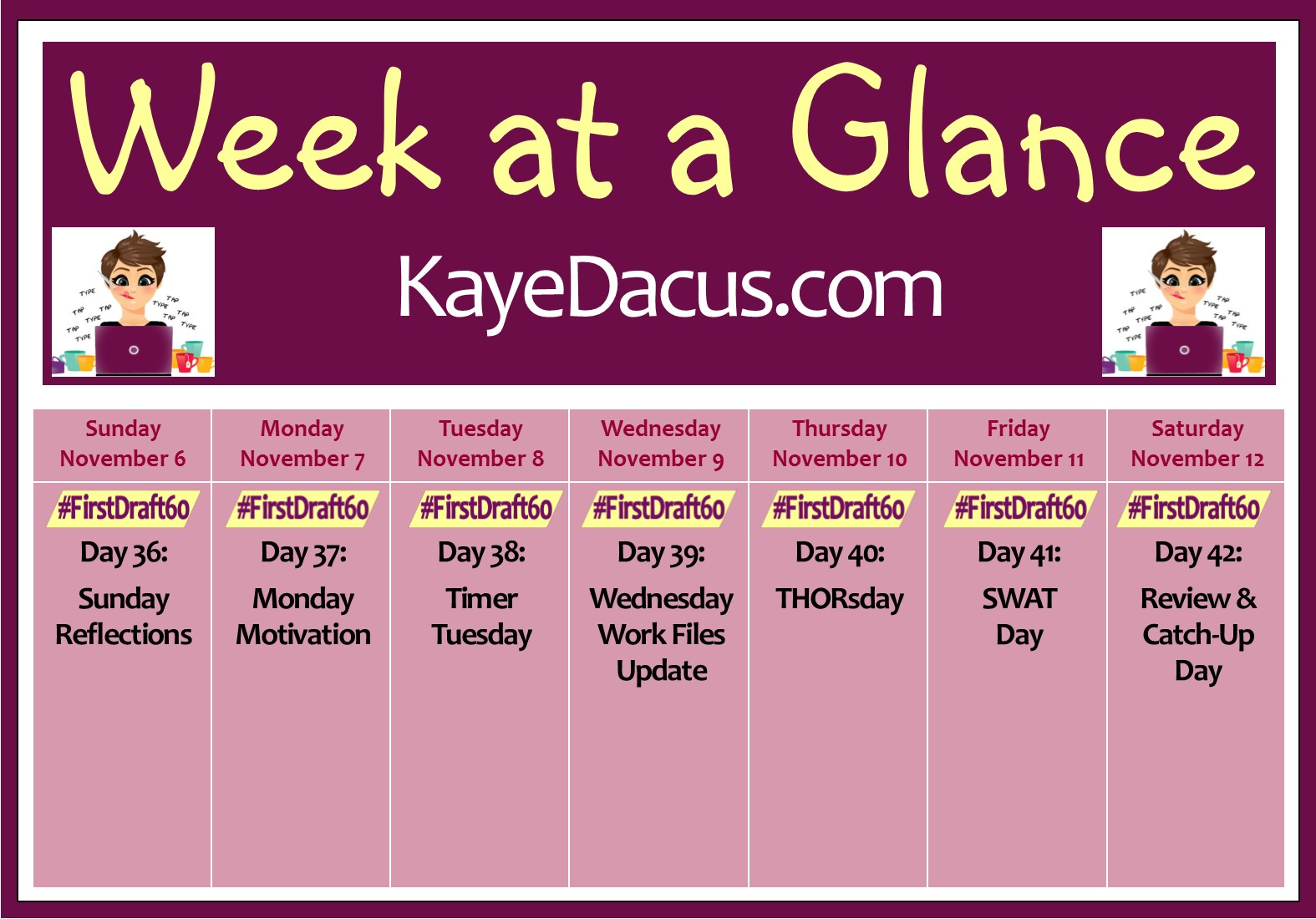
#FirstDraft60 Day 35: Saturday Catch-Up & Review Day #amwriting #nanowrimo
 I can’t believe that it’s almost 8 p.m., and this is the first time I’ve had a chance to sit down at the computer to do anything. (It was a day out with my girlfriends—lunch and movie and shopping—which I desperately needed after a whole lot of time with little to no social interaction.)
Just like during the prep portion of this challenge, Saturdays are our days to review what we’ve done during the week, and to catch up on anything we fell behind with. And now that we’re writing, it’s time to catch up with word count if we’ve fallen behind during the previous week, too.
When doing any kind of a challenge like this in which the goals are cumulative, it’s always good to build in a day (or two) to be able to get caught up on anything we’ve fallen behind with. Because most of us work during the week, we have more time to do this on the weekends. So until October 30, be sure to set aside time on your weekend, whether on Saturday or Sunday to stop, update your Story Bible, and get caught up on your word count.
This isn’t permission to slack off during the week. It’s to give you permission to not beat yourself up if you don’t meet your daily word-count goals or if circumstances make it impossible to write on a day you’d planned to. As long as you give it your best effort and the complete it by the end of the week, you’ll be able to stay on track.
So let’s begin.
Assignments for Saturday:
- Review everything you’ve written so far. Remember that we’re draft writing, so don’t spend too much time revising—but making a few corrections or revisions/additions here or there is okay. But it’s better during this process to make notes (in the Revisions section of your Story Bible and/or in comments in your document) of what you’re going to want to change once you finish the first draft and start your rewrites/revisions for your second draft.
- Update your Story Bible and Style Guide based on everything you wrote this week.
- If you’re behind on word count, do some 1k1h sprints this weekend to get caught up (and possibly get ahead).
- Once you’ve caught up and have everything updated, do some “what if” brainstorming and see if you can come up with some additional ideas for either the characters themselves or for your story/plot. Have fun with this. And if you feel inspired to write some more, do it!
- Check in and let us know how you’re doing, what you’ve accomplished, and what you hope to achieve this weekend.
Above all else, have a great weekend!
#FirstDraft60 Day 34: Friday Is S.W.A.T. Day #amwriting #nanowrimo
It’s Friday! It’s also the first Friday of the writing portion of our sixty-day challenge.
Even though we’ll be (hopefully) sharing our progress on a daily basis, on Fridays I want to know about your full writing week. What were your greatest successes during the week? What was your favorite line/bit that you wrote? What did you learn about yourself, your characters, and/or your story during the week’s work? What are you most proud of yourself for doing this week when it came to your writing? What are you proud of yourself for accomplishing?
In the business world, there’s a planning model called SWOT—which is an acronym for Strengths, Weaknesses, Opportunities, and Threats.
Around here, we’re going to use SWAT, but we’re going to do it differently, so check in with the following recap for your week:
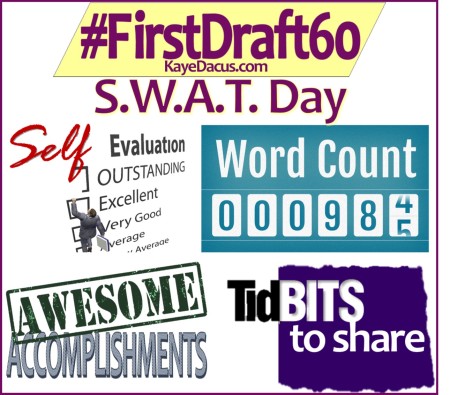
- Self-Evaluation (how do you think you did? what can/do you want to do differently next week? what did you learn about yourself as a person or as a writer? what didn’t you do or finish that you wanted to? etc.)
- Word count (total for the week, Tuesday through today)
- Awesome Accomplishments (breakthroughs, discoveries, highest daily word-count ever, etc.)
- Tidbits to share—something you wrote that’s just too good not to share or that struck you as funny or whatever.
If you don’t want to share this stuff publicly, that’s okay. You can add a section to your Story Bible or start a journal (or add this to your existing journal) to keep track of this. But don’t skip doing this—I think that in the future, when you look back either on what you accomplished during this challenge or (heaven forbid) why you gave up on it, the insights you’ll gather later with hindsight on your thoughts during the challenge will be invaluable.
Happy writing!

 KayeDacus.com