Tricia Goyer’s A Valley of Betrayal (Blog Tour)

ABOUT THE AUTHOR
Tricia has a writing blog, It’s Real Life, and a parenting blog, Generation NeXt.
TRICIA GOYER is the author of five novels, two nonfiction books and one children’s book. She also was named Mount Hermon Christian Writers Conference Writer of the Year in 2003. In 2005, her novel Night Song, the second title in Tricia’s World War II series, won ACFW’s Book of the Year for Best Long Historical Romance. In 2006, her novel Dawn of A Thousand Nights also won book of the Year for Long Historical Romance. Tricia and her husband, John, live with their family in northwestern Montana.

ABOUT THE BOOK
For reasons beyond her control, Sophie finds herself alone in the war-torn Spanish countryside, searching for her beloved Michael. His work as a news photographer has taken him deep into the country wracked by civil war. What was once a thriving paradise has become a battleground for Nazi-backed Franco fascist soldiers and Spanish patriots. She is caught up in the escalating events when the route to safety is blocked and fighting surrounds her.
Secrets abound in the ruined Spain. Michael is loving but elusive, especially about beautiful Maria. The American who helped Sophie sneak into Spain turns up in odd places. Michael’s friend Jose knows more than he tells. When reports of Michael’s disappearance reach her, Sophie is devastated. What are her feelings for Philip, an American soldier who comes to her rescue?
Sophie must sift truth from lies as she becomes more embroiled in the war that threatens her life and breaks her heart. On her darkest night, Sophie takes refuge with a brigade of international compatriots. Among these volunteers, she pledges to make the plight of the Spanish people known around the world through the power of art.
I got this book about two weeks ago, and haven’t had a chance to read it yet, but just picking it up and reading the back cover and the first couple of pages had me completely intrigued and I cannot wait to dig into this one!
For more information and other blogs with reviews up, visit http://christianfictionblogalliance.blogspot.com/2007/02/valley-of-betrayal-by-tricia-goyer (see the comments for the list of other review blogs).
Does it matter what Jane Austen looked like?
I don’t usually post on Sundays, but my mom forwarded this link to me. It’s a nice op/ed piece on Jane Austen and if what she looked like and what she was like as a person have any effect on how we read her novels:
“It is a failing to read Shakespeare and feel impoverished by the lack of biographical detail. It is no less a failing to read Austen and wonder what the mirror said when she looked into it. I cannot think of anything that would make Emma richer than it is.”

It’s interesting that this essay should appear in the NY Times today. I recently read another article (from the British Guardian) where the writer poses the idea that publishers are as concerned about what an author looks like as they are with the quality of the writing.
“Amid the pile of first novels in front of me, a handful of author photos proves her point: Ivo Stourton looks as if he has stepped out of Brideshead Revisited, snapped outside a sunny villa. His publisher makes much of his youth and Cambridge education. And an A4-sized photograph of a smiling Priya Basil slips invitingly out of the review copy of her novel as if to win favour.
That is not to imply that this is a talent contest – only that everything counts.”
This is an area long debated by literary critics—and something I had to learn about as an undergrad in my Literary Criticism course. Is it possible to separate the author from the work? The theories of literary criticism are vast and wide—and very similar to the theories of philosophy . . . and some are rather along the lines of “If a tree falls in the forest…”
For example: Is a poem good because of the response that readers have to it, or is it good because it has the potential to create a response in readers? Does the author lose authority over his/her writing as soon as someone else reads it (reader as authority)—in other words, does it matter with what intention an author writes something, or is it only what the reader gets out of it that means anything?
Wow—this has made me dig out my notes from that class, which was one of my favorites.
So let me as you—when you read, do you find out everything you can about the author? Do you try to figure out what the author is trying to say or do you read it looking only for your own interpretation of it? Does knowing about an author’s personal life enhance or detract from your reading experience?
Miss Invisible by Laura Jensen Walker

“One size does not fit all…”
How many times have I thought that upon seeing a OSFA label in a garment?
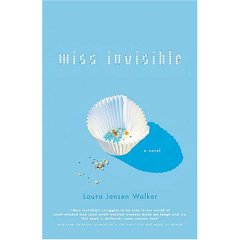
I knew when I read this opening line of Laura Jensen Walker‘s latest inspy chick lit, Miss Invisible, that I was in for a treat. As with the first LJW novel I read (Dreaming in Black & White), by the time I got to the bottom of the first page, I wanted to shout, “Get outta my head!”
Freddie (Frederika Heinz) is a large woman, but smaller than a 22/24 we learn when she first meets Deborah, a flamboyant, larger-than-life (and Freddie) African American woman. Freddie is a cake decorator at a bakery in the small Northern California town where she grew up.
This is a part of the book that struck me on a deep level. Freddie returned “home” to this town after several years (and a broken relationship) in Chicago. She grew up here, but her only friends are her current coworkers and Deborah—after Deborah makes Freddie her friend. Though it is never said in the text of the story, this is one of the symptoms of Freddie’s invisibility—no childhood friends that she hangs out with and reminisces with over the “good times.” Very much like when I moved away from the small town where I grew up and went to college out of state, it was “out of sight, out of mind”—I never really had contact with anyone I grew up with again. I don’t know if LJW set out to show this or if it just happened, but either way, it gave me a deep connection with Freddie.
I read an article yesterday that mentioned how “coming of age” stories are very popular in the literary genre right now. MI isn’t really a coming-of-age story—though Freddie does turn thirty in it. It’s more of a “coming to terms” story. After a lifetime of being told she’s fat, ugly, good-for-nothing (mainly by her father and step-mother) and being ignored or discriminated against, Freddie has to come to terms with who she is (a beautiful, beloved child of God) and that the resentment she’s carried around about this for years has made her not only bitter but it’s made her reverse-discriminate against “skinny” girls.
Deborah, who owns a catering company, becomes Freddie’s Mr. Miyagi, taking her shopping for clothes in some color other than black (I did this about six or seven years ago) and gets her moving—water aerobics, swimming, walking (the only forms of exercise I will do too). My favorite scene in the whole book is the first time Freddie has dinner at Simon’s restaurant.
As Freddie’s confidence grows through Deborah’s friendship, mentoring, spiritual guidance, and positive encouragement, others start noticing Freddie. Now she’s no longer invisible—in fact she has two men fighting over her!
While the spiritual lesson is important (God loves us just as we are) it is never preachy. However, there was one section that did make me skip over a couple of paragraphs because it seemed more like a lecture than a natural flow of dialogue—and that was when Freddie and Deborah are talking about Californians’ obsession with weight and dieting and the problem of childhood obesity.
Something else that pulled me out of the story a little is that Lydia has her baby late one night and is home the next day. Are women really sent home without staying in the hospital at least twenty-four hours after giving birth? Or did I skip a couple of pages or something?
The story did wrap up a little too neatly for me. By the end of the book, Freddie has gotten so completely over her body-image issues that wearing a swimsuit at a pool party doesn’t give her a moment’s hesitation—and she’s still about the same size (though a little more toned) that she was at the beginning of the story. No matter how much spiritual and emotional healing she’s done, something like body-image issues or self-consciousness doesn’t go away that quickly. Even just a brief hesitation before taking off her wrap and then reminding herself of the lessons learned would have helped the ending be a little more realistic for me. Some emotional scars (like a lifetime of verbal abuse over being fat) run a little too deeply for just a couple months of new-found self-confidence to heal.
Don’t let my one problem (and it’s only my opinion) scare you off this great read. I highly recommend this as a fun, light read—LJW has given us another winner!
Next on my TBR pile: Fireworks by Elizabeth White.
LOST–This Writer’s Perspective
Okay, really, I don’t have some big, philosophical or academic diatribe to write about this TV show. The truth of the matter is: I’m addicted to LOST, which is why you typically don’t see blog entries from me on Wednesdays. By the time I get home from choir practice around 8:00, that only gives me an hour to read the mail (usually junk mail on Wednesdays), take out the trash, check and respond to e-mails that have been building up for a few hours (not that there are usually that many), set up the VCR to record Medium which comes on at the same time (which really just means making sure the tape is rewound, put back into the correct VCR–not the one that eats tapes–and the timer button pressed), set up the coffee maker for the next morning, and settle whatever other affairs need settling before sitting down at 8:57 to make sure that I don’t miss the absolute very beginning of the show. (Previously on LOST . . .)
I did not start watching LOST when it first came on. At that point in time, I was just weaning myself off Alias and had several other programs I watched on a very regular (religious?) basis. I did not want to get caught up in another show that had to be watched every week for the viewer to understand what was going on. I’ll call this “sequential” as opposed to “episodic.” Episodic programs, to me, are those that deal with a particular problem each week which is solved by the end of the hour (or by the next week if it’s a major problem). For example, the CSI and Law & Order franchises, ER, JAG/NCIS/The Unit, etc. Yes, there is continuing backstory for the main characters, but you don’t really have to watch every single episode to understand what’s going on. Whereas sequential programs, like Alias and LOST (and probably Heroes, but I haven’t watched that one–waiting ’til it comes out on DVD this summer) is one continuous story with a cliffhanger every week. The characters’ backstories are vital and integral to what’s going on in the here-and-now (especially true in LOST). And they seem to involve more global/universal themes such as survival or saving the world, instead of solving one particular crime or figuring out what someone is dying of before they actually die (as happens each week on House, another episodic show I enjoy occasionally).
Anyway, as I stated, I didn’t start watching it two years ago when it first came on. I ended up getting hooked on it this year–in January, actually–when my coworkers, who are die-hard fans, loaned me the first two seasons on DVD…which I watched in the span of about two weeks (can you say “got no writing–or anything else done”???). At that time, all six of the episodes from the beginning of this year were available for free viewing on the ABC website, so I was able to get caught up with the entire show just a few weeks before they came back from their hiatus in February.
Most weeks, as my scream of “Nooooooooooooo!” dies away, I turn the TV off wondering what, exactly, it is about this program that makes it so addictive. I’ve come up with a few reasons, the first of which is the fact that it’s sequential. There isn’t closure at the end of each episode, even when there is a conclusion to whatever conflict happens on that week’s show—there is that agony of needing to know what happens next.
The second reason, the reason why I need to know what happens next, is strength of character development. As a writer, I’ve watched the behind the scenes featurettes on the DVDs and listened to JJ Abram’s and Damon Lindelof’s commentary about their process with coming up with the story and how they developed the characters. One of the things they did that makes this show somewhat different is that they developed many of the characters around the actors who came in to audition. Case in point–Yunjin Kim, the actress who plays Sun, actually auditioned for the role of Kate. But they liked Yunjin so much that they developed the characters and plotline of Sun and Jin so they could have her on the show (and I’m so glad, because they’re some of my favorite characters).
The third is tightness of storytelling. There is very little I’ve seen in any episode that has happened that has not come into play in the plot. The people responsible for creating this show like to plant what they call “Easter eggs”—whether it’s the DHARMA logo on the shark or the use of the Widmore Pharmaceuticals products or the frequency of certain numbers—that may seem unimportant when they first appeared, but now have considerable importance . . . even though we’re still not sure exactly why.
Fourth, the writers aren’t at all scared of killing off characters—even those we’ve come to love. This puts all of the main characters in mortal jeopardy (although most viewers feel pretty confident that they wouldn’t dare kill off the key cast who’ve been there from the beginning) and we have to watch each week to make sure that these characters we’ve come to love will survive to entertain us another week.
I could talk about how they’ve dealt with backstory on this show, but that could run over several thousands of words, so I’ll spare you.
What about you? Do you have shows you’re addicted to? Have you ever analyzed why they keep you coming back week after week?
Pushing the Words
Well, the only part of my schedule that got off track last night was the half hour of reading before bedtime . . . and bedtime. Once I finished typing in the 1,652 words that I had already handwritten of my new project, I wrote an additional 1,105 words to have a complete (though a little short) first chapter—though I’ve thought of a few things during the day today to add to it. But because I was on a roll, I didn’t stop until around midnight. Now, I used to be able to function well if I was in bed by 1:00 or 2:00 am and up by 7:00 am—as long as I got to sleep about 12–13 hours on Saturday. But as I get older, I’m discovering that isn’t working so well any more—case in point . . . as soon as I got home from work this evening (at 5:00), I sat down to flip through the mail before changing clothes to go out for my walk. An hour later, when I woke up, I figured out that I’m too old to stay up past midnight and still expect to function normally any more.
The faster I write the better my output. If I’m going slow I’m in trouble. It means I’m pushing the words instead of being pulled by them.
~ Raymond Chandler
I like this quote by Raymond Chandler, because I’ve been there—boy have I been there!—when the words just won’t come. But over the past month, I have learned that while this is true—that it’s better to write when the words are flowing—if I don’t sit myself down and make myself write every day, the days when the words flow are going to be fewer and farther between, until it gets to the point when the words cease coming easy at all. Just like coming up with something to write about here every day (and Erica has sent me a suggestion for a topic, but I’m still looking into it to see if I can find enough written about it to make it comprehensible) isn’t easy, sitting down to write every day isn’t easy. I usually want to do it when I’m supposed to be doing something else (like working). But then when I have my entire evening in which I could be writing, I want to do anything but.This is nothing new, nor is it unique to writers:
For what I am doing, I do not understand; for I am not practicing what I would like to do, but I am doing the very thing I hate.
~Romans 7:15 (NASB)
Of course, here Paul was talking about sinning instead of living life in a godly manner—but the lesson holds true. For if we are truly called to write—if writing is a gift God has given us—but we don’t do it, we don’t discipline ourselves to sit down at the keyboard or with the pen and notebook on a daily basis, we are like the wretched servant in Jesus’ parable who hid the talent instead of going out and doing something with it.
So, my encouragement for the day is this: write, even when you feel like you’re having to push the words. Because you never know when the Master might come and ask for an accounting of the work you accomplished.
I’ve Been Procrastinating Again
I haven’t been sticking to my writing schedule. Sure, I could blame it on having been sick for almost a week and the cough that is still lingering (which is most likely allergies, since our temps here in Middle Tennessee have been in the 80s for the past week and EVERYTHING is blooming). But the truth of the matter is, I’ve simply been ignoring the schedule and sitting in front of the TV wasting time—even when I know there’s nothing on and I have several projects needing my attention.
Anyone can do any amount of work, provided it isn’t the work he is supposed to be doing at that moment. ~Robert Benchley
I wish I could say that I’ve been procrastinating by doing other things—yardwork, spring cleaning, or other projects—but that’s not even the case. Nope. I’ve just been lazy the past couple of weeks. (Of course, you notice, I have managed to post a blog entry almost every day.)
There are a million ways to lose a work day, but not even a single way to get one back. ~Tom DeMarco and Timothy Lister
Every night when I go to bed, I feel guilty, because I haven’t finished reading Miss Invisible, I haven’t responded to a few e-mails I know are waiting for my attention, and, most detrimental, I’ve hardly written, even though I now have two projects going. And I think, Tomorrow, I’ll get back on the schedule; I’ll write at least 1,000 words—on one or the other or both projects; I’ll get out and walk my mile; I’ll read for at least thirty minutes; I’ll catch up on all my e-mails; and I’ll go to bed by 11:00.
Procrastination is opportunity’s assassin. ~Victor Kiam
Knowing that I couldn’t waste another entire Saturday as I did last weekend (in my defense, I was running a fever, couldn’t breathe—or when I did, lapsed into a coughing fit—and my head spun every time I moved), I started the day out well by making it to my 9 a.m. hair appointment not just on time, but about 45 seconds before my stylist arrived for the day. I then spent the remainder of the morning and early afternoon scouting for a real location to use as a template for the town in my new project I’m working on. (This, of course, necessitated a stop at Starbucks for a latte and Barnes & Noble for a good roadmap of Middle Tennessee before I actually hit the road). Several hours later, around 1:30, I found myself sitting in Courthouse Square in Charlotte, Tennessee, sketching a map of the square complete with the businesses or offices located in each of the buildings.
A year from now you may wish you had started today. ~Karen Lamb
On the way home, I stopped for lunch, and then picked up some posterboard at Walgreens (the kind with the hairline grid printed on it) and hit the interstate for the half-hour drive home. And this time was made double-use of, as I was listening to an audiobook almost the entire time.
Laziness is nothing more than the habit of resting before you get tired. ~Jules Renard
Once home, I put clothes in the dryer, straightened up the kitchen, fixed a snack (iced tea and carrots with buttermilk dressing for dipping), and then moved a small table (the one I use for my little Christmas tree) into the living room where I started laying out the map of my setting. So while I didn’t do any actual writing Saturday, I did get some writing-related work accomplished.
That destructive siren, sloth, is ever to be avoided. ~Horace
Sunday, I’m almost ashamed to say, the only writing I got done was a couple hundred words written on the back of the handout we were given in the special Sunday school class that all adult classes combined for (taught by a judge who’s a member of the church about the trial of Jesus). After church was the new member luncheon (I was one of the honorees), then I spent a couple of hours setting up and formatting a blog for the new college Sunday school class I’ll be teaching beginning this coming Sunday.
The road to success is dotted with many tempting parking places. ~Author Unknown
So, tonight when I get home from work, I WILL walk, I WILL catch up on e-mails, I WILL write at least 1,000 words on one or both of my WIPs, I WILL take at least half an hour to read Miss Invisible, and I WILL go to bed by 11ish. And I WILL check in tomorrow to let you know if I was successful in sticking to my schedule.
You Know You’re a Writer If . . .
Signs you might be afflicted with the condition known as WRITER:
- You would rather talk to the voices in your head than the person sitting next to you.
- You know the research librarian’s office, cell, and home phone numbers but can’t remember your own.
- Some of the letters on your keyboard are completely worn off.
- You would rather write than go out.
- Your/you’re and their/there/they’re errors send you into an apoplectic fit.
- You get cranky if you don’t get to write.
- You’ve ever said, “The voices are getting louder; I must go write.”
- When talking with others, you mentally edit their dialogue and compose tags and beats.
- You’ve heard/seen something and thought, I need to write that down.
- You’ve ever written a scene, outline, synopsis, or character sketch on a restaurant napkin . . . and it wasn’t a paper napkin.
- In the middle of the night, you grab the pen and paper you keep next to your bed to write down a scene to make the voices be quiet so you can get some sleep.
- You end an argument with your spouse by saying, “Oh, wait, I have to write this down–this is the perfect conflict for my characters! Now, repeat what you just yelled.”
- Getting the scene finished is more important than food, coffee, or the bathroom.
- You have a momentary reality lapse and mention your characters’ situation as a prayer request in Sunday school.
- A blank wall becomes the screen where the scene you’re writing takes place right in front of your eyes.
- The easiest way for you to deal with conflict is to go home and write it into your story.
- You have filed and cross-referenced every issue of The Writer and Writer’s Digest you’ve ever received.
- You purposely eavesdrop when out in public.
- At parties, your method of making conversation is to discover people in the room with interesting occupations (preferably your hero’s or heroine’s) so you can conduct research.
- You listen to the writer’s commentary on every DVD so that you can analyze his/her writing process.
- You have a favorite line from every movie you’ve seen.
- You can’t write because you’re mad at one of your characters.
- You argue with said character.
- You have a folder on your computer labeled “Ideas.” Some of the files within this folder have only one or two words or sentences and while they made perfect sense fifteen years ago, between the software changes in that period of time garbling half the words and your own faulty memory, you have no idea what it means or where you were going with it. But you keep it anyway because you never know, you might remember it eventually.
- You drive three hours to a city where you don’t know anyone, spend another three hours driving around the city, then drive three hours home and decide NOT to set your story there.
More “You Know You’re a Writer If . . .” Posts:
More You Know You’re a Writer If . . .
Even MORE You Know You’re a Writer If . . .
You Know You’re A Writer If, Extended Edition
Writer versus Reader
When do we stop being readers? I don’t mean a cessation of reading, but a slowing in or absence of the joy of reading. When I think about former reading habits, I wasn’t just avid, I was voracious, insatiable. I read four to five novels per month–or more–even during the first few semesters after I went back to college. If I discovered an author whose book I liked, I went out and bought every book by that author and feasted upon them. And this was not in exclusion to writing–I was writing 3,000–5,000 words per week, too.
I went to my first writer’s conference six years ago, then joined ACRW (now ACFW)—and I discovered so many new writers that I feared I would never have time to write again if I read all of their books. Then, in 2004, I went to grad school. In this program, we were taught not just to critique our peers’ writing but to break down and analyze published novels in our genre. Very much like the literature courses I took as an undergrad English major, reading became a task, a chore—something that I couldn’t just lose myself in; rather, something that I had to remain analytically alert while doing. If I started losing myself in the story, the left-brain analyst would kick in and make me stop to figure out why I liked it (or, conversely, why not).
Then, to compound the problem, a year ago, I changed jobs and became a copy editor with a small publishing house. While I am still very much a beginner at it, it’s hard to shut it off when I get home. It has affected the way I critique, judge contest entries, and read. Because each house has its own house style—choosing whether or not to use a serial comma or capitalize pronouns for God—whenever I read something not punctuated the way I’ve learned to do it for our house style, the copy editor part of my brain wants to take a purple pen (my designated color at the office) to it.
So, I figured I’d just switch completely over to audiobooks. I’ve always enjoyed them. I have Jane Austen’s six major novels, the Harry Potter books, a couple of Star Wars spinoff series, the Little House books, the complete Narnia series, and all three Lord of the Rings–and that doesn’t include the titles I’ve bought through audible.com and downloaded straight to my MP3 player. Audiobooks help me reclaim parts of the day that are otherwise “wasted” time–getting ready for work in the morning, in the car, on walks in the evening. I still occasionally rewrite the sentences in my head, but it’s easier to get into the story when my mental copy editor isn’t scrutinizing all of the punctuation on the page. But even still, I’ve been having a hard time sticking with a novel all the way through.
I’ve done enough critical analysis of the few books I have managed to read all the way through and enjoy to realize that it’s not because they’re perfectly punctuated nor the best at craft, it’s the strength of the storytelling and character. In the past two or three years, I have picked up so many books at Barnes & Noble; read the back; thought, That sounds interesting; and put it right back on the shelf because I knew if I bought it, I might read the first few chapters, but then, or one reason or another—historical inaccuracies, issues with craft/voice/tone, or technical difficulties with a different house’s style—I would set it aside and never finish reading it.
But since putting myself on a schedule, I became determined that I was going to become a reader again. And, now that I’m writing a contemporary romance again, I need to be reading currently published contemporaries. So, a little over a week ago after the monthly MTCW meeting, I made a trip to Lifeway. I usually buy all of my books online, but I was determined to find something new by picking them up, reading the first few pages and buying whatever drew me in enough to turn the pages. I picked up two—Laura Jensen Walker’s latest chick lit, Miss Invisible, and Fireworks by Elizabeth White, a contemporary romance set in a small town in Mississippi (my contemporaries are set in a fictional city in Louisiana). Then, in the mail that week, I received review copies of Susie Warren’s Reclaiming Nick and Tricia Goyer’s Valley of Betrayal for blog tours.
All of this is the lead-in to say, I am about halfway through Miss Invisible and it is such a good story with so unique a main character that never once has the analyst in me pulled me out of it to break it down; nor has the copy editor raised any purple flags over a technical aspect. Maybe all I needed was the break I’ve had since last spring of not reading anything new at all—just returning to many old favorites—to get the analytical part of my brain to stay quiet when I’m reading and just let me lose myself in the story.
Although it sounds (and feels) conceited to admit, since learning as much as I have about the craft of writing, I have come to a conclusion when determining the strength of a particular story. If, when I put it down, I don’t think about how I would have done it differently, it was a pretty darn-good book!
Do you have trouble “just reading”? What will make you put down a book without finishing it? What will keep you reading, even if you have to overlook something that’s a personal pet peeve?
Speaking of reading/reviewing, check out a couple of reviews of novels by members of Middle Tennessee Christian Writers, posted by members Ruth Anderson and J. M. Hochstetler, on our group blog, http://mtcw.wordpress.com.
What’s in Your Fridge?
Kristy Dykes tagged me today: “Tag, you’re it. Post a pic on your blog of the inside of your refrigerator.”

So here it is. It actually looks fuller in the picture than it does in real life. I was in the process of making a grocery list when I got tagged, as a matter of fact. Yes, there are two egg cartons on the top shelf . . . but the one on top only has one egg left in it. There are a few left-overs, but over the past 11 years, I’ve gotten pretty good at making one-serving meals. Of course, on the second shelf you see my Tennessee Pride HOT ground sausage–perfect for making chili–and the two beside it are a link of Peppridge Farm regular sausage which I have with breakfast every morning and a link of Andouille sausage for red beans. Cheeses and lunch meats in the drawer, sour cream and plain yogurt, and, yes I confess, half a loaf of French bread–for lunch sandwiches during the week this week. Salad stuff and veggies on the bottom shelf, and yes, a ginormous jar of jalapeno slices behind the bleu cheese and lemons. What you can’t see are the seven or eight different types of salad dressings in the top shelf of the door, along with all of the various condiments in the next two door shelves.
So what’s in your fridge? Take a picture and post a link!
I’m off to Publix! Maybe I’ll follow up tomorrow with an “after” picture! 🙂


