Famous Last Words—Answers . . . and Another Question!
Congratulations to Austin Field who got an amazing 10 out of 15 correct! Austin wins the Amazon gift certificate. And here are the answers:
1. It is a far, far, better thing that I do, than I have ever done; it is a far, far, better rest that I go to, than I have ever known.
A Tale of Two Cities by Charles Dickens
2. Now small fowls flew screaming over the yet yawning gulf; a sullen white surf beat against its steep sides; then all collapsed, and he great shroud of the sea rolled on as it rolled five thousand years ago.
Moby Dick by Herman Melville
3. He drew a deep breath. “Well, I’m back,” he said.
The Return of the King by J. R. R. Tolkien
4. He was still the same old God, ordering my life and doing all things well.
The Visitation by Frank Peretti
5. They could not be forgotten, she thought, because now is now. It can never be a long time ago.
Little House in the Big Woods by Laura Ingalls Wilder
6. Hadn’t they ever seen a kiss before? At least they couldn’t hear her as she whispered into his ear. “You haven’t seen the last of me, Jamie D. Lane.”
The Celebrity by Robert Elmer
7. “ . . . Daily he announces more distinctly, ‘Surely I come quickly!’ and hourly I more eagerly respond, ‘Amen; even so come, Lord Jesus!’”
Jane Eyre by Charlotte Bronte
8. She gloried in being a sailor’s wife, but she must pay the tax of quick alarm for belonging to that profession which is, if possible, more distinguished in its domestic virtues than in its national importance.
Persuasion by Jane Austen
9. He was soon borne away by the waves and lost in darkness and distance.
Frankenstein by Mary Shelley
10. Whatever we had missed, we possessed together the precious, the incommunicable past.
My Ántonia by Willa Cather
11. “She is the Surprise,” said Stephen, and he whispered, “The joyful Surprise, God and Mary be with her.”
The Far Side of the World by Patrick O’Brian
12. And, to our bitter grief, with a smile and in silence, he died, a gallant gentleman.
Dracula by Bram Stoker
13. And everyone, of course, lived happily ever after.
Miss Invisibility by Laura Jensen Walker
14. “I feel like praising and glorifying our Lord in heaven and giving Him thanks for all that He has done for us.”
Heidi by Johanna Spyri
15. The joy of the children was in his voice.
Christy by Catherine Marshall
So, now the question becomes: why are first lines more memorable/quotable/worthy of academic or critical scrutiny than last lines? Is the last line of a novel or story as important as the first line?
What Are Some Last Lines YOU Like?

While the contest is still going on, and before we get into the in-depth discussion of last lines, I thought I’d let y’all do some of the discussion . . .
What is your favorite last line from a book or movie?
Why do you like it?
What makes it memorable?
How does it make you feel?
How does it serve the story that it ends?
If you don’t have a favorite line, what do you like to see in the last paragraph/line of a story when you’re reading? Are you a fan of Jane Austen’s style of wrapping everything up and taking the characters years into the future in a quick, happily-ever-after summary? Or do you prefer something more vague, an ending that leaves a lot of the solution of the story’s conflicts up to the reader’s imagination?
Right now, let’s just focus on what we read . . . we’ll get into what we write later!
Happy Friday the 13th!
Famous Last Words
To make this a little more fun, this time, I’m not going to tell you what book the line is from. Whoever can guess the most correctly will win a $5 Amazon gift certificate! (Well, it’s something, anyway.) Please compile all of your guesses into only one comment so that I’m not having to try to find all of your answers :-). (And they’re not all technically “famous,” but they are all last lines of traditionally published books.) Be sure to list the title of the book as well as the author’s name.
Prize will be awarded Saturday, April 14, so get those answers in quickly!
1. It is a far, far, better thing that I do, than I have ever done; it is a far, far, better rest that I go to, than I have ever known.
2. Now small fowls flew screaming over the yet yawning gulf; a sullen white surf beat against its steep sides; then all collapsed, and he great shroud of the sea rolled on as it rolled five thousand years ago.
3. He drew a deep breath. “Well, I’m back,” he said.
4. He was still the same old God, ordering my life and doing all things well.
5. They could not be forgotten, she thought, because now is now. It can never be a long time ago.
6. Hadn’t they ever seen a kiss before? At least they couldn’t hear her as she whispered into his ear. “You haven’t seen the last of me, Jamie D. Lane.”
7. “ . . . Daily he announces more distinctly, ‘Surely I come quickly!’ and hourly I more eagerly respond, ‘Amen; even so come, Lord Jesus!’”
8. She gloried in being a sailor’s wife, but she must pay the tax of quick alarm for belonging to that profession which is, if possible, more distinguished in its domestic virtues than in its national importance.
9. He was soon borne away by the waves and lost in darkness and distance.
10. Whatever we had missed, we possessed together the precious, the incommunicable past.
11. “She is the Surprise,” said Stephen, and he whispered, “The joyful Surprise, God and Mary be with her.”
12. And, to our bitter grief, with a smile and in silence, he died, a gallant gentleman.
13. And everyone, of course, lived happily ever after.
14. “I feel like praising and glorifying our Lord in heaven and giving Him thanks for all that He has done for us.”
15. The joy of the children was in his voice.
What’s the Big Deal about First Lines?
I’ve posted some from published authors and I’ve posted some of my own. So, what’s the big deal about first lines?
In the workbook for Writing the Breakout Novel, Donald Maass writes: “Weak first lines greet us like a limp handshake.” You know—the limp-wrist, no-grip handshake that makes you wish you’d been handed a dead fish instead.
According to my writing guru, Sol Stein, in Stein on Writing, there are three goals for the opening paragraph of a story or novel:
- To excite the reader’s curiosity, preferably about a character or a relationship.
- To introduce a setting.
- To lend resonance to the story
Nancy Kress in Beginnings, Middles & Ends puts it slightly differently:
“Every story makes a promise to the reader. Actually, two promises, one emotional and one intellectual. . . .
The emotional promise goes: Read this and you’ll be entertained or thrilled or scared or titillated or saddened or nostalgic or uplifted—but always absorbed.
There are three versions of the intellectual promise . . . (1) Read this and you’ll see this world from a different perspective; (2) Read this and you’ll have confirmed what you already want to believe about the world; or (3) Read this and you’ll learn of a different, more interesting world than this.”
Not only do all three of them agree on the importance of the opening line/scene, but they also agree on the space in which you have to make your impression on the “average” reader: three paragraphs for a short story, three pages for a novel. Fewer than one thousand words. And many acquisitions editors give them even less time. Most editors I’ve talked to or heard speak on panels say that they usually know by the end of the first paragraph of a submission whether or not they’re going want to see more or automatically put it on the “rejections” pile.
So—how can we analyze a first line/paragraph to see if it works as a hook? Let’s look at an example from Liz Curtis Higgs’ contemporary romance Mixed Signals:
Rainy days and Mondays never got Belle O’Brien down. Not when her radio listeners were waiting.
Just two short sentences, yet a wealth of information on setting and characterization:
–it’s raining
–it’s a Monday
–the POV character’s name is Belle O’Brien
–Belle is an optimist
–it’s a contemporary/modern setting
–Belle is a radio show host
–Belle lives for her job
How about the opening line from George Orwell’s 1984:
It was a bright cold day in April, and the clocks were striking thirteen.
(Aside from the fact that it starts with one of the worst sentence constructions in the English language):
–It’s April, but it’s cold, which either indicates something unusual or that this takes place somewhere in the North
–It’s bright (daytime?)
–Clocks, plural—taking place somewhere populated most likely
—striking THIRTEEN—whoa! What? Sure on a 24 hour clock it shows 13:00 for 1 p.m., but clocks that chime don’t strike thirteen times—they strike once. Definitely something very unusual about this. Must read on.
Go pick up a book you haven’t read—or one you haven’t read in a long time. Read only the first line—maybe the first couple of lines if they’re short. Break down the sentences into key components (do you know how to diagram sentences?)—the nouns, verbs, and adjectives. Does it grab you and not let go? Is it active (The crack of the pistol’s report came from directly behind the courier) or passive (Ryan was nearly killed twice in half an hour) voice? Is the character named or not? Is the setting revealed (and not just because it’s written with a date stamp above the first line)? What do you learn about the time of day, the location of the character, what you might have just walked in on the middle of?
Next, pick up one of your favorite books and do the same exercise. Does the opening line convey what you know to be the tone of the story? Is it memorable?
Now, do the same with your work in progress. If your current first sentence doesn’t work, is there something else in the opening few paragraphs you could use as your first sentence to grab the reader’s (and, more importantly, editor’s) attention?
Hallelujah—Christ Arose!
What a glorious (though somewhat cold, at 43 degrees) day to celebrate the Resurrection of Jesus! In the pastor’s sermon this morning, he read a list he’d made of names/descriptions of Jesus starting with each list of the alphabet. I couldn’t write them all down, but loved the idea. Some of these will be what I remember from his list, some are from me.
Alpha and Omega (Revelation 1:8, 21:6, 22:13)
Bread of life (John 6:35)
Creator (John 1:3)
Deliverer (Romans 11:26)
Emmanuel (Matthew 1:23)
Fortress (Psalm 31:3)
Good Shepherd (John 10:11)
Holy One (Isaiah 49:7, Mark 1:24)
I AM (John 8:58)
The Just One (Acts 7:52)
King of kings (I Timothy 6:15, Revelation 17:14, 19:16)
Lord of lords (I Timothy 6:15, Revelation 17:14, 19:16)
Messiah (Matthew 1:1, John 1:41)
Name above all names (Philippians 2:9)
Only begotten Son of God (John 3:16)
Prince of Peace (Isaiah 9:6)
Quickening Spirit (I Corinthians 15:45)
Reedemer (Psalm 19:14, Isaiah 54:5)
Savior (Psalm 62:7, Luke 2:30, Romans 10:13)
Truth (John 14:6)
Ultimate Sacrifice (1 Corinthians 5:7, Hebrews 10:12)
Victorious over death (Revelation 1:18)
Word of God (John 1:1-3)
eXalted One (Acts 2:33, 5:31, Philippians 2:9, Hebrews 7:26 — I know, it’s a cheat, but really, do you want to call Jesus a xylophone or xanthophyll?)
Yahweh—who is, who was, and who is to come (Revelation 1:4)
Zealous (John 2:16-18)
Famous First Lines
The opening line of a story or novel is one of the most important sentences in the entire work. Opening lines have given us some of the greatest quotes in literary lore. Here is a sampling from books on my shelves–both classics and modern releases:
All children, except one, grow up.
—Peter Pan by J. M. Barrie
It is a truth universally acknowledged, that a single man in possession of a good fortune, must be in want of a wife.
—Pride and Prejudice by Jane Austen
It was a bright cold day in April, and the clocks were striking thirteen.
—1984 by George Orwell
One size does not fit all.
—Miss Invisible by Laura Jensen Walker
You better not never tell nobody but God.
—The Color Purple by Alice Walker
As Gregor Samsa awoke one morning from uneasy dreams, he found himself transformed into a giant insect.
—Metamorphosis by Franz Kafka
Once upon a time there was a Martian named Valentine Michael Smith.
—Stranger in a Strange Land by Robert Heinlein
It was a dark and stormy night.
—A Wrinkle in Time by Madeleine L’Engle
Marley was dead, to begin with. There is no doubt whatever about that.
—A Christmas Carol by Charles Dickens
Call me Ishmael.
—Moby Dick by Herman Melville
He should never have taken that shortcut.
—Timeline by Michael Crichton
Ryan was nearly killed twice in half an hour.
—Patriot Games by Tom Clancy
The hunter waited patiently for his prey.
—Guardian Angel by Julie Garwood
Once upon a time, sixty years ago, a little girl lived in the Big Woods of Wisconsin, in a little gray house made of logs.
—Little House in the Big Woods by Laura Ingalls Wilder
When Mr. Bilbo Baggins of Bag End announced that he would shortly be celebrating his eleventy-first birthday with a party of special magnificence, there was much talk and excitement in Hobbiton.
—The Fellowship of the Ring by J.R.R. Tolkien
My name is Toby Heydon and I am practically seventeen years old, since my sixteenth birthday was five whole months ago.
—Practically Seventeen by Rosamond du Jardin
“Christmas won’t be Christmas without any presents.”
—Little Women by Louisa May Alcott
The crack of the pistol’s report came from directly behind the courier.
—Daughter of Liberty by J.M. Hochstetler
Kate O’Malley had been in the dungeon since dawn.
—The Negotiator by Dee Henderson
He barely escaped with his shirt.
—Happily Ever After by Susan May Warren
Growling with battle fury, Rowan of Emrys wrenched his sword from the rib cage of the tattooed barbarian.
—Maire by Linda Windsor
Mr. and Mrs. Dursley, of number four, Privet Drive, were proud to say that they were perfectly normal, thank you very much.
—Harry Potter and the Sorcerer’s Stone by J.K. Rowling
Pick up some novels off your shelves and post a few of your favorite first lines. Next time, we’ll look at our own first lines and talk about how choosing just the right opening line can change the entire tone of your story–and give it the pop it needs to hook potential editors and readers.
The Sunny Side of the Street
I grew up in the great Desert Southwest—Las Cruces, New Mexico. To this day, I love the desert landscape—the rich browns, reds, and greens of the Mesilla Valley running right up to the foot of the purple Organ Mountains.
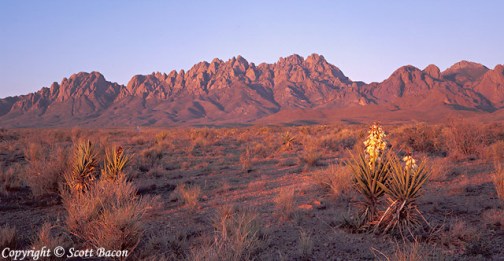
It is sunny and dry 300+ days of the year there. Yet there is a wide variety of vegetation due to two factors—the Rio Grande and a major underground water table. So, with just a little work, industrious settlers cultivated the land into produce and/or cotton farms as well as pecan orchards. (According to a study by a task force in the NMSU Ag Department, 46% of all chiles produced in the U.S. come from New Mexico.) Unlike farmers in the deep south where rainfall is usually plentiful, farmers in New Mexico must work to get water to their crops. They irrigate—there is a series of canals that run through Las Cruces that carry water all throughout the Mesilla Valley.
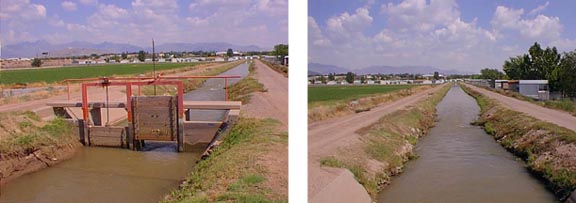
Today, I took these industrious farmers’ example to heart. The “rainfall” of writing still hasn’t come, so I dug deep, found what little reserves I had left in my creative reservoir, and tapped into it. An hour later, I’d written more than 1,200 words! Much like the early farmers in the Mesilla Valley, I didn’t have to dig too deeply before I found a source waiting to be plumbed. They found water for their crops; I found refreshment for my creativity and spirit.
I’ve had a few people share with me privately that they, too, are experiencing a drought in one form or another in their lives right now. And to think I almost didn’t post yesterday. Not sharing my thoughts and feelings when I’m “blue” is another symptom of that downward spiral I mentioned. I usually just smile and pretend everything is okay—which is much easier to do online, and extremely stressful at church or work. And yet the perverse issue with that response to the depression is that all I really want is for someone to reach out to me, to understand that I’m hurting, and to help me lift myself up out of the three-day-old coffee dregs that my life has become. But how can I expect that kind of help if I don’t ask for it?
Are we creative-types more prone to bouts of the blues or depression because of the solitary nature of our pursuit? Or is it because most creative-types are introverts who spend too much time looking inward—depending on ourselves alone for refreshment and falling down the spiral when our internal resources are tapped out? Unless you’ve been living in a cave for the last couple of years, you’ve heard over and over about how our country’s/world’s natural resources are quickly being used up—from fresh water to oil and natural gas. Our internal resources are like this—if we don’t find some way to renew them, eventually they get tapped out.
This is when we really need to turn to others and, though it may be one of the most difficult things we’ve ever done, ask for help. You know who the people are around you who provide that kind of refreshment. For me, it’s my crit partners, Erica and Georgiana, with whom I can vent off my frustrations and receive encouragement in return—and offer encouragement when one of them needs help. It’s chatting with my friend Ruth, who shares my affinity for British actors/movies and the music of Frank Sinatra and Dean Martin. It’s singing songs about Jesus and his resurrection in choir practice. It’s praying with my spiritual mentor or my best friend. It’s laughing over an inside joke. It’s writing and feeling that gentle rainfall starting once again, quenching my drought.
So, when you’re tapped out, where can you turn? Who is there—or can be there—for you to help you return to the “Sunny Side of the Street”?
Have you ever noticed that writing is sometimes a lot like the weather? If we work hard at it, most days can be sunny and pleasant—not remarkable, but enjoyable. Occasionally, the words will come pouring in a torrential rainfall, blowing and swirling around us until they threaten to carry us away like Dorothy’s house in The Wizard of Oz. Then there are those drought times. The times when no matter how hard we try, the words just won’t come.
But I have to stop and examine what’s really going on when I hit one of these droughts. Is it really that the words won’t come or am I just not putting in enough (or any) effort? What am I doing that is taking focus away from my writing? How am I spending the time I’m supposed to be writing? What excuses am I making for the time I’m letting slip away without getting anything accomplished?
And then it strikes me—whenever I start feeling a drought in my writing life, I’m feeling it in all areas of my life. As someone with cyclical depression, I know the signs of a downward spiral . . . and it usually follows a time spent focusing too much on me and not enough on my writing, on others, and on God. It also usually follows a time of stress—such as having my car break down on me Monday on my way to the car place to get it looked at, starting to teach a new Sunday school class, figuring out that I’m not going to be able to afford to go to Pennsylvania for alumni weekend at Seton Hill in June.
Once I recognize the signs (compulsive eating, staying up extremely late, wanting to do nothing but sit in front of the TV, having extreme difficulty getting out of bed in the morning, not wanting to have contact with anyone), I can start pulling myself back out of it by refocusing outside of myself—calling my friend Gayle and talking and praying with her; getting back into critiquing for my crit partners; making sure I am meeting my word count every day; sending Easter cards to my niece and nephews; spending time in Bible study; picking up a new book to read; writing an entry for the blog.
So, here I am, on one of the steps of that journey, posting a blog, writing the first words since I posted on Sunday. I apologize for not having anything insightful or profound to share about the craft of writing, but hopefully by the end of the week, I’ll be back on track, both here and with everything else. Until then, I beg your indulgence while I try to refocus and pull myself back up emotionally.
Love to all!
–k


