Stolen Characters

We interrupt your regularly scheduled series for this Fun Friday post . . .
I read an article this afternoon about the proliferation of “Character Plagiarism” in modern publishing. Yes, there is a problem with story/idea plagiarism that has splashed across the news over the past several years, not the least of which are the accusations against Dan Brown for stealing the idea/story for The DaVinci Code. But that’s not what I’m referring to. What I’m talking about is people stealing characters from classic (i.e., public domain) literature and either writing “sequels” or putting the classic characters into new pieces by updating them, sending someone back in time to interact with them, or some other method of incorporating someone else’s creation into their story.
One of the most famous of these modern-day sequels is Scarlett by Alexandra Ripley, which was so poorly received that it only rated being made into a TV miniseries (in 1994) that few people will admit to actually watching. A quick trip to Amazon.com shows that Ripley, a best-selling romance novelist in her own right before publishing Scarlett, carries a 4.5 star rating on almost every single one of her titles . . . except Scarlett which is hovering around a 2.5—which, to me, indicates two things: the book wasn’t up to the standards her regular readers expect from one of her books, and fans of Gone with the Wind didn’t like her version of the continuing story of the characters.
As my dear blog readers know, Jane Austen is my favorite author. Though I love her characters, I, for the most part, have stayed away from almost all of the sequels to her novels–most especially those for Pride & Prejudice. (I also get ticked when people claim P&P is the first chick lit novel, because it’s NOT! It’s a romance—but that’s a rant for another time.) I made the mistake of picking up one that opens with a sex scene between Elizabeth and Darcy! I don’t know if Jane Austen would have been mortified at the liberties taken with her story/characters/sensibilities, but I certainly was. The only ones I’ve read that I truly enjoyed reading were Pamela Aidan’s Fitzwilliam Darcy: Gentleman trilogy, which retells the story of P&P from Darcy’s point of view. The second volume lost me a bit, as it takes place during the timeperiod when Darcy and Elizabeth are separated from each other, but the first two are excellent reads.
The truth behind the madness is, these books sell—and sell well, or else the publishers would not continue publishing them. But it does worry me a little that the book industry is taking too much of a lead from the film industry where, in the past ten years, we have seen a shift from studios wanting to produce new stories—stories that have never before been told—to rehashing the same characters (Spiderman, Superman), the same stories (did you know Oliver Twist has been put on film 23 times?), multiple sequels–even when they can’t get the same actors back in the original roles (the “franchise” films like American Pie, Revenge of the Nerds, Police Academy, Scream, etc.), and making old TV shows into movies (Scooby-Do, The Beverly Hillbillies, The Brady Bunch, X-Files: The Movie, Starsky & Hutch, The Dukes of Hazzard). Again, the film studios wouldn’t produce most of these if they weren’t convinced the box-office returns would be there. And on Monday, we’ll see if Spiderman 3 pulls in the $100 million they’re hoping for. (I’m sure it will.)
On the other side of the argument, this proliferation in Character Stealing can be seen in its purest form in Fan Fiction all over the web, which is really how this trend got started. The reason authors write sequels to these books—at least those who began the craze—is because they were fans of the work. They loved the characters. They loved the story. They thought their idea for “what happens next” would be something others would be interested in reading. Others read it and gave them really positive feedback on it, so they submitted it to a publishing house. The acquisitions editor really liked it, decided to send it to the ed. board. The board loved it, decided to buy it and—bam—fan fic becomes published novel. Yes, I have written fan fic. No, I don’t intend to try to get it published.
But whether it’s stealing or a tribute (that might have the author spinning in his or her grave), whether we—the fans of that particular story—love it or hate it, it seems like it’s here to stay. I just hope all writers don’t forget how to create our own unique characters, plots, settings, and storylines in the rush to jump on the Sequel-to-a-Classic bandwagon.
Stir Up Your Setting – Part 1: World Building
In Writing the Breakout Novel, Donald Maass writes:
In nineteenth century novel writing, it was usual to treat the landscape as a character in the story. In the twenty-first century, we may have less patience for scenery, but we certainly expect a novel to show us the world as a vital force in which the characters move. It may be hostile or seductive, sprawling or confined, gritty or charming, closely observed or wildly improvisational. Whatever the author’s approach, we want to live in the world of the story. Proof of this can be found in the highly popular fields of science fiction and fantasy. Here, scene setting is a high art . . . they construct their settings in logical and exhaustive detail. Their process is called world building. Simply put, it is a disciplined method for creating a convincing alternate time and place. . . . Building breakout time and place starts with the principle that the world of the novel is composed of much more than description of landscape and rooms. It is milieu, period, fashion, ideas, human outlook, historical moment, spiritual mood, and more. It is capturing not only place but people in an environment; not only history but humans changing in their era. Description is the least of it. Bringing people alive in a place and time that are alive is the essence of it. (pp 81-83)
World Building isn’t just for SciFi/Fantasy writers! Even if you’re using a contemporary, real place like New York City or London, the setting is just as important as if you’re writing about a fictional city or another place/time/world. Your job as author is to bring the reader into your world, not just assume they’ll know your setting without being shown.
To see how a world is built, I have gone through the first 3 pages of Chapter One of my recently completed historical romance, Ransome’s Honor:
- sail
- ship
- larboard
- Midshipman
- Indomitable
- companion stairs
- quarterdeck
- small spyglass
- mainmast
- “…only two days out from England…”
- shroud
- scrow’s nest
- ropes
- …over the noise and bustle of the crew below…
- …ninety-eight gun, three deck ship…
- the distant ship
- …flag flying aft snapped in the sun…
- sailor’s whistle
- lieutenant
- Boatswain’s mate
- …brought the lively crew to a frenzy of action…
Now, if you’ll notice, all of my setting descriptors are sight and sound–which is something a couple of critiquers dinged me on. No, you don’t have to use all five senses in the first five pages of the novel, but when World Building, incorporating the textures (are the ropes rough or smooth under his hands?), smells (the odor of unwashed bodies in close quarters), and taste (the salt spray as the ship breaks through high waves) draws the reader further into the story by immersing them in the total sensory experience of the character.
Your assignment, if you choose to accept it, is to go through the first three pages of your first chapter and list as many descriptions of the actual location of the story as possible. Then identify what type of discriptors they are: sensory (use of the five senses), physical (do you describe something’s structure or the layout of furniture in the room), vocabulary (words or language unique to that time or place), locale (do you explain where your setting is located?), or interactive (is the character interacting with the setting–are they using “props”?).
Stir Up Your Setting
This is a reposting of a series I taught on settings a year ago. Please let me know if you would be interested in my re-teaching/expanding this series by leaving a comment below.
Steel Magnolias. Titanic. Lord of the Rings. What do these three films all have in common?
Dynamic settings.
Would Steel Magnolias have had the same characters if set in a beauty shop on the rough streets of Detroit? Would Jack and Rose’s upstairs-downstairs romance have had the same level tension if they hadn’t been on a certain ill-fated luxury liner? And who can think of Lord of the Rings without bringing to mind the White City of Gondor, the Shire, or Edoras with the Great Hall of Meduseld sitting atop that hill out in the middle of nowhere surrounded by mountains.
What cinematographers can do with cameras, lighting, and computer-generated graphics, we writers must do with words on a page. And not only that, we must do it in a way that incorporates the grittiness of a New York street or the relaxed, honey-filled air of a small Midwestern town into the action of our stories without being intrusive. Movies are allowed wide, sweeping angles of an Arizona desert at sunset. We aren’t.
So how do we draw our readers into our setting without being able to give them grand vistas in Technicolor?
By understanding what setting is and how it can not only enhance our stories, but can help develop our characters, subtly influence the plot, and possibly create tension or conflict in the story.
In the Writer’s Digest Elements of Fiction Writing book Setting, Jack M. Bickham wrote,
Story setting…is not merely the physical backdrop of the tale. It may also include the historical background and cultural attitudes of a given place and time, the mood of a time, and how the story people talk. Also tied closely to setting may be such details as the author’s style, a period’s traditions, and the kind of story the writer wishes to relate. All these factors must dovetail properly with the story’s plot, its characters, the theme and the desired general emotional tone of the piece if the finished fiction is to “work” for the reader. (1)
Why Facebook Is Better than My Space

Okay, I know, it’s Saturday and not Friday. But I didn’t get a chance to post this yesterday.
What is it about online communities like My Space and Facebook that make them so addictive? Let’s face it—e-mail is much easier. For me, anyway, because I have Outlook set up on my computer to automatically go retrieve my e-mail. I have a few friends who communicate with me solely through comments and e-mails on My Space—even though we have each other’s e-mail addresses and phone numbers!
I set up a My Space page over a year ago simply because I heard that it was a great networking tool. For a while, it was nice, because I was able to keep in touch with people I’d worked with at The Tennessean after I left—no worrying about someone’s e-mail address changing, and the added benefit of finding out more about that person than I knew about them in the years I’d worked with them simply from reading their profile pages. But My Space is slow. Most of the pages are overwhelmed with graphic-laden themes that take forever to load. And don’t get me started about trying to be discreet and look at someone’s page and all of a sudden some nasty acid rock or other loud music starts playing. (See my friend Jill’s blog for why embedded music players on websites could be illegal.) Not to mention the fact that I’ve received some very questionable e-mails in my inbox at My Space that, frankly, creeped me out. I set it up to use it as a marketing/networking tool—not as a barstool in the skankiest singles bar in cyberspace. But it is fun to be able to click on my friends’ pages and see what’s going on in their lives at the moment.
Facebook used to be limited to “.edu,” “.com,” “.org,” “.gov” or “.mil” email addresses, but changed to be open to everyone last fall. A few weeks ago, a writing colleague started a Christian Fiction group on Facebook and sent me an invitation to join. I had, a while back, set up an account, thinking I could use it as an outreach tool for the college Sunday school class I teach. But I’d never done anything with it. However, in the past week, I’ve become a Facebook addict. One of the awesome things about Facebook is the presence of college students—including my oldest nephew and college-aged/recently graduated cousins with whom I have little contact throughout the year. Usually I see them at Christmastime and at other extended-family gatherings. But we sure don’t e-mail each other and keep up with what’s going on in the other’s lives. (Except as their parents choose to share with the family via e-mail.) And I get to see the photos of all the cute little college girls who are leaving comments on my nephew’s wall. (And there are a lot of them. Atta boy!)
One of the best things I love about Facebook is that there are no bells-and-whistles templates for people’s profile pages. Everyone’s page is laid out the same—meaning if I’m looking for their biographical information, it’s going to be in the same place on each profile I look at. Facebook also has a Newsfeed feature—showing what the people in my friends-list have been up to recently. This is a great networking tool, because if one of my friends joins a group, I learn about its existence. If one of my friends becomes friends with someone else, I can look to see if it’s someone I’d be interested in networking with (usually it’s not, but I still check). Each person is able to post their status too—this is a quick caption that starts of “Kaye is…” and wants you to put in whatever it is you’re doing at the time you’re logged in:
–writing
–looking forward to the weekend
–writing a post for her blog
I’m not sure if it’s because many people don’t know about Facebook yet, or if it’s because it’s actually true, but Facebook feels like a much more secure/safe environment than My Space. Maybe it’s just because it looks cleaner that makes it feel cleaner and safer, but I’m having so much more fun with it than I ever had with My Space.
To me, My Space is a psychedelically decorated, dark, dank, smoke-filled, music-too-loud, drunk-patron filled night club; while Facebook is clean, bright, airy, filled with squashy-sofas, humming with a buzz of conversation, fun place to run in and “poke” people, great-place-to-run-into-familiar-faces coffeehouse.
So, pour me another latte . . . I’m off to catch up on my news and status feeds on Facebook.
Maria Snyder–on Writing Series Endings
I am super-thrilled today to be able to feature an interview about writing the endings of series novels with a former schoolmate from grad school.
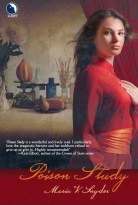
Maria V. Snyder changed careers in 1995 from being a Meteorologist to a Novelist when she began working on her first novel, Poison Study. Published in October 2005, Poison Study won the 2006 Compton Crook Award for Best First Novel, won the Salt Lake Co. Library’s Reader’s Choice award, was a 2005 Booksense pick, was nominated for four other awards, and received a Starred Review from Publisher’s Weekly. Maria’s second book, Magic Study was published in October 2006, is a 2006 Booksense pick, and is a RITA Award Finalist.


Since, for the most part, my blog readers won’t be familiar with your work, tell us a little about your series.
My “Study” series starts with Poison Study. Poison Study is about Yelena who is in the dungeon waiting to be executed for murder. She’s offered a choice of being the Commander’s new food taster or the noose. She chooses life and ends up getting into all kinds of trouble. Magic Study continues Yelena’s story. This time instead of learning about poisons, she’s trying to learn about magic and how to control her powers. Problems arise unexpectedly and she’s tangled in a plot to reclaim a throne and has to deal with a soul-stealing serial killer who is after her. Fire Study will be out in March 2008 and it is the last Study book with Yelena as the main character. In Fire Study she battles a Fire Warper, comes to terms with her conflicting loyalties, and fights the lure of power. The Study series is considered adult fantasy with romantic and suspenseful elements, but I have many young adult readers who are enjoying the books, too.
Did you know when you came up with the story idea that it would be a series?
No. When I wrote Poison Study, I thought it would be a stand alone book. 
When you started writing, did you already know/had you already written the ending?
No. I’m what’s known as a “seat of the pants” writer (aka pantser). I like to discover the plot and twists as I write. However – I usually have a general idea of where and how the book will end, but I wouldn’t write it out until I reach that point, because it can always change.
How did you determine the plot structure for each volume and how each would fit into your overall plot for the series?
As I said before – I’m a pantser so there wasn’t any overall planning for a multi-book series. But what I did discover as I wrote the second book was little subplots in Poison that I could use and expand on for Magic or Fire. For example, in Poison I mention the Kennel Master – who is in charge of the Commander’s dogs – there’s rumor that he might have a magical connection with the dogs so everyone avoids him. That was it – the scene was to demonstrate the Commander’s strong intolerance for magic that makes a rumor ruin a person’s reputation. But in Fire – I used the Kennel Master’s hidden magic for a whole subplot. This is a technique that can be used for someone plotting a long series, planting info and events that seem minor at the time, but will become very important in later books.
How did you decide which subplots to tie up and which to leave hanging at the ends of the first and second books?
I believe you have to tie up all the major plots at the end of each book. I tried to make each Study book a story of itself so they could be read out of order. I will leave a subplot or two without a knot at the end – usually because life is messy and nothing ever gets pulled together completely at the end. My biggest complaint about trilogies is the middle book tends to be just all middle story – nothing is solved and I find myself very frustrated with them.
How did you determine how much information from Poison Study to include in the opening of Magic Study so that new readers could follow along and those who’d read the first book wouldn’t feel like they were being dragged back through the whole story?
That was the hardest part to write! I tried to tell the new story straight on, but when ever I came to a place where the reader needed a little background info, I added an internal thought or some dialogue like when Yelena’s mentor chides her about climbing trees, mentioning she had no trouble before – which leads Yelena to think about the time she had climbed through the tree canopy to avoid being captured.
Have you written the ending of the series? If so, how did writing the end of the last book differ from the first two?
Fire Study is written – and while it’s not the end of the series it is the end of Yelena’s story. The difference was getting her to a place (both physically and emotionally) where the reader knows that Yelena has fought the good fight and is now a better person. By that point all the questions about Yelena needed to be answered – but I could still leave a few mysteries for future stories.
When you pitched/submitted the series to publishers/agents, did you have a synopsis/3 chapters of each book or just of the first book with a more general synopsis of the sequels?
I submitted the complete manuscript of Poison, and when LUNA books called they offered me a two-book contract. Good thing I had 18 months to write that second book, and that I had an idea for it. The original ending of Poison was revised to be more suspenseful and to mesh better with Magic. I knew I needed to write Fire half way through Magic – and for approval – I sent my editor a 4 page synopsis and they offered me a three-book contract. At that time – I had no idea what books 4 & 5 would be. I’m working on #4 now and it’s set in the Study world, but no title has been approved, yet. Five is still a mystery!
What have you learned about writing through the experience of writing a series that we might not learn through writing single-title/stand-alone stories?
The two things I mentioned earlier – leaving clues in earlier books for later use and how to insert background info without boring the people who have read the first book – were the most important lessons I learned.
Any other words of advice you can share about writing endings?
I tend to be an instinctual writer – while I know where I want my story to end, I’m not going to force it there. I would advice writers to listen to your internal feelings. Your logical mind may say to end with X Y Z, but as you write you might hit a spot (a sentence or a scene) and your heart will go “That’s It!” To quote song lyrics, “Listen to your heart.”
Is It Really Over? To Epilogue or Not to Epilogue
An epilogue is a speech or scene added to the end of a play, story, or novel that offers more information about the characters. The story is over, satisfactorily concluded, but now we are going to show the reader the consequences or results of that ending.
The tradition of epilogues goes back to the very roots of fiction itself. It’s the moral-of-the-story ending of Aesop’s Fables that explains the lesson being taught by the metaphoric story. It was also prevalent in drama—a final word or thought to send the audience home with. Take, for example, the ending of Shakespeare’s Henry V:
EPILOGUE
Chorus:
Thus far, with rough and all-unable pen,
Our bending author hath pursued the story,
In little room confining mighty men,
Mangling by starts the full course of their glory.
Small time, but in that small most greatly lived
This star of England: Fortune made his sword;
By which the world’s best garden be achieved,
And of it left his son imperial lord.
Henry the Sixth, in infant bands crown’d King
Of France and England, did this king succeed;
Whose state so many had the managing,
That they lost France and made his England bleed:
Which oft our stage hath shown; and, for their sake,
In your fair minds let this acceptance take.
Exit
Drawing upon the examples of classic literature, novelists of the nineteenth century developed the epilogue into a story device at the end of novels to wrap up any loose ends still dangling—to let the reader know that the wrong should fail and the right prevail in every circumstance brought forward in the book. One of the most familiar examples is the last chapter of Pride & Prejudice:
CHAPTER SIXTY-ONE
HAPPY for all her maternal feelings was the day on which Mrs. Bennet got rid of her two most deserving daughters. . . .
Mr. Bennet missed his second daughter exceedingly . . .
Mr. Bingley and Jane remained at Netherfield only a twelvemonth. . . .
Kitty, to her very material advantage, spent the chief of her time with her two elder sisters. . . .
Mary was the only daughter who remained at home . . . it was suspected by her father that she submitted to the change without much reluctance.
As for Wickham and Lydia, their characters suffered no revolution from the marriage of her sisters. . . . They were always moving from place to place in quest of a cheap situation, and always spending more than they ought. His affection for her soon sunk into indifference; hers lasted a little longer . . .
Miss Bingley was very deeply mortified by Darcy’s marriage . . .
Pemberley was now Georgiana’s home; and the attachment of the sisters was exactly what Darcy had hoped to see. They were able to love each other even as well as they intended. . . .
Lady Catherine was extremely indignant on the marriage of her nephew . . .
With the Gardiners, they were always on the most intimate terms. Darcy, as well as Elizabeth, really loved them; and they were both ever sensible of the warmest gratitude towards the persons who, by bringing her into Derbyshire, had been the means of uniting them.
In the last decade or so, sequels and spinoffs of Pride & Prejudice have proliferated—something that Austen herself apparently never considered doing. For her, the summary she wrote at the end of the novel was enough to satisfy her of the happily-ever-after of those who deserved it in the novel.
In romance novels, the epilogue is as common as heaving bosoms and . . . well descriptions of other body parts(!). It’s the author’s chance to show the hero and heroine’s wedding. Or, if they’re married in the course of the story, to show the birth of their first child. Something that goes beyond the promise of a happily-ever-after ending given in the ending by showing these two characters are still blissfully happy (and still together) at a later time. For me, as I knew I would be writing a spinoff novel to follow up my contemporary romance Happy Endings Inc., writing an epilogue to show the wedding-planner heroine’s wedding never entered my mind—mainly because I knew the event would play an important role in the next book. Had I not planned a spinoff series, I would have wanted to write the wedding scene simply for my own gratification. But, it wouldn’t truly be necessary to give the book its satisfying ending.
Is the epilogue necessary or is it an extra cherry on top of the sundae? I emphasize extra, because the true metaphoric cherry-on-top should be the satisfying ending that your novel has without an epilogue.
When I finish reading a book I’ve enjoyed, my mind automatically starts formulating ideas of what happens to the characters next. If it’s a series book, I might not have to wait long to find out if my ideas are right or not. I mentioned the upcoming final book in the Harry Potter series in the last post. While I expect it will have a satisfying ending, I fear that it will take some unexpected twists and turns and not everything will turn out the way I hope. A greater fear than that is that I won’t like the way she chooses to end her story, which will taint my enjoyment of the books I’ve liked reading and re-reading over the past several years—and that I’ll feel like I’ve wasted all that time.
This is a danger you could run into with an epilogue. While it’s a wonderful indulgence for us as writers to spend just a little more time with our characters, if it’s not well done, or if the characters do something silly or uncharacteristic, it could ruin the whole book for the reader. Epilogues extend the lives of the characters beyond the magic of the resolution of the plot and could possibly diminish them by pulling them into a mundane or ordinary experience which makes them, to some, no longer special. Epilogues can also make readers (and potential editors/agents) feel that you aren’t confident in the ending of your book and felt you had to include additional information just to make sure everyone understood the final scene.
But, you may ask, what if the information in the epilogue is necessary for readers to truly “get” the ending?
By the time your reader gets to the last chapter of your novel, they want a complete and satisfying ending. If the epilogue contains necessary information, what you have is an unresolved ending, and you should revisit whether or not you’ve written the strongest ending possible. Your reader should be able to close your book at the end of the last chapter and have read a complete ending—to have closure without reading further. Just like some people don’t read prologues, some don’t read epilogues, as they would rather imagine what comes next for themselves.
Ultimately, there is no hard-and-fast rule on whether or not to use an epilogue (though if you’re writing a series, general consensus is don’t). But there are some things to consider:
–Keep it short and simple. No new characters, no new conflicts. (Just think, again, about Lord of the Rings and its multiple “epilogue” endings—both the movie and the book.)
–Don’t be repetitive. If your character has learned a lesson in the denouement of the novel, don’t repeat the character learning the lesson (or telling someone of the lesson he’s learned) in an epilogue.
–Separate the epilogue from the last chapter. Set it weeks, months, or years in the future, and if you can, set it in a different location to differentiate it from the actual ending of the book and not make it feel like just a continuation of the last chapter.
–Add insight and perspective to the epilogue (the moral of the story is . . .). Show the continuing consequences of a decision, the sentencing of the villain after the case is won in the final chapter, the wedding, the birth of a child, or the brighter future world created by the results of the ending of your story.
–Most of all, question its very existence. Is the story stronger with it or without it?
What are some of your favorite epilogues in books you’ve read? What books have you read that made you wish for an epilogue?
It’s Not Over Yet–Ending a Series Novel
Originally published in 2007
Ending a stand-alone story—like a romance novel—is all well and good . . . but what if your story doesn’t end with the end of the novel? What if it’s just one part of a longer piece of work—a series of two, three, four, or a Gilbert Morris-esque fifteen or twenty books?
I have only recently tried my hand at writing something that is truly a series—a trilogy—purposely. Since I first seriously started studying and pursuing fiction writing as more than just a hobby, I have written stand-alone romances . . . which included characters that could then have their own spin-off novels. But there’s quite a difference between sequels and spinoffs.
The American Heritage Dictionary defines sequel as: “Something that follows; a continuation.” It defines spinoff as: “Something . . . that is derived from something larger and more or less unrelated; a byproduct. Something derived from an earlier work, such as a television show starring a character who had a popular minor role in another show.” Let’s add one more term to this discussion—serial: “Published or produced in installments, as a novel or television drama.”
Now, what’s the difference in these?
Spinoffs: A series of novels that take an existing minor character, setting, or concept from the first stand-alone story and create a new plot/situation for additional stand-alone stories. Examples: Susan May Warren’s “Deep Haven” series and Dee Henderson’s “Uncommon Heroes” series; Christine Schaub’s “Music of the Heart” series that has as its continuing thread the novelization of the stories behind some of the greatest hymns of all time. Spinoffs are very common in the Romance genre—or in TV, though without as much success as in novels (e.g., Joni loves Chachi, Joey, or Frasier or the “Avonlea” series that was a spinoff of the Anne of Green Gables setting).
Serials: A series of novels that follow one particular character throughout many different, mostly unconnected episodes. Each novel is self-contained and could be read as a stand-alone title, though each successive title reveals more about the continuing character(s). Examples: Tony Hillerman’s novels featuring Navajo tribal police officers Leaphorn and Chee; Tom Clancy’s Jack Ryan novels; Janet Evanovich’s Stephanie Plum novels; Sherlock Holmes; Nancy Drew/Hardy Boys . . . are you sensing a genre pattern? Serials are seen most often in Mystery/Suspense and Action/Adventure. This is also what makes up the bulk of TV programming: the CSI and Law & Order franchises are prime examples. If you’re addicted to them, you watch every week and pick up on all of the tiny hints about the continuing-characters’ lives outside of the cases they’re working. However, the driving force of each week’s episode is the self-contained crime they must solve. Non-addicts can come in at any time and watch an episode and understand 95% of what’s going on (the other 5% being information about the characters that have been built throughout the series, such as Bobby Goren’s mother’s schizophrenia and cancer, or Horatio Cane’s relationship and short-lived marriage to Eric’s sister).
Sequels: A series of novels that contain one continuing story in a finite number of volumes. While each volume has a beginning, middle, climax, and denouement, the main plot/conflict of the series continues throughout the series and finally comes to a climax and resolution in the final volume. This main plot/conflict must be introduced early in the beginning of the first book. It cannot suddenly appear three chapters from the ending. While, if well-written, sequel-series books could be read separately, it is usually necessary to start with the first volume and read them in sequence to truly understand the entire storyline. Examples: JRR Tolkien’s Lord of the Rings, Star Wars (whether taken as the original trilogy or the full set-of-six films), Tracie Peterson’s “Ribbons West” series. Sequel series are most common in Science Fiction, Fantasy (just do a search for “trilogy” in the books section of amazon.com!), and Historical Fiction/Romance. In television, these are shows such as LOST or Alias where each show builds the story upon what happened in the show before, and it’s really difficult to come into the middle of it and really know what’s going on without going back to the beginning to catch up.
Ending Spinoff novels is just like ending any other stand-alone story. It is a self-contained unit, even though you may have already started planting the seeds for the spinoff story of a secondary character. What’s important to remember here is that the spinoff series typically features characters who are not POV characters in the originating story. They are usually a secondary character—sometimes even a minor character. Or, if it’s the setting and not a succession of characters (a family, college sorority sisters, coworkers, victims of the same crime) that the series is built around, you must ensure that each successive title, while building on the richness of the stories that came before, is whole and complete in and of itself. While the main characters from the originating novel(s) may come into play in the spinoffs, they are no longer POV characters and any role they play in the spinoff should be minor, or else you have a sequel or a serial and not a spinoff.
Ending Serial novels is very much like spinoffs and stand-alones: hardly anything is left hanging at the end . . . though there may be a thread or two left dangling—but no major cliffhangers. The questions that could remain at the end of a serial novel would be along the lines of a continuing will-they-or-won’t-they relationship between the heroine (Stephanie Plum) and a recurring male character (Joe Morelli). The POV character is going to have some kind of job or life-situation that continually puts them in series of conflicts—solving mysteries, chasing bail-jumpers, becoming mired in political intrigue, etc. Many times, serials will feature an “arch-nemesis” such as Moriarty in the Sherlock Holmes serials or the Nazis in the Indiana Jones movie franchise. It is someone or something that the hero will come up against time and time again, and, though each book will end with a victory for the hero and a satisfying ending, there may be a stalemate between the hero and his arch-nemesis that will come to a conclusion only with the end of the series. The arch-nemesis does not always appear in every story—or, as in the case of the Indiana Jones films, it is an amorphous enemy/society against which the fight will be continual, with different faces put on it in each successive story—which keeps it from being a Sequel.
Ending Sequel novels may be the hardest skill a writer ever acquires. Of course, the final book in the series will be least difficult, as you’re finally wrapping up all of the threads/plots/conflicts you’ve created throughout the series. But when ending the first and middle books, you must find a balance between giving the reader a satisfying climax, resolution, and denouement, and keeping some questions unanswered and conflicts unresolved so that they’re anxious to read the next installment. (Have you preordered your copy of Harry Potter and the Deathly Hallows yet?) In fact, many sequel-series writers will say that they wrote the ending of the final book at the very beginning of the writing process—some even before they began the first book.
The important thing when writing a sequel series is to figure out the entire story from beginning to end, then determine the main events that can become the climaxes of each of the novels in the series. What is going to happen to your characters before they can get to the ultimate resolution? Stories centered around a war are easiest to use as examples. Which important battles must the soldier hero survive and what atrocities at home must the heroine make it through before the two can finally come together at the end? Sequel series typically feature more than just two POV characters, and definitely more than one plot. There should be multiple subplots. The main plot of the novel is your over-arching throughline. It is the story of the entire series. Your subplots are those which drive the narrative of each individual novel. For example, in my Ransome Trilogy (historical romance), the over-arching question posed in the first novel is, “Will William and Julia fall in love and have a happily-ever-after ending?” Now, by the end of the first book, they’ve gotten married. Both have also realized they love the other—though have not admitted it to each other. However, there are enough threads still hanging, and hints at conflicts to come—in addition to a subplot left hanging wide open—to set up the action of the second and third novels. But there is satisfaction in the ending. They’ve fallen in love and now they’re married and getting ready to embark on the next leg of the adventure, where the hanging subplot will take center stage and drive the narrative of book 2.
What are some spinoffs, serials, and sequels you’ve enjoyed? How did the author handle the endings of them?
What are some spinoffs, serials, and sequels that completely frustrated you by the way they ended? How would you have done it differently to give a satisfying ending while also setting up the future books in the series?
In Other News . . .

Thursday marked the auction of a portrait purported to be of Jane Austen—not the familiar drawing by her sister Cassandra, long accepted in academic circles as the only genuine image of Jane Austen in existence, but a full-length, painted portrait. In this Jane Austen Society of North America article, you can compare the two pictures.
Being a scoffer of this as a genuine painting of her (wrong clothing style, too many inconsistencies and unlikelihoods in the provenance, no mention or record of this portrait having been commissioned or painted–and I believe Jane would have written about that experience!), I’ve followed this story with curiosity. Especially since this painting has been on the market before and did not sell. No one in England will touch it, apparently, so Rice (a “descendant” of Jane Austen all the news organizations have been calling him, though she was childless and he’s actually a descendant of one of her brothers—the one adopted by another family who changed his last name from Austen to Knight). Apparently, Rice brought the portrait here because he decided American buyers were more “open-minded.”
Here’s an interview from NPR’s “Morning Edition” program today explaining more about the painting and the skepticism surrounding it.
So I went to the Christie’s website to find out more information on the painting itself—Lot #120 in a sale of Important Old Master Paintings—because I wanted to know if it actually brought in the $400,000–800,000 they expected for it. So, I pulled up the auction results page.
The painting in this sale that brought in the most money was Lot #113: Bernardo Bellotto Venice 1721-1780 Warsaw / The Grand Canal at the Church of San Stae, Venice / oil on canvas—an impressive $11 million!
But how much did the Rice “Portrait of Jane Austen” bring in? Well, if you look at the list, you’ll notice that Lot #120 is not listed. According to the top of the page, “Lots which did not sell are not shown.”
I guess we Americans aren’t as gullible as ol’ Rice hoped.
In more Other News, next month a $125 million Charles Dickens theme park, “Dickens’ World,” will open for business in Kent, outside of London. According to http://www.thisislondon.co.uk/ the main feature of the park “is a painstakingly recreated Victorian London, from the cramped streets to Newgate Prison to the city waterways of Oliver Twist . . . Attractions include a boat ride the operators claim is the longest of its kind in Europe, and a haunted house featuring the various Christmas ghosts as well as Ebenezer Scrooge. Escaped convict Magwitch is there with his chilling warning, ‘You ain’t seen me!’ And there is a Fagin’s den, though it is now a children’s soft play area.”
The good ol’ BBC (one voice amongst many) wonders “is it wrong to Disney-fy” a classic author like this. Kevin Christie, of the International Dickens Fellowship—who spearheaded this project—defends it by saying, “Dickens was not a purist, he was a populist. He wrote stories serialised for newspapers. If he were alive he would be writing for TV. I think he would have loved this.”
The truth of the matter in both of these cases is that Jane Austen and Charles Dickens (though their lives overlapped, they were not really contemporaries) are both long-since dead and gone. The legacy they left behind them—their novels and other writings—is all we in the twenty-first century will ever know about them. Though I am very proprietary about the liberties people take with “adapting” Jane’s stories for movies or other works, I hold fast to the opinion that her legacy—and Dickens’ as well—is what we make of it. Their stories have meaning only as each reader interprets them. Let’s not ascribe anything to them that isn’t true (like the painting), but let’s have fun with the stories they gave us. And if the furor surrounding an “is it or isn’t it” controversy over a “Jane Austen Portrait” or a haunted house featuring Scrooge and the Christmas ghosts gets one more person to pick up a book and read, then I’m all for it!
Oh, and if anyone happens to be reading this 200 years in the future—I formally give you my blessing to build a Kaye’s World theme park and sell any pictures you can find that “might” be me . . . especially if they show me as thin and gorgeous.
The Denouement–Resolution & Resonance
Sol Stein defines resonance as: “an aura of significance beyond the components of a story.” He also writes that for a work to have resonance, it must start with the first line and weave all the way through the story.
Now, I had to quote that because—for the very first time—Mr. Stein’s most excellent book on the craft of writing has failed me. Stein on Writing doesn’t include any specific information on crafting the end of the novel. So, instead, we’ll be focusing on what Nancy Kress has to say about endings in Beginnings, Middles & Ends.
Since, as we’ve already determined, it isn’t just the last line that’s most important, let’s focus on crafting the ending.
Last week I wrote about the implicit promise the opening of the story makes to the reader. Your ending—the climax and the part that comes after it—is your chance to make sure you’ve followed through on all the promises you made to your reader in the opening pages.
According to Kress, the ending “must use [the] same characters, conflicts, problems, and tensions” as the beginning. “If the ending tries to use different characters (such as the cavalry riding over the hill at the last minute), the story will fail. If the ending tries to switch to some other last-minute conflict, the story will fail. If the ending tries to evade the promised collision (by, for instance, a peaceful compromise in which no one loses anything), the story will fail. You cannot, in other words, promise apples and deliver oranges.” (BM&E, pg. 105)
This is the resolution (little ‘r’) of the conflict that I’ve discussed at length before.
How do you craft your ending? Well, firstly, what has your story promised your reader? As a romance writer, my stories promise a relationship between two people that has its ups and downs but, ultimately, ends in a happy ending. Before you start to write your ending, go back and re-read your first (at least) three chapters. Make a list of the promises you’ve made to your readers.
Secondly, make a list of the conflicts you’ve set up in your middle that you haven’t resolved—both in the main plot and in any subplots you have. Can you craft an ending that brings them all to a satisfying ending?
“The ending dramatizes the triumph of some of the forces developed in the middle, which, in turn, were set in motion by the characters and conflict introduced in the beginning.” (BM&E, page 107)
Once you wrap up the climax, you come to what’s called the denouement—or as Mark Twain tagged it, the “marryin’ and the buryin’.”
“A successful denouement has three characteristics: closure, brevity, and dramatization.” (BM&E, page 113)
Closure means you give your reader enough information about what’s going to happen to the characters after the last line of the story so that they can feel satisfied the promise from the beginning has been fulfilled. It doesn’t mean your character has to be satisfied at the end (just think of Scarlett O’Hara at the end of Gone with the Wind), just your reader.
A beginner’s mistake is the “let the reader decide for him-/herself” ending. The story is under your control. If you suddenly let go of that control, it’s like letting go of the steering wheel of a car going 70 miles per hour on the interstate during rush hour. The reader doesn’t want to decide what happens to your characters. They want you to tell them what happens to your characters (well, showing them would be better).
Keep the denouement brief. Look at Return of the King (the novel, not the movie). After the climax of the victory over Sauron, and the coronation of Aragorn / Aragorn and Arwen’s wedding, the book then goes on with the hobbits back to Hobbiton where a whole new conflict takes place. Don’t do this to your readers.
Use dramatization to make sure that your denouement flows with the rest of your story. It shouldn’t feel like a “wrap-up” just tacked onto the end. (Oops, I got to the end, I’d better wrap this up quickly!) Show your characters in action—but keep it simple. You don’t want it to compete with your climax (see example of Return of the King above).
Now, we get to RESONANCE and RESOLUTION—the last paragraph/last line. Kress tells us to keep the denouement active. But when you get to the last line, you have two choices. Here are examples from Ransome’s Honor:
Resolution ending:
William hastened up the ladder and attained the deck just as Cochrane assisted Julia from the bosun’s chair. His crew, all standing at attention and dressed in their finest, crowded the quarterdeck, the men eagerly craning for a better look at her.
He escorted her up to the poop and the crew turned to face them. “Julia, I have the honor of presenting the officers and crew of his majesty’s ship Alexandra.” Looking out over his men, he raised his voice. “Men. I am pleased to introduce to you Mrs. Ransome, my wife.”
The men cheered, but the pounding of William’s heart drowned it out. His wife. He looked down at her in wonder. Hints of the ten-year-old Julia Witherington remained in the freckles across her nose and dimples in her cheeks. But standing beside him, Julia Ransome was his wife—the wife he had not even known he’d been praying for all his life.
I could have just ended it there. But I felt it needed more. So I continued with a Resonant ending:
He now understood—fully comprehended—Collin’s decision to resign his commission and stay in England to be with Susan. William’s ship, his career, his reputation—none of it mattered any longer. For, if asked, he would walk away from his crew, forsake his duty, and even sacrifice his own honor to provide for and protect Julia.
Love demanded nothing less.
Kress wrote: “. . . you create a resonant ending by suggesting connections between your story and a larger context.” (BM&E, page 123) In my case, I decided I wanted to end not just with a happily-ever-after ending (until the sequel) but I wanted to connect it to more universal themes: honor, duty, love.
Is your ending feeling flat? Is it possible that it needs RESONANCE? Try writing a resonant ending paragraph after your last line. How does your ending connect your characters and the change that’s happened in them since the beginning of the story with the wider world? Even if you don’t end up using the resonant ending, you may find an even stronger RESOLUTION for the ending than you had before.
An Ending to Remember
Today I edited a book we’re publishing in conjunction with Highlights magazine. It’s a hidden pictures book—the kind where there’s a line-drawing picture and you have to find all of the odd little items hidden in the drawing. I spent the entire day with a highlighter finding all of the socks, fish, bananas (on almost every one of the 26 pictures!), ice-cream cones, etc., hidden throughout pictures of kids outside playing ball, skateboarding, swimming . . . On one spread, I even found a bird (it was the first thing I saw when I looked at the page) that wasn’t listed along the side as an item to find. But then I got to one near the back. I found most of the items quickly, but then I was completely stymied. There were three items I couldn’t find for the life of me. After half an hour of looking at it from every angle possible, I finally gave up and moved on to the next page. But this sense of anxiety settled into my chest—you know that feeling you have when you know you’ve lost or forgotten something but can’t think of what it is.
And then I realized—that’s the same feeling I get when I get to the end of a book that doesn’t have a satisfying ending! The feeling that something is lost or missing or forgotten.
After lunch, I went back to that page. Within ninety seconds, I had found the three “missing” items. All it took was a little time away and fresh eyes. What relief—what satisfaction!
Just like a great ending to a book.
From everyone’s comments (thanks!), I think we’ve established that ending lines of books aren’t as familiar to us as opening lines. I think we’ve also come to the conclusion that the specific ending line isn’t nearly as important as the overall feeling of satisfaction in how the book ends. Has the plot come to an exciting and logical conclusion? Have the subplots been wrapped up with no threads left hanging, no questions left unanswered (unless, of course, the book is part of a series and it isn’t the last book)?
There are so many books I’ve read where I closed the book and hugged it to my heart and wished the feeling the ending gave me would go on and on and on. But, even if right at that very moment, you asked me what the last line was, I wouldn’t be able to quote it verbatim. But I would be able to tell you how the story ended and whether or not I liked it.
We know that having a great opening line/paragraph is important to get editors to want to put us under contract/readers to buy our books. I would imagine most people reading this blog are like me when it comes to book shopping. We pick a book up off the shelf, examine the front cover image to try to get a sense of the story, then flip it over to read the back cover copy (we’ll talk about that later) to find out what the story’s about. Then we open the front cover. We read the opening lines with a critical eye. Can this author (known or unknown) write something that will intrigue me right from the start and get me to part with my hard-earned money? Is this really a story I’ll like? Will I like this author’s voice/style/storytelling ability? Am I going to like the characters?
That’s an awful lot of pressure put on a first line of a story! Which is why we agonize over finding just the right hook, just the right words.
But how much time and effort should we put into crafting the “perfect” last line? We know that we need to spend a lot of time making sure our ending is good. But crafting a good last line is like having the last say in an argument or discussion. It’s the last impression you’ll leave your readers with. You want to end strong, but in keeping with the tone of the rest of your story. It’s your last chance to give your characters—and your readers—closure.
Here are the ending lines from my five completed manuscripts:
She finally managed to get a deep enough breath to enable her to say clearly, “You are the best friend I have in the world. And I can’t imagine spending the rest of my life without you in it.” (What Matters Most)
Stephen hugged her tightly and kissed her forehead. “I meant every word. Death will never separate us.”
Hannah looked up at him, put her hands on either side of his face, and brought his head down so they were almost nose-to-nose. “Good. Because I’m not letting you get off that easily.” (The Best Laid Plans)Kevin covered her hand where it still clasped the pendant, then took hold of her left hand as well. “In the past, in the present, or in the future, only God can love you more than I do, and that love will remain true throughout eternity.” (Love Remains)
He traced the curve of her jaw with his forefinger, kissed the bridge of her nose, and tucked her back into his arms. “Now that’s what I call a happy ending.” (Happy Endings Inc.)
William now understood—fully comprehended—Collin’s decision to resign his commission and stay in England to be with Susan. William’s ship, his career, his reputation—none of it mattered any longer. For, if asked, he would walk away from his crew, forsake his duty, and even sacrifice his own honor to provide for and protect Julia.
Love demanded nothing less. (Ransome’s Honor)
Have you figured out yet what genre I write? 🙂
Ransome’s Honor, the only one with the original first chapter I still like, is the only ending that I ever cried while writing—and you have to understand, I am NOT a sentimental person. I can sit through a Nicholas Sparks movie and not shed a single tear (am actually annoyed by those purposeful tear-jerkers anyway, so I don’t watch them if at all possible). But this is a RESONANCE* ending rather than a RESOLUTION* ending like the previous four—it’s emotional, not active. And it’s more in keeping with the genre of books it’s styled after: Regency romances, especially Jane Austen’s novels, which always ended with resonance after the resolution.
Post your favorite last lines from your completed stories/novels. Why do you like them? How did it make you feel to write that last line? Does it bring back the emotion to you or do you just look at it and think, I can do better than THAT?
Next time, we’ll get a little more in depth into the difference between RESONANCE* and RESOLUTION* in our endings.
*Kress, Nancy. Beginnings, Middles & Ends. Cincinnati: Writers Digest Books. 1993.

 KayeDacus.com