Fun Friday/What’s in Your Five–’Tween Favorites

I heard a story on NPR yesterday morning about how Hannah Montana is the biggest thing for ’tween girls these days (and the biggest ticket scalping scandal in years). Which got me to thinking of the characters/stories I was interested in when I was between the ages of 9–14. I can’t specifically remember anything that was on TV (except Little House on the Prairie, and I think T.J. Hooker may have been on during those years, but I’m too lazy to go over to IMDb to look), so, naturally, my thoughts turned to books.
It goes without saying that Laura Ingalls Wilder’s books were—and still are—some of my all-time favorites. But those have been favorites since before I was a ’tween. So I went to books specifically from those years. I’ve listed them in chronological order by copyright date, but I must say that the final one on my list was my favorite book all through my teens and is held together by contact paper and clear packing tape, I read it so many times.
5. Can I Get There by Candlelight by Jean Slaughter Doty, © 1980, published by Scholastic. This book had everything—horses, time travel, and history. This was probably one of my last girl-and-her-horse novels.
- Gail’s parents have just rented a carriage house, about all that’s left of an old country estate. The big house was torn down long ago, and woods have sprung up where the lawns and gardens grew. Beyond the woods, fields stretch for miles—perfect for riding. But when Gail steps through the iron gate near the edge of the woods, she has a shock. Instead of fields, she looks across a wide lawn to an enormous house! and running toward her is a girl wearing a dress from a hundred years ago!
Somehow, Gail has gone back in time. Can she return to the present? Or will she and Candy [her horse] be caught in the past forever?
4. Spunky by Dori Brink, © 1980, published by Scholastic. It’s a dog’s life . . . told from the dog’s point of view. Spunky begins life as a thrown-away puppy who is found and adopted by a young couple. Other dogs come into their family. They move to a big house out in the country. Stuff happens that made me cry every time I read the book. (I have this thing where I cry whenever I read a book/see a movie about dogs.)
- You are asleep now and don’t even know I am here watching you. The house is still and everyone else is asleep too. I will see that no harm comes to you. If anything happens, I will bark loud and even bite. I’ve learned a lot in the past year since I was a pup. As soon as you are able to stretch your legs, we will run through the fields and play together. There is so much I can show you and so many things we can do. Strange how much I love you. Up until now, I didn’t know how love could feel. Maybe if I tell you about myself, you will understand. . . .
3. The Ghosts of Departure Point by Eve Bunting, © 1982, published by Scholastic. The twists and turns in this story were what made it something I would read over and over . . . along with the romance between the two main characters.
- Depadres Point was the name of the steep jutting cliff, but around here it was called Departure Point. Twelve people had died at this place when they missed the curve and went down onto the rocks below.
So begins the story of a girl, a boy, and a place known as Departure Point. Many people have lost their lives there—and it is there that seventeen-year-old Vicki and eighteen-year-old Ted meet and fall in love in a strange and unique way. You see, Vicki and Ted are ghosts, victims of Departure Point, and now it’s up to them to find a way to stop the accidents—but they’re running out of time . . .
2. And Both Were Young by Madeleine L’Engle, © 1983, published by Laurel-Leaf. Aside from the fact that it was penned by the incomparable Madeleine L’Engle, this book is an example of a perfect YA romance. It’s got the fantastical setting of a Swiss boarding school (this was the early ’80s—thanks to The Facts of Life the boarding school setting was cool), it has a foreign boy as the romantic interest, and a girl who wants to fit in but finds that she’s happier being herself and having only a few friends than being part of the popular group. And did I mention it was written by Madeleine L’Engle?
- Flip doesn’t think she’ll ever fit in at the Swiss boarding school. Besides being homesick for her father and Connecticut, she isn’t sophisticated like the other girls, and discussions about boys leave her tongue-tied. Her happiest times are spent apart from the others, sketching or wandering in the mountains.
But the day she’s out walking alone and meets a French boy, Paul, things change for Flip. As their relationship grows, so does her self-confidence. Despite her newfound happiness, there are times when Paul seems a stranger to her. And since dating is forbidden except to seniors, their romance must remain a secret. With so many new feelings and obstacles to overcome in her present, can Flip help Paul to confront his troubled past and find a future?
1. Victoria by Willo Davis Roberts, a Sunfire Romance, © 1985, published by Scholastic. Following the formula for the Sunfire line, Victoria faces two major conflicts: a major historical event/era and choosing between two equally suitable men to whom she is almost equally attracted—though in this case, she really knows she’s in love with Cade, Luis is there as a comfort and as someone who offers to whisk her away from all the unpleasantness. It was through this book that I learned what happened in the battle at the Alamo (I’m not from Texas, so it wasn’t really part of anything I learned about in school to that point), and what gave me my interest in history (well, the whole line served to do that). The other majorly important thing about this book is that I did my first writing after reading it—writing the “sequel,” or my version of what happens after the happily ever after ending. I loved the characters so much, I just couldn’t let them go.
- To beautiful Victoria Winters, Texas in 1835 is a place where parties last for three days. It’s also a place of turmoil and violence. A war with Mexico can’t be far off. Luis Arista, the son of a wealthy Mexican landowner, offers Victoria security and comfort, but would she ever be able to adjust to his way of life? Cade Riely is a ruggedly handsome Texas Ranger who loves Victoria. But he can’t marry her until—or if—he returns from the battlefields. What will become of Victoria’s Texas and the men she loves?
My copy naturally falls open to page 100, which is when Vickie and Cade share their first kiss, and where my favorite lines in the book appear:
- Cade . . . bent to brush her lips with his own.
Ice and fire swept through her, and she knew now why a man embraced a girl when he kissed her. Otherwise, she’d fall down when her bones turned to jelly this way . . .
So what are the books you remember from your ’tween (or early teen) years?
Plot or Plod Part 1a: “EKG” Plotting Example
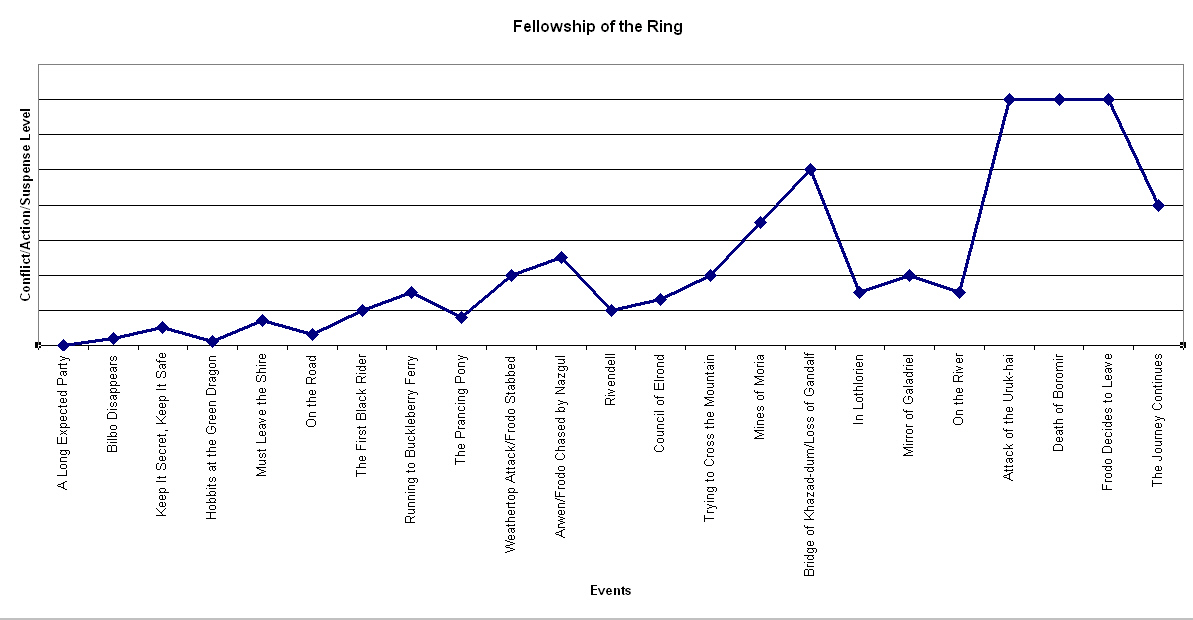
Plot or Plod Part 1: Give Your Story an EKG
As I’m certain you can well imagine, there’s a very good reason behind how I came up with the title of this series. We’ve all read them (and perhaps thrown them across the room)—those books that just plod along, that seem to be going nowhere in particular: the navel-gazing introspection; the passages describing the way a dragon fly’s wings shimmer in the fading sunlight; the overly superfluous, ubiquitous, even-an-English-major-might-not-know-it vocabulary; the angst-ridden, whiney, on-the-journey-of-discovering-self-is-nothing-and-yet-everything characters. These are the kinds of novels that happen when the author has a love affair with the words, not the story. YAWN!
I don’t necessarily want to read a book that is so action packed I never get a chance to take a breather, unless I put the book down. I haven’t read Robert Ludlum’s books, but I understand from those who have, he does take plenty of downtime away from the action (apparently in a Clancy-esque need to describe technical stuff in detail). But even with as frenetic as the films are (the third being the most action-packed), they still have lulls in the action to give the viewer a chance to breathe, to catch up, to relax a moment before the next crisis hits.
If asked to draw a plot line on a graph, most of us would draw something like this:
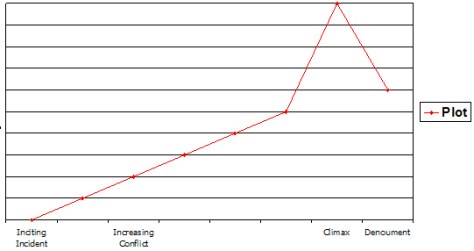
(where the Y-axis [upright] represents level of conflict/suspense/action). This is a good, basic plot. There is rising suspense and action as the plot progresses and the conflicts increase.
Unfortunately, a lot of stories turn out more like this:

Flat-lining, either far short of including a lot of conflict, or throwing such a steady stream of conflict at the reader that there is no actual movement at all.
If you were actually to look at the plot lines of some of the best plot-driven novels, they would look more like an EKG read-out:

Many of these up and down moments in the plot will come from your characters. It’s no coincidence that the first three chapters of The Plot Thickens by Noah Lukeman are all on characterization. Sol Stein spends most of his two chapters on plotting discussing characters. It’s one of Don Maass’s five elements of plotting, and Ansen Dibell defined plot as what the characters do.
Well, I’ve already done a series on creating characters, so I’m not going to rehash all of that in this series as well. Suffice it to say, you must have good characters to have a good plot. If a story is to have one weakness and still be an enjoyable read, it’s in plot—because if the reader doesn’t relate with the characters, they won’t relate to the plot of the story, no matter how good. Characters are the portal through which the reader enters the story. The character is the avatar for the reader—the ultimate role-playing game.
Now, with all this talk of rising action and suspense, I know it sounds like I’m talking about something that is more action related, something that has life-and-death consequences. While those are the easiest stories to use as illustrations for plotting—because they’re plot-driven—what I plan to get into in this series is looking at how plot works at its most basic levels, which can then be applied to all genres.
Think about the plot of your current project. While we want to be constantly raising the stakes for the characters, it does not follow that the conflict, action, and/or suspense must always be rising also (or rising and falling at the same time—but that’s another post). Characters must experience some successes along with the setbacks, the obstacles, the thwarting of their desires. They must be able to stop and take a deep breath, so that the reader can, too.
If you’ve ever been to a classical music venue and heard a symphony played in its entirety, it depicts exactly this type of EKG writing—the rising and swelling of the music, the crescendo to the fortissimo followed by a decrescendo into pianissimo. But even though the second movement may be softer, there’s a tension behind it, a building toward that third movement; and then finally, it crashes into the climax of the piece—think the cannons firing and church bells chiming (and fireworks shooting off) at the end of the “1812 Overture.”
That’s the kind of bang we want our plots to have!
Plot or Plod: A New Writing Craft Series
It’s been a while, but just like with fiction writing, sometimes it takes a while for the next idea to strike. This past weekend at the MTCW meeting, we discussed some of the basic fundamentals of plotting, and as more questions came up during the discussion, I realized there’s still so much I need to learn about plotting, so I’d better go ahead and do a blog series. {Wait for it . . .}
As we’ve discussed before, there are two kinds of writers: Outliners and Pantsters (seat of the pants writers, and yes, I just made up the spelling of that word). I am very much a pantster when it comes to writing. Beyond a general idea of the story arc, I typically don’t know where my story is going when I first start writing it. Because most of what I write is romance, as a pantster, I really don’t need to know everything, because I have the basic structure of the romance novel to guide me (boy and girl meet, fall in love, are torn apart, and are reunited for a HEA ending). {Wait for it . . .}
Just as there are those two approaches to writing, we also know that there are two methods of writing: character-driven and plot-driven. These two divisions can really be seen along genre lines: romance, women’s fiction, chick lit, some historical fiction, and most literary fiction are character-driven stories, while mystery, suspense, thriller, sci-fi, fantasy, and action/adventure are plot-driven stories. But that doesn’t mean that character-driven stories don’t need strong plots or vice versa. {Wait for it . . .}
{Here it comes . . .} In Stein on Writing, Sol Stein writes: “The most interesting stories involve characters who want something badly. . . . Which brings us to the essence of plotting: putting the protagonist’s desire and the antagonist’s desire into sharp conflict. . . . The three keys: the want and the opposition to the want need to be important, necessary, and urgent.” {Ah . . . now I feel like I’m writing a blog series.}
Don Maass (Writing the Breakout Novel) breaks plotting down to its basics this way: “The five essential plot elements are sympathetic character, conflict, complications, climax, and resolution.”
Noah Lukeman, in The Plot Thickens, gives us a list of five elements as well: “. . . A good plot is an amalgamation of many ideas or elements of writing, including characterization, journey, suspense, conflict, and context.”
In the original Writer’s Digest book on the subject, Plot (recently replaced by James Scott Bell’s Plot and Structure), Ansen Dibell put it this way: “Plot is the things characters do, feel, think or say that make a difference to what comes afterward . . . Plotting is a way of looking at things. It’s a way of deciding what’s important and then showing it to be important through the way you construct and connect the major events of your story. It’s the way you show things mattering.”
As just these four quotes illustrate, there’s quite a broad definition of what plot really is. So I hope you’ll take this journey with me as I delve into these four books, and others, and see if we can truly figure out what plot means and how to make sure we have good, strong plots in our stories.
To kick things off, please post a comment with any questions or concerns you have about plotting and I will try to make sure I cover those topics in the course of this series.
Still #1 in My Heart
Well, LSU fans all over the world are drowning their sorrows right about now (I have a huge bowl of mint-chocolate-chip ice cream sitting beside me as I type this). But I have to say, I still love my boys and though I was disappointed in the final outcome of the game, they’re still #1 in my heart.

10-20-30 Tag
I was tagged by Erica Vetsch for this fun little exercise.
It’s called the 10-20-30 tag. The idea is to post what you were doing 10, 20, and 30 years ago.
Ten years ago, I had lived in Nashville for one year and was working as an administrative/sales assistant at The Tennessean newspaper. I had just moved from a relatively nice one-bedroom apartment in a huge complex to a relatively crappy duplex in a great neighborhood (where I would live for the next seven years before moving one block over to the cute little house where I now live). It had been five years since I dropped out of LSU and I hadn’t yet returned to school, but I was already thinking about it.
Twenty years ago, I was a junior at Las Cruces High School, Las Cruces, New Mexico. At school, I was in the treble choir and the a capella choir. I auditioned for and won a spot in the all-state choir, which was held in January (’88) in Albuquerque on the campus of UNM. I didn’t get a chance to actually perform with the all-state choir because on the way to rehearsal the day before the concert, I slipped on a patch of ice and fractured my right kneecap. Later that school year, I scored a 1+ in the solo element of the state Solo & Ensemble competition (highest score) and a 1 in the ensemble portion with the school treble choir. I also sang in youth choir at church. Yes, music was a huge part of my life that year. We also had a foreign exchange student, Karin, from Sweden who lived with us that year. It was the year I got my driver’s license, too.
Thirty years ago, I was six years old. One of my most vivid memories of that year is going to see Star Wars. We had lived in Las Cruces for about a year and a half, and I was in first grade at Loma Heights Elementary. I enjoyed playing all kinds of sports with Greel, the boy who lived across the street, which is where my understanding of the rules of most sports came from, as well as the foundation of my life-long love of football.
I tag:
Rachel Smith
Jennifer Hofmann
Patricia Woodside
Ruth Anderson
and Amy Jane
Call Me a Nerd!
I happened to see this cartoon on a fellow WordPress blogger’s site. The title of the post is:
If you find this cartoon amusing, there’s a good chance you’re a nerd.
(Image from http://bigeyedeer.wordpress.com/)

So, just call me a nerd.
Fun Friday–Cake & Ice Cream
Okay, I started out with just the Ice Cream quiz, but then I found the cake one . . . so let’s have cake AND ice cream today!
| You Are Strawberry Cake |
 Fresh, sassy, and romantic. You’re a total flirt, who never would turn down a sugary treat. Occasionally you’re a bit moody – but you usually stay sweet! |
What Flavor Ice Cream Are You?
| You Are Strawberry Ice Cream |
 A bit shy and sensitive, you are sweet to the core. You often find yourself on the outside looking in. Insightful and pensive, you really understand how the world works.You are most compatible with chocolate chip ice cream. |
From the Archives: Cooking Up a Novel
Originally posted October 2006
My mom is a wonderful cook—and she loves doing it. For spans of years at different times in her life, she served as the Wednesday night “chef” at church. She loves having people over to the house for a meal, because it give her an excuse to get out all of her restaurant-size pots and pans. She loves recipe and cooking books, especially books that explore the science of cooking. Her ultimate dream-home is one that allows at least 1,000 square feet for the kitchen. Her idea of an over-the-top romantic gift: a commercial-grade gas stove with six burners and built-in griddle (she’s had one before and unfortunately jobs took my parents to another state, and she had to leave it behind). For Mom, cooking is one of her creative outlets—a stress reliever and something she does to bring happiness to herself and to others.
One of the many projects I’ve got on my desk at work right now is a pile of rough, reader-submitted recipes for a new Dessert Cookbook we’ll be putting out in the spring. A major part of the task is editing them for across-the-board consistency: measurements, terminology, order of ingredients, and step-by-step instructions. Some of the recipes were submitted by dear, sweet ladies who have been making these cakes or candies or pies all their adult lives, and many times, they tend to either leave out or gloss over important steps that someone just learning to cook, or who has never made that kind of recipe, might not be able to figure out on her own. If I did not have a good foundation in what we’ll call cooking theory—learned from years spent helping my mom in the kitchen—I wouldn’t recognize when those steps aren’t there.
Writing is very much like this. We must know our craft well—must become experts in the theory of the genres we’re writing in—so that when our manuscripts leave our desks and land in someone else’s hands, they don’t end up reading a mish-mash of a story because we left out important ingredients—such as story elements, wrap-up of secondary plots, or character development—or step-by-step directions—such as clear and concise plot, conflict, and resolutions.
There are basic fundamentals of cooking theory which cannot be ignored—yeast, baking powder, and baking soda are leavening agents; too much salt makes something inedible, while too little makes it bland; chicken must be thoroughly cooked to reduce the risk of food poisoning; Thanksgiving turkeys have a certain temperature at which they burst into flames; and eggs still in the shell will explode if microwaved. There are also basic fundamentals of writing which cannot be ignored—good grammar; goals, conflict, motivation; a clear beginning and ending; a well-defined plot; interesting characters; realistic dialogue; active rather than passive language; etc.
Then, within the world of cooking, there are certain types of cooking we find more enjoyable: bread baking, cakes and pies, cookies, grilling, casseroles, raw/organic, low fat/carb. These are like the genres in writing: romance, sci-fi, fantasy, suspense, horror, humor, mystery, children’s, inspirational, literary. Once a cook finds a knack for making certain types of food, she can—and usually does—discover that, in addition to the recipes she knows by heart and follows to the letter, she wants to experiment with her own ideas, based upon the principles and fundamentals she has learned by following others’ recipes to the letter. She starts to add a pinch of this, a dash of that. Maybe she has developed to the point where she can eyeball measurements and just throw stuff in a bowl and be confident it’s the right amount.
Because I don’t do a ton of cooking at home (mostly because it’s not so fun to cook for one person, and I hate having to clean up afterward), whenever I make something out of the ordinary, I always follow the recipe—but am comfortable enough with the theory of cooking that I can and do estimate measurements or experiment with different flavors or spices. There are a few things I make where I follow no recipe, just the basic steps I put together by doing it so many times—chili con carne, for example. I must have the basic foundations of the dish: tomato sauce, Rotel, Tennessee Pride HOT ground pork sausage, light red kidney beans. And I add the same amounts of these items every time (which is easy because they come pre-packaged that way). If I stopped there, it wouldn’t taste all that great. So I add spices: basil, oregano, chili powder, red chile flakes, onion (fresh or powdered), garlic (salt, powdered, or minced?), salt, ground black pepper. I’ll add some, stir the mixture, see what it looks like, let it bubble for a few minutes, taste it—knowing that once it cooks for a while the flavors will be intensified—add a little more of this, set that aside. I usually make chili about once a month—and it has never turned out the same any time I’ve made it. Sometimes it’s just okay, sometimes it’s fantastic. Next time I make it (which will probably be this weekend, now that I’m craving it), I’m going to try something that I saw on the Food Network—adding a little bit of cocoa powder to it.
In writing, I know the basic theory of my genre: boy and girl meet; boy and girl fall in love; boy and girl face rising obstacles to their happiness/relationship; conflict ultimately seems to tear boy and girl apart; boy and girl reconcile and live happily ever after. Pretty bland. But then I start adding the spices: a secret identity, a marriage of convenience between two people who think they can’t stand the other, an ex-fiancé returning to the picture, a mysterious illness, a job offer thousands of miles away, miscommunications and misunderstandings, sabotage by outsiders. One of the best things about adding spices in writing as opposed to cooking is if it doesn’t “taste” right, it can be edited right back out!
When we first learn to cook, we’re not doing it for a party of 500+. We’re usually doing it for ourselves and maybe our closest family members. Then, as we gain more experience and confidence, we start offering to bring dishes when invited to a friend’s home for dinner. If that goes over well, we might host a small dinner party for a very few close friends. Once the rave reviews come in (and the suggestions of what dishes to work on or not to serve again), we’ll become more and more confident with our skill and willing to invite larger and larger groups over for dinner parties.
When we first start writing, it’s usually something we do in private, not really letting many, if anyone, see it. But then, once we start learning the craft, we’ll allow a few close friends or family members read it. Eventually, we get to the point where we’re seeking out critique partners to have a taste of it—and then, the ultimate dinner party invitation: sending it out to agents and editors.
So, learn the foundations of the craft of writing. Learn the theory behind your chosen genre. And then, go out and write something tasty!
What’s in Your Five?–Research Books
Last week, I posted about my five favorite writing-craft books. But just as important—maybe even more so—are research books. Obviously, this list will change from year to year as I move from one project to another. But there are some that I have read and highlighted and Post-it-Noted until they’re almost sad looking . . . and then I read them again! Once again, this is a hard list to narrow down, so I’ll call this my Favorite Five from the past year to eighteen months.
5. All Dressed in White: The Irresistible Rise of the American Wedding by Carol Wallace. Okay, so maybe I lied about these all being from the last eighteen months, because it’s been a couple of years since I pulled this one off the shelf. But this book was invaluable to get inside the head of Anne Hawthorne, my wedding-planner heroine in Happy Endings Inc.
- From Booklist:
Wallace takes a fascinating backward glance at the transformation of the American wedding. Evolving from a simple family ceremony into an unbelievably expensive and often garish extravaganza, the distinctive American wedding has become a ritual that in many ways defines our tendency toward cultural excess. Analyzing exactly how and why the ceremony began to supplant the idea of the marriage itself, the author provides delightful details of a wide spectrum of weddings through the decades. Along the way, the social significance of sex, class, money, and all the singularly American ritualistic trimmings are examined in depth. Given the constant barrage of media attention accorded to contemporary weddings, this captivating slice of American popular culture will appeal to a broad spectrum of wedding watchers. Margaret Flanagan, Copyright © American Library Association. All rights reserved.
4. A Sea of Words, Third Edition: A Lexicon and Companion to the Complete Seafaring Tales of Patrick O’Brian by Dean King, John B. Hattendorf, and J. Worth Estes. This book has been such a treasure for me when it comes to making sure I’m not only using the correct terminology in dialogue and descriptions of the ship, but in making sure I understand exactly what those terms mean and I’m not just using something because I heard it in a movie or read it in one of O’Brian’s or Forrester’s books.
- Book Description from Amazon.com:
This comprehensive lexicon provides definitions of nautical terms, historical entries describing the people and political events that shaped the period, and detailed explanations of the scientific, medical, and biblical references that appear in the novels.
3. Patrick O’Brian’s Navy: The Illustrated Companion to Jack Aubrey’s World by Chris Chant, David Miller, Clive Wilkinson, and Richard O’Neill. Even moreso than the book listed above, this book is my constant companion when writing about anything to do with the Royal Navy in my Ransome trilogy. It’s a large (not quite coffee-table size) hardcover book with slick paper covered with all sorts of fabulous art, diagrams, charts, and tables that explain pretty much everything I’m ever going to need to know about ships and sailors for my book.
- From Publishers Weekly
Both visually impressive and highly informative, this large-format introduction to Napoleonic naval warfare focuses on Patrick O’Brian’s splendid Jack Aubrey saga, which it presents as a major work of English literature. In fact, parts of this book (including the material on Lord Cochrane, the original model for Jack Aubrey’s character) will be more useful to O’Brian’s fans than to the lay reader. However, the book also depicts, in words and pictures, the political background of the Napoleonic Wars, the development of the major navies, the sailors’ life at sea (where weather and disease killed far more men than battles did) and the design and construction of the wooden sailing warship. The volume also details the training of officers, fleet actions, frigate actions (prominent in the career of both Cochrane and his avatar) and the role of piracy, slave trading and mutiny in the maritime history of the era. Although not uniformly well reproduced, the illustrations are outstanding, including many period items, and the book as a whole makes a fine treat O’Brian’s many fans.
Copyright © Reed Business Information, a division of Reed Elsevier Inc. All rights reserved.
2. The Making of a Chef: Mastering Heat at the Culinary Institute by Michael Ruhlman. I am currently in the process of reading this . . . and even if I weren’t writing a chef as a main character right now, I’d be enjoying it. Journalist Michael Ruhlman attended the Culinary Institute of America and wrote a nearly blow-by-blow (or should that be bowl-by-bowl?) description of what chefs-in-training have to go through. It’s given me a whole new perspective not only on some of my favorite shows (like Top Chef and Iron Chef America), but on my character, Major O’Hara.
- Book Description from Amazon.com:
Now in paperback, the eye-opening book that was nominated for a 1998 James Beard Foundation award in the Writing on Food category. In the winter of 1996, Michael Ruhlman donned hounds-tooth-check pants and a chef’s jacket and entered the Culinary Institute of America in Hyde Park, New York, to learn the art of cooking. His vivid and energetic record of that experience, The Making of a Chef, takes us to the heart of this food-knowledge mecca. Here we meet a coterie of talented chefs, an astonishing and driven breed. Ruhlman learns fundamental skills and information about the behavior of food that make cooking anything possible. Ultimately, he propels himself and his readers through a score of kitchens and classrooms, from Asian and American regional cuisines to lunch cookery and even table waiting, in search of the elusive, unnameable elements of great cooking.
1. Jane Austen: A Companion by Josephine Ross. This is the be-all and end-all book for anyone wanting to know what life was like in the Georgian era (also commonly referred to as “Regency,” though the true Regency era didn’t start until 1811). With chapters covering all aspects of life—from daily routine to fashion to books to husbands and lovers—this single volume has given me more insight on what life would really have been like for my characters in 1814, not just the rosy picture of it we usually see in the BBC movies, or even in Austen’s own novels. This book is great for anyone who’s an Austen lover or who is interested in knowing more about the Georgian era in England.
- Book Description from Amazon.com:
This illuminating, entertaining, up-to-date companion is the only general guide to Jane Austen, her work, and her world. Josephine Ross explores the literary scene during the time Austen’s works first appeared: the books considered classics then, the “horrid novels” and romances, and the grasping publishers. She looks at the architecture and decor of Austen’s era that made up “the profusion and elegance of modern taste”: Regency houses for instance, Chippendale furniture, “picturesque scenery.” On the smaller scale she answers questions that may baffle modern readers of Austen’s work. What, for example, was “hartshorn”? How did Lizzy Bennet “let down” her gown to hide her muddy petticoat? Ross shows us the fashions, and the subtle ways Jane Austen used clothes to express character. Courtship, marriage, adultery, class and “rank,” mundane tasks of ordinary life, all appear, as does the wider political and military world–especially the navy, in which her brothers served. This book will add depth to all readers’ enjoyment of Jane Austen, whether confirmed addicts or newcomers wanting to know what all the fuss is about.

 KayeDacus.com