Much Ado about To-Do Lists
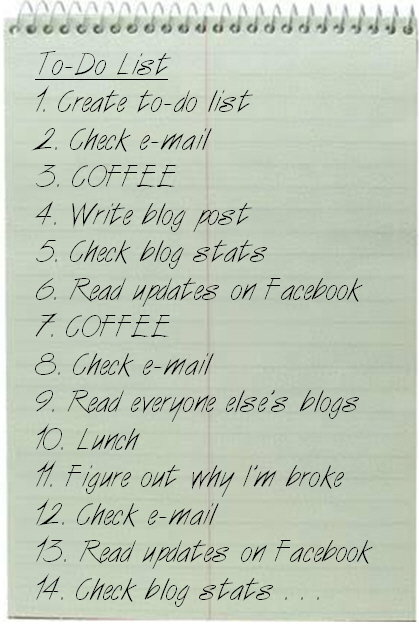 Because I haven’t been sitting down to write my Monday blog posts on Sundays, it seems like it’s getting later and later in the day on Mondays when I’m getting them posted. Part of that is sometimes a lack of an idea for something to post, but part of it is that Monday mornings are always busy. Yes, even for someone who works from home and can arrange my schedule any way I want to. From more than thirty years of routines that involved the week’s activities starting on Monday (school, working, working + school), even after a year of self-employment, Monday is the day to sit down and look to see what needs to be accomplished in the next five days. It’s much ado about the to-do list.
When I was first laid off last year (August 1 marked the one-year anniversary of my official unemployment date), I kept tons of lists: places I needed to contact, or go, about unemployment and benefits stuff; things I needed to take care of financially; jobs I applied for; editors to contact about freelance work; things I already had scheduled that I needed to remember to do/go to; things I could do around the house to keep myself busy; daily housekeeping activities to keep my home in order; and friends I wanted to set up lunch dates with to make sure I was getting out of the house regularly.
Once I grew more comfortable with the idea that I wasn’t immediately going to plunge back into another full-time, outside-the-house job and certain things started falling into a routine, I stopped making a weekly to-do list. Because I wasn’t being overwhelmed with freelance projects—but had them coming in at a somewhat slow but regular pace—I could keep up with them by setting reminders on the e-mails so that I’d get a pop-up to remind me of the due dates. I knew when my books were due. And because of budgetary restrictions, I started staying home more and going out less.
But, after five or six months of this, certain things started to fall by the wayside, like the daily housekeeping tasks or making sure I get out of the house regularly—and more than just going to the grocery store a couple of times a week to pick up one or two things. I’m still getting things done that must get done: the freelance work, preparing for the workshops I teach each month for MTCW, and (usually) my daily writing goal. But sometimes, other stuff falls through the cracks, simply because it isn’t top of mind. Like writing reading-group questions for Ransome’s Honor (which reminds me to say, if you’ve read it and you have some ideas for group discussion questions for it please e-mail me!!!). Submitting an expense report. Following up on reader e-mails. Actively looking for ways/places to market my books, for book signing or speaking opportunities. Staying in touch with friends, more than just reading their status updates on Facebook and letting that suffice. Reading. Exercising. Cooking. Etc. (I’m just remembered that I’m getting really bad about forgetting to take my blood-pressure pills first thing in the morning.)
I’m writing this in a break from finishing up a freelance editing project (a great book about divorce recovery which could easily have been slightly tweaked to be a book on recovering from getting laid off), which is what made me think about the fact that I need to reorganize my life and start keeping a to-do list again, not only to stay on top of everything, but for my own mental health. Because I’ve noticed I’ve been feeling more and more like I’m on the downward slope into depression (I suffer from cyclical depression)—mostly because of the vast amount of amorphous “things I should be doing” hanging over me which I am not doing. And getting organized this week is going to be even more important because I have a meeting with the head of a small publishing house who wants me to start doing some freelance administrative work for her company. (And I’m thrilled at the prospect. Believe it or not, I actually miss doing administrative work. It’s very rewarding, because it’s the kind of work that doesn’t eat into the part of my mental stores reserved for writing, the way editing sometimes does.) So as soon as I finish this project and get it sent off, I’ll be sitting down to write my to-do list for the week. And I’m thinking I may get out one of those blank journal-style books I have (because I can’t help myself but buy them occasionally) and use that for keeping my lists. Either that, or I may move my whiteboard back into the office from the kitchen (where I currently use it to plan my meals for the week) and use that. Or just buy another one eventually.
Do you make to-do lists? If you don’t, how do you keep track of everything you need to accomplish during the day/week?
Fun Friday–Thanks for the ’80s, John Hughes

UPDATE: I forgot to add this last night when I put this post up . . . Congratulations to KELI GWYN, winner of The Blue Enchantress.
You may have read today’s blog title and thought, Who the heck is John Hughes? Well, for those of you who don’t know, John Hughes was a screenwriter, director, and producer who passed away Thursday, August 6. Because so many of his movies have become iconic over the years, I thought I’d pay a little tribute to the influence this man has had on the culture of the 1980s.
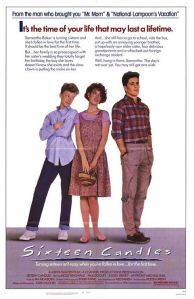 Sixteen Candles (1984)
This movie, in combination with the next two on this list, practically defined the 1980s for teenagers. And these three films made Molly Ringwald into the biggest teen star of the ’80s. Now, if you’ve never seen these films (or if it’s been a really long time), I will warn you that the language and subject matter can be rather crass at times, but still, some of the most culturally important films for my generation. Back in ‘the day,’ turning sixteen was a big deal . . . because WAAAAYYYYY back then, sixteen was the age when we were supposed to start thinking of first boyfriends and first kisses (though I realize that even back then, this was happening at a much younger age—but still probably not as young as now!). Also, if you think about the way that school systems were set up then, with ninth grade still being in junior high and not high school, the year we turned sixteen was usually the first year of high school, just adding that much more pressure. And in this film, when the girl turning sixteen has an older sister who’s getting married at the same time as the sixteenth birthday, there’s going to be a lot of emotional turmoil going on—but in a fun way in this film.
 The Breakfast Club (1985)
Now, while I’ve said this as one of the iconic films of my teen years, I have to admit that I didn’t see it for the first time until I was in my twenties. But, boy, it took me straight back to those days. Aside from the fact that this movie churned out some really good actors, it also delved into the most common stereotypes of teens in the ’80s: the jock, the nerd, the beauty-queen, the loner, and the stoner—and then broke down those types into real people and the real issues behind the labels. Hughes used the platform of a day-long detention to pull these five disparate characters together in a setting in which they’d be isolated from the rest of their peers so that they had to interact with each other. And in interacting with each other, they each discovered the fallacies of the stereotypes they’d been labeled with, finding a little piece of themselves in each other—and vice versa—and ended with the characters voicing that lesson, just as any good teen film should.
 Pretty in Pink (1986)
When I was fifteen years old, I developed a crush on an actor who was being pretty much ignored and called “Matthew Broderick for the Near-Sighted” (which I was at the time, so actually, that fit). That actor was Jon Cryer, whom hardly anyone knew about until he hit it big with his current show on CBS, Two and a Half Men. Jon Cryer played the uber-iconic Duckie in Pretty in Pink, and maybe he stood out in my mind a little bit more than for other people because I had a good friend my sophomore year of high school who was the spitting image of him—and dressed and acted just like that character, right down to the “duck shoes.” But more than just this new breed of ’80s guy, PiP gave us Andrew McCarthy as the rich guy who was willing to ask out the girl from the wrong side of town in spite of his friends and James Spader in the type of role it took him years to break out of—the snobby rich guy. It also sent teen fashion into new and strange directions—I’ve already mentioned Duckie’s style, but Molly’s character sported some pretty bizarre couture in this film; and pretty soon after it came out, that kind of style sensibility started making its way into my high school.
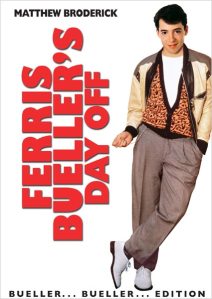 Ferris Bueller’s Day Off (1986)
Is this not the most iconic film of the 1980s??? (Bueller? Bueller?) By the time I got to college three years after it came out, there wasn’t a single person I knew who hadn’t seen this movie—and loved it and quoted it often (until Steel Magnolias became the most quoted movie shortly thereafter). Who didn’t dream of skiving off a day of school (or work) and going out and doing whatever we wanted to do and not get caught? In this film, Hughes broke the “fourth wall” and had Matthew Broderick, as Ferris, talk directly to the audience—giving the audience lessons on how, exactly, to fake out the parents or get away with skipping school. (And they tied the movie to Broderick’s other breakout hit of the ’80s, War Games, when Ferris hacks into the school’s computer system to change the number of sick days he’d taken). I’ll admit it straight out—I like Cameron more than Ferris, as I tend to go more for the quiet type than the flashy type, but the character of Ferris is going to be a big influence for the hero of one of my future contemporary romance novels (at least on the surface of my character). If you haven’t watched this movie recently (or ever) may I recommend renting it this weekend?
What Would You Wear to the Ball?
So I’m writing Ransome’s Crossing and have another ballroom scene—the ball Lady Dalrymple is throwing for Charlotte’s debut—and realized I had no desire nor need to go to my favorite costume site and find just the right gown for Charlotte to wear. Why? Well, take a look:


Unless I really want to get into the intricacies of the embroidery work, there really isn’t much to describe when it comes to what Charlotte would be wearing: a white gauzy gown. [At the ball in Ransome’s Honor, I could get away with Julia wearing dark blue and gold, as she’s much older, and it wasn’t her debut ball.]
So even though it’s a curse that the ball gowns of the Regency era are so boring, at least for a young woman of Charlotte’s age, it’s also a blessing—one less area in which I’m apt to fall into over-description.
Now if I were writing something set in the Victorian era (i.e., if I get to write the sequel trilogy to Ransome, which would take place from 1848–1851), there’s so much more to choose from (all depending on the year, of course—these range from the early 1850s to the 1880s):


Now, here’s my challenge for you. Imagine you’ve been invited to a “Celebration of Historical Costumes” Ball. Post a link to an image of what you would choose to wear—from any era of history. Here are a few links that might be helpful:
Nineteenth Century Fashions
Vintage Textile
The Victoria & Albert Museum
The History of Costume
The Costume Gallery
If I had the figure for it, here’s what I’d wear:

Ceremonial gown of Dowager Tsarina Maria Fyodorovna, c. 1820-1830
Book Giveaway: M.L. Tyndall’s The Blue Enchantress
I’m starting something new on the blog . . . giveaways of other authors’ books. It just so happens that I picked up a copy of my good friend MaryLu Tyndall‘s newest release, The Blue Enchantress, at ICRS. But I was already on her influencer list, so I received a second copy of it this week. Since I don’t need two copies of it, I’m going to hold a drawing for the second copy.
About the book:
Trying to forget about a painful past, Hope Westcott plunges into Charles Towne society trying to find love and acceptance. Captain Nathaniel Mason is determined to build his shipping business and doesn t need a romantic entanglement especially with a woman like Hope. When Hope s adventure-seeking puts her freedom and her life in jeopardy, will Nathaniel turn his back or follow God s voice and sacrifice everything to save her?
4-1/2 Star Review! “No one writes a pirate story better than Christy Award finalist Tyndall! This romantic action-packed adventure illustrates the healing, redemptive power of God’s grace while still offering readers the excitement they crave.” (Romantic Times )
About the author:
M. L. (MaryLu) Tyndall dreamt of seafaring adventures during her childhood days in Florida. Her love of history and passion for story drew her to create the popular Legacy of the King’s Pirates series. Writing for more than twenty years, she lives on California’s coast with her husband and six children, where her imagination still surges with the sea.
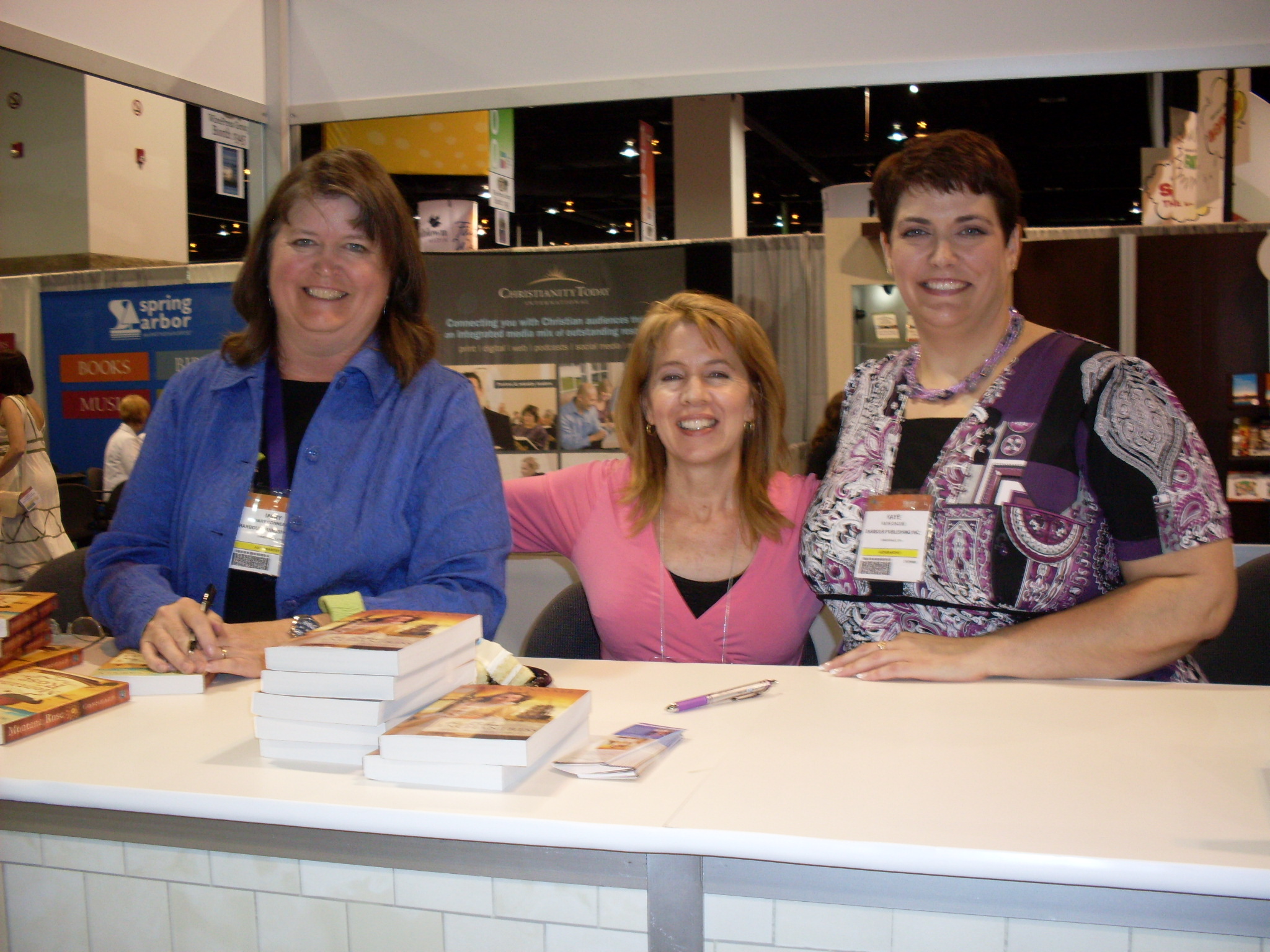
Mary Connealy, MaryLu Tyndall, and Me at ICRS
I’m currently up to about chapter thirteen or fourteen and completely loving it, so I know y’all will, too!
If you’d like to enter to win The Blue Enchantress, please leave a comment on this post before 11:59 p.m. (Central time) on Thursday night, August 6, explaining why you deserve/need/should win this particular book. (It doesn’t really have to be all that well written—after all, I’ll be drawing the winner’s name at random, not judging the answer. I just want to be entertained. Unfortunately, due to the cost of mailing, I can take entrants from the US and Canada only.) I’ll announce the winner in Friday’s post.
So . . . why do you deserve to win MaryLu’s book?
No More Chapters?!?!?
Okay, wow, today really got away from me. I woke up this morning with this topic running through my head, but had several things on my to-do list to accomplish today and knew I needed to dive right into them—most especially adding exercise/activity back into my day. And once I got started with everything, the blog just had to be put on the back-burner.
As I do most mornings, I was listening to Morning Edition on NPR as I lay in bed waking up. And as they occasionally do, they had a segment on publishing/reading. This morning’s segment was on the rise of the e-book, which we’ve discussed here before.
Listen to the piece (or read the transcript) here.
I was listening along just fine, enjoying hearing perspectives from both sides. Until they played a clip from a graphic designer they interviewed, who said this:
Pages, chapters, all those things are very necessary in paper. They’re not in an e-book reader.
~Robert Fabercant
As soon as I stemmed my outrage, I reminded myself that this was coming from a graphic designer talking about it from a design standpoint, not from a story-structure standpoint. I, of course, immediately applied what he said to a story-structure viewpoint and was horrified.
Could you imagine trying to read a 90–100,000-word novel with no chapter breaks? I don’t know that I’ve ever heard of one because it would be nearly impossible to write, much less read.
Aside from the fact that we need breaks in books where we can put them down late at night so we can get some sleep, the chapter-style storytelling structure is deeply ingrained in the Western psyche. Think about literature going back as far as written stories exist. They were broken down into episodes, into “chapters”—whether in more of a short-story format or in a way of breaking down a longer story into something that could be serialized and doled out in chunks.
A while back, I had a critique partner who, when writing the first draft of her story, wasn’t writing it in chapters, but was just writing scene after scene after scene. She’d switch back and forth from the hero’s and heroine’s viewpoints between those scenes; but even though there was quite a bit of conflict, it got to the point where it was like watching one endless Ping-Pong rally. Back and forth, back and forth, with no end point in sight. And that’s when I really understood just how important chapter breaks are. It’s more than just finding a point after two to four thousand words to start a new chapter so that the reader can stop for the night. It’s doing what I love to do: writing to a hook, dropping a bomb, leaving the reader with a question that must be answered, having the character come face to face with the one person she did not want to see—and then ending the chapter . . . and picking up the next one with a totally different character/piece of action to keep the reader hooked.
The structure of the chapter is almost the same as the structure of the story as a whole. The character should be in a different place/state of mind/emotional state by the end of the chapter than they were at the beginning. Everything that happens in the chapter should build toward what happens at the end of the chapter (action or emotion, big or little). Chapter endings mark the turning points of the story, and also serve the writer as places where we leave our readers hanging, dangling, needing to find out what happens next. The readers, now faced with the prospect of starting a new chapter, must decide if they want to know badly enough what happens next to go ahead and start reading the next chapter or not. And the sign of a good book is that no matter how late it is, the end of a chapter is the last place a reader wants to put a book down.
So no more chapters in e-books? I think that would bring about the end of the e-book and ensure the survival of the ink-and-paper kind for centuries to come.
Early Women Authors
I was looking for something on the computer in my files from my undergrad days (that would be the second time around, even though I do still have most of my papers from the first time I was in college back in the early ’90s) and ran across this paper I wrote on the rise of women as published authors from my “Restoration Lit” course in 1999. So today, I’m celebrating those pioneering women who opened the door to allow me to have the career I have today.
~~~~~~~~~~~~~~~~~~~~~~~~~~~~
But how can a man respect his wife when he has a contemptible opinion of her and her sex?1
Throughout history, women have struggled to become recognized as just as intelligent, just as witty, just as interesting as men. In Restoration England, women began to branch out, to speak out. Just as new ideas about government were shaping the political side of England, new thoughts about writing and who could do it were shaping the literary world. Emerging during this time period were women writers who paved the way for the generations to come. The writings of Margaret Cavendish, Aphra Behn, Mary Astell, and others gave women a new voice, presented women in a more realistic light, and created a new profession.
I know not whether or no women are allowed to have souls.2
Approximately half the population of the world was widely ignored by the different governments of the world for millennia. Women were, for the most part, not even allowed to have opinions on politics, religion, or social issues. In the 1660s, Margaret Cavendish, Duchess of Newcastle, did the unthinkable and actually published some of her poetry. She was quite open about her feelings, opinions, and desires. She wrote a lengthy discourse on the invention of the microscope, showing that women not only knew about things scientific, but could observe, reason, and argue eloquently. Aphra Behn wrote a moving story about a slave (Oroonoko), bringing to light her opinions on the issue—although in a somewhat round-about, confusing way. Through poetry, prose, and articles, women began to have a voice… beginning as the hum of a whispering wind and gradually building to the trumpeting of a tornado.
Shall I compare thee to a summer’s day?
Thou art more lovely and more temperate.3
The shrew, the harlot, the heroine. Before the late 17th century, most female characters in literature fell into one of those three categories. The shrew was a woman who refused to marry the man her father had chosen for her, harped endlessly on her husband and children, and brought a sigh of relief to the reader/audience when she made her exit. The harlot—who usually had a heart of gold—was someone who, while sympathetic, could never hold her head up in decent company. And, alas, the shrinking, delicate, petal-soft heroine, who always did as bade, married whom she was supposed to, and spoke to placate. When women began to write, women characters began to think. They began to become complex, complete individuals who did not fit so nicely into a category. A character might start off shrewish; however, underneath, she may actually be protecting a deep heroine-style secret. Female characters began to have opinions on topics other than the care of a household and the raising of a family. Issues such as slavery, the church, politics, and science became subjects that women could and did talk and write about. Women created a role for females not only in the literary world, but in society as well, as it became widely acknowledged and grudgingly accepted that a woman’s place is wherever she wants it to be.
Condemn me not, I make so much ado
About this book; it is my child, you know…4
In the 17th century, there were not many professions open to women. Those of the lower classes might become governesses or tutors, those of the upper classes had even fewer prospects outside of a “good” marriage and the bearing of children. As groundbreaking strides were made by women such as Margaret Cavendish and Aphra Behn publishing their works, a new profession was opened to women: that of the writer. It was a profession that spanned all classes, for any woman who had the opportunity of education could do it. Women with husbands and children could write, as could a spinster daughter on a small farmer’s estate. As the novel became more and more popular, women delved into all genres of it: fiction, romance, mystery, gothic, and fantasy. Women began to write for the stage. It would take two more centuries before women writers would be given much respect as professionals, but the women of the Restoration era certainly made it possible.
I am not single, or the first woman, that hath put herself upon such hazards or pilgrimages…5
The emergence of women as professional writers forever changed the face of literature. Through the voices of women, female characters became more realistic. Through the ideas of women, politics began to change. Through the reason of women, society began to change. The pioneer writers are owed a debt of gratitude by all women, for it is because of them our voices can be heard, our ideas become reality, and our reason become known.
1. Mary Astell, Some Reflections upon Marriage
2. Mary Astell, Some Reflections upon Marriage
3. William Shakespeare, Sonnet 18
4. Margaret Cavendish, An Apology for Writing So Much upon This Book, lines 1-2
5. Mary Carleton, The Case of Madam Mary Carleton
More to (Not) Love
 Last night, I watched the premiere episode of a new show on Fox (yes, I know, that should have been a red flag right there) called More to Love, which is basically a take-off of The Bachelor except with larger-sized contestants. Luke, the bachelor, is 6’3″ and 330 pounds (Fox has labeled him as “husky”). The women ranged in height from about 5’4″ to 6’2″ (yes, without shoes on) and had a weight range of 170 (on someone 5’4″) to 279 (she was 5’10”). The thinnest-looking woman was 5’10” and weighed 190. (As soon as I saw her, I thought: THAT’S what I want to look like in a form-fitting dress!)
Some of you may know, and others may have guessed: I cannot abide the whole idea behind the Bachelor/Bachelorette shows. To begin with, I cannot believe anyone can stand to watch that kind of shallow dreck for an hour every week—especially since it basically mocks the institution of marriage by having men or women compete with each other for the affection of just one person. All it does is set up the one doing the choosing as an idol they’re all trying to sacrifice themselves to. And then there’s my utter abhorrence of watching women throw themselves at a man because they’ve been led to believe he’s worth having (he was picked out of hundreds of thousands of applicants for the show, therefore he must be a great catch, right?). But I’m getting ahead of myself.
Now, obviously, since I’ve never deigned to watch any of the other shows like this, I wasn’t sure what to expect in the first episode. But it sure wasn’t the very awkward first meetings as he greeted each girl as she came out of the car. Yes, I know fifteen to twenty seconds isn’t going to get you beyond a “Hi, my name is…” kind of conversation; but the women’s shallow attempts to say something flirtatious were so cringeworthy, and his remarks to them were so gratingly patronizing (“I like your dress”—but only after one of the women asked him if he liked hers—-PUH-leez!), I ended up fast-forwarding through most of them. I was more interested in finding out who these women were.
As each one came out of the limo (most of them in strapless or spaghetti-strap dresses which were not necessarily flattering on them—let’s get real: big girls have big girls and need to be wearing BRAS!) and came forward to meet the big-bachelor, they showed a brief one-on-one interview clip of her talking about her experience with dating and men. Most of them have had relationship problems—either they’ve never been able to keep a boyfriend, have had boyfriends who were embarrassed to be seen with them, or, like me, have never had a boyfriend. One even mentioned never having been kissed before. That’s my girl. (But I don’t recall which one it was, so I don’t know if she was one of the first five kicked off or not, but I think she might have been.) Almost every single one of them cried or got emotional during this clip.
Then, once they were all in the house and he started making his rounds to speak to each of them for a minute or two before he decided which five to dump the first night (after giving each one a diamond “promise” ring which he said signified his promise that he would look past their outsides and get to know who they are inside), I was immediately transported straight back to junior high school—when, at a party, every girl’s attention was focused on the “popular” boy, and every girl did whatever she could to try to get his attention, whether it was kissing him when she finally got him alone or jumping into the pool fully clothed in front of him. This was where the show completely lost me—and where all of these shows lose me.
You know, it’s no wonder that the divorce rate is so high in our country and that young people bounce from relationship to relationship to relationship if these are the behaviors that have become the accepted norm from people. It’s go-all-out to hook the hottie without even finding out first if you’re compatible or if he’s someone you really would want to be with for the rest of your life. The idea of making an intellectual and emotional connection with someone has gone completely out the window. It’s physical first and foremost—with dignity taking the bullet and dying a horrible death, in this case in front of an audience of millions. And I have to wonder at these women who are fooling themselves into believing that this type of situation is a good incubator for real, true, abiding love or that the bachelor is going to be faithful to her after the end of the show when he’s just been spoiled by having twenty women throw themselves at his feet—especially since these shows have such a wonderful track record of couples with relationship that last past the final episode. But I digress, once again.
As I listened to the interview clips of these women that they played throughout the episode, all I could think of was how much worse off each is going to be after she leaves this show than before she got on it. Most of them got extremely emotional when talking about their past relationships (or lack thereof): the fact she didn’t get to go to prom; the fact that whenever she goes out with a group, men always flirt with her “skinny” friends but not with her; and that she’s tired of being overlooked or rejected and is afraid she’ll be alone for the rest of her life. I wanted to shake these women and scream at them: “What do you think is going to happen to you on this show? You’ll be rejected—because he can only pick one—and it’ll hurt worse because you’ve been given a false sense of a ‘relationship’ with him. You’ll have even worse self-esteem issues by watching this guy ‘date’ all the other women in the house in front of your very eyes. When he does finally reject you, it’s going to be on national television. And then all the bloggers and forums (especially places like Television without Pity) are going to tear you to shreds from the way you look to the way you dress to the way you talk to what you did ‘wrong’ that got you eliminated. You’re not advancing acceptance of plus-sized women. You’re just giving the American public another opportunity to laugh at us.”
OH! And I almost forgot . . . after the whole thing with giving them the “promise” rings—THEY HAD TO GIVE THEM BACK!!!! Because the rings are what he uses to indicate who’s staying and who’s going. Just goes to show how much a promise is worth these days. Though there were many things about the show that bothered me, I think that one bothered me the most.
This is why I write romance novels in which the hero and heroine have time to get to know each other before they “fall in love.” There’s a deep level of respect and honor between the characters that goes into each of the relationships I write about—because that’s the type of relationship I long to find. And even though they’ll usually find each other physically attractive initially, it isn’t the other person’s looks or the way that physical attraction builds that will form the foundation of their romance.
Am I jaded? Probably. Am I appalled? Definitely. Will I watch this show again? Absolutely NOT.
A Colorful Day
In my effort to raise my interest in healthy foods, I’ve decided that for the rest of the summer (and into the fall, however long it lasts), I’m going to do as much of my food shopping at the large farmers’ market in downtown Nashville. Rather than fight the crowds on the weekends, though, I’ve chosen to go during the week when, yes, there are fewer displays/sellers there, but when I’m also not having to push and shove my way through crowds to get to the fruits and vegetables that have been poked and prodded and bruised by hundreds of others before me.
Here’s what I got . . .


Tomatoes

Cucumbers

A couple of the biggest bell peppers I've ever seen

White Squash

Small Purple Bell Peppers

"Fairy Tale" Eggplant

Gorgeous, Sweet Blackberries!
Now, what I’m going to do with all of these, I’m not sure, but they should make very nice additions to the mains I already have planned for the rest of the week!
What’s the most fun/unusual fruit or veggie you’ve ever bought? What did you do with it?
A Sneak Peek at A Case for Love
I’m trying to get some editing work and some writing done today, so I’m drawing a blank in coming up with a blog topic (obviously, since it’s two in the afternoon and I’m just now posting!). Instead, I thought I’d treat you to a scene from A Case for Love. This comes from the second chapter of the book, as the first chapter has a Menu for Romance spoiler in it.
A CASE FOR LOVE
© 2009 by Kaye Dacus
Alaine stared into the camera lens as if she were talking directly to a person instead of a machine. “The publicist for Bonneterre Lifestyles reported that participation in voting for this year’s Most Eligible Bachelors was up more than 200 percent over last year. And they expect the July issue, which hits newsstands Monday, will be the top-selling edition in the magazine’s thirty-five year history.”
Much more so than the June issue, on which Alaine’s photo appeared as the number one old-maid in town.
“Tonight at ten o’clock, I’ll reveal the winner and give you a preview of the magazine’s cover, which will be announced after the dinner feting the twenty-five nominees. Live from the Plantation House restaurant, this is Alaine Delacroix for Channel Six News.” She stood still, smiling, until receiving an all-clear.
Instead of mingling and making small-talk with everyone gathered in the exclusive second-floor dining room of the most expensive restaurant in town, Alaine walked around followed by her cameraman and stuck her microphone in people’s faces, asking them silly questions so she could file a story which no one would remember three days from now.
A frisson of excited whispers in the group near the entrance caught her attention. She turned to find the source, and her jaw almost unhinged. In walked one of the most gorgeous men she’d ever seen—and he looked vaguely familiar. His hair was a cross between brown and auburn, and he looked better in his tuxedo than Fred Astaire ever had. But could he dance like the sliver-screen legend?
“That’s Forbes Guidry.”
“I can’t believe he actually came.”
“He’s been on the list for five years in a row.”
“I heard he drives a Jaguar and lives in one of those fancy townhouses in Old Towne.”
Alaine focused on the last whispered comment from the women behind her. One of those townhouses in Old Towne? Of course! That’s where she recognized him from. They lived in the same community, and she’d seen him out running almost every morning on her way to work.
While she’d toyed with the idea of trying to meet him, she’d never followed through, assuming someone that good looking must be married. She couldn’t believe she hadn’t connected her eye-candy jogger with the infamous Forbes Guidry. He was what her mother would call a “confirmed” bachelor—or, in other words, a hopeless case other women had long-since given up on trying to make settle down.
Which meant he was definitely not the man for her. But to tide her mother over until Mr. Right came along? It was worth a shot.
Alaine turned to motion Nelson over—but he wasn’t behind her. She scanned the room and saw him chatting up the woman who’d been second behind Alaine on the old-maid list. She started toward him, but before she got there, the microphone on the dais at the far end of the room squawked, drawing everyone’s attention.
“Ladies and gentlemen, bachelors and bachelorettes, if you would find your seats, dinner service will begin in just a few minutes.”
Alaine had arranged a seat and meal for Nelson ahead of time, so she sent him to go eat, and went to find her name on one of the tables.
Paying more attention to the place cards than anything else, she gasped and jumped when she stepped on someone’s foot.
“I beg your . . .” Though her four-inch heels brought her up to five foot six, the close proximity to the man forced her to crane her neck to see his face. His gorgeous face—and grayish-blue eyes looking into hers with such intensity, her whole head grew hot.
“No apology necessary, Ms. Delacroix. I believe this is your seat.” Forbes Guidry pulled out the chair he stood behind.
“Thank you.” She sat, hoping he would walk away with no further conversation so she could compose herself before she had to speak with him again.
He pulled out the chair to her left and sat in it. “I’m Forbes Guidry.”
Fun Friday—My TBR List
One of the things most people do when they go to ICRS is stock up on the free books that are being signed and given away. I signed more than 200 books while I was there (both titles combined). I was very proud of myself in that I only picked up three books while there . . . because I knew how many unread books I have sitting here at home. So I thought today, I’d share my TBR (to be read) list, or at least, part of it:
Currently Reading
The Blue Enchantress by M.L. Tyndall. I had to pick this one up at ICRS—not only because of doing a couple of events side-by-side with MaryLu while she was signing them, but because I would have had to wait several more weeks to get it if I hadn’t. Though this is the second book in a series, so far, I’m not really seeing that one would have to have read the first book (The Red Siren) to enjoy this one. The opening scene was absolutely fantastic and drew me into the heroine’s emotions immediately.
 A Passion Most Pure by Julie Lessman. I picked this book up at one of the stores in Louisiana where I did a book signing back in May. I started it about ten days before conference (after turning in A Case for Love). Unfortunately, I must admit that it was rather easy to set aside while reading MaryLu’s book, as the first few chapters haven’t yet gripped me. But I’ll get back to it soon.
 North and South by Elizabeth Gaskell. This is my current audiobook that I’m listening to on my walks. It isn’t as good as the BBC miniseries. But still, I’m getting much more insight into John’s and Margaret’s characters this way. And no, it wasn’t read by Richard Armitage, more’s the pity.
To Read, Eventually
Okay, so here’s the list of books I keep hoping I’ll get to soon–and some of them I really need to get to, as I received influencer copies, so it’s incumbent upon me to read them since I did receive them for free by promising to read and, if I like it, post a review:
Turning the Paige by Laura Jensen Walker (Book 2 of the Getaway Girls series) I really enjoyed the first book in this series (Daring Chloe), so I’m upset that I haven’t been able to get to this one yet.
Daniel’s Den by Brandt Dodson. Not only do Brandt and I share the same wonderful agent (Chip MacGregor) and the same publishing house (HH), I’ve been hearing wonderful things about this book, so I can’t wait to get to it.
The Reluctant Cowgirl by Christine Lynxwiler. Christine herself gave me a copy of this one the last day of our Michigan book signing tour, and I got engrossed in it on the flight home. Unfortunately, life then went absolutely crazy, and I haven’t been able to get back to it. But I WILL!
American Anthem by B.J. Hoff. This is actually a re-packaging of three of Hoff’s previously released novels: Prelude, Cadence, and Jubilee. It may be a while before I can get to it, but I will read it sometime.
A Claim of Her Own by Stephanie Grace Whitson. Whitson’s series that started with Walks the Fire are some of the first books I read when I started getting into Christian fiction ten or twelve years ago. I loved her next series as well. After that, she lost me a little bit—as I was growing somewhat weary of the “Old West”/Cowboys-and-Indians settings and stories. But it’s been a long time since I’ve read that kind of setting (Mary Connealy’s Montana Rose being the first Cowboy/Old West romance I’ve read in a long time), and the description of Whitson’s book intrigued me.
Gone to Green by Judy Christie. I met Judy at ICRS and got a signed copy of her debut novel. I’m not usually one to read books written in first person with a chick-litty tone, as this one seems to have, but just hearing Judy describe the story caught my attention, so I can’t wait to read it.
Now, as I said, that’s just a partial list . . . I have so many other unread books lying about, it’s ridiculous. It may be time to purge again, though I hate getting rid of books. But if I’m not going to read them, I can donate them to the library and someone can get some enjoyment out of them.
So, what are you currently reading? What are the first few books on your TBR stack?


