2018 Writing Challenge–Prompt: She’s Outta Here | #amwriting
Writing Prompt—March 12, 2018
And with that, she walked away.
Word Count Goal: 300 to 1,000 words
My name is Kaye, and I’m a Library-aholic | #amreading
 So we’re twelve days into March, which means I’m not quite two weeks into my monthlong challenge to only read books I already own, and I’ve come to a realization:
I’m a Library-aholic!
It’s amazing how many times since the beginning of the month that I’ve picked up my Kindle—even when I’m in the middle of reading something—and then set it aside, intending to pick up my phone or sit down at the computer and log into the library app/website and download some ebooks and/or audiobooks.
You see, I can check out up to 25 titles at a time. And you’d probably (not) be surprised at how often I meet that limit! One of the best things about checking out ebooks through the library (my system uses Overdrive for their digital-content provider) is that if I turn off the wifi connection on my Kindle, the ebooks stay on my device until the next time I turn the wifi on again. Which means that if I haven’t quite finished reading a book when it’s due (a 21-day check-out cycle), the library’s system automatically checks it back in. That means I’m not charged late fees, and the next person waiting for it can go ahead and get it, whether I’m through with it or not!
Of course, I rarely go twenty-one days without turning that wifi on. Between being a BookBub subscriber—and purchasing one to several low-cost/free ebooks every week or so—and browsing the library at least once a week, I typically tune my Kindle into the ether for downloads at least once every week to ten days.
Last night, after I finished reading Naming the World: And Other Exercises for the Creative Writer, I was ready to start another book. Without even thinking, I picked up my phone (I was already in bed) and was three pages deep into my library wishlist before I remembered that I’m supposed to be reading books I already own this month.
See, this is why there’s a very high percentage of the 340 Kindle titles I own that I haven’t read (yet). Because I’m always looking for the next best, latest-greatest thing from the library or the best-sellers lists or on my Goodreads feed or the book-review blogs I read.
So I guess what I’m saying is that I’m going to have to do this challenge a few more times this year in order to break my addiction to always looking elsewhere for a book to read, rather than reading one that’s already on my own (virtual) bookshelf.
Have you read all the books you own? Do you have an addiction to BookBub or the library or another source to get your next read?
2018 Writing Challenge–Prompt: Yes or No?
In accordance with #3 in my Top Ten exercises to relearn how to be a seat-of-the-pants (SOTP) writer, last week, I went through and created a writing prompt book, using a blank journal and gathering writing exercises/prompts from multiple sources.
I came up with 90 of them, so I thought in addition to my regular blogging, I’d share each day’s writing prompt here as well.
Writing Prompt—March 11, 2018 Everything within him screamed YES! But he said, “No.”
Word Count Goal: 300 to 1,000 words
Get Motivated: @AnneLamott on Writing First Drafts | #amwriting
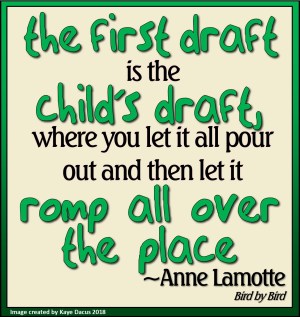
The first draft is the child’s draft, where you let it all pour out and then let it romp all over the place, knowing that no one is going to see it and that you can shape it later. You just let this childlike part of you channel whatever voices and visions come through and onto the page. If one of the characters wants to say, “Well, so what, Mr. Poopy Pants?,” you let her. No one is going to see it. If the kid wants to get into really sentimental, weepy, emotional territory, you let him. Just get it all down on paper, because there may be something great in those six crazy pages that you would never have gotten by more rational, grown-up means.
~Anne Lamott
Bird by Bird: Some Instructions on Writing and Life
pp. 22–23
#TBT: NaNo Prep: Draft Writing vs. Regular Writing | #amwriting
Originally posted October 2013
One thing that can make a writing marathon like NaNoWriMo discouraging and make writers want to give up is the failure to realize the difference between draft writing and regular writing.
Regular Writing
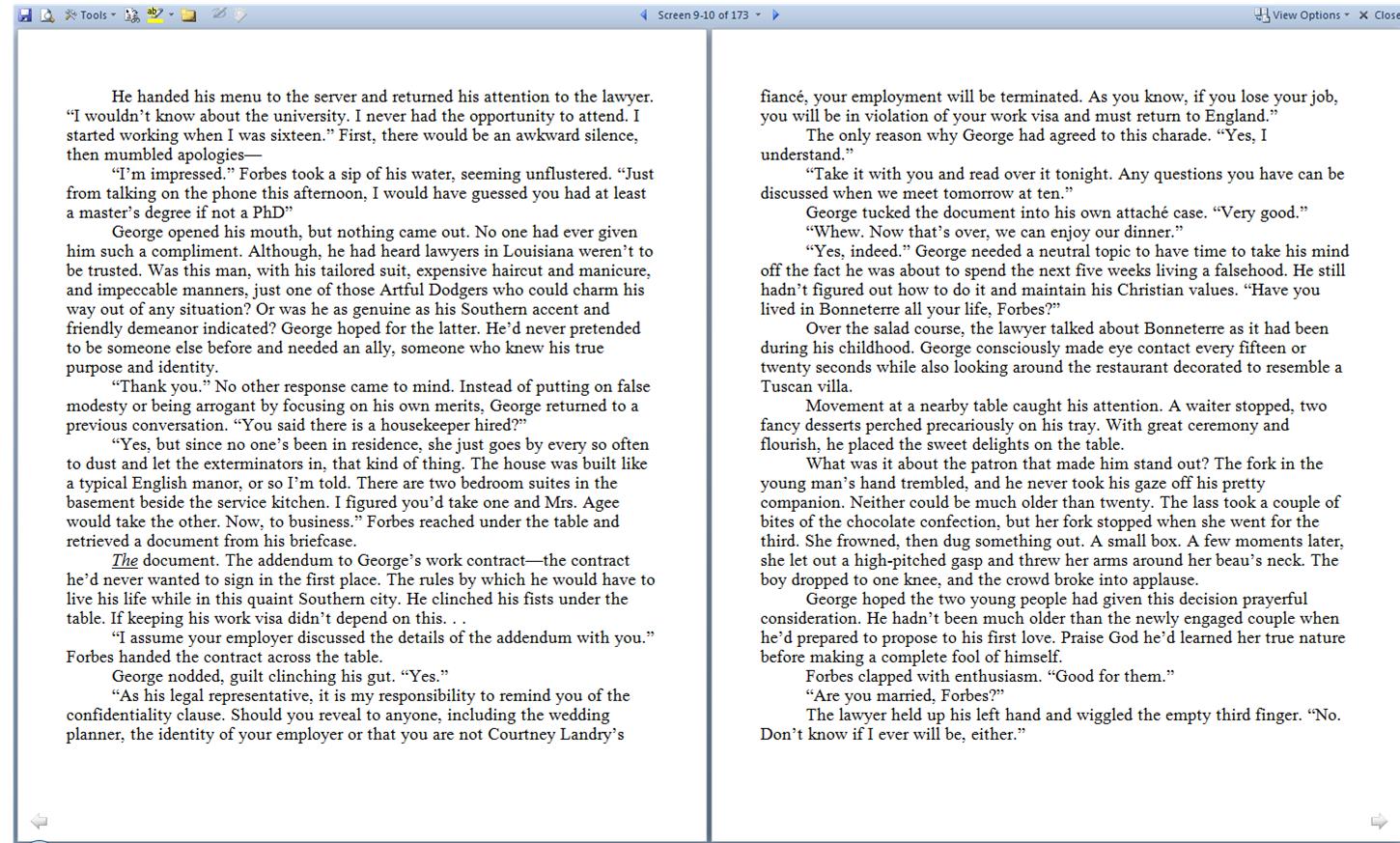
What Regular Writing looks like.
- In the process of regular writing, you may take the time to re-read what you’ve already written, maybe do a little tweaking or editing on that, before you start writing for the day.
- If you can’t think of the correct word or phrase you want to use, you’ll pause, go to thesaurus.com or some other resource and search until you find just the right term for your prose, then go back to writing.
- You may run across something that needs to be researched. Maybe it’s how to change the oil in a 1957 Ford Mustang. Maybe it’s the correct title for the crew member on the ship who serves the captain’s dinner. So you pause, pull out your reference book or start searching online until you know exactly what you need to know. You incorporate that information, and then you go back to writing.
- A minor character comes on the scene. You think this person may show up again—may even become a secondary character—but you need to know a little more about him. You need to know his name, a bit about his background, what he does, and what role he has in the story. So you pause, go to your Story Bible and start an entry for this character. Then, once you know exactly what you need to know, you go back to writing.
- You get to the end of a piece of dialogue, and you’re not sure exactly how you want to tag it. So you pause and sit back. Do you want to use a “said” or “asked” tag? But those are so passe. Perhaps something with an adverb? No. Adverb tags are of the devil, you heard at a conference once, so better not do that. Maybe an action tag? Okay. Where are the characters in the space and in relation to each other? How would the character move? What’s the facial expression? Maybe you should act it out. Once you have the perfect tag, you get it down in words and continue writing.
Are you getting a picture here of what “regular” writing is?
Draft Writing

What Draft Writing looks like.
- In drafting, you may take the time to re-read the last few paragraphs of what you wrote the day before to remind yourself where you left off, but you don’t make any changes and you immediately start writing as soon as you finish reading.
- If you can’t think of the correct word or phrase you want to use, you type ____________ and then may even use the comments feature to highlight it and type a reminder to yourself to look it up later and then resume writing.
- You may run across something that needs to be researched. Maybe it’s how to change the oil in a 1957 Ford Mustang. Maybe it’s the correct title for the crew member on the ship who serves the captain’s dinner. So you type ___________ and use the comments feature to highlight it and type a reminder to yourself to look it up later and then resume writing.
- A minor character comes on the scene. You think this person may show up again—may even become a secondary character—but you need to know a little more about him. You need to know his name, a bit about his background, what he does, and what role he has in the story. So you type ___________ and then may even use the comments feature to highlight it and type a reminder to yourself to make it up later and resume writing.
- You get to the end of a piece of dialogue, and you’re not sure exactly how you want to tag it. So you write “he said” or “she asked” and then type ___________ and use the comments feature to highlight it and type a reminder to yourself to write something better later and then resume writing.
Are you catching the difference between regular writing and drafting?
In drafting, the most important thing to do is get the bones of the story down in writing. It doesn’t have to be perfect. It doesn’t even have to be good. That’s what the second, third, fifth, tenth draft process is for.
Forget about “getting it right.” Just get it written!
Top Ten SOTP #Writing Exercises | #amwriting
 In my effort to relearn the joy of writing and regain my writing “mojo” in 2018, I’ve decided to embark on a quest to relearn how to be a seat-of-the-pants (SOTP) writer. So I sat down today and came up with a list of things I used to do back in the days before I was published/before I learned too much about how I’m supposed to write. Things I can start doing immediately that, while they may not lead to a complete rough draft on the schedule I set for myself at the beginning of the year, these ideas should at least get me started writing again—and hopefully learning to have fun with it again.
My Top Ten SOTP Writing Exercises
- Review old, unused story ideas
Between old files on my computer (some of which I might not even be able to open anymore, because I think they may still be in old MS-DOS WordStar format) and boxes full of old spiral notebooks, this is a task that could take me months, if not years. The plan for the rest of this week is to revist three old story ideas each day and write 50 new words (additional story/scene ideas, character ideas, etc., or even a snippet of story) for each one. - Write fan fiction
I’ve done this in the past (I wrote more than 45,000 words of Lord of the Rings fan fic back in the mid-2000s). The main character (the name dug out of Tolkien’s appendices where she’s mentioned as marrying King Éomer of Rohan) is a total Mary Sue—and I knew it at the time. But I remember how good it felt to just write and write and write something that no one but I would ever see. That’s how I want to feel about writing again! - Use writing exercises
There are plenty of websites, Twitter feeds, Facebook pages, etc., that post writing prompts daily. I’ve never found most of those all that helpful because they seem to be more focused on journaling, blogging, or types of fiction scenes that I’d never incorporate into one of my stories. But I recently picked up a book called Naming the World which is full of writing exercises, meant to hone skills and help to build a story, rather than just prompts to write random scenes. - Learn to write flash fiction
I’d like to do this for a couple of reasons. First, I feel like it’s a skill that will help me in my novel writing, as it’ll be a great exercise in learning to “write tight”[ly] and eliminate unnecessary prose. Second, I’d really like to start sharing original fiction here more. - Write longhand at night in bed
For years—a couple of decades—sitting in bed at night with no light other than a 40-watt bulb in by bedside lamp with a spiral notebook propped on a pillow on my lap was the way I did some of my most prolific writing. Even though I’ve had computers on which I could write since 1980, there’s something primally creative about writing longhand. I ignore margins. I cross out words/phrases/sentences liberally. I make notes along the top of the page. I doodle. And I stop thinking and just write; the characters and story take over and I’m just taking dictation. - Get out of the house to write
Because I work from home, sometimes my whole house makes me feel like I’m still “at work.” It’s also easier to procrastinate when I’m at home—there’s always something around the house that I can do instead of writing. So going elsewhere to write—the library, Panera, a coffee shop—can help stimulate my creativity. I’ve been using the excuse of not wanting to leave my puppy alone (she’s a year old) for an hour or two as to why I haven’t been doing this since I moved to Clarksville, where I have three coffee shops (S’bux plus two local chains) within a three-mile drive of my house. But it’s just an excuse. I don’t have much of an issue with leaving her home alone for five or six hours when I drive down to Nashville for girls’ day brunch and a movie at least once a month. Plus, I just need to be getting out of the house a lot more than I do. - Indulge in other non-writing story activities
Here’s what I did during my timed writing hour last night:
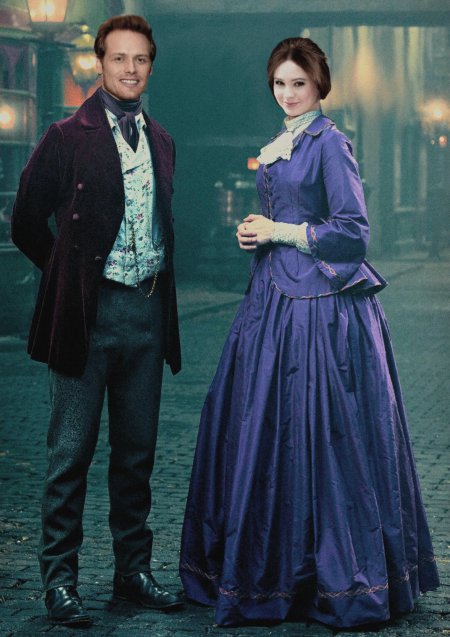
James Yates (template: Sam Heughan) and Eleanor Ransome (template: Karen Gillan)
I also have spent some time collecting images on Pinterest for this story. Because I became so accustomed to writing on tight deadlines (and because things like Pinterest didn’t exist for most of the time) while I was writing on contract, I came to view these types of creative activities as indulgent or time-wasting. But when thinking about how I used to spend my writing time years and years ago, it included plenty of character casting, template gathering, and world building. After all, that’s how the fictional city of Bonneterre, Louisiana, came into being! - Write in short bursts throughout the day
Instead of forcing myself to try to do one-hour (or longer) sprints daily, I can break this up into ten- to fifteen-minute bursts spread out over the day. That way, it doesn’t feel like such a chore to set aside everything at a certain time of day in order to write. And, if I do spread these out and start early enough, I’ll likely exceed the 300-words-per-day goal that I’ve been saying I want to reach for a couple of weeks now (and haven’t been doing). - Review the 1- and 2-star book reviews I’ve written
Sure, sometimes these come out of my not being in the right mindset for the story when I tried to read it. But there’s always a reason why I rated a book at less than three stars. So how would I have written it differently? I know this is something that can lead to my own story . . . after all, Stand-In Groom started with this basic exercise after I saw the movie The Wedding Planner—how would I rewrite that story so that the resolution of the romance didn’t cause the breakup for the engaged couple? - Review/revise/update casting book and “families” spreadsheets
More than 25 years ago, I started a spreadsheet file that contains a couple dozen tabs for hundreds of characters who “live” in what became Bonneterre. They’re grouped by family, each cast with someone from my casting book. But I haven’t really done anything with it for ten or fifteen years at this point, focusing more on moving forward with new characters, new settings (new Real World Templates, too). Including the three Brides of Bonneterre books, I’ve written more than half a million words (three published novels and two unpublished manuscripts) that developed out of building that “families” spreadsheet.
What other exercises would you suggest as those that I could incorporate in relearning how to be a SOTP writer?
Talk-about-It Tuesday: Are You a Plotter or a Pantser–or a Plantser? | #amwriting

Last week, my Throwback-Thursday post was one in which I wrote about how I had to evolve from a Seat of the Pants (SOTP/Pantser/Pantster) Writer to a Plotter. So it was quite ironic that this video came through on my YouTube subscriptions just a day or two later:
.
Are you a Plotter or a Pantser—or are you somewhere in between (a “plantser”)? Why do you feel like that particular method works best for you?
Have you ever changed from one style to the other to see if it would work better?
Is there a particular tool or method you use that helps you either plot or pants?
What Did You Read in February 2018? What Are You Reading Now? What’s on Your TBR List? | #amreading
Happy First Monday of March, everyone!
It’s time to check in with what you read this past month!
It’s Reading Report Time!

Open Book by Dave Dugdale
.
Tell us what you’ve finished reading last month, what you’re currently reading, and what’s on your To Be Read stack/list. And if you’ve reviewed the books you’ve read somewhere, please include links!
To format your text, click here for an HTML cheat-sheet. If you want to embed your links in your text (like my “click here” links) instead of just pasting the link into your comment, click here.
.
- What book(s) did you finish reading (or listening to) last month?
- What are you currently reading and/or listening to?
- What’s next on your To Be Read stack/list?
Get Motivated: “Creativity Sets Us Free” | #amwriting
In the creative act we can experience the same freedom we know in dreams. This happens as I write a story. I am bound by neither time nor space. I know those distant galaxies to which Meg Murray went with Charles Wallace and Calvin. …
But this freedom comes only when, as in a dream, I do not feel that I have to dictate and control what happens. I dream, sometimes, that I am in a beautiful white city I have never seen in “real” life, but I believe in it. I also believe in the planet Uriel, with its beautiful flying creatures, and also in that other planet where are found the unicorn hatching-grounds.
When we are writing, or painting, or composing, we are, during the time of creativity, freed from normal restrictions and opened to a wider world, where colors are brighter, sounds are clearer, and people more wondrously complex than we normally realize.
~Madeleine L’Engle
Madeleine L’Engle Herself: Reflections on a Writing Life
p. 55
SOTP Writers and Plotters—a #TBT Post and a Follow-up Question | #amwriting
A decade ago, just as my career as a published author was getting started and I realized the need for no longer “winging it” while writing under contracted deadlines, I posed this question:
Can a SOTP Writer Become a Plotter?
I have always been a seat-of-the-pants (SOTP) writer, even well before I had ever heard that term. I almost never knew, beyond the fact that the hero and heroine are supposed to end up together, where my stories were going when I sat down to write them. With my first three manuscripts, I just sat down and wrote. Started with Chapter One and wrote straight through, discovering the story as I went along, being as surprised by the twists and turns the story took as if I were reading a book written by someone else.
Of course, that was before I started graduate school and learned all the ins-and-outs of plotting, character development/arc, story beats, and pacing. All of a sudden, there were elements of writing a story I kind of had to know before I could actually sit down and write one. Which is why my three manuscripts since then, Stand-In Groom, Ransome’s Honor, and Menu for Romance, have all taken me much longer to write, and have all required a couple of re-starts—because once I got into them, I found major holes in the stories or characters behaving in ways that didn’t lend to a good character growth arc.
A week or so ago, I pulled out the notebook containing the printed copy of my first complete manuscript—a six point-of-view romance/women’s fiction novel that I wrote in nine months following the first writing conference I attended. It’s the one where I practiced what I’d learned about limited POV and writing every day even when I didn’t feel like it. The amazing thing is that the story is strong, the main conflicts and plotlines are easily identifiable, and, even though the pacing suffers in places, the narrative drives toward the ending.
So why, over the last four years, have I had trouble repeating this process of just sitting down and writing a story?
Read more…
How I Became a Plotter
What I discovered once I was in graduate school and then, later, under contracted deadlines, was that I could no longer just let the story come as it may if I wanted to meet those due dates. I needed to know where my story was going so that I could make the most efficient use of my writing time (which was very limited in those years—working full time, going to school part time, and being an officer in a national writing organization). I also needed to be able to write full synopses of stories I hadn’t yet composed in order to get those contracts. Plotting out my books before starting (and I use the term plotting to mean writing a full synopsis and a Seven Story Beats outline) became especially important once I was under multiple contracts at the same time, with three or more full-length (100k+ words) manuscripts due each year and needed to be able to hammer out the book in two or three months’ time.
Does that mean I knew everything about those books before writing them? No. There was still a lot left for my imagination to fill in when I did sit down to write. But having that outline, the synopsis, for which I’d done a considerable amount of brainstorming before writing (or even before selling) the book became the buoy that kept me afloat when I got to the part of the book I hadn’t plotted out ahead of time. I had milestones, beats I needed to get to in order to reach the ending I’d already planned, which helped guide me.
Since finishing my last published book in 2013 . . . no, actually, before I finished my last book—while I was writing that book—I was so burned out on writing this way. It had become what I’d always sworn I didn’t want, why I never really dreamed of being a full-time author. It became WORK. It was no longer a process of creative discovery. It was a job. My job was to come up with a synopsis/outline that a publisher liked and would pay me money for. But in order to earn all of that money, I then had to sit down and write it according to that synopsis/outline. I couldn’t let it get off track. I couldn’t let it change halfway through into something else. And once I finished one manuscript, I couldn’t allow whimsy to capture my imagination and lead me to a totally new and different story . . . I had other contracted manuscripts to completed.
Writing in 2018—A Follow-up Question to the Original Post
I started out this year with the goal in place to spend thirty days planning/plotting my next story and then the next 90 to 120 days writing it. And, as has happened with me each of the previous times I’ve tried to do this over the last couple of years, I lost steam about halfway through. Why can’t I make this work?
Ah, there’s that W-word again: WORK. I’ve realized that in the deep recesses of my brain, planning/plotting out my story ahead of time is associated with everything negative that came from becoming a moderately successful published author—and completely drained the joy from writing for me. Between 2008 and 2013, writing went from something in which I took refuge—something that both relaxed and energized me at the end of a stressful day, a way to work out my anxieties and emotions—to my greatest source of stress and anxiety and emotional turmoil.
So I set aside my 2018 writing project for a month. At least, the planning part of it. I’ve been thinking about my characters. I’ve been collecting (and manipulating) images of my templates (and am about to re-cast my hero—from Arthur Darvill to Sam Heughan). I’ve been trying to remember how I used to approach writing a story. How I used to look forward to sitting down with a notebook or at the computer in the evenings to try to get out in words what I could see happening in my head. How I couldn’t sit through an evening of music after dinner without brainstorming my story all over the paper tablecloth. How I once spent an evening at the famous Bluebird Cafe in Nashville, where I’d taken a couple of other authors in town for a conference, writing the next chapter of Stand-In Groom on a bunch of paper dinner napkins.
So now I have to ask myself:
Can a plotter become a SOTP writer again?
That’s what I’m setting out to answer in 2018.

 KayeDacus.com