Midweek Motivation: “Writer’s Block Instant Cure” | #amwriting
From the book Writing FAST: How to Write Anything with Lightning Speed, author/producer Jeff Bollow shows you a simple, fast, guaranteed way to break through writer’s block instantly.
The secret is simple: By giving yourself permission to write garbage, you overcome writer’s block instantly, allowing your creative flow to resume. But what about the inner critic—that voice that tells you your ideas are terrible? Make a deal with it, and tell it to wait its turn.
(from the video description on YouTube)
2018 Writing Challenge–Prompt: I Saw a Ghost Once | #amwriting #writingprompt
Writing Prompt—March 21, 2018
A character says: “I saw a ghost once…”
Word Count Goal: 300 to 1,000 words
You can write it as a scene or notes or an outline or even an epic poem worthy of a minstrel in the king’s court. Just write!
Five Benefits of Being a Seat-of-the-Pants Writer | #amwriting
 In my effort to relearn the joy of writing and regain my writing “mojo” in 2018, I’ve decided to embark on a quest to relearn how to be a seat-of-the-pants (SOTP) writer. So I sat down today and came up with a list of reasons why being a seat-of-the-pants writer can be beneficial for me as a romance writer.
1. I already know the ending I’m working toward.
- Because I’m writing romance, I already know what the structure of my story will be. Therefore, I don’t need a detailed outline or synopsis in order to know the ending that I’m trying to get my plot and characters to. They’re gonna end up together.
2. It allows for more spontaneity in character development.
- I do need to know at least the basics of my characters before I start writing—their names, their general backstory, what they look like, and so on. By not knowing too much about the story before I start writing, I can be more like a reader, discovering who the characters are as the plot evolves and develops around them. The characters react to the situation at hand in a way that’s extemporaneous, instead of planned ahead of time—which helps me learn even more about them than I would if I tried to plan out all of their traits, motivations, and reactions ahead of time.
3. It allows for more spontaneity in story development.
- There are some things I have to know before I start writing: where and when the story is set, who the main characters are, what the basic premise will be. But something that I learned in my years as a full-time published author is that being locked into writing to a pre-planned synopsis can be very constraining and stressful, especially when I get into the middle of a story and it doesn’t want to go where it was originally planned. Writing SOTP, if a story isn’t working, it’s a lot easier to make changes to the plot, the setting, the time frame, even the story structure.
4. I can always find something to write about (i.e., it reduces the risk of writer’s block).
- When I’m not locked into having to write certain scenes or follow a storyline or characters that aren’t working for me anymore, it’s a lot easier to find something to write about. Even if I know (or think I know) it’s something that won’t end up in the final draft. An exercise I used quite a lot in the past (especially with my contemporary stories) was to send one of the main characters to the grocery store; I would write about everything they put in their basket—and why—and then, usually by the time they get to the frozen-food section, they run into someone that actually pulls the character back into the story. And even if that doesn’t happen, I’ve still written—and gotten to know that character better.
5. I don’t have to pay attention to language, words, or phrasing.
- This is true for me in both my historicals and my contemporaries. If I’m having to make sure that everything hangs together and matches up with a preconceived outline/plan, I find myself worrying more about making sure that my writing is “clean” and that the dialogue is appropriate for each character in the way that I planned them in pre-development—because that’s the way I had to learn to do it when I was writing under contract. There wasn’t time to just write and clean it up later in a couple of rounds of rewrites, revision, and polishing. Most of the time I only had two or three months to get each manuscript written—while also working on two or three other books in various stages of production at the same time. Even though it’s been five or six years since I’ve written anything for publication, this became so ingrained in me that I feel like I still need to write that way—final-draft quality—whenever I sit down to write. And it’s paralyzing!
Are you a SOTP writer? In what ways is it beneficial to you?
2018 Writing Challenge–Prompt: It’s a Very Important Place | #amwriting #writingprompt
Writing Prompt—March 20, 2018
A landmark that’s important to the characters/story.
Word Count Goal: 300 to 1,000 words
You can write it as a scene or notes or an outline or even an epic poem worthy of a minstrel in the king’s court. Just write!
Sounds Interesting: New-ish Additions to my #Goodreads List in Q1 2018 | #amreading #books
 As you’ve probably guessed by the challenge thumbnails over at the bottom of the right-hand navigation panel, I catalog and track all of the books I’ve read/am reading on Goodreads. I also use it to keep track of books that I might eventually want to read—those that Sound Interesting to me.
Between seeing what my GR friends are reading, and reading reviews of books on different blogs and book sites I follow, I probably add a few books to my Sounds Interesting list each week.
Books Added to Sounds Interesting Shelf in the First Quarter of 2018
(Click the title to open the book’s Goodreads page in a new tab.)
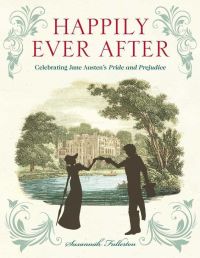
Happily Ever After: Celebrating Jane Austen’s Pride and Prejudice by Susannah Fullerton
. . . .Shelves: nonfiction–literary criticism
Stalking Jack the Ripper by Kerri Maniscalco
. . . .Shelves: historical–1830s-1899, historical fiction, mystery, suspense-thriller
An Elegant Façade (Hawthorne House #2) by Kristi Ann Hunter
. . . .Shelves: historical–1800-1820s, inspy historical romance
The Lady Travelers Society series by Victoria Alexander:
- #0.5: The Proper Way to Stop a Wedding in Seven Days or Less
#1: The Lady Travelers Guide to Scoundrels & Other Gentlemen
. . . .Shelves: historical-romance, historical–1830s-1899
 The House on Foster Hill by Jaime Jo Wright
. . . .Shelves: historical/gothic romance, early 20th century
Trail of Lightning (The Sixth World #1) by Rebecca Roanhorse
. . . .Shelves: fantasy, paranormal
Juliet Immortal by Stacey Jay
. . . .Shelves: fantasy-romance, paranormal-romance
The Seven Deaths of Evelyn Hardcastle by Stuart Turton
. . . .Shelves: historical mystery, early 20th century, time-travel
The Girl of Fire and Thorns by Rae Carson
. . . .Shelves: young adult, fantasy
What books have you found recently that sound interesting?
2018 Writing Challenge–Prompt: Meeting History | #amwriting #writingprompt
Writing Prompt—March 19, 2018
Your character meets an important historical figure.
Word Count Goal: 300 to 1,000 words
You can write it as a scene or notes or an outline or even an epic poem worthy of a minstrel in the king’s court. Just write!
Get Motivated: The Power of Love in Fiction Writing | #amwriting
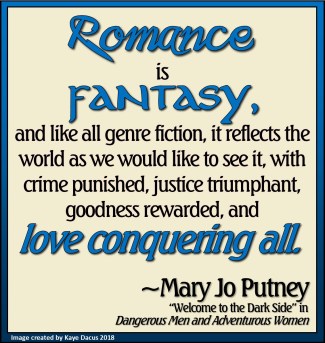
Romance is fantasy, and like all genre fiction, it reflects the world as we would like to see it, with crime punished, justice triumphant, goodness rewarded, and love conquering all. Characters are larger than life, with stronger passions, blacker faults, and brighter virtues. . . .
As with all fantasy, even the most outrageous premise can work if it is developed in a logical fashion, with convincing details.
~Mary Jo Putney
From the essay “Welcome to the Dark Side” in
Dangerous Men and Adventurous Women
p. 99, 100
2018 Writing Challenge–Prompt: Myth, legend, or fairy tale | #amwriting #writingprompt
Writing Prompt—March 18, 2018
Reimagine a myth, legend, or fairy tale using your current character(s).
Word Count Goal: 300 to 1,000 words
You can write it as a scene or notes or an outline or even an epic poem worthy of a minstrel in the king’s court. Just write!
2018 Writing Challenge–Prompt: Oh, no! It’s lost! | #amwriting #writingprompt
Writing Prompt—March 14, 2018
Write about your character losing an important object.
Word Count Goal: 300 to 1,000 words
2018 Writing Challenge–Prompt: Unexpected | #amwriting #writingprompt
Writing Prompt—March 13, 2018
They had been warned, but no one expected it in the middle of the lecture.
Word Count Goal: 300 to 1,000 words

 KayeDacus.com