LOST–The Unanswered Questions
I was going to go back to the list of questions I wrote just before Season 6 of LOST premiered and go through and see which were answered and which weren’t. But I think this video explains it all pretty well:
Fun Friday–2010 Summer Movie Edition

It’s that time of year, people, time for summer blockbusters! Y’all know me, that one of my favorite things to do in my spare time is watch movies, so I usually perk up and start paying attention to movie previews around this time of year. So here are a few movies I’m looking forward to this summer—broken down into Theater Views and Rentals.
Theater Views
Prince of Persia
I’m going to see this one tonight!
Set in medieval Persia, the story of an adventurous prince who teams up with a rival princess to stop an angry ruler from unleashing a sandstorm that could destroy the world. Which is why after the prince was tricked by a dying Vizier to unleash the Sands of Time that turns out to destroy a kingdom and transforms its populace into ferocious demons. In his effort to save his own kingdom and redeem his fatal mistake, it’s up to the prince and the princess to return the sands to the hourglass by using the Dagger of Time, which also gives him a limited control over the flow of time. (from IMDb.com)
Ondine
Showing a June 4 limited release date, no wide release date yet
Syracuse is a simple fisherman who catches a beautiful and mysterious woman in his trawler’s nets. The woman seems to be dead, but then she comes alive before Syracuse’s eyes and he thinks he may be seeing things. However, with the help of his ailing, yet irrepressible daughter, Annie, he comes to believe that the fantastical might be possible and that the woman (Ondine) might be a myth come true. Ondine and Syracuse fall passionately in love, but just as we think the fairytale might go on forever, the real world intercedes. Then, after a terrible car crash and the return of a dark and violent figure from Ondine’s past, hope eventually prevails and a new beginning is presented to Syracuse, Ondine and Annie. (from Yahoo Movies)
The A-Team
June 11 I’m SO going to this movie opening night.
A group of Iraq War veterans looks to clear their name with the U.S. military, who suspect the four men of committing a crime for which they were framed. (from IMDb.com—okay, so the movie description is rather sketchy, but really, do we need to know anything other than the fact that it’s a remake of the fabulously cheesy and campy 1980s TV show?)
Salt
July 23
[I’m not a huge Angelina Jolie fan, but this looks like a great action film.] When CIA officer Evelyn Salt (Jolie) is called a spy by a Russian defector, she goes on the run, putting all of her experience and skills to use to elude capture, learn the truth of her identity, and hopefully clear her name. (from IMDb.com)
Ramona and Beezus
July 23
[Okay, it’s been about thirty years since I read the books, and I imaging this is “loosely” based on them. But it looks like fun.] The adventures of young Ramona Quimby (Joey King) and her big sister Beezus (Selena Gomez) come to life in this all new film based on the best-selling books (over 30 millionand counting) by Beverly Cleary. Ramonas vivid imagination, boundless energy, and accident-prone antics keep everyone she meets on their toes. But her irrepressible sense of fun, adventure and mischief come in handy when she puts her mind to helping save her family’s home.
Get Low
Listed as July 30 [Limited], so who knows when we’ll get to see it
For years, townsfolk have been terrified of the backwoods recluse known as Felix Bush. People say he’s done all manner of unspeakable things — that he’s killed in cold blood; that he’s in league with the Devil; that he has strange powers — and they avoid him like the plague. Then, one day, Felix rides to town with a shotgun and a wad of cash, saying he wants to buy a funeral.
Beastly
July 30
Manhattanite Kyle Kingson is young, wealthy, beautiful, and cruel, but he picks the wrong classmate to prank when Kendra casts a spell that turns him into everything he despises. Banished to Brooklyn and informed that the only way to break the curse is to find someone who will love him as he is, a fateful encounter with Lindy looks to literally and figuratively change his life.
Rentals (click on title for the trailer)
Eclipse
With as much as I thought the second movie sucked, I’m kind of drawn into the series now—kind of like when you drive past a car accident and you can’t help but look to see just how gruesome it is. But I will not be paying to go see it at the theater.
Despicable Me
Actually, I’m up in the air about whether to wait for this one on DVD or going to see it in the theater. But it looks cute.
The Sorcerer’s Apprentice
If Nicholas Cage weren’t such a big part of this movie, I’d probably be more apt to go see it in the theater. And who knows—depending on what’s going on that weekend, I still might. But with the mixed buzz this movie’s getting, I don’t know that I’m going to want to spend the money on it.
Scott Pilgrim vs. the World
Looks cute.
Nanny McPhee Returns
I enjoyed the first movie (which I watched as a rental), and this one looks good too. (But really, Maggie Gyllenhaal? Was every thirtysomething BRITISH actress unavailable?)
Centurion
Ancient British history? Roman history? Combined? Sure, I’ll rent that.
What do you want to see that’s coming out soon?
RANSOME’S CROSSING: I Love a Man in Uniform
 Of course, we can’t have any action taking place aboard a ship without knowing something about the men crewing it. As with the modern military, there were commissioned and non-commissioned officers, as well as the general rank-and-file sailors—most of whom, until just before Ransome’s Honor opened, were “pressed” (or forced/conscripted) into service. Press gangs would literally go into towns and round up the men who were young/strong/healthy enough to serve. Remember that in 1814 (until Bonaparte was exiled to Elba in April), England was fighting two wars—the Napoleonic War and the War of 1812 with America. By this time, England had been in an almost constant state of war since the American Revolutionary War—mostly with France, but a pretty good chunk of that was with America as well. So volunteers for service were scarce.
(Be warned—this is going to be a LONG post)
Officers
For a commissioned officer, there was a very clear path of advancement:
Volunteer—(boys as young as 7 or 8 years old, up to about 11—for families without connections, though the ages could vary if these were servants and not aspiring officers). These were the “powder monkeys”—they had the extremely dangerous job of running the gun powder from the magazine to the gun crews during drill or battle. They might also serve as cabin boy for the captain, who was allowed 4 servants for every 100 men on his ship; if the captain was knighted, as Julia’s father was, his allotment was doubled. Servant posts were granted to lieutenants and masters—which meant they could use those positions to get their own sons/nephews/godsons/etc. aboard to enter the service. Volunteers in training to become midshipmen wore midshipmen’s uniforms; the rest wore the more random clothing allowed for the common sailors.
Midshipman—(boys ages 12–18*—a young man could begin as a midshipman with patronage**) The senior midshipman (the oldest with the most years of service) was the captain of the watch and stationed on the quarterdeck, the rest of the midshipman worked under his command (the number depended on the size of the ship and if they were split into two or three watches). Their duties included using the flags to signal other ships, recording soundings, marking the ship’s log board, running messages between the lieutenants and captain, and, occasionally, commanding the ship’s boats. At midday, using sextants or quadrants, they took observations to mark the ship’s position and determine noon. They had to record everything—as the captain reviewed their log books daily. During action (battle, drill, or making adjustments to the sails), midshipmen were needed aloft at each mast to relay orders from the deck to the sailors who lined the yardarms working with the sails. Each midshipman oversaw and commanded one or two gun crews (depending on the size of the ship). This involved ensuring that the men in his division had sufficient clean clothing, that those who were sick reported were on the sick list, that all gunnery equipment and powder cartridges were at hand and that the guns under his charge were ready for action. When not on duty, midshipmen spent most of their downtime studying: navigation, higher math (trigonometry), and seamanship—as well as filling out their log books.
- *Midshipmen could range up to thirty or forty years old, or older, if they couldn’t pass the examination for lieutenancy.
**Patronage meant the family had connections with a superior officer, usually a captain or higher, who could place the boy on a ship as a midshipman without his having to go as a volunteer at a younger age. In the Ransome series, William and his brothers entered the Royal Navy as midshipmen at the age of twelve because of their father’s long service in the navy and his good relationship with three captains he’d served under, including Julia’s father, then-Captain Edward Witherington. Patronage was important through all the steps of promotion and in getting a “good” ship.

In this image from Master & Commander, you can clearly see the midshipmen’s uniforms—tall round hat, indigo coat with white patches on the collar and brass buttons at the cuff, ivory waistcoat, white ruffled blouse with black neckcloth, belt with scabbard for a cutlass, and pants—obviously that’s where the rules ended. Behind them, you see the varying dress of the common sailors—and one marine in a red coat.
Lieutenant—At age 19 and with at least six years of service (though with patronage, some boys were allowed to take the examination earlier), a midshipman could stand for the lieutenancy examination—an oral exam in front of a board of three senior captains. After reviewing the candidate’s log books (journals) and certificates of service, they questioned him on seamanship, including duties when under sail as well as his knowledge of the technicalities of being on board ship—like splicing lines and reefing sails. He was tested on navigation, dead reckoning, calculating compass variations, understanding of tides, and sun/moon observations. His disciplinary record was also considered. If the candidate passed (or knew someone on the board who could get him through even if he didn’t actually pass), he was promoted to the rank of lieutenant; however, this depended on there being a vacant spot for a lieutenant available. Until he could get a post as a lieutenant on a ship, he would remain a midshipman, drawing a midshipman’s pay and continuing doing a midshipman’s duty and living in the midshipmen’s berth, until he got a position on his or another ship. That’s why patronage was so important.
Lieutenants were ranked on a ship in order of their commission date—the date they passed their examination. The first lieutenant was the one with the most seniority. There was no age limit for first lieutenants—sometimes, they were decades older than their captains if they never distinguished themselves in any way and didn’t have patronage and thus could not secure promotion and their own command. The larger the ship, the more lieutenants she needed (in the Ransome series, Alexandra, a 74-gun, 3rd rate ship, has six lieutenants; Audacious, a 64-gun, 3rd rate ship, has five). Lieutenants ensured the ship maintained its correct bearing; saw to the disposition of the sails; made sure the midshipmen, mates, and seamen under his command were attending to their duties and not slacking off; determined when the captain should be called on deck in case of any problems, unusual occurrences, ship sightings, or sudden changes in weather. The first lieutenant was directly responsible to the captain for overseeing the ship and its crew. He determined the watches and battle stations; he drew up the berthing chart. He was responsible for the cleanliness of the ship as well as maintaining discipline. He did not keep a watch, as the rest of the lieutenants did. And, most importantly, if the captain fell in battle, he instantly assumed command of the vessel.
The lieutenants berthed in the wardroom, as discussed in Tuesday’s post.

In this image from one of the Hornblower films, we see an image of the lieutenant’s uniform. Notice the white piping around the lapels, the cut-away (tailed), double-breasted design, and the bicorn hat—worn fore-and-aft, rather than athwartsship (side to side) as they were at the turn of the century. In this image, which is from a film set several years before the Ransome series takes place, Hornblower has an epaulette on his left shoulder as a commander; in 1812, the uniform regulations changed so that lieutenants wore an unornamented epaulette on their right shoulders as the mark of their rank. As with the midshipmen’s uniforms, the style and color of pants was determined by the officer.
Commander—The rank of commander was a temporary rank (the commander still held the commission of lieutenant and drew a lieutenant’s pay) but, as the title suggests, this was an officer who was now in command of a vessel—one of the smallest frigates or sloops in the Royal Navy—likely one small enough to necessitate only one or two lieutenants and a half dozen or so midshipmen. He had his own cabin and, aboard his ship, had all the privileges of rank, including being called “captain.” (By 1830, the rank of “commander” had replaced the rank of “first lieutenant”; thus a commander was the first officer serving on a ship under a captain.) In 1812, the uniform of a commander was the same as a captain, but with only one epaulette, now on the left shoulder.

On the right is an example of a commander’s uniform—with the epaulette on the left shoulder. Note the slight differences between the commander’s uniform (Hornblower) and the lieutenant’s (just imagine an epaulette on Bush’s right shoulder).
Post Captain—Most post captains held the position of commander before being promoted to the rank of post captain, though it wasn’t unheard of for first lieutenants to be promoted to this rank if he greatly distinguished himself in battle or had good patronage (or his captain died—in which case, he basically was serving as commander until his promotion was confirmed). Pay for a captain was directly proportional to the size of his ship—the bigger the ship, the more he got paid (creating quite a bit of competition for patronage and upward mobility in the fleet). He also got a much larger percentage of the prize money from any vessels they captured in battle. He was answerable only to his squadron commander—a commodore or admiral—he held total supremacy over everything that happened on his ship.
Captains had two uniforms—undress and dress. The “undress” uniform was the daily-wear uniform, which, technically, were only supposed to be worn on duty (they were supposed to wear civilian clothing when not on duty), but Ciaran Hinds looked so good in the uniform as my favorite Austen hero, Frederick Wentworth, I can forgive the filmmakers for overlooking that rule:

And then there was the dress uniform:
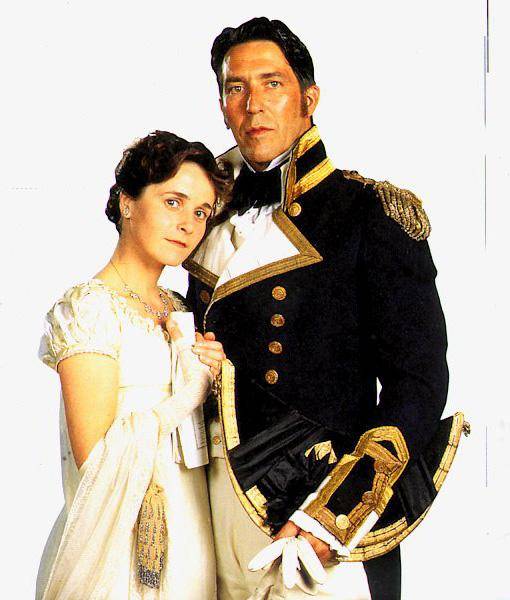
Here you see quite a difference between the “undress” and the “dress” uniform. Notice the gold braiding along the lapels, collar, cuffs, and even the rim of the hat.
Commodore—Like commander, commodore was a temporary rank. A commodore held the rank (and drew the pay) of post captain but had been put in charge of a small squadron or on-shore division/post. The commodore had his own pendant (pennant) that he flew from his mast, its color referencing the senior admiral to whom he reported. He was able to give commands to the captains of the ships in his group; they, in turn, had to carry them out, irrespective of their own seniority (this was the only time that a captain of fewer years’ experience could give a more experienced captain orders). The rank of commodore was important, especially during war time, when an admiral needed reconnaissance or needed an attack made that didn’t require his entire fleet. Or, as in William’s case, if the admiral needed a captain to escort a large convoy of supply ships somewhere.
In addition to more command responsibility and superior officer status over the captains attached to him, the commodore was allowed to wear an admiral’s uniform. Here’s an example of the commodore/admiral’s undress (frock) coat:

The main difference between an admiral’s undress uniform and the captain’s undress uniform is that the captain merely has the row of brass buttons around the cuff and the commodore/admiral has gold braid on the sleeve as well. As this is a picture of Lord Admiral Horatio Nelson’s frock, it carries the ornamentation (badges) of all of his titles and orders.
Admiral—There was a hierarchical structure for admirals—three divisions with three ranks in each. The entire naval fleet was divided into three squadrons, each assigned a color: blue, white, or red. Admirals were divided into three ranks: rear admiral, vice admiral, and admiral. The admiral had overall command of the squadron, vice admiral his second in command, and the rear admiral . . . well, he brought up the rear. In the Ransome series, Julia’s father, Admiral Sir Edward Witherington, holds the rank of Rear Admiral of the Blue, the lowest rank amongst the admirals. The seniority was as follows (from lowest to highest):
Rear Admiral of the Blue
Rear Admiral of the White
Rear Admiral of the Red
Vice Admiral of the Blue
Vice Admiral of the White
Vice Admiral of the Red
Admiral of the Blue
Admiral of the White
Admiral of the Red
Admiral of the Fleet
And, as rank was rank, the admiral’s dress uniform was a sight to behold:
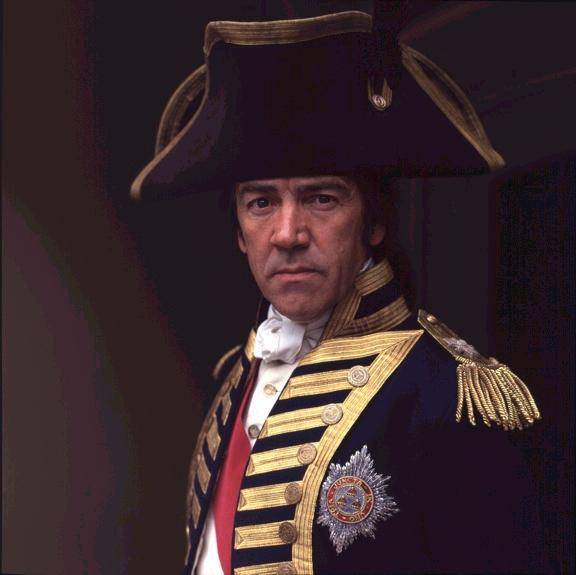
Talk about your gold braid! Here, Hornblower’s Admiral Pellew (a.k.a. Admiral Sir Edward Witherington) displays a full admiral’s regalia—complete with the insignia of his knighthood (the red sash and starburst-like emblem on his chest).
RANSOME’S CROSSING: Life Aboard Ship
 Since so much of Ransome’s Crossing takes place aboard the ships, I thought it might be fun share a little more of my research about early 19th century Royal Navy, the ships, and the men who populated them. (Yes, I spent a few hours yesterday scanning images from some of my reference books: Stephen Biesty’s Cross-Sections: Man-of-War, Patrick O’Brian’s Navy, Men O’ War, Men-of-War, and The World of Jack Aubrey.)
With Charlotte disguising herself as a midshipman and joining the crew of the smaller of the two Royal Navy ships, Audacious, there’s a question that naturally arises, whether spoken or not. How did she . . . um . . . you know?
Well, first, you need to click over and read the post “The Necessary” that I wrote last fall.
Did you read it? No? Okay, I’ll wait . . .
Great, now for some pictorial explanations of what that passage from Nelson’s Trafalgar really means.
First, here’s a general overview of the decks and the different parts of the ship mentioned in the book (click to see the full image in a new tab/window):
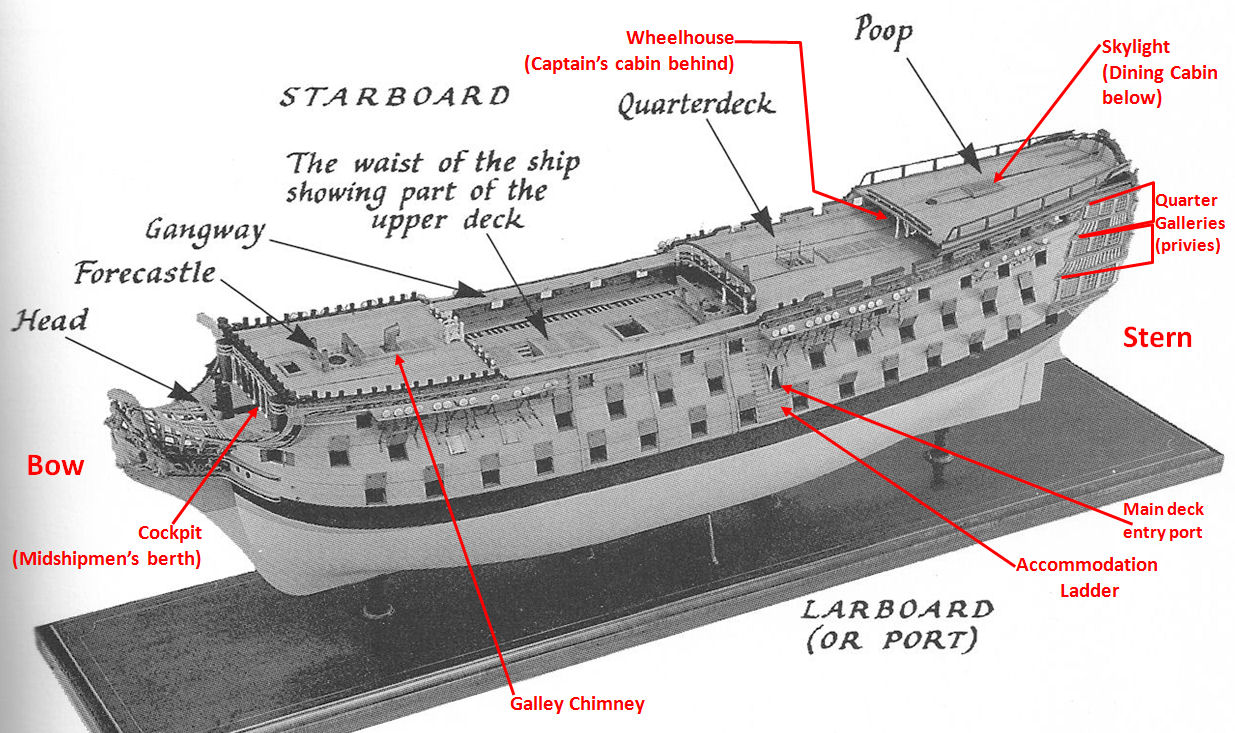
In this picture, you see a big, gaping hole in the middle of the ship (the “waist”)—this is where the ships boats were stowed until needed. At the BOW (front) of the ship, you’ll see I’ve added an arrow pointing to the Cockpit—or the Midshipmen’s berth, at either end of which you’ll see two semi-circular bump-outs known as the roundhouses. And at the STERN (back), I’ve bracketed the Quarter Galleries—ornamented sections with windows that bumped out at an angle at the side of the ship. (Here’s another image of the HMS Victory—which has a third deck the ships in RC don’t have—showing just how they hug the back end of the ship.)
The Quarter Gallery
Here’s what the quarter galleries look like in cross-section—looking toward the stern from the front of the ship:

The ships had quarter galleries on both sides. The captain probably only had one set up as a privy and used the one on the other side for storage (he could also look forward through the windows and see the sails without having to leave his cabin—very nice in foul weather!). The lowest quarter gallery was open to the sea, while the upper galleries had discharge piping. As mentioned yesterday, in the wardroom, there were two quarter galleries—one for the first lieutenant’s private use, accessible only through his cabin, and one shared by the remainder of the wardroom officers.
The Roundhouses
Though I’ve taken creative license and placed them farther apart in Ransome’s Crossing, typically the sick berth and the cockpit (midshipmen’s berth) shared the fore part of the main gun deck (just below the forecastle), giving the sick berth the benefit of light and circulation from the windows as well as access to a private privy. The midshipmen (all 18+ of them on Audacious) shared the other roundhouse—though most of the midshipmen, like most of the sailors, didn’t usually bother with the roundhouse, instead making use of the open-air “heads” in the beakhead (just behind the figurehead).

Looking from the top down:
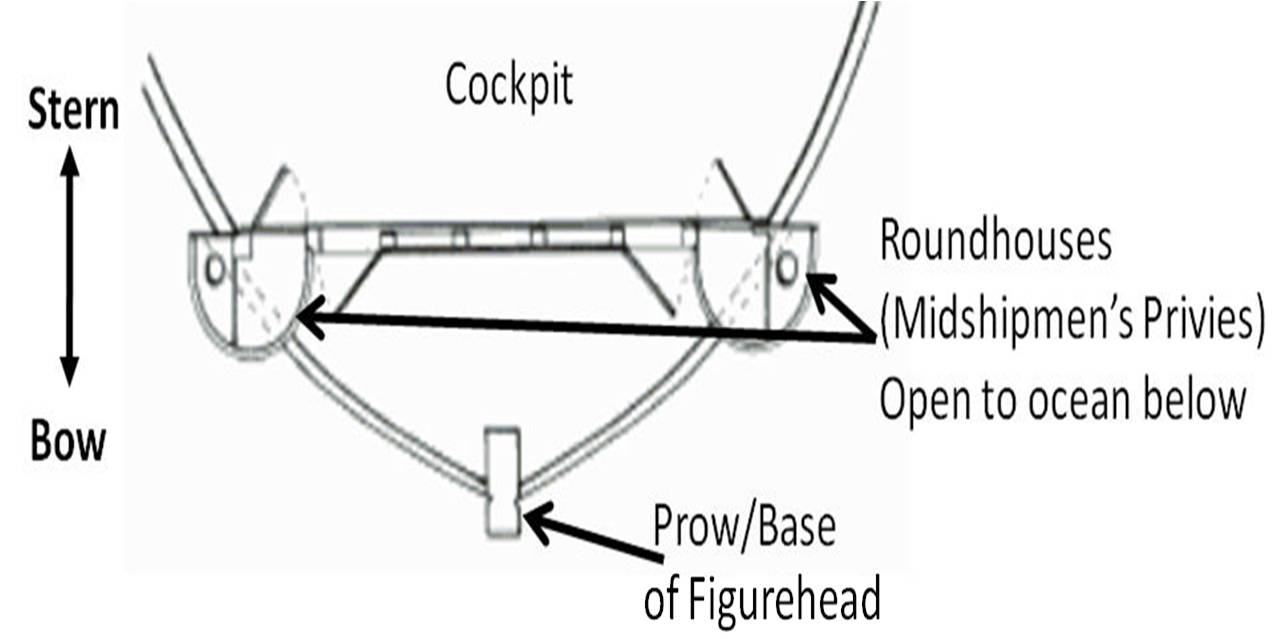
In this image, you can actually see that, contrary to the line drawing above, the beakhead extended quite far from the main body of the ship and was floored with open grating.
Let’s move on to something more pleasant, shall we?
Bells and Watches
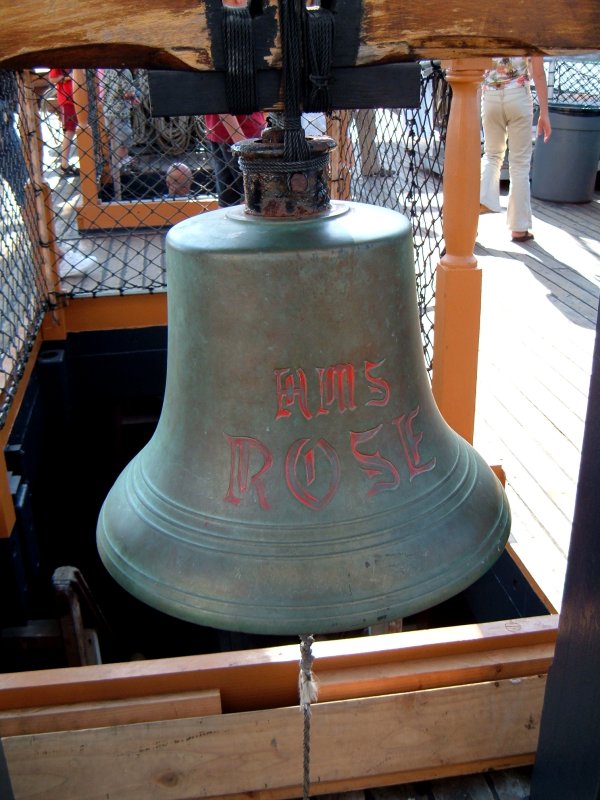 A few times in Ransome’s Honor and much more often in Ransome’s Crossing you’ll notice reference to the “bells” when naval officers talk about time. Aboard ship, time was marked by the ringing of a large brass bell. The bells were rung in single strikes and couplets—so eight bells would be ding-ding ding-ding ding-ding ding-ding with a slight pause between each couplet. Eight bells always marked the beginning of a watch, as watches were four hours long, and the day began with the “marking of noon”—when the midshipmen with their sextants marked the sun’s zenith (remember, no time zones yet). The top of the hour was marked by an even number of chimes, the half hour with an extra single chime. (Here’s a modern-day example of the officer of the watch marking noon aboard Queen Mary II.) The crew were split into watches—usually two, alternating every four hours, though larger ships (like those in Ransome’s Crossing) had a large enough crew they could split into three watches, meaning the crew got between six and eight hours off between each watch instead of two to four).
Afternoon Watch (1200 to 1600 hours)
12:00 pm. . . . .8 bells. . . . .Traditionally the day starts at noon with the entering of the day, date, and observation on the log board. Crew were piped to dinner. The crew receives the first half of the grog or beer ration afterwards on deck.
12:30 pm. . . . .1 bell
1:00 pm. . . . .2 bells. . . . .The Officers dined
1:30 pm. . . . .3 bells. . . . .The watch on duty was called to their stations. The other watch(es) were at ease, unless all hands were called to drill (fire, boarding, gunnery, etc.)
2:00 pm. . . . .4 bells
2:30 pm. . . . .5 bells
3:00 pm. . . . .6 bells
3:30 pm. . . . .7 bells
To create an odd number of watches during the day—and ensure the crew rotated fairly between the watches—the Dog Watch was only two hours long.
First Dog Watch & Second (Last) Dog Watch (1600 to 1800 hours) & (1800 to 2000 hours)
4:00 p.m.. . . . .8 bells. . . . .Evening meal and second grog or beer rations served (by watches of crew)
4:30 p.m.. . . . .1 bell
5:00 p.m.. . . . .2 bells
5:30 p.m.. . . . .3 bells
6:00 p.m.. . . . .4 bells
6:30 p.m.. . . . .1 bell
7:00 p.m.. . . . .2 bells
7:30 p.m.. . . . .3 bells
Just before sunset, the drummer beat to quarters, assembling the whole ship’s company at their battle stations for inspection. Men then were released, and recovered their hammocks from the netting.
First Watch (2000 hours to Midnight)
8:00 pm. . . . .8 bells. . . . .Eight Bells, Lights extinguished. Master at arms begins his series of nightly rounds.
8:30 pm. . . . .1 bell
9:00 pm. . . . .2 bells
9:30 pm. . . . .3 bells
10:00 pm. . . . 4 bells
10:30 pm. . . . 5 bells
11:00 pm. . . . 6 bells
11:30 pm. . . . 7 bells
Middle Watch (Midnight to 0400 hours—graveyard Watch)
12:00 mid. . . . 8 bells
12:30 a.m.. . . . 1 bell
1:00 a.m.. . . . .2 bells
1:30 a.m.. . . . .3 bells
2:00 a.m.. . . . .4 bells
2:30 a.m.. . . . .5 bells
3:00 a.m.. . . . .6 bells
3:30 a.m.. . . . .7 bells
Morning Watch (0400 to 0800 hours)
4:00 a.m.. . . . .8 bells. . . . .The Carpenter and Boatswain begin their repair work. Cook lights fires and begins breakfast.
4:30 a.m.. . . . .1 bell
5:00 a.m.. . . . .2 bells. . . . .The watch begins to wash the decks and polish the planks. Decks were dried while others polished the brightwork, and still others flemished lines.
5:30 a.m.. . . . .3 bells
6:00 a.m.. . . . .4 bells
6:30 a.m.. . . . .5 bells
7:00 a.m.. . . . .6 bells. . . . .The first Lieutenant to supervise remaining work for the day.
7:30 a.m.. . . . .7 bells. . . . .Boatswain’s mate pipes up all hammocks, and the crew stores their hammocks in the netting.
Forenoon Watch (0800 to 1200 hours)
8:00 a.m.. . . . .8 bells. . . . .Captain on deck at Eight Bells. Captain confers with First Lieutenant, and releases crew for Breakfast.
8:30 a.m.. . . . .1 bell. . . . .New watch comes on deck. Crew bags and chests brought on deck by this watch, so lower decks can be cleaned. The watch worked in messes (divided by the mess tables that each group uses at dinner) Each mess may work at assisting the cook, stow provisions in the hold, shift ballast, repair duties, or maintenance. The Captain reviews the Gunner’s, Purser’s, Boatswain’s, and Carpenter’s accounts, and examines the Midshipmen’s logs, and Confers with the Lieutenants.
9:00 a.m.. . . . .2 bells
9:30 a.m.. . . . .3 bells
10:00 a.m.. . . . 4 bells
10:30 a.m.. . . . 5 bells
11:00 a.m.. . . . 6 bells. . . . .Captain may call hands to witness punishment and order the boatswain to rig a grating for a flogging.
11:30 a.m.. . . . 7 bells. . . . .(new “day” begins at noon)
Thursday, we’ll look at the crew. Who were they? What did they wear? How did one get promoted/become an officer?
In the mean time, what questions do you have about the Royal Navy, her ships, or the men who served?
RANSOME’S CROSSING–The Settings
In my introductory posts for Ransome’s Honor, I went into a lot of detail on how I chose the specific settings that appear in the first volume of this trilogy. Since Ransome’s Crossing picks up right where Ransome’s Honor leaves off, in the opening few chapters, most of the settings are still the same:
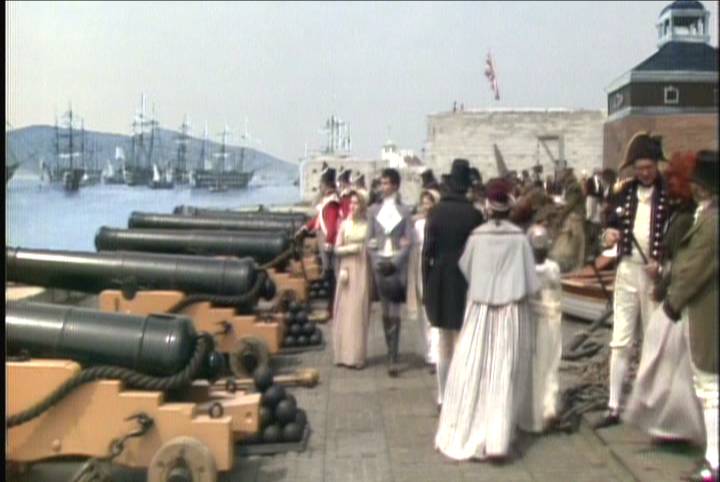
The Portsmouth dockyard:
The home of Collin and Susan Yates:

The Witheringtons’ home:

And though it’s mentioned in Ransome’s Honor, we get to “see” much more of Brampton Park, home of the dowager Lady Dalrymple in Ransome’s Crossing:

After a few chapters, though, our characters set sail for Jamaica, some of them aboard Alexandra the 74-gun man o’ war commanded by William, and some aboard Audacious, a slightly smaller 64-gun ship commanded by Captain Alban Parker. We get to explore much more of the ships, as we spend so much more time on them, in Ransome’s Crossing.
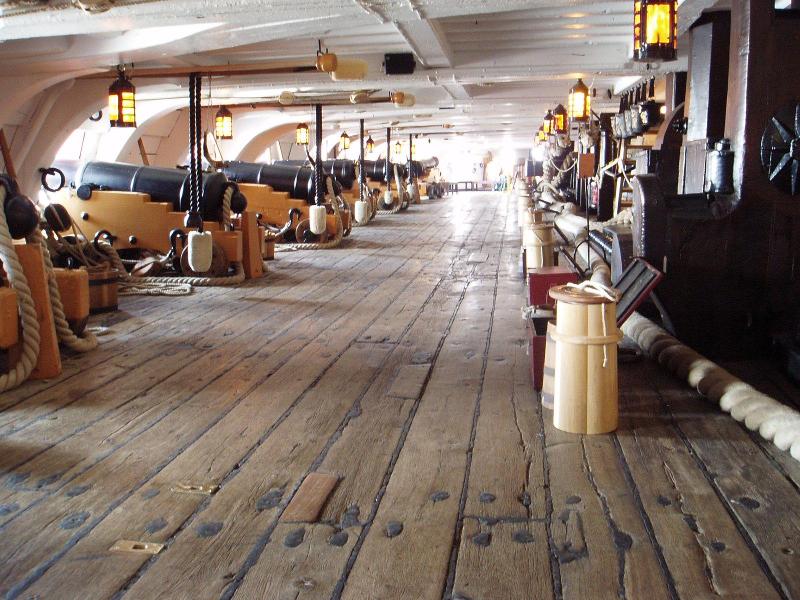
There’s the main gun deck:
William’s—now William and Julia’s quarters aboard Alexandra, which include a hanging box-bed fashioned after Lord Admiral Horatio Nelson’s aboard HMS Victory pictured here. William and Julia’s bed is wider, of course.

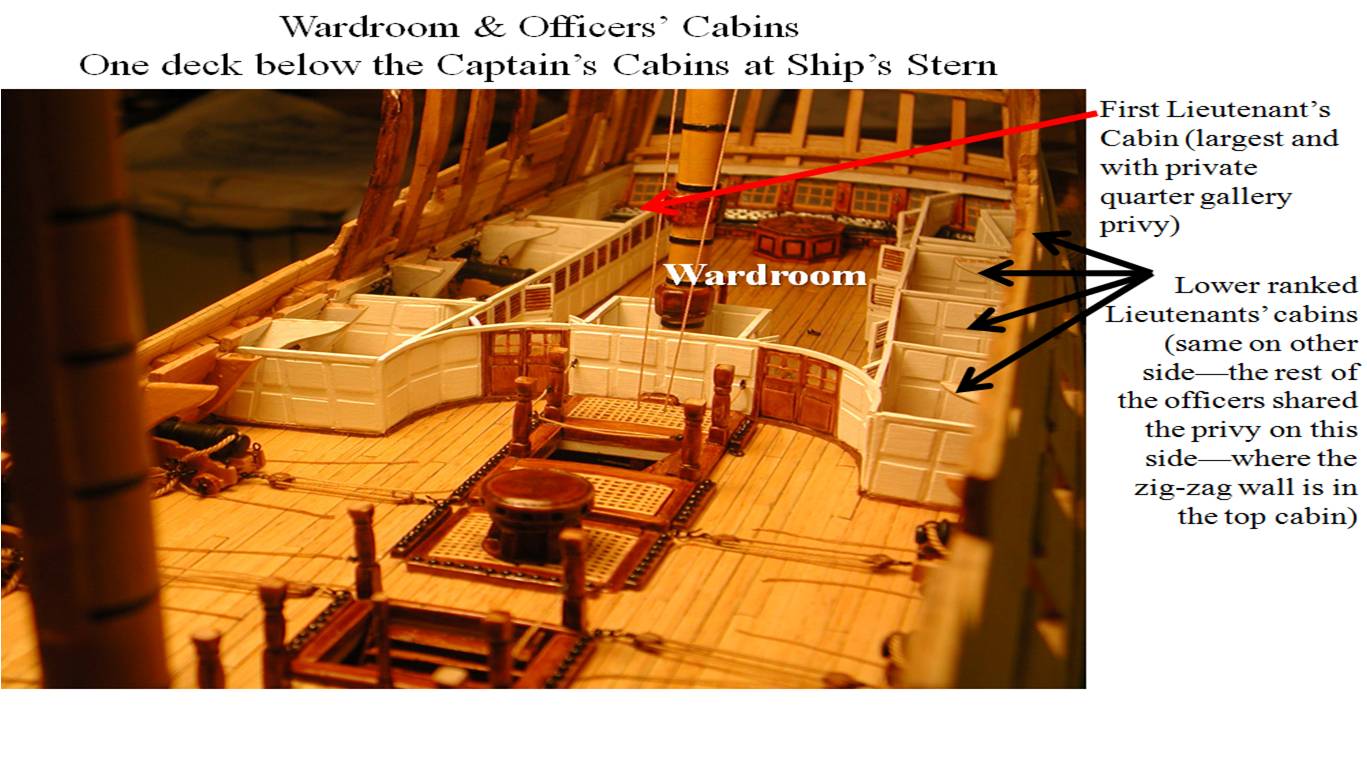
The wardroom—the common area the lieutenants’ quarters surround.
Here’s a floor plan of the wardroom and officers’ quarters:
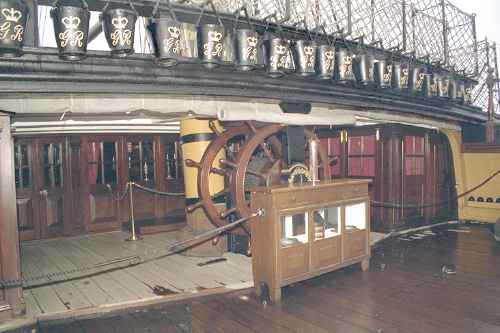
The wheelhouse, behind which is situated the captain’s quarters aboard Alexandra and Audacious, with the poop deck above.
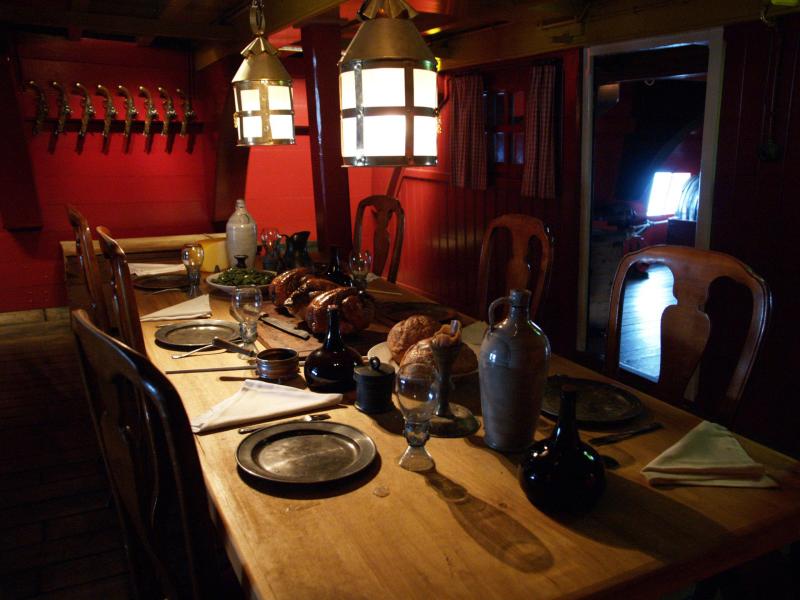
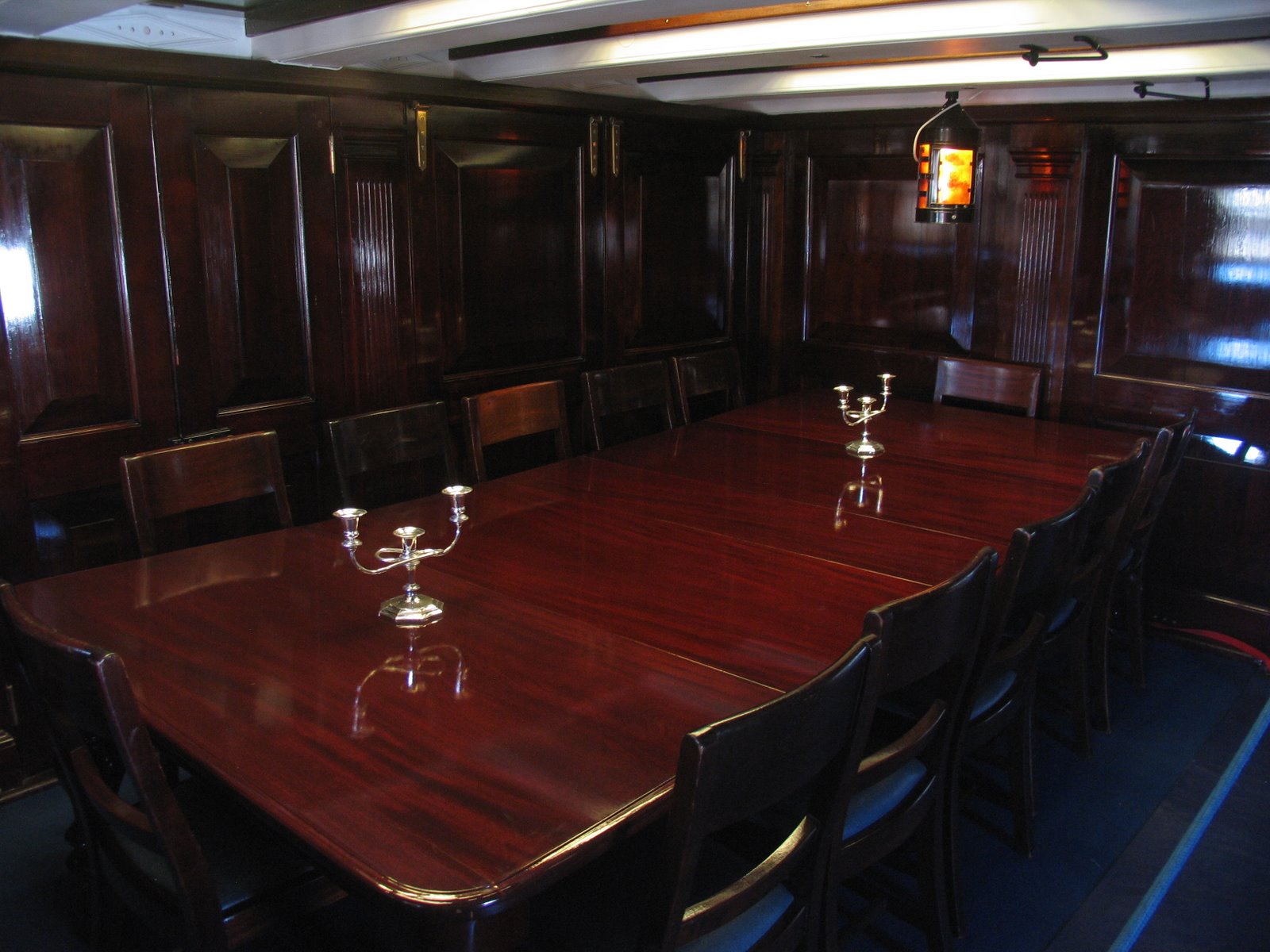
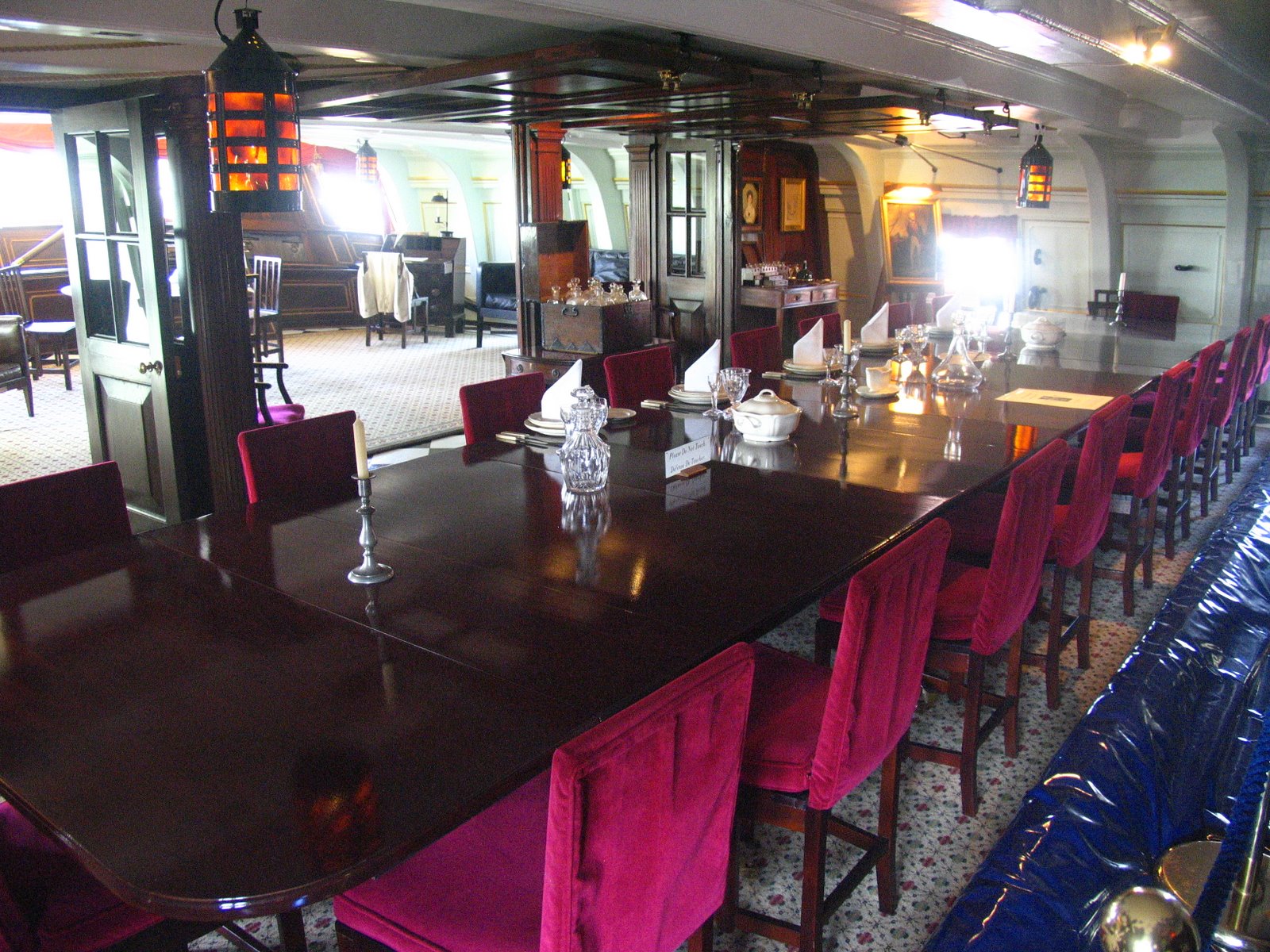
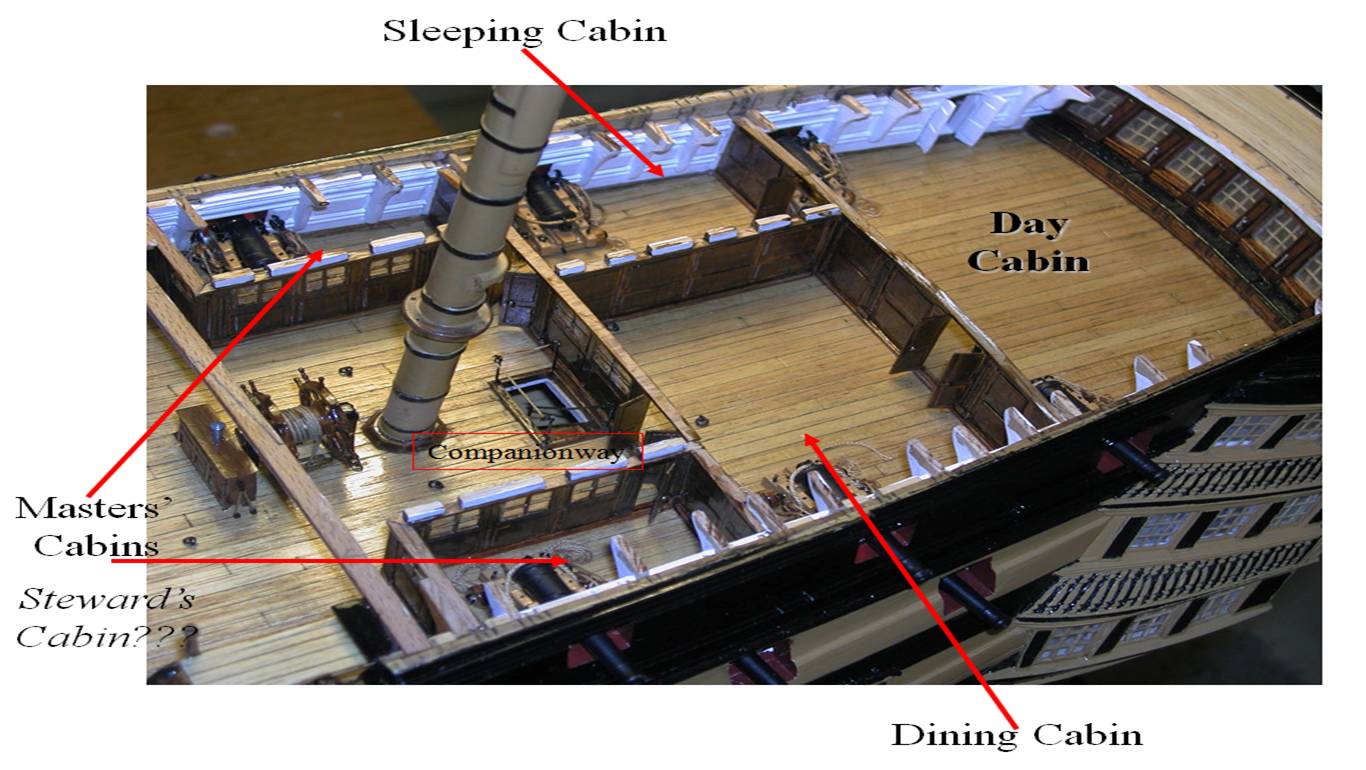
The dining cabin, situated between the wheelhouse and the captain’s main, or “day”/”big” cabin.
Though William’s is not so finely furnished and does not have the painted oilcloth on the floor, and Captain Parker’s, on Audacious is even smaller (but does have the black-and-white painted floor covering), here’s Nelson’s day cabin aboard HMS Victory:
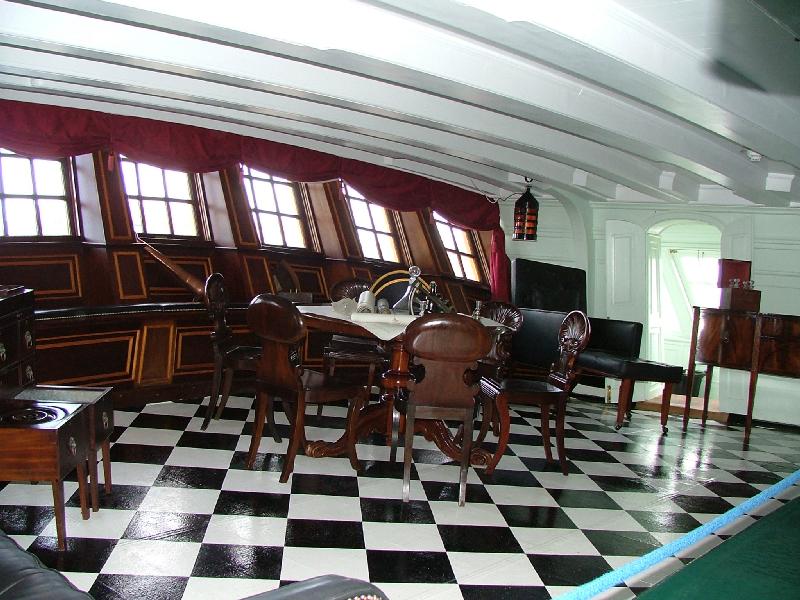
In case of battle, the bulkheads between the dining cabin and the big cabin were removable so they could get smaller guns (chasers) to the stern windows if needed.
Here’s a floor plan of how the captain’s cabins are actually laid out:
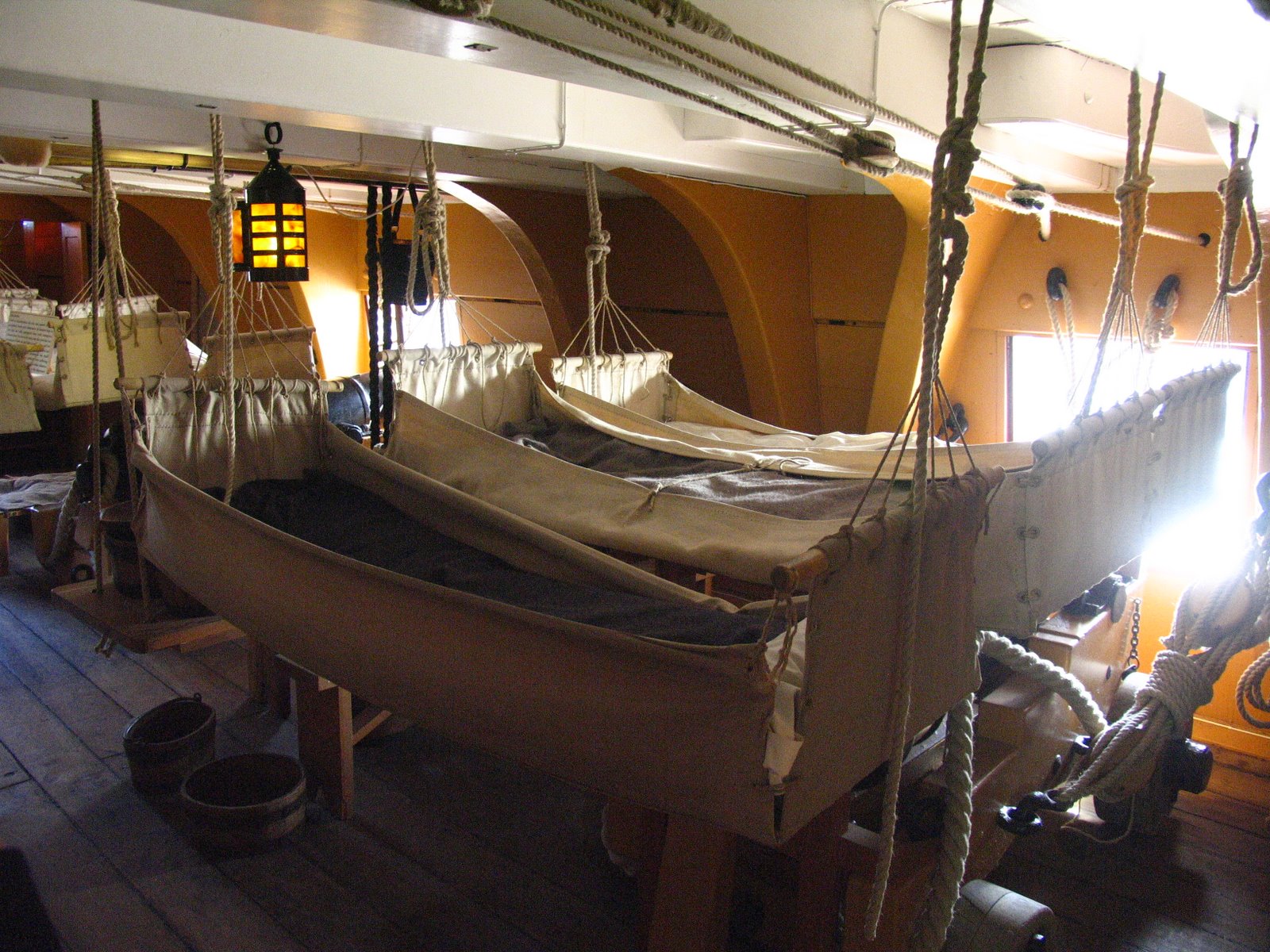
And if there’s going to be battle, there must be a sick berth:
Unfortunately, there are no images I can find of the midshipmen’s berth—known as the cockpit—which was in the bow of the ship, unlike the officers’ cabins, where were at the stern, taking full advantage of the light from the stern windows.
And then, we arrive at our destination . . . the Tierra Dulce sugar plantation.

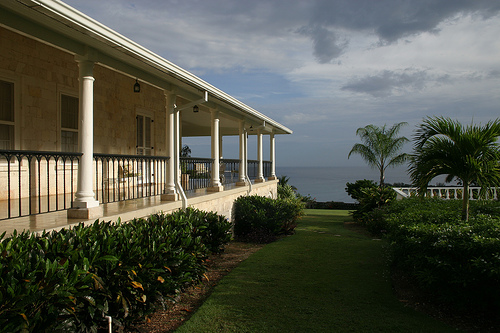
So now you can picture these settings the way I have, for the most part.
Fun Friday–A Robin Hood Favorites List
Since I went to see the new Ridley Scott/Russell Crowe version of Robin Hood last night, I had to make some kind of Fun Friday list out of it.
Now, understand, that I have something of a fondness for the legendary thief-with-a-heart-of-gold . . . I included an overview of the legend of Robin Hood in my thesis that I had to write/present in my History of the English Language class as an undergrad in discussing the impact of the Norman invasion of England on the English language. So I know a little about the actual history behind the legend. And let’s just say . . . it’s really more legend than it is history, no matter what Ridley Scott would want you to believe.
Now, you’re probably expecting a list of my favorite Robin Hoods (or is that Robins Hood?). However, those of you who’ve been hanging around here for a while know that I have an obsession with secondary characters. And that extends to the world of Robin Hood as well. My favorite character in the Robin Hood legend is Little John. And much of that comes from the actors who’ve been put in the role of Little John over the years. So here’s my list of my five favorite portrayals of Robin Hood’s right-hand man, Little John.
5. Dean Martin, Robin and the Seven Hoods
Okay, maybe this one is a stretch, but the character he played was named Little John. And, yes, it gives me an excuse to post a video of my favorite singer singing. And it’s a unique take on the meeting between Robin and Little John with the staff fight.
4. Alan Hale, The Adventures of Robin Hood (1938)
A.k.a. “The Errol Flynn version of Robin Hood.” If for no other reason than they gave us the legendary meeting between Little John and Robin Hood, Alan Hale’s portrayal of Little John stands out as the staff-fighting, self-confident man who convinced Robin to make him part of the Merry Men by beating him in a man-to-man fight.
3. Phil Harris (voice), Disney’s Robin Hood (1973)
Phil Harris did quite a few voiceovers for Disney, but most people recognize his voice from two roles: as Baloo the Bear in The Jungle Book and as Little John in Robin Hood (also a bear, and a bear that looked very similar to Baloo). To me, this version of Little John is the funniest. And, even though I know now there would be compatibility issues, I always wanted to see Little John and Lady Cluck end up together.
2. Gordon Kennedy, Robin Hood for BBC TV (2006–2009)
There were three saving graces of this most recent, short-lived TV series: Richard Armitage as Sir Guy, Keith Allen as the Sheriff, and Gordon Kennedy as Little John. Maybe I’m showing my age, but none of the young actors did much for me, so in this version of the legend, it was definitely Little John who was my favorite amongst our hero characters. Kennedy didn’t have much to work with, but what he was given by way of dialogue and screen time, he made the most of. Of course, the Scottish accent doesn’t hurt, either.
1. Kevin Durand, Robin Hood 2010
 I’ve liked Kevin Durand for a very long time—ever since seeing him as the bumbling, somewhat slow “Tree” Lane in another Russell Crowe movie, Mystery, Alaska. More recently, he took a turn as the sinister mercenary Martin Keamy in the fourth season of LOST. At 6′6″, he’s the perfect physical type for Little John . . . and for the character I’ve cast him as in Ransome’s Quest. (Which one? You’ll have to wait until next year!) I love the fact that they found an actress to play Little John’s, um, romantic interest in this film (“Little John’s Wench”) who’s also quite tall (Andrea Ware is 6′2″). And he did a decent job with his accent in the few lines he had in this movie. But really, he’s my number one Little John because he’s a hottie. (If you don’t go see this movie while it’s in the theater, be sure to rent it when it comes out!)
Let’s Talk Groceries
 Okay, I know today’s supposed to be another Writing Tips post, but from the lack of comments on those, I can see they aren’t everyone’s most favorite . . . so we’ll put a hold on that series until after the RANSOME’S CROSSING PRE-RELEASE CONTEST ends at the end of the month and try to get some fun posts up that you’ll feel more like commenting on.
After being in Hot Springs for the past ten days and then spending all day on the road yesterday (which did include a four-hour lunch in Memphis with my wonderful colleague and fellow contemporary romance author Annalisa Daughety, who has a giveaway of her most recent release, Love is Monumental, happening on her blog right now), I needed to replenish the food stocks in my house today—especially since I’m starting the Atkins Induction phase today to remind myself of the good/healthy foods I should be eating and to start chipping away at all of the weight I’ve regained over the past several months so that I can look good and feel confident when ICRS and the ACFW conference roll around here pretty soon.
So let’s talk about grocery shopping.
What’s the grocery store you shop at most often?
What are the top five items you buy most often?
How often do you go?
Paper, plastic, or reusable?
Are you a coupon clipper/user?
Do you have a standard circuit you make around the store or do you just wander?
Do you make a list? If so, do you stick to it militantly and not buy anything not on the list—or is the list more a “guideline” than a “rule”?
Here are my answers:
What’s the grocery store you shop at most often? Kroger—simply by dint of the fact that it’s closest to my home.
What are the top five items you buy most often? Milk (for coffee); flavored, sugar-free soda water; bagged salad; eggs; meat (whatever’s on sale)
How often do you go? I’m going to try to get back to going only once a week, to buy the few items I need to fill out my meal plan for the week.
Paper, plastic, or reusable? Reusable (I even take them to Sam’s!)
Are you a coupon clipper/user? I know I should, but I’m just not as organized as my sister.
Do you have a standard circuit you make around the store or do you just wander? When I make a list, I make it in order of the way the store’s organized, starting with the produce section and then working my way around to the dairy/frozen-food section on the other end of the store. But at Publix or Sam’s, I pretty much stick to the perimeter and read the signs over the rows to see what I might need down each one.
Do you make a list? If so, do you stick to it militantly and not buy anything not on the list—or is the list more a “guideline” than a “rule”? I’ve gotten bad about going without a list—and treating the grocery store as a convenience store. In the past few months, there have been times when I’ve gone to Kroger every day—sometimes more than once a day. When a craving struck, I was there. When I was doing well on Weight Watchers, I made a list each week when I made my meal plan. I stood in the kitchen at the fridge and planned meals around what I already had and made my grocery list from what I needed to fill in the rest of the plan. Not only did it mean less wasted food, I was spending a lot less money on food—because I wasn’t making impulse purchases or buying stuff that sat around until it rotted because I never got around to eating it. So I’m definitely going back to list making!
What about you? What are your grocery store habits?
Top Ten Writing Tips–Tip #4: Reading Ratio 5:1
Last week, we covered Writing Tips 1 through 3:
1. Finish your first draft.
2. Put your manuscript aside for as long as you possibly can after you finish the first draft.
3. Start something new.
Today and Thursday, we’ll cover the next two on the list.
Writing Tip #4. Read five published novels in your genre for every one craft book you read.
 So many writers, especially new writers, get caught up in “learning the craft” and they lose sight of “writing.” You can learn more from critical reading of published novels (breaking them apart, learning how/why they work or don’t work) than you’ll ever learn from reading a how-to book.
What was one of the reasons you started writing? For me, it was the combination of an overactive imagination combined with a love for reading. I didn’t just read novels, I devoured them. And the more I read, the more my imagination expanded. In fact, my first true foray into writing was after I read what would become my favorite book of my teens, Victoria by Willo Davis Roberts. I loved that story, those characters so much that I wasn’t ready to say good-bye to them when the book ended. So I started writing my own sequel to it.
If it hadn’t been for reading, I never would have become a writer!
But more than that, as I grew up and read more and more books, it was a rare book that didn’t spark half a dozen or more story ideas of my own as I was reading it—whether the idea had anything to do with what I was reading or not. I shared this story back in 2007 in a post titled “Interrupted by Inspiration”:
A goal I’ve set for myself recently is to read through the entire Lord of the Rings trilogy—whether by listening to them on audio (I have the entire unabridged set of CDs) or by actually reading the books. Well, I’ve had trouble convincing myself to put the CDs back in the car after I got to about disk six of the first book (and they’d barely made it to Bree!), so I picked up the actual book to read before bed last night.
Things were going along swimmingly…. Then, suddenly, I was no longer in Middle Earth, but standing on the deck of a ship, observing the silhouette of an officer looking out into the night.
Yes, that’s right, in the middle of reading Aragorn’s explanation of the Black Riders, I was suddenly visualizing a scene for the second book of my historical trilogy. Needless to say, I tossed the book aside and picked up the notepad and pencil I keep right beside the bed for just such an occasion.
I only got two pages written, not nearly all of what I was picturing, but it’s a great start on a scene (I think poor Julia may have broken a toe or two). And not only was it fun to be writing something for the second book (although I try not to write out of sequence), it gave me some insight into the tension between William and Julia at that point in the story (where exactly it fits, I’m not sure, but I think pretty early on), so that I’ll be able to incorporate the possibility for it as I work on revisions of the first book.
The scene that I started writing that night—and continued over the next couple of days to get the entire idea down before I forgot it—appears in Ransome’s Crossing almost verbatim from what I wrote three years ago. Would I have had that idea anyway? I’m not sure. All I know is that the creativity that’s inspired by the process of reading inspired that scene.
Another reason to read novels is to learn new words and see how other authors use language. It’s hard to develop a unique voice and style if all you’re reading is cut-and-dry nonfiction. That’s not saying that nonfiction authors aren’t creative. They just don’t use language the same way novelists do. My tenth-grade AP English teacher gave us vocabulary lists each week that were words taken from the American literature we studied that year. Most of those words (such as superfluous, tenacity, ubiquitous, ambivalent, tintinnabulation, etc.) have stayed with me as part of my everyday vocabulary. I learned to love it when I run across a word or term in a novel that I’m unfamiliar with but learn what it means through the context of the story—and it’s more likely to stick with me that way.
Though it’s important to read within the genre you’re writing, it’s a good idea to read across genres, too—otherwise, your own writing might become stale. Reading other genres expands your imagination as well as helps you develop your own personal writing voice and style instead of just falling into the patterns of the other authors in your genre. It sharpens your imagination (see the above example of being struck with an idea for Ransome’s Crossing while reading Fellowship of the Ring).
While it’s great to read books from throughout the ages, from classics to dime novels of the late 19th/early 20th century to mid-century pulp novels to 1990s experimental fiction, it’s very important to make sure you’re reading new releases in your genre and from the publishers you’re targeting—it’s called market research (thus, you can write those purchases off come tax time!) and it’s something every writer and published author needs to do. It keeps us abreast of current trends, current styles, and what non-writing readers are out there enjoying.
You should read for enjoyment, but you should read for education as well. I’ll encourage you to review the series on Critical Reading (click on Writing Series Index and scroll down to the Critical Reading topic).
For Discussion . . .
It’s goal time! What are the five novels you’re going to read and the one craft book?
RANSOME’S CROSSING: Character Introductions
 Oh, my goodness! I can’t believe I let time slip away from me—do you realize that Ransome’s Crossing releases
 less than two weeks from now sometime in June?
Last year, when I explained the character-casting process for Ransome’s Honor, you met many of the characters who continue on into Ransome’s Crossing: William Ransome, Julia Witherington, Charlotte Ransome, Collin & Susan Yates, Admiral Sir Edward Witherington, Dawling, Creighton, and Elton.
In Ransome’s Crossing we leave Portsmouth behind, meaning we leave several key characters from Ransome’s Honor behind: Sir Drake, Lady Pembroke, and Admiral Sir Edward Witherington. But in Ransome’s Crossing, we get a new point of view, that of William’s first officer.
Lieutenant Ned Cochrane
Charlotte’s fingertips tingled when they came in contact with Ned’s—even though they both wore gloves. A few steps into the allemande, Charlotte had trouble catching her breath. Every time they separated, she felt cold and abandoned. And she could look nowhere but at Ned. His hair was too dark to be blond and too light to be brown. He had a scar in the middle of his forehead that broke up the lines when he raised his brows, the way a rock broke the flow of a stream. And though he was not as tall and lithe as Percy Fairfax, he seemed lighter on his feet, more graceful, no doubt from years of developing a keen sense of balance aboard ships.
 When I first started writing Ransome’s Honor, I knew Ned would be an important secondary character, but I never realized just how important—until Charlotte burst onto the scene as a POV character and I wrote the scene in which Ned and Charlotte first meet—when Ned tackles Charlotte on the quay to keep her from being crushed by a piece of furniture falling from an ill-secured crane overhead. And in that moment, the entire plot for Ransome’s Crossing bloomed in my imagination. Sure, it altered the course I’d originally thought Charlotte’s story was going, but for the better, I believe. Because I’d fallen in love with Ewan McGregor as Obi Wan Kenobi in Star Wars Episode III and in Miss Potter, he seemed a natural for Ned Cochrane—a man who’s a walking dichotomy: a mature, assured officer who easily commands others, and a young man who’s still figuring out his place in the world. And the man who’s going to wreak havoc with Charlotte’s heart.
The Ships’ Crews
Because in the initial draft of Ransome’s Honor there were several more scenes that took place aboard Alexandra which I ended up cutting, I already had quite a few of the key crew members cast—drawing mostly from the Hornblower movies, and some from Master & Commander, and others from…well, you’ll figure out where! So in this first partial crew listing, if you’ve read (or are reading) Ransome’s Honor, you should recognize most of these names.
Crew of HMS Alexandra
Captain William Ransome (Paul McGann)
First Lieutenant Ned Cochrane (Ewan McGregor)
Second Lieutenant Patrick O’Rourke (James d’Arcy)
Third Lieutenant Angus Campbell (Jamie Bamber)
Fourth Lieutenant Horatio Eastwick (Ioan Gruffudd)
Fifth Lieutenant Eamon “Jack” Jackson (Orlando Bloom)
Sixth Lieutenant Robert Blakeley (Heath Ledger)
Steward Archibald Dawling (Sean Gilder)
Midshipman Josiah Gibson (Josh Groban)
Midshipman Walter Kennedy (Max Benitz)
Boatswain Allerdyce Matthews (Paul Copley)
Marine Sergeant Ryken (Samuel West)
Bringing up the rear of the supply ships William is leading to Jamaica is HMS Audacious, a smaller ship, at 64 guns, which means one less officer and a slightly smaller crew. In writing Ned Cochrane’s opening scene in the first chapter of Ransome’s Crossing, I learned that he and the first lieutenant of Audacious came up as midshipmen together, so are about the same age. And because the newly assigned captain of this ship needs to be someone who won’t resent coming under William’s command, I decided he needed to be a little younger than William’s thirty-four.
Crew of HMS Audacious

Captain Alban Parker

1st Lt. Montgomery Howe

2nd Lt. Griffith Crump

3rd Lt. Lewis Gardner

4th Lt. Millington Wallis

5th Lt. Richard Duncan

Midshipman Thomas Hamilton

Midshipman Cornelius Martin

Midshipman Harry Kent

Midshipman Charles Lott
Fun Friday–Costume-Drama Mashups
Okay, my friend Ruth has shared a couple of “mashup” or cross-cut or whatever you want to label them videos, both on my FB page and on her blog this week, so I thought I’d post a Costume-Drama Mashup Video post today.
Our first is set to one of my favorite songs, “L-O-V-E” by Nat “King” Cole and features Richard Armitage as John Thornton in North & South and Matthew Macfadyen as Mr. Darcy in Pride & Prejudice ’05.
Next, is a true “mashup” video—one where someone takes bits and pieces of different movies and edits them together to make a new story. Here’s what the video’s poster said about it on YouTube:
Now I love BBC North and South and John Thornton and Margaret Hale are my OTP ! But I wanted to experiment because I like pushing my limits a bit when it comes to AU videos 😉
————————
Storyline:Many years ago John (A successful cotton mill owner) and Victoria (daughter of a nobleman) were close friends before Victoria and her family left London to settle elsewhere.
During this time a riot broke out at the mill and Margaret , the daughter of a friend of John`s family , saves his life.He realizes that Margaret is in love with him and after some persuasion from his mother is convinced that the honourable thing to do would be to marry her.
Victoria soon returns to London. John and she both realize that they have feelings for each other but John is already married and Victoria is to be engaged to Albert – a wealthy young Duke…..
(There is no definite ending because I wanted to give it that movie trailer feel 😉
———————–
Music: The Tudors season 2 score by Trevor Morris
Clips: BBC North and South The Young Victoria
This next one isn’t really a mashup, but I had to include it because it’s a tribute to men in costume dramas set to a very unexpected song. (And it’s got a really quick clip from Timeline featuring the yummylicious Gerard Butler opposite Anna Friel, the template for Julia in the Ransome books.)
Finally! There’s a tribute video to Lieutenant William Bush, as brought to life by Paul McGann, who served as the inspiration for Captain/Commodore William Ransome in The Ransome Trilogy! (Please disregard raunchy lyrics of the song it’s set to.)
(You may have read me post before about how I love PM’s voice. To get a taste, click here and click the tiny play button under the book cover to listen to the sample of him reading this book.)
And can I post that video without posting these two?


