Writing Tip #8: It’s Okay If What You Write Stinks
One of the main reasons so many would-be writers never get further than being would-be writers—people with bits and pieces of started, but never finished, manuscripts hidden in drawers or secret files on the computer—is because they’ve let something that all of us who write know paralyze them and keep them from moving forward with their writing. Which brings us to today’s writing tip.
Writing Tip #8. Write for you first. Edit for others later.
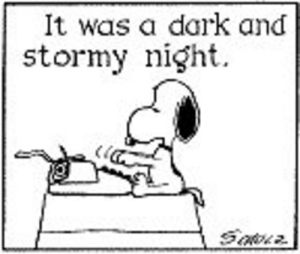 As Stephen King wrote in On Writing, “Write with the door closed, rewrite with the door open. Your stuff starts out being just for you, in other words, but then it goes out. Once you know what the story is and get it right—as right as you can, anyway—it belongs to anyone who wants to read it. Or criticize it.”
Saturday, on his Advanced Fiction Writing Blog, author and marketing guru Randy Ingermanson put it this way:
Nobody is ever going to see your first draft except a very few people who already love you, warts, backstory, and all. Those are your critique buddies. Frankly, they already know your first draft sucks, so it’s OK. . . . It’ll give them something to feel good about when they point it out to you.
Let me put it another way . . .
Do you think Yo-Yo Ma sounded like this or like this the first time he picked up the cello?
How many times do you think Evan Lysacek had to do this before he could do this?
In short: it’s okay if what you write stinks—because you can always fix it later.
When you’re in the creative process, you don’t need to be bogging yourself down with worrying about whether or not what you’re writing is “good.” You just need to write. You need to get the first draft finished. You need to turn off the analytical/self-doubting/self-criticizing side of the brain.
I love my computers. Y’all know that. I couldn’t live without them. But writing at the computer does something weird to me—by seeing the words coming out as printed prose—i.e., the way they might actually look in hard copy/printed in a book—I feel like I have to “get it right” before I type it into the computer . . . like what I’m writing has to be the correct words, without telling or loose POV or embellished dialogue tags or adverbs or whatever “rule” my brain is pecking at me with at that moment.
So when I’m really struggling with those negative thoughts and writer’s block that comes from the worries and fears that what I’m writing isn’t good enough, I pull out my trusty spiral notebook.

In Writing Down the Bones, Natalie Goldberg gives the reason why writing longhand can help with writer’s block and overcoming those nasty “it has to be perfect as soon as you commit it to text” voices:
In my notebooks, I don’t bother with the side margins or the one at the top: I fill the whole page. I am not writing anymore for a teacher or for school. I am writing for myself first and I don’t have to stay within my limits, not even margins. This gives me a psychological freedom and permission. And when my writing is on and I’m really cooking, I usually forget about punctuation, spelling, etc. I also notice that my handwriting changes. It becomes larger and looser. . . .
One of the main aims in writing is to learn to trust your own mind and body; to grow patient and nonaggressive.
If we’re constantly questioning the quality and craft-level of what we’re writing, are we really trusting our own mind? Our talent? The story we’ve been given?
Remember the parable of the talents—the master went away but gave his servants a certain sum of money (“talents”). Two of them went out and put what he’d entrusted them to good use and multiplied the talents; the third was afraid he might fail if he tried to do something with his talents, so he kept them hidden, to himself. And what did the master say to the two who put theirs to good use? “Well done, good and faithful servant. You have been faithful with a few things; I will put you in charge of many things. Come and share your master’s happiness!”
But what did he say to the one who gave in to fear of failure? “You wicked, lazy servant! . . . Take the talent from him and give it to the one who has the ten talents. For everyone who has will be given more, and he will have an abundance. Whoever does not have, even what he has will be taken from him. And throw that worthless servant outside, into the darkness, where there will be weeping and gnashing of teeth.”
If you let the fear of failure—the fear that your writing stinks—rule you and keep you from writing the stories you’ve been given, you’re no better than that “wicked, lazy servant.”
Sure, it’s easy to stand in awe of published authors—those who’ve gone out there and taken the risk of putting their writing in front of others and faced rejection and won. But, you’re thinking, they’re great writers, they’re great storytellers. I’ll never be like that.
Let me refer you back to the video examples I linked to above. No talent comes out of the gate fully formed (well, okay, yes, Yo-Yo Ma was a child prodigy who, at seven years old, played for President Kennedy) without the need for lots of practice, lots of studying, and lots of defeating self-doubt and fear that what we’re doing (writing, music, sports, art, cooking, etc.) isn’t good enough.
Over the past couple of months, I’ve had so many conversations or read e-mails from multi-published authors of whose talents I stand in awe who say they are sure that with every manuscript they turn in, it’s the worst one they’ve ever written and will be the one that ends their career. So, you see, those fears and doubts never go away.
So allow yourself to write stinky prose. Allow yourself to write info dumps. Allow yourself to use clichés and ignore punctuation and write scenes of dialogue with only he-said/she-said attributions. Allow yourself to draw _______________ blank lines in places where you need to research something or you can’t think of the right word. Write longhand and scribble things out and ignore the margins.
It can all be fixed later.
People usually write novels in several drafts, and writers agree that the first draft doesn’t have to be perfect. Many writers will tell you frankly that their first drafts are a crime against the humanities. But they write a first draft anyway, because you can’t write a second draft until you’ve done a first. So your first task as a writer is to give yourself permission to write a first draft that stinks. . . .
You always write your first draft in creative mode. When we talk about a first draft, we mean the first version you write on the page or type on the screen. Everything after that is edited copy. If you’re doing your job right, some of your first draft will be excellent, and some will be awful. Your goal is to make sure that all of your final draft is excellent, and the only way to get there is to start with a first draft, no matter how bad.
Give yourself permission to be bad on the first draft. After all, your editor isn’t going to see that first draft. Just get it written. Later on, when you go into editing mode, you can worry about making it pretty. After you finish editing, everyone will think that you were brilliant all along. Only you’ll know the truth, and you don’t have to tell anyone.
~From Writing Fiction for Dummies by Randy Ingermanson and Peter Economy
They’re Here!
My UPS guy usually comes between 2 and 3 p.m. (Yes, almost always the same guy, and I see him often enough to have a schedule.) So when I hadn’t had a knock on the door by that time this afternoon, I figured I wouldn’t be getting any big, heavy boxes from a guy in brown shorts until some time next week.
So, around 6ish I went in to start supper (soft tacos made with low-carb tortillas!), and just as I was getting ready to put the meat in the pan to cook, I heard a knock on the door. With the episode “Out of Gas” from the wonderful, short-lived TV series Firefly playing in the background, I opened my door to see . . .
A guy in brown shorts holding three big heavy boxes. (Not my regular guy.)
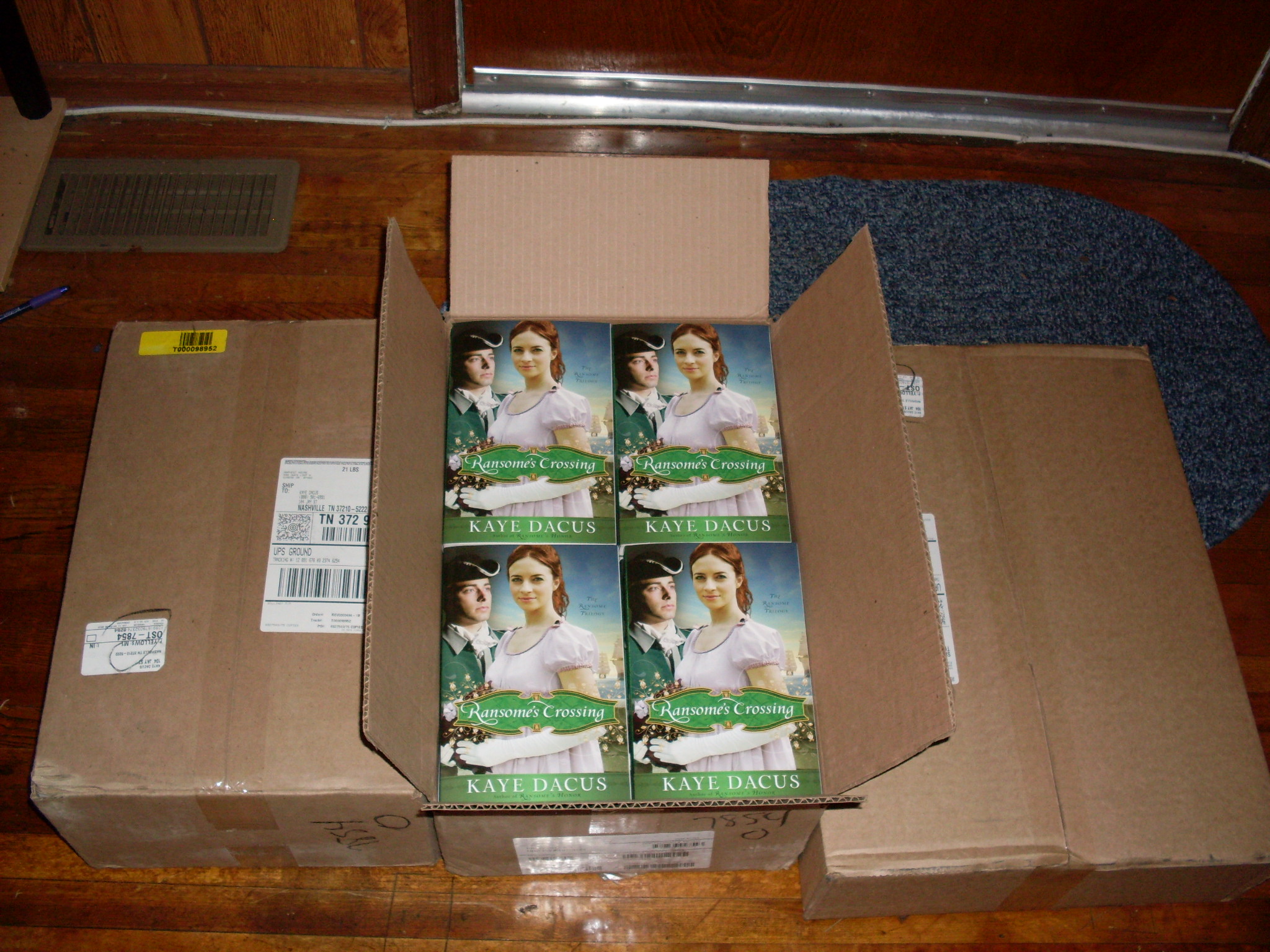
Yay! Hopefully this means that Amazon and ChristianBook.com and all of the other stores will be getting their stock in next week!
Fun Friday–You Give Love a Bad Name

I haven’t done a meme for a Fun Friday post in a long time. I did this one on Facebook a couple of years ago, so it seems like a good time to resurrect it. (You’ll understand the post’s title when you see the last question.)
1. Put your iTunes/Windows Media Player on shuffle with your entire music library selected.
2. For each question, press the next button to get your answer.
3. YOU MUST WRITE THAT SONG NAME DOWN NO MATTER HOW SILLY IT SOUNDS!
4. Make a fun/silly/witty comment on your answer.
5. Feel free to post your answers in the comments; or if you do this meme on your site, please come back and post a link.
1. What is your motto?
“Barbossa Is Hungry” (by Klaus Badelt from the Pirates of the Caribbean: The Curse of the Black Pearl soundtrack)
Maybe that’s why I can’t seem to lose weight.
2.What do your friends think of you?
“I Found a Friend” (recorded by Gordon McCrae and Jo Stafford)
Obviously.
3.What do you think about very often?
“A Person Can Change” (from the Miss Pettigrew Lives for a Day soundtrack)
Don’t know that I really think about that all that often, but I do believe it.
4. What is 2+2?
“More” (recorded by Bobby Darin)
Seriously—this is the song that came up on this click! Could it be any more perfect?.
5.What do you think of your best friend?
“You Make Me Feel So Young” (recorded by Frank Sinatra)
Isn’t that what a best friend should do for you?
6.What do you think of the person you like?
“Unaccompanied Cello Suite No. 1 in G Major” (J.S. Bach, recorded by Yo-Yo Ma)
Appropriate, since there isn’t a romantic interest in my life currently (or even in the recent past)
7. What is your life story?
“Benundrum” (by Michael Giacchino from the LOST: Season 4 soundtrack)
Hmmm . . . a song title that’s a play on the word conundrum. Pretty fitting, actually.
8.What do you want to be when you grow up?
“To Die for Love” (by Patrick Doyle from the Sense & Sensibility soundtrack)
I hope not!
9.What do you think when you see the person you like?
“Stardust” (recorded by Nat King Cole from the Sleepless in Seattle soundtrack)
“Love is now the stardust of yesterday . . . the music of the years gone by . . .”
10.What do your parents think of you?
“Maternity Hell” (by Michael Giacchino from the LOST: Season 4 soundtrack)
My player is usually better about skipping around to all the albums than this, but LOL!
11.What will you dance to at your wedding?
“This Guy’s In Love With You” (recorded by Steve Tyrell)
What a great song—slow and romantic! I tingle just imagining new hubby crooning this in my ear throughout the first dance.
12. What will they play at your funeral?
“Let’s Misbehave” (recorded by Elvis Costello from the De-Lovely soundtrack)
ROTFLOL! Maybe I should be living it up a little more.
13. What is your hobby/interest?
“Hella Bar Talk” (by Michael Giacchino from the Star Trek soundtrack)
Hmmm . . . I don’t go to bars, but I do like to talk! (And I could comment on how much the opening few notes of this piece sound like it could have been from one of the LOST soundtracks, but I won’t.)
14. What is your biggest secret?
“Life Is a Song” (recorded by Tony Bennett)
Don’t know if that’s a secret or not, but I always have some kind of music running through my head.
15. What do you think of your friends?
“That’s How It Goes” (recorded by Michael Bublé)
Yep, that’s pretty much how I roll,
16. What’s the worst thing that could happen?
“Why Don’t You Believe Me?” (recorded by Dean Martin)
It’s never a good feeling when someone doesn’t believe (or believe in) you.
17.How will you die?
“When I Reach the Place I’m Going” (recorded by Wynonna Judd)
LOL—I guess when my job here is done, so will be my time here.
18. What makes you laugh?
“Memories of Home” (from the HBO miniseries The Pacific soundtrack)
Good times, good times.
19.What makes you cry?
“You’re Nobody ‘Til Somebody Loves You” (recorded by Dean Martin)
That would make me cry, if nobody loved me.
20. Will you ever get married?
“If You’ll Have Me” (from the Miss Pettigrew Lives for a Day soundtrack)
Again, a repeated album, but still . . . couldn’t get a better answer than that!
21. What scares you the most?
“Finding Private Ryan” (by John Williams from the Saving Private Ryan soundtrack)
Maybe I’m afraid Private Ryan has it out for me!
22. Does anyone like you?
“There’s Yes! Yes! in Your Eyes” (recorded by Dean Martin)
Hmmm . . . does this mean I have an admirer???
23. If you could go back in time, what would you change?
“The Black Gate Opens” (by Howard Shore from The Lord of the Rings: The Return of the King soundtrack)
I’d stop the Black Gate from opening!
24. What hurts right now?
“Locke’s Excellent Adventure” (by Michael Giacchino from the Lost: Season 5 soundtrack)
Yep, I’m still hurting over the way they chose to end the series.
25. What is the one thing you regret?
“When You Say Nothing at All” (recorded by Keith Whitley)
There are many times in my life when I could have/should have spoken up but didn’t.
26. What will you post this as?
“You Give Love a Bad Name” (recorded by Bon Jovi)
I hope not! After all, giving love a “good name” is what I’m building my career on!
Your turn!
Writing Tip #7: I Should Probably Write That Down
As you all know, I work as a freelance editor to support my career as a full-time writer. One of my most recent jobs was a copy- and content edit of the first novel in a trilogy. The editor asked me, in addition to the in-document edits and comments, to create a “series guide” for the trilogy—because whether I edit the other two books in the series or not, whoever does it is going to need to know what was established in the first book about the characters (their physical attributes, ages, likes/dislikes, backstories, quirks, etc.), the setting (geography, town names, store names, area layout, who lives where, and so on), the timeline of the story (if someone says in book 1, in May, she’s six weeks pregnant, she can’t have the baby in book 3, which takes place from August to October), and so on.
Which brings me to today’s writing tip.
Writing Tip #7. Make lists.
Something every successful con artist or pathological liar knows—you have to keep track of the details; you have to know whom you told what and when. Since those of us who call ourselves writers know that what we’re doing is basically telling lies for fun and fortune (okay, maybe not so much fortune as farthings), we need to remember what we’ve made up.
But there are a lot of other things we want to remember also. For example:
Potential Character Names (some of mine are: Elaine, Stephen, Montgomery, Elisa, Joycelyn, Brandon, Kyle, Dacia, Liane, Neal, Ryan, Shaun (F), Alexander, Deborah, Grace)
Interesting Words (synonyms for loud: forte, fortissimo, sonorous, deafening, ear-rending, thunderous, crashing, booming, full-throated, trumpet-voiced, clangorous, clamorous, blaring; synonyms for do act, serve, practice, take action, proceed, go ahead, run with it, make it so, get on with it, have a go, effect, bring about, deliver)
Possible Titles (The Wooing of Mrs. Paroo, House Mother, The Thirty-Five Guarantee, There Is Nothing Lost, Your Right to Remain Wrong, The Very Thought of You)
Interesting Things Overheard (At a restaurant: “As soon as we get back to the office, we need to put a kill order in on McCall.” Guy on the phone at Panera: “How do you feel about widows?” Heard on ESPN: “Cooler than the flip side of the pillow.”)
There are also business/industry things we need to keep track of:
Networking Contacts (Agents/editors met at conferences; authors met at conferences; authors, publicists, book sellers met at book signings; librarians, book buyers, writing teachers)
Blogs (those to read daily, weekly, or occasionally—Google Reader is great for this)
Reading Lists (books to read for fun; books in my genre for critical reading/study; research books; craft books; nonfiction; devotionals)
Research Resources (contacts for interviews, websites, books, museums)
And so on.
These can be kept hand-written in notebooks or you can use my old method of various sizes and colors of Post-it Notes stuck to the sides of the computer and the wall. Or you can type them in and keep them electronically.
But even more important than these are continuity lists and style sheets.
Continuity Tracking
As I mentioned at the beginning of this post, one of the main components I have to edit for, especially with the series (a series with continuing characters and storylines written by several different authors) I edit each month is continuity. To try to keep these multiple authors up to date with what all the other authors have done in the volumes they’ve written is to have created a Series Guide—a way of trying to ensure continuity from book to book to book.
But it isn’t just from book to book that we need to ensure continuity. It’s within the same book. Because we’re writing them over an extended period of time, we may not remember certain details—a character’s eye color or a minor character’s first name.
Obviously, when creating a series guide or continuity lists, that others (co-authors, editors) will be using, it’s usually done as text, with possibly a few images appended. But when you’re doing this for yourself, you can be as creative and visual as you’d like.
Microsoft has a new program that came with Office 2007 called One Note, which acts like a virtual three-ring binder. Here are some screen captures of how I used it to track continuity in Love Remains:
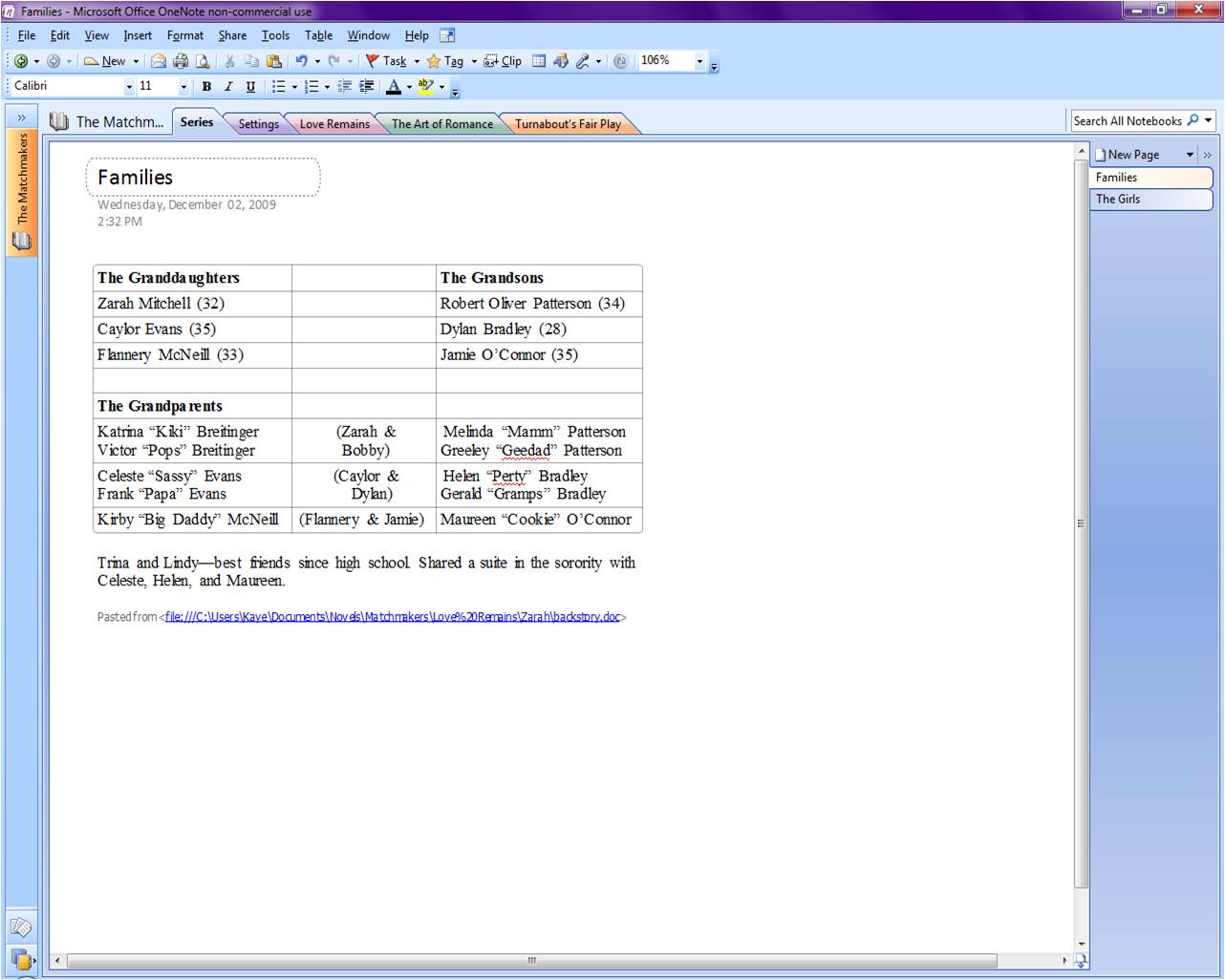

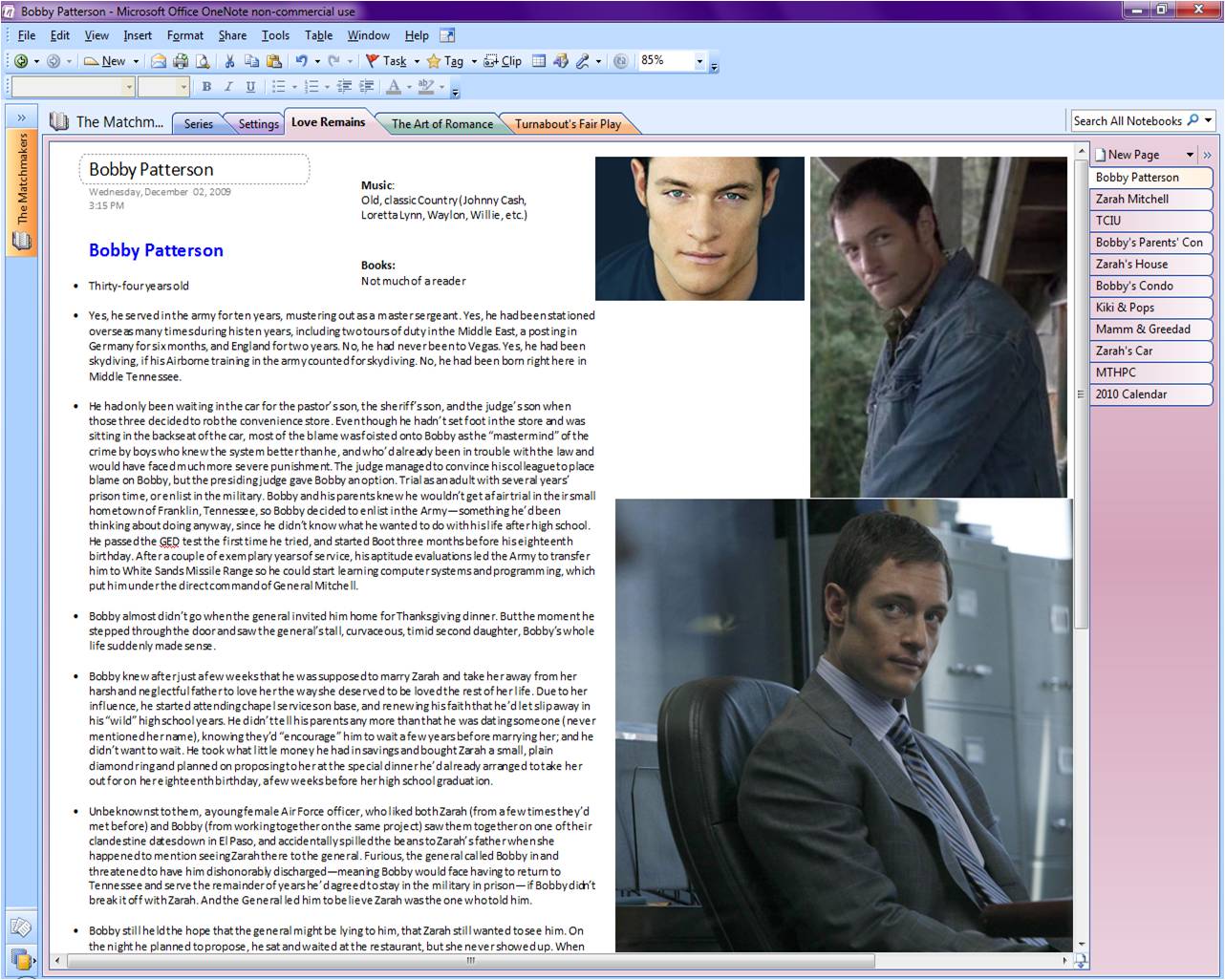
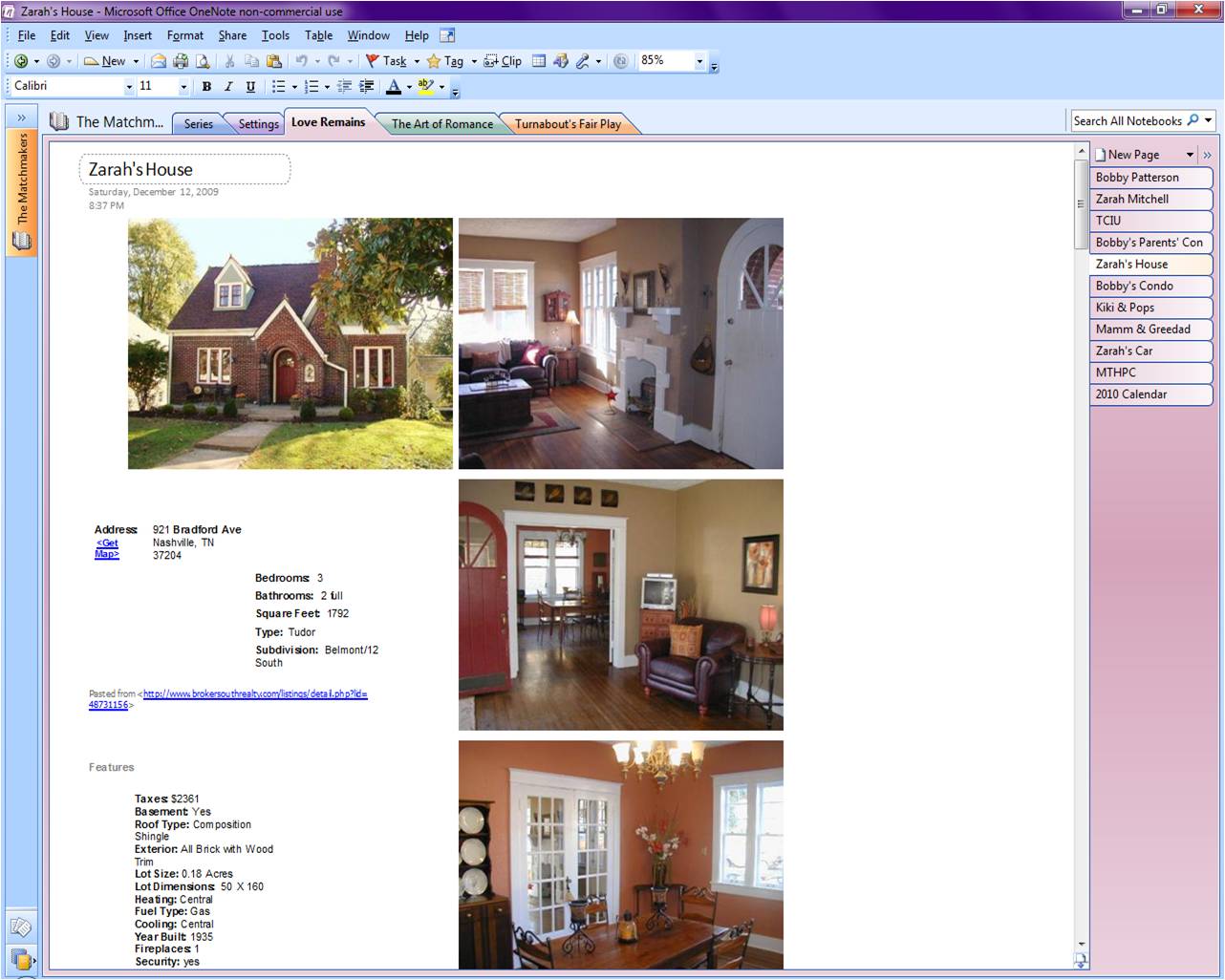
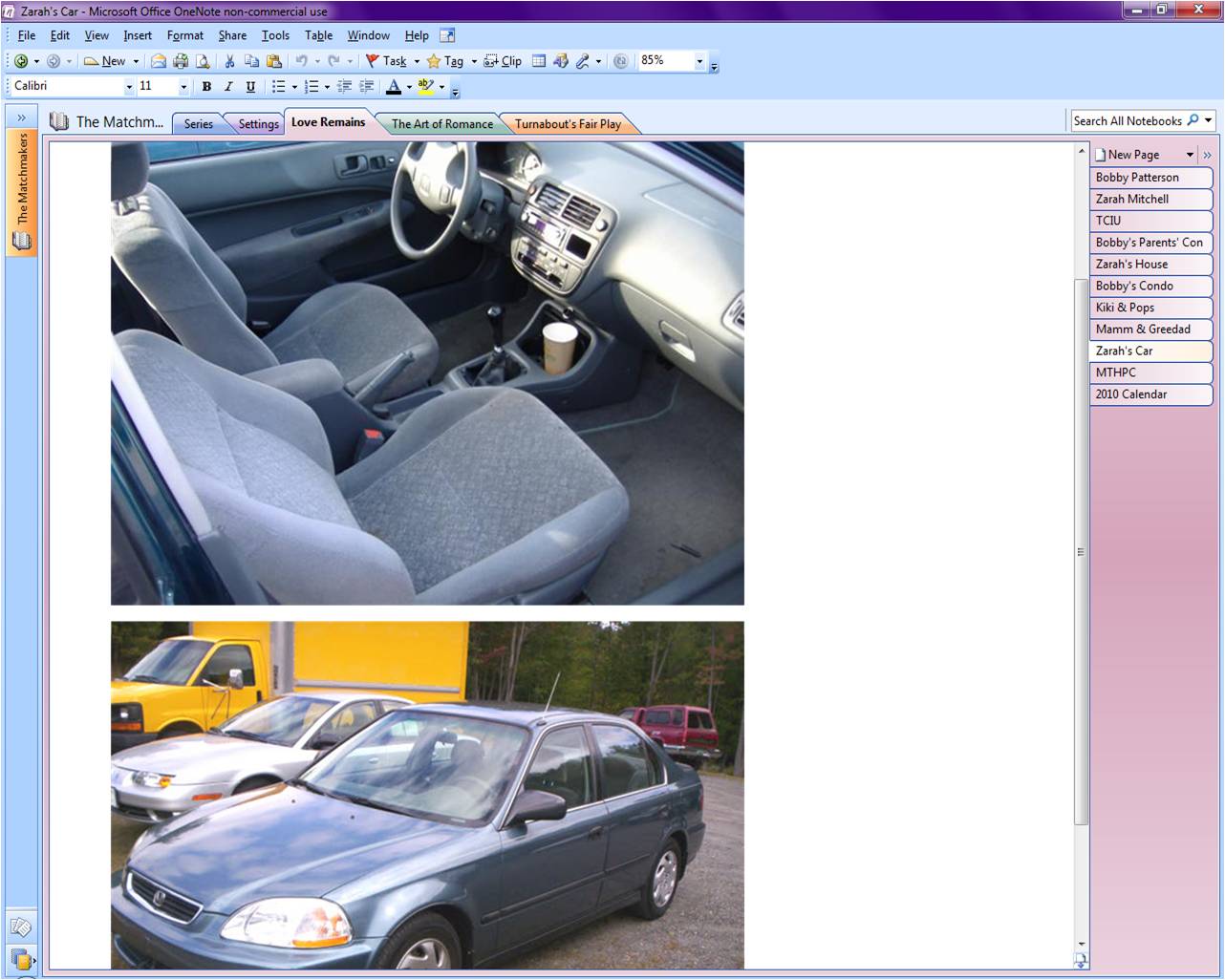
And, as I was writing Love Remains, I tracked details I would need for characters in The Art of Romance and Turnabout Is Fair Play:
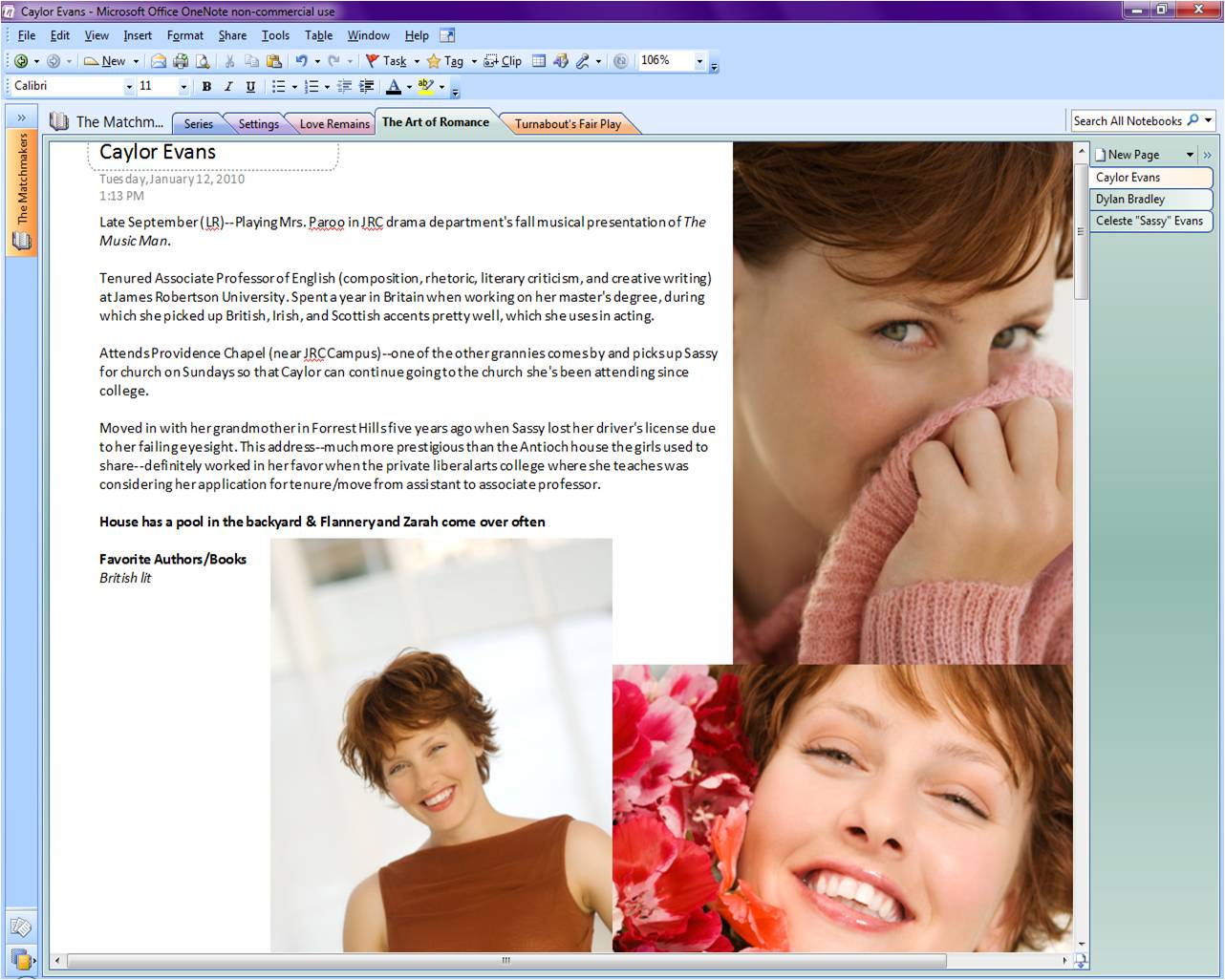

That way, I’m not having to recreate the wheel (or the descriptions/lives of my characters). I try to write these types of details down as I’m writing, but most of the time, it’s easier to do in the revision process.
Of course, sometimes the old-fashioned way works just fine:

Style Sheets
More often than not, style sheets are kept by editors. For example, here’s the house style sheet (the decisions made amongst the editorial staff that applied to everything we worked on) that I developed when I was working at Ideals Publications.
If you’re writing something that includes unusual names (such as Cajun, foreign, or otherworldly/supernatural), it would be a good idea to make a style sheet so that once your manuscript is acquired and sent to copy editing, you can make things easier for the copy editor by sending along a document showing how things are spelled, punctuated, capitalized, etc. For example, I should have done this on Ransome’s Honor, because port admiralty shouldn’t have been capitalized but the Admiralty (referring to the group that oversaw the entire Royal Navy in London) should have been capitalized. And I didn’t realize how much I needed it to help out my editor when I was writing Ransome’s Crossing because I wrote things differently in RC than I did in RH (in RH I had poop deck and Aye, aye, sir; but when writing RC I wrote them as poop-deck and aye-aye, sir, so she had to go in and correct all the little details like that).
I know certain multi-published authors have personal style sheets that their publishing house gives to all of their copy editors who work on that author’s books (with instructions such as “don’t use semicolons”).
So that, little ones, is why we need to write things down.
Writing Tip #6: You’re Not Supposed to Think
Before you read the rest of this post, take this quick quiz:
Are You Right or Left Brained?
As expected, this was my result:
You Are 50% Left Brained, 50% Right Brained
The long and short of it is: the left side of the brain is analytical, the right side of the brain is creative. Which side do you think you’re supposed to be using when you’re writing?
One of the reasons I’ve written some of my favorite scenes in those final weeks before a deadline is because when I have thirty thousand words to write in just a couple of weeks, panic and adrenaline allow the the right side of my brain to take over. And that leads into the next writing tip.
Writing Tip #6. Don’t think, just write.
 Try to shut off the left side of your brain when writing. When you’re writing you want to tap into your creativity—the right side of the brain.
I mentioned this in the comments yesterday: The more we learn about craft, the harder it gets to write. That’s because learning about craft strengthens the left side of the brain. And that’s a good thing. Really, it is—except for when you’re trying to follow Writing Tip #1 and get your first draft finished.
Anne Lamott wrote: “The first draft is the child’s draft, where you let it all pour out and then let it romp all over the place, knowing that no one is going to see it . . . If one of the characters wants to say, ‘Well, so what, Mr. Poopy Pants?’ you let her.”
The left side of the brain is the self-analyst, the self-critic, the self-doubter, the little voice that says you’re not good enough, not talented enough, and that you’ll never be able to write the story the way you see it in your head.
“In the creative act we can experience the same freedom we know in dreams. This happens as I write a story. I am bound by neither time nor space. I know those distant galaxies to which Meg Murray went with Charles Wallace and Calvin. But this freedom comes only when, as in a dream, I do not feel that I have to dictate and control what happens. I dream, sometimes, that I am in a beautiful white city I have never seen in real life, but I believe in it. When we are writing . . . we are, during the time of creativity, freed from normal restrictions and opened to a wider world, where colors are brighter, sounds clearer, and people more wondrously complex than we normally realize.” ~Madeleine L’Engle
The brain is like a kitchen. Reason provides the raw ingredients, imagination is the recipe, understanding and knowledge the pot and stove; the product is a complete, well-rounded “meal” or worldview.
Imagination gives us the ability to distance ourselves from oppression or stress. Over the past twenty years, multiple studies have been conducted on the efficacy of creative writing as therapy (the emphasis being on creative). Results have shown that college students’ test scores increased an average of about one letter-grade; blood pressure and heart rate can decrease; it can improve immune function and reduce the rate of minor illnesses such as colds and flu; it can reduce psychological distress over a traumatic experience by reducing “intrusive” thoughts about the event; and so on.
“I know very little about how this story was born. That is, I don’t know where the pictures came from. And I don’t believe anyone knows exactly how he ‘makes things up.’ Making up is a very mysterious thing. When you ‘have an idea,’ could you tell anyone exactly how you thought of it?” ~C.S. Lewis
Where does inspiration come from? Well, in Walking on Water, Madeleine L’Engle wrote that inspiration “far more often comes during the work than before it.”
Have you ever used an old-fashioned water pump? If it hasn’t been used in quite a while, you’re going to have to work long and hard to get anything out of it. But if it’s used regularly—every day—when you go to it wanting a drink of water, the pump is already primed. The water is right there, waiting to pour out.
Inspiration comes when we prime the creative pump. It is not thinking about a final product that gives us inspiration. What gives us inspiration is what leads us to write in the first place: the joy we take in imagination and creativity. When we are in the creative process and inspiration hits, everything else falls away. We lose track of time; we’re deaf to anything going on around us; nothing fills us with more joy than creating a story from our imagination. Or, as Gordon Dickson put it, we “fall through the words into the story.” That’s using the right side of the brain.
“When the work takes over, then the artist is enabled to get out of the way, not to interfere. When the work takes over, then the artist listens.
But before he can listen, paradoxically, he must work, getting out of the way and listening is not something that comes easily. . . .
We must work every day, whether we feel like it or not, otherwise when it comes time to get out of the way and listen to the work, we will not be able to heed it. . . .
Inspiration comes much more often during the work than before it, because the largest part of the job of the artist is to listen to the work, and to go where it tells him to go. Ultimately, when you are writing, you stop thinking and write what you hear.” ~Madeleine L’Engle
In this busy world, when, at any given time during the day, there are at least five things vying for our attention—between work, e-mail, phone, blog, writing, bills, family, and so on—allowing time for the free-flow of the imagination doesn’t get priority. But the good thing about creativity is that it can happen anytime. So instead of listening to the radio in the shower or in the car, turn it off and turn on your imagination. Same goes for the TV. If you have a set amount of time to write every day, take fifteen minutes at the beginning of it to just let your mind wander—try to remember what you dreamed about last night, or take a snippet of a conversation you had earlier in the day and imagine it went in a totally different direction, or imagine you’d made a decision differently earlier in the day. Anything to tap into the right side of your brain.
Time for you to do some left-brain work:
| Creative | Analytical |
|---|---|
| Writing (try longhand) | Trying to find the “right word” |
| Character casting | Trying to figure out how to show what emotion the character is experiencing rather than tell it |
| “What If-ing” | Trying to figure out how to do an action/introspection tag instead of using “said.” |
| “Listening to the voices” | Trying to apply GMC to every single scene before writing it. |
—
What are some other activities you can add to the “Creative” column that you should be doing? What are some other “Analytical” activities you are doing that are hindering you from being able to just write?
Top Ten Writing Tips #5: Let Me Tell You a Story
Why did we start writing in the first place? Was it so that we could get our wrists slapped and be told “no” and “don’t” and “you can’t do it that way”? So we could sit at the computer and stare at the screen and feel so inadequate and full of self-doubt that we’d never be able to do it “right” that we’re unable to write at all?
Of course not. We all started writing because WE LOVE TELLING STORIES! It saddens me when I go to conferences or speak at writers’ groups and see the majority of people who are more concerned about “crafting the perfect prose” so they can get a book contract rather than learning how to tell a great story. Which brings us to today’s tip . . .
Writing Tip #5. Story trumps craft.
 Several members of my local group have had very frustrating experiences with their results from unpublished-author contests they’ve entered. It’s allowed them to see how subjective the publishing world is . . . but it’s also shown them that most contests are judged based on the “rules” of writing rather than on storytelling. After all, how can you really judge a story in only fifteen or twenty pages? I’ve read plenty of published novels that start out with a bang—the first two or three chapters (the ones the author worked on and worked on and worked on for contests and to submit to publishers) are fantastic—but then the story loses my interest. Sure, it may be a technically well written piece of prose, but is it really a good story? And it’s even more frustrating when these judges whose scores are based on judging whether or not the entrant “followed the rules” when each judge has a different/subjective/occasionally flawed understanding of those “rules.”
So when you receive critiques or contest scores back, carefully consider each comment you receive. My local writing group has adopted a line from Captain Barbossa from Pirates of the Caribbean when it comes to comments received from critiquers or on contest entries: “The code is more what you’d call guidelines than actual rules.” It doesn’t matter how many writing how-to books you memorize and how skillfully you apply the “rules” you’ve learned from them—if you don’t have a good story, none of the rest of it matters. Yes, the guidelines of good writing are important, but don’t let your story get lost in an attempt to “follow the rules.”
Does that mean you can ignore all of the guidelines about showing vs. telling, Limited Third Person POV, using active rather than passive language, varying sentence structures, eliminating as many adverbs as possible, not using embellished dialogue tags? NO, of course not. Just like a contractor needs an architect’s blueprints to go by BEFORE building a house, you need to learn the guidelines of good writing and current accepted style before you’ll be able to express your story in writing well. So do study the craft (but remember Tip #4: you learn more from reading currently published books in your genre than you do from reading craft books). Just think of the guidelines as a shepherd’s crook guiding you to a wide-open, grassy meadow rather than a dog catcher’s tight leash dragging you toward a cage.
In The Fire in Fiction, agent extraordinaire Donald Maass talks about two different types of writers he runs into at conferences: storytellers and status seekers.
Status seekers are the writers who see a contract (and hopefully a multi-book contract) as the be-all and end-all of their writing. They’re writing to sell. They’re studying and following the trends. They’re crafting their manuscript. They’re going to all the right conferences, making all the right contacts, going to all the right classes, entering (and finaling in/winning) the right contests, working with the right critique partners, and sending out the right number of queries each month. Of these types of writers, Maass writes:
At my Writing the Breakout Novel workshops, I again notice the difference between [status seekers and storytellers]. Some want to know how to make their manuscripts acceptable. If I do this and I do that, will I be okay? When I hear that question, my heart sinks a little. That is a status seeker talking.
. . .Status seekers rush me fifty pages and an outline a few months after the workshop. . . .
What the status seeker wants is a contract. He wants to know that his years of effort will pay off.
In contrast a storyteller is someone who is more concerned about crafting her story, about developing the characters and the plot, about conveying the story that resonates in her heart and soul every time she sits down and gets lost in the world of it. Of these types of writers, Maass writes:
A storyteller, by contrast, is more concerned with making his story the best story that it can be, with discovering the levels and elements that are missing, and with understanding the techniques needed to make it all happen. . . . Storytellers won’t show me their novels again for a year or more, probably after several new drafts. . . .
Can both kinds of writers get published? Sure. Can both be successful? Initially, yes. But for a status-seeker writer, the world of writing and publishing is about oneupmanship—about one-upping both himself and everyone else around him. If his last book spent five weeks on the bestseller list, he isn’t successful if his next book doesn’t spend six weeks on the list. For the storyteller, the measure of success is not number of weeks on the lists, but reviews that say things like “I enjoyed this book even more than the last one” or “The characters stayed with me long after I put the book down.” The status seeker believes that success in writing can be relayed in lists and royalty checks. The storyteller knows that success in writing is the intangible thread that connects the reader’s and writer’s hearts through the written word.
Is that saying that storytellers don’t want to make money writing? Not on your life! It’s saying that for storytellers, story trumps craft every time. This is why when you pick up a book by a bestselling author, you may be frustrated by the way the author seems to break all the rules you’ve had beaten into your head about the craft of writing. But the reason the bestselling author can do it? Because he knows how to tell a dang-good story (and because of that whole branding/name recognition thing—but that’s a different blog series).
Madeleine L’Engle put it this way:
Being a writer does not necessarily mean being published. It’s very nice to be published. It’s what you want. When you have a vision, you want to share it. But being a writer means writing. It means building up a body of work. It means writing every day. You can hardly say that van Gogh was not a painter because he sold one painting during his lifetime, and that to his brother. But do you say that van Gogh wasn’t a painter because he wasn’t “published”? He was a painter because he painted, because he held true to his vision as he saw it. And I think that’s the best example I can give you.
I think so, too.
Super Saturday–When I Fell in Love

I had so much fun at the Marshall County Writers Group meeting on Thursday night in Calvert City, Kentucky . . . so much fun that, after getting home near 1 a.m. (it’s a little more than a two hour drive), I crashed and crashed hard—losing most of Friday in sleeping and then trying to get some freelance projects finished. Therefore, no Fun Friday post. So, since I know many of you are trying to get as many entries in the RANSOME’S CROSSING RELEASE CONTEST as you can, here’s a Saturday post so you don’t lose an opportunity for another entry this week.
One of the questions I’ve been asked several times this week—in interviews as well as at the writers’ group meeting—is where my story ideas come from. As I mentioned on Kathy Harris’s Divine Detour blog, I have the uncanny ability to fall madly in love on a regular basis with characters from TV shows or movies and develop them into my own characters and write romance novels about them. So for those of you who’ve read my books . . . or who may be looking for a little romantic-hero inspiration yourselves . . . today’s post is dedicated to video clips of the actors in the roles that inspired the heroes of my novels.
HEROES
George Laurence, Stand-In Groom
Template: Peter Wingfield
Role: Methos, Highlander (TV series)
(For a longer “tribute” video, click here.)
Major O’Hara, Menu for Romance
Template: Tyler Florence
Role: Himself, Food 911
Forbes Guidry, A Case for Love
Template: Julian McMahon
Role: Cole Turner, Charmed
Captain/Commodore William Ransome, Ransome’s Honor, Ransome’s Crossing, Ransome’s Quest
Template: Paul McGann
Role: Lieutenant William Bush, Mutiny
Lieutenant/Acting-Captain Ned Cochrane, Ransome’s Crossing, Ransome’s Quest
Template: Ewan McGregor
Role: Young Obi Wan Kenobi, Star Wars: Revenge of the Sith (The only good part of the prequel trilogy)
Bobby Patterson, Love Remains
Template: Tahmoh Penikett
Role: Paul Ballard, Dollhouse (TV series)
Dylan Bradley, The Art of Romance
Template: Sam Talbot
Role: Himself, Top Chef Season 2
Jamie O’Connor, Turnabout Is Fair Play
Template: Alex O’Loughlin
Roles: Dr. Andy Yablonski, Three Rivers and Steve McGarrett, Hawaii Five-0 (TV series)
BAD GUYS
Sir Drake Pembroke, Ransome’s Honor
Template: Adrian Paul
Role: Duncan MacLeod, Highlander (TV series)
Midshipman Kent, Ransome’s Crossing
Template: Tom Felton
Role: Draco Malfoy, Harry Potter and the Prisoner of Azkaban (mostly)
Shaw (Pirate), Ransome’s Quest
Template: Josh Holloway
Role: James “Sawyer” Ford, LOST
A DIVINE DETOUR Contest
As those of you who’ve been following my blog regularly know, I don’t often feature or promote others’ sites—not because I don’t think anyone is worthy, but because once that starts, it can become overwhelming for me and hurtful to others if I don’t feature theirs.
But this is one of those rare occasions that I’m going to send you to someone else’s blog today.
A friend from my local writing group has started a new blog called Divine Detour. As someone who’s worked in the music industry for . . . well, a while now, as well as being a fiction and nonfiction writer, Kathy brings a unique perspective to the creative process.
And since she featured an interview with me this week, I decided to drive some traffic her way by holding a contest!
On Sunday evening, June 6, 2010, at 10 p.m. Central Time, I will draw the name of one person who’s left a comment on my interview on Divine Detour to receive a signed copy of one of my books. The rule: you must mention something in the comment that you learned about me from reading the interview. One comment per person will be entered into the drawing, and the winner gets to choose the book (Stand-In Groom, Menu for Romance, A Case for Love, Ransome’s Honor, or Ransome’s Crossing).
I’ll announce the winner in the comments section on that post as well as on my Author Page on Facebook and on Twitter.
AND your comment on Divine Detour will also count toward the RANSOME’S CROSSING PRE-RELEASE CONTEST that’s still going on over here!
Me . . . Unplugged
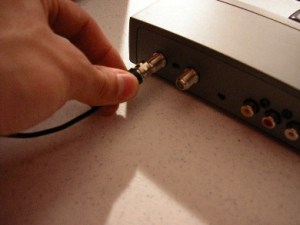 I’ve been saying for a while now that I was thinking about getting rid of my DVR and expanded digital cable package.
Well, last night, I came unplugged.
Yep—when the DVR/cable box started acting wonky, not responding well to the remote control (even after putting new batteries in the remote), I figured there was no time like the present—now that almost all of my shows have ended, been canceled, or are on summer hiatus. So I unplugged and disconnected the box and hooked the cable directly to the TV. Tomorrow, I’ll take the box and remote back to the Comcast office and have them switch me back to the more basic package.
No, I’m not completely eliminating cable. I need HGTV and Food Network—oh, and SyFy and Lifetime so I can keep watching the current seasons of Merlin and Army Wives. But I am getting rid of a piece of technology that’s done nothing but suck up most of my writing time for the past couple of years. Between surfing a couple hundred channels and watching recordings of more TV series than any one person should be watching (most of which I couldn’t even tell you what day they were on because I remembered to watch them only when they showed up on my DVR), once I sat down to eat dinner (in front of the TV) I knew I wouldn’t be moving from that spot again for several more hours. Even if “nothing” was on. I’d spend hours either watching reruns of shows I’ve already seen or just surfing through the channels looking for something to catch my interest—instead of turning it off and writing or reading.
That’s my goal for this summer—to break myself of my bad habit of sitting in front of the idiot-box for hours on end and to put that time toward reading. I’d like to read (for pleasure) and finish at least three novels from this list this summer.
What’s one step you can take to develop a new good habit this summer? Or what’s a goal you can set for yourself to get one of those long-term items crossed off of your to-do list between now and Labor Day?
P.S. Check out this unique interview I did for a friend from my local writing group on her new blog, Divine Detour.
Memorial Day Tribute & Ransome’s Crossing Contest End Date Extended
Since it looks like Ransome’s Crossing isn’t actually going to be out for a couple more weeks, I’m extending the contest end date to June 15, 2010. (Click here for a refresher on the prizes and method of entering.)
Today is the last Monday of May, which means, in the U.S., it’s Memorial Day, a day set aside for remembering those who’ve given their lives for our country. As such, here’s a tribute video I found that says it better than I could*. You’ll have to click over to YouTube to watch, but it’s well worth the time and effort.
*I don’t think I’m wrong when I say the video’s maker meant “Lest we ever forget their sacrifice…” at the end.


