Top Ten Writing Tips–Tip #3: Start Something New
Tuesday, I wrote about how one of the best things we can do before starting revisions is to put our finished manuscript away for a while before starting revisions. So what do you do while you’re waiting to get back to it?
Writing Tip #3: Start something new.
 To help you clear your mind of the manuscript you just finished, one of the best things you can do is start working on another story. It may not be writing—it may be collecting images of characters and settings, doing research of the time period or of the careers you want these characters to have. It may be meeting with your critique/accountability partners and brainstorming story ideas. It may be reading books you’ve determined are similar to or will give you ideas for your new idea. The important thing is to move on to something new as soon as possible. Write something new.
On Monday, we looked at why it’s important to finish your first draft. In Stein on Writing, Sol Stein compares learning to write with learning to ride a bicycle. It’s great to know all of the basics before ever sitting down on the bike (setting pen to paper/fingers to keyboard). If you don’t have a good foundation of knowledge of what it means to write a bike, it’s going to be a lot harder to learn how. But once you know the “how” of riding a bike (or writing a novel), you aren’t all of the sudden a cyclist.
Your first few forays out on the bike, you find yourself very wobbly; you tend to make jerky turns and movements because of how you manage the handlebar; too much speed is scary, but if you go too slowly, you don’t have very good control over stability/balance; you aren’t sure exactly how much pressure to exert on the brakes to stop in time to keep from hitting that parked car.
Those are the essentials of cycling, but it doesn’t mean you can ride a bicycle. What you need is practice. You learn to coordinate your movements. You discover how rapidly you have to rotate the pedals in order to keep the bicycle moving, and how to redirect the handlebars gradually to turn a corner. Only with repetition do you find out how to slow down and stop without tipping over. Once you master riding, what you have learned will stay with you for the rest of your life. You may abandon the bicycle for an automobile, then years later take it up for exercise and find that, in moments, you are rolling ahead, fully coordinated, your brain responding to what you learned in your practice sessions long ago. (Sol Stein, Stein on Writing)
It’s the same with writing. It’s all well and good to complete one novel. It’s great to finish two. But why should we expect to be “professional” authors if that’s all the practice we’re going to give it? As James Scott Bell wrote in The Art of War for Writers, we learn more about how to write a full-length novel by writing a full-length novel. Professional authors must write dozens of novels—on deadline—so how can one expect to attain that level without putting that kind of work in before becoming a professional?
Look at all of the other professions in the world—concert pianists take lessons for years and practice hours upon hours each day before they are considered “professionals.” To rise to the level of Executive Chef at a restaurant, a cook must do one of two things: survive the rigors of culinary school and then work for years and years and years as a sous chef; or she must work for years and years and years and years—working her way up through the ranks until she knows enough to compete with others who also worked hard to get to the executive level. Doctors have to go to school for years then have to complete more years of internships and residencies before they’re allowed to work independently as “professionals.”
Don’t make the assumption that finishing one or two manuscripts is going to give you the skill-set you need to become a professional author—when being a professional author requires one to be able to churn out multiple manuscripts, one after the other after the other. By writing multiple manuscripts before you’re published, not only are you honing your skill at the craft of writing, you’re doing your internship at being a professional author.
James Scott Bell wrote this in The Art of War for Writers:
I’ve counseled many writers at conferences who have come with a single manuscript yet haven’t got another project going. I tell them, “That’s wonderful. You’ve written a novel. That’s a great accomplishment. Now, get to work on the next one. And as you’re writing that next one, be developing an idea for the project after that.”
Publishers and agents invest in careers. They want to know you can do this over and over again.
On her website, Christy Award–nominated author Mary Connealy says, “I wrote for ten years before I got my first book published. When I did get my first contract I had twenty finished books on my computer at home. . . . The two years before I got published I was a finalist in eleven contests with five different books. And all the while I’m entering these contests, I kept writing.”
In addition to the three completed manuscripts I had before I started writing Stand-In Groom, I had dozens of partially written story ideas on the computer or in notebooks, and a 200,000-word never-ending saga that was a fictionalized view of me and my circle of friends from college and “what could have been.” Without knowing it, by writing every day since I was fourteen or fifteen years old, I was learning the work ethic I’d need to become a professional author. By writing that long manuscript, even though I never brought it to a conclusion, I did learn about character development, about conflict, about setting, about revision. And by completing three manuscripts before SIG, I learned about story and plot development, about structure, about POV, about showing vs. telling, etc.
Though there’s a lot of hard work that comes after the book contract is signed, all of the hard work of learning to be a published author shouldn’t wait until then. It’s a lot easier to learn how to be a multi-published author before signing that three-book contract than it is once you’re on deadline.
So, write something new!
For discussion . . .
For writers: How many manuscripts have you completed? How many story idea files do you have right now? Are you constantly writing down/developing new story ideas?
For published authors: How many manuscripts did you finish before getting published? How do you think that helped/hindered you?
For non-writers: How many years did it take you to learn your profession—whether you’re a doctor or a homeschooling parent? What do you wish you’d done differently before embarking on that profession that might have made it easier?
Top Ten Writing Tips: Tip #2–I Need Distance!
You’re probably familiar with these two adages:
- Familiarity breeds contempt.
Absence makes the heart grow fonder
In the Disney version of Robin Hood, when talking about the fact Marian hasn’t seen Robin since they were “children” and that “he’s probably forgotten all about me,” Lady Cluck says, “Absence makes the heart grow fonder.” Marian follows that up with, “Or forgetful.”
And that’s the basis of today’s tip.
Writing Tip #2. Put your manuscript aside for as long as you possibly can after you finish the first draft.
 You want to forget as much as possible about it before you start revisions—that way, you can be more objective about it.
This topic makes me think a lot about the flooding in Nashville last weekend (pretty much everything does these days). No matter where anyone was during the storm and in the immediate aftermath, we couldn’t get a clear idea of exactly what was going on. All I knew was it was raining a lot, there were reports of flash floods, I’d seen some footage on TV, and I knew it was continuing to rain. It wasn’t until Monday, when the rain stopped and the pictures—and especially the aerial footage from the news helicopters—started surfacing that I started to realize just how bad everything was. The helicopters were able to gain distance and show us the bigger picture, show us things that we never would have seen from the ground, even right in the messiest part of the disaster. And it wasn’t until several days had passed that we were able to truly start assessing the damage.
When we’re in the midst of writing a manuscript, we’re so close to it, we can’t see misused or missing words. We can’t see where we’ve used telling language instead of showing. We can’t see info dumps or excessive explanation or description. It isn’t until we’ve cleared the manuscript from our minds, until we’ve allowed ourselves to move on to something else for a little while, that we can begin to see the things that need to be addressed.
You may already have experience with this concept—we subconsciously use it in problem solving quite a bit. When we have a problem or a dilemma and we just can’t come up with a solution, an answer, sometimes the best thing to do is walk away. A couple of years ago, I related this anecdote in a post about satisfying endings:
I edited . . . a hidden pictures book—the kind where there’s a line-drawing picture and you have to find all of the odd little items hidden in the drawing. I spent the entire day with a highlighter finding all of the socks, fish, bananas (on almost every one of the 26 pictures!), ice-cream cones, etc., hidden throughout pictures of kids outside playing ball, skateboarding, swimming . . . On one spread, I even found a bird (it was the first thing I saw when I looked at the page) that wasn’t listed along the side as an item to find. But then I got to one near the back. I found most of the items quickly, but then I was completely stymied. There were three items I couldn’t find for the life of me. After half an hour of looking at it from every angle possible, I finally gave up and moved on to the next page.
I went back and tried to find the items again. No luck. So, I finally went to lunch.
After lunch, I went back to that page. Within ninety seconds, I had found the three “missing” items. All it took was a little time away and fresh eyes.
Though in that case, it was only an hour or two later that allowed me to see the solution to my “problem,” with a manuscript—because of the prolonged investment of time and energy—we obviously need a more extended period away from it to gain the appropriate objectivity, that “fresh eye.”
In Writing Down the Bones Natalie Goldberg wrote*:
From Writing Down the Bones by Natalie Goldberg
It is a good idea to wait awhile before you reread your writing. Time allows for distance and objectivity about your work. After . . . a month, sit down and reread [it] as if it weren’t yours. Become curious: “What did this person have to say?” Make yourself comfortable and settle down as though it were a published author you were about to read. Read it page by page. Even if it seemed dull when you wrote it, now you will recognize its texture and rhythm.Another good value to rereading is that you can see how your mind works. Note where you could have pushed further and out of laziness or avoidance didn’t. See where you are truly boring. . . .
When you go over your work, become a Samurai, a great warrior with the courage to cut out anything that is not present. Like a Samurai, with an empty mind who cuts his opponents in half, be willing to not be sentimental about your writing when you reread it. Look at it with a clear, piercing mind. . . .
See revision as “envisioning again.” If there are areas in your work where there is a blur or vagueness, you can simply see the picture again and add the details that will bring your work closer to your mind’s picture. . . .
Often, you might read page after page of your notebooks and only come upon one, two, or three good lines. Don’t be discouraged. Underline those good lines. Then when you sit down to “practice” you can grab one of those lines and keep going.
*I typed this passage into a document late at night—I think I might have paraphrased a little and don’t have the book readily at hand. But the majority of the words—and the entire sentiment—are Natalie Goldberg’s.
For Discussion . . .
In your writing (or in life), how has gaining distance brought you new perspective? How has it helped you with your story, with editing, with problem-solving?
Top Ten Writing Tips: Tip #1
The members of Middle Tennessee Christian Writers asked if, for our May meeting last week, I could present “Kaye’s Top Ten Writing Tips” as the workshop topic. Having been forced by a blog interviewer to come up with five (thanks, Regina—I usually only have to do one, maybe two) tips, I agreed, thinking it would be easy to come up with an additional five. Well . . . it wasn’t as easy as I anticipated—especially since I wanted to make sure I had “experts” to back me up on all of them.
And since I went to that much work, I figured they’d make a nice blog series. So, over the course of the next couple of weeks, you’ll be treated to Kaye’s Top Ten Writing Tips.
Kaye’s Writing Tip #1. FINISH YOUR FIRST DRAFT.
 As I just mentioned in a class on writing opening hooks, don’t stress out about perfecting your opening hook before you have your entire story written—until you get to the end, you don’t really know what your story is about, no matter how detailed your outline/synopsis is.
It’s all well and good if you can write great openings, three to five great chapters. It’s fantastic if you can win contests with them. But if you never actually finish a manuscript, winning contests is all you’re ever going to be able to do.
You’ll never know how to write the beginning of a novel until you write through to the ending of it. You don’t know what hints/clues/red herrings you need to incorporate. You don’t know what themes are going to be important to introduce early. And you don’t know what secondary characters or subplots are going to come into play that need to be worked into the beginning of the novel.
In The Art of War for Writers, James Scott Bell wrote:
Finish your novel, because you learn more that way than any other.
Some writers tinker over their words endlessly, perhaps fearing the end result. It might stink.
Yes, it might. But it’s the only way you’re going to get better.
Finish your novel.
As an unpublished writer, how will you know if a story has enough plot, enough conflict, to sustain an entire 80–100,000-word novel unless you write the whole thing? The only way you learn how to write a novel is by writing a novel. You’ll never be a professional author if all you ever write are snippets and snatches and opening chapters.
Instead of getting so wrapped up in going back and trying to “perfect” what you’ve already written, when you sit down for your writing time, don’t do anything more than re-read and possibly do a light revision on what you wrote yesterday, but then move forward. Try to push yourself to write a few more words today than you wrote yesterday. In War, Bell encourages writers to “write hard, write fast” when you’re writing your first draft. By pounding out the story in a shorter amount of time, you stay in its slipstream much more easily—the story takes on a life of its own and compels you to write it.
Obviously, this requires writing every day. If you want to be a professional (i.e., published) author, you must treat writing as your profession (even if it’s a second, third, or fourth profession in addition to a full-time job, spouse, and kids). “A surgeon can’t refuse to operate because he’s upset over the Lakers game last night,” Bell writes. “A criminal defense lawyer can’t ask for a continuance so he can go to the beach and dream of someday getting a client who’s actually innocent. And a professional writer can’t sit at the computer playing Spider Solitaire, waiting for a visit from the Muse. A pro is someone who writes, whether inspired or not, and keeps on writing. . . .”
 Madeleine L’Engle put it this way in Walking on Water:
We must work every day, whether we feel like it or not, otherwise when it comes time to get out of the way and listen to the work, we will not be able to heed it.
Bell gives quite a few examples of authors who put the “write hard, write fast” principle to work:
- “William Faulkner wrote As I Lay Dying in six weeks, writing from midnight to 4 a.m., then sending it off to the publisher without changing a word. (You’re not Faulkner by the way.)”
- Ernest Hemingway wrote The Sun Also Rises also in six weeks, part of it in Madrid, and the last of it in Paris in 1925.
- From 1953–1954, John D. MacDonald produced SEVEN novels of high quality. Over the course of the decade, he wrote many more superb books, including The End of the Night and Cry Hard, Cry Fast. MacDonald quelled a critic (who said he should give up writing “paperback drivel” and write “real fiction”) by saying in thirty days, he could write a novel that would be published in hardback, serialized in magazines, selected by a book club, and turned into a movie. The critic laughed and bet him $50 he couldn’t. MacDonald went home and, in a month, wrote The Executioners. It was published in hardback by Simon & Schuster, serialized in a magazine, selected by a book club, made into a film in 1962 that continues to garner acclaim (and remade in 1991): Cape Fear.
- Ray Bradbury wrote Farenheit 451 in nine days on a rented typewriter. He had a newborn at home so he needed somewhere else to work. He had no money for an office. But UCLA had a room in the basement of the library with 12 typewriters for rent at ten cents per half hour. $9.80 later, Bradbury had written his famous “dime” novel.
- Jack London would shut himself in a room and write, sometimes for up to eighteen hours a day. He filled a trunk with rejections. But he was learning. When he died at the age of forty, he was one of the most prolific and successful writers of all time.
- Stephen King says he used to write 1,500 words a day every day, except his birthday and the Fourth of July.
For discussion:
What is the shortest amount of time it’s ever taken you to complete a manuscript? How many manuscripts have you finished (written through to the ending)? How long did it take you to finish your first full-length manuscript? Why do you think it’s important to finish your first draft?
Fun Friday–My Mother Is . . .

Sunday is Mother’s Day. I won’t get to spend the day with my mom—though I will get to spend the next ten days after that with her. There is going to be some serious shopping (for dresses to wear to my cousin’s wedding in July) and sushi eating one day while I’m there, too. So, since I can’t be there on Mother’s Day, here’s a little tribute to my mom, Judy.
My mother is . . .
 . . . beautiful (and she gets it from her mom, Julia, who’s also gorgeous, and after whom Julia Witherington was named)
. . . funny (she can’t tell jokes to save her life, but she’s a great storyteller)
. . . uber-intelligent (I am awed by how much she knows, and her ability to pass along that knowledge)
. . . perseverant (after many delays and bumps in the road, including two kids, she completed her Ph.D. when I was in 3rd Grade)
. . . a wonderful teacher (I should know, I had her for science and math in junior high; she’s now a community college professor who always gets great student reviews)
. . . a wonderful cook (she made sure we were exposed to all kinds of cuisines growing up; she also spent years as the Wednesday-night-supper cook at her church)
. . . a great hostess (a trait I didn’t inherit—she has the ability to make anyone welcome in her home at any time)
 . . . understanding (she has the ability to put herself in others’ shoes to see an issue from all angles)
. . . supportive (she and my dad made sure my sister and I knew they wanted us to learn to make our own decisions, to figure out what we wanted to do/be when we grew up—though they did expect us to live up to our potential)
. . . dedicated (over the years, I’ve seen her spend hours with just one student many times, trying to help that student bring up a grade or make it through a class)
. . . stoic (she learned at an early age that she had to take what life threw at her and find some way to live through it—it prepared her to be an Army Wife with two small children, living in Alaska, while trying to cope with depression. We all made it through and are stronger and better people for it.)
. . . creative (she’s always loved hand-crafts, from knitting and crocheting to quilting)
. . . a deacon (yep, my mom’s a deacon—was ordained when we lived in Virginia)
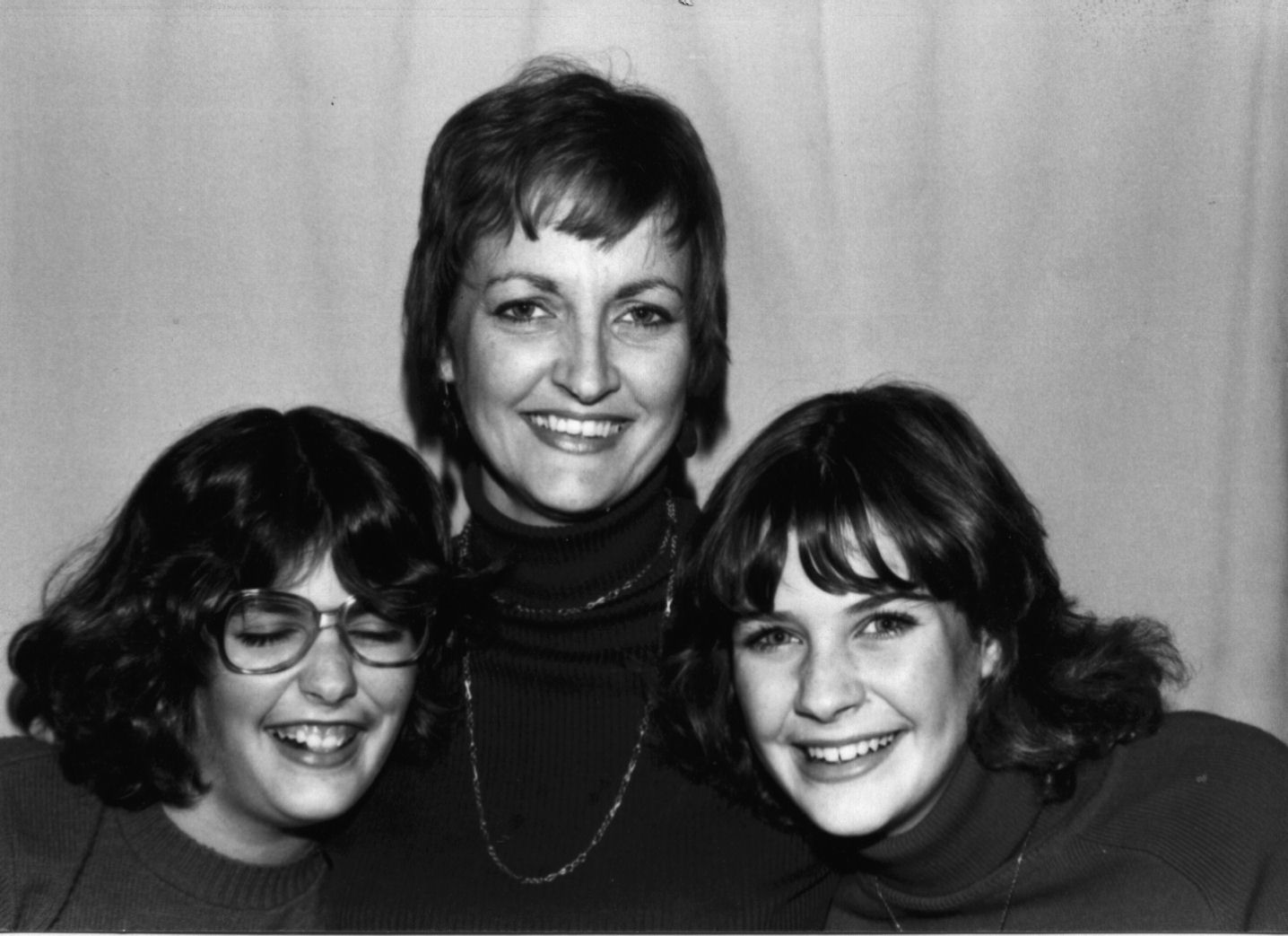 . . . a sign-language interpreter (she served as the head of the deaf ministry in her previous church for many years—yes, the same church for which she cooked!)
. . . a big sister (not just to her five younger siblings, but to anyone who’s crossed her path who needs a big sister/mom figure)
. . . an example (she knows the value of teaching/leading through actions and not just words)
. . . generous (she sees needs and fills them however she can, always with a little unexpected extra)
. . . firm (discipline was strong in our house; we knew that rules were rules and once a decision was made, it was made—no arguing)
. . . someone who loves unconditionally (no matter how much my sister and I screwed up over the years, we always knew we could depend on our parents’ unconditional love)
. . . and . . .
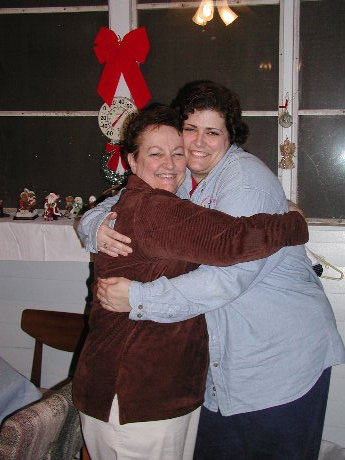
. . . my best friend!
Happy Mother’s Day, Mom!
Nashville Will Rise Again (#NashvilleFlood #Flood2010)
 The water has started to recede in some places, and those of us in Middle Tennessee (and other parts of the region) are steeling ourselves for the true scope of this disaster.
If you’re an author, editor, agent, or otherwise involved in the publishing industry, please consider finding something to donate for auction at Do the Write Thing for Nashville—and if you’re a writer or reader, please consider bidding on the items up for auction (signed books, critiques, phone conversations with editors/agents, etc.). They’ve already raised $1,500+ for Nashville disaster relief—let’s help them increase that amount!
If you live in/around the Middle Tennessee area, please support area businesses’ efforts at raising money for flood relief and consider attending one of the benefit music concerts or art show that are going to be happening all over the area. In Southeast Nashville, consider attending the benefit concert at the Flatrock Cafe on Nolensville Road Friday, May 14. They already have several groups on board (And, Okay!, Like Candy Red, and Spider Poets) and several others may be added.
Here’s a video containing images of the flooding, a little of the aftermath, along with quotes from Patten Fuqua’s “We Are Nashville” blog post on Section 303.com:
And here’s a slide show from The Tennessean covering the past five days.
Damage from this flood could top $1 billion—and that’s just to replace all the physical stuff. There is no price we can put on the loss of lives and peace of mind this tragedy has caused. We just keep trying to make sure that those who need help receive it by making sure they get the attention they deserve.
I do have to say, the more time that’s passed, the more this story has been picked up, not just within the U.S., but internationally. I’ve seen articles in newspapers from London to Sydney to Saigon about the disaster—and the need for relief, and the story is starting to gain more traction with the national news outlets across the U.S. (the major networks and the cable news networks) giving us more than just thirty seconds to two minutes of air time. The Weather Channel, of course, has been here and reporting continuously since the event started.
Of course, we here in Nashville, were disappointed to learn that RWA chose to relocate the national convention from Nashville to Orlando, but we do understand that it’s going to take more than just a couple of months for this area to recover. Mayor Karl Dean, though, has lit the fire under everyone in Nashville to get downtown ready to receive the tens of thousands of tourists who come to Nashville every year for the CMA Fest (most of us here still call it Fan Fair), which is donating half of its proceeds toward disaster relief.
Everyone’s calling this the worst disaster to hit Middle Tennessee since the Civil War. Now, as then, Nashville will rise again.
The Flood of 2010 (#NashvilleFlood #Flood2010)
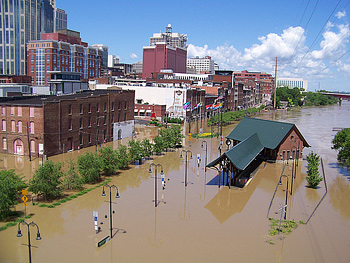 Unless you know someone in Nashville or live nearby, you may not have heard about what’s going on here in Middle Tennessee. You’ve probably heard a lot about the failed car-bomb in Times Square because, well, that’s New York, and anything that happens in New York must dominate the news cycle. I know you’ve heard about the devastation of the oil spill in the Gulf of Mexico, one of the worst eco disasters we’ve seen. Yes, I’m concerned about that, too. And I know you’ve seen news coverage of the protests against Arizona’s new anti-immigration law. And you may have heard a thirty second sound bite about “flash flooding in Nashville” and not thought much about it.
As Patten Fuqua pointed out on his blog, Section 303 (a blog usually dedicated to following Nashville’s NHL team, the Predators), in a thoughtfully presented post “We Are Nashville”:
A large part of the reason that we are being ignored is because of who we are. Think about that for just a second. Did you hear about looting? Did you hear about crime sprees? No…you didn’t. You heard about people pulling their neighbors off of rooftops. You saw a group of people trying to move two horses to higher ground. No…we didn’t loot. Our biggest warning was, “Don’t play in the floodwater.” When you think about it…that speaks a lot for our city. A large portion of why we were being ignored was that we weren’t doing anything to draw attention to ourselves. We were handling it on our own.
Now that it’s been several days and word is starting to get out, we’re starting to get a little more coverage nationally.
Here’s what I personally almost got caught in coming back to Nashville from a book signing in Shelbyville on Saturday:
Thankfully, my impatience for once worked in my favor and I climbed out of dead-stopped traffic about half a mile south of this and took surface streets home—not learning about this until I got home and turned the TV on.
And I nearly cried last night when my favorite news and political commentator, Keith Olberman, dedicated a “Quick Comment” to the devastation in Nashville:
You heard Keith mention the Opryland Hotel being under ten feet of water. Here are some images:
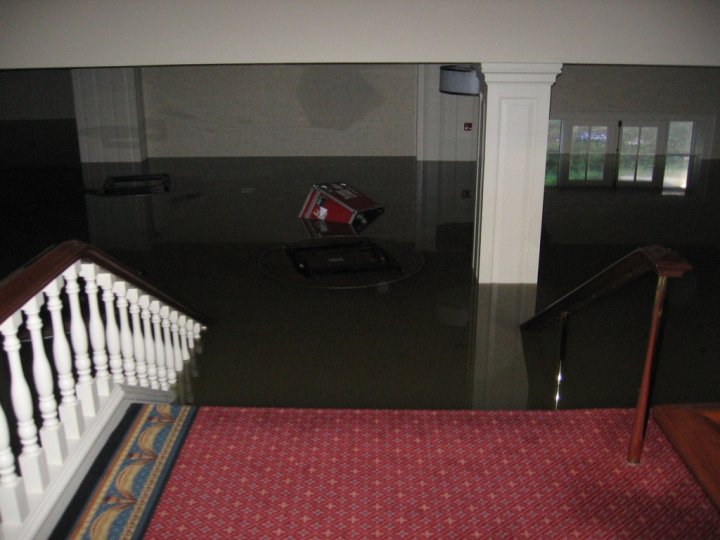
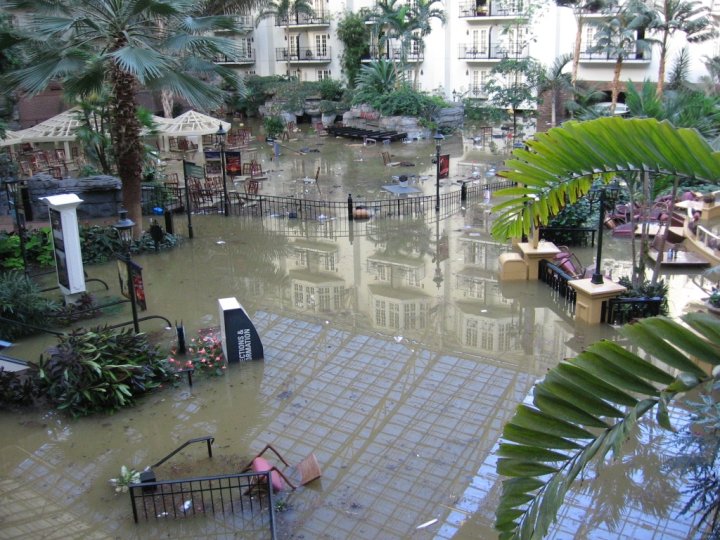
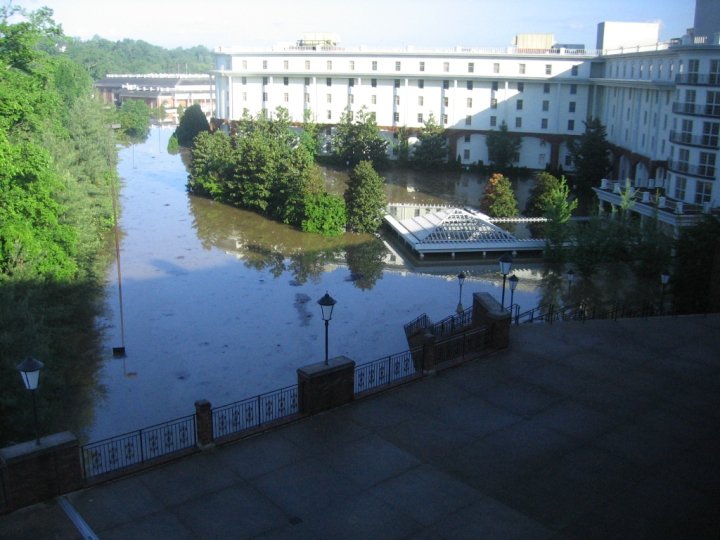
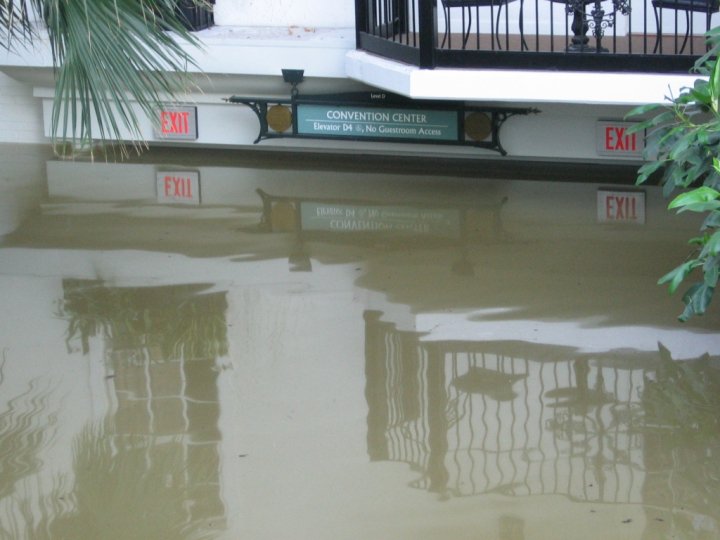
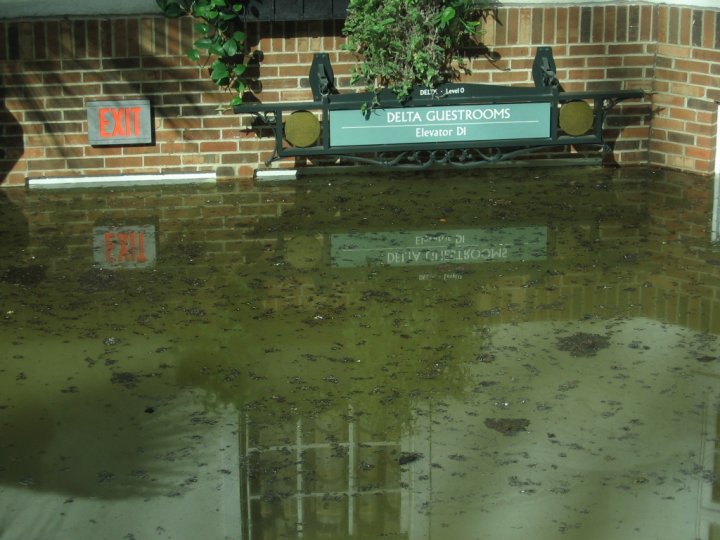
(Images borrowed from the Facebook Photo Album of Steven Lee.)
And here’s a slideshow from The Tennessean of more images of the hardest-hit areas.
The Romance Writers of American conference, which was scheduled to be held at the Opryland Hotel at the end of July, will now have to be held elsewhere—in another city—due to the devastation at the hotel.
Oh, yeah, that’s right. The hotel’s being flooded (and not expected to re-open before December), along with the Grand Ole Opry House (the shows will move to the Ryman in downtown), Country Music Hall of Fame, and most of the tourist haunts in downtown, means millions of dollars lost to Middle Tennessee—from tourism and travel, our largest “industry.” And I haven’t even gotten into the devastation of lives (at least 22 dead, hundreds unaccounted for across the Southeast) and personal property.
This will probably be one of the most iconic pieces of film to come out of this disaster. Be sure to watch the whole video. This is why they tell you not to go into flash-flooded areas because you don’t know (a) how deep it is and (b) how strong the current is.
You don’t have to search very hard to find images of the devastating flooding across Middle Tennessee.
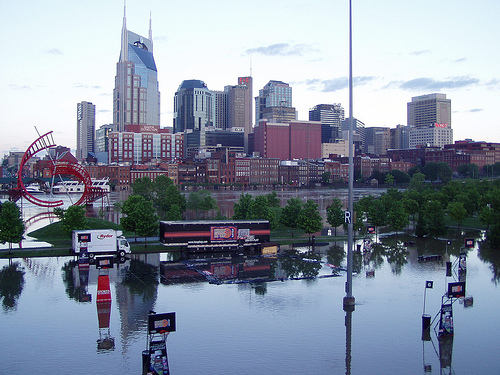 One of the reasons those of us who live here are so concerned with the lack of national coverage of this disaster is because the money to recover from it is going to have to come from somewhere. But without the constant attention disasters like the tornado in Yazoo City got or the oil spill in the Gulf is getting, the volunteers to help with recovery efforts as well as the financial support we’re going to need to recover aren’t going to come.
How can you help?
If you live in/around Middle Tennessee, there are several churches and community organizations set up to take donations of food and clothing:
The Community Foundation of Middle Tennessee
Nashville Flood Relief Art Show
Hands On Nashville
Purchase and donate foodstuffs at local grocery stores
Graceworks Ministries
Crosspoint Church
And since I can’t possibly list all of the local churches and businesses that are helping out, here’s a great list from the Nashville Business Journal.
Across the country/world, here’s how you can help:
Donate to the Red Cross
Do the Write Thing for Nashville
Or donate to any of the above listed outreach organizations/churches.
Most of all, please pray for those who have lost everything—their homes, their belongings, and their livelihoods. This is not going to be easy to recover from. But they don’t call this the Volunteer State for nothin’. And the outpouring of help and support from those in Middle Tennessee to help our neighbors before the rains had even ended just goes to show the spirit of the people who call ourselves Tennesseans.
We just ask to not be forgotten or overlooked. Please post on Twitter, Facebook, or your own blog information on how to help with relief efforts (or a link to this blog post) to spread the word about the needs in Nashville.
Upcoming Author Introduction–Michelle Lesley
It’s not often (okay, never) that I dedicate a blog post to an individual author, to recognizing and celebrating someone making that step on the journey from writer to published author, but I can’t not do it.
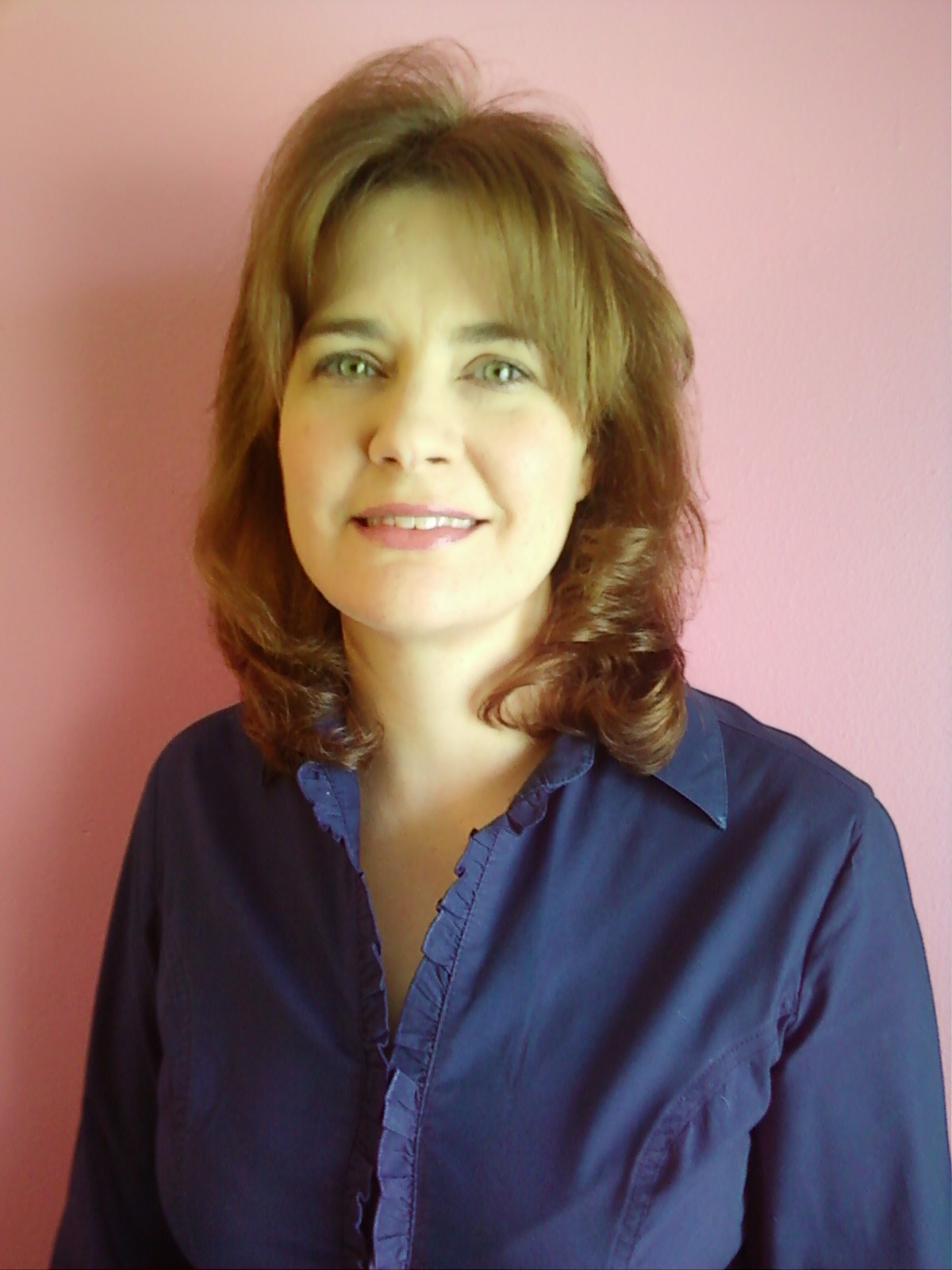 Michelle Lesley holds a B.A. in psychology and did her master’s work in both education and marriage and family counseling. She taught school for several years and worked as a university advisor. She has taught countless Bible studies since she was a teenager, and she has been committed to daily personal Bible study for nearly twenty years. While serving as a women’s ministry leader, she especially enjoyed teaching women’s Bible studies. As the associational prayer coordinator for the Baptist Association of Greater Baton Rouge, she assists in and oversees the prayer ministries of over 100 churches in her area and leads Bible studies and workshops.
Michelle’s Bible study, Jacob: Journaling the Journey, grew out of her devotional journal. Jacob follows the story of the patriarch as he grows from an impetuous mama’s boy into one of the founding fathers of the faith. Equally important to Jacob’s story are the family members—such as “Manipu-Mom” Rebecca, “Wild Thing” Esau, and Rachel, “Queen of High Maintenance”—who played such vital roles in his life. With its emphasis on stream of consciousness journaling, this Bible study uses the story of Jacob to draw out the story of readers’ own journey toward godliness through a fulfilling, dynamic alternative to traditional workbook Bible studies. Jacob releases in the spring of 2012 from Journey Press.
Michelle has always used writing as a creative outlet. As a child, she wrote poems and short stories. Later, she drew upon her experience in music ministry and ventured into songwriting. Journaling during her quiet time led Michelle into a deeper and more intimate relationship with God, and it is out of these journals that her first book grew.
As an army brat, Michelle has lived in some interesting places such as Alaska and New Mexico, but returned to her native Baton Rouge, Louisiana, in 1989. Here, she graduated from LSU with a degree in child and adolescent psychology, and did her master’s work in family counseling. She remains a die-hard Tiger fan.
Michelle and her husband have been blessed by the six wonderful children God has brought into their lives. Passionate about prayer, Michelle serves as the Associational Prayer Coordinator for the greater Baton Rouge area, working with over 100 churches and pastors to increase corporate prayer. She also sings on the praise team, assists her husband with his duties as minister of music at their church, and home schools her three youngest children.
(from the Sheaf House Publishing Dream blog and Sheaf House website.)
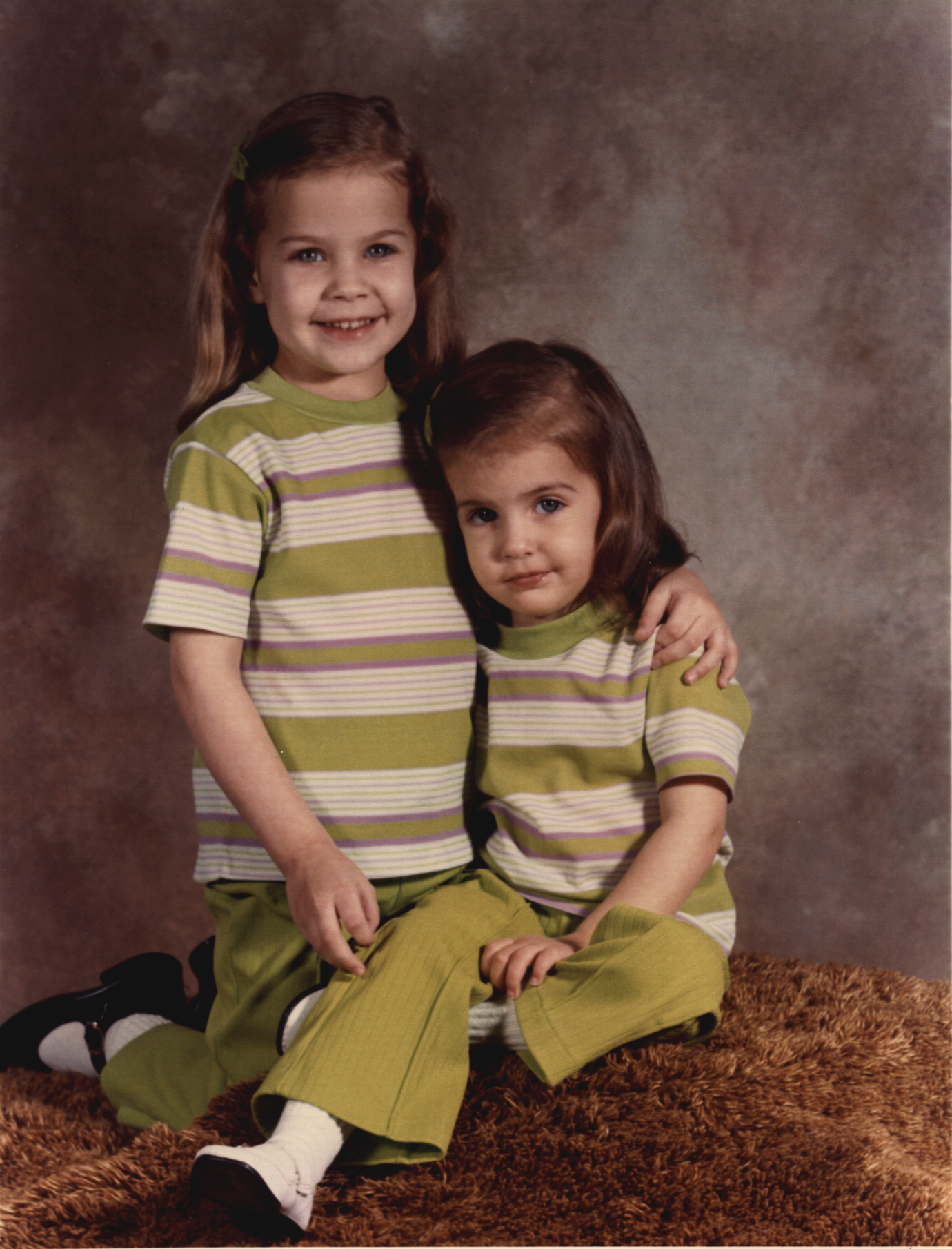
Visit Michelle’s blog at http://breadandh2o.blogspot.com. Be sure to let her know that her little sister is very proud of her and sent you over!
Fun Friday–Great 1980s Commercials
Last summer on NBC and now this spring on SyFy, I’ve been enjoying watching the BBC series Merlin, and for the past couple of weeks, I’ve been watching (for the first time) the TV series Buffy the Vampire Slayer on Netflix Instant Watch. So I’ve been on something of an Anthony Head kick recently.
As a teen in the 1980s, and as someone who is addicted to romance, I vividly remembered a series of commercials for Tasters’ Choice coffee that ran in the late 1980s featuring Anthony Head which really launched his acting career. So, after watching my evening episode of Buffy last night, I hopped over onto YouTube to see if I could find one of those commercials. And guess what!
Yay!
And, of course, I can’t have a post about commercials from the 1980s without this one:
A commercial for the first computer my family ever got (in 1980):
Speaking of people whose careers took off after romance-themed commercials in the 1980s:
And finally, even though this one is actually from the 1970s (I think these kids are probably older than me now!), can’t have a nostalgic post about commercials without one of the most iconic commercials of all time.
You know you’re dying to do it. Go over to YouTube and find one of your favorite nostalgic/iconic commercials from the 1980s (or ’70s or earlier) to post!
2010 Christy Award Nominees & Keynote Speaker Announced
ANN ARBOR, Mich.—The Christy Advisory Board is pleased to announce nominees in nine categories for the 2010 Christy Awards honoring Christian fiction. The Christy Awards will be conferred in advance of the International Christian Retailing Show at a ceremony at the Renaissance St. Louis Grand Hotel, Sat., June 26, 2010, at 7:30 p.m. Author and entrepreneur Lisa Samson, a two-time Christy Award winner and seven-time nominee, will present the keynote address.
Tickets to the event are $30. For more information about the awards reception and to make reservations (beginning Apr. 30), visit the Christy Award website at http://www.christyawards.com.
The 2010 Christy Award nominees are:
CONTEMPORARY ROMANCE
Breach of Trust by DiAnn Mills • Tyndale House Publishers
How Sweet It Is by Alice J. Wisler • Bethany House Publishers: a Division of Baker Publishing Group
Stand-In Groom by Kaye Dacus • Barbour Publishing
CONTEMPORARY SERIES, SEQUELS, AND NOVELLAS
Who Do I Talk To? by Neta Jackson • Thomas Nelson
The Hope of Refuge by Cindy Woodsmall • WaterBrook Multnomah Publishing Group
Daisy Chain by Mary DeMuth • Zondervan
CONTEMPORARY STANDALONE
June Bug by Chris Fabry • Tyndale House Publishers
The Passion of Mary-Margaret by Lisa Samson • Thomas Nelson
Veiled Freedom by Jeanette Windle • Tyndale House Publishers
FIRST NOVEL
The Familiar Stranger by Christina Berry • Moody Publishers
Fireflies in December by Jennifer Erin Valent • Tyndale House Publishers
Scared by Tom Davis • David C. Cook
HISTORICAL
A Flickering Light by Jane Kirkpatrick • WaterBrook Multnomah Publishing Group
Though Waters Roar by Lynn Austin • Bethany House Publishers: a Division of Baker Publishing Group
The Swiss Courier by Tricia Goyer & Mike Yorkey • Revell Books: a Division of Baker Publishing Group
HISTORICAL ROMANCE†
Beyond This Moment by Tamera Alexander • Bethany House Publishers: a Division of Baker Publishing Group
A Bride in the Bargain by Deeanne Gist • Bethany House Publishers: a Division of Baker Publishing Group
The Inheritance by Tamera Alexander • Thomas Nelson
The Silent Governess by Julie Klassen • Bethany House Publishers: a Division of Baker Publishing Group
SUSPENSE
Intervention by Terri Blackstock • Zondervan
Lost Mission by Athol Dickson • Howard Books: a Division of Simon & Schuster
The Night Watchman by Mark Mynheir • WaterBrook Multnomah Publishing Group
VISIONARY
By Darkness Hid by Jill Williamson • Marcher Lord Press
The Enclave by Karen Hancock • Bethany House Publishers: a Division of Baker Publishing Group
Valley of the Shadow by Tom Pawlik • Tyndale House Publishers
YOUNG ADULT
Beautiful by Cindy Martinusen-Coloma • Thomas Nelson
The Blue Umbrella by Mike Mason • David C. Cook
North! or Be Eaten by Andrew Peterson • WaterBrook Multnomah Publishing Group
†Historical Fiction includes four nominees due to a tie in scoring.
Congratulations to all of the finalists. I’m awed to be in such company!
And the Nominees Are. . .
Well . . . I won’t know until tomorrow when they’re officially posted who the other nominees are. But I do know this . . .

Stand-In Groom is a
FINALIST
in the
Christy Awards
Why am I so excited? Well, you have Oscar, Tony, Emmy, and, for those of us in Christian fiction, Christy.
The winners will be announced on Saturday, June 26, at the banquet that kicks off the International Christian Retailers Show. Works out well that Barbour had already scheduled me to be at the show—and that it’s in St. Louis, which is in easy driving distance from Nashville.
Tomorrow, I’ll post the full list of finalists, but wanted a chance to do my Snoopy dance today!


