#NaNoWriMo Prep: Set Your Word Count Goal and Writing Schedule | #amwriting #NaNo2018
 We are one week away from the start of National Novel Writing Month.
Do you feel ready to start?
Because writing a first draft in thirty days is not a normal level of writing that any of us do on a regular basis, it’s important to start thinking now about how you’re going to schedule time to write every day.
Setting Word-Count Goals
From the NaNoWriMo website:
Why 50,000 words? And how do you define “novel”?
Our experiences since 1999 show that 50,000 words is a challenging but achievable goal, even for people with full-time jobs and children. This is about the length of The Great Gatsby. We don’t use the word “novella” because it doesn’t seem to impress people the way “novel” does.
We define a novel as “a lengthy work of fiction.” Beyond that, we let you decide whether what you’re writing falls under the heading of “novel.” In short: If you believe you’re writing a novel, we believe you’re writing a novel, too.
The thing about this being a voluntary contest is that you don’t have to commit to 50,000 words if you don’t want to. In order to figure out how long your manuscript needs to be, you need to know what type of manuscript you’re writing:
Novella: 20,000 to 25,000 words
Novelette/Category Romance: 40,000 to 65,000 words
Single Title/Mass Market/Trade Fiction: 75,000–120,000 words
Epic: 125,000+ words
Obviously, depending on what you’re writing, you may or may not be able to write the entire thing in 30 days. Or you might be able to write two novellas or multiple short stories. It really is up to you.
Because I’m trying to relearn the joy of storytelling and writing books, I’m challenging myself but not in a way that should prove to be too stressful.
My goal is to write an average of at least 500 words per day on my story, for a total of 15,000 words for the month. It doesn’t seem like a whole lot—especially given that I’ve just said above that even a novella (novellette) should be at least 20k words. But as someone who’s been creatively stifled and experiences anxiety whenever I think about sitting down to write, I feel like 500 words per day (2 to 3 pages—or less than half the length of one of my average blog posts) is more than enough to be going on with.
To write 50k in 30 days, you need to average 1,667 words per day. Which sounds like a whole lot . . . unless you look at it more like getting in a full day’s worth of calories. In addition to breaking down your full word-count to a daily average, you can break down the words needed per day into smaller chunks to be done at designated times per day. For example, waking up a little early to write 500 words before the day starts. Trying to get in 800 to 1,000 words at lunch, and then finishing up the rest of it in an hour or so in the evening.
Assignment 1: Determine the word-count you’d like to reach at the end of this challenge. Then calculate what you’ll need to average daily to reach your goals.
Set Your Writing Schedule for the Entire Month of November
Don’t take this lightly. If you’re really serious about this, you need to sit down with your calendar (and if you’re scheduling around a spouse/partner and/or kids, then you need to grab every calendar in the house) and really look at what you have coming up November 1–30.
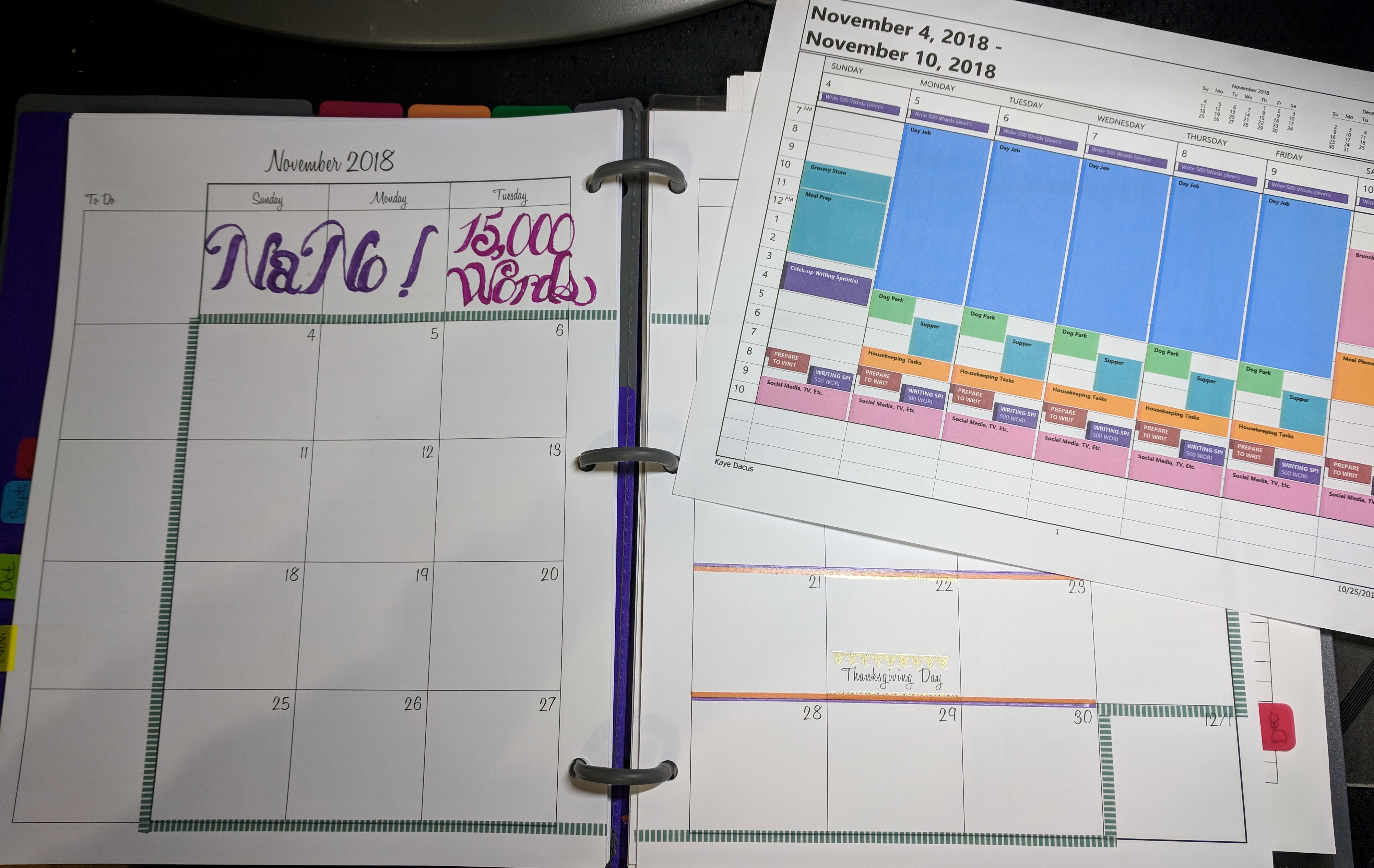
Look at the word-count goals that you set (overall and daily average). Think about how long it takes you to write 1,000 words. Have you ever timed yourself? If you never have and you don’t know how productive you can be in a certain amount of time, then you need to allow more time than you think you’ll need. Don’t short-change yourself.
To paraphrase Master Yoda: Guess not. Know, or know not. There is no guess.
And if you’re working around the schedules of other people in your household, now is a great time to start talking to them about this challenge and about how, in November, you’re going to need their understanding and support as you pour most of your focus and energy into your story. Get them on board. Start planning schedules of who’s responsible for meals and other things you usually take care of now, rather than waiting until November 1 and then announcing that things must change.
For those in the United States, something to keep in mind is that you may struggle the week of November 18–24 to get your writing time scheduled, between cleaning and cooking, Thanksgiving festivities, football games (or Black Friday shopping), travel, etc. So be sure to build in some extra time in the other three weeks of the month to get ahead/catch up with what you may not have time for that week.
Assignment 2: In order to reach your word-count goal for the challenge, set “writing time” appointments for yourself one each day of the month that you know you’ll need to write. If you know—or even just suspect—you’re not going to have time to write on certain days, build in contingency writing-time appointments on other days so you can get your word-count in when you have the time.
If you need more advice, hints, or tips on how to manage your time for a month-long writing marathon, check out this video from NaNoWriMo:
#NaNoWriMo Prep: Site Your Settings | #amwriting #NaNo2018
What Do You Already Know about Your Settings?
One of the sections I suggested when creating your NaNo project story bible was for setting.
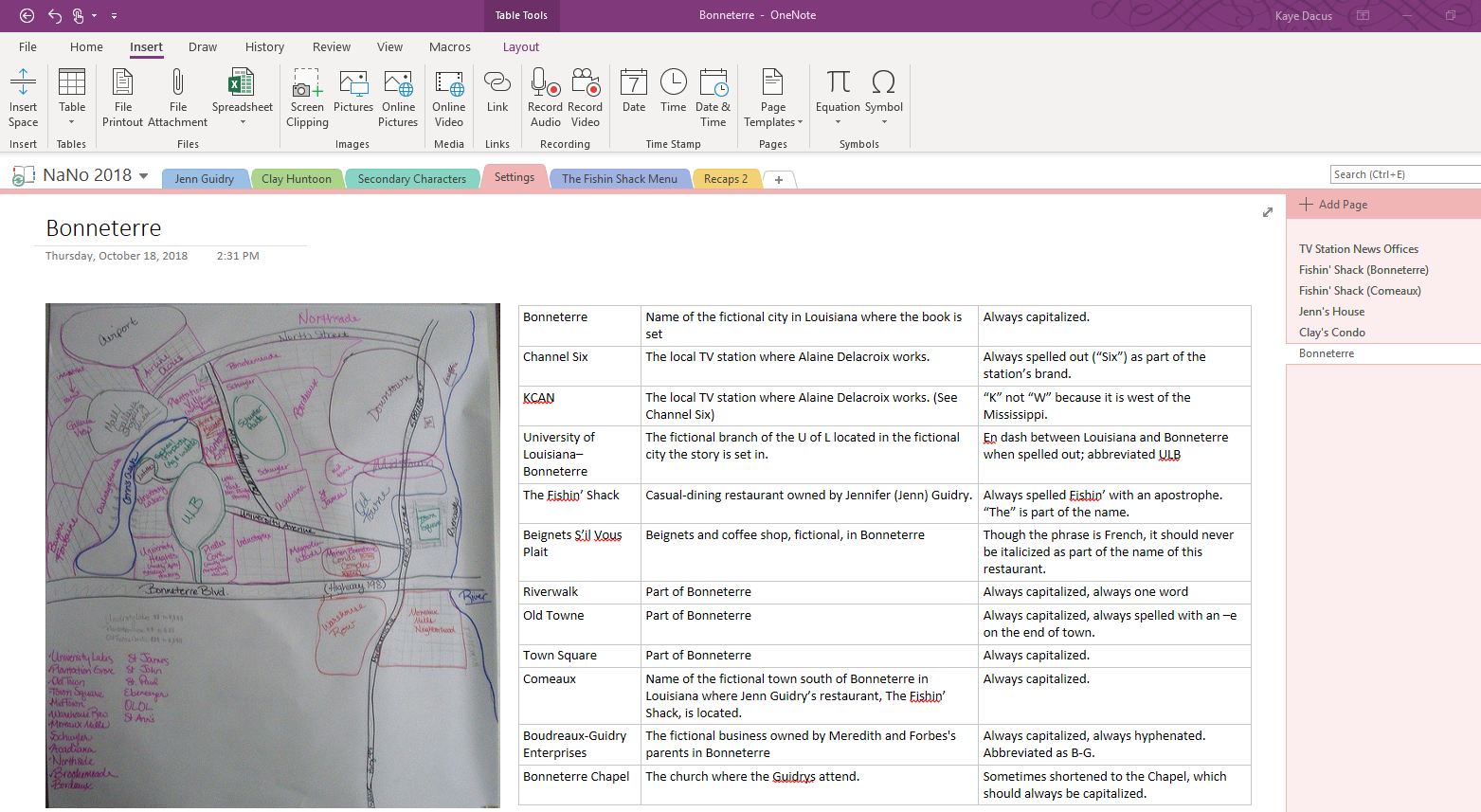
So you don’t have to go back and read the original post:
If you’re writing a world-building genre—like fantasy, science fiction, or historical—you’re going to have a relatively large section for your setting—large enough that you may want to create a subgroup (basically giving you a notebook within a notebook) or a separate notebook just for world-building. But even when writing contemporaries set in places we’re familiar with (like for me when I was writing the Matchmakers series, set in Nashville), we’re going to need a place to keep information about our settings. What do your characters’ homes or workplaces look like? Where are things located geographically? What’s the topography or weather like?
Again, because I’m returning to a previously created fictional setting, I was able to go ahead and start adding pages (all of them blank right now except for this one—and this one has info because I already had it in another OneNote Notebook).
Setting is where I tend to split things up a bit. I’ll keep the research/development part of my setting information (text) in OneNote, but I’ll collect setting images in Pinterest. It’s so much easier, and it doesn’t take up space on my computer.
In the past, I’ve also done things like hand-draw a map of my fictional city of Bonneterre, Louisiana, and hang it on the wall for easy reference. (And then I took a digital picture of it and put it in my folder of images in my cloud drive so I could access it anytime I needed it—yes, that’s it in the image from OneNote above.)
In addition to just the general location of where your story is set (for me, that’s my fictional city of Bonneterre, Louisiana), knowing at least some of the specific locales within your setting before the marathon writing starts will be a good idea.
Assignment 1: If you don’t already have a section for Settings in your story bible, create one. Then add whatever you already know about your settings.
Get More Specific with Your Setting
This is one of the few times in this prep cycle that I’m suggesting that we dive a little deeper into figuring things out ahead of time. That’s because if we’re already familiar with where the scenes we’re going to write can take place, it’ll make writing easier.
- Does your setting have a unique culture (traditions, observances, taboos, quirks, etiquette) that can play a role in your story?
 Think of places that have cultures that are unique to them: Santa Fe, Greece, Louisiana, Las Vegas, the Deep South, Hawaii, a small fishing town on the coast of Ireland, a ship of the line in the 19th century Royal Navy, etc. What are the unique elements of a setting that you can incorporate into your characters’ background/mannerisms/behavior and into how your story unfolds?
 - What are the elements of the culture you need to make sure you get absolutely right?
If you’ve read my Bonneterre books, you know I don’t have people walking around calling each other cher or babbling in Cajun French. If you live somewhere with a unique culture and watch movies/TV shows set there, what are the things that they get wrong that drive you crazy? How can you make sure you get those elements right? - What are some specific locations and/or events you can incorporate into your story?
 In the Matchmakers series, set in Nashville, I have my girls meet for coffee on Sunday afternoons at The Frothy Monkey in the 12 South neighborhood. In the Bonneterre series, with my fictional setting, I created Beignets S’il Vous Plait, a beignets-and-coffee shop reminiscent of Cafe Du Monde in New Orleans or Coffee Call in Baton Rouge. Use specific locations, but have a reason for using those locations. Don’t just “name drop.”
 - How can your setting affect how your story plays out?
For example, if you’re writing suspense and your characters are on the run outdoors, they’re going to run into much different conflicts in a mountainous area than in a desert than in a jungle. Is it cold and snowy? hot and humid? Does your character have environmental allergies that could affect whether or not he’s able to do the physical activities required of him in the plot? Is he a sailor who suffers from seasickness? Someone who works in mountain search and rescue who suddenly gets a bad case of vertigo?
Assignment 2: Take about 10–15 minutes to write down your answers to each of these questions. If you need to look things up and/or find images to help, feel free. Just don’t spend too much time on this—getting that specific can wait until the first round of revisions.
Setting the Mood
Think about the cliche of the gothic novel being set in a creepy, dark, old castle with a labyrinth of hallways, tunnels, and dungeons. There’s a reason why it’s become cliche—because it works. One of my favorite YA novels from childhood is a gothic, but it’s set in a recently built Victorian mansion in Northern California in the late 1800s. The author uses the house, and the fog that envelops it daily, to great effect.
Although we don’t want to get caught up in the whole idea of making sure we’re choosing exactly the “right word” when we’re marathon writing, If you know ahead of time what mood you’re trying to invoke, it can help you as you write—so that you don’t feel stuck, searching for the “right word.”
Assignment 3: Think about how the weather, the landscape, the culture, etc., of your setting can affect and effect the mood of your story. Create a Mood Words page in your Settings section and take 10-15 minutes to free-write a list of words (adjectives, nouns, verbs) that evoke the tone you want. Use a thesaurus if you must in order to kickstart your brainstorming, but don’t rely on it to find words that don’t naturally come to mind.
#NaNoWriMo Prep: What Do You Already Know about Your Story? | #amwriting #NaNo2018
By now, you’ve started a story bible structure and you’ve jotted down your ideas for your characters. But what about your story? What are you actually going to write about?
What’s Your Premise?
Premise—or what your story is about—is one of the essential elements to being able to write a complete draft of a story. Without your premise in place, how do you even know you have a story to write?
As I mentioned in the comments yesterday,
Because I write romance, I already have a basic structure around which to build a story. And I have to know the two main characters—otherwise, with romance, there is no story to start with. If I know those two characters and can figure out how they meet, then I have something to get me started writing.
I know that even though Jenn and Clay have known each other (and dated off and on) all their lives, I still need a meet-cute—the story of a romance doesn’t start until the heroine and hero actually come together on the page. That’s got to happen early on. I know that the bulk of the story will be the developing romantic relationship between these two characters—that there’s major history between them that includes a true and deep love, but there’s a major conflict keeping them apart. And I know they’ll eventually end up together. After all, it’s a romance novel.
So I know the basics of what happens in the story. But I don’t know the premise—I don’t know the why of the story. Why do these two fall (back) in love with each other? What might threaten this (last?) chance of a happily-ever-after for them? Why should readers care if they get a happily-ever-after ending?
Premise without Plotting
So, if we’re not going to plot the heck out of our stories before we start writing—if we’re planning to mainly do this by the seat of our pants—can we really have a premise without resorting to plotting?
That, for me, goes back to getting to know my characters. In a typical romance novel, it’s the characters’ arcs—mainly internal but with some external conflicts—that drive the plot of the story.
In FirstDraft60, I have a whole post dedicated to determining the premise of the story. If you want, you can go read that and spend time working out the details of a premise.
Or, you can do what I did right before I started writing this post. Which is take ten or fifteen minutes to free-write the idea that I’ve had swimming around my brain for a few weeks now as if I were writing back-cover copy:
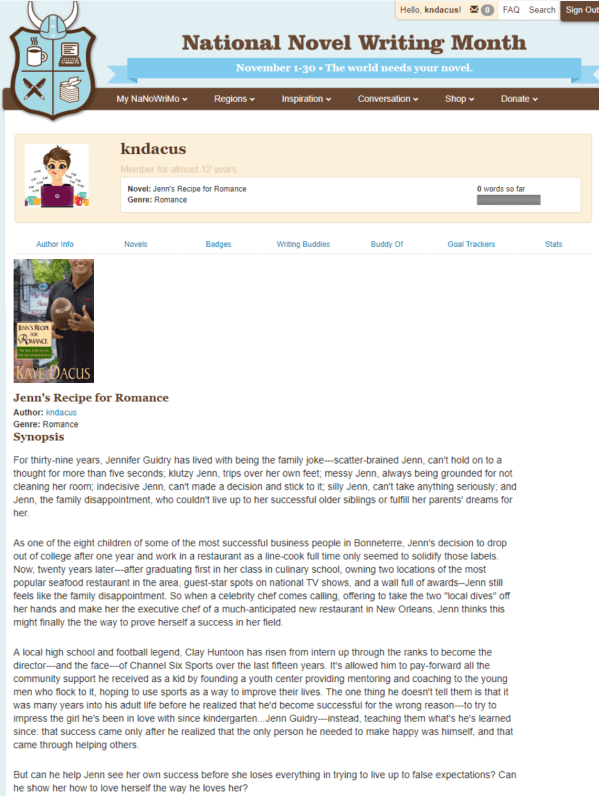
Assignment: Spend ten to fifteen minutes free-writing/brainstorming your story’s premise.
#NaNoWriMo Prep: What Do You Already Know about Your Characters? | #amwriting #NaNo2018
In the next twelve days until November 1, it’s going to be important to be thinking about what we’re planning to write for our NaNo project—but if you’re following along with me for this prep, it’s also going to be important not to overthink it. I’ve already done a couple of First Draft in 60/90/120 Days in which I give detailed instructions for preplanning a novel project. We’re not going to go in depth with it this time.
Today’s Focus Is on Characters
Again, I’ve already filled in some stuff about my characters in my story bible, because this is a story I’ve tried writing before—and because these characters were introduced in other stories as secondary characters. And while I don’t want to get caught up in trying to plan out the minutia of every detail of the main characters’ lives, backstories, goals, motivations, etc., I do at least need to make notes on what I do already know about them.
For example:
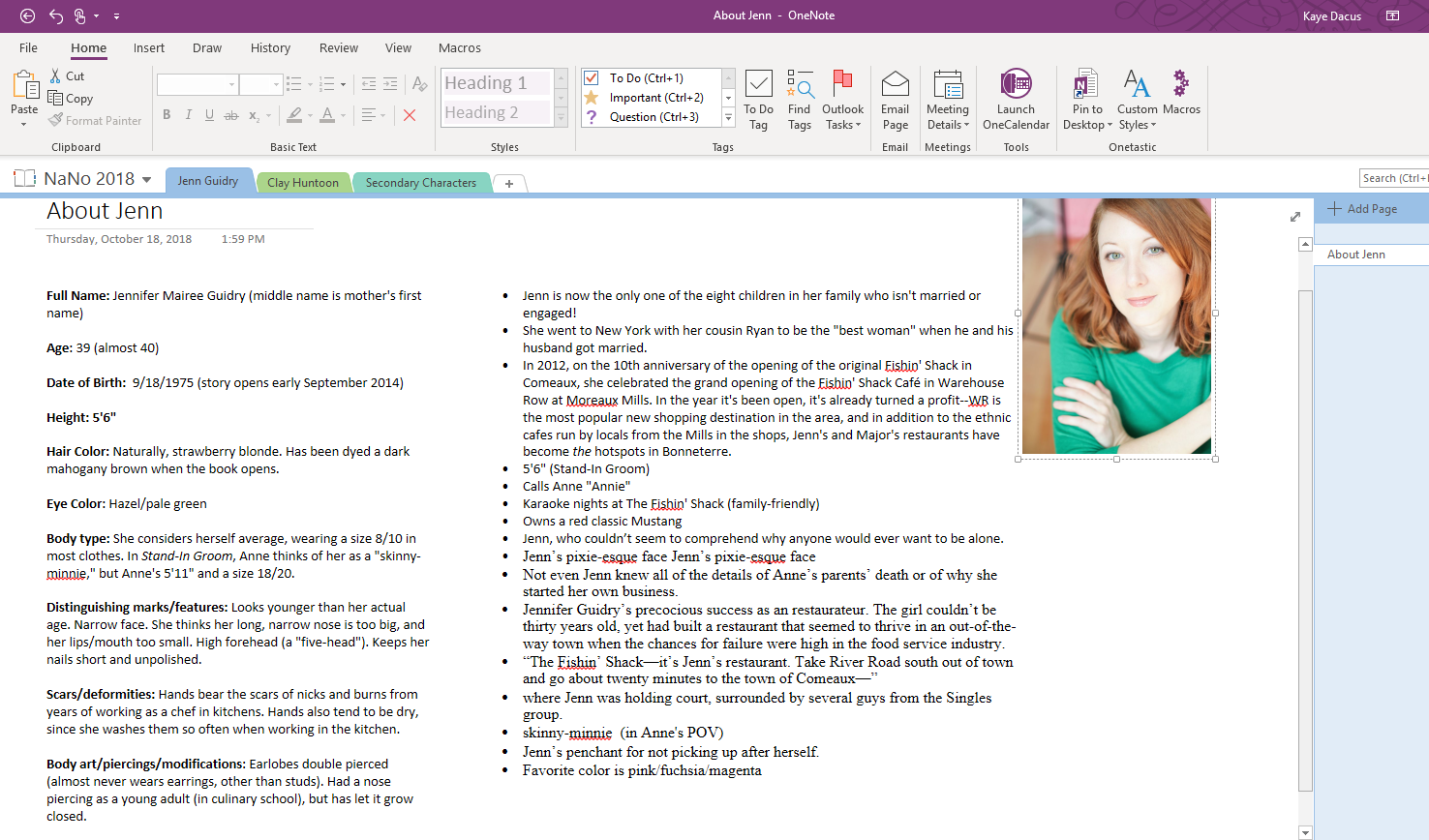
I have this quick character info chart about Jenn already filled out from when I worked on this idea five years ago:
- Full Name: Jennifer Mairee Guidry (middle name is mother’s first name)
- Age: 39 (almost 40—story opens early September, birthday is September 18)
- Height: 5’6″
- Hair Color: Naturally, strawberry blonde. Has been dyed a dark mahogany brown when the book opens.
- Eye Color: Hazel/pale green
- Body type: She considers herself average, wearing a size 8/10 in most clothes. In Stand-In Groom, Anne thinks of her as a “skinny-minnie,” but Anne’s 5’11” and a size 18/20.
- Distinguishing marks/features: Looks younger than her actual age. Narrow face. She thinks her long, narrow nose is too big, and her lips/mouth too small. High forehead (a “five-head”). Keeps her nails short and unpolished.
- Scars/deformities: Hands bear the scars of nicks and burns from years of working as a chef in kitchens. Hands also tend to be dry, since she washes them so often when working in the kitchen.
- Body art/piercings/modifications: Earlobes double pierced (almost never wears earrings, other than studs). Had a nose piercing as a young adult (in culinary school), but has let it grow closed.
- Repetitive/habitual physical quirks: Has a hard time sitting still. Tends to be a little accident-prone outside of the kitchen.
As I think about my characters and story over the next not-quite-two-weeks, I know I’ll be revising/changing some of this—I’m going to bump her birthday later, as turning 40 will play a role in the character arc I currently have simmering for her in the back of my mind. And I know that some other things will come up and/or change as I write the story—my characters always have surprises for me!
For Clay, I don’t have the same kind of structured chart of information—just a list of things I know about him. And I’m going to leave it that way.
Assignment 1: Add whatever you already know about your main character(s) to your story bible. Don’t spend too much time thinking about it—just jot down notes of what you already have in mind or have already created.
Get to Know Your Characters Better
There are plenty of ways to do in-depth character development before starting a story. I’ve covered several here on the blog:
-
Creating Credible Characters
Four Character Building Questions
Getting Your Characters into S.H.A.P.E.
Your Characters’ Physical Descriptions
Ambitions, Inducements, & Entanglements (GMC)
Character Backstories
You can do any or all of these if you want to. I, personally, am planning to spend some time collecting images of the Real World Templates for my characters (they’re already cast, I just want more images for visual inspiration/writing prompts). And I’ll be doing some brainstorming and what-if-ing, focusing on what I’ve already figured out for Jenn’s character arc that will drive the plot of the story. I’m not going to make myself stick to any particular method above, and I’m not going to be filling out prescribed lists or questionnaires. (Though I may do the Four Character Building Questions.)
Assignment 2: Spend at least one hour brainstorming, free writing, character casting, profiling, or whatever method you like best to get to know your characters better than where you started with them today. If nothing else, at least figure out your characters’ names! 😉
#NaNoWriMo Prep: Setting Up Your Story Bible | #amwriting #NaNo2018
National Novel Writing Month (NaNoWriMo or NaNo) starts November 1. Now that we’ve taken a look at the processes that go into becoming a writer, let’s get prepped to actually take that step and write.
I’m going to spend some time over the next couple of weeks helping us get all our ducks in a row and get everything ready so that we can concentrate on actually writing and knocking out some word count in November. Each one will be a small, bite-sized activity we can do that day. Think of it as daily training for a marathon.
And the first thing we’re going to do is create a story bible.
What is a story bible?
Something that all writers (should) do is to keep a “bible” for our book/series (even more important in the case of a series) in order to keep up with all the trivial—and not-so-trivial—details going on. This is how we make sure that we’re always spelling unusual names/words the same way. How we keep track of what eye color you assigned to what character. How we know when and where things take place in the story (or the series).
Determine how you will keep/organize your book bible. You can do this the old-fashioned way, in hard copy in a three-ring binder or series of file folders in a drawer. Or you can employ one of a multitude of software/apps and do it electronically.
I personally use OneNote to contain all of my information for my book—it’s my go-to program when I’m figuring out backstory or forward story (i.e., brainstorming), as well as for keeping all the info about my characters, setting, etc., which I’ll explain below.
If you’ve never used OneNote and/or don’t have it on your computer, you can download it for free from the Microsoft website. You can also find tutorials on how to use OneNote on the Microsoft website as well.
Part 1: Pick Your Format
First, you need to figure out how you’re going to keep all of this information. You have as many options as there are writers in the world—from actual old-school three-ring binders or whiteboards (though, since these aren’t permanent, I recommend taking photos with your phone for future reference) or butcher paper spread on a table/wall, to Scrivener/OneNote/EverNote or Excel/PowerPoint or any other combination of software available.
Assignment 1: Determine how you intend to keep up with all of the details/background info for your Story in Progress. Will you use a three-ring binder? OneNote? Scrivener? Evernote? Or do you have some other method of keeping track of your story/series details?
Part 2: Characters
Because I write romance, one of the primary areas of my Story Bible is dedicated to my characters.
If you are using OneNote, you could add a section group just for Characters, but I’ve never found that necessary. As you can see in the images below (click for a larger view), I have three sections for characters—both main (viewpoint) characters have an individual section, as each will be getting multiple pages over the next few days. And then all of my secondary (and minor) characters are included in a single section, since they each only need one page.
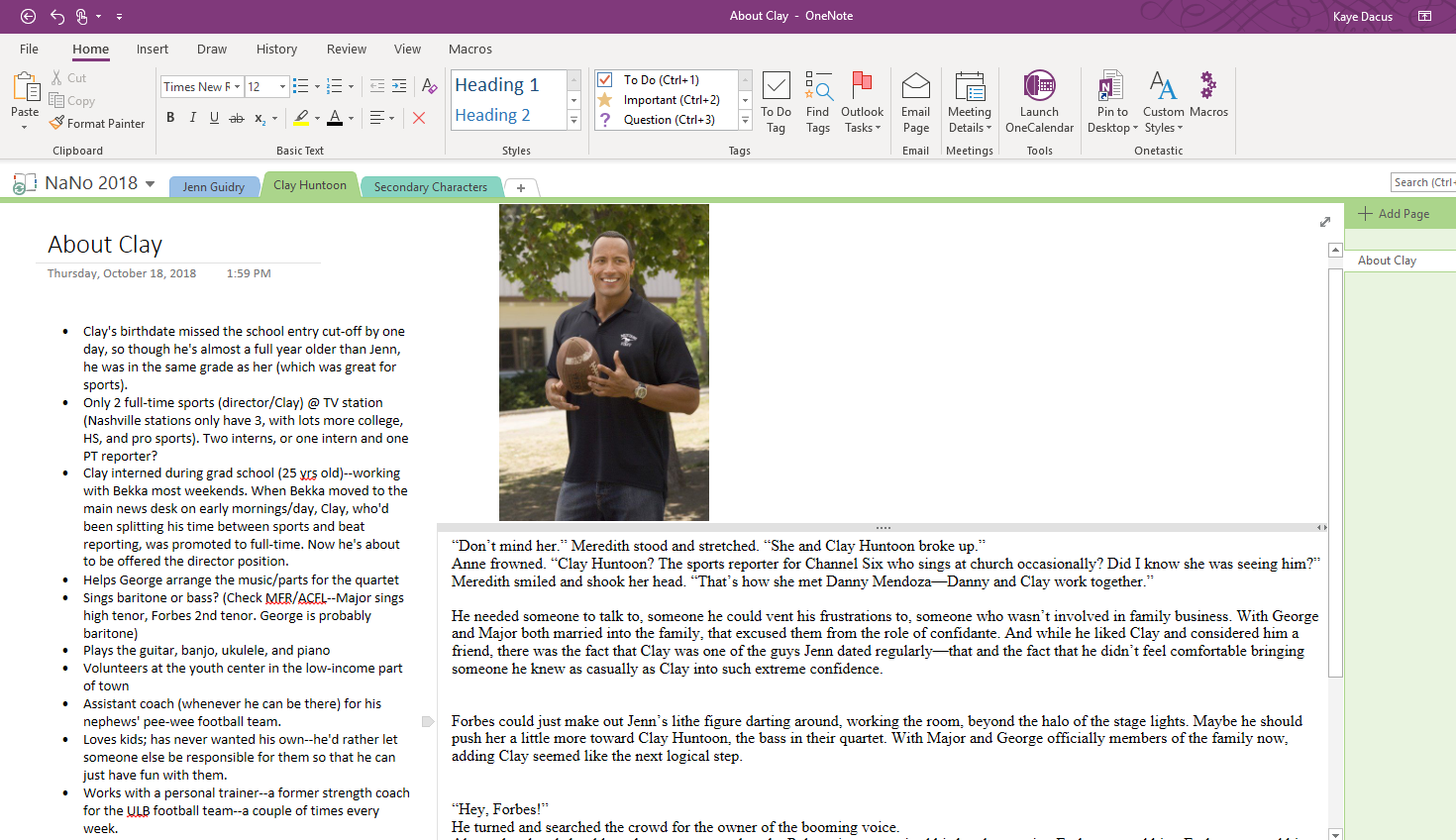
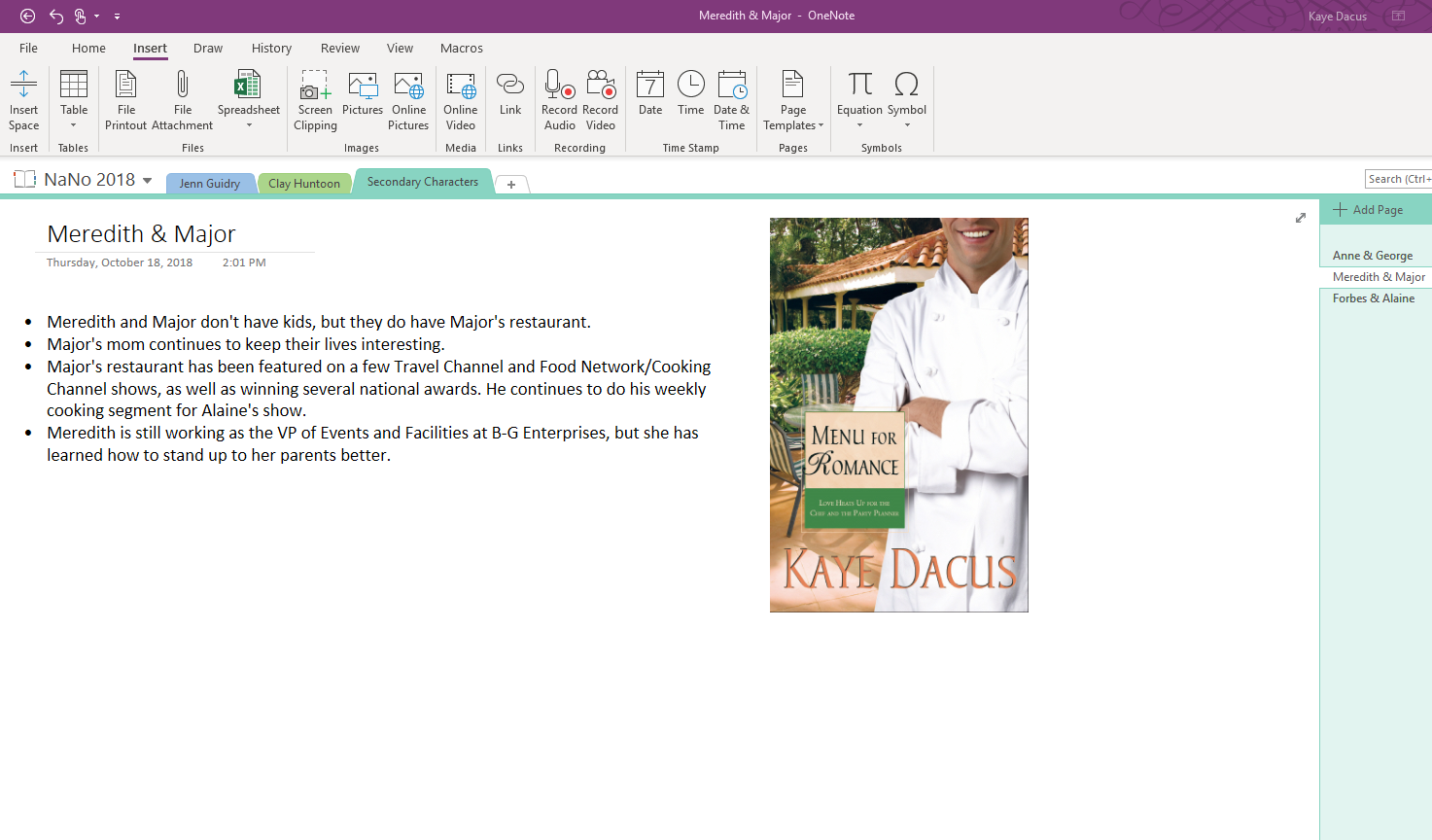
And, as you can see, since the main characters for this story are existing (secondary) characters whom I’ve known and been thinking about for a while, I’ve already added background info on Jenn and Clay—the two romantic leads of the story—including some specific info about them from where they appear in the previous books. So far, the main secondary characters I know will make appearances are the six main characters from the three Brides of Bonneterre novels.
Assignment 2: Create the Characters section(s) of your Story Bible. How do you plan to organize this? What information do you already have that you can start populating this section with? Other than figuring out how you plan to organize it and adding in what info you already know about your characters, don’t worry about how many pages you’ll need. We’ll work on that as we move forward.
Part 3: Setting
If you’re writing a world-building genre—like fantasy, science fiction, or historical—you’re going to have a relatively large section for your setting—large enough that you may want to create a subgroup (basically giving you a notebook within a notebook) or a separate notebook just for world-building. But even when writing contemporaries set in places we’re familiar with (like for me when I was writing the Matchmakers series, set in Nashville), we’re going to need a place to keep information about our settings. What do your characters’ homes or workplaces look like? Where are things located geographically? What’s the topography or weather like?
Again, because I’m returning to a previously created fictional setting, I was able to go ahead and start adding pages (all of them blank right now except for this one—and this one has info because I already had it in another OneNote Notebook).
Setting is where I tend to split things up a bit. I’ll keep the research/development part of my setting information (text) in OneNote, but I’ll collect setting images in Pinterest. It’s so much easier, and it doesn’t take up space on my computer.
In the past, I’ve also done things like hand-draw a map of my fictional city of Bonneterre, Louisiana, and hang it on the wall for easy reference. (And then I took a digital picture of it and put it in my folder of images in my cloud drive so I could access it anytime I needed it—yes, that’s it in the image from OneNote above.)
Assignment 3: Determine what details you will need to keep track of for your setting/world-building and then how you will keep track of all of that information. What tool or combination of tools do you think you’ll use?
Part 4: Props and Costumes
Our characters have to get dressed. And they need to be able to pick things up and move them around occasionally. They need personal items that make us identify with them, even if they may not personally be in the room. (And these types of details are even more significant in mysteries—you never know what little piece of detritus on the floor will lead to the killer!) In SciFi, Fantasy, and Historical genres, costumes and the general look of things lying about will be important in drawing the reader into the storyworld.
Right now, all we need to do is just create this section, because this is information that we’ll fill in as we write and discover these items that need to be tracked. And, again for me, this is an area where I’ll use both OneNote and Pinterest for keeping up with the info and the images.
- What does each character carry on his/her person?
What items would your character never leave home without? This is Doctor Who’s sonic screwdriver, Peter “Star Lord” Quill’s Walkman, or Phrynie Fisher’s golden revolver. Or think of it like this—what is something that if left behind would signal to others that your character had been there? - Location of important/key objects in the story.
Even though we don’t always see it, we always know where the One Ring is throughout the Lord of the Rings trilogy. Keep track of where you’ve placed the most precious items in your story. - Furniture, Objet d’Art, Curios, and Knicknacks.
It may seem trivial, but readers notice when the Tiffany lamp is on the table at the right-end of the sofa in one scene and on the end table next to the wing chair in another. Use your Story Bible to keep track of all the little things, too. (Though this may wait until you do your read-through of your first draft after it’s completed. But create a space for it now.) - Modes of transportation.
How do your characters get from one place to another? - Costuming.
If you’re writing a costume-specific piece (like a historical or fantasy where costuming can make quite a statement about characters on its own), you may want to include this in your character section. But whether it’s with character (a line or two about their personal style in their write-up) or pages of images for each character, you need to keep track of it. (Again, a combo of text/descriptions/research info in your Story Bible and images on Pinterest works well). - Any other “physical properties” you think you might need to keep track of.
Because the story I’m planning to work on has a contemporary setting, I really won’t have to worry as much about the costuming aspect of this section, as I do for my historicals. But it is nice to get to know a character through how they choose to dress, what their favorite shoes are, and whether or not they’re the kind of person who’ll buy five of the same shirt in the same color “just in case.”
Assignment 4: Determine how you will keep track of props and costumes. What tool or combination of tools do you think you’ll use?
I know this seems like a lot of work, but remember—you’re just laying the groundwork and getting your Story Bible set up. Most of these pages will be blank right now. You’re just creating the notebook, not actually filling it up yet!
Can’t wait to hear from you to find out how you plan to keep your story organized.
Fun Friday: What’s Your Romantic Film Score? | #AFITop100 #RomanticMovies
How many of the AFI’s “100 Years…100 Passions” romantic movies have you seen?

- Casablanca (1942)
- Gone with The Wind (1939)
- West Side Story (1961)
- Roman Holiday (1953)
- An Affair to Remember (1957)
- The Way We Were (1973)
- Doctor Zhivago (1965)
- It’s A Wonderful Life (1946)
- Love Story (1970)
- City Lights (1931)
- Annie Hall (1977)
- My Fair Lady (1964)
- Out of Africa (1985)
- The African Queen (1951)
- Wuthering Heights (1939)
- Singin’ in the Rain (1952)
- Moonstruck (1987)
- Vertigo (1958)
- Ghost (1990)
- From Here To Eternity (1953)
- Pretty Woman (1990)
- On Golden Pond (1981)
- Now, Voyager (1942)
- King Kong (1933)
- When Harry Met Sally… (1989)
- The Lady Eve (1941)
- The Sound of Music (1965)
- The Shop Around the Corner (1940)
- An Officer and a Gentleman (1982)
- Swing Time (1936)
- The King and I (1956)
- Dark Victory (1939)
- Camille (1937)
- Beauty and the Beast (1991)
- Gigi (1958)
- Random Harvest (1942)
- Titanic (1997)
- It Happened One Night (1934)
- An American in Paris (1951)
- Ninotchka (1939)
- Funny Girl (1968)
- Anna Karenina (1935)
- A Star Is Born (1954)
- The Philadelphia Story (1940)
- Sleepless in Seattle (1993)
- To Catch a Thief (1955)
- Splendor in the Grass (1961)
- Last Tango in Paris (1972)
- The Postman Always Rings Twice (1946)
- Shakespeare in Love (1998)
- Bringing Up Baby (1938)
- The Graduate (1967)
- A Place in the Sun (1951)
- Sabrina (1954)
- Reds (1981)
- The English Patient (1996)
- Two for the Road (1967)
- Guess Who’s Coming to Dinner (1967)
- Picnic (1955)
- To Have and Have Not (1944)
- Breakfast at Tiffany’s (1961)
- The Apartment (1960)
- Sunrise (1927)
- Marty (1955)
- Bonnie and Clyde (1967)
- Manhattan (1979)
- A Streetcar Named Desire (1951)
- What’s Up, Doc? (1972)
- Harold and Maude (1971)
- Sense and Sensibility (1995)
- Way Down East (1920)
- Roxanne (1987)
- The Ghost and Mrs. Muir (1947)
- Woman of the Year (1942)
- The American President (1995)
- The Quiet Man (1952)
- The Awful Truth (1937)
- Coming Home (1978)
- Jezebel (1939)
- The Sheik (1921)
- The Goodbye Girl (1977)
- Witness (1985)
- Morocco (1930)
- Double Indemnity (1944)
- Love Is a Many-Splendored Thing (1955)
- Notorious (1946)
- The Unbearable Lightness of Being (1988)
- The Princess Bride (1987)
- Who’s Afraid of Virginia Woolf? (1966)
- The Bridges of Madison County (1995)
- Working Girl (1988)
- Porgy and Bess (1959)
- Dirty Dancing (1987)
- Body Heat (1981)
- Lady and the Tramp (1955)
- Barefoot in the Park (1967)
- Grease (1978)
- The Hunchback of Notre Dame (1939)
- Pillow Talk (1959)
- Jerry Maguire (1996)
I’ve seen 48/100. How many have you seen?
A Character Study through Dialogue (aka, Got Weekend Plans?) | #amwriting #writingchallenge
 I think I’ve mentioned before that I’ve been reading the Dear Prudence advice column on Slate.com for many years now—mainly because it’s a great outlet for story/character/conflict ideas.
This week, one of the contributors came through for me in a big way—it’s the first time in forever that I’ve read one of the letters and thought, I need to use that as an example on my blog.
Here’s the post:
Q. Co-workers asking about outside life: I am one of, if not the lowest paid low-level grunts in a large corporate law firm. Well-meaning co-workers often ask, “Doing anything fun this weekend?” The answer is always “No,” because I am paid so little that I have no money to play with on weekends. Every time I get that question, it’s like a reminder that most other people have both the money and an answer to that question. And in the unlikely event I do have plans, it’s always personal and cannot be shared.
A few times I have responded honestly, saying something like “You know, I don’t like that question and the answer will always be the same.” My co-workers have pushed back immediately, suggesting that I am being antisocial. How do I politely tell my co-workers to stop asking me about my weekend? I have long since stopped asking about theirs.
The only real advice needed came from the first couple of sentences of “Prudence” (Daniel Mallory Ortberg)’s response:
A: There are a number of inappropriate questions co-workers can ask that require pushback, but I don’t think that “Doing anything fun this weekend?” is one of them. It falls under the umbrella of pleasantries that are customary to exchange at work, and requires no more than “Oh, nothing much” or “Getting some rest, I hope” or “I might see some friends” in response.
But half the fun of reading this column regularly is reading the inane (and insane) comments from other regular readers and comment trolls that frequent it. So you can imagine what kind of reaction this one got!
Then I got to thinking, as I read the onslaught of increasingly ridiculous suggestions of how this person should respond, that a response to a “socially neutral” question like this can tell us a lot about someone who doesn’t give an expected “socially neutral” (acceptable) answer. Whether it’s their sense of humor, their social anxiety, their desire to flirt with the asker, their annoyance with “socially neutral” small talk, or—like this person—their paranoia that this question is actually a means by which everyone they work with can rub their higher-salary-status in their face.
How Would Your Character Answer?
To keep dialogue from being boring, you can use an interaction in dialogue like this to show something of your character’s personality.
For example:
- “Got any plans for this weekend?”
“I’ll tell you, but first I need you to take a blood oath that you’ll give me an alibi.”
. - “Got any plans for this weekend?”
“Yes—I just got the shipment of seeds and the new seedling starter I’ve been waiting on. I plan to spend all weekend up to my elbows in the dirt!”
. - “Got any plans for this weeken—”
“No.”
“I was just asking—”
“And I was just saying no.”
And so on.
Your turn—what can you tell us about a character just by the character’s response to the question: “Got any plans for this weekend”?
Writing with Depression — A Work in Progress | #amwriting #depression #anxiety #healing
Photographer: Nick Youngson (Source)
I started writing when I was a teen, and it was always part of my life, something I was compelled to do. Family members told me they always knew I’d turn out to be a published author because I was always writing or at least had something with me to write on in case inspiration struck.
In the past, I’ve brainstormed one of my (now published) series on the paper table cover at a dinner/concert at a church (Everywhere is a good place to brainstorm a story!), written on programmes at events, and even gone through a pile of paper napkins at the Bluebird Cafe while hosting some out of town guests (“Stealing” Writing Time).
Over the past 25+ years since that first depressive episode, I’ve struggled with cyclical depression, but never anything as bad as that first bout. And never anything that killed my desire to write.
Until the early 2010s.
You’ve Lost that Loving Feeling…
I was a “full-time writer” (i.e., I was barely scraping by with freelance editing work in order to write the three trade-length books per year that I was contracted for). And suddenly, my writing had become something I never wanted it to be…a job. It was work. It was no longer enjoyable. It was no longer an escape. Rather than relieving my anxiety (yes, I have mild generalized anxiety as well), it created massive levels of anxiety. Rather than provide a way to boost my mood, it made my depression worse.
It’s now five years since my last book came out (nearly six since I finished writing it). For at least four of those years, I didn’t write anything. I didn’t want to write. The compulsion was gone because the joy was gone.
If you have depression (or love someone who does), you know that one of the major signs is loss of interest in hobbies or activities formerly loved. So for me, no longer having a passion for writing spiraled me down into another major depressive episode—this time, enough that I was having what I told my doctor were “annihilative” thoughts. I didn’t want to do self-harm, but I thought the world and I would be better off if I just didn’t exist anymore. (It didn’t help that this coincided with the worst financial situation I’d ever been in, given that I’d been laid off my full-time job four years before and didn’t see any financial relief in sight–thus the writing=work situation.)
Even though I got a great full-time job soon thereafter (as well as “better living through pharmaceuticals”), the desire to write didn’t come back. And if I thought I might be able to jump-start it by sitting down to write, as soon as I did, I’d have a major anxiety episode.
So I set writing aside. Maybe I was only meant to be a writer for that period of my life. Maybe I wasn’t meant to be a writer my entire life.
Maybe I Have a Little More Story in Me
Two years ago, something started happening in my brain. First, little seeds. Then little seedlings. Eventually, vague ideas of a character or setting or situation or story. When 2017 started, I set a goal for myself that I’d make myself start writing again—that I would plan out and write a story (short story, novella, or whatever it became) by the end of the year. I had an idea—I even had a great title—but the characters and story never formed. And instead of sticking with it, I ended up buying a house and moving to another city 50 miles away instead.
This year, I decided to go back to an activity that was part of what helped me overcome my first major depressive episode. Instead of focusing on “writing a story,” I’ve been focusing on “being creative.” I’ve spent the past several months working on creating a fictional city (Welcome to Gossettville!). I’ve been “populating” it along the way—doing some character casting, which has always been one of my favorite creative activities—and have roughly sketched out a couple of character and/or story ideas, as they related to building this fictional city.
And though I occasionally have random creative thoughts about it that I feel compelled to write down, I’m still at a point at which I have to schedule time to make myself sit down to work on it—or else I won’t. But when I do, I can actually find myself getting lost in the creative process and spending a lot longer working on it that I’d originally planned.
So while the passion for writing hasn’t returned, at least it’s starting to make a few cracks in that hard black shell of depression. Enough that it makes me want to keep at it in order to see if if I can ever break through.
If you live with depression, or have experienced a depressive episode, how has it affected your writing—or other creative endeavors? Have you had breakthroughs that have allowed your passion to overcome the depression?
Welcome to Gossettville!
As I posted on Instagram several months ago: “My first published novel grew out of a fictional city I’d created and been playing around with for years. So I’m taking myself back to square one and starting a new fictional city in hopes of jump-starting my writing after five years away.” I’m happy now to introduce you to GOSSETTVILLE, my new fictional setting, by way of a fictional marketing spiel!
Welcome to Gossettville!
If you take Exit 58 off Highway 112, it will take you through the wooded mountains of Yarrow Lake State Park into the heart of Historic Downtown Gossettville. Settled and founded by Donnal Gossett in the early 1800s, the main features today are the painstakingly restored Victorian-era rowhouse buildings that surround the 1830s courthouse in the center of the Courthouse Commons park. These three- and four-floor buildings—which feature unique facades and a variety of colors, and used to be homes for the earliest residents of Gossettville—are now home to a thriving retail and business community, providing retail space on the street level and office spaces above.
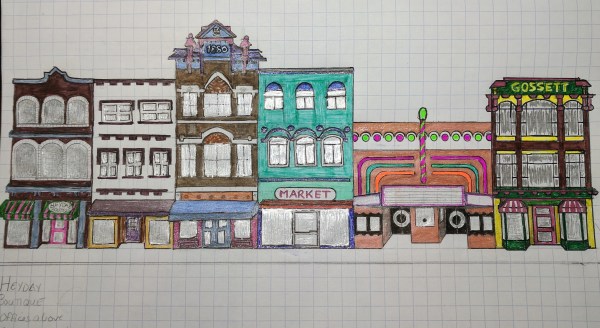
Artist’s rendering of a block of Historic Downtown Gossettville buildings.
Image ©2018 by Kaye Dacus, Do Not Copy or Share without Permission
Venture outside of Historic Downtown and you’ll get to explore a plethora of unique and diverse communities providing a wide variety of entertainment, dining, shopping, staying/playing, and living options. Looking for a house to buy or a vacation rental? Check out Tiny Town Village—an entire neighborhood celebrating small-space living. Need more room? Gossettville boasts vacation rentals of all sizes and all the real estate opportunities a new resident could desire. You’ll definitely want to give one of Gossettville’s historic Bed & Breakfast inns a try. Visitors can find any level of comfort for your stay—from rustic campsites to five-star luxury spa hotels and all-inclusive resorts.

Golden eagle in flight. (Source)
Avid anglers will want to get in touch with Gossettville’s Anglers’ Club to learn all the best places and tackle for fishing Yarrow Lake and the myriad of surrounding streams and rivers. And be sure to join us for the Biggest Fish Fry, where everyone gets to feast on the results of the Annual Yarrow Lake Fishing Tournament (Labor Day Weekend each year). Hunters, be sure to visit the Gossettville website for this year’s calendar and information on permits and licenses for everything from deer and wild turkey to quail, rabbit, and waterfowl. The Yarrow Hunting Club hosts its annual field trials the week of Memorial Day each year in association with the Gossettville Wildlife Management Area, with demonstrations and competitions for field and water hunting dogs.
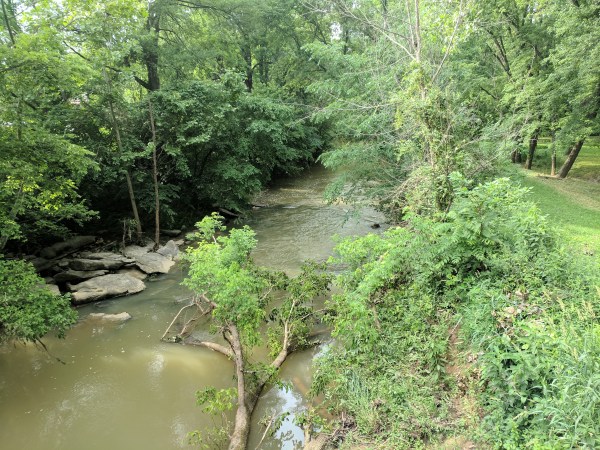
Inspiration for a fishing spot in Gossettville
Photo ©2018 by Kaye Dacus, Do Not Share or Copy without Permission
At normal pool, Yarrow Lake has a surface area of 21,900 acres, a maximum depth of 85 feet, and an average depth of 35 feet. The lake is fourteen miles long and three miles wide and, between the perimeter and the islands, has 192 miles of shoreline. This means there are plenty of marinas where you can rent or slip boats, pontoons, and houseboats, along with all kinds of other water toys. There are also five designated swimming beaches—two of which are on the biggest islands in the lake—complete with grills and picnic pavilions.
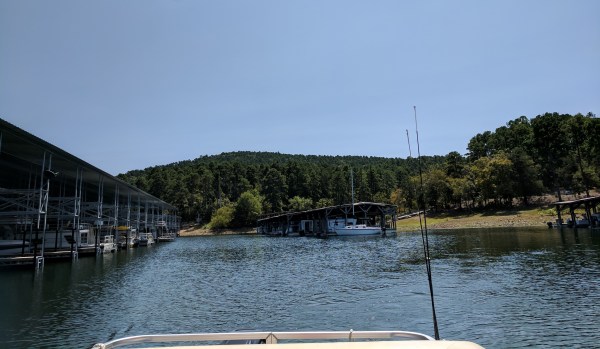
Inspiration for Yarrow Lake.
Photo ©2018 by Kaye Dacus, Do Not Share or Copy without Permission
When the weather turns cold and the snow starts to fly, strap on your skis or snowboard to enjoy one of Gossettville’s three downhill ski parks, featuring world-class ski slopes from green circle to black diamond. Or take off cross-country and ski or snowshoe some of the area’s most beautiful nature trails. Don’t forget about tubing and sledding, and indoor or outdoor ice skating—and snow machine rentals and trails, as well.
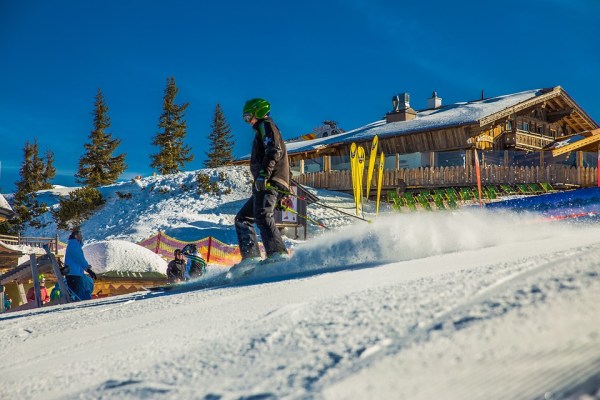
Inspiration for a ski resort in Gossettville. (Source)
After playing hard all day, you’ll be hungry! Explore the wide range of dining options in each unique community within Gossettville. Can’t decide? Let us suggest starting in Historic Downtown, where there’s a restaurant on nearly every corner—and then some! From there, you can work your way out and experience all the delicious food and rousing entertainment the city has to offer.
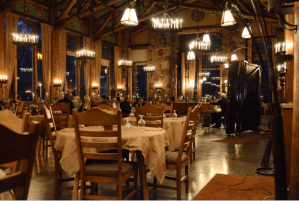
Inspiration for a restaurant in Gossettville. (Source)
Music lover? Many bars and restaurants around the area regularly feature live music, and the Gossettville Civic Center hosts some of the highest-demand music tours each year. Each August, the Gossettville Music Fest brings together all genres of music with live performances on multiple stages at the Rose Bay Waterfront Park. And don’t forget to check the schedule of the Gossettville Choral Society. The GCS performs several times each year, and the December holiday and Memorial Day concerts with the Gossettville Symphony are the most popular—so get your tickets early!
Whether your idea of fun and relaxation is a tent in the woods and a fishing boat on the lake or a five-star resort and a day at the spa, Gossettville has everything you’re looking for. We look forward to seeing you soon!
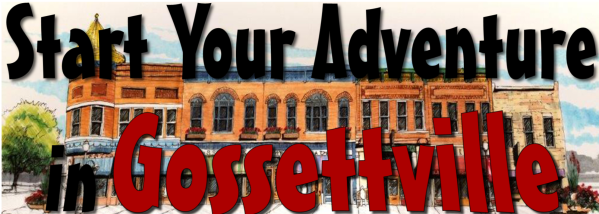
Gossettville adventures coming . . . soon, hopefully!
Does a Fictional City Need a Specific Location? A Poll | #amwriting
If you follow me on Instagram, you may have seen me post this over the weekend:
Or, you may have seen me post this on my Facebook page:
So, now that I’m deeply entrenched in creating this fictional city, I have a question for you as readers and/or writers.
If it’s made known that the city is in the United States—and perhaps a general geographic region given—does it matter to you as a reader if the state is never specified?

 KayeDacus.com