The Struggles of Getting Ready for #NaNo
Cute article on Buzz Feed:
17 Struggles Of Getting Ready For NaNoWriMo
NaNo starts tomorrow. Are you ready?
#NaNo Prep: Feet to the Fire Time—Post Your One-Paragraph Pitch/Summary for Your NaNo Story
If you’ll remember (or if you’ll go back and read it now), last week we discussed how to figure out what your story’s about before you start writing. A big part of that post is on writing your one-paragraph pitch/summary.
So now it’s time to put your feet to the proverbial fire and make you do it.
Share your one-paragraph pitch/summary for the story you’ll be writing during National Novel Writing Month.
If you would like to give feedback on others’ paragraphs, please do so in an encouraging and positively constructive manner. It’s a big risk for some people to be vulnerable enough to share their ideas, much less to do so in front of strangers.
I’ll go first, using the James Scott Bell formula (this is rough—I’m still really in the planning stages for this one) . . .

Trenna Keating, the Real World Template for Jenn Guidry
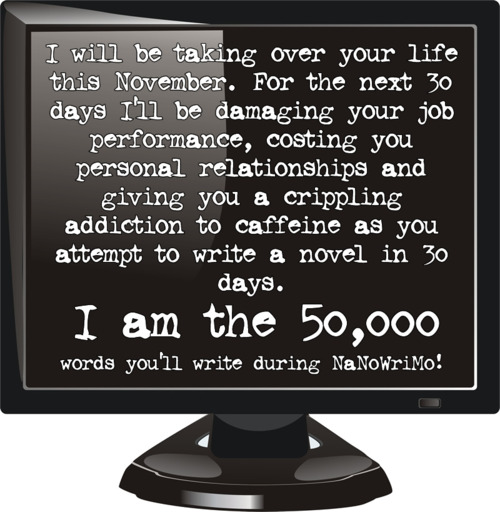
I am the 50,000 #NaNo
I’ve seen this floating around on Pinterest and a few writing blogs, so I thought I’d jump on this meme.
Quick Reference Resources for NaNo or other Writing Marathons
As we looked at last week, when you’re fast drafting, or draft writing, you need to be able to get through your word-count quickly, which means that if you must stop to look something up, you need to make sure you’re not wasting time doing it. So here are some quick-click reference resources that you can bookmark to allow you to look something up quickly and then get right back to writing.
Language/Grammar Resources
Does that word mean what you think it does? Are you using the correct spelling of a homophone?
Dictionary.com
I can’t quite think of the right word, and I’m not going to be able to move forward until I do.
Thesaurus.com
How would a character say this in his native language?
translate.google.com*
*take these translations with a grain of salt—and check with an actual speaker of that language after you finish your first draft.
I just can’t continue writing until I know how to punctuate this.
University of Chicago Press Quick Guide to Punctuation (pdf)
How do I punctuate dialogue?
Where Do I Put the Quotation Marks?
Writing Resources
Help! I can’t think of a name for this character!
Behind the Name: Random Name Generator
Seventh Sanctum Fantasy Name Generator
Victorian and Steampunk Name Generator
Ack! I have this Scrivener/Word/OneNote/Evernote software, but I’m not quite sure what to do with it!
Scrivener Knowledge Base
Microsoft Word FAQ
OneNote Tips
Learn How to Use Evernote (video)
Health and Wellness Resources
My wrists/back/bum/neck/shoulders hurt.
Ergonomics Exercises
My eyes hurt!
How to Exercise Your Eyes
I’m hungry, but it’s not mealtime and I want to stay healthy.
100 Healthy Snack Ideas
I don’t have time to cook meals, but my family is counting on a hot meal.
101 Fall Crock Pot Recipes
15-Minute Dinner Recipes
I’m blocked/burned out and I just want to quit writing.
Encouragement for Writers
___________________________________
What resources do you have that you can share?
NaNo Prep: Setting Daily Word-Count Goals and Tracking Your Progress
Two main things that can really help motivate you (or discourage you) when you’re participating in a marathon writing challenge are setting daily word-count goals and then tracking your progress.
Setting Daily Word-Count Goals
When you know you have a certain total word-count you want to reach by a certain date, you need to break it down into smaller, more easily achievable goals.
But before you even start looking at numbers, you need to look at your calendar.

November is always a busy month!
If you are serious about writing 50,000 words in the month of November, you’ll have to look at the events you already have on your calendar and make decisions on what’s going to take priority. For me, because I’m not on an other-than-self-imposed deadline for the first time in nine years (between grad school and publishing), things that I want to do that aren’t writing-related are allowed to take priority—things like movies I really want to see (Thor and Catching Fire) and TV show premieres I’ve been waiting a VERY long time to see (Almost Human starring one of my two main men, Karl Urban). Then there are three very important LSU football games (though I’ll give up the Alabama game in favor of seeing Thor depending on what time my BFFs want to go). I’ve also got a writing group meeting not only to attend but for which I will prepare and present a two-hour workshop, so I need to allow time for that.
And, of course, don’t forget about Thanksgiving, Americans. Even if you aren’t hosting/preparing the meal, you still need to account for traveling (whether within your city or to family elsewhere) and time to spend with friends and family throughout that weekend. I will probably not do much, if any, writing during the four days blocked off at the end of the month (or the Sunday following) from wanting to spend time with my family those days.
Once you know on what days you won’t be able to write (for me, I’m going to say it’ll be 10 days out of 30), then you will be able to better calculate a word-count goal for each of the remaining days of the month.
So if I decide to try to participate in NaNo and get 50k words written (which would be the entire manuscript of the story I’m currently working on, which would make it the shortest complete manuscript I’ve ever written), I am going to have to set a daily word-count goal of 2,500 words—or at least one chapter a day—for each of the 20 days on which I think I’ll be able to write.
Tracking Your Progress
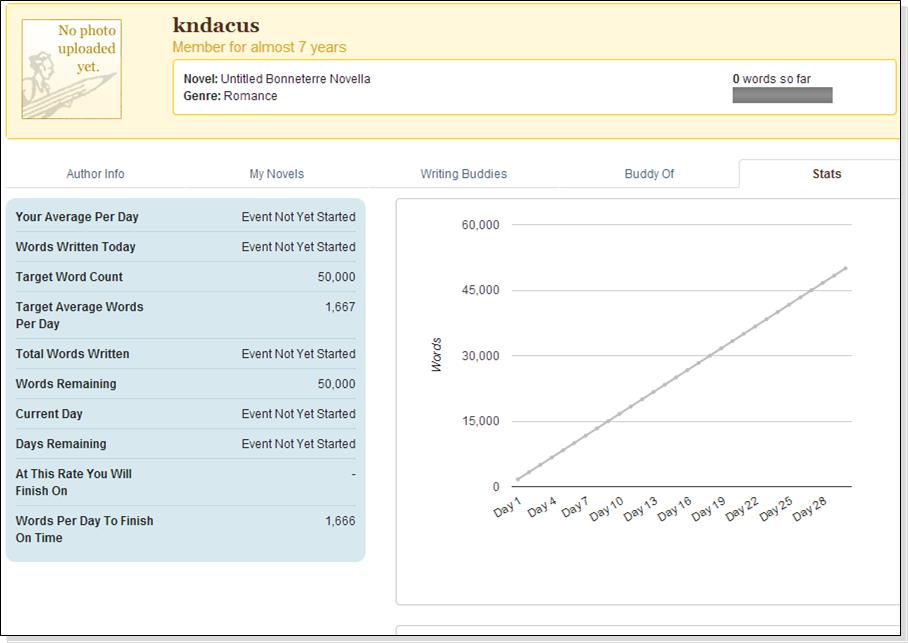
NaNo Tracking
If you are participating in NaNoWriMo, their website has built in tools for tracking your writing and determining your progress. I’ve never participated officially, so I don’t know how well this works or what the interface looks like beyond the above pictured screen.
 If you want to track your progress during November but then also continue tracking it beyond NaNo, I highly recommend StoryToolz.com. (You can click on the image on the left to see screen captures of just a few of the available features. You can also see my StoryToolz tracker for my story-in-progress in the right-hand sidebar.)
In addition to graphing your progress, StoryToolz will show you a spreadsheet of your progress (click History) and a summary of your project and progress (click About).
And, as you can see in both the cropped image on this page and in the larger, extended edition when you click through to the full image, you can have more than one progress meter going at a time. It’s very easy to pull the HTML code and add it to your website (as I’ve done). I believe there are also other options for how you can share your progress meters through other social media sites.
Of course, if NaNo and StoryToolz aren’t for you, you can always go “old skool” and track it privately in a spreadsheet on your computer.
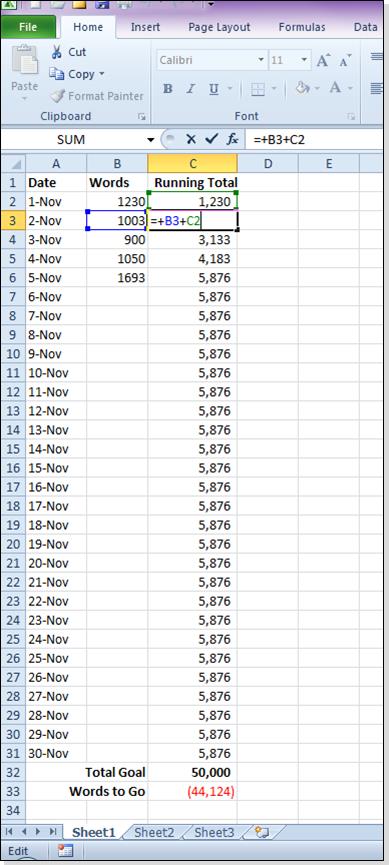
If you don’t know how to set up the formulas, just ask. I’ve been doing spreadsheet formulas for over twenty years now.
FOR DISCUSSION:
How many days in November will you really be able to write?
What does that mean your daily word-count goal for the designated “writing days” will be?
How will you track your progress?
NaNo Prep: Draft Writing vs. Regular Writing
One thing that can make a writing marathon like NaNoWriMo discouraging and make writers want to give up is the failure to realize the difference between draft writing and regular writing.
Regular Writing
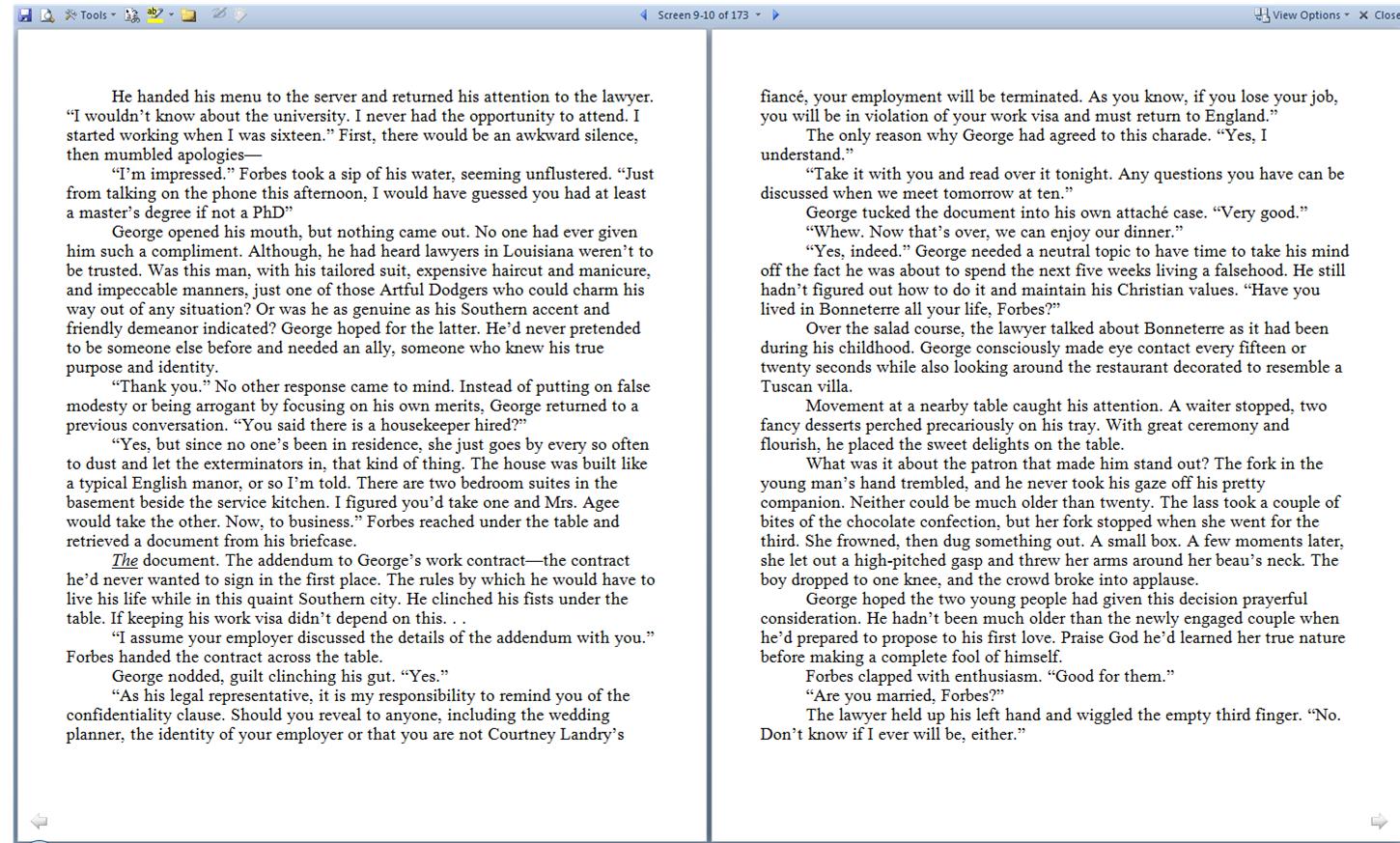
What Regular Writing looks like.
- In the process of regular writing, you may take the time to re-read what you’ve already written, maybe do a little tweaking or editing on that, before you start writing for the day.
- If you can’t think of the correct word or phrase you want to use, you’ll pause, go to thesaurus.com or some other resource and search until you find just the right term for your prose, then go back to writing.
- You may run across something that needs to be researched. Maybe it’s how to change the oil in a 1957 Ford Mustang. Maybe it’s the correct title for the crew member on the ship who serves the captain’s dinner. So you pause, pull out your reference book or start searching online until you know exactly what you need to know. You incorporate that information, and then you go back to writing.
- A minor character comes on the scene. You think this person may show up again—may even become a secondary character—but you need to know a little more about him. You need to know his name, a bit about his background, what he does, and what role he has in the story. So you pause, go to your Story Bible and start an entry for this character. Then, once you know exactly what you need to know, you go back to writing.
- You get to the end of a piece of dialogue, and you’re not sure exactly how you want to tag it. So you pause and sit back. Do you want to use a “said” or “asked” tag? But those are so passe. Perhaps something with an adverb? No. Adverb tags are of the devil, you heard at a conference once, so better not do that. Maybe an action tag? Okay. Where are the characters in the space and in relation to each other? How would the character move? What’s the facial expression? Maybe you should act it out. Once you have the perfect tag, you get it down in words and continue writing.
Are you getting a picture here of what “regular” writing is?
Draft Writing

What Draft Writing looks like.
- In drafting, you may take the time to re-read the last few paragraphs of what you wrote the day before to remind yourself where you left off, but you don’t make any changes and you immediately start writing as soon as you finish reading.
- If you can’t think of the correct word or phrase you want to use, you type ____________ and then may even use the comments feature to highlight it and type a reminder to yourself to look it up later and then resume writing.
- You may run across something that needs to be researched. Maybe it’s how to change the oil in a 1957 Ford Mustang. Maybe it’s the correct title for the crew member on the ship who serves the captain’s dinner. So you type ___________ and use the comments feature to highlight it and type a reminder to yourself to look it up later and then resume writing.
- A minor character comes on the scene. You think this person may show up again—may even become a secondary character—but you need to know a little more about him. You need to know his name, a bit about his background, what he does, and what role he has in the story. So you type ___________ and then may even use the comments feature to highlight it and type a reminder to yourself to make it up later and resume writing.
- You get to the end of a piece of dialogue, and you’re not sure exactly how you want to tag it. So you write “he said” or “she asked” and then type ___________ and use the comments feature to highlight it and type a reminder to yourself to write something better later and then resume writing.
Are you catching the difference between regular writing and drafting?
In drafting, the most important thing to do is get the bones of the story down in writing. It doesn’t have to be perfect. It doesn’t even have to be good. That’s what the second, third, fifth, tenth draft process is for.
Forget about “getting it right.” Just get it written!
NaNo Prep: Taking Pre-Planning Your Story a Step (or Seven) Further with an Outline and/or Synopsis
In addition to the blurbs and one-page synopsis that you can do in preparation for a marathon writing session like NaNoWriMo, you can go ahead and try writing out a full synopsis. A full synopsis can be anywhere from five to ten pages, but the general rule of thumb one synopsis page to every 15–20k words of your novel (so a 100k-word novel will melt down to a 5–7 page [double-spaced] synopsis).

Partial seven story beat structure for Turnabout’s Fair Play with columns for both romance storylines.
The structure I’ve found that works best for me is the Seven Story Beat structure from Writing the Romantic Comedy by Billy Mernit. Don’t let the title fool you—as you’ll see below, this structure applies well to just about any story.
1. The Setup/Hook
“A scene or sequence identifying the exterior and/or interior conflict (i.e., unfulfilled desire), the “what’s wrong with this picture” implied in the protagonist’s (and/or antagonist’s) current status quo” (Mernit 110).
This is the introductory scene of your story and your synopsis—the opening hook and introduction of your main characters. As with all opening scenes, this is the establishment of that character’s story goal, as well as hinting at the main conflict for the entire novel. In a synopsis, you should focus on the one or two main characters (possibly as many as three if they’re closely tied together) who are involved in the main plot of the story.
Example from the movie Witness: (adapted from Wikipedia)
After the death of her husband in Lancaster County in 1984, young Amish woman RACHEL LAPP decides to take her eight-year-old son, SAMUEL, into the outside world for the first time on a trip to Baltimore, Maryland, to visit her sister. Traveling by train, Samuel is amazed to see people different from him and sights such as a hot air balloon.
2. The Inciting Incident
“The Inciting Incident brings the main characters together and into conflict; an inventive but credible contrivance, often amusing, which in some way sets the tone for the action to come” (Mernit 111).
Beat 2 should follow Beat 1 in close succession—after all, it’s the Inciting Incident that gets the story rolling. It’s the story hook that keeps us reading.
You’re probably more aware of Inciting Incidents than you think. Whenever you start talking with your friends about any type of storyline—a book, a movie, or even an episode of your favorite television show—inevitably someone will start analyzing what led up to it. What was it that put everything in motion? What’s the first important thing that really pulls you into the story? In other words, what was the Inciting Incident?
Example from the movie Witness: (adapted from Wikipedia)
When waiting to change trains at the 30th Street Station in Philadelphia, Pennsylvania, Samuel uses the men’s room. As he does so, he accidentally witnesses the brutal murder of a police officer.
3. The First Turning Point
“Traditionally occurring at the end of Act 1, this is a new development that raises story stakes and clearly defines the protagonist’s goal; it is most successful when it sets characters at cross-purposes and/or their inner emotions at odds with the goal” (Mernit 112).
The First Turning Point of your story is the event that happens to set your characters at cross-purposes with each other, to complicate things, to start building to the ultimate conflict yet to come.
Example from the movie Witness: (adapted from Wikipedia)
CAPTAIN JOHN BOOK takes Samuel and his mother to the police station and has Samuel study pictures of convicts and a police line-up to identify the murderer, but Samuel does not see a match. However, after wandering around the police station, Samuel sees a newspaper clipping with a picture of Lieutenant James McFee and identifies him as the man he saw at the train station.
4. The Midpoint/Raising the Stakes
“A situation that irrevocably binds the protagonist with the antagonist and has further implications for the outcome of the relationship” (Mernit 113).
This is taking the conflict you’ve just raised at the turning point and continuing to raise the stakes: throwing as many twists and turns and conflicts as you can at the characters to keep them from resolving the plot question as long as possible. (In the example, conflicts that raise the stakes are bold/red—obviously, you wouldn’t do that in a formal synopsis.)
Example from the movie Witness: (adapted from Wikipedia)
Book reports to his superior officer, Chief Paul Schaeffer, saying that McFee was responsible for a drug raid where expensive chemicals used to make amphetamines were discovered, but never reported to the police department. The police officer who was murdered was investigating the disappearance of these chemicals which, if sold, would make McFee a very wealthy man, hence he was murdered to ensure silence. Schaeffer advises Book to keep the case secret so they can work out how to move forward with it.
Later, when Book returns home, he encounters McFee in a parking garage. McFee tries to shoot him but Book draws his own gun and, after a fierce shoot-out, McFee flees the scene—but not before Book is wounded. Book realizes that since he only told Chief Schaeffer about McFee’s corruption, then Schaeffer must be corrupt, too. Book then phones his partner and tells him to remove all the police files that include the Lapps’ details, and that he is going into hiding. Schaeffer, McFee, and Fergie (the second murderer) start their hunt of Book.
Book returns Rachel and Samuel to their farm in Lancaster County, but as he is about to leave, he passes out from loss of blood as a result of McFee’s gunshot. He cannot go to any mainstream doctors or hospitals, as they will make reports, and McFee will find and kill him and the Lapps. Rachel’s father-in-law, who also lives at the farm, reluctantly agrees to shelter Book in their home for the sake of his grandson and daughter-in-law’s safety. Eli recruits an Amish apothecary to treat Book’s gunshot wound using traditional Amish methods.
Book stays with the Amish for some time, learning their ways, helping out around the farm, and becoming part of Rachel’s and Samuel’s lives—and begins to fall in love with Rachel along the way, which creates friction between Book and Daniel, the Amish man who wants to marry Rachel.
5. Swivel: Second Turning Point
“Traditionally occurring at the end of Act 2, stakes reach their highest point as the story goal’s importance jeopardizes the protagonist’s chance to succeed at his/her state goal—or vice versa—and his/her goal shifts” (Mernit 115)
The Second Turning Point is basically the straw that breaks the camel’s back. It’s almost “Inciting Incident Part II”—an event that leads the characters to make a turning-point decision that will lead to the climax of the story.
Example from the movie Witness: (adapted from Wikipedia)
After he’s been with the Amish for a while, Book goes into town to telephone his partner; but he is informed that his partner has been killed [incident]. Enraged, Book calls Chief Schaeffer’s private residence (where he cannot be traced), openly calling out Schaeffer on his corruption and stating that he is through with hiding and is going to hunt down Schaeffer and McFee instead. While returning to Eli’s farm, Daniel is harassed by local punks who defile Amish culture and pacifism. Book then confronts the tormentors, and when one of them harasses him, he strikes back and breaks the nose of one of the punks [turning-point decision]. The fight becomes the talk of the town, and makes its way to the local sheriff.
6. The Dark Moment/Crisis
“Wherein the consequences of the swivel decision yield disaster; generally, the humiliating scene where private motivations are revealed, and either the relationship and/or the protagonist’s goal is seemingly lost forever” (Mernit 115).
This is when the conflict rises to such a crescendo that it seems insurmountable.
Example from the movie Witness: (adapted from Wikipedia)
Book tells Rachel he is leaving the next day. However, before Book gets a chance to leave the farm, Fergie, McFee, and Schaeffer arrive and threaten Rachel and her father-in-law. Book, who is in the barn with Samuel, orders Samuel to run to the neighbors’ for safety. Using Samuel’s lessons about the grain silo, Book tricks Fergie into entering the silo, then releases a cascade of corn which suffocates Fergie. Book grabs Fergie’s shotgun, then uses it to shoot McFee dead. Meanwhile, Samuel rings the bell on his farm, alerting their Amish neighbors that help is needed. When a crazed Schaeffer threatens to kill Rachel, Book surrenders to him.
7. Resolution
“A reconciliation that reaffirms the primal importance of the story goal; an ending that provides satisfaction to the reader” (Mernit 116)
The Resolution, as the name of this beat implies, is the denouement and ending of the story—“the marryin’ and the buryin’” as Mark Twain called it. It is the resolution of the Dark Moment/Crisis and the resolution of the relationship between your characters. In your book, this can be anywhere from a few paragraphs to a few pages to a chapter. So in your synopsis, it can be anywhere from a sentence to a paragraph or two. Note: It is very important to include the entirety of the resolution in a formal synopsis.
Example from the movie Witness: (adapted from Wikipedia)
However, at that moment, a large number of Amish arrive at the Lapp farm in response to the bell. Schaeffer, realizing he cannot murder everyone, knows he has lost and allows Book to disarm him. The local police arrive, and Schaeffer is taken away.Afterwards, as Book prepares to leave, he shares a quiet moment with Samuel, then exchanges a silent, loving gaze with Rachel. Eli bids Book goodbye on his return to Philadelphia by saying, “You take care out there among them English,” showing his acceptance of Book as one of the community. As Book drives away from the Lapp farm, he passes Daniel, who has presumably come to resume his courtship of Rachel.
When I put all of these examples together in a separate document, it comes out to more than one single-spaced page, so it would need to be edited down for one of those, but, for a full synopsis could include so much more of the story.
No, you don’t have to write a synopsis like this or work with an outline like this—but when you get stuck around the 30,000-word mark, having even just one or two scene ideas for each of these seven points can help in regaining momentum and continuing to write.
__________________________________________
Work Cited:
Mernit, Billy. Writing the Romantic Comedy. New York, NY: HarperCollins Publishers Inc., 2000.
“Witness (1985 film).” (2013, October 22). Wikipedia. Retrieved October 22, 2013, from http://en.wikipedia.org/wiki/Witness_(1985_film)
NaNo Prep: Figuring Out What Your Story’s “About” Before You Start Writing
One of the essential ingredients in pre-planning your writing in order to be able to churn out a high word count in a short time span is to know what your story is about before you start writing. And there are several exercises you can do to figure this out. (And this makes another good section to put in your Story Bible.)
The One-Paragraph Marketing Blurb
This is some of the most fun “synopsis” writing you will ever do . . . because this is practice for hooking people on your story idea in one paragraph or less. Basically, you’re practicing writing back-cover copy in this exercise.
- Explain your story in four or five sentences.
- What is the main plot of the story?
- What is the major conflict in the story?
- Who are the characters (no more than three, preferably one or two) who are the stakeholders in the plot?
- What is the hook/question you can end with to make people want to know more? (Doesn’t have to actually be phrased as a question.)
- Study back-cover copy of your favorite books.
- Read the marketing copy on Amazon or author or publisher websites.
The James Scott Bell Formula for the one-paragraph blurb:
Start with three sentences1. [Name] is a [description] who wants/is struggling with [goal].
2. But when [something happens], [Name] has to [change direction].
3. Now, [Name] must [go do something] or else [something bad will happen].Expand it with one or two more sentences to make it even more compelling (and to give a hint at where/when it’s set).
Your blurb should be between 75–200 words, with around 100–150 being an optimum length for one-sheets and proposals and websites and back-cover copy.
- Sample Blurb using the JSB Formula:
Luke Skywalker is a farmboy who wants to escape his life of drudgery by enrolling in the Imperial Academy. Before he can, one of his uncle’s new androids begins to malfunction and then runs away, so Luke must go after him or face his uncle’s wrath. But when Luke finds the rogue droid and hears a distress call from a beautiful princess, he finds himself embroiled in a war that could spell doom for the entire galaxy.
The One-Page Synopsis
Expand your one-paragraph summary to a one-page (single-spaced) summary. This is your chance to tell your story in about 500–800 words. Focus on your main character(s), the main theme (one or two), the inciting incident, the conflict it causes, the climax, and the resolution. This is about the length of the pitch you want to prepare for a 15 minute appointment with an editor or agent, or what most contests these days are looking for you to submit along with your pages.
What-if, Why, When, Who, and So On
Before you start writing your story, write down all of the questions, ideas, and leading questions you can think of. When you write out your story summary, what questions come to mind? When you think about your plot and main conflict, what are the what-if scenarios they bring up for you? When you write out your characters’ backstories, what ideas do their experiences, personalities, strengths/weaknesses, etc., give you for ways you can test them (or torture them, as that’s a lot of fun, too)?
Scene Cards
 I’ve shown this photo many, many times here, but I like trotting it out. I use the large 4×4 (I think) lined Post-it Notes to do scene cards. Using my synopsis (and usually what I’ve already written) I created viewpoint-character color-coded scene cards for the scenes I know I need/want in the story based on all of the previous work I’ve done (and since I’ve been writing books over the last four years that were sold based on the long synopsis, most of those scenes came from culling the synopsis for them). I then also do the what-if/why/when/who exercise from above and write out additional “possible” scene cards. You can be as low-tech as Post-it Notes on a wall or as high tech as doing it in any of several pieces of software that we’ve already discussed.
You Don’t Have to Know the Whole Story!
With all this said, let me be clear in stating that you don’t have to know everything about your story before you start writing. Most of us are not detailed outliners who know every single scene, every single conflict, that will take place in the story. That’s most of the fun of writing for the majority of us—having something come up and surprise us as we’re writing. But this caveat does lead into the discussion for today:
FOR DISCUSSION:
What do you need to know about your story before you start writing in order not to get stuck 10,000 words in?
NaNo Prep: Creating a Style Sheet
One of the most important things you can do in preparation for starting a new project is to make lists. We’ve been covering a lot of the information that usually would go on these types of lists, but I don’t want to leave a very important list out.
The Style Sheet
When I was editing, I kept a style sheet for every manuscript I worked on—especially when I was working on a series. I needed to ensure continuity in spelling, capitalization, and punctuation (hyphenation, accent marks, etc.) of everything that couldn’t be found in the dictionary; was foreign, archaic, regional, or unfamiliar (jargon, techy, medical, etc.); or that was fictional/made up. I needed to make sure names were spelled the same way all the time (was it Kristen or Kristin?).
These are SOOOOOOOO helpful, not just to an editor, but also for yourself both in your revision process and as you go forward in a series so you can maintain consistency in the way you do things. For example—I should have done this during my revision process on Ransome’s Honor—before it ever went out to publishers and got contracted—because there were certain words/terms that were historically accurate capitalized that got lowercased or that, when used in different contexts should be uppercased or lowercased. I also should have done it for myself during the editorial process to make the editing of the second book easier because I wrote things out differently in Crossing: aye-aye instead of aye, aye; poop-deck instead of poop deck and so on. If I’d kept my own style sheet, I could have saved the editor a LOT of time!
So what should you include on a style sheet?
Unusual, foreign, archaic, uniquely spelled, and made-up names. You don’t think you’ll forget how you chose to spell something, but when it’s 3 a.m. and you’re trying to get your last 5,000 words written so you can have your manuscript emailed to your editor before she gets to her office at 8 a.m., believe me, you want these things written down. Be sure to include all nicknames/shortened forms of the names that are used.
All place names. While you may not think that you need to write these things down, even if you’re using a real-world place, it’s still a good idea to do so. After all, even a place like Nashville has many names that could be questioned: the Athens of the South, Music City USA, Nashvegas. There are also community/suburb/enclave names that get used: Woodbine, Woodmont, Green Hills, Forrest Hills, Belle Meade, Bellevue, etc. Writing these down, and including a descriptor of what each place is, can be helpful to you as you do your research and to your editor later down the road.
Names of restaurants, stores, schools, and other establishments. You need to know these, so does your editor. Be sure to include any abbreviations/shortened forms of the words.
Anything that gets a red squiggly line as you type it. Anything that shows up as a spelling error (whether it’s fictional or the computer just doesn’t recognize it) needs to be added to your style sheet.
Foreign, archaic, regional, or made up words and phrases. I used a French phrase as part of the name of a coffee shop in fictional Bonneterre, Louisiana. The computer doesn’t like it (red squiggly line) and, as a rule, foreign words and phrases not in common usage in America get italicized. So I included Beignets S’il Vous Plait on my style sheet.
Here’s a snapshot of what my style sheet for my story-in-progress, a sequel to the original Bonneterre series, looks like:

Click to See Full-Size
For Discussion:
How do you keep track of this kind of information, both during your prep time and while you’re writing?
NaNo Prep: Adding Secondary and Minor Characters to Your Story Bible
We spent the first couple of days of this prep series discussing your main characters and all of the information you should/could collect and record about them in your prep work before you start writing. Now it’s time to turn our focus on . . .
Secondary and Minor Characters
To begin with, let’s answer this question:
What’s the difference between a “secondary” character and a “minor” character?
SECONDARY CHARACTERS are those non-viewpoint characters (we never get inside their heads) who are important to the main characters and are around a lot in the story. They may even have a hand in the resolution of the plot.
- These are your antagonists, best friends, about-to-be-ex-girl/boyfriends, partners, etc. They have considerable presence on page—enough that your readers get to know who they are, at least in relation to your main characters, and may even come to care for them.
MINOR CHARACTERS are the walkons—shop keepers, random people on the bus, faceless/nameless (usually nameless) classmates, the ship’s crew, etc.

Source: MS Office Clipart
- These are the people who populate your story world to keep it from being empty, but they’re the ones whose names, if they’re ever even mentioned, readers aren’t going to remember. These are more of the static, cardboard cutout silhouettes that make up crowd scenes in a stage play. It may be a courier that hands your character an important file, but never has more of a role than that. These are also the characters that you need to see if they’re absolutely necessary or if you can give their tasks to one of your secondary or main characters and eliminate the minor character.
What to Record in Your Story Bible about Secondary/Minor Characters
This is pretty easy: names for those who rate them, descriptions, occupations, roles in the story, and whatever else you end up writing about them.
This section will grow as you write your story and as incidental (or not so incidental) characters pop up in scenes. It always happens. But if you keep track of the ones who do, you can figure out if you can re-use certain minor characters (and possibly even promote them to secondary) instead of constantly bringing on “extras” to fill up the background.
FOR DISCUSSION:
How is your story bible coming along? Are you ready to start NaNo in 15 days?

 KayeDacus.com