Natalie Goldberg on the Practice of Writing: “I am free to write the worst junk in the world.”
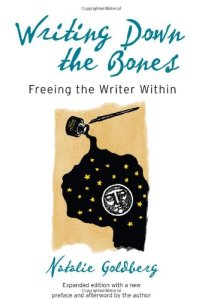
Excerpt From Chapter 3 “Writing as a Practice” in Writing Down the Bones: Freeing the Writer Within by Natalie Goldberg
This is the practice school of writing. Like running, the more you do it, the better you get at it. Some days you don’t want to run and you resist every step of the three miles, but you do it anyway. You practice whether you want to or not. You don’t wait around for inspiration and a deep desire to run. It’ll never happen, especially if you are out of shape and have been avoiding it. But if you run regularly, you train your mind to cut through or ignore your resistance. You just do it. And in the middle of the run, you love it. When you come to the end, you never want to stop. And you stop, hungry for the next time.
That’s how writing is, too. Once you’re deep into it, you wonder what took you so long to finally settle down at the desk. Through practice you actually do get better. You learn to trust your deep self more and not give in to your voice that wants to avoid writing. It is odd that we never question the feasibility of a football team practicing long hours for one game; yet in writing, we rarely give ourselves the space for practice.
. . . Sit down with the least expectation of yourself; say, “I am free to write the worst junk in the world.” You have to give yourself the space to write without a destination.
(quoted from pg. 11, emphasis mine)
About the book:
For more than twenty years Natalie Goldberg has been challenging and cheering on writers with her books and workshops. In her groundbreaking first book, she brings together Zen meditation and writing in a new way. Writing practice, as she calls it, is no different from other forms of Zen practices, “it is backed by two thousand years of studying the mind.”
__________________________________________
Work Cited:
Goldberg, Natalie. Writing Down the Bones: Freeing the Writer Within. Boston, MA: Shambhala Publications, Inc., 1986. Print.
Natalie Goldberg’s Rules for First-Draft Writing: “Give the paper the colorful coleslaw of your consciousness.”
Excerpt From Chapter 2 “First Thoughts” in Writing Down the Bones: Freeing the Writer Within by Natalie Goldberg
1. Keep your hand moving. (Don’t pause to reread what you have just written. That’s stalling and trying to get control of what you’re saying.)
2. Don’t cross out. (That is editing as you write. Even if you write something you didn’t mean to write, leave it.)
3. Don’t worry about spelling, punctuation, grammar. (Don’t even care about staying within the margins and lines on the page.)
4. Lose control.
5. Don’t think. Don’t get logical.
6. Go for the jugular. (If something comes up in your writing that is scary or naked, dive right into it. It probably has lots of energy.)
These are the rules. It is important to adhere to them because the aim is to burn through to first thoughts, to the place where energy is unobstructed by social politeness or the internal censor, to the place where you are writing what your mind actually sees and feels, not what it thinks it should see or feel. It’s a great opportunity to capture the oddities of your mind. Explore the rugged edge of thought. Like grating a carrot, give the paper the colorful coleslaw of your consciousness.
(quoted from pgs. 8–9)
About the book:
For more than twenty years Natalie Goldberg has been challenging and cheering on writers with her books and workshops. In her groundbreaking first book, she brings together Zen meditation and writing in a new way. Writing practice, as she calls it, is no different from other forms of Zen practices, “it is backed by two thousand years of studying the mind.”
__________________________________________
Work Cited:
Goldberg, Natalie. Writing Down the Bones: Freeing the Writer Within. Boston, MA: Shambhala Publications, Inc., 1986. Print.
Fun Friday: Dogs vs. Cats—Can’t We All Just Get Along?

These sweet doggies just want to be friends!
#TBT: A Year in the Life of My Ankle

Sometimes, I’m late jumping on a bandwagon. But when I do, I jump on (in) with both feet and take up the banner. Here, instead of posting old photos, #TBT will be looking back at the 1,760 posts from the past eight years (yes, I’ve been blogging for EIGHT YEARS!) and sharing one chosen at random every Thursday.
If you want to join in the #TBT fun, share a link to your #TBT post in the comments section below!
.
Throwback Thursday Post of the Week:
Friday Retrospective–A Year in the Life of My Ankle
Originally posted: November 4, 2011
A year ago today, November 4, 2010, this happened:

Short version of the story: I fell and dislocated and fractured both bones in my right ankle when leaving the library after spending the afternoon working on The Art of Romance. You can read the long version of the story here. That weekend, my parents came over and picked me up and took me home with them to Hot Springs, Arkansas, where I would stay while I convalesced.
Here’s what it looked like on Thursday, November 11, 2010 when the ER splint was removed at my first appointment with the orthopedic surgeon:

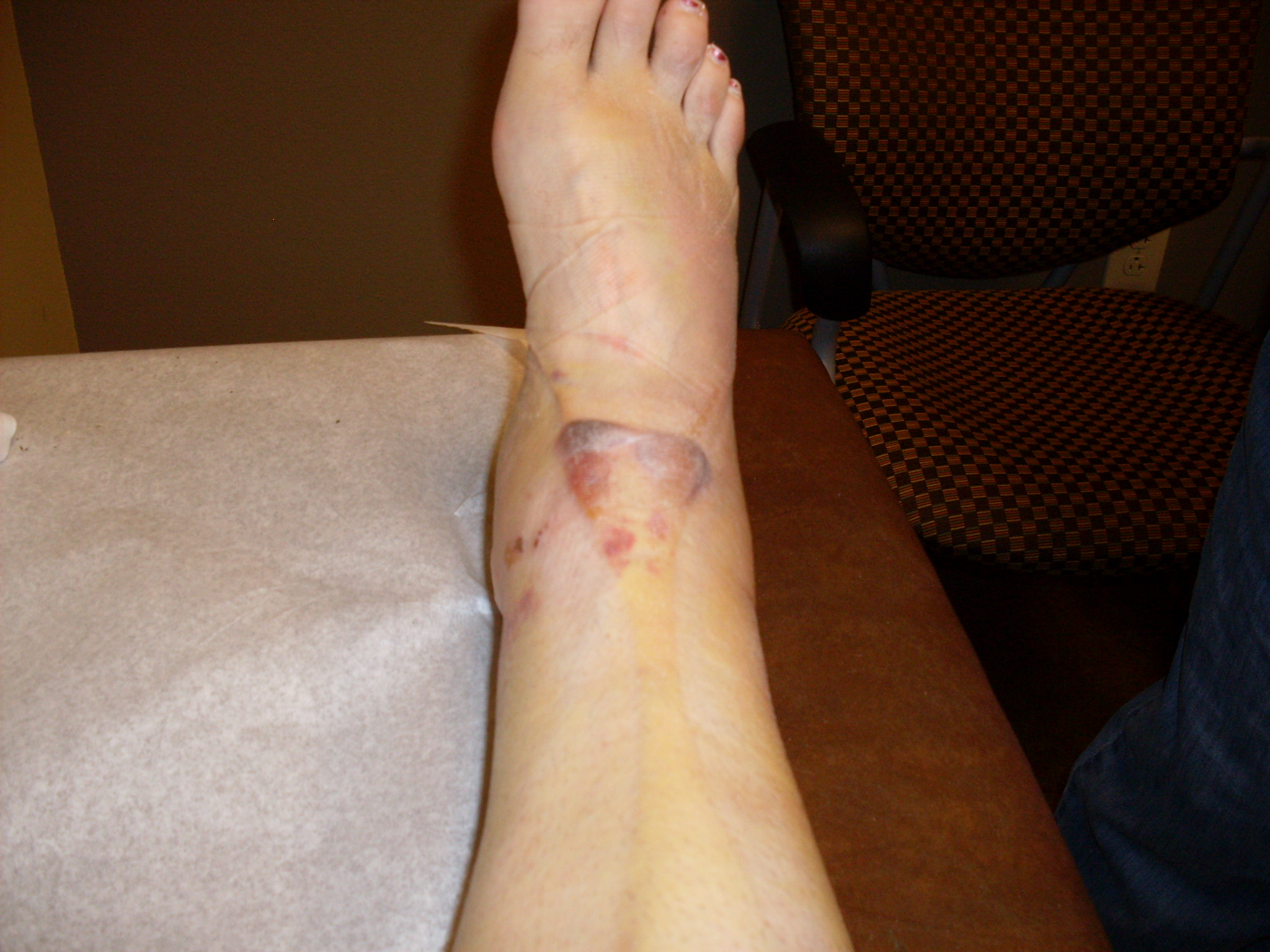
On Wednesday, November 17, 2010, I had surgery to plate and screw the bones back together. You can read about my surgery experience here.

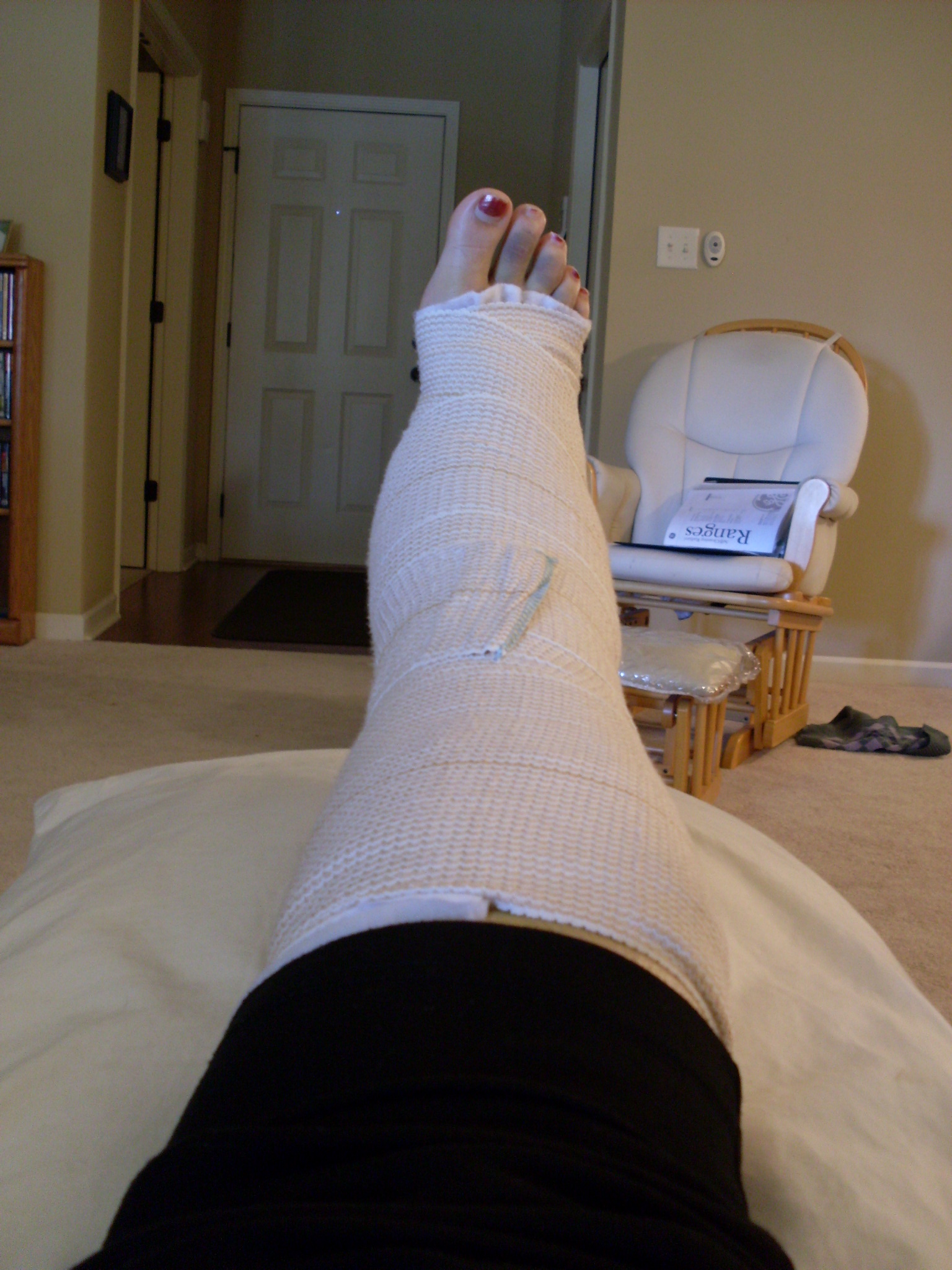
A week after surgery on Wednesday, November 24, 2010, I went back for my first follow-up appointment at which they removed the surgical splint (and the cotton batting, which is what you see stuck to my leg). And, of course, there’s a blog post about that.

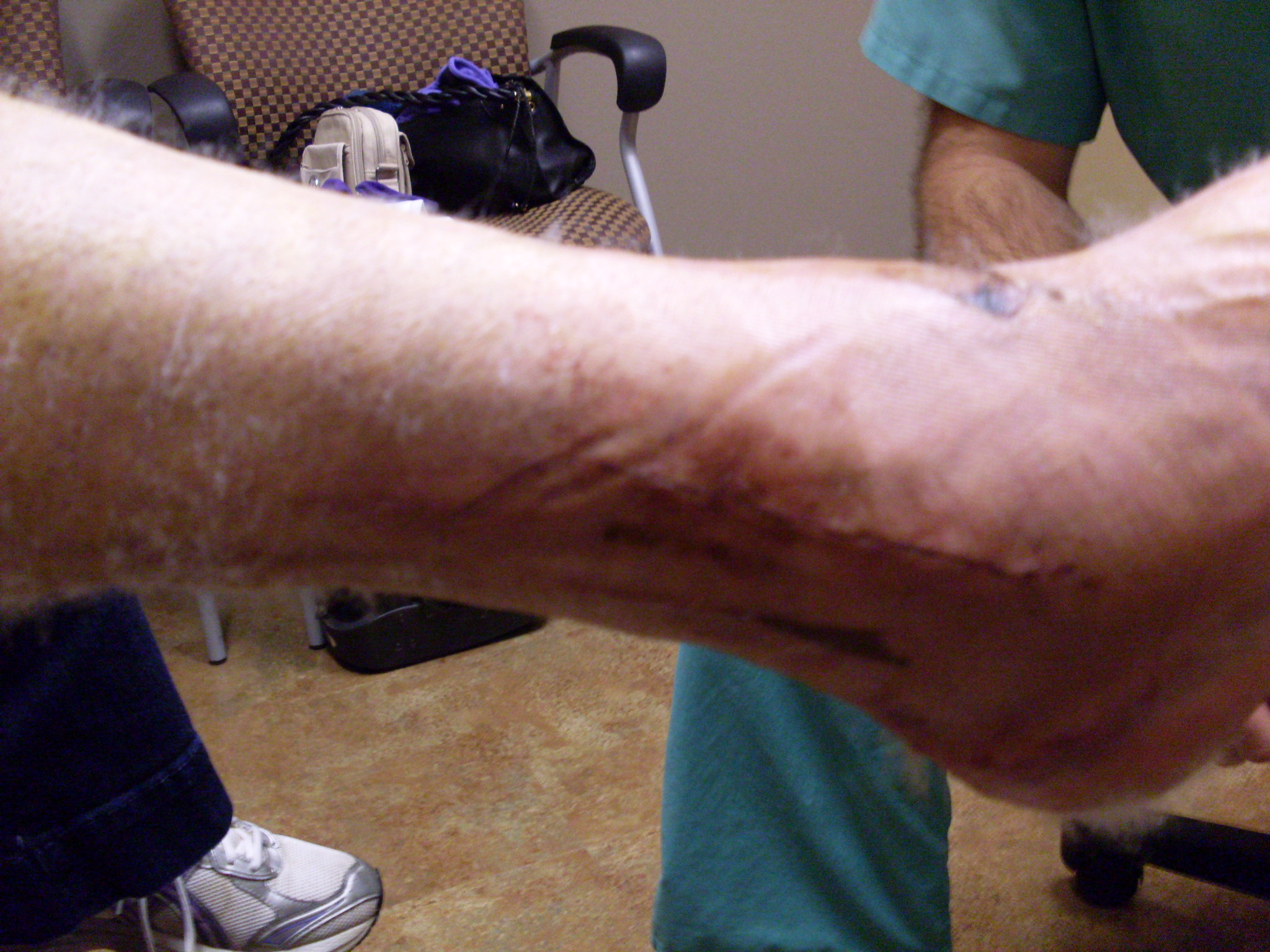
Here’s a better picture of the outside of the leg, taken three weeks post-surgery:

All of the skin abrasions/scabs surrounding the surgical scar are from where the original ER splint rubbed my skin raw.
After spending a month getting around in a wheelchair that barely fit through the doors at my parents’ house—and was a (literal) pain for my parents to get in and out of their vehicles whenever we went anywhere—on an acquaintance’s advice, I found a medical supplier in Little Rock that rented knee walkers, so on Wednesday, December 9, 2010, we drove over to Little Rock to get it—and to have lunch with my uncle and aunt who live there.

At my six-week post-surgery follow-up appointment on Thursday, December 30, 2010, I was allowed to start bearing weight—with the walking boot. (Sorry, no pictures.)
Over Martin Luther King weekend, my mom and I made a trip back to Nashville so that I could participate in the Manchester-Coffee County Library Author Day event on January 15, 2011.

Then, the next week, back in Hot Springs, I had another appointment on January 20 at which we set the date for my final surgical procedure and at which I was told I could start driving again—though I still had to walk in the boot—which meant a change of footwear getting in and out of the car. On Wednesday, February 2, 2011, I had a quick in-and-out surgery to remove the long screw that corrected the separation between the fibula and tibia.

Once this surgery was complete, I was free to go—back home to Nashville! I did have to go back to Hot Springs once more for a final appointment on February 17, 2011, at which I was given the all-clear to continue recovery on my own.
Since then . . .
It’s been a long road of recovery, and I’m still working on it. Because there was so much soft tissue damage due to the dislocation, I still have problems with pain and stiffness, especially if I’ve been sitting for too long (and given the nature of my jobs, it’s pretty much a given that I sit too long all the time), but it’s coming along.
And here’s what it looks like one year after it all began:

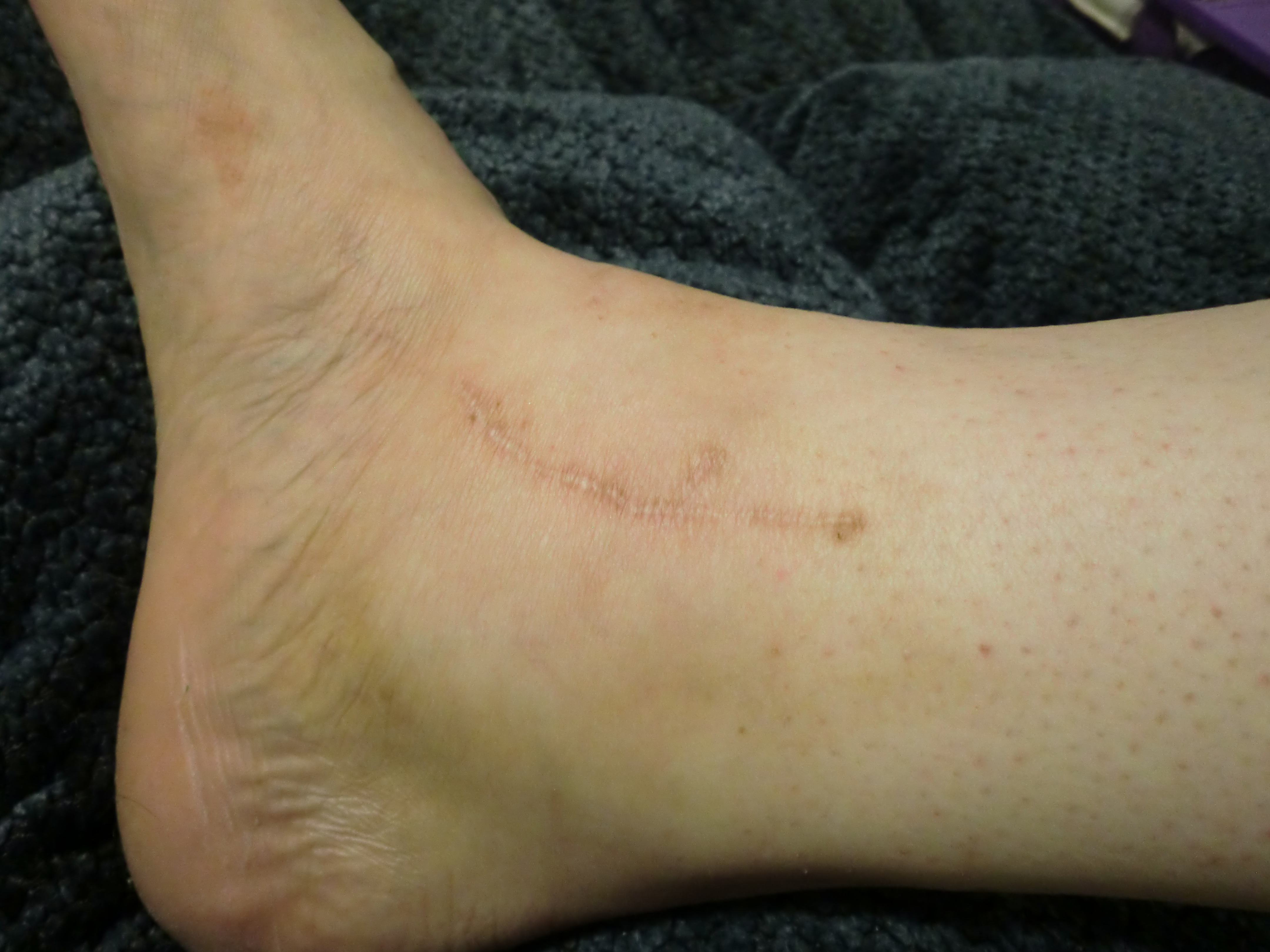

So, there it is. A “year in the life” of my ankle.
Update, May 1, 2014:
It’s ironic that when I clicked on “random post,” this would be the one that came up.
On Saturday, April 12, 2014, I suddenly started experiencing severe pain in my ankle. I thought, maybe, it was because there was supposed to be a front/big spring storm moving through later. But it continued to hurt—for two more weeks. So, finally, on Friday, April 25, I went to an urgent care place and had it X-rayed for the first time in three years. I was afraid that perhaps something was wrong with the hardware or that the bone(s) had started stress fracturing around the screws and/or plate.
Fortunately, the hardware and bones looked fine. Unfortunately, there’s a lot of swelling that is wreaking havoc with the scar tissue from all of the soft-tissue damage done by the dislocation. It’s most likely the swelling is being caused by my psoriasis (possibly the beginning of psoriatic arthritis), but it presents like a moderate sprain, so that’s how the doctor chose to treat it. So I’ve spent the last (almost) week wearing this:

It definitely doesn’t hurt as much as it had been, but it’s not back to 100% of where it was before this started (it’ll never truly be back at 100%—I’ve been injuring this ankle since my first bad sprain the summer after third grade). But if it doesn’t stop hurting soon, I’ll be making an appointment with a rheumatologist to see if it really is psoriatic arthritis and, if so, what can be done about it.
(Mostly) Wordless Wednesday: It’s also THIS time of year.
This is from three years ago, but this happens every year around this time.
Madeleine L’Engle on Faith, Belief, and Inspiration in the Creative Process
Excerpt From Chapter 9 “Do We Want the Children to See It?” in Walking on Water: Reflections on Faith and Art by Madeleine L’Engle

The creative process has a lot to do with faith, and nothing to do with virtue, which may explain why so many artists are far from virtuous; are, indeed, great sinners. And yet, at the moment of creation, they must have complete faith, faith in their vision, faith in their work.
Again, the degree of talent, the size of the gift, is immaterial. All artists must listen, but not all hear great symphonies, see wide canvasses, conceive complex, character-filled novels. No matter, the creative act is the same, and it is an act of faith.
A ten-year-old boy asked me of A Wrinkle in Time, “Do you believe all that?”
“Yes,” I replied, “of course I do.”
The artist, like the child, is a good believer. The depth and strength of the belief is reflected in the work; if the artist does not believe, then no one else will; no amount of technique will make the responder see truth in something that the artist knows to be phony. . . .
If the artist works only when he feels like it, he’s not apt to build up much of a body of work. Inspiration far more often comes during the work than before it, because the largest part of the job of the artist is to listen to the work, and to go where it tells you to go. Ultimately, when you are writing, you stop thinking and write what you hear.
(quoted from pgs. 148–149, emphasis mine)
About the book:
In this classic book, Madeleine L’Engle addresses the questions, What makes art Christian? What does it mean to be a Christian artist? What is the relationship between faith and art? Through L’Engle’s beautiful and insightful essay, readers will find themselves called to what the author views as the prime tasks of an artist: to listen, to remain aware, and to respond to creation through one’s own art.
__________________________________________
Work Cited:
L’Engle, Madeleine. Walking on Water: Reflections on Faith and Art. Wheaton, IL: Harold Shaw Publishers, 1980. Print.
Madeleine L’Engle on Writing Every Day to Let the Work Take Over
Excerpt From Chapter 1 “Cosmos from Chaos” in Walking on Water: Reflections on Faith and Art by Madeleine L’Engle
If the work comes to the artist and says, “Here I am, serve me,” then the job of the artist, great or small, is to serve. The amount of the artist’s talent is not what it is about. Jean Rhys said to an interviewer in the Paris Review, “Listen to me. All of writing is a huge lake. There are great rivers that feed the lake, like Tolstoy and Dostoyevsky. And there are mere trickles, like Jean Rhys. All that matters is feeding the lake. I don’t matter. The lake matters. You must keep feeding the lake.”
To feed the lake is to serve, to be a servant. Servant is another unpopular word we have derided by denigrating servants and service. To serve should be a privilege, and it is to our shame that we tend to think of it as a burden, something to do if you’re not fit for anything better or higher. . . .
When the work takes over, then the artist is enabled to get out of the way, not to interfere. When the work takes over, then the artist listens.
But before he can listen, paradoxically, he must work. Getting out of the way and listening is not something that comes easily, either in art or in prayer. . . .
Someone wrote, “The principal part of faith is patience,” and this applies, too, to art of all disciplines. We must work every day, whether we feel like it or not, otherwise when it comes time to get out of the way and listen to the work, we will not be able to heed it.
(quoted from pgs. 23–24, emphasis mine)
About the book:
In this classic book, Madeleine L’Engle addresses the questions, What makes art Christian? What does it mean to be a Christian artist? What is the relationship between faith and art? Through L’Engle’s beautiful and insightful essay, readers will find themselves called to what the author views as the prime tasks of an artist: to listen, to remain aware, and to respond to creation through one’s own art.
__________________________________________
Work Cited:
L’Engle, Madeleine. Walking on Water: Reflections on Faith and Art. Wheaton, IL: Harold Shaw Publishers, 1980. Print.
Fun Friday: Let’s Be Honest, Ladies, This Is the Main Reason Most of Us Went to See THE HOBBIT
Let’s be honest, ladies, this is the main reason most of us went to see The Hobbit.
.
#TBT: The Down-and-Dirty Guide to Critiquing
Sometimes, I’m late jumping on a bandwagon. But when I do, I jump on (in) with both feet and take up the banner. Here, instead of posting old photos, #TBT will be looking back at the 1,760 posts from the past eight years (yes, I’ve been blogging for EIGHT YEARS!) and sharing one chosen at random every Thursday.
If you want to join in the #TBT fun, share a link to your #TBT post in the comments section below!
.
Throwback Thursday Post of the Week:
The Down-and-Dirty Guide to Critiquing
Originally posted: July 31, 2007
For a more comprehensive discussion of critiquing—from how-to, to working with crit partners—go to the Writing Series Index page and scroll down to Critiquing.
I always hated math classes. I was good at math—great at math. But I hated sitting there for an hour (or longer) listening to someone drone on about the concepts. Aside from Geometry in 9th grade (where I finished the year with a 108% A grade—you know, all that visually oriented stuff), the only time I ever really enjoyed using “higher” math consciously—I know I use it subconsciously every day—was when I took Astronomy and the accompanying labs in college. It was taking all of the concepts of algebra, geometry, and trigonometry I’d memorized over the past five or six years and applying it to stuff that actually had applications in the real world—figuring out distances from the earth to other planets and stars, planet sizes, the angle of the earth to the sun by measuring the shadow of a flag pole at different times during the day/semester, and so on. Math stopped being “conceptual” and became “concrete.”
In the same way, critiquing makes everything we’ve ever heard about what “good writing” is concrete instead of conceptual.
Becoming a good critiquer is part and parcel with becoming a good writer. Until you learn how to critique others’ writing, you’ll never be able to look at your own objectively. I have learned more about the craft of writing through the critiquing/mentoring process than I did in all of the seminars I took in two years of graduate school in a genre fiction writing program [2014: not to mention the years I worked subsequent to posting this as an editor!]. That’s not to say I didn’t learn stuff from the seminars—just that to me, it was like sitting in those math classes . . . just memorizing concepts. What I learned through the process of critiquing others and understanding and internalizing the critiques given to me on my own writing made it all concrete.
So here’s the down-and-dirty recap of the Critiquing series:
Critiquing Step 1: Becoming a Pot-Bellied Pig
1. Be tough but sensitive. Be tough-skinned enough that you don’t take critiques personally, but sensitive enough to take in the comments so you can improve your writing.
2. Be a good listener. Whether literally (in face-to-face situations) or figuratively (written critiques), listen first. Do not respond until you have heard/read everything the critiquer has to say. It’s so easy to become defensive, whether it’s the first or the hundredth time we’ve gotten feedback on our writing. No, not all advice/comments will be valid or applicable. But if you shut down at the first comment you don’t agree with, you might not find the pearl of wisdom that will mean the difference between a rejection and a request for a full.
3. Be loyal to your “herd.” Your critique group is your herd. You have a role to perform within the group as well as outside of it. Don’t betray confidences, do give support and encouragement. Let your “herd” help you figure out what your strengths and weaknesses are so you can work on them.
4. Be an individual. You cannot be so bound by the critiques you receive that you alter your voice, style, or story to fit what someone else thinks is best. You must remain true to your inner voice and to your story.
Critiquing Step 2: Be a Reader First, Writer Second
The First Read-Through: When you sit down to read the latest novel from your favorite published author, do you do it with red pen in hand just waiting to start marking up the pages? Of course not. The first time you sit down with your crit partners’ work, do so as if you were reading a published novel. Just read it. Keep a pen and notepad nearby to make notes of things to comment on later, but not on the first read-through.
The Second Read-Through: Now is your chance to put everything you know about writing into practice. With your notes from the first reading at hand, read through the manuscript again, this time, marking/commenting on the details. (See the original post for a list of things to read for.)
Critiquing Step 3: Remember the Golden Rule
You’ve completed the two read-throughs and you have your rough notes. Great. Now, set it aside for at least one day, a couple of days if possible. Then, come back to your notes with fresh eyes. As you read each criticism, try to word it in your mind to make it as positive as possible—word it the way you would want to read it if someone were writing the comment about your writing. In other words, “critique others as you would wish to be critiqued yourself.”
Critiquing Step 4: Putting the Crits to Work
You must carefully consider each comment before deciding whether to implement it or not. If you can (if it’s not feedback from a contest or the like where you cannot contact the critiquer), ask clarifying questions. If you find yourself getting bogged down in the critique comments and losing heart, step back and consider the bigger picture. And set specific goals of what you are trying to achieve.
Wordless Wednesday–It’s that time of year.
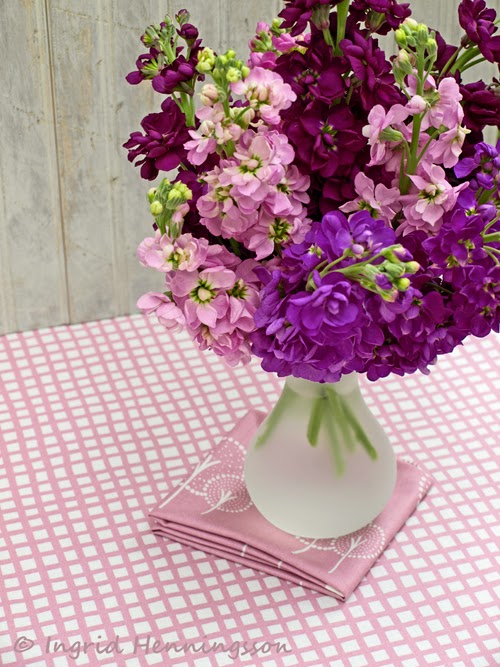
Styling and photography © Ingrid Henningsson for Of Spring and Summer
.

The Swiss Alps, photo via Polo Pixel
.

Image from Save the Azaleas
.

Pink and white dogwoods in bloom. From Young Gardener.
.

Wisteria (from Romancing the Bee)
___________________________________________
Where possible, I have credited the owner/creator/copyright holder of the images. If you are the owner/creator/copyright holder and want the image removed from my blog, please contact me directly and I will be happy to do so.

 KayeDacus.com