Writing Tip #9: Write your passion—but keep an eye on the market.
There are two pieces of advice you’re bound to hear at just about every writing conference or group you’ll ever attend: First, write the book of your heart; second, if you want to sell, make sure you know the market and if the genre you’ve chosen to write is selling.
And that brings us to today’s writing tip:
Writing Tip #9. Write your passion—but keep an eye on the market.

This is a hard balancing act, which we’ve discussed many times. It goes back to the two types of writers Don Maass mentioned in The Fire in Fiction: the status seeker and the storyteller. Are you seeking merely to be published and chasing the market, or are you looking to tell the story that’s on your heart?
Is there a way to do both? Yes. But one takes much longer than the other. If you have a good grasp of the market, of what’s selling, and you can write in a genre that’s selling—but still write from the heart, not just “knock something out”—and you have a good grasp of the craft of writing and storytelling, you’ll probably find success a lot sooner than someone who’s writing the story of her heart without knowing how to make sure it fits the guidelines and expectations for what’s actually selling. “Heart stories” are typically those that don’t fall neatly into any existing publishing category. They’re not always easy to market. But if you hone your craft in addition to writing the best story you can, you may eventually be able to sell it.
The best rule of thumb when it comes to choosing the kind of book you’re going to write is to write the kind of book you would want to read. This is different from saying write a book that fits neatly into your favorite genre to read. You may not actually write the same genre you like to read—for example, you may be best suited to write bittersweet women’s fiction but your favorite books to read may be cozy mysteries. You may write Old West action-adventure but enjoy reading literary fiction. There is no rule that says you have to write the same genre you like to read (although that makes it a lot easier and more fun).
As we’ve already discussed, even if it isn’t your favorite genre to read you still need to read a good number of currently published books in the genre in which you’re writing to keep up with standards and styles and what’s already been published.
If the book of your heart happens to fit neatly within the genre you like to read, you’re already a few steps ahead—because you’re already familiar with the conventions and recent publishing history of your genre and you know personally what readers are looking for in a particular book in that genre.
What you shouldn’t do, though, is choose to write a certain genre because you’ve been led to believe that it’s the “shoo-in” genre or one that’s easier to get published or easier to market.
All other considerations aside, be sure to choose a story that will keep you motivated to write it, passion and market notwithstanding.
Madeleine L’Engle explained it this way in Walking on Water:
The artist, like the child, is a good believer. The depth and strength of the belief is reflected in the work; if the artist does not believe, then no one else will; no amount of technique will make the responder see the truth in something the artist knows to be phony.
(p. 148)
You must carefully balance the choice between “choosing your genre” and “choosing your story.” Don’t compromise the integrity of your story for the expedience of “writing a book that will sell.” If you don’t believe in your story, your readers won’t believe in it either. It becomes formula, dry, with a “dashed off” feeling. (You’ve all read books like that, I’m sure.)
By staying true to the story of your heart rather than chasing the market, it may take you longer to get published, but you’re going to have better success with the story that’s meaningful, that’s from the heart. But even a book-of-the-heart needs to be marketable if you want to see it published one day.
Once you have determined what your “heart story” is, figure out how it will fit into the market. If you’re lucky, like me, the stories you want to write already fit into a genre (every story idea I come up with automatically turns into a romance, whether it’s contemporary, historical, or science fiction). Here are some “tests” to put to yourself and your story (adapted from Writing Fiction for Dummies, pp. 39–41):
- Who are the authors you think you write most like? Which authors’ voices, language, and style most speak to you and inform your own writing?
- What genre does your story fit into best? You’re allowed to cross genre lines, but for the sake of marketing it, one genre should be dominant—keeping in mind that there are many hybrid genres, such as Romantic Suspense, SFR (science-fiction romance), PNR (paranormal romance), Urban Fantasy, etc.
- What do you think is the strongest element of your writing—what parts do you like writing most? Complex worldbuilding? Deep characterization? Snappy back-and-forth dialogue? Steamy romantic scenes? Answer honestly, not with the answer you think is “expected” or “right.”
- What settings do you like to write? Real places in the here and now? Historical settings with as much accuracy as you can get without a time machine? Fantastical settings from historical-ish to urban? Otherworldly? How do the settings you enjoy writing fit in with the market for your genre?
- What “expertise” do you bring to the type of story you want to write? How can you tie that into marketing your story?
- (For example, from my One Sheet for the Ransome series: “Kaye’s love of the Regency era started with Jane Austen. Her undergraduate literary thesis was entitled “Wealth and Social Status as a Theme in Pride and Prejudice,” and much of her final semester of undergraduate school was spent studying Austen’s novels. Her minor in history has given her a love—a thirst—for conducting in-depth, accurate research from original source materials as well as historical, academic, and literary criticism sources.”)
- How long is your story going to be? Are you writing a short story? The market for those is completely different than it is for novellas, short novels (e.g., category romances), novels, and epics.
- Who is your target audience? What are their interests? their education? age? gender? reading habits? spirituality?
- How can you adjust existing parts of or add elements to your story that will help it better fit in with the market you’ve identified for yourself?
Once you’ve analyzed your story and your writing and determined whether or not you’re writing only for yourself or for yourself and the market, then you’re ready to figure out how you can incorporate the elements that the market desires into your writing so that you can eventually share the story of your heart with your chosen audience.
But remember, above all else:
Don’t chase the market;
write the best story you can
and let the market chase you.
__________________________________________
Work Cited:
Ingermanson, Randy and Peter Economy. Writing Fiction for Dummies. Hoboken, NJ: Wiley Publishing, 2010. Print.
L’Engle, Madeleine. Walking on Water: Reflections on Faith and Art. Wheaton, IL: Harold Shaw Publishers, 1980. Print.
Writing Tip #8: It’s Okay If What You Write Stinks
One of the main reasons so many would-be writers never get further than being would-be writers—people with bits and pieces of started, but never finished, manuscripts hidden in drawers or secret files on the computer—is because they’ve let something that all of us who write know paralyze them and keep them from moving forward with their writing. Which brings us to today’s writing tip.
Writing Tip #8. It’s Okay If What You Write Stinks.
As Stephen King wrote in On Writing, “Write with the door closed, rewrite with the door open. Your stuff starts out being just for you, in other words, but then it goes out. Once you know what the story is and get it right—as right as you can, anyway—it belongs to anyone who wants to read it. Or criticize it” (King, p. 47).
Author and marketing guru Randy Ingermanson put it this way:
Nobody is ever going to see your first draft except a very few people who already love you, warts, backstory, and all. Those are your critique buddies. Frankly, they already know your first draft sucks, so it’s OK. . . . It’ll give them something to feel good about when they point it out to you.
(Advanced Fiction Writing Blog, 2010)
Let me put it another way . . .
Do you think Yo-Yo Ma sounded like this or like this the first time he picked up the cello?
How many times do you think Evan Lysacek had to do this before he could do this?
It’s okay if what you write stinks
because you can always fix it later.
The only thing you can’t fix is a blank page.
When you’re in the creative process, you don’t need to be bogging yourself down with worrying about whether or not what you’re writing is “good.” You just need to write. You need to get the first draft finished. You need to turn off the analytical/self-doubting/self-criticizing side of the brain.
I love my computers. Y’all know that. I couldn’t live without them. But writing at the computer does something weird to me: by seeing the words coming out as printed prose—i.e., the way they might actually look in hard copy/printed in a book—I feel like I have to “get it right” before I type it into the computer . . . like what I’m writing has to be the correct words, without telling or loose POV or embellished dialogue tags or adverbs or whatever “rule” my brain is pecking at me with at that moment.
So when I’m really struggling with those negative thoughts and writer’s block that comes from the worries and fears that what I’m writing isn’t good enough, I pull out my trusty spiral notebook.

In Writing Down the Bones, Natalie Goldberg gives the reason why writing longhand can help with writer’s block and overcoming those nasty “it has to be perfect as soon as you commit it to text” voices:
In my notebooks, I don’t bother with the side margins or the one at the top: I fill the whole page. I am not writing anymore for a teacher or for school. I am writing for myself first and I don’t have to stay within my limits, not even margins. This gives me a psychological freedom and permission. And when my writing is on and I’m really cooking, I usually forget about punctuation, spelling, etc. I also notice that my handwriting changes. It becomes larger and looser. . . .
One of the main aims in writing is to learn to trust your own mind and body; to grow patient and nonaggressive.
(p. 12)
If we’re constantly questioning the quality and craft-level of what we’re writing, are we really trusting our own mind? Our talent? The story we’ve been given?
Sure, it’s easy to stand in awe of published authors—those who’ve gone out there and taken the risk of putting their writing in front of others and faced rejection and won. But, you’re thinking, they’re great writers, they’re great storytellers. I’ll never be like that.
Let me refer you back to the video examples I linked to above. No talent comes out of the gate fully formed without the need for lots of practice, lots of studying, and lots of defeating self-doubt and fear that what we’re doing (writing, music, sports, art, cooking, etc.) isn’t good enough.
Why do people assume that writing is the only art
or profession which can be perfected without practice—
lots and lots of practice?
To become a doctor, one must go to school for years beyond the first college degree. Then they must spend more years in internships and residencies before they enter their what? Their practice. The job they do on a daily basis is called a practice for a very good reason—they are putting into action (into practice) the skills they’ve learned over years and years of education and hands-on training. And they do it EVERY DAY. And they continue to pursue training and education, staying on top of the latest techniques and skills to remain at peak performance.
This is what we’re called to do as writers, too—prepare ourselves for the practice of writing by years of diligent study and hands-on training by writing daily, finishing as many manuscripts as we can, working with critique partners, and learning how to revise. But we can’t do that if we don’t write it first—despite our fears that it stinks.
I’ve had so many conversations or read e-mails from multi-published authors of whose talents I stand in awe who say they are sure that with every manuscript they turn in, it’s the worst one they’ve ever written and will be the one that ends their career. So, you see, those fears and doubts never go away.
So allow yourself to write stinky prose. Allow yourself to write info dumps. Allow yourself to use clichés and ignore punctuation and write scenes of dialogue with only he-said/she-said attributions. Allow yourself to draw _______________ blank lines in places where you need to research something or you can’t think of the right word. Write longhand and scribble things out and ignore the margins.
It can all be fixed later.
People usually write novels in several drafts, and writers agree that the first draft doesn’t have to be perfect. Many writers will tell you frankly that their first drafts are a crime against the humanities. But they write a first draft anyway, because you can’t write a second draft until you’ve done a first. So your first task as a writer is to give yourself permission to write a first draft that stinks. . . .
You always write your first draft in creative mode. When we talk about a first draft, we mean the first version you write on the page or type on the screen. Everything after that is edited copy. If you’re doing your job right, some of your first draft will be excellent, and some will be awful. Your goal is to make sure that all of your final draft is excellent, and the only way to get there is to start with a first draft, no matter how bad.
Give yourself permission to be bad on the first draft. After all, your editor isn’t going to see that first draft. Just get it written. Later on, when you go into editing mode, you can worry about making it pretty. After you finish editing, everyone will think that you were brilliant all along. Only you’ll know the truth, and you don’t have to tell anyone.
(Ingermanson, Writing Fiction for Dummies, pp. 59, 60)
__________________________________________
Works Cited:
Goldberg, Natalie. Writing Down the Bones: Freeing the Writer Within. Boston, MA: Shambhala Publications, Inc., 2005. Print.
Ingermanson, Randy. “Backstory and the Cursed Writer’s Block.” Advanced Fiction Writing. 2010. Web. 14 Sept 2014.
Ingermanson, Randy and Peter Economy. Writing Fiction for Dummies. Hoboken, NJ: Wiley Publishing, 2010. Print.
King, Stephen. On Writing: A Memoir of the Craft. New York, NY: Pocket Books, 2000. Print.
Fun Friday–Men in Costume Dramas Tributes
It’s time for some Men in Costume Dramas tributes. It’s probably also time for me to break out some of these movies/miniseries and re-watch them.
Our first is set to one of my favorite songs, “L-O-V-E” by Nat “King” Cole and features Richard Armitage as John Thornton in North & South and Matthew Macfadyen as Mr. Darcy in Pride & Prejudice ’05.
.
This next one is a tribute to men in costume dramas set to a very unexpected song (though, unfortunately, not the original version of the song, which would have been better). The compiler pulled from a wider variety of historical-set movies than we usually see in these—including a really quick clip from Timeline featuring the yummylicious Gerard Butler opposite Anna Friel, the template for Julia in the Ransome books.)
.
This may be my favorite one that I’ve seen—it’s more a tribute to the couples/relationships than just the men in costumes, but it gave me chills. (And the couple it ends with should make several of my regular readers VERY happy!)
Writing Tip #7: MAKE LISTS
As you all know, for many years before I changed careers and started working full-time in academia, I worked as a freelance editor to support my career as a full-time writer. One of my jobs was a copy-and-content edit of the first novel in a trilogy. The editor asked me, in addition to the in-document edits and comments, to create a “series guide” for the trilogy—because whether I edited the other two books in the series or not, whoever did it was going to need to know what was established in the first book about the characters (their physical attributes, ages, likes/dislikes, backstories, quirks, etc.), the setting (geography, town names, store names, area layout, who lives where, and so on), the timeline of the story (if someone says in book 1, in May, she’s six weeks pregnant, she can’t have the baby in book 3, which takes place from August to October), and so on.
Which brings me to today’s writing tip.
Writing Tip #7. Make lists. Lots and lots of lists.
Something every successful con artist or pathological liar knows is that you MUST keep track of the details; you have to know whom you told what and when. Since those of us who call ourselves writers know that what we’re doing is basically telling lies for fun and fortune (okay, maybe not so much fortune as farthings), we need to remember what we’ve made up.
But there are a lot of other things we want to remember also. For example:
Potential Character Names (some of mine are: Elaine, Stephen, Montgomery, Elisa, Joycelyn, Brandon, Kyle, Dacia, Liane, Neal, Ryan, Shaun (F), Alexander, Deborah, Grace)
Interesting Words (synonyms for loud: forte, fortissimo, sonorous, deafening, ear-rending, thunderous, crashing, booming, full-throated, trumpet-voiced, clangorous, clamorous, blaring; synonyms for do: act, serve, practice, take action, proceed, go ahead, run with it, make it so, get on with it, have a go, effect, bring about, deliver)
Possible Titles (The Wooing of Mrs. Paroo, House Mother, The Thirty-Five Guarantee, There Is Nothing Lost, Your Right to Remain Wrong, The Very Thought of You, The Bride’s Spinster Aunt, The Spinster Aunt Conquers the World, etc.)
Interesting Things Overheard (At a restaurant: “As soon as we get back to the office, we need to put a kill order in on McCall.” Guy on the phone at Panera: “How do you feel about widows?” Heard on ESPN: “Cooler than the flip side of the pillow.”)
There are also business/industry things we need to keep track of:
Networking Contacts (Agents/editors met at conferences; authors met at conferences; authors, publicists, book sellers met at book signings; librarians, book buyers, writing teachers)
Blogs (those to read daily, weekly, or occasionally—Google Reader is great for this)
Reading Lists (books to read for fun; books in my genre for critical reading/study; research books; craft books; nonfiction; devotionals)
Research Resources (contacts for interviews, websites, books, museums)
And so on.
These can be kept hand-written in notebooks or you can use my old method of various sizes and colors of Post-it Notes stuck to the sides of the computer and the wall. Or you can type them up and keep them electronically.
But even more important than these are continuity lists and style sheets.
Continuity Tracking
As I mentioned at the beginning of this post, one of the main components an editor looks for, especially with a series, is continuity. One of my long-term projects as a freelancer was an ongoing series about four characters who worked in a hospital in a small town, which was written by multiple authors. To try to keep all of the authors up to date with what all the other authors have done in the volumes they’d written was to have created a Series Guide—a way of trying to ensure continuity from book to book to book.
But it isn’t just from book to book that we need to ensure continuity. It’s within the same book. Because we’re writing them over an extended period of time, we may not remember certain details—a character’s eye color or a minor character’s first name.
Obviously, when creating a series guide or continuity lists, that others (co-authors, editors) will be using, it’s usually done as text, with possibly a few images appended. But when you’re doing this for yourself, you can be as creative and visual as you’d like.
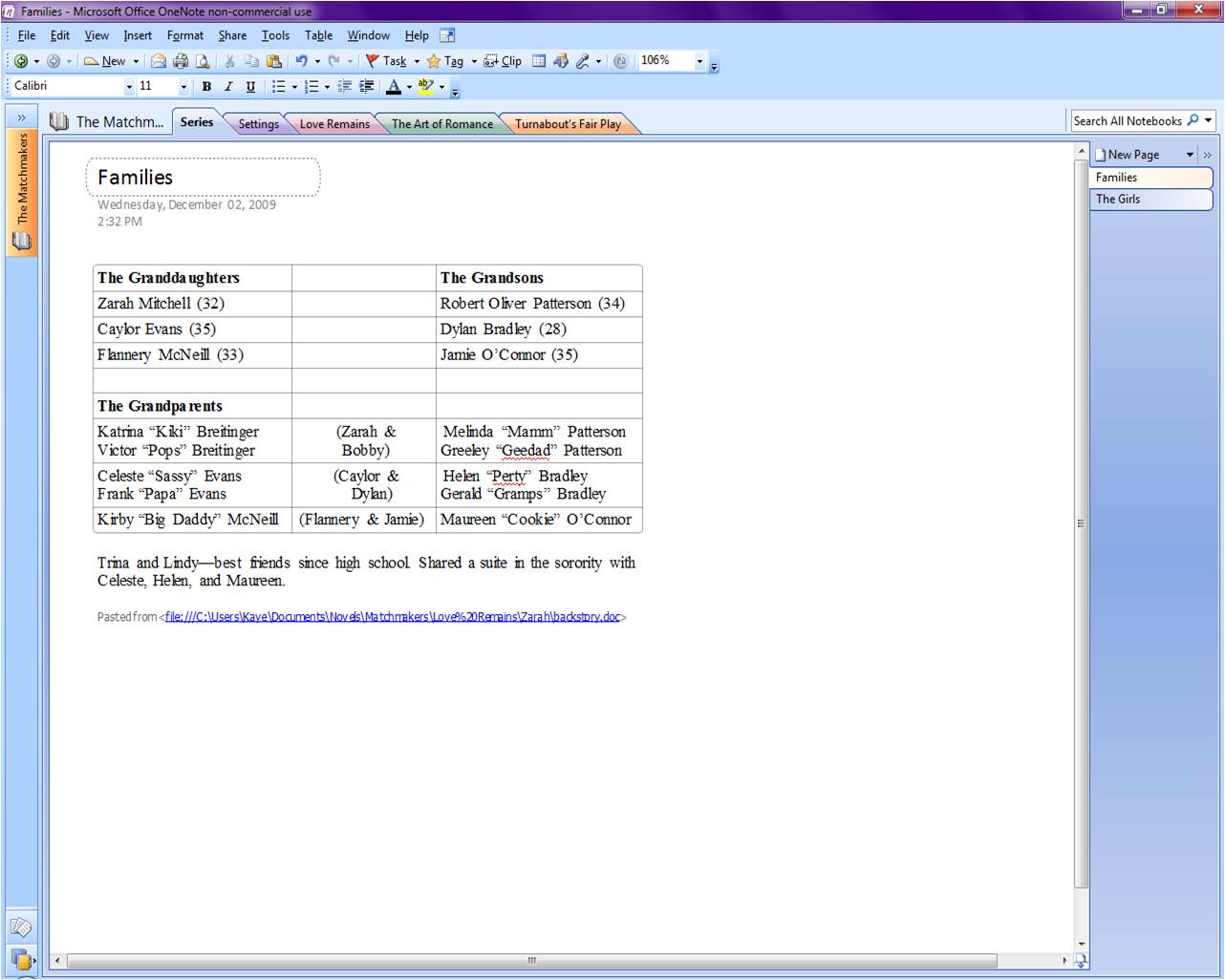
One of my favorite programs for writing is Microsoft’s One Note, which acts like a virtual three-ring binder. Here are some screen captures of how I used it to track continuity in Love Remains. (If these look weird, it’s because these screenshots were done before I upgraded to the 2010 edition).

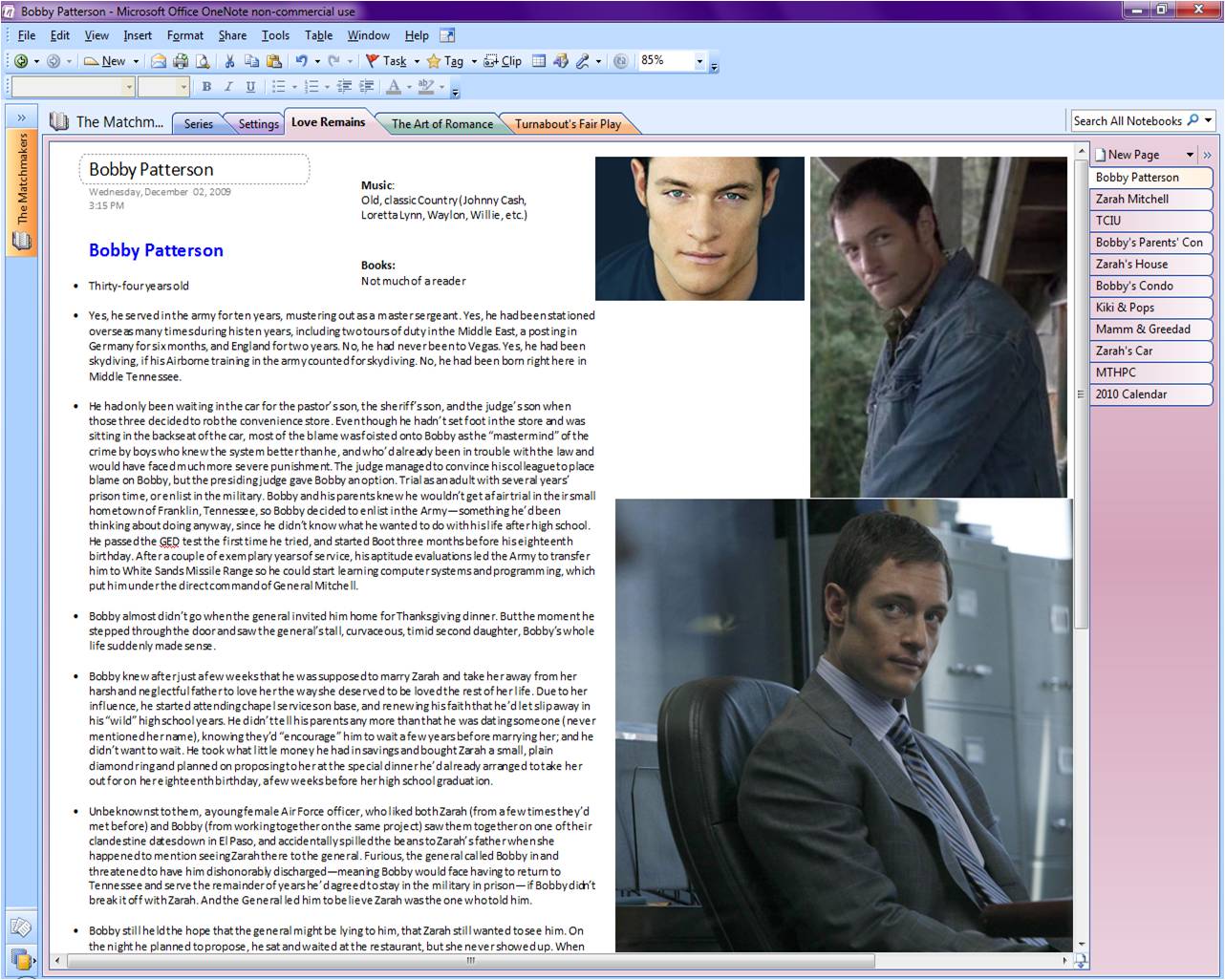
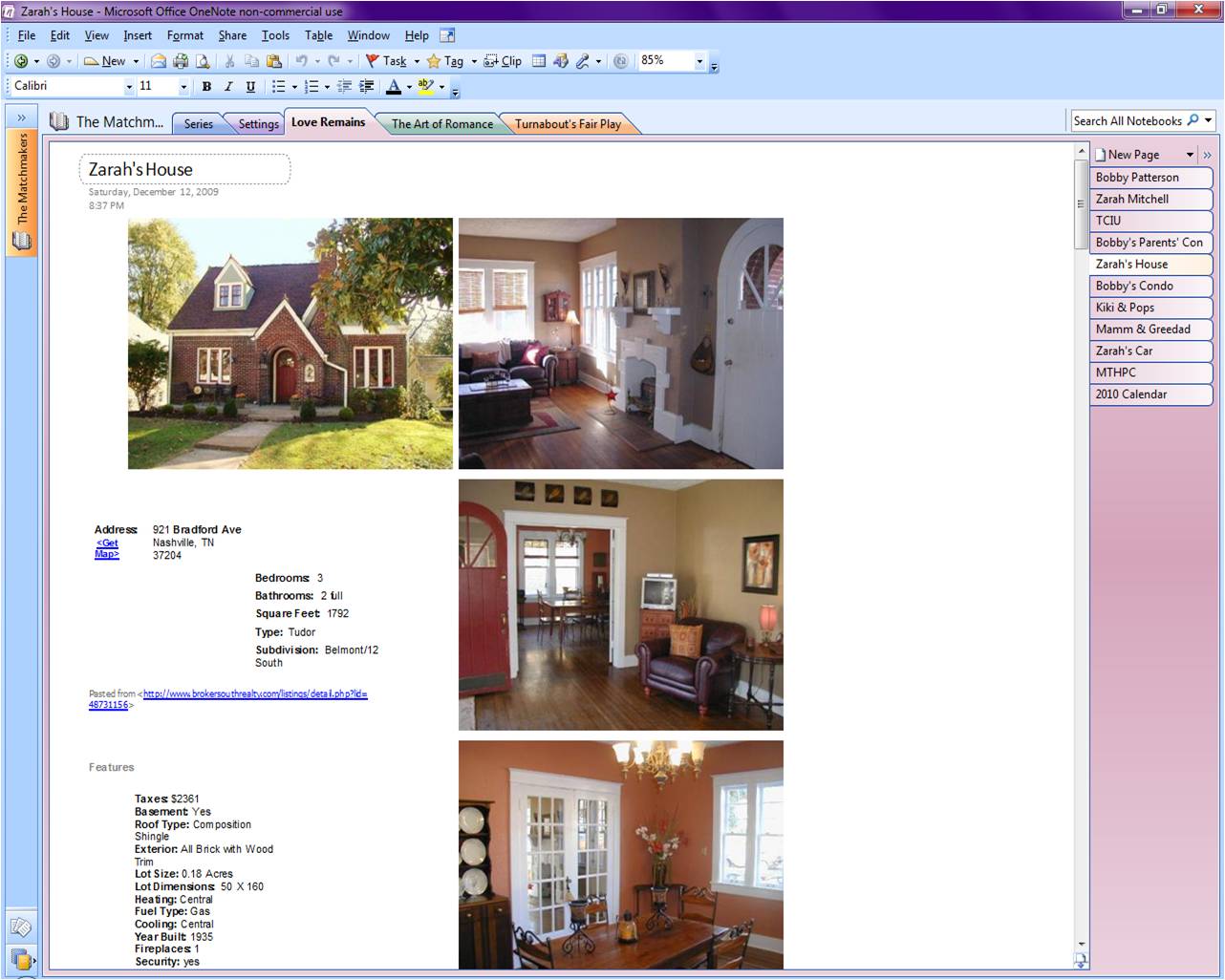
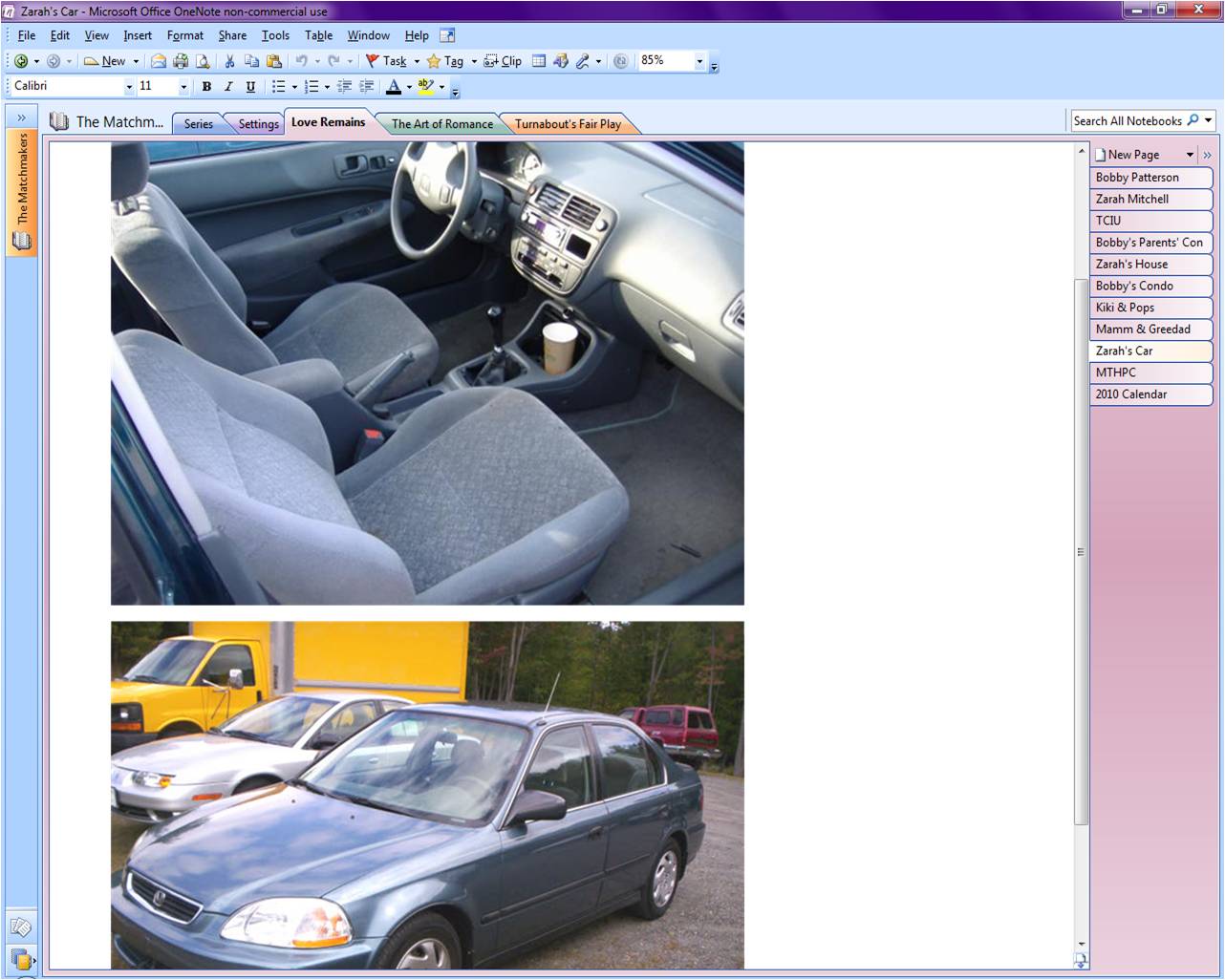
And, as I was writing Love Remains, I tracked details I would need for characters in The Art of Romance and Turnabout’s Fair Play:
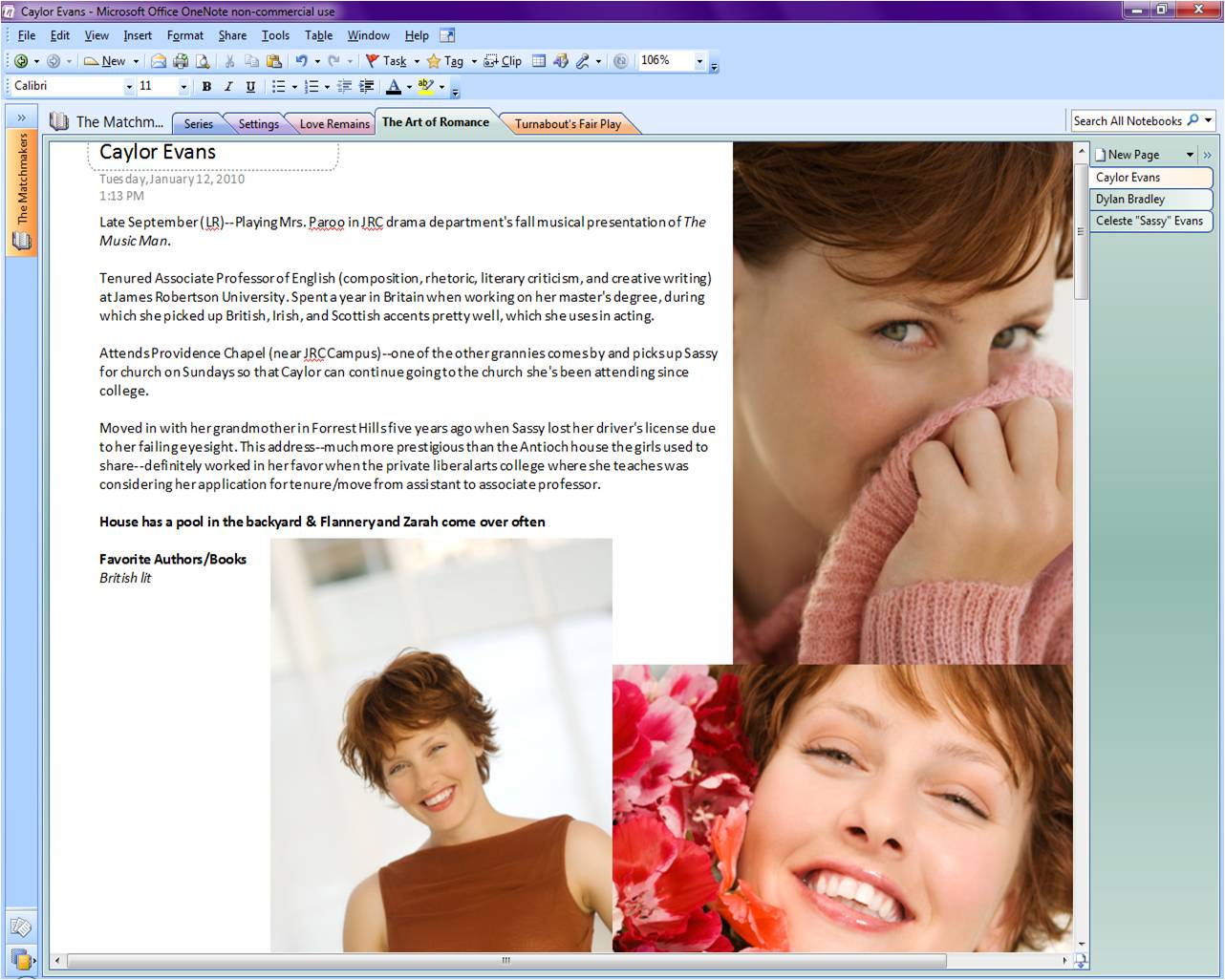

That way, I’m not having to recreate the wheel (or the descriptions/lives of my characters). I try to write these types of details down as I’m writing, but most of the time, it’s easier to do in the revision process.
Of course, sometimes the old-fashioned way works just fine:

Style Sheets
More often than not, style sheets are kept by editors. For example, here’s the house style sheet (the decisions made among the editorial staff that applied to everything we worked on) that I developed when I was working at Ideals Publications.
If you’re writing something that includes unusual names (such as Cajun, foreign, or otherworldly/supernatural), it would be a good idea to make a style sheet so that once your manuscript is acquired and sent to copy editing, you can make things easier for the copy editor by sending along a document showing how things are spelled, punctuated, capitalized, etc. For example, I should have done this on Ransome’s Honor, because port admiralty shouldn’t have been capitalized but the Admiralty (referring to the group that oversaw the entire Royal Navy in London) should have been capitalized. And I didn’t realize how much I needed it to help out my editor when I was writing Ransome’s Crossing because I wrote things differently in RC than I did in RH (in RH I had poop deck and Aye, aye, sir; but when writing RC I wrote them as poop-deck and aye-aye, sir, so she had to go in and correct all the little details like that).
I’ve recently revisited the Bonneterre books as I’m playing around with the idea of writing a sequel novella/novel for a much beloved character from those books. In re-reading those books, I’ve started a style-sheet based on a lot of the back-and-forth discussions/debates/down-right arguments I had with the copy editor who was hired to work on my books for that publisher.
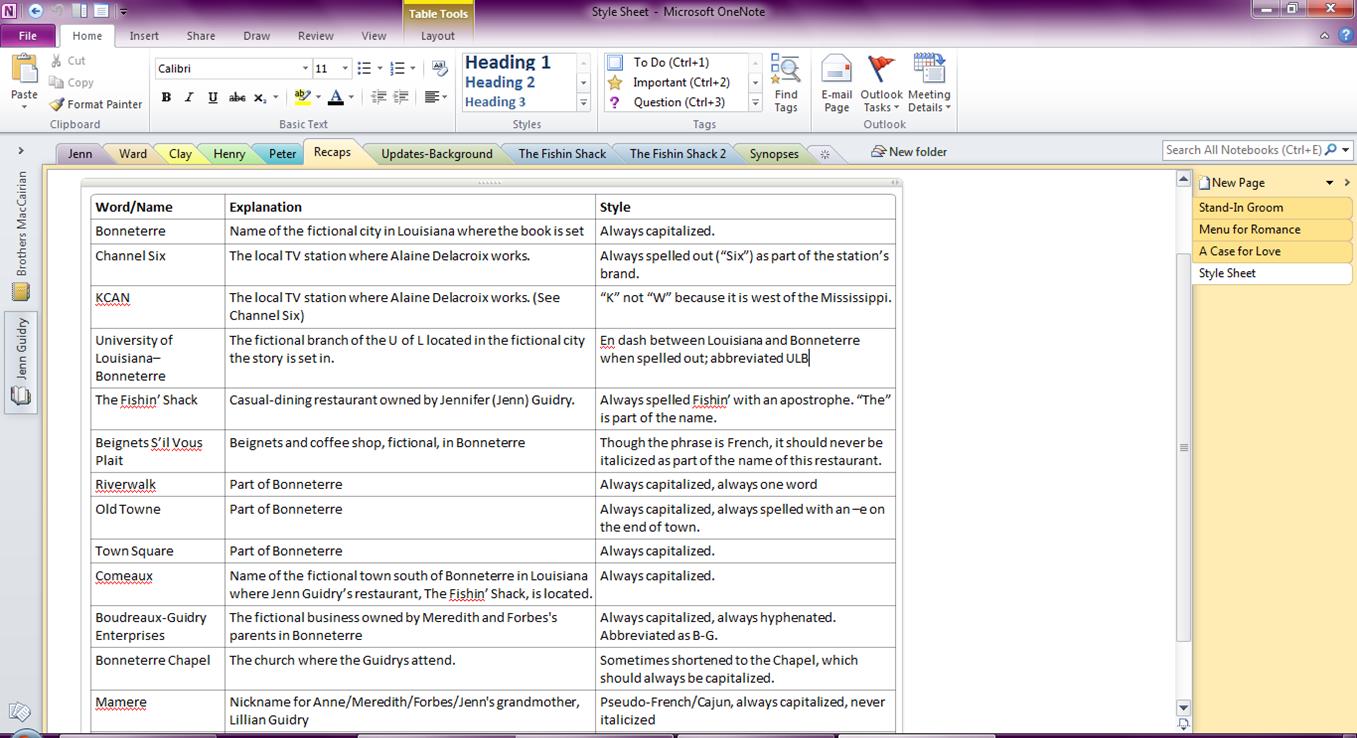
I know certain multi-published authors have personal style sheets that their publishing house gives to all of their copy editors who work on that author’s books (with instructions such as “don’t use semicolons”).
So that, little ones, is why we need to MAKE LISTS. Lots and lots of lists.
FOR DISCUSSION: How do you keep track of your information for your stories?
Writing Tip #6: Don’t Think. Just Write.
Before you read the rest of this post, take this quick quiz:
Are You Right or Left Brained?
As expected, this was my result:
You Are 50% Left Brained, 50% Right Brained
The long and short of it is: the left side of the brain is analytical, the right side of the brain is creative. Which side do you think you’re supposed to be using when you’re writing?
One of the reasons I’ve written some of my favorite scenes in those final weeks before a deadline is because when I have thirty thousand words to write in just a couple of weeks, panic and adrenaline allow the the right side of my brain to take over. And that leads into the next writing tip.
Writing Tip #6. Don’t think. Just write.
Try to shut off the left side of your brain when writing. When you’re writing you want to tap into your creativity—the right side of the brain.
The more we learn about craft, the harder it gets to write. That’s because learning about craft strengthens the left side of the brain. And that’s a good thing. Really, it is—except for when you’re trying to follow Writing Tip #1 and get your first draft finished.
The first draft is the child’s draft, where you let it all pour out and then let it romp all over the place, knowing that no one is going to see it and that you can shape it later. You just let this childlike part of you channel whatever voices and visions come through and onto the page. If one of the characters wants to say, “Well, so what, Mr. Poopy Pants?,” you let her. No one is going to see it. If the kid wants to get into really sentimental, weepy, emotional territory, you let him. Just get it all down on paper, because there may be something great in those six crazy pages that you would never have gotten to by more rational, grown-up means.
–Anne Lamott, Bird by Bird
Although the whole left-side, right-side thing has been under quite a bit of scrutiny and debate in the past few months, I’m still a firm believer in it. So I’m gonna run with it.
The left side of the brain is the self-analyst, the self-critic, the self-doubter, the little voice that says you’re not good enough, not talented enough, and that you’ll never be able to write the story the way you see it in your head. This is the side you want in charge after you finish the first draft when it’s time to edit and revise. This side isn’t very helpful when it comes to writing the first draft.
The right side is the creative side. The side that wants to make believe and play and laugh and spin around the room until we’re dizzy. This is the side of the brain we need to tap into when writing that first draft. We don’t need to analyze. We just need to tell a story. In writing.
In the creative act we can experience the same freedom we know in dreams. This happens as I write a story. I am bound by neither time nor space. I know those distant galaxies to which Meg Murray went with Charles Wallace and Calvin. But this freedom comes only when, as in a dream, I do not feel that I have to dictate and control what happens. I dream, sometimes, that I am in a beautiful white city I have never seen in real life, but I believe in it. When we are writing . . . we are, during the time of creativity, freed from normal restrictions and opened to a wider world, where colors are brighter, sounds clearer, and people more wondrously complex than we normally realize.
–Madeleine L’Engle, Walking on Water
The brain is like a kitchen. Reason provides the raw ingredients, imagination is the recipe, understanding and knowledge the pot and stove; the product is a complete, well-rounded “meal” or worldview.
Imagination gives us the ability to distance ourselves from oppression or stress. Over the past twenty years, multiple studies have been conducted on the efficacy of creative writing as therapy (the emphasis being on creative). Results have shown that college students’ test scores increased an average of about one letter-grade; blood pressure and heart rate can decrease; it can improve immune function and reduce the rate of minor illnesses such as colds and flu; it can reduce psychological distress over a traumatic experience by reducing “intrusive” thoughts about the event; and so on.
I know very little about how this story was born. That is, I don’t know where the pictures came from. And I don’t believe anyone knows exactly how he ‘makes things up.’ Making up is a very mysterious thing. When you ‘have an idea,’ could you tell anyone exactly how you thought of it?
–C.S. Lewis, qtd. in The Christian Imagination
Where does inspiration come from? Well, in Walking on Water, Madeleine L’Engle wrote that inspiration “far more often comes during the work than before it.”
Have you ever used an old-fashioned water pump? If it hasn’t been used in quite a while, you’re going to have to work long and hard to get anything out of it. But if it’s used regularly—every day—when you go to it wanting a drink of water, the pump is already primed. The water is right there, waiting to pour out.
Inspiration comes when we prime the creative pump. It is not thinking about a final product that gives us inspiration. What gives us inspiration is what leads us to write in the first place: the joy we take in imagination and creativity. When we are in the creative process and inspiration hits, everything else falls away. We lose track of time; we’re deaf to anything going on around us; nothing fills us with more joy than creating a story from our imagination. Or, as Gordon Dickson put it, we “fall through the words into the story.” That’s using the right side of the brain.
When the work takes over, then the artist is enabled to get out of the way, not to interfere. When the work takes over, then the artist listens.
But before he can listen, paradoxically, he must work, getting out of the way and listening is not something that comes easily. . . .
We must work every day, whether we feel like it or not, otherwise when it comes time to get out of the way and listen to the work, we will not be able to heed it. . . .
Inspiration comes much more often during the work than before it, because the largest part of the job of the artist is to listen to the work, and to go where it tells him to go. Ultimately, when you are writing, you stop thinking and write what you hear.
–Madeleine L’Engle, Walking on Water
In this busy world, when, at any given time during the day, there are at least five things vying for our attention—between work, email, phone, blog, writing, bills, family, and so on—allowing time for the free-flow of the imagination doesn’t get priority. But the good thing about creativity is that it can happen anytime. So instead of listening to the radio in the shower or in the car, turn it off and turn on your imagination. Same goes for the TV. If you have a set amount of time to write every day, take fifteen minutes at the beginning of it to just let your mind wander: try to remember what you dreamed about last night, or take a snippet of a conversation you had earlier in the day and imagine it went in a totally different direction, or imagine you’d made a decision differently earlier in the day. Anything to tap into the right side of your brain.
Time for you to do some left-brain work:
| Creative | Analytical |
|---|---|
| Writing (try longhand) | Trying to find the “right word” |
| Character casting | Trying to figure out how to show what emotion the character is experiencing rather than tell it |
| “What If-ing” | Trying to figure out how to do an action/introspection tag instead of using “said.” |
| “Listening to the voices” | Trying to apply GMC to every single scene before writing it. |
—
For Discussion: What are some other activities you can add to the “Creative” column that you should be doing? What are some other “Analytical” activities you are doing that are hindering you from being able to just write?
__________________________________________
Works Cited:
L’Engle, Madeleine. Walking on Water: Reflections on Faith and Art. Wheaton, IL: Harold Shaw Publishers, 1980. Print.
Lamott, Anne. Bird by Bird: Some Instructions on Writing and Life. New York, NY: Pantheon Books, 1994. Print.
Ryken, Leland (Ed.). The Christian Imagination. Colorado Springs, CO: WaterBrook Press, 2002. Print.
Top Ten Writing Tips #5: Story Trumps Craft
Why did we start writing in the first place? Was it so that we could get our wrists slapped and be told “no” and “don’t” and “you can’t do it that way”? So we could sit at the computer and stare at the screen and feel so inadequate and full of self-doubt that we’d never be able to do it “right” that we’re unable to write at all?
Of course not. We all started writing because WE LOVE TELLING STORIES! It saddens me when I go to conferences or speak at writers’ groups and see the majority of people who are more concerned about “crafting the perfect prose” so they can get a book contract rather than learning how to tell a great story. Which brings us to today’s tip . . .
Writing Tip #5. Story trumps craft.
Several members of my local group have had very frustrating experiences with their results from unpublished-author contests they’ve entered. It’s allowed them to see how subjective the publishing world is . . . but it’s also shown them that most contests are judged based on the “rules” of writing rather than on storytelling.
After all, how can you really judge a story in only fifteen or twenty pages?
I’ve read plenty of published novels that start out with a bang—the first two or three chapters (the ones the author worked on and worked on and worked on for contests and to submit to publishers) are fantastic—but then the story loses my interest. Sure, it may be a technically well written piece of prose, but is it really a good story? And it’s even more frustrating when these judges whose scores are based on judging whether or not the entrant “followed the rules” when each judge has a different/subjective/occasionally flawed understanding of those “rules.”
So when you receive critiques or contest scores back, carefully consider each comment you receive. My local writing group has adopted a line from Captain Barbossa from Pirates of the Caribbean when it comes to comments received from critiquers or on contest entries: “The code is more what you’d call guidelines than actual rules.” It doesn’t matter how many writing how-to books you memorize and how skillfully you apply the “rules” you’ve learned from them—if you don’t have a good story, none of the rest of it matters. Yes, the guidelines of good writing are important, but don’t let your story get lost in an attempt to “follow the rules.”
Does that mean you can ignore all of the guidelines about showing vs. telling, Limited Third Person POV, using active rather than passive language, varying sentence structures, eliminating as many adverbs as possible, not using embellished dialogue tags? NO, of course not. But just like a contractor needs an architect’s blueprints to go by BEFORE building a house, you need to learn the guidelines of good writing and current accepted style before you’ll be able to express your story in writing well. So do study the craft (but remember Tip #4: you learn more from reading currently published books in your genre than you do from reading craft books). Just think of the guidelines as a shepherd’s crook guiding you to a wide-open, grassy meadow rather than a dog catcher’s tight leash dragging you toward a cage.
In The Fire in Fiction, agent extraordinaire Donald Maass talks about two different types of writers he runs into at conferences: storytellers and status seekers.
Status seekers are the writers who see a contract (and hopefully a multi-book contract) as the be-all and end-all of their writing. They’re writing to sell. They’re studying and following the trends. They’re crafting their manuscript. They’re going to all the right conferences, making all the right contacts, going to all the right classes, entering (and finaling in/winning) the right contests, working with the right critique partners, and sending out the right number of queries each month. Of these types of writers, Maass writes:
At my Writing the Breakout Novel workshops, I again notice the difference between [status seekers and storytellers]. Some want to know how to make their manuscripts acceptable. If I do this and I do that, will I be okay? When I hear that question, my heart sinks a little. That is a status seeker talking.
. . .Status seekers rush me fifty pages and an outline a few months after the workshop. . . .
What the status seeker wants is a contract. He wants to know that his years of effort will pay off.
In contrast a storyteller is someone who is more concerned about crafting her story, about developing the characters and the plot, about conveying the story that resonates in her heart and soul every time she sits down and gets lost in the world of it. Of these types of writers, Maass writes:
A storyteller, by contrast, is more concerned with making his story the best story that it can be, with discovering the levels and elements that are missing, and with understanding the techniques needed to make it all happen. . . . Storytellers won’t show me their novels again for a year or more, probably after several new drafts. . . .
Can both kinds of writers get published? Sure. Can both be successful? Initially, yes. But for a status-seeker writer, the world of writing and publishing is about oneupsmanship—about one-upping both himself and everyone else around him. If his last book spent five weeks on the bestseller list, he isn’t successful if his next book doesn’t spend six weeks on the list. For the storyteller, the measure of success is not number of weeks on the lists, but reviews that say things like “I enjoyed this book even more than the last one” or “The characters stayed with me long after I put the book down.” The status seeker believes that success in writing can be relayed in lists and royalty checks.
The storyteller knows that success in writing is the intangible thread that connects the reader’s and writer’s hearts through the written word.
Is that saying that storytellers don’t want to make money writing? Not on your life! It’s saying that for storytellers, story trumps craft every time. This is why when you pick up a book by a bestselling author, you may be frustrated by the way the author seems to break all the rules you’ve had beaten into your head about the craft of writing. But the reason the bestselling author can do it? Because he knows how to tell a dang-good story (and because of that whole branding/name recognition thing—but that’s a different blog series).
Madeleine L’Engle put it this way:
Being a writer does not necessarily mean being published. It’s very nice to be published. It’s what you want. When you have a vision, you want to share it. But being a writer means writing. It means building up a body of work. It means writing every day. You can hardly say that van Gogh was not a painter because he sold one painting during his lifetime, and that to his brother. But do you say that van Gogh wasn’t a painter because he wasn’t “published”? He was a painter because he painted, because he held true to his vision as he saw it. And I think that’s the best example I can give you.
I think so, too.
__________________________________________
Works Cited:
L’Engle, Madeleine. Walking on Water: Reflections on Faith and Art. Wheaton, IL: Harold Shaw Publishers, 1980. Print.
Maass, Donald. The Fire in Fiction: Passion, Purpose, and Techniques to Make Your Novel Great. Cincinnati, Ohio: Writer’s Digest Books, 2009. Print.
Top Ten Writing Tips–Tip #4: Read five published novels in your genre for every one craft book you read.
Last week, we covered Writing Tips 1 through 3:
1. Finish your first draft.
2. Put your manuscript aside for as long as you possibly can after you finish the first draft.
3. Start something new.
This week, we’ll cover #4 through #7.
Writing Tip #4. Read five published novels in your genre for every one craft book you read.
So many writers, especially new writers, get caught up in “learning the craft” and they lose sight of “writing a story.”
You can learn more from critically reading published novels than you’ll ever learn from reading how-to books.
What was one of the reasons you started writing? For me, it was the combination of an overactive imagination combined with a love for reading. I didn’t just read novels, I devoured them. And the more I read, the more my imagination expanded. In fact, my first true foray into writing was after I read what would become my favorite book of my teens, Victoria by Willo Davis Roberts. I loved that story, those characters so much that I wasn’t ready to say goodbye to them when the book ended. So I started writing my own sequel to it.
If it hadn’t been for reading, I never would have become a writer!
But more than that, as I grew up and read more and more books, it was a rare book that didn’t spark half a dozen or more story ideas of my own as I was reading it—whether the idea had anything to do with what I was reading or not. I shared this story back in 2007 in a post titled “Interrupted by Inspiration”:
A goal I’ve set for myself recently is to read through the entire Lord of the Rings trilogy—whether by listening to them on audio (I have the entire unabridged set of CDs) or by actually reading the books. Well, I’ve had trouble convincing myself to put the CDs back in the car after I got to about disk six of the first book (and they’d barely made it to Bree!), so I picked up the actual book to read before bed last night.
Things were going along swimmingly…. Then, suddenly, I was no longer in Middle Earth, but standing on the deck of a ship, observing the silhouette of an officer looking out into the night.
Yes, that’s right, in the middle of reading Aragorn’s explanation of the Black Riders, I was suddenly visualizing a scene for the second book of my historical trilogy. Needless to say, I tossed the book aside and picked up the notepad and pencil I keep right beside the bed for just such an occasion.
I only got two pages written, not nearly all of what I was picturing, but it’s a great start on a scene (I think poor Julia may have broken a toe or two). And not only was it fun to be writing something for the second book (although I try not to write out of sequence), it gave me some insight into the tension between William and Julia at that point in the story (where exactly it fits, I’m not sure, but I think pretty early on), so that I’ll be able to incorporate the possibility for it as I work on revisions of the first book.
The scene that I started writing that night—and continued over the next couple of days to get the entire idea down before I forgot it—appears in Ransome’s Crossing almost verbatim from what I wrote three years before I ever started writing RC. Would I have had that idea anyway? I’m not sure. All I know is that the creativity that’s inspired by the process of reading inspired that scene.
Another reason to read novels is to learn new words and see how other authors use language. It’s hard to develop a unique voice and style if all you’re reading is cut-and-dry nonfiction. That’s not saying that nonfiction authors aren’t creative. They just don’t use language the same way novelists do. My tenth-grade AP English teacher gave us vocabulary lists each week that were words taken from the American literature we studied that year. Most of those words (such as superfluous, tenacity, ubiquitous, ambivalent, tintinnabulation, etc.) have stayed with me as part of my everyday vocabulary. I learned to love it when I run across a word or term in a novel that I’m unfamiliar with but learn what it means through the context of the story—and it’s more likely to stick with me that way.
What should you be looking for when reading novels published in your genre?
- Point of view—what is the most common POV used by the professionals in your genre? First person, present tense? Third person, past tense? Omniscient? Limited? Deep-third?
- How many viewpoint characters (on average) do the professionals in your genre tend to use?
- What tone, style, voice, etc., do you find works best in the stories that are most similar to yours?
- How complex are the language and sentence structure of the authors you love and those who are bestselling authors (if they aren’t one and the same)?
- How do professional authors explain unfamiliar/colloquial/technical/fantastical/historical terminology and vocabulary without actually explaining them? Context? Proxy character for the reader to whom everything needs to be explained? Glossary in the front/back of the book?
- What can you learn from these professional authors about balance between dialogue and narrative?
- How do authors in your genre handle descriptions—settings, characters’ physical appearance, weather, world-building, history of the setting, etc.?
- How are the physical aspects of your characters interactions with each other (i.e., anything leading up to, and including, sex)?
- How have professional authors handled the types of scenarios, conflicts, plots, situations, etc., that you have in your story?
- And so on.
.
Read Other Genres, Too
Though it’s important to read within the genre you’re writing, it’s a good idea to read across genres, too—otherwise, your own writing might become stale. Reading other genres expands your imagination as well as helps you develop your own personal writing voice and style instead of just falling into the patterns of the other authors in your genre. It sharpens your imagination (see the above example of being struck with an idea for Ransome’s Crossing while reading Fellowship of the Ring).
Be Sure to Read Recent, Traditionally Published Novels
In this day and age, sometimes it’s hard to tell traditionally published books apart from self-published. The easiest way to do that in this scenario is to make sure that you’re reading books that are put out by the publisher(s) you’re targeting, whether that’s Harlequin, Simon & Schuster, Hachette, Mira, Tor/Macmillan, etc. This means you need to do your research on the publishing industry and, by doing so, familiarize yourself with which publishers actually acquire and publish the types of novels you write. Will this guarantee you that you’ll be picked up by a major publisher? No. But it means that the novels you’ll be studying for your “master class” in writing are those which have met the standards that publishers know readers are looking for. Don’t try to shoehorn your story into the mold of those published works—just try to learn everything can from them.
While it’s great to read books from throughout the ages, from classics to dime novels of the late 19th/early 20th century to mid-century pulp novels to 1990s experimental fiction, it’s very important to make sure you’re reading new releases in your genre and from the publishers you’re targeting—it’s called market research (thus, you can write those purchases off come tax time!) and it’s something every writer and published author needs to do. It keeps us abreast of current trends, current styles, and what non-writing readers are out there enjoying.
You should read for enjoyment, but you should read for education as well. I’ll encourage you to review the series on Critical Reading (click on Writing Series Index and scroll down to the Critical Reading topic).
For Discussion . . .
It’s goal time! What are the five novels you’re going to read and the one craft book?
Fun Friday: Frozen—Yep, that’s pretty much what I thought, too.
It’s no secret—I didn’t like nor enjoy the movie Frozen. Thankfully, I don’t have kids, so one single exposure to it is all I had to put up with.
One of my favorite channels on YouTube is CinemaSins because I love their “Everything Wrong With…” (I also love Screen Junkies‘ “Honest Trailers”). So it made me very, very happy to see this “Everything Wrong with Frozen” to know that I hadn’t been making things up or being overly disparaging when they pointed out everything (and more) that bothered me about the movie (although—I didn’t like the music/singing, either, which this video doesn’t go into).
Top Ten Writing Tips–Tip #3: Start Something New
Originally posted May 13, 2010.
Yesterday, I wrote about how one of the best things we can do before starting revisions is to put our finished manuscript away for a while before starting revisions. So what do you do while you’re waiting to get back to it?
Writing Tip #3: Start something new.

To help you clear your mind of the manuscript you just finished, one of the best things you can do is start working on another story. It may not be writing—it may be collecting images of characters and settings, doing research of the time period or of the careers you want these characters to have. It may be meeting with your critique/accountability partners and brainstorming story ideas. It may be reading books you’ve determined are similar to, or will give you ideas for, your new idea. The important thing is to move on to something new as soon as possible. Start something new.
On Tuesday, we looked at why it’s important to finish your first draft. In Stein on Writing, Sol Stein compares learning to write with learning to ride a bicycle. It’s great to know all of the basics before ever sitting down on the bike (setting pen to paper/fingers to keyboard). If you don’t have a good foundation of knowledge of what it means to write a bike, it’s going to be a lot harder to learn how. But once you know the “how” of riding a bike (or writing a novel), you aren’t all of the sudden a cyclist.
Your first few forays out on the bike, you find yourself very wobbly; you tend to make jerky turns and movements because of how you manage the handlebar; too much speed is scary, but if you go too slowly, you don’t have very good control over stability/balance; you aren’t sure exactly how much pressure to exert on the brakes to stop in time to keep from hitting that parked car.
Those are the essentials of cycling, but it doesn’t mean you can ride a bicycle. What you need is practice. You learn to coordinate your movements. You discover how rapidly you have to rotate the pedals in order to keep the bicycle moving, and how to redirect the handlebars gradually to turn a corner. Only with repetition do you find out how to slow down and stop without tipping over. Once you master riding, what you have learned will stay with you for the rest of your life. You may abandon the bicycle for an automobile, then years later take it up for exercise and find that, in moments, you are rolling ahead, fully coordinated, your brain responding to what you learned in your practice sessions long ago. (Sol Stein, Stein on Writing)
It’s the same with writing. It’s all well and good to complete one novel. It’s great to finish two. But why should we expect to be “professional” authors if that’s all the practice we’re going to give it? As James Scott Bell wrote in The Art of War for Writers, we learn more about how to write a full-length novel by writing a full-length novel. Professional authors must write dozens of novels—on deadline—so how can one expect to attain that level without putting that kind of work in before becoming a professional?
Look at all of the other professions in the world—concert pianists take lessons for years and practice hours upon hours each day before they are considered “professionals.” To rise to the level of Executive Chef at a restaurant, a cook must do one of two things: survive the rigors of culinary school and then work for years and years and years as a sous chef; or she must work for years and years and years and years—working her way up through the ranks until she knows enough to compete with others who also worked hard to get to the executive level. Doctors have to go to school for years then have to complete more years of internships and residencies before they’re allowed to work independently as “professionals.”
Don’t make the assumption that finishing one or two manuscripts is going to give you the skill-set you need to become a professional author—when being a professional author requires one to be able to churn out multiple manuscripts, one after the other after the other. By writing multiple manuscripts before you’re published, not only are you honing your skill at the craft of writing, you’re doing your internship at being a professional author.
James Scott Bell wrote this in The Art of War for Writers:
I’ve counseled many writers at conferences who have come with a single manuscript yet haven’t got another project going. I tell them, “That’s wonderful. You’ve written a novel. That’s a great accomplishment. Now, get to work on the next one. And as you’re writing that next one, be developing an idea for the project after that.”
Publishers and agents invest in careers. They want to know you can do this over and over again.
On her website, Christy Award–nominated and Carol Award–winning author Mary Connealy says, “I wrote for ten years before I got my first book published. When I did get my first contract I had twenty finished books on my computer at home. . . . The two years before I got published I was a finalist in eleven contests with five different books. And all the while I’m entering these contests, I kept writing.”
In addition to the three completed manuscripts I had before I started writing Stand-In Groom, I had dozens of partially written story ideas on the computer or in notebooks, and a 200,000-word never-ending saga that was a fictionalized view of me and my circle of friends from college and “what could have been.” Without knowing it, by writing every day since I was fourteen or fifteen years old, I was learning the work ethic I’d need to become a professional author. By writing that long manuscript, even though I never brought it to a conclusion, I did learn about character development, about conflict, about setting, about revision. And by completing three manuscripts before SIG, I learned about story and plot development, about structure, about POV, about showing vs. telling, etc.
Though there’s a lot of hard work that comes after the book contract is signed, all of the hard work of learning to be a published author shouldn’t wait until then. It’s a lot easier to learn how to be a multi-published author before signing that three-book contract than it is once you’re on deadline.
So, write something new!
For discussion . . .
For writers: How many manuscripts have you completed? How many story idea files do you have right now? Are you constantly writing down/developing new story ideas?
For published authors: How many manuscripts did you finish before getting published? How do you think that helped/hindered you?
For non-writers: How many years did it take you to learn your profession—whether you’re a doctor or a homeschooling parent? What do you wish you’d done differently before embarking on that profession that might have made it easier?
.
__________________________________________
Works Cited:
Bell, James Scott. The Art of War for Writers: Fiction Writing Strategies, Tactics, and Exercises. Cincinnati, OH: Writer’s Digest Books, 2009. Print.
Connealy, Mary. “About Mary.” Mary Connealy: Romantic Comedy with Cowboys. 2009. Web. 12 May 2010.
Stein, Sol. Stein On Writing: A Master Editor of Some of the Most Successful Writers of Our Century Shares His Craft Techniques and Strategies. New York, NY: St. Martin’s Press, 1995. Print.
Top Ten Writing Tips–Tip #2: I Need Distance!
Originally posted May 11, 2010
You’re probably familiar with these two adages:
- Familiarity breeds contempt.
Absence makes the heart grow fonder
In the Disney version of Robin Hood, when talking about the fact Marian hasn’t seen Robin since they were “children” and that “he’s probably forgotten all about me,” Lady Cluck says, “Absence makes the heart grow fonder.” Marian follows that up with, “Or forgetful.”
And that’s the basis of today’s tip.
Writing Tip #2. Put your manuscript aside for as long as you possibly can after you finish the first draft.
You want to forget as much as possible about it before you start revisions—that way, you can be more objective about it.
This topic makes me think a lot about the flooding in Nashville [in early May 2010]. No matter where anyone was on Saturday and Sunday during the storm and in the immediate aftermath, we couldn’t get a clear idea of exactly what was going on. All I knew was it was raining a lot, there were reports of flash floods, I’d seen some footage on TV, and I knew it was continuing to rain. It wasn’t until Monday, when the rain stopped and the pictures—and especially the aerial footage from the news helicopters—started surfacing that I started to realize just how bad everything was. The helicopters were able to gain distance and show us the bigger picture, show us things that we never would have seen from the ground, even right in the messiest part of the disaster. And it wasn’t until several days had passed that we were able to truly start assessing the damage.
When we’re in the midst of writing a manuscript, we’re so close to it, we can’t see misused or missing words. We can’t see where we’ve used telling language instead of showing. We can’t see info dumps or excessive explanation or description. It isn’t until we’ve cleared the manuscript from our minds, until we’ve allowed ourselves to move on to something else for a little while, that we can begin to see the things that need to be addressed.
You may already have experience with this concept—we subconsciously use it in problem solving quite a bit. When we have a problem or a dilemma and we just can’t come up with a solution, an answer, sometimes the best thing to do is walk away. A couple of years ago, I related this anecdote in a post about satisfying endings:
I edited . . . a hidden pictures book—the kind where there’s a line-drawing picture and you have to find all of the odd little items hidden in the drawing. I spent the entire day with a highlighter finding all of the socks, fish, bananas (on almost every one of the 26 pictures!), ice-cream cones, etc., hidden throughout pictures of kids outside playing ball, skateboarding, swimming. . . . On one spread, I even found a bird (it was the first thing I saw when I looked at the page) that wasn’t listed along the side as an item to find. But then I got to one near the back. I found most of the items quickly, but then I was completely stymied. There were three items I couldn’t find for the life of me. After half an hour of looking at it from every angle possible, I finally gave up and moved on to the next page.
I went back and tried to find the items again. No luck. So, I finally went to lunch.
After lunch, I went back to that page. Within ninety seconds, I had found the three “missing” items. All it took was a little time away and fresh eyes.
Though in that case, it was only an hour or two later that allowed me to see the solution to my “problem,” with a manuscript—because of the prolonged investment of time and energy—we obviously need a more extended period away from it to gain the appropriate objectivity, that “fresh eye.”
In Writing Down the Bones, Natalie Goldberg wrote:
It is a good idea to wait awhile before you reread your writing. Time allows for distance and objectivity about your work. After . . . a month, sit down and reread [it] as if it weren’t yours. Become curious: “What did this person have to say?” Make yourself comfortable and settle down as though it were a good novel you were about to read. Read it page by page. Even if it seemed dull when you wrote it, now you will recognize its texture and rhythm. . . .
Another good value to rereading . . . is that you can see how your mind works. Note where you could have pushed further and out of laziness or avoidance didn’t. See where you are truly boring. . . .
. . .[W]hen you go over your work, become a Samurai, a great warrior with the courage to cut out anything that is not present. Like a Samurai, with an empty mind who cuts his opponents in half, be willing to not be sentimental about your writing when you reread it. Look at it with a clear, piercing mind. . . .
See revision as “envisioning again.” If there are areas in your work where there is a blur or vagueness, you can simply see the picture again and add the details that will bring your work closer to your mind’s picture. . . .
Often, you might read page after page of your notebooks and only come upon one, two, or three good lines. Don’t be discouraged. . . . Underline those good lines. . . . And when you sit down to practice you can grab one of those lines and keep going.
(Goldberg, pp. 172–176)
For Discussion . . .
In your writing (or in life), how has gaining distance brought you new perspective? How has it helped you with your story, with editing, with problem-solving?
.
__________________________________________
Works Cited:
Goldberg, Natalie. Writing Down the Bones: Freeing the Writer Within. Boston, MA: Shambhala Publications, Inc., 2005. Print.
Robin Hood. Dir. Wolfgang Reitherman. Walt Disney Productions. 1973. Animated Film.

 KayeDacus.com