#CostumeDrama Thursday: Sons of Liberty (2015)
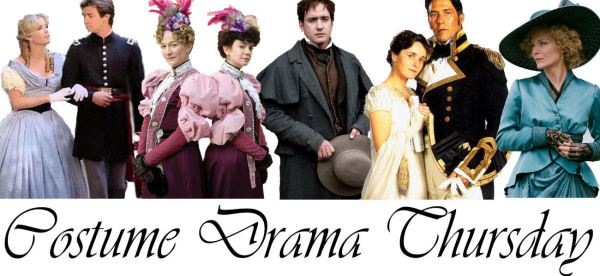 For the last year, I’ve been living without cable TV (about to remedy that TODAY!), so I’m sure I’ve missed a lot of made-for-TV movies, miniseries, and specials over that span (like the AMC show Turn, which had just been announced when I made the decision to cut the cord). So I’m going to have a lot of catching up to do and reruns to find over the next few months!
 Fortunately, a couple of friends of mine mentioned the History Channel’s “based loosely on history” miniseries Sons of Liberty which aired for three nights in January. I know there were probably a lot of Revolutionary War buffs who were grossly offended by the liberties the “History” Channel took with the actual history surrounding our founding fathers (whether founding our country or a beer brand), but as that’s not one of my areas of historical expertise, I was able to watch it with an eye toward sheer enjoyment of the pretty, pretty actors in historical costumes in vaguely familiar historical settings.
Title: Sons of Liberty
Historical Setting: Massachusetts/Pennsylvania, 1760s–1770s
Starring: Ben Barnes, Marton Csokas, Ryan Eggold, Michael Raymond-James, Rafe Spall, Dean Norris, Jason O’Mara, Henry Thomas
Original Release Year: 2015
.
.
At first, I wasn’t buying Once Upon a Time‘s Neal/Baelfire (Michael Raymond-James) as Paul Revere, and in the first episode, I just couldn’t see it. But as the series moved on, and especially after the “event at the barn,” I not only believed him as Paul Revere, I actually started falling for him just a bit. Now I have a hard time remembering him as Neal/Bae!
.
Get Set: Getting into the Draft-Writing Mindset #ReadySetWrite
 One thing that can make writers, whether trying for a first manuscript or a fiftieth, want to give up is the failure to realize the difference between regular writing and draft writing.
Regular Writing
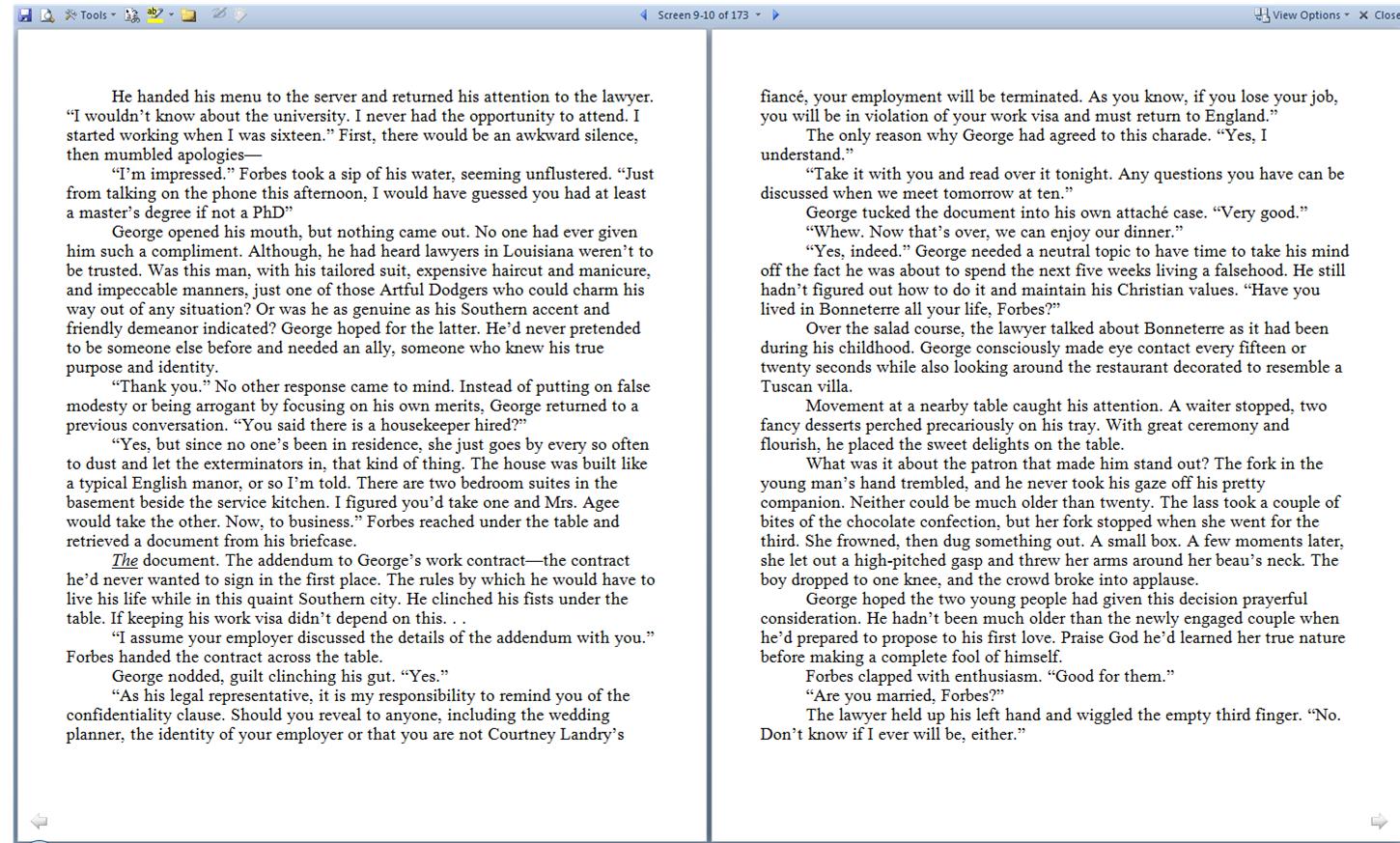
What Regular Writing looks like.
- In the process of regular writing, you may take the time to re-read what you’ve already written, maybe do a little tweaking or editing on that, before you start writing for the day.
- If you can’t think of the correct word or phrase you want to use, you’ll pause, go to thesaurus.com or some other resource and search until you find just the right term for your prose, then go back to writing.
- You may run across something that needs to be researched. Maybe it’s how to change the oil in a 1957 Ford Mustang. Maybe it’s the correct title for the crew member on the ship who serves the captain’s dinner. So you pause, pull out your reference book or start searching online until you know exactly what you need to know. You incorporate that information, and then you go back to writing.
- A minor character comes on the scene. You think this person may show up again—may even become a secondary character—but you need to know a little more about him. You need to know his name, a bit about his background, what he does, and what role he has in the story. So you pause, go to your Story Bible and start an entry for this character. Then, once you know exactly what you need to know, you go back to writing.
- You get to the end of a piece of dialogue, and you’re not sure exactly how you want to tag it. So you pause and sit back. Do you want to use a “said” or “asked” tag? But those are so passe. Perhaps something with an adverb? No. Adverb tags are of the devil, you heard at a conference once, so better not do that. Maybe an action tag? Okay. Where are the characters in the space and in relation to each other? How would the character move? What’s the facial expression? Maybe you should act it out. Once you have the perfect tag, you get it down in words and continue writing.
Are you getting a picture here of what “regular” writing is?
Draft Writing

What Draft Writing looks like.
- In drafting, you may take the time to re-read the last few paragraphs of what you wrote the day before to remind yourself where you left off, but you don’t make any changes and you immediately start writing as soon as you finish reading.
- If you can’t think of the correct word or phrase you want to use, you type ____________ and then may even use the comments feature to highlight it and type a reminder to yourself to look it up later and then resume writing.
- You may run across something that needs to be researched. Maybe it’s how to change the oil in a 1957 Ford Mustang. Maybe it’s the correct title for the crew member on the ship who serves the captain’s dinner. So you type ___________ and use the comments feature to highlight it and type a reminder to yourself to look it in the revision process after the first draft is finished and then resume writing.
- A minor character comes on the scene. You think this person may show up again—may even become a secondary character—but you need to know a little more about him. You need to know his name, a bit about his background, what he does, and what role he has in the story. So you type ___________ and then may even use the comments feature to highlight it and type a reminder to yourself to make it up later and resume writing.
- You get to the end of a piece of dialogue, and you’re not sure exactly how you want to tag it. So you write “he said” or “she asked” and then type ___________ and use the comments feature to highlight it and type a reminder to yourself to write something better later and then resume writing.
Are you catching the difference between regular writing and drafting?
In drafting, the most important thing to do is get the bones of the story down in writing. It doesn’t have to be perfect. It doesn’t even have to be good. That’s what the second, third, fifth, tenth draft process is for.
Forget about “getting it right.” Just get it written!
Get Set: Structuring Your Story in Seven Steps #ReadySetWrite
If you’ve followed the other steps in this series so far (links at the bottom in case you missed some/all), you may feel ready to start writing. But just in case you aren’t, this week and next week, we’ll explore a few additional exercises to get set you up to be as ready as possible to write your story.
Structuring Your Story in Seven Steps
The easiest way to not only make sure you have enough story to reach your desired word count—as well as to have something that keeps you on track when you feel lost or derailed somewhere after about chapter 3—is to use some kind of outline structure. If you’re writing genre fiction, this is a little easier, because there are certain markers, certain landmarks your story needs to hit in order to meet reader (and publisher) expectations.
 The structure I’ve found that works best for me is the Seven Story Beat structure from Writing the Romantic Comedy by Billy Mernit. Don’t let the title fool you—as you’ll see below, this structure applies well to just about any story.
1. The Setup/Hook
“A scene or sequence identifying the exterior and/or interior conflict (i.e., unfulfilled desire), the “what’s wrong with this picture” implied in the protagonist’s (and/or antagonist’s) current status quo” (Mernit 110).
This is the introductory scene of your story and your synopsis—the opening hook and introduction of your main characters. As with all opening scenes, this is the establishment of that character’s story goal, as well as hinting at the main conflict for the entire novel. In a synopsis, you should focus on the one or two main characters (possibly as many as three if they’re closely tied together) who are involved in the main plot of the story.
Example from the movie Witness: (adapted from Wikipedia)
After the death of her husband in Lancaster County in 1984, young Amish woman RACHEL LAPP decides to take her eight-year-old son, SAMUEL, into the outside world for the first time on a trip to Baltimore, Maryland, to visit her sister. Traveling by train, Samuel is amazed to see people different from him and sights such as a hot air balloon.
2. The Inciting Incident
“The Inciting Incident brings the main characters together and into conflict; an inventive but credible contrivance, often amusing, which in some way sets the tone for the action to come” (Mernit 111).
Beat 2 should follow Beat 1 in close succession—after all, it’s the Inciting Incident that gets the story rolling. It’s the story hook that keeps us reading. These two may even happen at the same time—giving you a six-beat structure, rather than seven.
You’re probably more aware of Inciting Incidents than you think. Whenever you start talking with your friends about any type of storyline—a book, a movie, or even an episode of your favorite television show—inevitably someone will start analyzing what led up to it. What was it that put everything in motion? What’s the first important thing that really pulls you into the story? In other words, what was the Inciting Incident?
Example from the movie Witness: (adapted from Wikipedia)
When waiting to change trains at the 30th Street Station in Philadelphia, Pennsylvania, Samuel uses the men’s room. As he does so, he accidentally witnesses the brutal murder of a police officer.
3. The First Turning Point
“Traditionally occurring at the end of Act 1, this is a new development that raises story stakes and clearly defines the protagonist’s goal; it is most successful when it sets characters at cross-purposes and/or their inner emotions at odds with the goal” (Mernit 112).
The First Turning Point of your story is the event that happens to set your characters at cross-purposes with each other, to complicate things, to start building to the ultimate conflict yet to come.
Example from the movie Witness: (adapted from Wikipedia)
CAPTAIN JOHN BOOK takes Samuel and his mother to the police station and has Samuel study pictures of convicts and a police line-up to identify the murderer, but Samuel does not see a match. However, after wandering around the police station, Samuel sees a newspaper clipping with a picture of Lieutenant James McFee and identifies him as the man he saw at the train station.
4. The Midpoint/Raising the Stakes
“A situation that irrevocably binds the protagonist with the antagonist and has further implications for the outcome of the relationship” (Mernit 113).
This is taking the conflict you’ve just raised at the turning point and continuing to raise the stakes: throwing as many twists and turns and conflicts as you can at the characters to keep them from resolving the plot question as long as possible. (In the example, conflicts that raise the stakes are bold/red—obviously, you wouldn’t do that in a formal synopsis.)
Example from the movie Witness: (adapted from Wikipedia)
Book reports to his superior officer, Chief Paul Schaeffer, saying that McFee was responsible for a drug raid where expensive chemicals used to make amphetamines were discovered, but never reported to the police department. The police officer who was murdered was investigating the disappearance of these chemicals which, if sold, would make McFee a very wealthy man, hence he was murdered to ensure silence. Schaeffer advises Book to keep the case secret so they can work out how to move forward with it.
Later, when Book returns home, he encounters McFee in a parking garage. McFee tries to shoot him but Book draws his own gun and, after a fierce shoot-out, McFee flees the scene—but not before Book is wounded. Book realizes that since he only told Chief Schaeffer about McFee’s corruption, then Schaeffer must be corrupt, too. Book then phones his partner and tells him to remove all the police files that include the Lapps’ details, and that he is going into hiding. Schaeffer, McFee, and Fergie (the second murderer) start their hunt of Book.
Book returns Rachel and Samuel to their farm in Lancaster County, but as he is about to leave, he passes out from loss of blood as a result of McFee’s gunshot. He cannot go to any mainstream doctors or hospitals, as they will make reports, and McFee will find and kill him and the Lapps. Rachel’s father-in-law, who also lives at the farm, reluctantly agrees to shelter Book in their home for the sake of his grandson and daughter-in-law’s safety. Eli recruits an Amish apothecary to treat Book’s gunshot wound using traditional Amish methods.
Book stays with the Amish for some time, learning their ways, helping out around the farm, and becoming part of Rachel’s and Samuel’s lives—and begins to fall in love with Rachel along the way, which creates friction between Book and Daniel, the Amish man who wants to marry Rachel.
5. Swivel: Second Turning Point
“Traditionally occurring at the end of Act 2, stakes reach their highest point as the story goal’s importance jeopardizes the protagonist’s chance to succeed at his/her state goal—or vice versa—and his/her goal shifts” (Mernit 115)
The Second Turning Point is basically the straw that breaks the camel’s back. It’s almost “Inciting Incident Part II”—an event that leads the characters to make a turning-point decision that will lead to the climax of the story.
Example from the movie Witness: (adapted from Wikipedia)
After he’s been with the Amish for a while, Book goes into town to telephone his partner; but he is informed that his partner has been killed [incident]. Enraged, Book calls Chief Schaeffer’s private residence (where he cannot be traced), openly calling out Schaeffer on his corruption and stating that he is through with hiding and is going to hunt down Schaeffer and McFee instead. While returning to Eli’s farm, Daniel is harassed by local punks who defile Amish culture and pacifism. Book then confronts the tormentors, and when one of them harasses him, he strikes back and breaks the nose of one of the punks [turning-point decision]. The fight becomes the talk of the town, and makes its way to the local sheriff.
6. The Dark Moment/Crisis
“Wherein the consequences of the swivel decision yield disaster; generally, the humiliating scene where private motivations are revealed, and either the relationship and/or the protagonist’s goal is seemingly lost forever” (Mernit 115).
This is when the conflict rises to such a crescendo that it seems insurmountable.
Example from the movie Witness: (adapted from Wikipedia)
Book tells Rachel he is leaving the next day. However, before Book gets a chance to leave the farm, Fergie, McFee, and Schaeffer arrive and threaten Rachel and her father-in-law. Book, who is in the barn with Samuel, orders Samuel to run to the neighbors’ for safety. Using Samuel’s lessons about the grain silo, Book tricks Fergie into entering the silo, then releases a cascade of corn which suffocates Fergie. Book grabs Fergie’s shotgun, then uses it to shoot McFee dead. Meanwhile, Samuel rings the bell on his farm, alerting their Amish neighbors that help is needed. When a crazed Schaeffer threatens to kill Rachel, Book surrenders to him.
7. Resolution
“A reconciliation that reaffirms the primal importance of the story goal; an ending that provides satisfaction to the reader” (Mernit 116)
The Resolution, as the name of this beat implies, is the denouement and ending of the story—“the marryin’ and the buryin’” as Mark Twain called it. It is the resolution of the Dark Moment/Crisis and the resolution of the relationship between your characters. In your book, this can be anywhere from a few paragraphs to a few pages to a chapter. So in your synopsis, it can be anywhere from a sentence to a paragraph or two. Note: It is very important to include the entirety of the resolution in a formal synopsis.
Example from the movie Witness: (adapted from Wikipedia)
However, at that moment, a large number of Amish arrive at the Lapp farm in response to the bell. Schaeffer, realizing he cannot murder everyone, knows he has lost and allows Book to disarm him. The local police arrive, and Schaeffer is taken away.Afterwards, as Book prepares to leave, he shares a quiet moment with Samuel, then exchanges a silent, loving gaze with Rachel. Eli bids Book goodbye on his return to Philadelphia by saying, “You take care out there among them English,” showing his acceptance of Book as one of the community. As Book drives away from the Lapp farm, he passes Daniel, who has presumably come to resume his courtship of Rachel.
When I put all of these examples together in a separate document, it comes out to more than one single-spaced page, so it’s a good starting point to make sure your story is set and ready to write. At any step along the way, if you know specific scenes or conflicts you’re planning to use, go ahead and add notes about them. The idea here isn’t to keep it to a certain word count or page length. It’s to help you think through the structure of your story before you’re so wrapped up in the middle of it you forget where you were going.
No, you don’t have to work with an outline like this—but when you get stuck around the 30,000-word mark, having even just one or two scene ideas for each of these seven points can help in regaining momentum and continuing to write.
__________________________________________
Work Cited:
Mernit, Billy. Writing the Romantic Comedy. New York, NY: HarperCollins Publishers Inc., 2000.
“Witness (1985 film).” (2013, October 22). Wikipedia. Retrieved October 22, 2013, from http://en.wikipedia.org/wiki/Witness_(1985_film)
__________________________________________
 Previous Posts in the #ReadySetWrite series:
- Ready. Set. Write.: Planning, Preparing, and Writing Your Novel This Year
- Get Ready: Is Your PREMISE Ready?
- Get Ready: Are Your CHARACTERS Ready?
- Get Ready: Is your SETTING ready?
- Get Set: Developing Your Backstory
- Get Set: Picking Your Point of View and Viewpoint Characters
- Get Set: Getting to Know Your Setting
- Get Set: Doing Your Research
- Get Set: Determining Your Story’s Tone
- Get Set: Setting Writing Goals and Timelines
- Get Set: Figuring Out Your Characters’ Desires, Goals, and Motivations
Get Set: Figuring Out Your Characters’ Desires, Goals, and Motivations #ReadySetWrite
There are a couple of things lurking in the work you’ve already done up to this point which will be important to dig out and define at this point: your main characters’ goals and motivations.
Your Characters’ Desires
You can’t read a craft-of-writing book without reading about making sure that your characters want something, right from the first page—even if that desire is simply to get a glass of water, according to Kurt Vonnegut.
As you look back through your story premise and the work you did in determining who your viewpoint characters would be, your main characters’ desires—what they want in the story—should start becoming clear.
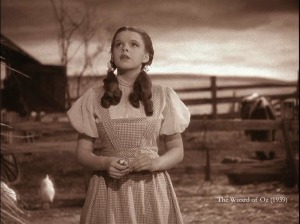 It’s not interesting to read about someone who doesn’t want anything, who has no desires. The greater the desire, the more opportunities for that desire to be thwarted (conflict); therefore, the more interesting the story. Think about The Wizard of Oz. In the opening (B&W) part of the movie, Dorothy’s desire is to leave the drudgery of life in a Kansas farmhouse and go “Somewhere Over the Rainbow.” Almost immediately, the fulfillment of this desire is thrust upon her in a somewhat violent and traumatic manner. Desire met. Story over, right?
Of course not! Once Dorothy arrives in Oz, the driving force of the story is her desire to go home to Kansas. If she attained that desire as quickly as her initial desire was fulfilled, if she followed the yellow-brick road all the way to the Emerald City with no one to stop her—even if she did meet the same quirky folks along the way—it would not be a very interesting story (nor take very long to tell!).
Sol Stein describes plotting at its most basic as “putting the protagonist’s desire and the antagonist’s desire into sharp conflict. . . . think of what would most thwart your protagonist’s want, then give the power to thwart that want to the antagonist” (83).
Along her journey, in Dorothy’s quest to fulfill her desire, she meets with one conflict after another brought upon her by the main antagonist of the story, the Wicked Witch of the West. But the witch wasn’t thwarting her just to thwart her. She had a desire as well: to retrieve the magical ruby slippers which were on Dorothy’s feet and held the key for Dorothy’s return home.
Dorothy’s desire (home) is one that everyone can understand; it’s what Stein calls universal: “The wants that interest a majority of readers include gaining or losing a love, achieving a lifetime ambition, seeing that justice is done, saving a life, seeking revenge, and accomplishing a task that at first seemed impossible” (84).
In my genre, this universal desire is built in: gaining a love. Love, money, and power, according to Stein, are the three themes which create the greatest conflict, which is perhaps why the romance genre makes up more than half of all popular fiction sold. However, “falling in love” is not usually the main desire of the main characters of a romance novel.
In my contemporary romance, Stand-In Groom, Anne’s desire is to run a successful business, remain independent, and perhaps, after ten years of living with the regrets and bitterness of a broken engagement, “create her own happy ending.” So what antagonist comes up against this desire to create conflict? Why, that would be the hero, George Laurence, who comes to town desiring nothing more than to fulfill his contractual agreement to his employer to (a) plan his famous employer’s wedding and (b) keep the media from learning that his employer is getting married. Why do these two desires come into conflict? Because Anne and George are attracted to each other, and Anne believes that falling in love with the “groom” of the biggest wedding she’s ever planned will ruin her business.
Now, as we discussed in the Goals vs. Dreams series, it’s all well and good to have desires (dreams), but in order to fulfill those desires, one must set and achieve goals.
Your Characters’ Goals
Just like with writing, once we know our characters’ desires (dreams), we must set actionable, personally achievable goals to set the characters on their paths as the story moves along.
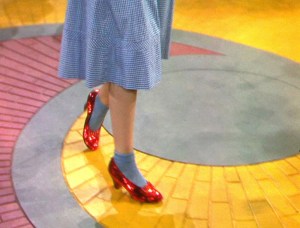 Let’s go back to The Wizard of Oz for a moment. While getting home to Kansas is Dorothy’s driving desire, her specific, personally attainable goal for the purpose of the active plot is to make it from Munchkinland to Emerald City to seek help from the Wizard of Oz. Because there are multiple other characters with their own desires and, thus, goals, Dorothy’s road to fulfilling her desire by working toward a specific goal is filled with conflicts. These conflicts seem like they might keep her from achieving her goal; but she finally reaches Emerald City and meets the wizard. But rather than fulfilling her desire, the wizard gives her a new goal: to get the Wicked Witch’s broom stick and return it to the Wizard. She accomplishes this goal (“I’m melting. . . .”) and just when it seems like she’ll get to go home, after teary goodbyes, her desire is once again thwarted by the balloon taking off without her in it—she has achieved her goals, big and small, but not her overall desire. Enter Glenda the Good Witch who explains that the means to gain her desire was always within Dorothy’s reach—the ruby slippers.
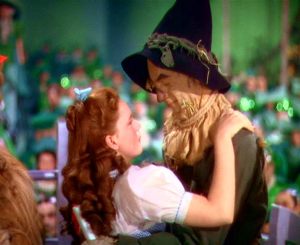
 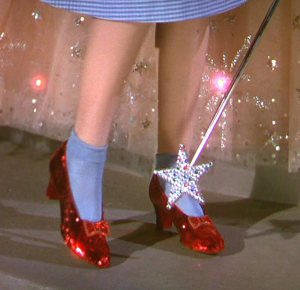 Once Dorothy learns that “there’s no place like home,” the story comes to its (somewhat) satisfying conclusion. (Am I the only one who ships Dorothy and the Scarecrow?)
Your character’s main desire shapes his or her goals for your story.
In Stand-In Groom, Anne’s primary goal for the first part of the novel is to plan a wedding with a limitless budget, thus ensuring the future of her business, while her secondary goal is to fight her attraction to the man she thinks is the groom. When she discovers he isn’t the groom, her secondary goal changes to trying to trust him again (while continuing with the main goal of planning the wedding); after all, George has been dishonest with her about his identity for several weeks. Then, when she discovers the true identity of the groom, her secondary goal changes again. And, along the way, her desire changes to focus on putting happiness in her personal life first and her business second. While the hero and the man he works for (the groom) aren’t necessarily antagonists, it is through their actions—the hidden identities and goals of their own—that Anne’s desires and goals seem to be thwarted.
Your characters’ desires and goals are all well and good, but if they have no motivation to follow-through and overcome the conflicts that arise, you have no story.
Your Characters’ Motivations
Go back through all of your prep work that you did in developing your characters, as well as your work on your characters’ backstories. Up to this point, you’ve identified your main characters desires and goals. But now is the time to ask why. Why does your character want what she wants? Why does she set the goals she sets, and not other goals, in order to reach those desires?
There are several aspects of your characters you need to work on and identify in order to determine what their motivations are (and this is the time to release your inner four-year-old and constantly ask “why?”).
- What is your character’s spirituality? This isn’t about religion. This is something important for all writers to know about all of your main characters, because the characters’ morals and values, and thus their actions, reactions, and decision making, will hinge on what they believe about life and the afterlife and the value of both.
- What is your character’s heart? What is your character passionate about? Beyond the scope of the story, what are his desires? Her goals? What does she want to do with her life? What does he want to accomplish by the time he’s 30, 50, 70?
- What are your character’s abilities? This goes beyond their physical abilities (walk, run, talk, etc.). What have they learned to do? Is she a Victorian girl who’s learned to use a typewriter in hopes of getting a job to support herself instead of marrying someone she doesn’t love? Has he learned to train guard dogs and police canines? But then, what are their inborn talents? Those things with which we would say he or she is “gifted”?
- What is your character’s personality type? While not everyone believes in personality typing, when developing characters, going through a personality-type questionnaire and answering the questions as your character can give you great insight into how your character’s mind works. Introverts and Extroverts “recharge” differently and react differently in public and private settings. Thinkers and Feelers come to decisions in totally different ways. And so on. Make your character more dimensional by giving him or her a complete personality.
- What are your character’s life experiences? What has your character been through in her life to make her who she is when she steps onto Page 1 of your story? This is the bulk of the backstory, which everything else plays off of and is affected by. This can include:
- – Family makeup/background. What size family does he come from? How many siblings? Were both parents present? Did she have a good relationship with them? What was his relationship with his siblings like? Did she love her family or could she not wait to escape? And so on.
– Education. Whether formal or self-taught, one’s education is crucial to who they are as a person. Did they have all the benefits of an upper-class private/Ivy League education? The scrappier, American-dream public school education? Or maybe she had to drop out in eighth grade and go to work to support the family. And even if someone went to school and got a college degree, that doesn’t make them “intelligent” or “learned.” That just means that they have a couple of pieces of paper. How intellectual is your character? How smart? How street-smart? How wise? How knowledgeable? How does this compare to the people around him/her?
– Favorites. Color, food, music, entertainment, etc. What are the things that give your character a good quality of life? (Or would if they had access to them.) Get creative and have fun with these.

Once you have all of this down you should have a good understanding of who your character is. The reason I try to figure as much of this out before writing is that it saves me time in revision after finishing the first draft if I don’t have to go back and edit out long stream-of-consciousness scenes in which I’m inside the character’s head digging into backstory I didn’t know before I started writing. But no matter how detailed I get with this, I always have a few revelations about my characters—things I never would have known about them until they were faced with a crisis and forced to own up to something from the past they kept deeply hidden, even from me—whether it’s a desire the character kept hidden from me, or the character telling me there’s a better way to structure his goals in order to achieve his desires because of something in his personality type or an ability or experience I don’t learn about until halfway through the draft.
__________________________________________
Works Cited:
Stein, Sol. Stein On Writing: A Master Editor of Some of the Most Successful Writers of Our Century Shares His Craft Techniques and Strategies. New York, NY: St. Martin’s Press, 1995. Print.
Get Set: Setting Writing Goals and Timelines #ReadySetWrite
In addition to getting all of the creative aspects of your story ready and set for writing, it’s important to make sure you have goals and timelines when it comes to how you’re going to write your story—and how long it will take you to write your story.
It’s all well and good to be ambitious and say you’re going to have the rough draft of your manuscript finished in three months—or even less time. And, if you’re an experienced writer and you know your own production ability, then you know whether or not that’s a reasonable goal.
Setting Writing Goals
As we discussed in the Goals vs. Dreams series, it’s all well and good to dream of writing a novel, but unless you give your dreams marching orders—unless you set actionable, personally achievable goals—you’ll likely never see those dreams fulfilled.
Remember, when it comes to setting goals for your writing:
- Don’t be vague—set a goal with a specific, detailed end product as your result.
- Make a checklist of actionable, personally achievable steps.
- Set long-term and short-term goals.
- Set a timeline for every step it will take to achieve your ultimate goal—a completed manuscript.
Setting Your Timeline for your First Draft
Once you’ve laid out your goals and actionable items—and you know what your overall timeline is, you know how much time you need to get your first draft written. When you know you have a certain total word-count you want to reach by a certain date, you need to break it down into smaller, more easily achievable goals.
But before you even start looking at numbers, you need to look at your calendar.
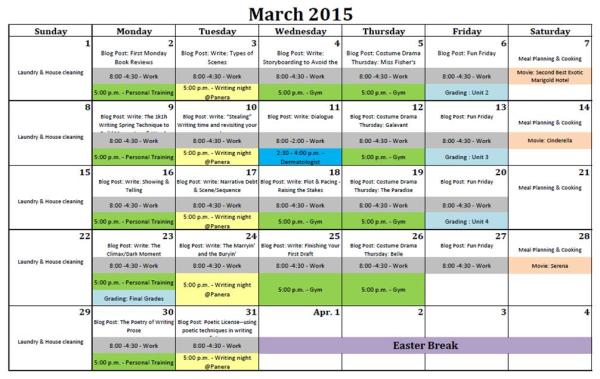
As you can see, my schedule stays pretty busy, between blogging daily, working full time, personal training, going to the gym, and meeting up with a friend once a week to write. Then there are the weekly tasks, like laundry, house cleaning, and meal planning and cooking ahead for those busy weeks. And don’t forget special events/occasions. Since my friends and I go to the movies regularly, and since it usually involves a meal before or after, I make sure to block out that time on my calendar, too.
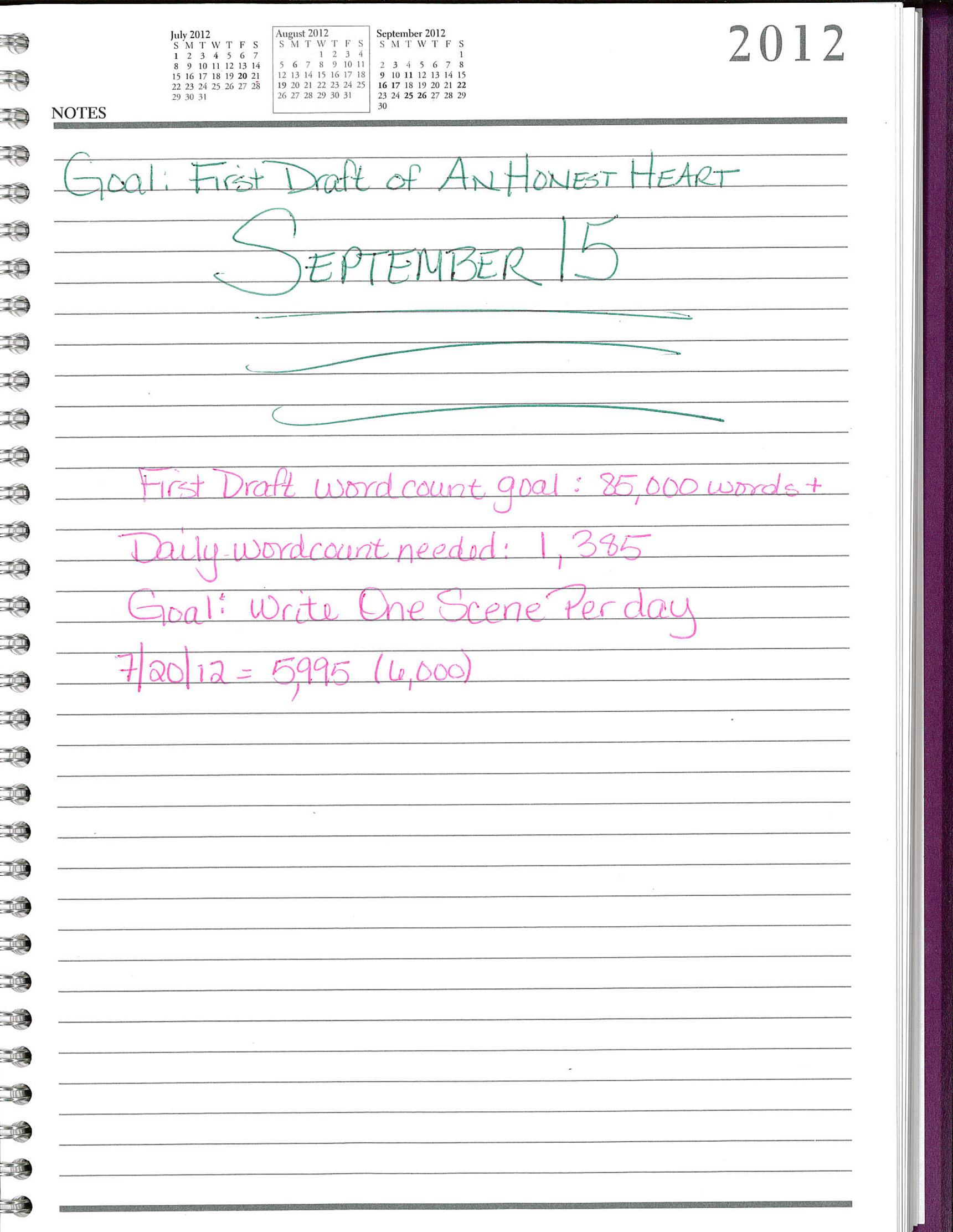
Once you know on what days you will and won’t be able to write, then you’ll be able to better calculate a regular (daily/weekly) word-count goal. So, for example, if you want to write an 85,000-word first-draft in 90 days, you’d set a daily word-count goal of 945 words per day, or a weekly goal of 7,085 words per week for twelve weeks.
For someone just starting out on your first manuscript, you will want to give yourself more time than that. Because writing every day is a habit that, like any habit, needs time to become a normal part of your everyday life, you may want to start with a smaller goal of, say, 500 words per day or 1,500 words per week.
 ..
.. 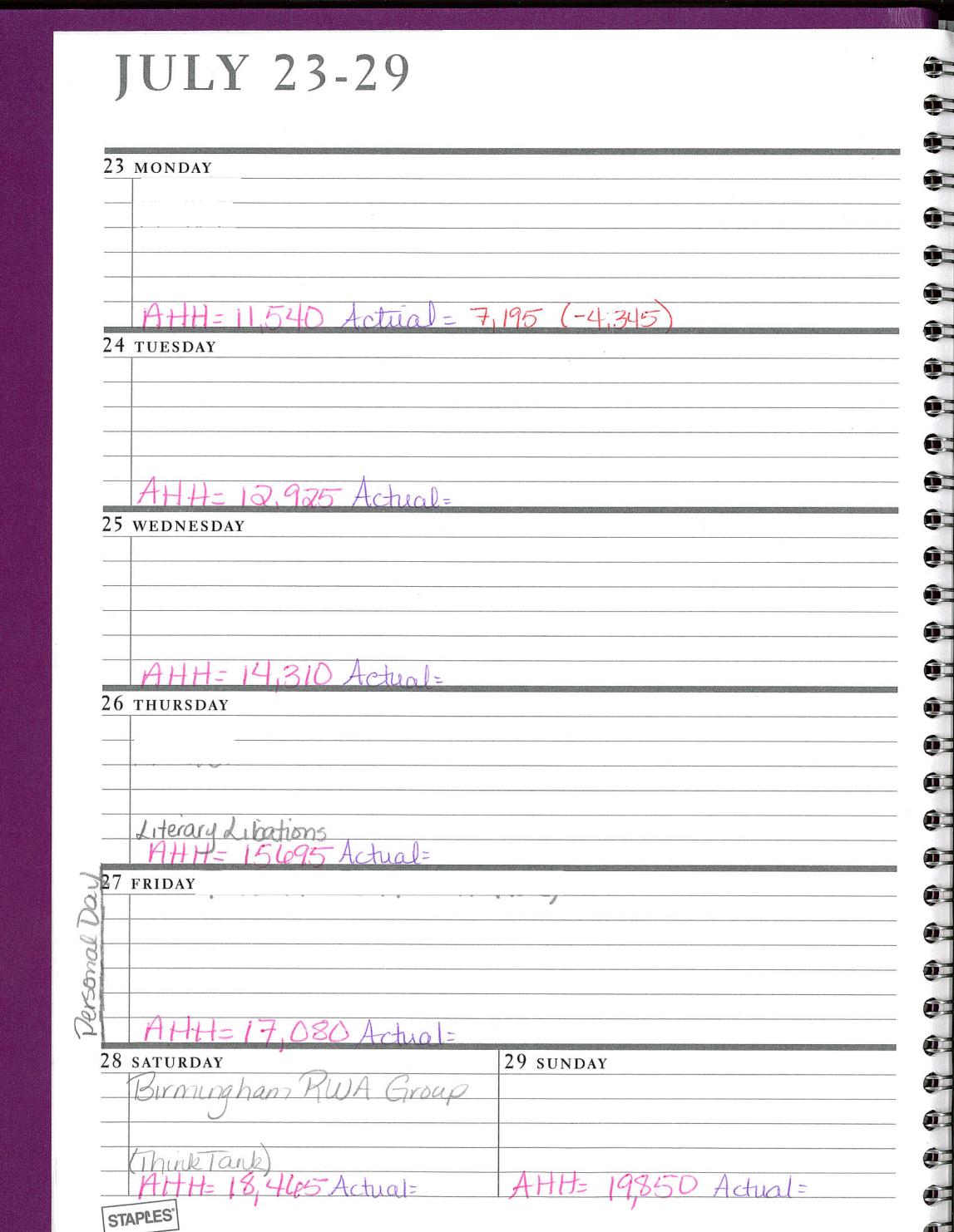
In addition to setting a total word-count goal and daily goals, in the past, I’ve used a planner to create and track a daily running total of what my total word-count should be if I’m keeping up with my daily goals.
 The best way to figure out your writing timeline is to figure out what your manuscript word-count goal is. Then, once you do that, you might want a planner of some sort you can use as a daily accountability tool to track your writing. Or, if an online tracker like the one I’m using to track my reading goal or my word count for my current story over on the right-hand side, works better for you, visit Story Toolz.
TL;dr version:
- Set a total word-count goal for your first draft.
- Set a date by which you want to have your first draft finished.
- Look at your calendar to see when you will and won’t be able to write.
- Set daily/weekly word-count goals to be able to meet your deadline goal.
- Track your word count in a planner or online widget to make sure you’re on track to meet your deadline goal.
What are some other tips and advice you can share about setting goals and timelines?
Costume Drama Thursday: Comanche Moon #TBT


Karl Urban as Woodrow Call
If it’s not obvious why I was originally excited to watch this TV miniseries, and why I continue to go back to it time after time, even though I don’t enjoy the storyline of it all that much, you haven’t been around here for very long!
.
Title: Comanche Moon
Historical Setting: Texas, 1850s–1860s
Starring: Karl Urban, Elizabeth Banks, Steve Zahn, Linda Cardellini, Val Kilmer, Rachel Griffiths
Original Release Year: 2008
.
.
Get Set: Determining Your Story’s Tone #ReadySetWrite
My name is Tobey Heydon and I am practically seventeen years old, since my sixteenth birthday was five whole months ago. Actually, Tobey is my midle name and my first is Henrietta. My mother got sort of desperate when her third child turned out to be another girl, so she named me for my father. But, thank Heaven, my grandmother’s maiden name was Tobey. Otherwise it would have been too ghastly. People might have called me Henny for short and I would have simply died.
(du Jardin, p. 3)
Late in the winter of my seventeenth year, my mother decided I was depressed, presumably because I rarely left the house, spent quite a lot of time in bed, read the same book over and over, ate infrequently, and devoted quite a bit of my abundant free time to thinking about death.
(Green, p. 3)
I like to save things. Not important things like whales or people or the environment. Silly things. Porcelain bells, the kind you get at sourvenir shops. Cookie cutters you’ll never use, because who needs a cookie in the shape of a foot? Ribbons for my hair. Love letters. Of all the things I save, I guess you could say my love letters are my most prized possession.
(Han, p. 1)
Hello, World!
I’ve decided to start a blog.
This blog.
Why, you might ask?
You know when you shake a Coke can and then you open it and it explodes everywhere? Well, that’s how I feel right now. I have so many things I want to say fizzing up inside of me, but I don’t have the confidence to say them out loud.
(Sugg, p. 1)
When I wake up, the other side of the bed is cold. My fingers stretch out, seeking Prim’s warmth but finding only the rough canvas cover of the mattress. She must have had bad dreams and climbed in with our mother. Of course, she did. This is the day of the reaping.
(Collins, p. 3)
Aside from point of view, what’s one thing all of these opening paragraphs have in common?
Yes, they’re all YA books. That’s not it.
No, not all of them have been made into movies.
Give up?
All of them do a pretty good job of establishing the tone of the book right from the beginning.
Now, I’ll admit that I haven’t read a few of these (Green, Han, and Sugg). But through my extensive research (reading a few reviews on Goodreads) and what I’ve heard about them through word of mouth, I think it’s pretty safe to say that the way each of these books is written follows in the same tone that’s established in these opening lines.
Let’s look a couple of other examples quickly:
Mr. and Mrs Dursley, of number four, Privet Drive, were proud to say that they were perfectly normal, thank you very much. They were the last people you’d expect to be involved in anything strange or mysterious, because they just didn’t hold with such nonsense.
(Rowling, HPSS, p. 1)
As you’ve likely recognized (or guessed) these are the opening lines of Harry Potter and the Sorcerer’s [Philosopher’s] Stone. Right from the beginning, the tone is set—Rowling doesn’t open with the murder of Harry’s parents or with Sirius “killing” Peter Pettigrew and being hauled off to Azkaban. She doesn’t open with the revelation that Harry has been made to live in the broom cupboard under the stairs for almost his whole life. She doesn’t even open with wizards, but with muggles—the most muggliest muggles ever to live! She throws in a “thank you very much” and “they just didn’t hold with such nonsense” which immediately set the tone of the story—even though this will deal with things that are not “perfectly normal” but “strange or mysterious,” it’s going to be lighthearted.
The two men appeared out of nowhere, a few yards apart in the narrow, moonlit lane. For a second they stood quite still, wands directed at each other’s chests; then, recognizing each other, they stowed their wands beneath their cloaks and started walking briskly in the same direction.
(Rowling, HPDH, p. 1)
In the opening lines of Harry Potter and the Deathly Hallows, we get no “thank you very much” no “nonsense.” It’s brisk. It’s “moonlit.” It’s immediately tense and full of suspicion. Who are these unnamed men? Why are they meeting in a “narrow, moonlit lane”? Why do they immediately pull their weapons on each other? How do they know each other? We get a sense of impending doom rather than a lighthearted introduction to a new and magical world that we see in the first book.
That’s what it means to set a tone.
Will your story be lighthearted? serious?
Will it be dark and moody or bright and cheery?
Soulful and somber? Or fun and witty?
Cynical and sarcastic? Or witty and irreverent?
Will your viewpoint characters’ POV scenes be different from each other in tone? Do you have a character who is an optimist while the other’s a pessimist? Show this in the tone—in the words you choose and how you string them together. In the length and complexity/simplicity of your sentence structures. How do you want readers to feel as they’re reading your story?
Sometimes, you may think that you know the tone of your story, only to get a few thousand words into the first draft and realize that it isn’t working at all. I tried writing a story in which the heroine had social anxiety disorder but which was still in keeping with the lighthearted tone I use in my contemporary novels. But that character’s viewpoint scenes started getting more and more angsty and insular, taking the tone of the story into a much darker place than I wanted—one that didn’t really work for the lighthearted, hopeful romance novels I write.
So I ended up going back to the “get my characters ready” part of preparing my story and changed her character quite a bit. And she became the Meredith Guidry who now appears in Menu for Romance.
If you aren’t really sure what tone your story needs, let your characters help you decide. Freewrite in your main characters’ viewpoints and then go back and see what their moods are, and what mood you’re in when reading it. From that, you should be able to get a better grasp on, and figure out how to capitalize on, the tone of your story.
__________________________________________
Works Cited:
Collins, Suzanne. The Hunger Games. New York: J. B. Lippincott Company, 1949. Print.
du Jardin, Rosamond. Practically Seventeen. New York: Scholastic Inc., 2008. Print.
Green, John. The Fault in Our Stars. New York: Dutton Books/Penguin Group (USA) Inc., 2012. Print.
Han, Jenny. To All the Boys I’ve Loved Before. New York: Simon & Schuster/BFYR, 2014. Print.
Rowling, J. K. Harry Potter and the Sorcerer’s Stone. New York: Arthur A. Levine Books/Scholastic Inc., 1997. Print.
Rowling, J. K. Harry Potter and the Deathly Hallows. New York: Arthur A. Levine Books/Scholastic Inc., 2007. Print.
Sugg, Zoe. Girl Online. New York: Atria Books/Keywords Press, 2014. Print.
Get Set: Doing Your Research #ReadySetWrite
 When I first started writing Menu for Romance, I had a cursory knowledge of professional/restaurant kitchens—after all, I paid my dues my senior year of high school and worked in a restaurant, and I watched Food Network and Top Chef and other cooking shows religiously. So in one scene, I had Major’s sous chef wipe his hands on the towel tucked into his apron-string at his waist.
And then, after I finally got around to doing a little research, I read this:
And a word about side towels. The Culinary imported these sturdy items—gray-and-white cotton cloths that students tuck into their apron strings—from Germany because it couldn’t find acceptable ones in the United States, and they were excellent tools. At this stage in a student’s career [the first week], the towels were crisp and clean, all but new. “Side towels are not for wiping your board,” Pardus said. “They are not for wiping your knife, they’re not for dabbing your brow. They’re for grabbing hot things. Things are going to be hot. Anticipate it, expect it.” (from The Making of a Chef by Michael Ruhlman, pgs. 18–19)
Oops. Okay, so that was an easy fix. But if I’d been a good girl and done my research (or at least some research) ahead of time—when I was in the planning stage of the story—I wouldn’t have made that mistake . . . and many, many others that followed.
Doing Your Research
We’re told to write what we know. But that advice is more about taking what we know and extrapolating it into other situations, rather than just about the specific things we’ve experienced in our lives (read more about that here).
I knew restaurant kitchens—I’d worked in one. Right?
Wrong!
I knew how to work as a hostess, as an order-taker on the line (it was a Golden Corral back in the day when it was still a budget-friendly steakhouse not a graze-all-day buffet place), and as a salad bar stocker/cleaner. We had cooks—we didn’t have chefs. I’d never worked in a fine-dining restaurant. I’d never worked in high-end catering. I’d never worked with anyone who’d been to culinary school. So I had A LOT to learn.
And that was just for one character.
As I mentioned in the Finding Your Beginning in The End series, you win or lose your reader’s trust on the first page. I also wrote: Even if you think you know a topic, always find backup sources. Someone else will always know more about it than you do and will tear you (as the author) and your story apart for any mistakes.
I learned more about the city of Nashville in the 18 or so months it took me to write the Matchmakers trilogy than I had in the entire 14–15 years I’d lived here before that. It was actually harder for me to write contemporary novels set in a city I’ve lived longer than I’ve lived anywhere else in my life than it was to write contemporary novels set in a fictional city I’d been working with for years but was still developing as I was writing the Bonneterre books (and am continuing to develop while working on Jenn’s story now).
It’s obvious (I hope) that I had to do tons of research for both the Ransome series and the Great Exhibition books. There was so much research, in fact, that I included a section about it in the proposals that went out to editors for both series. It wasn’t just the history of the era, but the vernacular (of both the everyday and naval variety), the settings, the clothes, the transportation, the social expectations and strictures, etc. And almost all of these were things I needed to know before I could write.
I’ve spoken with various authors over the past two decades and am always shocked when I hear one say that they don’t bother with research before writing. What?!?! How can you NOT do any research before writing—especially for historical fiction? (Or even contemporary—there are always things that a writer needs to know more about.) I don’t care how well you think you know an era or a setting or a profession—there are details you’re going to need, issues that might arise, things you will have forgotten. And it will be obvious, even after multiple revisions, because you’re going to miss something.
But if you do a good bit of your research before you start writing—research that may start even way back when you’re developing the premise of your story—when something comes up as you’re writing, you’re either already going to have notes on it, or you’re going to know which book or website from which you’re likely to find the information you need.
Organizing Your Research
There are as many ways to organize research as there are writers. I work best with the information broken down into topics. And to do this, I love to use OneNote. Here’s an image of the Research section of my notebook for the Great Exhibition series:
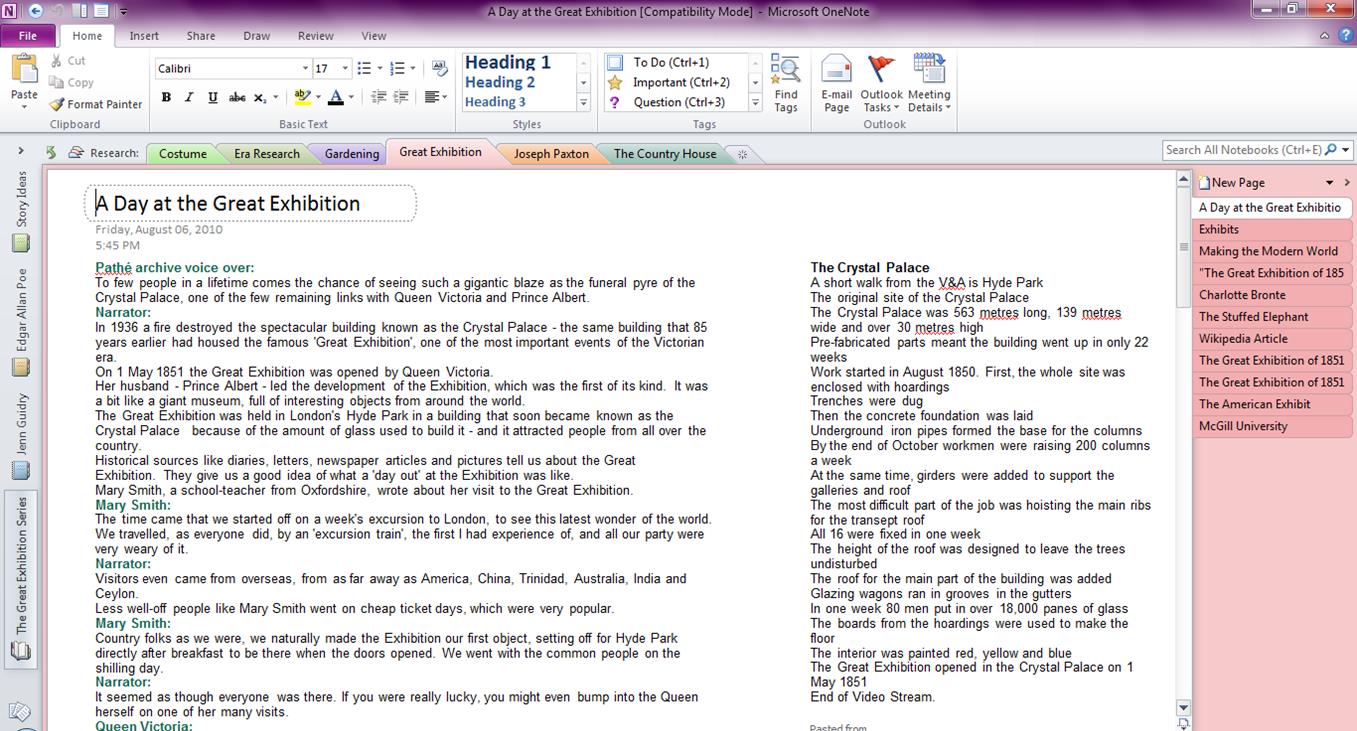
In addition to the Great Exhibition itself, I have sections on costuming, the era in general (which includes info on steamships, railway travel, music, industrialization, art, interior design), gardening (after all, Andrew is a landscape architect, so I needed to know all about the current styles for garden design, orangeries, conservatories, ornamental gardens vs. kitchen gardens, and more), and “the country house” which contains pages and pages of snippets and notes from a few books I got to make sure that I depicted a Victorian country house—how it ran, who ran it, what the daily schedule was like, what a country party was like, and more—to make sure I wasn’t just rewriting my Regency settings and culture but that I was getting the details unique to the early Victorian age. (I also have pages of research for seamstressing/design and 1840s/50s medical practice and other info I needed in the section for An Honest Heart).
One of the first bits of research I did for these books, long before I even started writing them, was on steamship travel and how to get Kate and Christopher from New York to England—how long it would take, what kind of ship it would be, how much it cost, where it put in once it arrived in England, how they would be transported from there (Liverpool) to Oxford (which meant also researching the railway system in England in 1851). I did this research while writing the initial synopsis of the story. Before I even knew what the full plot would be or even most of the main conflicts, I knew exactly how Kate would get to England, where Andrew would meet her, and how long they’d be confined to a compartment on a train together. I did other research as I worked on the synopsis and proposal. And even more research as I wrote the first three sample chapters.
Did I have all the information I’d need before I started writing? No way. There wasn’t a writing day that went by on which I didn’t need to stop and look something up—even if it was just to figure out if a word I wanted to use was in use back then (being able to use the search function on all of Dickens’s and Gaskell’s novels on Project Gutenberg made my life so much easier in this respect!) or to look at the layout of the Crystal Palace, duplicated from the original tourist booklet, to figure out where the biggest displays of fabrics were (upper floor) or where the Australian/New South Wales display was (ground floor near the south entrance, behind Canada and the West Indies and beside the sculpture garden). In fact, it was reading a tidbit in an article about the Great Exhibition while doing research on it after first coming up with the idea of using it as a setting (for a different series) that led me to making Neal in An Honest Heart Australian.
So do your research—you’ll probably find your characters more interesting, your setting richer, and your storyworld more vibrant from what you learn before you start writing. And it will save you tons of revision later on down the road.
Get Set: Getting to Know Your Setting #ReadySetWrite
Last week, we discussed backstory and the importance of knowing the backstory of your setting, in addition to your characters. But now it’s time to get to know your setting even more intimately.
Getting to Know Your Setting
1. Your Story World: Where does your story take place? Go from the broad (Planet Earth) to the narrow (the Woodbine neighborhood of Nashville) to the specific (77 Elberta Street).

The diverse architecture in downtown Nashville (source)
3. Landscapes, Climates: What does your story world look like? What are the geographic features? What is the weather like? No, you’re not necessarily going to include all of this in your story, but you, the author, need to know as much about this as possible so that you don’t have it snowing on Thanksgiving in Brownsville, Texas. If you’re creating a fantasy/sci-fi world, this is of VITAL importance to know before you start writing.
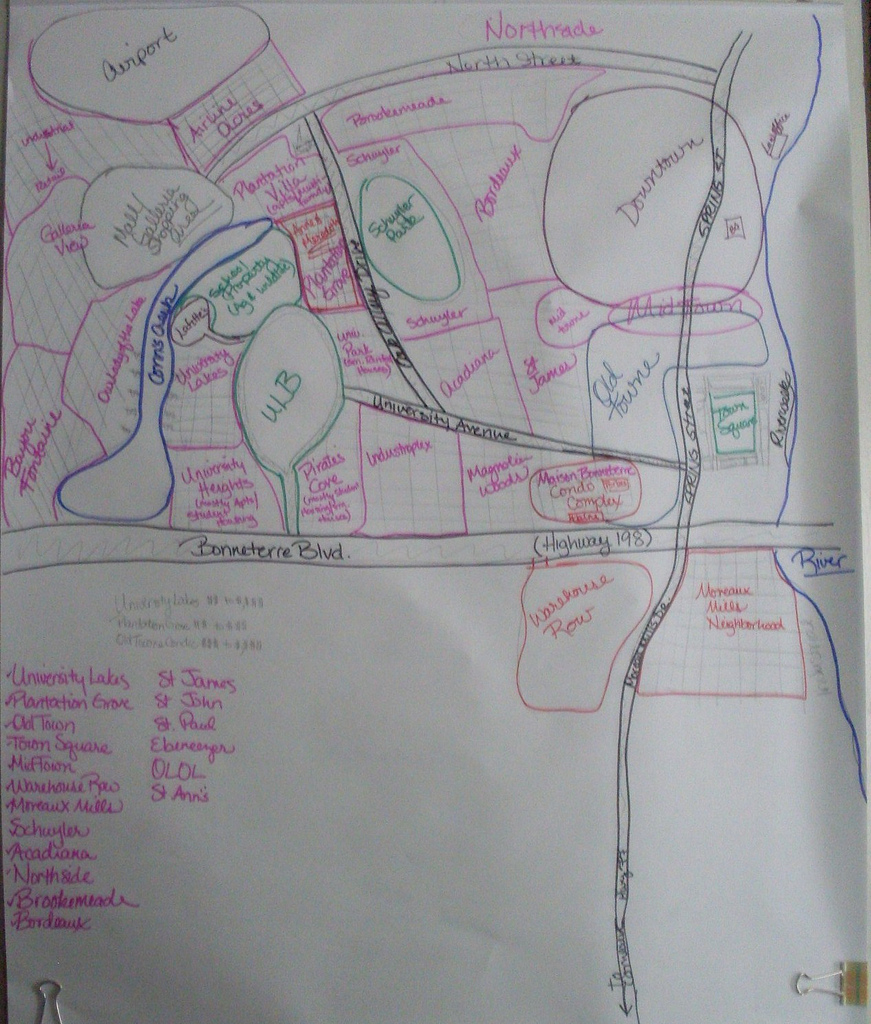
My rough, hand-sketched map of Bonneterre
5. Terminology: Is there a unique terminology to your setting? For example, when I was writing the Ransome series, I had to keep lists of all of the different parts of the ships and sails. Be specific with these (schooner rather than ship; jigger staysail instead of sail, etc.).
6. Historical Background: What’s the history of your storyworld? For those of us writing in either real or fictional cities set in familiar countries (like the US), this isn’t as hard as for those creating their own countries/worlds. But it is important to know why, for example, a person of color might be treated differently in Selma, Alabama, than in Detroit, Michigan, even in the year 2015.
7. Culture and Customs: What are the unique cultures and customs of your story world? “Nashville” has one connotation to the outside world, and a very different one to those of us who live here (and to those who live in different areas of Nashville. What’s culture/custom for me living in Woodbine might be completely different from culture/custom for a 20something hipster living in downtown. What festivals and other celebrations take place in your city? (And what does it mean when someone in Nashville calls CMA Fest “Fan Fair”—or even CMApocalypse?) How do people greet each other? Do they make eye contact and speak with strangers (Nashville), or do they avoid it if at all possible (Washington DC)?
8. Language, Accent, and Regional Slang: Whether real-world or fantasy/sci-fi, people are going to have different vernacular based on their region, their local culture/customs, and their backgrounds.
9. Social/Government Organization: More important for fictional/otherworldly story settings, but it’s good to know what would happen if a character breaks a social taboo or a law (and knowing what those social taboos and laws are).
10. Daily Life: This includes fashion/dress/style, manners, diet, calendar, customs, etc. Again, this is less consuming if you’re writing contemporary/real-world settings, but still something everyone needs to consider when developing your settings.
11. IMAGES, IMAGES, IMAGES: Collect images of settings that inspire, floorplans/images from real estate sites of your characters’ homes, images of the city or countryside or landscape, and so on. This is a great time to employ Pinterest—and you can use a private board if you don’t want to share with the rest of the world just yet.
Learn more about developing your setting here.
Get Set: Picking Your Point of View and Viewpoint Characters #ReadySetWrite
Now that you know the backstories of your characters and storyworld, it’s time to start preparing to choose in what style and in what viewpoints your story will be told.
Picking Your Point of View
“Point of View” or POV is quite often the term used to identify which characters’ heads the reader is allowed into in a story. However, we’re using it in the more technical, grammatical definition today.
In order to set your story up to get ready to write it, there are three parts of POV you must decide upon:
- Person: First (I, me, my), Second (you, your, yours), Third (he, she, his, hers, they, theirs).
- Omniscience: Omniscient (using a narrator, even if it’s an invisible/god-like narrator), Limited (camping out in just one viewpoint character’s head per scene, the narrative is in the character’s voice, not a “narrator’s”), Objective (more of a journalistic style—“just the facts, ma’am”—not seen in fiction often).
- Tense: Present (action is happening in the here-and-now), Past/Active (verbs are past tense, but because this is the most common form of storytelling, it still seems to be immediate action), Past/Passive (usually a form of the “be” verb plus a gerund—word ending in -ing—or a form of the “have” verb + past-tense verb).
You can read more about these, and the vast array of combinations thereof here.
Must you know what POV you’re going to use for your story before you start writing? It’s a good idea to have a grasp of what’s accepted/expected in your genre—and the example I always give here is that in romance, the accepted and expected (by readers) POV is 3rd Person, Limited, Past/Active with the heroine and the hero being viewpoint characters. But since you’ll be writing multiple drafts, if you want to play with POV to see what works best for your story, please feel free to experiment. However, you should know how to do the POV you choose well and you should know the guidelines and conventions for it from studying craft-of-writing books, attending courses, and extensive reading of published books using that POV.
Picking Your Viewpoint Characters
No discussion of Point of View/Viewpoint is complete without talking about our characters. Whether you’re an outliner, loose-plotter, or seat-of-the-pantster, knowing who the key viewpoint characters of your story are before writing it is very important. Yes, this can change after a draft is finished—case in point, in the first draft of Ransome’s Honor, I had five viewpoint characters: Julia, William, Julia’s mother, Sir Drake, and (after the halfway point) Charlotte. Once I wrote the ending and learned what actually happened in my own story, I not only dropped one of the five viewpoints, but changed Julia’s mother to her aunt, Lady Augusta. I also introduced Charlotte’s viewpoint much earlier. That’s the benefit of allowing yourself to write a first draft—knowing that you might (and probably will) go back and make significant changes in subsequent drafts.
So when you’re in the composing process, you don’t have to feel locked into the viewpoints you’ve chosen . . . you just need to make sure that if you add a viewpoint or drop one in the first draft, you go back and weave it in (or out) more thoroughly in the revision process.
The first question to ask yourself when it comes to determining your viewpoint characters is: Whose story am I telling? In a romance novel, this is easy—it’s the story of the hero and the heroine as they fall in love with each other. In a detective/P.I. novel, it’s probably best to go with 1st Person—the viewpoint of the one solving the crime. However, even though these are usually the case, you can’t always force your stories to fit into that mold.
Next, which characters have important information to reveal to the reader that cannot be done without getting inside their heads? This is a tricky question—because when we’re first starting out writing, there may seem to be lots of characters who have important things to reveal to the reader, even if it’s just for one short paragraph. But as we read more, study more, and write more, we’ll get a better feel for what really is important and what isn’t. Typically, if it’s only one scene’s worth of information to be revealed, it’s probably not that important in the grand scheme of things—or it can most likely be revealed in another manner without dipping into that character’s viewpoint for just one scene. If you’re not sure, make a list of the characters in your story and try dividing them up into three categories: walk-ons (may not even have a speaking role, may or may not need to be named, might have one or two lines of dialogue, but never appear again); secondary characters (are along for pretty much the whole journey, are somehow connected to the development of the story—but not important enough to have a viewpoint); and viewpoint, or main, characters (those whose story you’re telling). If you’re coming up with too many main characters ask the next question . . .
Which characters’ internal journeys affect the direction, conflict, climax, and resolution of the story? If you’re giving a character a viewpoint just to reveal information to the reader, they may not actually be a viewpoint character, they may be a secondary character. If you still end up with multiple viewpoint characters, ask . . .
Do all viewpoint characters’ story arcs tie in to the main plot of the novel? Does each viewpoint character’s storyline somehow intersect with and/or affect or influence the main plot of the story? Do the characters’ lives intersect with each other? Does each viewpoint character’s storyline wrap up at the end and/or tie in to the ending? If you have multiple viewpoint storylines going on, and they don’t tie in with each other by the end of the novel, what you have are two plots—two stories that should be separated from each other.
How often does a character’s viewpoint appear? (This may not be apparent until after you’ve completed your first draft.) If you have a viewpoint character who has only a few scenes scattered throughout a 300-page novel, it may be time to consider relegating that character to a secondary role and finding a way to incorporate what’s revealed in his/her scenes to one of the major characters—UNLESS there is a very compelling reason to only have a few, such as it’s the villain’s viewpoint or something like that which serves to up the ante and increase the conflict and/or suspense.
Finally, which character has the most to gain/lose in each scene? With your synopsis/treatment/write-up of your premise, you should know at this point what many of the major scenes will be with the conflicts that happen in your story. Examine those and ask these questions: Who will be the most embarrassed by what’s about to happen? Who has a secret agenda? Whose heart is going to be racing? Who’s going to be ducking around the corner out of sight and overhear something he/she shouldn’t? That will help you choose the correct viewpoint character for each scene. But it isn’t foolproof. If a scene feels flat to you as you’re writing it, or to your crit partners or editor later, try it from another character’s viewpoint and see if it changes things.
Choosing which viewpoints to use in your story is ultimately your decision. And when you’re writing your first draft, you need to trust your gut and go with what feels right—but allow yourself the freedom to make the decision to demote a viewpoint character to secondary or promote a secondary to viewpoint halfway through. The easiest way to do this is to just keep writing with the change made—and then revise in the second draft stage. But if you just can’t do that, go back and rewrite just the scenes that would be affected by the change—don’t try to completely revise/rewrite your entire draft to that point. You’ll get stuck in an endless loop of revision and never finish it.
Most of all—have fun exploring your characters’ inner lives and conflicts, both internal and external. Lose yourself in them and their world. This prep time—and the time you spend writing your first draft—should be filled with the joy of discovery, not the agony of tedium and make-work.
For more on Point of View/Viewpoint, see the Make POV Work For You series.

 KayeDacus.com