Books (re)Read in 2016: ‘The Six Wives of Henry VIII’ by Alison Weir (audiobook read by Simon Prebble)
 The Six Wives of Henry VIII by Alison Weir
Audiobook read by Simon Prebble
My rating: 4 of 5 stars
Original review from 2013:
Audiobook read by Simon Prebble. This was really less about the women and more about the general history of Henry VIII’s marriages. Still in all, it was a fun listen and, even with as much as I thought I knew about these women, I learned some new tidbits–with the exception of Anne Boleyn and the only thing I learned about her is that Weir did not like her AT ALL.
Updated review in 2016:
This is the second time I’ve listened to this twenty-two-and-a-half-hour long audiobook. Alison Weir is something of a go-to author for me when it comes to Tudor nonfiction (not so much with her fictionalized versions—she’s too much of a historian/biographer to do a good job with novelizations/historical fiction). I’ll reiterate my original reaction from three years ago that this is less about exploring the internal lives and journeys of these six women and more about the simple history of Henry VIII’s six marriages.
There is a good amount of historical background on each of the women—Weir does a great job of digging up and documenting what is known about their origins and experiences before their lives fatefully intersected with Henry’s. I will also stick by my earlier assertion that Weir isn’t the biggest fan of Anne Boleyn. Though she does a good job of presenting most of the information in the book in a relatively objective manner, most of what is included about Anne Boleyn presents her in the worst light possible. Even Catherine Howard—who was actually guilty of adultery which Anne was innocent of but still executed for—gets a kinder portrait painted of her than Anne Boleyn.
As with most media, fiction or nonfiction, that focuses on Henry VIII and his wives, the majority is given over to Katherine of Aragon, Anne Boleyn, and the king’s Great Matter—his desire to divorce Katherine and marry Anne.
My reading update from 01/29/16, at 60.0%:
- “Off with her head! (Part 1) Although I know they were part of his life longer and had a huge impact on history, I think it’s sad that Katherine of Aragon and Anne Boleyn get 60% of the book, while Jane Seymour, Anne of Cleves, Catherine Howard, and Kathryn Parr are relegated to the remaining 40%.”
Throughout the first part of the book, we get the life history of KA—with more details about her parents (Queen Isabella and King Ferdinand) and siblings (and her siblings’ marriages) than we get about anyone else. As the only person of royal birth that Henry married, there is much more documentation about her family than any of the others. A lot of focus is placed on the negotiations between Henry VII (Henry Tudor) and KA’s parents on the marriage contract between KA and Prince Arthur—including all the haggling over the dowry, when it would be paid, how it would be paid, etc. And it takes quite a while for the book to actually get to the point at which KA and Henry VIII finally get married.
Then, once they do marry, it quickly glosses over the twenty-four years of their marriage to get as quickly as possible to Anne Boleyn. Yes, it is hard to give Anne Boleyn’s backstory without cutting into the ability to focus on KA and her marriage to Henry; however, given that he was married to her for twenty-four years, and the other five wives all fit into the last fourteen years of his life, it might have been nice to have less of a focus on KA’s childhood, extended family drama, and dowry issues before her marriage and more information on what KA and Henry were like as King and Queen of England before he decided to get rid of her.
Then, pretty much everyone knows the story of Anne Boleyn, the woman who made Henry break England away from the Roman Catholic church and the dictatorship of the Pope, and who was the center of one of the greatest scandals of the early Renaissance era. (If you aren’t familiar with her story, just watch Anne of the Thousand Days, A Man for All Seasons, Wolf Hall, or even The Tudors.) Again, while this book purports to be about Henry’s wives, this part of the book really focused more on everything going on around Anne than Anne herself. Of course, most of Anne’s letters, writings, or those of people close to her were most likely destroyed after she lost her head.
Reading update from 01/29/16, at 66.0%:
- “Another wife (Jane Seymour) bites the dust.”
One of the tidbits of history that is adjacent (but not about) Jane Seymour that I’d either forgotten or missed the first time listening to this is actually about her brother Edward (played with great effect by Max Brown in The Tudors)—and that is that he was married twice. His first wife bore two sons, but it was almost certain that his own father had actually sired the two boys; and when Edward’s wife died when the boys were still very young, he disowned them and was estranged from his father for many years. And it’s likely one of the main reasons why Henry didn’t lavish titles and estates on Jane’s father the way he did with Anne Boleyn’s father. It’s also probably why Jane did not attend her father’s funeral once she was Queen.
Jane . . . is boring. She was probably much more intelligent and educated than most historians/novelists give her credit for. But unlike Anne (or perhaps because of Anne’s example—after all, she was a maid of honor/lady in waiting to both KA and AB), she’d learned to hold her tongue lest she incur Henry’s wrath. (There is one recorded instance of her speaking “out of turn,” when she spoke up on behalf of men who had participated in the traitorous Pilgrimage of Grace—for which Henry reminded her of the fate of her predecessors, who had also meddled in his affairs.)
Most of the gloss-over histories we’re told about JS make it sound like she married Henry, got pregnant, had the baby, and then immediately died. They were married for about seven months before she got pregnant. Then, she was in labor for three days before finally giving birth. However, it took her twelve days to succumb to the fever that eventually killed her. It is believed that due to the difficult birth (most likely caused by a breech birth position), she died either of an infection from tearing in the perineum or because of a retained placenta. Either way, it was painful and unpleasant.
But the honest truth is that she was one of the lucky ones. Had she lived, she might have given Henry additional children; however, he probably would have quickly tired of her, and she would have spent what was left of her remaining years watching as her husband bounced from mistress to mistress while she aged prematurely from multiple pregnancies, poor healthcare, and stress.
Reading update from 01/30/16, at 75.0%:
- “Queen down! Queen down! Anne of Cleves (my favorite of the six) makes it out with not only her head, but also three major estates, a huge annuity, and the favor of the king and his subjects.”
Because not much is known about Anne of Cleves’s early life, not much is included here. So most of this part of the book focuses on the political machinations of Cromwell and Cranmer and those in the reformist movement around Henry to convince him to ally openly with the Protestants by marrying one. There are several well-known anecdotes about the first meeting between Henry and Anne that, surprisingly, Weir did not include here—I’m not sure why; they’re represented in every other piece of fiction or nonfiction I’ve ever read about AC.
And the most disappointing thing to me about Weir’s treatment of AC is that once Henry’s marriage to her is annulled, she pretty much disappears from the book, even though she remained part of Henry’s, his children’s, and his subsequent wives’ lives. It is mentioned that when he was in the process of getting rid of Catherine Howard (the next one), that there were very hopeful rumors in England that he was going to remarry AC—and even that Anne was pregnant with Henry’s child. Apparently, shipping isn’t a new phenomenon!
Reading update from 01/31/16, at 84.0%:
- “Off with her head! (The Sequel). ‘She hath done wondrous naughty.’ ~Francis I of France about Catherine Howard.”
Catherine Howard was an idiot—who didn’t deserve to be sacrificed by her ruthless and ambitious relatives to a lecherous, murderous old narcissist like HVIII.
Henry was an idiot for marrying her. Sure, he was going through a massive midlife crisis and wanted to feel young and vigorous and desirable again. But let’s face it: He wasn’t. And he likely knew that a fifteen- or sixteen-year-old girl like CH was most likely only flirting with him because he was King. And that she couldn’t refuse him or her family might lose their positions, land, and wealth—and she might lose more than that.
I mean . . . the only good thing about this part is that she at least managed to find a little bit of happiness with Culpepper before they were both executed.
And then there’s Kathryn Parr.
The caretaker wife. The one whose marriage to Henry was probably never even consummated. Again, she was someone who wasn’t allowed to say no to his advances. That’s how much power Henry wielded. She was someone who’d been around in the Tudor court for many years, as part of the aristocracy. She’d even been part of Jane Seymour’s household for a time—so Henry already knew who she was when their paths intersected after the debacle with CH. But this time, there was something about her—perhaps the reputation she had as a woman of high moral character who’d been a loyal wife to both husbands (she was still married to the second when Henry started to pay court to her). While nursing her second husband through a long, mortal illness, she fell in love with Thomas Seymour, Jane’s brother, and they planned to marry as soon as her husband died and her mourning period was over.
But as soon as her husband died, Henry decided he wanted to marry her, so he sent Thomas abroad and put on the full-court press with KP, and he made her an offer she couldn’t refuse. Literally.
Of course, as a woman who’d seen two husbands through their final years, she may have realized that Henry wasn’t long for the world and she could bide her time until he died and then she could still marry the love of her life.
Kathryn, after Jane, was one of Henry’s most honored and respected wives. He even made her Regent, ruling England in his stead, when he went off to war in France during their marriage. She was also one of the most highly intelligent and educated of his wives, publishing two books while Queen.
However, because of her intelligence and education, KP loved to debate—and she loved to debate theology with Henry. And as a secret Protestant, her theology didn’t always match up with his. The Catholics in England were regaining power at this time and wanted to get rid of KP, so that she wouldn’t have an undue effect on Henry and hurt their cause. So they managed to convince him to let them arrest her and have her tried for heresy. However, one of KP’s attendants found the warrant and told her about it. KP managed to convince Henry that the only reason she debated him—and disagreed with him on so many points—was so that he could educate her. After all, he was the supreme head of the church, and of her as her husband, and she depended on him for her spiritual education.
After Anne of Cleves, Kathryn Parr is the luckiest of Henry’s wives. He died before anything bad could happen to her (like the Catholics coming after her again or Henry getting tired of her). And then she was able to go on and marry the love of her life. Which story we get in brief at the end of this book (because, after all, it ties in with several key events in the life of the young woman who would become Queen Elizabeth I).
Weir is an expert at finding and making readily accessible the extant documents and records of the Tudor era and bringing them entertainingly to life for the modern reader. (See the quote from Francis I about Catherine Howard in my status update above for a prime example.) Because she has also done some novelizations of these historical events/people, she brings that creativity and style into her nonfiction prose; however, at times, I do have the same problem with her nonfiction that I have with her fiction: she tends to get sidetracked by her fascination with minor historical details . . . which she wants to describe and/or explain in full, even when it’s not really all that pertinent to the forward movement of the events she’s relating. But, then again, because of this, there are the interesting historical tidbits, like that of Edward Seymour’s first marriage and the reason for the estrangement from his father. I guess as a reader/listener, one must be in just the right mood at the moment for it to be an interesting tidbit instead of an uninteresting tangent.
#LeapAheadWritingMarathon Day 5: Self-Evaluation, Word Count, Awesome Accomplishments, and Terrific Tidbits. It’s SWAT Day!
 It’s Friday! That means it’s time to check in with your progress in the marathon.
On Fridays, I want to know about your full writing week. What were your greatest successes during the week? What was your favorite line/bit that you wrote? What did you learn about yourself, your characters, and/or your story during the week’s work? What are you most proud of yourself for doing this week when it came to your writing? What are you proud of yourself for accomplishing?
That means it’s SWAT Day!
Check in with your progress on your story and share, if you feel like it, the following:
- Self-Evaluation (how do you think you did? what can/do you want to do differently next week? what did you learn about yourself as a person or as a writer? what didn’t you do or finish that you wanted to? etc.)
- Word count (total for the week, Saturday through today)
- Awesome Accomplishments (breakthroughs, discoveries, highest daily word-count ever, etc.)
- Tidbits too good not to share
If you don’t want to share this stuff publicly, that’s okay. You can add a section to your Story Bible or start a journal (or add this to your existing journal) to keep track of this. But don’t skip doing this—I think that in the future, when you look back either on what you accomplished during this marathon or (heaven forbid) why you gave up on it, the insights you’ll gather later with hindsight on your thoughts during the challenge will be invaluable.
Happy writing!
#LeapAheadWritingMarathon Day 4: J. K. Rowling’s Ten Rules for Success
Whether or not you enjoy their books, it’s always nice to “draw back the curtains” on the lives, experiences, and motivations of best-selling authors.
The interesting thing listening to J. K. Rowling in this compilation of features, speeches, and interviews, is her knowledge when the idea for Harry Potter hit her, she knew it was publishable.
I had this same experience when I came up with the original idea for Stand-In Groom. I’d been writing (but not finishing anything) since my early teens and, for the two or three years prior to coming up with the idea, I’d completed three full manuscripts. When I first started working on the idea for what would become SIG (it went through a couple of iterations before the plot finally gelled for me), I knew beyond a shadow of a doubt that it would be my first published novel.
If you take nothing else away from this video, let it be “rule” #5: BELIEVE!
#LeapAheadWritingMarathon Day 3: Wednesday Word-Count Challenge
I know I said at the beginning of this month-long marathon that we were going to focus on writing every day rather than trying to achieve a specific daily/weekly/monthly word count.
But what’s a marathon month without a few word-count challenges, right?
Your Wednesday word-count challenge for this week, if you choose to accept it, is:
Write 50 more words today than you wrote yesterday.
That means, for me, my challenge today is to write at least 1,519 words today, since I wrote 1,469 in my 1k1h sprint yesterday.
For you, it means look at your word-count total from yesterday and add 50 to it and try to reach that today.
Good news for those of you who might not have written anything yesterday—that means you only need to write 50 words of your story today in order to meet the challenge! 😉
So, who’s up for the challenge?
Leap-Ahead Writing Marathon Day 2: Timer Tuesday (#1k1hr Sprint Day)
 In previous marathons, we’ve discussed 1k1h writing sprints and how useful they can be in helping us build our word count and our story’s momentum when doing a marathon writing challenge like this. On Tuesdays, the challenge will be scheduling and completing at least one 1k1h writing sprint some time during the day.
My 1k1h sprint will be from 6:30 p.m. to 7:30 p.m. (Central) tonight.
I’d love to make these weekly (sometimes daily!) writing sprints a “team” effort with as many of you participating as possible, even if we don’t do it at the same time of day. The more support (and accountability) there is, the more successful we’ll all be! So go ahead and pick the times that work best for you.
1k1h Tips for Success
- Let anyone within your household know that you need one uninterrupted hour to try to head off at the pass any interruptions.
- Set a timer. This is most important. Don’t do this by just watching the clock. You’ll find yourself only watching the clock and not getting anything written. Setting a timer allows you to forget about the time and concentrate fully on writing.
- Prepare yourself before starting your timer. Re-read the last few pages you wrote (without editing/revising!) to get your head back into the story and figure out where you need to pick up. Review your outline and/or character pages in your Story Bible. And then put all of that away so you don’t use those to procrastinate during the hour.
- If you listen to music while writing (I recommend instrumental so that you don’t get distracted by the lyrics), have it set up and playing before starting your timer. Use earphones, even if you’re working at home, to block out any sounds that might pull you out of your story.
- If you can’t listen to music while writing, I recommend wearing the earphones anyway. People are less likely to interrupt you (at home or working somewhere like a coffee shop) if you have them in/on—and they help block out those distracting sounds.
- Make sure your writing space (both physical and mental) is set up and ready to go before you start your timer.
- In other words, make sure that about five to ten minutes before you start the 1k1h sprint, you’re in the process of getting ready to write.
- Silence or turn off your cell phone (unless you’re using it as your timer—then don’t turn it off). Close your Internet browser. Close Facebook and Twitter (as soon as I give the “start” signal, of course). Close your email program if you use something like Outlook that isn’t web-based. Eliminate all distractions!
Don’t Know How to Start Writing?
If you aren’t sure how to start writing when the hour starts, even after re-reading what you’ve previously written, here are a few suggestions.
- Which character had the viewpoint in the last scene you wrote? Start with a different character in this scene.
- Still not sure what to write? Try this prompt:
Character walked into the room. Character saw a piece of paper tacked to the wall on the other side of the room. Character walked across the room and took the piece of paper down. Character read the piece of paper. The piece of paper said . . . - If that prompt doesn’t work, try the exercise of taking your character to the market to buy food.
- If you can’t think of what the “next” scene is that comes after the one you just left off with in your previous writing session, start writing something you know comes later in the story that you already have a good idea for. Though I recommend writing your story in linear fashion (from beginning to end) instead of jumping around, sometimes you need to write stuff that comes later if you already have a clear idea of the scene in your head, just to make sure you don’t lose it. And that can also help you figure out what comes between what you’ve written so far and that future scene and help you to fill in the gap next time.
Leap-Ahead Marathon Day 1 — What Story Are You Working On? (Share your blurb!)
Obviously, this isn’t the first time we’ve done a marathon on this blog. But as I mentioned yesterday, I’d like for us to make this one more about being committed to writing every day rather than trying to hit specific word-count goals. Not that word-count goals are a bad thing . . . it’s just that they put a lot of pressure on us, and for the most part, it’s easier to quit once we miss that first goal.
In the FirstDraft60 series, the first thirty days were focused on pre-planning a novel. That’s how I wrote the majority of my eleven published manuscripts—because I had to. I was on such a time restriction with them—and I had to write fairly detailed synopses in order to get those contracts—that I had to have the major plot points already figured out before I started writing so that I wouldn’t find myself written into a corner or deciding twenty-five thousand words in that the premise just didn’t work or that there really was no plot or that I just didn’t like the characters as much as I thought I would (the reason I’ve set aside the contemporary I was working on last fall—the one “starring” Brandon Routh).
So with this current manuscript, set in 1805 and once again focused on characters in and associated with the British Royal Navy, I’m back in familiar territory without feeling like I’m having to resurrect something I’ve already done. I also have a built-in timeline with actual historical events to build my plot around. And this time, I came up with the conflict between the hero and heroine first—before I really even knew who each one was beyond that conflict. But other than that, I’m trying not to overthink this one. I’m trying to see if I can go back to being the seat-of-the-pants writer that I was before grad school and publication—the person who loved writing for the sake of writing and not because it was a contractual obligation.
That being said, one of the first things I did when I started to solidify this idea to see if I even wanted to write it was to write a blurb (i.e., a brief pitch) for it . . . limited by the number of characters that Pinterest would allow me to post as the description for my board there where I’m collecting all of the images, templates, and research links for the story (turned out to be 86 words). And because this story is a little more seat-of-the-pants, the blurb is subject to change. But here it is:
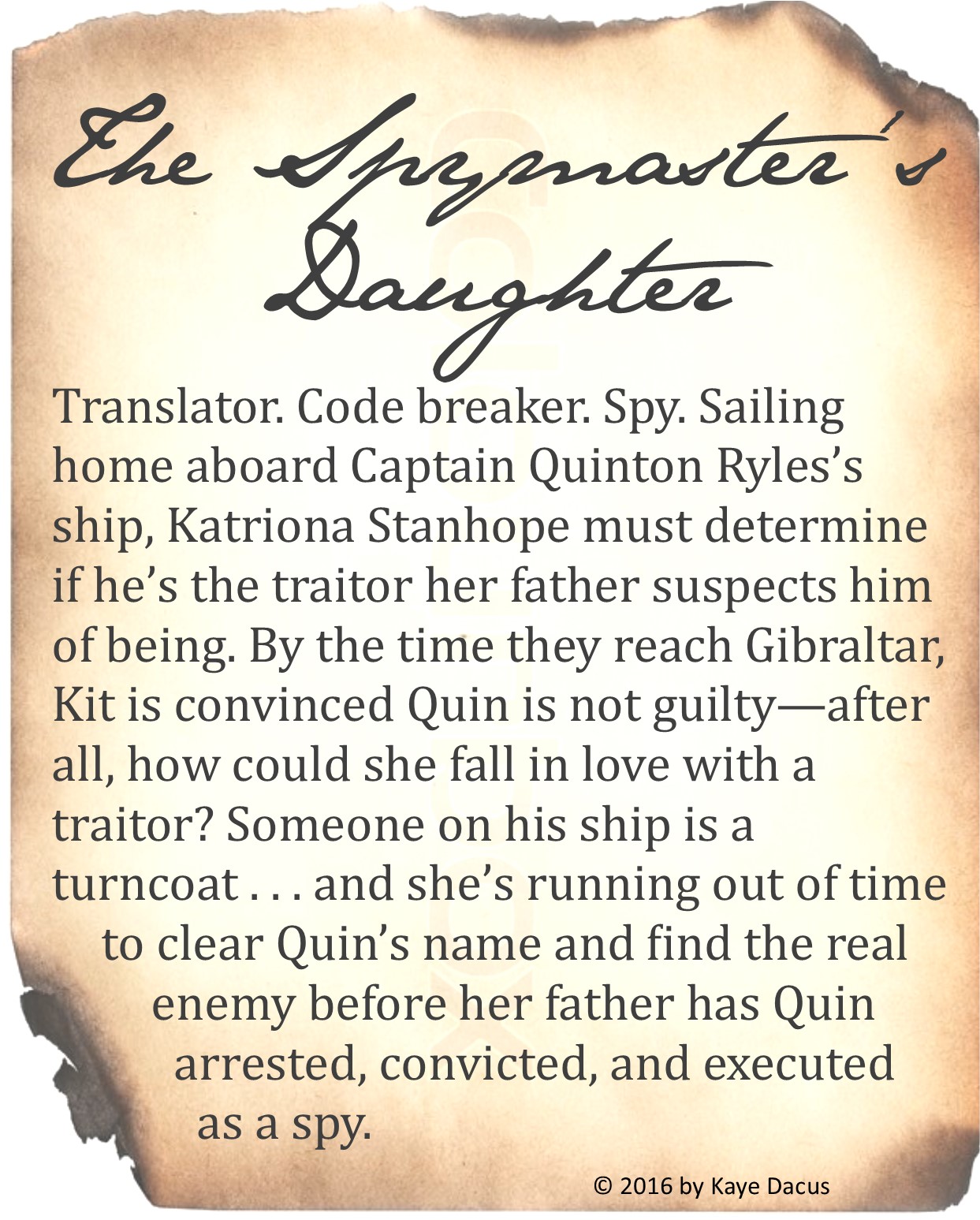
If you plan to work on only one project during this month and don’t already have a blurb for it, today’s the day to write it . . . and to share it with us! Here are some tips to get you started:
The One-Paragraph Marketing Blurb
This is some of the most fun “synopsis” writing you will ever do . . . because this is practice for hooking people on your story idea in one paragraph or less. Basically, you’re practicing writing back-cover copy in this exercise.
- Explain your story in four or five sentences.
- What is the main plot of the story?
- What is the major conflict in the story?
- Who are the characters (no more than three, preferably one or two) who are the stakeholders in the plot?
- What is the hook/question you can end with to make people want to know more? (Doesn’t have to actually be phrased as a question.)
- Study back-cover copy of your favorite books.
- Read the marketing copy on Amazon or author or publisher websites.
The James Scott Bell Formula for the one-paragraph blurb:
Start with three sentences1. [Name] is a [description] who wants/is struggling with [goal].
2. But when [something happens], [Name] has to [change direction].
3. Now, [Name] must [go do something] or else [something bad will happen].Expand it with one or two more sentences to make it even more compelling (and to give a hint at where/when it’s set).
Your blurb should be between 75–200 words, with around 100–150 being an optimum length for one-sheets and proposals and websites and back-cover copy.
- Sample Blurb using the JSB Formula:
Luke Skywalker is a farmboy who wants to escape his life of drudgery by enrolling in the Imperial Academy. Before he can, one of his uncle’s new androids begins to malfunction and then runs away, so Luke must go after him or face his uncle’s wrath. But when Luke locates the rogue droid and hears a distress call from a beautiful princess, he finds himself embroiled in a war that could spell doom for the entire galaxy.
What’s Your Blurb?
It’s Reading Report Time! (January–February 2016)
Happy First Monday of February, everyone.
It’s Reading Report time!

Open Book by Dave Dugdale
.
Tell us what you’ve finished over the last month, what you’re currently reading, and what’s on your To Be Read stack/list. And if you’ve reviewed the books you’ve read somewhere, please include links!
To format your text, click here for an HTML cheat-sheet. If you want to embed your links in your text (like my “click here” links) instead of just pasting the link into your comment, click here.
.
- What book(s) did you finish reading (or listening to) since the last update?
- What are you currently reading and/or listening to?
- What’s the next book on your To Be Read stack/list?
2016 “Leap-Ahead” Writing Marathon
I don’t know about y’all, but I’m falling far behind on my personal writing goals this year. And now that I’ve got a new story that I’m really excited about, I need something to motivate myself to get back to a regular writing schedule and get this story moving! To that end, I’m pleased to announce the . . .
If you’ve ever participated in the National Novel Writing Month in November, or if you did the FirstDraft60 challenge last fall (which yes, I, too, failed to complete) then you know what a month-long writing marathon is.
If you aren’t familiar, here’s the idea:
For a set number of days (February 1–29 in this case), you commit to writing as much of your manuscript as you can, which usually involves setting a total word-count goal for the month and then breaking that down into achievable daily chunks.
But I’d like to suggest we work this marathon a little differently.
Instead of arbitrarily setting a number goal to achieve by the end of the month, the main challenge of this marathon will be writing every day to see what can be accomplished in twenty-nine days. Sure, set daily goals and set a total goal if you want to—but this is more about being committed to writing every day for the entire month and building the story. If you can commit to doing a 1k1h sprint every day, you’ll have written at least 29,000 words at the end of the month! Don’t have an hour a day to spare? Try a 30-minute sprint.
The challenge isn’t to “write a book in a month.” The challenge is to write for each day in a month.
You can set your own challenges within it as well—such as:
I will write five more words each day than I wrote the day before.
Or: I will write one poem (or song or essay or short story) per day.
Or: I will write one full notebook page per day.
I hope you’ll create your own challenge during Leap Ahead month and then come back and check in often with your progress, successes, and struggles. I’ll try to post something encouraging, motivating, or challenging most days during the next month. And I hope you will, too. And on Fridays, I’ll bring back the SWAT (Self-evaluation, Word count, Awesome accomplishments, Tidbits to share) Day from FirstDraft60 to give everyone a chance to share.
For Discussion:
1. Are you going to participate?
2. What story are you going to work on?
3. What questions do you have?
Books Read in 2016: IN BED WITH A HIGHLANDER by Maya Banks

 In Bed with a Highlander by Maya Banks
My rating:
~2.5 stars average
First 30-40% of the book: 4 stars
Remainder of the book: 2 stars
Book Summary (from Goodreads):
Ewan McCabe is a warrior determined to vanquish his enemy. Now, with the time ripe for battle, his men are ready and Ewan is poised to take back what is his—until a blue-eyed, raven-haired temptress is thrust upon him. Mairin may be the salvation of Ewan’s clan, but for a man who dreams only of revenge, matters of the heart are strange territory to conquer.The illegitimate daughter of the king, Mairin possesses prized property that has made her a pawn—and wary of love. Her worst fears are realized when she is rescued from peril only to be forced into marriage by her charismatic and commanding savior, Ewan McCabe. But her attraction to her ruggedly powerful new husband makes her crave his surprisingly tender touch; her body comes alive under his sensual mastery. And as war draws near, Mairin’s strength, spirit, and passion challenge Ewan to conquer his demons—and embrace a love that means more than revenge and land.
I tried an experiment and went through all of the Goodreads recommendations based on my “shelves” containing the genres I read most often, picking out several books from new-to-me authors with an average of 4 stars or higher with more than 200 ratings.
However, didn’t didn’t work well in this situation. At least, not once the hero and heroine come together in this story.
The beginning of this book started off great. There was real peril to the heroine. The heroine was written as a competent and intelligent, if somewhat sheltered, person. She stoically withstood terrible physical abuse and held herself together mentally and emotionally. She put herself in harm’s way to protect others.
The hero, when first introduced, did seem to have a little bit of a 1980s alpha-hole scent about him, but he also seemed to have a compassionate side as well.
Unfortunately, these two characters brought out the worst in each other, turning them into a caveman and a thinking-impaired shrew. At around the 25-30% mark, a few things started happening that took me back to the Julie Garwood, Catherine Coulter, and Jude Deveraux Highlander romances I read as a teenager in the 1980s. The heroine is in peril, so of course the first thing she thinks of doing is running away on her own with no destination in mind (nor extra clothes or food!). But then when she’s near the loch, she hears male voices and of course comes upon the hero taking a swim in the freezing water buck naked and just can’t draw her eyes away—in fact, instead of realizing that the hero is currently not paying attention to her and is distracted by what he’s doing, she just stupidly stands there thinking about “that part of him between his legs” and how she shouldn’t be looking at it until he comes up and speaks to her.
She also has a tendency to say things she’s thinking aloud—but it’s written as narrative, so it’s jarring as a reader because I never knew what she was just thinking and what she was actually saying (apparently, it’s only the really embarrassing or stupid thoughts that she actually says aloud).
After the hero demands (a) that she trust him and then, once he learns her true identity, (b) that she marries him after just meeting two days before, she loses all ability to be a rational human being. She becomes one of the Too Stupid to Live (TSTL) heroines of romance-novels-of-yore who can’t even realize when she’s putting herself and others in danger of physical injury by barging through a yard full of soldiers training so that she can embarrass herself by shrewishly yelling at the hero for something he didn’t do—and of course, by doing this announces to everyone in the keep that the hero wants her to marry him, in the most embarrassing way possible.
I was pretty much finished with the book around the 40% mark—the point at which Banks started throwing every hackneyed Highlander romance cliche in that she could possibly think of. And not only that, but Ewan, the “hero,” completely loses any hint of compassion that we saw in the beginning and becomes a demanding, misogynistic jerk toward the heroine, while she just becomes stupider and stupider.
So disappointing.
_______
My rating matrix:
5 STARS = one of the best I’ve ever read
4 STARS = a great read, highly recommended
3 STARS = it was okay
2 STARS = I didn’t enjoy it all that much, not recommended
1 STAR = DNF (did not finish)
January 2016 Weekend Writing Marathon, Day 3 — Write Through the Frustration #WWMarathon
So how has the marathon been going for you?
As I posted in the comments on yesterday’s post, so far, I’ve written a total of 3,232 words and done some research that has several new plot ideas running around in my head. Can’t wait to dig in today!
Some writing motivation from James Scott Bell:
Don’t forget to check in with your progress, struggles, and goals for the remainder of the weekend!


 KayeDacus.com