Books Read in 2016: ‘Pioneer Girl: The Annotated Autobiography’ by Laura Ingalls Wilder | Part 1
 Pioneer Girl
by Laura Ingalls Wilder
My rating: 5 of 5 stars
Book Summary from Goodreads:
Pioneer Girl follows the Ingalls family’s journey through Kansas, Missouri, Wisconsin, Minnesota, Iowa, back to Minnesota, and on to Dakota Territory sixteen years of travels, unforgettable experiences, and the everyday people who became immortal through Wilder’s fiction. Using additional manuscripts, letters, photographs, newspapers, and other sources, award-winning Wilder biographer Pamela Smith Hill adds valuable context and leads readers through Wilder’s growth as a writer. Do you think you know Laura? Pioneer Girl: The Annotated Autobiography will re-introduce you to the woman who defined the pioneer experience for millions.
My Review:
This is going to be an unusual review, as I’m going to pretty much just share the status updates I posted on Goodreads, along with the images and thoughts I posted on Facebook as I read through this tome.
As a child who loved the Little House on the Prairie TV show and books growing up—to the point that I loved wearing long “calico” skirts to play pretend pioneer in—I grew into an adult who found the person and true life history of Laura Ingalls Wilder fascinating. Over the past two or so decades, as more biographies have been published, along with collections of her other writings (articles, essays, poems, etc.), I’ve collected several volumes that shed much more (realistic) light on who she was and what her life was really like, apart from the fictionalized, highly sanitized version in the novels she wrote for children. So when I heard that the South Dakota State Historical Society was publishing LIW’s never-before-published autobiography (the memoir she wrote for her daughter, Rose Wilder Lane, before fictionalizing it and turning it into the novels we know so well now) along with historical and literary annotations by editor Pamela Smith Hill and the entire team behind the Pioneer Girl Project, I knew I had to have it. It had just come out at that point—and immediately sold out the first press run. So I got on a waiting list for it. I paid full cover price for a gorgeous, oversized (9.5″ x 10.25″ x 2″) hardcover book that I waited almost six months to receive.
I immediately flipped through it as soon as I received it, so excited to finally have it. And then, believe it or not, it sat on top of a chest in my living room for over a year, untouched and unread.
Then, about a month ago, something compelled me to pick it up. I started re-reading the introduction and explanation of the methodology behind how they put the book together, starting with the five-cent writing tablets Laura scrawled her memories into, leaving her wording and spellings [mostly] in tact (surprisingly, she wasn’t a great speller!), and researching everything as they went along—from the historical details to the changes made between the original and several different possible versions of the memoir that might have been published and then, many times, to how the incidents ended up being changed/represented in the novels. And it shed a light for me on aspects of Laura and her family that I’d never known nor guessed at.
So now, as promised, here’s Part 1 of how I documented my read-through of this very special book, covering Little House in the Big Woods, Little House on the Prairie, and On the Banks of Plum Creek:


05/04 Pioneer Girl marked as: currently-reading
05/04 on page 59 of Pioneer Girl (14.0%): Will be reading this alongside the novels as I re-read the LHOTP books. So far, I’ve read through the parts featured in LHOTP (which actually came first in real life, when LIW was only 2-3 years old) and LHITBW. It’s great to read the historical perspectives and notes and to see how LIW actually wrote about all of this when she was doing it as a nonfiction memoir.
-
05/04 Little House in the Big Woods marked as: read
05/05 Little House on the Prairie marked as: currently-reading
05/06 Little House on the Prairie marked as: read
05/06 on page 65 of Pioneer Girl (16.0%): According to the annotations, the house Pa built in Plum Creek was 20×24 feet, only 480 square feet, for a family of five. Or roughly half the size of the small 2-bedroom house I live in by myself and complain about the lack of storage room. According to the assessor, the house he built “has a good roof and floor, and contains five doors and 3 windows, and is a comfortable house for a family to live in.”
-
05/07 On the Banks of Plum Creek marked as: currently-reading (33%)
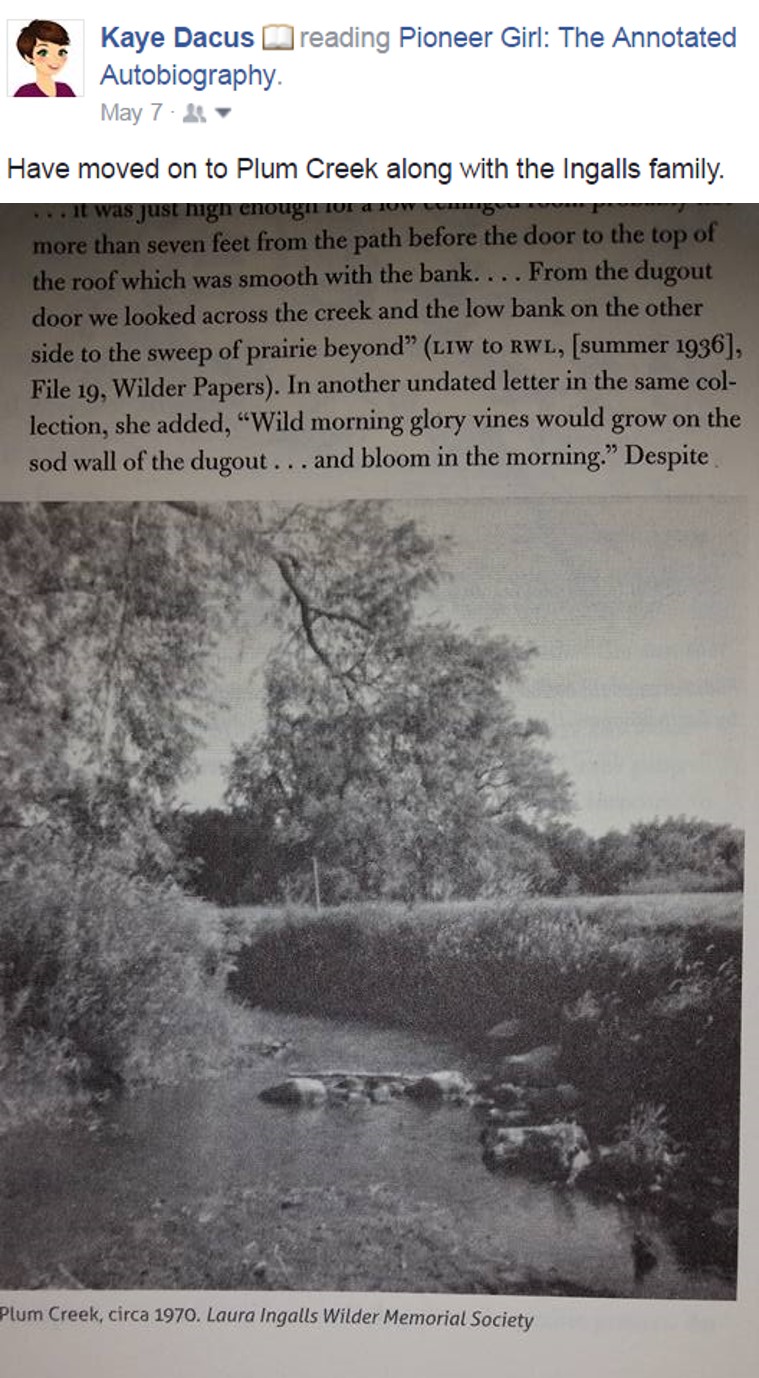

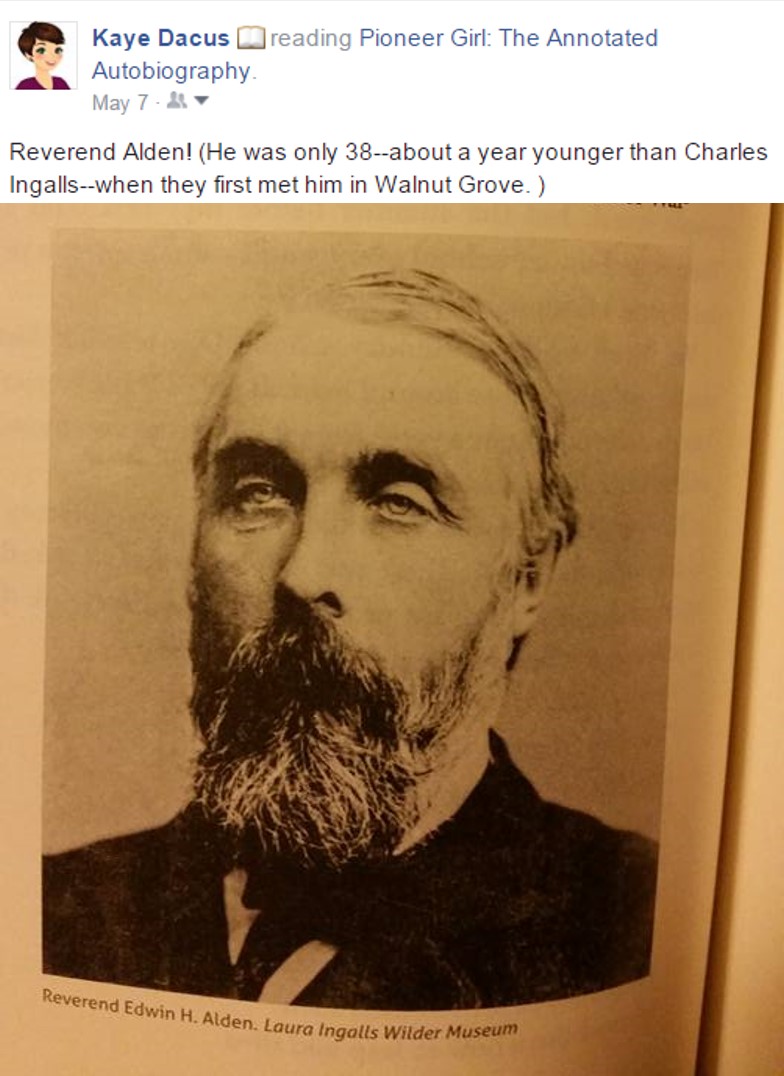
05/07 on page 115 of Pioneer Girl (28.0%): It was interesting to read about the family’s time in Burr Oak, Iowa, from Laura’s perspective. I’d read bits and pieces about it in biographies, but those were mostly from public records or the few articles/essays Laura wrote about it for the newspapers or magazines she wrote for as an adult. I knew they were struggling financially, but not to the point that they had to sneak out of town in the middle of the night!
05/07 on page 131 of Pioneer Girl (32.0%): “Mary objected to my playing such rough games outdoors with the boys, but she could not keep me in; and once when she took both hands full of my loose, long hair and tried to hold me, I stiffened my neck and dragged her to the door where she caught some of the snowballs herself before she let me go.” (Laura Ingalls Wilder, approx. 12 years old.)

.
05/07 on page 142 of Pioneer Girl (35.0%): “The last thing Mary ever saw was the bright blue of Grace’s eyes as Grace stood holding by her chair, looking up at her.”
.

.
05/07 on page 151 of Pioneer Girl (37.0%): While it’s tempting to keep reading, I’m up to the point at which the Walnut Grove years end. I promised myself I’d read this alongside the corresponding novels, so it’s time to get back to On the Banks of Plum Creek.
-
05/07 On the Banks of Plum Creek marked as: read
It’s Reading Report Time! (June 2016) #amreading
Happy First Monday of June, everyone.
It’s Reading Report time!
Open Book by Dave Dugdale
.
Tell us what you’ve finished over the last month, what you’re currently reading, and what’s on your To Be Read stack/list. And if you’ve reviewed the books you’ve read somewhere, please include links!
To format your text, click here for an HTML cheat-sheet. If you want to embed your links in your text (like my “click here” links) instead of just pasting the link into your comment, click here.
.
- What book(s) did you finish reading (or listening to) since the last update?
- What are you currently reading and/or listening to?
- What’s the next book on your To Be Read stack/list?
Here’s my report:
What book(s) did you finish reading (or listening to) since the last update?
As always, click through on the title for my review.
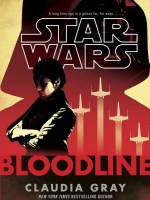
- Star Wars: Bloodline by Claudia Gray, audiobook read by January LaVoy (SFF/Star Wars | 4 stars).
- A Noble Masquerade (Hawthorne House #1) by Kristi Ann Hunter (Inspy historical romance–Regency | 3.25 stars)
- “Some Desperado” by Joe Abercrombie, audiobook read by Stana Katic (Short story in Dangerous Women, Martin & Dozois, Eds. | 3 stars).
- “My Heart is Either Broken” by Megan Abbott, audiobook read by Jake Weber (Short story in Dangerous Women, Martin & Dozois, Eds. | 4 stars).
- Pioneer Girl: The Annotated Autobiography by Laura Ingalls Wilder (Autobiography w/biographical & historical annotations | 5 stars).
- Little House in the Big Woods by Laura Ingalls Wilder (YA historical fiction–American Frontier | 4 stars).
- Little House on the Prairie by Laura Ingalls Wilder (YA historical fiction–American Frontier | 4 stars).
- On the Banks of Plum Creek by Laura Ingalls Wilder (YA historical fiction–American Frontier | 4 stars).
- By the Shores of Silver Lake by Laura Ingalls Wilder (YA historical fiction–American Frontier | 3.5 stars).
- The Long Winter by Laura Ingalls Wilder (YA historical fiction–American Frontier | 4 stars).
- Little Town on the Prairie by Laura Ingalls Wilder (YA historical fiction–American Frontier | 4.5 stars).
- These Happy Golden Years by Laura Ingalls Wilder (YA historical fiction–American Frontier | 5 stars).
What are you currently reading and/or listening to?
- Only Beloved (The Survivors’ Club #7) by Mary Balogh, audiobook read by Rosalyn Landor (historical romance–Regency)
- The Curse of Lord Stanstead (The Order of the MUSE #1) by Mia Marlowe (historical paranormal romance–Regency)
What’s the next book on your To Be Read stack/list?
Here are the books I’m hoping to get around to soon—pre-orders, recent purchases, or checkouts/downloads from the library:
- Summer of Dreams (From This Moment #0.5) by Elizabeth Camden (Inspy historical romance novella–1880s America | free Kindle download)
- Until the Day Breaks (California Rising Book 1) by Paula Scott (Inspy historical romance–1840s America | borrowed through Kindle Unlimited)
- The Anatomy of Death (Dr Dody McCleland Mysteries Book 1) by Felicity Young (Historical mystery–Victorian | library book)
- Laird of the Mist (The MacGregors Book 1) by Paula Quinn (historical romance–1600s Scotland | library book)
- Not Another Bad Date (Writer Friends Book 4) by Rachel Gibson (contemporary romance | library book)
- The Witches of Cambridge by Menna Van Praag (romantic contemporary fiction | library book)
- The Wild Princess: A Novel of Queen Victoria’s Defiant Daughter by Mary Hart Perry (historical fiction–Victorian | new book purchase)
- Gambled Away: A Historical Anthology by Joanna Bourne, Isabel Cooper, Rose Lerner, Jeannie Lin, Molly O’Keefe (historical romance anthology | new book purchase)
- Journey’s End (Gilded Promises) by Renee Ryan (Inspy historical romance–Edwardian America | Kindle First book)
Other than that, my next reading selection will most likely be from the 2016 Reading List that I put together for myself on Goodreads for my A to Z reading challenge for this year.
2016 A–Z Reading Challenge Update
Here are the letters (author last names) I haven’t fulfilled yet: E, I, J, L, O, Q, U, V, X, Y, Z (oh, if only I could count the author of the Little House books by her maiden name!).
_______
My rating matrix:
5 STARS = one of the best I’ve ever read
4 STARS = a great read, highly recommended
3 STARS = it was okay
2 STARS = I didn’t enjoy it all that much, not recommended
1 STAR = DNF (did not finish)
Books Read in 2016: ‘Little House in the Big Woods’ by Laura Ingalls Wilder #amreading
 Little House in the Big Woods
by Laura Ingalls Wilder
My rating: 4 of 5 stars
Book Summary from Goodreads:
The first book in Laura Ingalls Wilder’s treasured Little House series—now available as an ebook! This digital version features Garth Williams’s classic illustrations, which appear in vibrant full color on a full-color device and in rich black-and-white on all other devices.This beloved story of a pioneer girl and her family begins in 1871 in a log cabin on the edge of the Big Woods of Wisconsin. Four-year-old Laura lives in the little house with her Pa, her Ma, her sisters Mary and Carrie, and their dog, Jack. Pioneer life is sometimes hard for the family, but it is also exciting as they celebrate Christmas with homemade toys and treats, do the spring planting, bring in the harvest, and make their first trip into town. And every night Laura and her family are safe and warm in their little house, with the happy sound of Pa’s fiddle to send them off to sleep.
The nine Little House books are inspired by Laura’s own childhood and have been cherished by generations of readers as both a unique glimpse into America’s frontier history and as heartwarming, unforgettable stories.
My Review:
As mentioned yesterday, I decided it was high time for me to do a re-read of the Little House on the Prairie books this year. It’s something I used to do every year . . . but recently that tradition has been replaced with re-reading most, if not all, of the Harry Potter books (on audio, usually as I’m going to sleep to give my brain something to focus on instead of being scattered and keeping me awake.) I have the original 1971 set (yes, it’s the same age I am) that we had growing up—the paperbacks with the yellow covers—but they’re so old and brittle that I’m afraid of damaging them further from their well-loved, well-read state. So I decided to go ahead and purchase the series (minus Farmer Boy and The First Four Years—neither of which I enjoy reading) as ebooks.
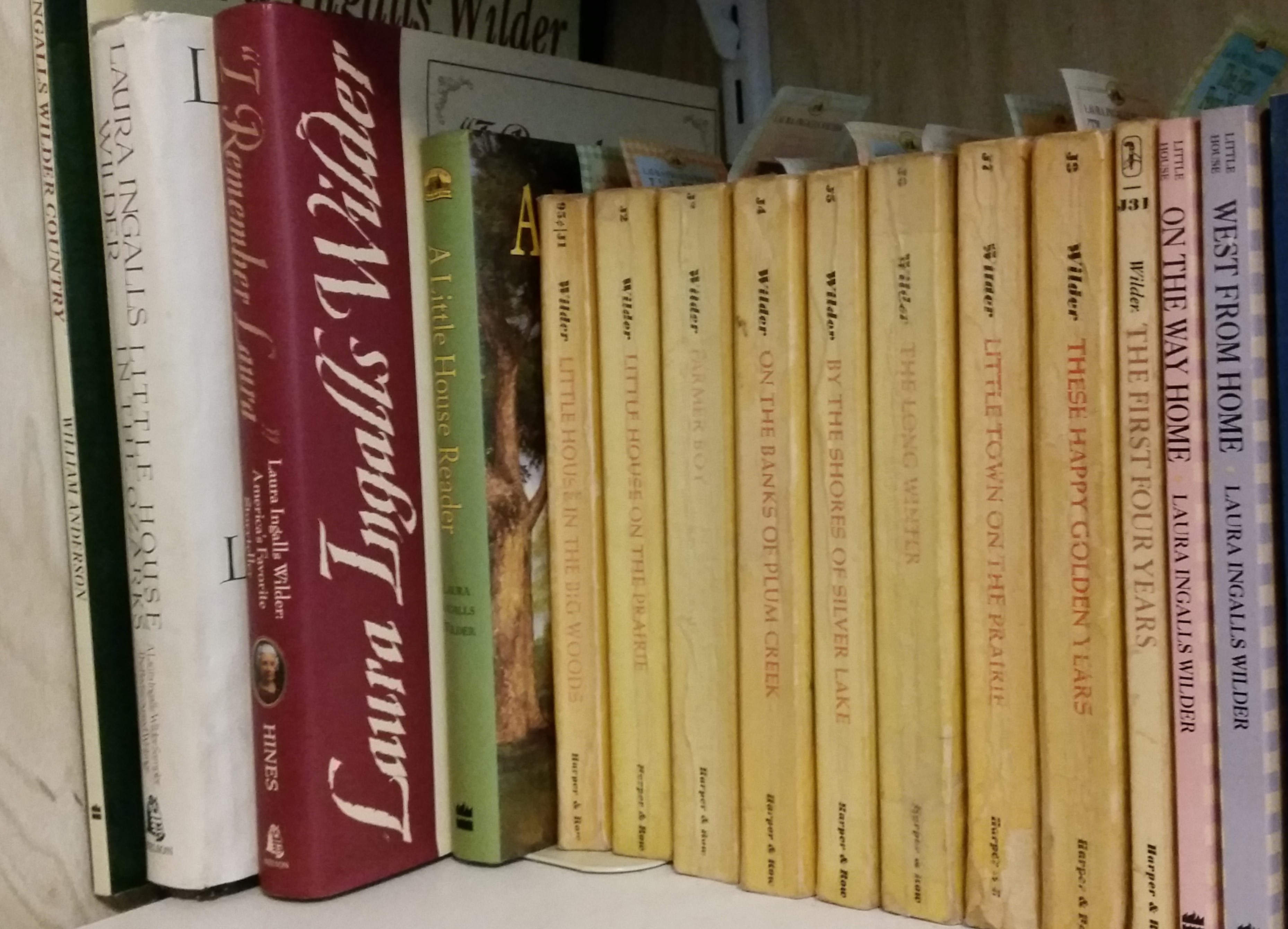 Little House in the Big Woods is set in 1871–2, opening when LIW was four, about to turn five, years old. As such, it’s much more of a conglomeration of disjointed memories rather than a narrative with a storyline, as we get in the more mature, subsequent books.
And that works fine. This was originally written with young children in mind; and, much like J. K. Rowling did many decades later, the books and their tone and subject matter mature right along with the main character as she ages through the series.
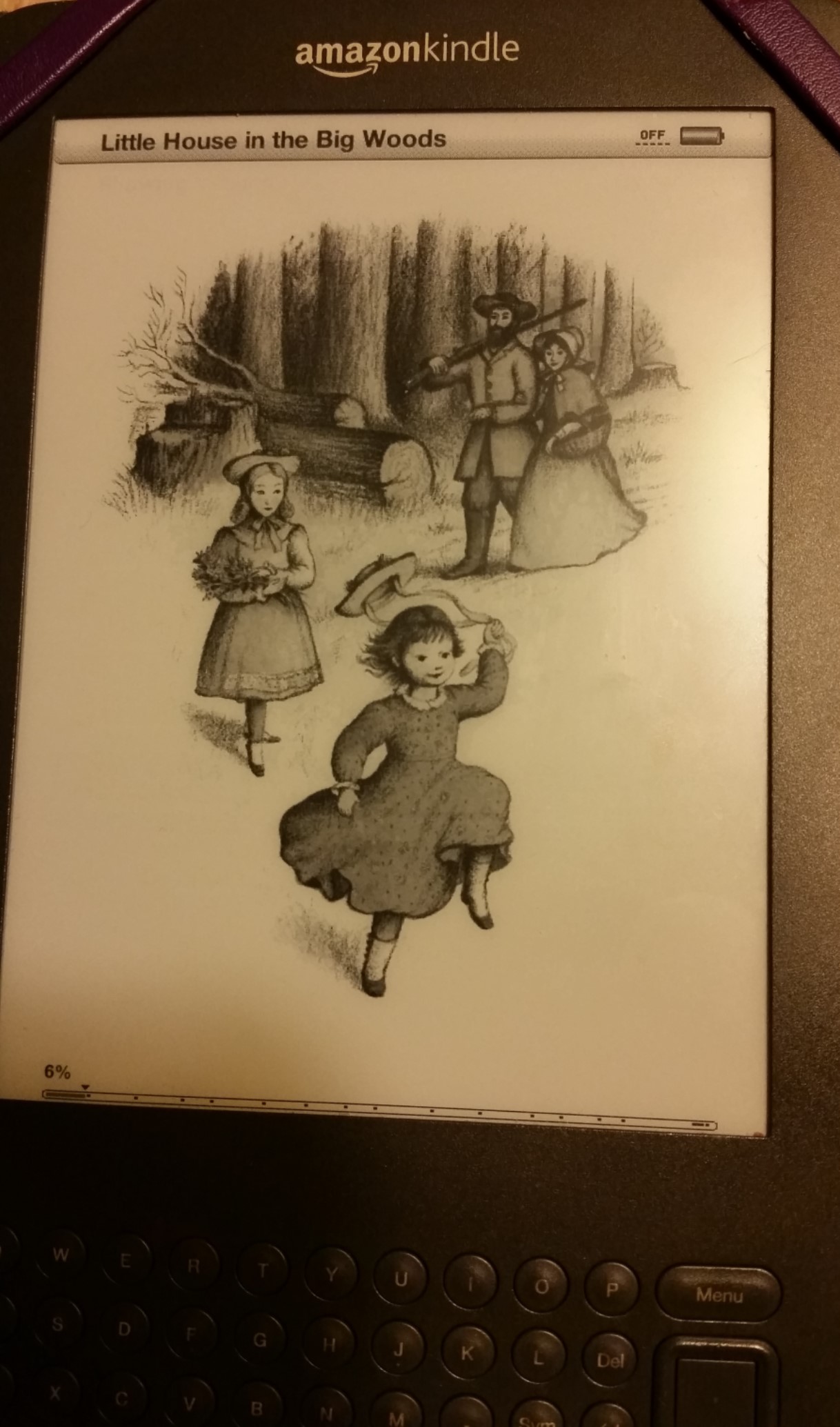
I was happy to discover Garth Williams’s wonderful illustrations included in the Kindle edition.
Still, this is a classic providing a glimpse into a bygone era which, yes, is romanticized both in this book and now, but which still holds both fascination and lessons for us in the 21st century.
If I had to pick a favorite anecdote from the book (and this will sound odd), it’s when Laura and Mary are picking up wood chips after their aunt’s visit and Mary tells Laura that everyone knows golden hair is prettier than brown hair—and Laura slaps her. Yes, she gets in trouble/disciplined for it, but then Pa takes her on his knee afterward. And when Laura asks him if he prefers golden curls to brown, he points out that he, too, has brown hair.
As a younger child with an older sister (whose hair was also “golden” as a child, and who was also very much like Mary) to whom I felt like I was compared all my life, I think this is where, even as a small child before I could really remember or figure out the reason why, I immediately identified and became lifelong “friends” with Laura “Half-Pint” Ingalls.
________________________________
View all my reviews on Goodreads
It’s Reading Report Time! (May 2016) #amreading
Happy First Monday of May, everyone.
It’s Reading Report time!
Open Book by Dave Dugdale
.
Tell us what you’ve finished over the last month, what you’re currently reading, and what’s on your To Be Read stack/list. And if you’ve reviewed the books you’ve read somewhere, please include links!
To format your text, click here for an HTML cheat-sheet. If you want to embed your links in your text (like my “click here” links) instead of just pasting the link into your comment, click here.
.
- What book(s) did you finish reading (or listening to) since the last update?
- What are you currently reading and/or listening to?
- What’s the next book on your To Be Read stack/list?
Here’s my report:
What book(s) did you finish reading (or listening to) since the last update?
As always, click through on the title for my review.
- From London With Love (Lady Spies, #1) by Jenna Petersen (historical romance–Regency | 2 stars)
- Persuasion by Jane Austen, audiobook read by Anna Massey (Annual Austen, inspiration/motivation for The Spymaster’s Daughter)
- Out of the Storm (Beacons of Hope #0.5) by Jody Hedlund (historical inspirational romance–1880s America; novella | 3 stars)
- The Other Side of Midnight by Simone St. James (historical paranormal romance–1925 | 4 stars, full review to come)
- Secrets of a Proper Lady (Last Man Standing #3) by Victoria Alexander (historical romance–Victorian | 1 star–DNF @42%)
- Seduction & Scandal (The Brethren Guardians, #1) by Charlotte Featherstone, audiobook read by Helen Stern (historical romance with paranormal elements–Victorian | re-read)
What are you currently reading and/or listening to?
- Little House in the Big Woods by Laura Ingalls Wilder (I decided it was time for a LHOTP re-read, since I used to read the series every year but haven’t done so in several years).
- I’m waiting for two audiobooks which release on Tuesday that I’ve already preordered, which is why I haven’t started anything else yet (see below)
What’s the next book on your To Be Read stack/list?
Here are the books I’m hoping to get around to soon—pre-orders, recent purchases, or checkouts/downloads from the library:
- Only Beloved (The Survivors’ Club #7) by Mary Balogh, audiobook narrated by Rosayln Landor (historical romance–Regency | Releases 5/3/16, audiobook preordered)
- Bloodline: New Republic (Star Wars) by Claudia Gray, audiobook narrated by January LaVoy (SFF | Releases 5/3/16, audiobook preordered)
- The remaining LHOTP books (minus Farmer Boy and The First Four Years, neither of which I’ve ever felt added much to my enjoyment of the series/story).
- To Wed a Scandalous Spy (Royal Four #1) by Celeste Bradley (historical romance–Regency | library book)
- If You Dare (The MacCarrick Brothers, Book 1) by Kresley Cole (historical romance–Victorian | library book)
- Entreat Me by Grace Draven (pseudo-Medieval fantasy romance | library book)
- Three Weeks With Lady X (Desperate Duchesses by the Numbers #1) by Eloisa James (historical romance–Georgian/1799 | library book. I’m giving EJ one more shot with this one, which the romance students in my grad school program read last year and raved about)
- All-of-a-Kind Family (All-of-a-Kind Family #1) by Sydney Taylor (historical kid-lit–Edwardian | library book)
- Pride and Prejudice and Zombies by Seth Grahame-Smith, Jane Austen (historical paranormal romance–Regency | library book—because I enjoyed the movie so much!)
Other than that, my next reading selection will most likely be from the 2016 Reading List that I put together for myself on Goodreads for my A to Z reading challenge for this year.
2016 A–Z Reading Challenge Update
Here are the letters (author last names) I haven’t fulfilled yet: E, G, I, J, L, O, Q, U, V, X, Y, Z.
_______
My rating matrix:
5 STARS = one of the best I’ve ever read
4 STARS = a great read, highly recommended
3 STARS = it was okay
2 STARS = I didn’t enjoy it all that much, not recommended
1 STAR = DNF (did not finish)
Books Read in 2016: ‘Beyond Heaving Bosoms’ by Sarah Wendell and Candy Tan #amreading
 Beyond Heaving Bosoms: The Smart Bitches’ Guide to Romance Novels
by Sarah Wendell and Candy Tan
My rating: 3 of 5 stars
Book Summary from Goodreads:
We do it in the dark. Under the sheets. With a penlight. We wear sunglasses and a baseball hat at the bookstore. We have a “special place” where we store them. Let’s face it: Not many folks are willing to publicly admit they love romance novels. Meanwhile, romance continues to be the bestselling fiction genre. Ever. So what’s with all the shame?Sarah Wendell and Candy Tan — the creators of the wildly popular blog Smart Bitches, Trashy Books — have no shame! They look at the good, the bad, and the ugly in the world of romance novels and tackle the hard issues and questions:
— The heroine’s irresistible Magic Hoo Hoo and the hero’s untamable Wang of Mighty Lovin’
— Sexual trends. Simultaneous orgasms. Hymens. And is anal really the new oral?
— Romance novel cover requirements: man titty, camel toe, flowers, long hair, animals, and the O-face
— Are romance novels really candy-coated porn or vehicles by which we understand our sexual and gender politics?
With insider advice for writing romances, fun games to discover your inner Viking warrior, and interviews with famous romance authors, Beyond Heaving Bosoms shows that while some romance novels are silly — maybe even tawdry — they can also be intelligent, savvy, feminist, and fabulous, just like their readers!
My Review:
Even though I didn’t actually finish reading this, I’m still giving it a three-star rating because it does have good information in it. I just got tired of reading stuff about the genre that I already know (I had to read several books full of critical essays by academics and authors who are experts in the romance genre in grad school, and then write a thesis of my own about it)—and I got tired of the overuse of foul language.
Now, I can curse with the best (worst) of them when the mood strikes (or when something else strikes and causes pain). But I feel like the authors of this book undermined their purpose—and their authority on the subject—by being too flippant and by lacing the prose with unnecessarily “shocking” language. I understand that being conversational and flippant, while also celebrating the romance genre and its readers, is what the Smart Bitches made their name doing on their blog. But there’s quite a difference in reading one blog post a day and trying to read a few hundred pages of it. Plus, I think they’ve toned this down a bit on the blog—I don’t recall reading anything on the SBTB blog since I started reading it a couple of years ago that matches the level of cursing I found in this book.
But if the language doesn’t bother you, and you haven’t read a ton of other critical tomes exploring the subject of the romance genre, then you might want to check this out.
If you are interested in reading more serious/academic critical writings on the Romance genre, here are some suggestions:
- Dangerous Men and Adventurous Women – Edited by Jayne Ann Krentz (this one was published in 1992, so it gives more of a “historical” perspective on the genre, right around the time that it really started changing into what we have today)
- A Natural History of the Romance Novel by Pamela Regis (published in 2007)
- Making Meaning in Popular Romance Fiction: An Epistemology by Jayashree Kamble (pubished in 2014)
- New Approaches to Popular Romance Fiction: Critical Essays – edited by Sarah S.G. Frantz and Eric Murphy Selinger (published in 2012)
- Dangerous Books for Girls: The Bad Reputation of Romance Novels Explained by Maya Rodale (published in 2011)
- For Love and Money: The Literary Art of the Harlequin Mills & Boon Romance by Laura Vivanco (published in 2011)
- Happily Ever After: The Romance Story in Popular Culture by Catherine M. Roach (published March 29, 2016)
- Pursuing Happiness: Reading American Romance as Political Fiction (Genre Fiction Monographs) by Laura Vivanco (published in 2016)
_________________________________________
View all my reviews on Goodreads
Books Read in 2016: ‘The Burning Sky’ by Sherry Thomas #amreading
 The Burning Sky by Sherry Thomas
Audiobook read by Philip Battley
My rating: 4.25 of 5 stars
Book Summary from Goodreads:
It all began with a ruined elixir and a bolt of lightning.Iolanthe Seabourne is the greatest elemental mage of her generation—or so she’s been told. The one prophesied for years to be the savior of The Realm. It is her duty and destiny to face and defeat the Bane, the most powerful tyrant and mage the world has ever known. This would be a suicide task for anyone, let alone a reluctant sixteen-year-old girl with no training.
Guided by his mother’s visions and committed to avenging his family, Prince Titus has sworn to protect Iolanthe even as he prepares her for their battle with the Bane. But he makes the terrifying mistake of falling in love with the girl who should have been only a means to an end. Now, with the servants of the tyrant closing in, Titus must choose between his mission—and her life.
The Burning Sky—the first book in the Elemental Trilogy—is an electrifying and unforgettable novel of intrigue and adventure.
I, personally, think that the book’s prologue makes for a better back-cover/marketing blurb than the summary above:
- Prologue
Just before the start of Summer Half, in April 1883, a very minor event took place at Eton College, that venerable and illustrious English public school for boys. A sixteen-year-old pupil named Archer Fairfax returned from a three-month absence, caused by a fractured femur, to resume his education.
Almost every word in the preceding sentence is false. Archer Fairfax had not suffered a broken limb. He had never before set foot in Eton. His name was not Archer Fairfax. And he was not, in fact, even a he.
This is the story of a girl who fooled a thousand boys, a boy who fooled an entire country, a partnership that would change the fate of realms, and a power to challenge the greatest tyrant the world had ever known.
Expect magic.
My Review:
The book summary is a little deceptive on this one . . . Iolanthe isn’t told she’s the greatest elemental mage of her generation—not in the beginning anyway. She’s been led to believe that she’s an okay mage. Better than most people who just use everyday (“subtle”) magic—but because she can only control (she believes) three of the four elements, she’s not considered one of the “greatest”—as are those who have control of all four elements (earth, air, fire, water). She’s got earth, fire, and water down pat. But it’s when she accidentally calls upon the power of the air—with strength that she cannot control or comprehend—that she lands in a world of trouble
Earlier this year, I read and reviewed Uprooted by Naomi Novik. It was a book that I had so many problems with that it took me two full posts (Part 1, Part2) in order to express most of thoughts about and reactions to the book.
Right from the beginning of that book, I had a big problem with it being a typical YA novel about a young woman who is a special-snowflake-chosen-one. One of the main reasons I took issue with this trope in Uprooted is because the first-person narrator spends the first (many) pages narrating over and over and over again just how not-special she is.
The difference between that book and this one (aside from this one being in third rather than first person) is that this one just starts in the middle of the main character doing something. She’s not giving her life story. She’s not spending page after page bemoaning how not-special and gawky and awkward she is and how she’s not the beautifulest or specialest girl in the village. She’s just doing something. And one of the key guidelines for writing good fiction that every author should know and employ is to let the reader get to know the character through actions, not through narrative (i.e., show don’t tell).
Iolanthe doesn’t give us page after page of narrative stuck inside her head about who she is and what her place in society is. We don’t get paragraphs-long descriptions of the history of her village/society or the prophecy concerning the great elemental mage-to-come. We don’t get a rundown of the political system. Instead, the story opens (after the above, wonderfully engaging prologue) with Iolanthe doing what she does: using her magic to manipulate fire and water—practicing for a performance at a wedding.
Once we see Iolanthe doing this, her joy at being able to manipulate the elements she knows how to work with, her excitement over performing at the wedding, then, and only then, do we start learning about what’s going on in society around her. Then and only then is the idea of outside forces and her possible connection to them—and their likely danger to her—introduced. It doesn’t take long. Just a few pages (on pages 9–10 in the print version).
This immediately introduces conflict between Iolanthe and her guardian—he doesn’t want her to perform at the wedding because there will be collaborators there. The Domain, the kingdom in which Iolanthe lives, is being oppressed by Atlantis and its Lord High Commander Bane. What Iolanthe doesn’t know at this point is the prophecy of the great elemental mage who will come and defeat the LHC and break Atlantis’s dominion over the Domain.
However, Prince Titus, the ruler of the Domain, does know of this prophecy. After all, his mother was a great seer; and her journals, in which she recorded her visions of the future, have been his guide his whole life, preparing him for the day when the greatest elemental mage would appear. He is to be the mage’s guide and protector—and sacrifice his own life in service to helping the mage defeat Atlantis.
Iolanthe’s guardian pollutes the potion that she was supposed to use for her performance at the wedding. Because she doesn’t want to fail on her promise to these people, she decides to take a piece of advice scribbled in an unknown hand in the margin of a book: summon lightning to purify the potion. But with no power (she thinks) over air, how is she supposed to be able to do that?
When Titus sees the magical lightning bolt streak through the sky—just as his mother’s vision foretold—he knows the time has come. The mage is ready; is he?
In The Burining Sky, well-known historical romance author Sherry Thomas makes the leap into YA fantasy—and she does a fantastic job! Her world-building is marvelous. The magical realm exists alongside the mundane, everyday world of 1880s England, where Prince Titus attends Eaton. And the magical world includes wonderfully imaginative elements, such as a “storybook” into which the two main characters enter in order to be trained in magical combat and to learn the history of the Domain, as well as potion and spellwork, from Titus’s royal ancestors.
This is the first book in a series, so of course not all of the storylines are wrapped up neatly at the end. But it was so well done (especially hinging on the question of whether or not Titus will have to sacrifice his life to help Iolanthe fulfill her destiny) that I’m looking forward to reading the rest of the books. (Plus as an experienced romance author, Thomas was able to craft the developing relationship between Iolanthe and Titus quite well throughout the story.)
What’s in a Name? (It’s a Name Game!)
Today we’re going to play a name game. Get your paper and pen/pencil ready so that you can share your results in the comments!
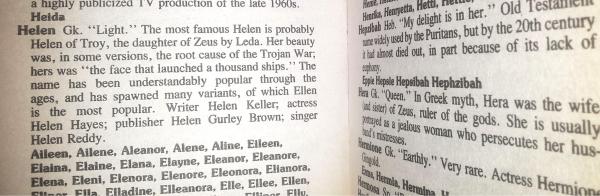
We read plenty of stories about famous fictional characters who almost ended up with different names . . . the most famous example being how Scarlett O’Hara’s name was originally Pansy. According to this post, Lord of the Rings almost had a Bladorthin the Grey; Harry Potter could have had a good friend named Hermione Puckle; and who would have read a novel by some Irish guy named Bram Stoker featuring a character named Count Wampyr?
I’ve gone though some name changes in my books, too . . .
- In Stand-In Groom, the wedding planner’s name started out as Nell—and she had quite a different personality before she became Anne (you can read about my process of changing her name here).
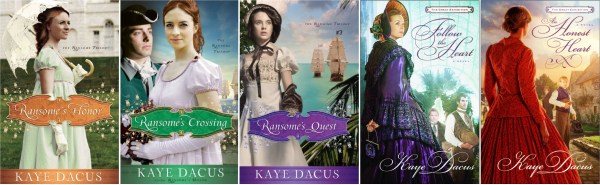
- In the Ransome Trilogy, while William was always William, in my first story idea notes, the heroine was named Elizabeth. However, once I discovered her character, that name didn’t fit—and only Julia did.
- In the first version of Love Remains that I wrote in 2003 (which was my first and only attempt at a category romance, and I still couldn’t get it under 75,000 words), the hero’s name was Kevin, not Bobby, and he was a computer guy, not in law enforcement.
- I dug up my original writeup of the idea for The Art of Romance (which began its life with the working title Cover Model) and discovered that the original names for the characters were Jason and Angie. Jason then got changed to Bradley Caylor (my two grandmothers’ maiden names) and Angie to Kate Blane. But I still wasn’t connecting with the characters. I’m not sure how many other names I went through before I came up with Dylan Bradley and Caylor Evans, I just remember it took me a really long time to get there.
I’ve mentioned before that I like to comb my family tree for fun/interesting names. Just from main characters, Major, William, Julia, Michael, (Dylan) Bradley, and Caylor are all names from my genealogy (and there are lots of others in the ranks of the secondary characters).
Today, I thought it would be fun for us to come up with some funny/silly character names—and maybe find some hidden gems among them! (Don’t feel like you have to do all of them. Pick and choose the ones you want to do, but be sure to include the item number so we know which ones you did.) You may find pen/pencil and paper will be helpful so you don’t have to keep scrolling up and down the page.
1. Your paternal grandmother’s (or grandfather’s) middle name + your maternal grandmother’s (or grandfather’s) middle name (if you know them) + last name of your favorite singer.
- Grandmothers: Ethel Katherine Adams
Grandfathers: Carroll Reid Kent
2. First name of your favorite actor/actress + your favorite color (or a synonym) + your father’s or grandfather’s first name.
- Katharine Amethyst David
Oded Aubergine Crawford
3. (First Name) take the first 3 letters of your first name and add the first 2 letters of your last name; (Last Name) first 2 letters of your mother’s (or grandmother’s) maiden name and add the first 3 letters of the city you were born.
- Kayda McBat (I used my mom’s maiden name—because my grandmothers’ names would make it Cabat or Brbat, neither of which work as well with Kayda—which could be Katda if I used my full name instead of my nickname. See how many options we can have???)
4. Name of the street you grew up on + a favorite pet’s name + last name of the author of the first book you look at.
- Valencia Cricket Johnson
Capri Missy Wilder
5. First name of an ancestor (beyond a grandparent, if you can) + City, County (Parish), OR State (Province) in which you’ve resided + last name of a favorite teacher.
- Florinne Virginia Stevens
James Fairfax Bowling
6. First name of the last person who sent you an e-mail + last name of the first person listed in your newsfeed on Facebook (unless, of course, they happen to be the same person!).
- Judy Moncado
Chuck Cypert
Ruth Taylor (and you can just keep going down the lists!)
7. First name of one of the authors in the top 100 paid/free Kindle Best Sellers + name from the Top Names of the 1880s + last name of one of the singers/a word from a band name from this list.
- Ellin Clara Presley
Upton Clarence Feathers
8. First name of someone you went to junior high/middle school with + Name of a constellation.
- Tonya Boötes
Todd Serpens
9. First name of Best Supporting Actress or Actor Oscar winner/nominee + last name of a U.S. President.
- Katina Fillmore
Basil Harding
10. Your choice. Share with us your methodology so we can play along, too!
Books Read in 2016: ‘William Shakespeare’s #StarWars’ by Ian Doescher #amreading
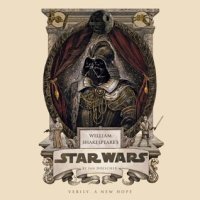 William Shakespeare’s Star Wars: Verily, A New Hope by Ian Doescher
Audiobook performed by Ian Doescher, Daniel Davis, Jonathan Davis, January LaVoy, and Marc Thompson
My rating: 5 of 5 stars
Book Summary from Goodreads:
Return once more to a galaxy far, far away with this sublime retelling of George Lucas’s epic Star Wars in the style of the immortal Bard of Avon. The saga of a wise (Jedi) knight and an evil (Sith) lord, of a beautiful princess held captive, and a young hero coming of age, Star Wars abounds with all the valor and villainy of Shakespeare’s greatest plays. ‘Tis a tale told by fretful droids, full of faithful Wookiees and fearsome Stormtroopers, signifying…pretty much everything.William Shakespeare’s Star Wars will astound and edify Rebels and Imperials alike. Zounds! This is the audiobook you’re looking for.
My Review:
I’ve had this book on my wishlist ever since it came out. I finally decided that getting the audiobook version would probably be better than trying to read it in text . . . and that was a GREAT decision! Ian Doescher and the others who lent their voice talents to this performance (and it’s definitely a performance, not a “reading”) kept me entertained from beginning to end. And at under four hours, it was perfect for my trip home from visiting my parents in Arkansas for spring break, since I had a couple hours of another book to finish before I started it.
The best character: R2-D2. Not only did the performer read the beeps and whoops and whistles and squeeks in a way that made me laugh every time, but Doescher wrote some aside monologues that get inside the motivations of this most mysterious character from the series.
And I thought Doescher handled the controversy over who shot first (it was Han) quite cheekily:
Han: Pray, goodly sir, forgive me for the mess. And whether I shot first, I’ll ne’er confess.
View all my reviews on Goodreads
______________
My rating matrix:
5 STARS = one of the best I’ve ever read
4 STARS = a great read, highly recommended
3 STARS = it was okay
2 STARS = I didn’t enjoy it all that much, not recommended
1 STAR = DNF (did not finish)
#Romance Novels: What’s the Difference Between Historical Romance and Historical Fiction? #amwriting
 When talking about fiction, there are some areas in which there seems to be more distinction between genres for writers than there may be among readers. And one of the grayest areas is when it comes to figuring out how to categorize historical fiction versus historical romance.
So what is the difference between Historical Fiction and Historical Romance?
Though it would seem like there would be an easy answer to this (and there is, to some extent), in the historical category, there’s a little more line blurring than in most other genres.
 The easy answer is this:
- A historical romance (HR) is a romance novel that’s set prior to the Vietnam war (or WWII, depending on the publishing house). Remember, the definition of a romance novel is that the storyline focuses on the developing relationship between the two main characters—if the romance is taken out, there is no more story—and it ends with a happy/joyful union (HEA or HFN) between the two.
- Historical fiction (HF) is a story that takes place in a historical setting which is more about the effect of that setting on the characters—whether it’s a war, the frontier, or the Protestant Revolution. There might be a romance that occurs in the story, but it’s a subplot.
For example: Georgette Heyer wrote historical romances (primarily Georgian and Regency settings); Jeff and Michael Shaara wrote/write historical fiction. Gone with the Wind is historical women’s fiction (it’s about Scarlett’s internal journey and how the events of history effected that journey); John Jakes’s North & South trilogy is historical fiction (it’s about the friendship between Orry and George, and the relationships between the Hazard and Main families, and how they interacted with and were involved in the historical events).
But most historical fiction includes romance.
This is why there’s so much of a gray area and why the answer gets harder when we take into account that many HF novels include a grand love story as part of the storyline. It might not be the main focus of the plot, but it is integral to the story—the main plot just wouldn’t be of any interest without it. Grand love stories increase both the emotional depth and the jeopardy to the characters in any story—but especially in historical fiction. There’s something about the additional jeopardy of war or wagon travel across the continent or eras when one could die from any infection or wound that makes the addition of having someone else’s hope and happiness depending on the character that adds conflict and tension.
But unlike HR, in HF the love story doesn’t have to have a happy ending. Scarlett and Rhett don’t end up together at the end of GWTW (oops, spoiler alert—and they’ll continue in this paragraph). In Cold Mountain, Inman is shot and killed just before he’s able to reach Ada. The title character in Anna Karenina finds her happy ending with an oncoming train.
And while many HF stories do reward their long-suffering characters with a happy conclusion to the love story, it’s not necessarily required for the novel to have a satisfying ending.
How can I tell the difference between HR and HF?
Here are some of the features HR and HF have in common:
- Set prior to the mid- to late-20th century.
- The time period is important to the story—whether it’s because of the real historical events and how they impact the characters/plot or because of the limitations/burdens of the time period on the characters/plot.
- Readers have certain time periods they enjoy more than others.
- Research is vital.
- The language—the dialogue, descriptions of the setting, the narrative—should be accurate without being overwhelming in order to give the reader an immersive experience.
.
As for differences . . .
| Historical Romance | Historical Fiction |
|---|---|
| The developing relationship between two main characters is vital to the plot of the story. | There may be a love story, and it may be important to the plot, but it isn’t the only focus of the plot. |
| The story focuses on two main characters—the two in the developing relationship (the H&H). | Number of main characters can range from one to multiple. The “main” character may not be the one involved in a love story—it could be a secondary character/plot. |
| A happy union between the H&H, happily ever after or happily for now, is required. | The love story does not have to end happily—in fact many have tragic/discordant endings to the love story. |
| The HEA/HFN is the ultimate goal and conclusion of the story/plot. | Even if main character(s) have a happy ending to their love story, that may not be the end/resolution of the story or plot |
| May have real historical characters as minor/secondary (non-POV) characters, but not as a main character in the story | May not only feature real historical characters, but are also sometimes written with them as main characters, telling lightly (or sometimes highly) fictionalized versions of their real lives and activities (think Philippa Gregory or Jeff Shaara). |
| The H&H are rarely apart, as the story hinges on their being together in order for their relationship to develop and move the plot forward. | Varies from story to story, but oftentimes the love story hinges on the two in the relationship being separated, sometimes for years, whether by social custom of the time or the actual historical events surrounding them (war, natural disaster, arranged marriages to someone else, etc.). |
| The H&H are the central focus of the story no matter what historical event(s) or characters are around them. Everything always comes back to how the historical setting impacts their relationship. | Sometimes, characters and/or relationships can take a backseat to the history—depending on the novel, it’s the history (or the historical figure) that is the main focus of the story, with the characters built in to serve the historical aspect of the novel. |
.
But what about historical series that feature a main love story?
It’s been a trend for the last few decades for historicals (both HF and HR) to be written as series, from trilogies to epic libraries of ten or more books to tell one story (whether based on a limited number of main characters or sagas that follow generations of one or more families). Even if a romance is integral to the plot of the story, the romance may not be resolved for seven or eight volumes (or more—it depends on how long the author drags out the series).
The entire series may be looked at as a romance once it is complete, because the overarching thread is the love story between the H&H—who are, for example torn apart by the eruption of the French Revolution. Their relationship may be set up in the first volume, but it isn’t actually resolved at the end of that first book. Each book in the series then follows these two characters, slowly developing their relationship while using the events of history—whether actual events or fictional events molded by real history—to keep them apart.
Each individual book can be considered historical fiction, as it doesn’t follow the seven basic beats of the romance novel—and though each should have a satisfying ending (that leaves the reader wanting more), it isn’t a happily ever after ending. However, the final book in the series will end with the triumph of these two characters over the history that threatened to keep them apart, the war will be won, and they will have their happy ending. Then, only when the series as a whole is complete, we could apply the seven story beats to the entire story and we’ll see the romance “novel” emerge.
See how the definitions can get muddied?
BTW, Jane Austen did NOT write Historical Romance!
Oh, and just to add one more facet to the definition: the works of Jane Austen, Charles Dickens, Elizabeth Gaskell, etc., are not considered “historical” romance or fiction—because they were contemporary fiction when they were written—in other words, set during the time period in which they were actually written. A true “historical” (HR or HF) is written by someone not living in the time period in which the story is set.
For Discussion:
Who here reads historical romances? Who are your favorite authors? Who is writing historicals/historical romances? Can you define from this whether your story is a historical or a historical romance?
(Oh, and BTW, I do use “a” with the word “historical” based on the Chicago Manual of Style which says to use “a” if the “h” sound is pronounced. If I pronounced it ’istorical, I’d use “an.”)
Romance Novels: Romance on the Edge of the Seat—A Look at Romantic Suspense (Guest Blogger Liz Johnson @LizJohnsonBooks)
Continuing the series on Romance Novel genres, please welcome special guest poster Liz Johnson today.
Romantic Suspense: Trial and Error
Everything I know about writing romantic suspense I learned by trial and error. Mostly it consisted of me trying it and my editor saying, “Nope.”
 I never intended to write romantic suspense novels, so I hadn’t spent much time studying the craft of this specific subgenre. Reading it? Yes. Analyzing it? Not so much. But when I sat down to write, my stories always had a strong suspense element. (The romance aspect was never up for discussion. I don’t think I could write a book without a love story.) I’d spent years writing and studying how to write novels in general. Character development and story arcs. Dialogue and description. These are integral to every novel, regardless of genre.
But there a few things I’ve learned along the way that are specific to romantic suspense.
It started in 2007 when I wrote a novel and zipped it off to Love Inspired Suspense—a Harlequin line devoted to books with equal parts sweet romance and suspense. An editor was kind enough to send me a response. While her words were different, her gist was clear: This book doesn’t meet our guidelines. So I asked if I could revise and resubmit. She said yes—with a two-page letter of changes she wanted me to make. We went back and forth three more times. Always with additional changes and more for me to learn.
Eight books and almost a decade later, here’s what I’ve learned about writing a romantic suspense novel.
The hero and heroine have to meet. Quickly.
 It seems like a given, but it’s harder than you’d think (and I’ve read more than a few books claiming to be romantic suspense novels that leave the characters languishing apart for chapters and chapters), especially if the story doesn’t start in the right place. When I start too early, my hero and heroine may be on a trajectory to run into each other. But trajectory isn’t where the story starts. So get them together. Fast.
Someone has to be in danger.
Serious, mortal danger. Someone threatening your heroine’s flower garden may work for a cozy mystery, but that’s not what we’re writing. We need more than an off-the-page death to keep the tension tight and the suspense strong. Your villain has to be bad. Really bad. And he (or she) has to be threatening someone we love. Maybe it’s the hero or heroine. Maybe it’s the hero’s daughter or the heroine’s grandmother. Someone is in danger, and your characters recognize they’re in trouble. The villain wants more than to make life for the hero or heroine miserable. He’s after blood.
And the villain has a very plausible reason for everything he does.
In his mind, he is the hero of the story. In his mind, his victims deserve everything they get—and then some. I’ve written everything from revenge-seeking villains to bad guys who are clean out of their minds to ones who know they’re motivated by money. But they all believe that what they’re doing is validated by their situation.
The romance shouldn’t outweigh the suspense.
Or vice versa. Finding a balance isn’t always easy, but any romantic suspense should have equal parts of both. Like in every romance, the hero and heroine must have a conflict—a reason they can’t/won’t be together. And that conflict has to build right along with the suspense. They should match each other so that as the suspense heightens so does the romantic conflict.
The story has to develop and grow.
Each event and plot point has to lead to an eventual black moment—that situation where it seems impossible that the hero and heroine will work out their conflicts and that the bad guy is going to win. If these things don’t happen at exactly the same time, they should definitely happen back-to-back. As I mentioned, the romance and the suspense should run at the same pace.
Finally, the romantic and suspense conflicts must be resolved.
A romance isn’t a romance without a happy ending. So they’ll have to defeat the villain and work through their romantic issues by the end of the book. This one is non-negotiable. At least for my editor. And for me as a reader.
I’m not going to lie. I’m not an expert. And I’m still trialing and erroring more than I’d like to admit. And I still think it’s the best way to learn. But I am pleased to report that my editor says, “Nope,” a lot less than she did when I first started this writing adventure.
________________________
 By day Liz Johnson works as a marketing manager, and she makes time to write late at night. Liz is the author of nine novels—including her first contemporary romance, The Red Door Inn, and her most recent romantic suspense, Navy SEAL Security—and a New York Times bestselling novella. She makes her home in Nashville, where she enjoys exploring local music, theater, and making frequent trips to Arizona to dote on her nieces and nephews. She writes stories of true love filled with heart, humor, and happily ever afters. Connect with her at www.LizJohnsonBooks.com or www.Facebook.com/LizJohnsonBooks.
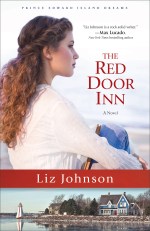 About The Red Door Inn: Marie Carrington is broke, desperate, and hoping to find sanctuary on Prince Edward Island while decorating a renovated bed-and-breakfast. Seth Sloane moved three thousand miles to help restore his uncle’s Victorian B and B–and to forget about the fiancée who broke his heart. He wasn’t expecting to have to babysit a woman with a taste for expensive antiques and a bewildering habit of jumping every time he brushes past her.
The only thing Marie and Seth agree on is that getting the Red Door Inn ready to open in just two months will take everything they’ve got—and they have to find a way to work together. In the process, they may find something infinitely sweeter than they ever imagined on this island of dreams.

 KayeDacus.com