Books Read in 2017: ‘Close to You’ by Kara Isaac | #amreading #bookreview
 Close to You
by Kara Isaac
Genre: Contemporary Romance (Inspirational/Christian)
My rating: 2 stars
Book Summary:
A disgraced scholar running from her past and an entrepreneur chasing his future find themselves thrown together—and fall in love—on a Tolkien tour of New Zealand.Allison Shire (yes, like where the Hobbits live) is a disgraced academic who is done with love. Her belief in “happily ever after” ended the day she discovered her husband was still married to a wife she knew nothing about. She finally finds a use for her English degree by guiding tours through the famous sites featured in The Lord of the Rings and The Hobbit movies. By living life on the road and traveling New Zealand as a luxury tour guide, Allison manages to outrun the pain of her past she can’t face.
Jackson Gregory was on the cusp of making it big. Then suddenly his girlfriend left him—for his biggest business competitor—and took his most guarded commercial secrets with her. To make matters worse, the Iowa farm that has been in his family for generations is facing foreclosure. Determined to save his parents from financial ruin, he’ll do whatever it takes to convince his wealthy great-uncle to invest in his next scheme, which means accompanying him to the bottom of the world to spend three weeks pretending to be a die-hard Lord of the Rings fan, even though he knows nothing about the stories. The one thing that stands between him and his goal is a know-it-all tour guide who can’t stand him and pegged him as a fake the moment he walked off the plane.
When Allison leads the group through the famous sites of the Tolkien movies, she and Jackson start to see each other differently, and as they keep getting thrown together on the tour, they find themselves drawn to each other. Neither expected to fall in love again, but can they find a way beyond their regrets to take a chance on the one thing they’re not looking for?
My GR Status Update(s):
01/02. . .marked as: currently-reading
01/18 . . .12.0% This is a fun book, but I can see that it might have a limited audience, given the overabundance of Lord of the Rings/Hobbit references.
01/24 . . . 17.0% This feels like it should be a faster read than it is so far. Of course, maybe it’s because I’m not making a concerted effort to set aside reading time daily.
01/27 . . . 36.0% The level of physical abuse the heroine, Allie, is taking at the hands of her author is really starting to bother me. I like a good awkward moment between characters, but not when it involves the heroine needlessly falling on her face (or other anatomy) in front of the hero and being humiliated by him twice within just a couple of chapters.
01/31 . . . 50.0% DNF. Here’s where I quit reading: “Chapter 17: . . .Allie tripped over her laptop cord and barely missed clocking herself on the bedside table. . . . since her day traipsing around the wilderness with Jackson, it was like what little coordination she did possess had gone on strike. Walking into doors, pouring juice into her lap, dropping stuff–you name it, she’d probably done it.” STOP ABUSING YOUR HEROINE!
01/31. . .marked as: did-not-finish
My Review:
This is a DNF, however, I still gave it two stars because there were parts of the first half that I read that I did like (mostly the setting).
As I posted in my status updates, I just couldn’t put up with the abuse the Heroine was receiving at the hands of this author (and the delight the “Hero” seemed to be taking in these mishaps). Falling into a mud/manure pit. Tumbling down a hill. Tripping over her laptop cord. “Walking into doors, pouring juice into her lap, dropping stuff—you name it, she’d probably done it” (Kindle p. 194). While she’s klutzy and ends up covered in mud/manure or he’s laughing at her for being covered with grass after taking a tumble down a hill (while trying to intervene in a bad situation he was in), when he falls into a pond, he’s compared to Mr. Darcy’s wet-shirt scene from Pride and Prejudice. In other words, her mishaps make her laughable/worthy of humiliation; his make him sexier and worthy of admiration. No thanks.
However, the abuse of the heroine wasn’t the only problem I had with this novel. The conflicts—her weird is-she-or-isn’t-she-married situation and his run-of-the-mill/cliched evil-ex-girlfriend-ruined-his-life/business backstory—were too complex to try to deal with in a story like this. This would probably have worked better as more of a “road romance” (two strangers fall for each other while traveling and must overcome the conflicts that the “road”—the journey—brings their way) than a “we both have such complicated lives that we cannot talk to each other about anything honest/truthful about our pasts, so, therefore, what’s keeping us apart is our lack of communication” story.
Then, there’s the fact that when I started reading this book, I had no idea it was actually inspy/Christian romance. I was happy that it seemed like a sweet/clean read, since those are rare and hard to find. In fact, up to almost halfway through this book, there was no indication that it was “Inspirational” fiction. Nothing in the book blurb (on the library’s website for the ebook or on Goodreads) mentioned anything about a faith element being part of this book. And, no, I don’t make a habit of looking to see who published a book for an indication as to whether it’s mainstream or religious. (For anyone reading this who doesn’t know me, I am published in the inspirational romance category, too, so it’s not like I have a problem with reading inspirational fiction.) I’ve always been of the mind that fiction with a religious element needs to make it clear in the back-cover copy so that the book doesn’t get a whole bunch of bad reviews from people who read it and then feel like they were “duped” into reading something with a religious message. But I know that could have been a decision by the publisher, not the author, to leave that part out of the blurb.
My problem with discovering that this is “Christian” fiction is that it’s not an organically integrated part of the story/characters. In the first almost half of the book, the only mention of God is when one of the secondary characters randomly asks Allie if she believes in God. And then that’s about all there is to the conversation. It jarred me out of the story completely. Up to that point, it had been just a fun, clean (“sweet”) romance novel—or so I thought. Then, apparently, in the second half, the religious element really takes off; however, I’m relying on having read other reviews to know that, because I didn’t actually make it that far. It would have been nice to have seen this as an element that was woven much more subtly and evenly throughout the whole story, not just the last half.
For the most part, I do like Ms. Isaac’s writing style. However, even with as much as the setting of New Zealand and the inclusion of the Lord of the Rings stuff should have been catnip for me, I just couldn’t bring myself to like it enough to force myself to finish reading it.
_______
My rating matrix:
5 STARS = one of the best I’ve ever read
4 STARS = a great read, highly recommended
3 STARS = it was okay
2 STARS = I didn’t enjoy it all that much, not recommended
1 STAR = DNF (did not finish)
Ransome Sequel Story Ideas (including latest/newest!)
I didn’t quite meet my goal of posting a new Ransome sequel/spin-off story idea every day for the last nine days of the FirstDraft120 challenge. But I have worked on these ideas most days for the past week and a half or so. My (revised) goal for FirstDraft120 was to relearn that writing can be fun. And you know what? It’s working!
You may not have seen most of the others, as I posted some of these in the comments section rather than in designated posts, so here’s what I’ve come up with so far:
Working title: Her Independent Heart
This is the story that’s hinted at in the epilogue of Ransome’s Quest—the romance between Eleanor Ransome (older daughter of William and Julia) and James Yates (only son of Colin and Susan).

James Yates = Arthur Darvill
Eleanor Ransome = Karen Gillan (adjusted for hair/eye color)
Working Title: Secrets of His Heart
The romance story for Edward Ransome (older son of William and Julia), which involves the daughter of Sir Drake Pembroke, Cordelia (Pembroke) Eckley-Hibbitt.

Cordelia Pembroke Eckley-Hibbit = Holliday Grainger
Edward William Ransome = Tom Mison
Clara Eckley-Hibbitt = Catherine Steadman
Working Title: An Antiquities Affair
Telling the story of the eldest child of Ned and Charlotte (Ransome) Cochrane, Charles Lott Cochrane.

Charles Lott Cochrane = Chris Hemsworth
Olivia Ahern = Elsa Pataky
And now for the story that I’ve been working on for the better part of the last several days. (Please note: if I do ever write this story, this will definitely not be the title—I just think it’s funny and fits the story idea.)
Working Title: My Fair . . . Lady?

Michael Edward Witherington, Jr. = Michiel Huisman
Lady Marianne Yates = Sophie Turner
[Begin Backstory]
Michael Edward Witherington grew up in Philadelphia as the heir apparent to Declan Importing. As his father’s eldest (of 4 sons) and because his uncle (_______ Declan) had no children (only daughters/never married?), Michael has been groomed to take over the offices of Declan Importing/the extensive family business empire in England. Michael cannot imagine spending the rest of his life in one place and, thankfully, with his cousin Edward’s agreeing to take over the combined businesses’ (Witherington Sugar and Declan Importing) operations in Portsmouth, Michael strikes a deal with his parents to be allowed to take one of the ships to “scour the Old World” for the antiquities, arts, and collectibles that have made the business, and the extended Declan-Witherington family, quite successful/wealthy. He will travel though Europe and contract with merchant ships to send the goods back to England and Philadelphia for the company to sell.
After three unremarkable Seasons—at least as far as she is concerned, she wouldn’t remark upon any of the several proposals she received from men more interested in her dowry and her father’s title—The Lady Marianne Elizabeth Yates convinced her mother to allow her to leave London early to spend the fall, winter, and spring on a Grand Tour of Europe. After all, she elicited a promise from her parents at a very young age (before her father inherited his brother’s title/estates) that she, like they, would be allowed to marry for love. And since love hasn’t found her in England, maybe it will find her abroad. With their fair skin and ginger hair, Marianne and her mother, Susan Yates, Countess Childers, make quite the splash (outside of the English enclaves where they stay) on their visits in the South of France, Greece, and Italy. And Marianne racks up several more declined proposals before they arrive in Florence in the spring.
Marianne has high hopes for Florence—the music, art, culture, history, architecture . . . but once there, she discovers it’s to be just like all of the other European cities they’ve visited. Surrounded by other temporary British expatriates, hearing only English spoken, participating in only the customs of the Ton—everything Marianne had hoped to get away from by convincing her mother to come on this Grand Tour. Rather than spend the last six weeks before they return to England being bored out of her mind, Marianne tells her mother she intends to avail herself of what the city has to offer—she’s going to take voice and painting lessons. She hires a tutor to teach her about the art and architecture while also teaching her Italian.
Four weeks in, Marianne has learned enough Italian that she can barter in the market with the best of them (because, of course, she’s a pretty Englishwoman who tries speaking Italian, so the men give her just about anything she wants), and she’s mastered putting on an Italian accent for the afternoons when she and her maid go out around town when Marianne is supposed to be taking lessons—with Marianne wearing a dark wig and her maid’s dress and her maid pretending to be her wealthy employer.
[End Backstory]
Two weeks before they’re supposed to return to England, the Yateses hear through the British grapevine of the handsome and wealthy American treasure hunter who has just arrived in Florence to acquire objet d’art for the prestigious Declan Importing company. However, no one has, as yet, actually met him—all invitations, cards, and calls have gone unanswered. Which just makes everyone all the more anxious to make his acquaintance. As soon as Susan Yates learns his name, though, she sends a card and an invitation to tea.
Michael immediately recognizes the name on the card and knows this is the opportunity he has been waiting for. He accepts Lady Childers’ invitation to tea—something he knows will cause a stir and generate even more interest in the items he’s been collecting around Italy and sending back to London. If he can convince Lady Childers to become his patron and host a gallery showing in her home in London just after Easter—as the London Season is at its height—he will prove to his father and uncle that he should be allowed to remain in the field instead of being stuck in an office forever.
When Marianne hears her mother has a young, wealthy, handsome man coming to tea, she dons the dark wig, maid’s dress, and false Italian accent and escapes the house before her mother can force her into the sitting room for an introduction. But she’s curious about this Michael Witherington—she’s been hearing his family name her whole life. So she arranges to bump into him (literally) on the street in front of her home as he’s arriving. And as soon as she sees him, she recalls all the stories she heard as a girl about his namesake father’s colorful past as a privateer. For Michael Witherington, with his unkempt, curly dark hair, scruffy face, and fancy suit, looks every inch the pirate his father was purported to be. She’s so startled by her initial reaction to him that she completely forgets to use the fake accent and must quickly amend her cover story about being a maid traveling with one of the other British households (thus excusing her for being British rather than Italian). It’s a brief encounter, but all-too-unsettling for her liking.
After tea with Lady Childers, Michael’s success in London is virtually assured. Yet it’s not the high-born in London who occupy his mind. The maid with the black hair and skin far too pale for these southern climes haunts his waking—and sleeping—mind.
Marianne, too, cannot stop thinking about the momentary encounter—and is bothered by it. However, she is certain that if she sees him more—perhaps even talks to him—she will find him to be just like every other man who’s ever tried to pay his addresses to her. With the freedom that her mother’s near-daily social activities affords her, Marianne—still dressing as a maid and with her own maid along for propriety’s sake (introduced as a friend/coworker)—begins to haunt the markets, shops, and galleries where she has heard Michael Witherington is regularly spotted.
Michael has several brief encounters with the mysterious “Mary”—who Michael is fairly certain is not a lady’s maid as she claims—and he finally convinces her to evade her companion and spend an afternoon exploring Florence with him. From architecture to art, her knowledge of the city, its history, and its culture, he knows she’s high-born—the kind of young woman he’s always tried to avoid. He’s unsure of why she’s hiding her true identity, but believes that she’s perhaps come to Italy in disguise to escape an unwanted suitor or a malevolent parent. He gives her every opportunity to come clean with him—dropping hints about honesty and how much he prefers it when people have open honest communication between them. He knows he should walk away before he gets hurt by whatever she’s hiding, but he can’t help wanting to spend more and more time with Mary. He’s smitten and must get to know her better.
Although she knows she shouldn’t, Marianne continues to sneak out to meet Michael during the day. She tells herself it’s to see all of the sites of Florence she otherwise wouldn’t get to. But she honestly can’t remember one fresco from another. Not when Michael is nearby. But the time the two weeks are up and she must say goodbye, she’s tempted to tell him the truth—because she knows the next time she sees him, it will be as herself in London. And he won’t want her anymore. Just as she’s about to test that theory and reveal her true identity to him, he kisses her and proposes. Devastated by the assumption that he only loves the maid, Mary, and would loathe The Lady Marianne, she flees, giving no explanation, leaving behind the plain gold locket he’d given her and into which she’d placed the miniature sketches of each of them that they’d had drawn by a street artist.
Michael is determined not only to give the locket back to Mary but also to marry her. With her knowledge of art and her keen eye for beautiful objects, she’d make a perfect partner for him to travel the world with to find items for the business to sell. With her quick wit, sunny disposition, and constant thirst to know more about the world around her, she’s the perfect partner for him to spend the rest of his life loving. When he arrives in London, he pays some of the boys who loaf around the docks that Declan Imports uses to scour the city to find Mary, the housemaid with the dark hair, and pale skin and silver eyes. He’s even had one of the company’s catalog artists recreate the miniature sketch of her and print multiple copies of it to assist the lads in trying to find her. (He hangs the locket with the fob on his watch chain so that he can pull it out and gaze at the original drawing whenever he feels the need.)
- Susan isn’t as oblivious as Marianne wants to think she is. She realizes that Marianne is sneaking out to meet a man (and is proud of her daughter for doing so—it’s something she knows she would have done herself had she not fallen for Colin the moment she met him when she was but sixteen and married him shortly thereafter). But she realizes on the way back to England that Marianne and this man (she hopes it’s Michael, since Marianne tries desperately not to react whenever Susan speaks his name) have parted ways. She doesn’t understand why, not knowing that Marianne was hiding her identity. So, naturally, as soon as she finds out that Michael has arrived in London, she takes every opportunity she can find (or make up) to invite Michael to social gatherings. Including planning a “family” dinner party that includes James and Eleanor, Edward and Clara Witherington, and Michael. It’s the first time that Marianne cannot get out of coming face-to-face with Michael, because Susan made sure of Marianne’s commitment to the dinner and then neglected to tell her Michael will be there.
Marianne is sitting with Eleanor and Clara showing them her sketch book containing many of the wonders that they saw on their travels, wondering why her mother has not yet called dinner, when the butler enters to announce a late arrival. At Michael Witherington’s name, Marianne is certain she will disgrace herself by fainting, fleeing, or cursing in one of the many languages she learned while abroad. She’d sincerely hoped—prayed—that she would have a chance to visit him at his company’s offices so that they could have privacy upon their first meeting, upon his learning her true identity. The last place she wanted it to happen was in front of her family.
The ruse had been so thorough that she’d used something to darken her eyebrows along with her hair. But the woman sitting on the settee across the room, with her bright ginger hair and pale brows, is most definitely his Mary. No, not his Mary at all. She’s The Lady Marianne Yates, daughter of the Earl and Countess of Childers. No wonder she’d left the locket he’d given her behind. She’d played him for a fool and never had any intentions toward him other than alleviating her own boredom while abroad. Knowing that anything between them had been as false as her hair and name, Michael feigns ignorance and allows himself to be introduced to “Lady Marianne” as if meeting her for the very first time. Thankfully, he and his cousin Edward need to discuss a business matter before dinner, and at the table, he is seated so that he must spend the first part of the meal conversing with Edward’s wife, Clara. When the table turns, however, he must find some way to make polite conversation with Lady Marianne. So he keeps up the pretense of not knowing her and asks her about her travels.
Marianne cannot eat. She can hardly breathe. She isn’t worried that he will reveal her unconventional activities in Florence. She is worried that she will not be able to make it through dinner without completely disgracing herself by bursting into tears at Michael’s continued coldness toward her. She wants to excuse herself on the very real threat that her stomach is upset and her head is pounding. But she cannot let him think that she’s hiding or running away from him. She must talk to him, privately. But even when the splitting of the men and ladies of the party after dinner affords her a moment alone with him in the foyer, he is unwilling to listen to anything she has to say. Nothing, he tells her, can excuse the way she deceived him and made him think she returned his feelings.
————
And that’s as far as I’ve gotten up to this point. This is one of those story ideas that I’ve been pondering over, savoring, thinking about, brainstorming, and debating possibilities as to which way it could go. It’s also, as you can see, one of the longest/most detailed I’ve come up with so far.
#FirstDraft120 DAY 120: WE MADE IT THROUGH!!!! (Timer Tuesday) | #amwriting #1k1hr #2017goals
 It’s the last day of January, which means it’s the last day of the FirstDraft120 challenge!
Woohoo! Yippee! Yay! Way to go! Well done!
Pat yourself on the back and celebrate. Because whether or not you finished a first draft, I know you did more in the last 120 days (well, 122 days, technically) than you would have done without the challenge. I know I did!
IT’S (also) TIMER TUESDAY!
Yes, it’s the last day of the challenge. But that doesn’t mean that you should stress yourself out trying to get in more words than you’d usually be able to do in one day. Treat today like any other writing day. And since it’s Tuesday, that means scheduling a one hour/1,000-word writing sprint (or a timed one-hour writing-work sprint if you’re not doing word count).
What time will you be doing your 1k1hr sprint today?
Just because today is the end of the FD120 challenge doesn’t mean it’s the last day you get to write ever again in your life. In fact, you should treat today like a first day.
Make today the first day of your 2017 Writing Goal Challenge.
And I’m even going to set that goal/challenge for you: spend an average of at least one hour per day (seven hours per week) on “writing-related work.” What do I mean by that? Well, for example:
- Brainstorming new story ideas.
- Writing out character sketches for new character ideas.
- Character casting.
- Working on a Story Bible (or several) for new or existing story ideas.
- Writing (yes, actual story writing!).
- Research—settings, locations, time periods, events, other story-related info, etc.
- Creating a story calendar (timeline of events that happen in the story).
- Outlining/plotting a new or existing story idea.
- Organizing/reorganizing your writing-related lists.
- Storyboarding.
- Re-reading what you’ve already written and making notes for revision and for future scenes.
- Writing a synopsis, query letter, proposal, one-sheet/pitch-sheet, or practicing for a face-to-face pitch session at a conference.
What are some other writing-related-work tasks you can think of that you can do for an hour each day, in order to keep your creative pump primed and to give you momentum to actually write your (current/next) manuscript?
#FirstDraft120 Day 119: TWO MORE DAYS! (counting today) | #amwriting
 Are we there yet? Today and tomorrow are the last days of the FirstDraft120 challenge. I’m warming up, getting ready to sing. 😉
What will you have accomplished by the time February 1 dawns that you might not otherwise have done in the last four months?
While I’d set out with a goal to complete a rough draft of a full manuscript for this challenge, I realized I was pushing myself too hard and needed to take much smaller steps. So I changed my goal to “relearn that writing can be fun” and allowed myself to “play” with a whole bunch of story/character ideas instead of trying to force myself to do what it was that burned me out on writing in the first place. And you know what? I’m starting to remember that creating fiction can be fun. I’m not 100% of the way there yet—and I didn’t do a good job of keeping up with my at-least-one-hour-a-day commitment to “fiction work” this weekend (I need to catch up with writing some story ideas today and tomorrow). But I no longer dread the idea of sitting at the computer (or with a notebook and pen) and doing writing-work. And most days, I actually look forward to it.
Monday Momentum Motivation
This video came through this morning from one of the YouTube channels I subscribe to, which is great timing. While he’s focused on cliched scenes in movies, I’ve seen many (if not all) of these in novels before.
Don’t believe me? Picture this scenario: Our Hero meets a woman to whom he’s immediately attracted. But (needle scratch on the record) she’s already in a relationship with someone else. Heroine has been dating the Other Guy for a while now. And while it’s not a perfect relationship, (for some reason) she’s determined to make it work. Come to find out, though, Other Guy is sleeping around/doing something illegal/kicks puppies in his spare time (whatever dastardly thing it is) which gives the Heroine the perfect excuse to dump him for the (much more perfect) Hero.
Sound familiar? That’s because it’s the premise of far too many rom-com movies and romance novels out there. (Princess Bride, You’ve Got Mail, and so on.)
So, check out this video and see if there are any other cliched scenes you might be using without realizing it:
Are you guilty of any of these cliches? What kinds of scenes do you think are overused in fiction? How’s your writing going?
#FirstDraft120 Day 116: It’s SWAT Day (Self-evaluation, Word-count, Accomplishments, Tidbits) |#amwriting
 It’s Friday! And that means I want to know about your full writing week. What were your greatest successes during the week? What was your favorite line/bit that you wrote? What did you learn about yourself, your characters, and/or your story during the week’s work? What are you most proud of yourself for doing this week when it came to your writing? What are you proud of yourself for accomplishing?
In the business world, there’s a planning model called SWOT—which is an acronym for Strengths, Weaknesses, Opportunities, and Threats.
Around here, we’re going to use SWAT, but we’re going to do it differently, so check in with the following recap for your week:
- Self-Evaluation (how do you think you did? what can/do you want to do differently next week? what did you learn about yourself as a person or as a writer? what didn’t you do or finish that you wanted to? etc.)
- Word count (total for the week, through today; or time spent on writing projects if you’re not doing word-count)
- Awesome Accomplishments (breakthroughs, discoveries, highest daily word-count ever, etc.)
- Tidbits to share—something you wrote that’s just too good not to share or that struck you as funny or whatever.
If you don’t want to share this stuff publicly, that’s okay. You can add a section to your Story Bible or start a journal (or add this to your existing journal) to keep track of this. But don’t skip doing this—I think that in the future, when you look back either on what you accomplished during this challenge or (heaven forbid) why you gave up on it, the insights you’ll gather later with hindsight on your thoughts during the challenge will be invaluable.
Happy writing!
#FirstDraft120 Day 115: THORsday Thursday! | #amwriting #handwriting
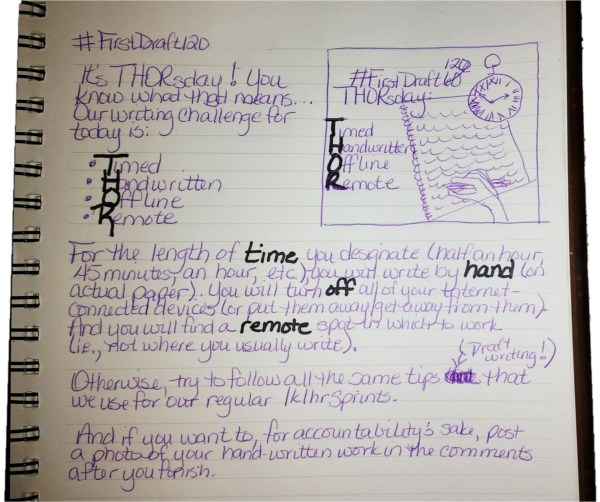
On Thursdays, we do an alternate version of Timer Tuesday—instead of challenging ourselves to sit at the computer and try to crank out as many words as fast as we can, the challenge is to get away from the computer.
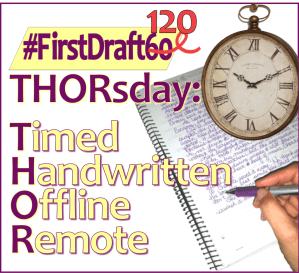 What Does THORsday Mean?
It’s pretty simple. Our writing challenge for today is:
Timed
Handwritten
Offline
Remote
What that means is that for the length of time you designate (half an hour, 45 minutes, an hour, etc.), you will write by hand (on actual paper). You will turn off all of your Internet-connected devices (or put them away/get away from them). And you will find a remote spot in which to work—in other words, don’t do this at the same place where you usually write. Go into a different room. Go outside. If you can, get out of the house and go work somewhere else, like your public library or a coffee shop.
Otherwise, try to follow all of the [revised] suggestions that we use for regular 1k1hr writing sprints.
Assignment: Leave a comment with your THORsday goal—when, where, and for how long do you plan to do your handwritten challenge today? If you’d like to, for accountability’s sake, come back afterward and post an image of your handwritten work.
#FirstDraft120 Day 114: More Story Ideas! (Is Your Story Bible Up to Date?) | #amwriting
 As a reminder for those still keeping up with the FirstDraft120 challenge, Wednesday is the day to review your story bible and see what needs to be updated or revised.
In case you missed it, I committed at the beginning of the week to spending the last days of FD120 writing up and sharing a new story idea for characters in the “next generation” of those written about in the Ransome Trilogy.
On Monday, I posted the idea for the story for Eleanor Ransome (daughter of William and Julia) and James Yates (son of Colin and Susan).
Yesterday, I posted the story idea for Edward Ransome (older son of William and Julia), which involves the daughter of Sir Drake Pembroke.
Since I haven’t written up my story idea yet today (though I’ve been thinking about it all day), I thought I’d share a couple of screen shots to show you what I have been doing on this project this week:
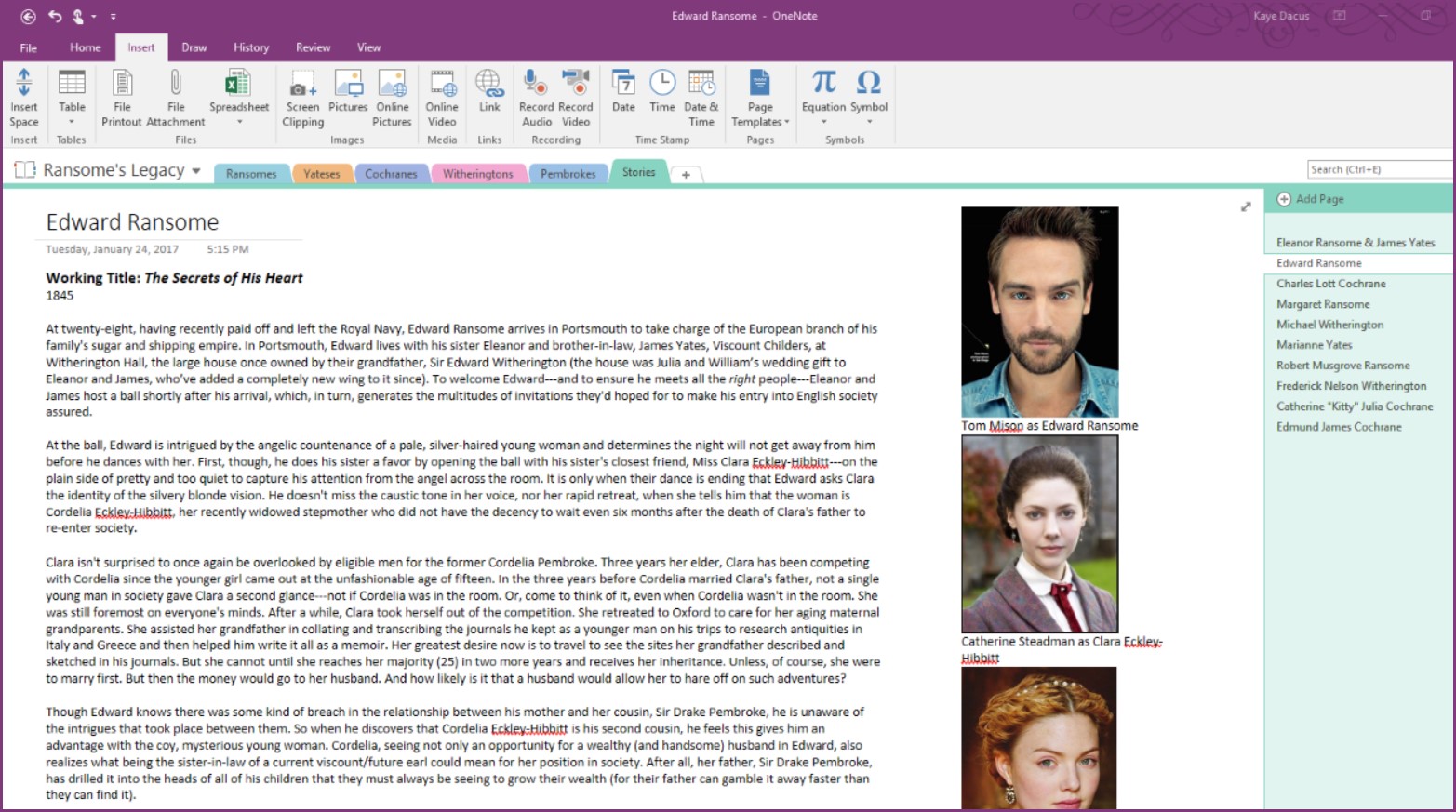
Ransome’s Legacy OneNote Story Bible
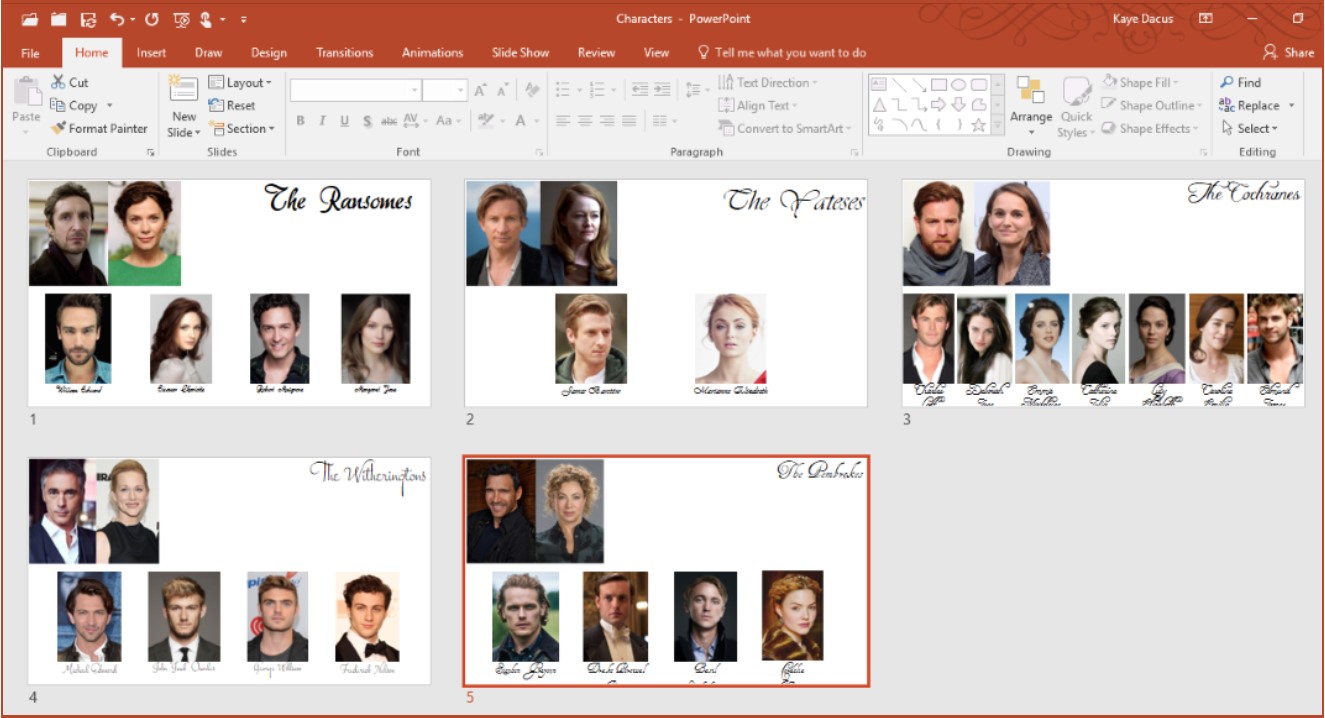
Ransome’s Legacy Character Casting PowerPoint
How Is Your Story Bible Shaping Up?
If you’ve gotten out of touch with what’s in your story bible, today would be a good day to do a quick skim of all of your sections/pages as a reminder. If you’re on top of most of it, pick a few sections you haven’t updated recently and go ahead and work on those. But don’t forget to get your word count in, too!
If you’re doing project time instead of word count (like me) and you aren’t sure what writing-related work you want to do today, consider setting up a OneNote Notebook (or other kind of organizational method) of “Story Ideas” and start filling it up!
Assignment: Be sure to check in with your progress/accomplishments!
#FirstDraft120 Day 113: Timer Tuesday! | #amwriting #1k1hr
Moving forward with our “New Year, Revised Goals” theme for the remainder of FD120, our challenge on Timer Tuesdays will be to schedule and complete a solid one-hour block of writing-related work during the day. If you’re still working on a word-count goal for your first draft, please continue with a regular 1k1hr sprint, if you so desire. For those of us who are now looking at a goal of spending more time writing, the focus of that scheduled, uninterrupted hour isn’t trying to hit a word-count but just making sure we’re completely focused on something fiction-writing related for the entire hour with no distractions.
IT’S TIMER TUESDAY!
I’m going to try to do my #1k1h fiction-focused hour today at 5:30 PM US Central time*.

*To determine the time of the 1k1hr sprint in your time zone, go to the Time Converter website by clicking the image above and inputting my time (as Nashville or Central Standard Time) on the left, and your city/location on the right. For example, 5:30 PM Tuesday in Nashville is 10:30 a.m. Wednesday in Sydney, Australia.
What time will you be doing your 1k1hr today? Or if you absolutely cannot do one full hour, how will you make sure you get at least one hour of writing-related work done today?
Remember, the more support (and accountability) there is, the more successful we’ll all be!
1k1h Tips for Success (Updated for New Year, Revised Goals)
- Prevent Interruptions.
Let anyone within your household know that you need one uninterrupted hour to try to head off at the pass any interruptions. - Set a Timer.
This is most important. Don’t do this by just watching the clock. You’ll find yourself only watching the clock and not getting anything accomplished. Setting a timer allows you to forget about the time and concentrate fully on your project. - Prepare Ahead of Time.
Schedule your 1k1hr time far enough in advance (allow yourself at least an hour if not more) in order to start thinking about what you’re going to work on. Even if you’re doing something else until just about time to work, you can still use part of your brain to be thinking ahead as to what scene you’re going to write or what story idea you’re going to work on. Be sure to allow a few minutes before your work time starts in order to truly prepare, though.–For Sprint Writing: Re-read the last few pages you wrote (without editing/revising!) to get your head back into the story and figure out where you need to pick up. Review your outline and/or character pages in your Story Bible. If you’re going to be sprint writing, put all of that away so you don’t use those to procrastinate during the hour.
–For Project Time: If you’re focused on building time rather than word-count, surround yourself with all of these things in order to keep from having to stop to find stuff as you work. The more things you have that will spark your creativity and present new ideas to you, the better.
- Music:
–For Sprint Writing: If you listen to music while writing (I recommend instrumental so that you don’t get distracted by the lyrics), have it set up and playing before starting your timer. Use earphones, even if you’re working at home, to block out any sounds that might pull you out of your story.–For Project Time: Have you considered setting up a “playlist” for your story/idea? Do you have a theme song for each of your main characters? How does/could music play into your story idea/character development. (See this post for an example.)
- Wear Earphones.
If you can’t listen to music while writing/working, I recommend wearing the earphones anyway. People are less likely to interrupt you (at home or working somewhere like a coffee shop) if you have them in/on—and they help block out other distracting sounds. - Prepare Your Work Space.
Make sure your work space (both physical and mental) is set up and ready to go before you start your timer, whether your sprint writing or working on a writing-related project for the hour. In other words, make sure that about five to ten minutes before you start the 1k1h time begins, you’re in the process of getting ready to work. - Eliminate all distractions!
Silence or turn off your cell phone (unless you’re using it as your timer—then don’t turn it off, just put your phone in Airplane Mode; or if there are people who may absolutely need to get in touch with you—spouse, kids, etc.—set up your Do Not Disturb with exceptions for those few people.). Close your Internet browser. Close Facebook and Twitter. Close your email program if you use something like Outlook that isn’t web-based.
Can’t figure out how to get started sprint writing? Check out one of the previous Timer Tuesday posts for ideas.
Don’t forget to check in with your progress and how you do with your own 1k1hr writing/project time today!
#FirstDraft120 Day 112: A Ransome Sequel Story Idea | #amwriting #romance
 I mentioned in yesterday’s post that watching Victoria on PBS was making me want to revisit the proposal I wrote seven years ago for a sequel series to The Ransome Trilogy. The main reason for this is because of the setting—the mid- to late-1840s, possibly up to the Great Exhibition in 1851. (Although, now that I’ve written about that in another series, I don’t know that I’d include it in any of these stories.)
Although I went through some of the files I’d created when I wrote the proposal back in 2010, I didn’t actually re-read the synopses. I just pulled the character lists and re-read the epilogue at the end of Ransome’s Quest for a brief reminder of some of the ideas I’d come up with. But I wanted to start fresh.
My goal for the remainder of January is to take at least one of the “next generation” (the children of Julia/William, Colin/Susan, Michael/Serena, and Sir Drake Pembroke) and, each day, come up with and share an idea for a romance story (whether novella or full-length remains to be seen—because who knows if I’ll ever write any/all of these).

Victorian woman standing at the window by Lee Avison (Source)
-
Eleanor Ransome has reached the grand state of being a twenty-four-year-old spinster by being quite a bit like her mother, Julia Witherington Ransome; who, Eleanor is fond of pointing out, did not marry until she was twenty-nine. Although she is the second child, and a daughter, she is the one who has learned the running of the plantation at her mother’s right hand—since her elder brother followed their father’s footsteps and went off to sea fourteen years ago.
Because Colin Yates’s elder brother died unexpectedly (still a bachelor at his age!) and left the Earldom to Colin; because James is Colin & Susan’s only son and heir; and because James just turned twenty-nine years old, Colin has insisted James marry before his thirtieth birthday—otherwise he will be cut off from access to the money set aside for him (i.e., precursor to the trust fund). Because James has something of the reputation of a reclusive scholar—and because he’s never met a young woman he doesn’t think is flighty, simple-minded, and vapid—he decides it’s finally time to take his “aunt and uncle” (William and Julia Ransome) up on their offer for him to visit their sugar plantation in Jamaica and learn how such an enterprise is run; after all, James will someday be in charge of all the family’s investments, including the money involved in the sugar plantation and shipping ventures with the Ransomes. He sees it as an escape from his mother’s continuous attempts at matchmaking; his parents see it as the way to put James and the older of the two Ransome daughters together, just as they’d always hoped/dreamed.
Eleanor loves Tierra Dulce and Jamaica, and cannot imagine living anywhere else (she hated London the few times they’ve visited during her lifetime). However, when she learns that James Yates—the man her parents have always hinted at as being her “intended,” even though there is no formal agreement—is coming to visit, Eleanor decides her freedom is worth more to her than anything else. So she books passage on a steamer bound for Philadelphia to pay a visit to her uncle Michael Witherington’s family.
When James arrives in Jamaica, he is immediately given the task of sailing aboard a Tierra Dulce cargo ship to Philadelphia—where the other end of the shipping conglomerate is located and run by Julia Ransome’s brother, Michael Witherington, and his family. Little does James know that his real task is to retrieve Eleanor and convince her to return home—and/or to marry him. (Because, of course, this is all explained to Michael and Serena in a letter from Julia that James is carrying.)
As soon as James arrives on the ship from Jamaica, Eleanor knows what’s going on and what her parents (and his, and her uncle/aunt) are up to. However, she’s now trapped in Philadelphia with James because she spent all of her own readily-available money to purchase her passage to get out of Jamaica, and she knows no one else will give her the money she needs to leave, since they all seem bound and determined to make her marry James Yates. So she decides she will do whatever it takes in order to turn him off. And for her, that means being as bookish, intelligent, studied, and authoritative on all subjects as possible (since, she believes, men don’t like bluestockings).
When James sees how intelligent and independent Eleanor is, he cannot stop himself from admiring her. And the more she tries to turn him off by being the opposite of what’s expected from a society girl, the more attracted he is to her. Now he has to figure out how he can make her fall in love with him—because he can no longer imagine spending the rest of his life without her in it.
What are you working on today? How will you build momentum for this week? Have anything motivational to share?
#FirstDraft120: Only Nine Days Left! | #amwriting
I’ve gotten in a bad habit of not posting here regularly, and that’s on my list of goals I need to revisit and do better with in 2017. Just like doing something writing related for an hour each day. I’ve done okay with that revised FD120 goal—I’ve spent a lot of time revisiting and revising/updating my OneNote Notebooks, working on character development for some characters I’ve had ideas for, and so on.
Tonight, as I’m sitting here watching the second episode of Victoria on PBS, it reminded me of one of the old ideas that I hadn’t yet revisited—and one that I really think I need to spend some time with this week: The Pembroke Legacy, a sequel series to The Ransome Trilogy.
I wrote the proposal for this series back in 2010, when I was finishing up the manuscript for Ransome’s Quest. When my publisher passed on it—not wanting to publish another continuing-story series, I regrouped and came up with the ideas for what would become Follow the Heart and An Honest Heart. All I ever did with the idea for this sequel to Ransome was to write the epilogue that appears at the end of Ransome’s Quest and touches upon a few of the ideas I developed in the proposal.
So, now almost seven years later, as I watch Jenna Coleman and Rufus Sewell waltzing on my screen, I’ve dug down into the (electronic) archives and dusted off the proposal and other files I’d created (character lists/castings) and have created a OneNote notebook for it which I am in the process of transcribing everything into.
As we enter the last nine days of the FirstDraft120 challenge, I’m going to see where diving into this proposal will take me.
How is your writing going? What are you working on? What can you do for the remainder of the month to build momentum that will keep you motivated to write for the rest of 2017?

 KayeDacus.com