Timed, Handwritten, Offline, Remote–It’s THORsday! | #amwriting #1k1hr #2017WritingGoals
 On Thursdays, we do an alternate version of Timer Tuesday—instead of challenging ourselves to sit at the computer and try to crank out as many words as fast as we can, the challenge is to get away from the computer.
What Does THORsday Mean?
It’s pretty simple. Our writing challenge for today is:
Timed
Handwritten
Offline
Remote
What that means is that for the length of time you designate (half an hour, 45 minutes, an hour, etc.), you will write by hand (on actual paper). You will turn off all of your Internet-connected devices (or put them away/get away from them). And you will find a remote spot in which to work—in other words, don’t do this at the same place where you usually write. Go into a different room. Go outside. If you can, get out of the house and go work somewhere else, like your public library or a coffee shop.
Otherwise, try to follow all of the [revised] suggestions that we use for regular 1k1hr writing sprints.
Leave a comment with your THORsday goal—when, where, and for how long do you plan to do your handwritten challenge today? If you’d like to, for accountability’s sake, come back afterward and post an image of your handwritten work.
Writer-Talk Wednesday: Kaye’s Top Ten Writing Tips | #amwriting #top10 #2017WritingGoals
Set aside a completed manuscript to create objectivity. Don’t think; just write. Make lists. Here’s a list of the top-ten tips that have helped me the most as a professional author.
Originally published May–June 2010 / Revised September 2014
Writing Tip #1: FINISH YOUR FIRST DRAFT
- You’ll never know how to write the beginning of a novel until you write through to the ending of it. You don’t know what hints/clues/red herrings you need to incorporate. You don’t know what themes are going to be important to introduce early. And you don’t know what secondary characters or subplots are going to come into play that need to be worked into the beginning of the novel. more…
Writing Tip #2: I Need Distance
- When we’re in the midst of writing a manuscript, we’re so close to it, we can’t see misused or missing words. We can’t see where we’ve used telling language instead of showing. We can’t see info dumps or excessive explanation or description. It isn’t until we’ve cleared the manuscript from our minds, until we’ve allowed ourselves to move on to something else for a little while, that we can begin to see the things that need to be addressed. more…
Writing Tip #3: Start Something New
- To help you clear your mind of the manuscript you just finished, one of the best things you can do is start working on another story. It may not be writing—it may be collecting images of characters and settings, doing research of the time period or of the careers you want these characters to have. It may be meeting with your critique/accountability partners and brainstorming story ideas. It may be reading books you’ve determined are similar to, or will give you ideas for, your new idea. The important thing is to move on to something new as soon as possible. more…
Writing Tip #4: Read five published novels in your genre for every one craft book you read.
- So many writers, especially new writers, get caught up in “learning the craft” and they lose sight of “writing a story.” You can learn more from critically reading published novels than you’ll ever learn from reading how-to books. more…
Writing Tip #5: Story Trumps Craft
- Why did we start writing in the first place? Was it so that we could get our wrists slapped and be told “no” and “don’t” and “you can’t do it that way”? So we could sit at the computer and stare at the screen and feel so inadequate and full of self-doubt that we’d never be able to do it “right” that we’re unable to write at all? Of course not. We all started writing because WE LOVE TELLING STORIES! more…
Writing Tip #6: Don’t think. Just write
- Try to shut off the left side of your brain when writing. When you’re writing you want to tap into your creativity—the right side of the brain. The more we learn about craft, the harder it gets to write. That’s because learning about craft strengthens the left side of the brain. And that’s a good thing. more…
- Something every successful con artist or pathological liar knows is that you MUST keep track of the details; you have to know whom you told what and when. Since those of us who call ourselves writers know that what we’re doing is basically telling lies for fun and fortune (okay, maybe not so much fortune as farthings), we need to remember what we’ve made up. more…
Writing Tip #8: It’s Okay If What You Write Stinks
- It’s okay if what you write stinks because you can always fix it later. The only thing you can’t fix is a blank page. When you’re in the creative process, you don’t need to be bogging yourself down with worrying about whether or not what you’re writing is “good.” You just need to write. more…
Writing Tip #9: Write your passion—but keep an eye on the market
- There are two pieces of advice you’re bound to hear at just about every writing conference or group you’ll ever attend: First, write the book of your heart; second, if you want to sell, make sure you know the market and if the genre you’ve chosen to write is selling. more…
Writing Tip #10: YOU are your best source of motivation!
- No matter how many writing groups you join, no matter how active you are in them, no matter how many blogs you write and read and comment on, no matter how many writers’ forums you participate in, when it comes down to it, writing is a solitary venture. Unless you put YOUR butt in YOUR chair and start committing words to paper (whether electronic or wood pulp), your story will not get written. more…
#2017WritingGoals: It’s Timer Tuesday! | #amwriting #1k1hr
 Moving forward with our “New Year, Revised Goals” theme for our 2017 Writing Goals effort, our challenge on Timer Tuesdays will be to schedule and complete a solid one-hour block of writing-related work during the day. If you’re still working on a word-count goal, please continue with a regular 1k1hr sprint, if you so desire. For those of us who are now looking at a goal of spending more time writing, the focus of that scheduled, uninterrupted hour isn’t trying to hit a word-count but just making sure we’re completely focused on something fiction-writing related for the entire hour with no distractions. Same goes for editing and revision, as well.
IT’S TIMER TUESDAY!
I’m going to try to do my #1k1h fiction-focused hour today at 5:30 PM US Central time*.
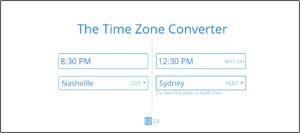
*To determine the time of the 1k1hr sprint in your time zone, go to the Time Converter website by clicking the image above and inputting my time (as Nashville or Central Standard Time) on the left, and your city/location on the right. For example, 5:30 PM Tuesday in Nashville is 10:30 a.m. Wednesday in Sydney, Australia.
What time will you be doing your 1k1hr today? Or if you absolutely cannot do one full hour, how will you make sure you get at least one hour of writing-related work done today?
Remember, the more support (and accountability) there is, the more successful we’ll all be!
1k1h Tips for Success
- Prevent Interruptions.
Let anyone within your household know that you need one uninterrupted hour to try to head off at the pass any interruptions. - Set a Timer.
This is most important. Don’t do this by just watching the clock. You’ll find yourself only watching the clock and not getting anything accomplished. Setting a timer allows you to forget about the time and concentrate fully on your project. - Prepare Ahead of Time.
Schedule your 1k1hr time far enough in advance (allow yourself at least an hour if not more) in order to start thinking about what you’re going to work on. Even if you’re doing something else until just about time to work, you can still use part of your brain to be thinking ahead as to what scene you’re going to write or what story idea you’re going to work on. Be sure to allow a few minutes before your work time starts in order to truly prepare, though.–For Sprint Writing: Re-read the last few pages you wrote (without editing/revising!) to get your head back into the story and figure out where you need to pick up. Review your outline and/or character pages in your Story Bible. If you’re going to be sprint writing, put all of that away so you don’t use those to procrastinate during the hour.
–For Project Time: If you’re focused on building time rather than word-count, surround yourself with all of these things in order to keep from having to stop to find stuff as you work. The more things you have that will spark your creativity and present new ideas to you, the better.
- Music:
–For Sprint Writing: If you listen to music while writing (I recommend instrumental so that you don’t get distracted by the lyrics), have it set up and playing before starting your timer. Use earphones, even if you’re working at home, to block out any sounds that might pull you out of your story.–For Project Time: Have you considered setting up a “playlist” for your story/idea? Do you have a theme song for each of your main characters? How does/could music play into your story idea/character development. (See this post for an example.)
- Wear Earphones.
If you can’t listen to music while writing/working, I recommend wearing the earphones anyway. People are less likely to interrupt you (at home or working somewhere like a coffee shop) if you have them in/on—and they help block out other distracting sounds. - Prepare Your Work Space.
Make sure your work space (both physical and mental) is set up and ready to go before you start your timer, whether your sprint writing or working on a writing-related project for the hour. In other words, make sure that about five to ten minutes before you start the 1k1h time begins, you’re in the process of getting ready to work. - Eliminate all distractions!
Silence or turn off your cell phone (unless you’re using it as your timer—then don’t turn it off, just put your phone in Airplane Mode; or if there are people who may absolutely need to get in touch with you—spouse, kids, etc.—set up your Do Not Disturb with exceptions for those few people.). Close your Internet browser. Close Facebook and Twitter. Close your email program if you use something like Outlook that isn’t web-based.
Can’t figure out how to get started sprint writing? Check out one of the previous Timer Tuesday posts for ideas.
Don’t forget to check in with your progress and how you do with your own 1k1hr writing/project time today!
A New Twist to My 2017 Reading Challenge: Critical Reading
People who’ve been around me—either virtually here on the blog or in person—have heard me use the term “critical reading” before. It’s something that I highly recommend, especially to new authors as well as to anyone who’s having a hard time connecting with their chosen genre. It’s something I learned how to do in graduate school.
It may sound like hyperbole to call it a “master class,” but that’s really what it is. If we take the time to look at the “best” of our genre—not just our favorites, but those that have received critical acclaim, both from readers and from critics of the genre who know what they’re talking about (I’m looking more at those that have won awards from the major genre associations like RWA and MWA and SCBWI, not professional book reviewers—like those at newspapers—who tend to hate and denigrate genre fiction).
As mentioned in yesterday’s post, one of my goals this year is to write a novella for the very first time. I’ve never been able to write a complete story shorter than 75,000 words. A novella should be under 35,000 words (but longer than 20-25,000). So for me, this will mean learning new structure, pacing, characterization, plotting, etc., as I work to tell an entire, coherent, interesting, engaging story in less than half the amount of words that I’m used to.
I have on my calendar a date by which to find some workshops, classes, or other online training so I can study this new (to me) method of storytelling. However, I put that on my goals list/calendar before I’d remembered that there’s an even better way for me to learn how to do this: by critical reading.
I spent over an hour Friday evening on Goodreads, adding historical romance novellas with high-ish star ratings into a new list of just novellas. And I’m adding to the date I have set to find the workshops/classes/whatever that I will have chosen at least five novellas to read critically.
What is critical reading and how does it differ from regular reading?
Critical reading is reading to figure out the mechanics behind a whole work, and to try to see it from an academic viewpoint. What is the structure? How are the characters introduced and then developed? What are the specific beats this story hits—and where do they fall within the structure? What makes this book fit within what’s known about the genre? Where does it deviate? What makes it work? What is it about this particular story/writing that would lead to its being published? And so on.
If you’re interested in learning more about critical reading to see if it’s a tool you’d like to add to your reader/writer toolbox, check out the full series here: Critical Reading
#WritingGoals2017: What Is “Writing Time” if Not Writing?
 As mentioned before, my “Writing Goal” for 2017 is to spend at least one hour per day on “fiction writing–related” work. I know that most non-writers interpret that to mean that for an hour each day, I’ll be sitting down and writing fiction.
But that’s not actually what I’m doing during that time. Here’s what I have been doing during my fiction writing–related work time:
- Working on the Ransome Spin-Off story ideas.
- Casting (and re-casting) Ransome-connected characters.
- Determining when and where the story will be set.
- Creating additional characters—which includes naming, casting, creating a background, etc.
- Researching specific times/locations/events.
- Writing the story summary.
- Revising the story summary.
- Editing the story summary.
- Posting the story summary for the Friday blog post.
- Writing a two- or three-sentence blurb for the Story Ideas in Progress page.
Sometimes, the “writing-related work” looks a lot less like writing and a lot more like photo manipulation. Here’s what I worked on yesterday during my “writing-related work” time:

Left: Michael Witherington (Michiel Huisman) and “Mary,” the maid he meets and falls in love with in Florence.
Right: Michael Witherington and the Lady Marianne Yates (Sophie Turner), the daughter of Colin and Susan Yates, the Earl and Countess Childers.
See the story idea summary for My Fair…Lady? for more info on these two.
By allowing myself to focus on the creation and inspiration part of the “writing-related work,” so far this year, there have only been two days on which I haven’t gotten in at least an hour (more like 3+ hours) each day—and the days on which I haven’t gotten that time in, I made a deliberate choice to take a break and not do anything “writing-related.”
In addition to the writing-related time goal, I’ve also been doing quite well at keeping up with many of the other goals I set for myself: organizing my house/office and getting rid of a lot of the hundreds of author-copies of my books that have been sitting around in boxes for years; approaching social media with deliberation; tracking time spent on all work related to my career as an author (not just writing-related tasks, but social media, website, professional development, study/research, and so on).
I have a very specific timeline for the big projects I’ve set for myself this year. I’ve set dates (with calendar reminders) for the days on which I’m supposed to research and then choose a market for the scholarly paper I’m going to write this year (with a deadline date for that paper to be completed as well). I sat down and planned out the prep tasks from FD60 for the month of August as I prepare to meet my goal of completing a novella this year (including a date by which I must choose the story idea I’m going to work with). And I have the dates for when the first draft will be finished, when it will go to Beta readers, and when I will be working on revisions and edits. To go along with writing the novella, I have dates planned on which I’m to research how to write a novella (I’ve never been able to write anything shprter than 75,000 words so far—and a novella shouldn’t be more than 30-35k) as well as what goes in to self-publishing a novella in case I decide to go that route. Once I run out of Ransome spin-off story ideas to write each week, I’ll come up with new ideas; if not that, I’ll be writing/sharing short pieces of original fiction on Fridays instead.
In addition to those, I set a goal of rejoining a national and local writing group (done). By April 1, I will have decided which writing conference I’m going to attend later this year. I have put on my schedule to attend both the Southern Kentucky Book Fest in Bowling Green in April as well as the Southern Festival of Books in Nashville in October. I have set dates on which I’m to look at the workshop/presentation schedules for each and choose at least one to attend.
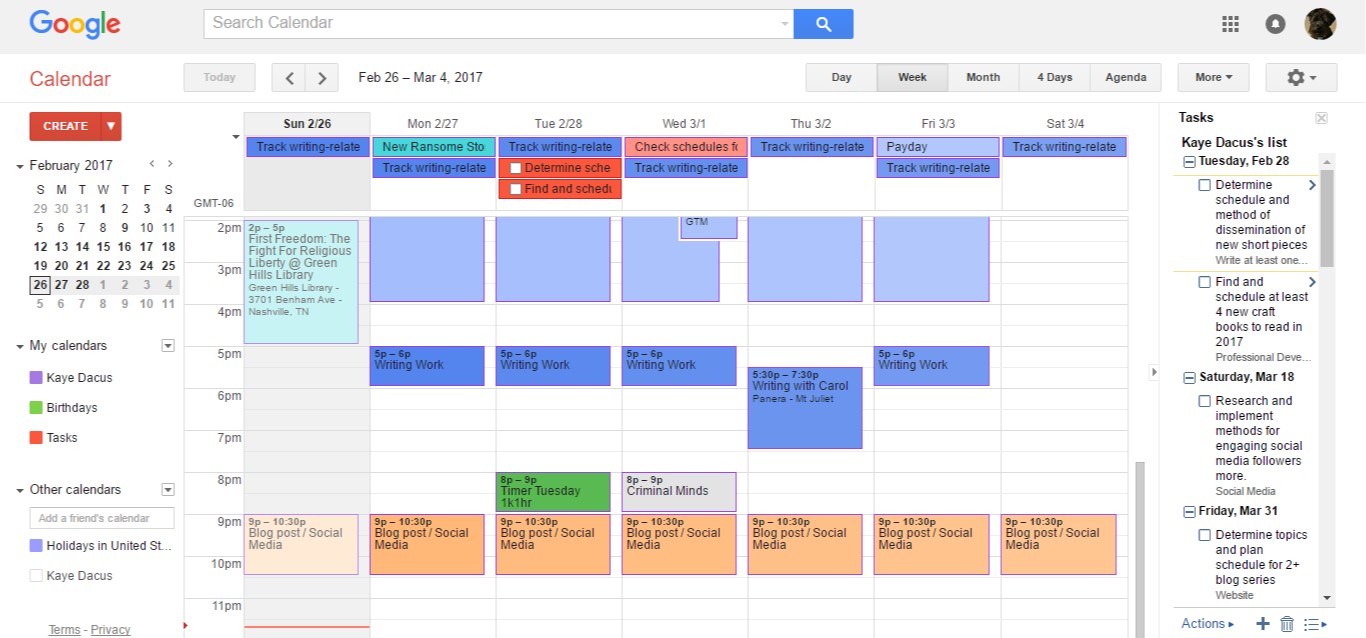
And, most of all, I’m making myself live by my calendar. I get an email each morning from Google with my daily “agenda” (downside: it only shows appointments/events, not the tasks over on the right-hand side). I like having the task lists because it feels really good when I can click that little box and have a check mark appear and see the text crossed out because it’s been completed.
How are your 2017 Writing Goals progressing?
Fun Friday: The Doctor and the Scotsman (A Ransome Spin-Off #StoryIdea)

Because I’m trying to re-teach myself that writing can be fun, this year, I’m focusing on coming up with new ideas for stories. Does this mean they’ll all get written in novel or even novella form? No guarantees. However, this is a creative exercise that I both need and want to share.
You can read all of the previous story ideas here.
Enjoy!
Working Title: The Doctor and the Scotsman

Adeline Henrietta “Henry” Witherington = Jaimie Alexander
Broderick McLaren = Sullivan Stapleton
With the full knowledge and support of her parents—Michael (formerly known as the pirate El Salvador) and Serena (a yacht/pleasure-craft designer)—Adeline Henrietta Witherington entered the American School of Medicine (Eclectic) in Cincinnati, OH, as Mr. Henry Witherington—because posing as a man was the only way she could study to be a doctor.
Now, with the ink barely dry on her diploma, “Henry” has been hired as the doctor for a small town in northern Kentucky, not too far across the river from Cincinnati. Although she thinks she is prepared for it, the reality of slavery is harder to deal with when she sees it face to face for herself. She learns upon arriving that she was hired (as Dr. Henry Witherington) because the previous town doctor left to go work at a new hospital in Louisville. She’s now solely responsible for treating everyone in town as well as on the surrounding plantations.
As soon as Broderick McLaren sees Dr. Henry Witherington, he realizes there’s something not quite right about the very young doctor. He was able to trust the former doctor with his secret, so Brodie would like to be able to take Dr. W. into his confidence. However, he needs to observe the doctor for a while first.
Adeline/Henry is shocked by the condition of the slaves she’s asked to treat at the McLaren plantation. She doesn’t want to be judgmental, but the injuries and conditions she sees lead her to think the worst of McLaren. Especially since he hides these injured/sick slaves away from everyone else.
After weeks of visits to the McLaren plantation, Addie/Henry realizes that she’s misjudged Brodie—that he’s actually helping slaves escape. The more she’s around him, the more she witnesses his kindness and compassion for the refugees, the harder she falls for him. She finally can’t stand to keep lying to him. She confronts him with the knowledge of what he’s doing, then tells him that she cannot continue being dishonest with him and reveals her true identity. Now each is in the other’s confidence and each has the power to ruin the other should their secrets be revealed.
However, more than one neighbor is suspicious of the Scotsman—after all, Brodie never has trouble with runaways—and because he’s a foreigner, he’s always been an outsider. . .a very successful outsider, and the other planters would love to see him gone.
It’s noticed that the new doctor pays a lot more calls on the McLaren plantation than anyone else’s—which is suspicious, as Brodie is a single man with no family, who claims to have no problems with his slaves (no whippings, no physical punishments that would necessitate a doctor’s care).
When a family of fugitives makes their way to the McLaren plantation with slave catchers hot on their trail, the suspicion that McLaren and Dr. W are helping the runaways boils to the surface. The slave catchers roust up a posse which descends upon the plantation, discovering that Dr. W is there again. When the leader of the incensed group insists on searching the plantation for the runaways, Brodie makes a split-second decision that will, hopefully, save the lives of this family. He reveals to his neighbors and the townspeople that Dr. Henry Witherington is actually Adaline Henrietta Witherington—who really is a doctor—and the reason she’s been spending so much time at his plantation is because they’re in love and getting married soon.
Can this deception protect the innocent? How far will the charade engagement have to go in order to save those under their protection? Will Brodie and Adeline have to make good on his claim?
Timed, Handwritten, Offline, Remote–It’s THORsday! | #amwriting #1k1hr #2017WritingGoals
On Thursdays, we do an alternate version of Timer Tuesday—instead of challenging ourselves to sit at the computer and try to crank out as many words as fast as we can, the challenge is to get away from the computer.
What Does THORsday Mean?
It’s pretty simple. Our writing challenge for today is:
Timed
Handwritten
Offline
Remote
What that means is that for the length of time you designate (half an hour, 45 minutes, an hour, etc.), you will write by hand (on actual paper). You will turn off all of your Internet-connected devices (or put them away/get away from them). And you will find a remote spot in which to work—in other words, don’t do this at the same place where you usually write. Go into a different room. Go outside. If you can, get out of the house and go work somewhere else, like your public library or a coffee shop.
Otherwise, try to follow all of the [revised] suggestions that we use for regular 1k1hr writing sprints.
Leave a comment with your THORsday goal—when, where, and for how long do you plan to do your handwritten challenge today? If you’d like to, for accountability’s sake, come back afterward and post an image of your handwritten work.
Writer-Talk Wednesday: Ready, Set, Write!
This is the year you’ve promised yourself that you’re finally going to get around to writing that novel. So let’s get ready, let’s get set, and let’s write.
Originally published January–March 2015

Ready. Set. Write.: Planning, Preparing, and Writing Your Novel This Year
- This is the year you’ve promised yourself that you’re finally going to get around to writing that novel. The one that you’ve always dreamed of writing but have never actually sat down to do.
Or this is the year that you’ve resolved to finish your manuscript. Or this is the year that you’re going to write two, three, or more manuscripts—but you just aren’t sure how to do it since it takes you a year or longer to get one story down on paper just right.
more…
Get Ready: Is Your PREMISE Ready?
- I have a story idea, thanks.
Well . . . story premise is a bit more complex than a story idea. Conversely, premise is not nearly as complex as plot.
more…
Get Ready: Are Your CHARACTERS Ready?
- Now that you have your PREMISE nailed down, it’s time to start thinking about characters. Since we’re not actually writing yet—or really even in deep preparation for writing—now is the time to really just concentrate on who’s going to be in the story, not on deep character development.
more…
Get Ready: Is your SETTING ready?
- Sometimes, the geographic location of a story is an integral part of the premise. Other times, we have to figure out where the best setting for our story will be. And this is something you need to know before you get into the planning stage.
more…

Get Set: Developing Your Backstory
- This is known as giving your characters extended lives. Just as you exist before and after the few weeks you might spend caught up in some project or conflict, your characters need an existence beyond the scope of your story in order to come across as real people, rather than just two-dimensional caricatures who vanish like a puff of smoke as soon as their role in the story is over.
more…
Get Set: Picking Your Point of View and Viewpoint Characters
- Now that you know the backstories of your characters and storyworld, it’s time to start preparing to choose in what style and in what viewpoints your story will be told.
more…
Get Set: Getting to Know Your Setting
- Last week, we discussed backstory and the importance of knowing the backstory of your setting, in addition to your characters. But now it’s time to get to know your setting even more intimately.
more…
- If you do a good bit of your research before you start writing—research that may start even way back when you’re developing the premise of your story—when something comes up as you’re writing, you’re either already going to have notes on it, or you’re going to know which book or website from which you’re likely to find the information you need.
more…
Get Set: Determining Your Story’s Tone
- Will your story be lighthearted? serious? Will it be dark and moody or bright and cheery? Soulful and somber? Or fun and witty? Cynical and sarcastic? Or witty and irreverent?
That’s what it means to set a tone.
more…
Get Set: Setting Writing Goals and Timelines
- It’s all well and good to be ambitious and say you’re going to have the rough draft of your manuscript finished in three months—or even less time. And, if you’re an experienced writer and you know your own production ability, then you know whether or not that’s a reasonable goal.
more…
Get Set: Figuring Out Your Characters’ Desires, Goals, and Motivations
- There are a couple of things lurking in the work you’ve already done up to this point which will be important to dig out and define at this point: your main characters’ goals and motivations.
more…
Get Set: Structuring Your Story in Seven Steps
- The easiest way to not only make sure you have enough story to reach your desired word count—as well as to have something that keeps you on track when you feel lost or derailed somewhere after about chapter 3—is to use some kind of outline structure. If you’re writing genre fiction, this is a little easier, because there are certain markers, certain landmarks your story needs to hit in order to meet reader (and publisher) expectations.
more…
Get Set: Getting into the Draft-Writing Mindset
- One thing that can make writers, whether trying for a first manuscript or a fiftieth, want to give up is the failure to realize the difference between regular writing and draft writing.
more…
Get Set: Setting Up Your Writing Space(s)
- We as writers are blessed with the ability to ply our chosen art form anywhere we might find ourselves—from jotting notes on paper restaurant napkins to what-if’ing on the order of worship during a long-winded sermon to plotting a three-book series on a butcher-paper table cloth during a dinner/concert. But this isn’t the most practical way to go about writing an entire manuscript, much less trying to do it on a deadline, self-imposed or otherwise.
more…
Get Set: Writing Your Opening Scene(s)
- Rather than repeat everything that’s already been written about crafting the “perfect” opening scene, let’s discuss what it means to sit down and write an opening scene—or a dozen—for the book you’ve been getting Ready and Set to Write.
more…
Write: Writing Your Story Scene by Scene
- When you sit down to work on your story, don’t think about “writing the story,” think about “writing a scene.” If you don’t think about what you’re doing in terms of small chunks, then it’s going to be overwhelming and is the quickest path to writer’s block.
more…
Write: Using Dialogue to Bring Your Story to Life
- Because we’re dealing with words on a page, not being spoken aloud by actors with the benefit of staging, lighting, props, and direction, we have to hit somewhere between these two screen writers—with excellent dialogue that keeps readers’ attention engaged while also building tension and moving the story forward without getting bogged down in exposition or being so awkwardly phrased as to be uncomfortable or unbelievable—all the while balancing it with dazzling narrative and action.
more…
Write: “Stealing” Writing Time and Revisiting Your Goals
- As I’ve stated in another post, everywhere is a good place to brainstorm (or write). But how often do we either recognize and/or utilize the opportunity to “steal” that time and actually use it for writing?
more…
Write: Storyboarding to Avoid the Sagging Middle
- As with most of the rest of the aspects of writing, there are just about as many different ways to do this as there are writers. For me, there are actually two steps to how I storyboard.
more…
Write: Building Your Momentum (and Word Count) with #1k1h Writing Sprints
- Sometimes, when you’re in the middle of your manuscript and you just can’t seem to move forward—and even storyboarding doesn’t help—the only thing that does help is setting a timer and making yourself write, marathon-style.
more…
Write: Generating Conflict and Collecting Narrative Debt
- This is what the middle of the story is about: the triumph of our characters over any conflict we as the writers can throw in their paths. Be mean to your characters. Take away from them what they treasure most in this world and give it to their arch-nemesis. Strip them of everything. Treat them like Job and see what they do.
more…
#2017WritingGoals: It’s Timer Tuesday! | #amwriting #1k1hr
Moving forward with our “New Year, Revised Goals” theme for our 2017 Writing Goals effort, our challenge on Timer Tuesdays will be to schedule and complete a solid one-hour block of writing-related work during the day. If you’re still working on a word-count goal, please continue with a regular 1k1hr sprint, if you so desire. For those of us who are now looking at a goal of spending more time writing, the focus of that scheduled, uninterrupted hour isn’t trying to hit a word-count but just making sure we’re completely focused on something fiction-writing related for the entire hour with no distractions. Same goes for editing and revision, as well.
IT’S TIMER TUESDAY!
I’m going to try to do my #1k1h fiction-focused hour today at 5:30 PM US Central time*.
*To determine the time of the 1k1hr sprint in your time zone, go to the Time Converter website by clicking the image above and inputting my time (as Nashville or Central Standard Time) on the left, and your city/location on the right. For example, 5:30 PM Tuesday in Nashville is 10:30 a.m. Wednesday in Sydney, Australia.
What time will you be doing your 1k1hr today? Or if you absolutely cannot do one full hour, how will you make sure you get at least one hour of writing-related work done today?
Remember, the more support (and accountability) there is, the more successful we’ll all be!
1k1h Tips for Success
- Prevent Interruptions.
Let anyone within your household know that you need one uninterrupted hour to try to head off at the pass any interruptions. - Set a Timer.
This is most important. Don’t do this by just watching the clock. You’ll find yourself only watching the clock and not getting anything accomplished. Setting a timer allows you to forget about the time and concentrate fully on your project. - Prepare Ahead of Time.
Schedule your 1k1hr time far enough in advance (allow yourself at least an hour if not more) in order to start thinking about what you’re going to work on. Even if you’re doing something else until just about time to work, you can still use part of your brain to be thinking ahead as to what scene you’re going to write or what story idea you’re going to work on. Be sure to allow a few minutes before your work time starts in order to truly prepare, though.–For Sprint Writing: Re-read the last few pages you wrote (without editing/revising!) to get your head back into the story and figure out where you need to pick up. Review your outline and/or character pages in your Story Bible. If you’re going to be sprint writing, put all of that away so you don’t use those to procrastinate during the hour.
–For Project Time: If you’re focused on building time rather than word-count, surround yourself with all of these things in order to keep from having to stop to find stuff as you work. The more things you have that will spark your creativity and present new ideas to you, the better.
- Music:
–For Sprint Writing: If you listen to music while writing (I recommend instrumental so that you don’t get distracted by the lyrics), have it set up and playing before starting your timer. Use earphones, even if you’re working at home, to block out any sounds that might pull you out of your story.–For Project Time: Have you considered setting up a “playlist” for your story/idea? Do you have a theme song for each of your main characters? How does/could music play into your story idea/character development. (See this post for an example.)
- Wear Earphones.
If you can’t listen to music while writing/working, I recommend wearing the earphones anyway. People are less likely to interrupt you (at home or working somewhere like a coffee shop) if you have them in/on—and they help block out other distracting sounds. - Prepare Your Work Space.
Make sure your work space (both physical and mental) is set up and ready to go before you start your timer, whether your sprint writing or working on a writing-related project for the hour. In other words, make sure that about five to ten minutes before you start the 1k1h time begins, you’re in the process of getting ready to work. - Eliminate all distractions!
Silence or turn off your cell phone (unless you’re using it as your timer—then don’t turn it off, just put your phone in Airplane Mode; or if there are people who may absolutely need to get in touch with you—spouse, kids, etc.—set up your Do Not Disturb with exceptions for those few people.). Close your Internet browser. Close Facebook and Twitter. Close your email program if you use something like Outlook that isn’t web-based.
Can’t figure out how to get started sprint writing? Check out one of the previous Timer Tuesday posts for ideas.
Don’t forget to check in with your progress and how you do with your own 1k1hr writing/project time today!
Books Read in 2017: ‘The Madness of Lord Westfall’ by Mia Marlowe (Regency Paranormal Romance | 3.5 stars)
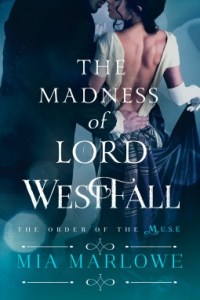 The Madness of Lord Westfall (The Order of the M.U.S.E. Book 2)
by Mia Marlowe
Genre: Regency Paranormal Romance
My rating: 3.5 stars
Book Summary:
Pierce Langdon, Viscount Westfall is mad. Everyone knows it. He fell from a tree when he was a boy and woke to hear strange voices. When the voices grow stronger as he grows older, his family commits him to Bedlam. But what he hears are the thoughts of those around him—a gift to be used in service to the Order of the M.U.S.E. Until he falls again…this time for a totally unsuitable woman.Lady Nora Claremont hides her heartbreak behind the facade of a carefree courtesan. Viscount Westfall is the most confusing man she’s ever met. He seems to know exactly what she wants…and what she’s thinking.
Which is a dangerous thing, because what Nora wants is Pierce.
And what she’s thinking could expose her as a traitor to the crown.
My GR Status Update(s):
02/12. . .Currently Reading
02/14 . . . 20.0%—Not sure I like the heroine in this one as much as in Book 1, but still an enjoyable story so far.
02/15. . .54.0%
02/19. . .68.0%
02/20. . .Finished Reading
My Review:
I seem to be in the minority of people on Goodreads who enjoyed the first book in the series, The Curse of Lord Stanstead, a bit more than this one. In the first book, both main characters had supernatural powers—she as a fire mage, he as someone who can psychically implant thoughts in and influence others’ minds . . . and who, if he gets close to someone, can dream about them (nightmare) and then tragically see that dream come to horrific reality.
In this second book, only the hero, Pierce, has a supernatural ability—to “hear” the thoughts of others. Apparently, he didn’t have it his whole life; it started when he was a child and fell from a tree and hit his head. How head trauma could cause a supernatural ability, I have no idea, so this origin of his superability didn’t really work for me; but I was able to suspend disbelief. Regardless of how Pierce gained the ability, it was overwhelming and confusing for him as a child and, as an adult and the heir to the Viscount Westfall title (and lands and money and social status), his uncle (his father’s brother and therefore next in line after Pierce) had him committed to Bethlehem Hospital—Bedlam.
Having met Pierce in the first book, the idea that he found being around others difficult was already well established. So it was more than a little surprising to find him almost constantly around other people in this book. Yes, he’s learned to erect a mental shield against the thoughts of others (thanks to his mentor and founder of the Order of the MUSE, Lord Camden); but I would have found this much more believable had the toll this took on him been given more than just a few passing lines about how exhausting/difficult it was for him to keep this shield up constantly. I guess I subscribe to the Once Upon a Time school of thought when it comes to magic or superpowers—they always come with a price (or, to put it in real-world physics terms, for every action, there is an equal and opposite reaction).
The heroine of this book, Honora, is also a bit implausible. And it felt like Marlowe originally started writing her as one type of character (a voracious flirt who’s always saying outrageous things, like the other courtesan in this series, Vesta LaMotte) as that’s how she appears in her first scene; but this side of her is never seen again. And that Pierce can’t read her thoughts the first time he meets her and can’t immediately tell that she’s not the person she’s pretending to be, much less not sleeping with her patron, is one of the worst examples in this book of how there seem to be no rules to how superabilities work in the MUSE universe. At other times in the book, he has trouble clarifying the thoughts of others because they’re scattered, too fast, or too confusing (compared to trying to catch squirrels by the tail in one scene—yet I think that was actually from Honora’s viewpoint when she couldn’t settle her own mind). Okay, fine. But to say that he can’t read someone’s thoughts because they’re pretending to be someone else (actors) . . . it doesn’t really work. Maybe not being able to filter between the real persona and the fake—or having the real thoughts so deeply buried that he couldn’t get to them, okay, maybe.
Anyway . . . Nora (Honora) turns out to be nothing like the way she’s introduced in her first scene. In fact, she’s pretty boring. Her “secret” is both obvious and not scandalous or dangerous at all. (Boring.) She’s not the flamboyant, sensual, free-spirited, outrageous person that she’s introduced as in her first scene; instead, she’s . . . someone with little personality other than wanting to have sex with Pierce and being slightly concerned that her patron’s (Lord Albermarle) secret that he’s being blackmailed over doesn’t get out. (And even here she manages to be boring.)
In Book 1, both Garrett and Cassandra were “extraordinaires”—and both had superabilities that could not only both help and hurt others but could destroy each other. She had to learn to control her power as a fire mage lest she immolate everyone and everything around her (including Garrett); and if he came to care for her, he could potentially bring harm/death to her by having one of his nightmares-that-come-true about her. They had to work together in order to both control and mitigate each other’s destructive potential, and that’s what made the story, and the building of the relationship between them, work so much better than in this one.
Conversely, even after Nora learns of Pierce’s superability and that he knows of the plot that her patron is involved in (because of the aforesaid blackmail), she remains a passive figure in the intrigue part of this story (the supernatural threat/mystery that the Order of the MUSE is trying to solve), being unwilling to help Pierce figure out a way to get rid of the supernatural item that is to be used for nefarious purposes—even though she knows what it is, where it is, and what it’s to be used for and probably had easy access to it the whole time. Instead, Pierce must put himself in both physical and mental peril in order to try to bring a resolution to this part of the storyline. By the time Nora does finally decide to act, it’s almost too late, as Pierce has already pretty much worked out just about everything by himself, and her appearance comes almost as a deus ex machina moment in order to bring the crisis moment to a quick/neat solution.
SPOILER (highlight to reveal) And what bothered me the most about this story was its conclusion. In escaping Bedlam, Pierce once again receives a blow to the head. He’s out cold for about a day (it was a week when he was a child). When he wakes up, he cannot read anyone’s thoughts anymore. I was SO annoyed with this! It’s just like the stories in which a character loses their eyesight due to a blow to the head/injury, only to receive another similar injury/blow toward the end and, miracle of miracles, they get their sight back. It’s a cop out and bad storytelling. (And now the character has even worse traumatic brain injury than they had before.)
I know I’ve focused mostly on the negative in this review. I did enjoy reading this book, for the most part. Marlowe is a good writer and tells a great story. She keeps the narrative/plot moving along and only rarely gets mired down inside a character’s head to the point that I started skimming—but this was usually only a few paragraphs.
This was enjoyable enough that I’m still really looking forward to reading the next book in the series.
_______
My rating matrix:
5 STARS = one of the best I’ve ever read
4 STARS = a great read, highly recommended
3 STARS = it was okay
2 STARS = I didn’t enjoy it all that much, not recommended
1 STAR = DNF (did not finish)

 KayeDacus.com