Fun Friday–A Little Regency Fun

Since I haven’t been blogging this week, I haven’t had a chance to mention that crit partner and pal Georgiana awarded me the “Rockin’ Girl Blogger” award! I’m passing this along to Ruth, Amy Jane, Rachel, and Jennifer!

If you’ve been keeping up with my Word Count page, you’ll know that I finished my proposal for the RANSOME TRILOGY and sent it off to my agent last night.
Since I’m now completely immersed in Regency Romance mode, I thought I’d share some of my favorite YouTube videos with you today!
On Hiatus This Week
Hi, all!
Just wanted to let y’all know that I’ve decided to take a break from blogging this week. I’ve got a ton of stuff I need to get done—need to finish the synopsis for Ransome’s Honor, along with the shorter snyopses for Ransome’s Crossing and Ransome’s Quest, get the proposal written, and get it out to my agent. I seriously need to get some critiquing done, I need to get another couple of chapters of A Major Event Inc. written and out to the crit partners, and I need to get my application for an adjunct teaching position out to my undergrad college.
I will update my word count page daily, so be checking in there to make sure I’ve done it!
And keep posting comments with ideas for new Fiction Writing Series topics!
Next Fiction Writing Series–Any Suggestions?
I’m trying to figure out if there’s a Fiction Writing Series topic just waiting for my attention out there. Since many of the topics I’ve serialized here have come from suggestions from my loyal and lovely readers, I wanted to see if there’s anything any of y’all would like to see as a topic of a series.
Just post a comment with your suggestions!
Harry Potter–the Event & Reading It
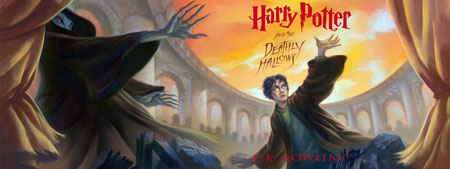
No spoilers, I promise.
After some friends warned me that I might need to arrive early to get a number that would determine my place in line, I bit the bullet and went down to B&N at 7:00 Friday evening. Because I had to stand in line about thirty minutes just to get up to the table outside the door to get a wristband (orange for those of us who had pre-reserved our copies, blue for those who didn’t), and hearing people talk about how much trouble they had with parking and getting back into the store later in the evening “last time,” I made the decision to just stay there for the entire length of time instead of returning home or doing other shopping in the area.
I made my way through the crowd to the very quiet Christian fiction aisle and picked up Terri Blackstock’s Last Light, which, I believe, someone recommended in a comment here on the blog. After a little more than an hour of book browsing and picking up a few other titles to look at to see if I might be interested in reading them, and found an empty table in the cafe area. I sat there and read until about 10:30 (after reading about the first one-third of Last Light) when I finally got up to figure out where I needed to be to have a decent shot of getting my book as close to midnight as I could. I ran into a few people I know from church and stood with them in what eventually became a line. We were two Bargain Books rows back from the cashier’s station. I finally got to the front and got my book at 12:38 a.m. While waiting at the head of the line, I asked the employee standing there (who’d been directing people to the appropriate lines outside earlier, walking around with a clicker/counter) if they knew a rough estimate of how many people where there. He said when he turned the clicker over to someone else at 9:30, there were already 1,800 people there—based on the steady stream of people he saw coming in after that, he figured there were probably at least 2,000-2,200 people there. And this is not a overly large B&N. There were people everywhere.
Since I hadn’t taken the time to get something to eat before going, I stopped at Jack-in-the-Box on the way home for food (was able to read the first page and a half waiting at the window), then came straight home and, after changing into PJs, started reading. I stopped around 3 a.m. only because I kept dozing off and rereading the same page without really comprehending anything on it. So I decided to sleep. Woke up around 9 a.m., made coffee, eggs, and bacon, and immediately started reading again. With only a few breaks to get up and move my stiff, sore body, I finished reading it at 7:00 p.m. tonight. I went through about a dozen tissues while reading. She didn’t pull any punches, but it has a deeply satisfying ending.
As far as the predictions I made before reading it—well, with some of them, I was right on the money. With others, I got a couple of elements correct but missed others, and with a few, I was just way off base.
I’m so glad I went last night and experienced this much excitement over a book. And not just any book—a genre fiction/popular fiction novel!
I’ll be getting the unabridged audio version from Amazon some time this week, so I’ll spend the next couple of weeks listening to it and catching all of the little details I know I missed because I tend to skim in my anxiousness to know what happens next when reading a new book.
Fun Friday–Harry Potter: My Predictions
Update July 23: Spoilers are posted in the comments where I have commented on each of the predictions below.
If you don’t have Harry Potter mania by now, I’m sure you’ve gotten good and sick of hearing about it. So I’ll understand if you don’t want to read this post. Please come back on Monday when, I promise, I will not be posting about it.
I’ll be headed down to Barnes & Noble at 7:00 this evening to get my number or get in line or whatever, to get my reserved copy of Harry Potter and the Deathly Hallows at midnight. I then plan to stay up all night reading. Actually, I’m posting this late on Thursday night because, even though it means painful withdrawal symptoms, I will be trying to stay offline as much as possible tomorrow, as there are people in many other countries who have already received their copies, and I don’t want to know what happens before I read the book.
Here are my predictions for things that will happen in the seventh and final book in the best-selling fiction series of all time:
- The book will open in the summer and feature the wedding of Bill and Fleur. Harry will have one more chance here to be with Ginny. I believe this is also when he will learn that, for some reason, he really needs to return to school. Because I find it really hard to believe this whole book will take place away from Hogwarts.
- Sometime in the book—maybe in the summer before or after the wedding, or perhaps on school holiday over Christmas—Harry will visit Godrick’s Hollow, where his parents lived, and find the horcrux that is made out of something belonging to Godrick Gryffindor.
- Ron and Hermione will be made Head Boy and Head Girl.
- The “major” character who will die: Neville Longbottom, opening the door of opportunity, somehow, for Harry to kill Voldemort. With his death, the prophecy will be fulfilled. Too big a deal has been made at the end of the fifth and with several references in the sixth books to the fact that the prophecy could have meant either Harry or Neville.
- Leading to the next obvious prediction: Harry will live.
- The last horcrux that will be found is the locket. The locket was tossed out of one of the cabinets at the headquarters of the Order of the Phoenix at the beginning of book five when they were trying to clean the place up. Kreacher picked it up and has been hiding it—unless he gave it to Bellatrix Lestrange, which means it is back in the custody of Voldemort. Which I doubt. The note inside the fake locket that Harry and Dumbledore retrieved in book six was signed R.A.B., which I’m sure everyone knows by now is Regulus Black, Sirius’s younger brother; and it’s the reason why Voldemort had Regulus killed (and how the locket ended up in the Black home).
- It will be proven that Snape was actually “good”—that he was acting on Dumbledore’s orders all the time. That Dumbledore knew he was dying anyway and the most logical thing was to make it look as if his death was actually a victory for Voldemort, not something that was just going to happen anyway. I believe that Dumbledore’s hand not healing from the curse that was on the ring was what made him decide to cook up the scheme with Snape so that Snape could get in good with Voldemort, while all the time working for Voldemort’s downfall. Does it mean I like him? No. But Dumbledore’s unwavering belief in Snape will be vindicated.
- Snape might actually die protecting Harry. He might even reveal he was in love with Lily Evans. And that he was possibly at Godrick’s Hollow the night the Potters died—had gone to warn them but was too late and had to watch them die.
- Lupin and Tonks will get engaged or married.
- Somehow—perhaps with the broken 2-way mirror Sirius gave Harry—Harry will be able to communicate with Sirius. This is what will lead him to Regulus and the real locket.
- We’re going to find out what it means that Harry has his “mother’s eyes.” So much has been made of this—mentioned in every book. Did she somehow leave an imprint of herself—a good horcrux?—inside of him when she died protecting him? I think we’re going to learn a lot more about Lily Evans and James Potter in this book.
- Will Harry’s scar disappear when Voldemort dies? Is that why the last word of the book is supposed to be scar?
- Draco Malfoy will come to Harry for help—to protect his parents from Voldemort or to help Draco get out of the Death Eaters or something. Harry will have to figure out if Draco is being honest and, if he is, if Harry can possibly forgive him.
- Ron and Hermione will become engaged if not go ahead and get married.
- Viktor Krum will make another appearance.
- Lupin will kill Grayback.
- Slughorn will continue on as Potions Master and head of Slytherin house.
- But who will be the Defense Against the Dark Arts Teacher????
- In book five, when they were trying all of the doors in the Department of Mysteries, there was one door that was locked. This may become important.
- We’ll find out exactly how much Aunt Petunia knows about the wizarding world. Maybe the reason she hates Harry so much is that she was secretly in love with James Potter who wouldn’t give her the time of day because she wasn’t a witch?
- I’ve heard that someone who’s never had a magical ability will suddenly be able to do magic in this book. I originally thought it was going to be Aunt Petunia—but I read somewhere (maybe on Mugglenet.com or JKRowling.com) that it is not Aunt Petunia. Maybe Filch? or Mrs. Figg? or Mrs. Norris the cat?
- Quiddich—if shown at all—will play a very small part in the book. But Gryffindor will win the house cup thanks to Ron’s goalkeeping, fulfilling the vision of himself Ron saw in the Mirror in book one.
- Dumbledore is really dead. But through his portrait in the Headmistress’s office (after all, Professor McGonagall is the deputy and next in line), and possibly through his Chocolate Frog Cards (after all, in book five, he makes a point of saying that after the ministry stripped him of many of his responsibilities, the only thing he requested was that they didn’t take him off the Chocolate Frog Cards), he will continue to act as a guide to Harry.
This reminds me a lot of how four little words in a movie “changed the world” twenty-seven years ago, when Darth Vader said “I am your father.” It’s so much fun to live in a time when something like this can happen and remind us that, deep down, we’re all “just folk” (as Mal Reynolds from Firefly would say)—that we’re more alike than we give ourselves credit for. This is a pretty major pop culture event, though, more than just the largest first-run book printing in history (with more than 12 million copies already sold before the book comes out!). It’s a turning point in the collective consciousness of our culture that no other piece of fiction—not even Star Wars—has had on our society.
Just goes to show the power of good storytelling.
What Do I Have to Lose?
In trying to regain momentum in my writing life—which has stalled out almost completely except for the twenty or thirty minutes I make myself write just before switching off the light at night—I’ve been reading articles, chatting with other writers, and, in general, reminding myself that I thrive with structure, goals, and deadlines and flounder when I don’t have something to achieve.
Gina Conroy recently shared that she has a goal of writing 1,000 words per day. In the past three days, she’s written about 4,500 words. Ah, I remember the time—back this past spring, in fact—when I set this same goal for myself and had the same kinds of results. Some days, no, I didn’t actually get all the way to 1,000 words. But the other days of the week usually made up for it and I was producing 5,000 to 7,000 words per week. Of new material. Of forward progress. Of motivation to sit down and see if I could surpass the previous day’s word count. Of being proud of myself at the end of the night when I opened up my spreadsheet and plugged in that day’s number and saw my total word count grow.
In this search for motivation, I read an article in the archives at writermag.com by David Taylor, “A no-fret, no-sweat plan for getting it DONE” (may only be available to subscribers, not sure). In it, he explains his method of not setting a word count goal, but allotting his writing time into blocks of forty-five minutes to one hour. “Spend enough time in the chair,” he writes, “and eventually it will get done.”
Taylor writes that much of why we as writers don’t produce as much as we’re capable of is because of doubt or fear. We fear the blank page. We doubt we’ll be able to produce anything worthy of our crit partners’ time, much less of publication. Every little negative thought we have comes to the fore and as soon as we sit down to write, we spring right back up to go do something else we’re more comfortable with. Face it—writing can be one of the most uncomfortable things to do, and not just physically. As I delve deeper into my characters and my stories, sometimes it’s like pulling my heart out of my chest with my bare hands and laying it on the desk—defenseless and vulnerable to everything.
As much as we all hate talking about it, committing time to writing is just like committing ourselves to losing weight. If I set a weightloss goal of 20 pounds between now and September 19, what am I going to do to reach that goal? Well, I’m going to make sure I’m eating healthy foods, smaller portions, lower fat/calories, more fruits and veggies, and exercising every day. What? Exercise every day? Yep. That’s part of the commitment. In my appointment with my new doctor this week, when I expressed concern that, after losing 15 pounds relatively easily by just changing my diet to lower carb/lower fat, I’ve plateaued, she asked me how much I’m exercising. About thirty minutes a day three or four days a week, I admitted. This was when she gave me the bad news: for someone my age and my weight, that’s not going to cut it. I have to increase my aerobic exercise to forty-five minutes per day at least five days per week if I want to try to get to a point of steady weight loss.
Hmmm . . . I’m seeing a frightening similarity here. It’s all about commitment. It’s about willpower. It’s about figuring out what I have to gain and what I have to lose to determine how committed I’m going to be when it comes to each goal—writing and weightloss.
In the article, Taylor illustrates the fact that people who depend on their writing for their livelihood have no trouble staying motivated. “If they don’t write, they don’t pay the bills. Simple enough.” But as someone whose livelihood does not depend on my writing, what do I have to lose by not writing?
Well, I do have a little more to lose than other unpublished authors—after all, I am agented. If I’m not writing and getting new material to him, pretty soon (in six months, in fact), my contract will be up for review. If I haven’t been getting stuff to him that he’s getting bites on from acquisitions editors, he’s probably not going to renew my agreement and I’ll once again be not only unpublished but unagented as well, and starting all over again—this time with the stigma of having been dropped by one of the best agents in the industry. Yikes—don’t want that to happen.
On a more personal level, I actually tend to start edging toward depression when I’m not productive with my writing. Writing prolifically (not publishable-quality, but words on page) was what got me out of the deep clinical depression I experienced fifteen years ago that led to my dropping out of college. That manuscript, still unpolished and unfinished, clocks in at slightly more than 200,000 words—which doesn’t represent all of those scenes and “chapters” (segments, really) that I rewrote dozens of times as the mood struck. In the past couple of months that I’ve allowed my writing motivation to dwindle away and my word count fade to almost nothing, I’ve noticed the wolves of depression circling, waiting to attack. When I write, these predators are excised through the endorphins generated by the creative process. My emotions are boosted, my adrenaline pumped up, my mental faculties clearer, my sociability increased. Writing regularly makes me more productive in other areas of my life—it’s amazing how much MORE time I seem to have to do things like exercise, do freelance work, critique, and read when I’m committing myself to my own writing than I do when I’m not committed to anything.
Looking at it this way, I have far too much to lose by not writing than I do by committing myself to a goal or schedule. Sure, it’s nice to be able to just come home after work, sit in the recliner, watch TV all evening, maybe chat on the phone, knit a while, and just “take it easy.” But what will I have accomplished with my life, with the talent God has given me, by doing that? I have nothing to gain and everything to lose by not committing myself to what will make me better as a person.
Those of you who’ve been reading my blog a while are probably thinking about the other times I’ve posted about commitment or determination to have and reach a daily word count goal, and I’m sure you’re thinking, “So shut up and just do it.” Here’s my commitment to you and my request for you to hold me accountable. I have created a Daily Word Count page—there’s a link at the top of the page and in the right-hand nav-bar—where I will post the total number of words I wrote the previous day. If I’m not posting, y’all better be e-mailing me to find out why! Because the greatest source of motivation in goal-keeping is accountability.
I did it–I left MySpace
A while ago, I wrote a blog entry about why Facebook is better than MySpace in which I referred to having a page on MySpace as sitting on a barstool in the skankiest singles bar in cyberspace (or something to that effect).
Now that I’ve been using Facebook for more than six months, I’ve really come to appreciate the clean lines, the lack of bizarre ads, the “news feed” feature that shows me what my friends have been up to, the status updates, along with the how the different “apps” that can be added to my profile don’t overwhelm my profile page with unnecessary graphics–and anything that has flash/animation/sound capability has to be clicked on to start. No automatic music playing or waiting for animations to load when viewing someone’s profile.
But the thing I’ve come to appreciate most of all is the level of privacy/security Facebook affords. Here’s the information from the “Privacy” page:
-
Privacy Overview
Facebook wants you to share your information with exactly the people you want to see it. On this page, you’ll find all the controls you need to set who can see your profile and the stuff in it, who can find and contact you on Facebook, and more.
Profile
You are in one network and you can control who can see your profile, contact information, groups, wall, photos, posted items, online status, and status updates.
Search
You can control who can find you in searches and what appears in your search listing.
News Feed and Mini-Feed
You can control what actions show up in your Mini-Feed and your friends’ News Feeds.
Poke, Message, and Friend Request
You can select which parts of your profile are visible to people you contact through a poke, message, or friend request.
Applications
You can edit your privacy for applications you have added to your account, applications that you have used on another website, and other applications built on Facebook Platform.
(And I just have to say—I love the fact that whoever wrote this knows how to use commas and apostrophes correctly.)
I mentioned in the other post about some of the creepy e-mails I’d been getting at MySpace. Well, they stopped for a while. But in recent days, I’ve been inundated with them, whether they’re simple text e-mails from users asking me if I’ve ever had my feet licked (reported it to “abuse,” blocked the sender) or saying, “You’re cute, I hope we can meet” (reported it to “abuse,” blocked the sender, set my profile to “private” which supposedly means it’s only available to approved friends). Since setting my profile to private, the number of unwanted messages has actually increased. I’ve gotten messages about debt consolidation, dating services, escort services, over-eighteen-only sites (on MySpace and off), and a few more sexually harrassing e-mails from other users. After receiving three spam messages today and never hearing anything back from customer service on my previous complaints, I finally had enough. I cancelled my MySpace account.
I already feel safer. I feel cleansed. I feel like my couple of friends who contacted me only through MySpace will have to figure out how to e-mail me through my regular e-mail account . . . or get a Facebook account and contact me there (at least one already has).
I originally set up a MySpace account because it was supposed to be the best place for not just social networking, but marketing myself as a writer—to start building a readership base before getting published. But you know what? My blog does that. Because I write so much about common writing-related topics, I get tons of hits from websearch sites that lead to several page views per visit. And they don’t leave me comments asking me if I’ve ever had my feet licked. Or if they did, I’d catch them before they would even be posted, as until I approve someone to be able to post comments, I have the opportunity to moderate any comments coming through.
On Facebook, not only have I had the opportunity to network with and keep up with what’s going on with a couple dozen other writers, but I’ve connected with members of my family I’d never really had the chance to get to know well before, separated as we are by age and distance.
MySpace can have their skanky singles bar. I’d much rather go hang out in the safe coffee house that is Facebook.
Things I’d Rather Do than Write a Synopsis
My crit partner Erica blogged yesterday about an experience she’d rather go through than to write a synopsis (“Crowns of the Princess”). So I thought I’d share a list of things I’d rather do . . .
- Play Spades online over at msn.com
- Write a blog entry.
- Check my blog stats. Click on the link of every “referring site” where people clicked to get to my blog. Look at all of the “web search terms” to see how people are finding my site. Check out some of the search terms to see how far down the list in the Google search I am. Refresh the page to see if anyone else has looked at my blog in the three minutes I’ve been on the stats page. Look at the pages that had the most page views today and re-read them. Edit if necessary. Go back and check blog stats . . .
- Knit while watching a movie—at least my hands will be busy.
- Sit in front of the TV for three hours flipping the channels because there is nothing on.
- Visit all of my friends’ blogs and leave inane comments.
- Update my “status” on Facebook every ten or fifteen minutes.
- Send e-mails to people I haven’t communicated with in six or seven years.
- Research and comparison shop new cars that I can’t afford to buy anyway.
- Look at crazy cat pictures at I Can Has Cheezburger?
- Spend a couple of hours looking at every recommendation Amazon wants to make for me based on the hundreds of items I have either bought or rated there throughout the years.
- Look up every single actor I’ve ever heard of on IMDb.com to see what they’re up to.
- Watch the new BBC adaptations of Jane Austen’s novels on YouTube.
- Rearrange the 40+ movies listed in my queue at Netflix.
- Leave some more inane comments on friends’ blogs.
- Exercise.
- Read the dictionary.
- Rotate the tires on my car in my driveway, by myself, in the 90+ degree heat, with only my standard-issue car jack and tire-iron. (I’ve actually done this before. Not an easy task, I’ll tell ya.)
- Wash the car. (Hey, there’s a novel idea.)
- Launder, iron, hang, and/or fold and put away every single piece of clothing in my house, including the closet full of clothes that I’m too fat to wear right now.
- Scrub every surface, nook, crevice, and cranny in the bathroom with Q-tips. (What’s a “cranny” anyway?)
- Take every single dish, utensil, container, vase, platter, etc., out of the cabinets in the kitchen, scrub out the insides of the cabinets, wash every single dish, utensil, container, vase, platter, etc., by hand, and replace them all in the cabinets. Then decide I don’t like the arrangement, pull everything back out, and rearrange it all.
- Take a pair of sewing scissors out and trim the over-grown grass in my yard one blade at a time.
What about you? What would you rather do than write a synopsis?
Revisions and the Dreaded Synopsis
Now that the first three chapters of Ransome’s Honor are in good shape, I started working on writing a complete, detailed synopsis of the novel this weekend—as a lead in to writing the series synopsis—so that I can get it out to my agent this week. This is one area of writing that really wasn’t covered in my grad school program. We were just expected to figure out how to do it.
I hate writing synopses. At least synopses that are meant for other people (like editors) to read so they know what my story is about. I don’t mind writing them for myself as I’m starting a project so I know the general direction I’m headed (I’ve already done this for the second book in the series, so all it needs are a few minor tweaks). I don’t know why writing the synopsis for a novel I’ve already finished the first draft of should be so hard. But it is. The only good thing about it is that most editors and agents agree that the synopsis, while it needs to reflect our writing and storytelling skills, isn’t going to be the most scintillating piece we’ll ever write.
I did something with this manuscript that I did not do with Happy Endings Inc. When I first sat down to start the second draft, I just started revising, adding, cutting, etc., into new chapter files, as I did with HEI. But then I got into the fifth chapter and was adding new material which I came to realize wasn’t going to work. I needed a better handle on all of the plot points of my story—especially since I was cutting a POV character as well as introducing another POV character much earlier in the story (it was her POV introduction I was having an issue with).
A while ago, I shared the storyboards I put together for this book—with images of the characters and settings and costumes. I had done this chapter-by-chapter and could pretty much remember what each chapter was about by looking at the storyboard. But I needed more information this time. I needed to know what each scene was, what happened in each scene, and whose viewpoint it was told in. So I created scene cards: one PowerPoint slide for each scene, color-coded by viewpoint character, coded by which chapter/scene it is in the original draft. By using the “title only” slide layout and typing the scene description into the title box, I was then able to export the scene descriptions into Word (using the “outline” format). So, you’d think writing the synopsis would be easy, right?
Wrong! It’s one thing to have a sentence or two that describes the scene to me, the author. It’s a totally different exercise to make it understandable to someone completely unfamiliar with the story. Plus, it’s a completely different writing style than what I’m used to: present-tense verbs and “telling” rather than “showing.” Not to mention, this story totals more than 120,000 words. How do I boil that down to seven or eight (double-spaced) pages?
So, that’s my writing goal for the next several days—to get this synposis written and, in the process, revise the structure of the story to cut about 20-30,000 words to get it under the 100k limit (preferably around 90k).
So what’s your process for writing synopses and preparing to revise a first draft? What’s the best advice you’ve ever received about revisions or synopses?
Fun Friday–Technology
Because of a nearly life-long love of history, I’ve often been told that I was born centuries too late—that I should have lived in the 19th Century to experience the history I love learning about so much. My answer is always that while it might be a nice place to visit, the past isn’t somewhere I’ve ever wished to live. You see, I’m too addicted to technology. I love my car, computer, cell phone, AIR CONDITIONING, microwave, fridge and freezer, washer/dryer, Starbucks, airplanes that can take me in a few hours a distance that used to take weeks or longer, Amazon.com, my blog (especially the “stats”—I’m addicted to knowing how many people have visited each day, what posts they’ve clicked on, and so on), and did I mention AIR CONDITIONING?
I’ve been reading/hearing in the news in the last several days about families who are trying to see if they can forego buying any products—food, clothing, household items/goods, toys, electronics, etc.—that are imported into the U.S. from China. Most of the newspapers and TV commentators believe this is a daunting if not impossible experiment, as so much of what we in the U.S. consume comes from China.
At ICRS, I overheard a conversation between a rep from one of the big CBA publishers and a potential customer about the popularity of Amish stories in the CBA market. And that night, on Letterman, I heard Diddy (or whatever he’s going by now) talking about how he spent his summers on an Amish farm. (No, I didn’t believe him, either.)
Last night, when I arrived home before work, hoping to shoot off a couple of e-mails before meeting friends for a 6:30 showing of the new Harry Potter movie, I discovered my cable modem wasn’t connecting and I had no internet service—no e-mail, no Worldwide Web, no blog stats, no Amazon.com. So I grabbed my phone—my cellular phone, which is the only phone I have, as I gave up a land-line six or seven years ago—and discovered that my “more bars in more places” service provider wouldn’t connect my calls; I couldn’t even get a single bar indicating signal strength sitting in my home six miles from downtown Nashville. It’s not like I’m out in the boonies somewhere where every provider’s service is sketchy. I live practically in the heart of a major metropolitan area!
What was I going to do? No phone! No internet! I felt stifled, constricted, like I couldn’t breathe . . . my call finally went through. Ah, a little relief, even though I was dropped twice after I finally got through to a real person at Comcast. No, there wasn’t a service outage in my area. Was my cable TV still working? I checked. Yes, it came on. Okay, it’s probably my modem. They could send someone out and charge me $40 for them to try to figure out what’s wrong. So I set up a service call for Saturday afternoon, wondering how I could possibly survive at home all night Friday night with no ACFW.com, no playing Spades online, no Facebook, no junk e-mails from the several retailers I frequent online.
Which made me start putting all of these seemingly random recent experiences together. Could I voluntarily give up the technology, the comforts, the consumerism that surrounds me all day, every day? Or am I too much of a technology/comfort addict to be able to do it? Could I live as the Amish do—without the comforts of technology? (Although this isn’t entirely true, as they have adopted some technology such as car batteries to run refrigeration devices.) What if my car does finally decide to break down on me and need thousands of dollars of work that I can’t afford right now? Could I walk the six miles to work in the heat and humidity? What about the amount of electricity my central heat/air uses? Am I willing to give that up—or to set my AC five to ten degrees higher to at least save a few dollars a month? What about the computer? Could I limit the amount of time I spend on it? Could I give up cable internet access? What about giving up cable TV?
All of these things, these comforts I have. Would I be a better person if I gave them up?
A few minutes ago—just before I started writing this post—I got a call from Comcast. They sent someone out to my area to “fix a small outage.” If I still didn’t have connection, would I please call them? (Amazing—someone else in the neighborhood must have called to tell them their Cable TV or internet wasn’t working and suddenly they’ll send someone out to look at it without a service call.) Even though I’m not home to check right now to see if it really is working, I had such a rush of relief flow through me, I knew that all of my ruminations on giving up technology would never amount to anything.
But it hasn’t been a wasted experience. Because it’s made me stop and think about all of the blessings I have that make my life so comfortable and easy. It’s made me thankful for the things God has allowed me to have that make my life so easy, I sometimes forget about Him and how much I really do/should rely on His provision for my daily bread.
Am I giving up technology? No way. Will I consider cutting back on the time I waste because of all that is available to me? Probably. Will I stop being a typical American consumer/technology junkie? Uh . . . are you reading this blog I just posted from a computer connected to the internet? If I had to give up one creature comfort/piece of technology for a week, I’d give up my microwave. Because while it’s a convenience, I could retrain myself to survive without it.
What about you? If you had to give up one piece of creature comfort/technology for a week, what would it be?


