Menu for Romance and A Case for Love Blurbs
As I announced Thursday, this week, I signed contracts for two additional books with Barbour. Many of you have been asking what they’re about, so here are the blurbs for Menu for Romance and A Case for Love:
Executive Chef Major O’Hara has foresworn love, knowing he could never saddle the woman he loves with a family situation like his. But when it seems he’s about to lose Meredith Guidry to another man, he realizes he must concoct a MENU FOR ROMANCE to win her back.
When Forbes Guidry is asked to take over a pro bono case for a colleague, he must decide between doing what’s right or turning a blind eye on the fact his parents’ corporation is about to put many small family-owned companies out of business. Can TV society-reporter Alaine Delacroix help this jaded lawyer make A CASE FOR LOVE?
Fun Friday—Cranford Part 2


The second part of Cranford airs this Sunday on most PBS stations.
As winter approaches, Cranford is beset by sorrows
and struggles to regain confidence.
Like the second act of any dramatic work, the second part of Cranford is most likely the darkest, most conflict-filled. It is lovingly and beautifully written and acted—the whole thing is—so be sure to tune in.
I started reading the first of the three books upon which the miniseries is based, Cranford, last weekend. Not only was I amazed at how well Heidi Thomas interpreted the mostly-narrative style of the work into action and dialogue, but I was floored by how totally different Mrs. Gaskell’s writing style is from the style she employed in North & South. Reading Cranford is like reading a breezy, conversational hen lit novel. Here’s my favorite passage so far:
When Mrs. Forrester, for instance, gave a party in her baby-house of a dwelling . . . [we] talked on about household forms and ceremonies as if we all believed that our hostess had a regular servants’ hall, second table, with housekeeper and steward, instead of the one little charity-school maiden, whose short ruddy arms could never have been strong enough to carry the tray upstairs, if she had not been assisted in private by her mistress, who now sat in state, pretending not to know what cakes were sent up, though she knew, and we knew, and she knew that we knew, and we knew that she knew that we knew she had been busy all the morning making tea-bread and sponge-cakes.
~~~~~~~~~~
Now, for some more actor connections, this time to the Horatio Hornblower movies!

Greg Wise (Sir Charles Maulver) played Major Andre Cotard in Hornblower: Duty and Loyalty.
Barbara Flynn (Mrs. Jamieson) played Mrs. Mason in Hornblower: Duty and Loyalty.
Philip Glenister (Mr. Carter) played Gunner Hobbs in Hornblower: Mutiny and Retribution.
Julia Sawalha (Miss Jessie Brown) played Maria Mason-Hornblower in Hornblower: Duty and Loyalty.
Jim Carter (Captain Brown) played Etheridge in Hornblower: Duty.
Simon Woods (Dr. Harrison) was in Rome (HBO series) with Ray Stevenson, who was in King Arthur with Ioan Gruffudd (Horatio Hornblower), and Ciaran Hinds, who was in Amazing Grace with Ioan Gruffudd. Was in Angel with Romola Garai, who was in Amazing Grace with Ioan Gruffudd (Horatio). Was in Cambridge Spies with Samuel West (Major Edrington, Hornblower: Frogs & Lobsters).
Judi Dench (Matty Jenkyns) was in Ladies in Lavender with David Warner (Capt. James Sawyer, Mutiny and Retribution); Toby Jones, who was in Amazing Grace with Ioan Gruffudd; and Dame Maggie Smith, who was in Harry Potter and the Chamber of Secrets with Christian Coulson (M’man Jack Hammond, Hornblower:Loyalty).
Lisa Dillon (Mary Smith) was in Hawking with Benedict Cumberbatch, who was in Amazing Grace with Ioan Gruffudd; was in Bright Young Things with Jim Carter (Etheridge, Hornblower: Duty) and Stephen Campbell Moore, who was also in Amazing Grace; was in Cambridge Spies with Samuel West (Major Edrington, Frogs & Lobsters).
Imelda Staunton (Miss Pole) was in Bright Young Things with Jim Carter (Etheridge, Duty) and Stephen Campbell Moore, who was also in Amazing Grace; was in Cambridge Spies with Samuel West (Major Edrington, Frogs & Lobsters). Was in Harry Potter and the Order of the Phoenix with Jim McManus (Pawnbroker, Hornblower: Loyalty).
Julia McKenzie (Mrs. Forrester) was in Bright Young Things with Jim Carter (Etheridge, Duty) and Stephen Campbell Moore, who was also in Amazing Grace with Ioan Gruffudd.
Alex Etel (Harry Gregson) was in Millions with Christopher Fulford (M’man Hunter, Hornblower: The Duchess and the Devil).
Kimberly Nixon (Miss Hutton) is in the upcoming Easy Virtue with Georgie Glen, who was in Amazing Grace with Ioan Gruffudd and who also guest-starred in an episode of the TV series My Family starring Sir Robert Lindsay (Admiral Sir Edward Pellew). She was in Wild Child with Shirley Henderson, who was in Harry Potter and the Chamber of Secrets with Christian Coulson (M’man Jack Hammond, Loyalty).
Deborah Findlay (Miss Tomkinson) was in Vanity Fair with Romola Garai, who was in Amazing Grace with Ioan Gruffudd (Horatio), and was in Wives & Daughters with Barbara Flynn (Mrs. Mason, Duty and Loyalty).
Selina Griffiths (Caroline Tomkinson) was in The Scarlet Pimpernel (1999) with Jonathan Coy (Lt./Capt. Bracegirdle, Hornblower: The Fire Ships, The Duchess and the Devil, Frogs & Lobsters, Duty) and Jim Carter (Etheridge, Duty).
Claudie Blakley (Martha) was in The Inspector Lynley Mysteries: Seed of Cunning with Tony Haygarth (Master Prowse, Duty and Loyalty). Was in Gosford Park with Maggie Smith, who was in Harry Potter/Chamber of Secrets with Christian Coulson (M’man Hammond, Loyalty) and HP/Order of the Phoenix with Jim McManus (Pawnbroker, Loyalty).
Francesca Annis (Lady Ludlow) was in Jericho: A Pair of Ragged Claws with Sir Robert Lindsay (Admiral Sir Edward Pellew) and Nicholas Jones (Lt. Buckland, Mutiny and Retribution). Was in Wives & Daughters with Barbara Flynn (Mrs. Mason, Duty and Loyalty).
Emma Fielding (Miss Galindo) was in The Inspector Lyndley Mysteries: A Great Deliverance with Nicholas Day, who was in Amazing Grace with Ioan Gruffudd (Horatio).
Adrian Scarborough (Mr. Johnson) was in Gosford Park with Maggie Smith, who was in Harry Potter/Chamber of Secrets with Christian Coulson (M’man Hammond, Loyalty) and HP/Order of the Phoenix with Jim McManus (Pawnbroker, Loyalty). Was in Bright Young Things with Jim Carter (Etheridge, Duty) and Stephen Campbell Moore, who was also in Amazing Grace with Ioan Gruffudd. Was in Maxwell with Duncan Bell (M’man Clayton, Hornblower: The Even Chance).
Andrew Buchan (Jem Hearne) was in If I Had You with Paul McGann (Lt. William Bush, Mutiny, Retribution, Duty, and Loyalty).
Joseph McFadden (Dr. Marshland) was in Small Faces with Ian McElhinney (Capt. Hammond, The Fire Ships, Retribution, and Loyalty).
Eileen Atkins (Miss Deborah Jenkyns) was in Gosford Park with Maggie Smith, who was in Harry Potter/Chamber of Secrets with Christian Coulson (M’man Hammond, Loyalty) and HP/Order of the Phoenix with Jim McManus (Pawnbroker, Loyalty). Was in Vanity Fair with Romola Garai, who was in Amazing Grace with Ioan Gruffudd (Horatio). Was in Marple: Towards Zero with Greg Wise (Maj. Cotard, Duty and Loyalty).
Michael Gambon (Mr. Holbrook) was in HP/Order of the Phoenix with Jim McManus (Pawnbroker, Loyalty). Was in Amazing Grace with Ioan Gruffudd (Horatio). Was in Wives & Daughters with Barbara Flynn (Mrs. Mason, Duty and Loyalty).
Writing the Multi-ethnic Romance Novel: Asian American, by Camy Tang
Unless you’ve been hiding under a rock (and therefore have no idea who she is), you’re bound to be as excited as I am that Camy Tang wrote today’s column. One of the aspects of writing the romance novel I really wanted to highlight in this series is the ever expanding diversity of characters we’re finding. Today, Camy shares with us her experience about breaking into the market with stories focused on Asian-American characters.
~~~~~~~~~~
When I first started to seriously write fiction, I originally wrote ethnic-neutral characters. I was also relatively new to writing and didn’t understand good characterization or I would have realized a writer can’t get away with a character with no background. LOL
But after a while, I got the idea that maybe I should write Asian American characters. After all, write what you know, right? The problem was that at the time, there were very few Asian novels and not a huge demand for ethnic romances.
 But God is in control. At a writer’s conference, while being prayed for, I received a word from God to “write my heritage.” I hadn’t told anyone I was thinking of writing Asian characters, of doing anything so risky, so this was a profound affirmation of God’s will for me.
I plunged in and started revising my story with a Japanese American character. But at the same time, I did some extensive research of the market.
I would strongly suggest this for any writer, whether you write ethnic fiction or not. Whatever you decide your brand is, do the research on other novels similar to yours in the market. It will help you craft a stronger proposal that will be more likely to catch an editor’s eye.
For example, at the time I wrote my first Asian American novel, I looked at what other novels had been published with Asian characters in both the Christian and mainstream market. In the Christian market, there were very few, and they all fell into either historical fiction or contemporary fiction genres. There were more novels in the mainstream market, but again they almost all fell into one of four genres: historical fiction, contemporary or women’s fiction, suspense, and erotica. There were exactly three Asian chick lit novels in print.
Also, most Asian American novels were about first or second generation Asian Americans. The cultural struggles of a first or second generation is subtly different from those of Asians who are their third, fourth, or fifth generation in the States.
There were almost no romances, nothing light or humorous.
 This was good news for me, because I tend to like light, fun, humorous romances. I wrote my first Asian chick lit (which, consequently, was very very bad).
Since there were no Asian American romantic suspense novels in the Christian market, I also wrote a romantic suspense.
I wouldn’t have so specifically targeted light romance and romantic suspense if I hadn’t done my research and known what WASN’T being published in the Christian (and mainstream) markets. If I’d done a contemporary fiction or historical fiction novel, my story wouldn’t have stood out from any of the other Christian contemporary fiction or historical fiction novels with Asian characters that were already in print.
Because my proposal was so unique, it caught the eye of Sue Brower, who at the time was the Marketing Director at Zondervan. My Asian American chick lit hook intrigued her, and she encouraged Karen Ball (at the time, the Senior Editor) to take another look at my proposal. So, it was my proposal hook in addition to my writing that got me that second look.
I had also noticed that many romance and women’s fiction readers don’t like first person tense, and so I deliberately wrote my novels in third person in order to appeal to more readers. This decision paid off because I believe more people are willing to read my novels since they aren’t in first person. My publishing house recognizes that and respects my willingness to adjust to reach a wider reader demographic.
 Since my novels have come out, I’ve had mostly good reviews, a few bad ones. They don’t surprise me, because let’s face it—none of us is going to write a book that appeals to EVERYBODY.
But what I love about reader letters is that so many people who are not Asian completely related to the family dynamics of the Sakai cousins. I’ve had people who say, “My German/Norwegian/Italian/you-name-it grandmother is exactly like Grandma Sakai!” It just goes to show that no matter the ethnicity, all families are alike. That was the appeal of stories like The Joy Luck Club, Bend It Like Beckham, and My Big Fat Greek Wedding.
So I guess you could say that my writing journey was instigated by God’s word to me, and carried through with the market research I did. I think that writers these days need a combination of both trust in God and business savvy.
My next novel, Single Sashimi, comes out in August and I’m very excited about it because it’s my favorite one in the series. After that … who knows? I’m open to God’s leading, but I’m pretty sure it’ll still be in my brand of Asian American romance.
 Camy Tang is the loud Asian chick who writes loud Asian chick lit. She used to be a biologist, but now she is a staff worker for her church youth group and leads a worship team for Sunday service. She also runs the Story Sensei fiction critique service. On her blog, she gives away Christian novels every Monday and Thursday, and she ponders frivolous things like dumb dogs (namely, hers), coffee-geek husbands (no resemblance to her own…), the writing journey, Asiana, and anything else that comes to mind. Visit her website at http://www.camytang.com/ and sign up for her newsletter YahooGroup for monthly giveways!
Writing the Romance Novel: Beats 6 & 7
I don’t usually publish series posts on Sundays, but we still have a lot to cover in this discussion!
Last week, we looked at Billy Mernit’s seven beats of the romance storyline, first with his definitions, then with examples of the first five. Let’s round out the discussion with the two final beats, the ones that seemed to generate the most confusion/comments last week.
6. The Dark Moment/Crisis
- Wherein the consequences of the swivel decision yield disaster; generally, the humiliating scene where private motivations are revealed, and either the relationship and/or the protagonist’s goal is seemingly lost forever. (115)
When we talk about the general structure of the romance novel, this is the “boy loses girl, seemingly forever” part. This is when the conflict between them rises to such a crescendo that it seems insurmountable.
Continuing the illustration with Jude Deveraux’s historical romance The Velvet Promise, the dark moment comes when—after Gavin and Judith have reunited, forgiven each other for everything that’s come before, and admitted they love each other—Judith is kidnapped by Gavin’s former lover, Alice (remember the one who created the first and second turning points [steps 3 & 5]). Now crazed because Gavin has given her up, Alice threatens to pour boiling oil on Judith’s face to steal her beauty and, she believes, regain Gavin’s love (kind of a “who’s the fairest of them all” scenario). Gavin arrives—his only thought of saving Judith, yet still not wanting to believe that Alice is the deceitful, manipulative woman of loose morals everyone has been trying to tell him she is. When Alice greets him, he finally sees her for what she is—an obsessed, crazed woman. For Gavin, his dark moment comes when he realizes how foolish he’s been in always defending Alice, in always believing she was as close to an angel as a human could get, and that because of this, he stands a very real chance of losing the woman he truly loves, Judith. For Judith, the dark moment comes when Alice drags her up onto the rooftop to try to get away from Gavin (Judith is terrified of heights). She believes she is about to die.
Beat 6: You’ve Got Mail
Despite all of Kathleen’s efforts, she comes to the painful decision to close The Shop Around the Corner—the one tangible thing she had left from her mother, who left it to her. To add insult to injury, Kathleen gets sick. When Joe hears she’s sick, he goes to visit her and discovers just how devastated she is by the closing of the store. There’s no way he can make up for the loss he’s caused her. Kathleen likes him, but to forgive him would be a betrayal of her mother’s dream, now lost.
7. Joyful Defeat/Resolution
- A reconciliation that reaffirms the primal importance of the relationship; usually a happy ending that implies marriage or a serious commitment, often at the cost of some personal sacrifice to the protagonist. (116)
This seems to be the point that generated the most questions/confusion. What did Mernit mean by “personal sacrifice”? Does that mean that to be together, the hero and/or heroine has to give something up in order for the romance to have a HEA ending? No, not necessarily.
Here is the step from The Velvet Promise (Jude Deveraux, published by Pocket Books, copyright 1981):
- Alice fell backward, away from the edge, thanks to the sacrifice of her maid. But the pot of oil in her hand fell with her, spilling across her forehead and cheek. She began to scream horribly.
Gavin made one leap across the roof to where Judith still clung. Her extreme fear of heights and her resulting iron grip on the chimney had saved her life. . . .
“Look what you’ve done to me!” Alice screamed through her pain. . . .
“No,” Gavin answered, looking at Alice’s mutilated face with great pity. “It was not I nor Judith who has harmed you, but only yourself.” . . .
Gavin took Judith down the stairs to the room below. . . . “It’s over now, my love,” Gavin whispered. “You are safe now. She will harm you no more.” . . .
“What will happen to her now?” Judith asked quietly.
“I don’t know. I could give her to the courts, but I think perhaps she’s been punished enough. No longer will her beauty ensnare men.”
Judith looked up at him in surprise and studied his face.
“You look at me as if you’re seeing me for the first time,” he said.
“Maybe I am. You’re free of her.”
“I have told you before that I no longer loved her.”
“Yes, but there was always a part of you that was hers, a part I couldn’t touch. But now she no longer possesses you. You are mine—totally and completely mine.”
“And that pleases you?”
“Yes,” she whispered. “It pleases me greatly.”
The “personal sacrifice” Gavin has made here is that he saw his first love for what she really was. The rose-colored glasses were torn from his eyes and he was forced to see reality (and, as mentioned above in his dark moment, realize that his willful blindness to Alice’s faults put Judith’s life—and that of the child she lost—at risk). This book closes with a “commitment” HEA ending—because Judith and Gavin are already married. In arranged/forced-marriage stories, usually historicals, you’ll usually find this kind of an ending—a reconciliation of the couple and something that indicates their marriage will be happy. And both of these steps—from Judith’s kidnapping to the ending, quoted above—take place in the last nine pages of the book.
The “personal sacrifice” that Mernit mentions can be equated to whatever internal journey the characters have throughout the book. It’s the change they need to make in their lives—whether emotional, spiritual, or even physical (moving, changing jobs, etc.)—that will allow them to make that commitment to the other person. It can also be one of the characters facing his or her greatest fear (such as flying, heights, water, etc.), because the thought of losing the other is actually worse than the long-held fear.
In Catherine Marshall’s Christy (not technically a romance, but a women’s fiction with a strong romantic thread), it is Dr. McNeil’s prayer at Christy’s sickbed, when he gives up the tight control he’s always tried to hold over his life to God. In The Wedding Planner, it is Steve realizing he’s making a mistake if he marries Fran and going on a mad rush to try to find Mary, because he finally realizes he chose to marry Fran for the wrong reasons.
Beat 7: You’ve Got Mail
Determined to not only make things up to Kathleen, but to get her to fall in love with him offline as well as online, Joe begins a tactical campaign to bring down Kathleen’s defenses. He arranges for her to meet with a children’s book publisher to help her see that just because she lost the store, she hasn’t lost the meaning/purpose in her life. He uses his online personality to gently push her toward Joe in real life. As their “accidental” meetings start becoming more purposeful, with Kathleen agreeing to meet up with him, they develop a warm friendship—and Kathleen realizes she’s falling in love with him. This is complicated by her feelings for NY152. When her online friend again suggests they meet face to face, Kathleen is torn; she wants to know who NY152 is to see if there’s a chance at a relationship, but she’s in love with Joe . . . who doesn’t give her any reason not to meet with NY152. Kathleen arrives at the designated meeting place and realizes that the person she fell in love with online is the same person she’s fallen in love with in person: Joe Fox. They kiss, and the viewer is left believing they will have a happily ever after ending.
For Discussion:
Is your dark moment dark enough? What about some that are too dark so that they become melodramatic? How long are these two steps in your WIP or last completed manuscript? If you haven’t gotten that far, pick out a favorite book and see how many pages it takes to complete these two steps.
__________________________________________
Work Cited:
Mernit, Billy. Writing the Romantic Comedy. New York, NY: HarperCollins Publishers Inc., 2000.
* * * * * *
If you like what I do here and want to keep this content free,
consider supporting me and my work by buying me a coffee.

Fun Friday—Cranford on Masterpiece Classics
Welcome to Cranford, circa 1840…a rural English town where etiquette rules, undergirded by a healthy amount of gossip. Modernity is making a move in town as construction of a railway comes harrowingly close. Cranford’s eclectic residents, among them Matty Jenkyns (Dame Judi Dench) her sister Deborah (Dame Eileen Atkins), and Miss Pole (Imelda Staunton), stay immersed in the sweet pleasures and sometimes heartbreaking realities of simple village life. But when a handsome, young doctor arrives with cutting-edge new techniques, it rapidly becomes clear that as the world changes, so Cranford will change with it. Boasting an all-star cast, and based on the works of Elizabeth Gaskell, Cranford breathes life into one town during one extraordinary year.
(Courtesy of the PBS/Masterpiece website)
I’m sure all of my wonderful readers have heard of Charlotte Bronte and Charles Dickens. But most of you have probably not heard of another wonderful author who was a contemporary of Charles and Charlotte: Elizabeth Gaskell. For some reason, she never gained the popularity outside of England as authors such as Dickens, the Brontes, and Jane Austen. However, her works remained popular in Britain . . . so much so that adaptations were made of two of her novels, the unfinished Wives and Daughters and, perhaps the most popular, North and South (not about the American War Between the States, but about the differences between the “industrial” northern part and “genteel” southern part of England during the industrial revolution of the 1840s), bringing her to the notice of lovers of BBC costume dramas and making Richard Armitage a very popular piece of British eyecandy.

Judi Dench as Miss Mattie Jenkyns
This Masterpiece/BBC version of Cranford is actually based on three of Mrs. Gaskell’s novels: Cranford, My Lady Ludlow, and Mr. Harrison’s Confessions. Here’s the back cover blurb on the copy of Cranford I have at home:
- Cranford is a humorous account of a nineteenth-century English village dominated by a group of genteel but modestly circumstanced women. By eschewing the conventional marriage plot with its nubile heroines and focusing instead on a group of middle-aged and elderly spinsters, Elizabeth Gaskell did something highly unusual within the novel genre. Through her masterful management of the novel’s tone, she underscores the value and dignity of single women’s lives, even as she causes us to laugh at her characters’ foibles. Charles Dickens was the first of many readers to extol its wit and charm, and it has consistently been Gaskell’s most popular work.
Heidi Thomas, whose best-known work as a screenwriter is probably the indie film I Capture the Castle says of the Cranford adaptation, “There is no sex. You are dealing with a lot of very excitable virgins, and that to me is so much more delicious than sexing it up.” (CNN.com) And that is probably one of the things I liked best about this film. It’s funny, poignant, and romantic without having to “go there,” as even the venerated Andrew Davies did in the latest adaptation of Sense & Sensibility.

The casting in Cranford is absolutely superb. I actually had to stop the DVD in the first episode and look it up on IMDb, because I kept recognizing faces but couldn’t quite place them, then had “Oh, of course” [smack self on forehead] moments as soon as I saw each actor’s list of film credits. (Which we’ll get into in just a moment.)
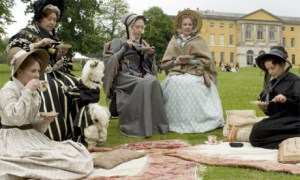
Everything about this adaptation is of the highest quality. The costuming, the sets, the screenplay, the art direction, the acting. As I told Ruth yesterday, I feel it’s the best new film the Masterpiece Classic Series has put on this spring—yes, better than the new Jane Austen adaptations.
Watch it when it comes on (the next three Sundays), and record it or go ahead and preorder the DVD, because this is one you’re going to want to watch over and over and over and over . . .
The Austen Connection
Just in case anyone doubted my Austen obsession, we’ll now get into the Austen Connections . . . or how the actors in this film are connected with film adaptations of Austen’s novels:
Simon Woods (Dr. Harrison)—played Bingley in Pride & Prejudice 2005.
Judi Dench (Mattie Jenkyns)—played Lady Catherine in P&P 2005.
Lisa Dillon (Mary Smith)—was in Hawking with Peter Firth (Henry Tilney, Northanger Abbey 1986); was in Bright Young Things with James McAvoy (Becoming Jane); was in Cambridge Spies with Tom Hollander (Mr. Collins, P&P 2005), Samuel West (Mr. Elliot, Persuasion 1995), and Rupert Penrey-Jones (Frederick Wentworth, Persuasion 2008).
Imelda Staunton (Miss Pole)—played Mrs. Palmer in Sense & Sensibility 1995.
Julia McKenzie (Mrs. Forrester)—was in Bright Young Things with James McAvoy (Becoming Jane); was in Adam Bede with Susannah Harker (Jane Bennet, P&P 1995) and Jean Marsh (Mrs. Ferrars, S&S 2008).
Alex Etel (Harry Gregson)—was in The Water Horse: Legend of the Deep with David Morrissey (Col. Brandon, S&S 2008).
Kimberly Nixon (Sophy Hutton)—is in the upcoming (2009) film Easy Virtue with Colin Firth (the third best Mr. Darcy, P&P 1995).
Deborah Findlay (Miss Tomkinson)—was in Wives & Daughters with Tom Hollander (Mr. Collins, P&P 2005) and Rosamund Pike (Jane Bennet, P&P 2005).
Barbara Flynn (Mrs. Jamieson)—was in Miss Potter with Ewan McGregor (Frank Churchill, Emma [GP version] 1996) and Phyllida Law (Mrs. Austen, Miss Austen Regrets, and Mrs. Bates, Emma [GP version] 1996); was in Hornblower: Duty with Greg Wise (Willoughby, S&S 1995) and Julia Sawalha (Lydia, P&P 1995) in which she played Julia’s mother.
Philip Glenister (Mr. Carter)—was in Hornblower: Mutiny and Hornblower: Retribution with David Rintoul (the best Mr. Darcy, P&P 1981).
Julia Sawalha (Jessie Brown)—played Lydia Bennet in P&P 1995. (Was also in a couple of Hornblower movies along with Barbara Flynn, who played her mother, and Greg Wise—S&S 1995—though not the same episodes as Philip Glenister/David Rintoul—hmmm . . . maybe I should do all of these with connections to Hornblower one of these days . . .)
Jim Carter (Captain Brown)—was in Bright Young Things with James McAvoy (Becoming Jane); was in Hornblower: Duty with Greg Wise (Willoughby, S&S 1995) and Julia Sawalha (Lydia, P&P 1995—see, I told you I could do this with the Hornblower films too). He’s also married to Imelda Staunton (yes, who’s in this film and who was also in S&S 1995).
Claudie Blakley (Martha)—played Charlotte Lucas in P&P 2005.
Francesca Annis (Lady Ludlow)—was in Wives & Daughters with Tom Hollander (Mr. Collins, P&P 2005) and Rosamund Pike (Jane Bennet, P&P 2005).
Greg Wise (Sir Charles)—played Willoughby in S&S 1995.
Alistair Petrie (Major Gordon)—played Robert Martin in Emma (KB version) 1996. He’s married to Lucy Scott (Charlotte Lucas, P&P 1995).
Michael Gambon (Mr. Holbrook)—aside from his connections to all of the JA-adaptation actors in the Harry Potter movies (another version of “degrees of separation,” anyone?), was in Wives & Daughters with Tom Hollander (Mr. Collins, P&P 2005) and Rosamund Pike (Jane Bennet, P&P 2005).
Whew! And those were just the ones I could come up with that were one or two degrees of separation!
Links of Interest
The Writings of Elizabeth Gaskell on Google Books
Wikipedia Article on Elizabeth Gaskell
The Gaskell Web
Elizabeth Gaskell Page on VictorianWeb
The Gaskell Society
Cranford Chronicles (a blog dedicated to the film)
Reviews of the Film:
Variety
Why We All Want to LIve in Cranford (Daily Mail)
Where Gossip Is a National Treasure (Times Online)
Splendid but Sudsy (The Guardian)
“Very Excitable Virgins” Dominate Town (CNN.com)
Jane Austen Today’s Review
Cranford Brings Memories for Judi Dench (Los Angeles Times)
Be sure to come back and leave your thoughts about the first section of Cranford that airs this Sunday evening!
Writing the Romance Novel: Beats 3, 4 & 5
Since there haven’t been a lot of responses, I’m hoping that y’all are out there just taking it all in and anxiously awaiting the next post. So let’s look at the next three beats:
3. The Turning Point
- Traditionally occurring at the end of Act 1, a new development that raises story stakes and clearly defines the protagonist’s goal; most successful when it sets man and woman at cross-purposes and/or their inner emotions at odds with the goal. (112)
In the last post, I asked if the inciting incident in The Wedding Planner was when Mary and Steve meet or when Mary learns Steve is the groom in the big-ticket wedding she’s just signed on as the planner for. As Eileen commented, the inciting incident (step 2) is when they meet. The turning point (this step) is when Mary discovers Steve is the groom. Why? Because it completely changes their relationship—from growing attraction to conflict because they can’t be together because she’s planning his wedding to someone else. In You’ve Got Mail, the inciting incident (the meet) occurs when Joe takes his “aunt” and little brother into Kathleen’s bookstore and they like each other. The turning point is when Kathleen and Joe meet again face to face as adversaries, because Kathleen knows he’s the owner of the super-bookstore that’s putting her shop out of business. Even though they’ve known each other online for awhile before the story starts, it isn’t until they meet face to face that we get our inciting incident and first turning point.
The turning point is the main conflict between your hero and heroine that will contrive to keep them apart for most of the story, even as they’re falling in love with each other. It’s usually the setup for the plot—a wedding planner tasked with planning a wedding for a man she’s falling in love with (whether he’s the real groom, as in The Wedding Planner, or he’s just pretending to be the groom, as in Stand-In Groom); a woman whose former flame returns and is resentful toward her for turning down his proposal years before—she must watch while he flirts with and seems to build a new relationship with someone she’s close to (Persuasion); the woman who’s falling in love, unbeknownst to her, with the man putting her out of business (You’ve Got Mail); this is the shotgun wedding, the arrival of the mailorder bride, the wedding day when the arranged bride and groom meet for the first time, and so on. The turning point is the realization that this isn’t going to be a smooth path to romance—it’s the first (major) bump in the road.
Beat 3: You’ve Got Mail
Shortly after Kathleen and Joe meet for the first time at her store, still not knowing they’re “Shopgirl” and “NY152,” Kathleen and Joe run into each other at a publishing party. When Kathleen is introduced to Joe as Joe Fox, she realizes he’s part of the mega-chain bookstore that’s threatening to put her out of business. Even though she was initially attracted to him, she’s now furious at him because of what his company is doing to small, independent bookstores, like hers, and because he didn’t identify himself when she first met him. Now, instead of attraction, they’re set up as bitter rivals.
4. The Midpoint/Raising the Stakes
- A situation that irrevocably binds the protagonist with the antagonist (often while tweaking sexual tensions) and has further implications for the outcome of the relationship. (113)
This is taking the conflict you’ve just raised at the turning point and continuing to raise the stakes—throwing as many twists and turns and conflicts as you can at the characters to keep them apart as long as possible. In Jude Deveraux’s Velvet Promise, the turning point is just after Judith and Gavin’s arranged wedding, when Judith comes upon Gavin and his lover in the garden—the lover is threatening to kill herself if Gavin falls in love with his new wife. Because there had been an immediate attraction between Judith and Gavin, this is the first time Judith realizes she isn’t in for a happy marriage. The raising of the stakes is when Judith is captured by an enemy who believes he should have been given Judith as his wife. Even though Gavin rescues her, because he has been unfaithful to Judith, he believes the enemy’s story that Judith has been unfaithful to him as well and now bears the enemy’s child.
Beat 4: You’ve Got Mail
Though they’re now enemies in real life, Kathleen and Joe’s relationship continues to deepen and develop through their anonymous online communication. Adding to the conflict of the story, both Kathleen and Joe are involved in dead-end relationships the viewer knows are completely wrong for them.Online, “Shopgirl” and “NY152” decide to meet in person. Kathleen shows up with her rose and copy of Pride & Prejudice. Joe shows up, with his friend along for moral support, and realizes that “Shopgirl” is none other than Kathleen Kelly. He decides to go in and talk to her anyway, but doesn’t reveal who he is to her because he doesn’t want to lose what they have online—realizing he’s actually fallen in love with her, both through their online chats and in person. Kathleen is mean to him, and ends up regretting the nasty things she says to him, but she cannot bring herself to admit she’s starting to like the man who’s putting her out of business.
5. Swivel: Second Turning Point
- Traditionally occurring at the end of Act 2, stakes reach their highest point as the romantic relationship’s importance jeopardizes the protagonist’s chance to succeed at his/her stated goal—or vice versa—and his/her goal shifts. (115)
Let’s pause for a moment and consider the characters’ “goals” in a romance novel. In every work of fiction, each character must have a goal, motivation, and conflict for them to be believable to the reader. In Stand-In Groom, Anne’s goal is to plan the wedding she’s just been hired to plan to the best of her ability; George’s goal is to get through planning his employer’s wedding without anyone finding out he’s not the groom. When Anne and George begin falling for each other, both of their goals are jeopardized—if Anne falls in love with a client, her reputation as a wedding planner, and her business, would be ruined. As George falls in love with Anne, he risks revealing the truth to her, even though he’s signed a confidentiality addendum to his work contract; if he breaks the contract, he’ll have to return to England because he’ll lose his job, which means losing his work visa.
In Velvet Promise, the second turning point occurs when Judith and Gavin go to London to attend court. Through the contrivance of the king and queen, Gavin and Judith realize they’re in love with each other, and Judith is able to convince him the child is really his, that she didn’t have an affair with the enemy. But Gavin’s paramour isn’t giving up quite so easily. One night, after Gavin and his brother get rip-roaring drunk, Gavin falls into the nearest bed to sleep it off. The paramour climbs into the bed under his inert form and sends one of her servants to fetch Judith to help her husband back to their room. When Judith sees her husband in what she believes is an intimate position with his lover, she falls down the stairs and begins to miscarry the child, putting her life in jeopardy. Though Gavin is miserable at what happened and fears for Judith’s life, he will not abide anyone’s saying anything ill against his paramour. Judith, on the other hand, believes he’ll never change and blames him for the loss of the child, barely tolerating his presence. Because her goal was to have a happy home and a loving marriage, this second turning point has now jeopardized her chance at succeeding. And it seems like nothing will ever be able to bring them back together again.
Beat 5: You’ve Got Mail
Kathleen begins a public campaign against Fox Books—and Joe—organizing a boycott/picketing of Fox Books and doing TV interviews. When her boyfriend appears on a local talkshow and falls for the hostess, they break up amicably. After getting stuck on an elevator with his girlfriend and seeing her for who she really is (with Kathleen as a point of comparison), Joe breaks up with his girlfriend as well.
For Discussion:
From your own work, a published novel, or a romantic film, identify the Turning Point, the rising stakes in the Midpoint, and the Second Turning Point. Is there a way that you can make the conflicts even bigger/worse?
Continue on to Writing the Romance Novel: Beats 6 & 7
__________________________________________
Work Cited:
Mernit, Billy. Writing the Romantic Comedy. New York, NY: HarperCollins Publishers Inc., 2000.
* * * * * *
If you like what I do here and want to keep this content free,
consider supporting me and my work by buying me a coffee.
Writing the Romance Novel: Beats 1 & 2
Yesterday, I gave you the seven basic beats of the romance storyline, as defined by Billy Mernit in Writing the Romantic Comedy. Let’s look at the first two beats and see if we can start clearing up exactly what they mean as far as writing and structuring a romance novel.
1. The Setup/Hook
- A scene or sequence identifying the exterior and/or interior conflict (i.e., unfulfilled desire), the “what’s wrong with this picture” implied in the protagonist’s (and/or antagonist’s) current status quo. (Mernit, 110)
Because Mernit wrote his book for screenwriters, the first couple of steps may come across as slightly different than what we, as novelists, are used to seeing, but really, they’re the same. This is your introductory scene—the opening hook and introduction of your hero or heroine (whichever has the first POV scene). As with all opening scenes, this is the establishment of that character’s story goal, as well as hinting at the main conflict for the entire novel.
With your heroine—whether in third person or first person—there is something to keep in mind: a romance heroine wants to fall in love, even if she thinks she doesn’t. There has to be some part of her that is going to be open, receptive, to falling in love. It’s much easier to accept a hero who’s not at all interested in romantic entanglements or the emotional side of falling in love. But because we want to be able to put ourselves in the heroine’s place, there has to be some indication that she’s emotionally available and ready to fall in love. A romance heroine who has so much internal conflict and turmoil going on, combined with so much external conflict that she can hardly breathe or think would probably be a better main character of a chick lit or women’s fiction novel—the story would be more about her getting her life together than about her falling in love. There can still be a romantic interest in a story like that, even a happy ending, but it’s not necessarily a true romance novel if it’s more about her internal life and less about the relationship.
Beat 1: You’ve Got Mail
Kathleen Kelly (Meg Ryan) is the owner of a charming, independent children’s bookstore, The Shop Around the Corner. Using the screen name “Shopgirl,” Kathleen communicates with “NY152.” This is the screen name of Joe Fox (Tom Hanks). Joe belongs to the Fox family which runs Fox Books — a chain of “mega” bookstores similar to Borders or Barnes & Noble. The movie begins with Kathleen logging on to her AOL account to read an email from “NY152” (Joe). In her reading of the e-mail, she reveals the boundaries of the online relationship; no specifics, including no names, career or class information, or family connections. The two then pass each other on their respective ways to work, where it is revealed that they frequent the same neighborhoods in upper west Manhattan. Joe arrives at work, overseeing the opening of a new Fox Books in New York with the help of his friend, branch manager Kevin (Dave Chappelle). Meanwhile, Kathleen and her three store assistants, George (Steve Zahn), Birdie (Jean Stapleton), and Christina (Heather Burns) open up shop for the day.
(from Wikipedia)
2. The Meet/Inciting Incident
- The inciting incident brings man and woman together and into conflict; an inventive but credible contrivance, often amusing, which in some way sets the tone for the action to come. (111)
The inciting incident for a romance novel is when the hero and heroine meet. It doesn’t matter what other conflicts are going on in the story or with the characters. Since a romance novel is about the developing relationship between hero and heroine, it is the meet which sets the rest of the action of the story in motion. In a category-length romance (HeartSong, Love Inspired, Harlequin, Silhouettes, etc.), this is expected to happen in the first chapter. In trade/mass-market romances, this might not happen until the second chapter—so long as the hero and heroine are both introduced and it is shown as being inevitable they’ll meet by the end of the second chapter. In Ransome’s Honor, even though William and Julia have known each other for almost twenty years and thought about and spoke about each other throughout the beginning of the novel, in my initial draft which got sent to publishers, they didn’t actually come face to face until the end of the third chapter. The feedback I got was that was too late—even in a novel of over 100k words. So I had to rework the opening of the novel, not only adding a prologue that shows them together, but also revising/rewriting the first chapters so that they come face to face in Chapter 2.
Beat 2: You’ve Got Mail
On a day out with his young aunt and brother (children of his recently divorced grandfather and father), Joe takes them into The Shop Around the Corner for storytime. There’s obviously an instant attraction between Joe and Kathleen, and Kathleen even expresses her concern to Joe about the Fox Books store opening nearby. Startled, Joe doesn’t tell her his full name and makes a hasty exit with the children.
These two beats go hand-in-hand . . . the meet/inciting incident can be your opening hook. And in a romance, it is really the meet that is the hook—beyond your initial hook-sentence/paragraph at the beginning of the story. Romance readers want the hero and heroine to cross paths as soon as possible so that we can start to see the chemistry between them from the get-go. That’s the hook that keeps us reading.
When the hero and heroine meet, even if they initially seem to hate each other, you must show that there is some kind of attraction, something that will allow them to start seeing the good in each other—even if that side is only shown to the reader. Once again, I’ll reference the film You’ve Got Mail. If we didn’t see the softer sides of the two characters, we’d never believe there was any way they could ever fall in love with each other. They’re so hateful toward each other through the first half to two-thirds of the film, when they’re face to face, that we’d never buy it as a romance if we didn’t see their pain, their internal conflicts. That’s what makes us root for them to work it out in the end—because we know they’re meant to be together, even when they don’t.
For Discussion:
From a favorite movie or romance novel, what’s the opening hook that introduces the character(s) to the reader/viewer? Is the meet between h/hn the opening hook? If not, when does the inciting incident occur? In the movie The Wedding Planner, would you consider the inciting incident when Steve saves Mary from the run-away garbage bin or when Mary learns Steve is the groom of the wedding she’s been working so hard to land? Is it possible for the meet and the inciting incident to be separate?
Up next: Writing the Romance Novel — Beats 3, 4 & 5
__________________________________________
Work Cited:
Mernit, Billy. Writing the Romantic Comedy. New York, NY: HarperCollins Publishers Inc., 2000.
* * * * * *
If you like what I do here and want to keep this content free,
consider supporting me and my work by buying me a coffee.
Writing the Romance Novel: The Seven Story Beats
In Writing the Romantic Comedy, Billy Mernit breaks the romance storyline into “seven basic” pieces, or “beats.” Most of us have heard that we should structure novels like plays or movies: in three acts. In a romance, the three acts can be broken down by the plot points we’ve already looked at: the meet, the lose, and the get. But Mernit breaks it down even further into these seven elements that are important to every romance:
1. The Setup/Hook
- A scene or sequence identifying the exterior and/or interior conflict (i.e., unfulfilled desire), the “what’s wrong with this picture” implied in the protagonist’s (and/or antagonist’s) current status quo (Mernit, 110).
2. The Meet/Inciting Incident
- The inciting incident brings man and woman together and into conflict; an inventive but credible contrivance, often amusing, which in some way sets the tone for the action to come (111).
3. The Turning Point
- Traditionally occurring at the end of Act 1, a new development that raises story stakes and clearly defines the protagonist’s goal; most successful when it sets man and woman at cross-purposes and/or their inner emotions at odds with the goal (112).
4. The Midpoint/Raising the Stakes
- A situation that irrevocably binds the protagonist with the antagonist (often while tweaking sexual tensions) and has further implications for the outcome of the relationship (113).
5. Swivel: Second Turning Point
- Traditionally occurring at the end of Act 2, stakes reach their highest point as the romantic relationship’s importance jeopardizes the protagonist’s chance to succeed at his/her state goal—or vice versa—and his/her goal shifts. (115)
6. The Dark Moment/Crisis
- Wherein the consequences of the swivel decision yield disaster; generally, the humaliating scene where private motivations are revealed, and either the relationship and/or the protagonist’s goal is seemingly lost forever (115).
7. Joyful Defeat/Resolution
- A reconciliation that reaffirms the primal importance of the relationship; usually a happy ending that implies marriage or a serious commitment, often at the cost of some personal sacrifice to the protagonist (116).
Okay, now I know this is a short post, and that beyond giving the definitions straight from the book, I haven’t really explained what any of them are. So for more in-depth information on each of these points, be sure to check out the follow-up posts:
Writing the Romance Novel: Beats 1 & 2
Writing the Romance Novel: Beats 3, 4 & 5
Writing the Romance Novel: Beats 6 & 7
__________________________________________
Work Cited:
Mernit, Billy. Writing the Romantic Comedy. New York, NY: HarperCollins Publishers Inc., 2000.
* * * * * *
If you like what I do here and want to keep this content free,
consider supporting me and my work by buying me a coffee.

 KayeDacus.com