Ministering to Singles: So Where Are They?
 All this talk about how we can minister to singles (as well as anyone else who feels disenfranchised by the church(es) they’ve attended) presupposes the idea that these people are actually going to church. However, this is increasingly not the case.
And I’m a perfect example.
Even though I’m a member of a church—in that my name is on record as being a member at a certain church here in Nashville—I haven’t attended regularly in about two years. In fact, since I left the first church of which I was a member in Nashville (the one I went to and served at for seven years which I talked about yesterday), which I left in 2003, I’ve become one of those Singles who just can’t seem to settle down and stay long-term at a church. I’ve moved my membership to two other churches since then (as well as a stint of about six months back at the original church in between) and visited a few other churches for a month or two at a time before joining the church I now no longer attend.
Why?
Part of it has been me growing up and figuring out who I am as a person—and figuring out that I really don’t belong in churches that tend to be more conservative. The irony is, I love a traditional worship service (i.e., hymns instead of choruses, a choir in robes accompanied by a piano and pipe organ instead of a “praise band,” etc.)—but I don’t like churches that are so stuck in the “this is how we’ve always done it” mentality that they become more of an exclusive country club than a church at which the doors are always open to anyone who wants to come in. But because I grew up in a Southern Baptist family (from way back—my great-grandfather was a pastor and then worked for the Convention in various capacities), I’ve always felt like I should attend a Baptist church—mostly because it’s what I’m most familiar with. I know the tenets of the doctrine (or at least I knew them before the SBC started changing them). I know the structure of the church governance. I know how things work, structurally, educationally, and ceremonially when it comes to Sunday school and worship services. I know the lingo. I know all of the hymns (and can sing the alto line without even looking at the hymnal). But the truth of the matter is that I really don’t fit in to most Baptist churches anymore.
So what’s a single girl who likes a traditional worship service and wants a church that’s a little less conservative to do? Well, I’ve started to attend an Episcopalian church. And I love the sense of awe and reverence that I experience when I’m there. But every week, it’s a struggle to convince myself to get out of bed to get dressed and drive into downtown (which is a pain during football season when the Titans have home games) to go to a church where I don’t know the lingo. Where I don’t know the hymns. Where I’m not familiar with the rhythm of the liturgical worship service. Where I’m not familiar with the names and structures of their Bible study classes to even know how to try to get involved. I find myself sitting in one of the side-facing wings of the cathedral just observing everything happening, but not really feeling like I’m a part of it (until that magnificent pipe organ begins to play and the choir begins to sing—then I just close my eyes and am transported!). But I’m trying. I’m going more often than I’m staying home. Because there’s one thing that I absolutely refuse to do: quit church. (Update December 2009: I’ve been attending a United Methodist Church for about six weeks now and loving it. I will probably be joining sometime in the spring when my schedule calms down a little bit.)
Let’s look at some statistics:
In 1971, around 41–43% of Americans said they attended church regularly, according to most polls. In 2002, a poll by the National Opinion Research Center at the University of Chicago showed that number had dropped to 31%. However, two studies in 2005 (Hadaway/Marler and Olson) showed that the number has actually dropped to between 18–20%. And though some churches/denominations still show growth numbers, it is primarily through attrition—those churches are gaining members who are coming to them from other churches. According to the American Religious Identification Survey of 2008, the number of people answering the question “What is your religion, if any?” with the response “Christian” declined 10.2%.
Those are overall numbers—for everyone, married or unmarried.
Here’s the 2008 breakdown of numbers on single/unmarried adults (Source: America’s Families and Living Arrangements: 2008):
95.9 million – Number of unmarried Americans 18 and older (42.7 percent of all U.S. residents 18 and older)
53.5% – Percentage of unmarried Americans 18 and older who were women
32.2 million – Number of people who live alone. They comprised 28 percent of all households, up from 17 percent in 1970.
According to a demographic study done by Brad Wilcox of the University of Virginia in 2005, only 23 percent of unmarried women attend church regularly; and only 15 percent of unmarried men do. That compares with 39 percent of married women and 32 percent of married men (married men are more likely to attend if they have children, also) (Source: Quitting Church by Julia Duin).
Yesterday, in the comments, we started hitting upon some the reasons why some people have either stopped going to church or why it’s a chore to go (because we don’t feel like we fit in, because we don’t feel like we’re being ministered to). According to a survey conducted by a Seventh Day Adventist group on why people quit church:
54.40% Turned off by the attitudes/behaviors of members of the group
40.95% No longer believed in the doctrines/teachings of the group
36.06% The credibility of the ledership discouraged me
33.17% Other
27.89% It didn’t meet my needs
19.10% No longer believed in God
18.09% Something happend and I no longer felt comfortable
17.34% I was specifically hurt/offended by a person within the group
16.96% Got busy and gradually quit going
7.91% I relocated and lost connections
2.51% Moved to a community where my religious group did not meet
That first stat should convict every church-going person out there. With as much as we’d like to say that the reason church attendance has declined is because people are so much busier now than thirty or forty years ago, the truth of the matter is that it’s the way that people are treated (or ignored) either by others in a congregation or by “the church” (i.e., the organized entity, the ministers, the leadership) that pushes most of them away.
Another factor: corporate churches can’t get everyone plugged in, and lots of people who’ve been Christians for most of their lives are falling away because they’re not getting anything other than “spiritual milk” from their church attendance. They’re not hearing anything new, they’re not being challenged. In the modern evangelical church, we’re not encouraged to raise questions or doubts, to express opinions that don’t match up with the religious, social, or political views of that particular Sunday school class, congregation, or denomination—even when those views are not theological or faith-based. People struggling with issues in their marriage, such as a partner’s infidelity or an addiction or just an incompatibility, can’t openly talk about those problems in their Sunday school class. Singles struggling with loneliness or longing for marriage/companionship or questions about sexual conduct cannot openly discuss those matters in Bible study. Why? Because those kinds of issues are uncomfortable and make us have to confront the fact that we all have problems, we all have doubts, we all struggle with what it really means to be Christ-followers. It’s easier to use the right lingo, to give the trite “Sunday School Answer,” to keep everything light and fluffy because we have a schedule to maintain here. And, after all, church is supposed to be the place where we go to get “recharged” for the week, to feel good about ourselves again, to put the cares of the world aside. And we can’t do that when we start getting bogged down with questions, doubts, and fears.
One of my best Bible study experiences was shortly before I left the seven-year church. In an effort to try to get me involved again, the pastor asked me if I would teach the newly formed college class. Since all of the kids on the roll were kids I’d taught when they were in the youth group (many of them the ones I’d started out with when they were in 7th and 8th grade), I agreed to do it for one semester and summer—but was already visiting other churches. The class met after church on Sunday afternoon, at the home of the parents of one of the students (also good friends of mine). They fed us lunch, and then we adjourned to the living room for our Sunday school class. It usually lasted at least two hours. With legs draped across arms of chairs, some people sprawled on the floor, shoes kicked off, and all formality done away with, we got into some of the deepest spiritual and theological discussions I’ve ever had with anyone—and these were eighteen- to twenty-year-olds! But we had two things going for us: they knew me well enough to know that when I asked a question, I expected discussion; and they learned that our discussions were no-holds-barred, anything goes.
Maybe it’s time for more of those kinds of “churches”—the kind where it’s okay to be different, to not have to fit into the mold of marital status or race or political affiliation just to feel like a “member in good standing” in the church. But until we can get back to that kind of openness and welcoming attitude in the organized church, unfortunately, membership and attendance numbers will continue to fall.
Ministering to Singles: No Longer “All in the Family”
 At the church I attended when I was at LSU, the college-aged class was included under the Singles Ministry umbrella. We were the Singles I class. What’s now usually called “Young Professionals” was the Singles II class. I think that class went up to about age 30 or so. Even though I was the outreach person for the college class (because no one else in a class that usually had between 50 and 60 people on Sunday mornings would do it), I socialized more with people from the Singles II class—those who were just a few years post-college. Maybe this was why, when I dropped out at age twenty-one, I jumped straight into singles ministry and never looked back. By the time I was twenty-two, I was already the regular substitute teacher for the singles class at the small church I attended in Vienna, Virginia. A couple of years later, attending a different church, I had taken on the same role.
When I moved to Nashville, after having gone to two small churches in Northern Virginia—but both of which had singles groups—my main goal for finding a church was to find one with an active, vibrant, large singles ministry because, I was certain, God had sent me to Nashville to meet my husband—and where else was I going to do it but at a church where there were lots of single guys? That was more than thirteen years ago. In the first six months I lived here, I visited all of the Baptist churches with singles ministries. And a lot of churches have very large, very active, very vibrant groups. But with most of them, I walked in and immediately felt like I was in high school again—the only girl who wasn’t a size 2/4 with perfect hair, expensive clothes, the right accessories, and looks that turned men’s heads. Yes, I’d run into a problem intrinsic in the gathering together of unmarried people: the “meet market.”
Eventually, I ended up joining exactly the kind of church I’d sworn I wasn’t going to join: a mid-size church where the only “singles” class is the one filled with people aged 40+ who are all single-again and mostly single parents (I was 25 when I joined this church). It was taught by a couple in their 40s who’d gotten married the day after their high school graduation. I had absolutely nothing in common with any of them. But I knew that was the church where I was supposed to be. So after I’d been there a few months, I volunteered to start teaching youth Sunday school (7th & 8th grade). Within two years, I was the Youth Sunday School Director (and, because the paid minister wasn’t doing his job, the defacto Youth Director) and teaching the entire youth department on Sunday mornings because I couldn’t get anyone else in the church to help out. With forty or fifty teenagers gathered in one room with only one adult/authority figure—and a youth group hurting from the lack of attention from their youth director—they were very hard to control. I usually ended up barely being able to sing during service after yelling at/over them for the hour. (And many of their parents were in the classrooms surrounding us. I know they could hear what was going on.)
Over the few years that I taught in the youth department, something interesting started happening . . . twenty- and thirtysomething singles started attending the church. When I finally had enough and went to the pastor to tell him I needed to resign from teaching the Youth, he asked me if I would consider taking on co-leadership of the Singles department. The man who was leading it wasn’t comfortable teaching, but loved doing outreach and ministry. I prayed about it and felt like God was leading me to say yes. So I did. The ministry grew to the point where the only place we could meet that was big enough was in the main foyer behind the sanctuary (we always ended on time!). The group grew from about eight to ten regular attendees to about twenty-five to thirty (and that’s in a church that averaged about 350 in worship service). I headed up an activities committee to plan all kinds of social activities. I started a women’s Bible study group (yes, I was teaching that, too). We were so active and growing that we managed to get a line-item added to the church’s budget for Singles Ministry. We even did a weekend-long retreat. Things were going great!
And then my co-leader got engaged and started going to his fiancée’s church. A dating couple in the group broke up. She and her roommate started going to another church; he stopped coming. Someone else’s job transferred him to Kentucky. The Singles Ministry budget was taken away (and used for re-doing the youth room downstairs). When the standardized Sunday school literature had a four-week lesson on marriage and I asked the Sunday school director if I could teach from a wonderful book I’d just read about living a fulfilled life as a single, he said no, that I had to teach what was in the SS literature—and besides, we probably all needed lessons on marriage so we’d stop screwing around and grow up. (Yes, he said that. To ME. If only he’d known…) I taught the lessons on singleness anyway. And then I promptly resigned. At that point, the group, which had once regularly numbered around thirty on Sunday mornings (and forty or fifty at social events, with those who worked in the nursery or taught other classes or just didn’t come to Sunday school) was back down to about four or five die-hards. I didn’t resign from my position on the Nominating Committee until a month later when the chair of the committee (the self-same Sunday school director) said, upon discussion of potential teachers for the Singles group, that we needed to find a married couple to teach the class so they could be a “good example for those kids and encourage them to grow up and become upstanding, contributing members of the church.”
For those of you who’ve read the last several posts I’ve written about singleness as well as the comments made afterward who may think that my tone has been defensive, this is why. These things were said to me seven or eight years ago—when I was just starting to come to terms with the fact that I was now thirty years old and still not married. When I was busting my butt teaching (SS and Bible study) and leading the Singles group, singing in the choir (serving as a section leader and a choir officer), serving on three committees (youth council, nominating committee, committee on committees), starting and singing in a women’s ensemble as well as a southern gospel quartet, attending Sunday morning and evening and Wednesday evening, volunteering as a “sponsor” for youth trips, and so on. And to have a person in a position (several positions, actually) of leadership intimate that I was not an “upstanding, contributing” member of the church—simply because I was not married—was one of the most hurtful things anyone has ever said to or about me. I and many of the other singles in that church were more actively involved and provided more service to the church and its members than the majority of those “upstanding, contributing” married members did.
I had been a member of that church for almost seven years. And after that happened, I stopped going. I just stopped showing up on Sunday mornings. And Sunday evenings. And Wednesday evenings. And you know what happened? NOTHING. For seven years, I was at that church practically every time the doors were open. I poured my heart into that church. And after not showing up for three or four weeks in a row, it was like I’d never been there. No one cared I wasn’t there anymore. No one called. No one sent cards or e-mails. No one even bothered to find out that I was okay physically—you know, that I hadn’t been maimed or killed in a car accident.
In one of my final attempts to “reconcile” with this church, I made an appointment to meet with the pastor—someone I had considered a friend, up to that point. I explained to him how devastating it was that no one had reached out to me during a time when I was hurting both emotionally and spiritually. I asked him what would happen if one of the senior adult ladies, who only attends on Sunday mornings, were to all of a sudden not show up one week. We both knew the answer: Someone would have been on the phone that afternoon to make sure everything was okay. But even though, in this medium-sized congregation, pretty much everyone knew I lived alone and didn’t have any family in the area, when I didn’t show up for a month, they just wrote it off to my being a “church-hopping single.” (After SEVEN years of active membership/service in that church!)
The modern evangelical church in America prides itself on being “family-focused.” However, the message of being “family-focused” has created such a sense of selfishness in the local congregation that it’s led to a mass exodus of unmarried people from the body. Because the focus isn’t on the Family of Faith—that we’re all part of the same family and need to look out for one another. The focus has become: “It’s all about MY family, and as long as OUR needs are being met, we have no other responsibility to anyone else in the church.”
And this is where the apathetic attitude toward singles ministry comes from. Because singles in a congregation aren’t usually connected with any family unit there, most families in the church don’t even notice them. Sure they might know about them, but it’s more in the way you know the church foyer has a tile (or carpeted) floor. It’s just there, but not anything you pay attention to.
Ever since the Christian church came into being, unmarried people have contributed at least as much if not more to the running and leadership of our local congregations as married people have. We do it because we’re called to and have a heart for it; but we also do it because we’re trying to feel like a part of something bigger than ourselves—we’re trying to build a family of faith so that we don’t have to go through life alone, with no one there to lift us up when we’re down, no one to care about what happens to us.
We’re not looking for the church to “take care of us.” We’re just looking for a family who will love and support us. And yes, there are going to be those unmarried people who hop from church to church to church, looking for Mr./Ms. Right (or Right Now). But that’s not the majority of us.
Next Sunday, look around your congregation. Does it reflect the fact that nearly 50% of Americans are single/unmarried? What can you do—no matter your own marital status—to make your church a place where everyone is cared about and supported and made to feel like part of the family?
Ministering to Singles: Just Listen
Around the end of 2001, beginning of 2002, I started having problems with my lower back. It got bad enough that I went to the doctor. He came into the room, asked me to describe the pain (shooting/stabbing pain across the left-side of my lower back and radiating through my left hip), and proceeded to tell me that I would always have back pain until I lost weight. He sent me home with some sample packs of arthritis medication and a photocopied sheet of stretching exercises I could do at home (I’d been going to the gym at work and walking at lunchtime with a coworker for months before this).
In May 2002, I got home from work on a Monday evening and my back was really hurting. So I pulled out the sheet of stretches and did the first one: lay on my back on the floor with my feet up on my desk chair (knees at a 90-degree angle). When I went to get up from this position a few minutes later, the pain was so excruciating, I couldn’t move. I was going to call 9-1-1, but I had to get up to be able to get to the phone. Sobbing from agony the likes of which I’d never experienced, I finally made it up from the floor into the desk chair. Though the pain subsided somewhat, I knew something was definitely wrong this time. This wasn’t just “my back aches because I’m fat.” So I went back to the doctor the next day.
The doctor spent hardly any time with me, but did order an X-ray this time. I could barely walk to the other end of the hallway to Imaging, and then it was all I could do to keep from screaming from the pain of lying on my stomach and side so they could get the images. When the doctor came back to see me after looking at the X-rays, he said that it looked like the space between the L-4 and L-5 vertebrae was compressed—but that was to be expected in someone as overweight as I was. He wrote me a prescription for a pain killer I couldn’t take (it was in my chart!) and ended up sending me home with more sample packs of arthritis medication.
I missed a week of work that time.
Between then and Christmas 2002, the pain never went fully away, and shortly before Thanksgiving it happened again—the agonizing, debilitating pain that kept me from being able to function enough to do anything. I went back to the doctor. He sighed (he may have even rolled his eyes) and said, “Well, I’ve said it before: you’re going to have back pain until you lose weight. But if you really believe it’s more than that, I guess I could refer you to an orthopedic specialist.”
Instead of punching him in the face—because it would have required getting off the exam table—I took the referral and left. Made an appointment with the orthopedist and went.
The ortho’s office had requested the X-rays from my GP’s office and had them up on the light board when I arrived for my appointment. He took a complete history. He had me stand up and show him how much I could move without pain (not much). And he did something my GP had never done: He ordered an MRI.
On January 3, 2003, I had that MRI (and plotted out the story of what would become my third completed manuscript—but that’s another story).
A week later, I went in for my follow-up appointment. The ortho came in and said, “It’s no wonder you’ve been in so much pain—you have a ruptured disc at L-4 and a bulging disc at L-5. Let’s discuss treatment options.”
After months of physical therapy and a couple of cortisone shots (straight into the spine—not fun!), we finally were down to the last option. I had surgery on August 5, 2003. Within a week, I was feeling so much better that I finally understood exactly how much pain I’d really been in and how debilitating it was.
The reason I’m sharing this story is not as an analogy but as an object lesson. The GP I’d been seeing had a major problem that hindered his ability to be able to correctly diagnose me: He could not put aside his judgmentalism (or prejudice) long enough to look beyond what was, to him, my only health problem—my weight. He couldn’t step outside of his own preconceived ideas to listen to what I was saying to him: I was in excruciating pain. Was my weight a contributing factor? Probably. Was it the root of the problem? No.
My experience with the orthopedic specialist was great. Not only did he listen to me and make objective observations about me without making hasty judgments or assumptions, once it was established that I was, indeed, in pain, he didn’t just send me home with some pills and exercises and the disparaging advice to “just lose weight and it’ll get better”; he educated me on my options for treatment and was there with me through all of it—offering advice/direction when asked, but letting me guide my own treatment. Oh, and I lost about 40 pounds on my own during the eight months before surgery.
When a single person says, “I’m lonely,” and a married person responds, “Yeah, well I’m lonely, too—and I have a husband and kids to take care of, as well,” it would have been like me going to the doctor in excruciating pain and having him look at me and say, “Yeah? Well my back hurts, too, and I just had a root canal, as well.”
It takes an awful lot for me to show any kind of pain or vulnerability. Teased unmercifully as a child in school, I learned to hide my emotions/feelings and suck it up when I was hurting (at least in public—it made me somewhat volatile at home upon occasion). As a single person, for me to actually admit in public that I don’t always like being single, that I feel agonizing loneliness (though those times have diminished as I’ve grown older and more comfortable with myself), and that I do long to find that life partner someday, I’m really putting myself out on a limb.
But just like I didn’t need that doctor to sit there and tell me that if I’d just lose weight, my back wouldn’t hurt anymore, I don’t need someone to try to “comfort” me during those hard emotional times with spiritual platitudes (“Maybe God made you this way”), rebuttals (“I have it just as bad as/worse than you do”), or advice that comes from a place of misunderstanding, prejudice, or judgment (akin to the “just lose weight” advice my doctor gave me).
When I get to the point that I’m hurting enough to show my vulnerability, all I want is for someone to listen. Someone to pat my hand or hug me. Someone to be with me. Someone to say, “I love you. Let’s figure out together how we can try to make you feel better.”
Older singles don’t need to be told that we should be thankful or content or feel blessed, or whatever, to be single. We don’t want to be constantly told how marriage is a struggle. Just like every other person on the planet, what we want is to feel like we’re living an abundant life, a life filled with meaning and purpose. A life focused on the blessing of today, not the uncertainty of the future.
Whether you’re married or unmarried, the best response you can ever have when someone comes to you in emotional and/or spiritual pain is to just listen. That’s all we want when we say, “I’m lonely.” Ask, “How can I help?” Give advice only if the person asks for it. You may have to ask questions to get the person to really talk about what’s bothering them, but your job when someone comes to you is to just listen—listen to the person and listen to God.
Several years ago, a friend of mine who was really struggling with some problems started talking about them one night after a singles event at her house (and I was not just her friend, I was her Sunday school teacher). She was hurting, deep down, and questioning why God would allow bad things to happen to her. There were so many things on the tip of my tongue that I wanted to say: Bible verses to quote about how God can turn bad situations into blessings, advice about how to look at other people who’ve gone through worse situations and managed to come through them okay, comparisons to bad things that have happened in my life and how I dealt with them. But I kept my mouth shut. I let her say everything she needed to say. And when she finally finished and I knew it was my turn to speak, the only thing that came out of my mouth was, “I don’t know.” And at that point, I knew I had failed her. I didn’t give her any of that wonderful advice. I didn’t quote any Bible verses to her. I didn’t give her any examples to look toward for inspiration. I didn’t even tell her I would pray for her.
The following Monday, our pastor called me at work. “What did you say to her?” he asked me. I explained the whole situation to him, and was in tears by the time I finished, apologizing to him for failing her. “You didn’t fail her,” he said. “She just left my office and was like a totally different person. I had to find out what you said to her, because all she told me is that what you said to her Saturday night was the best thing a Christian has ever said and it really helped her figure things out in her head.”
My friend didn’t need my advice. She didn’t need Bible verses quoted to her. She didn’t need examples thrown at her. She’d heard all of those things before, from everyone else she’d ever opened up to. She just needed a friend who would listen—and who would be vulnerable enough in return to admit that I didn’t understand why things happened the way they did either. By ignoring the urge to recite all of the “good Christian answers” I’ve heard all my life and admit to the fact that, deep down, I really didn’t understand why these things were happening to my friend, she finally started to realize that she wasn’t the only person who didn’t have all the answers. That there were other Christians who struggled and questioned why God lets bad things happen to us and doubted and got angry at God. That she was normal.
Those of us who are unmarried—and especially those of us who live alone—just want someone to listen to us occasionally. Someone to laugh and/or cry with when we don’t understand why our lives have turned out the way they have. We just want to feel normal. To be reassured that it’s okay to feel lonely, to long for what we don’t have (marriage and/or children), to know that it’s okay to be angry at God for seeming like He’s withholding His blessings from us when we look around us and see everyone else who’s been “blessed” with what we want most, to know that we’re loved just as we are. To not be looked at with a sigh and a roll of the eyes and have our pain written off as “it’s just in your head” or “if you had enough faith, you wouldn’t hurt like that” or be told “until you do XYZ, you’ll always have that pain.” If you must say something, say, “I hurt for you. And I’d love to listen to what you have to say.”
Don’t look at the unmarried people around you as “singles.” Look at them as brothers and sisters—as people. Don’t focus on their marital status and any preconceived ideas you may have about what it means to not be married and the stereotypes of what unmarried life is like. Just extend love by making the time to listen to us. That’s really all any of us are looking for, when it all comes down to it.
Listen. Extend love. And then reap the blessings that will gush forth.
Fun Friday: Books We’d Love to See on Film

I debated back and forth on whether to do this topic or another “You Might Be a Writer If…” post—but after the, ahem, lively discussion on yesterday’s post, I just couldn’t get the juices flowing to come up with more than a couple. (But maybe next week . . .)
Instead, I decided to stick with the topic I’d thought of last week. Favorite books I’d love to see put on the big screen (okay, the TV screen would be okay, too). And then, of course, I’ll want you to share yours.
—————————————————————————————————
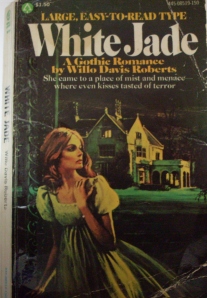 White Jade by Willo Davis Roberts.
Though this book, published by Doubleday in 1975, was intended for adult readers, it really is more of a YA book (and a very tame one by today’s secular fiction standards), with a heroine who’s barely twenty years old and the story written in her first-person point of view. It’s written in the Gothic style and incorporates many of the wonderful elements of traditional Gothics, but in a New World, Victorian-era setting. The teaser line on the front cover reads: “She came to a place of mist and menace where even kisses tasted of terror.” The back-cover blurb doesn’t do the story justice, so I’ve written a new one:
- Someone is trying to kill her for a fortune she didn’t know she possessed.
In 1885, following the death of her missionary parents, twenty-year-old Cecelia Jade Cummings has risked her life, and that of her crippled younger brother, to get from China to their only remaining relative—the grandfather she’s never met. But when she arrives in Eureka, California, she learns her grandfather is dying in a house filled with distant relatives who not only resent Cecelia’s presence but who may want her dead, too.
Cecelia doesn’t know whom she can trust: Cousin Lawrie, who wants nothing more than to be left to his music and art; Cousin Edward whose overtures and insinuations make her dread his company; or Cousin Shea, whose presence holds her spellbound with a mixture of fascination and fear. But when her grandfather takes a turn for the worst, Cecelia is forced to make a decision that seals her fate—and could spell her doom, especially when he reveals with his last breath he’s written a new will. Now, someone is trying to kill her . . . and all evidence points to the man she’s starting to love.
Can’t you just see this on Hallmark or Lifetime? I discovered this book when I was about sixteen years old because two of my favorite romance novels (YA, from the Sunfire series) were written by WDR: Victoria and Caroline. So I looked her up at the public library in Las Cruces and they had White Jade. And to this day, it remains one of my favorite books.
—————————————————————————————————
The O’Malley Series by Dee Henderson
Actually, I could see this as a TV series featuring all of these characters and their “heroic” jobs—Kate, the police hostage negotiator; Marcus, the U.S. Marshal, Lisa, the forensic pathologist; Jack, the firefighter; Rachel, the trauma psychologist; Stephen, the paramedic; and Jennifer, the pediatric doctor. And then there are all of their romantic partners including an FBI agent and an assistant to a state senator—who decides she might want to pursue a political career; along with the different murders and crimes they come together as a family to solve.
—————————————————————————————————
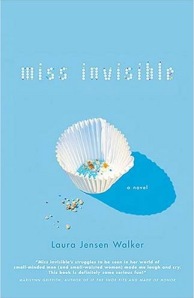 Miss Invisible by Laura Jensen Walker
Y’all know that I don’t read much chick lit. But the few chick-lits I’ve read by LJW usually start out with me thinking, Get out of my head, already! by the end of the first page. No more so than with this stand-alone romantic comedy.
- A feast of romance and laughter featuring a delightful and courageous heroine that you can relate to no matter what your size.
Convinced that her larger size relegates her to wallflower status, Freddie Heinz hides behind the wedding cakes she creates as a professional baker. But life is about to change for Miss Invisible.
First of all, Freddie’s found a new friend who encourages her to come out of her shell. Then Hal, the cute veternarian, starts showing interest in the woman behind the delightful cakes. And when Freddie decides to break every rule in the “big girl’s” book and find out who she really is, life gets even more exciting—and hilarious.
Cinderella, look out! Miss Invisible is becoming the belle of the ball—and having a ball in the process. Because when you finally find God’s call for your life, any size is the right size—and love can see what the rest of the world passes by.
Read my review of MI here.
—————————————————————————————————
Now it’s your turn. Go take a tour of your bookshelves and come back with some books you’d love to see made into movies.
Platform Delving: That’s Going in My Next Book!
I just spent the last two hours reading this blog post and the 291 comments left there. Let me summarize it for you so you don’t have to spend that much time:
People say really dumb things to folks who aren’t married.
Well-meaning? Usually. Intended to encourage? Usually. Condescending and hurtful? Almost always.
As I’ve already established, the genre that I write—romance—is populated with unmarried people. And in my books, my unmarried heroes and heroines are always surrounded with well-meaning, intending-to-encourage people at their churches as well as their workplaces and in their families. But so far, I haven’t really had many of those loved-ones offering the same kind of “encouragement” or “advice” that I’ve been hearing myself for years and years and years. Mostly because when I’m writing, I’m writing my fantasy world—a world in which married people (even parents and pastors) don’t say stupid things to single people.
What only child/eldest child who didn’t marry young (or who did marry but decided to wait to have children) hasn’t heard, “I want grandchildren someday,” from a parent? (Or if it isn’t said in so many words, the person knows that’s what Mom’s thinking every time one of her friends calls to gloat about their most recent grandchild.) I did actually use that one in Menu for Romance—mostly because it’s something I never had to deal with (my parents have four grandchildren and two step-grandsons already).
As part of my effort to delve into my platform and see where it takes me, I’ve spent several hours today sending out a questionnaire to a bunch of single/unmarried folks—though my writing groups as well as doing websearches and finding bloggers that I “cold-called” and got responses from. As I was reading through those 291 comments, some of the questionnaires started coming back, and I was amazed at how many of them were almost verbatim as to what was on that blog.
Here are a few:
“You just need to stop looking. As soon as you stop looking you’ll find him.”
versus
“You need to put yourself out there more. You need to search for opportunities to meet more single Christian men.”
“Don’t worry; God has someone special for you.”
versus
“Maybe there’s something in your life God wants you to work on.”
This happened to me at a book signing event. The Total Stranger’s kids were running around screaming, wreaking havoc in the store:
-
Total Stranger: “So, do you have children?”
Me: “No, I’m not married.” (But thinking: Absolutely not, even if I were married!)
Total Stranger: “Really? But you have such a pretty face. Some man out there’s going to be lucky to get you.”
Me: (Reminding myself that I’m representing my publisher and God at this event.) “I’m actually very happy that God has allowed me to remain single so that I’ve had time to write and to travel. It’s the dream job I always wanted, and I wouldn’t be able to do it if I were married.”
Total Stranger: (Looking at me with a mix of pity and disdain.) “That’s right. You just stay strong until God sends him to you.”
Then there’s this one from author Abidemi Sanusi:
- The day I signed the contract for my first book, I went to the church that night and screamed in delight to a friend, “I’ve got the most awesome news!”
“You’re married?” Big grin, arms reaching out to hug me.
“No. I’ve got my first book contract.”
Her smile freezes, to be replaced by deep disappointment. “Is that all?”
Thich Truong , a young man who is currently in seminary pursuing an M.Div., had this to share:
- I have two younger siblings that have both married before me and it is the worst when “well-meaning” family and friends ask me why I haven’t married yet. What’s worse, I’ve actually had a member of the church tell me I need to go out and just find a girl and settle for her and get married.
B.K. Jackson shared this little gem:
- “You just wait. One day some man is going to walk into the room and you won’t know what hit you.”
[To which I immediately had the mental response: He can try, but I know self-defense.]
Sarah Salter, who works in the ministry full-time, related this:
- Before I bought my house, I lived with a widow. She was only 60 and so her own kids (all married with kids) are my age. She reminded me several times that my biological clock is ticking. And that I’m getting older. And that if I lost weight or did my hair differently, I might catch more interest. She made me feel pressured to be married, but unworthy of love.
Several people had similar experiences with these zingers:
“Maybe God has called you to a ‘season of singleness’ for a reason.”
“Maybe God just isn’t finished working on your husband/wife.” (Um, it only took Him SEVEN DAYS to create the whole universe.)
“God has blessed you with singleness so you have time to serve Him.” (Usually right before they dump a bunch of work on you that no one else at the church wants to do.)
And one of the things we dread the most about the holidays/family gatherings:
“So, are you seeing anyone yet?”
 As I’ve done the research on this topic and read through posts like the one I linked to in the first line, I’ve started keeping a list of things that made me think: Ooh—I MUST use that in a book someday. And then it brought me right back around to what I’ve been writing about for the past couple of days. Writing books with characters that not only I can identify with, but characters who’re real enough that anyone can identify with them, because there’s enough truth in the fiction that either a single-adult reading it will recognize the things happening to the characters and married adults might recognize some of the things they’ve said and through the character’s honest and emotional reaction to it realize that, while well intentioned, many of these statements are usually more hurtful than helpful.
What are some “stupid things” you’ve heard people say that, while you know they were said with the best intentions, didn’t quite come out that way—which made you think, I’m going to use that in a story someday? (And this can be to anyone/any social group, not just singles.)
Platform Delving: Writing What I KNOW
A couple of years ago, I was talking with one of my fellow romance writers who also happens to be unmarried, and she reported a conversation she had about books with a few other people in the book club at her church. (Two things they didn’t know about her: that she writes romances and that she isn’t married.) Apparently one mentioned that she does not read romance novels if they are written by someone who isn’t married, as single people can’t possibly know what they’re talking about when it comes to romance. Another person apparently voiced approval of this statement, adding that unmarried women who write romance are just showing their desperation to be married so much so that they have to make up stories about it—oh, and they’re ugly, too, which is why they aren’t married in the first place.
It’s a good thing that I was not nearby when this conversation took place, because I probably would have lost my religion—all over them. As I’ve already stated, I’m passionate about those who are single, especially women over a “certain age.” And part of my passion is focused trying to break through the long-standing prejudice against singles in the Christian community, especially within the church congregation—but that’s not the point of this entry.
“Write what you know” is one of the most misunderstood instructions given about writing. Most people take it at face value, interpreting it as, “Write about only what you have personally done or experienced in the confines of your own life.” If fiction writers were to interpret it this way, we would eliminate entire genres: science fiction, fantasy, horror, historical, and 99% of mystery/crime/suspense/thriller. There would be no Mr. Spock and Captain Kirk, no Luke Skywalker, no hobbits and Middle Earth, no Jack Aubrey and Stephen Maturin, no Scarlett O’Hara, no Sherlock Holmes, no James Bond or Jason Bourne, no Superman or Batman, and no one would have ever heard the names Stephanie Myers, J.K. Rowling, or Stephen King.
If we wrote only about what we have personally experienced, what a boring world this would be. But God gave us imaginations with which, as the character of Chaucer (Paul Bettany) said in A Knight’s Tale, we “give the truth scope!”
Lest anyone should argue that this is unbiblical, let me give the ultimate example. In His life on earth, Jesus grew up in a small town and learned the trade of a carpenter from His stepfather, Joseph. Yet He crafted stories of farmers, of masters, of vineyard owners, of slaves, of widows, of husbands and wives, of profligate young men who ran away from home—of people whose lives and experiences were vastly different from His own.
I have chosen romance as my genre. I love the process of crafting my characters and taking them through the intricate dance that is the progression of their relationship. And, on that day so long ago, as we discussed whether or not singles are fit to write romance novels, a very important thought struck me:
Romance novels are about SINGLE people! Yep, you read that correctly. Think about it. With the exception of two small subgenres (romance in marriage and stories featuring extramarital affairs), romance novels feature as their main characters two UNmarried people facing and dealing with everything that comes along with being SINGLE. And for me, being unmarried and having lived by myself for more than thirteen years, I find it very easy when I read romance novels to determine if the author was married at a very young age or if she experienced some of what it is to be a single adult out on her own in this world. Those who married later—in their late twenties or after—have a much more authentic voice when creating their characters’ SINGLENESS than those who married straight out of high school or college.
Those who married later as well as those who are still unmarried know the loneliness that can creep unawares from our subconscious to our conscious mind and hit us like a Mack truck—even when we’re at the top of our game or feeling the most confident we ever have. They know what it’s like to be the “sole supporter” of our household—having to provide for all of our own needs with no relief of someone else to share the burden (unless there’s a roommate in the situation, but that brings its own inherent problems). They also understand, especially when writing characters over the age of thirty, it’s not necessarily “romance” we desire most—not the flowers, fancy dinners, or quoted poetry (although we still like all that); it’s a longing for companionship, for support, for understanding, for someone to walk with hand-in-hand down whatever is left of life’s road. Someone to help us pay the bills. Someone to comfort us when facing the illness or death of a loved one. Someone to help us take care of our aging parents. Someone to be there when the rest of the world seems to shut us out. Someone to start our car and scrape the ice from the window on a winter morning, or to make our favorite dinner at the end of a long, hard day.
Yes, many of us who are single and writing romance novels do so because we desire to experience the fulfillment of our soul’s longing for that companionship. We also write romance because we are in love with falling in love. We write it in reaction to relationships we’ve experienced, or as a “what if” scenario after a chance encounter. We write it to counter the rejection we have experienced in our lives.
A question we single-writers-of-romance have for those who see our writing romance as a sign of our desperation to be married: what, then, does that say about married women writing romance? Do they desire to not be married and go through meeting someone and falling in love again? Are they writing them because they are discontent with their own husband and are desperately living out their fantasies of being married to someone else?
Of course not! Like the singles who write romance, they write it because they, too, are in love with falling in love, or because of past relationship experiences, or because of the wonder they experienced in their own path to marriage.
Therefore, when I write romance, I’m writing what I know. Not because I’m married or in a relationship. But because I have been in love. Because I know the longing for companionship. And because I have the experience of the ultimate “romance”—Jesus’ love for me.
Oh, and one final thought . . . most people, whether readers of romance or not, when asked what the greatest romance novel ever written is, will most likely answer Pride & Prejudice or Jane Eyre or Wuthering Heights—all three of which of which were written by SINGLE women!
Platform Delving
Happy National Unmarried and Single Americans Week!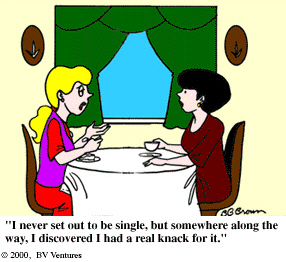 What? You mean you’ve never heard of this week designated to celebrate single/unmarried adults in the U.S.? Well, don’t feel too bad, I hadn’t heard of it either when I happened to start researching the next topic that I want to discuss here. But amazing how it coincided exactly with the week (September 20–26, 2009) that I wanted to start getting a little more into my platform.
In case you haven’t figured it out yet, or this is your first time visiting this website, I’m not married. Ever since writing the post I just linked to (“Thirtysomething and Never Been Kissed—Getouttahere!”), I’ve had more and more conversations with people from all over the world who are also single/unmarried and hearing how much they appreciate the fact that there’s someone out here who’s talking about it as if it’s nothing to be ashamed of—or a “condition” to be remedied as quickly as possible. In addition to that, I’m starting to hear from folks who are just as dissatisfied as I am with the way that “the church” treats unmarried people. In fact, I’ve had so much response from that one blog post that I considered starting a secondary (okay, third-ary) blog as a platform for the discussion of what it means to be an unmarried Christian in the 21st Century.
Ah . . . there’s that word again: platform. What exactly is a writer’s platform? In discussing this term with some other published authors, I learned that this idea came out of nonfiction publishing. For nonfiction writers, having a platform—a certain area of expertise and/or a certain audience they’ve already cultivated—is essential to getting their submissions past the acquisitions editor’s desk. In the year between the time I signed with my agent and when I got my first contract, this idea had started to bleed over into the fiction side as well. On my proposal for Stand-In Groom (from 2006), here are the statements that come closest to defining a platform (in this case, an already-cultivated audience):
- As an active, long-time member and former Vice President of American Christian Fiction Writers (ACFW), I have direct contact with more than 1,200 members—national and international through the e-mail listservs and forums—who can market the novel by word of mouth, through church/community reading groups, through reviews on Amazon.com and Christianbook.com, and through well-read blogs. Through ACFW, I have contacts with some of the top selling authors in Christian fiction, many of whom may be willing to act as influencers.
- As an unpublished author, I have already had the opportunity to teach at the 2005 ACFW National Conference (“Characterization for Visually Oriented Writers” late night chat) and through the monthly online courses (“Overcoming Writer’s Block” June 2005, “Stirring Up Your Setting” April 2006) and currently serve as the online courses coordinator through which I have high visibility through announcing and promoting courses and recruiting and working with instructors.
- As a graduate of Seton Hill University’s Master of Arts in Writing Popular Fiction program, I also have contacts with authors such as RITA award winner Shelley Bates and secular romance writers such as Maria Snyder and Daphne du Maurier–winner Marta Dana who are members of RWA and local RWA chapters and could act as influencers outside of the typical Christian market. The school maintains a listing of graduates’ publications and publicizes these titles in the program’s marketing materials, with posters on campus, and by selling the titles in the campus bookstore.
That was, obviously, before my books were published and I started getting feedback on them. And it wasn’t until I got the review that prompted the Getouttahere post that I finally realized what my platform really is: singleness.
And the irony is that I’d already stated this platform long before I realized it was my platform:
My heart is, as it has been for more than twenty years, focused on writing light-hearted romances. But not just any romances. I like writing characters who represent a growing segment of the population that seems to be increasingly left out in Christian circles: women in their late-twenties, thirties, and early-forties (and even older) who have never been married and who want to be loved and accepted for who they are, not pigeon-holed into a category, labeled, or, as happens most often, shoved to the side and ignored/forgotten about by their churches, coworkers, or even friends and family. I’m writing to the women who, like me, expected to be married before they turned twenty-five (-six, -seven, -eight . . .), but who may find themselves now in their mid- to late-thirties or forties and have never even had a date or meaningful relationship.
I’m writing for them (me, actually) so we can hang on to the hope of finding a well-adjusted, loving, marriage-minded Christian man out there somewhere and having a “happily ever after” ending with him (with the optimism that he may be closer than we realize). I’m writing for the woman who, like me, feels most alone when she goes to church and sees all the married/engaged couples and families sitting together; who has to endure the family-focused activities, Bible studies, Sunday school lessons, and sermons (if you’ve never noticed, start keeping track of how often your pastor talks about families and/or marriage); who begins to feel it isn’t just the church that has pushed her aside and forgotten about her, but that maybe God has too.
So this week, I’m going to be delving into my own platform a little more—taking a serious look at what it really means to be unmarried in the 21st Century, especially from a Christian’s point of view.
Fun Friday–Vampires Are SO Last Season
 Am I the only one who’s sick of seeing all the black-covered books in the YA section of B&N, or that every other new show and movie this season has vampires in it? Don’t get me wrong—I’ve gotten into a couple of the TV series, the best of which is BBC’s humorous drama Being Human about a vampire, a werewolf, and a ghost living together in a flat in Bristol, England, and trying to, well, be human. The reason it’s the best? It’s not just like every other vampire show/story out there. Between Twilight (I’ve only seen the movie, so don’t judge me too harshly), HBO’s True Blood, and the CW’s The Vampire Diaries, all of the characters are starting to run together (though of Edward, Bill, or Stefan, I’d have to say Bill is my favorite vampire after Being Human‘s Mitchell—but that’s probably an age thing). I’m starting to get really confused as to what the rules are for all of them. In Being Human vampire Mitchell can go outside—into the sunlight—without any ill effects; same with Edward in Twilight. In True Blood, Bill has to sleep in the crawlspace under the house because any exposure to sunlight is like pouring hydrochloric acid on his skin. In The Vampire Diaries, I believe the trick is that as long as Stefan wears a particular ring, he’s okay going out in the sunlight. And each one has differing methods as to how one turns someone else into a vampire. Used to be that it only took one bite. Some of them, you have to exsanguinate the person and replace their blood with your (vampire) blood. In True Blood you have to be buried with them for a complete day cycle. At least all of them have kept two pieces of vampire lore that I’m familiar with: they have to be invited in before they can enter your home, and a stake through the heart will kill them (though, in Mitchell’s case . . .)
But as Heidi Klum says every week on Project Runway, “One day you’re in; the next day, you’re out.” Now that everyone’s jumped on the vampire bandwagon (even Christian fiction—and even, horror of horrors, Jane Austen adapters), the publishing world is all abuzz with trying to predict what the next big publishing trend will be.
Karen Springen, of Publisher’s Weekly, seems to think the next big trend for YA fiction will be angels:
This fall publishers are introducing more than a dozen titles about angels—good ones, funny ones and especially fallen ones, kicked out of heaven. “We’ve kind of exhausted where we can go with vampires,” said Heather Doss, children’s merchandise manager for Bookazine. “Now we’re taking the safe characters and making them the bad guys. We’re turning that stereotypical angel image upside down.”
Christopher Campbell, who writes the Hollywood Crush blog for MTV.com thinks the next big trend will be faeries (which I guess is different than fairies):
Another film about faeries is on its way to the big screen. Following this summer’s announcement that Miley Cyrus is to star in Disney’s adaptation of Aprilynne Pike’s teenage faerie tale “Wings,” Variety reports that Universal is working on a movie based on “Wicked Lovely,” the first in a series of young adult books by Melissa Marr.
The projects aren’t very similar, however. Disney’s film, which is being produced by “Twilight” producers Marty Bowen and Wyck Godfrey, involves a seemingly normal girl who sprouts wings, making her a human-sized faerie. “Wicked,” on the other hand, features a teenage girl who can merely see the creatures—though she is offered the chance to join that world by a faerie suitor who takes human form in order to pursue her.
In the romance genre, we’ve seen trends come and go—chick lit, bounty hunters, vampire slayers, vampire/werewolf/shapeshifter lovers, Highland warriors and English damsels, etc. The most virulent of the trends in historical romance, in Christian publishing anyway, is the Regency romance. I know that the timing of the publication of Ransome’s Honor looks like I’m a bandwagon-jumper-on-er, but I was writing it when editors were still telling us that historic fiction was dead, dead, dead and all they were looking for was chick lit. But now the market is telling us that same-old-same-old Regencies aren’t what readers are looking for. They want something different—different time periods, different settings.
So that’s my question for you today. What do you think will be (or what do you want to be) the next big trend in fiction—whether YA or adult? What’s the next big character group that hasn’t been tapped yet? Careers? Historical periods? Be as creative as you’d like!
Bad Girls: From Vixens to Villains
I’m going to use a term today that may offend some of my readers, but as it’s becoming a technical term in writing, there’s no other way to say it. We’ve spent quite a lot of time talking about men in this series. And we’ve talked at length about those Bad Guys who have a quality about them in which, even though they’re bad and we recognize they’re bad, we can’t help but feel attracted to them. Doesn’t matter what they do—doesn’t matter that Sir Guy murdered Marian at the end of season two, on top of all the other atrocities he’s committed—so long as they show that they’re tortured by their actions (i.e., they brood about it), we’re willing to forgive them. However, put a woman in a similar role, and she’s hated and reviled and called a bitch. What is it that makes us sympathize with Bad Guys and hate Bad Girls? Is it because men secretly want to be that kind of guy and women want to save him?
 I worked in the advertising/marketing industry for more than twelve years. When I first started, as a sales assistant at a community newspaper in suburban Washington DC in the early 1990s, the industry was just starting to transition from being male dominated to female dominated. That newspaper (along several others in the area) was owned by a family—but it was the wife who was the most hands-on when it came to running the business. As a matter of fact, she had all of the partitions taken down between the desks in the large room that contained the advertising department (including between the thirty or so sales reps in the Classifieds call center) so that she could walk into the room and at a glance make sure everyone was working. She was my first exposure to the kind of woman who erroneously believed that ruling with an iron fist, never showing any kindness or empathy, was the only way to maintain authority. In reality, the only thing she managed to accomplish was to instill fear and hatred for her into everyone who worked there. As always happens, fiction is a reflection of life, and throughout the ’80s and ’90s, as women started moving up in the corporate world and breaking all kinds of glass ceilings, women in fiction—especially women’s fiction and romance novels—started doing the same. Only there were two classes of them: the Cinderellas and the Bitches. The Cinderellas worked hard and tried to get recognized for their accomplishments, all while “playing nicely” with everyone else, and would never consider trying to throw someone else under the bus or step on others to get that promotion she so badly wanted (but then, the handsome and wealthy CEO fell in love with her and asked her to marry him, so she didn’t have to worry about climbing the corporate ladder anymore). Then, there were the Bitches. The Ball Busters. The women who could emasculate a man with just one look, just one word.
As we’ve explored with taking about the Disney/fairytale villainesses, there have always been Bad Girls in literature. But the ones we saw there were the more one-dimensional evil queens and wicked stepmothers. Was it through these stories that women who attained power believed they had to become a Bad Girl/Bitch to keep it?
Captain Harville: Let me just observe that all histories are against you, all stories, prose, and verse. I do not think I ever opened a book in my life which did not have something to say on women’s fickleness.
Anne Elliot: But they were all written by men.
(Persuasion 1995, screen adaptation)
The way women have been portrayed in literature throughout the millennia has been a snapshot of that particular author’s/that particular society’s view of women. And because women really didn’t start getting a voice as authors until the late 17th and into the 18th centuries, we have thousands of years of men’s histories, stories, prose, and verse that try to define what women are. And, for the most part, women—the Good Girls, anyway—are supposed to be nurturing and submissive, if not downright subservient. And if you think about it, with the exception of those women who had to go out and work for the few years before they married, like Laura Ingalls Wilder did, in most popular fiction (including TV and movies) it wasn’t until the mid- to late-20th Century that women moved out of the home and into the corporate world.
Because the first very successful corporate climbers we had exposure to back in the 20th Century seemed to embody the Bitch character, it became the accepted norm that for a woman to be successful, she had to put away all trappings of femininity—from frills and lace on her clothes (remember the shoulder-padded, man-tailored suits of the ’80s?) to the way she talked, to the way she interacted with people—and become this caricature of Sigourney Weaver in Working Girl. Why? Because when a woman attains and maintains a position of power, she’s seen as a threat to the Alpha Males who’ve always been handed that kind of power throughout the years. Therefore, she’s allowed no signs of weakness or vulnerability (like empathy or the ability to be a nurturer). Bitches must either be shamed and brought to justice (like Weaver’s character in WG)—or even killed off, like Lady Macbeth or Madame Bovary—or they must be tamed and brought to heel, usually by a man, ala Kate in Taming of the Shrew.
What happens to the Bad Girl character at the end of the story greatly depends on the type of Bad Girl she is. So let’s look at several of those archetypes:
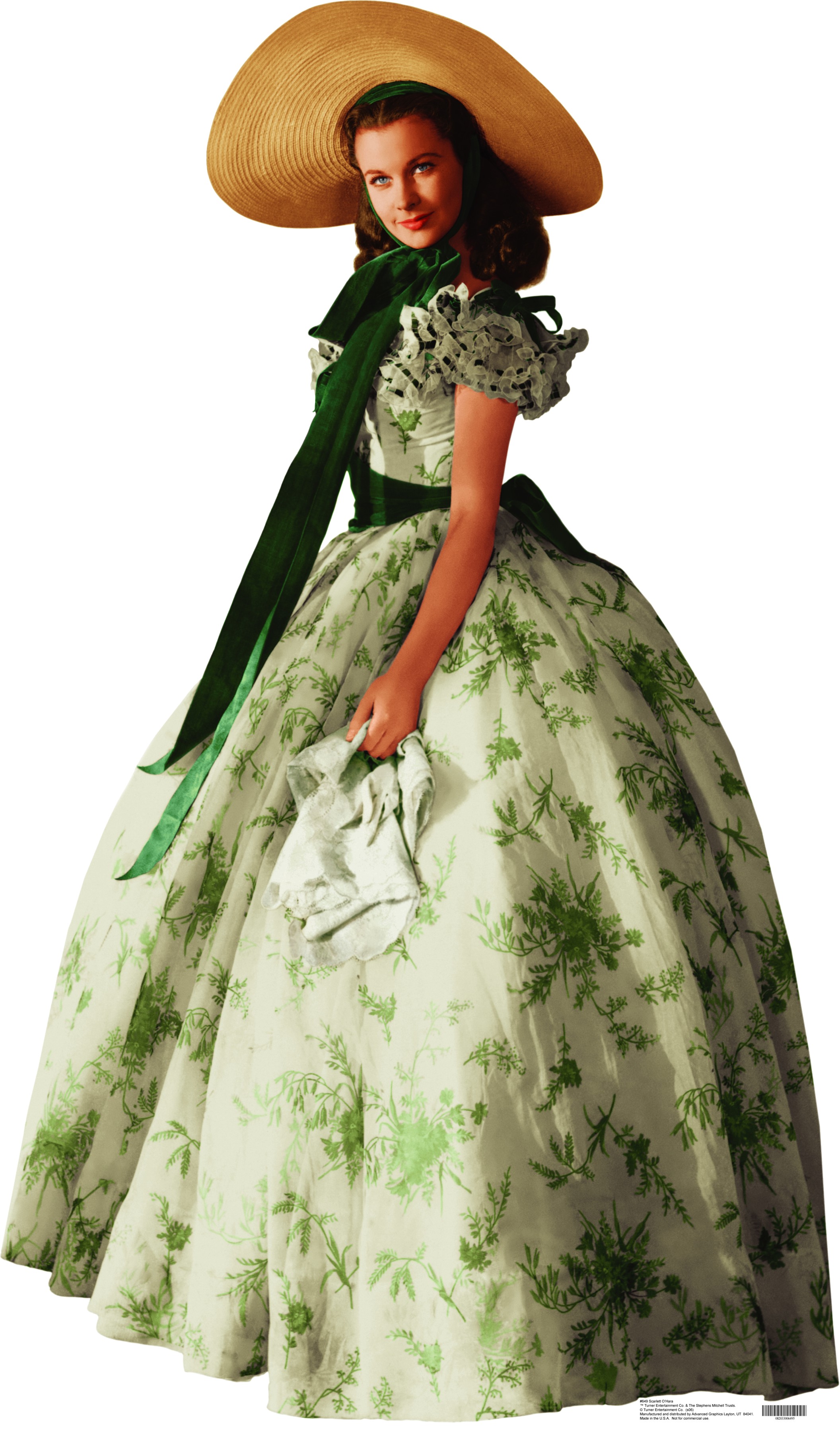 Femme Fatale: A beautiful woman who uses her feminine wiles to manipulate the people (men, usually) around her to get what she wants—which usually includes money and/or power. She exploits her sexual prowess and confidence, and men usually find her irresistible. The best known of these characters is Scarlett O’Hara in Gone with the Wind, or her 1980s successor, Ashton Main Huntoon from John Jakes’s North and South franchise. (Other examples would be Sharon Stone in Basic Instinct, Kathleen Turner in Body Heat, Barbara Stanwyck in Double Indemnity.)
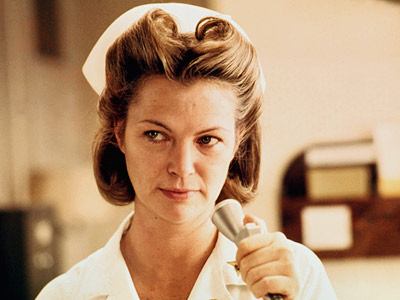 Crone: A bitter older woman, mentally twisted and usually lovelorn—perhaps the femme fatale in her later years. This character is usually more of the cartoon caricature: the evil queen in Snow White, the wicked stepmother in Cinderella, the witch/crone in the Kevin Costner version of Robin Hood. However, these can also be more of a creepily sympathetic character, like Miss Haversham in Great Expectations, or just downright creepy, like Nurse Ratched in One Flew Over the Cuckoo’s Nest.
 Con-Woman/Female Criminal/Sociopath/Black Widow: Women who live outside the law. They rob, cheat, maim, abuse, lie, murder—basically, everything a woman is not supposed to be able to do. Though they do have some of the traits of the femme fatale and/or the crone, they tend to take those traits ten or twenty steps further into the darkness of evil. Once again, there are two types of these characters: the cartoon caricatures (Cruella de Vil) or the creepy, more realistic characters—many of whom are based on real life criminals/sociopaths (after all, truth is stranger than fiction): Joan Crawford, Lizzy Borden, Aileen Wuornos, or Bonnie Parker. My favorite of these characters is probably Peyton Flanders (Rebecca De Mornay) in The Hand that Rocks the Cradle.
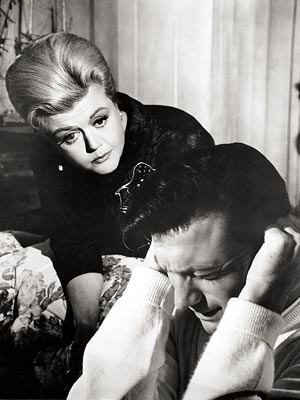 King Maker. We’re all familiar with the quote, “Behind every good man, there’s a good woman.” Well, this archetype twists that and takes us to a place where the woman is the one who’s power-hungry and willing to do whatever it takes to push the man in her life (her husband or son, usually) into a position of power. Whether it’s a queen whose husband has died and she is now the guardian of her son, the underage new king, a mother who wants her son to succeed in the career she’s chosen for him, or a wife who thinks her husband is settling for less than he (she) deserves, these King Makers wield their power by lurking in the background. Examples are Angela Lansbury’s character of Mrs. John Iselin in The Manchurian Candidate and my own Lady Augusta Pembroke in Ransome’s Honor.
 The Other Woman/Jealous Woman/Scorned Woman. We’ve already looked at these types of characters with some pretty good detail. But I do want to point out that the Scorned or Jealous Woman character doesn’t have to be jealous over a man. This can be a girl who’s jealous over someone else’s talent or ability or even over her looks/wardrobe/social status, etc. These are the catty girls, the Mean Girls, who make all of us look bad—like Nellie Oleson in the Little House on the Prairie TV series.
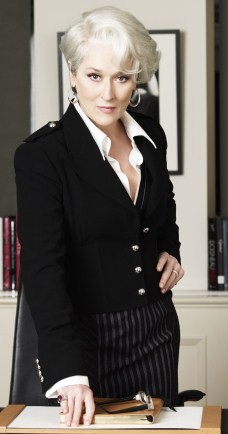
Boardroom Bitch/Ball Buster: This woman wants one thing and one thing only: Power. Power that translates into ruling a country or a world (or an undersea world). Power over a major corporation. Power over men, because they’ve betrayed/abused her in the past. Power that leads to wealth. Power that leads to vengeance/vindication. These women can use sex to get what they want, but it’s about dominance, not seduction—unlike the femme fatale. For these women, relationships are a distraction, men something to be used and discarded, not worthy to be her partner—either in life or in business. This is Ursula in her quest to wrest the throne from Triton. This is Miranda Priestly in The Devil Wears Prada or Sigourney Weaver in Working Girl. She knows what she wants and she’s not afraid to go after it. But usually in fiction, she meets with a very unpleasant end.
For Discussion:
Looking at these categories and thinking about some of your favorite Bad Girls—whether of your own creation or someone else’s—where do they fall? Do they easily fit into one category, or do they blur the lines? How do things turn out for them at the end of the story? If the Bad Girl you’re thinking of doesn’t fit into one of these categories, what category would you put her in and how would you describe that kind of a character?


