A CASE FOR LOVE: Questions Answered
Sorry this post is so late. I got back to Nashville around 9:30 Wednesday night. Before I could even get into the house, I had to put everything in my arms down so that I could unblock my front door. I have a small wooden crate on the front porch that has all my gardening implements and outdoor tools in it (with some bricks in the bottom to keep the Tennessee winds from blowing it away). When USPS and UPS delivered the boxes and envelopes containing all of my copies of A Case for Love (Barbour sends a copy from their office with my cover flats via UPS, another box of five copies came via UPS, a box with two copies along with the two cases containing 24 copies each came via USPS), they put the envelope and one of the small boxes between the storm door and front door, then scooted the crate over to hold the storm door closed and put the second small box and the two cases of books on top of it. I couldn’t even kick it off to the side to be able to get the door open. Needless to day, after two nights of almost no sleep (and three hours in the car without stopping for, um, anything), I was somewhat annoyed by this obstacle to getting into my house. But, anyway, I got home and my books are here. And then, after several hours of trying to get my life straightened back out so I could hit the ground running today (not getting to bed before 1 a.m.), I slept for a little over ten hours, then lay in bed at least another hour just because it was so flippin’ comfortable.
(Hold on . . . must go get second cup of coffee.
- Ahhh . . . much better.)
Okay on to answering the questions.
Becky Miller asked . . . Do you feel like your creativity suffers when you’re under a fast-approaching deadline? When you have to churn out the words, do you ever end up feeling disappointed in the work and/or wishing you could have spent more time on a section?
Funny you should ask this, as this very question came up at one of the panel discussions I participated in yesterday. When I’m several months away from a deadline, there’s no rush, no hurry to get it done, so I’m more apt to wait for inspiration to strike. If I don’t feel inspired to write when I sit down to do it, I don’t force myself to write, even though I fully ascribe to Madeleine L’Engle’s tenet (emphasis mine): “Inspiration comes far more often during the work than before it, because the largest part of the job of the artist is to listen to the work and to go where it tells him to go. Ultimately, when you are writing, you stop thinking and write what you hear” (Walking on Water, p. 149).
When deadline is looming and panic-mode kicks in for me to get a book finished, all of the inhibitions, all of the analysis, all of the self-doubt is drowned by the rush of adrenaline that comes from the fear I’m not going to meet my deadline (and thus my editor, agent, and everyone else who knows me or knows of me will be disappointed in me). Most of my favorite scenes—which are those that come toward the ends of my books—are those that I’ve written in that panic-induced rush of creativity that comes from the need to get the book finished on time. Now . . . if only I could get that to kick in about a month before a book is due so that I have time to go back and re-read it for edits/revisions before I turn it in! Because, yes, there are times when I feel like certain (early to middle) sections of a book were short-changed or could have done with a couple of months of critiques and fiddling. However, I also know my penchant for getting caught in a rewrite/revision loop—nothing is ever good enough, it can always be fixed. So that’s the greatest thing about deadline—having to turn it in and not being able to spend months or years fiddling with it.
Adrienne asked . . . I was going to ask if it is difficult to go from a book in the Bonneterre series to a historical and back again? From what I have seen it seems you write a historical between every modern day based book.
After spending two and a half years working on Stand-In Groom (on my own followed by a year with critique partners followed by the first year of graduate school), the manuscript was “finished” and in revision/editing mode. I had never worked on any story that long (with the exception of the 200,000+ opus I started in college and worked on throughout the ’90s)—I had finished three manuscripts in the two years before starting that one. So I was ready to do something different. As I mentioned in my Inspiration post for Ransome’s Honor, I’d started toying with the idea of a historical romance with a Royal Navy captain as the hero. And since I needed something to turn in for workshop critiques, and I didn’t want to submit anything from SIG, as it was already in revisions, I decided to knock out a first chapter of this historical idea, just to see if I could do it and what reaction I would get. The reactions were overwhelmingly positive (from a romance-genre-focused critique workshop), and I was captivated by the story at that time too—and I needed something to be submitting to my critique partners for the next year as well, so I kept writing it.
Having moved from writing Menu for Romance straight into writing A Case for Love, after struggling with the story for a while, I realized that the reason I was having trouble was that I really needed to write a historical between each contemporary—because I use a different style of writing with the historicals, I feel like when I come back to the contemporary, my voice and style are fresher and I’m not repeating myself—my sentence structures, speech patterns for characters, etc.—as much.
Renee asked . . . Who was your favorite “hero” to write, Forbes, Major, or George? Who was your favorite heroine?
Jolanthe asked . . . Which one of your characters in the series do you most closely relate to?
Alexandra asked . . . I want to know, too…who’s your favorite hero in your stories?
You know, Tuesday, after reading Renee’s question, I brought it up with the other authors I was with down in Mississippi. Most of them had the same reaction I did—hmmm . . . tough question. Almost like asking a mother which child is her favorite. Although one of the authors I spoke with had the opposite reaction—by the time she finishes her book, she doesn’t like the hero anymore and thinks she could have come up with someone better for the heroine.
In the Brides of Bonneterre series, if forced to choose, I’d have to say that Major is my favorite of the three heroes. I spent three years with George and even though I do still like him, by the time I turned that manuscript in to be evaluated for my master’s degree, I was ready to say goodbye to him and move on to the new love of my life (which was William at that time). When I finished Menu for Romance, however, I wasn’t ready to say goodbye to Major. He’s the one who still makes my heart flutter when I think of some of the more romantic scenes in the book. I couldn’t pick Forbes, because he fought me most of the time I was writing Case . . . but that’s best left for another question.
The character I most closely identify with is Anne. Even though she ended up somewhat different from me, when I first started writing her story, I’d used my middle name as her name (Nell), so she was very similar to me, without my realizing it—until I changed her name and she started changing into a much stronger, more successful, more business-savvy person than I’ll ever be. I want to be Anne Hawthorne when I grow up.
Amee asked . . . How do you get past writer’s block (if you get it at all!), especially if there is a tight deadline? Was there any specific part of A Case for Love that really challenged you?
Alexandra asked . . . How do you fix writer’s block? I love my story and I’ve got lots of ideas, but I’m stuck. And I’ve been stuck for the last two weeks.
Again . . . another question I was asked yesterday at one of the panel events. When I’m at a point when I have got to sit down and write, either because I’m on deadline or I’m blocked (and on deadline), I make one of the characters go to the grocery store. I write it out in detail—they get a basket; they buy two apples and three oranges and a bag of spring mix salad; they wander through the bakery aisle and experience the smells of the baked goods . . . and so on (in the historicals, I have them go on a walk into town—remember William’s walk after the encounter with Sir Drake in the stationery store in Ransome’s Honor?). It’s something of a writing exercise, and almost always gets cut out, but it serves two purposes: I’m getting to know the character a little better and eventually they’re going to start talking to me again or they’re going to run into someone that will present a conflict which will get the action of the story moving again (or introduce a subplot). (For example, William’s post-encounter walk ended at the dockyard where his ship was being stripped for repairs, and, thus, I was right back into the story because he was talking to me again.)
Any specific part of Case that challenged me? Um, yeah, FORBES GUIDRY. That self-proclaimed control freak did not want to let go and let me get inside his head. I think it’s because he knew I was going to start taking away his control over everything in his life and he didn’t like it, not one bit. Eventually, we negotiated a settlement and he was much more forthcoming. But, oh my goodness, how he frustrated me the first couple of months I was trying to write that book (and, thus, why Major is my favorite of the three heroes).
Regina Merrick asked . . . I have a question about your writing process. Before you were published, what did you do to keep yourself on a schedule of writing? I have the most awful time getting back in a groove after a holiday, or after any major distraction!
There are a couple of different times of my “before I was published” life—there was pre-grad school and during grad school. In my pre-grad school days, writing was my escape, my joy, my way of destressing after a long day at work (in a job I didn’t necessarily enjoy that much) and school (from 1999 through 2004, I took 9 hours of undergraduate hours each semester) and ACFW officer stuff (from 2003 through 2005). I couldn’t wait to get home and sit at the computer a few hours (or even better, in bed with a spiral notebook) and write a chapter or more (about 3,000 to 4,000 words) at night and completely lose myself and not have to think about everything else going on in my life. Between May 2001 and April 2003, I completed three manuscripts (120k, 100k, and 75k words). First drafts, yes, with no revisions, but completed drafts nonetheless. In graduate school, I was learning how to write on deadline, because each semester, I had to turn in a certain number of pages each month to my mentor and critique partners—and I had a personal goal of having the first draft completed by the end of my first year (May 2005—a deadline that I met by writing the final 25,000 words in about 78 hours with about six hours of sleep that weekend—and those are some of my favorite scenes in the book!). I’ve never been good at sticking to a schedule for my writing. I need to be better about it, and that is one of my goals for this year.
Jess asked . . . This isn’t based on “A Case for Love” itself, but your post yesterday really got me thinking. Do you ever consider using the Sims game to help plan your houses or towns?
I haven’t, mostly because by the time that game came out, I was already so familiar with Bonneterre that I felt like I’d waste more time trying to get my mental image/map of the town laid out than I would writing. If I ever decide to do a new fictional setting (such as, if I ever get around to the story idea I have for a series set in a small, fictional town in the hills an hour east of Nashville), I might consider it.
Jess @ Blog Schmog asked. . . I wanted to ask how many words would you estimate you wrote (including any cuts) for your most recent book and how many is it completed. Did that make sense? IOW how many words had to be cut/edited. Obviously an estimate unless you keep everything.
Has this changed drastically since you started writing?
I recently cut 1/3 (10K wds) of my wip and though it was a big trim I am much happier with the result. Now I’ve got some gaps to fill. I’m curious how those who know what they are doing fare.
Since completing Stand-In Groom and Ransome’s Honor, and going through massive revisions/rewrites/critiques/edits on both of those manuscripts, I think the most I’ve cut from any of my subsequent manuscripts has been one chapter that I cut from Menu for Romance before I turned it in (about 3,000 words). My contemporary manuscripts are contracted at 100,000 words and my historicals are contracted at 105,000 words. Stand-In Groom because it was written prior to being contracted, is just over 90,000 words; Menu for Romance was turned in at 96,944; my final draft of A Case for Love was 99,533 words; Ransome’s Honor was 106,368, and Ransome’s Crossing was 106,946.
This is a good question for everyone who’s writing: How long are your manuscripts? How much cutting do you find you have to do once you finish writing your first draft? Or do you find you need to add words after you finish?
Rose Biles asked . . . When you write, do you just write whatever comes to mind regardless of its position in the story, or do you work on specific chapters at a time? Do you start each story with a storyline and general synopsis then create an outline, or do you just let the words flow with no formal organization?
I used to be complete a “seat of the pants” writer—not really knowing where a story was going before I started it. Now that I’m selling books based off of a synopsis of the idea for the book, I have to know who the characters are and what the main conflict and scenes of the story are. And because I write romance, I already have a certain structure of things that need to happen in the story. It’s actually been very helpful for me to have the main pieces of the story already figured out before I start writing, now that I can’t take a year or two to write each one, because when I get to a place where I’m feeling lost in the story, I can go back and reread the synopsis and figure out where I’m supposed to be going. And with the Ransome Trilogy, the story formed pretty early—which was good, because I had to know what was going to happen in the third book before I could write the second book. And I had to know what was happening in the second and third books to be sure to include setup for those events/reveals in the first book. I’m definitely not an outliner, but I do like to have a synopsis to go by. For example, when I got to the eleventh chapter of Ransome’s Crossing last fall and got stuck, I pulled out the synopsis (which was a good five or six pages long) and wrote out scene “cards” (on large Post-it Notes) of events that needed to happen in the book, then, when I sat down to write each day, I knew where I needed to go:

Those on top were the completed chapters,
those below were the scenes I needed to write.
I write from beginning to end almost exclusively. There have been rare occasions when a scene has come to me that comes much later than what I’m writing, and I will go ahead and write it so that I don’t forget it. But then I go right back to writing it in order.
Alexandra said . . . I’d love to hear about your writing on deadline, too. My first WIP has taken me three years and it’s still not where it should be. I can’t imagine getting a story from brainstorming to sending it to the publisher in six months.
Because my stories are contracted so far in advance of when I have to turn them in (with Love Remains being an exception—in more ways than one), I usually have quite a bit of time between when I write the synopses for the stories and when I actually have to write them—so I’m already thinking about them for a while before I write them. Plus, it helps that I’m writing series in which the characters in subsequent books are characters in the initial book—so, again, I’m already working with those characters for months/years before I start writing them.
I had years to develop the characters/stories for the Bonneterre Series and the Ransome Trilogy, having started them long before being contracted. And even though I’m not able to use any of it, Love Remains is actually taken from the third complete manuscript I wrote (using the same title)—the one right before starting Stand-In Groom. The second book in the Matchmakers series is a story idea I came up with and started developing in 2007. And when my agent mentioned I should have a new series proposal ready to go around the time I turned in the manuscript for Case, I pulled those two story ideas along with one I’d been toying with in which the characters’ grandparents were trying to get them all married off. I wrote out a treatment of the idea for the trilogy for the first time in August 2008, which was when I came up for the idea for the third book. So even though I may only have two, four, or six months to get a book written, I’ve been thinking about each one and figuring out who the characters are for months or even years before I ever write them.
Elaine asked . . . How did you choose the location, Bonneterre?
For the answer to this, I’ll refer you to the Settings post for Menu for Romance, in which I explained the development of Bonneterre in detail.
Did I cover everyone’s questions?
A CASE FOR LOVE: Ask a Question, Any Question
Enter the “Make A Case for Love” contest. Click here to review the prizes and ways to enter.
As many of you who follow me on Twitter know, I’m currently in Blue Mountain, Mississippi, speaking at Blue Mountain College (I spoke at an 8 a.m. Freshman Comp class and a 9:30 Modern Lit class this morning with author Donn Taylor, and tonight I’ll be participating in a panel discussion with the five other authors who are here; tomorrow, I have appearances/signings at a library in Pontotoc and Lake Horn, MS). I (obviously) have internet access, but as I need to spend what little free time I have working on the editing project that’s due at the end of the week, I thought I’d open the “floor” to your questions.
Earn TWO points* toward your entry in the “Make A Case for Love” contest today by posting a question you have about A Case for Love—from the any of the subjects I’ve already covered (inspiration, characters, research, setting) or anything else you’re curious about (the writing process, my schedule, marketing, etc.) as it relates to this book/the Brides of Bonneterre series.
I won’t be posting on Wednesday, but will post the answers to your questions on Thursday. So, what questions do you have about A Case for Love and/or The Brides of Bonneterre series?

*Offer expires at 9 p.m. Central time on Wednesday, January 20, 2010.
A CASE FOR LOVE: The Settings
Welcome back to Bonneterre, Louisiana, for the delightful conclusion of the Brides of Bonneterre series!
Of course A Case for Love puts us right back into the fictional city of Bonneterre (pronounced bon-TARE-uh). For a refresher on the origins of this fictional city, read the Settings post from Menu for Romance.
There are a few key locations in and around Bonneterre that see quite a bit of the action in A Case for Love.
The Fishin’ Shack—Jenn’s restaurant in Comeaux, Louisiana, another fictional town, this one much smaller, about fifteen minutes south of Bonneterre. The Fishin’ Shack has been featured in both of the other books. It’s where a bunch of the Guidry cousins gather on Thursday nights for dinner (they started doing this when Jenn opened the restaurant to help her business grow). It features “Family Friendly Karaoke” on Tuesday, Thursday, and Saturday nights. And, if I ever do get to write Jenn’s story, you’ll learn even more about it!


Arcenault Dance Studio—Just down the street from The Fishin’ Shack in Comeaux, this is a new business, the grand-opening of which Alaine decides to cover for her show. The dance studio is in an old karate studio and was opened by a married couple, Ruth Arcenault and Ian Birtwistle, who also happen to be world champion ballroom dancers.


Maison Bonneterre—This is the name of the townhouse community where both Forbes and Alaine live. Forbes lives in the “upscale” part of the neighborhood while Alaine’s townhouse is in the more affordable section. I don’t believe I ever used the actual name of the development in the books.
- Forbes’s Townhouse (Forbes’s is on the left, Shon’s is on the right):


Alaine’s Townhouse (hers is the light brown one with the bay window, and the kitchen has been modified from this floorplan, as described in Menu for Romance):


Moreaux Mills—In A Case for Love I introduced a new and very important area of Bonneterre. It’s considered by most to be the “wrong side of the tracks”—it’s the residential area built in the early 20th century to house the families of the hundreds of workers for the now-defunct Moreaux Paper Mills. The Mills shut down about twenty or so years ago, but even before then, the area had started changing into more of a mixed-use area with dozens of people operating businesses out of their homes. The inspiration for this type of community came from the Bransford Avenue area that lies between 100 Oaks and Berry Hill in Nashville. And of course, the most important setting in Moreaux Mills is Delacroix Gardens, the florist and nursery center owned by Alaine’s parents.


And just in case you have a hard time figuring out the geography of Bonneterre and how to get around, here’s the hand-drawn map I sketched out just to help myself when writing A Case for Love, because the characters seem to get around town more in this one than in the other two.

Fun Friday: Top Five Favorite LOST Episodes

I know that there are a lot of you out there who don’t watch/care for the TV series LOST, but it’s been my favorite show for the past several years (I didn’t start watching until 3rd season, but got caught up with Seasons 1 & 2 on DVD and have been an addict ever since.) So since the final season starts on February 2, my next three Fun Friday posts are going to be dedicated to my favorite show. I’ll understand if you aren’t a fan and don’t read them. And also be warned if you haven’t caught up with all five seasons that there will be spoilers.
If you do watch the show and need a refresher, here’s “Everything You Need to Know about LOST in 8:15”:
And now, here are my top five favorite episodes of LOST:
5. “The Incident, Parts 1 & 2”—this was the two-hour season finale of Season 5. Talk about a game changer! There were several things that put this one on the list: finally seeing Jacob for the first time—and seeing how he personally interacted with each of the main characters off island sometime during their lives; finding out what happened to Rose, Bernard, and Vincent (“We’re retired.”); discovering there are now two John Lockes—one dead, one alive; the emotional good-bye between Sawyer and Juliet; and after finally seeing Jacob, watching as Ben killed him.
4. “Greatest Hits” and “Through the Looking Glass”—Yes, technically these are two episodes (well, three, because “Through the Looking Glass” is a two-hour episode), however there’s one storyline that goes through these that’s the reason they’re on this list—and that’s Charlie’s farewell. In “Greatest Hits,” as Charlie prepares to go to his death, he writes a list of the best moments in his life—something to leave behind for Claire. Then, in “Through the Looking Glass,” he meets his end in one of the best death scenes in the series.
3. “Tricia Tanaka Is Dead”—The beginning of season three, with Jack, Kate, and Sawyer having been taken by the others, and the very heavy storylines that gave us, the tenth episode, with its focus on Hurley’s finding the “hippie car” and his determination to get it running, gave us a much needed emotional uplift. This episode gave us the “four musketeers” in Hurley, Charlie, Jin, and Sawyer (and a very humorous English lesson between Sawyer and Jin). And while we discovered a few episodes later the very dark origin of the van and the remains of “Roger Workman,” this episode stood for quite some time as my favorite.
2. “There’s No Place Like Home”—This is the three-part finale of Season 4, in which we learned how the Oceanic 6 actually got off the island and made it back to the real world. And LOTS of stuff happened in this episode—including the island moving. I entered that season’s finale extremely worried about my favorite character, Desmond, and his fate. I was pretty sure that if they killed him off at the end of the season, I wouldn’t watch the rest of the show out of protest. But I shouldn’t have worried. The Island isn’t finished with Desmond yet.
1. “The Constant”—With Desmond as my favorite character, is it any surprise that this is my favorite episode? Not only did it set up the idea of time travel, which they got into in the fifth season, but it had as its main focus the romance between Desmond and Penny. (And this episode is why the finale of the fourth season is in the #2 position—because of the resolution it gave to what happened in this episode.)
What Do You Do in a Bookstore?
Another quick post/question to be answered today.
 Just got an e-mail from my dear friend Ruth that A Case for Love is starting to hit the shelves at LifeWay stores across the country. So be looking for it in stores near you soon!
Since Stand-In Groom came out, my experience with walking into any place that sells books has become much different than it was before . . . and it had already changed two years before that when I started working at a publishing house. When I walk in, I take note of what books are on the first display just inside the door—how they’re arranged, who the authors are, if they’re new releases or “bargain” (i.e., overstocks or OOPs—books going out of print), what genres are represented, etc. Then I go back to the Christian fiction section. I look for the massive display of Ted Dekker’s books . . . and then look to the left of the first book with his name on it for the ones with DACUS on the spine. If I’m at Barnes & Noble, I’m usually very disappointed, because there aren’t any. So I leave a bunch of bookmarks, either on the shelves or in other people’s books. At LifeWay and other stores that carry my books, I look to see how many of them they have. And after putting bookmarks/post cards for my other books in each one of those, I may go around and put some in other people’s books. (And face-out a few of my closest friends’ books, if they aren’t already.)
On very rare occasions, I’ll actually buy books.
What do you do when you go into a bookstore?
Breakfast with an Author?
Once again, I don’t have a lot of time to write a long post (I promise, I’ll get back to the background stuff on A Case for Love as soon as possible!), but don’t want to short-change you on your opportunity to post a comment for the Make A Case for Love contest.
I had a nice long breakfast with bestselling author Rachel Hauck this morning. We talked about everything under the sun . . . and had a really good time talking about our books/series under development and sharing/brainstorming ideas (along with my being the peanut gallery while Rachel helped Susan May Warren brainstorm a new book proposal over the phone).
So here’s my question to you. If you could go to breakfast with any author, living or dead, who would it be and why? (And please be honest. Sucking up to me won’t earn you any extra entries in the contest!)

Patty Smith Hall, Kaye Dacus, and Rachel Hauck
It’s a Regional Thing
I went to the launch party/book signing for Sweet By and By a new novel penned by my dear writing friend Rachel Hauck and country music star Sara Evans at the Davis Kidd bookstore in the Green Hills mall here in Nashville last night.

Rachel and I met in 2001 at the Blue Ridge Mountains Christian Writers Conference and she, along with Patty Smith Hall, another dear writing friend, encouraged me to join what was then known as American Christian Romance Writers (now ACFW). Over the years, Rachel and I have worked on different projects together, from the praise band/women’s choir at a couple of early ACFW conferences to serving on the board of ACFW together for a year (she was president, I was volunteer officer) to touring Nashville and going to the Bluebird Cafe to listen to music when she was doing research for Diva Nashvegas and her other Nashville-set books.
Because I lost a few hours last night in which I should have been working—or pre-posting a blog—I’m going to make this entry short so that I can get some work knocked out.
So here’s something to ponder and then to post a comment about (after all, you need to be able to leave a comment for the contest, right?) . . .
 Amongst the myriad of weird things that Middle Tennesseans say, there’s one that stands out to me more than the rest. It’s the penchant for adding an S to the end of store names. For example:
- We’re going to Krogers. (If you look at their signs or go to their website, the store name is Kroger.)
- Let’s meet at Paneras for lunch. (Again, look at the sign!)
- We did most of our Christmas shopping at Walmarts. (No kidding. Folks around here call it Walmarts.)
I guess they think that someone named Panera owns the restaurant, or someone named Walmart owns the stores, so they’re making them possessive, but it weirds me out every time I hear it.
What’s one speech pattern/saying that’s unique to your neck of the woods—or something you noticed elsewhere when you’ve traveled outside of your area?
A CASE FOR LOVE: The Research
I’ve mentioned in a few places a little bit about some of the research I did when writing A Case for Love, but today, I have proof!
Last January, after several weeks of watching the morning “news magazine” program on which I based Alaine’s Inside Bonneterre program—Talk of the Town on WTVF, Nashville’s CBS affiliate—I e-mailed the host, Meryll Rose, the following through the contact address on the station’s website:
From: Kaye Dacus
Sent: Wednesday, January 28, 2009 12:23 PM
To: Meryll Rose
Subject: I would like to interview you
Dear Ms. Rose:
I enjoy seeing you on “Talk of the Town” every day on News Channel 5. In fact, your program is part of the inspiration for the main character of the novel I am currently writing. I would love to set up a time to interview you about your job and find out what goes into making a daily lifestyle program like “Talk of the Town” so that I can get the details right in my novel.
My schedule is flexible and can be worked around yours. If you are interested, please send me your direct contact information, or let me know what a good time to talk would be.
I look forward to speaking with you.
I figured I didn’t have anything to lose—the worst she could say was no, that she was too busy. The next day, I received the following reply:
- From: Meryll Rose
Sent: Wednesday, January 28, 2009 4:03 PM
To: ‘Kaye Dacus’
Subject: RE: I would like to interview you
Hi Kaye,
I’ve always thought Talk of the Town would make a great novel! I’d be happy to help you fill in the blanks about what goes on here.
Would you like to come to the studio and watch us do the show? That would give you a feel for what goes on behind the scenes, and we could talk while you’re here.
Let me know what works for you… I’m here almost every day!
Meryll Rose
Talk of the Town/ WTVF-TV
So we set it up that I would go down to the studio (in downtown Nashville) on February 2, 2009, meet with Ms. Rose before she had to start recording her teasers for the next day’s show, meet several other people, including Lelan Statom, the daytime meteorologist, and Vicki Yates, the daytime news anchor. (And yes, the camera skews your perception of someone’s size. Lelan wasn’t nearly as tall as I thought he would be!)
So I arrived at the studio early and was taken downstairs (the building is situated on a hill in such a way that the main entrance which opens out onto street level is actually the building’s second or third floor—I want to say third, but that’s because that’s how the newspaper building where I worked for ten years was built) to the studio. Again, the camera gives a skewed perception—the studio was much smaller than I expected it to be—with the weather station to the left, the main news desk in the center, and Stage C, where Meryll and Lelan sit to do Talk of the Town to the right—with their mock-kitchen area across from the main news desk though closer to Stage C than the news desk—I know, I’m not making that easy to visualize—as I recall, it was kind of like this:
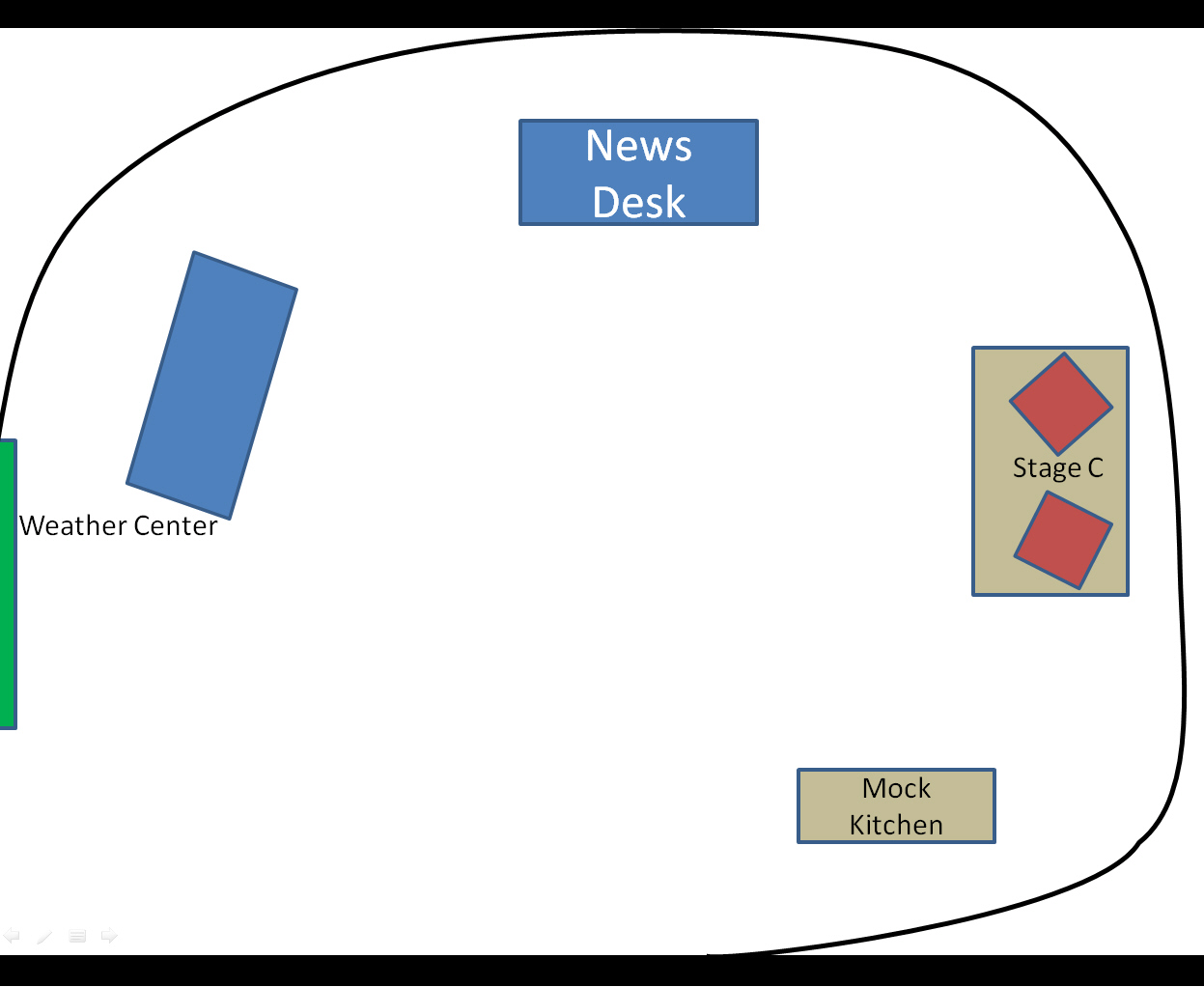
And if you think your office or home is cold, you haven’t experienced a cold work environment until you’ve been into a TV studio. They must have that room chilled to about sixty degrees—yet it probably still gets up to about 75 or 80 for the anchors under all those lights.
Here’s what the studio actually looks like:

With the weather desk to the left and the news desk in the middle (with Vicki Yates, behind the stand that has a flat-panel monitor attached to it, at the desk filming a “coming up on News Channel 5” teaser).
I couldn’t really take a lot of pictures—I spent most of my time talking to people and taking notes, but I did take detailed pictures of the cameras, because they fascinated me so much, never having seen how a teleprompter really works.

Here you see the main camera for Talk of the Town with Meryll’s script for the teaser for the next day’s show (and on the flat-panel monitor beyond the camera, you can make out the list of teasers they were recording). The “VO” on the monitor indicates when she’ll be talking but they’re rolling video clips instead of showing her (thus it’s a “voiceover”). Below the teleprompter is a monitor that shows what’s actually being broadcast at that moment.

In this shot, you can see that the camera lens is actually behind the glass on which the words are reflected—from what looks like a laptop-base below it. The words are projected backwards from the horizontal monitor and reflected on the angled glass in front of the camera lens!
For the rest of what I learned at the studio . . . you’ll just have to wait and read A Case for Love.
Now, I didn’t go quite so far in doing research for Forbes’s job as a lawyer. I never want to assume that the way any profession is portrayed in movies/on TV is accurate (after working for more than a decade in the newspaper business, I know this is not true!), but given the proliferation of examples of lawyer characters/law firms I’ve seen, I know what the expectation is for readers who’ve also never actually worked in a law firm—because it’s about the same as mine. But pulling from my own years working in an office environment as well as serving on jury duty, reading several John Grisham novels, and checking with a couple of friends/acquaintances who are lawyers when I wasn’t sure exactly how something would work, I’ve hopefully managed to make Forbes’s job realistic enough that it won’t turn off anyone who is a lawyer and believable enough for readers to connect with.
Obviously, I had to do a lot of research on what kind of legal case I could do. I had to be extremely careful with that research and make sure I was looking only at Louisiana law—because laws dealing with eminent domain (which I discovered I couldn’t use) and other issues regarding real estate development vary from state to state. But I won’t bore you with those details.
The only other major thing I had to research for the book was dancing. You see, while I had the music of Dean Martin as the cultural throughline in Stand-In Groom and the movies of John Wayne in Menu for Romance, I struggled with what it would be in A Case for Love—until Jenn came up to Forbes and begged him to take dance lessons with her. So I had to brush up on my steps a little. Thank goodness for YouTube and people who’ve posted video dance lessons there!
An Interview Scavenger Hunt
For those of you who’re entering the Make A Case for Love contest, I’m giving you a rare Saturday post to give you another opportunity to post a comment to count toward your entry.
In the past week or so, I’ve been featured with interviews on three other blogs:
A Christian Writer’s World
A Sequence of Continuous Delights
Jill Eileen Smith
So here’s a little scavenger hunt to help you get another entry in the contest by answering one or all of the following questions with information found in those interviews.
1. What is my favorite genre?
2. What famous author would I like to sit down and brainstorm with?
3. What is my favorite TV show?
4. What did I use as the inspiration for the Guidry family in the Brides of Bonneterre series?
5. What other career might I consider if I stop writing?
6. Where’s my favorite vacation spot?
Fun Friday: Five Random DVDs
It’s no secret that I have a great love of movies. I also have quite a few. Probably not as many as some people (looking at you, Ruth and Caleb), but only because I’ve had a Netflix subscription since 2004, which has definitely cut down on the number of movies I’ll buy when I know I can easily get them from Netflix in a day or two and watch it first to see if I really want to buy it or not.
So today, I thought I’d do something that everyone can play along with, if you’d like (so that you can earn another entry toward the Make A Case for Love contest!).
Here’s the rules to play along: Go to where you keep the majority of your DVDs, close your eyes, and pull five at random, then come back and tell us what they are and something about them (why you bought it, why/if you like it, or something). If you’d like to do this as a post on your blog, come back and post the link in your comment.
Since I keep my DVDs in alphabetical order, I’ll post them in that order.
Random DVD #1: Bill Cosby, Himself
 When I was growing up, we had a bunch of Bill Cosby’s live concert albums (on LP, of course). So when we got our first VCR in the early 1980s, Bill Cosby, Himself was one of the first videos we got (I believe my uncle Jon had actually recorded it off HBO for us—we didn’t have cable). For years after I got a DVD player, I thought about trying to find it, but we’d watched it so often when I was young, I could practically quote the thing. But then I worked with a wonderful young woman named Corie Martin who, whenever I would help her out with something, adapted one of the jokes from Himself and would sing, “Kaye is great . . . give us the chocolate cake.” So I had to go out and find it, and I think I picked it up for about $5 at Target.
Random DVD #2: Ever After
 Believe it or not, this one is still in the plastic shrink-wrap from the store. It’s not that I don’t love this movie—thus the reason I bought it—but it’s on TV often enough that I don’t have to pull out the DVD to watch it. I really enjoy this re-telling of the Cinderella story—especially the humor that’s added to it. Drew Barrymore has never been one of my favorite actresses—in fact, I can’t usually stand to watch her, because she has this weird way she moves her mouth that starts to get on my nerves pretty quickly. But even with all of the horrible fake British accents aside, this is definitely a movie worth having in a DVD library.
Random DVD #3: The Man in the Iron Mask
 This is probably the only Leonardo DiCaprio movie I’ve ever seen that I’ve really enjoyed—but that has more to do with the actual leading men who star in this movie: Jeremy Irons, John Malkovich, Gerard Depardieu, and Gabriel Byrne. Written and produced by Randall Wallace, who also wrote and co-produced Braveheart, this movie gives us the Three Musketeers (and D’Artagnan) in their less-than-golden years. I never got around to seeing this when it was out in theaters, but I bought it not long after I got a DVD player because I enjoyed it so much as a rental.
Random DVD #4: The Princess Bride
 I love this movie. I’ve loved it ever since I saw it at the cinema when it first came out in 1987 (and yes, I was old enough to drive myself to the theater when it came out—I’m that old!). This film has an ageless quality about it. While other movies from the same era come across as obviously “dated” (i.e., you know they were made in the ’80s) this movie hasn’t seemed to age at all. And, along with Steel Magnolias, it’s one of the most quotable movies ever.
Random DVD #5: “Unafied” In Concert
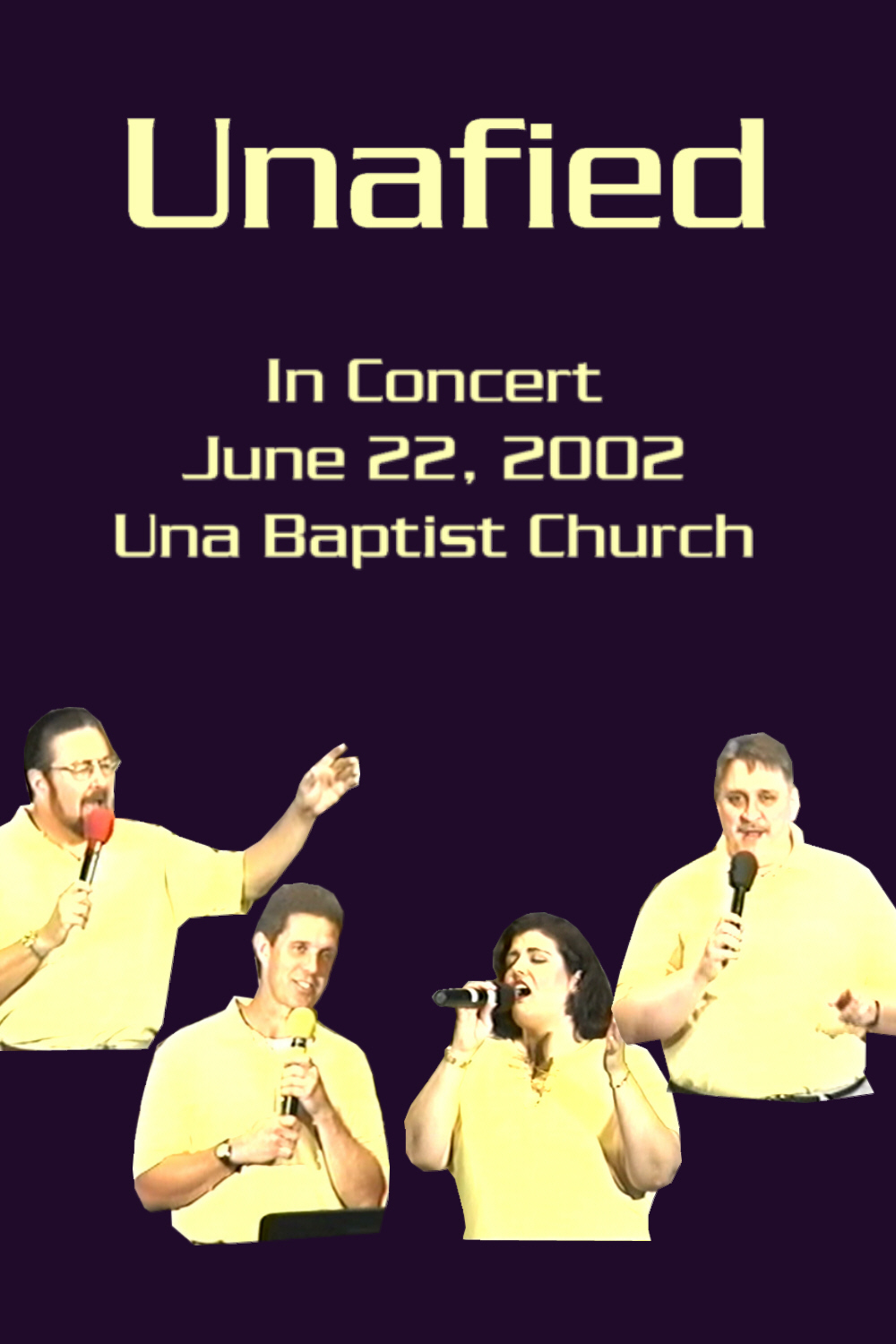 I know, you’re scratching your head thinking, huh? I almost put this one back when I opened my eyes and saw I’d pulled it, but for this to be an honest game, I had to go with what I actually pulled. Unafied is the Southern Gospel Quartet I sang with for a couple of years. The name, Unafied, came from the name of the church we all attended: Una Baptist Church right here in Nashville. This concert was performed on June 22, 2002 at our church. Here we are, singing the Gaither Vocal Band song “Hide Thou Me” (you’ll have to crank up the sound to actually hear it):


