Debunking Writing Myths: Always/Never Use “Said” Dialogue Tags

Never use a “said” dialogue tag. / The only dialogue tag you should ever use is “said.”
.
 Like anything else in writing, overuse of anything is lazy writing and can frustrate readers (and editors).
.
Back in the day when most of us started writing, the books we were reading used dialogue tags such as:
…she announced
…she stated
…he commanded
…he explained
…she muttered
…he contradicted
…he assured
…she expressed
…he said cheerfully
…he said heavily
…she echoed
…he said laughingly
…he demanded
…she whispered breathlessly
…she intoned incredulously
Remember those? Because we were so used to reading them (and yes, I pulled out two books that I took all of those from—one from the mid-1980s, the other from the early 1990s), that’s how we attributed our dialogue when we first started writing.
But times—and accepted styles—have changed.
“The only attribution (dialogue tag) you’ll normally need is ‘said,’ although there will be times when more specific verbs such as ‘whisper’ or ‘yell’ or ‘ask’ might be called for” (William G. Tapply, “Dialogue: The lifebood of the mystery story,” The Writer, October 2008, p. 31).
When I was in graduate school it was explained this way: readers see “said” or “asked” much like a period or comma. It’s more like punctuation than anything else, therefore those are unobtrusive. However, as a reader and editor—and as someone who listens to audiobooks more than I read actual physical books—I can attest to the fact that “said” dialogue tags get very old very fast if those are the only way the author attributes the dialogue in his/her book. Just as we want to look for ways to make our writing stronger when it comes to verb or adverb use, we want to make sure we’re not overusing any words, and that includes the words said and asked, even as dialogue tags. And the best way to do that is with action and/or introspection laced in with the dialogue.
Here’s an example of how “said”-type dialogue tags can overwhelm and stunt a scene:
- . . . . .The house lights rose, and when Zarah turned to look at Bobby, to ask him what he thought, she caught sight of a scowl before he quickly rearranged his expression into a smile and unfolded his arms.
. . . . .“I’m almost afraid to ask you what you think of it so far,” Zarah said.
. . . . .“The performances are great. Your friend—Caylor?—isn’t really Irish, is she?” Bobby asked.
. . . . .“No. She spent a year in Britain—England, Ireland, and Scotland—working on her master’s degree. She’s always had an ear for accents, but she came back sounding like she’d grown up over there,” Zarah said as she curled the cardstock program in her hands. “But what do you think of the story?”
. . . . .“Honestly?” Bobby asked.
. . . . . “Honestly,” Zarah said.
. . . . . “It bothers me,” Bobby said.
. . . . . “Bothers you? In what way?” Zarah asked as she turned sideways and leaned her arm against the seat back.
. . . . . “Well. . .this Harold guy, he’s a con man,” Bobby said.
. . . . . “Right,” Zarah said. “That’s who he is at the beginning of the story. I don’t want to give away the ending, but most stories are about someone who needs to go through some kind of change—a metamorphosis—and grow into a better person. So they have to start out with flaws.”
. . . . . “Flaws? Zarah, the man’s a criminal,” Bobby said, and his face turned red when a few people turned at his raised voice. He turned to face her, his knee touching hers. “I’m just saying that I’ve had lots of experience with men like that over the past several years. They don’t change their ways.”
. . . . . He looked so earnest, so concerned over the plight of the fictional people Harold Hill was in the process of swindling, that Zarah wanted to reach out and hug him. Instead, she leaned back a little. “It’s called willing suspension of disbelief. You should try it,” she said.
. . . . . Bobby ducked his head, a grin forming. “Fine. For your sake, I’ll try to enjoy the rest of the play—I’ll try to forget that master manipulators never stop trying to manipulate people,” he said as he reached over and squeezed her hand.
Now, here’s the scene the way I actually wrote it (from Love Remains):
- . . . . .The house lights rose, and when Zarah turned to look at Bobby, to ask him what he thought, she caught sight of a scowl before he quickly rearranged his expression into a smile and unfolded his arms.
. . . . . “I’m almost afraid to ask you what you think of it so far.”
. . . . .Bobby glanced at the stage and then back at her. “The performances are great. Your friend—Caylor?—isn’t really Irish, is she?”
. . . . . “No. She spent a year in Britain—England, Ireland, and Scotland—working on her master’s degree. She’s always had an ear for accents, but she came back sounding like she’d grown up over there.” Zarah curled the cardstock program in her hands. “But what do you think of the story?”
. . . . .Bobby pressed his lips together—making them almost entirely disappear. “Honestly?”
. . . . .She nodded. “Honestly.”
. . . . . “It bothers me.”
. . . . . “Bothers you? In what way?” With Kiki having left to go to the restroom with Sassy and Lindy, Zarah turned sideways, leaning her arm against the seat back.
. . . . . “Well. . .this Harold guy, he’s a con man.” Bobby’s expression indicated this should be enough explanation.
. . . . .But Zarah wasn’t quite following him. “Right. That’s who he is at the beginning of the story. I don’t want to give away the ending, but most stories are about someone who needs to go through some kind of change—a metamorphosis—and grow into a better person. So they have to start out with flaws.”
. . . . . “Flaws? Zarah, the man’s a criminal.” Bobby nodded, red-faced, at the few people who turned at his raised voice. He turned to face her, his knee touching hers. “I’m just saying that I’ve had lots of experience with men like that over the past several years. They don’t change their ways.”
. . . . .He looked so earnest, so concerned over the plight of the fictional people Harold Hill was in the process of swindling, that Zarah wanted to reach out and hug him. Instead, she leaned back a little. “It’s called willing suspension of disbelief. You should try it.”
. . . . .Bobby ducked his head, a grin forming. “Fine. For your sake, I’ll try to enjoy the rest of the play—I’ll try to forget that master manipulators never stop trying to manipulate people.” He reached over and squeezed her hand.
See what a difference eliminating unnecessary said/asked tags, and replacing some with action/introspection can make?
Sometimes, when dialogue is moving quickly and you need to pepper in an attribution here and there to make sure the reader knows who’s speaking (especially when there are more than two characters “on stage”), a good “said” dialogue tag can be particularly useful. Embellished dialogue tags—those using more descriptive verbs or, even worse, adverbs—come across as author intrusion. If your character has just explained something in dialogue, the reader knows it and doesn’t need a “she explained” tag. Same thing with “argued,” “elaborated,” or “confirmed.”
If you have an action or introspection that follows the dialogue, you don’t need to use said/asked. (And it will also eliminate the unnecessary/repetitious use of “as” and “when,” as shown in the examples.)
Have you ever read something and noticed the dialogue tags because they were so overdone they brought attention to themselves? How do you prefer to see/use dialogue tags in what you read/write?
* * * * * *
If you like what I do here and want to keep this content free,
consider supporting me and my work by buying me a coffee.

Writer’s Window–Ann H. Gabhart
 Joining us today for Writer’s Window is historical-fiction author Ann H. Gabhart.
One lucky commenter* will win a signed copy of Ann’s latest book, Angel Sister. Deadline for leaving a comment to enter the drawing is Friday. To enter the drawing, you must answer the question posed by Ann at the end of the interview. Only one comment per person will count toward the drawing. You do not need to include your e-mail address in the body of your comment—just make sure it’s correct when you sign in to leave your comment. The winning name will be drawn next weekend and announced on the next Writer’s Window post. Congratulations to Sally Bradley, who won the drawing for last week’s featured book.
- *U.S. residents only, void where prohibited. If you win the drawing, you will be ineligible for the next three drawings, though hopefully you will still come back and join in the discussion.
__________________________________________________________
It is 1936 and Kate Merritt works hard to keep her family together. Her father has slipped into alcoholism, her mother is trying to come to grips with their dire financial situation, and her sisters seem to remain blissfully oblivious to all of it. Kate could never have imagined that a dirty, abandoned little girl named Lorena Birdsong would be just what her family needs.
In this richly textured novel, award-winning author Ann H. Gabhart reveals the power of true love, the freedom of forgiveness, and the strength to persevere through troubled times, all against the backdrop of a sultry Kentucky summer.
Welcome, Ann!
What do you like best about being a writer?
- The thing I like best about being a writer is writing stories. I love coming up with new characters who have a story to tell. I get so close to my characters while I’m writing about them that they become like family members. When that book is written and new characters necessarily push the old characters out of the way in order to tell me a new story, I sometimes miss the old characters.
What do you like least about being a writer?
- That worrisome time that sometimes comes in the middle of book when I think I’m sinking in quicksand and losing the storyline.
Pop, Soda, or Coke? What do you call it, and what’s your favorite variety?
- I say “Would you like a Coke?” That’s covering all kinds of soft drinks and is what most people say in this area. But my father-in-law, a dyed-in-the-wool Pepsi lover never said that. He would say, “Do you want a Pepsi?” He’d have made a good guy for the Pepsi people to have on their commercials.
I don’t have a favorite soft drink. (That’s what I say if I don’t say Coke.) My drink of choice is tea.
What’s your favorite dessert?
- My favorites have changed over the years. But you can’t beat a homemade Angel Food cake with that delicious divinity type icing. We call it Seven-Minute Frosting because that’s how long you have to stand there and stir it while it’s cooking. We had laying hens when I was a kid and my mom would make this cake when we got an over-abundance of eggs. I haven’t made it from scratch for years, and back when I did, the cake didn’t always turn out right and the icing rarely did. The weather even has to be right to make that icing. But I know this one lady who still does it all the old-fashioned way. Delicious. I think I’ll go visit her for tea and cake.
What’s the most fun/interesting/crazy/scary/unique hands-on research you’ve done for a book?
- Gee, now I feel boring. I do most of my research by reading history books or journals of people who lived during the times of my books. I’ve never done anything crazy/scary/unique to research my books. I leave that stuff up to my imagination. It’s safer that way. But for my Shaker novels, I have gone to the Shaker village near me and walked through their buildings and stood in their meeting house and heard the echoes of their worship. And for Angel Sister, I did listen to my mother’s stories of growing up during the Great Depression years and I got to be a young person with her in my imagination. That was fun.
What’s your favorite movie from childhood?
- We didn’t do much movie going when I was a kid. They tell me my aunt took me and my two sisters to see Gone with the Wind, but I don’t remember much about that. The only other movie I can remember going to as a little kid was a horror film another aunt took us and her two boys to see. I still remember a scene in an insane asylum from that film, but I’d never say it was a favorite!! My cousin had nightmares that night after we got home. Maybe not the best decision my aunt ever made. We read books instead of going to the movies.
If you were to write a novel about what your life would have been like if you’d become what you wanted to be at eight years old, what kind of character would the story be about?
- A writer. When I was about that age or a little older I used to tell people I wanted to live in a house in the woods with a dozen dogs for pets and write. Sounded like heaven to me at the time. Writing and dogs. My two favorite things then.
What makes you happy?
- Grandkid hugs. Walks with my dogs. Listening to my husband’s Southern gospel quartet. Holding a new book in my hands that has by Ann H. Gabhart on the front. Writing a good scene. Laughing with my sisters. Just to name a few things.
What makes you nervous?
- Lots of things used to make me nervous – even calling somebody I didn’t know well on the telephone, but I got over it. Now not much makes me nervous. Okay, waiting to hear back from my editor after submitting a new story – that can make me nervous. And high places if I have my grandkids with me. Of course if I had to walk across a swinging bridge over a river of crocodiles, I’d definitely be nervous. But I only imagine that sort of thing.
What’s your biggest dream for the future?
- So many of my dreams have already come true. My beautiful family. Twenty plus books published. Seeing my books on a couple of Christian bestseller lists. My dream now in regard to my writing is that I’d like to write stories readers love so much that my books stay on store shelves for a long time. And I can dream big and want to see one of my titles on the NY Times bestseller list. Mostly I want to dream up some new stories and have time to write them.
Tell us about your newest release and what you’re working on now.
- Angel Sister is a story about a family during the Great Depression years. My characters and story are completely fictional, but the seed of the idea came from the stories my mom and her sisters used to tell me about growing up during the Depression years. They were so happy in spite of the hard times and some family hard times too. I borrowed their background. Their dad was a blacksmith and served in WW I. My dad in the book is a blacksmith and served in WW I. There were four sisters in their family. There are four sisters – sort of – in my family. They had a number of odd characters in their community. I picked two of them, imagined reasons for their oddities and dropped them into my story. Kate Merritt is fourteen and the middle sister in her family. The responsible sister. When the pressures of the economic times cause her father to turn to the bottle for relief and her mother begins to shut him away, Kate works to hold her family together. And then a little girl is abandoned on the church steps, and the Merritt family will never be the same. The story’s romance is between the parents; a flashback WW I story of how they fell in love is woven throughout the book as they try to hold onto that love in the face of the problems besetting them.
I just finished the edits on my fourth Shaker book, The Blessed, to be released in July 2011. I’m looking forward to editing a historical novel set in Louisville, Kentucky in 1855 with a working title of Words of Fire. My work in progress is my fifth Shaker novel. No title yet, but it’s set in 1849 and has an engaging heroine who makes her Shaker sisters shake their heads and say, “What are we going to do about Sister Isabella?”
Where can people find out more about you/connect with you online?
- You can visit me at my website www.annhgabhart.com and keep up with what’s going on in my writing life and down on my farm by reading my One Writer’s Journal blog at www.annhgabhart.blogspot.com. You can also join in the conversation on my Facebook author page, http://www.facebook.com/pages/Ann-H-Gabhart/132862247566, or follow me on Twitter, http://twitter.com/AnnHGabhart.
Now it’s your turn to ask the question. What question do you want to ask the commenters to answer?
- If you could be any fictional character for a day, who would it be and why?
__________________________________________________________
 Ann H. Gabhart has published over twenty novels for adults and children. The Scent of Lilacs, her first inspirational book, was one of Booklist’s Top Ten Books in Christian Fiction. Her first Shaker novel, The Outsider, was a finalist for the Evangelical Christian Publishers Association Fiction Book of 2009. Summer of Joy (2009) and The Believer (2010) were finalists for the ACFW Carol awards. Ann lives on a farm in Central Kentucky with her husband, Darrell, a bass singer in the Patriot Quartet. They have three children and nine grandchildren. When Ann’s not writing, she enjoys reading, playing with those grandkids, watching UK basketball, and hiking on the farm with her dogs while trying to figure out what happens next in her stories. She attends a little country church called Goshen.
Fun Friday–A Movie Meme

A couple of years ago, I filled out a meme all about reading: what’s on the TBR pile, what we’ve read recently, what we’ve borrowed, etc. So, I thought I would adjust it for my other favorite pasttime. Feel free to use this on your blog, just be sure to leave me a comment with a link. Or, just post your answers in your comment!
Netflix Discs I Have at Home:
1. (Just mailed Toy Story 3 back today)
2. Wild Target
First five movies in my Netflix DVD queue:
1. Tangled (releases 3/29)
2. Ancient Mysteries: Camelot
3. The Expendables
4. Scott Pilgrim vs. the World
5. Get Low
The last five movies I’ve watched at home:
1. Toy Story 3 (Netflix rental)
2. Meet Me in St. Louis (I own it)
3. Stardust (I own it)
4. The Family Stone (Netflix rental)
5. Red (I own it)
The last three movies I’ve seen at the theater:
1. Beastly
2. The Eagle
3. Harry Potter and the Deathly Hallows Part 1
The last two documentaries/nonfiction films I’ve watched:
1. Monarchy: Series 1 (streaming on Netflix)
2. The Captains of the Final Frontier (on Bio Channel)
Three upcoming new releases I may go see at the theater:
1. Red Riding Hood (opens today)
2. Jane Eyre (supposedly opening in Nashville April 1)
3. The Conspirator (supposedly opening April 15–but listed as “limited”)
One film I’ve seen recently that surprised me by how much I enjoyed it:
Clash of the Titans
Thursday Thought Provoker

Debunking Writing Myths: “Read, Read, Read”
If you want to be a writer you must “read, read, read” all the time to learn how.
.
.
When you are in the throes of creating the first draft of your story, reading fiction may actually work against you.
.
I know what you’re thinking—that I’m about to contradict myself.
Last year, in the post Top Ten Writing Tips–Tip #4: Read five published novels in your genre for every one craft book you read., I gave my suggestion for the proper reading ratio to help us truly learn the craft of writing:
- Read five published novels in your genre for every one craft book you read. . . .
While it’s great to read books from throughout the ages, from classics to dime novels of the late 19th/early 20th century to mid-century pulp novels to 1990s experimental fiction, it’s very important to make sure you’re reading new releases in your genre and from the publishers you’re targeting—it’s called market research (thus, you can write those purchases off come tax time!) and it’s something every writer and published author needs to do. It keeps us abreast of current trends, current styles, and what non-writing readers are out there enjoying.
I’m not going back on what I said in that post. It is very important to be well read, both in and out of the genre you’re writing in, both classics and new releases.
But when you’re writing your first draft, that may not be the best time to be reading, reading, reading.
Yes, as writers we want to be well read. We want to see what is out on the market now as well as be well-versed in the classics. However, when you’re in the throes of creating the first draft of your story, reading may not be the best thing for you. You may find yourself unconsciously morphing your own voice to echo the voice of the author whose book you’re reading.
When I was writing the Ransome series, it was helpful for me to listen to Jane Austen’s books on audio to get the patterns of the language engrained in my head. However, when I’m writing my contemporaries, I’ve learned it’s better if I don’t read fiction while I’m writing them, because it not only distracts me, it starts messing with my voice. I’ve noticed this especially since I started editing more fiction than nonfiction—after finishing my monthly editing project in the fiction series I edit for Guideposts, when I go back and re-read what I wrote during the two weeks I work on the editing project, I find that I start to write more like the authors whose work I edit rather than the way I prefer to write. I tell more and I use use more passive language and more adverbs. My writing looks like this:
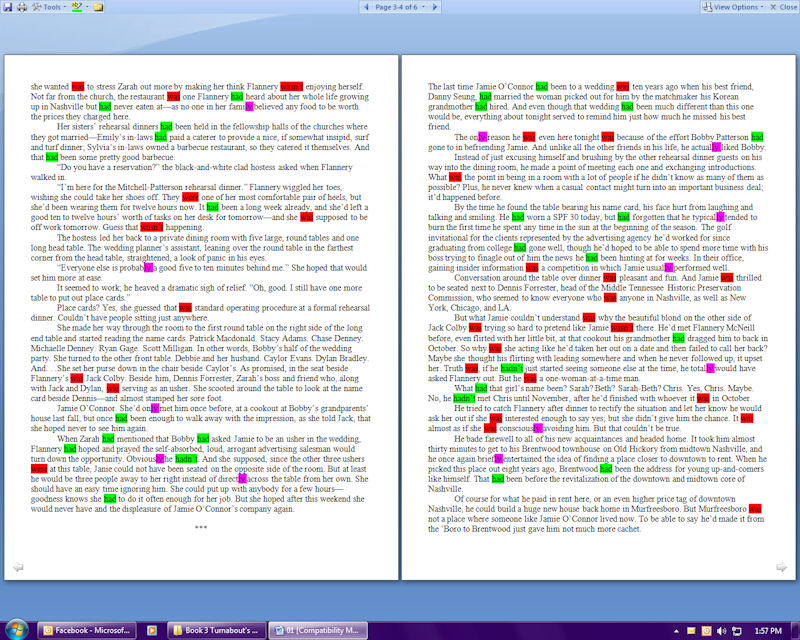
when I highlight all of the wases and hads and adverbs instead of like this:
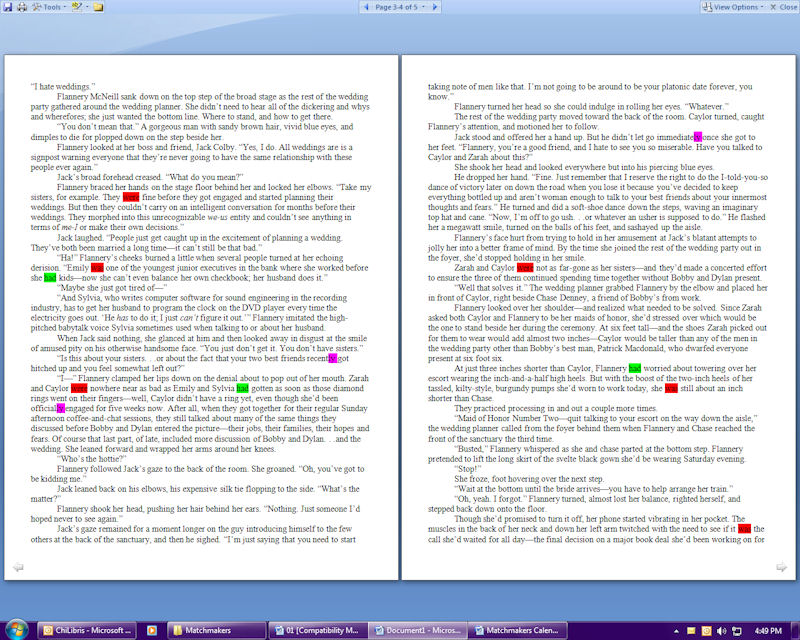
which is how I usually write when I don’t have other authors’ voices echoing in my head (and when I have time to go back and completely rewrite the opening chapter of the book).
Now, that’s not to say that reading fiction can’t be helpful when we’re in the process of writing. Sometimes, we need to lose ourselves in someone else’s world, someone else’s story, for a little while, just to recharge our own creative juices. But maybe that’s a better time to read something outside of your genre, something that isn’t going to seep in to your subconscious and try to become part of your story.
There are a few other problems that can arise if we read too much when we’re writing our first draft.
- Self-doubt—Reading published novels, especially within our genre, when we’re still in the development stage of our story can make us doubt our story, our ability, our craft knowledge (not always a bad thing to be challenged on, no), and even our calling to be writers. I’ve never met a published author who didn’t think, at least once, in the process of writing every single one of his or her novels that it was complete and utter crap and not worthy of the nastiest trash heap known to man. So we don’t need to compound that by, consciously or not, comparing our first draft or story idea to someone’s multiply revised and edited published novel.
- Story idea bleed-over—I can’t imagine that anyone reading this blog would purposely plagiarize someone else’s work. But if we do a lot of reading when we’re in the first-draft of our own novel, we may do it unwittingly and not even realize the idea/turn of phrase came from what we just read.
- There’s nothing new under the sun—Sure, we don’t want to labor over writing a novel only to find out when we come up for air after writing the end that someone else just published a book with the themes/ideas/storyline. But, really, there is nothing new under the sun; and if you do too much reading while you’re writing, you’re going to find most of your ideas for your story already at work in someone else’s story. There have been a few reviewers who’ve criticized the ending of Ransome’s Crossing because it ends similarly to how MaryLu Tyndall’s second Charles Towne Belles book, The Blue Enchantress, ends. As I said, there’s nothing new. . . MaryLu and I are friends, but we never talked about these stories when we were writing them—and even though her book came out right around the time I was finishing writing Ransome’s Crossing, I hadn’t read it when I wrote the ending of RC—the ending I’d envisioned for it more than four years earlier. But if I had read MaryLu’s book before I wrote the ending of Ransome’s Crossing, it might have sent my story crashing down around me, because I wouldn’t have wanted people to think that I was aping what she’d done in her book.
- Just reading, not writing—When I saw that Siri Mitchell’s previous release, She Walks in Beauty, was free on Kindle last week, I decided it was high time to pull out the copy of the book I’ve owned for about a year and finally read it. I read it in two sittings over two days. And while I’m very glad I did, because it’s a great book, there’s a big problem—those were two days I didn’t get anything written on my book which is due on May 1. But that’s what happens when we get enthralled with a book. We’ll sacrifice just about anything to finish it, including writing time.
So, yes—read, read, read. But do it when you’re at a point where you have writer’s block, when you’re creatively stumped, or when you’re in the revision/submission process and not actively composing a first draft.
Have you ever had trouble with another author’s voice getting into your head and affecting your writing? For the non-writers, have you ever picked up a recently published book and felt like the author had copied another author’s writing style/voice? (And, if you’d like, what are you currently reading, and what do you like/not like about that author’s style/voice?)
Writer’s Window–Jill Eileen Smith
Joining us today for Writer’s Window is Biblical-fiction author Jill Eileen Smith.
One lucky commenter* will win a signed copy of Jill’s latest book, Bathsheba. Deadline for leaving a comment to enter the drawing is Friday. To enter the drawing, you must answer the question posed by Jill at the end of the interview. Only one comment per person will count toward the drawing. You do not need to include your e-mail address in the body of your comment—just make sure it’s correct when you sign in to leave your comment. The winning name will be drawn next weekend and announced on the next Writer’s Window post. Congratulations to Brenda Anderson, who won the drawing for last week’s featured book.
- *U.S. residents only, void where prohibited. If you win the drawing, you will be ineligible for the next three drawings, though hopefully you will still come back and join in the discussion.
__________________________________________________________
A single moment changed her life – will she ever regain all she’s lost?
Can love triumph over treachery?
Bathsheba is a woman who longs for love. With her husband away fighting the king’s wars, she battles encroaching loneliness–making it frighteningly easy to succumb to the advances of King David. Will one night of unbridled passion destroy everything she holds dear? Can she find forgiveness at the feet of the Almighty? Or has her sin separated her from God—and David—forever?
With a historian’s sharp eye for detail and a novelist’s creative spirit, Jill Eileen Smith brings to life the passionate and emotional story of David’s most famous—and infamous—wife. You will never read the story of David and Bathsheba in the same way again.
Welcome, Jill!
What do you like best about being a writer?
- I love the actual writing, though sometimes “having written” is less stressful! Telling the stories of my heart and hearing from readers, working with the great people at Revell, and everything that goes into being a writer. It’s my dream career, and I’m living my dream!
What do you like least about being a writer?
- Struggling to figure out the plot of a new story. Some books take constant prayer and research over every single scene! Of course, that’s not a bad thing! I probably like bad reviews the least. 🙂
Pop, Soda, or Coke? What do you call it, and what’s your favorite variety?
- We call it Pop in Michigan, and I don’t drink it. I drink unsweetened tea. I don’t like sugary drinks, but occasionally, I like really good root beer.
What’s your favorite dessert?
- Anything with chocolate! I really don’t have a favorite—there are too many.
What’s the most fun/interesting/crazy/scary/unique hands-on research you’ve done for a book?
- Fun—back when I was still trying to break into publishing I wrote romantic suspense. My heroine loved Starbucks Caffe Mocha, so of course, I had to try one! I didn’t drink coffee at the time, but soon realized I liked it!
Interesting—traveling to Israel to see first hand what I’d envisioned and written about for years.
What’s your favorite movie from childhood?
- The Sound of Music
If you were to write a novel about what your life would have been like if you’d become what you wanted to be at eight years old, what kind of character would the story be about?
- It’s hard to remember back that far! But I would probably have written about horses (as in the Misty stories) or a detective sleuth like Nancy Drew.
What makes you happy?
- Spending time with my family. There is nothing better than talking and laughing with them, and just being together.
What makes you nervous?
- Medical procedures and public speaking!
What’s your biggest dream for the future?
- Unrealistically? Seeing Bathsheba on the silver screen.
Tell us about your newest release and what you’re working on now.
- Bathsheba is my newest release is the third and final book in the Wives of King David series. Sarai, book one in The Wives of the Patriarchs is “in house,” and I’m currently working on book two in that series about Rebekah and Isaac.
Be sure to look for Jill’s previous release, Abigail:
Her days marked by turmoil and faded dreams, Abigail has resigned herself to a life with a man she does not love. When her husband Nabal’s foolish pride angers David and his men, she boldly steps forward to save her family—and David, the would-be king, takes notice.
Circumstances offer Abigail a second chance at happiness with the handsome David, and she takes a leap of faith to join his wandering tribe. But her struggles are far from over. How can she share his love with the other women he insists on marrying?Abigail follows the bestselling Michal and continues Jill Eileen Smith’s rich story of David’s wives.
Where can people find out more about you/connect with you online?
- Personal website: http://www.jilleileensmith.com
Series website: http://www.thewivesofkingdavid.com
Facebook: https://www.facebook.com/pages/Jill-Eileen-Smith/10924241028
Twitter: http://twitter.com/#!/JillEileenSmith
Now it’s your turn to ask the question. What question do you want to ask the commenters to answer?
- Which novel have you enjoyed so much that you would love to see it made into a movie?
__________________________________________________________
 Jill Eileen Smith is the best-selling author of Michal and Abigail, books one and two in The Wives of King David series. She has more than twenty years of writing experience, and her writing has gathered acclaim in several contests. Her research into the lives of David’s wives has taken her from the Bible to Israel, and she particularly enjoys learning how women lived in Old Testament times.
When she isn’t writing, she enjoys spending time with her family; in person, over the webcam, or hopping a plane to fly across the country. She can often be found reading Christian fiction, testing new recipes, grabbing lunch with friends, or snuggling one or both of her two adorable cats. She lives with her family in southeast Michigan.
Fun Friday–Routines Routine
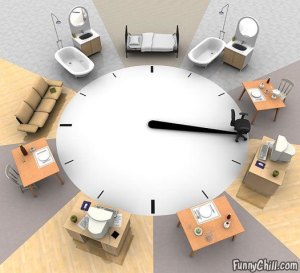 Something that was really hard for me the first few weeks I was in Arkansas—other than having a broken ankle and needing surgery, obviously—was being away from home and, therefore, being unable to go through with all of my routines.
And one of the hardest things about having been home for several weeks now is getting back into those routines once I’d gotten used to a different way of doing things in Arkansas. But next week, I’ve got to get myself back onto a regular schedule—both for work and for everything else—so that I can accomplish what I need to do over the next couple of months. Especially since there is the possibility I might be going back to work (for someone else, no longer freelancing full-time at home) in the near future. So it’s gotten me thinking about how I need to get back into my routines routine. There are the obvious ones that never stopped (brushing my teeth, taking my pills, etc.), and some others were quite easy to pick back up again:
- Friday = laundry day. It also = change the sheets on the bed day. Which means the house smells great all day (I use “Fresh Rain” ALL detergent and “Mountain Spring” Downy fabric softener, and in a small house like mine, with the W/D in the kitchen, the fragrance permeates the whole place).
- Every other Saturday is a Middle Tennessee Christian Writers meeting, one at which I present a workshop (our public meetings) and one which is laid back and open agenda (our members-only meeting). It gets me out and about and face-to-face with people, which I really look forward to.
- Sunday, of course, means church. And on the first Sunday of each month, it’s the added bonus of Communion during service and the First Sunday lunch for my Sunday school class. So first Sundays, like this week, are special.
Some, however, are taking a little bit longer to build back into habits:
- I need to get up at the same time every morning—not allow myself to sleep in whenever I want to and stay up until the early morning hours whenever I want to.
- Once I’m up, I need to have breakfast and then go to the gym to walk on the treadmill to start getting my ankle reconditioned even faster so that I can move on to other forms of exercise. (Daily)
- I need to limit the time I allow myself for e-mail, blogs, and Facebook throughout the day. While social media is part of my job, I’ve allowed that to become an excuse to be on that far too long every day, limiting my productivity—or forcing me to stay up all night to get my work done because I didn’t get it done during the day.
- With five rooms in my house (kitchen, living room, bathroom, and two bedrooms), I need to spend twenty to thirty minutes cleaning one room each day.
- I need to work outside of the house at least one day each week, just to get out and be around people and have a change of scenery. (Of course, if I do end up going back to work full-time, this won’t be an issue anymore—then it’ll be a chore to get me out of the house at all once I get home at night!)
- I want to start sending a message of encouragement, praise, or warm thoughts to friends and family—at least one person each day. Living alone and working at home has allowed me to become far too insular, so making myself think of someone else and write to them will help me break out of that isolated, somewhat self-centered mindset.
- I want to read at least one novel each month for fun. Especially now that I have my Kindle with a bunch of content loaded on it. I know one novel a month doesn’t sound like much to most of you, but when you spend so much time with words the way I do (both writing and editing), reading just doesn’t relax me the way it used to. But this is something I need to do, not only to exercise different parts of my brain, but also to help with my own writing/storytelling abilities.
- I need to rejoin Weight Watchers and get back into all of my routines associated with losing weight—going to meetings, reporting my weight on my other blog weekly, activity tracking, and planning out my meals for the week on Sunday afternoon before going to WW and then to the grocery store afterward.
And that’s just the tip of the iceburg. My life is so much easier, so much calmer and more joyful when I’m living on a schedule with all of my routines in place.
What is your routines routine? What are some routines you must have in place to keep from going stir crazy from the chaos?
Thursday Thought Provoker
March “Maid”ness
It’s a new month . . . which means it must be time for a new contest!
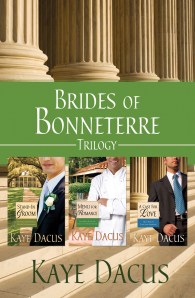
During the month of March, I’m going to be running a contest in which five people will win a signed copy of the Brides of Bonneterre 3-in-1 omnibus when it releases in May.
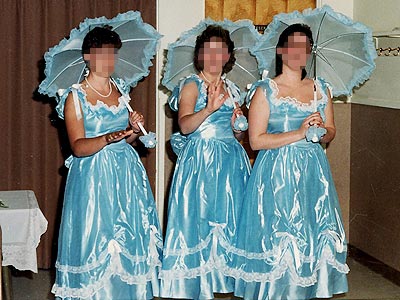
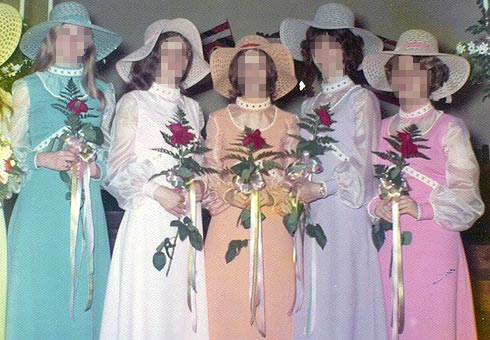
This is a WRITING contest—to enter, you must submit a story about the funniest and/or worst experience you’ve ever had as a bridesmaid or maid of honor in a wedding (if you don’t have a real one, you can make one up or use someone else’s). The only restriction is that it cannot have happened at your own wedding.
- I am the sole author and proprietor of this work of nonfiction (or fiction). The work is original and not in the public domain and has not been previously published in any form without notice of copyright as required by United States law. By granting Kaye Dacus permission to publish this on http://kayedacus.com, I warrant that no copyrights or proprietary rights of any third-party will be infringed upon.
Submissions without the release statement will not be entered in the contest.
I’ll be posting the stories here between Tuesday, March 22, through Friday, March 25, (a few a day, if I get enough entries) and allowing the blog’s readers to vote on them that weekend, Saturday March 26 and Sunday March 27 (anonymous voting through a poll which will close at midnight Sunday night).
The top five vote-getters will win a signed copy of The Brides of Bonneterre 3-in-1, and the winners will be announced on Friday, April 1, 2011.
Deadline for entering is 11:59 p.m. Central time Saturday, March 19, 2011. E-mail your entry to kaye (at) kayedacus (dot) com with the subject line of your e-mail as MARCH MAIDNESS ENTRY.
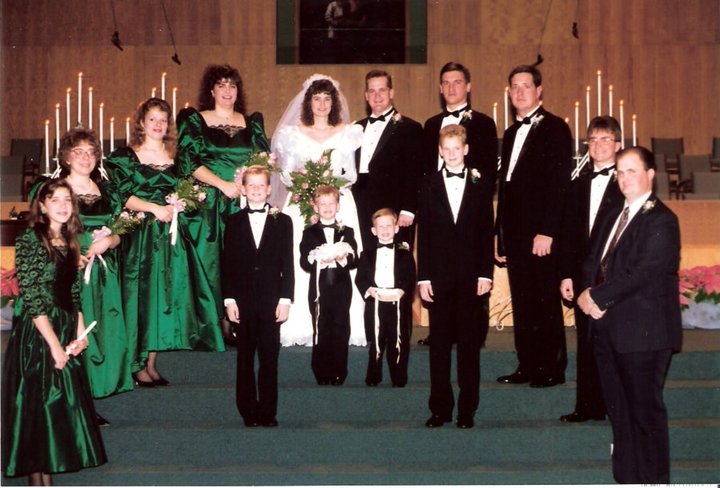
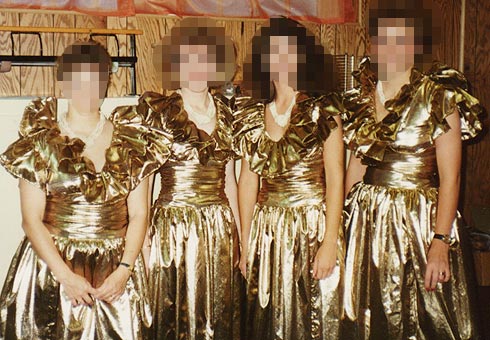
- The photo at the top is from my sister’s wedding in 1992—the only wedding I’ve ever been in (yes, that’s me, directly to the bride’s right). The other photos were found on TackyWeddings.com, which you really need to check out for a good laugh/walk down memory lane.
Writer’s Window–Maureen Lang
Joining us today for Writer’s Window is historical romance author Maureen Lang.
One lucky commenter* will win a signed copy of Maureen’s latest book, Springtime of the Spirit. Deadline for leaving a comment to enter the drawing is Friday. To enter the drawing, you must answer the question posed by Maureen at the end of the interview. Only one comment per person will count toward the drawing. You do not need to include your e-mail address in the body of your comment—just make sure it’s correct when you sign in to leave your comment. The winning name will be drawn and announced on Sunday.
- *U.S. residents only, void where prohibited. If you win the drawing, you will be ineligible for the next three drawings, though hopefully you will still come back and join in the discussion.
__________________________________________________________
By the fall of 1918, the Great War has ended and the world is at peace, but there is little to celebrate in Germany. After four years of fighting for his homeland, Christophe Brecht returns to find there is little left of what he once called home. So when family friends ask him to travel to Munich to bring back their runaway daughter, Christophe agrees.
When he finally locates Annaliese Duray, he discovers she is far different from the girl he once knew. Headstrong, idealistic, and beautiful, she is on the front lines of the city’s political scene, fighting to give women and working-class citizens a voice in Germany’s new government.
As the political upheaval ignites in Munich, so does the attraction between Annaliese and Christophe. With an army from Berlin threatening to squash everything Annaliese has worked for, both she and Christophe are forced to choose between love and loyalty.
Welcome, Maureen!
What do you like best about being a writer?
- I love writing! There’s nothing else like indulging my imagination, getting to research other times and places and making up some extraordinary circumstances for people far more fascinating than I am. Writing a story is like putting together little pieces that—hopefully—will fit like a puzzle.
What do you like least about being a writer?
- Worrying about marketing and doing the business end of things (making sense of a royalty statement is like trying to read hieroglyphics). I write stories because that’s my creative outlet, and somewhere along the way I thought it only made sense to share those stories with others. Getting published kicked in the business side, and that’s just not one of my strengths.
Pop, Soda, or Coke? What do you call it, and what’s your favorite variety?
- I’m from the Chicago area, born and bred, and around here we call it “pop.” Although I must admit my cosmopolitan daughter calls it “soda” in spite of my training. My favorite variety is caffeine free Diet Coke, especially with pizza.
What’s your favorite dessert?
- Oh, goodness, do I only get to name one? I love sweets! But if I can only name one, I love, absolutely love, cookies. Just as long as they don’t contain coconut…
What’s the most fun/interesting/crazy/scary/unique hands-on research you’ve done for a book?
- My best memory for researching a novel was going to Belgium and Northern France for books one and two of my Great War Series (Look to the East and Whisper on the Wind). Walking along the same old streets my characters would have walked was amazingly fun, imagining them during the German occupation of Brussels. In Northern France, my husband and I were given explicit directions to find a very small plaque commemorating the spot where an English captive was shot (who, at least in part, inspired my hero in Look to the East). We felt like we were on a treasure hunt, because it was in a very rural area and not on any tourist maps. We did find it, but I must say the journey getting there was as much fun as anything else!
What’s your favorite movie from childhood?
- Oh, no! This is another one of those questions where I can hardly stop myself from naming more than one. My husband is always teasing me about having twenty movies on my Top Ten list. But choosing one from childhood does narrow it down. I loved the Wizard of Oz, of course, who didn’t? I think my all-time favorite movie when I was a little girl was Sleeping Beauty, the Disney version. I loved everything about it!
If you were to write a novel about what your life would have been like if you’d become what you wanted to be at eight years old, what kind of character would the story be about?
- I’m afraid I have a very predictable answer, because even at eight years old I wanted to be a writer. So although I would have changed quite a bit of things in other areas of my life, it would still be about a woman who wanted to tell stores. Like me.
What makes you happy?
- When stories start to take shape and characters start acting out things I haven’t told them to do.
What makes you nervous?
- Believe it or not, starting a story. Every time I finish a book that I love, I wonder where it came from and am fairly convinced I could never do it again. It isn’t until I’m about 100 pages or more into a story that the fun really starts, when I know the plot/era/characters well enough to see it slip beyond my control and let the story tell itself.
What’s your biggest dream for the future?
- Getting to tell more stories, to find security in the thought of being a writer. This is a business with too little of that, so I’d like to feel like the market and my muse won’t desert me if I blink.
Tell us about your newest release and what you’re working on now.
- My newest release is Springtime of the Spirit (featured at the top of the interview).
And what I’m working on now? It’s quite different from the serious tone of wartime Europe, as my last three books have been. My settings have come home to America. I decided I wanted to go in a more fun, more light-hearted and romantic direction. The story I’m working on now is set in New York City, 1881, and is about a thief and the woman who wants to join him in his “adventures” — until the Lord catches both of their hearts.
Maureen’s second book in The Great War series, Whisper on the Wind, is currently available for free download on Kindle and Nook (and if you click on the book cover image below, it’ll take you to ChristianBook.com where there are even more e-reader options for downloading it). If you download it, please be sure to post reviews of it on all those sites to encourage others to read it!
In Brussels at the height of WWI, a small, underground newspaper is the only thing offering the occupied city hope—and real news of the war. The paper may be a small whisper amid the shouts of the German army, but Edward Kirkland will do anything to keep it in print. Meanwhile, Isa Lassone, a Belgian-American socialite whose parents whisked her to safety at the start of the war, sneaks back into the country to rescue those dearest to her: Edward and his mother. But Edward refuses to go, and soon Isa is drawn into his secret life printing the newspaper . . . and into his heart.
Where can people find out more about you/connect with you online?
Now it’s your turn to ask the question. What question do you want to ask the commenters to answer?
- Do you peek at the ending of books you read?
__________________________________________________________
 Maureen Lang is the award-winning author of several novels, including The Oak Leaves, On Sparrow Hill, and most recently, The Great War series. She has won the Inspirational Readers Choice Contest and a Holt Medallion Award of Merit and was a finalist for the Christy Award. Maureen lives in the Midwest with her husband and three children.

 KayeDacus.com