Fun Friday–My Virtual Summer Vacation: Going Deutsch

Well, I’m keeping it Continental this week. I figured since I was in the neighborhood, after visiting Salzburg last week, I’d visit one of the places I’ve been wanting to go for more than twenty years—again, dating back to taking German (Deutsch) in high school.
Bayern, Deutschland (Bavaria, Germany)
 (I would usually have a video here, but I can’t find one that’s specific to the few locations I’m visiting today—and that’s in English.) I am limiting myself not just to one specific region of Germany, but to only a few specific towns/sites in that region. (Otherwise, this post would have gone on and on and on and on. It’s going to be pretty long as it is!) For my sojourn in Germany, I’ve decided that I’m going to take advantage of one of the unique aspects of holidaymaking in Europe—staying in a castle.
Burg Rabenstein
This is where I’ll be staying on this leg of my vacation. Mentioned historically as far back as the twelfth century, Rabenstein underwent a full renovation in the 1830s into Rococo style. With a nearby Celtic-style village to explore, can it get more authentic than this? (Click the image to view the slideshow in a new tab/window.)

Bamberg/Oberfranken
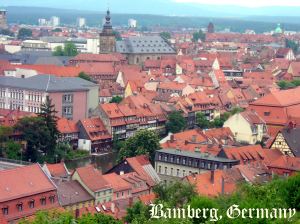
My first excursion will be to the city of Bamberg, located in Upper Franconia (Oberfranken). Bamberg dates back to the early twelfth century and sits on the river Regnitz, near its confluence with the river Main. Unlike most cities in Germany, Bamberg did not suffer damage from the American and British bombings during World War II because of cover fire from a nearby artillery factory that kept the bombers from flying into the area.
Bamberg is considered the German twin of Rome, as it’s situated in seven hills: Domberg (lit. “Cathedral Hill”—where the Cathedral and Neue Residenz are located), Michaelsberg (location of St. Michael’s Abbey—a former Benedictine monastery), Kaulberg/Obere Pfarre, Stephansberg (Stephanskirche is the main Protestant church in Bamberg), Jakobsberg (site of Jakobskirche, second oldest church in the city), Altenberger Berg (the highest of the seven and site to the Altenberger Castle), and Abtsberg (which used to belong to St. Michael’s Abbey). So of course, I’ll be touring the town, along with the Altenberg, Neue Residenz (bishop’s palace) and the Domplatz (cathedral square), Ehemalige Benediktinerabtei und Klosterkirche Sankt Michael (the Benedictine Abbey and Cloister of St. Michael), Altes Rathaus (old townhall), and Fischerhäuser von Klein-Venedig (the fishing village of Little Venice). And, of course, I’ll hit the Markt (market), a cafe or two, and stuff myself on local fare. (Click the photo to view the slideshow in a new tab/window.)
Nürnberg (Nuremberg)
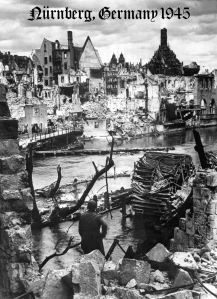
Though this city is famous for its ties to World War II and the Nazis, that’s not the aspect of this lovely town I’ll be focusing on. Predating Bamberg, Nürnberg was settled in the early eleventh century, and sat on a key trade route, on both the Pegnitz and the Rhine–Main–Danube Canal (dating from the 10th century, thanks to Charlemagne). Because of this, it became the “unofficial capital of the Holy Roman Empire.” And then because of that, the Nazi Party chose it as the site of what are now known as the Nuremberg Rallies in the 1930s. . .and lots of other stuff.
On January 2, 1945, British and American bombers strategically bombarded the medieval town center, destroying about 90% of it in about one hour. After the war, though, the residents painstakingly rebuilt the city—including many of its medieval and other historical buildings. So we’ll be seeing many of those buildings on our tour. We’ll also be seeing the old city wall fortifications, the Nürnberger Burg (Nuremberg Castle), Tiergärtnertor Platz (the main town square), Sebalduskirche (St. Sebaldus Church), Henkersteg (Hangman’s Bridge), and the Heilig Geist Spital (literally, Holy Ghost Hospital, but officially, Hospice of the Holy Spirit). Let’s visit Nürnberg! (Click the photo to view the slideshow in a new tab/window.)
Bayerische Schlösser (Bavarian castles)
Here’s where I start to fast-forward through Bavaria—there are so many places I don’t have time to visit: Augsburg, Würzburg, Regensburg, Ingolstadt, München (Munich), Ammersee—and I don’t even have room to list all of the other places outside of Bavaria I’d like to see in Germany! But I can’t visit Germany without visiting some castles! In Bavaria, we’re going to see Blutenburg, Brennhausen, Burghausen, Elmau, Hoheneck, Irmelshausen, Johannisburg, Linderhof, and, of course, Rosenau—the birthplace and childhood home of Prince Albert of Saxe-Coburg and Gotha, consort to Queen Victoria. (Click the photo to view the slideshow in a new tab/window.)

What—you thought I’d forget the two most famous castles in all of Germany?
Schwangau
Schloss Hohenschwangau (High Swan County Palace) was built in the nineteeth century by King Maximilian II of Bavaria and was the childhood home of King Ludwig II. It’s located above the village of Schwangau near the town of Füssen in southwestern Bavaria, not far from the Austrian border. It was built on the remains of Festung Schwanstein, a twelfth century fortress, which had fallen into ruins by the nineteenth century. In 1829, Maximilian, then Crown Prince, discovered the ruins on a walking tour and acquired the property in 1832 due to its beautiful aspect. Construction of the new castle began in 1833 and continued until 1837—with continual additions until 1855. It became the official summer residence and hunting “lodge” of Maximilian and Queen Marie (who created the gardens with plants from all over the Alpine region). Maximilian died in 1864, and Ludwig became king. As he was unmarried, he moved in to Hohenschwangau to live with his mother until his own castle was finished.
Schloss Neuschwanstein (New Schwanstein Castle) sits even higher over Schwangau than Hohenschwangau. It’s built in the Gothic revival style, commissioned by Ludwig II and in inspired by Ludwig’s almost obsessive love of Richard Wagner’s operas and his overly romantic ideals of medieval times and architecture. It was built as the reclusive Ludwig’s personal retreat. It was built on the site of two other castle ruins that had overlooked Schwangau in medieval times. Ludwig had become familiar with these additional ruins during hiking excursions from Hohenschwangau—he even sketched them in his diary in 1859. When he came to power in 1864, construction of Newschwanstein began. Though contemporary architecture critics derided the design as kitsch, the castle is now considered one of the major works of historical architecture in Europe.
Let’s see our two swan-y castles. (Click the photo to view the slideshow in a new tab/window.)

Where are you heading on your virtual vacation this week?
Comments are closed.


A little explanation of German:
Festung = a fortress for military and defensive purposes
Burg = a fortified castle meant for both living and defensive purposes
Schloss = a palace or castle meant for luxurious living
Someone who’s more of an expert than I will probably correct me on these connotations, but that’s what I remember of these words from more than twenty years ago.
LikeLike
Oh, and burg is a building while berg is a hill. Isn’t German fun?
LikeLike
Wow, does this post ever bring back memories for me, Kaye. My hubby and I lived in Bavaria/Bayern in a little village outside Fürth by Nürnberg from 1989-1993. Gwynly was teaching the dependents of U.S. Army personnel at the Nürnberg American High School. Our daughter was born in a German hospital just two blocks from the Nürnberg castle. We lived in Germany during the time when the Wall fell and the country was reunified, and when a huge portion of the soldiers in our area were sent to the first Gulf War. Talk about witnessing history up close and personal.
I hope you are able to tour Bayern someday. It’s an incredible place, and the people are wunderbar. =)
LikeLike
I never really thought much about that part of the world as a tourist destination until the first time I saw “The Sound of Music,” and then the first few episodes of the second season of “Scarecrow and Mrs. King.” I nearly wore out the VHS copies I made of those episodes! Beautiful tour, Kaye!
LikeLike
If I were to go to Germany, it would be in October to do the Frankenstein tours. For starters. Then I’d hope all over the country seeing stuff. My dad wants to go over during Oktoberfest.
I’m off to Copenhagen this week. Hans Christian Andersen specifically, and the statue of The Little Mermaid.
LikeLike