Social Media Marketing for Authors: How Much Is Too Much?

Image from socialmediainbusiness.com
No statistics. No experts.
Let’s chat about authors using social media to market their books.
As an author, how much do you use social media as a marketing tool?
As a reader, at what point do you unfriend/unfollow an author because it seems like all they ever do is use social media to shill for their latest project?
Let’s look at social media across the board, but focus especially on Facebook, Twitter, and Pinterest, as these are the three largest. Let’s be honest, but remember not to bash any authors by name and to keep our discourse here civil.
What Are You Reading? (April 2013)

It’s the first Monday of the month. So I hope you have your lists ready!
.
- What book(s) did you finish reading (or listening to) since last month’s update?
- What are you currently reading and/or listening to?
- What’s the next book on your To Be Read stack/list?
~~~~~~~~~~~~~~~~~~~~~~~
Since the March 2013 update, I’ve finished . . .
- A Cast of Stones by Patrick W. Carr. (4.5 stars, click title for more info)
- The Six Wives of Henry VIII by Alison Weir. Audiobook read by Simon Prebble. (4 stars, click title for more info)
- Outlander by Diana Gabaldon. Audiobook read by Davina Porter. (1 star/DNF, click title for more info)
- The Hunger Games by Suzanne Collins. (re-read, click title for more info)
I’m currently reading . . .
- Lord of Darkness (Maiden Lane Book 5) by Elizabeth Hoyt.
Currently waiting to be read . . .
-
I have a strong urge to read . . . nothing right now. It may be time to raid my bookshelves for an old favorite or two.
Planning for the Future—Future Books to Write, That Is
Even though I’m struggling with my wordcount on An Honest Heart (I promise I WILL catch up!), I’ve started thinking about what I might write after I finish that book. And it started with an inventory of characters and story ideas I’ve already had, spun off from my existing series.
Bonneterre, Louisiana
 People who’ve read the Brides of Bonneterre series (Stand-In Groom, Menu for Romance, A Case for Love) have long clamored for me to tell at least one more story in this world: that of Jennifer (Jenn) Guidry, Meredith and Forbes’s next-younger sister, owner of the Fishin’ Shack restaurant in Comeaux, and Mere and Anne’s former housemate.
Then, last year, I came up with the Five Golden Rings story idea, for which I decided Bonneterre would be the perfect setting.
I started developing the setting that would become Bonneterre in the early 1990s, so it’s really hard for me to stay away from it. I never realized how much I could love a fictional place!
.
The Matchmakers
I knew as soon as I introduced these three guys (the younger brothers of hero Dylan Bradley in The Art of Romance) that they had extreme spinoff potential:

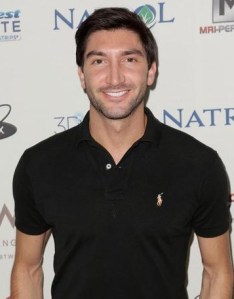

Paxton “Pax” Bradley (David Alpay), Spencer Bradley (Evan Lysacek), and Tyler Bradley (Christopher Mintz-Plasse).
.
And many of you have let me know that you’re interested in their stories as well. But I’ve also been thinking a lot about Caylor’s younger sister, Sage. She really started making a turnaround there at the end of The Art of Romance, and I’d love to see where it takes her.
.
The Ransome Trilogy
I’ve actually already written a proposal (complete with story synopses) for what I was calling The Pembroke Trilogy—a “next-gen” sequel series to the Ransome books. Unfortunately (or fortunately, depending on how you look at it), the proposal didn’t sell—but it did lead me to coming up with the idea for The Great Exhibition series.
Opening in 1849, The Pembroke Trilogy follows Richard Grayson Pembroke, son of Sir Drake Pembroke, Baronet, as he is forced to try to exact his father’s revenge stemming from a grudge held longer than Gray has been alive. At his father’s behest, Gray travels to Jamaica as Richard Grayson to become steward at the Tierra Dulce sugar plantation. There, he meets Julia Ransome, the woman his father blames for everything that has gone wrong in his life, including the Pembrokes’ financial woes which forced Gray to leave Cambridge before completing his studies.
Life at Tierra Dulce, however, shows Gray that his father might not have been honest with him about the woman who, in a few short months, becomes more mother to Gray than his own. And then there’s the Ransomes’ youngest daughter, Margaret—the girl who is the key to Gray’s father’s plan for revenge. Will Gray’s loyalty to his father overcome his budding feelings for the people his father raised him to believe were their enemies?

The titles I came up with for the books in this trilogy are: Pembroke’s Intrigue, Pembroke’s Persuasion, and Pembroke’s Redemption.
I came up with that proposal while I was writing Ransome’s Quest. And in the process of writing RQ, I realized I had additional characters who might, someday, need their own prequel/parallel series to the Ransome books: Salvador, Serena, and Declan. Of course, there are also William and Charlotte Ransome’s brothers, James and Philip. James, with his role in RQ, already has a great backstory to build from!
.
The Great Exhibition Series
Yes, I do already have sequel/spinoff ideas for this series—There’s Mrs. Headington’s Home for Wayward Women. A possible late-life romance for Kate and Christopher’s uncle from Follow the Heart. Romances for their cousins Dorcas and Florie. Then, in An Honest Heart there are several younger characters who could transition into a series (The Seamstresses of Oxford???) set in the 1860s. I even have an inroad to taking a novel to 1860s Australia! Oh, and with a niece and nephew and a school for young women featured in The Heart That Waits, it’s also rife with spinoff/sequel possibilities.
.
Non-Sequels/Spinoffs
And if those weren’t enough, I’ve got several other ideas I’ve been germinating for a couple of years. A time-travel romance (featuring Karl Urban as the hero!!!). An epic sci-fi action/adventure (featuring Oded Fehr as one of the *multiple* heroes, along with Sasha Roiz and Jeremy Renner). Then there’s a fantasy idea that I built off of a dream from a couple of years ago. I also have a couple of contemporary romance trilogy proposals that I’ve written over the years which never got picked up that I could go back to.
Then there’s the idea for the Civil War-era story that began with a young soldier “speaking” to me in my sleep one night a couple of years ago:
- “I couldn’t believe it. General Grant saluted me. Well, I’d immediately snapped my hand to the bill of my hat upon seeing him, so, really, General Grant was *returning* my salute.
General Grant. The Scourge of the South. The Butcher of Vicksburg.
General Grant–now president of the United States. The country I’d been taught to hate as a child. General Grant. The man I’d been hired to kill.”
.
What Will I Write Next?
So what will I write next? I have NO CLUE. All I know is that I’m looking forward to meeting new characters and telling new stories.
.
For Writers: When you finish a story/series, how do you decide what to write next (aside from “whatever I have on contract,” for those who are published). How many stories do you usually have going (writing-wise) at a time?
For Readers: Do you read series? Do you ever get burned out on series—as in, thinking the author should have quit while she was ahead? Are there certain books/series you wish had been continued but weren’t? Have you ever written “fan fiction” stories to satisfy your own desire to have additional stories set in some of your favorite authors’ worlds? (I have! That’s how I got started writing in the first place!)
Wordless Wednesday: Let the Earth Declare the Glory

Cheile Carasului—Banat, western Romania
.
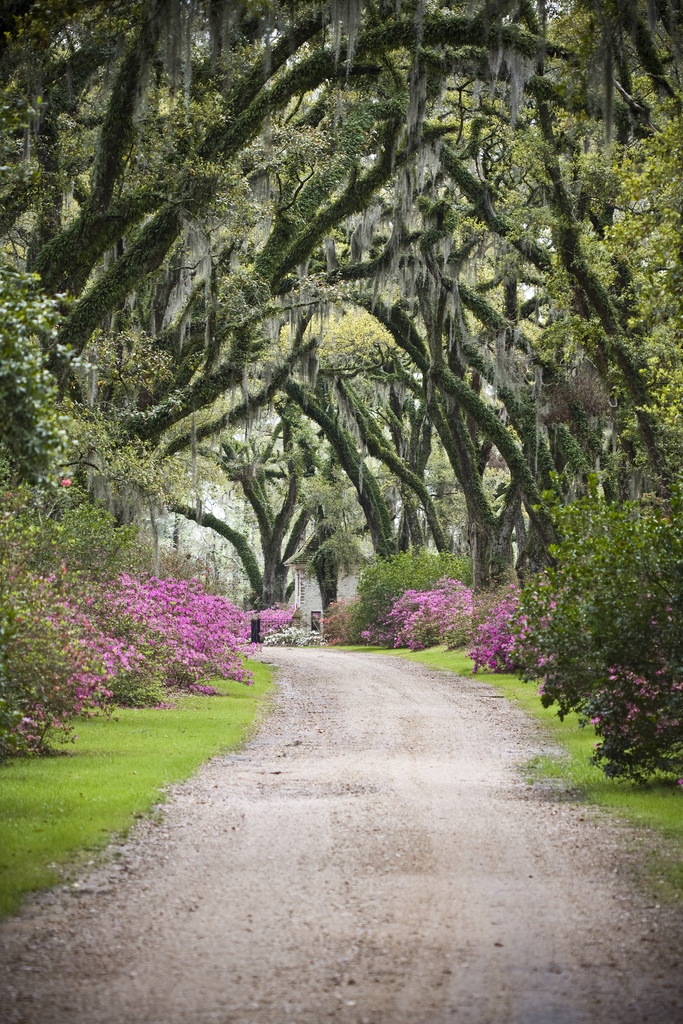
Afton Villa Gardens, St. Francisville, Louisiana (by Oivanki)
.

Plitvice, Croatia
.

“Crescent Dawn” Organ Mountains, New Mexico
Jeffrey Murray Photography
.
A Love Affair with the Library
When I was a teenager, I loved the Sunfire romance novels. Those written by Willo Davis Roberts (especially Victoria and Caroline) were my all-time favorites. Which led me to . . .
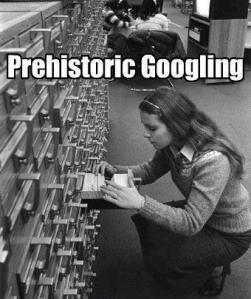
I wanted to read more books by this author, and a couple of decades ago, the card catalog was the only way to discover what else she might have written. The only limitation was that it had to be something that our public library (and we’re talking the Thomas Branigan Memorial Library in Las Cruces, NM) actually owned.
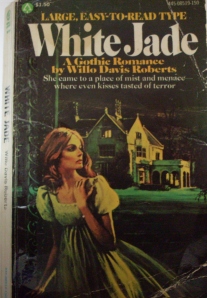
That was when I discovered what would become my favorite YA novel of all time. White Jade, by WDR, is a YA gothic romance set in the late 1800s in northern California. Yes, you read that right. A gothic romance set in NoCal.
 This was back in the day when library books actually had cards in them that recorded the library-card number of each person who checked the book out and when. And after a year or two, my number filled at least half the lines on that card. By the time I graduated from high school, I’d read that book twenty or thirty times since discovering it two years before.
And then I moved away. I went to college. I fell in love with other authors, other stories. I started reading more adult fiction (and being forced to read “literature” as an English major—thank goodness for Cliff’s Notes!). But I never forgot about White Jade. But no library in Baton Rouge, or later in Northern Virginia, had a copy of that book. Because I’d loved it so much, I assumed it must be an extremely well-known/popular book that I’d be able to find anywhere I looked.
Not so.
I resigned myself to never being able to find it again.
Enter the Internet Age
In the early 2000s, after I was already a confirmed Amazon customer, they started allowing people to sell used/old books through their site. And there were other websites that focused solely on the sale of used books. (Don’t get me, as an author, started on the ethical/legal issues surrounding re-selling books. As a reader, I’ve made use of this more times than I care to admit, but I do try to limit it to out-of-print titles that can’t be acquired any other way.)
Once I discovered old/used books for sale on the internet, I decided, out of curiosity, to look up some old favorites. I filled out a few missing spots in my Sunfire Romance collection. And once I was thinking about those books, I decided to try to find that one book, my elusive unicorn, that I’d fallen in love with through the library so many years before.
Jackpot! I found a used (mediocre condition, as you can see in my photo of it above) paperback copy of the book on sale for $1.99. I didn’t care that the shipping cost was twice that much. I would have paid just about anything for that book. Besides, even if I’d been able to purchase it new when I first discovered it, the book would probably have been in about that same condition by this time.
Now I owned the book that had been the one that almost got away—the one which cemented my love and reverence for the institution of the public library. Every year when I pick up that book to read, it reminds me of those cozy hours spent in a chair hidden in the stacks perusing books and trying to decide which few I could take home this time.
If it hadn’t been for the PUBLIC LIBRARY . . .
If it hadn’t been for the public library, I never would have discovered all of the stories/authors I did throughout my life. I now make use more of the e-book lending program through the Nashville public library system (no pickups/returns, no late fees). I’m about to take a crate of DVDs and books-on-cassette and another of books to donate to the library due to my spring cleaning/organizing efforts. Whether they sell them all or put them into circulation doesn’t matter to me—in one way or the other, I feel like I’m giving a little something back to the institution that nurtured and fed my desire for a life beyond my own experience/existence.
What’s your favorite book/author you discovered at the LIBRARY? Tell us about your love affair with the basilica of books.
Book-Talk Monday: Biblical Fiction
Open Book by Dave Dugdale
Since it’s Holy Week, let’s turn our focus to Biblical fiction.
Name up to five of your favorite titles of Biblical fiction.
It can be novelizations of actual events/people from the Bible, or it can be 100% fiction but set during Biblical times/events. Let’s get some discussion going!
(For the sake of clarification: we’re discussing fiction actually set during Bible times—any novels that are set during the time of the Old or New Testaments, whether it’s a re-telling of one of the stories from the Bible or just set during that time.)
Fun Friday–some fun Q&As (My questions, your answers!)

1. If there were no internet, what would be your biggest “time waster”?
.
2. If you could choose any musician/music group in the world to perform at your birthday party, who would it be and what one song would you require them to play at least three times during the event?
.
3. What ONE event in your own country’s history would you like to go back to witness for yourself?
.
4. If you had no responsibilities or obligations this weekend, how would you spend it?
.
5. What’s your dream vacation spot?
Six Weeks to Release Day and Counting! Want to Help Me Promote the Book?
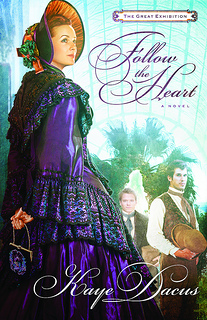 I’m starting to get really excited about the upcoming release of Follow the Heart, book 1 of The Great Exhibition series with B&H publishing.
Set in Oxford, England, in 1851, Follow the Heart is a stand-alone historical romance. Katharine Dearing, an American whose father has lost the family fortune, is sent to England to marry wealth, but finds herself torn between the poor man she thinks she’s falling in love with and the viscount who offers the wealth and stability that can save her family. Will she fulfill her family’s mandate to marry money or will she follow her heart?
The Great Exhibition series fits in with my contemporary series (The Brides of Bonneterre and The Matchmakers series) for being light-hearted, stand-alone novels which are tied together with recurring characters and a comfortable and familiar yet unique setting. These books will also sit well beside The Ransome Trilogy as historical romances that fully immerse readers in the language, fashion, and details of the historical era. And each book fulfills my promise of “Humor, Hope, and Happily Ever Afters” that readers have come to expect.
If you are interested in reading an advance digital ARC of Follow the Heart for review, please let me know and I can send you that information.
If you would be interested in featuring the book on or around its release date of May 1, 2013, with a blurb or interview with me, I can send you a document containing a bunch of questions/answers—or feel free to send me your own questions. The document contains links to the book cover and my headshot, along with the back cover copy, my bio, and other information about the book and about me.
I’d love to hear back from you if you’d be willing to help spread the word about my new release.
Thank you!
Wordless Wednesday: I has happy feels
SCENE IT! Visualizing Your Story One Scene at a Time (Scene Cards)
I’ve talked about this many times, both in workshops and here on the blog, but it’s always worth repeating. Think about adding the use of scene cards and/or storyboarding to your writer’s toolbox. Play around until you find a method that works for you, then use it—both as you’re writing your first draft and as you’re in the revision process. There are different uses for scene cards and storyboards in both processes, and I want to focus more on scene cards in this post.
What are scene cards?
Scene “cards” are a method of breaking your story down scene by scene in a manner that is both visual and adaptable. They can be anything from Post-it Notes or index cards to PowerPoint Slides or virtual Index Cards in writing software. The form isn’t as important as the function. I suggest going with what’s easiest/most comfortable for you. You don’t have to invest in/learn new software to do this (though if you’re like me and you have fun playing with software, you might find something that works better than a currently comfortable method). Use materials/software at hand and organize them in a way that makes most sense to YOU.
Using scene cards while writing the FIRST DRAFT
In the past four or five years, when I’ve sat down to start writing a novel, I’m doing so from a slightly more advanced stage of story planning than I used to do—because the books I’m writing are those I sold off of long synopses. And while the synopsis for a given story will give the full plot and some key scenes, it doesn’t contain everything—not always even the specifics of the opening scenes.
So when I get about 10k to 20k into the story (or past the character introductions/inciting incident), I usually founder a bit. That’s when I pull out my handy-dandy colored Post-it Notes.

I color-code my scene cards by viewpoint character and arrange them by chapter. In the above example, there are two groupings: those in the top group represent what was already written (in my first draft of Ransome’s Crossing—yes, this is an old photo that has been featured here many times) and those in the bottom group representing scenes I knew I needed based on what I’d written (sequel/consequence scenes) and those already planned, pulled from the synopsis.
When I was working from home and doing most of my writing there, this method worked quite well for me—because all I had to do was turn my desk chair around and look over those cards to refresh my memory of what to write next or what scene/conflict I needed to build toward.
Once I started working outside the house again (first part-time, now full-time), I tend not to write at home as much—I bring my laptop to work or meet writing friends elsewhere after work or on the weekends. Or, sometimes, I may go to Panera or another coffee shop to write on my own. So, I tried sticking with the Post-it Note system but making it virtual:

But . . . that was a program I had to remember to start up, and my 14-inch laptop screen will only hold so many. It was a good way to keep track of/make note of ideas that sprung up while writing, but, then, what if I switched over to the desktop computer once I was home?
With the current WIP (The Heart That Waits) I decided to go back to a method I haven’t used since Ransome’s Honor: PowerPoint Scene Cards:
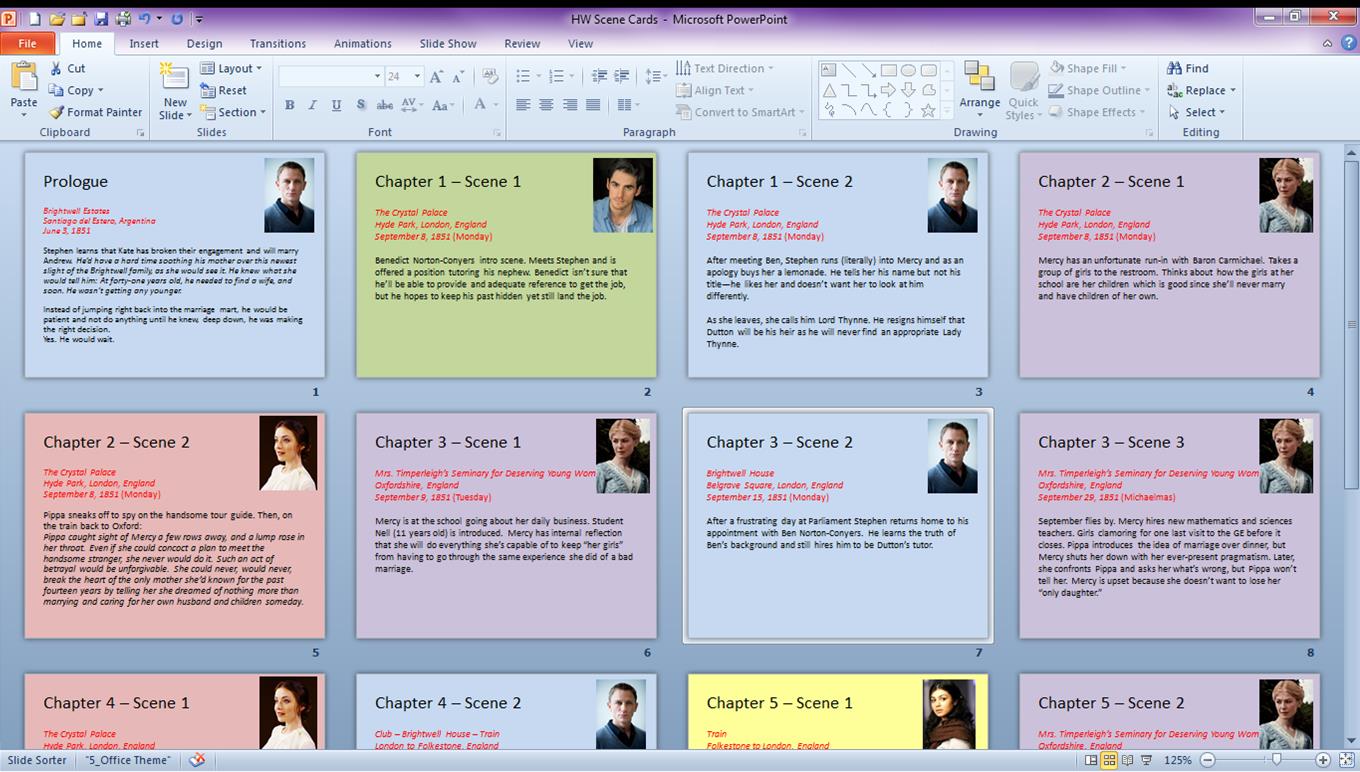
As if color-coding the “cards” by POV character weren’t enough, in PPT, I can include an image of the character, just in case I forget which color is which character. Each “card” includes the setting (red text) and a summary of what happens in that scene.
Using scene cards in the REVISION process
One of the great advantages of scene cards while writing is that it helps you figure out if each scene moves the story forward, has all the elements it needs, and ends with something that will keep the reader turning pages. It also gives you a thumbnail glimpse (sometimes literally!) of what you’ve already written so that you don’t repeat scenes and so that you remember to follow up with sequels/consequences. Color-coding by POV character lets you see if you have a good balance of viewpoints from your main characters—and to make sure that you aren’t getting stuck into a repetitive pattern of his POV, her POV; his POV, her POV; his POV, her POV; his POV, her POV; his POV, her POV; his POV, her POV…
When using scene cards in the revision process, you can also notate how you begin each scene: action, introspection, dialogue, setting, etc. This can help you revise so that you’re not beginning too many successive scenes the same way. Same thing with the way you end them. Scene cards can really help you add variety to your structure and narrative.
You can also determine if the scenes are in the order in which they need to be to give your story the best punch it can have. This is why having a highly adaptable method of scene-carding is best—because it makes it easier to play with the order/structure of your scenes.
What products or software can I use?
While I mentioned that you don’t have to invest in new software (or learning it if you have it) and that there are physical products you can use, I want to make sure that you understand there are as many ways of doing this as there are writers. Make it creative. Make it fun. Make it work for you.
Here are some examples I found around the web of how other authors do it. (Inclusion here does not constitute endorsement of these authors or their books on my part—I just thought their methods were interesting and I wanted to give credit where credit is due.) Click on the image to go to that author’s website/blog to find out more info about his or her methodology.

Color-coded Index Cards by KM Smith
.

Index Cards & Sticky Notes by Christi Corbett
.

Excel/Spreadsheet by Ken McConnell
.

Word Table from H. D. Dodson
.

Write It Now 4 software by Pamela Hegarty
.
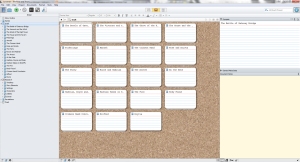
Scrivener software by Michael J. Sullivan
.
Do you scene-card? What method do you use? What affects has this process had on your writing in your FIRST DRAFT? In the REVISION process?
I’d love it if you’d share a link to an image of your method!

 KayeDacus.com