Books Read in 2014: THE MAKING OF A MARCHIONESS by Frances Hodgson Burnett
The Making of a Marchioness (includes The Methods of Lady Walderhurst) by Frances Hodgson Burnett
Audiobook narrated by Lucy Scott
Book Blurb:
This two-part adult fairytale by the author of The Secret Garden combines a charming Cinderella story with an ironic look at class structure and the Edwardian marriage market in turn-of-the-century London.Emily Fox-Seton is a simple but good-hearted woman struggling to make ends meet while attempting to maintain the dignity of someone distantly related to the aristocracy. The Marquis of Walderhurst is an awkward but eligible bachelor being comically pursued by a pageant of unmarried ladies. When the Marquis surprises everyone by giving his attentions to Emily, he makes himself a fairy prince in her eyes. But marrying her prince is not the end of Emily’s troubles, as the forces of envy are more cunning and dangerous than she yet understands. Will Emily’s innocence be her downfall after all?
My Review:
Story: 3.5 stars
Narrator: 4 stars
- Goodreads bookshelves: audiobook, books-read-in-2014, classic-british-lit, historical-romance, hist-19th-c-romantic-victorian
Read from February 17 to 24, 2014
Yes, I’ll freely admit that, even though I had this book on my shelf for years, I didn’t make the decision to read (well, listen to) it until after watching The Making of a Lady on PBS a few weeks ago (and I’ve pre-ordered the DVD!). While the “gothic” elements of the story seemed odd in the movie, I have to admit, they’re even odder in the book . . . because they’re given so much less malice and true menace first by how they’re written about (and in whose POV) and by how the circumstances are handled.
Emily Fox-Seton is a genteel woman of little means who hires herself out as an event planner, secretary, and personal shopper to women in high society London in early 1900/1901. At thirty-four years old, she has been on her own for quite some time and she has learned how to make a shilling stretch as far as possible. She lives in a rented room in a boarding house owned and run by Mrs. Cupp and her daughter, Jane, whose kindness she appreciates and who are quite fond of her in return.
One of Emily’s employers, Lady Maria Bayne, who truly likes Emily (in addition to liking what Emily can do for her) invites Emily to come to a country house party—and to act as Lady Maria’s companion, which means she gets to participate in the social activities for the most part. There are several random other characters here, but the most important guest is Lady Maria’s cousin, the marquis James Walderhurst. Lady Maria lets Emily know that Lord Walderhurst (who is in his mid-50s) lost his first wife and son many, many years ago; and if he wants an heir to inherit his title/estates, he must remarry and have another son. Emily sees her role at the house party to make sure the other few young women there—a wealthy American girl and the poor Lady Agatha—are seen to their greatest advantage. At every opportunity, she speaks well of each of the other young women to Walderhurst.
On a day when Walderhurst and all of the other guests have gone out for a drive/site seeing, Lady Maria discovers that the fish monger who was supposed to supply them for dinner didn’t have anything. The next closest one is in another town four miles away. But all of the carriages (and I suppose all the riding horses, too???) are out, so Emily, even though she’s fatigued from the eventful day before, volunteers to walk the four miles to get fish for dinner. On this walk, Emily reads a letter delivered to her shortly before she left the estate and she discovers that the Cupps are selling their house and moving out to the country. What does she want them to do with all of her stuff? This, of course, comes as quite a blow to Emily. On her way back to the house, she breaks down and stops to have a good cry. When Walderhurst returns to the estate after the outing and learns about the errand Lady Maria sent Emily on, he immediately goes out with his phaeton to retrieve her. He finds Emily on the moors crying and, moved by . . . love (? he’s not an overly sentimental man) he proposes to her.
This is the end of Part 1, which was a novella originally published as The Making of a Marchioness. And it’s only about the first 20-25% of the book.
In Part 2, originally published as The Methods of Lady Walderhurst, Emily and Walderhurst marry. She meets his cousin, and heir, Alec Osborn and Alec’s half-Indian wife, Hester. Having believed for years that he would inherit the estates and wealth that go along with the Walderhurst title, Alec is none-too-happy that James has remarried. At first, he and Hester (who is pregnant) tell themselves that at her age, Emily is unlikely to give Walderhurst a son/heir. But then, of course, the inevitable happens. After Walderhurst traipses off to India on a diplomatic mission (unlike in the movie, he isn’t in the Army in the book), Emily discovers she, too, is with child. She invites the Osburns to live in a cottage on the estate, and that’s when things start getting all pseudo-gothicy.
Because we’re treated to Alec’s and Hester’s viewpoints in the story, we’re at no time unaware that he wishes Emily harm. While most of the potential danger is laid off at Ameerah’s feet (Hester’s former ayah, now maid), Alec seethes with malice and hatred toward Emily most of the time. Hester isn’t much better. She seems to hate Emily as much as Alec does . . . though when she realizes just how close to being off his rocker her husband is, she starts to realize how wrong it is to wish harm to another, much less to do harm to another.
In the movie version, Emily not only stays at Palstrey (one of Walderhurst’s country estates where they take up residence after leaving London), she drinks the drugged milk, even after commenting that she doesn’t trust the Osborns or Ameerah. In the book, Hester who has been treated better by Emily than by just about anyone else in her life, not only saves her from the drugging, but urges her to leave Palstrey to get away from Alec and Ameerah and what they might do to her. Emily does this and goes to London, first staying with Mrs. Cupp and Jane in the Cupps’ old house, and then, after telling her doctor everything, at his advice she moves back into the Walderhurst townhouse in Berkeley Square.
Walderhurst, whose return from India was delayed by his own fever, finally returns home to learn that not only has Emily had a child (she never told him in her letters, many of which went astray, and at least one of which was intercepted by Alec), but she is also on death’s door with doctors and nurses hovering over her.
In a scene worthy of any Disney movie or Jane Austen adaptation, Walderhurst kneels beside the bed calling to her—which brings her back from the “white sea” of death and back into the world of the living. Which is all very sweet and would have been a great way to end the story.
But then we’re treated to a “four years later” type of scene in which Hester, now widowed, and her daughter have been living with Emily and Walderhurst ever since Alec “accidentally” shot himself with a shotgun he didn’t know was loaded while he was drunk. So, instead of a romantic ending, we at least do learn that “justice” (or Just Desserts) has been served. But it was a rather lackluster ending.
The Making of a Marchioness and The Methods of Lady Walderhurst were published in 1901, the year Queen Victoria died. Several times in the book, Emily’s stature and demeanor are commented upon as being “early Victorian” and “Mid-Victorian” (and once also as a “Thacheryian saint”). It’s funny to me that, even less than a year after Queen Victoria’s death, levels of Victorian attitudes and behaviors had already been defined.
One major issue I had with the book is Burnett’s overuse of the word ingenuous. It’s apparently her favorite adjective/adverb. Everything about Emily is ingenuous and she does everything ingenuously. This is one of those things that is likely more noticeable in the audio version than the print version.
Where the script writers and filmmaker got it right was keeping the danger to Emily present, rather than removing her from it and having her hiding from the fear rather than living with it, as happens in the book. They also got (very, very) right the development of the relationship between Walderhurst and Emily. I loved the slow-burn between them in the film version. Here, there’s almost no emotional or intellectual connection between them, except for the fact that she moons over his letters when he’s gone, and he comes to have “tender” thoughts about her upon reading her letters while he’s convalescing. Though, in the end, his outburst that he would rather have Emily than the son she bore him, is very sweet. What the movie got wrong: Jane Cupp. Never in the book is Jane anything but completely loyal to Emily. It is Jane who saves Emily from disaster more than once, and it is she who loses sleep to watch over Emily when she realizes the threat to her mistress’s life.
It was quite interesting seeing the original depiction of these characters and the story as the author imagined it instead of just the 21st century adaptation’s take on them. Gothic romances were quite popular in the late-Victorian/early Edwardian era; but, unfortunately, this doesn’t work as one of those, even though it does have some of the elements. We also see clearly depicted the attitude of that era toward those of Indian birth/descent, though much of this is ameliorated by Emily’s attitude—and her suggestion that Jane read Uncle Tom’s Cabin (apparently Burnett’s favorite novel as a young girl) to understand the plight of “the blacks” (which, apparently, Indians were called in England at this time).
Had I not seen the movie and fallen so deeply in love with Emily and Walderhurst, I might not have stuck this one out. But I’m glad I did. It will never be a favorite, but I’m glad I read it.
______________________________________________
My rating matrix:
5 STARS = one of the best I’ve ever read
4 STARS = a great read, highly recommended
3 STARS = it was okay/not a favorite
2 STARS = I didn’t enjoy it all that much, not recommended
1 STAR/DNF = I hated it and/or Did Not Finish it
Imagining the Reading Olympics
Well, another Winter Olympics has come to a close. This year, thanks to a full digital-cable package and a DVR, I was spoiled by being able to record/watch all of my favorite events and see all of the competitors, not just the few events/competitors they chose to highlight in the primetime show. Being able to do that reminded me that there are so many sports (both in the summer and winter games) that we never get to watch or that we even hear about. We all laugh about becoming hute Curling fans every four years, but, really, isn’t that what the Olympics are all about? Getting to become fans of sports we wouldn’t usually watch?
Then, of course, I started thinking about my own personal favorite sport . . . reading. Okay, maybe it doesn’t technically fit the definition of “sport,” but isn’t it fun to imagine a Reading Olympics?

The Reading Olympics
The Opening Ceremony
We find ourselves in a wonderland, a forest of wooden shelves stacked high with leaves printed with all sorts of words and stories. We dance and weave to and fro, seeking the parts of the forest that are of greatest appeal to us. In addition to being a spectacle of color and art, it’s also a learning experience. We learn about different books, different authors, and we leave excited about what’s to come.
Short-Distance Racing: Short stories and novellas
The Marathon: Tomes by the likes of Stephen King or Bernard Cornwell. Those that are 700+ pages.
Downhill/Sliding Events: These books may be long, but they’re so exciting and fast paced, we fly right through them, heart pounding all the way.
Team Events (softball, soccer, hockey, etc.): Books we read for book club!
Figure Skating: It looks shiny and pretty on the surface (cover) but it suffers from a lot of mistakes and “falls” in the middle and leaves us disappointed—and we’re most likely going to hate the ending.
Surprise Performances by Young Athletes: YA stuff that crosses over big-time into the adult market!
Slope-Style, Half-Pipe, Moguls, Freestyle: Genres we’ve always been afraid to try. But then we take a peek . . . and we’re hooked. At least once every four years.
Cross-Country Skiing/Distance Cycling/10k+ running-swimming-skating races: The books we start, thinking we’re going to enjoy them, but which we’re completely bored with less than 25% of the way in. Do we stick it out or “fast-forward” to the end or just quit entirely?
What are some other Reading Olympics events (winter or summer) you can think up?
Books Read in 2014: LOVE OVERDUE by Pamela Morsi
Love Overdue by Pamela Morsi
Book Blurb: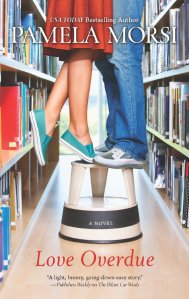
I’ll admit, the cover is one of the main things that first drew me to pick this book to read.
Buttoned-up book lover DJ is all sensible shoes, drab skirts and studious glasses. After an ill-advised spring-break-fueled fling left her mortified, she’s committed to her prim and proper look. When she’s hired by a rural library in middle-of-nowhere Kansas, she finally has the lifestyle to match-and she can’t wait to get her admin on.But it’s clear from day one that the small-town library is more interested in circulating rumors than books. DJ has to organize her unloved library, win over oddball employees and avoid her flamboyant landlady’s attempts to set her up with the town pharmacist. Especially that last part-because it turns out handsome Scott Sanderson is her old vacation fling! She is not sure whether to be relieved or offended when he doesn’t seem to recognize her. But with every meeting, DJ finds herself secretly wondering what it would be like to take off her glasses, unpin her bun and reveal the inner vixen she’s been hiding from everyone-including herself.
My Review:
Story: 3 stars
- Goodreads bookshelves: books-read-in-2014, contemporary-romance
Read from January 26 to February 18, 2014
There were lots of things to like about this book, especially the setting and the cast of secondary characters.
Unfortunately, there were as many or more things not to like about this book, and they tended to be more problematic.
The setup has potential. Eight years ago, prudish Dorothy Jarrow (D.J.) went to the beach for spring break and her 21st birthday just to see what she’s missing. She ended up having a mind-blowing one-night-stand with a handsome stranger. Now, eight years later, having both regretted and looked back with some longing on that night ever since, she’s a tightly wound, buttoned up librarian (seriously—bun, glasses, gray skirt suits!) who’s just accepted a job as the head of a library in Verdant, Kansas—mostly at the machinations of the head of the library board, Viv Sanderson (possibly the only person on the library board, for though we meet a lot of other townsfolk, we never meet another library board member). Viv is a widow whose son is the town pharmacist, like his late father before him; and she’s convinced that D.J. and Scott belong together—to the point she hired a P.I. to investigate D.J. before offering her the job, without ever meeting in person (from an online resume/interview).
So, of course, Viv’s son, Scott Sanderson, turns out to be “the hot guy” from spring break eight years before. But while D.J. remembers him clearly, he doesn’t recognize her (even though he’s dreamed/fantasized about that night ever since, too). However, out of fear that he will, D.J. becomes an absolute shrew and treats him like garbage whenever they’re thrown together. Which is, of course, often. Scott, having gone through a public and embarrassing romance, wedding, and divorce followed by a brief (and regretted) affair with a married woman, SHOULD be jaded when it comes to relationships. But there’s never really a glimmer that he’s learned much from his previous relationships—other than that he’s still “in love” with his “sparkle girl” from spring break eight years before (which happened before he got married).
As with all romance novels, the reader knows it’s inevitable that the two main characters are going to end up together. What we anticipate is how they end up together—it’s the relationship building that keeps me engaged in a romance novel. There wasn’t a whole lot of that here.
- Let me take a moment to gripe about a technical aspect of the book that drove me absolutely nuts. One of the things I learned and that I now teach about fiction writing is that you never go back in time to show a different person’s POV of the scene that just ended. Doing so halts the story momentum and confuses the reader who expects the story to follow a linear progression. Scene break (or chapter break in this case) means that we’ve moved another step forward in time. Morsi, however, has a tendency to like to end a scene, then go right back to the beginning of it (or even before) and rehash it from the other character’s POV—with the same dialogue and interactions and everything!
Rant over. Moving on.
D.J, who’s supposed to be someone who grew up with emotionally distant parents who sent her off to boarding school as a teenager and then died shortly thereafter (or something), doesn’t come across as emotionally stunted as someone who grew up like that would be. She does have a hard time trusting people (abandonment issues), but then at other times, she’s easy go lucky and just goes with the flow. It’s not a contradiction that works well. And then her reaction to Scott—the Insta-Hate when she first sees him upon arriving in Verdant—is so over the top as to make her almost unlikable.
So the tension between them for the first half or so of the book is the horrid way she treats him because she’s afraid he’s going to remember her from spring break and think . . . something. It’s never really clarified what she’s afraid he’ll think/say about her if he does remember it’s her. After all, he’d also be revealing that, while dating/engaged to his childhood sweetheart, he took off and went to South Padre Island for spring break and had a one-night stand with a girl whose name he never even asked.
There are several flashback scenes taking us back to their spring break encounter (in detail, with considerable repetition from segment to segment—done, I’m sure, to get the “sexy-time” stuff in, since the relationship in the present time doesn’t lend itself to any of that until toward the end of the book). We learn that he bought her a piece of cheap jewelry which he has obsessed over ever since—and why he thinks of her as his “sparkle girl.”
Then there are Viv’s viewpoint scenes which . . . added nothing to the plot or flow of the story. for the most part, they consist of monologues of Viv talking either to D.J.’s dog or to the grave of her late husband. And she’s not even talking about anything that’s important to the story—most of it is either backstory or inanity. Her little subplot turned out to be very weak and unnecessary. She did have a couple of bright spots of eccentricity. But she could have been a fun eccentric without having viewpoint scenes breaking up the (slight) forward momentum of the story.
Oh, did I mention it’s harvest time in Kansas? Readers of this book are treated to multiple looooooonnnnnngggggg discourses on what harvest time is like in a small Kansas town, what the process is, what heavy equipment is used, and so on. Yes, the author apparently did her research and wanted to make sure all of her readers knew she had done her research.
Something that I did quite enjoy about this book are all of the secondary characters in this small town. Some were quite stereotypical and almost directly from The Wizard of Oz (after all, “Emerald City” is mentioned on the first page of the story): the old “witch” of a former librarian who tries to sabotage D.J. at every step; the “cowardly lion” of the older man with autism/asperger’s who hides in the stacks at the library; Suzy, one of the bookmobile drivers (if she only had a brain!); and Amos, the other bookmobile driver, a “Gulf War” vet whom everyone has written off as having given up on romance (if he only had a heart!). So does that make Scott the wizard and Viv Glenda? Not sure on those two.
So, after several encounters with Scott, in which she treats him like gum stuck to the sole of her shoe—including a “date” that both claim isn’t, when Viv asks him to take her out and introduce her around town—D.J. suddenly decides to stop being so hateful to him. And Scott never even reacts to this about-face in her behavior toward him. He’s spent the first part of the book wondering what he did wrong (because, after all, everyone else in town talks about how nice she is, so he must have done something wrong for her to be so horrid toward him, right?), but he never has a single thought about the abrupt change in her attitude toward him.
Next thing you know, bada-bing, bada-boom, they’re making out in his car on the side of the road. And although he’s realized by this time that D.J. reminds him of his “sparkle girl,” and he’s started seeing D.J.’s face in his recurring fantasy about the encounter, he still hasn’t made the connection. And making out doesn’t seem to help him make the connection either. Huh? If it was so memorable that he’s been fantasizing about it for eight years, wouldn’t he be able to put 2 and 2 together?
Okay, I’ll leave it with that rather than give away the rest of the story.
However, I MUST discuss the “end” of the story.
*******SPOILERS*******
After a tragic circumstance that brings about each one’s epiphany moment, when D.J. is having an angsty internal debate as to whether or not to come clean with Scott about their spring break encounter, he finds the piece of jewelry that he bought her the night of their one-night stand (she kept it, all this time!). So, naturally, this is going to lead to a conversation clearing everything up, declarations of love, and maybe even a proposal. Right?
WRONG! The chapter leaves off with Scott looking from the chain to D.J. and then . . . wham—it’s eight years later, and they’re back on the beach with their precious little girls discussing if they want to try for a third child, a boy, or if they’re satisfied with two kids and knowing that they have the best sex in Kansas.
This has to be one of the worst endings to a romance novel I’ve ever read. Sure, I’ve read a few in which the wrong people end up together (multiple-character-arc stories, of course) or in which the ending is so cheesy it made me bilious. And I’ve never made it a secret that I HATE epilogues that are all about the “precious babies” that result from the relationship. But to not even resolve anything? To cut away from the big reveal and what should have been the climax of the plot? This was the point the whole plot was supposed to be building toward. It was all build up and no follow through. And since that’s the last impression the book leaves with the reader, it was a very unfortunate choice.
______________________________________________
My rating matrix:
5 STARS = one of the best I’ve ever read
4 STARS = a great read, highly recommended
3 STARS = it was okay/not a favorite
2 STARS = I didn’t enjoy it all that much, not recommended
1 STAR/DNF = I hated it and/or Did Not Finish it
Books Read in 2014: A NIGHT TO SURRENDER by Tessa Dare
A Night to Surrender by Tessa Dare
Audiobook narrated by Carolyn Morris
Book Blurb:
Welcome to Spindle Cove, where the ladies with delicate constitutions come for the sea air, and men in their prime are nowhere to be found.Or are they?
Spindle Cove is the destination of choice for certain types of well-bred young ladies: the painfully shy, young wives disenchanted with matrimony, and young girls too enchanted with the wrong men; it is a haven for those who live there.
Victor Bramwell, the new Earl of Rycliff, knows he doesn’t belong here. So far as he can tell, there’s nothing in this place but spinsters and sheep. But he has no choice; he has orders to gather a militia. It s a simple mission, made complicated by the spirited, exquisite Susanna Finch—a woman who is determined to save her personal utopia from the invasion of Bram’s makeshift army.
Susanna has no use for aggravating men; Bram has sworn off interfering women. The scene is set for an epic battle, but who can be named the winner when both have so much to lose
My Review:
Story: 3 stars
Narrator: 4 stars
- Goodreads bookshelves: books-read-in-2014, audiobook, historical-romance
Read from January 30 to February 12, 2014
The reason Tessa Dare’s books are on my To Sample list is because I’ve read tons of favorable reviews of her books and, most compellingly, a few of the reviews I’ve read compare her to Julia Quinn, who happens to be my favorite historical romance author.
So maybe I went into this book with expectations that were too high. I was expecting a solid plot; fun, witty, and charming characters; and fantastic relationship development.
What I found in the book was a serviceable plot, stock characters (though the main characters had their moments of individuality), and Insta-Lust in the place of genuine relationship development.
It was that third part that had me the most disappointed in this book. Instead of building genuine rapport and romantic tension between Susanna and Bram, it was hard-this and pulsating-that from the moment they met. I’m surprised Bram was able to remain standing for as often as he had physiological reactions to just seeing her across a room. And for an inexperienced woman who’s (supposed) primary concern was for the reputation of Spindle Cove as a place young women could come and recuperate from illnesses or just be themselves when they couldn’t in Society, she sure did “surrender” to the Insta-Lust early—and OFTEN.
And when I say often . . . once they consummate the first time (on the town green!!!!) they’re going at it like rabbits whenever and wherever they can. One morning, in the hour it takes me to get ready to go to work, as I was listening to the audio, there were two (explicit) sex scenes and it seemed like a third one was starting. In just an hour of narration! (The entire audiobook is around 11.5 hours long.) I lost count of the times they’d “coupled” before we got to the end of the book and their epiphanies/declarations of love for each other.
As far as the plot goes, if Dare had made the storyline and the (expansive) cast of minor characters more of the focus of the book, it might have fared better. Instead, because of the way things resolved, it all seemed pointless and unnecessary. There were a few bright moments: Minerva and her reticule full of rocks; Miss Taylor cutting off her hair so she could fill in as drummer boy for the review; the poignancy of Bram’s reaction to Finn’s (or was it Rufus’s?) accident. But other incidents (and viewpoints in the story) were too obvious a setup for the next book, and did nothing to serve the plot/main characters of this story, so came across as distractions.
Now, I will say that I didn’t hate this book. Dare has a fun, breezy writing style that I enjoy. And while I’m not champing at the bit to read another one of her books right now, I’m not taking them off my list either. I was intrigued by several of the minor characters, and I hope that some of them get their own stories.
______________________________________________
My rating matrix:
5 STARS = one of the best I’ve ever read
4 STARS = a great read, highly recommended
3 STARS = it was okay/not a favorite
2 STARS = I didn’t enjoy it all that much, not recommended
1 STAR/DNF = I hated it and/or Did Not Finish it
Movies Seen in 2014: THE MONUMENTS MEN
.

The Monuments Men
US Release Date: February 7, 2014
Starring: George Clooney (who also directed), Matt Damon, John Goodman, Jean Dujardin, Hugh Bonneville, Bill Murray, Bob Balaban, Dimitri Leonidas, and Cate Blanchett.
Run Time: 118 minutes
Rating (U.S.): PG-13 (“for some images of war violence and historical smoking”)
Viewing Experience: at the theater
Viewing Date: February 8, 2014
My Rating: 4 out of 5 stars
.
.
I’m nowhere near as good a reviewer as my dear friend Ruth, but since I need blog content—and since I made such a big deal back at the beginning of the year about all the movies I want to see this year—here goes.
The Monuments Men opens with art—the Ghent Altarpiece, to be specific—being hastily taken apart, packed up, and spirited away by the priests who are trying to protect it from Hitler’s forces, bearing down on the city. Then, we get an explanation . . . a lecture, of sorts, with George Clooney’s character, Frank Stokes, explaining to the president his idea behind forming the American Commission for the Protection and Salvage of Artistic and Historic Monuments in War Areas. (In reality, scholars, curators, and preservationists had been working since the 1930s on identifying and trying to protect art from the Nazis. Unfortunately, it wasn’t until 1944/45 that Monuments, Fine Arts and Archives Section, comprising approximately 345 members from 13 countries, was commissioned and sent out to do something about it officially.)
So then we go into a montage which has Stokes going around New York (?—I don’t think he went anywhere else) collecting his team: a curator at the Met, an architect, a theater producer (?), a sculptor, etc. Once they arrive in England (supposedly for Basic Training, but we only see one quick scene attesting to it), our team is also joined by an Englishman (Hugh Bonneville, wearing what looked like the same uniform he wore in Season 2 of Downton Abbey) and a Frenchman (Jean Dujardin, Academy Award winning Best Actor for The Artist). They also pick up Sam Epstein (Dimitri Leonidas), “from New Jersey”—a displaced German Jew whose family fled their small town in Germany and landed in New Jersey before the war. Now our team is complete.
So, of course, the first thing that happens is the splintering of the group. Two-by-two (sort of), they are sent out to try to track down where Hitler/the Nazis, on the run from the Allied forces, are hiding/taking the art they’ve stolen. Clooney and the script writers did something very important here: They gave us three very specific pieces of art to really focus on and come to care about: the Ghent Altarpiece (Hubert van Eyck), Madonna and Child (or Madonna of Bruges) by Michelangelo, and a self-portrait of Rembrandt, which had been stolen from the museum in Sam’s hometown.
I loved that even with this large of an ensemble cast, none of the characters felt unnecessary or useless. Each had a moment to shine and the relationship building between them was wonderful—it truly felt as if these men did know each other. That’s either a strength of the caliber of actors cast in this film or the fact that they may know each other well off screen—either way, it worked.
Many reviewers didn’t like this film, thinking it didn’t pay proper tribute to this heretofore little known piece of history. But I thoroughly enjoyed it, as, for me, it provided an accessible entry into a facet of WWII history that I hadn’t known anything about before seeing the film. I’m not a WWII buff, nor am I a huge fan of literature/film that focuses on it. What I am a fan of is good storytelling based on a solid plot (history, in this instance) with compelling characters. And that’s where this movie shines for me.
I made this comment on a Facebook discussion about this movie:
It reminded me a lot of the 1990 movie MEMPHIS BELLE. A lot of that is because of the ensemble group, though here you have George Clooney leading this motley crew rather than Matthew Modine. … To me, it’s [not a “caper film” but] more of an adventure (with a little action) film that looks at a serious time and serious events in history with a light-handed script which takes a lighthearted look at this through the camaraderie of the men involved, but which also adopts a more serious tone when appropriate. It’s definitely not SAVING PRIVATE RYAN. Yet there were still times in MM when I found myself getting choked up. Especially in a couple of scenes with Hugh Bonneville and Jean Dujardin and again toward the end.
While the music was a little heavy-handed in places (“You should be feeling *this* now!”), I thought the humor and gravitas were perfectly balanced.
In the same thread, I also mentioned that the balance of humor and drama reminded me of M*A*S*H.
I was also extremely happy with the way the one possible romantic entanglement in the film was handled. With only one (main) female character in the film, and with hers being a smaller, supporting role, it would have been easy for the script to have taken the relationship in a certain direction. After all, “It’s Paris,” as she remarks. And we all know that Paris is the city of romance. It was a delicate situation, and I truly appreciated the way it was handled.
Highly enjoyable. Highly recommended.
Rewind Review: THE WHITE QUEEN by Philippa Gregory
I just finished watching the miniseries based on this, and the other Cousins’ War novels, so I thought it would be a good idea to post this review while the miniseries is still fresh in my mind.
The White Queen by Philippa Gregory
Audiobook narrated by Susan Lyons
Book Blurb:
The White Queen is the story of Elizabeth Woodville, a woman of extraordinary beauty and ambition, who secretly marries the newly crowned Edward IV. Elizabeth rises to the demands of her exalted position and fights for her family’s dominance, but despite her best efforts, her two sons become pawns in a famous unsolved mystery that has confounded historians for centuries: the lost princes in the Tower of London. In this dazzling account of the deadly Wars of the Roses, brother turns on brother to win the ultimate prize, the throne of England.
My Review:
Story: 1 star (DNF)
Narrator: 4 stars
- Goodreads bookshelves: books-read-in-2013, audiobook, historical-fiction
Read from May 20 to June 06, 2013
I could not bring myself to finish listening to this book—and that’s the first time that has happened to me with one of Philippa Gregory’s books.
Philippa Gregory didn’t do her usual good job of making me care about the characters in this story. I figured it would be easier for me to grow to care for characters I didn’t know anything about (unlike in the Boleyn books)—I had no preconceived ideas or feelings about them one way or another. However, there’s no depth given to any of the characters in this story to make me care what happens to them beyond the basic historical knowledge I have of what did happen in reality. Perhaps the first-person narrator doesn’t work as well in a book like this which tries to cover 20 or so years of history, especially given that most of that history is about the war in which the first-person narrator is not personally involved. But even when the scene does switch over to Edward and the battlefield, there’s no emotion in it. It’s all just dry prose telling what’s happening and a strange emotional detachment from all of the characters.
Compared to the other books of Gregory’s that I’ve read (also on audio, The Boleyn Inheritance—a favorite—and The Other Boleyn Girl), it seems like she sacrificed a lot in the way of character development for inclusion of historical events. And, for me, that didn’t compel me to keep reading/listening.
____________________________________
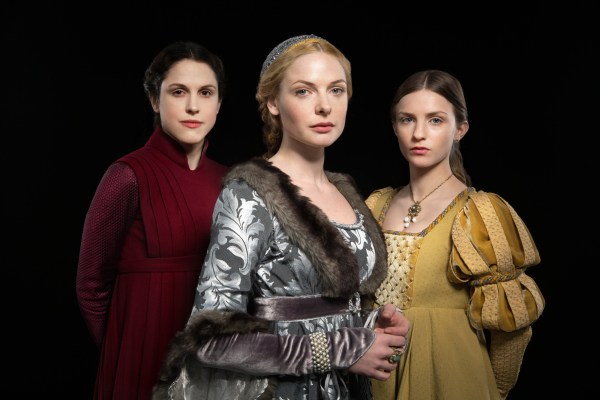 I recently added the Starz premium channels to my cable subscription. (No, it’s not to watch Black Sails. Really, it’s not.) And one of the things that gave me access to was the programming they have available through On Demand. And the entire (first season???) ten episodes of The White Queen were available for
 bingeing watching.
The reason I subscribed to Starz? Because I watched the first episode for free—and unlike the book, it sucked me right in.
Maybe it was because I had read about 2/3 of this first novel in the book series (the miniseries is based on The White Queen, The Red Queen, and The Kingmaker’s Daughter) and so I was somewhat familiar with the characters and where the story was going, for the most part.
This could be considered a prequel to The Tudors—and, as it was produced by and aired on Starz, it fills that role quite well. (Were the nudity and nearly pornographic sex really necessary to this story? No. At one point, I actually said aloud, “Oh, yes, we haven’t seen a woman’s bare breasts in this episode yet. That’s why she [the queen] is lying there in bed with the sheet neatly tucked under one boob.” Except I might have used a less eloquent word for breasts/boobs.)
The story covers the latter years of the War of the Roses—the battle for the crown of England between the Lancasters and the Yorks. It begins with Elizabeth Woodville and Edward York’s first meeting under an oak tree as he’s riding off to war with the Lancastrians. It’s been speculated throughout history that theirs was, indeed, a love match. He was nineteen; she was five or six years older, and a widow with two sons to boot. She went out to the road to meet him, even though her family were Lancastrians and her father and brothers had fought for that side, because it was apparent the Yorks would win and Edward would be king, to beg Edward to restore her dead husband’s title/lands for her sons to inherit (oh, and Lady Jane Grey, the Nine Days’ Queen, was her great-great granddaughter from one of these sons).
According to this version of events, Edward instantly fell in love (or lust) with Elizabeth. In a matter of days after meeting, he convinced her to marry him secretly (with her mother, his priest, and one other witness only). When her older brother Anthony discovered this, he assumed Edward was repeating a pattern—tricking a woman into thinking they were married so he could sleep with her. However, Edward did keep Elizabeth as his wife. Could be because it was true love, could be (as this fictionalized version posits) partly as a way to declare his independence from his uncle Richard Neville, Earl of Warwick (also known as “the Kingmaker” for his role in helping Edward/the Yorks overthrow Henry VI and take the throne). Elizabeth, a commoner, wasn’t popular; and the marriage created a lot of issues for Edward in his early reign—not the least of which were the rumors/accusations of witchcraft toward both Elizabeth and her mother. This part, of course, is played up quite prominently in the novel/miniseries.
As I was watching the series, I kept comparing it to other fictional portrayals of political intrigues, stories involving the toppling of monarchs/leaders, etc., and realized that if these events hadn’t actually happened, an author who came up with this would probably have been laughed out of a pitch session for proposing something so far-fetched. Yet it happened—it’s verifiable history. Though, there are still some mysteries—like what happened to the Princes in the Tower (Elizabeth and Edward’s two young sons) after Edward’s death and his brother Richard usurped Prince Edward’s throne before the boy could be crowned King Edward V? How did Isabel Neville, wife of Edward IV’s turncoat brother, George, really die? And could it be possible that Elizabeth Woodville and her daughter Elizabeth of York really did curse the entire Tudor line so that it died out with no surviving male issue?
So . . . I guess you can say that I enjoyed the TV series MUCH more than the book. Maybe, because I now have watched this, I might be able to go back and try re-reading the book and see if I would enjoy it more.
What Are You Reading? (February 2014)

Open Book by Dave Dugdale
It’s the first Monday of the month, and you know what that means . . .
Book Reports!
If you’ve challenged yourself to—or even officially signed up for—a reading challenge in 2014, now’s as good a time as any to start reporting your successes. (And I’m a bit perturbed that the widget for the Goodreads reading challenge up there hasn’t updated to show that I’ve actually finished three books so far. 😉
In addition to telling us what you’re reading, go ahead and share your goal(s) for the year (if you have any) pertaining to reading. Then, tell us what you’ve finished over the last month, what you’re currently reading, and what’s on your To Be Read stack/list. (And if you’ve reviewed the books you’ve read somewhere, please include links!)
.
- What book(s) did you finish reading (or listening to) since last month’s update?
- What are you currently reading and/or listening to?
- What’s the next book on your To Be Read stack/list?
.
_______________________________________
Here’s my report:
What book(s) did you finish reading (or listening to) since last month’s update?
- What Matters in Jane Austen?: Twenty Crucial Puzzles Solved by John Mullan
- Divergent by Veronica Roth; audiobook read by Emma Galvin
- Secrets of a Summer Night (Wallflowers #1) by Lisa Kleypas; audiobook read by Rosalyn Landor
Click titles to read my reviews
What are you currently reading and/or listening to?
- A Night to Surrender by Tessa Dare; audiobook read by Carolyn Morris—historical (Regency) romance. I’ve read glowing reviews of Dare’s books over the past few years, favorably compared to Julia Quinn, who is one of my favorites. I’m only about 1/3 into the book, but I’m disappointed that the “relationship” between the hero and heroine has so far been built only on the insta-lust they each feel for the other the moment they meet. It’s got a cute setup, and they’re both likable characters, so that makes me even more disappointed that there isn’t the same kind of emotional and intellectual relationship building here that I love so much in Quinn’s books. Otherwise, Dare seems to be a good writer.
- Love Overdue by Pamela Morsi—general-market contemporary romance. Cute so far (I’m about 50% into it), but a bit implausible and predictable.
.
I started The Stand by Stephen King, but it’s just not the right time for me to try to get into a 40-hour-long audiobook, so I’ve put it back on the “shelf” for a while.
What’s the next book on your To Be Read stack/list?
- The Ocean at the End of the Lane by Neil Gaiman. Each semester, my grad school program chooses one book from one of the representative genres of Popular Fiction that all students in the program must read, then the first session of the next residency (the week the students spend on campus at the beginning of the term) is spent discussing it. For the upcoming term, this is the Common Reading. There were 15 holds on it at the library, so I figured it would be a couple of months before I got it. But my notification came in last week, and I downloaded it Friday. So, as soon as I finish Love Overdue, I’ll start this one.
- I’m not sure what my next audiobook will be, but most likely something lighthearted and uncomplicated.
Rewind Reviews: OUTLANDER by Diana Gabaldon
With the renewed interest/hype in this book due to the announcement/production of the TV miniseries based on it (which was announced a couple of months after I wrote this review last year), I thought this would be an opportune time to post this review.
Outlander by Diana Gabaldon
Audiobook narrated by Davina Porter
Book Blurb:
The year is 1945. Claire Randall, a former combat nurse, is back from the war and reunited with her husband on a second honeymoon–when she walks through a standing stone in one of the ancient stone circles that dot the British Isles. Suddenly she is a Sassenach—an “outlander”—in a Scotland torn by war and raiding Highland clans in the year of Our Lord…1743.Hurled back in time by forces she cannot understand, Claire is catapulted into intrigues and dangers that may threaten her life…and shatter her heart. For here she meets James Fraser, a gallant young Scots warrior, and becomes a woman torn between fidelity and desire…and between two vastly different men in two irreconcilable lives.
My Review:
Story: 1 star (DNF)
Narrator: 4 stars
- Goodreads bookshelves: audiobook, books-read-in-2013, historical-fiction, fantasy
Read from March 17 to 27, 2013
Audiobook read by Davina Porter (excellent reader).
I put over eight hours of listening into this book (and had more than 25 hours remaining) before I gave up on it. My first problem is the whole extra-marital affair/bigamous marriage aspect. Then . . . I really just didn’t care about Claire, and because it’s 1st person, I didn’t care about anyone else. Jamie has almost no personality whatsoever. And what is the obsession with beatings equating marital and paternal love?
Claire, as a character, is not only unlikable–she’s downright unbelievable. She has almost no reaction to the time travel, and it takes her no time at all to adjust to living 200 years in the past. There’s no worry, no anxiety, over what happened to her and what it means, not just for her but FOR HER HUSBAND.
Which brings me to the biggest problem I had with this book—the husband factor. So much (too much) time is devoted in the beginning of the book to the focus on Claire’s life in the 20th century, so much so that the ONLY character I had any sympathy for in this book is Claire’s long-suffering husband, Frank. Even when she engages him in conversation, it’s patronizing at best. She doesn’t pay attention to him and basically paints him as a windbag with nothing of interest to do or say. Then, once Claire goes back in time, I got the impression that I was supposed to equate Frank with his historical counterpart, Captain Jack Randall, who is the villain of the piece, because he’s not only her husband’s ancestor, he also looks like Frank. So, now, this guy she’s legally married to in the 1940s, who has never been anything but nice and loving toward her, is supposed to suddenly be thought of as the bad guy? No thank you!
I’ve read a whole lot of reviews of this book since setting it aside, thinking that maybe I was just in a bad headspace when I tried reading/listening to it and I should give it a second chance. But, frankly, nothing I’ve read since I put this book down (actually, it’s the only audiobook I’ve ever “returned” for a refund). Some reviewers excuse Claire’s lack of shock/adjustment to the time travel because she was a battlefield nurse in WWII. No. I’m sorry, I don’t care how much trauma she saw in the war, she’s still going to have trouble adjusting to living in 18th century Scotland (which, from Gabaldon’s descriptions, sounds like it was closer to 16th or 17th century living conditions).
There isn’t a reviewer in the world who can convince me that the “romance” between Jamie and Claire isn’t wrong. Claire is married. Her husband is still alive, even if they aren’t in the same “place.” I don’t care if her husband is 200 years in the future. She’s married. End of story. But why did she need to be married? Had Claire merely been engaged to Frank or been on the trip to Scotland with a relative, Gabaldon could have still accomplished the feat of getting her where she needed to be in order to do the time travel. So, again, I ask—what’s the point of having her married in 1945 only to go back in time to be forced to marry someone else?
In addition to Claire’s easy transition to the 1700s, it’s also unbelievable to me how easily she’s accepted into the clan community. Maybe it’s because I was weaned on the Highland romances penned by the likes of Julie Garwood and Jude Deveraux in the 1980s and early 1990s, but my understanding is that Scottish clans were very insular and didn’t welcome outsiders at all—especially those from south of the border. No, granted, her acceptance wasn’t unconditional, but it was a lot wider and a lot easier than it should have been.
I know there are people who will defend this book to the death as one of the greatest romance novels ever written. And that’s your right and prerogative. But let’s clear up that misnomer—even though this book is labeled as romance, it really isn’t, at least, not once you get past the first (too-long) volume. This falls more into line with epic historical fantasy/fiction. Yes, there’s a strong element of what some would call romance (bigamous marriage, sex, beatings, sex, etc.), but the focus of the story isn’t necessarily the developing relationship of the two main characters culminating in a happily-ever-after ending, which is what defines the romance genre.
Will I watch the series once it hits Netflix streaming? I’ll at least give the first episode a go. I might like the characters better as brought to life on screen instead of how they come across in the book (remember, in the book, we’re stuck inside of Claire’s head and can never get anyone else’s thoughts or perspectives). But it will still be a hard sell for me, since my biggest problem with the book is a fundamental of the storyline.
Have you read Outlander? What did you think of it? Do you plan to watch the miniseries?
Books Read in 2014–SECRETS OF A SUMMER NIGHT by Lisa Kleypas
Secrets of a Summer Night (Wallflowers #1) by Lisa Kleypas
Audiobook read by Rosalyn Landor
Book Blurb:
 Four young ladies enter London society with one common goal: they must use their feminine wit and wiles to find a husband. So a daring husband-hunting scheme is born.
Annabelle Peyton, determined to save her family from disaster, decides to use her beauty and wit to tempt a suitable nobleman into making an offer of marriage. But Annabelle’s most intriguing and persistent admirer, wealthy, powerful Simon Hunt, has made it clear that while he will introduce her to irresistible pleasure he will not offer marriage. Annabelle is determined to resist his unthinkable proposition, but it is impossible in the face of such skillful seduction. Her friends, looking to help, conspire to entice a more suitable gentleman to offer for Annabelle, for only then will she be safe from Simon and her own longings. But on one summer night, Annabelle succumbs to Simon’s passionate embrace and tempting kisses and she discovers that love is the most dangerous game of all.
.
My Review:
Story: 2.75 stars
Narrator: 3.75 Stars
Overall: 3.25 stars
- Goodreads bookshelves: books-read-in-2014, historical-romance, audiobook
Read from January 15 to 25, 2014
I’ve been wanting to read a Lisa Kleypas book for a while. She seems to be a prolific writer and several of the romance review blogs I follow rave about her books.
After reading the descriptions of the first book in each of her “major” series, I chose to read this book, the first book in the Wallflowers series, as the premise sounded great to me. Four young women make a pact to help each other find husbands. Not only did it seem to fit my liking for a lighthearted tone in a romance novel, but I love historical romances that feature friendships between women and not just rivalries. So I should have loved this book.
Except that I couldn’t stand the heroine, and the hero was largely absent intellectually and emotionally, so I never connected with him—yet, even so, I still thought he was too good for the heroine. And that’s not how I want to feel at the end of a romance novel.
Technically, Kleypas is a moderately good writer. I was continually critiquing her style in my head, though, as she tends to head-hop quite a lot—but in a way that’s probably only noticeable to another writer who’s been dinged on it time and time again in critiques.
Storywise, however, is where this novel was lacking for me. Annabelle, our “heroine,” is petulant, spoiled, snobbish, and snotty—with absolutely no right to be. I know that Kleypas wanted us to see her as part of the down-on-their-luck gentility, those on the fringes of aristocratic society, who would have only socialized (and married) within that sphere. But the truth of the matter is that Kleypas never really gives us a solid explanation of how Annabelle’s family is tied to the aristocracy and why, if they’re so poor that her mother is having to prostitute herself to a disgusting old lord of something or another, Annabelle is even accepted into aristocratic society. She has no title, no dowry, and no future. In reality, people like this weren’t typically invited to social functions with earls and viscounts, much less courted by men at that level.
Yet Annabelle’s driving motivation is to marry a peer—someone with an inherited title and A LOT of money. But . . . this is set in the 1840s, which happens to be one of the times of transition in England when a lot of the peerage were hemorrhaging money as the Industrial Revolution was beginning to pick up steam (ha-ha) and the economy was changing and leaving most of them behind. It was the rising middle class—men like Simon, our hero—who were emerging as the movers and shakers in society. And while it really wouldn’t be until after the Great Exhibition in 1851 that this class of wealthy entrepreneurs would really start taking their place in society, Kleypas set up Simon as one of these: an independently wealthy (filthy rich, apparently) son of a butcher who rubs elbows with some of the highest echelon of the aristocracy. Again, not really realistic, but, for the sake of suspension of disbelief, we’ll let her run with it.
Annabelle and Simon meet in the prologue and he steals a kiss. Chapter one opens a couple of years later, at which time Annabelle hates Simon and doesn’t want anything to do with him. The problem is that she’s in her early 20s, the Season is almost over, and she has NO marriage prospects. Her younger brother may have to leave school and go to work to support her and her mother if she can’t find a rich husband.
Simon is still obsessed with this girl from whom he stole a kiss, and so he’s been trying to pursue her by stalking her—I mean asking her to dance at all of these society balls that both of them are inexplicably invited to all the time. Annabelle knows that he’s rich—everyone does—yet, strangely, she basically tells him that he has a snowball’s chance in hell of ever getting her to dance with him, much less let him court/marry/sleep with her.
Let me explain—she’s to the point at which she’s starting to think she’s going to have to take an offer from one of the titled gentlemen to become a mistress just so that she and her mother don’t starve. Yet she continually spurns the attentions of a VERY wealthy man, just because he’s a butcher’s son and not a peer of the realm. Because snob.
So she and the three other girls she ends up sitting in the wallflower corner with at all of these balls suddenly start talking to each other after months and months of ignoring each other. They decide to help each other find husbands. Since Annabelle is the oldest, she’s first. The other girls (well, Lillian, who’s the most outspoken) also hate Simon for being “common” (though Lillian and her sister, Daisy, are upstart wealthy Americans, so that’s really a pot/kettle situation there).
They all finagle invitations to a country house party. There’s a plain, weedy, weak, overly intellectual, nerdy (choose your negative adjective) lord there whom all the unmarried female guests (from the descriptions of them, it seemed like there had to have been at least 50 of them) are after because he’s one of the few single titled men left. Instead of flirting with him, the way they all do, Annabelle takes the approach of trying to appear disinterested in him romantically but interested in his pursuits and passions—which seem to mainly be droning on about the flora and fauna of Hampshire. Yes, we get it. He’s a big bore. But a big bore with a title and, we assume, money.
For some reason, he takes a liking to Annabelle. The Wallflowers decide the best way for Annabelle to win him is to get into a compromising position with him (just to be alone together in this time period was compromising enough, to be seen kissing would have sealed it for sure) and they’ll come by and witness it so that he’s forced to marry her. Although Annabelle has a few qualms about this idea, she goes along with it.
But . . . plans are put on hold due to a health issue. This is the point at which Simon actually starts looking like a hero. Unfortunately, it doesn’t last long.
Without giving away too many spoilers, Simon and Annabelle end up getting married—voluntarily—about two-thirds of the way through the book. And from there on, it’s just sex, sex, sex, interrupted only by his buying her extravagant gifts, like a five-carat diamond ring—which, of course, prompts more sex. And it’s not even good sex. It’s awkwardly written and stuff I would have skipped past if I’d been reading a print version and not listening on audio. The scenes didn’t add anything to the characterization (made her look worse, as a matter of fact) nor did they add anything to the plot or development of the relationship.
Annabelle continues to be snobbish and mercenary even after she’s voluntarily married Simon, even to the point of offending his family. This is the woman who knew her mother was whoring herself out to pay the bills, yet she’s going to look down her nose at the family of a successful merchant who lives in the same neighborhood where she and her mother could barely afford to live?
It takes another massive (and highly implausible) crisis right at the end of the book for her epiphany moment to come—and even then, it’s not enough to redeem her character and the way she’s been throughout the rest of the book.
I’ve read tons of reviews that drool all over Simon as the perfect hero. Um…no. Not only does he stalk Annabelle for a couple of years until she agrees to marry him (and the only thing she really has to offer is the fact that she’s supposedly so beautiful every man who sees her instantly wants her), there aren’t enough scenes from his viewpoint to really give us a reason as to why he’d want to marry her (other than the insta-lust he felt the first time he saw/kissed her) for me to be able to determine if he really does have qualities to qualify him as a “hero” in the truest sense. He’s handsome. He’s wealthy. He’s kind…to a point. In the beginning of the novel, he actually thinks about whether he’d marry her or just make her his mistress! That’s not hero quality, for me.
Now, all of that said, I may go ahead and read the second book in this series, because I hope that Kleypas can actually follow through on the sparks/fireworks hinted at between Lillian and Lord Westcliff.
Rewind Reviews: The Three Graces Series by Jennifer Blake (read in 2011)
One of the things I’m going to focus more on this year on this blog is reading and book reviews. I’m not currently writing, so it’s hard for me to get motivated or passionate for writing about writing. But I’ve challenged myself to read more books this year than I have in more than a decade. Since I’m not reading fast enough right now to be able to post a new book review every week, I thought I could spend some time going back and revisiting books I’ve read since I started tracking them back in 2011 (when I was barely writing a few sentences/blurb for most of them, not a full review). But what’s the point of tracking what we’ve read or writing reviews if we don’t go back and look at them again from time to time?
Before I get into the individual reviews for the books in this trilogy, I will say that one of the key factors that drew me to the first book in the series (aside from the blurb) is the fact that it’s set in a unique time period for general-market historical romance novels: in the court of the first Tudor king, Henry VII, a few years after the end of the War of the Roses. It was still a quite volatile time in England, yet not in the way it would be under the reign of this king’s son, the infamous Henry VIII. And now without further ado . . . The Three Graces.
.
By His Majesty’s Grace (Read in November 2011)
Back-Cover Blurb: Her hand may be bestowed by others, but her heart is hers alone to give.Much to her chagrin, Lady Isabel Milton has been given to Earl Rand Braesford—a reward from the Tudor king for his loyalty to the throne. The lusty nobleman quickly claims his husbandly rights, an experience Isabel scarcely hoped to enjoy so much. But youth and strength may not save Braesford from his bride’s infamous curse…
Accused of a heinous crime with implications that reach all the way to King Henry himself, Braesford is imprisoned in the Tower, and Isabel is offered her salvation—but for a price. She has the power to seal his fate, have him sent to the executioner and be freed from her marriage bonds. Yet the more Isabel learns of Rand, the less convinced she is of his guilt, and she commits to discover the truth about the enigmatic husband she never expected to love.
My Review:
4 stars.
Loved this book, and especially the unique time setting, with it being in the court of Henry VII, the first Tudor monarch.
____________________
Okay, so it’s not much of a review. I do recall that I did enjoy Blake’s writing and storytelling style. I also enjoyed the characterization and relationship-building with Isabel and Braesford. I do recall that there were some passages of backstory—but of the history of the era (the end of the War of the Roses) which I skimmed/skipped. I think, though, this one may require a re-read in order for me to write a more worthy review of a book to which I gave four stars.
.
By Grace Possessed (Read in December 2011)
Back-Cover Blurb: She is one of the accursed Three Graces of Graydon—if she marries not for love, her betrothed will soon meet his end.
The Tudor king issues Lady Catherine Milton a most unusual command: seduce Scottish loyalist Ross Dunbar. The son of an ornery borderland laird, Dunbar would make an advantageous match, but King Henry cannot force him to wed. So Cate must ensnare him
A rush of courtly parties and passionate nights in Dunbar’s embrace leaves Cate breathless and confused. She desires a proposal for the sake of propriety and politics, but she longs to be truly loved. Tortured loyalties are not hers alone—though Dunbar is enchanted by Cate, he cannot bind himself to England and abandon his people.
But when a pretender to the throne ignites a rebellion, the choice is made for them: to solidify northern alliances, Dunbar and Cate must wed. Suddenly Dunbar’s death appears certain—either by his bride’s curse or by a war he did not choose.
My Review:
4.5 Stars
While I thoroughly enjoyed the first book in this series, By His Majesty’s Grace, I enjoyed this book much better—and it’s because rather than giving a dry recounting of the history that happened before the story started (the end of the War of the Roses that led to Henry VII’s taking the throne of England), in this book, the history happens ON PAGE in the form of action and interaction and conflict for the characters, rather than just long paragraphs of dry history.
But I couldn’t quite give it five stars—because I wish there had been more of Ross’s viewpoint scenes, especially during the time he and Cate are apart when he’s at Grimes. The story glosses over several months, but only from Cate’s viewpoint. I’d really liked to have seen the development of his character, the development of his feelings for Cate, during that time rather than just have it assumed that he came to some of the same conclusions about her that she did about him during that separation.
I appreciated the fact that while there were misunderstandings between Cate and Ross, Blake never “went there”—never had the relationship break down because of their assumptions or misgivings about each other. While they didn’t just talk it out, either, at least the author didn’t rely solely on conflict that could have been easily solved by a conversation. I thought the relationship developed at just the right pace to match the action of the story (with the exception mentioned in the previous paragraph).
And, of course, I’ve always been a sucker for a man in a kilt! 😉
Now I’m really looking forward to starting the third book in the series, Seduced by Grace, since there was just the slightest hint at Marguerite and David’s relationship in this book that whetted my appetite for their story.
.
Seduced by Grace (Read in December 2011)
Back-Cover Blurb: The youngest of the fabled Three Graces of Graydon is waylaid from her bridal cortege, preserving one man from the notorious curse. But another may yet fall.
When Lady Marguerite Milton is abducted by the enigmatic—and famously insatiable—Golden Knight, it is the stuff of fantasy. Or would be, if Marguerite weren’t pining for her David, who pledged his devotion ten years before and disappeared. But the only thing more heartbreaking than a man who does not keep his word is one bound by it.
David is the Golden Knight, reaffirming his oath to protect Marguerite and, maddeningly, to love her, but chastely. More infuriatingly, Marguerite has been a pawn—bait to lure David into King Henry VII’s latest intrigue. To divide Yorkist insurrectionists, David is groomed as a rival to their latest pretender to the throne.
Marguerite is desperate. If David fails, the rebels will destroy him; if he succeeds, Henry will not scruple to execute the would-be king he himself created. Suddenly, love and life seem far beyond the reach of any mere curse.
My Review:
3.75 stars
Nowhere near as good as the first two books in the series, but that could be because I didn’t connect with either of the characters all that much, mainly due to the fact that the conflict between them felt contrived to my 21st Century mind. David’s insistence that he can’t marry Marguerite because of a “chivalrous vow” he made to her as a young man—before he was knighted—felt silly. Sure, it’s great to see a hero who’s a man of his word; however, it seems rather stupid when that word is all that’s keeping the hero and heroine apart, especially when it was a vow he made before he was in the position (knighthood) for it to mean anything.
____________
And, really, couldn’t the cover designer have photoshopped out the back-pocket button on David’s trousers on the cover of Seduced by Grace? Talk about anachronistic! 😉

 KayeDacus.com