Lessons from MANY GENRES, ONE CRAFT: Revision and Self-Editing with Lee Allen Howard (@LeeAllenHoward)
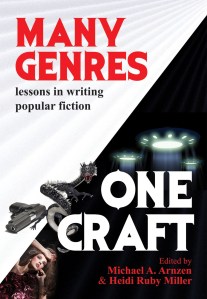
In Many Genres, One Craft, award-winning author Michael A. Arnzen and Heidi Ruby Miller gather the voices of today’s top genre writers and writing instructors alongside their published students. It fosters the writing process in a way that focuses almost exclusively on writing the novel. Using a compilation of instructional articles penned by well-known authors affiliated with Seton Hill University’s acclaimed MFA program in Writing Popular Fiction, the book emphasizes how to write genre novels and commercially appealing fiction. The articles are modeled after actual “learning modules” that have successfully taught students in the program how to reach a wider audience for over a decade.
Excerpt from “Your Very First Editor” by Lee Allen Howard
If writing a manuscript is like building a house, then revision is renovation—modifying the existing structure, such as putting up or taking down walls. Revision starts with the rough work or reorganizing the big pieces, and takes you from the first draft to the second. Self-editing takes you from the last draft to the final version you submit to an agent or publisher. This means you should complete your revision before you fine-tune your prose. In other words, don’t paint the drywall before you cut it, nail it to the studs, and patch the seams.
Revision is remodeling; self-editing is detailing—when every sentence and each word count.
__________________________________________
Work Cited:
Howard, Lee Allen. “Your Very First Editor.” Many Genres, One Craft. Eds. Michael A. Arnzen and Heidi Ruby Miller. Terra Alta, WV: Headline Books, Inc., 2011. 47. Print.
Lessons from MANY GENRES, ONE CRAFT: Avoiding Info Dumps with Maria V. Snyder
In Many Genres, One Craft, award-winning author Michael A. Arnzen and Heidi Ruby Miller gather the voices of today’s top genre writers and writing instructors alongside their published students. It fosters the writing process in a way that focuses almost exclusively on writing the novel. Using a compilation of instructional articles penned by well-known authors affiliated with Seton Hill University’s acclaimed MFA program in Writing Popular Fiction, the book emphasizes how to write genre novels and commercially appealing fiction. The articles are modeled after actual “learning modules” that have successfully taught students in the program how to reach a wider audience for over a decade.
Excerpt from “Dumping the Info Dump” by Maria V. Snyder
Imagine with me. . . . You’re curled up on the couch in front of a roaring fireplace with your favorite beverage within easy reach. Sleet is clinking on the windows while you’re reading. The story draws you in, the real world disappears, your beverage cools, and . . . WHAM! You hit an information dump and are either rudely ejected from the story world or become mired in paragraph after paragraph of dull explanation.
An information dump—also known as the “info dump”—is just that. A large chunk of exposition used by writers to explain backstory, technology, characters, etc. . . . Basically a huge pothole in the middle of the story, bringing the story’s action to a screeching halt. Many readers will not recover and will seek another book to read in their cozy living rooms.
As a writer, you want to avoid jolting your readers from your story world. But, you say, my characters are living on Planet Futon and I need to explain how the strong gravity has turned them all into squat warthogs! Wrong! You only need to include it when the information is critical to your plot and is necessary to avoid confusing your readers.
__________________________________________
Work Cited:
Snyder, Maria V. “Dumping the Info Dump.” Many Genres, One Craft. Eds. Michael A. Arnzen and Heidi Ruby Miller. Terra Alta, WV: Headline Books, Inc., 2011. 39. Print.
Lessons from MANY GENRES, ONE CRAFT: Tuning Up Your Writing with Michael A. Arnzen (@MikeArnzen)
In Many Genres, One Craft, award-winning author Michael A. Arnzen and Heidi Ruby Miller gather the voices of today’s top genre writers and writing instructors alongside their published students. It fosters the writing process in a way that focuses almost exclusively on writing the novel. Using a compilation of instructional articles penned by well-known authors affiliated with Seton Hill University’s acclaimed MFA program in Writing Popular Fiction, the book emphasizes how to write genre novels and commercially appealing fiction. The articles are modeled after actual “learning modules” that have successfully taught students in the program how to reach a wider audience for over a decade.
Excerpt from “Tuning Up Your Writing” by Michael A. Arnzen
There’s a reason we call thought “musing.” The proverbial “muse” that inspires us as writers is the same “muse” at the root of the word “music.” Think of all the musical terms we use to describe acts of writing—from “composition” classes to taking “notes” to “timing” a scene or adding “beats” to our dialogue—and you begin to realize that we writers, particularly those in the arts of fiction and poetry, share a lot more with musicians than we realize. Taking stock of the musicality of our writing can help us improve our craft and, in the process, serenade our publishers into a sale.
__________________________________________
Work Cited:
Arnzen, Michael A. “Tuning Up Your Writing.” Many Genres, One Craft. Eds. Michael A. Arnzen and Heidi Ruby Miller. Terra Alta, WV: Headline Books, Inc., 2011. 32–33. Print.
Lessons from MANY GENRES, ONE CRAFT: Opening Lines with Gary A. Braunbeck (@GaryABraunbeck)
In Many Genres, One Craft, award-winning author Michael A. Arnzen and Heidi Ruby Miller gather the voices of today’s top genre writers and writing instructors alongside their published students. It fosters the writing process in a way that focuses almost exclusively on writing the novel. Using a compilation of instructional articles penned by well-known authors affiliated with Seton Hill University’s acclaimed MFA program in Writing Popular Fiction, the book emphasizes how to write genre novels and commercially appealing fiction. The articles are modeled after actual “learning modules” that have successfully taught students in the program how to reach a wider audience for over a decade.
Excerpt from “You Have to Start with SOMETHING, So It Might As Well Be Something Like This” by Gary A. Braunbeck
Yes, it would be nice, be wonderful, be just oh-so-peachy if we lived in a world where readers had the patience and the time to be eased into a narrative, to be seduced by the ebb and flow of the language, the musical composition of sentences, the overall rhythm and atmosphere filtered by writers through their own sensibilities and re-interpreted for readers on the printed page as a magnificent feast of words. …
[T]he harsh reality is and will remain that you absolutely have to hook and hold a reader’s attention with your opening line; if they get to the second or third page of your story and are still not interested in what’s going on, they’ll turn to the next story in the anthology or pull another novel off the shelf. So your opening line has to be intensely immediate, somehow grabbing the reader’s attention while simultaneously establishing time, place, situation, character, and conflict.
__________________________________________
Work Cited:
Braunbeck, Gary A. “You Have to Start with SOMETHING, So It Might As Well Be Something Like This.” Many Genres, One Craft. Eds. Michael A. Arnzen and Heidi Ruby Miller. Terra Alta, WV: Headline Books, Inc., 2011. 16. Print.
Books Read in 2014: LOVING A LOST LORD by Mary Jo Putney
Loving a Lost Lord by Mary Jo Putney
Book Blurb:
In the first of a dazzling series, Mary Jo Putney introduces the Lost Lords—maverick childhood friends with a flair for defying convention. Each is about to discover the woman who is his perfect match—but perfection doesn’t come easily, even for the noble Duke of Ashton…Battered by the sea, Adam remembers nothing of his past, his ducal rank, nor the shipwreck that almost claimed his life. However, he’s delighted to hear that the golden-haired vision tending his wounds is his wife. Mariah’s name and face may not be familiar, but her touch, her warmth, feel deliciously right.
When Mariah Clarke prayed for a way to deter a bullying suitor, she didn’t imagine she’d find the answer washed ashore on a desolate beach. Convincing Adam that he is her husband is surprisingly easy. Resisting the temptation to act his wife, in every way, will prove anything but. And now a passion begun in fantasy has become dangerously real—and completely irresistible.
My Review:
Rating: 3.5 stars
- Goodreads bookshelves: books-read-in-2014, hist-19th-c-georgian-regency-napoleonic, historical-romance, read
Read from March 2 to March 13, 2014
Let me start this review off by saying that, as an author, if you have to write a scene in which your characters have a serious discussion about all of the “coincidences” that have happened to them in the last twenty or thirty pages . . . YOU HAVE TOO MANY COINCIDENCES!
This was only my second non-paranormal historical romance by Mary Jo Putney. I really do enjoy her writing style; but I, like many of the other reviewers at Goodreads, apparently, was somewhat disappointed in the lack of follow-through on the promise of the story premise.
The Amnesiac
First, let’s talk about the elephant in the book: Adam’s amnesia. I’m not someone who’s drawn to this trope in romance for one very important reason: for me, the idea of someone falling in love without knowing who he is or where he came from or who might be waiting for him at home isn’t palatable. Then there’s the idea that once the memory comes back, it’s necessarily going to change the person and, thus, the relationship. So I have to take a huge leap to suspend my disbelief when I read a book with this trope.
That said, I think Putney handled Adam’s POV scenes very well. Although we’re “told” Adam’s identity and ethnicity (half-English, half-Indian) through the (unnecessary) first chapter featuring his three BFFs and Lady Agnes, the surrogate mother and head of the school where the four men met, we do get to discover who he is along with him as his memories slowly come back to him through small sight/sound/smell triggers and through dreams. I thought this part was well done and it made me more comfortable with the idea of his developing a romantic attachment during this time. (Oh, if only there had been an actual development! But I’ll get to that later.)
A Crazy Person Lives Here
In Mariah’s first scene, I was a little concerned that she was slightly off her rocker—she has an “imaginary sister” named Sarah who “talks” to her in her head and chides her for being too much of a wild child (because, after all, isn’t that what all romance heroines are supposed to be?). Around the time that this got to be annoying, however, Putney toned this part down in favor of a somewhat more sane Mariah.
Mariah lives in a big house by the sea in Cumberland (northwestern England) which her father won gambling. Her father has dragged her from pillar to post—from city to country house—most of her life as he moves from game to game to game. Apparently, he’s been relatively successful yet this has put them on the fringes of society. The women at these house/gaming parties give Mariah all of their castoff gowns, so she has good clothes, but out of fashion, so she’s learned how to alter them to be stylish.
Let the Coincidences Begin!
Her father goes off to London to try to reconcile with his family (whom Mariah knows nothing about because he’s never talked about them). But shortly thereafter, George Burke, Hartley’s former, neglectful, owner appears to tell Mariah that her father has been killed by highwaymen. She doesn’t believe him initially, even though he shows her her father’s ring, but then she receives a letter from her father’s lawyer confirming it. Burke hangs around and presses himself and a courtship on Mariah. To try to dissuade him, she tells him that she’s already married but that her husband is away at war. (This takes place in 1814-15 between the end of the Peace of Amiens and Waterloo.) Of course, she has no way to back up that claim. Worried about this, she takes the incense her (Roma/Gypsy) grandmother left to her and goes outside to burn it to pray about the situation (for a husband).
As soon as she finishes her prayer, she feels an “urging” to go down to the beach. And, lo and behold, there’s a man in the water. She rescues him and he’s still alive! She assists him up to the house and, once she realizes he has amnesia, she asks him if that means he doesn’t remember that she’s his wife.
Here’s where the development of the relationship should be. She comes up with the name “Adam” (oh, how coincidental!) for him with her own last name, telling him they’re cousins. Even though he doesn’t remember her name or her face or anything about her, he immediately feels that being married to her is “right.”
Even though it’s not specifically called it in this book, the “fated to be together” trope is one that really doesn’t work for me in romance novels—usually because it means that the author opts out of the hard work of showing the building of a relationship and growing attraction between the two main characters. While Adam and Mariah enjoy being around each other and feel a frisson whenever they touch (and, eventually, have sex) I was never convinced that they’d actually built a deep relationship that would sustain a lifelong partnership.
Then, there are the breakaways to the viewpoints of his three friends who are searching for him. These were scenes that you’d expect would build suspense and add to the tension of the book (would they find him before Maria told him the truth?) but in all actuality, they just took up pages in what little space was given to the time in which Maria and Adam’s relationship should have been developing.
After M&A finally consummate, she reveals the truth to him—after all, even though he has amnesia, he doesn’t miss the fact that she was still a virgin. And here’s where the timing/plotting of the novel goes awry. Instead of concentrating on the new obstacle of rebuilding trust, while still trying to regain memory, Putney brings the three friends swooping in to tell Adam who he is and whisk him back to London. (And his name is really Adam—what a coincidence!)
Adam tells his friends that Mariah is his fiancee (which they are none-too-happy about, assuming she’s a fortune hunter and nowhere near good enough for their Adam), so she is invited to go with them to London. She takes Julia, the midwife in town, as her chaperone(apparently they’re supposed to be really good friends—enough that Julia knows the truth about Mariah/Adam’s relationship—but they don’t really interact that much in the book either before or after they go to London, and there were hints at a scandal in Julia’s past, and one of Adam’s friends wouldn’t look at her much less talk to her politely, so she and he must be a setup for another book in this series).
Oh, and I should mention at this point, that the three BFFs discovered evidence of sabotage in the wreckage of Adam’s prototype steamship (the one that blew up and gave him amnesia and deposited him so conveniently on Mariah’s beach), so there’s someone trying to kill him.
M&A have made a pact that because they’re not really married and because they’re not sure what’s going to happen once they get back to London (and because Adam is a duke and Mariah, they believe, a commoner).
No, wait. What? Really? What the . . . ?
At luncheon the day they arrive in London, Adam’s aunt and cousin Hal (his heir and the prime suspect in the plot to assassinate Adam) arrive to welcome him home. When Adam introduces Mariah to them as his fiancee, the aunt drops the bomb that she can’t be—Adam is engaged to her daughter. (Someone’s read Pride & Prejudice a few too many times, but I can’t tell if it’s me or Putney!) So, now things are even more strained between M&A. If Mariah hadn’t gone to London hoping to find out about her father, she would have left on the next coach out of town.
M&A go riding in Hyde Park the next morning (did I mention that Adam owns the largest private home in all of Mayfair?). It’s all going well—until the groom shouts to Adam that there’s a gunman in a tree. They gallop the horses away, but not before a bullet grazes Adam’s shoulder. Another man tries to help the groom catch the shooter, but to no avail. The other man turns out to be a retired Army officer who knew Adam’s father and asks if he can call on him, to which Adam agrees.
M&A go to visit Mariah’s father’s lawyer—who didn’t send Mariah the letter and didn’t know her father was dead. So, what happened to all the letters she sent to the lawyer that were never answered? Hmmm . . .
At this point, I pretty much kept reading for the sheer enjoyment of all of the WTFery that was going on in the book. The Army officer appears with his wife and stepdaughter—who just happen to be Adam’s real mom (supposedly dead in India) and sister (he never knew about). He also has two half-siblings. Ooh, how coincidental that the man who just happened to witness Adam getting shot at in the park is married to Adam’s long-lost mother! (Oh, as soon as he sees his mother, he regains most of his memories.)
Then, when they’re still trying to figure out who wants to kill Adam, Mariah’s father bursts into Adam’s office and accuses him of holding Mariah against her will, all because he went with her to the lawyer’s office and was watching her “closely.” What a coincidence! Not only is Adam’s mother (reported dead when Adam was a child) alive, but Mariah’s father (also reported dead) is alive!
But that’s not all!
Mariah’s father has something he wants to show Mariah, and she invites Adam along (of course). He takes them to a townhouse on the other side of Mayfair and unlocks the front door with his own key. Inside . . . (wait for it) . . . are Mariah’s mother (whom Mariah believed died when Mariah was two) and her identical twin sister who’s name just happens to be . . .
are you ready for it?
have you guessed it yet?
SARAH—remember the voices in Mariah’s head in the beginning that led me to believe her a nutter? Yes, that Sarah.
How coincidental is that???
There are a few other coincidences along the way that I won’t bother boring you with, and, of course, the person trying to have Adam killed turns out to be the most obvious person ever. And, of course, the aunt turns out to have lied about Adam being engaged to his cousin. So, all works out hunky-dory and Adam proposes to Mariah as they lie in bed together, using the Hindu idea of reincarnation and loving beyond lifetimes as part of his wooing strategy (not that he needs to because, obviously, they were fated to be together—thus all the coincidences, right?).
Putney is a good writer and I enjoy her style. I do plan to read the other books in this series, because I am interested in the BFFs, and to see what happens with Julia. I just hope that there aren’t as many “plot twists” in those books as there were in this one, because the ones in this book wore me out!
______________________________________________
My rating matrix:
5 STARS = one of the best I’ve ever read
4 STARS = a great read, highly recommended
3 STARS = it was okay/not a favorite
2 STARS = I didn’t enjoy it all that much, not recommended
1 STAR/DNF = I hated it and/or Did Not Finish it
Books Read in 2014: LIGHTNING by Dean Koontz
Lightning by Dean Koontz
Audiobook narrated by Christopher Lane
Book Blurb:
A storm struck on the night Laura Shane was born, and there was a strangeness about the weather that people would remember for years. But even more mysterious was the blond-haired stranger who appeared out of nowhere – the man who saved Laura from a fatal delivery.Years later – after another bolt of lightning – the stranger returned, again to save Laura from tragedy. Was he the guardian angel he seemed? The devil in disguise? Or the master of a haunting destiny beyond time and space?
My Review:
Story: 4.5 stars
Narrator: 3.5 stars
- Goodreads bookshelves: books-read-in-2014, mystery, time-travel, sci-fi
Read from February 25 to March 05, 2014
It goes a long way to ward explaining the strength of this story that even with a mediocre narrator, I found myself making any excuse I could come up with to listen, I was so enthralled with the story.
I’m sure I must have read the blurb for the story at one point; otherwise, I wouldn’t have known it was a time-travel story in order to add it to my 2014 Genre Challenge list. But by the time I downloaded the audiobook and started listening to it, I really had no memory of what the story was about.
And I’m really glad that was the case. I’m so accustomed to reading romance novels, that I always go into the story “knowing” what’s going to happen. One of the reasons I’m challenging myself to read a bunch of books outside of my comfort genre is to break out of this—to read stories in which I don’t automatically know what’s going to happen, or, at least, can predict what’s going to happen. I’d forgotten just how enthralling the not-knowing is when it comes to reading a book.
Laura Shane’s life was meant to be tragic. That’s the storyline fate had written for her. But then a stranger, a man whose appearance is like that of an angel, intervenes. Not once, not twice, but multiple times. Laura isn’t sure who he is or what his role in her life signifies. She only knows that her Guardian has saved her from tragedy time and again—but not always.
I don’t want to get too much into the whys and wherefores of the story, because this is one in which the explanation of who the time travelers are and when and where they come from is best left unspoiled. Suffice it to say that the explanation of the time travel worked for me (for the most part—I still had a question or two about potential paradoxes that could arise by someone time-traveling within his/her own lifespan). I loved the characters, and while there were times when I wished the POV would have been deeper and not so much just surface-level stuff (and there were a few situations that were somewhat glossed over and never explained—situations that would have had major consequences for Laura—like when she ran away from the second group home to check on Ruth and Thelma after the fire), the momentum of the book didn’t give me much time to feel like I’d lost anything.
This was a very fun read, and I’m really surprised it’s never been made into a movie—it has all the cinematic elements one could hope for.
______________________________________________
My rating matrix:
5 STARS = one of the best I’ve ever read
4 STARS = a great read, highly recommended
3 STARS = it was okay/not a favorite
2 STARS = I didn’t enjoy it all that much, not recommended
1 STAR/DNF = I hated it and/or Did Not Finish it
Does the Cost/Value of a Book Affect How You Review It?

Imagine this scenario:
You have four books to read and review.
Book #1 retails for $12.95, but you got it for free, signed by the author, in a giveaway.
Book #2 retails for $5.99 and you purchased it on sale for $3.99 (a 33% discount).
Book #3 regularly sells for $0.99 but you got it for free.
Book #4 is a hardcover that you paid $24.95 + tax for because you couldn’t wait for the paperback.
What is the inherent value of each of these books? Is the time the author of the $25 hardcover spent writing that book more valuable than the time of the author of the $0.99 book? Is the value of the book that you won in a giveaway that’s signed by the author more than the $3.99 paperback you purchased?
Then, once you’ve determined whether or not you perceive a difference in value of these books, does that perception affect the way you review them?
Will you be harder on the author of the hardcover book for which you paid so much money than you would be on the author of the $0.99 for which you paid nothing? Or, if the author of the hardcover is a favorite, but this new book disappoints, are you more likely to give the $25 book a softer review/higher rating than a $0.99 book that disappoints? Or is it the opposite? If you get a book for little to nothing, are you more willing to give the author a “free pass” with mistakes and plot holes than you are for a book you paid 25x more for?
Does the perceived value of a book affect how you review it?
What Are You Reading? (March 2014)

Open Book by Dave Dugdale
It’s the first Monday of the month, and you know what that means . . .
Book Reports!
If you’ve challenged yourself to—or even officially signed up for—a reading challenge in 2014, now’s as good a time as any to start reporting your successes. Tell us what you’ve finished over the last month, what you’re currently reading, and what’s on your To Be Read stack/list. (And if you’ve reviewed the books you’ve read somewhere, please include links!)
.
- What book(s) did you finish reading (or listening to) since last month’s update?
- What are you currently reading and/or listening to?
- What’s the next book on your To Be Read stack/list?
.
_______________________________________
Here’s my report:
What book(s) did you finish reading (or listening to) since last month’s update?
- A Night to Surrender by Tessa Dare; audiobook read by Carolyn Morris—historical (Regency) romance. 3 stars
- Love Overdue by Pamela Morsi—general-market contemporary romance. 3 stars
- The Making of a Marchioness (includes The Methods of Lady Walderhurst) by Frances Hodgson Burnett; audiobook narrated by Lucy Scott—I’m categorizing this one as my Classic British Lit choice (from my challenge list). 3.5 stars
- It’s in His Kiss (Bridgertons #7) by Julia Quinn—historical (1820s) romance. 4.25 stars
Click titles to read my reviews
What are you currently reading and/or listening to?
- Lightning by Dean Koontz—sci-fi/time travel. I went into this one blind—I know I must have read the book description when I put it on my challenge list, but when I downloaded the audiobook, I didn’t even look at that, so I really didn’t know what to expect. Unfortunately, I think I might have gotten “spoiled” for a reveal of who the bad guys are by something I saw in the reviews on Goodreads (I was looking for links to other people’s Time Travel fiction lists). I’m about 60% of the way through, and I’ve been listening whenever and wherever I can since the action is really ramping up now.
- How to Read Literature Like a Professor (Revised Edition). This is my “professional development” book for my challenge list. I’m currently facilitating a survey of literature course, which, fortunately for me, focuses more on writing about literature than any real, in-depth analysis of individual aspects of it. It’s been a long time since I took lit classes—and I’ll be the first to admit that I didn’t enjoy them very much. So this book is a challenge for me to learn how to do what I hate most about almost every literature course out there—analyze fiction like a literature professor. I’m actually enjoying it so far—it’s the first hard-copy book I’ve read in a couple of years (gasp!), and I’m treating it like a textbook, highlighting passages and making notes in the margins. And I’m even considering blogging through it. Have to get a little further into it before I make that decision, though.
- Loving a Lost Lord by Mary Jo Putney—historical (Regency) romance. I’ve read a couple of MJP’s stand-alone romances and enjoyed them enough to add other books of hers to my to-sample list. This one only has a 3.6-star average on Goodreads, so we’ll see how it goes. It’s the first in a series, and I really don’t want to get sucked into another one of those right now (still have one more in the Bridgerton series before I can move on to Julia Quinn’s Smythe-Smith series, and the next one in Elizabeth Hoyt’s Maiden Lane series doesn’t come out until this fall). But if I do, at least all of the books in this series of MJP’s are out, so I can binge read them if I so desire.
What’s the next book on your To Be Read stack/list?
- The Hero’s Lot and A Draw of Kings by Patrick W. Carr. Talk about getting sucked into a series . . . after enjoying A Cast of Stones so much, I decided to put off reading #2 until after #3 came out. Okay, maybe “decided” was more like “procrastinated,” but I wanted to wait until the time was right and I was in the right frame of mind to truly sink into Carr’s beautiful fantasy world and not be distracted by anything else.
- Audiobook: A Deeper Darkness by J.T. Ellison. I’ve known J.T. for many, many years, and just last week went to the launch of her latest book, the third one in the series this one starts. I think her Taylor Jackson books might be too dark for me, but I’m really eager to read Dr. Samantha Owens’s books.
______________________________________________
My rating matrix:
5 STARS = one of the best I’ve ever read
4 STARS = a great read, highly recommended
3 STARS = it was okay/not a favorite
2 STARS = I didn’t enjoy it all that much, not recommended
1 STAR/DNF = I hated it and/or Did Not Finish it
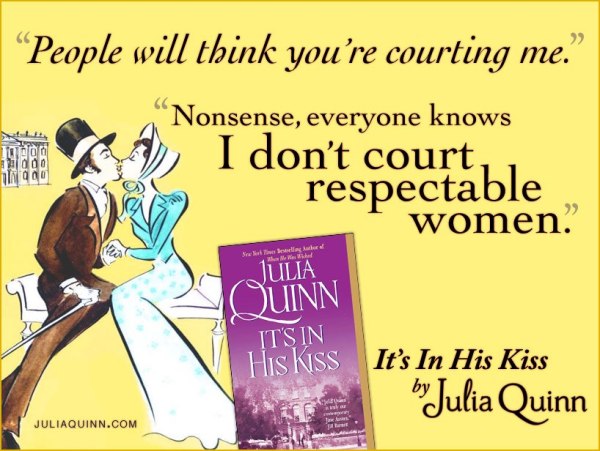
Books Read in 2014: IT’S IN HIS KISS by Julia Quinn
It’s in His Kiss (Bridgertons #7) by Julia Quinn
Book Blurb:
MEET OUR HERO…Gareth St. Clair is in a bind. His father, who detests him, is determined to beggar the St. Clair estates and ruin his inheritance. Gareth’s sole bequest is an old family diary, which may or may not contain the secrets of his past… and the key to his future. The problem is—it’s written in Italian, of which Gareth speaks not a word.
MEET OUR HEROINE …
All the ton agreed: there was no one quite like Hyacinth Bridgerton. She’s fiendishly smart, devilishly outspoken, and according to Gareth, probably best in small doses. But there’s something about her—something charming and vexing—that grabs him and won’t quite let go…
MEET POOR MR. MOZART…
Or don’t. But rest assured, he’s spinning in his grave when Gareth and Hyacinth cross paths at the annual—and annually discordant—Smythe-Smith musicale. To Hyacinth, Gareth’s every word seems a dare, and she offers to translate his diary, even though her Italian is slightly less than perfect. But as they delve into the mysterious text, they discover that the answers they seek lie not in the diary, but in each other … and that there is nothing as simple—or as complicated—as a single, perfect kiss.
My Review:
Story: 4.25 stars
- Goodreads bookshelves: books-read-in-2014, historical-romance, hist-19th-c-romantic-victorian
Read from February 21 to March 01, 2014
After several meh reads so far this year, it was nice to settle down with a book that sucked me in and gave me an experience I haven’t had with a book in a while: an almost-all-night marathon reading session.
After a gripping prologue, the book starts out with our heroine, Hyacinth (the youngest Bridgerton sibling), and the hero, Gareth St. Clair, with an already established relationship. Well, acquaintanceship. Hyacinth is friends with Gareth’s grandmother, Lady Danbury, so apparently Hyacinth and Gareth have met through her a couple of times.
Gareth supposedly has a reputation as a rake in London society, though we never actually see that side of him in the book. Only once does he even think about the woman who is supposedly (notoriously) his mistress, and that’s after he’s already realized he’s falling for Hyacinth—which made it feel very odd and out of place for his character at that point. Gareth is also famous in London society for the rift between him and his father, the baron, even though now, after the death of Gareth’s older brother, Gareth is the only heir. The rift came about because Gareth’s mother cuckolded the baron and Gareth is illegitimate. The baron has always held this over Gareth’s head, and, though they’d never had a strong relationship before (due to the Baron always possessing this knowledge, but not revealing it to Gareth until he was in his teens), the revelation and animosity created the complete severing of their ties. Until Gareth becomes the heir (since his father claimed him on his birth, he’s considered legally legitimate, thus eligible to inherit the title), which brings them back into contact with each other occasionally, much to Gareth’s emotional detriment.
Gareth’s sister-in-law brings him a diary written by the baron’s mother stating that Gareth’s brother had it and wanted Gareth to have it upon his death. Gareth, not knowing who his real father is, can’t claim to be related to Isabella St. Clair, but he decides to have the diary, written in her native tongue of Italian, translated. Oh, and guess what . . . Hyacinth knows (some) Italian. So she volunteers to translate the diary for him.
When Hyacinth comes to a point in the diary at which there’s a major revelation that she can’t wait to tell Gareth, I assumed it was going to be some kind of confession that the baron was also illegitimate. I was so certain of this, I even said it aloud. But I was wrong. It’s actually a revelation of something that would be helpful for Gareth to have to offset the debt that the baron intends to leave to Gareth upon his death. Which naturally requires several late night jaunts to sneak into the St. Clair manor to find this hidden treasure.
I typically adore the friends-to-lovers trope in romance, but the beginning of this one felt a bit off to me. They know each other . . . but not really. But well enough to tease each other . . . but not really. But then they’re sitting/dancing together almost exclusively at every event they attend for the couple of weeks that the book covers in the opening chapters. Once they got past this awkward stage and into a true relationship, Quinn’s talent for writing witty banter and developing an intellectual and emotional bond between her characters took over and drew me into their relationship.
Hyacinth was never one of my favorites of the Bridgerton siblings, being not just intelligent but headstrong and, at times, thoughtless of others. And while Hyacinth has these tendencies in her own book, Quinn did a great job of developing a love interest for her who is her match in just about every way. So while Hyacinth did grow on me, mostly it was because of being able to view her through Gareth’s viewpoint and to see her as he did—flawed but unique and interesting in a time when most women did their best to fit in to a strictly mandated norm.
And I love how Quinn worked the title of the book into the story.
Unlike previous books, the conflicts toward the end of this one didn’t resonate with me or seem believable or well handled (by the characters or the author). Several conflicts were somewhat swept under the rug or glossed over. Others were blown out of proportion. And with one of the big ones, I really felt like Hyacinth when she said, basically, that’s it? that’s all? all that wind up and no big scene?
Like all of the other books in this series, with the exception of The Duke and I, I’d have been just as happy without reading the epilogue. While this one doesn’t just focus on the “they lived happily ever after by producing several cute, fat babies” type of ending, it also raised more questions than it answered: the primary one being that if they were depending on the treasure mentioned in the diary to offset the debt the baron was intent on leaving the estate in when he died, how did they get ten or twelve years down the road without it? It’s hard to explain why I felt so dissatisfied with it without giving away massive spoilers.
All in all, while this turned out to be a fun read, it won’t replace Romancing Mr. Bridgerton as my favorite (so far) in the series. And I did enjoy it more than To Sir Phillip, with Love—and much more than When He Was Wicked, which I tried to read twice and decided to skip altogether when I just couldn’t get into it.
______________________________________________
My rating matrix:
5 STARS = one of the best I’ve ever read
4 STARS = a great read, highly recommended
3 STARS = it was okay/not a favorite
2 STARS = I didn’t enjoy it all that much, not recommended
1 STAR/DNF = I hated it and/or Did Not Finish it
When an Inkling becomes a Story Idea
After months (closer to a year or more) of struggling to write anything, recently it seems like I’ve been almost daily thinking of new characters or story ideas. Most of them don’t go further than the musing stage—I think about it for a few minutes and then dismiss it.
There are a few, though, that I’ve actually worked on a little bit and even done a little writing. But I know something is more than just an inkling when I start not only writing the character backstory(ies), but also when I take the time to do character casting. And this week, I’ve had one of those ideas.
Meet Kennedy Kelley and Jack Everett

Don’t recognize these templates? Well, that would be because for the first time ever, neither one is based off of an actor or actress or other well-known public figure. Each of these templates is a model—I found her in the plus-size section of Nordstrom’s website, and he’s an L.L. Bean guy.
I’m not sure exactly where this story is going (um, obviously toward a happy ending, but that should go without saying). I know that Kennedy has worked for the last 18 years in the publishing industry out West and has just moved to Nashville to take a position teaching creative writing and editing at James Robertson University. Recognize that fictional school? No? It’s where Kennedy’s friend Caylor Evans is a professor of English. (Kennedy was Caylor’s editor after Caylor switched to her new—clean—genre until Kennedy became the Marketing Director at the publishing house.) I know that Jack is an Associate Dean of Theater, Film, and Media at JRU—or he could be the head of either facilities maintenance or groundskeeping/landscaping at the school—but whichever he is, they meet when Kennedy is all gross and sweaty from moving into her new office in the middle of August in Nashville when it’s 100+ degrees outside and the AC in the building is on the blitz. Other than that, I have no idea what their story is.
So now, I have prequel/sequel story ideas going for three of my four published series—I’m actually into Chapter 2 of a prequel-novella for Ransome’s Honor featuring Susan and Collin’s romance (which will feature a lot more of what leads up to William and Julia’s interaction in the RH prologue); a sequel novella/novel for Jenn Guidry of Bonneterre fame; and now this one that’s connected to characters from the Matchmakers series.
Now I just need to make myself buckle down and finish one of them!

 KayeDacus.com